Taking Care of Yourself is Not Impossible

Taking Care of Yourself is Not Impossible

GUEST POST from Mike Shipulski

When there’s nothing left in your tank, what do you do? When it’s difficult for you to keep your head above water, what do you do? When you see people who need help, do you spend your energy to help them or do you preserve your energy for yourself?

If no one at your company has the energy to spare, what are the consequences? If a small problem isn’t solved quickly, might it snowball into something unmanageable? If a series of unsolved problems develop into a series of avalanches, couldn’t that change the character of your company? If everyone at your company is out of gas, what does that say?

If your calendar is full of standing meetings, you have no time for deep work. But, if your calendar has free space, that gives others the opportunity to fill your calendar with their priorities. Is it okay to say no to a meeting? Is it okay to preserve time for deep thought? Is it okay to cancel the whole meeting series for a standing meeting? What would it mean to your mental health if you deleted standing meetings and freed up six hours per week? What would it mean to the quality of your work? Might you even get to do the foundational work that is vital to next year’s success?

What would it mean if you could create a four-hour block of uninterrupted time that recurred wice per week? What could you accomplish in those two luscious time blocks? How many problems could you avoid? How many cross-team relationships could build? How much could you learn from researching the state-of-the-art? How much could you accelerate your projects? How many young people could you help?

What’s in the way of canceling some meetings? Is your mental health worth it? What’s in the way of scheduling a four-hour meeting with yourself twice a week? Is your work important enough? What’s in the way of stopping work at a reasonable time so you can get your personal things done, get some exercise, and spend time with your family? What would your company think if you took care of yourself and had some energy to spare for others?

What’s in the way of taking care of yourself?

Image credit: Pexels

Subscribe to Human-Centered Change & Innovation WeeklySign up here to join 17,000+ leaders getting Human-Centered Change & Innovation Weekly delivered to their inbox every week.

Ten Reasons You Must Deliver Amazing Customer Experiences

Ten Reasons You Must Deliver Amazing Customer Experiences

GUEST POST from Shep Hyken

Ten years ago, I wrote an article about why delivering an amazing customer service experience is important. While many of those concepts are still valid today, it’s time to modify the list and give a few of the original reasons a facelift to bring them into current times.

First, a reminder that an amazing customer experience isn’t about being over the top. It’s simply consistently meeting or (ever so slightly) exceeding expectations. It’s the consistent and predictable experience that makes customers trust you and come back.

So, here are today’s ten (10) reasons why you should deliver an amazing customer service experience:

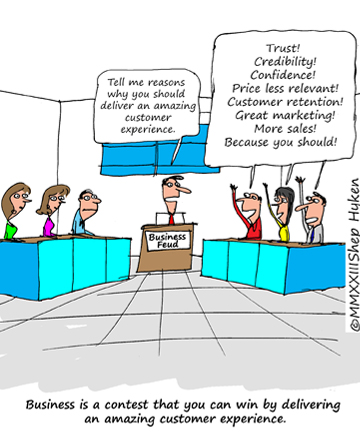
  1. Creating customer service builds trust, credibility and confidence. Our customer experience research found that 83% of people trust a company or brand more if it delivers good customer service. The benefit of building trust is potential customer loyalty.
  2. Your happy customers become the best members of your marketing department. The right customer experience gets customers to talk about you, refer you and evangelize your brand.
  3. Delivering an amazing customer experience makes price less relevant. Fifty-eight percent of customers we surveyed said excellent customer service is more important than price.
  4. A great customer experience goes hand-in-hand with a great employee experience. It’s no surprise that the best customer-focused companies are also some of the best places to work. Just compare a list of companies that provide the highest levels of customer satisfaction with the list of the best places to work on www.GlassDoor.com. It’s no coincidence that many of the same companies appear at the top of both lists.
  5. Customers who typically receive excellent customer service from you will be more willing to provide honest feedback when there is a problem or complaint because they trust that you will fix the problem. And when you do, they come back.
  6. Shep Hyken Amazing Cartoon

  7. Seventy-eight percent of the customers we surveyed said they would go out of their way to do business with a company that delivers a better customer service experience.
  8. You can’t afford not to deliver a strong customer service experience. Seventy-four percent of customers would switch to a business that provides better customer service.
  9. A good customer service experience leads to higher customer retention and customer lifetime value (CLV).
  10. An amazing customer service experience begets positive comments and reviews.
  11. Finally, do it because it’s the right thing to do!

If you want customers to do business with you, you must treat them in a way that makes them want to do so. Don’t expect them to be loyal to you until you show loyalty to them. That comes in the form of delivering an amazing customer experience.

This article originally appeared on Hyken.com

Image Credit: Pixabay, Shep Hyken

Subscribe to Human-Centered Change & Innovation WeeklySign up here to join 17,000+ leaders getting Human-Centered Change & Innovation Weekly delivered to their inbox every week.

The Life of a Corporate Innovator

As Told in Three Sonnets

The Life of a Corporate Innovator

GUEST POST from Robyn Bolton

Day 1

Oh innovation, a journey just begun

A bold quest filled with challenges, risks, and dreams,

A path of creativity, knowledge and fun,

That will bring change, growth and a brighter scene.

Do not be afraid, though unknowns abound,

For greatness starts with small unsteady steps

Take courage and embrace each change that’s found,

And trust that success will be the final event.

Remember, every challenge is a chance,

To learn, grow, and shape thy future bright,

And every obstacle a valuable dance,

That helps thee forge a path that’s just and right.

So go forth, my friend, and boldly strive,

To make innovation flourish and thrive.

The Abyss (Death and Rebirth)

Fight on corporate innovator, who art so bold

And brave despite the trials that thou hast,

Thou hast persevered through promises cold,

And fought through budget cuts that came so fast.

Thou hast not faltered, nor did thou despair,

Despite the lack of resources at thy door,

Thou hast with passion, worked beyond repair,

And shown a steel spine that’s hard to ignore.

Thou art a shining example to us all,

A beacon of hope in times that are so bleak,

Thou art a hero, standing tall and strong,

And leading us to victories that we seek.

So let us celebrate thy unwavering faith,

And honor thee, innovator of great grace.

The Triumph

My dear intrapreneur, well done,

The launch of thy innovation is a feat,

A result of years of hard work, and fun,

That sets a shining example for all to meet.

Thou hast persevered through many a trial,

With unwavering determination and drive,

And now, thy hard work doth make thee smile,

As thy business doth grow and thrive.

This triumph is a testament to thee,

Of thy creativity, passion, and might,

And serves as a reminder of what can be,

When we pour our hearts into what is right.

So let us raise a glass and celebrate,

Thy success, and the joy innovation hath created!

These sonnets were created with the help of ChatGPT

Image credit: Pixabay

Subscribe to Human-Centered Change & Innovation WeeklySign up here to join 17,000+ leaders getting Human-Centered Change & Innovation Weekly delivered to their inbox every week.

5 Things to Consider When Hiring Corporate Innovators

5 Things to Consider When Hiring Corporate Innovators

GUEST POST from Stefan Lindegaard

As businesses continue to face unprecedented change and uncertainty, innovation is no longer optional – it’s a must-have for companies looking to survive and thrive. However, finding and developing the right people to drive corporate innovation can be challenging.

In this newsletter, we’ll explore five key ideas for hiring and developing individuals capable of leading corporate transformation and innovation forward, in a world where staying ahead of the curve is essential.

Future Potential vs. Past Competencies:

In the past, companies often hired innovators based on past competencies and results. However, the future of hiring will shift towards potential as a key criterion. Past success in other organizations is no guarantee of success in your own, and companies must adapt their hiring practices to focus on individuals who have shown a proven potential for constant learning, growth, and adaptability. Look for people who are capable of dealing well with ambiguity, adapting quickly to changing circumstances, and who possess the potential to succeed in your organization.

Knowing the Direction of Adaptation:

Organizations and talent alike must know the direction in which they need to adapt. However, it can be challenging to maintain an overview of the internal and external factors and trends impacting innovation efforts and capabilities. To tackle this issue, companies must experiment and develop ways to gauge and maintain an overview and/or direction.

For companies with a strong tradition of relying solely on the knowledge of internal R&D experts, it may require broader tracking of emerging trends, as well as reaching beyond R&D to other parts of the company for ideas on other ways to innovate. Consider all the areas where innovation can occur, including in business models, channels, and customer engagement, to name a few.

The Importance of Community Building:

Innovation is increasingly happening in ecosystems and communities, both internally and externally. Future innovation leaders must be able to create shared purpose, values, and rules of engagement to foster innovation within these communities. To build a successful community, strong networking and communication skills, as well as the ability to inspire people, are essential.

Companies should foster a culture of collaboration, encourage participation from diverse backgrounds and perspectives, and recognize and reward innovation efforts.

Creating the Right Conditions and Frameworks:

To make innovation work in big companies, it’s essential to create the right conditions and frameworks. This means allowing talent to experiment and explore new ideas freely, but also providing the resources, time, and support needed to make innovation efforts successful. Companies must be prepared to take risks and try new approaches, and foster a culture that encourages diversity of thought and collaboration. In addition, creating an inclusive culture that values diversity and recognizes the importance of different types of intelligence can also be beneficial for driving innovation forward.

The Importance of Multiple Intelligences:

Innovation requires a diverse range of skills, not just technical or product expertise. Future innovators must have a broad range of skills and experiences, including creativity, customer-centric thinking, and collaboration skills. Companies should consider different types of intelligence when hiring and developing innovation talent, such as emotional intelligence, social intelligence, and cultural intelligence. By valuing multiple intelligences and creating a culture that encourages diverse perspectives, companies can ensure they have the talent they need to drive innovation forward.

As the business landscape continues to evolve at a breakneck pace, innovation will be the key to survival for many companies. However, innovation is only possible with the right people in place. By shifting the focus from past competencies to future potential, tracking emerging trends and adapting accordingly, building strong communities, creating the right frameworks, and considering multiple types of intelligence, companies can hire and develop the right people for the job. Hiring full teams can also help foster innovation and bring about change faster.

By keeping these ideas in mind, companies can ensure that they have the talent they need to thrive in today’s fast-paced business environment.

Image Credit: Pixabay

Subscribe to Human-Centered Change & Innovation WeeklySign up here to get Human-Centered Change & Innovation Weekly delivered to your inbox every week.

Artificial Intelligence is Forcing Us to Answer Some Very Human Questions

Artificial Intelligence is Forcing Us to Answer Some Very Human Questions

GUEST POST from Greg Satell

Chris Dixon, who invested early in companies ranging from Warby Parker to Kickstarter, once wrote that the next big thing always starts out looking like a toy. That’s certainly true of artificial intelligence, which started out playing games like chess, go and playing humans on the game show Jeopardy!

Yet today, AI has become so pervasive we often don’t even recognize it anymore. Besides enabling us to speak to our phones and get answers back, intelligent algorithms are often working in the background, providing things like predictive maintenance for machinery and automating basic software tasks.

As the technology becomes more powerful, it’s also forcing us to ask some uncomfortable questions that were once more in the realm of science fiction or late-night dorm room discussions. When machines start doing things traditionally considered to be uniquely human, we need to reevaluate what it means to be human and what is to be a machine.

What Is Original and Creative?

There is an old literary concept called the Infinite Monkey Theorem. The basic idea is that if you had an infinite amount of monkeys pecking away an infinite amount of keyboards, they would, in time, produce the complete works of Shakespeare or Tolstoy or any other literary masterpiece.

Today, our technology is powerful enough to simulate infinite monkeys and produce something that looks a whole lot like original work. Music scholar and composer David Cope has been able to create algorithms that produce original works of music which are so good that even experts can’t tell the difference. Companies like Narrative Science are able to produce coherent documents from raw data this way.

So there’s an interesting philosophical discussion to be had about what what qualifies as true creation and what’s merely curation. If an algorithm produces War and Peace randomly, does it retain the same meaning? Or is the intent of the author a crucial component of what creativity is about? Reasonable people can disagree.

However, as AI technology becomes more common and pervasive, some very practical issues are arising. For example, Amazon’s Audible unit has created a new captions feature for audio books. Publishers sued, saying it’s a violation of copyright, but Amazon claims that because the captions are created with artificial intelligence, it is essentially a new work.

When machines can create does that qualify as an original, creative intent? Under what circumstances can a work be considered new and original? We are going to have to decide.

Bias And Transparency

We generally accept that humans have biases. In fact, Wikipedia lists over 100 documented biases that affect our judgments. Marketers and salespeople try to exploit these biases to influence our decisions. At the same time, professional training is supposed to mitigate them. To make good decisions, we need to conquer our tendency for bias.

Yet however much we strive to minimize bias, we cannot eliminate it, which is why transparency is so crucial for any system to work. When a CEO is hired to run a corporation, for example, he or she can’t just make decisions willy nilly, but is held accountable to a board of directors who represent shareholders. Records are kept and audited to ensure transparency.

Machines also have biases which are just as pervasive and difficult to root out. Amazon had to scrap an AI system that analyzed resumes because it was biased against female candidates. Google’s algorithm designed to detect hate speech was found to be racially biased. If two of the most sophisticated firms on the planet are unable to eliminate bias, what hope is there for the rest of us?

So, we need to start asking the same questions of machine-based decisions as we do of human ones. What information was used to make a decision? On what basis was a judgment made? How much oversight should be required and by whom? We all worry about who and what are influencing our children, we need to ask the same questions about our algorithms.

The Problem of Moral Agency

For centuries, philosophers have debated the issue of what constitutes a moral agent, meaning to what extent someone is able to make and be held responsible for moral judgments. For example, we generally do not consider those who are insane to be moral agents. Minors under the age of eighteen are also not fully held responsible for their actions.

Yet sometimes the issue of moral agency isn’t so clear. Consider a moral dilemma known as the trolley problem. Imagine you see a trolley barreling down the tracks that is about to run over five people. The only way to save them is to pull a lever to switch the trolley to a different set of tracks, but if you do one person standing there will be killed. What should you do?

For the most part, the trolley problem has been a subject for freshman philosophy classes and avant-garde cocktail parties, without any real bearing on actual decisions. However, with the rise of technologies like self-driving cars, decisions such as whether to protect the life of a passenger or a pedestrian will need to be explicitly encoded into the systems we create.

On a more basic level, we need to ask who is responsible for a decision an algorithm makes, especially since AI systems are increasingly capable of making judgments humans can’t understand. Who is culpable for an algorithmically driven decision gone bad? By what standard should they be evaluated?

Working Towards Human-Machine Coevolution

Before the industrial revolution, most people earned their living through physical labor. Much like today, tradesman saw mechanization as a threat — and indeed it was. There’s not much work for blacksmiths or loom weavers these days. What wasn’t clear at the time was that industrialization would create a knowledge economy and demand for higher paid cognitive work.

Today, we’re going through a similar shift, but now machines are taking over cognitive tasks. Just as the industrial revolution devalued certain skills and increased the value of others, the age of thinking machines is catalyzing a shift from cognitive skills to social skills. The future will be driven by humans collaborating with other humans to design work for machines that creates value for other humans.

Technology is, as Marshal McLuhan pointed out long ago, an extension of man. We are constantly coevolving with our creations. Value never really disappears, it just shifts to another place. So, when we use technology to automate a particular task, humans must find a way to create value elsewhere, which creates an opportunity to create new technologies.

This is how humans and machines coevolve. The dilemma that confronts us now is that when machines replace tasks that were once thought of as innately human, we must redefine ourselves and that raises thorny questions about our relationship to the moral universe. When men become gods, the only thing that remains to conquer is ourselves.

— Article courtesy of the Digital Tonto blog
— Image credit: Unsplash

Subscribe to Human-Centered Change & Innovation WeeklySign up here to join 17,000+ leaders getting Human-Centered Change & Innovation Weekly delivered to their inbox every week.


Signal Crafting

Providing Foresight to Turn Fear into Fuel for Future-Proofing Your Business

Signal Crafting

GUEST POST from Teresa Spangler

As a business leader, it’s crucial to have a futurist vision and navigate the world of extreme consequences with optimism.  Maintaining good morale and motivation within the organization can be challenging as worldly events may create fear and anxiety. These issues can compound when navigating through company or organizational traumas.

“Trends are only useful when we look at them through multiple lenses as we gaze across all six time zones. We must think of trends as signposts that can illuminate the conditions we will likely encounter at some point in the future, even if that future is a century away. Or, as we’re about to see, as close as 1.3 light seconds.”

― Amy Webb, The Signals Are Talking: Why Today’s Fringe Is Tomorrow’s Mainstream

What strategies could be used to turn fear into fuel and lead through these tough times?

One effective method is through what I call “signal crafting.”  Signal crafting involves diving deeply into futuristic scenarios. Crafting both the best-case and the worst-case outcomes is a healthy exercise that provides insights beyond your day-to-day and even your year-to-year planning.  Signal crafting exercises help you anticipate future scenarios of global events, giving life, and a 360-degree view of circumstances.  In turn, by building out these signaling exercises you are equipping your organization to better plan.  Diving even deeper, combining different factors that affect not just your business’s future but humanity’s future, can help leaders envision various potential outcomes and make strategic decisions based on the most likely scenarios.  Signal exercises provide a foresight into the future in many cases alleviating fear and turning that fear into fuel.

What are the benefits of signaling in planning for the future?

  • Signal crafting is an exercise that helps businesses prepare for the future by creating scenarios based on different factors that affect their industry.
  • Companies must focus on attuning to signals of change in the world, including industry trends and emerging technologies, changing consumer behavior, social and cultural shifts, political and regulatory changes, and economic conditions.
  • By combining different factors that affect a business’s future, it can envision various potential outcomes and make strategic decisions based on the most likely scenarios.
  • The exercise helps businesses identify potential risks and opportunities and develop strategic plans considering different possible outcomes.
  • The exercise fosters cross-departmental collaboration and gains multiple perspectives.
  • The exercise can be repeated periodically, allowing companies to adapt to new signals of change and remain future-ready planners and strategists.

Signal Crafting Exercise

To reinvent the future, leaders should be attuned to the signals of change in the world. These signals may come from internal and external factors, such as:

  • Industry trends and emerging technologies: Businesses should keep a close eye on industry trends and emerging technologies, such as artificial intelligence, blockchain, and automation, that may potentially transform the industry.
  • Changing consumer behavior: Businesses should stay abreast of evolving consumer preferences, such as a growing focus on sustainability and ethical practices.
  • Social and cultural shifts: Businesses should keep up with social and cultural shifts, such as changes in attitudes towards diversity and inclusion.
  • Political and regulatory changes: Businesses should be aware of political and regulatory changes, such as new regulations around carbon emissions and sustainable practices.
  • Economic conditions: Businesses should monitor economic conditions and prepare for potential changes in the market, such as recessions or fluctuations in currency.

Here are twenty-five (25) possible signals of change that may impact the world in 2035: 

  1. Climate change: The effects of climate change are expected to become more severe, with more frequent extreme weather events, rising sea levels, and widespread impacts on ecosystems and human societies.
  2. Artificial Intelligence: The development of advanced artificial intelligence systems will have a transformative impact on many industries, including healthcare, transportation, and manufacturing.
  3. Automation: The increasing use of automation in manufacturing, agriculture, and other industries is expected to displace many workers, creating significant social and economic challenges.
  4. Internet of Things: The widespread adoption of connected devices and sensors, known as the Internet of Things, will enable more efficient and data-driven management of everything from supply chains to energy systems.
  5. Energy transition: The world is moving towards a more sustainable energy mix, with renewable energy sources such as wind and solar becoming increasingly essential and fossil fuels declining.
  6. Space exploration: Human exploration of space is set to accelerate, with more missions to the moon, Mars, and beyond, as well as the development of commercial space travel.
  7. 5G and beyond: The rollout of 5G and other advanced communication technologies will enable faster and more reliable connections, leading to new applications in areas such as autonomous vehicles and virtual and augmented reality.
  8. Quantum computing: The development of quantum computing could enable breakthroughs in cryptography, drug discovery, and climate modeling.
  9. Synthetic biology: Advances in synthetic biology are expected to lead to new forms of agriculture, medicine, and materials science, as well as ethical and regulatory challenges.
  10. Nanotechnology: The ability to manipulate materials at the nanoscale could lead to breakthroughs in areas such as energy storage, medicine, and electronics.
  11. Gene editing: The ability to edit genes could lead to new treatments for genetic diseases and improvements in agriculture, but it also raises ethical and regulatory concerns.
  12. Virtual and augmented reality: These technologies are expected to transform industries such as gaming, entertainment, education, and healthcare.
  13. Autonomous vehicles: The development of autonomous vehicles could lead to significant changes in transportation and urban planning, as well as in industries such as logistics and shipping.
  14. Cybersecurity: As more critical systems connect to the internet, the threat of cyber attacks will become increasingly significant.
  15. Blockchain: The development of blockchain technology could lead to more secure and efficient financial transactions and new applications in areas such as supply chain management and voting.
  16. Wearable technology: The widespread adoption of wearable technology, such as smartwatches and fitness trackers, is expected to enable more personalized and data-driven healthcare.
  17. Bioprinting: The ability to 3D print living tissues and organs could revolutionize medicine and lead to new forms of regenerative therapies.
  18. Vertical farming: Developing vertical farming techniques could enable more sustainable and efficient food production in urban areas.
  19. Smart cities: Using sensors and data analytics in urban planning and management is expected to lead to more efficient and livable cities.
  20. Universal basic income: The idea of providing a guaranteed income to all citizens, regardless of their employment status, is gaining traction as a potential response to the challenges of automation and job displacement.
  21. Circular economy: The concept of a circular economy, where waste is minimized, and resources are reused and recycled, is gaining momentum as a more sustainable alternative to the traditional linear economy.
  22. Mental health: The growing awareness of the importance of mental health is expected to lead to new treatments and interventions and changes in social attitudes and policies.
  23. Aging population: The increasing proportion of older adults in many societies is expected to create new challenges and opportunities in healthcare, housing, and social services.
  24. Social media: The impact of social media on society is expected to continue to evolve, with potential changes in areas such as politics, privacy, and mental health.
  25. Biometric authentication: The use of biometric data, such as facial recognition and fingerprint scanning, is expected to become more widespread as a means of authentication in areas such as finance, travel, and security, raising concerns about privacy and security.
  26. Geoengineering: As the impacts of climate change become more severe, the concept of geoengineering, such as solar radiation management and carbon capture and storage, is gaining attention as a potential solution to mitigate the effects of climate change, but it also raises ethical and environmental concerns.

Start the exercise:

  • Focus teams on attuning to signals of change in the world, including industry trends and emerging technologies, changing consumer behavior, social and cultural shifts, political and regulatory changes, and economic conditions.
  • Choose a signal of interest: Each team member choose 1 signal ea member
  • Details are important:
    • Who is affected?
    • What are the effects of this change/trend?
    • What does it feel like to people?
    • How are people interacting?
    • How will this impact businesses?
    • How will this impact the political environment?
    • Go as deep as you can to envision how the world is affected by this signal of change.
    • What will you be doing? How will this signal affect your world/life/family?
    • Keep going as deep as you can.
    • Include how will it impact your company.
  • Envision the signal including the details above in the scenario…it’s 10 years from today what happening?
    • Write a futuristic story about that signal. Write about two different outcomes 10 years from now.
      • Construct a positive outcome.
      • Construct worst-case outcome.
    • Finally, share your stories both positive and worst-case scenarios. Talk about these and the impacts that each signal may have on your business, on your people, on individuals, environments, governments …etc.

Company teams can create scenarios based on the categories they choose to work with. The teams can then present their scenarios to other groups, fostering cross-departmental collaboration and gaining multiple perspectives. The exercise can be repeated periodically, allowing companies to adapt to new signals of change and remain future-ready planners and strategists.

By creating a range of scenarios that identify potential risks and opportunities, businesses can develop strategic plans that consider different possible outcomes. This enables the company to be better prepared for the future and proactively prepare for different outcomes instead of reacting to events as they unfold. The approach will ensure you maintain a competitive advantage but moreover, you may experience a calming of fear and anxiety in the organization.  So many benefits come from this one exercise but overall is a future-planning exercise to help the organization achieve long-term success.

Image credit: Unsplash

Subscribe to Human-Centered Change & Innovation WeeklySign up here to join 17,000+ leaders getting Human-Centered Change & Innovation Weekly delivered to their inbox every week.
Charting Change Mystery Deal

Charting Change for an Outstanding 2023

Wow! Exciting news!

From now until March 27, 2023 you can get up to a 45% discount on my latest best-selling book Charting Change – plus FREE shipping!

OR you can also save on the eBook!

You must go to SpringerLink for this Cyber Sale:

  • The offer is valid until March 27, 2023
  • Please use Mystery2023 at check-out to get your discount on books & eBooks*
  • Free shipping

Click here and enter the code Mystery2023 before checkout

*This offer is valid for English-language Springer, Palgrave, Apress books and eBooks and is redeemable on link.springer.com only. Titles affected by fixed book price laws, forthcoming titles and titles temporarily not available on link.springer.com are excluded from this promotion, as are reference works, handbooks, encyclopedias, subscriptions, or bulk purchases. The currency in which your order will be invoiced depends on the billing address associated with the payment method used, not necessarily your home currency. Regional VAT/tax may apply. Promotional prices may change due to exchange rates. This offer is valid for individual customers only. Booksellers, book distributors, and institutions such as libraries and corporations please visit springernature.com/contact-us. This promotion does not work in combination with other discounts or gift cards.

Understanding Novelty is the Key to Innovation

Understanding Novelty is the Key to Innovation

GUEST POST from Mike Shipulski

If you want to get innovation right, focus on novelty.

Novelty is the difference between how things are today and how they might be tomorrow. And that comparison calibrates tomorrow’s idea within the context of how things are today. And that makes all the difference. When you can define how something is novel, you have an objective measure of things.

How is it different than what you did last time? If you don’t know, either you don’t know what you did last time or you don’t know the grounding principle of your new idea. Usually, it’s a little of the former and a whole lot of the latter. And if you don’t know how it’s different, you can’t learn how potential customers will react to the novelty. In fact, if you don’t know how it’s different, you can’t even decide who are the right potential customers.

A new idea can be novel in unique ways to different customer segments and it can be novel in opposite ways to intermediaries or other partners in the business model. A customer can see the novelty as something that will make them more profitable and an intermediary can see that same novelty as something that will reduce their influence with the customer and lead to their irrelevance. And, they’ll both be right.

Novelty is in the eye of the beholder, so you better look at it from their perspective.

Like with hot sauce, novelty comes in a range of flavors and heat levels. Some novelty adds a gentle smokey flavor to your favorite meal and makes you smile while the ghost pepper variety singes your palate and causes you to lose interest in the very meal you grew up on. With novelty, there is no singular level of Scoville Heat Unit (SHU) that is best. You’ve got to match the heat with the situation. Is it time to improve things a bit with a smokey, yet subtle, chipotle? Or, is it time to submerge things in pure capsaicin and blow the roof off? The good news is the bad news – it’s your choice.

With novelty, you can choose subtle or spicy. Choose wisely.

And like with hot sauce, novelty doesn’t always mix well with everything else on the plate. At the picnic, when you load your plate with chicken wings, pork ribs, and apple pie, it’s best to keep the hot sauce away from the apple pie. Said more strongly, with novelty, it’s best to use separate plates. Separate the teams – one team to do heavy novelty work, the disruptive work, to obsolete the status quo, and a separate team to the lighter novelty work, the continuous improvement work, to enhance the existing offering.

Like with hot sauce, different people have different tolerance levels for novelty. For a given novelty level, one person can be excited while another can be scared. And both are right. There’s no sense in trying to change a person’s tolerance for novelty, they either like it or they don’t. Instead of trying to teach them to how to enjoy the hottest hot sauce, it’s far more effective to choose people for the project whose tolerance for novelty is in line with the level of novelty required by the project.

Some people like habanero hot sauce, and some don’t. And it’s the same with novelty.

Image credit: Pexels

Subscribe to Human-Centered Change & Innovation WeeklySign up here to join 17,000+ leaders getting Human-Centered Change & Innovation Weekly delivered to their inbox every week.

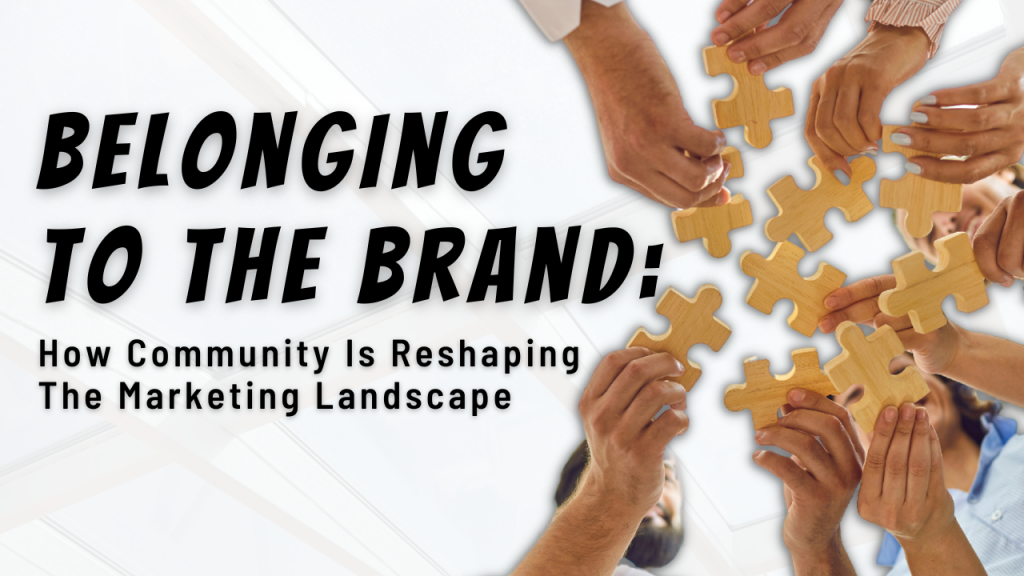
How Community is Reshaping the Marketing Landscape

How Community is Reshaping the Marketing Landscape

GUEST POST from Shep Hyken

According to bestselling author and marketing expert Mark Schaefer, the next—and last—great marketing strategy is community. When I read his latest book, Belonging to the Brand, I was intrigued by the subtitle, Why Community is the Last Great Marketing Strategy. Is it really the last? Having read Schaefer’s past books, I put faith in his words, but it’s up to you to decide.

First, let’s look at the definition of community, as it applies to marketing and business. The community includes customers aligned with the company, its brand promise and what it stands for. Schaefer writes in his introduction, “Helping a person belong to something represents the ultimate marketing achievement. If a customer opts into an engaging, supportive and relevant brand community, we no longer need to lure them into our orbit with ads and SEO, right? What we used to consider marketing is essentially over.”

Schaefer is saying that once the customer is part of the community, the need to engage with intrusive advertising and marketing messages is no longer needed. You will want to find meaningful ways to connect with customers other than traditional advertising and marketing programs, and these can include positive customer experiences, quality dependable products and services, the contribution the brand or company makes to making the world a better place and more.

In my book, The Amazement Revolution, one of the seven strategies covered was community. Harley Davidson was failing and rallied its community of customers to make suggestions that would get them to come back and buy its motorcycles. The company listened, the customers noticed and Harley regained its popularity and iconic status.

Lush, a cosmetics retailer with more than 950 stores worldwide, chose to make its products cruelty-free, which means no animals are harmed in manufacturing the products. They knew this would appeal to a segment of customers who are against animal testing practices. Those customers show intense loyalty toward Lush.

Apple created different communities of customers who voluntarily offer suggestions and answers to other customers in need of help and support. These communities are in addition to Apple’s regular customer support options.

These companies (and many others) have created communities of customers willing to evangelize their brands. They enjoy and love the companies so much that they provide some of the most powerful marketing techniques ever in the form of positive reviews and referrals, also known as word-of-mouth marketing.

Early in Schaefer’s book, he shares ten (10) reasons businesses can’t ignore the power of creating a community. I’ll share three of them with some of my commentary on each one:

  1. Brand Differentiation: Beyond price and product, which are often similar to the competition’s, the community can create an emotional connection. People like to belong to something. When they love a company and its products and find others who think and feel the way they do, they naturally gravitate toward the community. Once people join, they are participating at a higher level of brand engagement and their connection to the business is deepened by this connection.
  2. Market Relevance: How do you stay relevant? Listen to your customers. The community gives you the forum to listen and engage with your customers. The conversations you monitor or participate in will fuel you with ideas to make you even more relevant to your customers. Just remember, no matter how powerful the ideas and information you learn from listening are, they won’t mean anything unless you take action.
  3. Brand Loyalty: Loyalty is an emotional connection. Creating a community is a powerful way to drive loyalty. Schaefer shares some stats that make the case. Sixty-six percent of brand community members say they are loyal to the brand. Twenty-seven percent of customers say belonging to a brand influences their decision to do business with the brand. And, 66% of companies claim their community has impact on customer retention.

As powerful as creating a community is, don’t be lured into thinking you have a captive audience to which you can sell. That’s abusing the privilege and could be an insult to your customers. While members of your community may be more engaged and buy more, they don’t want to be sold. Use the community to offer early access to products and updates, ask for opinions and feedback, help in testing products and more. You want to give them a reason to meet and something to talk about.

So, is creating your company’s community your next big marketing strategy? If you haven’t already created one, it’s a concept worthy of serious consideration.

This article originally appeared on Forbes.com

Image Credit: Pixabay, Shep Hyken

Subscribe to Human-Centered Change & Innovation WeeklySign up here to join 17,000+ leaders getting Human-Centered Change & Innovation Weekly delivered to their inbox every week.

The AI Apocalypse is Here

3 Reasons You Should Celebrate!

The AI Apocalypse is Here

GUEST POST from Robyn Bolton

Whelp, the apocalypse is upon us. Again.

This time the end of the world is brought to you by AI.

How else do you explain the unending stream of headlines declaring that AI will eliminate jobsdestroy the education system, and rip the heart and soul out of culture and the arts? What more proof do you need of our imminent demise than that AI is as intelligent as a Wharton MBA?

We are doomed!

(Deep breath)

Did you get the panic out of your system? Feel better?

Good.

Because AI is also creating incredible opportunities for you, as a leader and innovator, to break through the inertia of the status quo, drive meaningful change, and create enormous value.

Here are just three of the ways AI will help you achieve your innovation goals:

1. Surface and question assumptions

Every company has assumptions that have been held and believed for so long that they hardened into fact. Questioning these assumptions is akin to heresy and done only by people without regard for job security or their professional reputation.

My favorite example of an assumption comes from the NYC public school district whose spokesperson explained the decision to ban ChatGPT by saying, “While the tool may be able to provide quick and easy answers to questions, it does not build critical-thinking and problem-solving skills, which are essential for academic and lifelong success,”

Buried just under the surface of this statement is the assumption that current teaching methods, specifically essays, do build critical thinking and problem-solving skills.

But is that true?

Or have we gotten so used to believing that essays demonstrate critical thinking and problem-solving that we’ve become blind to the fact that most students (yes, even, and maybe especially, the best students) follow the recipe that produces an essay that mirrors teachers’ expectations?

Before ChatGPT, only the bravest teachers questioned the value of essays as a barometer of critical thinking and problem-solving. After ChatGPT, scores of teachers took to Tik Tok and other social media platforms to share how they’re embracing the tool, using it alongside traditional tools like essays, to help their students build skills “essential for academic and lifelong success.”

2. EQ, not IQ, drives success

When all you need to do is type a question into a chatbot, and the world’s knowledge is synthesized and fed back to you in a conversational tone (or any tone you prefer), it’s easier to be the smartest person in the room.

Yes, there will always be a need for deep subject-matter experts, academics, and researchers who can push our knowledge beyond its current frontiers. But most people in most companies don’t need that depth of expertise.

Instead, you need to know enough to evaluate the options in front of you, make intelligent decisions, and communicate those decisions to others in a way that (ideally) inspires them to follow.

It’s that last step that creates an incredible opportunity for you. If facts and knowledge were all people needed to act, we would all be fit, healthy, and have absolutely no bad habits.

For example, the first question I asked ChatGPT was, “Why is it hard for big companies to innovate?” When it finished typing its 7-point answer, I nodded and thought, “Yep, that’s exactly right.”

The same thing happened when I asked the next question, “What should big companies do to be more innovative?”  I burst out laughing when the answer started with “It depends” and then nodded at the rest of its extremely accurate response.

It would be easy (and not entirely untrue) to say that this is the beginning of the end of consultants, but ChatGPT didn’t write anything that wasn’t already written in thousands of articles, books, and research papers.

Change doesn’t happen just because you know the answer. Change happens when you believe the answer and trust the people leading and walking alongside you on the journey.

3. Eliminate the Suck

Years ago, I spoke with Michael. B Jordan, Pixar’s Head of R&D, and he said something I’ll never forget – “Pain is temporary. Suck is forever.”

He meant this, of course, in the context of making a movie. There are periods of pain in movie-making – long days and nights, times when vast swaths of work get thrown out, moments of brutal and public feedback – but that pain is temporary. The movie you make is forever. And if it sucks, it sucks forever,

Sometimes the work we do is painful but temporary. Sometimes doing the work sucks, and we will need to keep doing it forever. Expense reports. Weekly update emails. Timesheets. These things suck. But they must be done.

Let AI do them and free yourself up to do things that don’t suck. Imagine the conversations you could have, ideas you could try, experiments you could run, and people you could meet if you no longer have to do things that suck.

Change is coming. And that’s good news.

Change can be scary, and it can be difficult. There will be people who lose more than they gain. But, overall, we will gain far more than we lose because of this new technology.

If you have any more doubts, I double-checked with an expert.

“ChatGPT is not a sign of the apocalypse. It is a tool created by humans to assist with language-based tasks. While artificial intelligence and other advanced technologies can bring about significant changes in the way we live and work, they do not necessarily signal the end of the world.”

ChatGPT in response to “Is ChatGPT a sign of the apocalypse?”

Image credit: Pixabay

Subscribe to Human-Centered Change & Innovation WeeklySign up here to join 17,000+ leaders getting Human-Centered Change & Innovation Weekly delivered to their inbox every week.