Creative Confidence Beats Market Signals

And How Johnny Cash Used it to Resurrect His Career

Creative Confidence Beats Market Signals

GUEST POST from Robyn Bolton

The best business advice can destroy your business. Especially when you follow it perfectly.

Just ask Johnny Cash.

After bursting onto the scene in the mid-1950s with “Folsom Prison Blues”, Cash enjoyed twenty years of tremendous success.   By the 1970s, his authentic, minimalist approach had fallen out of favor.

Eager to sell records, he pivoted to songs backed by lush string arrangements, then to “country pop” to attract mainstream audiences and feed the relentless appetite of 900 radio stations programming country pop full-time.

By late 1992, Johnny Cash’s career was roadkill. Country radio had stopped playing his records, and Columbia Records, his home for 25 years, had shown him the door. At 60, he was marooned in faded casinos, playing to crowds preferring slot machines to songs.

Then he took the stage at Madison Square Garden for Bob Dylan’s 30th anniversary concert.

In the audience sat Rick Rubin, co-founder of Def Jam Recordings and uber producer behind Public Enemy, Run-DMC, and Slayer, amongst others. He watched in awe as Cash performed, seeing not a relic but raw power diluted by smart decisions.

The Stare-Down that Saved a Career

Four months later, Rubin attended Cash’s concert at The Rhythm Café in Santa Anna, California. According to Cash’s son, “When they sat down at the table, they said: ‘Hello.’ But then my dad and Rick just sat there and stared at each other for about two minutes without saying anything, as if they were sizing each other up.”

Eventually, Cash broke the silence, “What’re you gonna do with me that nobody else has done to sell records for me?”

What happened next resurrected his career.

Rubin didn’t promise record sales.  He promised something more valuable: creative control and a return to Cash’s roots.

Ten years later, Cash had a Grammy, his first gold record in thirty years, and CMA Single of the Year for his cover of Nine Inch Nails’ “Hurt,” and millions in record sales.

“I wasn’t prepared for what I saw, what I had written in my diary was now superimposed on the life of this icon and sung so beautifully and emotionally. It was a reminder of what an important medium music is. Goosebumps up the spine. It really made sense. I thought: ‘What a powerful piece of art.’ I never got to meet Johnny, but I’m happy I contributed in the way I did. It wasn’t my song anymore.” — Trent Reznor

When Smart Decisions Become Fatal

Executives do exactly what Cash did.  You respond to market signals. You pivot your offering when customer preferences shift and invest in emerging technologies.

All logical. All defensible to your board. All potentially fatal.

Because you risk losing what made you unique and valuable. Just as Cash lost his minimalist authenticity and became a casualty of his effort to stay relevant, your business risks losing sight of its purpose and unique value proposition.

Three Beliefs at the Core of a Comeback

So how do you avoid Cash’s initial mistake while replicating his comeback? The difference lies in three beliefs that determine whether you’ll have the creative courage to double down on what makes you valuable instead of diluting it.

  1. Creative confidence: The belief we can think and act creatively in this moment.
  2. Perceived value of creativity: Our perceived value of thinking and acting in new ways.
  3. Creative risk-taking: The willingness to take the risks necessary for active change.

Cash wanted to sell records, and he:

  1. Believed that he was capable of creativity and change.
  2. Saw the financial and reputational value of change
  3. Was willing to partner with a producer who refused to guarantee record sales but promised creative control and a return to his roots.

Your Answers Determine Your Outcome

Like Cash, what you, your team, and your organization believe determines how you respond to change:

  1. Do I/we believe we can creatively solve this specific challenge we’re facing right now?
  2. Is finding a genuinely new approach to this situation worth the effort versus sticking with proven methods?
  3. Am I/we willing to accept the risks of pursuing a creative solution to our current challenge?”

Where there are “no’s,” there is resistance, even refusal, to change.  Acknowledge it.  Address it.  Do the hard work of turning the No into a Yes because it’s the only way change will happen.

The Comeback Question

Cash proved that authentic change—not frantic pivoting—resurrects careers and disrupts industries. His partnership with Rubin succeeded because he answered “yes” to all three creative beliefs when it mattered most. Where are your “no’s” blocking your comeback?

Image credit: Wikimedia Commons

Subscribe to Human-Centered Change & Innovation WeeklySign up here to join 17,000+ leaders getting Human-Centered Change & Innovation Weekly delivered to their inbox every week.

Unlearning is More Important Than Learning

Unlearning is More Important Than Learning

GUEST POST from Greg Satell

When I first went overseas to Poland in 1997, I thought I knew how the media business worked. I had some experience selling national radio time in New York and thought I could teach the Poles who, after 50 years of communism, hadn’t had much opportunity to learn how a modern ad market functioned. I was soon disappointed.

Whenever I would explain a simple principle, they would ask me, “why?” I was at a loss for an answer, because these were thought to be so obvious that nobody ever questioned them. When I thought about it though, many of the things I had learned as immutable laws were merely conventions that had built up over time.

As I traveled to more countries I found that even basic market functions, such as TV buying, varied enormously from place to place. I would come to realize that there wasn’t one “right” way to run a business but innumerable ways things could work. It was then that I began to understand the power of unlearning. It is, in fact, a key skill for the next era of innovation.

The One “True” Way To Innovate?

Innovation has become like a religion in business today, with “innovate or die” as its mantra. Much like televangelists preaching the prosperity gospel to gullible rubes, there’s no shortage of innovation gurus that claim to have discovered the secret to breakthrough innovation and are willing to share it with you, for an exorbitant fee, of course.

What I learned researching my book Mapping Innovation, however, is that there is no one “true” path to innovation. In fact, if you look at companies like IBM, Google and Amazon, although they are all world-class innovators, each goes about it very differently. IBM focuses on grand challenges that can take decades to solve, Google integrates a portfolio of innovation strategies and Amazon has embedded a customer obsession deep within its culture and practice.

What I found most interesting was that most people defined innovation in terms of how they’d been successful in the past, or in the case of self-described gurus, what they’d seen and heard to be successful. By pointing to case studies, they could “prove” that their way was indeed the “right” way. In effect, they believed that what they experienced was all there is.

Yet as I’ve explained in Harvard Business Review, innovation is really about finding novel solutions to important problems and there are as many ways to innovate as there are different types of problems to solve. Many organizations expect the next problem they need to solve to be like the last one. Inevitably, they end up spinning their wheels.

The Survival Of The Fittest?

The survival of the fittest is a thoroughly misunderstood concept. Although it arose out of Darwin’s work, it did not originate from him. It was coined by Herbert Spencer to connect Darwin’s work to his own ideas. Darwin’s theory was so novel and powerful at the time, it was difficult to articulate it clearly, and the phrase caught on.

All too often, people assume that Darwin’s theories predicted some sort of teleological end state in which one optimized form will dominate. If that were true, then the optimal strategy for every organism, as well as every business model and every organization, would be to strive to achieve that optimal state and dominate the competition.

Yet that’s not what Darwin meant at all. In fact, his theory rested on three pillars, limited resources, changing environments and super-fecundity, which is the tendency of organisms to produce more offspring that can survive. “Fittest” refers to a temporary state, not a permanent advantage. What is “fit” for one environment may be detrimental in another.

Eastern Europe was, for me, similar to the Galápagos Islands where Darwin first formed his famous theory. Seeing different business environments, in close proximity, give rise to so many different business models opened my eyes to new possibilities. Once I unlearned what I thought I knew, I was able to learn more than I could have imagined.

Turning The Page On Welchism

At the beginning of this century, Fortune magazine proclaimed Jack Welch to be the optimal manager of the last one. American industry had grown sclerotic and bureaucratic. It was in great need of some trimming down and Welch was truly an optimized fit for the environment.

Nicknamed “Neutron Jack” for his penchant of getting rid of all the people and only leaving the buildings standing, he voraciously cut through GE’s red tape. Profits soared, Welch became something of a prophet and “Welchism” a religion. Corporate boards heavily recruited GE executives as CEOs to replicate Welchism at their companies.

Yet as David Gelles explains in his book about Welch’s tenure at GE, The Man Who Broke Capitalism, not all was as it seemed. Yes, Welch made GE more efficient and profitable, but he also increased risk through “financializing” the industrial company, undermined engineering and innovation by moving manufacturing facilities overseas and cooked the books to make profits seem much smoother than they were.

GE would eventually implode, but the damage went much further and deeper than one company. Because Welchism was seen as the “one best way” to run a business, many other firms replicated its methods. The results have been alarming. In fact, a 2020 report by the Federal Reserve found that business dynamism in America has steadily declined since Jack Welch took the helm at GE in 1981.

Clearly we have some unlearning to do.

Moving Boldly Into An Uncertain Future

I’ve thought for some time that the 2020s would look a lot like the 1920s. That was the last time that we had such a convergence of technological, demographic and political forces at one time (and a pandemic as well!). Yet historical analogies can often be misleading. History is long and, if you look enough, you can find an analogy for almost anything.

It is certainly true that history seems to converge and cascade on particular moments and we seem to be at one of these moments now. We will need to unlearn much of what we thought we knew about shareholder value and other things as well. Yet correcting the mistakes of the past is never enough. We need to create anew.

The recently passed CHIPS Act is a good model for how to do this. Much of the $280 billion bill goes to tried and true programs that we under-invested in recent years, such as science programs at the NSF and the DOE as well as programs that support manufacturing and, of course, subsidies to support semiconductors. We know these things work.

Yet other programs are experiments. Some, such as a new Technology Directorate at the NSF are controversial. Others, such as $10 billion that will be spent on regional technology hubs and $1 billion that will go to a RECOMPETE pilot program to empower distressed communities, are new and innovative. We can almost guarantee that there will be hiccups and outright failures along the way.

It is tautologically true that the well-trod path will take us nowhere new. We need to unlearn the past if we are to learn how to build a new future.

— Article courtesy of the Digital Tonto blog
— Image credit: Unsplash

Subscribe to Human-Centered Change & Innovation WeeklySign up here to join 17,000+ leaders getting Human-Centered Change & Innovation Weekly delivered to their inbox every week.

Strategizing Execution

Take a Tip from the Oil Industry

Strategizing Execution

GUEST POST from Geoffrey A. Moore

When it comes to executing any market development playbook, the work should be organized around the same checklist of factors that structured our earlier blog on marketing strategy. Here is the overall framework to keep in mind:

The first four focus on constructing the ROI engine, the second four, on activating it. Or, to use the parlance of the oil industry, the first four represent the upstream work that locates and extracts the trapped value of an oil reservoir. This is the work of product management. The second four represent the downstream work of refining, distributing, and monetizing the end product. This is the work of product marketing. Both functions should report to a product line manager to ensure that end-to-end coordination is maintained throughout.

When a category is working its way through the Technology Adoption Life Cycle, the roles of the product manager and the product marketing manager change dramatically at each stage. In the early market, neither function has yet been staffed, as it is simply too early to organize for scaled deployment, but for the following three phases of the bowling alley, the tornado, and Main Street, these two functions lead the charge.

For the upstream product manager, here’s how the market development playbook evolves:

In the bowling alley, as we discussed at length in the earlier post on market power, the trapped value is due to a broken mission-critical process that needs substantial re-engineering only made possible by next-generation technology. The product manager needs to become an expert in this use case, and their role calls for them to both guide the product development roadmap and orchestrate the ecosystem to ensure the right partners show up at the right time.

In the tornado, trapped value has migrated from specific use cases to a whole host of potential applications. As a result, demand is widespread, infrastructure owners have budget for the new category and plan to spend it this year, and the goal is to win as much market share as one can. Product roadmaps are driven by feature competitions with others in category, and time to market with the next hot feature is the top concern. Partner recruitment now shifts to the sales side of the house where the goal is to win more market share by expanding distribution coverage beyond the limits of the direct sales force. The product manager supports this effort by driving a “partner-ready” track in the product development roadmap.

On Main Street, the “trapped value” is less like an oil reservoir and more like shale oil—it’s still there, but it is highly diffuse, collecting in small local pockets. Here the end user is in the best position to advocate for the improvements that would help most. Budgets are limited, however, so improvements need to be add-ons that are discretionary, ideally available through a digital-direct transaction.

Turning now to the downstream side of the market development checklist, here’s how the product marketing manager’s playbook evolves:

In the bowling alley, sales plays are consultative, organized around a diagnostic/prescriptive approach which the product marketing manager must continually update as more and more is learned about the problem process and how to fix it. The sales channel is direct, and the pricing is value-based, calibrated by the cost impact of not fixing the problem process. The offer competes with the status quo and the incumbent vendor who will push back with the best “good enough” response it can muster. The positioning has to make clear why that does not fill the bill and how the disruptive offer will take the problem off the table once and for all.

Inside the tornado, sales plays are competitive, organized around battle cards that are competitor-specific, which the product marketing manager must continually update to reflect the latest releases from the competition. Pricing is organized around company status in the market pecking order. Where there is proprietary technology involved, the gorilla sets the premium price for the category overall, chimps can set local pricing in their market segments if they are sufficiently differentiated to keep the gorilla out, and monkeys license or clone the gorilla technology and then compete on lowest price. Where there is no proprietary technology to create a barrier to entry, the same pecking order emerges, but it is much more fluid, meaning that it is much easier for a prince to depose a king than it is for a chimp to displace a gorilla. In all cases, competitions tend to get resolved via product versus product comparisons on features and benefits.

On Main Street, sales plays are transactional, ideally delivered through a digital self-service channel. Here the product marketing manager normally cannot rely on sending prospects to the corporate website—it is typically way too noisy a channel for this body of work—but instead either spin up a separate portal or work with a third-party digital distributor. Pricing and packaging matters a ton in any transactional business model, so the product marketing manager is responsible for frequent A/B testing or comparable experimentation on an ongoing basis. The competition is rarely direct—you are the incumbent vendor at this stage—but you must keep an eye out for the next-generation disruptor who sees your profit pool as a sitting duck. The more you can bolster your core offer with add-ons, the higher the switching costs for your end users, the less likely the challenger can penetrate your market.

Wrapping up

This concludes the sixth and final post in the Hierarchy of Powers series. Here are the links to the other five:

Framing Strategy

Strategizing Category Power: Portfolio Management

Strategizing Company Power: It’s a Team Sport

Strategizing Market Power: Target Market Initiatives

Strategizing Offer Power: The Importance of Overcommitting

I encourage you to print them out and staple them together as a reference guide to keep handy as you take on your next market development challenge.

That’s what I think. What do you think?

Image Credit: Unsplash, Geoffrey Moore

Subscribe to Human-Centered Change & Innovation WeeklySign up here to join 17,000+ leaders getting Human-Centered Change & Innovation Weekly delivered to their inbox every week.

Decoding the Code of Life

Human-Centered Innovation in Synthetic Biology

Decoding the Code of Life

GUEST POST from Art Inteligencia

From my vantage point here in Seattle, I’m constantly tracking emerging technologies that hold the potential to reshape our world. One area that consistently sparks my interest, and demands a strong human-centered lens, is synthetic biology. This revolutionary field combines biology and engineering principles to design and build new biological parts, devices, and systems—essentially allowing us to program life itself. While the possibilities are immense, so too are the ethical and societal considerations, making a human-centered approach to its innovation crucial.

Synthetic biology stands at the intersection of several scientific disciplines, leveraging our increasing understanding of genomics, molecular biology, and genetic engineering. It moves beyond simply reading the code of life to actively writing and rewriting it. This capability opens doors to addressing some of humanity’s most pressing challenges, from developing new medicines and sustainable fuels to creating novel materials and revolutionizing agriculture. However, as we gain the power to manipulate the fundamental building blocks of life, we must ensure that our innovation is guided by ethical principles, societal needs, and a deep understanding of the potential consequences.

A human-centered approach to innovation in synthetic biology means prioritizing the well-being of individuals and the planet. It involves engaging with the public to understand their concerns and aspirations, fostering transparency in research and development, and proactively addressing potential risks. It requires us to ask not just “can we do this?” but “should we do this?” and “what are the potential impacts on human health, the environment, and the fabric of society?” This proactive ethical framework is essential for building trust and ensuring that the transformative potential of synthetic biology is harnessed responsibly and for the benefit of all.

Case Study 1: Engineering Microbes for Sustainable Fuel Production

The Challenge: Dependence on Fossil Fuels and Climate Change

Our current reliance on fossil fuels is a major driver of climate change and environmental degradation. Finding sustainable and renewable alternatives is a critical global challenge. Synthetic biology offers a promising pathway by enabling the engineering of microorganisms to produce biofuels from renewable resources, such as agricultural waste or even captured carbon dioxide.

The Innovation:

Companies and research labs are now engineering yeast and algae to efficiently convert sugars and other feedstocks into biofuels like ethanol, butanol, and even advanced hydrocarbons that can directly replace gasoline or jet fuel. This involves designing new metabolic pathways within these organisms, optimizing their growth conditions, and scaling up production in bioreactors. The human-centered aspect here lies in the potential to create a cleaner, more sustainable energy future, reducing our carbon footprint and mitigating the impacts of climate change. Furthermore, these bioproduction processes can potentially utilize waste streams, contributing to a more circular economy.

The Potential Impact:

Successful development and deployment of these bio-based fuels could significantly reduce our dependence on finite fossil fuel reserves and lower greenhouse gas emissions. Imagine fueling our cars and airplanes with fuels produced by engineered microbes, utilizing resources that would otherwise go to waste. This innovation has the potential to create new jobs in biorefineries and contribute to energy independence, while simultaneously addressing a critical environmental need. However, careful consideration of land use, water resources, and the potential for unintended environmental consequences is paramount to ensure a truly sustainable solution.

Key Insight: Synthetic biology offers powerful tools to engineer sustainable solutions to global challenges like climate change, but a human-centered approach requires careful consideration of the entire lifecycle and potential impacts.

Case Study 2: Cell-Based Agriculture for a Sustainable Food System

The Challenge: Environmental Impact and Ethical Concerns of Traditional Animal Agriculture

Traditional animal agriculture has a significant environmental footprint, contributing to deforestation, greenhouse gas emissions, and water pollution. It also raises ethical concerns about animal welfare. Synthetic biology is paving the way for cell-based agriculture, where meat and other animal products are grown directly from animal cells in a lab, without the need to raise and slaughter animals.

The Innovation:

Companies are now developing methods to cultivate animal cells in bioreactors, providing them with the necessary nutrients and growth factors to proliferate and differentiate into muscle tissue, fat, and other components of meat. This “cultured meat” has the potential to drastically reduce the environmental impact associated with traditional farming and address ethical concerns about animal treatment. From a human-centered perspective, this innovation could lead to a more sustainable and ethical food system, ensuring food security for a growing global population while minimizing harm to the planet and animals.

The Potential Impact:

Widespread adoption of cell-based agriculture could revolutionize the food industry, offering consumers real meat with a significantly lower environmental footprint. It could also reduce the risk of zoonotic diseases and the need for antibiotics in animal agriculture. However, challenges remain in scaling up production, reducing costs, and gaining consumer acceptance. Addressing public perceptions, ensuring the safety and nutritional value of lab-grown meat, and understanding the potential socio-economic impacts on traditional farming communities are crucial human-centered considerations for this transformative technology.

Key Insight: Synthetic biology can contribute to a more sustainable and ethical food system through cell-based agriculture, but public engagement and careful consideration of societal impacts are essential for its responsible adoption.

Startups and Companies to Watch

The field of synthetic biology is rapidly evolving, with numerous innovative startups and established companies making significant strides. Keep an eye on companies like Ginkgo Bioworks, which is building a platform for organism design; Zymergen, focused on creating novel materials and ingredients through microbial engineering; Impossible Foods and Beyond Meat, leveraging synthetic biology for plant-based and cell-based meat alternatives; Moderna and BioNTech, who utilized mRNA technology (a product of synthetic biology advancements) for their groundbreaking COVID-19 vaccines; and companies like Pivot Bio, developing sustainable microbial fertilizers. This dynamic landscape is constantly generating new solutions and pushing the boundaries of what’s biologically possible.

As we continue to unlock the power of synthetic biology here in America and around the world, it is imperative that we do so with a strong sense of human-centered responsibility. By prioritizing ethics, engaging with society, and focusing on solutions that address fundamental human needs and environmental sustainability, we can ensure that this remarkable technology truly serves the betterment of humanity.

Disclaimer: This article speculates on the potential future applications of cutting-edge scientific research. While based on current scientific understanding, the practical realization of these concepts may vary in timeline and feasibility and are subject to ongoing research and development.

Image credit: Gemini

Subscribe to Human-Centered Change & Innovation WeeklySign up here to get Human-Centered Change & Innovation Weekly delivered to your inbox every week.

Goals Require Belief to be Achievable

Goals Require Belief to be Achievable

GUEST POST from Mike Shipulski

I’m all for stretch goals to help people grow. “Hey, you did this last year but I think you can do ten percent more this year. And here’s why – [list three reasons here.]” This works. This helps people grow. This is effective. This is grounded in what happened last year. This is grounded in specific reasons why you think the stretch goal is possible. And when you do it this way, you are seen as credible.

Back in the day, when elite runners were running the mile in 4:04 their coaches said “Hey, you ran 4:04 last year but I think you can do it a little faster this year. I think you can run it in 3:59. And here’s why – your time has been decreasing steadily over the last three years, you have been working out with weights and you’re much stronger and there’s a small adjustment we can make to your stride that will help you be more efficient.

As an athlete, I believe this coach. It’s true, I did run 4:04 last year. It’s true, my time has decreased steadily over the last years. It’s true, I have been working hard in the weight room. And, because all these things are true, I believe the coach when she tells me she knows a way to help me run faster. This coach is credible and I will work hard for her.

Back in the day, when elite runners were running the mile in 4:04, their coaches did NOT say “Hey, as a stretch goal, I want you to run 2:59 next year. I know it’s a big improvement, but I want to set an arbitrary and unrealistic goal so I can get the most out of you. And no, I don’t have any advice on how you can run 27% faster than last year. As the one doing the running, that’s your job. I’m just the coach.”

As an athlete, I don’t believe this coach. There’s no way in hell I will run 27% faster this year. It’s simply not physically possible. The world record is 4:01 and I can’t break it by over a minute. The coach has no clue about how I can achieve the goal, nor did he build a bridge from last year’s pace to this silly target. This coach is not credible and I will not work hard for him.

As a leader you are credible when you set an improvement goal that’s grounded in the reality of how things have gone in the past. And you’re more credible when you give specific reasons why you think the improvement goal is possible. And you’re more credible when you give suggestions on how to achieve the goal. And you’re even more credible when you tell people you will actively support them in the improvement effort. When you do it this way, people think better of you and they’ll work hard for you.

Here’s a rule: if the goal isn’t believable it’s not achievable.

As a leader, when you set an improvement goal that’s out of line with reality you are NOT credible. When you declare an improvement goal that’s disrespectful of history, it’s not a stretch goal. It’s an arbitrary edict designed to trick people into working too hard. And everyone can spot these “goals” at twenty paces. Your best people will give you the courtesy of calling you on your disingenuous behavior, but most people will just smile and quietly think less of you. And none of them will work hard for you.

When the improvement goal isn’t credible, neither are you. Think twice before you ask your people to drink the company Kool-Aid.

Image credit: Gemini

Subscribe to Human-Centered Change & Innovation WeeklySign up here to join 17,000+ leaders getting Human-Centered Change & Innovation Weekly delivered to their inbox every week.

I Quote Dead People

I Quote Dead People

GUEST POST from Shep Hyken

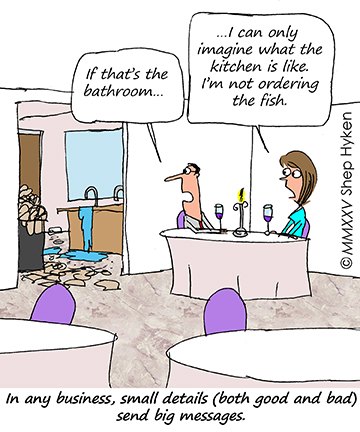
The other day, I was talking to a friend about famous movie lines. He said one of his favorite movies was The Sixth Sense starring Bruce Willis, and his favorite line came from 9-year-old Cole, played by Haley Joel Osment, who said, “I see dead people.”

I responded, “That’s funny. I quote dead people.” He looked at me strangely. He laughed. We’re both speakers, and we often use motivational quotes to emphasize our points. I told him the story of a client who felt one of my quotes was outdated. She said, “Nobody knows who you were referring to,” even though I prefaced the quote by mentioning that most of the audience wouldn’t recognize the actor I was about to quote, but that what he said was still relevant.

I could have quoted my father, my third-grade teacher, the 16th president of the United States or Aristotle, who died in 322 B.C. The point is, it doesn’t matter if the person is recognizable, living or dead. It’s what we can learn from them.

I Quote Dead People Cartoon Shep Hyken

So my line, “I quote dead people,” is now in my standard explanation prior to quoting someone who has passed and whose name may not be recognizable. Here are six of my favorite quotes I’ve used in customer service and experience keynote speeches:

  • Leonardo da Vinci said, “Simplicity is the ultimate sophistication.” Companies that are easy to do business with will win over competitors that offer complicated, cumbersome and inconvenient experiences.
  • Aldo Gucci said, “Quality is remembered long after price is forgotten.” Our customer service research shows that people will pay more for a quality experience.
  • Zig Ziglar said, “You can have everything in life you want, if you will just help other people get what they want.” Help your customers get what they want – not always what you want to sell them – and they will reciprocate by giving you business.
  • The 16th president of the United States, Abraham Lincoln, said, “Give me six hours to chop down a tree, and I will spend the first four sharpening the axe.” There are many ways you can interpret this. I’ll go with the importance of preparation. When you have an important meeting, your customers deserve your best. Take time to prepare!
  • Sam Walton, the founder of Walmart, said, “There is only one boss. The customer. And he can fire everybody in the company from the chairman on down, simply by spending his money somewhere else.” Keep that in mind each and every time you’re interacting with a customer.
  • Tony Hsieh, the founder of Zappos, said, “Customer service shouldn’t be a department, it should be the entire company.”

I’ve quoted many great minds of the past – some well-known, others less recognized. Their words can be powerful, educational and inspiring. But no matter who said them, always give credit where it’s due. Why? Because it’s the right thing to do, and as Dr. Martin Luther King Jr. wisely said, “The time is always right to do the right thing.”

Image Credits: Gemini, Shep Hyken

Subscribe to Human-Centered Change & Innovation WeeklySign up here to join 17,000+ leaders getting Human-Centered Change & Innovation Weekly delivered to their inbox every week.

The Nordic Way of Leadership in Business

The Nordic Way of Leadership in Business

GUEST POST from Stefan Lindegaard

What if there was a leadership approach that naturally fostered trust, embraced adaptability, and encouraged continuous innovation? Could this approach serve as a model for navigating today’s complex business landscape? Many organizations are finding inspiration in exactly such a model – the Nordic way. Known for its progressive approach to leadership, organizational agility, and transformative innovation, the Nordic style is gaining recognition worldwide for its unique, people-first methods.

Here’s a closer look at why the Nordic approach is a valuable inspiration for leaders globally and how its principles might apply across cultures and industries.

Leadership: Trust as the Foundation

Nordic leadership is deeply rooted in trust. Rather than micromanaging, Nordic leaders empower their employees by granting autonomy and responsibility, creating a high-trust environment that enhances motivation, engagement, and creativity. This approach not only flattens traditional hierarchies but fosters open communication and shared purpose. Employees in Nordic organizations are encouraged to think independently, take ownership of their roles, and bring their best ideas to the table – qualities essential for navigating constant change.

This trust-based model also creates an environment of psychological safety, where people feel valued and supported. It’s a model that resonates well beyond the Nordic region, offering a compelling answer to the global call for leaders who can cultivate an engaged and resilient workforce. By promoting a culture where everyone is part of the mission, Nordic leaders are creating teams prepared to face challenges collaboratively and creatively.

Agility: A Mindset of Flexibility and Collective Ownership

Nordic organizations approach agility not simply as a set of processes but as a fundamental mindset. It’s a philosophy of flexibility and shared ownership that spans the entire organization, enabling teams to pivot quickly and proactively address new challenges. By encouraging collaboration and empowering cross-functional teams, Nordic organizations instill a strong sense of collective responsibility, where employees at all levels contribute to swift decision-making and adaptive strategies.

This approach to agility is about building a resilient organization, one that can respond effectively to changes in the market, technology, or societal expectations. For organizations worldwide, adopting a similar mindset could mean going beyond structured agile practices to develop a true culture of adaptability and resilience, grounded in empowered teams and proactive collaboration.

Innovation and Transformation: Constant Evolution

Nordic companies are known for their strong commitment to innovation, but it’s not innovation for its own sake – it’s innovation with a purpose. In the Nordic approach, innovation is a continuous process integrated into everyday work, driving improvements across products, services, and even organizational practices. Rather than isolating innovation within specific departments, Nordic organizations encourage a culture of experimentation, learning, and reinvention throughout the entire organization.

This proactive approach to transformation and change is essential for maintaining relevance in a competitive world. Nordic leaders understand that sustainable innovation relies on a supportive culture, one where challenging the status quo is encouraged and continuous improvement is celebrated. For global businesses, this focus on purposeful innovation offers a framework that can help organizations evolve while staying aligned with their core values and mission.

Values as Drivers of Sustainable Success

At the heart of Nordic leadership and organizational development are values like sustainability, collaboration, and inclusivity. Nordic leaders prioritize these values not just as corporate responsibilities but as strategic drivers of success. By embedding principles of social responsibility, environmental stewardship, and inclusivity into their business practices, Nordic organizations create a competitive edge that appeals to modern consumers and stakeholders alike.

For organizations in other parts of the world, these values are increasingly relevant as they face rising expectations for transparency, ethical conduct, and positive societal impact. Nordic leaders illustrate how a values-driven approach not only enhances business reputation but also contributes to innovation and employee engagement, establishing a model that aligns organizational success with social progress.

Can the Nordic Way be a Learning Source for Global Leaders?

While the Nordic model provides valuable inspiration, it may not be universally applicable without adaptation. Here’s a closer look at its potential as a learning source for leaders globally:

Pros

  1. Adaptable Principles: Nordic leadership’s focus on trust, collaboration, and sustainability is relevant across industries and regions. These core principles offer a framework that any organization can incorporate to enhance engagement and adaptability.
  2. Scalability of Agility: The Nordic approach to agility as a mindset rather than a rigid framework allows for flexible application. Organizations of different sizes can tailor this mindset to suit their unique structures and goals.
  3. Empowered Innovation: By democratizing innovation across the organization, Nordic companies empower employees to contribute ideas and take initiative, a practice that can drive change and spark innovation regardless of regional context.

Cons

  1. Cultural Context: The success of the Nordic model is partly rooted in Nordic cultural values of equality and inclusiveness, which may not translate seamlessly into hierarchical or individualistic cultures. Adapting these principles may require significant shifts in mindset and organizational structure.
  2. Resource-Intensive: The commitment to employee well-being, work-life balance, and continuous learning is resource-intensive. Organizations in high-pressure or resource-limited environments may find it challenging to implement these practices at scale.
  3. Long-Term Focus: The Nordic model’s emphasis on sustainable, long-term growth over immediate profit may not align with the priorities of companies in highly competitive markets where short-term results are essential.

Why I Believe in the Nordic Way

I believe the Nordic approach to leadership can inspire global leaders, especially those who are rethinking how to create meaningful impact within their organizations. The Nordic way is not just a set of strategies or processes; it’s a philosophy that values people, purpose, and sustainable progress.

In a time when many leaders are facing complex challenges – ranging from rapid technological change to employee well-being and social responsibility – this approach offers a balanced framework that aligns with what a lot of people, inside and outside organizations, are seeking.

One of the biggest reasons it resonates globally is because of its simplicity: build trust, foster collaboration, and drive innovation with a purpose. These are universal needs, no matter where a business operates. In any organization, these principles tap into a common need to feel valued, empowered, and part of a meaningful mission. And while the Nordic model is uniquely suited to its cultural context, its core principles are adaptable and can be translated in ways that suit other environments.

Leaders in competitive, high-stakes markets might not adopt every aspect, like the high emphasis on work-life balance, but they can still take away a focus on trust, inclusivity, and adaptive agility to improve engagement and innovation.

But What are the Challenges?

What could be missing is perhaps a realistic look at the challenges Nordic leaders face within this model. While it’s admired for its human-centered approach, maintaining high trust and autonomy can be demanding. It requires leaders to be consistent, transparent, and continuously engaged with their teams, which can be difficult as organizations scale or enter competitive markets. Consider a fast-growing company where balancing autonomy with consistency becomes a daily challenge as new layers of leadership emerge.

For leaders, this means actively working to sustain the level of trust and openness that drove early success, even as the organization scales and diversifies. Another potential challenge is balancing the flexibility that empowers employees with the structure needed for consistent output.

For global leaders, the Nordic model might be most powerful if presented not just as a set of ideals but as a journey of ongoing effort and adjustment. As leaders across the globe adapt to new realities, the Nordic way offers not just a model but a mindset – one that reminds us that lasting success begins with people and purpose.

Image Credit: Pexels

Subscribe to Human-Centered Change & Innovation WeeklySign up here to get Human-Centered Change & Innovation Weekly delivered to your inbox every week.

How to Quickly Improve Your Ability to Predict the Future

How to Quickly Improve Your Ability to Predict the Future

GUEST POST from Robert B. Tucker

The need to predict is omnipresent. Every time you buy a stock, choose a partner, pick a president, or bet your brother-in-law that the 49ers will finally win it all, you’re making a decision based on a prediction.

And yet, despite all the big data, algorithms, learning models, and AI assistants, we’re still not very good at predicting the future. But, turns out, there are a few techniques that will help you get better fast.

The human desire to improve our ability to predict the future isn’t new.

Nostradamus was one of the original prognosticators to receive acclaim. Yet, on further reflection, his writings are so open to interpretation that they could be describing either the fall of Rome or the next global pandemic.

In recent decades, predicting the future of everything has become a growth industry, especially in politics. Cable news needs experts who sound cocksure about everything, even if their accuracy is less than dart-throwing chimps. As long as the ratings are good, bring on the blather.

A few individuals have a heightened ability to forecast what will happen next. What traits do they share?

Determined to find out what does make someone a good predictor, Tetlock launched a bold experiment. With funding from DARPA, he hosted forecasting tournaments known as the Good Judgment Project. Tens of thousands of ordinary people — teachers, engineers, pharmacists, and even a Canadian underwater hockey coach — competed to see who could best predict the outcomes of real-world events: Will the president of Tunisia go into exile next month? Will the price of gold exceed $3500 by the end of Q3?

Tetlock identified a small percentage — about 2 percent — who consistently made remarkably accurate predictions. He dubbed them “superforecasters.” They weren’t clairvoyant. They didn’t have access to classified information. But they do have certain traits in common:

  • They are intellectually curious, open-minded, and self-critical.
  • They don’t cling to ideas. They treated beliefs as hypotheses, not heirlooms.
  • They are comfortable with numbers but weren’t necessarily math geniuses.
  • They break complex questions into smaller parts and constantly update their thinking.

What You Think Versus How You Think

Tetlock puts it this way: “What you think is much less important than how you think.” Superforecasters don’t get attached to their opinions. They revisit assumptions. They seek out dissent. One participant even wrote code to curate news articles from across ideological spectrums so he wouldn’t fall into an echo chamber.

They also tracked and scored their predictions over time, treating it not as a parlor trick, but as a craft. If you want to improve your ability to anticipate the future — and let’s be honest, who doesn’t — Here are a few suggestions:

1. Start with the base rate. Ask yourself: What usually happens in situations like this? Don’t be seduced by the drama of outliers. Begin with the average.

2. Break it down. Instead of “Will AI take my job?” ask: “What tasks in my role are automatable?” Then assign probabilities to each.

3. Toggle perspectives. Use both the inside view (your specific context) and the outside view (what’s happened in similar situations).

4. Stay flexible. Your assumptions are not sacred scrolls. Update them when new information arrives. Bonus points if you can admit you were wrong without needing therapy.

5. Use numbers, not vibes. Avoid vague terms like “probably.” Go with: “I’m 70% confident.” It sharpens your thinking — and makes you easier to argue with at dinner parties.

6. Keep a prediction journal. Write down your forecasts and your reasoning. Revisit. Learn. Repeat. (Optional: give yourself gold stars.)

7. Seek disconfirmation. Don’t just look for information that proves you right. Hunt down what might prove you wrong. It’s called “growing.”

8. Diversify your info diet. Read widely. Follow smart people you disagree with. Cross-pollinate. Avoid becoming the human version of a YouTube algorithm.

In the end, getting better at prediction won’t make you omniscient, but it will make you wiser, calmer, and a better decision-maker. And maybe, just maybe, the next time someone at work says, “Nobody could have seen this coming,” you’ll be able to smile and say, “Actually… I kind of did.”

University of Pennsylvania professor Philip Tetlock has spent decades trying to answer this question: Spoiler alert: It’s not fame, credentials, or wearing a bowtie on TV.

This article originally appeared in Forbes

Image credit: Gemini

Subscribe to Human-Centered Change & Innovation WeeklySign up here to get Human-Centered Change & Innovation Weekly delivered to your inbox every week.

Use the DITO Framework to Navigate the Coming Chaos

Use the DITO Framework to Navigate the Coming Chaos

GUEST POST from Robert B. Tucker

The future is no longer something we can leave to chance — or to wishful thinking. It’s arriving faster than expected, packed with disruption, unpredictability, and opportunity in equal measure.

Over the past three decades, I’ve worked with companies large and small to spot emerging trends and sidestep disruption before it hits. But as I look ahead to the next ten years, I believe we’re entering a very different kind of era — one that will challenge every one of us to become more strategic, more adaptive, and more intentional in how we navigate forward.

Whether you’re running a company, managing a team, leading a classroom, raising a family, or thinking about your next chapter in life, the coming decade will test your decision-making skills. You’ll be asked to make smarter calls amid greater uncertainty. You’ll face crosscurrents — technological, societal, geopolitical, and environmental — that defy easy interpretation. You’ll be forced to take action in the face of incomplete information.

In other words, the old playbooks are wearing thin. We need new ones.

A Time for New Tools

The book I’m currently writing is about those new playbooks — specifically, how to navigate what I call the “Age of Accelerating Everything.” Change is no longer a series of isolated events; it’s a continuous condition. Trends don’t just emerge — they converge. Industry boundaries blur. Institutions wobble. And every decision feels more consequential.

In times like these, we need frameworks that help us see clearly through the fog. One that I’ve been refining for years is called the D.I.T.O. Framework — a simple but powerful way to make sense of the forces shaping our future and act on them before they act on us.

Meet D.I.T.O.

D.I.T.O. is an evolution of the classic SWOT analysis. But where SWOT looks inward — at strengths and weaknesses — D.I.T.O. turns your gaze outward, toward the unfolding future.

Here’s how it works:

  • D – Direction: What is the trajectory of this trend? Is it accelerating, plateauing, or fizzling out? Who or what will it impact, and when?
  • I – Implications: What are the likely consequences if this trend continues? How could it reshape your industry, your market, your life?
  • T – Threats: What are the risks, disruptions, or downsides? Where are the vulnerabilities?
  • O – Opportunities: What doors does this trend open? Where’s the potential for innovation, growth, or leadership?

What makes D.I.T.O. valuable is its versatility. You can use it to evaluate a new technology, a shift in customer behavior, a global supply chain issue, or even a personal life transition. It brings structure to the swirling complexity.

Why It Matters Now

Disruption used to be episodic. It hit now and then — an economic downturn here, a surprise new competitor there. You regrouped, recovered, moved on.

That’s no longer the case. Disruption is now structural. It’s built into the system. AI is transforming industries in real time. Climate volatility is redrawing maps. Geopolitical tensions are reshaping trade, labor, and migration patterns. And all of it is happening simultaneously.

To lead — whether in a boardroom or your own life — you need a method for seeing around corners. You need a framework for evaluating risk and upside. And you need to do it quickly, clearly, and often.

What D.I.T.O. Helps You Do

Using the D.I.T.O. framework will help you:

  • Build future fluency: Understand what’s changing and why — so you can act with clarity, not confusion.
  • Spot disruption before it lands: Get ahead of shifts in technology, regulation, consumer behavior, and more.
  • Make decisions with confidence: Evaluate new trends without overreacting or under-reacting.
  • Balance risk and reward: Know when to move forward, when to pause, and when to pivot.
  • Lead others through uncertainty: Be the person who sees what others miss — and helps them prepare.

This isn’t about becoming a futurist. It’s about becoming a better thinker. And in this age of acceleration, that’s the single most important skill you can build.

Thinking Differently, Acting Decisively

One of the biggest mistakes I see organizations and individuals make is mistaking motion for progress. We stay busy, overloaded with inputs, reacting to headlines and inboxes — without ever stepping back to assess where we’re headed, and whether the ground is shifting beneath our feet.

Frameworks like D.I.T.O. create the space to pause, reflect, and engage in proactive sense-making. They help you translate signals into strategy. And they build the habit of asking the right questions before charging into action.

Because the future isn’t something that just happens to you. It’s something you help shape — through your choices, your mindset, and your ability to read the landscape.

A Final Word — and an Invitation

The next decade will challenge every one of us. But it will also reward those who are ready — those who make it a practice to anticipate, adapt, and take intelligent action.

So, before you make that next big decision—about your business, your career, your investments, or your impact — pause. Pull out the D.I.T.O. tool. Ask:

  • Where is this heading?
  • What does it mean for me and mine?
  • What are the risks?
  • What’s the opportunity?

Simple questions. Smart structure. Powerful clarity.

It’s time to stop guessing and start navigating. D.I.T.O. can help you do just that.

This article originally appeared in Forbes

Image credit: Pexels

Subscribe to Human-Centered Change & Innovation WeeklySign up here to get Human-Centered Change & Innovation Weekly delivered to your inbox every week.

Navigating Unwelcome Change

Five Questions with Theresa Ward

Navigating Unwelcome Change

GUEST POST from Robyn Bolton

Picture this: your boss announces a major reorganization with a big smile, expecting you to be excited about “new opportunities.” Meanwhile, you’re sitting there thinking “What the hell just happened to my job?”

Theresa Ward, founder and Chief Momentum Officer of Fiery Feather, has spent years watching this disconnect play out. Her insight? Leaders are expected to sell change while still personally struggling with it, creating what she calls “that weird middle ground” where authenticity goes to die.

Our conversation revealed why unwelcome change triggers the same response as grief, and why leaders who stop pretending they’ve got it figured out are more successful.


Robyn Bolton: What’s the one piece of conventional wisdom about leading change that organizations need to unlearn?

Theresa Ward: That middle managers need to be enthusiastic about a change, or at least appear enthusiastic, to lead their teams through it.

RB: It seems like enthusiasm is important to get people on board and doing what they need to do to make change happen. Why is this wrong?

TW: Because it makes you wonder if this person is being authentic.  Are they genuinely enthusiastic?  Do they really believe this is the right thing?

To be clear, I’m talking about Unwelcome Change. Change that is thrust upon you.  How we experience Unwelcome Change is the same way we experience grief.

When we initially experience Unwelcome Change, our brain goes into shock or denial which can actually trigger an increase in engagement and productivity.

Then we move into anger and blame, which looks different for all of us. We’ve probably experienced somebody yelling in a meeting, but it can also look like turning off the camera, folding your arms, rolling your eyes, and disengaging.

Bargaining. I always think of that clip from Jerry Maguire, where he’s got the goldfish, and he says, “Who’s coming with me?” because he’s going to make lemonades out of this lemon, even if it’s a completely ridiculous condition.

Then depression sets in.  It’s the low point but it’s also where you’re really ready to admit that you’re upset, sad, and grieving the change that has happened. It’s the dark before the dawn.

RB: If everyone goes through this grief process, why do some leaders seem genuinely enthusiastic about the change?”

TW: If they came up with the idea, they’re not going to be angry or depressed about their own idea.

But even if it’s one announcement, people don’t experience just one change.  It’s not, “Our budget is going from X to Y” and everyone can just get used to it. It’s double or triple that!  It’s a budget cut, then a reorg, then a new boss, then a friend being laid off, then a project you loved getting trashed.  You’re dealing with onion layers of change.

We all go through different stages at speeds. You can’t rush it. Sometimes you just have to be like, “Oh, okay, I’m feeling pretty angry this week. I’m just gonna have to sit through my anger phase and realize that it’s a phase.”

RB: I get that you can’t rush the process, but change doesn’t slow down so you can catch up.  What can people do to navigate change while they’re processing it?

TW: BLT, baby.  These are 3 tools, not a formula, that you can use for different experiences.

B stands for Benefit of Change. This is finding the silver lining, something we often underestimate because it’s such a broad cliche. For it to be effective, you need to look for a specific and personal silver lining.  For example, a friend of mine works for a company that was acquired.  He was not a fan of how the culture was changing, but the bigger company offered tuition reimbursement. So he used that to get his master’s of fine arts for free.

L is Locus of Control.  Take inventory of everything that’s upsetting you and place it into one of 3 categories: What can I control? What can I influence? What do I need to just surrender? Sitting up at night and worrying about whether the budget will be cut again is outside of my control.  So, I shouldn’t spend my time and energy on that.  Instead, I need to focus on what I can control, like my attitude and response.

T is Take the Long View. Every day we find ourselves in situations that get us emotional – a traffic jam, getting cut off in traffic, or flubbing a big client presentation. When we get more emotional than what the situation calls for, ask how you’re going to feel about the situation tomorrow, then in a month, then a year Because when our fight or flight brain mode kicks in, we catastrophize things.  But the reality is that most of it won’t matter tomorrow.

RB: What’s the most important mindset shift leaders need to make to help their teams through unwelcome change?

TW: Find what works for you first then, with empathy, help your team. Like the Airline Safety Video, put your mask on first, then help others.  It allows you to be authentic and builds empathy with the team.  Two things required to start the shift from unwelcome to accepted.


Theresa’s BLT framework won’t make change painless, but it gives you permission to admit that transformation is hard, even for leaders. The moment you stop pretending you’ve got it all figured out is the moment your team starts trusting you to guide them through the mess.

Image credit: Pexels

Subscribe to Human-Centered Change & Innovation WeeklySign up here to join 17,000+ leaders getting Human-Centered Change & Innovation Weekly delivered to their inbox every week.