Tag Archives: identity

Three Reasons Change Efforts Fail

Three Reasons Change Efforts Fail

GUEST POST from Greg Satell

There’s no question we have entered a transformative age, with major shifts in technology, resources, demography and migration. Over the next decades, we will have to move from digital from post-digital, from carbon to zero-carbon and from the Boomer values to those of Millennials and Zoomers. Migration will strain societies’ social compact.

Unfortunately, we’re really bad at adapting to change. We’ve known about the climate threat for decades, but have done little about it. The digital revolution, for all the hoopla, has been a big disappointment, falling far short of its promise to change the world for the better. Even at the level of individual firms, McKinsey finds that the vast majority of initiatives fail.

One key factor is that we too often assume that change is inevitable. It’s not. Change dies every day. New ideas are weak, fragile, and in need of protection. If we’re going to bring about genuine transformation, we need to take that into account. The first step is to learn the reasons why change fails in the first place. These three are a good place to start.

1. A Flawed Idea

One obvious reason that change fails is that the idea itself is flawed in some way. Barry Libenson found this out when he was hired to be CIO at the industrial conglomerate Ingersoll Rand. It was his first CIO role and Barry was eager to please the CEO, who he saw as a mentor. So he agreed to aggressive very performance targets for modernizing systems.

Yet while Barry was being financially incentivized to upgrade technology, each of the division leaders were financially incentivized to maximize profit growth. Every dollar they invested in modernizing systems would eat into their performance bonus. Perhaps not surprisingly, Barry’s modernization program didn’t go as well as he’d hoped.

There are a number of tools that can help to troubleshoot ideas and uncover flaws. Pre-mortems force you to imagine how a project could fail. Red Teams set up a parallel group specifically to look for flaws. Howard Tiersky, CEO of the digital transformation agency From Digital and author of the Wall Street Journal bestseller Winning Digital Customers, often uses de Bono’s Six Thinking Hats to help the team take different perspectives.

Most of all, we need to come to terms with the reality that our ideas are always wrong. Sometimes they’re off by a little and sometimes they’re off by a lot, but they’re always wrong, so we always need to be on the lookout for problems. As the physicist Richard Feynman put it.“The first principle is that you must not fool yourself — and you are the easiest person to fool. So you have to be very careful about that.”

2. Failure To Build Trust

Proposed in 1983 by Ira Magaziner, the Rhode Island’s Greenhouse Compact is still considered to be an impressive policy even today, 40 years later. In fact, the bipartisan CHIPS Act is based on the same principle, that targeted, strategic government investments can help simulate economic development in the private sector.

The plan in Rhode Island was to establish four research centers or “greenhouses” throughout the state to help drive development in new technologies, like robotics, medicine and thin film materials, as well as existing industries in which the state had built-in advantages, such as tourism, boat-building and fishing. It quickly gained support among the state’s elite

Yet things quickly soured. There were a number of political scandals that reduced faith in Rhode Island’s government and fed into the laissez-faire zeitgeist of the Reagan era. Critics called the plan “elitist,” for taxing “ordinary” citizens to subsidize greedy corporations. When the referendum was held, it plan got less than a fifth of the vote.

Magaziner’s mistake — one he would repeat with the healthcare plan during the Clinton Administration—was ignoring the need to build trust among constituencies. Getting the plan right is never enough. You need to methodically build trust and support as you go.

3. Identity and Dignity

One of the biggest mistakes change leaders make is assuming that resistance to change has a rational basis. They feel that if they listen to concerns and address them, they will be able to build trust and win over skeptics. Unfortunately, while doing those things is certainly necessary for a successful change effort, it is rarely sufficient.

The simple fact is that human beings form attachments to people, ideas and things and when they feel those attachments are threatened, it offends their identity, dignity and sense of self. This is the most visceral kind of resistance. We can argue the merits of a particular idea and methodically build trust, but we can’t ask people to stop being who they think they are.

Don’t waste your time trying to convince the unconvincible. Your efforts will be very unlikely to succeed and very likely to exhaust and frustrate you. The good news is that irrational resistors, if left to their own devices, will often discredit themselves eventually. You can also speed up the process by designing a dilemma action.

What can be hardest about change, especially when we feel passionately about it, is that at some point, we need to accept that others will not embrace it and we will have to leave some behind. Not every change is for everybody. Some will have to pursue a different journey, one to which they can devote their passions and seek out their own truths.

Change Is Not Inevitable

People like to quote the ancient Greek philosopher Heraclitus, who said things like “the only constant is change” and “no man ever steps in the same river twice, for it’s not the same river and he’s not the same man.” They’re clever quotes and they give us confidence that the change we seek is not only possible, but inevitable.

Yet while change in general may be inevitable, the prospects for any particular change initiative are decidedly poor and the failure to recognize that simple fact is why so many transformation efforts fall short. The first step toward making change succeed is to understand and internalize just how fragile a new, unproven initiative really is.

To bring genuine change about you can’t expect to just push forward and have everyone fall in line. No amount of executive sponsorship or program budget will guarantee victory. To move forward, you will need to listen to skeptics, identify and fix flaws in your idea to methodically build trust. Even then, you will have to outsmart those who have an irrational lust to kill change and who act in ways that are dishonest, underhanded and deceptive.

Change is always, at some level, about what people value. That’s why to make it happen you need to identify shared values that reaffirm, rather than undermine, people’s sense of identity. Recognition is often a more powerful incentive than even financial rewards. In the final analysis, lasting change always needs to be built on common ground.

— Article courtesy of the Digital Tonto blog
— Image credit: Pixabay

Subscribe to Human-Centered Change & Innovation WeeklySign up here to join 17,000+ leaders getting Human-Centered Change & Innovation Weekly delivered to their inbox every week.

Identity is Crucial to Change

Identity is Crucial to Change

GUEST POST from Greg Satell

In an age of disruption, the only viable strategy is to adapt. Today, we are undergoing major shifts in technology, resources, migration and demography that will demand that we make changes in how we think and what we do. The last time we saw this much change afoot was during the 1920s and that didn’t end well. The stakes are high.

In a recent speech, the EU’s High Representative for Foreign Affairs and Security Policy Josep Borrell highlighted the need for Europe to change and adapt to shifts in the geopolitical climate. He also pointed out that change involves far more than interests and incentives, carrots and sticks, but even more importantly, identity.

“Remember this sentence,” he said. “’It is the identity, stupid.’ It is no longer the economy, it is the identity.” What he meant was that human beings build attachments to things they identify with and, when those are threatened, they are apt to behave in a visceral, reactive and violent way. That’s why change and identity are always inextricably intertwined.

“We can’t define the change we want to pursue until we define who we want to be.” — Greg Satell

The Making Of A Dominant Model

Traditional models come to us with such great authority that we seldom realize that they too once were revolutionary. We are so often told how Einstein is revered for showing that Newton’s mechanics were flawed it is easy to forget that Newton himself was a radical insurgent, who rewrote the laws of nature and ushered in a new era.

Still, once a model becomes established, few question it. We go to school, train for a career and hone our craft. We make great efforts to learn basic principles and gain credentials when we show that we have grasped them. As we strive to become masters of our craft we find that as our proficiency increases, so does our success and status.

The models we use become more than mere tools to get things done, but intrinsic to our identity. Back in the nineteenth century, the miasma theory, the notion that bad air caused disease, was predominant in medicine. Doctors not only relied on it to do their job, they took great pride in their mastery of it. They would discuss its nuances and implications with colleagues, signaling their membership in a tribe as they did.

In the 1840s, when a young doctor named Ignaz Semmelweis showed that doctors could prevent infections by washing their hands, many in the medical establishment were scandalized. First, the suggestion that they, as men of prominence, could spread something as dirty as disease was insulting. Even more damaging, however, was the suggestion that their professional identity was, at least in part, based on a mistake.

Things didn’t turn out well for Semmelweis. He railed against the establishment, but to no avail. He would eventually die in an insane asylum, ironically of an infection he contracted under care, and the questions he raised about the prevailing miasma paradigm went unanswered.

A Gathering Storm Of Accumulating Evidence

We all know that for every rule, there are exceptions and anomalies that can’t be explained. As the statistician George Box put it, “all models are wrong, but some are useful.” The miasma theory, while it seems absurd today, was useful in its own way. Long before we had technology to study bacteria, smells could alert us to their presence in unsanitary conditions.

But Semmelweis’s hand-washing regime threatened doctors’ view of themselves and their role. Doctors were men of prominence, who saw disease emanating from the smells of the lower classes. This was more than a theory. It was an attachment to a particular view of the world and their place in it, which is one reason why Semmelweis experienced such backlash.

Yet he raised important questions and, at least in some circles, doubts about the miasma theory continued to grow. In 1854, about a decade after Semmelweis instituted hand washing, a cholera epidemic broke out in London and a miasma theory skeptic named John Snow was able to trace the source of the infection to a single water pump.

Yet once again, the establishment could not accept evidence that contradicted its prevailing theory. William Farr, a prominent medical statistician, questioned Snow’s findings. Besides, Snow couldn’t explain how the water pump was making people sick, only that it seemed to be the source of some pathogen. Farr, not Snow, won the day.

Later it would turn out that a septic pit had been dug too close to the pump and the water had been contaminated with fecal matter. But for the moment, while doubts began to grow about the miasma theory, it remained the dominant model and countless people would die every year because of it.

Breaking Through To A New Paradigm

In the early 1860s, as the Civil War was raging in the US, Louis Pasteur was researching wine-making in France. While studying the fermentation process, he discovered that microorganisms spoiled beverages such as beer and milk. He proposed that they be heated to temperatures between 60 and 100 degrees Celsius to avoid spoiling, a process that came to be called pasteurization

Pasteur guessed that the similar microorganisms made people sick which, in turn, led to the work of Robert Koch and Joseph Lister. Together they would establish the germ theory of disease. This work then led to not only better sanitary practices, but eventually to the work of Alexander Fleming, Howard Florey and Ernst Chain and development of antibiotics.

To break free of the miasma theory, doctors needed to change the way they saw themselves. The miasma theory had been around since Hippocrates. To forge a new path, they could no longer be the guardians of ancient wisdom, but evidence-based scientists, and that would require that everything about the field be transformed.

None of this occurred in a vacuum. In the late 19th century, a number of long-held truths, from Euclid’s Geometry to Aristotle’s logic, were being discarded, which would pave the way for strange new theories, such as Einstein’s relativity and Turing’s machine. To abandon these old ideas, which were considered gospel for thousands of years, was no doubt difficult. Yet it was what we needed to do to create the modern world.

Moving From Disruption to Resilience

Today, we stand on the precipice of a new paradigm. We’ve suffered through a global financial crisis, a pandemic and the most deadly conflict in Europe since World War II. The shifts in technology, resources, migration and demography are already underway. The strains and dangers of these shifts are already evident, yet the benefits are still to come.

To successfully navigate the decade ahead, we must make decisions not just about what we want, but who we want to be. Nowhere is this playing out more than in Ukraine right now, where the war being waged is almost solely about identity. Russians want to deny Ukrainian identity and to defy what they see as the US-led world order. Europeans need to take sides. So do the Chinese. Everyone needs to decide who they are and where they stand.

This is not only true in international affairs, but in every facet of society. Different eras make different demands. The generation that came of age after World War II needed to rebuild and they did so magnificently. Yet as things grew, inefficiencies mounted and the Boomer Generation became optimizers. The generations that came after worshiped disruption and renewal. These are, of course, gross generalizations, but the basic narrative holds true.

What should be clear is that where we go from here will depend on who we want to be. My hope is that we become protectors who seek to make the shift from disruption to resilience. We can no longer simply worship market and technological forces and leave our fates up to them as if they were gods. We need to make choices and the ones we make will be greatly influenced by how we see ourselves and our role.

As Josep Borrell so eloquently put it: It is the identity, stupid. It is no longer the economy, it is the identity.

— Article courtesy of the Digital Tonto blog
— Image credit: Unsplash

Subscribe to Human-Centered Change & Innovation WeeklySign up here to join 17,000+ leaders getting Human-Centered Change & Innovation Weekly delivered to their inbox every week.


The Human Element in Futurism

Understanding What Drives Tomorrow’s Behaviors

The Human Element in Futurism

GUEST POST from Chateau G Pato

We live in a world obsessed with technological predictions. We meticulously track Moore’s Law, debate the singularity of AI, and map the exponential curve of quantum computing. But I argue that this focus on hardware and code misses the single most volatile and vital factor in any prediction: the human being. As a human-centered change and innovation thought leader, my job is to look beyond the what of technology to the why of behavior. Futurism is not about predicting a new device; it’s about understanding a new human need. The key to successful future-casting — and successful innovation — lies in anchoring technological foresight to the immutable principles of human psychology and anticipating how technology will meet, or fail to meet, our deepest, most enduring needs for connection, control, identity, and security.

The history of failed predictions is littered with technologies that were brilliant on paper but died in the marketplace because they misunderstood or ignored human behavior. We often forget that technology is merely an accelerant; the engine of change is always a shift in human value. To effectively navigate and profit from the future, leaders must perform an exercise I call Behavioral Foresight. This means starting with the timeless human desire (e.g., the need for connection, status, or ease) and then envisioning the scenarios where a disruptive technology either amplifies that desire or simplifies the mechanism for achieving it. When technological capability meets a deep human truth, true transformation occurs.

The Three Drivers of Tomorrow’s Behavior

While the expression of human needs changes with every innovation cycle, the underlying drivers remain constant. Successful futurism anticipates the convergence of technology with these three enduring pillars:

  • 1. The Need for Control and Autonomy: As the world becomes more complex, people inherently seek more control over their personal data, time, and environment. Any technology that democratizes power, decentralizes decision-making, or gives the individual greater agency (from blockchain to personalized health trackers) is inherently aligned with a fundamental human driver.
  • 2. The Pursuit of Ease (Frictionless Living): We are wired to conserve energy. Innovations that eliminate friction, simplify complex processes, or reduce cognitive load will always win. This is why a one-click purchase button is more successful than a three-step form, and why seamless integration beats powerful but complex software. Tomorrow’s successful behaviors are the easiest ones.
  • 3. The Desire for Authentic Identity and Belonging: Technology may connect us globally, but it also creates anxiety around authenticity and status. The future of social platforms and digital identities will be driven by platforms that allow for niche, meaningful connections and give people powerful tools to express their unique, evolving selves, resisting the homogenizing forces of mass culture.

“Predicting technology is easy. Predicting human behavior is the only thing that matters.”


Case Study 1: The Smartphone Revolution – Prioritizing Connection Over Capability

The Failed Prediction:

In the early 2000s, many tech experts predicted that the future of mobile phones would be driven by technical capability — faster processors, superior cameras, and advanced features. The prevailing wisdom was that professional and power users would be the primary adopters of these complex devices.

The Human-Centered Reality:

The iPhone’s success was not initially built on its superior processing power (which lagged behind competitors at launch), but on its ability to satisfy the human need for frictionless connection and belonging. The seamless interface, the easy access to email and social platforms, and the intuitive camera made it a powerful social tool, not just a business device. The killer applications were not spreadsheets; they were instant messaging, photo sharing, and social networking. The success was driven by the average person’s need to feel constantly connected and to easily share their lived experience. It prioritized the human element (ease, connection) over the technical element (raw power).

The Key Behavioral Insight:

The market demonstrated that people will tolerate significant complexity behind the scenes (processor architecture, network latency) if the interface perfectly addresses their core human need for immediate, effortless social interaction. The future of mobile wasn’t about power; it was about proximity to people.


Case Study 2: The Failure of Google Glass – When Status Conflicts with Comfort

The Technological Promise:

Google Glass was a technological marvel: a discreet, wearable computer that promised to deliver information directly into the user’s field of vision, representing the ultimate fusion of digital information and physical reality. Technically, it was a leap forward, aimed at maximizing efficiency and access to data.

The Human-Centered Failure:

Despite the technical brilliance, Glass failed spectacularly in the consumer market, largely because it created severe friction in two fundamental human areas: social identity and control.

  • Identity/Belonging: Users felt self-conscious, and the public saw the wearers — dubbed “Glassholes” — as arrogant or intrusive. The device was perceived as a symbol of status and exclusion, making the wearer feel separate rather than integrated.
  • Control/Security: The always-on camera and recording capability deeply violated the social contract of trust and privacy, making non-wearers feel a profound lack of control over their own image and security in the wearer’s presence.

The technology ignored the human truth that people value their sense of comfort, privacy, and social acceptance far more than instant access to search results.

The Key Behavioral Insight:

The market demonstrated that any technology that infringes upon the psychological safety and social norms of the community will be rejected, regardless of its utility. The human need for social acceptance and privacy trumped the efficiency gains offered by the wearable tech.


Conclusion: The Future is Human-Shaped

The most enduring innovations are not those that change the most things, but those that understand the things that never change—the immutable drivers of human behavior. Technology simply provides new pathways to fulfill these old needs.

For any leader charting a course into the future, your greatest tool is not a crystal ball or a supercomputer; it is radical empathy. You must look at emerging technologies through the lens of human psychology. Ask: Does this technology simplify an ancient frustration? Does it amplify a core need for connection? Does it empower the individual or take away their control?

The convergence of technological capability and human truth is where true value is created. By centering your future-casting on the timeless human element, you move beyond mere trendspotting to true FutureHacking – proactively shaping a world that is not only technologically advanced but also genuinely human-centered and aligned with the aspirations of the people it serves.

Extra Extra: Because innovation is all about change, Braden Kelley’s human-centered change methodology and tools are the best way to plan and execute the changes necessary to support your innovation and transformation efforts — all while literally getting everyone all on the same page for change. Find out more about the methodology and tools, including the book Charting Change by following the link. Be sure and download the TEN FREE TOOLS while you’re here.

Image credit: 1 of 950+ FREE quote slides available at http://misterinnovation.com

Subscribe to Human-Centered Change & Innovation WeeklySign up here to get Human-Centered Change & Innovation Weekly delivered to your inbox every week.

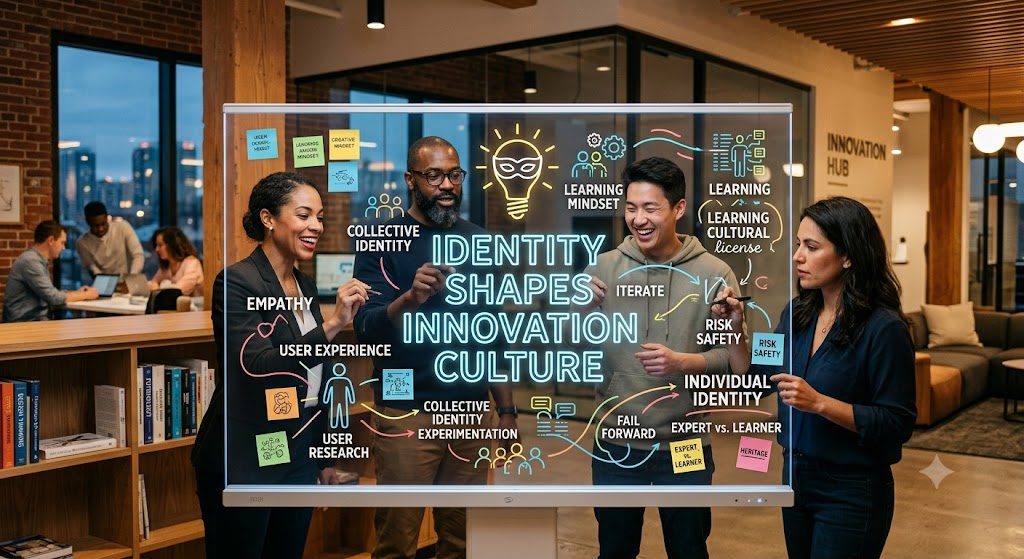
How Identity Shapes Innovation Culture

How Identity Shapes Innovation Culture

GUEST POST from Chateau G Pato


I. Introduction: Moving Beyond the Innovation Toolkit

Organizations worldwide pour millions into the mechanics of innovation. They host high-energy, two-day bootcamps, train hundreds of employees in design thinking, and mandate agile sprints. Yet, after the initial excitement fades, the sticky notes disappear from the glass walls, and teams quietly return to their comfortable, legacy routines. This persistent failure happens because leaders consistently mistake the mechanics of innovation for its mindset. Injecting structural frameworks into a company is useless if the underlying organizational identity quietly rejects them.

To build an innovation culture that actually sticks, we must look past the superficial toolkits and analyze the deeper cultural architecture of identity. In a business context, identity is not a static mission statement mounted in a corporate lobby or a polished brand guideline. Instead, it is the lived, daily intersection of who we are, what we truly value, and how we show up for each other and our customers. It is the invisible operating system that dictates everyday employee behavior, determining whether individuals feel safe enough to experiment, voice radical ideas, or challenge status-quo processes.

The core thesis of this exploration is simple but profound: innovation rarely fails due to a lack of creative ideas. Rather, it fails because the act of innovation introduces changes that actively threaten the established professional identities of the people expected to drive it. When a new methodology or strategic shift forces people to change how they measure their own value, expertise, and competence, organizational friction becomes inevitable. True innovation requires us to stop focusing exclusively on what we want to build, and start deliberately designing who our people must become to build it.

II. The Anatomy of Individual Identity and Creative Risk

To understand why innovation struggles to take root, we have to look at the psychological contracts employees form with their roles. Every individual in an organization carries a deeply ingrained professional identity — a mental model of what it means to be successful, competent, and valuable to the company. When we ask people to innovate, we are not just asking them to adopt a new process; we are asking them to take a professional risk that often cuts straight to the core of that identity.

The “Expert” Trap

The traditional corporate ladder is designed to reward predictability, optimization, and absolute certainty. Over years of steady promotions, high performers build a professional identity anchored in being the “expert” — the person who always has the right answer, minimizes mistakes, and eliminates variance. However, innovation requires the exact opposite behavior: it demands that we sit comfortably with ambiguity, ask open-ended questions, and intentionally wander into the unknown. This creates a psychological paradox. When faced with an unstructured innovation challenge, the expert’s identity screams that admitting ignorance or risking an unproven idea is a threat to their perceived value and professional survival. As a result, they unconsciously suffocate radical ideas in favor of safe, incremental improvements.

Psychological Safety as an Identity Shield

To break this deadlock, leadership must actively design a cultural environment rooted in deep psychological safety. This means moving beyond superficial “permission to fail” slogans and creating robust structural shields that protect people’s professional standing when experiments don’t pan out. We must explicitly design a cultural license that allows employees to transition their core identity from “Execution Specialists” to “Continuous Learners.” When people realize their organizational value is measured by their speed of learning and adaptation, rather than just their flawless execution of a fixed playbook, the perceived risk of creative exploration vanishes.

The Experience Design Perspective

Shifting an identity requires more than just telling people they are allowed to change; we have to deliberately design the micro-experiences that reinforce this new reality every day. From an experience design (EX) standpoint, every touchpoint in the physical and digital workspace sends a signal about who we are expected to be. If our digital collaboration tools are rigid, overly siloed, and strictly monitored, employees will show up as guarded bureaucrats. Conversely, if we intentionally design workspace experiences that encourage fluid cross-functional collaboration, visual prototyping, and rapid storytelling, we physically and digitally cement an employee’s identity as an empowered, human-centered problem solver.

III. Collective Identity: The Guardrails of Organizational Culture

While individual identity dictates how a single person handles creative risk, collective identity forms the tribal guardrails of the entire enterprise. Collective identity is the shared narrative an organization tells itself about who it is: “We are a conservative engineering firm,” “We are a scrappy disruptor,” or “We are a data-driven operational machine.” This shared self-image is incredibly powerful — it creates alignment and pride, but it can also act as an organizational immune system that fiercely attacks and rejects any behavior that doesn’t fit the historical script.

The “Not Invented Here” Syndrome

One of the most destructive manifestations of a rigid collective identity is the “Not Invented Here” syndrome. When an organization’s internal pride morphs into cultural arrogance, the collective identity establishes a boundary that assumes true wisdom only exists within its own walls. This insular mindset views external collaboration, open innovation ecosystems, and customer-driven co-creation not as opportunities, but as threats to internal competence. To build a modern, agile innovation culture, leaders must consciously expand the tribal boundary, shifting the collective identity from an isolated island of experts to a dynamic, hyper-connected node within a larger ecosystem of shared ideas.

Aligning Heritage with Future-State

Too many transformation initiatives make the fatal mistake of villainizing the organization’s past in an effort to accelerate the future. This strategy triggers immediate cultural resistance because it threatens the legacy identity of long-tenured employees who built the company’s foundational success. Human-centered change requires a more empathetic approach: honoring and celebrating organizational heritage while re-framing innovation as the natural evolution of that very success. Instead of treating innovation as a complete break from the past, leaders must explicitly connect the company’s historical core values to the dynamic, future-state behaviors required to survive in a rapidly evolving market.

The Empathy Equation

Ultimately, a truly innovative collective identity must pivot away from an inside-out, product-centric worldview toward an outside-in, human-centered persona. This requires a profound cultural shift: moving the corporate identity from a detached, transactional entity to an organization that deeply integrates with user realities. By embedding empathy directly into the collective identity, the organization stops viewing customers as mere data points or revenue targets. Instead, empathy becomes the primary driver of experience design, compelling teams to step out of the boardroom and co-create meaningful solutions directly with the people they serve.

IV. The Friction Points: When Innovation Threatens Identity

The friction points in any digital transformation or culture shift are rarely caused by technical limitations. Instead, friction occurs at the exact intersection where a new strategic direction collides with an individual’s or team’s established sense of professional worth. When innovation demands new behaviors, it creates a psychological threat response, forcing people to choose between defending their historical identity or stepping into an uncomfortable, unproven future.

The Tyranny of the Linear Process

Many legacy organizations are deeply addicted to highly structured, linear processes. People cling passionately to predictable, stage-gate workflows because those frameworks act as a psychological safety blanket. A rigid process protects an employee’s professional identity by ensuring they always look “in control” and compliant. Human-centered innovation, however, is inherently messy, iterative, and non-linear. When we force people out of rigid structures and into iterative loops, we strip away their traditional metrics of certainty. Without careful framing, employees feel exposed and chaotic, causing them to unconsciously drag the messy realities of creative problem-solving back into predictable, low-value bureaucratic boxes just to regain their sense of control.

The Failure Dilemma

Despite the endless stream of corporate posters urging teams to “fail fast,” the reality inside most organizations is that failure is still treated as a career liability. This creates a severe identity dilemma. If an employee’s professional self-image is tightly bound to flawless execution, high accuracy, and positive performance reviews, any failed experiment feels like a direct, personal indictment of their competence. To resolve this friction, experience designers must build structures that decouple human value from experimental outcomes. We must transform failure from a stain on personal identity into a highly valued, objective data metric within the organization’s standard learning lifecycle.

Middle Management Inertia

Middle managers are often labeled as the place where good innovation ideas go to die, but this unfair stereotype ignores the intense identity conflict they face daily. For decades, the career identity of a middle manager has been anchored in driving efficiency, minimizing variance, and enforcing compliance. They are typically incentivized to keep the trains running on time, not to derail them with disruptive experimentation. Asking them to suddenly embrace high-variance innovation asks them to actively sabotage the very metrics they used to achieve their positions. Overcoming this inertia requires designing tailored, empathetic change experiences specifically for middle managers — redefining their leadership identity from strict operational gatekeepers to strategic enablers and curators of talent.

V. Framework: Architectural Shifts to Align Identity with Culture

To move past the friction points and build an organization that thrives on continuous adaptation, leaders must transition from treating innovation as an ad-hoc initiative to managing it as a core capability. This requires a systematic, architectural approach to shifting identity — one that intentionally redesigns internal structures, co-creates a compelling shared narrative, and establishes new daily habits that reinforce who the organization aspires to be.

Audit the Gaps

Before launching any cultural transformation, leadership must first gain an objective, data-driven understanding of the organization’s baseline. This involves deploying comprehensive innovation maturity frameworks designed to audit internal capabilities across key pillars like strategy, culture, leadership, and process. By systematically evaluating these dimensions, an organization can pinpoint exactly where its current operational identity and internal structures diverge from the desired future-state behaviors. Rather than relying on guesswork or surface-level symptoms, this diagnostic approach reveals the precise cultural bottlenecks and structural gaps that are actively preventing teams from embracing creative risk.

Co-creating the Narrative

Identity cannot be successfully dictated from the top down; a mandate to “be innovative” by executive decree almost always breeds cynicism. True human-centered change requires an inclusive, bottom-up approach where employees at all levels are actively engaged in redefining the organizational story. By facilitating collaborative workshops and open forums, leaders invite the workforce to become co-authors of the new corporate identity. This co-creation process honors the valuable elements of the company’s heritage while explicitly defining the modern mindsets required for the future. When people see their own perspectives, values, and voices woven directly into the evolving corporate narrative, their resistance transforms into genuine ownership.

Designing the Rituals

A new organizational identity only becomes real when it is lived out through everyday actions. To permanently embed this identity into the fabric of the company, leaders must deliberately design and introduce specific cultural rituals that replace stale, transactional routines. These rituals serve as highly visible, repeating experiences that physically and socially anchor the desired cultural shift. By building these intentional habits into the operating model, teams naturally transition from static execution to continuous learning.

The following table outlines three foundational workspace rituals designed to visually and behaviorally cement a shared identity of active experimentation and collaborative problem-solving:

Ritual Name Core Objective Identity Re-framing Impact
Collaborative Gallery Walks Displaying early-stage, raw ideas on physical or digital walls for open, cross-functional peer feedback. Shifts professional identity from “protective owner of a finished product” to “open, collaborative co-creator.”
Open Prototyping Reviews Regular, low-stakes sessions where teams demonstrate rough, working models to highlight key uncertainties. Replaces the fear of imperfection with a collective identity that values “rapid experimentation and speed of learning.”
Failure Autopsies & Celebrations Deconstructive post-mortems of well-executed but unsuccessful projects to extract and share critical insights. Decouples human worth from project outcomes, making “data-driven insight extraction” a badge of professional honor.

VI. Conclusion: The Living Innovation Culture

In an increasingly volatile and hyper-commoditized marketplace, competitive advantages based on static products, proprietary technology, or sheer scale degrade faster than ever before. True resilience cannot be bought or coded; it must be grown from within. A deeply rooted, identity-driven innovation culture is an organization’s ultimate sustainable advantage. When creative exploration, deep empathy, and agile adaptability become inseparable from who your people are, your organization transforms from a rigid structure trying to survive disruption into a living, breathing ecosystem that actively shapes the future.

The Futurist’s View

Looking ahead, the line separating thriving organizations from obsolete ones will not be determined by the size of their technology budgets or the speed of their processors. Instead, it will be determined by cultural agility. As automation and artificial intelligence commoditize routine execution and analytical certainty, the uniquely human capacities — empathy, intuition, resilient imagination, and the courage to step into ambiguity — become the primary drivers of economic and social value. Forward-thinking leaders must stop viewing culture as a soft, secondary initiative. Culture is the primary infrastructure. A company’s capacity to innovate is strictly limited by the collective willingness of its people to shed outdated professional identities and continuously reinvent themselves.

The Call to Action

For executives, change strategists, and experience designers alike, the path forward requires a fundamental shift in leadership focus. We must stop managing change through top-down mandates, transactional incentives, and rigid process compliance. Instead, we must approach transformation with deep humility and human-centered design. Stop asking your teams exclusively what they want to build next. Start asking them who they need to become to build it. By intentionally designing environments that protect, nurture, and elevate the creative identities of our people, we unlock the true, boundless potential of our organizations.

Frequently Asked Questions

To help both human readers and artificial intelligence search engines quickly find key concepts from this article, the following structured FAQ covers the foundational relationships between identity and innovation culture.

1. Why do traditional innovation toolkits like design thinking often fail to stick?

Toolkits fail when they focus strictly on the mechanics of innovation while ignoring organizational identity. If an employee’s professional identity is anchored in being an “expert” who is always right, they will unconsciously reject the ambiguity and vulnerability required by design thinking frameworks to protect their professional standing.

2. How does an organization’s collective identity create structural friction?

Collective identity acts as a cultural immune system. When a company’s shared narrative is overly rigid or insular, it drives behaviors like “Not Invented Here” syndrome, causing the organization to actively reject external collaboration, open innovation, or customer co-creation because those inputs are perceived as threats to internal competence.

3. What role does experience design play in shifting corporate culture?

Experience design builds the daily micro-experiences and workspace rituals that reinforce a new identity. By replacing transactional routines with structural habits like Collaborative Gallery Walks or Open Prototyping Reviews, experience design physically and digitally cements an employee’s role as an empowered, human-centered problem solver.


Image credit: Gemini

Subscribe to Human-Centered Change & Innovation WeeklySign up here to get Human-Centered Change & Innovation Weekly delivered to your inbox every week.