
Tag Archives: human agency

Strengthen Your Human Agency to Thrive in the Age of AI

Strengthen Your Human Agency to Thrive in the Age of AI

GUEST POST from Robert B. Tucker

In a recent podcast, Sam Altman, CEO of OpenAI, was asked: “Who are the 20-something company founders of our era?” His response was telling: “They seem to be almost nonexistent. It’s not good. I hope this is just a weird accident of history. But something has really gone wrong.”

Actually, we do know what has gone wrong. In my just-released book, Build a Better Future: 7 Mindsets for Navigating the Age of Acceleration, I argue that what has gone wrong is a condition the futurist Alvin Toffler described 50 years ago: future shock. Too much change in too short a time. We are currently reeling under the pressure of so much political, technological, and social change. We are simply not ready for the profound changes just ahead.

While Silicon Valley tech “visionaries” promise that A.I. will bring quantum benefits in productivity, with our lives filled with abundance, superintelligence, and even a coming renaissance, other observers see a New Dark Age ahead for humanity.

Already, A.I. is responsible for the loss of tens of thousands of white-collar jobs, with more cuts on the way. On a recent edition of “60 Minutes,” Anthropic CEO Dario Amodei predicted that A.I. could wipe out half of all entry-level white-collar jobs, beginning with consulting firms, law firms, and financial service firms. Already, A.I. is not just helping employees with tasks; it is completing them.

For many young people, the age of A.I. is anything but abundant. The system seems rigged by robots and algorithms, and is a dizzying maze of complexity. The first rung on the ladder is missing entirely. There is little talk of the New Renaissance nor of A.I. as an enabler of human flourishing.

Instead, there’s bewilderment that we’ve travelled so far, so fast from that period in 2021 that came to be known as “The Great Resignation,” when 41 million Americans voluntarily left their jobs, exercising their agency to pursue new careers, start businesses, or follow their bliss.

Today, a leaner employment picture has taken hold. Large employers are shedding jobs at a pace not seen in years, shrinking career paths that once sustained middle-class families and long-term security. Nearly two million Americans have been out of work for six months or more, according to government data.

Consider the plight of job seekers today. For any open position, applicants are competing with hundreds of other job seekers on multiple job websites. For employers, A.I. performs the first few rounds of culling, so job seekers have no choice but to try and game the system. And when an interview is obtained, the exchange is often with a bot rather than a human being. The rejected applicant receives no feedback on which to hone their approach for the next opportunity.

AI did not set off these trends, but has exacerbated them. And combine AI with the “affordability crisis,” and you have a sense of why young people are often depressed and cynical.

People under the age of 40 are 24 percent less well off financially than a generation ago. Very few of them can afford a home, afford college, or pay off debilitating debt. Young men are especially challenged by the dawning age and are simply checking out instead. In five years, projections are that two women will graduate from college for every one man.

As AI changes how we work and how we add value, new mindsets will be needed. Meanwhile, problem-solving, critical thinking, and numeracy are in decline. A 2024 global assessment found that 34 percent of U.S. adults possess math skills below primary school level. One study noted that 45 percent of college students showed no significant gains in critical thinking, complex reasoning, or writing skills upon earning their four-year degree.

For many, “adulting” is becoming more difficult. Everything from paying bills on time to scheduling your own doctor’s appointments, keeping track of passwords, living within your means, cooking something that isn’t microwaved, and navigating modern life is what adulting entails. Young people often report struggling with these very tasks, especially relationship building. Surveys suggest nearly half of Americans have no close personal friends.

A key component of flourishing in the years ahead will be nurturing one’s human agency, or what people used to call motivation. By whatever name you call it, unleashing one’s agency to meet the challenge of hyper change will be essential to success in the Age of Acceleration.

Human agency is the capacity to act intentionally. It’s the ability and willingness to make choices and shape our own futures, rather than be controlled by circumstances. Human agency is the “make it happen” component in ourselves that is essential to navigating change, seizing opportunity, and building the future we most desire for ourselves.

Whatever we call it, it involves believing you can make your way in this world, and that “if it’s going to be, it’s up to me.” Start by noticing your thought patterns, replacing reactive thinking with intentional thinking. Practice self-management by asking, “What can I control here?” and acting on that. And you cultivate the conviction that your ideas and actions still matter — no matter the headlines. In an era of accelerating change, rediscovering and strengthening that sense of agency may be the most vital skill we can train ourselves to master.

When I speak to audiences of young people, I emphasize that we are not powerless. Even when it feels like the world is being driven by algorithms and A.I.-generated bots, your choice is to strive to become a fully functioning human being. Even when you’ve applied for a hundred jobs, been interviewed by bots, not by humans who gave you zero feedback, agency is a muscle. Agency is the belief that your choices matter.

Agency is the belief that if one door closes, another door opens, and it may turn out for the better.

This article originally appeared in Forbes

Image credit: Gemini

Subscribe to Human-Centered Change & Innovation WeeklySign up here to get Human-Centered Change & Innovation Weekly delivered to your inbox every week.
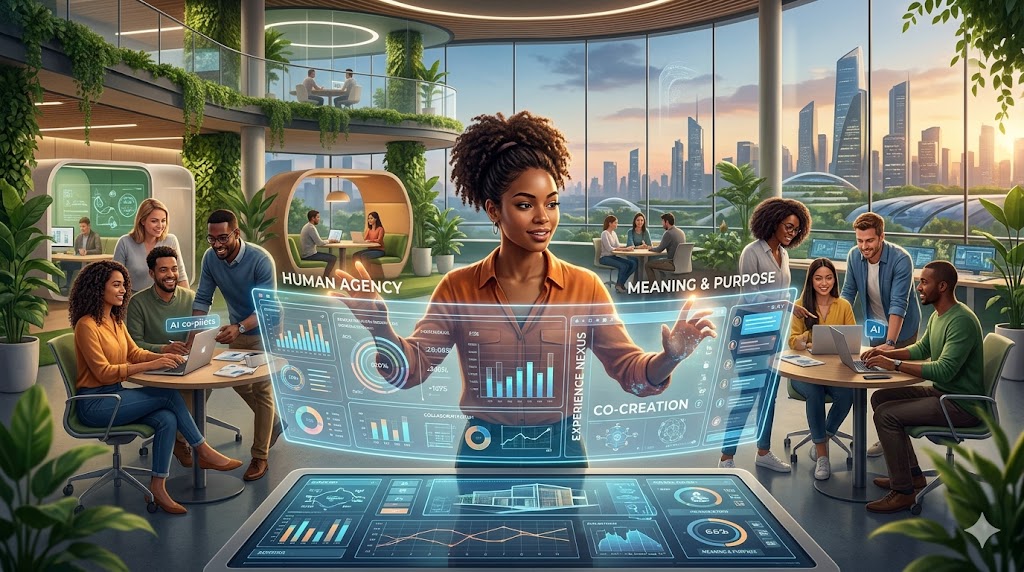
AI Should Expand Human Agency, Not Eliminate It

AI Should Expand Human Agency, Not Eliminate It

GUEST POST from Chateau G Pato


I. Introduction: The False Promise of Total Automation

The Efficiency Trap

In the relentless pursuit of operational speed and cost reduction, organizations frequently fall into a seductive trap: viewing Artificial Intelligence primarily through the lens of headcount reduction and task elimination. When decision-makers frame AI purely as an efficiency driver, they prioritize immediate labor savings over long-term capability building, systematically removing human judgment from core processes.

The Core Paradox

Eliminating human friction often inadvertently eliminates the very things that make organizations resilient: human context, empathy, nuance, and adaptive problem-solving. While hyper-automated systems can streamline repetitive workflows, they lack the intrinsic ability to navigate ambiguity, recognize ethical blind spots, or sense subtle shifts in human emotion and market dynamics.

A Human-Centered Vision

To capture the true promise of intelligence technologies, leaders must adopt a human-centered change perspective. We must shift the narrative away from AI-driven replacement and pivot toward AI-augmented empowerment—positioning technology not as a substitute for human intent, but as an extraordinary amplifier of human capability.

II. Redefining Agency in the Age of Intelligence

What Human Agency Truly Means

Human agency is the fundamental capacity of individuals to act independently, make intentional choices, and exercise meaningful control over their work and decisions. In an era dominated by algorithmic recommendations and automated workflows, preserving agency requires safeguarding two essential pillars:

  • Intentionality and Autonomy: The freedom to set goals, determine direction, and make final decisions rather than blindly following machine-generated prompts.
  • Critical and Creative Synthesis: Leveraging deep domain expertise to challenge assumptions, interpret contextual nuances, and inject original creative thinking where algorithms only see historical data patterns.

The Spectrum of AI Integration

To design systems that respect human capability, organizations must understand where their technology implementations land along the continuum of human-AI collaboration:

  • Automation (Task Execution): The system performs repetitive, low-variance tasks without direct human intervention. While valuable for administrative routine, over-extending automation into complex decision-making creates severe operational fragility.
  • Augmentation (Capability Expansion): The sweet spot of human-centered innovation. AI acts as a thought partner, surfacing insights, reducing cognitive load, and expanding clarity so humans can make better, faster, and more informed choices.
  • Agency Erasure (Autonomous Lockout): The failure state where systems make self-executing decisions that bypass human oversight entirely, stripping workers of autonomy and disconnecting organizations from critical feedback loops.

III. Human-Centered Innovation: Designing AI for Capability Expansion

Co-Creation over Replacement

True innovation begins by designing technology around human needs rather than forcing human workflows to conform to algorithmic constraints. Too often, AI implementations are dictated from the top down and optimized for executive dashboards, leaving frontline teams with tools that feel rigid or adversarial. A human-centered methodology engages frontline practitioners as co-designers, ensuring AI integration actively supports daily decision-making, respects tacit knowledge, and solves real operational friction points.

Expanding the Horizon of What’s Possible

When thoughtfully applied, AI acts as a equalizer and an accelerator across every layer of an organization:

  • Democratizing Expertise: Generative systems and intelligent assistants allow team members to bridge skills gaps, empowering generalists to execute complex tasks safely while accelerating learning curves.
  • Elevating Strategic Mastery: By absorbing routine analysis and administrative overhead, AI frees experienced specialists to focus on high-order strategic challenges, system design, and creative breakthrough.
  • Accelerating Iteration Loops: In experience design and continuous innovation, AI drastically compresses the time needed to prototype, test hypotheses, and gather feedback, allowing teams to explore a far broader space of possibilities.

Preserving the “Human at the Helm”

Moving beyond the passive “human in the loop” model, organizations must champion a “human at the helm” architecture. Systems should be designed so that algorithms propose, analyze, and enrich options, but humans retain the authority, ethical responsibility, and contextual awareness required to make the ultimate calls.

IV. The Experience Design Imperative (CX/EX)

Employee Experience (EX): Unlocking Flow and Meaning

An organization’s capacity for innovation is directly tied to the quality of its employee experience. When AI is deployed with empathy, it serves as an invisible assistant that removes administrative drudgery—routine reporting, tedious data entry, and schedule coordination—allowing people to enter state-of-flow work where creativity and critical problem-solving thrive.

Conversely, experience design fails when AI is used to enforce “algorithmic surveillance” or overly rigid micro-workflows. Pushing employees into tightly monitored, machine-paced environments erodes autonomy, stifles initiative, and breeds burnout. System designers must ensure AI enhances psychological safety and job satisfaction, rather than turning workers into cog-like extensions of an algorithm.

Customer Experience (CX): Preserving Empathy in Automation

In customer experience design, efficiency should never come at the expense of human connection. While AI-driven self-service portals and intelligent assistants can resolve routine requests instantly, over-automated service architectures often leave customers stranded when complex, emotionally charged issues arise.

A human-centered CX framework leverages predictive analytics and AI insights to enhance, rather than replace, human interaction:

  • Smart Escalation: Seamlessly transferring customers from automated systems to human agents with full context, enabling empathetic and informed support without repeating information.
  • Empowered Choice: Utilizing intelligent personalization to provide customers with expanded options and greater clarity, giving them control over their journey rather than forcing them down algorithmic funnels.

V. Managing the Change: Human-Centered Organizational Transformation

Overcoming Fear & Resistance Through Psychological Safety

The greatest barrier to successful AI adoption is rarely technical capability; it is human anxiety. When leadership introduces AI through top-down mandates focused purely on productivity metrics, employees naturally perceive the technology as a precursor to displacement. Human-centered change management flips this narrative by establishing psychological safety first. Leaders must communicate transparently about the purpose of AI integration, actively involve employees in defining their new toolsets, and reassure teams that AI is being deployed to augment their value, not undermine their security.

Upskilling for Flourishing and High-Order Impact

Preparing an organization for an AI-augmented future requires far more than technical software training. Organizations must invest in cultivating the distinctly human capabilities that machines cannot replicate:

  • Critical Evaluation & Algorithmic Literacy: Teaching teams how to question AI outputs, identify hallucinated or biased data, and apply rigorous context before acting on machine recommendations.
  • Complex Problem-Solving & Systems Thinking: Developing the capability to connect disparate ideas, understand cross-functional impacts, and navigate ambiguous challenges.
  • Ethical Judgment & Emotional Intelligence: Elevating skills in empathy, relationship building, and moral reasoning to ensure technology serves human needs responsibly.

Cultural Alignment: AI as Partner, Not Replacement

Sustainable transformation requires a cultural shift in how employees view their relationship with technology. Organizations must foster an environment of continuous experimentation, where workers are encouraged to treat AI as a collaborative thought partner. When team members realize that intelligent tools can absorb repetitive burdens and give them room to execute higher-value, more rewarding work, the prevailing posture shifts from defensive resistance to proactive innovation.

VI. Futurology & Governance: Architecting an Agency-Centric Future

Ethical Guardrails & Transparency

To ensure AI serves human agency over the long term, governance structures must move beyond passive compliance and focus on active explainability and accountability. Algorithmic decision-making must never exist as a black box. Systems should be designed so that human operators can easily trace machine logic, audit underlying data biases, and challenge or override automated decisions when contextual or ethical boundaries are crossed. Transparency is the bedrock of trust, and trust is non-negotiable when building sustainable human-machine partnerships.

Scenario Planning for Human Agency

As organizations look toward the future, the strategic choices made today will determine which path society and commerce take:

  • Path A (The Automation Trap): Hyper-centralized automation that treats humans as costly friction points. This trajectory leads to severe skill atrophy, reduced workforce initiative, systemic fragility, and environments where employees simply follow machine instructions without understanding or oversight.
  • Path B (The Human-Centered Paradigm): Decentralized augmentation that treats AI as a cognitive catalyst. This trajectory unleashes unprecedented human creativity, accelerates innovation, preserves organizational adaptability, and elevates work into higher spheres of purpose and impact.

The Call to Action for Leaders

Path B will not happen by accident; it requires intentional choice and courageous leadership. Executives, experience designers, and innovation leaders must actively decide to design systems, construct workflows, and build cultures that place human agency at the center. The future of work is not something that happens to us—it is something we intentionally architect.

VII. Conclusion: The Ultimate Goal of Innovation

Redefining Progress in the Intelligent Era

True innovation has never been about how much human effort we can eliminate; it is about how much human potential we can unlock. As Artificial Intelligence becomes deeply woven into the fabric of enterprise and daily life, our primary measure of success must shift away from total automation toward meaningful human flourishment. Technology should lighten our cognitive burdens, expand our horizons, and sharpen our capacity to create, decide, and connect.

Unlocking Elevated Human Potential

The ultimate trajectory of AI should not be defined by the jobs or roles it displaces, but by the elevated quality of human agency, experience, and progress it enables. By intentionally designing systems that keep humans empowered at the helm, organizations can build a future that is not only more efficient and innovative, but fundamentally more humane, resilient, and adaptive.

Frequently Asked Questions

Why should AI focus on expanding human agency rather than full automation?

Full automation often removes critical human context, empathy, nuance, and adaptive problem-solving from processes. Expanding human agency through AI augmentation positions technology as a force multiplier—enhancing human decision-making, creativity, and strategic capabilities while keeping people accountable and in control.

What is the difference between AI augmentation and AI replacement?

AI replacement eliminates human involvement by fully automating tasks and decisions, often leading to agency erasure and skill atrophy. AI augmentation, by contrast, acts as a collaborative thought partner that reduces administrative drudgery, democratizes expertise, and helps humans make faster, more informed choices.

How can leaders implement AI while preserving psychological safety in their teams?

Leaders should adopt a human-centered change approach by involving frontline employees as co-designers of AI workflows, transparently communicating the goal of augmentation over displacement, and investing in upskilling around critical evaluation, systems thinking, and ethical judgment.


SPECIAL BONUS: Braden Kelley’s Problem Finding Canvas can be a super useful starting point for doing design thinking or human-centered design.

“The Problem Finding Canvas should help you investigate a handful of areas to explore, choose the one most important to you, extract all of the potential challenges and opportunities and choose one to prioritize.”

Image credit: Gemini

Subscribe to Human-Centered Change & Innovation WeeklySign up here to get Human-Centered Change & Innovation Weekly delivered to your inbox every week.