
Tag Archives: transformation

A Different Approach to Well-being, Resilience and Creativity

A Different Approach to Well-being, Resilience and Creativity

GUEST POST from Janet Sernack

In our previous blogs, we outlined the need, in our chaotic world of unknowns, to reclaim our focus and attention and take charge of our own minds. By reclaiming these, and enhancing self-awareness we have a deeper understanding of the sources of our anxiety and distractions.  How to self-manage and self-regulate them through developing deliberate calm. To effectively create consciousness, and a safe space that potentially transforms the power of our minds and hearts to connect with others, cultivate well-being, harness people’s collective genius, and generate our resilience, through thinking about creativity differently.

Transforming fear and alarm

This mobilizes the energy our fears, anxiety, and alarm provide to transform the power of our minds and develop physical and psychological well-being. We can then apply proven neuroscience principles and coaching practices to cultivate resilience and think about creativity differently.

Transforming our fears and alarm in this way increases our resilience in responding to events in real-time, anticipating future events, and processing learning’s post events. It also enhances our well-being and creativity to enable us to be courageous and compassionate when inventing and innovating in an uncertain and constantly changing environment.

The potential outcomes include people experiencing more positive emotions, increased engagement at work, increased development of positive relationships, and more meaningful and purposeful work. These help us be adaptive, and transform the power of our hearts and minds to be creative, accomplish, learn, adapt, grow, and innovate through disruption.

Well-being is in crisis

In the latest report, by Udemy on “Workplace Learning Trends” they compare data collected from Australian workers (human capital) in early September 2022 with previous surveys in November 2019, August 2020, and May 2021.

They discovered three surprising truths about well-being, including:

  • Workers’ resilience levels are waning. More than two-thirds of workers (68.5%) felt like they were burning out at work. This is impacting workers’ levels of performance, job satisfaction, and commitment.
  • There is a crisis for meaningful work Only 39.1% of workers said their work was valuable and worthwhile, versus 47% in 2021, and 52.9% in 2020.
  • Many workplaces are wasting their well-being Workplaces have too much invested in EAP services (which are proving only slightly more effective than doing nothing) and not enough in more effective tools that workers are more comfortable accessing like Wellbeing Artificial Intelligence Bots, Wellbeing Apps, Wellbeing Workshops and Wellbeing Coaching.

This reinforces the need to think and act differently when we approach cultivating well-being, resilience, and creativity to better realize our human potential and human skills in times when they are our most valuable assets and needed the most and are crucial to future success!

Developing deliberate calm

“Deliberate calm” involves developing a practice of adaptive, intentional choices that anyone can develop by embracing what was once regarded as “soft” stuff: self-awareness, emotional intelligence, and mindfulness to learn proactively and lead dynamically amid the most uncertain circumstances, where according to Aaron De Smet, the co-author of “Deliberate Calm: How to Learn and Lead in a Volatile World”:

“Why do we say “deliberate”? Because if you’re not deliberate about it you will probably freak out. I need to be very deliberate in knowing that I’m in a chaotic situation, knowing the stakes are high, knowing there’s a lot of uncertainty, and then deliberately calming myself down and taking stock”.

Deliberate calm looks at the inner world, the outer world, the context, and the dynamic between those and starts by slowing down to create a safe space for people to enjoy the benefits of deliberate calm.  This helps activate, focus, and unleash our creative brains and facilitates thinking about creativity differently.

Hitting our pause buttons

Creating deliberate calm is one of the most critically urgent human skill sets to develop.

It involves creating for ourselves and co-creating, with others, more normalized states of equilibrium and calmness. This enables us to cultivate our physical and psychological well-being, develop resilience and unleash creativity differently by accessing our collective intelligence, skills, and experience through applying proven neuroscience principles and coaching practices.

It starts with initiating a habit of pausing long enough to take deep breaths, retreat, reflect, and access these inner parts of ourselves; including noticing our emotions, identifying our triggers, observing our physical reactions to normalize our equilibrium, coherence, and calmness, and focusing on thinking about creativity differently.

Re-appraising our situation

We can then reappraise what is really going on, by identifying what our emotions are telling us, sustaining the most resourceful emotions and letting negative ones go, and finally, by identifying the key options for taking positive actions. Ultimately take smarter risks, make smarter decisions, and take more intelligent actions that cultivate our well-being, develop our resilience, unleash creativity differently, and satisfy our desire for meaning, purpose, and accomplishment.

As evidenced by our global coaching practice, this personally empowering and energizing activity focuses our attention, minds, and hearts on what really matters, and on what we can truly influence and control in a world of unknowns, and engages people deeply in doing the value-adding, productive and meaningful work that delivers it.

Three new deliberate calming practices to access and unleash our creative brains

  • Being grounded: involves being fully embodied, whole, centered, and balanced in ourselves and our relationships, we are in complete control of our mental, physical, and emotional selves, and are not easily influenced or shaken by other ideas or individuals.
  • Our unconscious mind, through our brains’ default mode network (DMN), is freed to wander, and be spontaneous in emerging and generating novel and surprising ideas and patterns.

This is usually achieved by regularly practicing a range of very simple activities that help us get centered, including removing any distractions (mobile phones), deep breathing (box breathing), and slow grounding repetitive exercises such as Feldenkrais.

  • Being mindful: involves focusing our conscious attention on the present moment, our physical sensations, thoughts, and emotions in an accepting, nonjudgmental, and discerning way. It involves training our unconscious minds to notice, focus and pay deep attention to what is really going on, for ourselves, for others, and in the system, we are operating within.
  • Our conscious minds are now provided with the focus necessary for guided problem-solving and for identifying the actions required to deliver the desired outcomes.

This is usually achieved by simple activities, by directing your focus when walking during the day (in nature without headsets), yoga, swimming, golf, tennis, listening to music, cooking, or by simple mindful meditation practices.

  • Being conscious: involves being in the present moment, or fully in the “here and now,” and means that we are grounded, fully aware, and mindful of what is happening at every moment because we are now consciously aware and able to shift our minds and generate creative thinking strategies.
  • Our conscious minds are able to exploit possibilities and make sense of the ideas that surface in the mind-wandering phase, by accessing the salience network, which then recruits the executive control networks, in our brains to refine and develop an idea. We can then exploit the range of creative ideas to make unexpected connections and to emerge, diverge and converge novel ideas for thinking about creativity differently, as well as for smart risk-taking, decision-making, and innovative problem-solving.

Empowering people to envision and transform

Creating a safe space, to transform the power of our minds and hearts to connect with others cultivates our well-being, harnesses peoples’ collective genius, generates resilience, and unleashes creativity by thinking about creativity differently.

This manifests as an opportunity to empower people to plan and make the nudges necessary to kickstart change, envision and plan for the future of unknowns.

Rather than unintentionally colluding with their unconscious panicking and retreating from the fears, anxiety, and risks currently emerging in an uncertain world full of disruption and crises.

Find out about our collective, learning products and tools, including The Coach for Innovators, Leaders, and Teams Certified Program, presented by Janet Sernack, is a collaborative, intimate, and deeply personalized innovation coaching and learning program, supported by a global group of peers over 9-weeks, starting Friday, May 12, 2023.

It is a blended and transformational change and learning program that will give you a deep understanding of the language, principles, and applications of an ecosystem focus, human-centric approach, and emergent structure (Theory U) to innovation, and upskill people and teams and develop their future fitness, within your unique innovation context.

Image Credit: Pixabay

Subscribe to Human-Centered Change & Innovation WeeklySign up here to join 17,000+ leaders getting Human-Centered Change & Innovation Weekly delivered to their inbox every week.

How Has Innovation Changed Since the Pandemic?

The Answer in Three Charts

How Has Innovation Changed Since the Pandemic?

GUEST POST from Robyn Bolton

“Everything changed since the pandemic.”

At this point, my husband, a Navy veteran, is very likely to moo (yes, like a cow). It’s a habit he picked up as a submarine officer, something the crew would do whenever someone said something blindingly obvious because “moo” is not just a noise. It’s an acronym – Master Of the Obvious.

But HOW did things change?

From what, to what?

So what?

It can be hard to see the changes when you’re living and working in the midst of them. This is why I found “Benchmarking Innovation Impact, from InnoLead,” a new report from InnoLead and KPMG US, so interesting, insightful, and helpful.

There’s lots of great stuff in the report (and no, this is not a sponsored post though I am a member), so I limited myself to the three charts that answer executives’ most frequently asked innovation questions.

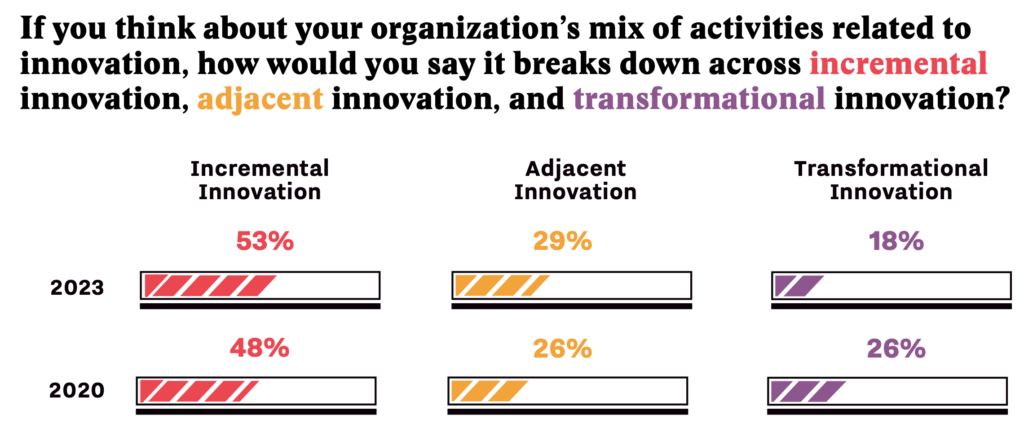
Innovation Leader Research 2023 Chart 1

Question #1: What type of innovation should I pursue?

2023 Answer: Companies are investing more than half of their resources in incremental innovation

So What?:  I may very well be alone in this opinion, but I think this is great news for several reasons:

  1. Some innovation is better than none – Companies shifting their innovation spending to safer, shorter-term bets is infinitely better than shutting down all innovation, which is what usually happens during economic uncertainty
  2. Play to your strengths – Established companies are, on average, better at incremental and adjacent innovation because they have the experience, expertise, resources, and culture required to do those well and other ways (e.g., corporate venture capital, joint ventures) to pursue Transformational innovation.
  3. Adjacent Innovation is increasing –This is the sweet spot for corporate innovation (I may also be biased because Swiffer is an adjacent innovation) because it stretches the business into new customers, offerings, and/or business models without breaking the company or executives’ identities.

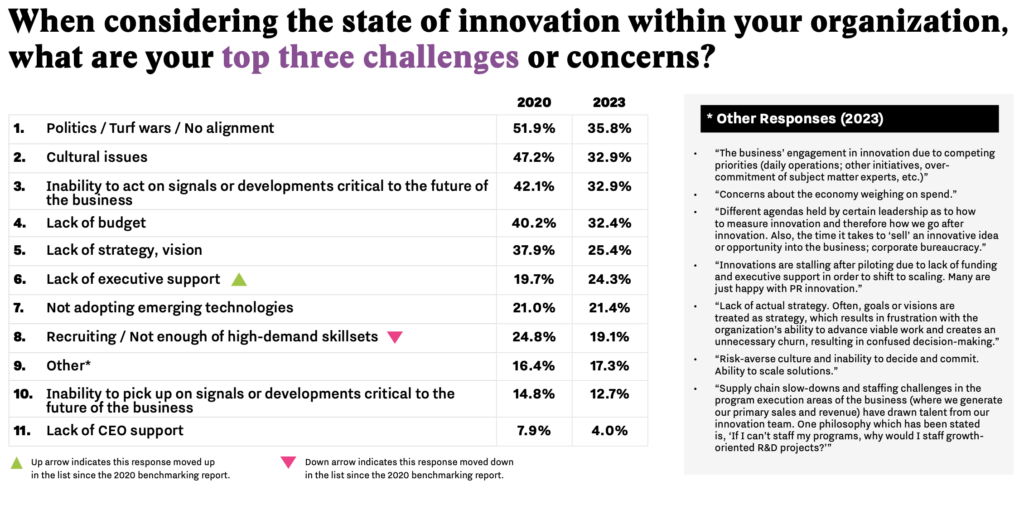
Innovation Leader Research 2023 Chart 2

Question #2: Is innovation really a leadership problem (or do you just have issues with authority)?

2023 Answer: Yes (and it depends on the situation). “Lack of Executive Support” is the #6 biggest challenge to innovation, up from #8 in 2020.

So What?: This is a good news/bad news chart.

The good news is that fewer companies are experiencing the top 5 challenges to innovation. Of course, leadership is central to fostering/eliminating turf wars, setting culture, acting on signals, allocating budgets, and setting strategy. Hence, leadership has a role in resolving these issues, too.

The bad news is that MORE innovators are experiencing a lack of executive support (24.3% vs. 19.7% in 2020) and “Other” challenges (17.3% vs. 16.4%), including:

  • Different agendas held by certain leadership as to how to measure innovation and therefore how we go after innovation. Also, the time it takes to ‘sell’ an innovative idea or opportunity into the business; corporate bureaucracy.”
  • Lack of actual strategy. Often, goals or visions are treated as strategy, which results in frustration with the organization’s ability to advance viable work and creates an unnecessary churn, resulting in confused decision-making.”
  • “Innovations are stalling after piloting due to lack of funding and executive support in order to shift to scaling. Many are just happy with PR innovation.”

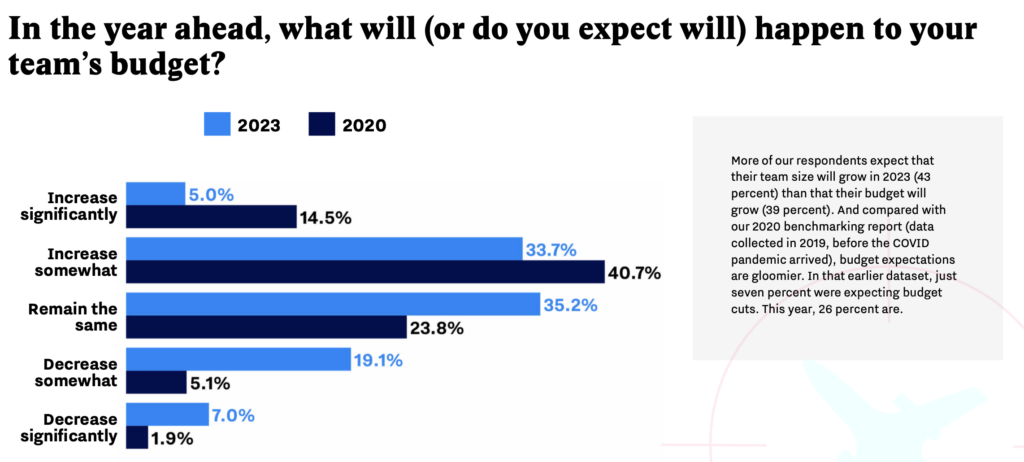
Innovation Leader Research 2023 Chart 3

Question #3: How much should I invest in innovation?

2023 Answer: Most companies are maintaining past years’ budgets and team sizes.

So What?:  This is another good news/bad news set of charts.

The good news is that investment is staying steady. Companies that cut back or kill innovation investments due to economic uncertainty often find that they are behind competitors when the economy improves. Even worse, it takes longer than expected to catch up because they are starting from scratch regarding talent, strategy, and a pipeline.

The bad news is that investment is staying steady. If you want different results, you need to take different actions. And I don’t know any company that is thrilled with the results of its innovation efforts. Indeed, companies can do different things with existing budgets and teams, but there needs to be flexibility and a willingness to grow the budget and the team as projects progress closer to launch and scale-up.

Not MOO

Yes, everything has changed since the pandemic, but not as much as we think.

Companies are still investing in incremental, adjacent, and transformational innovation. They’re just investing more in incremental innovation.

Innovation is still a leadership problem, but leadership is less of a problem (congrats!)

Investment is still happening, but it’s holding steady rather than increasing.

And that is nothing to “moo” at.

Image credits: Pixabay, InnoLead

Subscribe to Human-Centered Change & Innovation WeeklySign up here to join 17,000+ leaders getting Human-Centered Change & Innovation Weekly delivered to their inbox every week.
Innovation and the Silicon Valley Bank Collapse

Why It’s Bad News and Good News for Corporate Innovation

Innovation and the Silicon Valley Bank Collapse

GUEST POST from Robyn Bolton

Last week, as news of Silicon Valley Bank’s losses and eventual collapse, took over the news cycle, attention understandably turned to the devastating impact on the startup ecosystem.

Prospects brightened a bit on Monday with news that the federal government would make all depositors whole. Startups, VCs, and others in the ecosystem would be able to continue operations and make payroll, and SVB’s collapse would be just another cautionary tale.

But the impact of SVB’s collapse isn’t confined to the startup ecosystem or the banking industry.

Its impact (should have) struck fear and excitement into the hearts of every executive tasked with growing their business.

Your Portfolio’s Risk Profile Just Changed

The early 2000s were the heyday of innovation teams and skunkworks, but as these internal efforts struggled to produce significant results, companies started looking beyond their walls for innovation. Thus began the era of Corporate Venture Capital (CVC).

Innovation, companies realized, didn’t need to be incubated. It could be purchased.

Often at a lower price than the cost of an in-house team.

And it felt less risky. After all, other companies were doing it and it was a hot topic in the business press. Plus, making investments felt much more familiar and comfortable than running small-scale experiments and questioning the status quo.

Between 2010 and 2020, the number of corporate investors increased more than 6x to over 4,000, investment ballooned to nearly $170B in 2021 (up 142% from 2020), and 1,317 CVC-backed deals were closed in Q1 of 2020.

But, with SVB’s collapse, the perceived risk of startup investing suddenly changed.

Now startups feel riskier. Venture Capital firms are pulling back, and traditional banks are prohibited from stepping forward to provide the venture debt many startups rely on. While some see this as an opportunity for CVC to step up, that optimism ignores the fact that companies are, by nature and necessity, risk averse and more likely to follow the herd than lead it.

Why This is Bad News

As CVC, Open Innovation, and joint ventures became the preferred path to innovation and growth, internal innovation shifted to events – hackathons, shark tanks, and Silicon Valley field trips.

Employees were given the “freedom” to innovate within a set time and maybe even some training on tools like Design Thinking and Lean Startup. But behind closed doors, executives spoke of these events as employee retention efforts, not serious efforts to grow the business or advance critical strategies.

Employees eventually saw these events for what they were – innovation theater, activities designed to appease them and create feel-good stories for investors. In response, employees either left for places where innovation (or at least the curiosity and questions required) was welcomed, or they stayed, wiser and more cynical about management’s true intentions.

Then came the pandemic and a recession. Companies retreated further into themselves, focused more on core operations, and cut anything that wouldn’t generate financial results in 12 months or less.

Innovation muscles atrophied.

Just at the moment they need to be flexed most.

Why This is Good News

As the risk of investment in external innovation increases, companies will start looking for other ways to innovate and grow. Ways that feel less risky and give them more control.

They’ll rediscover Internal Innovation.

This is the silver lining of the dark SVB cloud – renewed investment in innovation, not as an event or activity to appease employees, but as a strategic tool critical to delivering strategic priorities and accelerating growth.

And, because this is our 2nd time around, we know it’s not about internal innovation teams OR external partners/investments. It’s about internal innovation teams AND external partners/investments.

Both are needed, and both can be successful if they:

  1. Are critical enablers of strategic priorities
  2. Pursue realistic goals (stretch, don’t splatter!)
  3. Receive the people and resources required to deliver against those goals
  4. Are empowered to choose progress over process
  5. Are supported by senior leaders with words AND actions

What To Do Now

When it comes to corporate innovation teams, many companies are starting from nothing. Some companies have files and playbooks they can dust off. A few have 1 or 2 people already working.

Whatever your starting point is, start now.

Just do me one favor. When you start pulling the team together, remember LL Cool J, “Don’t call it a comeback, I been here for years.”

Image credit: Wikimedia Commons

Subscribe to Human-Centered Change & Innovation WeeklySign up here to join 17,000+ leaders getting Human-Centered Change & Innovation Weekly delivered to their inbox every week.
Take Charge of Your Mind to Reclaim Your Potential

Take Charge of Your Mind to Reclaim Your Potential

GUEST POST from Janet Sernack

In our recent blog, we explored how our focus and attention have been stolen, and how our ability to pay attention is collapsing and described why we need to be intentional in reclaiming it. Yet, many of us are constantly challenged by very short attention spans, where we can often be found sitting at our desks, dealing with a range of very urgent deadlines with a distracted, and unfocussed mind. Despite being intrinsically motivated to meet our deadlines, and being self-aware of needing to focus on completing the tasks in front of us, many of us often still struggle to disrupt and stop our thoughts from wandering randomly and haphazardly. Because, we are no longer being in charge of our minds, our time, or of our cognitive capacities and abilities that help us self-regulate, concentrate and focus our attention, kickstart change, innovate and become resilient.

A recent article in Psychology Today “The War For Your Attention” reinforces this problem by stating:

 “We live in a time when attention has become our most valuable asset, one for which multiple stakeholders are competing. Political parties, media outlets, companies, and individuals want a share of it, and if they can have it, they want it all. As a result, remaining in charge of our minds has become a daily challenge. Our attention defines our experience, which sets the mindset of our minds”.

Become Resilient

Because we don’t know if companies will ever return to their pre-pandemic-like worlds, and what new technologies will emerge, we need to become resilient to be future-fit, in this new world of unknowns.

This requires people to unlearn some of their less resourceful “bad pre and post-pandemic habits” and be:

  • Open towards relearning and reskilling in how to focus, concentrate and observe, and how to manage, direct and expand our attention spans.
  •  Intentional, outcome-focused, and therefore, effective, agile, adaptive, and resilient in an uncertain world full of disruption and crises.

This is reinforced by a recent article “Seizing the momentum to build resilience for a future of sustainable inclusive growth” by McKinsey & Co:

“In the past year, leaders have been confronted with a lifetime’s worth of disruption and crises: global conflict, energy uncertainty, food shortages, accelerating inflation, and severe climate events. Natural and human-made disruptions will only persist. To enable long-term, sustainable, and inclusive growth, today’s business leaders and policymakers must strengthen resilience beyond a survival capacity.”

  • From surviving to thriving

The nature and speed of change are not going to slow down, at the same time, our uncertain world full of disruption and crises is having a harsh psychological toll on everyone, impacting negatively on people’s states of emotional and physical health.

If we want people to thrive, we have to start helping people to live better than we ever have.

Taking the first baby steps requires people to confidently and courageously be, think and act differently.

Starting with empowering and enabling people to take charge of their hearts and minds, and commit to focusing their attention on building their resilience.

The Switch-Cost Effect

In his best-selling book Johann Hari – Stolen Focus, describes how Professor Earl Miller, a specialist in neuroscience, at the Massachusetts Institute of Technology, states that “our brains can only produce one or two thoughts” in our conscious minds at once.

Because “we are very, very single-minded” and have “very limited cognitive capacity.”

  • Multi-tasking is an illusion

The delusion that we can multitask, or juggle a number of thoughts and activities at the same time, is revealed, through robust research, as actually “switching, back and forth.”

He states that we don’t notice the switching because:

“Our brain sort of papers it over to give a seamless experience of consciousness, but what they’re actually doing is switching and reconfiguring their brain moment-to-moment, task-to-task – which comes with a cost.”

  • Losing time to refocus

This is described as the “switch-cost effect” and means that every time we switch tasks while trying to work, we are actually losing a huge amount of time required to concentrate and manage our attention spans to refocus afterward.

“For example, one study at Carnegie Mellon University’s human-computer interaction lab took 136 students and got them to sit a test. Some of them had to have their phones switched off, and others had their phones on and received intermittent text messages. The students who received messages performed, on average, 20% worse. It seems to me that almost all of us are currently losing that 20% of our brainpower, almost all the time. Miller told me that as a result we now live in “a perfect storm of cognitive degradation”.

Reducing Cognitive Degradation

There are a number of simple and obvious ways to reduce our cognitive degradation and heal our unconscious “attention deficit syndromes”, and cognitively reappraise to be in charge of our minds, concentrate and effectively manage our attention spans.

It is also the first step we need to take to empower and enable ourselves and others, in taking charge of our hearts and minds and demonstrating our commitment to focusing our attention and becoming initially resilient.

These simple actions require us to be self-disciplined, methodical, and rigorous and open to re-learning how to concentrate and self-regulated our attention spans by habitually:

  • Stripping out distractions,
  • Ceasing to multi-task,
  • Getting more quality sleep,
  • Taking regular short breaks,
  • Doing brain exercises,
  • Doing physical exercises,
  • Listening to music,
  • Setting priorities,
  • Using a timer.

How to be in charge of our own minds

If we want to cultivate a calmer, coherent, and resourceful psychological state, to achieve the outcomes we want to have in our lives, then focus and place our attention on both what we want to manifest (our intention), and on what we want your attention to move away from, to cease.

  • Attention activates

When choosing to consciously slow down, hit our pause buttons, and retreat into stillness and silence, opens the sacred space, that allows us to reflect, focus and pay deeper attention to the impact of our emotions and beliefs on our thoughts.

We can then also attend to, and break down any unresourceful beliefs, emotions, and cognitive distortions about what we can really and truly influence and control to:

  • Create a more normalised state of equilibrium and calm, get grounded and fully present and manage our attention spans to concentrate on what really matters to us, in ways that are self-compassionate and optimistic about the future.
  • Support ourselves by believing that we can succeed in handling our situations, responsibly, creatively, and effectively.
  • Become resilient by knowing how to respond to events in real-time, anticipate events and problems that may occur in the future, and bounce from adversity whilst processing the insights and learnings gained by conquering key challenges.

Developing Resilience

We can then be in charge of our minds, become resilient, and create a safe space and generosity for others to fully show up and connect with us. We can open our eyes, minds, and hearts to all options, unleash possibilities and opportunities, make smart change choices, and innovate, rather than panicking and retreating from the risks emerging in an uncertain world full of disruption and crises.

Find out about our collective, learning products and tools, including The Coach for Innovators, Leaders, and Teams Certified Program, presented by Janet Sernack, is a collaborative, intimate, and deeply personalized innovation coaching and learning program, supported by a global group of peers over 9-weeks, starting Friday, May 12, 2023.

Image Credit: Pixabay, Pexels

Subscribe to Human-Centered Change & Innovation WeeklySign up here to join 17,000+ leaders getting Human-Centered Change & Innovation Weekly delivered to their inbox every week.

The Life of a Corporate Innovator

As Told in Three Sonnets

The Life of a Corporate Innovator

GUEST POST from Robyn Bolton

Day 1

Oh innovation, a journey just begun

A bold quest filled with challenges, risks, and dreams,

A path of creativity, knowledge and fun,

That will bring change, growth and a brighter scene.

Do not be afraid, though unknowns abound,

For greatness starts with small unsteady steps

Take courage and embrace each change that’s found,

And trust that success will be the final event.

Remember, every challenge is a chance,

To learn, grow, and shape thy future bright,

And every obstacle a valuable dance,

That helps thee forge a path that’s just and right.

So go forth, my friend, and boldly strive,

To make innovation flourish and thrive.

The Abyss (Death and Rebirth)

Fight on corporate innovator, who art so bold

And brave despite the trials that thou hast,

Thou hast persevered through promises cold,

And fought through budget cuts that came so fast.

Thou hast not faltered, nor did thou despair,

Despite the lack of resources at thy door,

Thou hast with passion, worked beyond repair,

And shown a steel spine that’s hard to ignore.

Thou art a shining example to us all,

A beacon of hope in times that are so bleak,

Thou art a hero, standing tall and strong,

And leading us to victories that we seek.

So let us celebrate thy unwavering faith,

And honor thee, innovator of great grace.

The Triumph

My dear intrapreneur, well done,

The launch of thy innovation is a feat,

A result of years of hard work, and fun,

That sets a shining example for all to meet.

Thou hast persevered through many a trial,

With unwavering determination and drive,

And now, thy hard work doth make thee smile,

As thy business doth grow and thrive.

This triumph is a testament to thee,

Of thy creativity, passion, and might,

And serves as a reminder of what can be,

When we pour our hearts into what is right.

So let us raise a glass and celebrate,

Thy success, and the joy innovation hath created!

These sonnets were created with the help of ChatGPT

Image credit: Pixabay

Subscribe to Human-Centered Change & Innovation WeeklySign up here to join 17,000+ leaders getting Human-Centered Change & Innovation Weekly delivered to their inbox every week.

The AI Apocalypse is Here

3 Reasons You Should Celebrate!

The AI Apocalypse is Here

GUEST POST from Robyn Bolton

Whelp, the apocalypse is upon us. Again.

This time the end of the world is brought to you by AI.

How else do you explain the unending stream of headlines declaring that AI will eliminate jobsdestroy the education system, and rip the heart and soul out of culture and the arts? What more proof do you need of our imminent demise than that AI is as intelligent as a Wharton MBA?

We are doomed!

(Deep breath)

Did you get the panic out of your system? Feel better?

Good.

Because AI is also creating incredible opportunities for you, as a leader and innovator, to break through the inertia of the status quo, drive meaningful change, and create enormous value.

Here are just three of the ways AI will help you achieve your innovation goals:

1. Surface and question assumptions

Every company has assumptions that have been held and believed for so long that they hardened into fact. Questioning these assumptions is akin to heresy and done only by people without regard for job security or their professional reputation.

My favorite example of an assumption comes from the NYC public school district whose spokesperson explained the decision to ban ChatGPT by saying, “While the tool may be able to provide quick and easy answers to questions, it does not build critical-thinking and problem-solving skills, which are essential for academic and lifelong success,”

Buried just under the surface of this statement is the assumption that current teaching methods, specifically essays, do build critical thinking and problem-solving skills.

But is that true?

Or have we gotten so used to believing that essays demonstrate critical thinking and problem-solving that we’ve become blind to the fact that most students (yes, even, and maybe especially, the best students) follow the recipe that produces an essay that mirrors teachers’ expectations?

Before ChatGPT, only the bravest teachers questioned the value of essays as a barometer of critical thinking and problem-solving. After ChatGPT, scores of teachers took to Tik Tok and other social media platforms to share how they’re embracing the tool, using it alongside traditional tools like essays, to help their students build skills “essential for academic and lifelong success.”

2. EQ, not IQ, drives success

When all you need to do is type a question into a chatbot, and the world’s knowledge is synthesized and fed back to you in a conversational tone (or any tone you prefer), it’s easier to be the smartest person in the room.

Yes, there will always be a need for deep subject-matter experts, academics, and researchers who can push our knowledge beyond its current frontiers. But most people in most companies don’t need that depth of expertise.

Instead, you need to know enough to evaluate the options in front of you, make intelligent decisions, and communicate those decisions to others in a way that (ideally) inspires them to follow.

It’s that last step that creates an incredible opportunity for you. If facts and knowledge were all people needed to act, we would all be fit, healthy, and have absolutely no bad habits.

For example, the first question I asked ChatGPT was, “Why is it hard for big companies to innovate?” When it finished typing its 7-point answer, I nodded and thought, “Yep, that’s exactly right.”

The same thing happened when I asked the next question, “What should big companies do to be more innovative?”  I burst out laughing when the answer started with “It depends” and then nodded at the rest of its extremely accurate response.

It would be easy (and not entirely untrue) to say that this is the beginning of the end of consultants, but ChatGPT didn’t write anything that wasn’t already written in thousands of articles, books, and research papers.

Change doesn’t happen just because you know the answer. Change happens when you believe the answer and trust the people leading and walking alongside you on the journey.

3. Eliminate the Suck

Years ago, I spoke with Michael. B Jordan, Pixar’s Head of R&D, and he said something I’ll never forget – “Pain is temporary. Suck is forever.”

He meant this, of course, in the context of making a movie. There are periods of pain in movie-making – long days and nights, times when vast swaths of work get thrown out, moments of brutal and public feedback – but that pain is temporary. The movie you make is forever. And if it sucks, it sucks forever,

Sometimes the work we do is painful but temporary. Sometimes doing the work sucks, and we will need to keep doing it forever. Expense reports. Weekly update emails. Timesheets. These things suck. But they must be done.

Let AI do them and free yourself up to do things that don’t suck. Imagine the conversations you could have, ideas you could try, experiments you could run, and people you could meet if you no longer have to do things that suck.

Change is coming. And that’s good news.

Change can be scary, and it can be difficult. There will be people who lose more than they gain. But, overall, we will gain far more than we lose because of this new technology.

If you have any more doubts, I double-checked with an expert.

“ChatGPT is not a sign of the apocalypse. It is a tool created by humans to assist with language-based tasks. While artificial intelligence and other advanced technologies can bring about significant changes in the way we live and work, they do not necessarily signal the end of the world.”

ChatGPT in response to “Is ChatGPT a sign of the apocalypse?”

Image credit: Pixabay

Subscribe to Human-Centered Change & Innovation WeeklySign up here to join 17,000+ leaders getting Human-Centered Change & Innovation Weekly delivered to their inbox every week.

Kickstart Change with Reclaimed Focus and Attention

Kickstart Change with Reclaimed Focus and Attention

GUEST POST from Janet Sernack

In 2019 we experienced the shock and the pain that resulted from the globally disruptive global Covid 19 pandemic. To both survive and thrive in the new decade of uncertainty, many people still need help and guidance to connect to, understand and manage their anxieties, fears, inertia, and confusion about the future to effectively ride the waves of disruptive change. Yet, according to Johann Hari, in his best-selling book – Stolen Focus, all over the world, our focus and attention have been stolen, and our ability to pay attention is collapsing, and we need to be intentional in reclaiming it.

He describes the wide range of consequences this has on our lives, which are further impacted by pervasive and addicting technology we are being forced to use in our virtual world, exasperated by the pandemic and the need to work virtually, from home. He reveals how our dwindling attention spans predate the internet, and how its decline is accelerating at an alarming rate.

He suggests that if we want to get back our ability to focus, stop multitasking and practice paying attention. Also, if we want to kickstart change and help people feel confident in their readiness, competence, and capacity to change and innovate in a world of unknowns, it all starts with improving our ability to pay deep attention to what is really going on.

Yet, in the thesaurus there are 286 synonyms, antonyms, and words related to paying attention, such as: listen, and giving heed, so what might be the key first steps to take in reclaiming your focus and attention?

Power of focus and attention

  • Energy flows where attention goes

Placing our focus and attention activates our energy, and our energy flows where our attention goes.

So, if you have been feeling tired and lethargic, or overwhelmed and burned out, then take a moment to consider how you might score yourself on an attentive-distractive continuum and consider how similar, or different you are to US college students who can now focus on one task for only 65 seconds, and where office workers on average manage only three minutes?

  • Being intentional

Involves getting clear upfront about what you want to achieve, by setting an intention to achieve a specific outcome or result in the future that is important to you.  In a world of unknowns, paying deep attention and being intentional are the key foundations for recovery, rebalance, and transformation.

Limiting ways of seeing, being, and acting in the world  

Many people are still experiencing unconscious intrinsic, or reactive responses to their pandemic-induced work situations and are suffering from stress overload, overwhelm, and burnout.

This is because our autonomic nervous systems, which control our cardiovascular, respiratory, digestive, urinary, and reproductive functions, and responses to stress, operate outside of our conscious control in two different and co-dependent and often competing systems.

  • Parasympathetic fight or flight system

Put very simply, our sympathetic nervous systems get overloaded by heightened stress levels, which ignite our protective fight or flight system, which normally allows our bodies to function under stress and danger, and, as a result, impacts significantly on our levels of tiredness, exhaustion, and burnt-out emotional, mental and physical states.  This exasperates our inherent, unconscious needs to self-preserve (gut), feelings of isolation and loneliness (heat), and having the limited presence of mind (head) and reverts many of us into survival mode, and shift out of alignment, where we become physiologically incoherent (out of balance).

Which is not conducive to knowing and activating what we can truly, really, and actually influence and control in our lives, which requires us to effectively balance chaos with order.

  • Reduced capacity

When operating in survival mode, we are unable (like the US College students) to take the sacred pauses we need to make the space to attend and observe, through retreat, and reflection.

We are no longer able to access our inner knowing, play in the space of possibility, create a normalized state of equilibrium and calm, and be coherent and congruent in our daily lives.

Our overall capacity to set clear goals, make smart decisions, creatively solve problems, courageously take the right actions, harness our intuition, compassionately cultivate understanding and perception, develop good relationships, learn and develop, and finally, our health and well-being, are significantly reduced.

Initiate reclaiming focus and attention

Because we don’t know if companies will ever return to their pre-pandemic-like worlds, and become future-fit, people need to be reskilled in how to focus, how to observe, how to deeply focus and attend, and how to be intentional.

Developing daily habits to be focused and productive

  1. Being intentional about breathing

 To help balance and initiate harmonizing our autonomic nervous systems, develop physiological coherence, to respond optimally to the world, starts with developing focus and attention on your breath.

Doing this helps your neurology to relax, reduce stress and anxiety, increase calmness, and reconnect to the self.

Sounds simple, yet in my global coaching practice, clients would often turn up feeling overwhelmed and incoherent, so we would begin the session with a “box breathing” exercise. This involves breathing while you slowly count to four for a total of four times – four counts of breathing in, four counts of holding your breath, four counts of exhaling, and four more counts of holding after your exhale. We could both be grounded, and coherent, to partner and connect in high-impact and productive sessions.

  1. Being intentional in stepping away from your screens

According to one 2019 survey of 1,057 U.S. office workers, 87 percent of professionals spend most of their workday staring at screens: an average of seven hours a day. Closing your laptop and taking a quick walk outside, in nature allows your brain to recharge for your next task, and enables your autonomic nervous system to take a well-deserved break and calm down.

Sounds simple, yet in my global coaching practice, clients found this very difficult to do, this might involve no TV screens in bedrooms, leaving phones outside bedrooms, turning phones off at 8.00 pm, buying an alarm clock, setting and sticking to a dedicated start and finish work times, taking regular lunch breaks outside in nature and coffee breaks with friends. Be playful and allow your mind to enjoy wandering into wondering.

  1. Working in focused intervals

A recent article in Inc stated that –  “In addition to the seven or eight hours of adequate sleep that so many entrepreneurs and CEOs neglect, taking smart breaks during your workday, and having longer periods of downtime are keys to being more productive”.

Sounds simple, again in my global coaching practice I had to negotiate with clients to be intentionally disciplined and methodical in planning their days, weeks, and months. This involved scheduling time to initiate or sustain a mindfulness or meditation practice, engage in a regular exercise program, go shopping to buy and eat healthy foods (eliminating desk-side snacks), being clear on key deliverables and breaking down key tasks into bite-size bits, and saying no to meetings that don’t contribute towards achieving these.

When we change the way we attend, a different world can come forth, for ourselves, others we are interacting with, and the environment we are operating within. When we know how to really, truly, and deeply attend, and observe, we can go to our place of deeper knowing, rethink and then act swiftly and inflow to effect the transformational breakthroughs that change the world as we know it.

Find out more about our work at ImagineNation™

Find out about our collective, learning products and tools, including The Coach for Innovators, Leaders, and Teams Certified Program, presented by Janet Sernack, is a collaborative, intimate, and deeply personalized innovation coaching and learning program, supported by a global group of peers over 9-weeks, which can be customized as a bespoke corporate learning program.

Image Credit: Pixabay

Subscribe to Human-Centered Change & Innovation WeeklySign up here to join 17,000+ leaders getting Human-Centered Change & Innovation Weekly delivered to their inbox every week.

Creating Great Change, Transformation and Innovation Teams

Creating Great Change, Transformation and Innovation Teams

GUEST POST from Stefan Lindegaard

Teams and organizations need to be agile, resilient and able to effectively navigate change and transformation to stay ahead in today’s fast-paced business environment.

Thus, the above question is one I often ponder upon and discuss in my network and circles. I would like to start a conversation here to better identify the key elements to make a team great for adapting to change, managing transformation and driving innovation.

So, this is like a discussion starter. Feel free to engage and follow-up with your ideas and perspectives in the comments!

What are the key benefits for you and your team(s)?

I am working on these three key benefits that a team should strive for as they develop through the building blocks I propose in this context.

1. Improved ability to embrace change and innovation!

Teams need to develop the skills and mindset needed to quickly and effectively respond to new situations, changes, and opportunities, leading to a more agile and adaptive teams and organization.

2. Stronger team cohesion and communication!

By focusing on psychological safety, emotional intelligence, resilience and internal communication around change and transformation, participants can get insights into creating an even more supportive work environment that encourages open communication and collaboration, leading to stronger relationships, a circle of us and a more positive work culture.

3. Continuous growth and development!

When teams and the team-members step outside their comfort zones, foster a culture of continuous learning, and develop a growth mindset this can lead to ongoing personal and professional growth for all team members.

The Building Blocks to Apply for Stronger Teams

Here, I share a range of topics that teams can work more specifically with in order to get better at adapting to changes, managing transformation and driving innovation.

Maybe you can suggest others like this or let me know what you think is really relevant here or not so at all?

1. Adaptability and Agility: The ability to be flexible and responsive in a fast-paced environment, adapting to change and embracing new opportunities.

2. Fostering Psychological Safety: Creating a supportive work environment that encourages open communication, experimentation, and learning.

3. Developing a Growth Mindset as a Team: Cultivating a curious, learning-oriented approach to challenges and opportunities, fostering a team environment that values personal and professional growth.

4. Internal Communication Around Changes and Transformation: Clear and effective communication of vision, strategy, and goals to team members and stakeholders to help them understand and navigate changes and transformations.

5. Collaboration Capabilities: Enhancing the ability to collaborate effectively with stakeholders, partners, and other teams, both within and outside the organization, to achieve common goals.

6. Emotional Intelligence (EI): Recognizing, understanding, and managing emotions to effectively navigate social interactions and build positive relationships.

7. Resilience: Bouncing back from challenges, maintaining positivity, and adapting to adversity through proactive approaches.

8. Strategic Vision: Aligning goals and vision with the organization’s future, anticipating future trends and challenges, and thinking systematically about goals, resources, and challenges.

9. Expanding One’s Comfort Zone: Encouraging personal and professional growth by embracing new challenges and taking calculated risks while continuously learning and developing.

10. Continuous Learning: Fostering a culture of continuous learning, growth, and development.

11. Stakeholder Engagement: Identifying and effectively engaging with internal stakeholders to ensure their support for successful implementation.

12. Data-Driven Decision Making: Making informed decisions by identifying, analyzing, and utilizing relevant data and insights from within the organization.

13. The Circle of Us: Identifying and focusing on the people elements and interpersonal interactions that need to be address to a higher degree to build stronger teams.

14. Empowerment: Many team leaders struggle with empowerment as in giving this to their own teams. Among several reasons for this, two might stand out. 1) They are unsure what they are allowed to do for their own leaders and 2) they don’t know how to increase the level of empowerment for their team members.

15. The “being too busy” Challenge: Everyone is so busy today. This can lead to a focus on the “wrong” things which in particular can have a negative impact in the mid and long-term range. A key issue here is to understand if and how being too busy impacts you in negative ways and then how to address this.

I believe these capabilities and mindset indicators help teams and employees develop and improve in areas critical to their success and growth, allowing them to be more effective and confident in their roles. This is highly needed for change, transformation and innovation.

Please be sure and share your reactions and additions in the comments.

Image Credit: Pexels

Subscribe to Human-Centered Change & Innovation WeeklySign up here to get Human-Centered Change & Innovation Weekly delivered to your inbox every week.

Kickstarting Change and Innovation in Uncertain Times

Kickstarting Change and Innovation in Uncertain Times

GUEST POST from Janet Sernack

In our last article, we described why innovation is transformational, and why, at this moment in time, it is more important than ever to innovate. We stated that innovation-led growth is absolutely critical and that people need to be enabled and equipped to adapt, connect and collaborate in new ways to kickstart change in agile, constructive, equitable, and sustainable ways to innovate in uncertain times. Yet, our research and experience at ImagineNation™ over the past 10 years has revealed that many governments, communities, organizations, teams, and leaders, feel somewhat – but not very – confident in their readiness, competence, and capacity to change and innovate in a world of unknowns.

Six Strategies to Kickstart Change and Innovate in Uncertain Times

To help build this confidence we have identified six key strategies and the key first steps to help you focus your attention, kickstart change, and drive and execute your change and innovation initiatives, to survive, thrive, and flourish in uncertain times.

Strategy #1

Build change readiness and receptivity to survive and thrive in an uncertain world by:

  • Giving people permission and safety that allows them to accept and acknowledge the range of emotional reactions (fears), physical consequences (exhaustion), and work-life imbalances as a result of the imposed WFH environment.
  • Acknowledging how people are feeling helps them better re-balance, adapt, and become resilient by supporting them to develop a work-life balance to better connect with others, tolerate uncertainty to change, and innovate in uncertain times.
  • Challenging people’s habitual default patterns of remaining in the safety of their comfort zones, breaking habitual “business as usual” habits, inertia, and complacency.
  • Being empathic and compassionate with people’s anxieties, confusion, insecurity, and uncertainties about their futures at work, and supporting them through their personal conflicts.

Strategy #2

Allow, accept and ack knowledge people’s fears and struggles about change, help manage their anxiety, improve their productivity and attune them to the possibilities and potential opportunities in the current business environment by:

  • Providing individual and collective support to enable people to take back and refocus their attention, self-manage anxiety, and become grounded, mindful, and fully present, with self and with others.
  • Investing in time and money to enable people to unlearn, learn and relearn how to be change ready and change-receptive, and become adaptive to effectively facilitate successful business and digital transformation initiatives.
  • Helping people get familiar with the brain’s basic cognitive functions, and build the foundations to help get work done by regulating emotions, suppressing biases, switching tasks, solving complex problems, and thinking creatively.
  • Developing 21st-century skills to shift old mindsets, develop new behaviors and the reasoning, problem-solving, planning, and execution skills to initiate and sustain business, cultural and digital transformation initiatives to embed the changes and to innovate in uncertain times.
  • Developing the fundamental foresight and energizing vision to perceive innovation strategically and systemically, adopting an approach that is holistic, human, and technology-centered, to align, enable, and equip people to adapt and grow and to change and innovate in uncertain times.

Strategy #3

Make sense of innovation, and develop a common understanding and language as to what innovation means in a unique context by:

  • Developing an awareness that innovation is, in itself, a change process, and paradoxically requires rigorous and disciplined change management processes and a chaotic creative and collaborative interchange of ideas.
  • Clarifying an energizing and compelling “why” innovation is important to an overall “cause” developing a passionate purpose and a sense of urgency towards leveraging innovation to achieve long-term success, competitiveness, and growth.
  • Knowing how to both make connections and distinguish and leverage the differences between creativity, invention, and innovation.
  • Building the safety, permission, and trust that helps facilitate, educate and coach people to deal with the emotional consequences of failure, to reframe it as opportunities to encourage a culture of taking small bets to learn quickly.
  • Taking a disciplined and methodical approach to risk planning and management, that allows and encourages a culture of smart risk-taking to reduce risk adversity.
  • Creating a consistent and common understanding as to what innovation means in their unique government, community, social, organizational, leadership, or team context and creating an engaging and compelling narrative around it.

Strategy #4

Optimize the notion that innovation is transformational and leverage it as an overall energizing strategic and systemic alignment mechanism and set of processes to kickstart change by:

  • Improving engagement, energizing and maximizing people’s potential and intentionally cultivating their collective genius to learn how to execute and deliver deep change and innovate in uncertain times.
  • Aligning technological, processes and adopting a human-centered structure for change management to deliver business breakthroughs and digital transformation initiatives.
  • Breaking down silos and supporting people to collaborate; re-connect, re-energize and re-invent themselves in a disrupted world.
  • Maximizing differences and diversity that exist between people’s demographics, cultures, values, perspectives, knowledge, experiences, and skillsets to deliver their desired outcomes.
  • Learning and coaching people to adapt to survive and thrive by solving complex problems, uncertainty, instability, and trends that are constantly emerging.
  • Improving both customer centricity and the customers’ experience.
  • Building accountable, equitable, and sustainable business enterprises that people value, appreciate, and cherish.

Strategy #5

Challenge the status quo and conventional ways of perceiving innovation to unleash the possibilities and the opportunities and kickstart change that true innovation offers by:

  • Taking a strategic perspective in the longer term and the need for investment in innovation, rather than being reactive, and short-term profit-focused.
  • Developing an understanding of the different types of innovation and how they can be applied, including incremental, breakthrough, sustaining, and disruptive, depending on their strategic imperative and motivation for change, and not just focussing on making continuous and process improvements.
  • Improving trust in organizational boards and leadership decisions, reducing self-interest and eliminating corruption, and focussing on being in integrity to successfully empower people in change and innovate in uncertain times.

Strategy #6

Explore opportunities for measuring, benchmarking, and contextualizing the impact of innovation on business performance, leadership, executive team, and organizational ability to adapt, innovate and grow by:

  • Embracing new business models, developing leadership capabilities and collaborative competencies, capacities, and building people’s confidence to perceive their worlds differently, and with fresh eyes.
  • Letting go of “old” 20th century methods of diagnosing and assessing culture, based solely on the “nice to haves” rather than exploring the emerging “must haves” to enable people to survive and thrive by experimenting with new assessment tools like the OGI® and the GLI® to quantify and qualify current and potential strengths and weaknesses.
  • Using data to know what new mindsets, behaviors, and skills to embody and enact, differently to become future-fit and succeed in the 21st century, and accepting that some of these are “not nice”.
  • Cultivating an innovation culture to embed deep change, provide learning and coaching to evoke, provoke and create mindset shifts, behavior and systems changes, and radically new sets of artifacts and symbols.

Taking the first steps to change and innovate in 2023

Embracing a range of new and different strategic and systemic approaches governments, communities, organizations, teams, and leader organizations can successfully kickstart change and innovate in uncertain times.

By using this moment in time to choose to refuse to walk backward and sleepwalk through life, by simply committing to take the first baby steps in allowing and enabling people to pause, retreat, reflect and:

  • Recover from the effects of working mostly alone, from home, and online.
  • Re-balance work and home lives through reconnection and resolving loneliness and rebuilding a sense of belonging.
  • Know how to tolerate uncertainty and become resilient and adaptive.
  • Reimagine and refocus a more energizing, compelling, and sustainable future.
  • Reinvent themselves, their professions, business practices, and teams in meaningful and purposeful ways.

We can then confidently, meaningfully, and purposefully energetically engage and enroll people, mobilize and harness their collective genius, to innovate in uncertain times in ways that add value to the quality of people’s lives in ways they appreciate and cherish.

To kickstart changes that contribute effectively to global stability, security, connectedness, and sustainability in the current decade of transformation and disruption.

Find out about our collective, learning products and tools, including The Coach for Innovators, Leaders, and Teams Certified Program, presented by Janet Sernack, is a collaborative, intimate, and deeply personalized innovation coaching and learning program, supported by a global group of peers over 9-weeks, starting Tuesday, February 7, 2023.

It is a blended and transformational change and learning program that will give you a deep understanding of the language, principles, and applications of an ecosystem focus, human-centric approach, and emergent structure (Theory U) to innovation, and upskill people and teams and develop their future fitness, within your unique innovation context. Find out more about our products and tools.

Image Credit: Unsplash

Subscribe to Human-Centered Change & Innovation WeeklySign up here to get Human-Centered Change & Innovation Weekly delivered to your inbox every week.

Engaging Consciousness in the Emotional Work of Organizational Transformation

Engaging Consciousness in the Emotional Work of Organizational Transformation

GUEST POST from Douglas Ferguson

Organizational transformation is a uniquely human endeavor. Navigating the journey to change starts with understanding the employee experience and creating space for emotional safety in the workplace.

According to organizational behavior expert Sigal Barsade, emotions are the key to encouraging higher performance and achievement. Her research shows that emotions influence employees’ wellness in addition to driving productivity. Thus, to influence organizational transformation, leaders need to take a closer look at how emotions factor into the employee experience.

In this article, we’ll discuss emotions and their role to change management in the following topics:

  • The Employee Experience
  • The Transformation Timeline
  • Emotions at Work
  • An Engagement of Consciousness

The Employee Experience

Without a keen understanding of the employee experience and your team’s emotional state, sustainable change is more fantasy than reality. In your efforts to initiate organizational transformation, consider first transforming employees’ work experience to promote a sense of emotional well-being.

In shaping the employee experience, it’s critical to understand employees’ expectations for emotional safety in the workplace. As most employees value their mental health above all else, they expect their working environment to promote trust, purpose, and social cohesion. Moreover, they want to know that leadership recognizes their contributions and that there is room and opportunity for sustainable growth and development. Similarly, team members want their personal sense of purpose to be in alignment with the organization.

With increased emotional wellness comes higher employee engagement and a more motivated workforce. With a stronger sense of emotional safety in the employee experience, leaders will find that their team is prepared to engage in organizational transformation.

The Transformation Timeline

 “You have to attract people… you can’t bribe or coerce transformation.”
Greg Satell

Once you prioritize the employee experience in your change strategy, you can begin the organizational transformation timeline. Organizational transformation is a process that happens through gradual change, resulting in sustainable behavioral transformation. This type of comprehensive change can only occur through a series of repeatable actions and innovative systems, not one-time initiatives.

Take steps towards sustainable change with the following phases of organizational transformation:

Phase One: Fight Resistance

To sustain organizational transformation, leaders and team members need a solid strategy for managing resistance. Resistance often stems from the discomfort that change brings.

To move beyond this fear, leaders should explain that while transformation involves many unknown factors, the forthcoming change will bring overall positive results. By showing team members how they will benefit from a change, leaders can overcome resistance and encourage their employees to support the initiative.

  • Freezing of Behaviors
    In Lewis’ Change management model, change is broken into three steps: freezing, changing, and refreezing.

    In the first phase of organizational transformation, the “unfreezing” process will occur. This involves recognizing one’s need for change and defining new behaviors that replace the former methods and practices. During this very fluid phase, team members and leaders identify and share data that supports a need for change.

Phase Two: Facilitate Adjustment

After strategically managing resistance to change, the next phase in achieving organizational transformation is facilitating the adjustment period. During this phase, team members are no longer actively resisting transformation but still need time to adjust to the changes the new initiative brings.

In the adjustment period, changes are discussed in detail, and team members are invited to provide criticism and feedback. This phase allows team members to personalize the change as they recognize their individual roles in achieving organizational transformation. In a successful adjustment phase, every team member is aligned with the necessary actions for the next phase: acceptance.

  • Changing

Within the adjustment phase of organizational transformation, team leaders will actively change their old habits. At this time, all stakeholders work to replace undesired behaviors with desired ones.

Phase Three: Foster Acceptance

In phase three of the organizational transformation timeline, you’ll lead your team into the acceptance phase with a solid vision and strategy for sustaining the changes over time.

  • Refreezing

In the foster acceptance phase, refreezing occurs when changes are stabilized and become the new normal. As the organizational transformation nears completion, team members are in the best position to cement these changes by ensuring a legacy of growth.

Phase Four: Ensure Consistency

The fourth phase of organizational transformation establishes consistent and sustainable growth. Consistency is a direct result of repeatable actions from strategic processes, intentional routines, and innovative practices that allow each team member to enact changes that carry into the future continuously.

Emotions at Work

A clear strategy for long-term change is only a roadmap to organizational transformation. After setting the stage for change to take place, leaders must engage in the emotional work of transformation.

Change takes emotional labor, requiring an environment that is uniquely attuned to address employees’ emotional needs. In the workplace, emotions can be an accelerator for transformation. To engage emotions in the most effective way, leaders can create conditions that ensure psychological safety.

Research shows that to solidify organizational transformation, we must mitigate emotional harm and, in doing so, foster emotional commitment from team members. While emotional harm isn’t tangible, it presents itself in certain ways that can create anxiety, fear, and similar negative responses in employees. Essentially, working to facilitate positive experiences alongside potentially negative emotions is the key to harnessing a safe space for transformation. Leaders that are able to manage the effects of stress successfully can transform a high-pressure environment into a space for high performance.

Sonja Kresojevic, the founder of Spinnaker Co. and a proponent of using agile principles for organizational change, firmly believes that true transformation is a product of an empowered organization. According to  Kresojevic, the more we humanize change through emotional labor and healing initiatives, the more we are able to influence others and start shifting organizations in the direction of transformation.

Leaders can promote healing and psychological safety by allowing employees to share their thoughts and criticisms freely and without retribution. With an increase in support and emotional safety, your team will be ripe for organizational transformation.

An Engagement of Consciousness

An organization’s penchant for the unknown is essential in driving organizational transformation. In your efforts to humanize change management, it’s crucial to understand and accept human nature’s role in experiencing change. In understanding our natural inclinations toward risk aversion in the face of change, we can work to replace this avoidance of uncertainty with curiosity, vulnerability, and authenticity in the workplace. This approach to change management will transform the way we work, the risks we take, and our willingness to accept change.

Much of organizational transformation is dependent on accepting uncertainty: that the future is unclear and we don’t have all the answers. The real secret to driving organizational transformation is empowering people to develop and accept new ideas on their own. Managing the uncertainty of organizational transformation takes time, allowing for the unfreezing, changing, and refreezing process to take place as stakeholders consider their options.

Rob Evans, Master Coach of Collaboration and Transformation Designer, shares that giving people a chance to court the unknown, is essential for change acceptance as it allows new ideas to seep in and take hold.

Practicing patience during the change management process allows for “engagement in the full consciousness,” in which leaders can kickstart the organizational transformation timeline and encourage employees to buy into the change. By pairing deliberate strategy with time for authentic employee engagement, radical transformation is an inevitability.

Ready to start the journey to organizational transformation? Consider a new approach to the employee experience. Voltage Control can help you and your team define the best path for your organization’s transformation. 

This article originally appeared at VoltageControl.com

Image credit: Pixabay

Subscribe to Human-Centered Change & Innovation WeeklySign up here to get Human-Centered Change & Innovation Weekly delivered to your inbox every week.