Category Archives: Technology

Announcing the Crowd Computing Revolution

Designing Work for Man and Machine to Do Together

by Braden Kelley
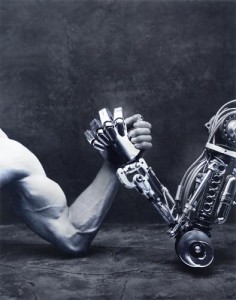
Announcing the Crowd Computing RevolutionI am proud to bring you a downloadable PDF of a piece I created on The Crowd Computing Revolution and the redesign of work that is now possible thanks to new technology tools and business architecture thinking that will allow man and machine to work more efficiently together than ever before.

Anyone who has read even one or two science fiction books or watched one or two SciFi movies inevitably finds themselves dreaming of a day when machines will free of us of some of the mundane tasks in our lives. Companies dream of this too. Witness the eagerness of companies to outsource entire job functions (or even more recently whole business processes) to third parties either onshore or offshore. Hackers and spammers have become quite adept at programming their machines to send emails to people or attempt to break through security around the clock, around the globe. We have built automated factories, interactive voice response systems, and devised all kinds of ways to put machines to work for us.

Roger Martin, Dean of the Rotman School at the University of Toronto has a simple framework from his treatise on Design Thinking titled The Design of Business, that shows how as we learn more about a knowledge (or work) area, our understanding and abilities allow us to move the piece of knowledge (or work) from something that is mysterious and performed in an ad hoc way by experts, to a level of maturity where we start to observe the patterns (or heuristics) in the knowledge area (or piece of work), to a stage where the work or knowledge is well-understood and can be reduced to an algorithm (or set of best practices) performed by lower skilled employees, and possibly even implemented as a piece of code to be executed by a robot or computer.
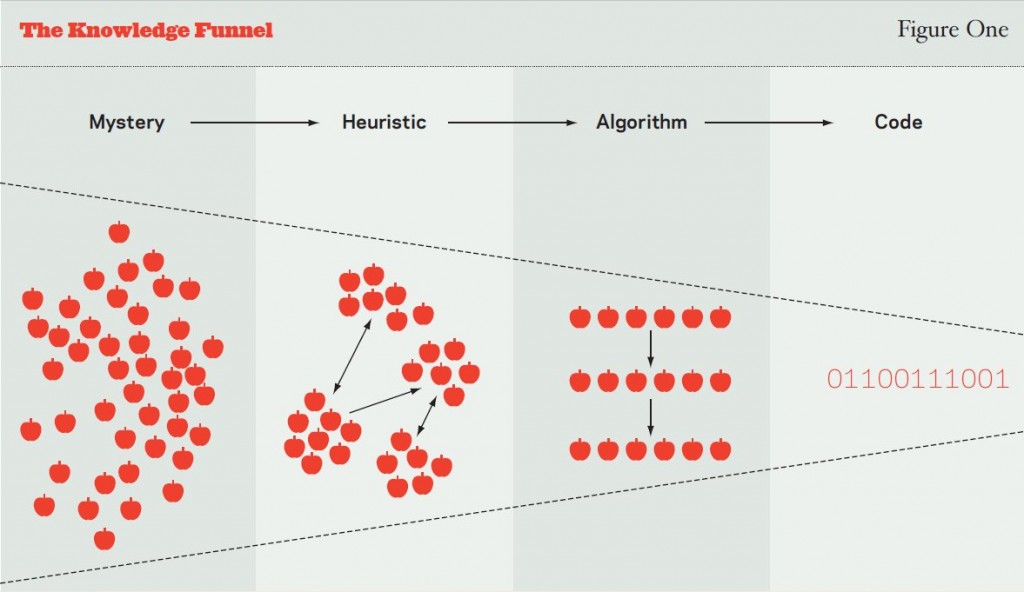
Knowledge Funnel

Source: The Design of Business by Roger Martin

But, as alluded to earlier, companies have not only become more comfortable with designing work to be executed by machines instead of employees, but also more amenable to many different sizes and shapes of work being completed by people outside the organization, including:

  1. Entire job functions (Contractors or Outsourcing Firms – Global Outsourcing Market was $95 Billion in 2011)
  2. Whole business processes (Business Process Outsourcing (BPO) Firms – 2011 Market in excess of $11 Billion)
  3. Projects or initiatives (Outside Consultants)
  4. Discrete tasks (99Designs, Crowdspring, etc.)
  5. Micro tasks (Amazon Mechanical Turk, etc.)

Task and Micro-Task Division
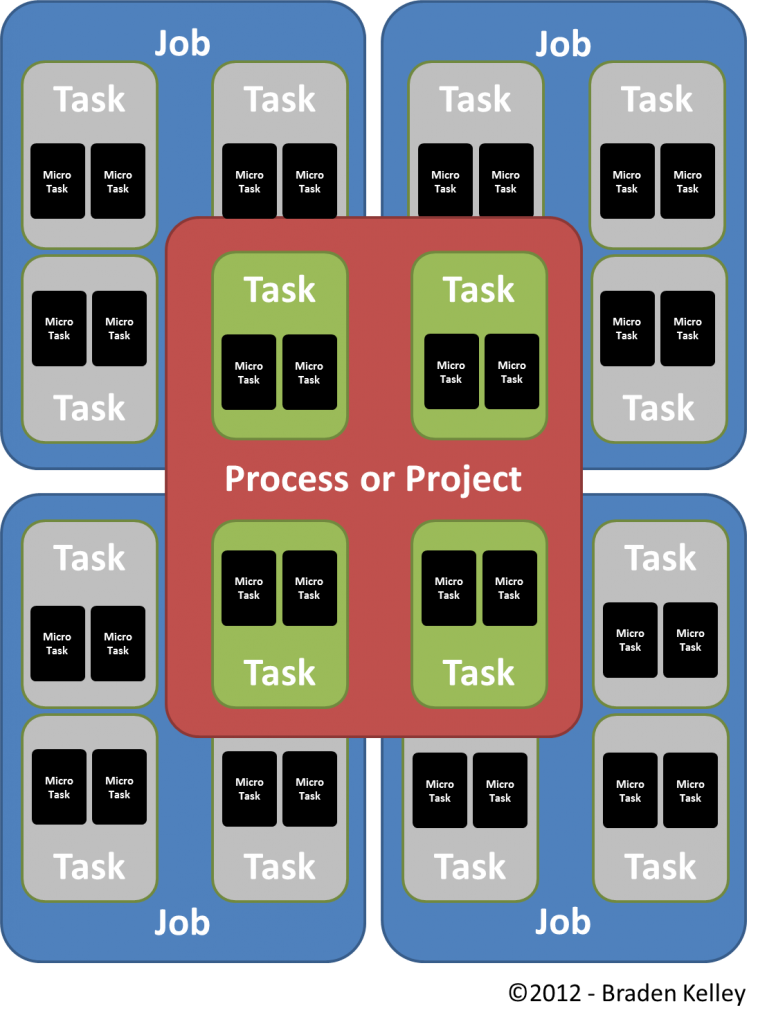
Task and Micro-task Division

Over time the human race has moved from building simple machines that function as tools (like a forklift), allowing a man to do more with the help of the machine, to building machines and robots capable of completing a whole task (like painting a car or making an exact copy of a document). Has anyone seen a help wanted advertisement for a scribe lately? Meanwhile, our fully automated manufacturing and packaging plants use machines to complete an entire process. But machines aren’t suitable for every kind of work. They are appropriate for tasks that are well-defined and repeated continuously as part of a standardized process, but not a proper fit for tasks where judgment is required, particularly tasks with numerous exceptions, variability, or personalization.

As a result, typically machines and robots have been relegated most often to the production areas of a business, places where it has been easy to define specific tasks or even whole processes that can be designed for machines or robots to own and complete 24/7/365 if necessary.


Build a Common Language of Innovation

Rethinking Who (or What) Does the Work

Crowd Computing Part 2Rise of the Crowd

There is another growing trend that is now rivaling the growing power of robotics and automation – crowdsourcing. It all started with prizes like The Longitude Prize, but now thanks to the power of the Internet, companies and individuals all around the world are breaking down their projects and processes and tapping into the power of the crowd using loosely-organized, non-employee workforces like Amazon’s Mechanical Turk to execute micro-tasks, getting whole tasks completed through sites like Top Coder and Crowdspring, or calling upon the crowd to solve difficult challenges using sites like Innocentive, NineSigma, and Idea Connection. Sites like these enable organizations to access knowledge, expertise, perspectives, or capacity that they don’t currently have in their organization (or to possibly to get a task or challenge completed at a lower cost). Check out my white paper Harnessing the Global Talent Pool to Accelerate Innovation to learn more about this topic and some of the strategies for successfully leveraging external talent.

Rise of the Business Architect

Our organizations face an innovation imperative amidst intensifying competition that is forcing an increasing number of industries to become commoditized. This increasing need for a sustained level of innovation and a requirement for innovation to be a repeatable and sustainable activity, has led to an increasing number of organizations to consciously design their approaches to the new businesses that they enter. This has led to the growth of two new business disciplines – business architecture and social business architecture.
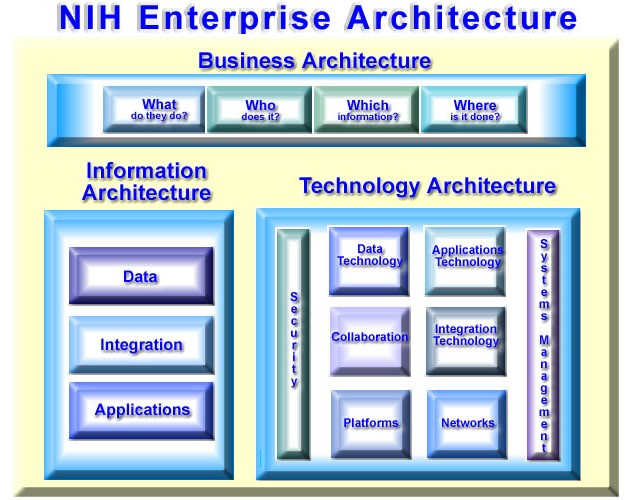
NIH Business Architecture

Source: National Institute of Health

Business Architecture, according to Wikipedia, is “a modern technology-oriented business occupation…. Working as a change agent with senior business stakeholders, the business architect plays a key part in shaping and fostering continuous improvement and business transformation initiatives. Business architects lead efforts aiming at building an effective architecture for the business process management (BPM) projects that make up the business change programme. The business architect implements business models that require business technology to work effectively.”
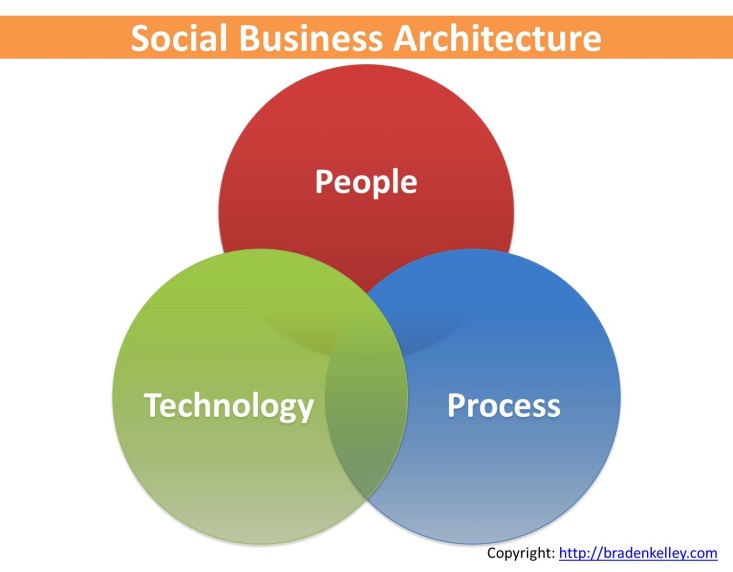
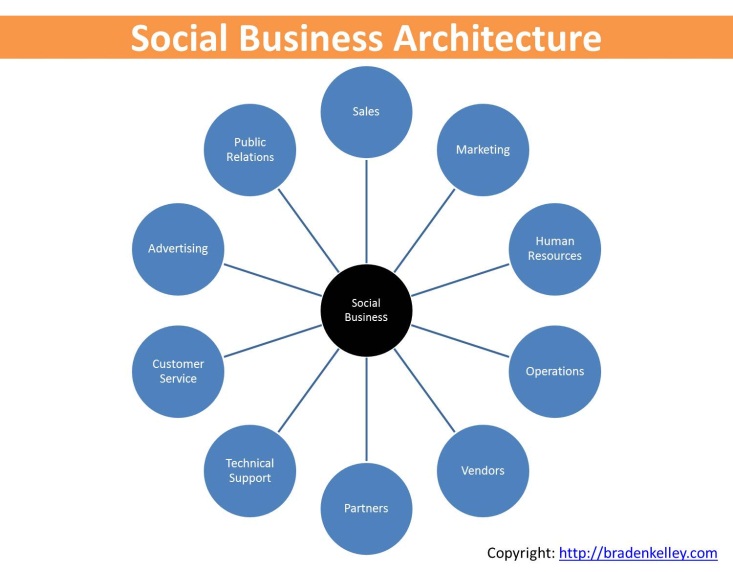
Social Business Intersections Social Business Connections

Social Business Architecture on the other hand, facilitates and optimizes the group dynamics and interactions inside the organization, and Social Business Architects specialize in identifying the different parts of an organization that need to interact with groups of people outside the organization, how those parts of the organization should work together to communicate with people outside the organization, and help to identify and implement communications solutions that connect the organization with the target groups so that a meaningful connection and conversation can be built, and then helps to manage the conversations and the information and learnings from their outcomes for the benefit of the organization.
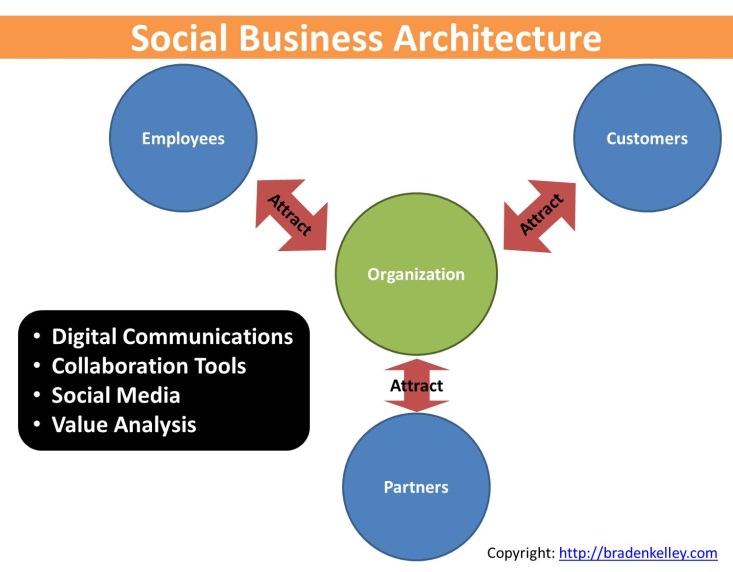
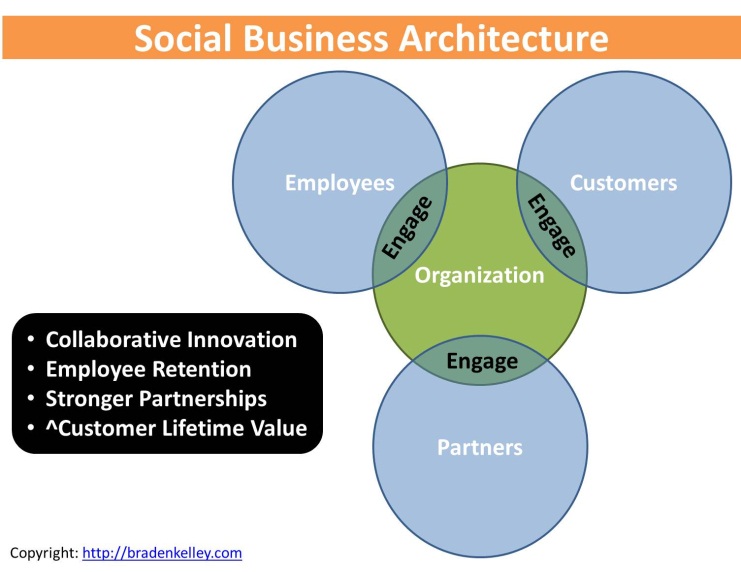
Social Business Attraction Social Business Engagement

Few organizations employ or are even yet aware of the need for Social Business Architects, but there are an increasing number of help wanted postings for Business Architects. This is because not only do organizations recognize the need to architect their new lines of business for maximum efficiency and to , but also because there are so many different ways that work can be executed (employees, contractors, consultants, outsourcing, business process outsourcing (BPO), crowdsourcing, and micro-task execution, that for maximum efficiency it now increasingly requires someone to investigate all of the options, break down the work to be done into jobs, projects and processes, tasks and microtasks so that the right resources can be hired, contracted, briefed, or otherwise engaged to ensure that everything is completed as quickly and as cheaply as possible.

A Guide to Open Innovation and Crowdsourcing

Investigating Examples of Crowd Computing

The Crowd Computing Revolution - Part ThreeMoving from The Design of Business to Redesigning Work

Business Architects have the opportunity to plan for the organization how work can move from mystery to heuristics to algorithms to code. Business Architects (or people filling this role in an organization) have the opportunity to redesign work in the most efficient way possible to leverage both man and machine to get the work done at the lowest cost possible. Technology now exists to allow Business Architects and managers to move beyond allocating work on a job, project, or process basis, and instead design flexible workflows that combine the use of humans and machines to complete the tasks that they are best suited for, or even for humans to augment the work of machines.

For example, imagine that you work in the purchasing department at a large multinational and every month you receive hundreds or thousands of invoices from suppliers all over the world in all different kinds of formats – electronic, mailed paper invoices, PDFs, scanned paper invoices, and even faxed invoices. Your job as purchasing (or accounts payable) manager is to track all of the invoices that you receive, get them entered into your ERP system, and ultimately make sure that they get paid. You can hire or use an existing employee or contractor to manually key them all in, or sign a big dollar outsourcing deal sufficient to support the hiring, training, and management of offshore resources by the outsourcer, or you could try and use OCR software to do the job, but it would fail because of the great deal of variability in both the input sources and formatting of the documents and you’ll end up needing human resources to interpret the OCR output anyways.
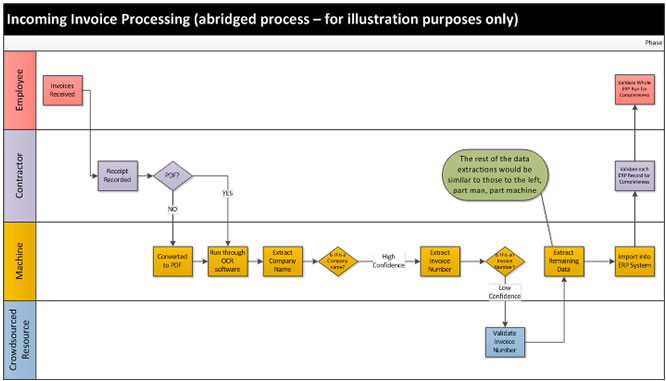
Crowd Computing Invoice Processing Example

Or, you could examine the workflow of the process and identify which micro-tasks humans are best suited to perform and which micro-tasks machines are most efficient and cost-effective at performing. Then assign the right micro-task to the right resource. In the case of human resources, this could be an employee, a contractor, an external expert, or even a resource you don’t even know or control (via a crowd workforce like Amazon Mechanical Turk, Elance, etc.). And finally for each micro-task, assign a level of confidence in the quality of the assigned resource’s output and a define a process for grading it. In situations where you have a high level of confidence in the micro-task’s output quality, you can move directly on to the next micro-task in the workflow, but if you have a low level of confidence in a particular micro-task output performed by a machine, assign an alternate process to validate that output (such as using someone via Amazon Mechanical Turk to validate that “yes, this is a purchase order number”).

But that is not all that is possible these days. It is now possible for systems that facilitate the management of this kind of atomized work structure definition and workflow management and assignment, like those from Crowd Computing Systems, to also use artificial intelligence to both learn from the corrections that humans are making to a machine-driven, micro-task execution to get more accurate in the future, but also to learn how to do micro-tasks that humans are currently performing without machine assistance and to help identify the best performing crowd resources to inform work allocation decisions and to perform overall output quality optimization.

Conclusion

In much the same way that outsourcing felt awkward 20-25 years ago and Business Process Outsourcing (BPO) felt foreign a decade ago, the time has come for crowd computing to begin to be a tool that managers and Business Architects can keep in their toolbox to better allocate work across man and machine. The time is now for man and machine to work together in ways that they never have before, and to learn from each other. The time has come for businesses and work to not just be operated and executed, but designed for maximum efficiency. Should we be afraid as workers that the machines are going to take away our jobs and leave us with nothing to do?

No. In much the same way that tractors and steam shovels began freeing man and beast from back breaking work nearly two hundred years ago, there are many benefits for man to gain from the crowd computing revolution – the biggest being freedom from an increasing amount of mind numbing work. Organizations that embrace crowd computing stand to gain not only to potentially lower processing costs for many high volume processes, but also will benefit from acquiring the ability to reassign analysts and other highly-skilled and trained employees to higher value work – better leveraging their existing human resources while simultaneously increasing employee satisfaction, retention, and knowledge creation in the enterprise. Are you ready for the crowd computing revolution?

Click Here to Download The Crowd Computing Revolution PDF

Sources:

http://speakology101.com/welcome/2012/05/21/break-it-down-tasks-sequencing/
http://www.huffingtonpost.com/martin-ford/job-automation-is-a-futur_b_832146.html
http://www.statista.com/statistics/189788/global-outsourcing-market-size-since-2000/
http://www.rediff.com/business/report/bpo-market-to-be-worth-14-bn-in-2011/20110412.htm


Build a common language of innovation on your team

Subscribe to Human-Centered Change & Innovation WeeklySign up here to get Human-Centered Change & Innovation Weekly delivered to your inbox every week.
Building Something Other Than a Faster Horse

Building Something Other Than a Faster Horse

GUEST POST from Jeff Rubingh

“If I had simply asked people what they wanted, they would have asked me for faster horses!” – Henry Ford

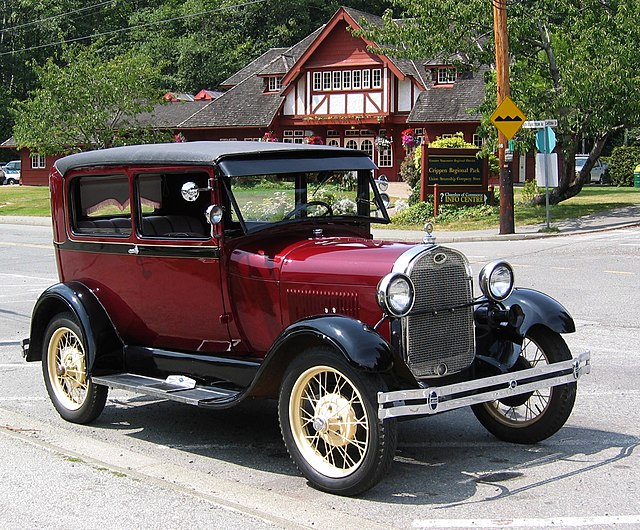
Eighty six years ago the intrepid and amazing Henry Ford and his Ford Motor Company introduced the Model A to the world. We have been amazed and enamored over the past few years at the long lines when a new Apple product has been introduced. But we have only to look back 86 years to witness a product rollout far more impressive in scale and magnitude. [1]

Henry Ford was well known for his devotion to the Model T. It was his baby. It had made him a fortune, established him as a paragon of industry and, with his commitment to a pricing model people could afford, endeared him to the people unlike any other public figure of the day. He was keenly aware of this role and the fundamental part his invention had played in shaping American culture and providing a new level of joy for the American people. An incident from 1912 illustrates the magnitude of his devotion to his product.

Ford had been away on an extended trip to Europe and during that time his leading engineers and managers cooked up a little surprise for him. As engineers are wont, they had a deep desire to “advance” the design and thought Mr. Ford, when he saw their work, would be excited to broaden the product line. So they designed a prototype, a proposed successor to the Model T. It had four doors, was longer with more stylish lines, and was painted red. When Mr. Ford returned from his trip, one company manager described what transpired as Henry inspected the new vehicle.

He kept looking at it. He’d tip his head this way and that and look at it…. I said, “Is there anything more I can …?” “No,” he said. “I’m going over and look at the new car.” He kind of smiled…. He had his hands in his pockets and he walked around that car three or four times, looking at it very closely. It was a four-door job and the top was down. Finally, he got to the left-hand side of the car that was facing me, and he takes his hands out, gets hold of the door, and bang! One jerk, and he had it right off the hinges! He ripped the door right off! God, how the man done it, I don’t know! He jumped in there, and, bang, goes the other door. Bang, goes the windshield. He jumps over the back seat and starts pounding on the top. He rips the top with the heel of his shoe. He wrecked the car as much as he could. [2]

And so, company executives knew exactly where not to stray. The Model T would define the Ford Motor Company forevermore. Well, not exactly. By the mid-1920s the Model T’s appeal to the American public was waning and everyone in the industry knew it. Everyone that is, except the titular head of said industry. Company executives began a concerted campaign to win over Mr. Ford and finally, in the late summer of 1926, after literally years of tension and debate, Henry Ford gave in. A new model could be built.

The following year was filled with endless debates; Henry staunchly advocating for traditional features, and Edsel, his son, and president of the company, lobbying for modern innovations and contemporary styling. Many of the debates, when viewed in modern terms, seem comical today. For example, the new model could hit sixty five miles per hour and during one test run, the driver lost control and the car ended in a ditch prompting Henry to proclaim, “We can’t put that car out on the public! We’ll kill them all!” [3] Nevertheless, Mr. Ford relented on many innovations proposed by his son including the more powerful engine.

Finally, on May 26, 1927, the new car was announced. In Apple-esque style, few details were given other than that the new model would have “speed, style, flexibility, and control in traffic.” [4] While the Ford Company re-tooled their factories to build the new model, Henry began a carefully crafted and masterful public relations campaign previously unmatched in American history. He withheld almost every detail of the new vehicle, occasionally releasing tiny teasing tidbits but never announcing anything substantive. He also positioned himself as the public’s benefactor, a heroic and wise man of the people, defender of their interests.

By Thanksgiving the anticipation for the new car had reached fever pitch. For five straight days after the holiday, Ford ran full page ads in every English language newspaper in the country, two thousand in all. On December 2, 1927, the day had arrived and Model-A-mania gripped the nation. This was the event that everyone had been anticipating, like a Super Bowl of epic proportions or a new iPad rollout. But nothing has or possibly will ever compare to this event. The first day numbers were staggering considering the US population of 119 million. In Detroit, 100,000 people viewed the car on the first day. In Cincinnati there were 296,745, in Chicago, 514,096 and in the Kansas City area, an amazing 651,000. [5] This, despite the fact that many people had to be turned away. C.W. Doss, the Kansas City branch manager related the staggering event.

“It’s history – what a tremendous reception the Model A had. In Kansas City they literally broke the doors down to get in before it was time to open to the public. They pushed them right through. You couldn’t control that mob. There will never be another introduction like that; never was before. That was the story all over the country. It was tremendous, fabulous. The advance orders on that car were tremendous. They just ran over you to get one.” [5]

Estimates were that 10 million Americans went to a dealer to see the new vehicle in the first thirty six hours and 25 million in the first week. In other words, over 20% of the American population, 1 out of every 5 men, women and children in every city, town, village, and borough made it a point to see the new vehicle in the first week alone. And the new car did not disappoint. New innovations were everywhere; hydraulic shock absorbers, windshield wipers, new color schemes, theft-proof locks and safety glass. Perhaps more surprisingly, the new model continued the Ford tradition of affordability, costing no more than the Model T, with prices ranging from $385 to $570.

The introduction of the Model A was a signature event in American history. In many ways it was a high point of the decade with an industry magnate building a product of high quality at a reasonable price. And it was likely the most remarkable product rollout in history.

[1] This entire post borrows greatly from Watts, Steven. The People’s Tycoon: Henry Ford and the American Century. New York: A.A. Knopf, 2005. Kindle Edition.

[2] Brown, “Reminiscences,” pp. 110– 11. Allan Nevins noted that this story was corroborated by C. H. Wills, Jr. (See Nevins, Ford: Times, Man, Company, p. 581.)

[3] Sheldrick, “Reminiscences,” pp. 30– 31; Ernest G. Liebold, “Reminiscences,” p. 846; Nevins and Hill, Ford: Expansion and Challenge, p. 450.

[4] Watts, Steven. The People’s Tycoon: Henry Ford and the American Century. New York: A.A. Knopf, 2005. 372. Kindle Edition.

[5] Spawn, Jim. “The Introduction of the New Ford Car.” The Restorer. N.p., July/August 2010 Web. http://www.mafca.com/downloads/Restorer/Introduction_of_the_New_Ford.pdf

Image Credit: Wikimedia Commons

Subscribe to Human-Centered Change & Innovation WeeklySign up here to join 17,000+ leaders getting Human-Centered Change & Innovation Weekly delivered to their inbox every week.

UPDATE – iPhone 5S mCommerce and Retail Implications

In my previous article on some of the potential implications of the iPhone 5S launch, I talked about how one of the things that wasn’t included in the iPhone 5S that I thought would be, was NFC technology (Near Field Communications).

Or at least I thought that Apple left it out…

That was until I came across this GigaOm article and this FastCoLabs article.

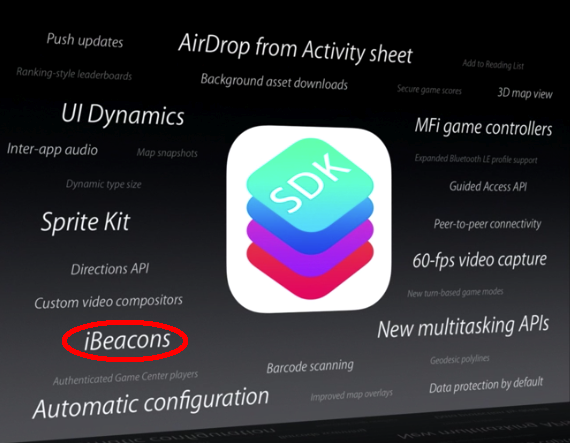
iBeacons mention on WWDC slide

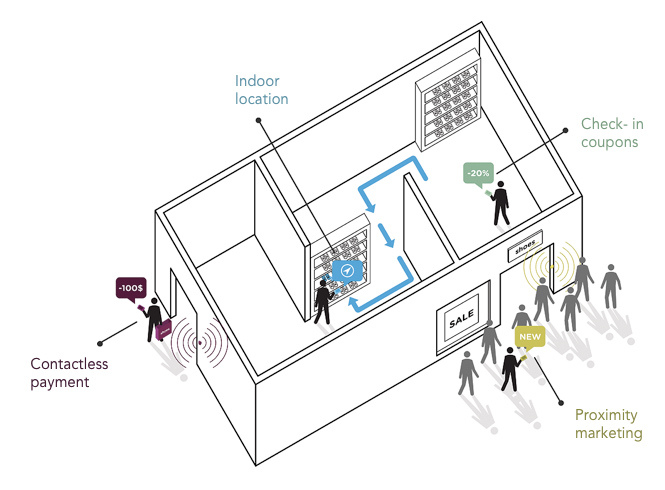
But it turns out that while they left out NFC, they didn’t leave out near field communications technology. They have just implemented in a slightly different way – using iBeacons – Apple’s flavor of Bluetooth Low Energy (BLE) that actually achieves the same basic job as NFC, but in a much more elegant and capable way.

To give you a better idea of what this technology is capable of (in addition to mobile payments), I encourage you to check out the following video about Estimote Smart Beacons:

I truly believe that the kinds of things that will come out of the BLE technology built into the new iPhone 5S in combination with the new fingerprint authentication will represent a quantum leap in the value we extract from our smartphones in much the same way that the AppStore that came along a year after the launch of the original iPhone.

UPDATE - iPhone 5S mCommerce and Retail Implications

It will be interesting to see what develops around the iPhone 5S (and the Android and Windows 8 devices to respond) over the next twelve months.

Keep innovating!

Image credits: GigaOM


Build a common language of innovation on your team

Subscribe to Human-Centered Change & Innovation WeeklySign up here to get Human-Centered Change & Innovation Weekly delivered to your inbox every week.
Interview for Top 75 Disruptive Experts Series

Interview for Top 75 Disruptive Experts SeriesAs part of Bill Jensen’s series of interviews with the Top 75 Disruptive Experts from around the globe, I had the opportunity to sit down with Bill and discuss several different questions about disruption in this video interview, including:

  1. Introduction
  2. My Favorite Disruptive Hero
  3. My Value Innovation Framework
  4. My Favorite Disruptive Change
  5. The Disruptive Change I Struggle With

Some of the key points I make in the video are importance of recognizing opportunities and seizing them, the impact of online services on how we all relate to each other and conduct our lives, my view on the key components to creating innovation success, and finally some thoughts on how evolving mobile capabilities are already changing our lives and how mobile will continue to change us (aka the mobile-centered human experience). Hope you enjoy it!

If you would like to schedule an interview with me for your online, television, print, or radio program, please contact me.


Build a common language of innovation on your team

Subscribe to Human-Centered Change & Innovation WeeklySign up here to get Human-Centered Change & Innovation Weekly delivered to your inbox every week.
Fingerprints of mCommerce Success on iPhone 5S?

Fingerprints of mCommerce Success on iPhone 5SLast August I wrote about Apple’s pending acquisition of Authentec, a biometric authentication company (which has since closed). At the time Apple was in a real hurry to complete the acquisition and it made me wonder whether Authentec’s fingerprint authentication technology would make it into the home button of the iPhone 5 and eventually into the iPad and the iPad Mini. It didn’t.

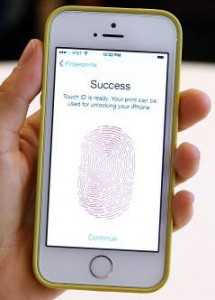
But today, as part of the new iPhone 5S, Apple has finally integrated this biometric technology into their flagship mobile phone.

Why does this tiny little sensor represent such a potential sea change for the mobile industry?

Let’s look at all of the ways that this technology addition makes the iPhone more valuable than other phones.

1. Security and Personalization

By integrating the Authentec technology into the iPhone 5S home button, and eventually the iPad and the iPad Mini, Apple can not only create a handy way (no pun intended) to eliminate the need for remembering passwords, but also enable people to make their devices easily personalized for MULTIPLE users of the same device.

But if Apple takes advantage of all the purported abilities of the Authentec technology, the new iPhone 5S may also have the ability to recognize multiple fingers from a single individual, allowing for the home button to potentially achieve multiple functions – like the multiple button mouse.

In practical terms, this means for example that if your five-year-old gets a hold of your iPhone 5S, or you let them have it to keep them occupied in a restaurant, the iPhone 5S could potentially keep them from making phone calls, opening your work emails, etc. or just limit them just to accessing the Apps you grant them access to. But there is also no reason why apps like Netflix could also become personalized based on whose finger was used.

And maybe finally Apple will finally introduce some parental controls on the iPad. It’s maddening as a parent that my only choice on our iPad is to either give my daughter full access to Safari, or no access to Safari and that I have to go in and re-enable Safari when I want to use it. What decade is this? Hopefully iOS 7 will fix this.

2. iTunes and App Store Authentication

For Apple, there are also legal and financial benefits from adding fingerprint authentication, as it will help to prevent (or at least reduce) unauthorized iTunes purchases made by account hackers or children playing with their parent’s iPhone 5S (or upcoming iPad 5). Fingerprint authentication in iPhone 5S and iPad 5 may also encourage people to begin utilizing Apple’s Passport.

3. Universal mCommerce Authentication v1.0

It is embarrassing that the United States is so far behind the rest of the world when it comes to mCommerce. Mostly this has been because the financial services companies (Citibank, Bank of America, Chase, Wells Fargo, American Express, Mastercard, Visa, Verisign, etc.) and mobile phone carriers (Verizon, AT&T, Sprint, T-Mobile, etc.) have been fighting to control mCommerce in the United States to the detriment of United States citizens and consumers and mobile innovation. Shame on you!

The new iPhone 5S might help to reignite mobile innovation and mCommerce activity in the United Sates. And given that Apple makes most of their money selling hardware and are facing a market share challenge from Android and Windows 8 devices, it is in Apple’s best interest to open up a fingerprint sensor API in iOS 7 for third party app developers to utilize. This would maximize the potential differentiation and hardware sales, and the incremental device lock-in offered by this new capability.

But there are also increased revenue opportunities for Apple, as integrated fingerprint authentication is likely to lead to an increase in impulse iTunes and App Store purchases. Why will a fingerprint sensor likely lead to an increase in music and app purchases for Apple? Simple, it will make it easier and faster for people to buy things from iTunes or the App Store, and give consumers less time to change their mind after they get the urge to buy something.

One thing I didn’t see mentioned in Apple’s iPhone 5S announcement was the inclusion of any kind of Near Field Communication (NFC) capability in this latest flagship model. So v1.0 of Apple’s universal mCommerce authentication capabilities may only include authentication of eCommerce purchases made via mobile web sites or mobile apps. Without NFC I’m not sure exactly how authenticated purchases in the physical world would be made, short of a scanner reading a post-authentication-generated QR Code or something like that. Of course there is a way (or several) and mobile innovators surely will find them until NFC is incorporated into future iPhones and iPads.


Build a common language of innovation on your team

4. Universal mCommerce Authentication v2.0

Once NFC capabilities are added to the iPhone, then people like Square, but also traditional banks, and even Google could add iPhone 5S fingerprint authentication to apps for mCommerce for users to download and install on their phone. This represents a HUGE opportunity for Square and a challenge obviously for the established players. It will be interesting to see whether Apple will be the first to integrate fingerprint authentication together with NFC or whether Samsung or someone else will beat them to it, or even whether it might be able to be added via a 3rd party case or backing for the phone. What do you think?

Wrapup

The initial iPhone turned your finger into a more useful tool for the digital world. The new iPhone 5S turns your finger into a key, and how many locks it will help you open remains to be seen. Let’s hope that in the same way that the iPhone broke the stranglehold that the mobile carriers had on application innovation on the handset, the new iPhone 5S will create a new wave of mobile innovation in the mCommerce space.

Let’s hope that Apple’s new iPhone 5S gives new meaning to the phrase ‘Digital Innovation’.

Okay this time the pun is intended, and hopefully it will help some of you think of new possibilities for digit-driven computing.

Keep innovating!

Subscribe to Human-Centered Change & Innovation WeeklySign up here to get Human-Centered Change & Innovation Weekly delivered to your inbox every week.

New Way to Integrate Real and Virtual World

First came augmented reality, using the GPS and camera on your smartphone to layer information from the virtual world onto the real world as displayed via the camera.

Now, Fujitsu has introduced a device that I came across on Mashable that allows you turn any document into a touchscreen that can recognize the actions of your fingers.


Is this an interesting invention or a potentially valuable innovation?

Personally, one potential application I see would be robotic surgery. What do you see?


Build a common language of innovation on your team

Subscribe to Human-Centered Change & Innovation WeeklySign up here to get Human-Centered Change & Innovation Weekly delivered to your inbox every week.

Optimizing Innovation Resonance

Optimizing Innovation ResonanceWhat does resonance mean to you?

The word has many different dictionary definitions depending on the context, but most of them focus on vibrations reaching an ideal state.

Here are two of the most relevant dictionary definitions for our innovation resonance context today:

  • “a quality of evoking response” (Merriam-Webster)
  • “the effect of an event or work of art beyond its immediate or surface meaning” (Bing)

Here also are a couple of my favorite resonance quotes:

  • “I think whatever resonance I may be able to achieve is in part simply from the amount of reading and learning that I acquired along the way.” – Robert B. Parker
  • “I think if the movie has resonance and stimulates the viewer to talk about it, you can have as large an audience as you want.” – Andy Garcia

I’ve written in the past about how innovation is all about value and about how innovation veracity is more important than innovation velocity. Now it is time to take the innovation conversations about value and veracity to the next level – to innovation resonance – and how difficult it is to achieve and maintain.

Optimizing Innovation ResonanceAchieving innovation resonance is about going from 1+1=2 to a state where 1+1+1+1=7, where the sum of the valuable parts in some new potential innovation suddenly becomes greater than the individual components and value may be created that you might not have even anticipated. When you reach this state of innovation nirvana, the power of resonance pushes your invention over the line from invention to innovation, and adoption becomes widespread. People start talking about, spreading it like a virus, and ultimately supplementing your marketing efforts in much more effective ways.
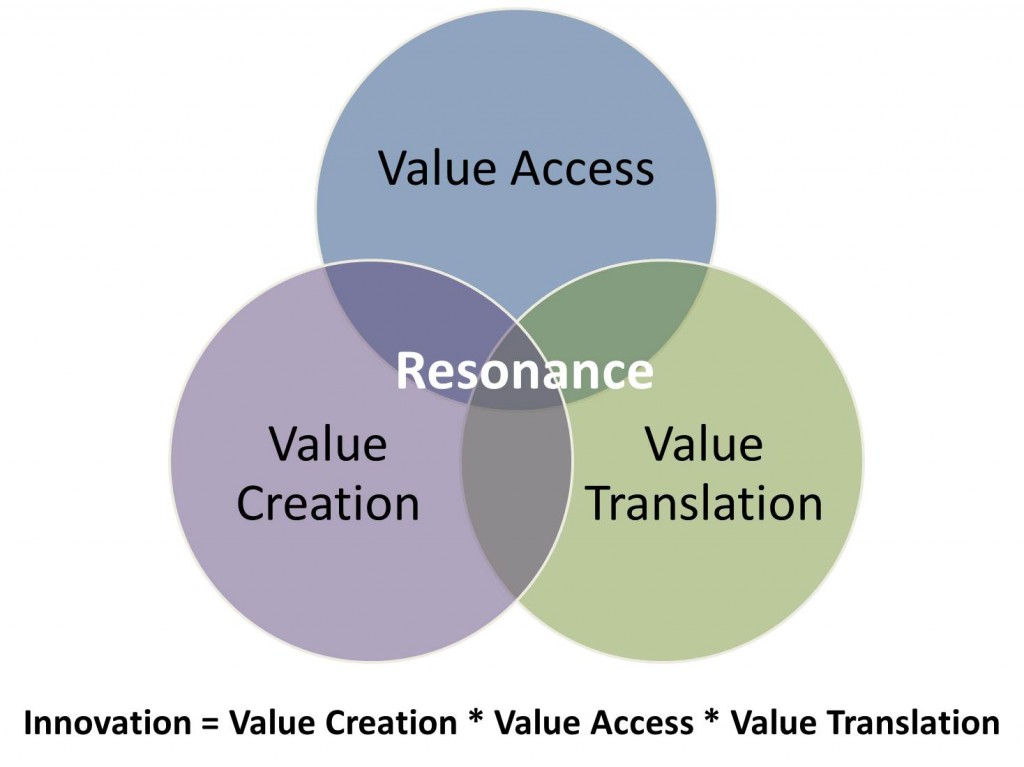

To achieve innovation resonance you must create value with innovation veracity and deliver it in a product or service with the right velocity and course corrections as you bring your potential innovation into the marketplace. Innovation veracity is about identifying the truths that are important to the customer in the problem space you are investigating, the inspirations and the insights that will hopefully lead to better ideas, more value creation, and hopefully, eventually – innovation resonance.

You’ll notice that I used the words hopefully and eventually in the last sentence in relation to achieving innovation resonance, and this is because our best attempts to anticipate the wants and needs of the marketplace will not always be immediately correct, and may require course corrections in the product or service to better match the expected or desired value.

And the ultimate value encompassed in a potential innovation attempting to achieve resonance, comes from three main sources:

1. Value Creation
2. Value Access
3. Value Translation

Innovation = Value Creation * Value Access * Value Translation

You’ll notice in this equation that the parts multiply, and as a result if you do any of the three badly, your potential innovation will fail. But do ALL three well and you will have the opportunity to achieve innovation resonance.

Innovation Resonance Venn Diagram

Optimizing Innovation Resonance

To optimize the value creation component of innovation, you must seek innovation veracity early on, identifying the fundamental truths upon which your potentially innovative solution will be built. During the value creation process you must prototype early and often to test and learn whether your insights are correct and resonating in their expression within the product or service as you expect. From the reactions to your prototypes you must evolve the solution to create more value.

To optimize the value access piece of innovation, you must seek to identify where friction is created in the delivery of your solution and seek to remove it. Carefully observe both where things are awkward or difficult for you to produce and scale the solution, and for your customer to consider and consume it. These friction points represent an opportunity to remove barriers to adoption and to increase potential innovation resonance through better production, purchase and consumption experiences.

To optimize the value translation piece of innovation, you must first identify the gaps in understanding and readiness among your target customers, your plan for working to close these gaps and prepare the market for your launch, and then you’ll want to find your picture or image that communicates a thousand words. Most importantly, you must be aware that the more disruptive your potential innovation the more you may have to educate your potential customers before you even try to sell to them, and so you must build the appropriate amount of market preparation time into the launch plan for your potential innovation plan. Thought leadership marketing and innovation marketing strategies can be very powerful here to help customers understand how the new solution will fit into their lives and why they will want to abandon their existing solution – even if it is the ‘do nothing’ solution.

Resonance Example #1 – The BMW Mini – Barbie in Motion

Barbie Mini CooperOne of those most fun, visually appealing vehicles on the road has to be BMW’s re-release of the Mini. I don’t have one, have only ridden in one once, but whenever I see one driving around, it makes me smile. And if you have any question about whether or not the Mini has achieved a level of resonance (at least in the USA and probably elsewhere), then how would you explain the photo of the Mini on the left that shows you can buy a Mini to drive Ken and Barbie around in? Can you buy a convertible Chrysler LeBaron for Barbie to drive around in? No, but you can buy a Fiat 500, another car achieving resonance here in the USA.
Resonance Example #2 – iPod Nano – Falling from the Pinnacle

iPod Nano 6th GenerationThe iPod Nano is a great example of the rise and fall of innovation resonance. The iPod took three years to take off (right about the time the iPod Nano was released). The trigger for innovation resonance was the Windows version of iTunes (Value Creation), combined with the launch of Apple Retail Stores (Value Access), combined with the iconic advertising campaigns (Value Translation). The iPod became a phenomenon with sales peaking in 2008 right after the iPhone release. Sales have been falling since then, but during this decline came the September 2010 release of the 6th Generation iPod Nano – which resonates to this day – so much so that Apple replaced the design six months ago to protect the market for their upcoming iWatch.
Maintaining Innovation Resonance

As we know from music, to maintain resonance, you must continue to inject energy and focus into the system – a bell won’t ring forever. And as we know from human psychology, just because you continue to ring the bell doesn’t mean that people will continue to want to listen to it in the same way forever. Tastes change, preferences change, the definition of value for each component creating value for customers can potentially change. And so to remain the market leader, to maintain innovation resonance, you must continue to observe, to learn, and to modify your solution to optimize the innovation value equation as needed over time.

One great example of an innovative organization losing resonance over time was Dell. They (and a handful others) came into the PC marketplace with a disruptive business model, captured market share, rose to #1, and then gradually started to lose their position because they didn’t recognize a shift in the relative value of cost vs. design in the marketplace, causing them to lose market share to HP, Apple and others.

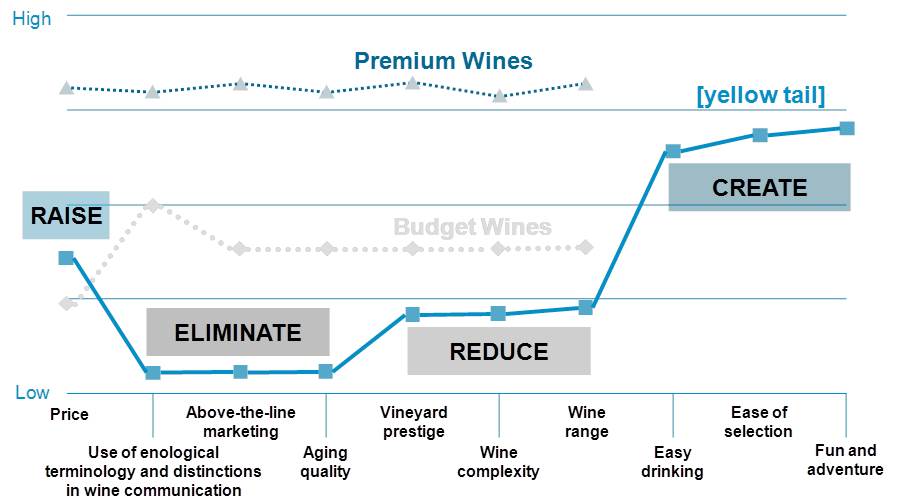
One way to look at the difference in strategies between HP and Dell might be to use the Strategy Canvas from the Blue Ocean Strategy methodology. You can see an example of a Strategy Canvas for the wine industry here:

Blue Ocean Strategy Canvas

But traditional Blue Ocean Strategy (or Value Innovation) is very static. As you can see, building a Strategy Canvas using Blue Ocean Strategy methods is a snapshot in time looking at the relative performance of a company on a selected set of value dimensions against its competition. To sail into a Blue Ocean the theory goes, you must select certain value dimensions to either:

  1. Raise
  2. Eliminate
  3. Reduce
  4. Create

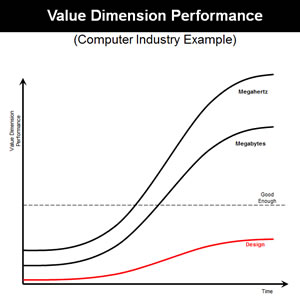
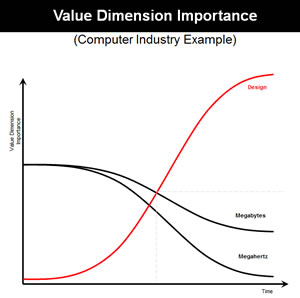
But as we know, value dimension performance, value dimension importance, and the competitive dynamics within the industry are not static, but change over time.

It is because of this weakness in the Blue Ocean Strategy methodology that I layer on the investigation of value dimension performance and importance onto any Value Innovation work that I might do. You can see in the two example images below related to the Dell vs. HP example about how changes in performance over time on certain value dimensions relative to what is “good enough” in the minds of customers can lead to changes in the relative importance of various value dimensions in the mind of the customers.

Value Dimension Performance Value Dimension Importance

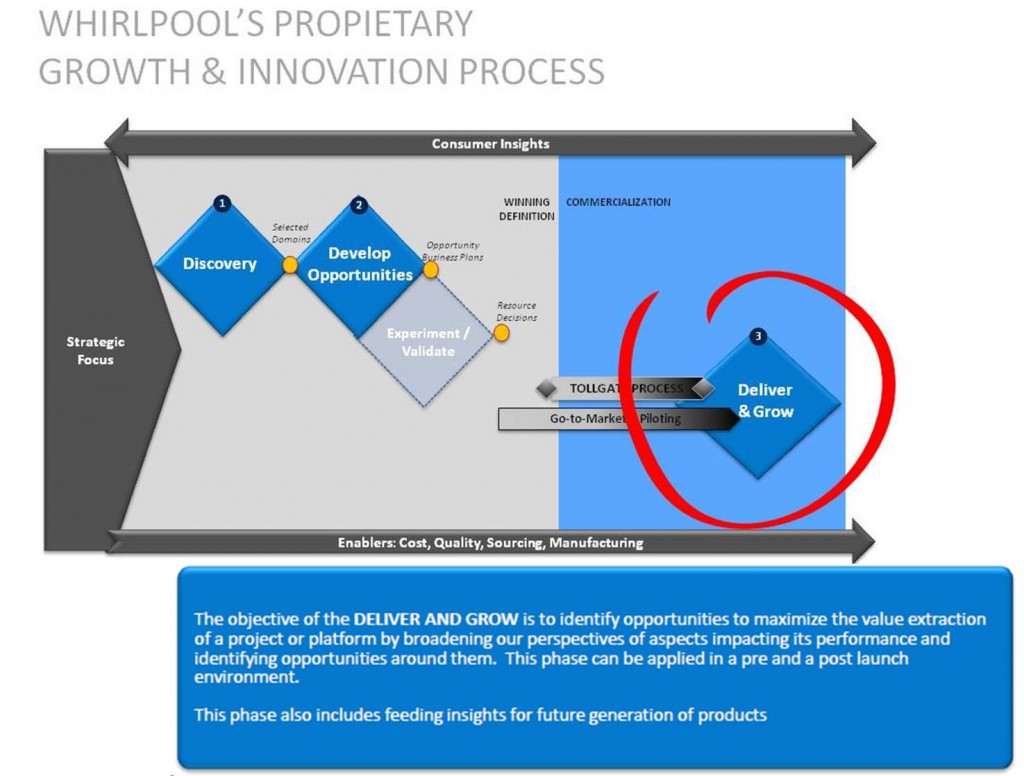
Because we cannot perfectly predict how customers will consume our product or service when we bring it to market, and because of the shifting sands of value force you to continuously re-evaluate the current situation with value dimensions and value importance, we must re-evaluate where we see the innovation process beginning and ending. Smart companies are recognizing that is not just about coming up with a great idea, or having a great launch, but about creating a commitment to launching, learning, and dialing in success by working to create and then maintain innovation resonance. Whirlpool Corporation, one of the early pioneers of a systematic pursuit of innovation excellence, has seen this and has created a commitment to launching and learning and has added a third diamond to their double diamond innovation methodology called ‘Deliver and Grow’.

Whirlpool Triple Diamond Process

Moises Norena, the Global Director of Innovation at the Whirlpool Corporation, was kind enough to share these thoughts:

“While we put a significant emphasis in the front end of innovation and in the commercialization phase, we recognize that you can not launch a product and sit and wait for its success. With the third diamond we assure that innovation teams stay engaged in the product management while it is in the market, contrasting the results with the predictions, not only on business performance but against the consumer and trade promise they were designed to deliver. We also ask these teams to use the innovation tools and process to identify opportunities to experiment and to maximize value extraction from the market.”

Conclusion

To achieve and maintain innovation resonance, you must nurture a commitment to learning fast, both during the innovation development process and after the launch of a potential innovation. You must maintain a laser focus on how you are creating value, helping people access that value, and translating that value for people so they can understand how your potential innovation may fit into their lives. So, do you have processes in place as part of your innovation methodology for measuring and evolving solutions in place to help you get to innovation resonance?

If not, keep a focus on value creation, value access, and value translation, use my evolutions of the Blue Ocean Strategy framework, and have a look at The Eight I’s of Infinite Innovation framework that I created or at the Whirlpool Corporation’s Triple Diamond methodology to help you deliver and grow more successful innovation into your organization, and hopefully reach some level of innovation resonance.


Build a common language of innovation on your team

Subscribe to Human-Centered Change & Innovation WeeklySign up here to get Human-Centered Change & Innovation Weekly delivered to your inbox every week.

Will Aereo strike the Death Knell of Cable Television?

Will Aereo be the Death Knell of Cable Television?Somewhere across the vast reaches of social media (I can’t remember where) I came across a small but growing internet television service called Aereo that allows you to stream live television over the internet on any device or even to record up to two shows at once like you would with a DVR – for only about $80 per year. Imagine a roof antenna or rabbit ears on your TV that happened to be somewhere you never had to see them. Aereo makes that possible. Here’s how:
1. They’ve made the TV antenna unbelievably small

So small it fits on the tip of your finger. But it still gets awesome HD reception.

2. They’ve connected those antennas to the Internet

They designed a way to put tons of these antennas in data centers, along with massive amounts of storage and super-fast Internet connections.

3. They give you control of your own antenna

They’ve built a simple, elegant interface to let you control this antenna. With any device you want, over the internet. All without boxes, cables, or cords.

The company has been around for about one year now and is now expanding to 22 additional cities. Cable Television Distributors are of course fighting back against this potential disruption, but Aereo maintains that their solution is legal. The bigger questions though are:

  1. Is Aereo disruptive? Does it have the potential to make people switch?
    (possibly when combined with Hulu and/or Netflix and Amazon Prime)
  2. Will Aereo be able to gain enough momentum to make cable television stations jump on board what might become part of an expanded premium offering?

What do you think?

UPDATE (2022): Eventually the cable companies won in court and Aereo was forced into bankruptcy where Tivo ended up buying them for $1 million. Sad but true. And now we have multiple offerings like YouTubeTV that have not been forced to cease operations – but at a much higher cost.


Build a common language of innovation on your team

Subscribe to Human-Centered Change & Innovation WeeklySign up here to get Human-Centered Change & Innovation Weekly delivered to your inbox every week.

Is Windows Phone a Serious Competitor to iPhone and Android?

Is Windows Phone a Serious Competitor to iPhone and Android?A few weeks ago I was fortunate enough to receive a shiny new Nokia Lumia 810 in the mail courtesy of Nokia USA. This was very welcome because I’ve been subjected to what I can only describe as a technology torture inflicted upon me for more than a year by a horribly designed Samsung Galaxy S. So anything would have been a step up, but so far the Nokia Lumia 810 has been a BIG step up.

My Samsung Galaxy S used to decrease my productivity, but the Nokia Lumia 810 now adds to my quality of life.

This isn’t exactly a product review, because that’s not typically something that I do. I will however give you my honest reaction to the Nokia Lumia 810 and how it has fit into the life of this busy innovation and marketing professional so far.

To date, the Nokia Lumia 810 has yet to crash a single time. My old Samsung Galaxy S in contrast crashed at least once every one to two days, and because of what seemed to be a flawed design I was never really able to download and successfully use applications on the device that weren’t loaded at the factory (despite a 16gb SD card being installed).

Thus far on the Nokia Lumia 810 I’ve been able to set up Yahoo! Mail, Hotmail, GMail, Twitter, Outlook, Linkedin, CNN, ESPN and other applications. I’ve also been able to load 15GB of music successfully onto the phone and use all of these applications multiple times every day and keep them synced without issues. Bottom line, the Nokia Lumia 810 has been a much smarter smartphone than my Samsung Galaxy S.

The one thing I haven’t found to be as good on the Nokia Lumia 810 as my old Samsung Galaxy S is the voice command functionality. The Nokia Lumia 810 doesn’t seem to recognize my voice as well with my new Motorola Elite Sliver bluetooth headset.

Now obviously today’s Samsung Galaxy S3 is probably a better device than the Samsung Galaxy S, and the iPhone 5 is for sure a solid device. But so far I find the Windows 8 OS on the Nokia Lumia 810 to provide a much more attractive user interface than iOS or Android thus far and to provide roughly a level of parity in overall functionality with these other competitors and a serious competitor to the market leaders.

Is parity and a better UI enough to help Nokia and Microsoft get back into the game?

Only time will tell, but it is my opinion that Nokia and Microsoft will need some kind of a killer app to truly gain traction towards regaining market share. Unfortunately, as I’ve written before, I think that Apple will introduce the next killer function to the smartphone – truly useful and viable mCommerce. But, only time will tell to see if this theory plays out or not.

What do you think?


Build a common language of innovation on your team

Subscribe to Human-Centered Change & Innovation WeeklySign up here to get Human-Centered Change & Innovation Weekly delivered to your inbox every week.

Top 10 Innovations of All Time

Accelerating Innovation Requires Accelerating Knowledge and Insight

Accelerating Innovation Requires Accelerating Knowledge and InsightOkay, I admit it, I came across the History Channel’s series Ancient Aliens recently and I’m intrigued, mostly because it is fascinating (and frightening) to me how long it takes to develop true knowledge and insight, but how quickly it can be lost.

Leaving the whole ancient astronaut theory thing out of it, it is obvious looking at the historical record that throughout history, civilizations around the world (more than once) have developed advanced scientific understanding only to have their civilization (and its knowledge) destroyed by a natural catastrophe or fade away for some other reason. At the same time, another thing that is clear as we look across our history as a species is that there are certain periods of time during which innovation accelerates and often this increase in the velocity of innovation is linked to an increase in the velocity of knowledge and insight sharing.

The Renaissance coincided with the arrival of paper in Europe, culminating with paper making its way to Germany in 1400 AD and inspiring the development of the printing press in 1450, which then accelerated the spread of books, magazines, and newspapers in the 15th and 16th centuries.

The Age of Enlightenment coincided with early semi-public libraries that were only available to a learned few, but those few were inspired to create important and transformative thought in the 17th and 18th centuries.

The 19th century was a golden age of invention and innovation, ushering in the era of modern medicine, and technologies like the telegraph and the telephone which enabled information, knowledge and insight to finally travel faster than the horse.

The modern public library, as we now know it, came into its own in the the United Kingdom in the 19th century and the United States in the 20th century (thanks to Andrew Carnegie) and new communications technologies like radio and television brought information and knowledge to the illiterate and enabled people to see and hear things they would never have imagined before.

And by the close of the 20th century and the beginning of the 21st century, human beings had gained the ability to learn from each other no matter where they live in the world, in real time, in words, pictures, and now even through the sharing of videos sharing knowledge and insight, and even by showing people how to do things.

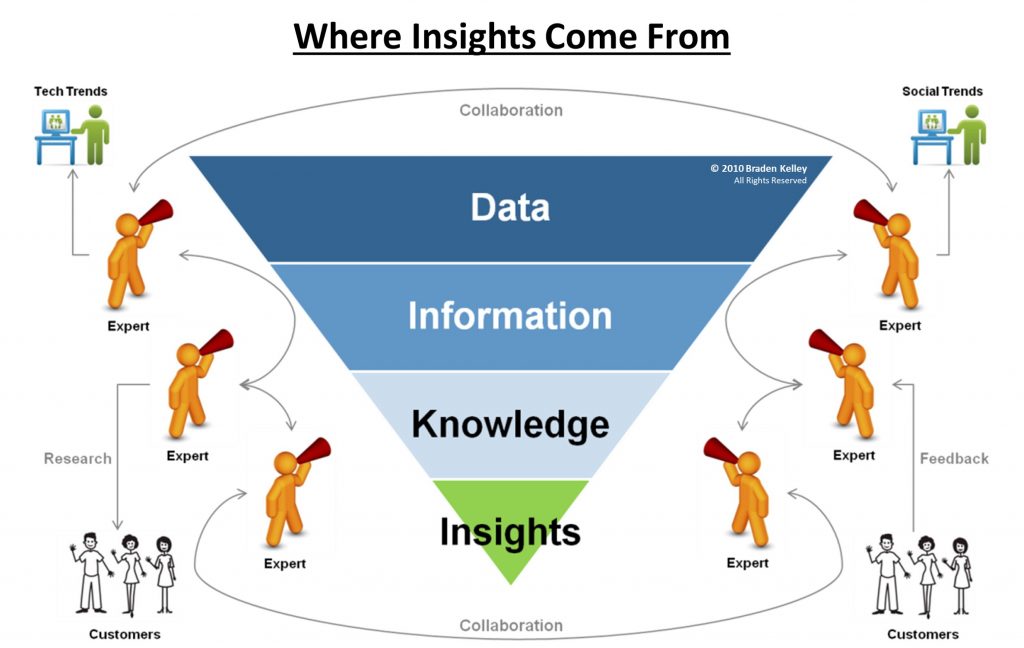
It is my contention that the pace of innovation accelerates when the speed of knowledge sharing accelerates, that knowledge acceleration leads to innovation acceleration. As we have developed more efficient ways of accelerating the pace of knowledge sharing, our pace of innovation has sped up.
It is shocking to think that if you go back only two hundred years as a species we had no idea how disease was transmitted, couldn’t send a message from one side of an ocean to another without using a ship, and that most human beings on this planet would not travel farther than 50 miles from the place of their birth during their lifetime.

Now we can travel to outer space, levitate objects using sound or magnetism, create life, destroy whole cities in an instant, build things smaller than the width of a human hair, and do some other things that even twenty years ago would have seemed impossible.

We are inventing and innovating today at an astonishing rate, and for companies or nations that want to outpace their competition, they should be laser-focused on accelerating the pace of knowledge sharing if they are intent on being faster and more efficient than their competition at innovation. But it isn’t even the speed of knowledge or information sharing that is the holy grail, it is the speed of insight sharing that leads to faster and more efficient innovation, and many organizations mistakenly restrict access to the voice of the customer. And when you cut off your employees from your customers, how can you expect to can anything but inventions instead of innovations?

It is because of these important linkages that I believe the below ten items are the Top 10 Innovations of All Time:

  1. Paper (105AD – Europe 10th century – Germany 1400)
  2. Printing Press (1450)
  3. Telegraph (1837)
  4. Telephone (1876)
  5. Modern Public Library (1850-1945 depending on country)
  6. Commercial Radio (1920)
  7. Commercial Television (1936 UK, 1948 US)
  8. World Wide Web (1991)
  9. Wikipedia (2001)
  10. YouTube (2005)

Caution – We May be Becoming Too Reliant on Technology

But there is a cautionary tale contained in this list and the Ancient Aliens reference at the beginning. You will notice that this list is increasingly dependent on technology – especially the existence of electricity.

What would happen if there was a major natural catastrophe (flood, famine, major volcanic eruption or meteor strike, giant solar flare) and for some reason all of our electrical devices ceased to function?

How much of our accumulated knowledge and technology would we lose?

Despite the growing decline of print and rising usage of digital media, the book has one major advantage, it doesn’t require power to operate. Stone tablets don’t decay as fast as paper.

Should we as a society be transcribing our most important knowledge onto something that could survive a major catastrophe (including the potential loss of electricity for an extended period of months or years), so that we as a species don’t have to start over again as we obviously have had to do in the distant past?

Technology is wonderful and allows us to do many amazing things but we should be careful about becoming too reliant on it, or we risk potentially losing the knowledge that allowed us to create it in the first place.

Just a thought…

And if you are intent on accelerating the sharing of knowledge, information, insight and innovation in your company or country, let me know, I could help with that.

Image source: kansasbob.com


Build a common language of innovation on your team

Subscribe to Human-Centered Change & Innovation WeeklySign up here to get Human-Centered Change & Innovation Weekly delivered to your inbox every week.