
Category Archives: Technology

Making Innovation Sustainable – Part 2 of 4

Making Innovation Sustainable – Part 2 of 4If you missed Part 1, you can find it here

If You Want Systemic Innovation, You Need Systems to Manage It

If you are really serious about creating sustainable innovation in your organization and engaging more than just a handful of people in the generation of ideas, you not only need to have a group of people to manage the process (either part – time or full – time), but you also need systems to manage the idea generation, idea evaluation, and idea development processes. This class of software is commonly referred to as innovation management software and it is often sold in a Software as a Service (SaaS) manner. Organizations with above average privacy or security concerns may choose to run this software locally in their own organization (see Figure 10.1 ).

There are tons of companies selling innovation management software, but the four heavyweights in this area are Brightidea, Hype, Imaginatik, and Spigit, but you also have software like Invention Machine and others that serve similar or adjacent needs (patent searches, etc.). But there is no reason you couldn’t build your own innovation management solution into your enterprise portal or collaboration software platform such as Lotus Notes, Microsoft SharePoint, and others (see Figure 10.2).

It’s not completely accurate to call it innovation management software because it only manages ideas, but having a software platform for managing ideas is crucial to ensure that you are able to do the following five key tasks.

  1. Capture all of the ideas.
  2. Allow employees to collaborate on evolving ideas.
  3. Allow program managers to evaluate them.
  4. Allow program managers to track idea development progress.
  5. Allow program managers to monitor commercial success of ideas.

No matter how you choose to solve the need for an innovation management software solution, make sure that you have a plan for how you are going to address these five tasks, both in the software and in your organization’s policies and processes.

Innovation versus Flexibility

Does your organization focus on identifying only new innovation projects and not on making the organization itself more agile? For innovation to be sustainable, the organization has to become flexible enough to remake itself as its environment changes and succeed at completely new ways of doing business. Think about Nokia going from tires to mobile phones. Could your organization do that?

Or, think about the Apple iPod, and how Apple went from being a computer company to a consumer electronics company. Figure 10.3 shows one way to think about the changes that both the organization and the customer had to think about (see the case study at the end of this section for more detail).

Stoking Your Innovation Bonfire – Figure 10-3

Innovation is all about change. It’s about finding a new set of solutions that customers value above every existing alternative – including your current products and services. While investing in innovation projects is important, you have to also make sure that your organization is capable of adapting to the changes in the marketplace. What good is coming up with a breakthrough customer insight that drives great innovation ideas and projects if your organization isn’t capable of making the internal changes that are necessary to execute upon the insight and bring the product or service solution successfully to market?

If you live in the United States, you may be familiar with a couple of failed airlines — Ted and Song. United started the ill-fated Ted, and Delta started the equally unsuccessful Song in response to the growing success of low-cost competitors like Southwest and Jet Blue. Given that Ted and Song came along and copied a successful, proven business model, how did they manage to fail so miserably?

The answer is not a simple one, but in addition to the brand confusion they caused among customers, the harsh reality is that neither organization could change fast enough to operate as efficiently or effectively as Southwest Airlines and then create any innovation capable of proving their solution to be valued above every existing alternative.

Quite often it is not the technical aspects of invention that keep established companies from delivering disruptive innovations, but the change that is required either on the part of the customer in order to adopt an innovation, or on the company’s part in order to deliver the innovation to the marketplace (or both). Investing in innovation without also investing in organizational agility is often a fool’s bet.

You can read ahead by getting the book or downloading the sample chapter, or by checking out the other parts here:

Subscribe to Human-Centered Change & Innovation WeeklySign up here to get Human-Centered Change & Innovation Weekly delivered to your inbox every week.
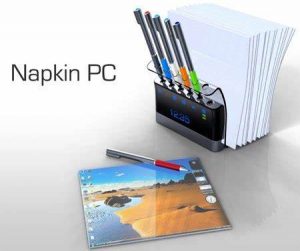
The Napkin PC and Other Innovative Ideas

The Napkin PC and Other Innovative IdeasI came across the web site for a Microsoft-sponsored alternative computing form factor contest a few years ago, and even still I must say there were a few interesting ideas that might help people begin to see the future of computing.

The most interesting concept was coincidentally the winner of the contest, the Napkin PC.

If you follow the link above you’ll see the artist conceptions and get a good sense of the vision. The gist is that some of the greatest advances in the world have been conceived on the lowly paper napkin in restaurants and coffee shops all over the world, so why not take the napkin high tech. Just don’t try and wipe up spilled coffee with it.

The concept consists of a rack to contain and potentially recharge the OLED “napkins” and the styluses that go with them. These “napkins” provide a computing interface much like a tablet computer and can be pinned up on a board or connected together to make a larger display.

The concept is targeted squarely at the brainstorming, ideation, collaboration space and if the designer can ever manage to pull it off, I think it would be a welcome tool for organizations everywhere.

So what is your vision for the future of computing?

Are there other sites on this topic you think others would find interesting?
— If so, please add a comment to this article with the URL

Build a Common Language of Innovation

Subscribe to Human-Centered Change & Innovation WeeklySign up here to get Human-Centered Change & Innovation Weekly delivered to your inbox every week.

Designing Innovation – Can Government Help?

Designing Innovation - Can Government Help?Can government help companies innovate, or do they tend to get in the way instead?

The answer is that often regulations tend to impede innovation and progress. Other key aspects of a country’s ability to innovate are the relative risk tolerance of its citizenry and whether it is culturally accepted to try and fail at something.

The United States leads the world in innovation because it has created the perfect storm of a risk tolerant citizenry, where failure is sometimes a badge of honor, and a government that invests in basic research, helps to commercialize it, and for the most part tends to go out of the way from a regulatory standpoint.

Other countries have looked to America with envy, often as some of their most innovative citizens were leaving to realize their visions in the New World. That is now starting to change, however. Some of the best and brightest are returning to their home countries from America and other governments are looking to replicate, or even improve upon, some of the factors that have led to success in America.

One of those countries is now Britain. Britain has been home to some phenomenal inventors over the past several centuries, but in the recent past the Brits have not been as successful at turning invention into innovation as the Americans. They are now working to change that.

When I was living there I saw several initiatives to spur innovation and new industries, and I also saw a growing innovative spirit. One of the top innovation agencies in the world, WhatIf?! (primary focus on product/service innovations), is located there and the country is full of design talent to go with its heritage of invention. This is allowing the creation of new global leaders like Dyson and Tesco with the right stuff to become leaders across the globe instead of only across Britain.

There is an interesting article on how Britain jumpstarts design (sorry, BusinessWeek unpublished it). America was the innovation leader in the last century. Who will be the innovation leader in this century? Will it be Britain, America, or someone else?

Who do you think it will be?

Build a Common Language of Innovation

Subscribe to Human-Centered Change & Innovation WeeklySign up here to get Human-Centered Change & Innovation Weekly delivered to your inbox every week.

Can Microsoft win the Android and iPhone Haters?

Can Microsoft win the Android and iPhone Haters?Nobody, including people inside Microsoft, would argue with the fact that Microsoft beat Google and Apple to the Mobile OS marketplace, but lags them both in terms of market share.

According to Wikipedia, the IBM Simon was the world’s first smartphone and was released to the world nearly twenty years ago. This means that the smartphone market is yet another example of a market where mass adoption has lagged behind initial product introduction by 20-30 years. For the inventor audience this is important to note, because it shows that #1 – innovation takes time – and #2 – that being first is no guarantee of being number one in the market when mass adoption arrives.

Well, mass adoption in the smartphone market is now upon us.

The only question is – which operating system maker will dominate the golden years of the smartphone market?

Will it be Apple or Google?

Or do Microsoft and RIM have a change to counterattack and make themselves relevant again?

Invention does not guarantee innovation. Innovation requires that you create value above every existing alternative and that you achieve wide adoption. The reason we often see changes in the leadership of the marketplace of an emerging innovation is that often the market creator does a worse job than new entrants of adapting their solution offering for the evolving desires of the customers. New entrants generally see an opportunity to solve problems that the incumbents don’t, and an create new value that the incumbent solutions don’t deliver.

But can an incumbent react to newer entrants and rebuild momentum in the marketplace?

Motorola’s revitalization in mobile handsets shows that a competitive response focused on leadership instead of reaction can in fact get you back in the game.

So can Microsoft do the same thing and steal share from Apple and Google in the smartphone OS market?

The answer lies in whether Microsoft can do a better job than Apple or Google (or even RIM) of understanding why people hate their current smartphones, while also anticipating:

  1. What the needs of customers will be in 6-12 months
  2. What customers will want in 6-12 months
  3. What emerging technologies will make possible in 6-12 months

Timing is one of the key components to successful innovation. You can invent things at any time, but you can only turn an invention into an innovation when customers and other parts of the value chain can see the value and are ready to accept it. Whether customers and the value chain can see the value is of course dependent on how well you translate for them how a potential innovation will fit into their lives.

Can Microsoft and Nokia come up with the answers that the marketplace will accept in 6-12 months? Are their existing phones the right answer for customers now?

I don’t know. But I can tell you that I hate, absolutely hate, the Google Android operating system on my Samsung Galaxy S. The Samsung device itself seems relatively well-designed but the Google Android OS is always crashing, doesn’t make smart use of the SD Card (the internal memory is always filling up), and leaves me constantly frustrated.

I bought two Samsung Galaxy S phones on T-Mobile over two iPhones on Verizon or AT&T for my wife and I, because they will cost me $1,000 less over the two-year commitment.

I can tell you with certainty that my next smartphone when I’m eligible for an upgrade will NOT be a Google Android phone. At the same time I know people who hate their iPhones and their Blackberries as well, so this represents an opportunity for Microsoft to convert disgruntled iOS, Android and Blackberry customers. Plus, there are a still a lot of people without a smartphone that will buy one in the next 6-12 months.

These two market dynamics represent a huge opportunity for Microsoft to get back in the smartphone OS market. The only question is:

Will they take advantage of this opportunity?


Article first published as ‘An Opening for Microsoft and Nokia?’ on Technorati.

Build a Common Language of Innovation

Subscribe to Human-Centered Change & Innovation WeeklySign up here to get Human-Centered Change & Innovation Weekly delivered to your inbox every week.

Software Design Challenge – Less is More

Software Design Challenge - Less is MoreI originally posed this software design challenge to application developers in September 2008 based on an InfoWorld article that warmed my heart, but have yet to see any major changes in how most software applications are designed.

For far too long, especially on the PC, software developers have been building applications with a feature arms race mentality. Because of rapidly expanding memory and hard disk space on customers’ machines, developers have not had to write tight code in the same way they had to in the early days of the PC.

Now, hopefully Symantec’s focus on creating Norton applications that install in under a minute and consume far less memory will spread to other industry players. Just because I have 4gb of RAM and 160gb of hard disk space does not give software developers the right to consume it thoughtlessly or to make my computer run slower.

Why can’t software developers give us adaptive software?

If I don’t use a feature of a product in 30 days, it should uninstall itself.

Why can’t I choose lean and mean (give me only the basic features) as an install option?

Software should be smart enough to minimize its footprint, while at the same time giving you the opportunity to add a feature easily later. So, an unused feature should get uninstalled, and simplify the menus as a result. But, if I hold the bottom of the menu it should expand to show uninstalled menu features in grey. If I select a greyed out feature it should tell me it is going to re-install it and then do so automatically.

I can only imagine how much smaller Vista, Office, Photoshop, and other applications would get if they were designed in this way.

If you know of applications designed in this way, please feel free to let me know by commenting on this article.

What do you think?

Build a Common Language of Innovation

Subscribe to Human-Centered Change & Innovation WeeklySign up here to get Human-Centered Change & Innovation Weekly delivered to your inbox every week.

Targeted Advertising While You Fly

It has been four years since I first wrote this article for my personal blog and because not many people saw it and because not much has changed I thought I would update it a bit and share it on Innovation Excellence.

Flying to Hawaii four years ago, I was reminded of the phrase, “You may be talking but nobody is listening.” Hawaiian Airlines had seen fit to pollute the cabin with an endless stream of un-targeted advertising on the plane’s set of televisions (no fancy seatback units here).

Now, at least on American Airlines the “advertising” mostly masquerades as entertainment (CBS sitcoms or clips of Letterman and 60 minutes) to try and keep the shows’ viewer base loyal or to pull in new viewers, but it’s still advertising. American Airlines has traditional advertising as well, but less than what I saw on Hawaiian Airlines four years ago. Since then I’ve flown all around the world delivering innovation speeches and innovation training, using a variety of carriers (Korean Air, Air France, Delta, etc.) and even on seatback inflight entertainment units I have yet to see any targeted advertising, and I’ve flown on a lot of flights without seatback entertainment units (although more and more airlines are updating their fleets).

Broadcast networks have at least some justification for spamming people over the airwaves (it’s their only revenue source and they are only able to target based on dominant audience profiles). The availability of on-demand, seatback entertainment systems, leaves airlines with no excuse, and in fact advertisers would be willingly to pay more for targeted impressions.

For targeting purposes, the airlines know who purchased the ticket (likely their age (senior/adult/child), phone number, e-mail, address, zip code, how much they paid, the credit card they paid with, etc.). About frequent fliers they will also know how frequently they fly, their home airport, and maybe even whether they are traveling on business and for which company. So it would definitely be possible to design a system to target advertising in-flight. And properly designed you could roll it out across a whole range of airlines to help airlines increase their revenue and advertisers reach their target audiences. So why haven’t airlines implemented such a system yet?

At its simplest, airlines could define the programming schedule as a mixture of content blocks and advertising blocks (interstitial advertising) and target the advertising by seat, using passenger data. Passenger data could be loaded up at the beginning of each flight by a gate agent using a USB key, smartcard, or other portable data storage device. Every seat could potentially receive a different combination of commercials during the flight.

Airlines wishing to avoid interstitial advertising could design a more complex system to support advertising that would appear during the programming (as banners, or whatever). Whichever way the airlines went, they have the opportunity to create a system that would likely attract the highest rates for video advertising on the planet to help them pay for the increasingly expensive fuel to fly the plane.

So why haven’t they done it?

P.S. I also thought it was interesting that Hawaiian Airlines had chosen four years ago to go “cash-free” and only accept debit and credit cards (which many other airlines have since copied). I agree with offering credit and debit cards as an option, but I’m not sure I agree with abandoning cash. Why would you want to do anything to make it more difficult for people to give you their money?

Build a Common Language of Innovation

Subscribe to Human-Centered Change & Innovation WeeklySign up here to get Human-Centered Change & Innovation Weekly delivered to your inbox every week.

Innovation Requires Diagonal Thinking

Innovation Requires Diagonal ThinkingThe outcome of a back and forth of a dialog on Twitter with Scramray E. Pinkus generated a lovely quote worth sharing:

“Innovating is like thinking diagonally. A perfect combination of both linear and lateral.”

– Scramray E. Pinkus (@Easelton)

The conversation sprung out of a tweet I posted that postulated that when people use technology (iPads, smartphones, laptops, etc.) and television as child minders, that they are actually promoting linear thinking in their children at the expense of the lateral thinking that our society so desperately needs. We need strong lateral thinking to compliment the dominant linear thinking out there, so that together they can drive the social innovation the world needs to fix this mess we’ve made.

What do you think?

Technology as child minder, positive or negative effects on the innovative capacity of our children?

One of my proof points is this article from The Washington Post.

Any other proof points out there?

Subscribe to Human-Centered Change & Innovation WeeklySign up here to get Human-Centered Change & Innovation Weekly delivered to your inbox every week.

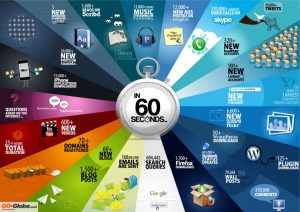
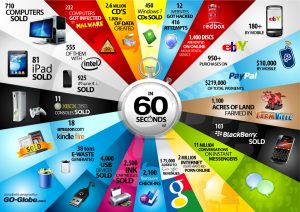
Every 60 Seconds Amazing Things Happen on the Internet

I found a couple of great infographics over on BusinessInsider that you’ll find below.

They highlight some truly astounding activity numbers from what happens in the world of technology and on the Internet.

Did you know that in a single minute there are over 168 million emails are sent? That’s just one example of the mind blowing online activity that takes place every sixty seconds.

Here are some of the other amazing things that happen in 60 seconds (click to enlarge):

Every 60 Seconds Amazing Things Happen on the Internet

Every 60 Seconds Amazing Things Happen on the Internet

Subscribe to Human-Centered Change & Innovation WeeklySign up here to get Human-Centered Change & Innovation Weekly delivered to your inbox every week.

Apple Tablet or iPhone Accessory?

There is a lot of chatter out there focusing on the possibility of a new Apple Tablet being announced at Apple’s next media event on September 9, 2009.

Will Apple launch a tablet computer?

Does it make sense for Apple to do so?

Let’s look at the current state of the market for computing devices:

  1. Many companies and individuals have recently made the switch from desktop computers to laptop computers
    • Yet, still IDC forecasts laptops like the Apple Macbook to represent only 55% of worldwide sales in 2009
  2. People are only now beginning to make the switch from dumb phones to smartphones in earnest
    • Yet in Q4 2008, only 23% of handsets sold in the USA were smartphones like the Apple iPhone (according to NPD group)
  3. Netbooks are currently the hot computing category
  4. Mobile operators in many countries charge by the device for Internet access
    • Adding an Apple Tablet would likely add $60/month to a mobile phone bill in the USA

So, given that a huge majority of individuals don’t even have a smartphone, are starting to keep their hardware longer, and may have just purchased a new laptop or netbook, does it make sense for Apple to launch a tablet or netbook computer?

I may be completely wrong, but personally I think that:

  1. Apple will not announce an Apple Tablet or Apple Netbook on September 9, 2009
    • Even if they wanted to, I don’t think they could make such a launch before January 2010 at the earliest
  2. Apple may never launch an Apple Tablet or an Apple Netbook
    • Experimentation with touch screens of various sizes could also point to a wireless iPhone and iPod Touch accessory

A Shift in How We Compute

People’s behavior is changing. As people move to smartphones like the Apple iPhone, these devices are occupying the middle space (around the neighborhood), and the mobility of laptops is shifting to the edges – around the house and around the world.

Personally, I believe that as smartphones and cloud computing evolve, these devices will become our primary computing hub and new hardware will be introduced that connects physically, wirelessly or virtually to enhance storage, computing power, screen size, input needs, output needs, etc.

– This would be thinking differently.
– This would be more than introducing a ‘me-too, but a little better’ product.
– This would be innovation.

And this would allow Apple (or someone else), by embracing this concept, to link up with pervasive, mobile, wearable computing efforts like those underway at IBM Research and elsewhere.

What will Apple really do?

What do you think?


Accelerate your change and transformation success

Subscribe to Human-Centered Change & Innovation WeeklySign up here to get Human-Centered Change & Innovation Weekly delivered to your inbox every week.