Tag Archives: project management

Change Management Best Practices for Project Managers

Change Management Best Practices for Project Managers

GUEST POST from Art Inteligencia

In today’s fast-paced business environment, effective change management is essential for project managers. Whether you are implementing new technology, restructuring your organization, or launching a new product, managing change effectively can be the difference between success and failure. This article outlines some of the best practices for managing change, supported by real-world case studies, to help project managers navigate the complexities of change with confidence.

Best Practices

1. Involve Stakeholders Early

Engaging stakeholders from the outset ensures that you capture their insights, foster collaboration, and gain buy-in. Early involvement helps to identify potential challenges and develop strategies to address them.

2. Clear Communication

Clear, consistent, and transparent communication is vital for managing change. Project managers should establish multiple communication channels and regularly update all stakeholders on the progress and impact of the change.

3. Provide Training and Support

A well-planned training program and ongoing support can help ease the transition and equip team members with the skills and knowledge they need to succeed in the new environment.

4. Monitor and Adjust

Continuous monitoring and adjustment are essential to address unforeseen challenges that may arise during the implementation of change. Regular feedback loops and flexibility in approach enable project managers to make necessary adjustments in real time.

5. Celebrate Milestones

Acknowledging and celebrating milestones, no matter how small, can boost morale and maintain momentum throughout the change process. Recognizing contributions keeps team members motivated and engaged.

Case Studies

Case Study 1: TechCorp’s Digital Transformation

TechCorp, a mid-sized technology firm, decided to undergo a digital transformation to enhance its operational efficiency and customer experience. The project manager, Lisa, implemented the following change management best practices:

  • Involvement of Stakeholders: Lisa organized workshops and focus groups with employees from different departments to gather input and ensure that their concerns were addressed.
  • Clear Communication: She established bi-weekly newsletters and town hall meetings to keep everyone informed about the progress and next steps.
  • Training and Support: A comprehensive training program was rolled out, including online courses and hands-on sessions, to help employees adapt to the new tools and processes.
  • Monitoring and Adjustment: Lisa set up a feedback mechanism enabling employees to share their experiences and suggestions, allowing her to make necessary adjustments promptly.
  • Celebrating Milestones: Quarterly events were held to celebrate the team’s achievements and recognize individual contributions, which fostered a positive environment.

As a result of these efforts, TechCorp successfully implemented its digital transformation, achieving a 30% increase in operational efficiency and a 20% improvement in customer satisfaction.

Case Study 2: HealthPlus Hospital’s EHR Implementation

HealthPlus Hospital undertook the challenging task of implementing a new Electronic Health Records (EHR) system. The project manager, Robert, followed these best practices:

  • Involvement of Stakeholders: Robert included doctors, nurses, and administrative staff in the planning process to understand their needs and ensure the system met their requirements.
  • Clear Communication: Weekly meetings and a dedicated intranet site were used to keep everyone up to date on the project’s status and provide answers to frequently asked questions.
  • Training and Support: A multi-phase training program was launched, including on-site workshops and one-on-one sessions, to prepare staff for the new system.
  • Monitoring and Adjustment: An ongoing evaluation system was created to identify and address issues as they arose, ensuring minimal disruption to hospital operations.
  • Celebrating Milestones: Each successful phase of implementation was celebrated with a small event and recognition certificates for employees who played key roles.

Through these efforts, HealthPlus Hospital achieved a seamless transition to the new EHR system, leading to improved patient care and increased staff efficiency.

Conclusion

Effective change management is critical for the success of any project. By involving stakeholders early, maintaining clear communication, providing adequate training and support, monitoring and adjusting strategies, and celebrating milestones, project managers can lead their teams through change successfully. The case studies of TechCorp and HealthPlus Hospital demonstrate how these best practices can be applied in real-world scenarios to achieve positive outcomes.

SPECIAL BONUS: Be sure and get your Visual Project Charter template and other FREE tools from the Human-Centered Change methodology on our FREE Human-Centered Change Tools page.

Image credit: Unsplash

Subscribe to Human-Centered Change & Innovation WeeklySign up here to get Human-Centered Change & Innovation Weekly delivered to your inbox every week.
Why Change is Hard

Why Change is Hard

In 250 Words or Less

When we think about change, often we look at it as being done to us, not something that we are part of. Initiating change is a scary, overwhelming process that we often avoid because we lack the tools to accumulate buy-in and successfully plan and execute the change in the face of the following obstacles/barriers:

  1. psychological/political
  2. logistical
  3. financial
  4. external

This leads to inaction and preservation of the status quo until the pain becomes too much to bear, or the promise of the change becomes so enticing, that people are willing to drop their resistance and begin engaging in the activities necessary to realize the intended outcomes of the change.

Organizations must identify up-front not only why people may resist, but also who will likely resist. Some of the typical reasons why people will resist include:

  • loss of certainty (includes fear of job loss)
  • loss of purpose, direction, or status
  • loss of mastery (includes loss of expertise/recognition)
  • loss of control or ownership
  • loss of connection or attachment
  • lack of trust or clarity
  • fear of failure (feel unprepared)
  • seeing proposed change as irrelevant or a bad idea

Finally, change is hard because even if you idedntify and overcome the resistance/obstacles/barriers, hiding below the surface is the even more daunting prospect that according to a 2009 ProSci study, 73% of organizations are at or near change saturation — the point at which organizations are incapable of absorbing additional change.

(248 words)

SPECIAL BONUS

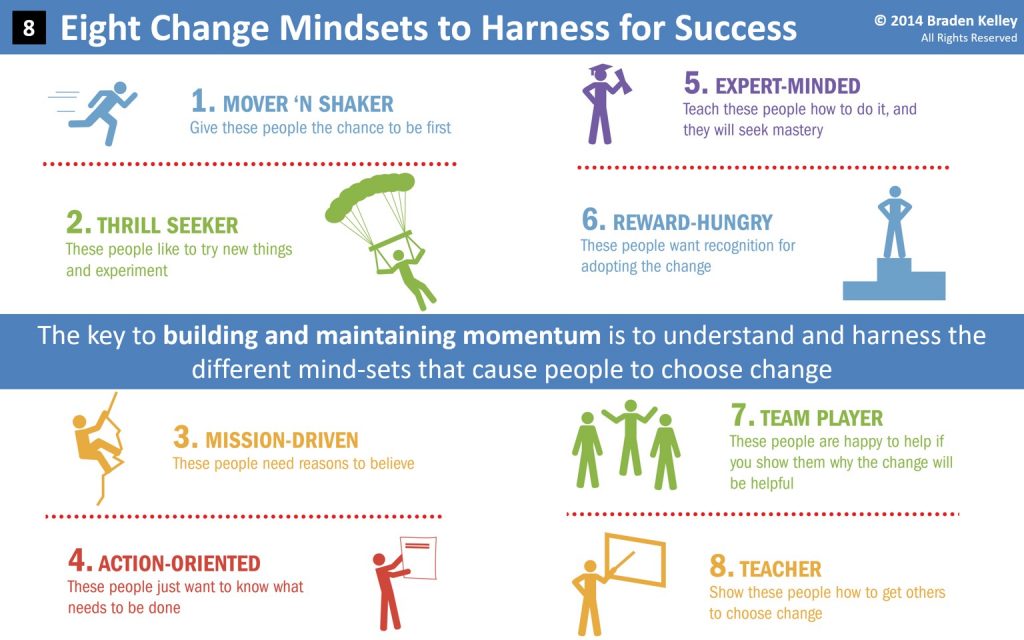
One tool I created for the Change Planning Toolkit™ that will assist you in creating a stronger change strategy and more targeted communications as you lower resistance and get people to choose change are the Eight Change Mindsets:

Eight Change Mindsets to Harness for Success

Obviously it is really hard to fit everything into 250 words so I had to leave some great other highlights of why change is hard, including this one:

In a 2008 global CEO study conducted by IBM on the enterprise of the future, the top challenges to successfully implementing strategic change were identified as:

  1. changing mindsets and attitudes (58 percent)
  2. corporate culture (49 percent)
  3. underestimating complexity (35 percent)
  4. shortage of resources (33 percent)
  5. lack of commitment from higher management (32 percent)
  6. lack of change know-how (20 percent)
  7. lack of motivation of employees involved (16 percent)

And here are some other challenges I would have included in the list:

  • lack of tools
  • lack of training
  • stakeholder misalignment
  • lack of buy in
  • change saturation
  • change fatigue
  • lack of change readiness
  • missing prerequisites
  • underestimating resistance
  • missing resources needed to succeed
  • underestimating risks and barriers
  • underestimating benefits of the status quo

To make change easier you’ll definitely want to transform how you plan and execute change into a more visual and collaborative approach, ideally suited for remote and hybrid interactions. It’s all laid out in my latest book Charting Change and supported by the Change Planning Toolkit™. A growing number of universities are picking up and teaching this new modern approach. Why not you?

Sources:

  1. Charting Change by Braden Kelley, Palgrave Macmillan, 2016
  2. Marsh survey on health, productivity and absenteeism—Prosci, 2009

Image Credit: Unsplash


Accelerate your change and transformation success

Subscribe to Human-Centered Change & Innovation WeeklySign up here to get Human-Centered Change & Innovation Weekly delivered to your inbox every week.

AI-Powered Project Management

Optimizing Efficiency and Delivery

AI-Powered Project Management

GUEST POST from Chateau G Pato

In today’s fast-paced and competitive business landscape, successful project management is more important than ever. Companies are constantly under pressure to deliver results on time and within budget, all while juggling multiple projects and resources. This is where artificial intelligence (AI) comes in, offering a powerful tool to optimize efficiency and enhance project delivery.

AI-driven project management tools analyze vast amounts of data and predict potential performance issues before they occur. By integrating AI into project management processes, teams can unlock new levels of efficiency, productivity, and collaboration.

Case Study 1: Global Tech Company

A global tech company faced challenges with project delays and resource allocation inefficiencies. By implementing an AI-powered project management platform, the company was able to significantly reduce project completion times and optimize resource allocation. The AI tool identified potential bottlenecks in real-time, enabling project managers to make informed decisions and proactively address issues before they impacted project timelines. As a result, the company improved project delivery by 30% and reduced costs by 20% within the first year of implementation.

Case Study 2: Healthcare Provider

A healthcare provider was struggling with patient scheduling and resource management inefficiencies. By leveraging AI technology in their project management processes, the provider was able to streamline patient appointments, optimize staff schedules, and improve overall healthcare delivery. The AI tool analyzed patient data and staff availability to automatically schedule appointments and assign resources, reducing wait times and improving patient satisfaction. As a result, the provider saw a 25% increase in patient attendance rates and a 15% decrease in staff overtime costs.

Conclusion

AI-powered project management is revolutionizing the way companies approach project delivery. By harnessing the power of AI to analyze data, predict performance issues, and optimize resource allocation, organizations can significantly improve efficiency, productivity, and collaboration. As we continue to embrace AI technology in project management, the possibilities for innovation and transformation are endless.

Bottom line: The Change Planning Toolkit™ is grounded in extensive research and proven methodologies, providing users with a reliable and evidence-based approach to change management. The toolkit offers a comprehensive set of tools and resources that guide users through each stage of the change planning process, enabling them to develop effective strategies and navigate potential obstacles with confidence.

Image credit: Pixabay

Subscribe to Human-Centered Change & Innovation WeeklySign up here to get Human-Centered Change & Innovation Weekly delivered to your inbox every week.

Remote Project Management – The Visual Project Charter™

Remote Project Management - The Visual Project Charter™

The truth is that for most of us project managers, whether we want to admit it or not, the process of creating a project charter is one that we often dread.

We sit there in front of a Microsoft Word template blinking at us on the screen and realize just how much missing or incomplete information we have when we begin typing into the one of the very first, and potentially most important artifacts for any project.

We know we face the sending of a series of emails, follow up emails, follow up to the follow up emails, and maybe even some escalation emails and phone calls just to get the information we need to create the first draft of a project charter. And that’s before we even begin trying to get alignment, buy-in, and sign-off on the document.

Now, add in the challenges of trying to create a project charter when everyone is working remotely and our sacred task of initiating a project doesn’t get any easier.

So, there has never been a better time to leverage the Visual Project Charter™.

The Visual Project Charter™

With online whiteboarding tools like Mural, Miro, LucidSpark and Microsoft Whiteboard you can easily download the Visual Project Charter™ for FREE as a JPEG and upload it as a background to place digital sticky notes on as you collaborate with cross-functional team virtually using Zoom, Cisco WebEx or Microsoft Teams.

Visual Project Charter™

Click here to access the PDF poster (35″x56″) and JPEG of the Visual Project Charter™

To help give you a better idea of how easy this is to do and what it might look like, I created the following short six-minute video introduction to the Visual Project Charter™ to show how easy it is to take the JPEG and upload it as a background into online whiteboarding tools like Mural, Miro, LucidSpark or Microsoft Whiteboard where you can place digital sticky notes instead of real ones as you collaborate with cross-functional team virtually using Zoom, Cisco WebEx or Microsoft Teams.

Click here to access the PDF poster (35″x56″) and JPEG of the Visual Project Charter™

Remote Project Management

Whether you download the Visual Project Charter™ PDF and print it as a poster (35″x56″) or use the JPEG in the digital world I’m sure you’ll agree that this a much more visual, collaborative, enjoyable and effective way to gather all of the information to populate your project charter and build the buy-in and alignment necessary to make your project a success!

Here is a step-by-step guide for how to use the Visual Project Charter™ with online whiteboarding tools like Miro, Mural, LucidSpark and Microsoft Whiteboard:

  1. Download the Visual Project Charter™ from this web site
  2. (both JPEG and PDF)

  3. Create a new workspace in your online whiteboarding tool (Miro, Mural, LucidSpark or Microsoft Whiteboard)
  4. Upload the JPEG version of the Visual Project Charter™ to your online whiteboarding tool
    • MIRO – ‘Upload->My Device’ (left side icons)
    • MURAL -‘Images->import images’ (left side icons)
    • LUCIDSPARK – ‘Insert->Images’ (under hamburger menu on the top)
    • WHITEBOARD – ‘Images->Library Image’ (bottom icons)

  5. Resize the JPEG image after it is added
  6. Lock the JPEG image down so people can’t move it around when placing their sticky notes
  7. Create work areas around the Visual Project Charter™ to give you larger, targeted areas to work (if desired)
  8. Plan and execute your cross-functional team meeting to populate the Visual Project Charter™ via Zoom or Cisco WebEx or Microsoft teams when the workspace is built
  9. Have fun!
  10. Use the results of your Visual Project Charter™ session to create a traditional project charter and route it for signatures

Charting ChangeI’m sure you’ll get a lot of value out of the Visual Project Charter™, especially when using it as part of your remote project management best practices.

And, if you like the Visual Project Charter™, you will LOVE the Change Planning Toolkit™ and should definitely pick up copies of my books:

  1. Charting Change
  2. Stoking Your Innovation Bonfire

Subscribe to Human-Centered Change & Innovation WeeklySign up here to get Human-Centered Change & Innovation Weekly delivered to your inbox every week.
FINAL DAY – Insane Cyber Deal on My Latest Book

Charting Change

Every so often something comes through your inbox that seems too good to be true.

Today was one of those times when an email dropped into my inbox stating that Palgrave Macmillan, the publisher of my latest book Charting Change is offering it at a ridiculous Cyber Week Sale price of $9.99 on the USA web site.

USA – https://www.palgrave.com/us/book/9781137536952

There is also a European web site offering it for 9,99 Euros if you need it:

EUROPE – https://www.palgrave.com/gp/book/9781137536952

You can either get the eBook with INSTANT DOWNLOAD or the hardcover with FREE SHIPPING – It’s your choice!

IMPORTANT CAVEAT: According to the email, this deal ends December 3, 2019

Here is a blurb about the book from the web site to give you a sense of the value it will deliver to your organization:

Research shows that up to seventy percent of all change initiatives fail. Let’s face it, change is hard, as is getting an organization on board and working through the process. One thing that has been known to be effective is onboarding teams not only to understand this change, but to see the process and the progress of institutional change. Charting Change will help teams and companies visualize this complicated process. Kelley has developed the Change Planning Canvas™, which enables leadership and project teams to easily discuss the variable that will influence the change effort and organize them in a collaborative and visual way. It will help managers build a cohesive approach that can be more easily embraced by employees who are charged with the actual implementation of change. This book will teach readers how to use this visual toolkit to build a common language and vision for implementing change.

Here are the links for you again to take advantage of this offer ending December 3, 2019:

USA – https://www.palgrave.com/us/book/9781137536952 (only $9.99)
EUROPE – https://www.palgrave.com/gp/book/9781137536952 (only 9,99 Euros)

Hardcover or eBook!

Coupon Code: CYBER19PAL

—————————————–

SPECIAL BONUS: Anyone who buys a copy of the book will get FOR FREE 26 of the 50+ tools in the Change Planning Toolkit™ – INCLUDING a copy of the Change Planning Canvas™

——————————————

If $9.99 is still too much of a barrier to break through to accelerate your change capability, then go ahead and grab the 10 free tools, including a visualization of the Association of Change Management Professionals (ACMP) Standard for Change Management® and my popular & powerful collaborative Visual Project Charter™.


What People Are Saying

Daniel H Pink“There’s no denying it: Change is scary. But it’s also inevitable. In Charting Change, Braden Kelley gives you a toolkit and a blueprint for initiating and managing change in your organization, no matter what form it takes.”

– Daniel H. Pink, author of Drive and To Sell is Human

Eric Hieger“Thoughtful, thorough, and practical is the rare blend that Braden has achieved in this Change Management field guide. Much more than a series of tactics, Charting Change will explicitly, sequentially, and visually help users create a diverse set of experiences for stakeholders that will most certainly increase likelihood of success.”

– Eric D. Hieger, Psy.D., Business Transformation and Change Leadership Practice Lead at ADP

Phil McKinney“Braden Kelley and his merry band of guest experts have done a nice job of visualizing in Charting Change how to make future change efforts more collaborative. Kelley shows how to draw out the hidden assumptions and land mines early in the change planning process, and presents some great techniques for keeping people aligned as a change effort or project moves forward.”

– Phil McKinney, retired CTO for Hewlett-Packard and author of Beyond the Obvious

Denise Fletcher“As the pace of change speeds up, the market disruptions and resulting changes can be daunting for all. We all wish we could predict how change will affect our business, our market and our people. No matter what business area you come from, change affects us all and can produce great outcomes when managed well. In Braden Kelley’s newest book, Charting Change, he provides a terrific toolkit to manage this process and make it stick.”

– Denise Fletcher, Chief Innovation Officer, Xerox

Marshall Goldsmith“Higher employee retention? Increased revenue? Process enhancements? Whatever your change goal, Charting Change is full of bright ideas and invaluable visual guides to walk you through change in any area where your organization needs it.”

– Marshall Goldsmith is the #1 New York Times bestselling author of Triggers, MOJO and What Got You Here Won’t Get You There


Accelerate your change and transformation success

Subscribe to Human-Centered Change & Innovation WeeklySign up here to get Human-Centered Change & Innovation Weekly delivered to your inbox every week.
The Benefits of Change Management for Project Managers

The Benefits of Change Management for Project Managers

GUEST POST from Chateau G Pato

Change management is becoming increasingly important for project managers in today’s fast-paced digital world. As more and more organizations adopt digital transformation strategies, project managers must be equipped to handle the changes that come along with it. Change management is the process of managing organizational change and helping people transition to the new normal. It involves analyzing the impact of the change, planning the implementation, communicating the plan, and monitoring progress. Change management can help project managers ensure that projects remain on track during periods of transition.

The benefits of change management for project managers can range from increased efficiency to improved morale. By using change management, project managers can ensure that the whole team is on the same page and that all stakeholders understand the implications of the changes. This helps to reduce the risk of miscommunication or misinterpretation of the new process, thus ensuring that projects stay on track. Additionally, change management can help project managers to reduce resistance to change, as employees can be provided with the support they need to adapt. This can help to improve morale, as employees feel like their voices are being heard and their concerns are being addressed.

Case Study 1: The UK National Health Service

The UK National Health Service is a good example of how change management can help project managers successfully tackle organizational change. The NHS recently implemented a large-scale digital transformation project, which included the introduction of new technology and processes. To ensure that the project ran smoothly, the NHS tapped into their existing change management process. This included creating a communication plan to ensure that stakeholders were informed of the changes, providing training for staff to help them adapt to the new system, and monitoring progress to ensure that the project stayed on track. Thanks to their effective change management process, the project was a success, and the NHS is now reaping the rewards of their digital transformation.

Case Study 2: Microsoft

Microsoft is another example of how change management can help project managers. Microsoft recently introduced a new organizational structure that was designed to improve efficiency and productivity. To ensure that the change was implemented smoothly, Microsoft applied their change management process. This included providing clear communication to stakeholders, offering training to ensure that employees were well-prepared, and monitoring progress to ensure that the transition was successful. The end result was a successful transition that has resulted in increased efficiency and improved morale.

Conclusion

In conclusion, change management is a valuable tool for project managers. By applying an effective change management process, project managers can ensure that projects remain on track during periods of transition. This can lead to increased efficiency, improved morale, and ultimately, a successful project.

Image credit: Pexels

Subscribe to Human-Centered Change & Innovation WeeklySign up here to join 17,000+ leaders getting Human-Centered Change & Innovation Weekly delivered to their inbox every week.

What is in a Project Charter?

What is in a Project Charter?

GUEST POST from Art Inteligencia

A project charter is an essential document used to define a project and ensure that all stakeholders are on the same page. It outlines the project’s purpose, goals, timelines, resources, and responsibilities, and serves as the foundation for successful project execution.

The most important element of a project charter is the scope. This section defines the scope of the project in terms of what will be done, the objectives to be achieved, and the deliverables expected. It also identifies any constraints or limitations that may affect the project.

The project charter also outlines the timeline and milestones for the project. This section lays out the start and end dates, as well as any major milestones, such as the completion of certain tasks or the delivery of specific deliverables.

The project charter also includes the roles and responsibilities of the stakeholders. This section outlines who is responsible for what, and who has authority over which decisions. It also defines the communication process between the stakeholders and outlines the decision-making process.

The resources section of the project charter lists the resources required to complete the project, such as personnel, materials, and equipment. It also outlines the budget for the project, including any costs associated with the resources.

Finally, the project charter includes the risks and assumptions associated with the project. This section identifies potential risks, such as changes in scope, resource constraints, or political changes, and outlines how they will be addressed. It also outlines any assumptions made during the project planning process.

A project charter is an important document that helps ensure that all stakeholders are on the same page and that the project is properly defined and managed. It outlines the scope, timeline, roles and responsibilities, resources, and risks and assumptions associated with the project, and serves as the foundation for successful project execution.

SPECIAL BONUS: You can get your very own copy of the Visual Project Charter™ for FREE for use as 35″x56″ giant poster or as a background to use in Miro, Mural, Lucidspark, Microsoft Whiteboard, Google Jamboard, etc. The Visual Project Charter™ was
created by Braden Kelley to help project managers set up their projects for greater success by beginning their project management efforts in a more visual, collaborative way.

The Visual Project Charter™ helps organizations:

  • Move beyond the Microsoft Word document
  • Make the creation of Project Charters more fun!
  • Kickoff projects in a more collaborative, more visual way
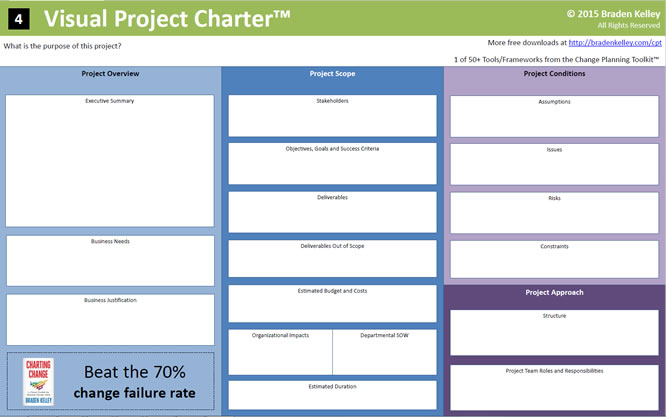
  • Structure dialogue to capture the project overview, project scope, project conditions and project approach

Image credit: Unsplash

Subscribe to Human-Centered Change & Innovation WeeklySign up here to get Human-Centered Change & Innovation Weekly delivered to your inbox every week.

What is the Cost of a Failed Change Initiative or Innovation Project?

What is the Cost of a Failed Change Initiative or Innovation Project?

by Braden Kelley

It seems like a simple question.

One that you would expect to lead to some risk mitigation behavior, but it doesn’t.

And when you consider that companies are spending an increasing amount of their budget on technology and working to transform their operations to be more digital in order to provide a better experience for customers, employees, partners and suppliers while simultaneously creating a more efficient and effective business, you would think that companies would do everything possible to make sure that these projects succeed, but they don’t.

Everyone knows that a lot of technology projects fail to achieve their intended objectives, timings, and budgets. This fact and the increasing investment levels should cause more executives to look for ways to de-risk these technology investments in digitizing the business, but they’re not.

Why is that?

Are we really so afraid of learning new ways of doing things that would dramatically reduce the risk and expense of project failures that we will continue using the old ways even though we know they don’t work?

Even though there are incredibly inexpensive and easy ways of reducing both the risk of project failures and the cost of project execution, patterns of behavior are not changing…

Perhaps you see the world differently.

Perhaps you’re fed up with project failures and want to increase the speed of both change execution and change adoption.

Consider answering these five simple questions before spending a single minute on your next innovation project, change initiative, or digital transformation effort:

  1. How much is an hour of your time worth to the company you work for? (multiply this by the number of hours you expect to invest in this project or initiative)
  2. What is the fully-loaded monetary value of the time that employees are going to spend on this project or initiative?
  3. How much do you pay to a single contract project manager to spin up a project before the first minute of actual work begins? Over the life of the project?
  4. How much are you planning to spend with consulting companies on this project or initiative?
  5. How much are you planning to spend on contractors to staff this project or initiative?

Get access to the Change Planning Toolkit for less than $100Have you got the numbers in your mind?

Now, are any of these numbers $100 or more?

I’m sure they are, unless of course you’re going to do the project yourself in less than an hour and don’t value your time very much.

So, what if I told you that for less than $100 you could plan and execute your change initiatives, innovation projects and transformation investments in a much more visual and collaborative way and simultaneously reduce the chances of project failure and the cost of executing your project?

Well, you can. You just have to be willing to challenge orthodoxies and use a new set of tools, a new approach, that will feel very natural and empowering if you’re already comfortable with the Business Model Canvas, Lean, Design Thinking, or the Lean Startup.

All you need to get started is a copy of my latest book Charting Change and a $99.99/yr license for the Change Planning Toolkit™ (which comes with a QuickStart Guide). In exchange you’ll get tools worth more than $1,200 and will help to support the creation of the Human-Centered Innovation Toolkit™.

It’s as simple as that.

And to get you started if you’re still unsure, go ahead and grab the 10 Free Downloads and the poster-size Visual Project Charter™ and the poster-size Experiment Canvas™ from the under-construction Human-Centered Innovation Toolkit™.

Let’s change change and keep innovating – together!


Accelerate your change and transformation success

Subscribe to Human-Centered Change & Innovation WeeklySign up here to get Human-Centered Change & Innovation Weekly delivered to your inbox every week.

The Benefits of Agile Project Management for SMEs

The Benefits of Agile Project Management for SMEs

GUEST POST from Art Inteligencia

The rapid pace of technological advancement and the increased competition in the business landscape have made project management a critical factor in the success of any organization. Small and medium-sized enterprises (SMEs) are no exception, and the implementation of agile project management can provide numerous benefits that can help them stay ahead of the competition.

Agile project management is a methodology that emphasizes flexibility and iterative progress, allowing teams to adapt quickly to changing conditions and customer needs. This type of project management has become increasingly popular in the business world and is a great option for SMEs looking to improve their project management capabilities. Here are five key benefits of agile project management for SMEs.

1. Improved Efficiency

Agile project management allows teams to break down large tasks into smaller, more manageable chunks, which can help teams complete projects efficiently and on time. The iterative nature of agile project management also encourages teams to test and revise plans and strategies regularly, which can help teams identify and address inefficiencies more quickly.

2. Improved Communication

Agile project management encourages teams to communicate frequently and collaboratively. This regular communication helps teams stay on the same page, reduces misunderstandings, and encourages everyone to contribute their ideas and perspectives.

3. Enhanced Flexibility

The iterative nature of agile project management makes it easier for teams to adjust to changing customer needs and priorities. This allows teams to respond quickly to changes, and to adjust their strategies accordingly.

4. Improved Quality

Agile project management encourages teams to consistently review and test their work, which can help identify and address any issues or problems more quickly and effectively. This can result in higher quality projects and products.

5. Increased Visibility

The regular communication encouraged by agile project management helps keep stakeholders informed of project progress and allows teams to identify potential risks or issues more quickly. This can help teams to take proactive steps to address any potential problems before they arise.

The implementation of agile project management can be a great way for SMEs to increase their project management capabilities and stay ahead of the competition. The five benefits discussed here are just the beginning of the many advantages that agile project management can provide.

Image credit: Pixabay

Subscribe to Human-Centered Change & Innovation WeeklySign up here to get Human-Centered Change & Innovation Weekly delivered to your inbox every week.
Introduction to the Change Planning Toolkit™

Introduction to the Change Planning Toolkit

The business world is showing an increasing interest in the people side of change, and there is a very real reason for this…

Companies are spending an increasing amount of their budget on technology and working to transform their operations to be more digital in order to provide a better experience for customers, employees, partners and suppliers while simultaneously creating a more efficient and effective business.

Everyone knows that a lot of technology projects fail to achieve their intended objectives, timings, and budgets. This fact and the increasing investment levels are causing more executives to look for ways to de-risk these technology investments in digitizing the business.

That’s why we’re seeing an uptick in the hiring and certification of change management professionals, which is great, but companies are still thinking about the relationship between project management and change management backwards.

In most cases change management is brought to bear as an afterthought, a bolt on to project management when the reverse should be true. Managing a change is a bigger endeavor than managing a project, and in fact you could say that because every project changes something, that every project is a change initiative.

It is thinking about managing projects in this way that I sat down to begin managing a new project several years ago and like many project managers, I found myself sitting at my computer by myself starting at an empty Microsoft Word template for a project charter knowing the uphill battle I’m going to face trying to route this document around via email and succeeding at both getting any responses at all and at getting meaningful input and a diversity of perspectives to make my project charter a really strong document that anyone will actually look at after week two of the project. I also found myself thinking that there has to be a better to plan and execute change initiatives and projects.

ACMP Standard Visualization

And sure people like pull ADKAR (a modified version of AIDA from the marketing world) and the ACMP Standard for Change Management (see the visualization I created above and download it for free here) and John Kotter’s change leadership approach, but they all fall short of making the planning and execution of change initiatives and projects a more visual and collaborative process, so I found myself starting to create new tools to help people (intended to link up with the PMBOK and ACMP Standard for Change Management).

These tools started to collect until they formed a comprehensive and new visual, collaborative approach to planning and executing change initiatives, and yes projects. This collection of tools became known as the Change Planning Toolkit™ and was first introduced in my latest book Charting Change which pairs nicely with my first book Stoking Your Innovation Bonfire. Both are designed to pack more insights into each chapter than most books contain in the entirety of their pages. Two of the most important frameworks introduced in the book are the Five Keys to Successful Change:

Five Keys to Successful Change 550

And the Architecting the Organization for Change framework:

Architecting the Organization for Change

Both frameworks are designed to help people challenge the way they think about organizational change. They are designed to help people think about more than change management and to think differently about how organizations are transformed and how change management and project management relate to each other.

To help people begin their participation in changing change I’ve made ten free tools available for download from the 50+ tools in the Change Planning Toolkit™, and people who buy a copy of Charting Change get access to 26 of the 50+ tools (including the Visual Project Charter™ and the Change Planning Canvas™). The book does a great job of helping to explain the philosophy behind the toolkit and how to get started with the tools, but people who purchase access to all 50+ tools (including tools to help people think through their Digital Transformation) also get a QuickStart Guide to explain each tool.

But if we are going to truly work together to change how change is planned and executed I thought it would make sense to give people a more in depth sneak preview into what’s inside the toolkit and so I’ve created the following Introduction to the Change Planning Toolkit™ webinar recording:


I encourage you to reflect upon your own experiences planning and executing both projects and change initiatives and what you’ve found lacking in the tools you call upon from ProSci, PMI, ACMP or others and then check out the book and the webinar and then let me know if there are any tools that you feel are still missing – and if it makes sense, I’ll create them!

My goal in creating all of these tools for you after all is to help you beat the 70% change failure rate, so let’s work together at changing change so our organizations are capable with more capably transforming themselves as the environment changes around them.

You can let me know if there are any change tools that you still need (or if you’d like me to come show you and your team personally how to use them) via the contact form.

Let’s change change together!

Change Planning Toolkit Million Dollar Value

Subscribe to Human-Centered Change & Innovation WeeklySign up here to get Human-Centered Change & Innovation Weekly delivered to your inbox every week.