Many years ago, Clay Christensen visited his firm where I was a partner and told us a story*.
“I imagine the day I die and present myself at the entrance to Heaven,” he said. “The Lord will show me around, and the beauty and majesty will overcome me. Eventually, I will notice that there are no numbers or data in Heaven, and I will ask the Lord why that is.”
“Data lies,” the Lord will respond. “Nothing that lies can be in Heaven. So, if people want data, I tell them to go to Hell.”
We all chuckled at the punchline and at the strength of the language Clay used (if you ever met him, you know that he was an incredibly gentle and soft-spoken man, so using the phrase “go to Hell” was the equivalent of your parents unleashing a five-minute long expletive-laden rant).
“If you want data, go to Hell.”
Clay’s statement seems absolutely blasphemous, especially in a society that views quantitative data as the ultimate source of truth:
“Above all else, show the data.” – Edward R. Tufte, a pioneer in the field of data visualization
“What gets measured gets managed” – Peter Drucker, father of modern management studies
But it’s not entirely wrong.
Quantitative Data’s blessing: A sense of safety
As humans, we crave certainty and safety. This was true millennia ago when we needed to know whether the rustling in the leaves was the wind or a hungry predator preparing to leap and tear us limb from lime. And it’s true today when we must make billion-dollar decisions about buying companies, launching products, and expanding into new geographies.
We rely on data about company valuation and cash flow, market size and growth, and competitor size and strategy to make big decisions, trusting that it is accurate and will continue to be true for the foreseeable future.
Quantitative Data’s curse: The past does not predict the future
As leaders navigating an increasingly VUCA world, we know we must prepare for multiple scenarios, operate with agility, and be willing to pivot when change happens.
Yet we rely on data that describes the past.
We can extrapolate it, build forecasts, and create models, but the data will never tell us with certainty what will happen in the future. It can’t even tell us the Why (drivers, causal mechanisms) behind the What it describes.
The Answer: And not Or
Quantitative data Is useful. It gives us the sense of safety we need to operate in a world of uncertainty and a starting point from which to imagine the future(s).
But, it is not enough to give the clarity or confidence we need to make decisions leading to future growth and lasting competitive advantage.
To make those decisions, we need quantitative data AND qualitative insights.
We need numbers and humans.
Qualitative Insight’s blessing: A view into the future
Humans are the source of data. Our beliefs, motivations, aspirations, and actions are tracked and measured, and turned into numbers that describe what we believed, wanted, and did in the past.
By understanding human beliefs, motivations, and aspirations (and capturing them as qualitative insights), we gain insight into why we believed, wanted, and did those things and, as a result, how those beliefs, motivations, aspirations, and actions could change and be changed. With these insights, we can develop strategies and plans to change or maintain beliefs and motivations and anticipate and prepare for events that could accelerate or hinder our goals. And yes, these insights can be quantified.
Qualitative Insight’s curse: We must be brave
When discussing the merit of pursuing or applying qualitative research, it’s not uncommon for someone to trot out the saying (erroneously attributed to Henry Ford), “If I asked people what they wanted, they would have said a horse that goes twice as fast and eats half as much.”
Pushing against that assertion requires you to be brave. To let go of your desire for certainty and safety, take a risk, and be intellectually brave.
Being brave is hard. Staying safe is easy. It’s rational. It’s what any reasonable person would do. But safe, rational, and reasonable people rarely change the world.
One more story
In 1980, McKinsey predicted that the worldwide market for cell phones would max out at 900,000 subscribers. They based this prediction on solid data, analyzed by some of the most intelligent people in business. The data and resulting recommendations made sense when presented to AT&T, McKinsey’s client.
Five years later, there were 340,213 subscribers, and McKinsey looked pretty smart. In 1990, there were 5.3 million subscribers, almost 6x McKinsey’s prediction. In 1994, there were 24.1M subscribers in the US alone (27x McKinsey’s global forecast), and AT&T was forced to pay $12.6B to acquire McCaw Cellular.
Should AT&T have told McKinsey to “go to Hell?” No.
Should AT&T have thanked McKinsey for going to (and through) Hell to get the data, then asked whether they swung by earth to talk to humans and understand their Jobs to be Done around communication? Yes.
Because, as Box founder Aaron Levie reminds us,
“Sizing the market for a disruptor based on an incumbent’s market is like sizing a car industry off how many horses there were in 1910.”
* Except for the last line, these probably (definitely) weren’t his exact words, but they are an accurate representation of what I remember him saying
Image Credit: Pixabay
Sign up here to get Human-Centered Change & Innovation Weekly delivered to your inbox every week.
At the beginning of each month we will profile the ten articles from the previous month that generated the most traffic to Human-Centered Change & Innovation. We also publish a weekly Top 5 as part of our FREE email newsletter. Did your favorite make the cut?
But enough delay, here are June’s ten most popular innovation posts:
If you’re not familiar with Human-Centered Change & Innovation, we publish 4-7 new articles every week built around innovation and transformation insights from our roster of contributing authors and ad hoc submissions from community members. Get the articles right in your Facebook, Twitter or Linkedin feeds too!
Have something to contribute?
Human-Centered Change & Innovation is open to contributions from any and all innovation and transformation professionals out there (practitioners, professors, researchers, consultants, authors, etc.) who have valuable human-centered change and innovation insights to share with everyone for the greater good. If you’d like to contribute, please contact me.
P.S. Here are our Top 40 Innovation Bloggers lists from the last two years:
“The world needs stories and characters that unite us rather than tear us apart.”~ Gale Anne Hurd, Producer of Aliens and The Terminator
GUEST POST from Bruce Fairley
In my early years I was fortunate to spend some time on film sets. Unlike how the entertainment industry is portrayed in the Netflix series, The Movies that Made Us, I did not come to blows with any of my directors as Eddie Murphy apparently did with John Landis during the making of Coming to America. Nor did I witness an entire crew mutiny, as James Cameron did on Aliens. Instead, I often saw the same dynamic I’ve witnessed in the tech sector from the first moment I stepped off set and into I.T.
People coming together.
Skilled, diverse, passionate people hard at work fighting against miscommunication, technical issues, and time constraints – coming together to achieve something significant. I referred to this in my previous Transformation Insights post, The Future Always Wins as:
Collaboration Between Complementary Influencers.
This dynamic is as true of a film set as it is of a firm engaged in digital transformation. In both cases, expertise in various areas is required to create a successful whole, with C-Suite leaders in the corporate sphere tasked with providing the articulated vision at the helm. Of course, the success of any endeavor comes down to human-powered action and decision making at every level of execution. And while the challenges of a digital transformation project may not be as bone-breaking dangerous as the stunts in an action film, getting to greatness requires a similar fusion of mind and machine – of talent and technology.
If that sounds like The Terminator, consider that its box office success speaks to the fusion of mind and machine as an unstoppable trajectory – but those who deepen their humanity rather than succumb to machine rule are the heroes that triumph. This was mirrored in the making of the film, which was nearly shut down when the crew put down their tools. Addressing their humanity and acknowledging the value of their contribution changed the story from disaster to blockbuster.
Humans lead – technology serves. Not the other way around.
When that is reversed, dystopia ensues whether on screen or in the boardroom. Having witnessed many occasions in which technology was expediently obtained before its value to the user could be established, I am convinced we have lost the plot in telling a wider, corporate story. Technology was supposed to liberate not enslave. Instead, how many times have you attended a Zoom meeting or prepared weeks for a presentation only to discover the sound not working, the slide deck freezing, or even a hidden ‘on’ button? These may be simple examples, but they rob the intrepid hero of the corporate journey; the chance to shine and advance their creative talent much like the crew of Aliens putting down their tools. Now multiply that by the large scale digital transformation projects I’ve spearheaded, and it becomes clear how a broken axis between human-powered decision making and technology can break the bottom line.
Optimism and momentum towards a more positive, successful outcome hinges on more than technological expertise. It requires an understanding of the whole story – and how the team, tech, leadership, and consumers each play a role. The story you wish to tell about your corporate journey requires buy-in at every level of service – human and tech. Obstacles are not indictments, they are merely obstacles. But they do often require a third-party complementary collaborator that understands how to transform pitfalls into profits.
When I launched the Narrative Group I wanted to amplify the genius of C-Suite executives through the optimization of the business-tech relationship. Similarly to how I observed the inner workings of a set and how all the pieces had to fit together to create a screen success, I spent years observing digital transformation from the inside. Across continents and boardrooms, I learned, led, and transformed as well. This only increased my commitment to helping talented leaders tell their story successfully.
If you’re a C-Suite leader that would like to storyboard the trajectory of your corporate success, please feel free to reach out and continue the conversation at:
Talent is one of the main drivers of innovation and its scarcity and high value makes it a frequent cause for concern for leaders from all over the world. And for good reason. Quality talent can make a business up to 800 times more productive.
But some of the biggest managerial challenges of senior leaders are finding the right talent and encouraging innovative behavior in employees. In fact, only23% of managers and senior leaders believe they have good methods in place to acquire and retain the best talent.
So, how do you find the right people, retain them, and get them to drive more innovation? Putting together innovative teams and making sure that you have the best talent in the organization is not just an HR responsibility. From top executives to managers and leaders, they all have a part to play in the quest for talent that can help the organization drive more innovation.
To this end, we wrote this article for people in large organizations, whether they are innovation managers, leaders, or executives, who want to build talented teams that can actually drive more innovation.
We’ll go through some important points on the characteristics of innovative employees and provide some practical tips on how to get better talent and tap into the potential of current workforce to drive more innovation.
Why organizations need more employees involved in, and trained for, innovation work
We know that at a global level there is a shortage of highly skilled employees, and that even large companies with all their resources, don’t excel at finding and retaining talent.
Even though unemployment is still a big problem in many areas of the world, the rapid pace of change in recent times have showed that there is also an increasing shortage of talent.
Before 2020, a Gallup survey revealed that 73% of respondents were thinking of leaving their job. The pandemic hit, along with a crisis for many workers, but also with a wakeup call for other employees. And the Great Resignation, where 25 million people in the US quit their jobs in the second half of 2021, is proof of these unpredictable changes.
So, maybe now more than ever organizations should make sure that they are prepared and that they have the right workforce to help them thrive in the future.
Finding top talent is difficult, it takes time and it’s expensive. There is no way around it, organizations need more people once they start growing. At the same time, inside most companies there are also huge opportunities to unlock value from the existing workforce.
Untapped internal innovation potential
As it’s becoming more difficult to recruit top talent who can make more innovation happen, businesses that lack the knowledge and support for future growth are on shaky grounds.
But the conversations around the war for talent are not enough to provide real solutions on how to get more people involved in innovation work. Of course, as businesses grow, the need for more people to support that growth is obvious. However, when it comes to innovation capabilities, we don’t hear that often discussions around internal scouting and training of the existing workforce who can turn into assets for innovation.
How to tap into the full potential of employees? The approaches can vary, but a good start that works for almost any company, is to include everyone in the conversation, create a sense of belonging and give them a voice. This option is always worth pursuing and for a more in-depth guide on how to do that you can also check our article on collecting ideas from frontline employees.
Include everyone in the conversation, create a sense of belonging and give them a voice.
A second approach is to actually have them implement and drive innovation, but this is more complicated and requires a very structured approach and well implemented innovation management processes.
Either way, employees would benefit from training on innovation as is understood and applied within your organization. A common understanding of what innovation is for you, as a company, and how to achieve it, can reveal more potential than you first imagined you had.
There is still some controversy around the topic, and some believe that not everyone can be an innovator. While that can be true to some extent, innovation comes in different forms and shapes and almost everyone can contribute to innovation in one way or another if the context allows for it. Which takes us to our next point.
Innovation can be everyone’s job
While innovation might not come natural to most people, it doesn’t mean that we can’t learn the skills and mindset required for it. Even though not everyone has the curiosity and openness to explore new opportunities and ways of improving their work, they should still be encouraged and incentivized to be more innovative. And we believe it all starts at the top.
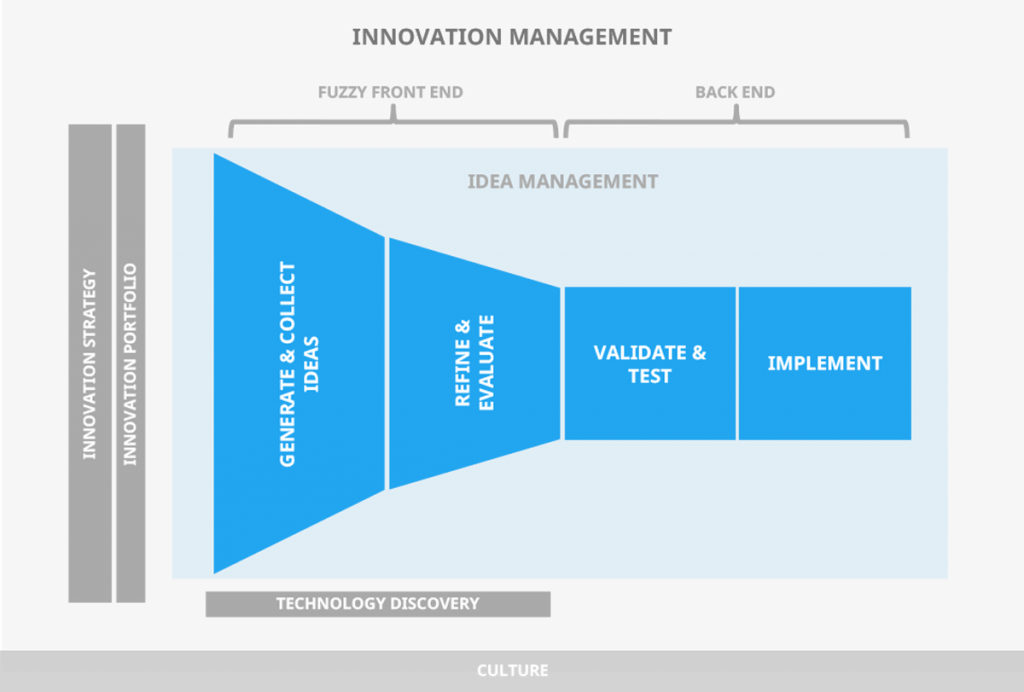
Innovation should be approached both top-down and bottom-up, but unless it starts from the top with great leaders who set the tone and support innovation, the chances of success are slim. At the same time, the front-end of innovation is where everyone can and should contribute, while the back-end execution requires more specialized skills and knowledge.
The bottom line here is that you can achieve a lot more innovation if you give everyone an opportunity to contribute. Most ideas, especially those that lead to incremental innovation come from the front-line employees, as they are the ones in close contact with your customers, products, and services. Even though most of these won’t necessarily change the trajectory of your business, when you put them together, they can make a huge difference in the performance of the core business.
Knowledge — source of innovation and competitive advantage
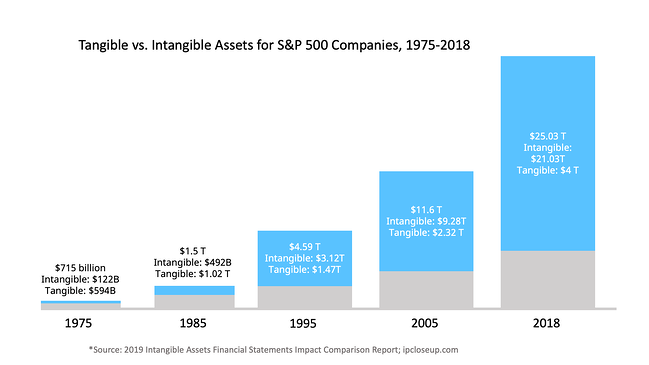
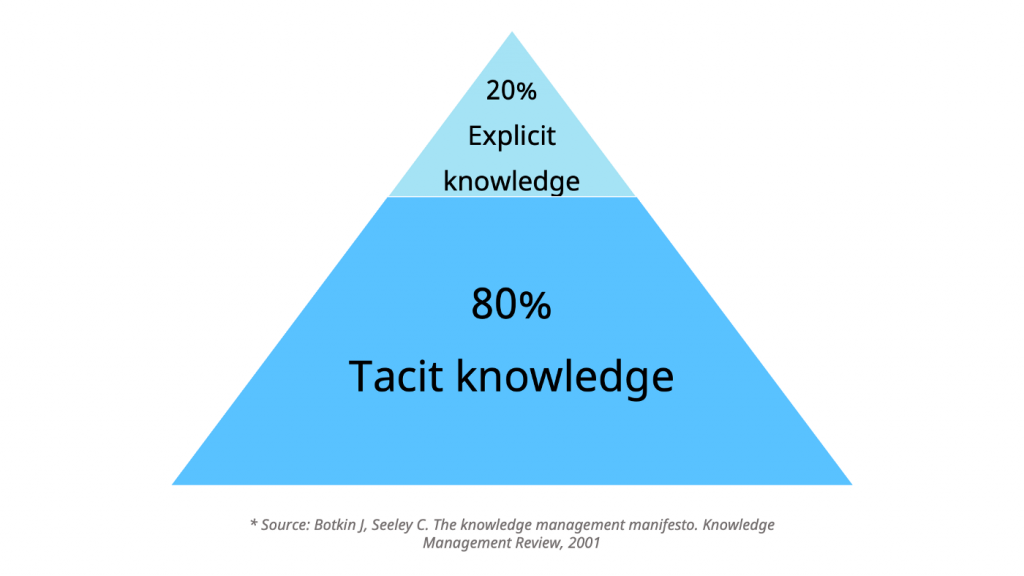
Speaking of competition, intangible assets, more prominently knowledge, are one of the major competitive advantages for organizations. Even more, tacit knowledge, the know-how, wisdom and experiences of employees which is not codified or explicit, represents an important driver for innovation.
As soon as you start working on harnessing that knowledge by creating the environment that enables transparent communication and flow of information, you will have more people involved in everyday innovation activities like idea challenges.
“Even if people themselves might not be innovators, they are still likely to support innovation instead of blocking it by being resistant to change.”
So, if we look at it from this perspective, everyone in the organization can contribute to innovation with the right leaders at the helm, some good skills development programs, and a sound scouting system in place. But for that, we first need to understand what makes an employee innovative and what are the traits that define innovative thinking.
What makes employees innovative?
In simple words, innovation stems from a mix of creativity and action. However, even if creativity is important, it is often overrated compared to execution, which makes change happen and gets things done. To get to execution in the corporate setting, you also need good communication and collaboration.
At a macro level, things seem simple but at the micro level, the individual’s set of skills and traits required for innovation can’t be summed up in a couple of words.
So, let’s see what makes someone innovative, what to pay attention to, and what skills innovators should learn and develop. This can help you assess whether some of your team members excel in some areas or if they need to refine other skills or behaviors.
Growth Mindset
The road to innovation is paved with uncertainty and risk, so innovators will always need to push into the unfamiliar. This comes natural to those with a growth mindset, who are usually inclined to be more open to change. On the other hand, those with a fixed mindset will be more reluctant to try something new or explore beyond what they are used to.
In short, a growth mindset is compatible with innovation because those who possess it, believe their abilities can be developed through hard work and dedication. Innovation work will most certainly mean that you will fail at some point, or your assumptions will prove to be false. Those with a growth mindset are resilient, curious, and eager to learn, so such failures won’t hold them back.
There is a common misconception that a fixed mindset can’t be transformed, since it is after all, fixed. The good news is that neuroscience has proved the plasticity of our brains, which means that behaviors and mindsets can be changed, even at a more mature age. But more on that, in the next section.
Skills
As mentioned earlier, if you want to build an innovation culture and inspire innovative thinking within your organization, it’s not enough to have the most creative people. There are certain skills that encourage the proactive “doers” to act and execute on innovation.
Some of these skills for innovation are critical thinking, which helps with problem solving, curiosity, which allows for exploration and learning, good communication which enables collaboration and teamwork, and of course the hard skills necessary to actually implement innovation.
This is by no means an exhaustive list of skills for innovation, but they can be seen as the basis on which people can build and improve their skills. The key thing to remember is that for some types of innovation, you want people that can move things forward and get them done.
Values
Maybe less pragmatic, but just as important in getting more people on the innovation boat, are the personal values. Values guide behavior and explain behavioral patterns. We tend to act instinctively according to our core values and according to empirical studies, certain values foster innovative behavior while others might impede it.
Our previous article on cultural differences and innovation explains more in depth the relation between people’s beliefs and innovation, so we won’t go too much into detail here.
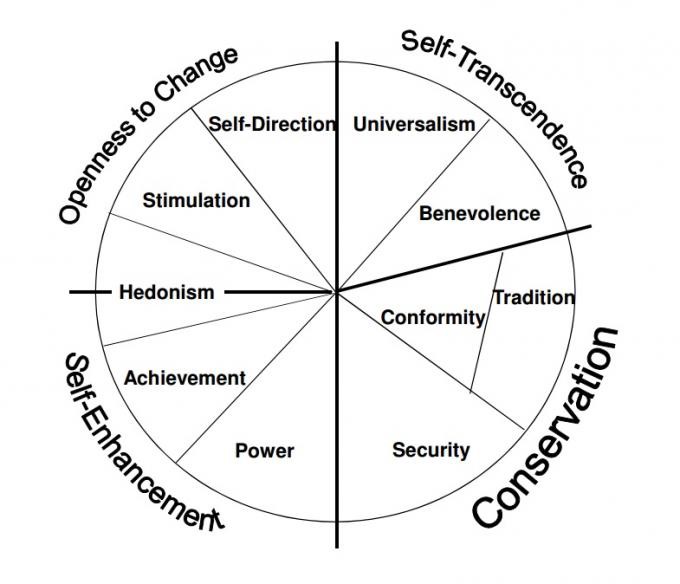
While some theories like the Theory of Basic Human Values of Schwartz or Hofstede’s cultural dimensions theory stem from cultural psychology and communication, they have been extended and applied to economics and the corporate world as well.
For example, one of the ten broad personal values identified by Schwartz, self-direction, is defined as someone being independent in thought, inclined to choose, create, and explore. On the other hand, someone that values conformity and security more, will be less inclined to accept change, or challenge the status quo.
These can be measured through the Schwartz Value survey and the Portrait Values Questionnaire. Of course, this is just one practical method, and it has its limitation, as it’s not always easy to apply in a corporate context. However, these methods can still be helpful in providing some guidelines on personality traits and values that are more inclined toward innovation.
So, let’s move from theory to practices that can encourage and nurture innovative behaviors in employees.
How to nurture innovative behavior in your organization
Most leaders concerned about the future of the organization they work for have asked themselves at some point how to unlock more innovation potential and it’s not easy to find the right answer. That’s because there is no single correct answer, but rather a mix of strategy, leadership approaches, resources, and practices.
The first noteworthy element that ignites innovation behavior is as simple as having the ambition to pursue specific goals that highlight the role and value of change and innovation.
Having the right goals that provide focus and direction is essential to set the stage and make it explicit that everyone has a role to play in improving the way they, and the company at large, operate and behave.
The next steppingstone that reinforces and support the goals are the processes that can lead to change and innovation. These are essential in strengthening teams that work on those goals and make things happen. Such processes will look different for each organization. Whether it’s a specific time allocation like the 15% or 20% rule for innovation, or idea management processes, these are crucial for long-term success.
Now, there are also other methods that are essential in nurturing an innovative behavior and these are mostly related to leaders’ soft skills and their ability to create the environment where innovation can flourish.
Foster a growth mindset
As already mentioned, there is a myth that you either have the growth mindset or you don’t. In fact, brains keep on changing, together with the cognitive abilities, and a fixed mindset can be developed into a growth one. How to achieve this in practice?
Start by identifying the fixed mindset patterns in your employees. Is someone giving up quickly? Maybe they avoid challenges and prefer the comfort zone, or they avoid negative feedback and are always prepared with the answer “It’s not my job” or “I’m not good with words, or creative enough”. These are all signs that point to a fixed mindset.
To change this, set smart goals and offer learning opportunities that are aligned with those goals. People with a fixed mindset usually hang on to old habits because they had success with those, and they’ve been measured based on them. So, create reward systems that encourage new ways of working and challenge people to take risks.
People with a fixed mindset usually hang on to old habits because they had success with those, and they’ve been measured based on them.
For example, Tata Group worked on developing an innovation culture for many years and as part of their initiative they have a prize for the best failed idea. The purpose is not to fail for the sake of failing but to encourage innovation.
Such initiatives should come from leaders who are willing to address the root causes of their employees’ uncertainty and reluctance to novelty. However, to be able to implement similar initiatives, leaders should take a step back and consider another element, which is critical: psychological safety in the workplace.
Psychological safety
The concept of psychological safety dates to 1999 and it refers to the belief that one will not be punished or shamed if speaking up or coming up with ideas, questions or concerns. Studies show that when employees feel comfortable to challenge the status quo without fearing negative consequences, organizations can innovate faster and adapt well to change.
Leaders have the greatest impact on team climate, and they have the power to influence internal behaviors more than anyone. A McKinsey survey reveals how leaders should develop their skills through leadership programs that focus on specific skills. Among the skills that have the biggest influence on creating psychologically safe work environments are the open dialogue skills, sponsorship, and situational humility.
While the theory helps us understand the importance of psychological safety in the workplace, it doesn’t provide practical answers. So, let’s briefly look at some concrete examples that leaders can put in practice to inspire more trust, and safety.
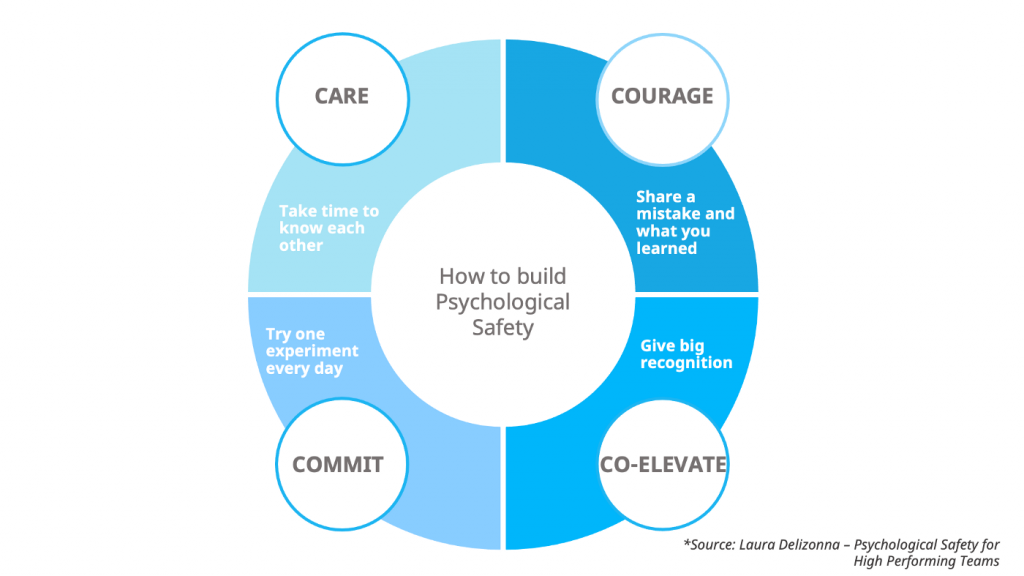
A good place to start is Laura Delizonna’s framework for psychological safety, which is based on four key pillars: Care, Courage, Co-elevate, Commitment.
Care
Care is about empathy and the openness to understand one another even if you don’t agree. Showing care means practicing active listening, showing interest and empathy.
For example, some organizations have team rituals like check-ins. One technique is the PIE check-in when each person in the team takes a few seconds to talk about their Physical, Intellectual and Emotional state.
Another technique you could use is the Rose Bud Thorn, where you ask each person to share a positive of the week (rose), something that emerged (the bud) and something that is challenging (the thorn).
There are other techniques and most of them work well even in remote environments. Also, something as simple as coffee chats, ask me anything sessions, sharing rituals like celebrating birthdays or holidays can all help in showing care and empathy. Leaders should constantly offer their support, assess people’s needs and burnout risk.
Courage
To inspire courage, leaders first have to show courage. They should walk the talk and be open with their vulnerabilities, mistakes, and challenges. So, while it might be difficult for some, true leaders show the way by admitting when they don’t know something, asking questions and showing interest to learn and improve their skills. Owning errors publicly and as soon as they happen has a big impact on team morale and attitude towards failure.
As a leader you can share your learning journey where you include the goal, the adversities you faced, experiments you made and failed and lessons you learned.
Co-elevate
Co-elevate is about inspiring and empowering others to bring their best, not just cooperate. Study shows that leaders think they give recognition 80% of their time, while team members feel they receive recognition 30% of the time. There is a disconnect in how we communicate.
Some best practice to co-elevate is to express appreciation that is frequent and specific. What do you appreciate in someone’s approach? How did their work influence the results and you personally? What specific behaviors can you praise?
Just as important is to solicit input and how you do that makes all the difference. Instead of leaving room at the end of a meeting for people to add something, change the approach to ask opposing views, or what someone would do in your place, etc. Remember to thank those who speak up and give an opposing argument.
As you can see, there are many nuances when communicating, providing, and asking for feedback. Once you create procedure and different pathways that allow for contribution, things will get easier.
Commitment
Commitment is what brings everything together. Leaders need to commit to experiments and to try to do something differently. Set goals for things you want to change. You can start with one experiment every day.
Psychological safety and a growth mindset are essential if you want to unleash the innovation potential of employees. However, nurturing them takes time, so you won’t see results overnight. It’s important to remember that as leaders you set the scene and lead the way. Unless you take baby steps to display the innovative behavior you expect from others, you won’t be able to move the needle in the right direction.
Conclusion
Neuroscience taught us that even as adults, our brains are malleable, so if some employees might seem resistant to change, disengaged or lack creativity, first ask yourself if there is something you can do differently. Maybe they don’t have the environment where they can flourish, or they are not led by people who allow them to shine.
Inevitably, there’s always going to be someone who resists change, who can’t be converted to a growth mindset or innovative thinking. This doesn’t mean that there isn’t room for improvement. Their support can contribute to incremental innovation and continuous improvements. It’s also more cost-efficient to train existing workforce than always looking for something you believe it’s missing.
When you’ll inevitably have to scout externally for new talent to support innovation work, consider a few key elements: the employer brand, innovation culture, leadership training programs, as well as the processes and mechanisms that facilitate innovation.
This article was originally published in Viima’s blog.
Image credits: Viima, Unsplash, Pexels
Sign up here to get Human-Centered Change & Innovation Weekly delivered to your inbox every week.
In our last two blogs on Taking Personal Responsibility, we stated that when people aren’t taking personal responsibility, they cannot be accountable, they will fail in their jobs, and their teams, and fail to grow as individuals and as leaders. Taking personal responsibility is an especially crucial capability to develop self-awareness and self-regulation skills in the decade of both disruption and transformation. It all starts with seeing self as the cause of what happens to us, rather than baling it on the effects events and problems have on us! Where people can learn to recognize the structures at play in their lives and change them so that they can create what they really want to create in their lives, teams, or organizations.
In the last twoblogs, we shared a range of tips for shifting people’s location, by creating a line of choice, to help them shift from being below the line and blaming others for their reactive response, to getting above the line quickly. Through shifting their language from “you, they and them” to “I, we and us” and bravely disrupting and calling out people when they do slip below the line. How doing this allows people to also systemically shift across the maturity continuum, from dependence to independence and ultimately towards interdependence.
In a recent newsletter Otto Scharmer, from the Presencing Institute states “Between action and non-action there is a place. A portal into the unknown. But what are we each called to contribute to the vision of the emerging future? Perhaps these times are simply doorways into the heart of the storm, a necessary journey through the cycles of time required to create change”.
Creating the place – the sacred pause
When I made a significant career change from a design and marketing management consultant to becoming a corporate trainer, one of the core principles I was expected to teach to senior corporate managers and leaders was taking personal responsibility.
Little knowing, that at the end of the workshop, going back to my hotel room and beating myself up, for all of the “wrongs” in the delivery of the learning program, was totally out of integrity with this core principle.
Realising that when people say – those that teach need to learn, I had mistakenly thought that I had to take responsibility for enacting the small imperfections I had delivered during the day, by berating myself, making myself “wrong” and through below the line self-depreciation!
Where I perfectly acted out the harmful process of self-blame, rather than rationally assessing the impact of each small imperfection, shifting to being above the line where I could intentionally apply the sacred pause:
Hit my pause button to get present, accept my emotional state,
Connect with what really happened to unpack the reality of the situation and eliminate my distortions around it,
Check-in and acknowledge how I was truly feeling about what happened,
Acknowledge some of the many things that I had done really well,
Ask myself what is the outcome/result I want for participants next program?
Ask myself what can I really learn from this situation?
Consciously choose what to do differently the next time I ran the program.
I still often find myself struggling with creating the Sacred Space between Stimulus and Response and have noticed in my global coaching practice, that many of my well-intentioned clients struggle with this too.
The impact of the last two and a half years of working at home, alone, online, with minimal social interactions and contact, has caused many of them to languish in their reactivity, and for some of them, into drowning in a very full emotional boat, rather than riding the wave of disruptive change.
Being the creative cause
In our work at ImagineNation, whether we help people, leaders and teams adapt, innovate and grow through disruption, their ability to develop true self-awareness and be above the line is often the most valuable and fundamental skill set they develop.
It then enables us to make the distinction that creating is completely different from reacting or responding to the circumstances people find themselves in by applying the sacred pause.
When people shift towards seeing self as the cause they are able to create and co-create what they want in their lives, teams or organization by learning to create by creating, starting with asking the question:
What result do you want to create in your life?
What is the reality of your current situation?
This creates a state of tension, it is this tension that seeks resolution.
In his ground-breaking book The Path of Least Resistance Robert Fritz, goes on to describe and rank these desired results as “Fundamental Choices, Primary Choices, and Secondary Choices.”
Because there is one thing that we can all do right and is totally in our control – is to shift towards seeing self as the cause and make a set of conscious choices, with open hearts, minds, and wills, as to how we think, feel and choose to act.
“We are the creative force of our life, and through our own decisions rather than our conditions, if we carefully learn to do certain things, we can accomplish those goals.”
We all have the options and choices in taking responsibility, empowering ourselves and others to be imaginative and creative, and using the range of rapid changes, ongoing disruption, uncertainty, and the adverse pandemic consequences, as levers for shifting and controlling, the way we think, feel.
Benefits of seeing self as the cause and being above the line
Applying the sacred pause to make change choices in how we act – and being brave and bold in shifting across the maturity continuum, will help us to cultivate the creativity, interdependence, and systemic thinking we all need right now because it:
Helps people self-regulate their reactive emotional responses, be more open-hearted and emotionally agile, and helps develop psychologically safe work environments where people can collaborate and experiment, and fail without the fear of retribution or punishment.
Enables people to be more open-minded, imaginative, and curious and creates a safe space for continuous learning, maximizing diversity and inclusion, and proactive intentional change and transformation.
Promotes ownership of a problem or challenging situation and helps develop constructive and creative responses to problems and an ability to take intelligent actions.
Gives people an opportunity to impact positively on others and build empowered trusted and collaborative relationships.
Enables entrepreneurs and innovators to invent creative solutions and drive successful innovative outcomes.
Building the foundations for accountability, where people focus their locus of control on what they promise to deliver, enables them to be intrinsically motivated, and take smart risks on negotiating outcomes that they can be counted on for delivering.
Tips for seeing self as the cause and operating above the line
Taking personal responsibility and seeing self as the cause involves:
Acknowledging that “I/we had a role or contributed in some way, to the fact that this has not worked out the way “I/we wanted.”
Clarifying the outcome or result in you want from a specific situation or a problem.
Seeking alternatives and options for making intelligent choices and actions, and using the language of “I/we can” and “I/we will” to achieve the outcome.
Replacing avoiding, being cynical and argumentative, blaming, shaming, controlling, and complaining with courageous, compassionate, and creative language and acts of intention.
People become victors who operate from “self as cause” where they are empowered to be the creative forces in their own lives by making fundamental, primary, and secondary change choices.
Trust your inner knowing and deep wisdom that everything has a specific and definable cause and that each and every one of us has the freedom to choose how to respond to it.
Back to leadership basics
As Stephen Covey says, people need to deeply and honestly say “I am what I am today because of the choices I made yesterday” because it’s not what happens to us, it’s our reactive response to what happens that hurts us.
Being willing to step back, retreat, and reflect on the gap between the results you want, and the results you are getting all starts with stepping inward, backward, and forwards, using the sacred pause, to ask:
What happened? What were the key driving forces behind it?
How am I/we truly feeling about it?
What was my/our role in causing this situation, or result?
What can I/we learn from it?
What is the result/outcome I want to create in the future?
What can I/we then do to create it?
As a corporate trainer, consultant and coach, I found out the hard way that developing the self-awareness and self-regulation skills in taking personal responsibility and seeing self as the cause is the basis of the personal power and freedom that is so important to me, and almost everyone else I am currently interacting with.
It’s the foundation for transcending paralysis, overwhelm, and stuck-ness and activating our sense of agency to transform society and ourselves.
This is the third and final blog in a series of blogs on the theme of taking responsibility – going back to leadership basics. Read the previous two here:
Find out about our learning products and tools, including The Coach for Innovators, Leaders, and Teams Certified Program, a collaborative, intimate, and deeply personalized innovation coaching and learning program, supported by a global group of peers over 9-weeks, starting Tuesday, October 18, 2022. It is a blended and transformational change and learning program that will give you a deep understanding of the language, principles, and applications of an ecosystem focus, human-centric approach, and emergent structure (Theory U) to innovation, and upskill people and teams and develop their future fitness, within your unique context.
Image credit: Pixabay
Sign up here to get Human-Centered Change & Innovation Weekly delivered to your inbox every week.
In our last blog, we described how people’s personal power is diminished when they don’t take personal responsibility for the impact of their behaviors and actions and the results they cause. Where many people are feeling minimized and marginalized, anxious as a result of being isolated and lonely, worrying about losing their security and freedom, and dealing with the instability in their working environments. Resulting in many people disengaging from the important conversations, job functions, key relationships, workplaces, and in some instances, even from society. Where managers and leaders lack the basic self-awareness and self-regulation skills to control the only controllable in uncertain and unstable times, is to choose how to respond, rather than react to it.
We have a unique moment in time to shift their defensiveness through being compassionate, creative, and courageous towards helping managers and leaders unfreeze and mobilize to exit our comfort zones. To take intelligent actions catalyze and cause positive outcomes, that deliver real solutions to crises, complex situations, and difficult business problems.
Why do people avoid taking personal responsibility?
People typically avoid taking personal responsibility for reasons ranging from simple laziness, risk adversity, or a fear of failure, to feeling change fatigued, overwhelmed, or even victimized by the scale of a problem or a situation.
Resulting in a range of different automatic defensive, and a range of non-productive reactive responses including:
Avoidant behavior, where feel victimized and targeted, people passively “wriggle” and the buck gets passed onto others, and the real problem or issue does not get addressed or resolved.
Controlling behavior, where people ignore their role in causing or resolving the real problem or issue, and aggressively push others towards their mandate or solution, denying others any agency.
Argumentative behavior, where people play the binary “right-wrong” game, and self-righteously, triggered by their own values, oppose other people’s perspectives in order to be right and make the other person wrong.
Creating the line of choice
At Corporate Vision, we added a thick line of “choice” between “personal responsibility” and “blame, justification and denial” to intentionally create space for people to consider taking more emotionally hygienic options rather than:
Dumping their “emotional boats” inappropriately onto others, even those they may deeply care about,
Sinking into their habitual, and largely unconscious default patterns when facing complex problems, which results in the delivery of the same results they always have.
Not regulating their automatic reactive responses to challenging situations, and not creating the vital space to pause and reflect to think about what to do next.
To enable them to shift towards taking response-ability (an ability to respond) and introducing more useful options for responding in emotionally agile, considered, constructive, inclusive, and creative ways to the problem or the challenge.
Noticing that when we, or others we interact with, do slip below the line to notice whether to “camp” there for the long term or to simply choose to make the “visit” a short one!
Doing this demonstrates the self-awareness and self-regulation skills enabling people to take personal responsibility. Which initiates ownership and a willingness to be proactive, solutions, and achievement orientated – all of which are essential qualities for 21st century conscious leadership that result in innovative outcomes that result in success, growth, and sustainability.
Shifting your location – from “you, they and them” to “I, we and us”
Developing the foundations for transformational and conscious leadership involves:
Supporting people to acknowledge and accept that the problem or challenge is not “out there” and is within their locus of control or influence.
Shifting the “Maturity Continuum” to enable leaders and managers to be both independent and interdependent.
Creating a line of choice to think, act and do things differently.
Calling out people when they slip below the line.
It involves supporting people to let go of their expectation that “they” or someone else, from the outside, will fix it, and supporting them to adopt a stance where:
“I” or “we” can and are empowered to do it,
“I” or “we” are responsible for getting above the line,
“I” or “we” can choose a different way of being, thinking, and acting intelligently in this situation.
Developing conscious leadership
At any time, everyone is either above or below the line because it is elemental to the type of conscious leadership we all need to survive and thrive, in a world where people are seeking leaders, managers, and working environments that require interdependence.
To operate in the paradigm of “we” – we can do it; we can cooperate; we can combine our talents and abilities and create something greater together.
We cooperate together by creating the line of choice where we call out to ourselves and others when we slip below it, to get above the line as quickly as possible.
Where interdependent people and communities combine their efforts, and their self-awareness and self-regulation skills with the efforts of others to achieve their growth and greatest success by increasing:
Transparency and trust,
Achievement and accountability,
Diversity and inclusion,
Experimentation and collaboration.
All of these are founded on the core principle of taking personal responsibility, which is an especially crucial capability to develop self-awareness and self-regulation skills in the decade of both disruption and transformation.
Bravely calling out self and others
When we take responsibility for managing our own, “below the line” reactive responses, by habitually creating the line of choice, we can bravely call out ourselves and others when we slip below it.
Because when we don’t call ourselves and others we interact with, we are unconsciously colluding with their emotional boats, default patterns, and automatic reactive responses, which inhibit their ability to effect positive change.
When we safely awaken ourselves and others, we can get back above the line quickly and choose different ways of being, thinking, and acting intelligently in the situation.
Alternately, people aren’t taking personal responsibility, they cannot be accountable, they will fail in their jobs, and their teams, and fail to grow as individuals and as leaders.
In fact, developing a habitual practice of emotionally intelligent and conscious leadership by safely and bravely disrupting ourselves and our people, in the face of ongoing uncertainty, accelerating change, and continuous disruption.
This is the second in a series of three blogs on the theme of taking responsibility – going back to leadership basics.
Find out about our learning products and tools, including The Coach for Innovators, Leaders, and Teams Certified Program, a collaborative, intimate, and deeply personalized innovation coaching and learning program, supported by a global group of peers over 9-weeks, starting Tuesday, October 18, 2022. It is a blended and transformational change and learning program that will give you a deep understanding of the language, principles, and applications of an ecosystem focus, human-centric approach, and emergent structure (Theory U) to innovation, and upskill people and teams and develop their future fitness, within your unique context.
Image credit: Unsplash
Sign up here to get Human-Centered Change & Innovation Weekly delivered to your inbox every week.
I was first introduced to the principle of Taking Personal Responsibility when I attended a number of experiential workshops facilitated by Robert Kiyosaki who is now well known globally as the successful entrepreneurial author of the “Rich Dad Poor Dad” book series. At that time, in the late 1980s, the concept simply involved taking personal responsibility for your role in getting the results you get, in both challenging and problematic situations.
This principle has since evolved as the most crucial foundation for developing our emotionally intelligent, conscious, and transformational leadership capabilities. Largely through focusing on the development of self-awareness and self-regulation skillsets, which are especially important skills to cultivate in times of extreme uncertainty.
Blaming, Justifying, and Denying
Taking personal responsibility involves encouraging people to step up and out of blaming themselves or others, out of justifying their position or denying what is really going on to largely avoid the cognitive, emotional, and visceral results and consequences of their actions.
Which are essentially, largely unconscious defensive reactions to the problem or situation. So, it sounds quite simple, yet, even now, it’s still largely a countercultural principle, and a neurologically challenging one, because we are wired to survive (fight/flight/freeze) in the face of what we perceive as danger!
Especially when many of us are living in an oppositional blaming and shaming political environment, or within a passively or aggressively defensive organizational culture. Where a large section of the community, has been forced by the constraints of the pandemic, into fearing that their security and survival needs will not be met. Alternately, the great resignation and the nature of the virtual hybrid workplace have increased some people’s fears about even being able to get their jobs done!
All of this creates distorted thoughts and language that focus on “scarcity” where many people are fearing that they are not “enough” and do not have “enough” to deal with their current circumstances. Rather than leaning towards exploring and eliciting the possibilities and opportunities available in our abundant world. As there is no clear playbook about how people can effectively and responsibly lead and manage in this unique 21st-century context, many people are floundering, languishing into largely emotionally overwhelmed states.
Where it is easier, and sometimes safer, to be a victim, blame and shame others for their helpless or powerless situation, or to justify and deny any need to change their perspective about it, never mind their role in causing their own anxious and unresourceful emotional states.
Back to Leadership Basics
Yet, it is more important than ever, for leaders and managers to help people:
Take ownership of their consequences and be responsible for the emotional, cognitive, and visceral results of their actions,
Authentically connect, empower, and enable people and communities to flourish,
Provide safe, transparent, trusted environments and interdependence where people can dare to think differently and potentially thrive.
This means that the range of crises, uncertainty, and disruptions we are experiencing now is forcing us to go back to basic 101 management and leadership principles.
According to McKinsey & Co in a recent article “A Leaders Guide – communicating with teams, stakeholders and communities during Covid 19” – “Crises come in different intensities. As a “landscape-scale” event, the coronavirus has created great uncertainty, elevated stress and anxiety, and prompted tunnel vision, in which people focus only on the present rather than toward the future. During such a crisis, when information is unavailable or inconsistent, and when people feel unsure about what they know (or anyone knows), behavioral science points to an increased human desire for transparency, guidance, and making sense out of what has happened”.
The Maturity Continuum – Shifting to I and We
The principle of taking personal responsibility has evolved and been enhanced significantly through the work of Steve Covey, in the “Seven Habits of Effective People” and provides the core foundations for transformational and conscious leadership through the “Maturity Continuum”:
Dependence is the paradigm of you – you take care of me; you come through for me; you didn’t come through for me; I blame you for the results. Dependent and approval-seeking people need others to get what they want.
Independence is the paradigm of I – I can do it; I am responsible; I am self-reliant; I can choose. Independent people get what they want through their own efforts.
Interdependence is the paradigm of we – we can do it; we can cooperate; we can combine our talents and abilities and create something greater together. Interdependent people combine their efforts with the efforts of others to achieve their greatest success.
Putting the Maturity Continuum to Work
In the early 2000s I was an associate of Corporate Vision, Australia’s first culture change and transformation consultancy, now the globally successful Walking the Talk organisation, for fourteen years.
Where every culture, leadership, team development, or change program we designed and presented, introduced taking personal responsibility, as a fundamental, core learning principle. Aligning it with the principle of – For things to change first I must change, which deeply challenged and disrupted people’s belief systems, habitual mindsets, thinking styles, and ways of acting.
As a seasoned coach of twenty years, these two core principles seem to still profoundly challenge the majority of my coaching clients across the world, no matter how senior their role or position is, or how knowledgeable, skilled, and experienced they are!
Where many managers and leaders have failed to self-regulate, lack self-awareness, and have unconsciously slipped into feeling victimized, powerless, helpless, and in some instances, even hopeless about their futures where some are:
Feeling frozen, inert, paralyzed, overwhelmed, and immobilized in their abilities to affect any kind of positive change in both their work and home environments.
Unconsciously slipping into blaming and shaming others for their situations,
Justifying their inertia through a range of “reasonable reasons” and “elaborate stories” about how it’s “not their fault” or it’s not “up to them” to make any change.
Simply denying their current consequences, or the importance of needing to take positive actions, and make changes.
Unmotivated, lack any desire for control, or have the personal power to affect change in their situation.
Initiating Taking Personal Responsibility
To accept and share responsibility starts with being bravely willing to courageously connect with our whole selves and consciously stepping back to hit our internal pause button, retreat into silence and stillness, and compassionately ask:
What happened?
What can I/we learn from it?
What can I/we then do to create it?
Taking personal responsibility becomes a compassionate, creative, and courageous exercise in continuous learning, self-awareness, and emotional self-regulation in ways that safely disrupt people’s defensiveness and awaken them to the possibility of being personally powerful in tough situations.
It is also the basis for taking intelligent actions catalyze and cause positive outcomes, that deliver real solutions to crises, complex situations, and difficult business problems.
This is the first in a series of three blogs on the theme of taking responsibility – going back to leadership basics.
Find out about our learning products and tools, including The Coach for Innovators, Leaders, and Teams Certified Program, a collaborative, intimate, and deeply personalized innovation coaching and learning program, supported by a global group of peers over 9-weeks, starting Tuesday, October 18, 2022. It is a blended and transformational change and learning program that will give you a deep understanding of the language, principles, and applications of an ecosystem focus, human-centric approach, and emergent structure (Theory U) to innovation, and upskill people and teams and develop their future fitness, within your unique context. Find out more about our products and tools.
Image credit: Pixabay
Sign up here to get Human-Centered Change & Innovation Weekly delivered to your inbox every week.
Many would-be innovators obsess over ideas, wait for inspiration to strike, and believe that with the right idea, success can miraculously come overnight.
However, as we’ve written before, that’s just not going to happen. In fact, usually the only thing separating the winning innovators from the rest is execution. It makes all the difference in the world, and yet, it’s still a vastly underrated capability.
As part of our coaching program, we’ve asked hundreds of corporate innovators and innovation leaders to reflect on their strengths and weaknesses. And, by far, the most common answer is that they’re great at coming up with ideas and thinking about the big picture but lack the patience and discipline to see things through to results.
As such, it’s safe to say that as a community, we innovators need to take a hard look in the mirror and admit that this an area where most of us have a lot of room for improvement.
So, in today’s article, we’ll explore the topic of executing innovation in more detail to try to understand what the problems associated with it are, and what successful execution of an innovation really takes. This is designed to be a guide to help leaders get it right, but I think there’s a lot that every innovator regardless of job title can learn from.
What does executing innovation mean?
Before we dive deeper, it’s probably a good idea to clarify what we mean with the term “executing innovation”, and how it relates to “implementing innovation”.
These are often used interchangeably, but I think it’s useful to distinguish them from one another. The way we like to put this is as follows:
Implementing innovation is the process of taking an idea and then turning that into reality.
Executing innovation, on the other hand, is the entire process of creating value with innovation.
In other words, implementation is what you do for an individual idea to make that happen. Execution covers the implementation, but also the process of turning that (along with many other ideas and innovations) into something that actually creates value and can be scaled up.
Implementation isn’t always easy, but it’s still typically a linear project that you can usually plan out in advance. Execution, on the other hand, is a much more complex and multidisciplinary effort.
To succeed at delivering value, you need to get a lot of things right. And with innovation, there are many assumptions in that plan. Some of those assumptions will always prove to be false, and you’ll need to deviate from the plan.
That combination of multidisciplinary collaboration and the need to deviate from original plans often leads to a myriad of practical challenges in many large organizations.
However, before we dive deeper into those challenges, let’s first take a step back to realize why execution is so critical.
Why execution is critical for innovation success
There’s a reason for innovation being defined as the act of introducing something new.
Everyone has ideas. Many can even implement some form of them, typically a prototype, but few successfully realize the full potential of the idea by truly executing on it successfully.
To clarify, ideas are an important starting point, but with every great idea, there are hundreds or even thousands of people across the world who’ve had the same exact idea.
Most never start working on it. Many give up in the process. Some make it to market, and a few might even make that into a feasible business. There are usually only a couple of winners. Those are the ones that succeeded in executing that idea.
Everyone has ideas, but few successfully realize the full potential of their ideas. The ones that do are the ones that know how to execute well.
This is of course a bit of an oversimplification but should help explain the fundamental importance of proper execution.
And that is not just true for individual ideas and innovations, but it’s also the case for corporate strategies at large. Look at any given industry, and it’s quite likely that you’ll see many companies with a nearly identical strategy. Again, the difference comes down to how well the company succeeded in executing that strategy.
In other words, your idea or strategy sets the ceiling for your impact if successful, but execution determines how close to that ceiling you’ll get. Even the best idea or strategy is worth nothing unless it’s executed well.
On the other hand, even with a mediocre strategy or idea, you can achieve remarkable success if you just execute it well enough. There are dozens of well-known companies like McDonald’s and FedEx that are obvious examples of this. There’s nothing particularly remarkable or distinctive about their ideas or strategies. They weren’t the first in their respective fields, they just executed on their ideas brilliantly.
What’s more, if you’re a strong executor, you’ll soon find out the limits of the original strategy or idea, at which point you can adapt and change course accordingly. But, it doesn’t work the other way around.
Thus, no matter the situation, execution will always be more important than your idea or strategy.
Misconceptions about executing innovation
As you might have realized by now, execution is of course a massive, nuanced, context-specific and very complex endeavor. In practice, it’s an endless jungle of interlinked choices and actions affecting one another that you need to navigate with limited information to get to the other side.
Thus, the space of possible challenges and problems you might encounter is pretty extensive. So, instead of looking at the individual problems themselves, it’s more helpful for us to try to understand the common misconceptions that ultimately lead to teams underappreciating execution and thus subsequently failing at it.
A big factor behind most of these is the fundamental uncertainty that innovation is always associated with. Because you can’t know everything in advance, it’s not going to be a nice and linear process of doing simple steps one after another. Instead, it’s a messy and iterative process of creative problem-solving.
Anyway, with that, here are the top four that I most commonly see innovation leaders and their teams have.
1. The leader’s job is just to get the big picture right
This is probably the most common problem I’ve come across, and it’s especially common among inexperienced executives, or ones that otherwise lack execution experience, such as some management consultants and academics.
There are many shapes this one might take, and we’ll return to it later, but what it ultimately comes down to is the glorification of strategy work and/or surface-level creativity.
In business school, and in consulting, we’re taught to think about the big picture as the job of top management. We’re led to believe that a leader or innovator takes in a market analysis, compares a few scenarios, chooses a positioning, and then paints an inspiring vision to show direction for the company. Then the pieces will simply fall in place and success happens.
While the above mentioned are of course still useful activities, if you’ve ever actually turned an innovative idea into a successful business, you know that in practice, there’s a lot more to it than that, and experienced executives are of course well aware of that
Strategic choices can be made across the organization, but the responsibility for execution always lies at the top.
As Professor Martin has well put it, CEOs should stop thinking that execution is somebody else’s job, and the same applies for every innovation leader. Strategic choices can be, and frequently are, made where the action is. Yet, the responsibility for execution always lies at the top. After all, there’s a reason for the CEO being the Chief Executive Officer.
2. I don’t need to understand the details
The second is closely related to our first one. It’s easy to think that as a leader or visionary innovator, you’re the person responsible for the vision, ideas, and big picture decisions, and then the experts will then figure things out in practice. After all, that’s why you hired them, right?
Well, that might work if you’re operating in a static industry where all the variables are known and static, but with innovation that really isn’t the case.
You need to get the big picture right, but it isn’t enough to succeed. You need to also have the right product, business model, technology, customer experience, customer acquisition channels and tactics, operating models, etc. All of these have a wide variety of choices that depend on one another and changes in any of the areas will force you to change many of the other pieces in the puzzle too.
With innovation, the devil is in the details!
As an innovation leader, connecting the dots is ultimately your job, and you can’t do that without understanding the details.
That’s why you’ll find an obsession for the details in pretty much every successful innovator, both past and present. They have the same in-depth understanding and attention to detail as the best artists, athletes and top representatives of other fields do too.
So, while you absolutely need to engage with and empower the experts, they are experts in their own field and likely don’t know how to consider all the other moving pieces in the puzzle. As an innovation leader, connecting the dots is ultimately your job, and you can’t do that without understanding the details.
It’s the one responsibility you simply can’t delegate away.
3. Execution requires a clear and unambiguous plan
Even if you are an experienced executive and value the importance of execution highly, it doesn’t mean you couldn’t fail when executing innovation. Here the most common problems occur if the leader’s experience comes primarily from operations within the known and well understood confines of “business as usual”.
When the environment is well understood, and the scale large from the get-go, it’s of course valuable to try to plan carefully, analyze business cases and craft detailed project plans prior to execution.
Also, since everyone knows that innovation is a risky endeavor, it of course makes sense to try to reduce those risks before your start a big innovation project to try to avoid major mistakes and generally just ensure that you’ve done a good job in planning and preparation before committing to the project.
This often leads to large companies commissioning all kinds of market studies and strategy projects. Some of those can certainly be useful in increasing your understanding of the landscape, but most invest way too much time, energy, and money into these. Also, every now and then these projects seem to be ordered only to have a scapegoat in case something goes wrong.
Regardless, there’s a fundamental problem: with innovation, you can’t have all the answers in advance. You’ll always need to make a number of assumptions upon which your plan relies on, some of which will inevitably prove to be wrong.
With innovation, you won’t have all the answers in advance.
Thus, if you require innovators to propose clear, detailed and unambiguous plans for you, or conversely create such plans and then hold innovators accountable for successfully executing them, it just won’t work out. And, whenever it then comes to surface that everything hasn’t gone according to the plan, innovation projects are frequently shut down, even if they’d still hold a lot of potential.
You obviously still need to align with the strategy, plan ahead, and have a disciplined approach to execution, but it’s not so much about creating a detailed roadmap, as it is about choosing direction and figuring out which questions or problems you’ll need to address first.
In other words, you need to embrace the uncertainty and the fact that you can’t have a perfectly unambiguous and detailed plan before starting to execute it. Instead, figure out what the assumptions and uncertainties in your plan are and commit to a disciplined learning effort to figure out the right path forward.
4. Innovation is fun
There’s a stereotype around people working in innovation being these visionaries that are bursting with great ideas and seem to come up with great new concepts all the time. And as mentioned in the intro to this article, that is often true.
That skillset is of course very useful for innovation, but there’s also a downside. There are naturally exceptions, but many of us working on innovation can find execution too boring and repetitive, and/or lack the perseverance, discipline, and patience needed to succeed at it.
Innovators often spend too much on the creative and “fun parts” of innovation, as opposed to what’s really needed to turn an idea into a successful innovation
As a group, we generally love creative work, and are always looking for fresh, new stimuli to feed that inspiration. That often leads us to spend too much time and effort on the “fun parts” of innovation, and too little on the not so fun, more repetitive, and laborious parts of the process that execution essentially is comprised of. The reality is that for every minute you spend coming up with ideas, you’ll probably need to spend a day, a week, or even more implementing those ideas.
So, if your innovation team is primarily filled with, or led by, such “idea people”, which is quite common, then there’s a big risk of a systematic lack of respect for and capabilities in execution. This will lead to a very suboptimal culture for innovation, and ultimately disappointing business outcomes.
Getting Execution Right
As already mentioned, there are a lot of similarities between successful execution in “business as usual”, and in innovation. However, there are also clear differences between the two.
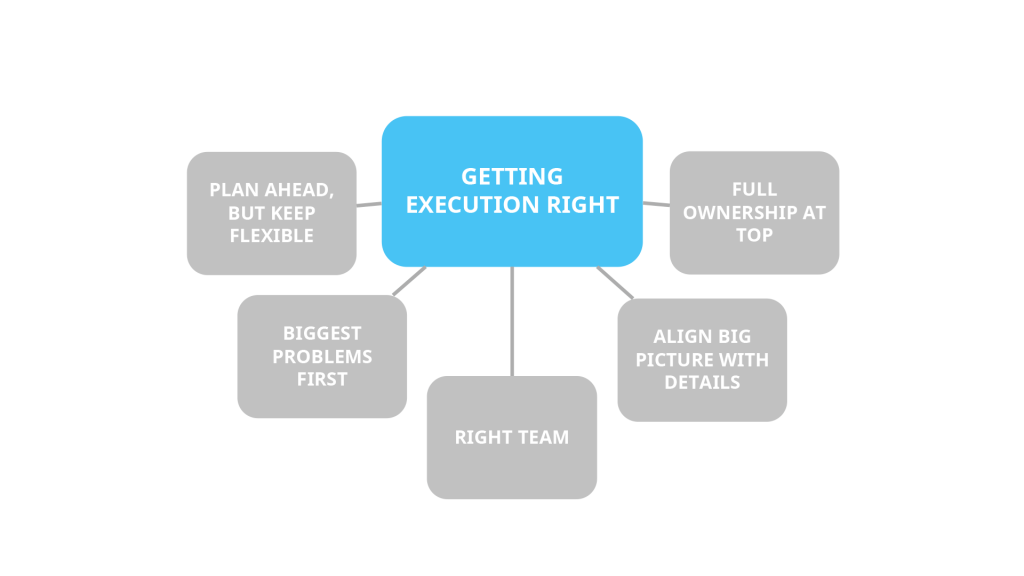
So, to help you navigate the differences, and to succeed at executing on whatever innovation you’re working on, here are the five most important factors to keep in mind whenever you’re trying to execute on an innovation and build something truly novel.
1. Take the path most likely to succeed, but keep your options open
As mentioned, with innovation planning and strategy work need to be done a bit differently than you would with an existing business.
Good decisions here make it much easier for your team to figure out how to move forward and can save a lot of time money going down the wrong path. Regardless, you’ll soon end up at another crossroads and need to make another decision. Heck, sometimes you might even come across a dead-end and need to backtrack to an earlier crossroads. Sometimes Plan C or D is the way to go.
The point is that no matter which path you choose, you won’t see what’s ahead all the way to the end.
Thus, good strategy work requires you to embrace uncertainty, test assumptions critically, and think deeply about the real-life feasibility of each path ahead.
And it’s certainly not a one-time project you do at the beginning, but more of a continuous learning process as you unravel the puzzle piece by piece.
If you keep an open mind and build your teams and products to embrace that uncertainty, you can quickly recover and learn from setbacks, as well as embrace new opportunities you couldn’t even think of before you set out. This is what’s known as cognitive and organizational flexibility.
2. Solve the biggest problems first
As humans, most of us have a bit of a tendency to go for the comfortable low-hanging fruits and procrastinate on the hard but important problems, as well as uncomfortable truths.
I’ve certainly been guilty of this on many occasions, even while writing of this article. Getting a number of small things done makes us feel like we’re making good progress, but unfortunately that’s often a bit of a false sensation as we might not really be any better off than when we began.
With the inherit uncertainty in innovation, that is naturally a bit of a problem. When you’re executing any given innovation, there’s countless things that need to be done so it’s easy to just start checking off boxes like building more features, creating marketing materials, getting compliance approvals, or whatever you may have on your agenda.
But, it’s the big things that make or break your innovation early on. For example: will a customer benefit from my product, how much are they willing to pay, can I even build the product I’ve envisioned, etc.
While you need to care about the details, it’s the big things that make or break your innovation early on. So, start from the big problems, even if it hurts!
The key is finding a way to figure out what these big problems or critical assumptions are, and then find ways to quickly test and address them. This allows you to quickly figure out if you’re on to something, which of course saves a lot of time and money for you in the inevitable case that you weren’t quite there from the get-go.
Also, if you get the big things right, you can already deliver most of the value, and that means you can more quickly start capturing some of that value to get a return for your investments.
Plus, if you tackle these early on when you still have a small team, changing course will be much quicker and easier, and you’ll have spent much less money solving the same important problems than you would with a larger team later on.
In most businesses, these critical assumptions revolve around how much value you can deliver to customers, and how valuable they see that to be. However, in certain circumstances, those can be related to something entirely different, such as the feasibility of implementation when developing a new breakthrough drug.
Solving for the hardest problems first does generally require a bit more of a leadership commitment as you won’t always be able to show quick wins as early on, but at least it can save you from an embarrassing and costly failure like CNN+.
3. Build the right team
It might be a bit of an obvious statement, but it’s still probably worth pointing out: innovation is a bit of a team sport. So, to do well at it, you need the right team.
However, what might not be as obvious is that ‘the right team’ means in practice. In our experience, there are two key parts to this:
Multidisciplinary team with talented individuals in each area
Leadership and individuals that share the right mindset for innovation
The prior is pretty self-explanatory. Innovation is almost always a cross-disciplinary effort. The specifics depend on what kind of an innovation you’re working on, but usually you need expertise in at least design, engineering, commercial and operational matters.
The most impactful innovations are actually comprised of a stack of innovations in many of these areas, each designed to work together to address a specific problem or ‘job’ for the customer. Thus, if you have talent at every position, the outcome will be much more than the sum of its parts.
The latter, however, is the part that many teams fail to appreciate. Innovation is, by definition, doing something that others haven’t succeeded at before, so the journey won’t be easy.
Your team will face a lot of uncertainty and struggles, and will still need to perform at their best, often under a lot of pressure. That requires a very specific type of culture within the team, but also the right mindset for each individual. You want people that can cope with uncertainty and are able to remain optimistic and overcome difficult situations while still being realistic and ruthlessly critical of their own capabilities. They need to have an innate passion to strive for excellence, and a lot of discipline, grit, and perseverance.
And, of course, because it’s a team sport, people need to be able to work well together and perform as a team. This, however, isn’t usually much of an issue as long as people can leave their egos at the door. The struggles you will face together as a team will build bonds and gel you into a team.
4. Make sure every decision and detail are aligned
As we already discussed, you don’t need (and usually can’t have) a clear and unambiguous plan for an innovation project where every role and task would be charted out in advance. However, as we also discussed, the devil is often in the details and seemingly small things can derail the project from its goals?
So, what gives?
Well, the point is that with innovation, you need to keep an eye on everything. As an innovation leader, you need to maintain excellent awareness of both the big picture and the details throughout the project. But, because the environment changes dynamically and you need to move fast, you can’t really do that work upfront.
Nor can you just look at some KPIs and financial reports to figure out if things are moving in the right direction because the important things won’t show up in these for quite a while, and at that point, it’s often too already too late to react.
As a leader, your primary job is to keep up with what’s going on both with the ever-changing big picture, and the details on the ground so that you can spot problems early and intervene before it’s too late, no matter where the issues might arise from. If you don’t understand how everything works in practice and know what problems everyone is working on and why, it will be pretty much impossible to do that.
Some might see the latter as micro-management, but it doesn’t mean you have to dictate what everyone does. It just means that as a leader, you need to be the person that connects the dots and then empowers the team to succeed. There’s a clear difference.
Which brings us nicely to our last point.
5. Take full ownership for the execution
As we’ve covered, execution is the make-or-break part in the lifecycle for every innovation.
It’s always a bit of an exploratory process where you need to remain flexible, while still moving forward quickly and executing at a high level.
And, at the same time, seemingly inconsequential low-level choices related to implementation turn out to become existential issues for any innovation project.
Again, you don’t need to decide everything on behalf of your team. In fact, often it’s best to let the experts solve problems and do their job, as long as you can give them the right guidance and constraints to work with. Instead, you need to think of every potential problem as your fault and then figure out a way to get past them together with your team.
The bottom line is that being an innovation leader isn’t easy. It takes a lot of time and work to understand and stay on top of things, but as already mentioned, that’s the one thing you can’t really skip, automate, or delegate. Essentially everything else you can.
The only way to succeed at that is to take full ownership and commit to the process.
Conclusion
We’ve covered a lot of ground, so let’s do a bit of a recap.
Innovation isn’t a linear project that you can plan out in advance and monitor progress with a Gantt chart. There will always be plenty of surprises. Many unpleasant, but usually some positive ones too. You’ll need to be flexible enough to react to these and alter course accordingly.
It’s an inherently messy and iterative process of figuring out a way to build new things and align all the pieces so that everything works out.
Fundamentally, an innovation leader’s job is to show direction and try to keep track of everything that’s happening, align those puzzle pieces together with the big picture while always being on the lookout for potential problems and then eliminate those before they derail the project, as there will be many.
It’s not an easy or comfortable job, but if you can get it right, it’s an incredibly rewarding one.
Ironically, despite all the talk about practical issues and attention to detail being vital, this has been a bit of a high-level overview on the topic. So, if you’re interested in learning more about the details related to what we’ve discussed today, I have a couple of practical recommendations for you:
First, the best way to learn to innovate is by doing. So, get your hands dirty, keep these tips in mind, do your best, and I’ll guarantee you’ll learn a lot.
But, if you currently don’t quite have the time to commit to an innovation project, a good alternative way to learn more about innovation management is with our Innovation System online coaching program. We’ve now made the program completely free of charge for the first 1000 readers to sign up for it.
This article was originally published in Viima’s blog.
Image credits: Unsplash, Viima
Sign up here to get Human-Centered Change & Innovation Weekly delivered to your inbox every week.
It’s been a tough two and a half for everyone since the COVID-19 crisis began. Some of us have been hit very, very hard, by the impact of the pandemic exacerbated by the rate of exponential change and now, by the impact of the conflict in Ukraine.
As result, many of us are feeling overwhelmed and exhausted and languishing in varying states of anxiety and discomfort. Some of us are struggling with “not knowing” how to deal with the extreme uncertainty existing within our business and personal environments, whilst many of us are optimistically seeking to prepare and manage for what might possibly come next.
At the same time, many of us are seeking collaborative partnerships to support us and explore options for keeping both ourselves, our people, and teams engaged in moving forward creatively in a constantly changing world. Where both the work environment and the nature of work are in a state of flux, where we are going through exceptional and extraordinary changes, and, where to both survive and thrive, we need to get comfortable with being uncomfortable with it all.
Safely stepping into the unknown
This creates an opening and a threshold to partner with others in resourceful and creative ways to support them, to safely and bravely step into the unknown.
To perceive this unique moment in time as an opportunity for growth, shape-shifting, and change – by empowering and equipping them to cautiously abandon and exit their comfort zones and get comfortable with being uncomfortable. Because the patterned worlds of our “business as usual” existences, which traditionally kept us get comfortable and calm, and helped us stay emotionally and mentally even, free from anxiety and worry to a great degree, are no longer certain, predictable or stable.
Where constant and accelerating change, coupled with uncertainty are the harsh realities of today, and of tomorrow, in the decade emerging as one of both disruption and transformation.
Impact of our neurological survival mechanisms
As humans, we have an internal need for consistency, represented by our internally mapped, largely unconscious, neurological comfort zones, our own unique places for getting comfortable, and amenable to what we habitually do. When we experience cognitive dissonance, in an extremely uncertain and disruptive operating environment, we unconsciously encounter apparent inconsistencies between what is really happening and what we believe to be really true.
As result, we often, mostly unconsciously, slip into our auto-pilot range of varied aggressive and passive defensive, reactive responses: including avoidance, denial, anger, opposition, and resistance to change. Often described as the “retreat, freeze, or take flight or fight” reactions to what is “seemingly” going on. This is because we distort and generalize our thoughts or feelings into believing that have no control over events. Which is a normal and natural neurological, yet primitive, survival mechanism that enables us to cope with the situation.
However, when we operate this way, we lose our personal power and question our abilities to shape and manifest the outcomes we want, or feel we lack the ability to influence others or constructively impact our environments.
Resistance is futile
Manifesting as feelings of discomfort, most of us will do anything to move away from – because we want to avoid pervasive, visceral, challenging thoughts and feelings, derived from our conflicting beliefs and values. Our auto-responses or neurological urges to remove the discomfort, and typically keep us in our comfort zones, where we procrastinate, make excuses, shift into denial, avoidance, and justification, resulting ultimately, in immobilisation and inaction.
The outcome is that we may feel paralysed, and become inert, inhibiting and preventing us from developing the mindsets, behaviours, and actions required to thrive in the future. Where our only “new normal” will depend on our abilities to flow with constant change, unpredictability, instability, and uncertainty and get comfortable with being uncomfortable.
Hidden costs of resistance
Resistance to change prevents us from:
Adapting to the current and future environment is not the survival of the fittest, it’s he or she who is the most adaptive, who ultimately survives, and thrives!
Exploiting this moment in time as an opportunity and threshold to improve our confidence, competence, and emotional capacity to effectively transition through the range of professional and personal crises, brought on by uncertainty and disruption.
Exploring possibilities and unleashing opportunities available in this moment in time as a turning point to learn and grow, as a coach, leader, or team.
Strategizing in the new global, hybrid, and virtual work environment to improve, competitiveness, productivity, and innovation grow our practices and help our members expand their roles, and grow their teams and businesses.
Breaking down silos that add to many of our member’s current states of disconnection and loneliness, and inhibit connection and collaboration.
Creating permission, tolerance, and safety for members to safely download and let go of their fears and anxieties, share their negativity and pessimism, fears of failure, and co-create positivity and optimism towards thriving in an uncertain future, together.
Embracing the new world of digitisation and experimentation, from implementing change, enhancing individual and organisational agility, and developing the mindsets, behaviours, and skills to be comfortable in constantly changing contexts.
What can we do about it?
Being agile and adaptive
In normal times, creating a comfort zone is a healthy adaptation for controlling much of our lives. Yet having the boldness, bravery, and courage in extreme uncertainty, to step up and out of our comfort zones helps us be agile and adaptive in transitioning, growing, and transforming through the enormous challenges, disruptions, and adversities many of us are confronting.
Entering the learning zone
In fact, once we do take the first baby steps out of our comfort zones and into our fear zone (fear of loss, blame, shame, envy, punishment, retribution, opposition, being controlled, humiliation, being envied or made wrong) we can safely enter the learning zone. Being in the Learning Zone is the first stopping point toward generating creative energy and expanding our comfort zones.
Facing the fear
Doing this builds the foundations for being more comfortable with being uncomfortable by facing, feeling, acknowledging, and letting go of some of our deepest fears by dealing with them rationally and realistically, with empathy and compassion, and without bias and distortion.
Reducing our levels of anxiety
By withdrawing, discerning, and deciding to let go of the need to be constantly in charge and in control and be willing to enter the Growth Zone, where everything that happens is a resource for being tolerant, and accepting, of the possibilities for making positive change.
Stepping into being comfortable
This is a great opportunity to co-create a new playbook for ourselves, our people, and their teams by enabling and empowering the mindset shift to the Growth Zone, to transform cognitive dissonance, and use it as the creative tensions toward being comfortable with being uncomfortable.
This involves engaging in a set of consistent and regular practices, to build and support a willingness to embrace change, disruption, and uncertainty, to take on even the impossible.
Hit your Pause Button: retreat from activity, get grounded in stillness and silence, and be fully present to your energetic state. Be mindful and pay deep attention to recognise your patterns, attune to what is really going on, and get unhooked from any internal chatter, stories, and unconscious default patterns.
Label Your Thoughts and Emotions: be fully present and get connected to yourself and to others you are interacting with, feel the feeling, knowing that it is transient.
Acknowledge and Accept: allow yourself to accept and embrace the range of feelings, be empathic, compassionate, and open-hearted with yourself and with others.
Detach from and Observe your Thoughts and Emotions: be willing to create and sustain an open mind, be inquisitive and curious, explore the non-judgemental space between your feelings and how to effectively respond to them.
Identify difficult feelings: as you experience them and find more appropriate ways of responding instead of reacting, be willing to become a “detached observer”.
Be emotionally agile: learn to see yourself as the operating system, filled with possibilities, knowing that you are more than one part of it and flow with it
Be courageous and brave: challenge the status quo, and your habitual thinking, feeling, and decision-making habits and build your confidence to reboot, consistently disrupt yourself and be comfortable with being uncomfortable.
Be imaginative and creative: reimagine your most desirable future state, be optimistic and positive about choosing the best ways to reset, and walk your way forward into the unknown.
Focusing your attention and being intentional
Being comfortable with being uncomfortable, enables us to re-think creates openings and thresholds for developing 21st-century superpowers, limitless possibilities for change, growth, learning, and innovation.
By empowering us to respond positively to uncertainty, and dynamic change that respects and engages people’s values and humanity, in co-creative and innovative ways that improve the quality of people’s lives in ways they value, appreciate, and cherish.
An opportunity to learn more
Find out about our learning products and tools, including The Coach for Innovators Certified Program, a collaborative, intimate, and deep personalized innovation coaching and learning program, supported by a global group of peers over 9-weeks, starting Tuesday, May 4, 2022.
It is a blended and transformational change and learning program that will give you a deep understanding of the language, principles, and applications of an ecosystem focus, human-centric approach, and emergent structure (Theory U) to innovation, and upskill people and teams and develop their future fitness, within your unique context.
Image Credit: Unsplash
Sign up here to get Human-Centered Change & Innovation Weekly delivered to your inbox every week.
The value of intangible assets in organizations is nowadays five times greater than the one of tangible assets. In fact, 84% of value in S&P companies is currently represented by intangible assets, like intellectual property, knowledge, or brand recognition, compared to merely 16% for tangible ones.
Even so, some leaders still have difficulties in grasping the power of knowledge and how it can be leveraged and managed to drive more innovation in their organizations. One of the biggest challenges for these leaders is that the majority of knowledge that makes more innovation happen is tacit, and therefore it’s harder to tap into its full potential through the traditional methods: processes, procedures and policies available in databases and documents.
Unfortunately, companies that were not able to keep up with these changes in value distribution faced difficulties and were surpassed by those that leveraged tacit knowledge better. Now, the question that arises is how top companies tap into the full potential of tacit knowledge.
So, in today’s article we’ll explain how different types of knowledge trigger innovation, what is the true value of tacit knowledge, as well as some practical tips on how to make the most of tacit knowledge.
Explicit, implicit, and tacit knowledge and their role in driving innovation
Before diving into the practical things, we’ll go through some theoretical aspects which can help clarify the reasoning behind some actions. There’s a lot of literature on tacit knowledge and knowledge management which you can explore more in depth if you’re interested, but for the purpose of this article we chose the essential information which can serve leaders, managers and decision-makers who want to tap into the potential of tacit knowledge.
The goal of this article is not to offer a perspective rooted in cognitive science and we are aware that there are different interpretations and a variety of opinions on the topic. That being said, let’s get to it.
Knowledge, especially tacit, is hard to quantify and measure, which makes it elusive and difficult to capture, but its role in driving innovation is undeniable. To exploit its innovation potential, it’s essential to understand the different types of knowledge, how they can be managed and how they come into play in an organization.
For this, we’ll briefly explain the three main types of knowledge and their role in making innovation happen.
First, there is explicit knowledge, which is the easiest to manage and understand. It’s the most basic type of knowledge that can be collected and transmitted throughout an organization. It comes from organizing, structuring, and processing data and it’s usually stored in databases or files like internal documentation, reports, analytics and financials, process maps, handbooks, and so on.
For example, all metrics and KPIs are forms of explicit knowledge. Explicit knowledge supports everyday improvements which primarily leads to incremental innovations.
Next is implicit knowledge, which oftentimes is put under the same umbrella with tacit knowledge. However, we prefer to separate the two because there are small differences in how you should manage them in practice.
Implicit knowledge is essentially explicit knowledge applied: how we make use of existing information and put it into practice. Each of us has different past experiences and ways of thinking. As you’ve probably seen, that means that we can draw different conclusions from the same data, and thus apply the same explicit knowledge in very different ways.
This is true especially when we think of how people communicate and transfer information. For example, when we create a report or a presentation, even if we work with the same data points and results, different people may choose to focus on different pieces of information and tell a very different story.
Last, but not least, is the focus of this article: tacit knowledge. Tacit knowledge refers to the wisdom we accumulate through experience but that is not codified or clearly expressed. These are the things we know but can’t really put into words. Think cognitive skills, mental models, intuition, and general know-how.
Different sources are citing various figures of how knowledge is distirbuted in an organization. From 80% all the way to 95%, tacit knowledge seems to be the bottom of an iceberg, hidden under water. Regardless of what the specific number really is, it’s probably safe to say, that the vast majority of information is tacit.
It’s believed that turning tacit knowledge into explicit knowledge is extremely difficult because of its nature. Many times, when we think we articulate or codify tacit knowledge, we might deal with implicit knowledge instead. Why is it then so hard to capture tacit knowledge — and should we even try to make it explicit?
In practice, people often aren’t aware of the tacit knowledge they possess, and that’s a big part of what makes it so elusive. Transferring know-how and cognitive skills requires regular contact, interaction, and trust between people. When this can be turned into a conscious, systematic effort, that’s when we start to get its value and make the best of it.
The importance of tacit knowledge and how to make the most of it
In the era of information technology, it’s so easy to become obsolete, that retaining and acquiring knowledge has become a central focus for most organizations.
Today most companies recognize employees’ talent and knowledge as a major competitive advantage. We’ll explain later in the article why most innovations and breakthroughs don’t come from explicit, but from tacit knowledge.
Losing employees with the tacit knowledge that hasn’t been passed on can lead to the inability to complete projects or meet strategic targets. For example, an engineering company lost its dominant market position simply because it lost the experienced engineers that major clients were looking for. Typically, that relationship isn’t as obvious, but the same principles still apply. The most talented or experienced employees create dramatically outsized returns for the organization.
As already mentioned, explicit knowledge refers to the public information, which would be easily accessible if desired, because it can be codified and transmitted in writing. As we know, such knowledge generally contributes to incremental improvements, but breakthrough innovations require truly novel knowledge, and that usually starts at an individual level.
From a highly experienced floor worker who comes up with ideas to streamline processes to a researcher’s insights that help develop a new product, the key is to make this individual knowledge available to others. That is one of the main sources of competitive advantage in knowledge-centric companies.
How tacit knowledge impacts organizational performance
Traditionally, knowledge isn’t systematically measured against financial results, so some executives might not be aware of how knowledge loss impacts their performance. It’s understandable, given that it’s easier to measure and track the impact of tangible assets, so the focus usually goes in that direction.
However, nowadays we have plenty of research that supports the idea that losing knowledge has a significant negative impact on an organization’s performance. This helps us better understand how losing tacit knowledge affects the bottom line. At the same time, if leaders can articulate the role of tacit knowledge, they can also assess the real costs of managing it and raise awareness on the investments required to create, retain, and transmit it.
Losing knowledge capital can affect the performance of an organization in different ways.
From reduced organizational capabilities or ability to achieve strategic objectives, to disruptions, increased time to accomplish tasks, increased costs, or reduced customer satisfaction.
Let’s take the example of a company where a veteran sales executive who played a major role in dealing with important customers is leaving the organization. His strong customer relationships developed over the years could affect the firm, leading to a loss of up to $ 10 million. The business will not only lose significant revenue but its ability to acquire new ones will also diminish.
In such cases, the external social capital is useful for the organization at large. Having access to a diverse external network allows people inside the organization to tap into a wide range of information.
On the other side, when these connections are exclusively internal, politics can get in the way and affect the transparent flow of information.
To summarize, losing knowledge capital can affect the performance of an organization in different ways. From reduced organizational capabilities or ability to achieve strategic objectives, to disruptions, increased time to accomplish tasks, increased costs, or reduced customer satisfaction.
On the other hand, if you focus on developing a knowledge-creating company that encourages continuous learning, interaction, and constant dialogue you will see additional benefits, as well as positive impact on the bottom line.
By now, you’re surely thinking what all this theory means in practice, so let’s take a look at that next by going through some methods that can help reap these benefits.
How to capture tacit knowledge
As already mentioned, turning tacit knowledge into explicit knowledge requires some work and effort, but by starting with baby steps like getting people to share thoughts, issues, or ideas on a regular basis you are already one step ahead.
We believe there’s no need to overcomplicate things and the good news is that something as simple as gathering ideas will force people to turn their tacit knowledge into something more tangible. Obviously, each organization has its share of bad ideas, but even so, it’s still a great way of bringing people’s insights to the table because it can uncover new opportunities, sometimes even unrelated with the idea itself.
It might not be the first thing that comes to mind when trying to access tacit knowledge, but an idea management tool can help you turn it into a systematic, continuous practice that on the long run, can lead to more innovation.
However, at the end of the day, a tool is just a tool. It helps you organize your processes better, automate tasks, and facilitates easy communication. The complexity and nature of such methods and processes varies greatly from one organization to the next.
If you are operating in an industry with higher risks, codifying tacit knowledge becomes even more complicated. A continuous ideation process could reveal new creative ways of accessing it as well as maintain communication and a constant flow of information.
To put things in perspective, let’s take the example of a maintenance technician who retired from a plant that produced soybean oil. After he left, the produced oil quickly started to go bad. It took the company two years and it cost them millions of dollars before they realized that the maintenance worker had been changing a seal on the machines that pressed the oil every week, instead of the eight weeks that was instructed in the maintenance manual.
The first reaction would be to blame the technician for not transferring that information before leaving, but in reality, it’s the company’s responsibility to have in place processes that ensure smooth transfer of information and knowledge.
Managers and leaders should be aware of these differences in procedures and in this particular case the mistake could have been easily avoided with a better process of documenting the steps taken to produce the soybean oil.
As this example shows, different organizations need different processes at various levels of complexity. Developing those processes that support knowledge creation and retention is still up to you, so let’s have a look at three simple steps that can make a big difference.
Bring to the surface the knowledge losses and the risk associated with that. What knowledge supports the strategic objectives and business goals? To run a diagnosis process you could, for example, start with a series of interviews that will help you surface potential issues.
Here’s where you want to identify the critical knowledge that might be lost and its impact, the interviewees perception of existing knowledge and the transfer processes and opportunities to leverage knowledge in case employees leave.
Map the employees and the roles whose knowledge is essential and play a key role in transmitting it. The previous step can also guide you in creating this map or list.
Create the environment and practices that encourage socialization and interaction. Since tacit knowledge is about the know-how and the skills we acquire through experience, these are best learned through emulation, imitation, and repetition.
There are many ways to go about this, and in the best practice section we go a bit deeper into these details.
Best practices for accessing tacit knowledge
These are three first steps that could be applied in any organization, regardless of their profile. They can become the foundation for a more thought-through process which you can develop in time. On a more practical level, the methods and processes you decide on, can be supported by some of these best practices:
It encourages contribution and collaboration between people. It enables networks of relationships that help the organization function effectively. When these connections are strong and built on trust and transparency, they facilitate the transfer of know-how and other skills that otherwise would be lost.
Encourage constant social interaction and exchange of ideas
As already mentioned, tacit knowledge is about the know-how and the skills acquired through experience. These skills are better transmitted through emulation, mentorship, and repetition. This knowledge is deeply embedded in people’s minds and human interactions are essential to facilitate the transfer of information.
This won’t help you just to find answers and solutions to specific problems but also to uncover opportunities that have an impact on the entire organization.
Collecting ideas systematically enables the entire workforce to get involved and build on each other’s knowledge. Moving from a traditional “suggestion box” to a more wholistic and transparent approach with an idea management tool can dramatically help in sharing and making knowledge more accessible.
Encourage storytelling in different forms
You can create a “lessons learned” database where people can learn about successes and failures that lead people to acquire their knowledge. The best way to tell these lessons, might be through stories.
Storytelling is a powerful tool because it allows people to reflect on their learnings. Essentially, you want people to share their (true) stories that serve as metaphors which make difficult-to-grasp information easier to digest and understand. Stories are powerful because they convey meaning and knowledge, not just unconnected bits of information. For example, you can put this in practice through internal newsletters, or casebooks.
Create succession planning, retirement policies, and mentoring programs
Retirement is one of the causes of knowledge loss and some companies don’t tap into the tacit knowledge of older employees. The loss of experienced employees can threaten core capabilities that rely on complex experiential knowledge. Organizations should have mentoring programs to train less experienced employees, as well as retirement policies and plans that help maintain the balance of the workforce.
Examples of codifying tacit knowledge:
As you’ve seen so far, there are different factors that can help you either capture tacit knowledge or turn it into explicit knowledge. And as mentioned, sometimes learning new things also comes from emulation and imitation. With that in mind, let’s see what other companies are doing to address the issue of tacit knowledge and think of what you could also learn from their experiences.
Matsushita Electric
The first example is one that helped popularizing the concept of tacit knowledge as well as the idea that it supports innovation.
In 1985 Matsushita Electric, now Panasonic, was working on creating a better home bread-machine. However, they lacked the knowledge a baker had. So Ikuko Tanaka, a software developer at Matsushita decided to learn from the best. He trained with the master baker at The Osaka International Hotel and observed the technique he had for kneading the dough.
The know-how of the baker, his special stretching technique, was the tacit knowledge that Matshushita was lacking, and that Tanaka was able to uncover and reproduce through imitation and observation. After working with the baker, experimenting, testing and developing the product, Matsushita created a final product that led to record sales.
Rolls-Royce
Even though it’s not a recent example Rolls-Royce is still a good case to look into. Rolls-Royce turbojet engines powered Concorde, the aircraft that introduced supersonic air travel to the world. The Rolls-Royce engineers held most of the knowledge on how to maintain the sophisticated supersonic jet engines and many of them were preparing for retirement.
Before the Concorde was retired in 2003 the company identified how the big number of retirements would impact their key capabilities. This helped them prepare for uncertainties and decide on future investments.
Bessemer
Last, but not least, an example that takes us even farther back into the history is Henry Bessemer and his patent for an advanced steelmaking process. Bessemer sold his patent, but he was later sued because they couldn’t make it work. So, Bessemer set up his steel company because he knew best how to do it, even though he wasn’t able to articulate it.
As you can see from these examples, tacit knowledge spans its impact in various areas and at different levels in each organization. So, it’s important to remember that tacit knowledge plays an important role in all stages of innovation.
It can be in the early stages, where there’s a higher degree of ambiguity so more knowledge to be harnessed. Or, it can be in the later stages of innovation, where execution and implementation require you to tap into the tacit knowledge of your employees to speed up the process and get better results
Conclusion
“We can know more than we can tell”, said Polanyi, the one to whom we attribute the concept of tacit knowledge. We couldn’t agree more. We can’t possibly articulate everything we know, so we need to find other means to go about it.
As leaders, managers, or someone with decision-making powers, you have to maximize the opportunities of expressing this knowledge. You can choose to develop a culture of innovation where continuous learning, improvement and knowledge exchange are encouraged and sustained. With a strategic and systematic approach, the flow of information will become more natural and easier to manage.
This article was originally published in Viima’s blog.
Image credits: Viima, Pixabay, Unsplash, Pexels
Sign up here to get Human-Centered Change & Innovation Weekly delivered to your inbox every week.

 Sign up here to get Human-Centered Change & Innovation Weekly delivered to your inbox every week.
 Drum roll please…