Tag Archives: Leadership

Impact of Cultural Differences on Innovation

Innovation and Impact of Cultural Differences

GUEST POST from Jesse Nieminen

The effects of cultural differences for innovation are an interesting and extremely multifaceted topic.

For most of us, it probably goes without saying that cross-cultural and multicultural capabilities are crucial in today’s globalized and hyperconnected world, and innovation is no exception. These capabilities are especially important if you’re working on it in a large international organization, as many of our customers are.

Such an organization must obviously think about how to adapt new innovative products and services to the cultures and unique characteristics of different markets and regions. But, in addition to that, they also need to manage the cultural differences within their organization while trying to innovate. Given that we have customers all over the world, it’s a theme we often get asked about.

And, of course, there’s also the age-old debate about the cultures of certain regions or countries being better suited to innovation to begin with.

So, in this today’s article, we’ll dive deeper on this nuanced topic and each of those three themes around cultural differences in innovation. We’ll also end by providing you with practical advice on how to look at and take these into account in your innovation work.

How can cultural differences be observed?

However, before we dive deeper, let’s first take a step back and consider the question of how to observe cultural differences in the first place.

I’m sure we all agree that there are significant cultural and behavioral differences between people coming from different backgrounds, be it based on geographical, ethnic, religious, or just the past corporate cultures people have been a part of.

As these differences are often hard to pin down, people usually have an innate urge to try to group people into specific buckets to make sense of those differences. There are significant challenges in doing that as it can lead to putting people into predefined boxes and reinforcing stereotypes, and then treating people based on those stereotypes instead of the individuals they really are. That is why these kinds of approaches shouldn’t be considered universal truths or used as recipes for making decisions even from a purely pragmatic point-of-view, let alone from an ethical one.

Still, with that major caveat, there are also benefits in using such frameworks since they can help us make sense of the world in a more structured way. They can help everyone get a better understanding of the big picture and can serve as a starting point for creating a shared understanding, as well as debating the practical implications of cultural differences.

There are many such methods available, but the general approach is always the same: to break a culture down into several behavioral and/or value-based dimensions ranging from one extreme to another, and then rating each culture on each of these dimensions to form an overview of their respective cultures.

The most popular and widely researched of these are probably the GLOBE project, and the Hofstede cultural dimensions model, but there are also other popular ones like the Culture Map. Each of these frameworks uses the above described approach, and most of the research on them is primarily focused on the differences between individual nations. Having said that, the same approaches have also been applied to other levels, such as gender, organizational, etc. often just with slightly different dimensions.

Next, we’ll briefly explain the Hofstede cultural dimensions model because it’s one of the earliest, and by far the most popular model in the field. If you’re already familiar with the model, you can skip the next paragraph and jump right into the takeaways.

Hofstede’s Cultural Dimensions

Geert Hofstede worked at IBM back in the 60’s when it was one of the first true global, multinational corporations. As part of his work on improving cross-cultural communication, he ran the same survey on values for more than 100,000 employees from different countries and analyzed the differences, which then led to the creation of his model some years later.

Initially the model consisted of four dimensions, but upon additional research, has since been expanded to six. I’ll briefly explain each of these next, and then share a few examples to illustrate how that works.

Power Distance Index (PDI) determines how equally power is distributed and how hierarchical a society is. High scores indicate a structured and hierarchical society, whereas low values indicate a more distributed power structure and willingness to question authority.

Individualism vs. Collectivism (IDV) looks at how heavily individuals are integrated into groups. This is mostly self-explanatory, but it’s worthy pointing out that collectivist cultures are highly loyal to the close-knit groups they belong to.

Uncertainty Avoidance (UAI) determines how much ambiguity and uncertainty a society is comfortable with. High scores indicate that a society values clear, often strict, rules and guidelines and believes in there being a “singular truth”. Low scores mean that a society is more willing to explore new ideas and divergent thoughts and is less structured overall.

Masculinity vs. Femininity (MAS) is of a dimension that’s subject to some controversy, but here refers to values associated with traditional gender roles. A masculine society values achievement, assertiveness, and material rewards for success, whereas a more feminine one values cooperation, modesty, care, and quality of life.

Long-term orientation vs. Short-term orientation (LTO) is pretty self-evident. Long-term oriented societies tend to think more about the future and view adaptation and pragmatic problem-solving as important, whereas more short-term oriented one tends to value traditions and the current state and be less willing to change.

Indulgence vs. Restraint (IND) in turn refers to how much a society indulges and encourages freedom for individuals to “just have fun and enjoy life”. More restrained societies tend to have stricter social norms regarding such behavior as they see these indulgences as counter-beneficial for bigger, longer-term ambitions.

There’s been some research on how these tendencies affect innovation, and as you can probably guess, some tend to be more favorable for high innovation performance than others. Which brings us to the big question: are some cultures intrinsically better at innovation than others?

Are some cultures better than others at innovation?

Well, in short, the answer is yes. At least to some extent. As mentioned, there’s research that shows a relatively strong correlation between certain cultural characteristics and innovation performance.

However, here it’s worth pointing out that almost all of the research done on the topic would seem to focus on country level data as that is widely and freely available thanks to studies like the Global Innovation Index (GII).

While certainly useful, we should take these findings with a grain of salt due to a number of factors, such as the studies again being high-level generalizations based on correlations, and the indices like GII being predominantly focused on inputs for innovation such as education and R&D spending. Even the output focused parts tend to be a bit biased towards activity metrics, such as number research papers and patents, instead of the real value and economic impact of innovation.

What’s more, I think it’s important to point out that most natural cultures evolve much slower than the GII rankings change, so it should be quite evident that there are also many other factors than culture that affect these scores.

But with that out of the way, let’s now look at the actual findings.

Characteristics of top innovation cultures

Based on the available studies, there would seem to be a pretty good consensus on the ideal innovation cultures having the following characteristics on the Hofstede model, in rough order of importance:

  • Low power-distance
  • High levels of long-term orientation and pragmatism
  • High levels of individualism
  • High levels of indulgence
  • Low levels of uncertainty avoidance
  • Lower levels of masculinity

These findings are obviously mostly in line with what most of us think of as a pro-innovation culture, so there aren’t really that many surprises here.

If people can question authority, are comfortable with ambiguous and uncertain environments, and can think about the long-term instead of just the next quarterly results, innovation is a lot more likely to happen.

While there’s more to innovation performance than culture, certain characteristics are likely to lead to a culture being better at innovation.

In most studies, the level of masculinity seemed to make the least amount of difference of any of the variables for innovation performance. Some studies found no correlation, but some did find a preference for a feminine, more collaborative culture instead of the more competitive and assertive, masculine one.

However, in my opinion, the most interesting findings are that high levels of individualism and indulgence are favorable for innovation, when intuitively we might think that a culture that is more collaborative and favors restraint and delayed gratification would be preferable.

This can be explained with the way that the Hofstede dimensions are constructed.

A more collaborative culture is one where certain in-groups, typically your own family, come first, and where loyalty and obedience are absolute values. So, collaboration according to the Hofstede model isn’t so much for the “greater good”, but more about the benefit of that specific “inner circle” ahead of your own interests. More individualist societies, on the other hand, tend to be more comfortable disagreeing, exploring, and “letting the best ideas win”, which is what likely led to these cultures over-performing.

A similar explanation also applies for the preference for indulgence. According to the authors of the study linked above, people in indulgent cultures have a greater drive for improving things and making life more enjoyable, and are generally more optimistic, which they viewed as the primary factors driving innovation here, perhaps alongside a general willingness to just try new things.

So, in that context, I do think the findings make sense, but I think it’s also a good example of some of the challenges associated with more nuanced sides of these cultural frameworks.

Takeaways from country level innovation performance

Looking at the GII study, and the mapping of the top countries from that to the Hofstede model, there are a couple of points worth noting out.
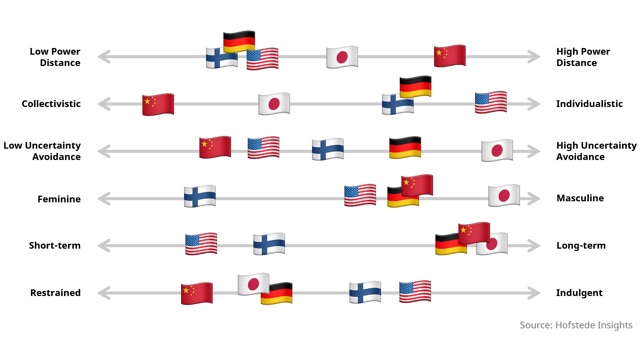
Viima Hofsted Insights GII study of cultural dimensions

First, the top countries in the GII are pretty much what most people would probably expect. The top 15 consists primarily of the US, the Nordics, as well as some Western European and East Asian countries.

However, the interesting part is that when we map these out to the Hofstede model, it’s immediately obvious that even the top performing countries are essentially all over the spectrum. Once we look a bit closer, it’s also evident that no individual country has the perfect innovation culture, as defined above.

To elaborate further, I think there are a few key takeaways from all of this:

  1. There’s more than just one way to be a great innovator
  2. While there are a few distinct types of cultures that generally do better, every culture has its own strengths and weaknesses when it comes to innovation
  3. You can improve your odds of succeeding at innovation by quite a bit if you recognize the biases of your culture that are likely holding you back

Top performing organizations should thus take these biases and cultural differences into account, and purposefully shape an organizational culture that is distinct from the average of any individual country and instead designed to drive more innovation. Here, diversity can be a real asset, but that’s another massive topic on its own.

Every culture has its own strengths and weaknesses when it comes to innovation. You can improve your odds of succeeding at it by recognising the biases that are holding yours back.

Having said that, there’s quite a bit more to creating this kind of an innovation culture than just what the Hofstede model captures, and we’ve written about that in detail in this earlier article.

However, one aspect that I’d like to highlight here is that innovation is requires a strong combination of both exploration and execution, so your culture should have a good mix of capabilities in both extremes.

If you’d like to start shaping your culture in practice, you can download our free Innovation Culture Toolkit for actionable tools that can help you do just that.

With that said, let’s now move on to the more practical implications of cultural differences for innovation work.

Multi and cross-cultural innovation capabilities

Let’s start from the first and most obvious challenge innovators in a globalized world face: how can their products and services, as well as sales and marketing efforts be relevant when doing international business, especially in different, highly culturally diverse regions?

In certain situations, and for certain products, it can be completely fine to just do minor localizations like translations, and primarily use the same channels, models, and messaging across the world. This will keep things much simpler and there are situations where these benefits can outweigh the costs for both your customers and your business. For example, this is the route we’ve so far decided to take with Viima.

Having said that, if you don’t adapt your offering and operations to different cultural and market preferences, you often can’t reach your full potential. In some situations, it might even take a completely different approach to reach the same goal in different cultures.

P&G is these days often cited as an example of a multinational company that has been able to successfully grow in emerging markets, but one of the lessons they learned the hard way was that just operating with the same products and models as they did back home wouldn’t work.

For example, according to ex-CEO Lafley, when P&G decided to focus on the baby-care market in Asia, the initial approach was to just cut away material from the diapers sold in Western markets. The problem was that to get to a cost-level that was acceptable, they had to cut out so much that the products no longer worked as intended. Once they went back to the drawing board and created an entirely new product with a completely different design focused primarily on costs instead of the latest technology, they succeeded in creating an attractive product and eventually became the market leader in China.

Pampers Cultural Tailoring

However, in most cases, either extreme isn’t the way to go. You need to look for a solution that allows you to build on your strengths, but still cater to the different cultural preferences of those whom you choose to serve – and usually that isn’t everyone.

Of course, for most of us who are innovators, that isn’t really that different from what we do anyway: we know that whatever great ideas we have, many will never survive first contact with the real world.

Cultural differences and local preferences of different markets are just another variable that we’ll need to take into account in our innovation work. Still, if you’re aiming for international business, it is a topic that you’d be wise to consider during your development process as it can save you a lot of trouble down the road.

Now, if you already have team members that are intimately familiar with these different cultures, it’s just common sense that the whole process is likely to be quite a bit smoother. And the evidence backs it up: this is one of the reasons for diversity being an asset for innovation.

But with that, let’s finally cover the practical considerations of what all of the above means for our organization before we wrap up.

Managing cultural differences within the organization

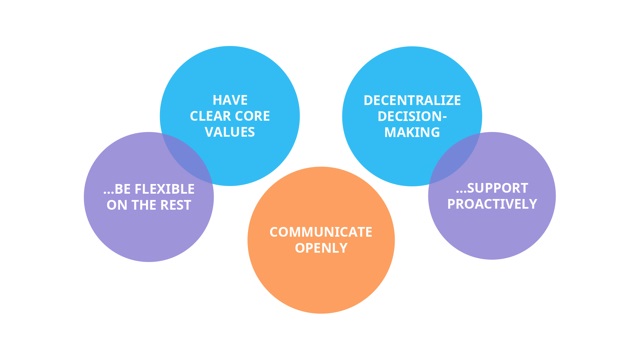
This is of course another massive topic, so we’ll keep things focused and will seek to provide you with the three key principles we’ve generally found to work well for getting great innovation outcomes in an international, multicultural organization in our work with such organizations.

While many of these are quite practical, depending on your role, you might not be able to put all of them into practice right away. Still, I’d recommend thinking about ways you can apply the same core ideas within the scope of your innovation work.
Cultural Differences for Innovation

Communicate about cultural biases and expectations openly

To illustrate this, I’ll share a story from No Rules Rules, which is a great book that I’d warmly recommend if you’ve made it this far into the post.

Before Netflix expanded internationally, it had a somewhat stereotypical US style task-oriented culture. It was quite common for employees to have lunch while working on their computers. However, as they expanded to Brazil, it quickly became obvious that this was a bit of a problem as, in general, Brazilians really value the relationships built over shared meals. As a result, early employees didn’t exactly feel welcome.

After some time, this came up in discussions, and while it was a trivial thing to fix, it still made a huge impact on morale. And not only did that help them adapt to local habits, but the changes also enriched the culture of the organization globally.

Netflix is known for its company culture

So, the takeaway here is that it’s important to pay attention to cultural differences and discuss them openly. Usually, the issues are easy enough to fix, but when they aren’t discussed, you easily miss them, and that’s what leads to many challenges down the road. The reality is that most people won’t be familiar with everyone else’s culture by default and expecting that to be the case just isn’t realistic.

Have core values and some norms, be flexible on the rest

Each organization’s culture is a result of its background. A sum of its parts, if you will. Be it the nationality of the company, past strategic and hiring decisions, and even simple practices and ways of working that have stuck around for one reason or another.

A few of these factors are core for the identity and competitiveness of the organization, and it’s these core values that you should hold on to. However, most of these factors are simple habits that are inconsequential in the grand scheme of things.

Making the difference between the two is key.

The core values and norms are something you simply need to succeed as an organization, and those you simply can’t compromise on. New employees, whatever their background or experience, do need to adhere to these few essentials. And for that to happen, you need to train them on these values and principles and tell why that is so important for your organization.

You should be adamant about upholding your core values, but be flexible and willing to give up or change the more inconsequential parts of your culture so that it can evolve and improve

On the other hand, the rest of inconsequential norms and habits you should be willing to give up or change when needed so that everyone can feel welcome and be the best version of themselves. Everybody doesn’t have to be a carbon copy of one another.

But there’s more to it than just that. The right changes can, in fact, make your culture better. This is essentially what “hire for culture add, not culture fit” means in practice.

Let’s again use the Netflix lunch example. Was it crucial for the company to have employees to eat at their desks? Of course not. It was just an inconsequential habit. However, it was vital to have the new Brazilian employees feel welcome, not just because it’s the right thing to do, but also because it improved the company’s performance. Plus, introducing this conscious habit globally helped have a positive impact elsewhere too!

Shared Lunch Brazil

The same can be applied even within the scope of your innovation work. For example, if you’re working on a new medical device, quality and safety are much more important than absolute speed to market. On the other hand, for a consumer web app, it’s probably the other way around. The exact values mentioned here aren’t important, it’s that they should support your strategy and innovation capabilities.

Figure out what the true core values and norms are for your innovation efforts, and make sure to reinforce these – and then be flexible on the rest.

Push decision-making down whenever possible

We’re a strong advocate for decentralized innovation. I won’t recap the whole topic here, but in a nutshell, it’s people who are closest to the market and the real work that often come up with the best ideas. Also, a decentralized approach allows you to dramatically scale your innovation work, which is key for long-term results.

While we’d argue that this is usually the preferable approach, it’s even more important when you’re operating in a multicultural and international environment, as we pointed out earlier.

Not only is this likely to lead to better decisions, but it’s guaranteed to improve the accountability and motivation of the employees making those decisions, which will lead to better results.

This is a key characteristics of the Netflix culture, and CEO Hastings prides himself in doing as few decisions as possible. And, at large, it’s seemed to work really well for them.

However, a market where they are struggling is India. And, at least on the surface, it looks like the problem has been that they’ve tried to adapt the same success formula to India as most other markets: using local top talent to produce new hit TV shows. The problem is that apparently Indians value sports and movies much more than they do TV shows, which has led to competitors focused on those areas dominating the market and a big commercial disappointment for Netflix. From the outside, it’s hard to say if they didn’t really live up to their values here, or if the mistake happened regardless of that. Still, I’m sure there were people on the ground in India that knew of these cultural preferences beforehand.

India Cricket

In practical terms, there are naturally some opportunities and capabilities that make sense to work on centrally, but in an international organization there are also plenty that would be best tackled by empowering people further down the organization to make decisions that best drive the key interests of the organization.

For example, some of our customers have launched big international innovation campaigns or other initiatives and struggled. They might find it difficult to engage people in the field because the centralized effort just doesn’t feel relevant for many of these people, or they might not be able to implement enough good ideas with that same centralized approach.

While there are others that have succeeded in similar centralized efforts, our most successful and advanced customers have nearly without exception evolved the way they work to really embrace innovation at the scale of the organization at large.

…and make sure innovators have the support they need

However, for that decentralized approach to work, you need to guide and support the people innovating across the organization. This is of course not specific to just an environment where there are cultural differences, but for innovation in general.

You likely have plenty of smart and capable people working for you who’d be more than capable of driving innovation, but if they don’t have the right resources, tools, and mindset, they might struggle.

So, in practice, you should:

  • share strategic priorities, and make sure people continue to work towards those
  • provide tools and resources that help people with the innovation process
  • communicate and oversee the above-mentioned core cultural values and norms of the organization
  • help people with challenges in being heard, understood, or taken seriously by others
  • help facilitate discussions and share innovation best practices between different parts of the organization

Often, the most convenient way to accomplish the above goals is to make these efforts a priority of your centralized innovation team, instead of having that small team try to drive innovation themselves.

The right approach and specific methods, tools, and frameworks obviously depend on the situation, but the point is that with the right support, you’ll find that people will often surprise you with the innovations that they’re able to create. The key to success with this model is to proactively invest in improving capabilities and supporting innovators across the organization.

Anyway, with this kind of an approach, you can move from just trying to manage cultural differences, to embracing and using them to drive value for your organization.

Conclusion

The topic of cultural differences is such a complex and nuanced topic that  we’ve barely scratched the surface on here, even though this has been a pretty long article.

But to summarize, if ignored, cultural differences can become a big challenge for innovators. Yet, if embraced and properly managed, it can turn out to be a real advantage for you.

The first step is to understand that these differences exist in the first place, and that teams and people from different backgrounds are likely to have certain strengths, but also certain weaknesses, when it comes to innovation.

Then, reflect on what the ideal culture for innovation looks like in your specific business, and discuss these differences openly with your team.

And finally, try to approach the whole process systematically, with the help of tools like our Innovation Culture Scorecard, one by one addressing challenges that are holding your team back from reaching its true innovation potential.

As mentioned, when embraced and properly managed, cultural differences can turn out to be a real competitive advantage for an innovator.

This article was originally published in Viima’s blog.

Image credits: Viima, Pixabay, Unsplash, Pexels

Subscribe to Human-Centered Change & Innovation WeeklySign up here to get Human-Centered Change & Innovation Weekly delivered to your inbox every week.

A Guide to Organizing Innovation

A Guide to Organizing Innovation

GUEST POST from Jesse Nieminen

I recently read a couple of excellent articles by Nick Skillicorn, and Prof. Rita McGrath where both discuss the challenges and intricacies involved in structuring and governing innovation within a large organization.

This is a classic topic that every corporate innovator has without a doubt come across, and it’s also one where “the right approach” is often quite elusive.

Inspired by those articles, we’ll present the most common archetypes and then dig a little deeper on the topic and share our thoughts and experiences to help you figure out how innovation should be structured within your organization.

Why organizing innovation is challenging

Before we dive into the different models for governing and organizing innovation, it’s important to understand why this is such a challenging topic to begin with.

That’s of course quite a lengthy and nuanced topic, but in short, there is no such thing as a perfect organizational structure or governance model. The bottom line is that a large organization is simply such a complex entity that structuring everything perfectly so that there aren’t any kind of bottlenecks, misaligned incentives, or any duplication of work just isn’t very realistic. If you’ve ever worked in large organization, you’ve certainly come across some of these challenges.

Now, most of these challenges are likely to be worse with innovation than with “business as usual” as, by definition, innovation means introducing changes. And most organizations simply aren’t designed for constant change.

What’s more, businesses are naturally very different from one another. A structure that works for a single product software company probably isn’t ideal for a CPG manufacturer or a house of brands because not only are their industries different, so are the innovations they are going after. So, what works well for some organization probably won’t be ideal for you.

This means that benchmarking and then applying “best practices” likely won’t work too well. Unfortunately, there just isn’t a single correct way to organize innovation.

Exploring the organizational archetypes for innovation

Having said that, there are a handful of common approaches, which we like to call archetypes, that most organizations use as the foundation for their efforts to organize and govern innovation.

Both McGrath and Skillicorn have done an excellent job in presenting many of these approaches, so a lot of credit for the following descriptions goes to them and I’d warmly recommend you read their takes too. Regardless, we’ve summarized their main points and combined them with our own experiences to create the following archetypes.

We’ll next explain each of these briefly, along with a quick summary of the key strengths and weaknesses for each.

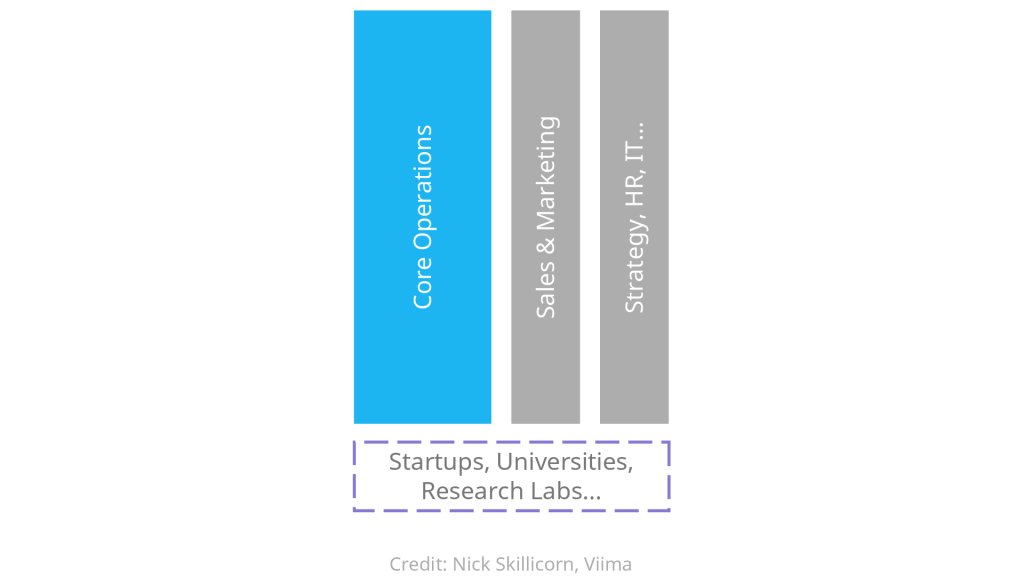
External Innovation Organizational Model

No in-house innovation

The first and simplest way to organize innovation is to not do it, or to completely outsource it. Perhaps the most common method here is to simply keep tabs on promising startups and then acquire them, or to have tight collaboration with universities and other research institutions.

While this obviously keeps things simple organization-wise and minimizes fixed costs, it also means that you no longer have control over your own destiny, and are instead reliant on third parties, which puts you in a very vulnerable position long term. Furthermore, in the last decade, we’ve seen a huge inflow of capital to fund startups, which means that valuations for promising startups have skyrocketed and acquiring them on the cheap is simply no longer a very feasible strategy.

Suffice to say, if you want to build an organization that thrives in the long run, I wouldn’t recommend this approach.

Pros

  • Low fixed costs
  • Structurally simple


Cons

  • Lack of strategic control and ability to build the future of the organization
  • Lack of differentiation
  • Reliance on third parties for both execution and especially exploration
  • Acquisition of promising innovations has become expensive

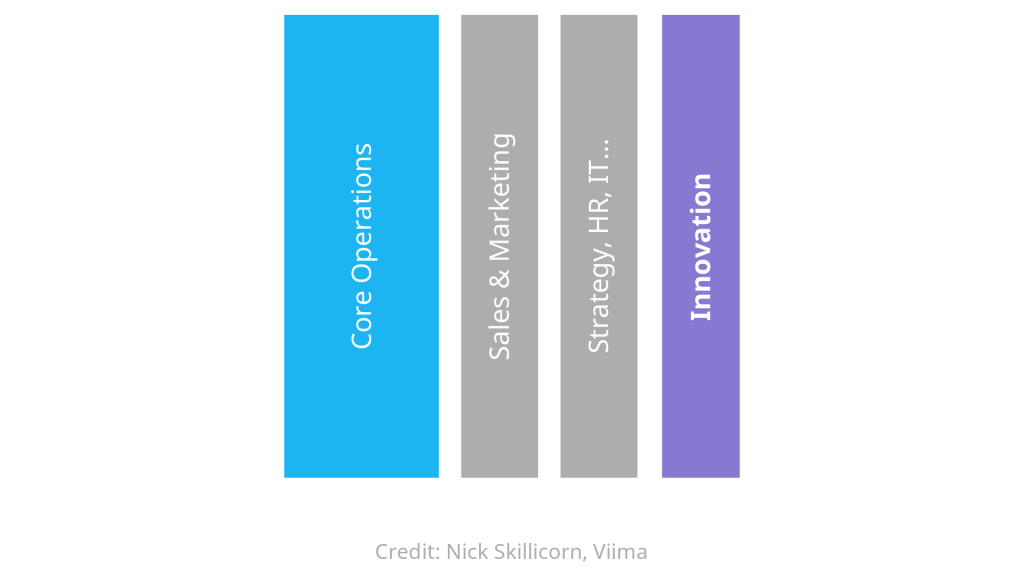
Centralized Innovation Organizational Model

Centralized

Perhaps the most common way large organizations set up innovation is by creating a centralized department that serves the innovation needs of the entire organization including each business unit and support functions, such as IT or HR. This can be a subdivision within R&D, but these days it’s typically a separate cross-departmental unit serving the innovation needs of business units.

Either way, such a unit is quick and easy to set up, and the approach has some other obvious advantages too, such as innovation expertise being built and managed centrally, which speeds up learning, as well as management and reporting being easy to organize.

It’s these advantages that make centralization the obvious choice for many who are just starting out with innovation. This is also an especially common approach for large industrial companies that typically have a strong R&D tradition.

If all of the innovation has to go through a single team, that team will inevitably become a bottleneck for innovation, no matter how skilled or large it is.

However, in the long run, this approach is also one that is likely to significantly limit your innovation potential. The reason is simple: if all of the innovation has to go through a single team, that team will inevitably become a bottleneck for innovation. No matter how large or skilled the team, they’ll never have enough resources. What’s more, this will also disincentivize everyone else in the organization from innovating and that prevents you from creating a true culture of innovation.

Pros

  • Quick, easy, and cheap to set up
  • Dedicated resources for working on innovation
  • Easy to govern, manage, and report on the overall innovation portfolio
  • Centralization can speed up learning


Cons

  • Poor scalability as centralized team will inevitably become a bottleneck for innovation
  • Likely to be pulled into too many projects, which leads to poor execution
  • High risk of degenerating into a support function serving business unit requests instead of strategically building the future of the organization
  • Likely to disincentivize others in the organization from innovating
  • Conflicting interests between business units can make prioritization difficult
  • Typically lack authority to make important, hard decisions

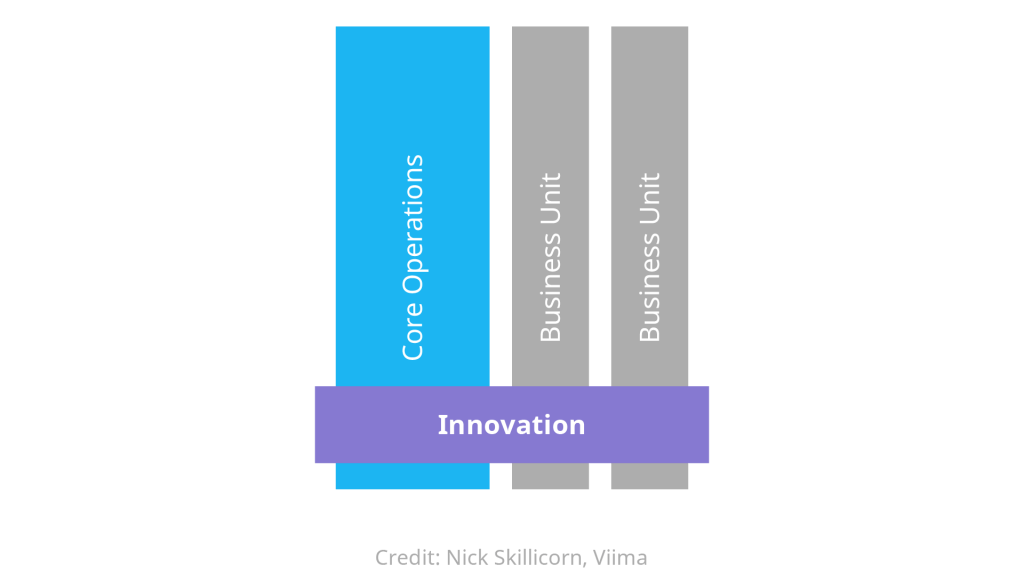
Dedicated Innovation Organizational Model

Dedicated

Popularized by Clayton Christensen as a solution to the Innovators’s Dilemma, dedicated business units for innovation have become increasingly popular in large organizations that are looking for the next stage of their growth. Sometimes these units have proper P&L responsibility, and they might even report directly to the CEO or others in senior management, but at times they can also be innovation labs responsible primarily for testing and piloting new ideas before they are to be integrated into the core business.

Regardless of the particularities, these approaches have some specific strengths, but also clear weaknesses. The good thing is that because the unit is independent, it can usually avoid being held back by the restrictions of the business as usual and can build their talent and approaches from scratch.

If innovation is the job of a select few, it will be incredibly hard to build a pro-innovation culture.

The downside is that they also don’t necessarily play to the strengths that the organization has already built. Without strong and clear leadership, these kinds of innovation efforts are likely to have an equally poor success rate as your average startup – but without the asymmetric upside.

The reason is simple: if you already have hundreds of millions or billions in revenue, most new businesses just don’t move the needle enough – unless they can quickly grow to a massive size or be combined with the strengths and competitive advantages of the core business.

And just like with the centralized model, this model again limits innovation to one part of the organization. As before, that will likely prevent you from creating a true culture of innovation, and thus lead to the unit becoming a bottleneck down the road.

Pros

  • Freedom to operate independently from processes of existing business units, which is essential for trying new things and creating disruptive innovations
  • Ability to hire and organize specifically for innovation
  • If led well, ability to focus on the long-term instead of short-term performance
  • High profile innovation unit can also be used for marketing and employer branding purposes


Cons

  • Conflicts of interest and lack of cooperation between core business and innovation unit likely to lead to politics, tension, and other challenges in integrating innovations into core business
  • Independence and lack of communication between business units might hurt strategic alignment and prevent the innovation unit from benefiting from the existing strengths of the organization
  • Can easily degenerate into a cost center performing innovation theaterwithout a clear strategic focus, strong leadership, and evidence-based processes
  • Likely to disincentivize innovation in other parts of the organization and thus prevent the creation of an innovation culture
  • High initial investment with lots of uncertainty can make the business case for investing in innovation look bad

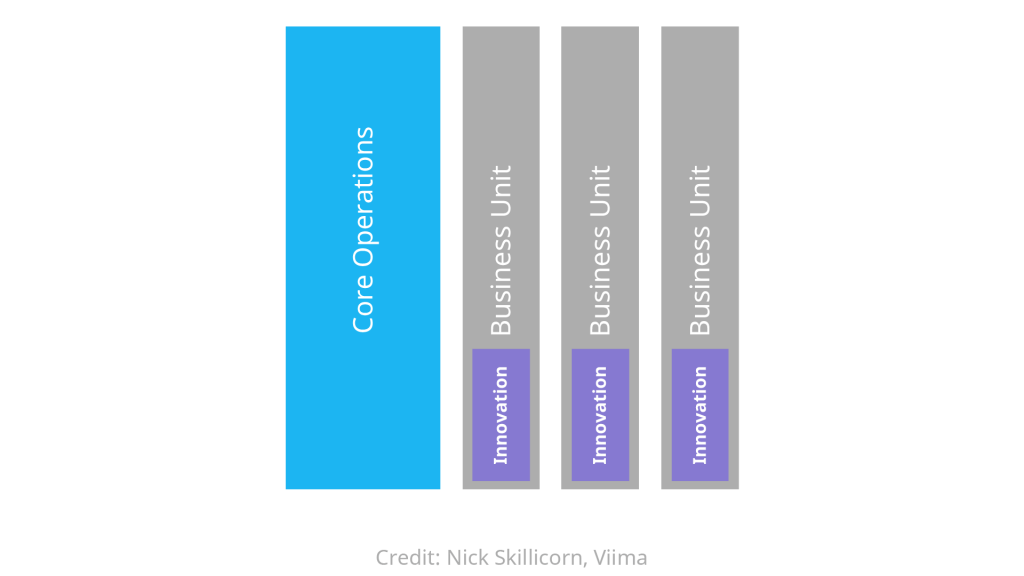
Embedded Innovation Organizational Model

Embedded

Many organizations have relatively independent business units or product and brand teams, and for them it can often make sense for innovation to be embedded within these units.

Traditional examples of such an approach are companies like P&G and other CPG companies with strong brands. These companies are working hard to keep up to date with evolving trends and consumer needs to innovate and create new products for the consumer. However, the same can also be true for many other kinds of businesses, such as software companies with multiple products.

Depending on the industry and organization, these units might have varying levels of control over their innovations once they are on the market. For example, in CPG companies manufacturing, logistics and many other functions would likely be managed by core business operations instead of this unit.

Pros

  • Better able to focus innovation on things that matter for each business, be they strategic projects or emerging customer needs
  • More control over innovation resources and ability to get talent that meets specific needs
  • Parallelization over different units can increase innovation throughput of the organization overall
  • Easier to align innovation with business needs and plans within the unit
  • The business case for investing in innovation is typically easy to make as you can start from low-hanging fruits that provide immediate value


Cons

  • Innovation likely to be biased towards more applied and incremental projects due to focus on immediate business needs
  • Some efforts may be duplicated between teams, especially if more long-term R&D work is being done
  • Can lead to a silo-effect, extra need to focus on facilitating knowledge transfer between units

Ambidextrous Innovation Organizational Model

Ambidextrous

Our fifth approach is usually referred to as the ambidextrous organization. We’ve  also seen it be referred to as the Hybrid model, and it’s quite a natural evolution from the previous archetypes as it seeks to combine the best of both worlds.

In a nutshell, the idea is that innovation should happen across the organization with existing business units focused on exploiting their current position through incremental innovation, and a separate dedicated unit being responsible for exploring and building the future of the organization through more radical or disruptive innovation.

In the ambidextrous model, existing units use incremental innovation to exploit the current position and new units are set up to explore and build future.

In practice, a new P&L responsible division will be setup for new non-core businesses, and the more incremental innovation will then be organised either as Embedded or Centralized.

If an organization does successfully implement such an approach, it can lead to exceptional long-term performance, but that’s of course easier said than done. For most organizations, this is likely to require a significant transformation, and it can be challenging to get everyone onboard, build the right processes, as well as to align goals and incentives the right way across the organization.

Pros

  • Easier to build a balanced innovation portfolio with both strong short and long-term performance
  • Enables building an innovation-oriented culture across the organization
  • Enough resources for key projects across the organization
  • Makes it easier to communicate the innovation strategy with clear roles and responsibilities for each part of the organization
  • Can customize governance models to meet the needs of different types of innovation in different parts of the organization


Cons

  • Expensive and difficult to build, as well as to maintain
  • Requires clear leadership and a commitment to a transformation from the top
  • Can demotivate innovation-oriented employees that are in the core business
  • Usually requires extensive changes to processes and the re-skilling of managers and employees across the organization
  • While easier than with most other models on paper, prioritization and division of responsibilities can still be challenging in practice

Decentralized Innovation Organization

Decentralized

Our final model is the decentralized approach. If you look at any of the best innovators in the world, be it Apple, Tesla, SpaceX, or Amazon, this is closest to the model they use. None of these organizations has a centralized or dedicated team responsible for all innovation in the organization.

Instead, the organization decentralizes the responsibility for innovation to happen in individual teams (which are typically cross-functional and relatively small) across the organization. Each team is focused on figuring out how they could help the organization better reach their strategic goals, and innovation is just one of the key tools in that process.

If a team (or an individual leader or employee) comes across a big idea that shows promise but would require significant additional investments, they’ll apply for additional resources from management via a quick and streamlined process. If approved, that typically leads to another team being set up to pursue that idea.

This approach is sometimes called the permissionless model due to the significant freedom each team possesses to make decisions affecting their own work. The obvious advantages are that they usually know the problems intimately and have the resources, incentive, and know-how to solve them, and have fewer dependencies to other parts of the organization. That leads to an extremely high pace of innovation and innovation throughput for the organization, which together create a tremendous competitive advantage.

Loosely Coupled vs Tightly Coupled Organization

Having said that, this too isn’t exactly an easy model to implement for most organizations. Typically, this would require a fundamentally different mindset, leadership philosophy, and a significantly higher talent density. For the average organization, that means a full-blown transformation where most fundamentals in the organization would need to change, which of course isn’t feasible for many.

Pros

  • Extremely high throughput and pace of innovation
  • Ability to adapt, re-organize and meet changing demands quickly
  • Strong focus on execution and value creation
  • Clear roles and responsibilities


Cons

  • Would require a fundamental transformation for most organizations
  • Requires strong communication and strategic clarity from management
  • Active management involvement required to remove barriers and to organize teams so that the portfolio remains balanced
  • Requires high talent density across the organization, which can be very challenging to achieve in practice
  • Continuously evolving and rapidly changing landscape might be too intensive for some employees
  • Some work often initially duplicated across teams, but can be managed by creating horizontal support teams

Choosing the right approach for your organization

As you can see, every approach has their benefits, but also their disadvantages.

In our experience, the Hybrid and especially Decentralized are the likeliest approaches to lead to sustained levels of high innovation performance in the 21stcentury but implementing either isn’t exactly a walk in the park for a large organization. If you have the luxury of meeting (or are close to meeting) the prerequisites, these are the models I’d personally go for.

However, for many, that just isn’t the reality. Even if you’re like most organizations and don’t quite have the talent, leadership, or other prerequisites needed for these approaches, I’d keep either the Hybrid or Decentralized approach as your eventual goal to build towards.

Move control and decision-making down in the organization to be able to move faster, make more informed decisions, respond to changes quicker, and to simply innovate more.

However, instead of a major overnight transformation, you should be prepared for a set of smaller, gradual steps that build your capabilities and culture towards that future while solving the current problems with your processes and structures.

Centralization vs Innovation Maturity

While not ideal in theory, in practice the journey towards becoming a mature top innovator typically first leads towards centralization for most incumbent organizations. They need to build their innovation strategy, knowledge and capabilities before they can successfully decentralize and move control and decision-making down in the organization to be able to move faster, make more informed decisions, respond to changes quicker, and to simply innovate more.

With that background, if such an approach is used, it’s crucial that this centralized innovation function understands and embraces their temporary role so that they are willing to relinquish control and power over innovation to others. All too often we see these leaders clinging on to the team, budget and power they’ve built long after it would’ve been in the organizations’ best interest to re-organize.

Best practices for organizing innovation

As we’ve discussed, if you’re planning to make changes to the way you organize innovation, most decisions will depend on your context. Still, there are a few things that are good to keep in mind regardless of the approach you end up choosing. Here’s my top three:

The best innovators continuously evolve

The first, and perhaps the most important point to remember is that the best innovators continuously evolve and improve the way they work. They don’t just pick one organizational structure and go with that forever. Instead, they are constantly looking for ways to re-organize their efforts so that they work on whatever is likely to best help them reach their goals. This is of course one of the fundamental strengths of the Decentralized model but applies to other approaches too.

This is also in line with how the most successful organizations approach re-organizations in general. They don’t just wait until the old structure is burning, they act proactively to position themselves for the future they want to create.

Clear roles and decision-making structures

It’s pretty obvious, but if people don’t know who can make a decision on an idea that they may have, or even who’s responsibility it would fall under, odds are that not a lot of innovation will happen.

The reality is that there will always be some ambiguity and overlap, especially in fast moving environments, but clear roles and decision-making structures are regardless important for an organization that wants to innovate.

If projects or decisions seem to get stuck, or turf battles seem to consistently pop up in your organization, unclear roles and ambiguous decision-making are likely to be the main culprits.

Organize according to strategy and plan for the execution

Again, it might sound obvious, but especially with innovation, the differences can be dramatic. Organization is the link between your strategy and your execution, so make sure it isn’t detached from the realities of what it will take to reach your goals with innovation.

To use a bit of a simplified example, if your strategy is focused on creating new business from emerging disruptive technologies, then the Embedded model probably won’t cut it as your innovators will be kept busy by the priorities from the core business.

How to organize innovation

Plan for the execution, on the other hand means that each team should have the resources and the freedom needed to reach your goals. If, using our previous example, you allocate just a few engineers to the team and then hope that sales will magically turn those technologies into booming businesses, odds are very much against you.

In other words, try to allocate resources so that the team has everything they need to reach their goals. While this sounds super basic, we still see these mistakes frequently when innovation is a bit of an afterthought for management.

Conclusion

As is probably evident by now, no structure or approach to governing innovation is ever going to be perfect, at least for long. As your goals change or your business and industry keep evolving, you will need to change and evolve too.

Even though organizing innovation doesn’t seem to get the same kind of attention as innovation strategy or culture, it’s extremely important, nevertheless. Get it wrong, and it will be almost impossible for your organization to succeed at innovation. Get it right, and you’ll at the very least have a realistic shot at that.

Hopefully this article has provided you with more thoughts on the topic, and some views on what to do and not-to-do.

This article was originally published in Viima’s blog.

Image credits: Unsplash, Viima, Nick Skillicorn

Subscribe to Human-Centered Change & Innovation WeeklySign up here to get Human-Centered Change & Innovation Weekly delivered to your inbox every week.
Dare to Think Differently

Dare to Think Differently

GUEST POST from Janet Sernack

As many of my colleagues are aware, I am at heart, a maverick, an unorthodox or independent-minded person. Who is curious and inquisitive, and finds change and challenging the status quo exciting, fascinating and stimulating. I am also, considered, by some, as a misfit, someone whose behaviors and attitudes sets them apart from others in an uncomfortably conspicuous way, that often rocks the boat. There is a range of consequences for people like me, who dare to think differently, especially now that I have also achieved the status of a Modern Elder – “the perfect alchemy of curious and wise, with curiosity leading to expansive inquiry while wisdom distills what’s essential.”

Coupled with both the challenges and constraints of the currently disrupted Covid-19 and digitized world, I am finding that the consequences of being different have intensified, become more impactful, and are often, quite confronting. Where differences cause resistance to change, divisiveness, and conflict, rather than maximizing differences in ways that embrace our humanity, diversity, to harness collective intelligence to make the organization, or world a better, more inclusive, and safer place.

Diversity is of the Essence

According to Jonathan Sacks, in his book “The Dignity of Difference- How to avoid the clash of civilizations,” he states that “we are living in the conscious presence of difference”.

Which exists in the home, in the street, in our workplaces, communities, and countries where we constantly encounter groups and cultures whose ideas and ideals are unlike ours. “That can be experienced as a profound threat to identity. Identity divides.” Considering that “the world is not a single machine, it is a complex, interactive ecology in which diversity – the biological, personal, cultural and religious – is of the essence.”

“When difference leads to war, both sides lose. When it leads to mutual enrichment, both sides gain.”

As is currently being evidenced by the tense and tentative Ukrainian and Russian border confrontation, with its potentially tragic consequences. Where Yuval Noah Harari states in a recent article in The Economist – “At the heart of the Ukraine crisis lies a fundamental question about the nature of history and the nature of humanity: is change possible? Can humans change the way they behave, or does history repeat itself endlessly, with humans forever condemned to re-enact past tragedies without changing anything except the décor”?

People Who Dare to Think Differently

Adam Grant, in his book “The Originals – How Non-Conformists Change the World” describes an original (n) as “A thing of singular or unique character; a person who is different from other people in an appealing or interesting way; a person of fresh initiative or inventive capacity”.

The book goes on to explain strategies, through studies and stories how to champion new ideas and fight groupthink, in constructive ways that maximize diversity and differences and promote dissent, as the basis for cultivating original thought to effect positive change.

Ray Dallio, in his book Principles explores this further, suggesting that “if you are like most people, you have no clue about how other people see things and aren’t good at seeking to understand what they are thinking because you’re too preoccupied with telling them what you yourself think is correct.” Often causing divisiveness rather than inclusion, resistance to change, and as a consequence, missing the possibilities and opportunities that may be present.

This also impedes our overall adaptiveness and creativity in an exponentially changing, world, to make real progress, and constructively change and limits the potential for innovation, growth and ability to contribute to the common good.

Change Management Has Changed

In a recent article from the Boston Consulting Group, they stated that  “Effective change management requires leaders to shift away from one-size-fits-all approaches and develop an expanded set of context-specific strategies”.

Which are truly adaptive, collaborative, energize, catalyze change, harness, and mobilize people’s and customers’ collective intelligence, in ways that are appreciated and cherished by all, and contribute to the common good.

To ultimately collectively co-create a set of different, empowered future-fit leaders, teams, and organizations – who courageously, compassionately, and creatively contribute toward an improved future, for customers, stakeholders, leaders, teams, organizations as well as for the good of the whole.

Welcoming Dissent and Thoughtful Disagreement

At ImagineNation™ we dare to think differently and teach train, and coach people and teams to maximize their potential to lead, manage, coach, through implementing and embedding change and innovation, differently.

We enable people to lead in the imagination age by empowering, enabling, and equipping them to be and think differently to:

  • Flow with some people’s need to be “right” and in control, when they are being defensive, abusive, and divisive, even when disagreement and conflict occur.
  • Artfully and skillfully use cognitive dissonance and creative tension to pull people towards a new possibility and envision a new and compelling future.
  • Be inclusive to support mutual enrichment, through co-sensemaking, that helps them create “order” (in their own context) and simplicity from complexity and change.
  • Self-regulate and self-manage emotionally in the face of uncertainty and volatility.
  • Be relatable, empathic, inspiring, and artfully and skillfully influential in helping people open their minds and hearts toward co-creation, collaboration, and experimentation that ensures a shared contribution for mutual gain.
  • Be creative and inventive to maximize their multiple and collective intelligences through learning, contrarian thinking, constructive debate, and creative conversations that generate discovery.

In ways that engage deep generative listening, inquiry, questioning, and differing that uses cognitive dissonance to unleash the creative energy that triggers and generates thinking differently.

When people are trusted and empowered to think differently, they co-create a frequency that allows, awakens, and activates their adaptive and innovative leadership qualities, consciousness, states, and qualities of mind and heart, to effect positive change.

Taking wise and intelligent action

It also enables them to wisely choose the most intelligent actions that result in adaptive and innovative outcomes.

This helps creativity to flourish and disrupts and interrupts those people, whose complacency, conformity, and rigidity create divisions, and feelings of desolation and exclusion that kill our capacity and competence to collaborate, create and invent.

Leaving me to wonder and inquire;

  • What if the “strangers” among us simply listen, with open minds and open hearts to the thought, feelings, and opinions of others, with both curiosity and detachment?
  • What if we could collectively co-create safe containers and collective holding spaces, that maximize our differences and diversity, and simply share a creative conversation about what could be possible?
  • How might we maximize our diversity of thought, to enable us to think differently about the issue, opportunity, or problem in ways that supported differences for mutual enrichment?

There is no wisdom on one point of view

Might this result in a deeper connection when there is polarization between people?

Might it be possible to co-sense and co-create a sense of inclusion, and an opening for a deeper philosophical exploration and discovery for thinking differently about the role, nature of and impact prescriptive points of view on how people truly feel, really think, and deeply act in our globalized and connected world?

Might it help us collectively to co-create making it a better place?

Find out more about our work at ImagineNation™

Find out about our learning products and tools, including The Coach for Innovators Certified Program, a collaborative, intimate, and deep personalized innovation coaching and learning program, supported by a global group of peers over 9-weeks, starting Tuesday, May 4, 2022. It is a blended and transformational change and learning program that will give you a deep understanding of the language, principles, and applications of an ecosystem focus, human-centric approach, and emergent structure (Theory U) to innovation, and to upskill people and teams and develop their future fitness, within your unique context. Find out more.

Image credit: Unsplash

Subscribe to Human-Centered Change & Innovation WeeklySign up here to get Human-Centered Change & Innovation Weekly delivered to your inbox every week.
Disrupt Yourself, Your Team and Your Organization

Disrupt Yourself, Your Team and Your Organization

GUEST POST from Janet Sernack

Moving into a new year is always a time for retreating and reflecting to accelerate growth and harvest new ideas from our feelings, thoughts, and learnings gleaned from the last two years of disruption, extreme uncertainty, and instability. Whether you are actively seeking to disrupt yourself, your team, and your organization to effect sustainable success this year, or not, we all have the opportunity to adapt, innovate and grow from the range of challenging events that impacted us in the past 24 months. This is why it might be useful to see these disruptive events as positive, powerful, and impactful forces for creating new cracks in your own, or your team or organizational soil – to sow some imaginative, creative, and inventive seeds for effecting positive change in an unstable world.

To see them germinate the desired changes you want for yourself, your team, and organization and deliver them, to survive and thrive in 2022.

We are all being challenged by disruption

Our status quo and concepts of business-as-usual have all been significantly disrupted, resulting in a range and series of deep neurological shocks, that have shaken many of us, our teams, and our organizations, to our very cores.  Some of us adapted to a sense of urgency and exploited the opportunity to reinvent, iterate, or pivot our teams and organizations, towards co-creating individual and intentional “new normals” and just “got on” with it. Some of us have continually denied, defended, and avoided making changes, where many of us have sunk deeply into our fears and anxieties, falsely believing that our lives, and our work, would eventually go back to “normal”.

This is because a significant number of our habitual, largely unconscious mental models and emotional states, were disrupted, largely by events beyond our individual and collective control.  Causing many of us to experience “cognitive dissonance” (a situation involving conflicting attitudes, beliefs, or behaviors that produce feelings of mental discomfort leading to an alteration in one of the attitudes, beliefs, or behaviors to reduce the discomfort and restore balance) from the chaos, discomfort, confusion, and conflict.

Which saw many of us, disconnect cognitively and emotionally, from the current disruptive reality, where some of us secretly hoped that “it will all go away” manifesting and festering fundamentally and unconsciously, as inherent neurological immobility, (freeze, fight, flight) resulting in many areas as resistance to change.

Why disrupt yourself, your team, and organization?

Yet disruptive change is inevitable, the speed and pace of exponential change cannot be stopped, the range of complex and wicked global and local problems that need to be solved collectively, aren’t going away.

Job security and full-time employment, as hybrid and virtual work, and technology accelerate, are becoming “things of the past” as the workplace continues to destabilize through digitization, AI, and automation.

Whilst the war for talent also accelerates as the great resignation sets in and people make powerful, empowered life balance decisions and are on the move globally.

Taking the first steps to disrupt yourself, your team, and organization

In this time of extreme uncertainty, we have a unique moment in time, to disrupt ourselves, teams, and organizations by:

  1. Hitting our individual, collective mental, and emotional pause buttons, to retreat from our business-as-usual activities, and take time out to reflect upon paying attention and qualifying:
  • How specifically have I/we been disrupted?
  • How have our people,  teams, and customers been disrupted?
  • What are some of the major collective impacts on our organization’s current status and how might these impact our future growth potential and overall sustainability?
  • How connected are we to an exponential world, how can we ensure that our feelings, thoughts, and actions, connect with what is really happening to us, our teams, and our customers?
  • What causes disconnection and how might we manage it to be more mentally tough and emotionally agile in an extremely uncertain future?
  • What really matters to us, our teams, organizations, and customers – what do our people, teams, and customers really want from us?
  • What are some of the key elements of our organizational strategy to enact our purpose and deliver our mission?
  1. Generating safe, evocative, provocative, and creative conversations, that evoke deep listening and deep questioning, about how to individually and collectively reconnect, revitalize, rejuvenate and reenergize people, teams and organizations to survive and thrive through asking:
  • How can we engage and harness our people and teams’ energies in ways that mobilize their collective intelligence to evoke new mindset shifts and new ways of thinking and acting?
  • What are some of the key mindsets and traits we need to disrupt, shift, and cultivate to be successful to adapt and grow through disruption?
  • What skills do our leaders and teams need to learn to think and act differently to shift the organizations culture to deliver our strategy?
  • How might we shift our teams and organizations to be agile, and redesign our organizations for both stability and speed?
  • What does it mean to us, our teams, and organizations to be creative, inventive, and innovative – How might we shift our teams and organizations to be more creative, inventive, and innovative?
  • What are the new behavioral norms that will support and enable us to execute agile and innovative changes?
  • How might becoming agile and innovative help our people, teams co-create a healthy, high-performing, and sustainable organizational culture?
  • How might becoming agile and innovative add value to the quality of people’s lives and help our customers flourish?
  1. Becoming comfortable with being uncomfortable by developing our peoples, teams, and our organizational “discomfort resilience” and dance of the edge of your comfort zones through:
  • Creating safe environments where people and teams are allowed to experiment,  have permission, and are trusted to practice, make mistakes as they move through difficult emotions, and take little bets in low stake situations.
  • Intentionally breaking organizational routines and habits, to create space in people’s brains for new neural pathways to be developed.
  • Enabling people and teams to become mindful of their triggers, to interrupt their automatic reactions.
  • Equipping people and teams to thoughtfully and intentionally respond to situations, that make them uncomfortable and risk-averse, by knowing how to think differently.
  • Bringing more play into the way people work, encourages people to be imaginative, inquisitive, curious, and improvisational, to seek different ways of thinking and acting, that really make a difference in how work gets done.
  • Support people and teams to learn by doing, and failing fast, without the fear of blame, shame, and retribution, despite it being risky to do that.

Why not disrupt yourself, your team, and organization?

The future is going to be full of disruptive events and circumstances that will impact is our families, communities, team, and organizations, and the conditions of extreme uncertainty and disruption are not going to go away. In fact, they are fundamental to what might be described as our collective “new normal” and it’s up to you to disrupt yourself, your team, and organization, to lead, adapt and grow, to survive and thrive through it.

Find out about The Coach for Innovators Certified Program, a collaborative, intimate, and deep personalized innovation coaching and learning program, supported by a global group of peers over 8-weeks, starting May 2022. It is a blended learning program that will give you a deep understanding of the language, principles, and applications of a human-centered approach to innovation, within your unique context. Find out more.

Contact us now at mailto:janet@imaginenation.com.au to find out how we can partner with you to learn, adapt, and grow your business, team and organization through disruption.

Subscribe to Human-Centered Change & Innovation WeeklySign up here to get Human-Centered Change & Innovation Weekly delivered to your inbox every week.
Developing 21st-Century Leader and Team Superpowers

Developing 21st-Century Leader and Team Superpowers

GUEST POST from Janet Sernack

According to McKinsey & Co, in a recent article The new roles of leaders in 21st-century organizations they say that the focus of leaders, in traditional organisations, is to maximize value for shareholders. To do this effectively, they say that traditional leaders typically play four different roles – the planner (developing strategy and translating it into a plan); the director (assigning responsibility); and the controller (making sure everyone does what they should minimize variance against the plan). Whilst these represent the core and foundational business management and leadership roles essential to successful organisational performance, the world has changed significantly, and traditional organisations are being severely disrupted. Requiring the development of new, adaptive, and supplementary, and new leadership and team roles, which embrace the set of 21st-century superpowers for leaders and teams – strategically supported by digital technologies, and an ecosystem focus to thrive in the face of exponential change and a VUCA world.

Maximizing the dormant space

This creates a space of unparalleled opportunity towards reshaping the world anew by activating what might be considered the dormant space, between traditional leadership roles and the possibility of a set of 21st-century superpowers for leaders and teams.

To be embraced, enacted, and embodied by conscious leaders and collaborative teams in more purposeful, meaningful, and innovative ways that serve people, customers, and the common good.

The new roles of leaders and teams in the 21st century

The leadership paradigm has shifted, in the past 20 years, to focus more on “co-creating meaningful value with and for all stakeholders, expanding beyond shareholders to include customers, employees, partners, and our broader society”.

Taking the stance that in an open system, everyone must win through co-creation, collaboration, experimentation, and innovation that results in delivering great customer experiences.  To retain and sustain current customers, and to attract and attain new ones in an increasingly competitive global marketplace!

Making the key “leadership challenge of our times” as one which cultivates transformative eco-system-led learning and change, nurturing connections, exploration, discovery, creativity, collaboration, experimentation, and innovation at all levels of the system.

Requiring the traditional organisational leadership roles, to shift towards bravely and boldly “stepping into the uncharted territories of future possibility” and weaving these possibilities into the way people work and commune together.

To co-create new “holding spaces” for igniting, harnessing, and activating people’s collective intelligence to embrace and execute change and deliver the desired commercial outcomes their organisation wants.

Openings for unparalleled opportunities

It seems that we not only survived through the emotional and mental anxiety and overwhelm of living in “a world of disruption, drama, and despair” we also saw the range of disruptive events as a “crack” or opening in our operating systems, for unparalleled opportunities.

By intentionally embracing the “key changes that currently reshape all our innovative learning systems” including the action confidence (courage and capacity to step into something new and bring it into being, creating reality as we step into it) to:

  • Deepen the learning cycle (from head-centric to the whole person: heart, head, and gut-centric).
  • Broaden our perspectives and actions (from an individual focus to an eco-system focus).

A moment in time – taking a deep breath

One of the many challenges our collective at ImagineNation™ faced during the Covid-19 pandemic-induced lockdowns (we had six long ones here in Melbourne, Australia over 18 months) was the opportunity to slow down, hit our pause buttons, retreat and reflect and take some very deep and slow breaths.

To make time and space to rethink, respond, regroup, experiment, and play with a range of wondrous, imaginative, and playful ideas, to unlearn, learn and relearn new ways of being, thinking, and acting to sense and actualize a future that is wanting to emerge – even though, then and right now, it was and still is unclear how.

Acknowledging that whilst many of us, and the majority of our clients were experiencing the range of significant emotional reactions, mental stalling, and the anxiety and overwhelm of living in “a world of disruption, drama, and despair” as well as sensing and perceiving the world that is emerging as one of unparalleled opportunity”.

Stepping up and into new spaces of possibility and learning

Individually and collectively, we focussed on a range of rethinking, responding, and regrouping strategies including adopting new 21st-century leadership roles.

Initially by taking responsibility for sustaining our own, our partners, and our families, emotional energy, mental toughness, engagement, and overall wellness.

Then consciously enact and embody the new set of emerging 21st-century leadership roles as visionaries, architects, coaches, and catalysts:

  • Being visionaries: by co-creating a collaborative and global collective of aligned ecosystem partners with clear accountabilities within a virtual, profit share business model.
  • Being architects: by iterating, pivoting and sharing our IP and learning programs to close peoples’ “knowing-doing gaps” to help them unlearn, learn, relearn, reshape and develop their 21st-century superpowers for leaders and teams.
  • Being coaches: by exploring working with the range of innovative new coaching platforms, including BetterUp and CoachHub to better democratize, scale, and share our strengths, knowledge, and skills to help a significant number of people deal more effectively with the impact of virtual hybrid workplaces.
  • Being catalysts: by focussing on partnering with clients to break down their self-induced protective and defensive “silos” to support them to become aware, acknowledge, accept, and resolve their feelings of loneliness, isolation, and disconnection, and overall anxiety.

21st-century superpowers for leaders and teams

It seems that these are just some of the 21st-century superpowers for leaders and teams which act as the foundations necessary to survive and thrive through the emerging decade of both disruption and transformation.

Summing these up into more concrete actions for leaders and teams include cultivating and sustaining these five superpowers:

  1. Transformational Literacy: The ability to increase our capacity to collaborate and co-create across institutional and sector boundaries through “shifting consciousness from ego-system awareness to eco-system awareness.” to pioneer solutions that bridge the ecological, the social, and the spiritual divides existing in the 21st
  2. Nimbleness and Agility: The ability to shift and re-think and re-learn in changing contexts, to quickly experiment, iterate and pivot to adapt and move forwards collaboratively through mindset flips to emerge creative ideas and innovative solutions that are appreciated, valued, and cherished.
  3. Scalability: The ability to rapidly build desired and most relevant internal capabilities, to shift capacity and service levels through increasing creativity, invention, and innovation in ways that meet changing customer expectations, and satisfy their demands and future requirements.
  4. Stability: The ability to maintain “action confidence” and operational excellence under pressure that frees people from the constraints of “getting it right” and allows them to continuously unlearn, learn, relearn and change through “failing fast” or forward, without being blamed or shamed.
  5. Optionality: The ability to “get out of the box” to build and develop value chains, stakeholder engagements, or an ecosystem focus to acquire new capabilities through external collaboration.

Walking the path forward

According to Otto Scharmer, in a recent article “Action Confidence: Laying Down the Path in Walking” the leadership qualities we also need to nurture in order to lean into the current moment and to source the courage to act are: Humility. Vulnerability. Surrender. Trust.

It might be time to hit your own pause button, retreat and reflect, inhale a deep breath in this precious moment in time to develop your path forwards and develop an ecosystem focus and an ecosystem focus and a human-centric, future-fit focus.

To embrace, enact and embody a set of 21st-century superpowers for leaders and teams and reshape your innovative learning systems by developing the action confidence to adopt an ecosystem, whole person, and a whole perspective that contributes to the good of the whole.

Join our next free “Making Innovation a Habit” masterclass to re-engage 2022!

Our 90-minute masterclass and creative conversation will help you develop your post-Covid-19 re-engagement strategy.  It’s on Thursday, 10th February at 6.30 pm Sydney and Melbourne, 8.30 pm Auckland, 3.30 pm Singapore, 11.30 am Abu Dhabi and 8.30 am Berlin. Find out more.

Image credit: Unsplash

Subscribe to Human-Centered Change & Innovation WeeklySign up here to get Human-Centered Change & Innovation Weekly delivered to your inbox every week.
Re-Thinking for a New Era

Re-Thinking for a New Era

GUEST POST from Janet Sernack

In our last blog, we proposed, rather than living in a world where everyone hates to fail, why not adopt a rethink, respond, regroup, thrive pattern, and experience failure as an opportunity for change, unlearning, and re-thinking? Adopting this approach supports your human-centricity and enables you to become future-fit through developing your set of 21st-century superpowers in the face of the acute disruption of COVID-19. This is reinforced by Adam Grant, in his book “Think Again” (the power of not knowing what you don’t know) where he states that we are living in a time vital for re-thinking to help us become adaptive and agile and develop our future fitness to thrive in a disruptive, uncertain world.

Critical Art of Re-Thinking

The critical art of re-thinking involves being actively open-minded, hearted, and willed:

  • To learning, and possibly re-learning how to effectively question your own beliefs, mindsets, assumptions, opinions, and habits;
  • Through connection, association, detachment, and discernment to these qualities in other people’s minds and hearts;
  • And to then put our “mental pliability” and “emotional agility” to the test by creating the time and space for re-thinking with a new “set of goggles” and revising our views based on what we learn.

This potentially benefits everyone because it allows us to upgrade and update our points of view and expand our understanding of the world, we are all living in today and build our future fitness.

It also positions us for change innovation and excellence in the way we transform our approach to work and share our wisdom in life.

Making time and space for re-thinking

  • The vital role of unlearning

Embracing human-centricity and a future-fit focus involves unlearning and letting go of many of our old beliefs, mindsets, assumptions, opinions, and habits embedded in our habitual feeling and thinking systems.

Being able to discern which of these are now incomplete, ineffective, and irrelevant as we adapt, and serve people, teams, and organisations to survive, grow, and develop future fitness to thrive in the post-Covid-19 world.

Unlearning is not about forgetting, it’s about paying deep attention and developing the awareness to see, and safely and courageously step outside of our old thinking systems, mental models, biases, and paradigms.

  • Being intellectually humble

Being intellectually humble involves “knowing what we don’t know” and being inquisitive and curious enough to explore new discoveries, and pay deep attention, and be consciously aware of the rich and valuable rewards to be found in the “unknown”.

Most of us are unconsciously motivated to move away from change and learning as a result of “blindness” to our learning or survival anxieties (Schein), and the need to cover up our “learning incompetence” (when people pretend to know things they don’t).

The willingness to be actively open-minded, hearted, and willed and embrace intellectual humility helps us see things clearly and moves us towards overcoming our blind spots and weaknesses.

Re-Thinking in a Disconnected and Disruptive Era

  • Thinking, fast and slow

Daniel Kahneman, in his book “Thinking Fast and Slow,” describes the “machinery of … thought,” dividing the brain into two agents, called System 1 and System 2, which “respectively produce fast and slow thinking.”

For our purposes, at ImagineNation™, in our group, leadership, and team coaching programs, these can also be thought of as intuitive and deliberate thought.

  • Introducing System 3 thinking

My colleague, Peter Webb (www.peterjwebb.com), has added to this work by researching and validating a System 3 which he describes as considerative, which is complementary to our approach to thinking differently at ImagineNation™.

  • System 1 operates automatically and quickly, with little or no effort and no sense of voluntary control. it is intuitive, quick, and emotional.
  • System 2 allocates attention to the effortful mental activities that demand it, including complex computations. The operations of System 2 are often associated with the subjective experience of agency, choice, and concentration. It is deliberative in that is rational and calculated.
  • System 3 thinking is more considerative, thoughtful, and consequential in that it enables you to focus on what really matters, discern what makes common sense, make small decisions and take small actions to find out what works best, be compassionate, regulate your emotions and develop a tolerance for divergent values.

You can explore more these three thinking systems, and initiate your own re-thinking process by contacting Peter at https://www.peterjwebb.com/

Initiating Your Re-Thinking Strategy

  • Developing a habit of reflective practices

Our innovation coaching, leading, and teaming learning programs involve developing a regular reflective practice –which according to Turner, Lucas & Whitaker, in the learning and coaching context is:

“the ability to step away from your work and identity patterns, habits, strengths, and limitations in your work, and/within the system you work in.”

  • Pause-retreat-reflect cycle to catalyse re-thinking

At ImagineNation™ to initiate the re-thinking process, through partnering with clients to be actively open-minded, hearted, and willed through our “pause-retreat-reflect-reboot” cycle.

To support the development of the new habit, we include:

  • A personal reflection practice involves initiating or continuing a mindfulness activity.
  • A set of regular reflection activities which include different sets of reflective and generative questions.
  • Journaling processes, incorporating the CCS Cards for play and critical reflection for our clients to experiment with.

This involves practicing a set of regular retreat and reflection activities involving safely and intentionally enabling people to deeply listen and question and paradoxically dance across the 3 thinking systems simultaneously.

Enhancing your own and your team’s capability to do this will transform your approach to work, harness people’s collective intelligence to share their wisdom in life with the world, and develop future fitness to master challenges and solve problems as they arise.

  • Shifting to re-thinking
  1. Interrupt their habitual “do-feel-think” cycles (doing stuff that may not deliver the results you want, feeling the awful emotions that result from mistakes, imperfection, and failure, then thinking what to do about it).
  2. Create “stop signals” to affect a pause, long enough to stop doing stuff and become present to the range of emotions to calm down their nervous system.
  3. Connect, associate with and acknowledge how they might be feeling at this unique and specific moment in time.
  4. Pay deep attention to observing their operating thought patterns, with detachment and discernment.
  5. Intentionally choose a desired future state or outcome.
  6. Consider the impact of their feelings and thoughts on the results they are getting.
  7. Deliberate, consider and quickly choose more resourceful visceral and feeling states that compels (pulls) and mobilise them to achieve the desired future state or outcome.
  8. Finally, deliberate, consider and quickly choose more resourceful thought and feeling patterns to choose the most intelligent actions to take to achieve the desired future state or outcome.

The result is usually the development of a re-thinking process that has evolved from “do-think-feel” to “feel-think-do” (connecting to a desirable outcome, feeling present, thinking about the most intelligent thoughts and actions to embody and enact to get there, saving both time and money on wasted activities, avoiding mistakes and failures, to get to their desired future state.)

A Final Word on the Benefits of Re-Thinking

Taking just a moment to pause-retreat-reflect catalyses our rethink, respond, regroup, thrive pattern and creates opportunities for change, unlearning, and re-thinking. It is also a vital ingredient towards developing peoples’ future fitness.

Enabling us to appreciate the value of tuning into ourselves and into others, to leverage our emotional and mental muscles, towards actively creating the space for evoking and provoking different options and creative choices.  Which better enable and empower us to re-think about being, thinking, and acting differently in a new age, impacted by the technologies created by accelerated digitization.

We can then perform at higher levels, achieve our desired outcomes and goals, interact, lead and team more effectively and develop functional and highly valued collaborative relationships with others, as well as with stakeholders and customers.

To leverage the current turning point, and develop our 21st-century superpowers, to co-create a more equitable, resilient, sustainable, human-centric, and future-fit environment, within an ever-changing landscape.

Join Our Next Free “Making Innovation a Habit” Masterclass to Re-Engage 2022!

Our 90-minute masterclass and creative conversation will help you develop your post-Covid-19 re-engagement strategy.  It’s on Thursday, 10th February at 6.30 pm Sydney and Melbourne, 8.30 pm Auckland, 3.30 pm Singapore, 11.30 am Abu Dhabi and 8.30 am Berlin. Find out more.

Image credit: Unsplash

Subscribe to Human-Centered Change & Innovation WeeklySign up here to get Human-Centered Change & Innovation Weekly delivered to your inbox every week.
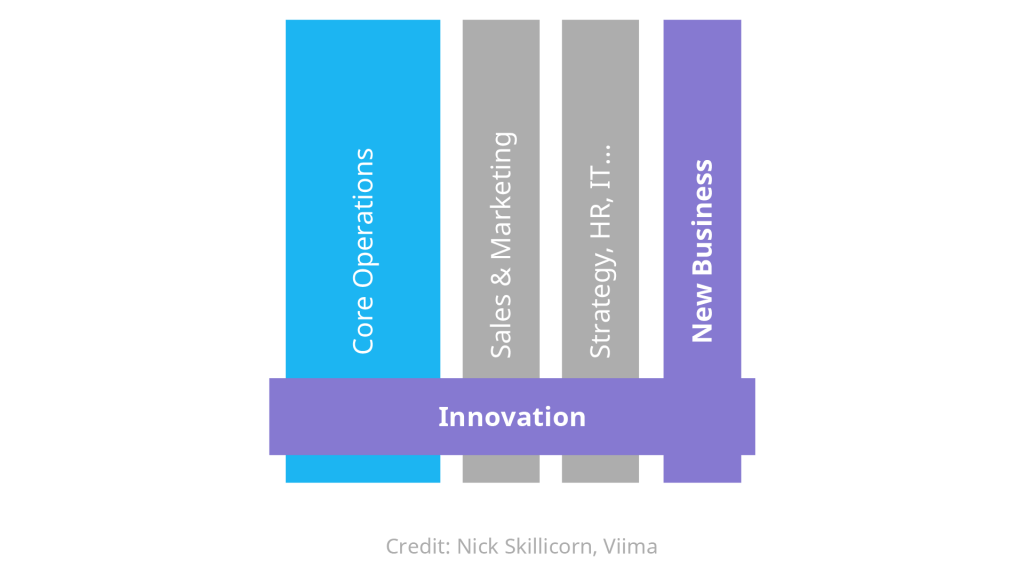
Everyone hates to fail, why do you?

Everyone hates to fail, why do you?

GUEST POST from Janet Sernack

If you have ever had a significant setback, made a serious mistake, or failed at completing an important task, you will have experienced some kind of deep emotional and visceral, largely unconscious, negative, reactive response to it.

By becoming passively or aggressively externally defensive and blaming and punishing others for the outcome, or by withdrawing internally, and attributing self-blame and self-punishment for what may have happened.

Everyone hates to fail because either type of reactive response stings and causes discomfort, dissonance, sorrow, suffering, and pain since you are feeling ashamed, judged, and shamed by yourself and by others. We need to re-think how we approach and digest failure, to scale and leverage it as one of our 21st-century superpowers.

Sabotaging your chances of success

According to a recent article in Psychology Today, this reactive response triggers your avoidance motivation, which then often exceeds your motivation to succeed!

Describing that the fear of failure causes us to then unconsciously sabotage our chances of success, as well as our ability to cultivate and manifest the superpowers necessary to thrive in the 21st century.

Self-doubt settles us into a denying the need to experiment, and a reluctance, full of excuses, to experiment further with adopting, iterating, and testing new and novel ideas. Or in taking smart risks, that help you connect, explore and discover and design opportunities for making important and necessary, personal and professional changes.

Pivot and adapt to disruptive events

Yet, our ability to experiment, test, validate and iterate creative ideas is critical to surviving and thriving through the current decade of both disruption and transformation – which more of us are viewing as a series of relentless, continuous, and exponential changes, requiring unlearning and radically new learning processes.

In a 2021 Deloitte survey of 2,260 private – and public-sector CXOs in 21 countries, 60% of the respondents said that they believe disruptions like those seen in 2020 will continue. The resulting challenge is underscored by another of the survey’s findings:

Seventy percent of the CXOs do not have complete confidence in their organisation’s ability to pivot and adapt to disruptive events.

This confidence can be developed by re-thinking how we approach and digest failure, to scale and leverage it as a 21st-century superpower.

Developing 21st-century superpowers

Here are the four key superpowers, to be supported by digital technologies:

  • Nimbleness: The ability to quickly pivot and move. (“We used to do this, and now we do that.”)
  • Scalability: The ability to rapidly shift capacity and service levels. (“We used to serve x customers; we now serve 100x customers.”)
  • Stability: The ability to maintain operational excellence under pressure. (“We will persist despite the challenges.”)
  • Optionality: The ability to acquire new capabilities through external collaboration. (“Our ecosystem of partners allows us to do things we couldn’t do previously do.”)

Rethinking our fears of failure

None of these 21st-century superpowers can be developed without experimentation and collaboration.

Where you are able to self-regulate your fears of making mistakes and failure, by becoming a smart risk-taker who willingly, stretches the envelope and steps outside of your safety and comfort zones.

This helps maximise your potential and ability to learn and develop in the growth zone, where we stop self-sabotaging our chances of adapting and learning, succeeding, and growing in an uncertain and unstable world.

Everyone hates to fail because it’s hard to self-regulate the basic emotions of disappointment, anger and frustration, and deep shame. Resulting from and the distorted thinking patterns that accompany failure, often immobilising you which results in an unwillingness and inability to disrupt yourself and take intelligent actions.

Slow down to rethink, respond, regroup, play and thrive

It all starts with leading, teaching, mentoring, and coaching people to slow down, to learn, and appreciate the value of taking “time-out” for retreat and reflection.

At ImagineNation, in last week’s blog, we described how this involves developing regular reflective practices, where people can pay deep attention, and learn how to master these basic emotions and unresourceful thought patterns. How this allows them to be playful and experimental in developing new mindsets, rethinking habits, and resourceful emotional states, which are foundational for developing 21st-century superpowers.

Failure can become valued as a process and resource for effecting significant human-centric change, deepening learning, and improving your future fitness.

Consequences of avoiding failure

According to the same article in Psychology today – “shame is a psychologically toxic emotion because instead of feeling bad about our actions (guilt) or our efforts (regret) shame makes us feel who we are”.

By getting to the core of your egos, your identities, your self-esteem, and your feelings of emotional well-being and resourceful thinking habits.

Because everyone hates to fail, we all unconsciously seek ways of mitigating the implications of a potential failure – “for example, by buying unnecessary new clothes for a job interview instead of reading up on the company – which allows us to use the excuse, “I just didn’t have time to fully prepare.”

Benefits of embracing failure

Rather than succumbing to the notion that everyone hates to fail, it is much more useful to develop healthier ways of embracing and flowing with it which might:

  • Motivate you to reflect deeply to consider and deliberate as to what might be the most intelligent and brave actions to take under the range of circumstances you find yourself in.
  • Inspire you to risk-taking those intelligent actions through developing sound risk anticipation, management, and mitigation strategies that help boost your confidence.
  • Commit to doing just a bit more, in inventive ways that add value to the quality of people’s lives as well to your customer’s experience of your product or service.
  • Encourage you to access your multiple and collective intelligence, be more courageous, compassionate, and creative in co-sensing, co-discovering, co-designing, and co-creating innovative solutions to complex problems.
  • Enable you to learn from others, and harness people’s collective intelligence to adapt and grow, through teaming, in ways that serve the common good.

Tips for rethinking and self-regulating fears of failure

A few tips to support you to rethink, respond, regroup and thrive that we will explore more deeply, through real-life stories and examples, in our next two ImagineNation™ blog posts (November and December):

  1. Be willing to redefine and reframe failure as what it means in your unique context, review past failures and see if you can find benefits that resulted from them.
  2. Set approach goals and not avoidance goals to view failure as a challenge that can be mastered.
  3. Control the controllable by intentionally managing your mindsets, shifting any negative perspective, and unpacking distortion and generalisations about failures and their negative consequences.
  4. Imagine yourself doing well, achieving your goals by composing and painting a picture or image of a desirable and compelling future success.
  5. Develop healthy self-compassion for when you do mess up, make mistakes and fail, by being kind and understanding, and empathic to your won humanness.
  6. Focus on every experience, no matter what it brings is an opportunity for deep learning and creative and inventive change.

Rather than living in a world where everyone hates to fail, why not adopt the rethink, respond, regroup, thrive pattern, be future-fit and develop your set of 21st-century superpowers in the face of the acute disruption of COVID-19?

Where it is expected that the business environment, over the next three to five years, will be the most exciting and innovative period that many of us may learn from and experience in our lifetimes?

Want to know why you might have a fear of failure?

Participate in our online research study “Ten Signs you may have a fear of failure” which we adapted from the article “10 Signs That You Might Have Fear of Failure… and 2 ways to overcome it and succeed” by Guy Winch Ph.D. in Psychology Today. Click here to access the survey.

We will happily share the results and findings with you if you leave your name and email address on the form provided. By sharing these details, you will also qualify for a complimentary 30 minute one on one online innovation coaching session, with one of our global professionally certified coaches to help you overcome your own anxieties and fears about failure and develop your 21st-century superpowers.

Join our next free “Making Innovation a Habit” masterclass to re-engage 2022!

Our 90-minute masterclass and creative conversation will help you develop your post-Covid-19 re-engagement strategy.  It’s on Thursday, 10th February at 6.30 pm Sydney and Melbourne, 8.30 pm Auckland, 3.30 pm Singapore, 11.30 am Abu Dhabi and 8.30 am Berlin. Find out more.

Image credit: Unsplash

Subscribe to Human-Centered Change & Innovation WeeklySign up here to get Human-Centered Change & Innovation Weekly delivered to your inbox every week.
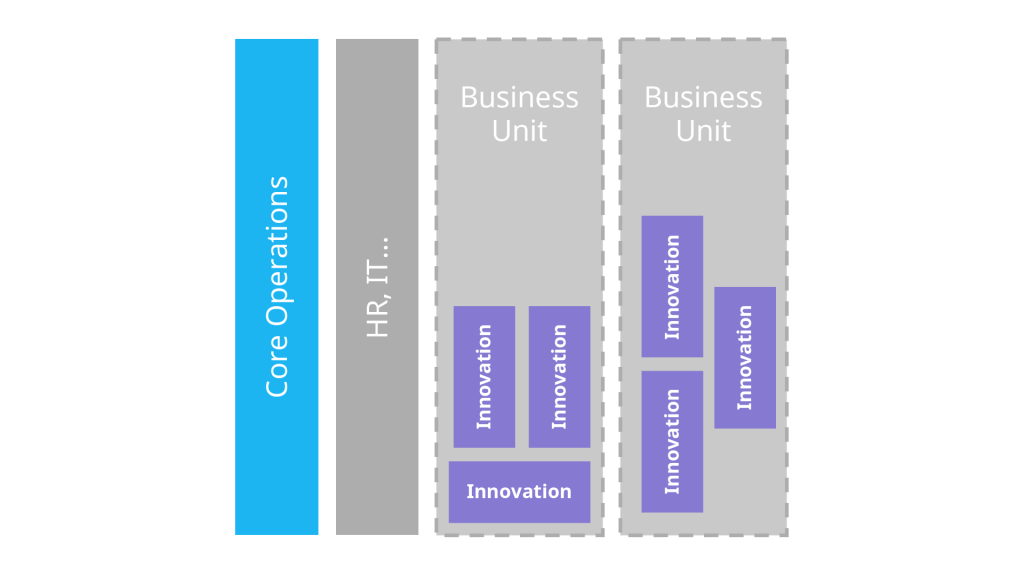
Discipline Has a Role in Innovation

Discipline Has a Role in Innovation

GUEST POST from Jesse Nieminen

Innovation is, without a doubt, a creative endeavor. However, many people still think it’s all about creativity. There’s a magical a-ha moment, and the rest is history.

Well, as we’ve explained before, that’s just not true. Those that have really been trying to innovate know that there is much more hard work than there is fun and games in the process of creating and scaling an innovation.

Thus, discipline plays a huge role in innovation. In fact, I’d argue that discipline is one of the least spoken about, yet most important factors determining whether individuals and organizations succeed at creating innovations.

So, in this article, we’ll dive deeper into the topic and discuss the role discipline plays in innovation to hopefully help you and your organization do a better job at it.

What is discipline?

As a term, discipline is commonly used to just refer to being strong-willed enough to put in a lot of hard work. In other words, self-discipline.

However, if we look at a dictionary, there are a few distinct but connected uses for the word. One refers to it as a branch of science, skill or type of work, another as the practice of regulating the behavior of people in a system, and the third as a synonym for punishing people for undesirable behavior in that system.

Well, innovation is certainly a discipline in the first meaning of the word, but it’s also one that takes a lot of discipline to succeed at, in the second meaning of the word.

“Innovation is a discipline that takes a lot of discipline to succeed at.”

Let’s dive a bit deeper on that second meaning for the word. For our purposes, we can further divide that it into two categories:

  • Self-discipline
  • Organizational discipline

There’s obviously a lot these have in common, but for an organization to succeed at innovation, you need both.

In a nutshell, you need self-disciplined individual willing to put their head down and persist. But you also need organizational discipline to focus on what matters, and to create the incentive structures needed to reinforce all of that.

Why is discipline so important for innovation?

So, with that covered, we can dive deeper into why discipline is so important for innovation and how that happens in practice.

We’ll next cover each of the main points briefly.

Viima Art of Discipline

It takes hard work, persistence, and focus to create an innovation

Because our software is centerer around ideas, we often have to explain that while every innovation starts from an idea, an idea is maybe 1% of the way there towards a real innovation. It still needs development, refinement, implementation, scaling, and so on.

Going through that whole process takes a lot of hard work for pretty much every idea, even if the idea might seem trivial at first. The fact is that by the time you get an idea, hundreds, thousands or maybe even millions of people have probably had the same idea before. Most have just never bothered to implement it, or at least haven’t succeeded at it.

“Every innovator will face plenty of challenges on the way, and there will be plenty of times when things look dire, and you could give up.”

Every innovator will face plenty of challenges on the way, and there will be plenty of times when things look dire, and you could give up. Most do. But to succeed, you need to persevere and persist through these hardships.

To do that, you’re going to need a lot of discipline to avoid potential distractions, keep your head down and focus on what matter.

Trust the process and keep going

If you’ve ever been following a challenging fitness program, you know the feeling when it looks like you’re working your butt off and not making any progress.

The weights feel even heavier than they did the last time. That’s because you’ve been accumulating stress on your body, and it hasn’t yet had the opportunity to respond. Once you get some rest and recover from that stress caused by the exercise, the body will react to the stress and make you stronger.

Innovation takes hard work and trust in the process

Well, the journey is the same with innovation: facing those stressors will feel challenging, but if you don’t give up, that’s what will make both you and the innovation better.

To keep using the same metaphor, if you’d like to run a 3-hour marathon, your fitness program will obviously look very different from if you instead wanted to squat 500 pounds. Similarly, if your strategy calls for incremental innovation, your innovation processes will look very different from those aiming for disruptive innovation, but more on that here.

Regardless, the key in each of these situations is to just trust the process and keep going. Even when things don’t look great. The challenges you face will shape your innovation for the better, and the results will follow – or you’ll run out of money. Regardless, you just need the discipline to persist and stay on track.

While following the process is what will eventually get you there, you of course need to make sure you’re on the right path in the first place, and that is where disciplined thinking comes into play. 

It’s easy to fool yourself without disciplined thinking

Our brain has a natural tendency to take mental shortcuts. We have an ability to recognize patterns and use those to make quick decisions efficiently and thus save energy. In most everyday situations, that ability is obviously very beneficial.

However, with innovation, this is often problematic. It’s these mental shortcuts that lead to many of the root causes behind issues that prevent organizations from innovating. This is perhaps easiest captured in common sayings like “This is how we’ve always done it” and “There’s no way that could work”.

“Our brain has a natural tendency to take mental shortcuts, which is the root cause behind many obstacles for innovation. Disciplined thinking is how you combat that.”

What’s more, if you’re an optimistic person, as most people working on innovation usually are, it’s easy to fool yourself to think that you have created something valuable even when you really haven’t. We often prematurely fall in love with that solution, instead of the problem.

Remaining highly analytical and rational in your decision-making while still being creative and aspirational is a tough combination for any person, or even for a team, to have.

Achieving that balance takes a lot of disciplined thinking. You need to stay grounded in reality, be willing to question yourself, and go back to first principleswhile still relentlessly moving forward. It’s a mindset anyone can learn, but that requires constant discipline to maintain.

Most organizations lack discipline

However, even if you are a good innovator, and have a great team that ticks all the boxes we’ve talked about above, it doesn’t mean that you’re automatically going to succeed.

One of the big barriers for that is the lack of organizational discipline. This is common for both startups and large organizations alike.

The idea is simple to understand. Just like an individual must remain focused to become great at something, so does an organization.

You need to make tough choices to have a clear strategy. That means saying no to a lot of things, so that you can focus on the things that will truly make a difference.

Clear focus and disciplined execution are necessary for innovation

Sometimes you might have to keep investing in these truly strategically important areas, even if there’s no quantifiable ROI in the near term. Again, at the same time, the organization needs the discipline to not think about sunk costs and ruthlessly kill innovation projects that have proven to not be able to live up to their potential to free up resources for the ones that have the best odds of success.

That might sound like a paradoxical combination, and to a certain extent, it is. But that’s what makes it interesting.

On the execution side, you need a lot of discipline to have clear roles and set clear goals so that people have the prerequisites for succeeding, but also leave innovators with enough freedom to explore the best way to reach those goals. Again, that is a difficult combination to achieve. It requires a lot of discipline at all levels of the organization.

In our experience, most organizations just aren’t there yet, even if many individuals within the organization would be, and that is a big barrier for innovation.

As a result, corporate innovators often end up burning out or losing their motivation just trying to navigate the maze of organizational hierarchy for one permission and approval after another before they even get to start working on an innovation. That is a clear sign of an organization that isn’t disciplined – or alternatively has chosen to not innovate.

Discipline in practice

We’ve covered a lot of ground, and most of that has been pretty abstract, so before we wrap up, I’ll share a more practical example with you.

It’s a cliché to use Steve Jobs and Apple as an example for innovation, so I don’t usually like to do that. However, for this specific topic, I think it’s the perfect illustration because people usually see Jobs as this creative visionary and the ultimate ideas guy who couldn’t care less about processes or discipline.

But in fact, the first thing he did when coming back to Apple in 1997 wasn’t to come up with cool new products. It was to introduce a ton of discipline in everything they did and ruthlessly cut back on anything that didn’t truly help them innovate and create better products going forward.

First, he cut 70% of the products the company offered, and as a result, had to lay off 3,000 employees.

Apple's innovations came from following a disciplined process

Jim Collins does a great job summarizing some of the other actions in his book Great by Choice:

“They cut perks, stopped funding the corporate sabbatical program, improved operating efficiency, lowered overall cost structure, and got people focused on the intense ‘work all day and all of the night’ ethos that’d characterized Apple in its early years. Overhead costs fell. The cash-to-current-liabilities doubled, and then tripled.”

That provided Apple with the financial stability needed to invest in innovation and allowed them to focus their leadership and top talent purely on creating new innovations that ended up shaping the future of the company.

Also, from the Walter Isaacson biography of Jobs (which I highly recommend), it becomes obvious how diligent and disciplined Jobs and the rest of the team at Apple were in perfecting every little detail of their products, processes, and even the look of their stores (sometimes to a fault).

Conclusion

To conclude, it takes a lot of discipline to succeed at innovation. That discipline is at least as important as the creativity we usually associate with the term innovation. And, because it’s so underrated, I’d argue it’s the part most of us need to focus on.

After all, it is that disciplined execution of an idea that usually makes the difference between those that succeed and fail.

Thomas Edison did a great job in summarizing discipline when asked about his failed attempts at a lightbulb:

“I have not failed. I have successfully found 10,000 ways that will not work.”

Discipline is, without a doubt, about putting in the work, but there’s a bit more to it than that. It’s also about staying focused and grounded in reality, both of which are well displayed in that quote.

“Being disciplined, both as an individual as well as an organization can be very challenging. The good thing is that it is a muscle that you can develop.”

Even if it might not be immediately obvious, lack of discipline either as an individual or as an organization, is the root cause behind a significant portion of challenges organizations face when trying to innovate.

To be frank, being disciplined, both as an individual as well as an organization, for extended periods of time can be very challenging. The good thing is that it is, figuratively speaking, a muscle that you can develop. Most would-be innovators and leaders just aren’t quite there yet.

If you recognize yourself or your organization from this article, there’s no need to hide that – and there’s nothing to be ashamed of. We’ve all been there. Each of us has areas in our life where we lack discipline, or at the very least, times when we’ve failed to keep that up.

In fact, as an individual or organization, you need to be honest and admit that this is a problem for you. Once you do, you can take steps to address that, and you’ll be much closer to becoming a successful innovator.

This article was originally published in Viima’s blog.

Image credits: Unsplash, Viima

Subscribe to Human-Centered Change & Innovation WeeklySign up here to get Human-Centered Change & Innovation Weekly delivered to your inbox every week.
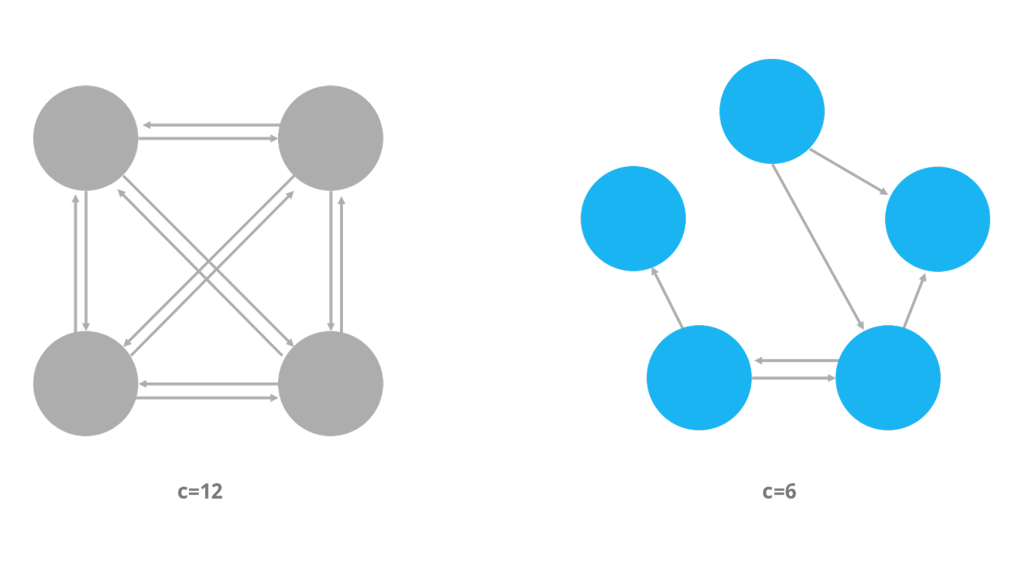
Scaling Innovation – The What, Why, and How

Scaling Innovation – The What, Why, and How

GUEST POST from Jesse Nieminen

Given that innovation is responsible for roughly 85% of economic growth, it’s without a doubt a pretty big deal for the success of both individual organizations, as well as for the society at large.

However, to achieve the level of impact that many are looking for from innovation, you can’t simply “create something new”, and then just hope the results will come. You will need to commit to systematically pursuing those results by scaling viable ideas into products or businesses that create value – at scale.

That is of course easier said than done. If you think it’s hard to come up with innovations, just try scaling one up. In this article, we’ll explore the topic in more detail and provide you with actionable tips on how to actually scale an innovation.

What does it mean to scale an innovation?

To explain what it means to scale an innovation, let’s first take a step back and look at the lifecycle of an innovation.

To begin, every innovation starts from a rough idea or concept. Often you may have a specific goal in mind, or a problem to be solved, but sometimes it can just be a cool idea that you think could really make an impact. From there, you first need to validate that the idea makes sense, and then build a product or a service that meets a real need in the market.

With these steps taken care of, the next part is to scale the innovation. At this point, we have all the pieces in place to create value, but we haven’t yet unlocked that value for the vast majority of the available market.

Lifecycle of an Innovation

So, as you may see from the chart above, scaling is the part where most of the value creation and impact comes from. With that said, we can define scaling an innovation as the process of expanding the presence and the use of the innovation to be as widespread as possible to maximize that impact.

Scaling innovation is the process of expanding the presence and the use of the innovation to be as widespread as possible to maximize the impact the innovation can have.

While on paper that sounds straightforward enough, it’s extremely important to first clarify the vision of what successful scaling looks like for your innovation, and what metrics you will use to measure your success here. For some, it might just be revenue or profit, for others it could be the number of customers or users, the impact you’ve delivered, and so on.

Most of these metrics are of course related, but when you start with the end in mind and gradually work backwards from there, you are much more likely to succeed because everyone in the organization will know what it actually is that you’re aiming for.

With that goal in mind, you can start narrowing in on the methods required to get there, which is what we’ll be focusing on next.

Dimensions of scaling an innovation

Traditionally, scaling innovation is seen as a matter of advancing the adoption, or the diffusion, of innovation. This is best visualized with a chart depicting the adoption curve, which you’ll find below.

Technology Adoption Lifecycle

The idea is that to scale an innovation, you need to cross that chasm and go from a few early adopters to the mainstream market where the volumes are significantly higher.

While that is certainly true, we can dig a bit deeper to understand scaling in a more nuanced, and more practical, way.

In reality, there are three dimensions to scaling an innovation.

Dimensions of Scaling Innovation

Let’s look at each of them a little closer.

Scaling Up

First, scaling up is about creating the preconditions for scaling effectively.

Before we start talking about scaling up, we’ll assume that the basic prerequisites for scaling are in place, namely that there’s a clear vision and a product-market fit for your innovation, and that the market potential is large enough for there to be something to scale to, even if the market isn’t there today.

Assuming those prerequisites are there, you need to ensure that:

  1. you can produce enough of the innovation to scale
  2. you can do that efficiently enough to be financially and operationally viable

For some products, such as software and other immaterial goods, that first part is pretty straightforward. For others, such as most complex manufactured goods, even the first one will be a real challenge.

Having said that, the second part of being efficient enough will prove to be a challenge for virtually every innovation. Even for a software product, acquiring, serving, and retaining customers profitably at scale is often more difficult than people realize. For other, fundamentally less scalable goods and services, this is often excruciating.

In addition to these two more practical aspects, there’s a third and more ambiguous component to scaling up, and that is the social and institutional adoption of the innovation.

How well you scale up affects how large of a scale you can ultimately reach.

For example, with an innovation as mundane as the modern umbrella, men who used it were initially ridiculed. So, before the umbrella could really take off as an innovation, societal norms needed to change. In other cases, there may be regulatory hurdles or other institutional considerations that might need to be addressed before an innovation can ultimately scale.

Regardless of the specifics, scaling up is necessary for every innovation that wants to reach significant scale.

However, what many people don’t pay enough attention to is that how well you scale up affects how large of a scale you can ultimately reach. If you can’t produce the goods at volume, and at low enough of a price while still being profitable at a unit economics level, there’s an obvious limit to your potential to scale.

Scaling Out

Scaling out is what most people think of when it comes to scaling an innovation. It’s the geographical or demographical expansion of the innovation to a larger audience.

In its simplest form, scaling out simply means getting a wider market share and audience for the innovation within an existing market. As we covered earlier, this typically means moving from those early adopter market segments towards the mainstream.

Scaling out is what most people think of when it comes to scaling innovation as it’s where you expand the innovation to a larger audience.

However, it doesn’t have to be limited to just that. Sometimes the same products or services can be sold and used in other geographical areas, or even in other industries or entirely different use cases, both of which unlock new markets and additional demand, and thus lead to a larger impact for the innovation. A well-known example of this is Tesla using their experience and innovations in electric car batteries to expand to stationary energy storage.

Paths for Scaling Out

Regardless of which path you choose, often these efforts to scale out to new segments or industries do require additional work to adapt the innovation or its positioning to the differing characteristics of these new segments, markets, and audiences.

Scaling out to new market segments can increase complexity a lot, so be mindful of the operational implications of your strategic decisions here.

This naturally adds complexity, which makes the scaling up part we covered earlier more challenging. So, be mindful of how you scale out and what the operational implications of your strategic decisions here will be.

Scaling Deep

The third, and the least well-known method for scaling innovation is scaling deep. This essentially means that you unlock more impact for your innovation by expanding and maximizing the use of it, typically for the people who already have access to it.

This usually requires you to either change people’s behavior to increase usage, or alternatively come up with innovative means for improving the utilization rate by enabling more people to make use of the same assets. Scaling deep is partly a matter of culture and mindset, and partly a more practical matter of having the right components in place for enabling and encouraging active use of the innovation.

Social Media

A classic, albeit somewhat controversial example of the first type would be social media algorithms. They are designed to provide users with engaging content to keep them entertained and thus stay in the service for longer, which leads to more revenue from the same number of users.

An example of the second type would be cloud computing. By adding network, virtualization, and software layers on top of the computing hardware, cloud providers can get more use out of the same hardware, which unlocks value for both the service provider and the customers.

This is how Amazon not just significantly reduced costs in one of their major cost centers, IT infrastructure, but actually turned that into Amazon Web Services (AWS), an additional growth business that now accounts for the majority of the profits for the entire organization.

Scaling deep is about unlocking more impact for your innovation by expanding and maximizing the use of it. This can help reduce the need to scale up or out, or alternatively maximize the impact from doing so.

Scaling Deep can reduce the need to scale up or out, or alternatively, maximize the impact from doing so. As such, it’s an excellent compliment for most innovations. However, it’s just that: a compliment. Your primary method of scaling should always be either to Scale Up or Scale Out depending on whether your bottleneck is more on the supply or demand side.

Even in the case of AWS, which has created entirely new vectors for scaling out and has dramatically subsidized their costs for scaling up, it obviously wouldn’t have been possible without Amazon already being at significant scale.

What’s the takeaway? These dimensions are distinct but very much intertwined.

If you can scale on all three of these dimensions in a coordinated way, you will not only be much more likely to achieve significant scale with your innovation in the first place, but also maximize the potential for scale and impact from those efforts. If you build momentum on one of the dimensions, some of that momentum will carry over to the other dimensions, which again helps you accelerate change going forward.

As such, pay attention to each of these dimensions and try to consider all of them in your plans to scale innovation. That doesn’t mean you should focus on all three from the get-go, on the contrary, but planning with the big picture in mind can allow you to make much more educated decisions.

Scaling innovation in practice

As we’ve established above, there unfortunately isn’t a one-size fits all solution to scaling innovation.

Achieving breakthrough success with an innovation, which is the goal of scaling innovation, always requires many related and adjacent (usually more incremental) innovations.

This is an extremely common pattern that you will see happening over and over again if you just start paying attention to it. Square co-founder Jim McKelvey has done a great job in describing that in more detail in his recent book called the Innovation Stack.

A well-known example is the lightbulb. Edison patented his famous design back in 1879, but most households didn’t yet have access to electricity, so it wasn’t something they could benefit from. It took countless other innovations and another 45 years before even half of US homes had one, even though the benefits were obvious.

In practice, scaling an innovation is simply an iterative and exploratory process where you focus on eliminating whatever bottleneck is preventing you from scaling, one by one. And, as we saw in the example of the lightbulb, sometimes these can be much bigger and more fundamental than you may think at first.

Process of Scaling an Innovation

Often you can just copy solutions other people have already used for the same or a similar problem (which you should always go for if you can), but many times you will also need to innovate something completely new and occasionally even go beyond your core product.

With that said, there are some common patterns that can be helpful for structuring your thinking when faced with some of these bottlenecks. However, as each innovation is ultimately new, and thus unique, these won’t necessarily fit every case.

Having said that, we’ll share one framework for each dimension of scaling below. We’ve also created a toolkit that includes the frameworks as editable templates, along with some examples and other supporting material, which you can download here.

Overview of Scaling in Practice

Demand side

For most organizations and innovations, the demand side is likely the source of most bottlenecks.

The way we see it, this is not just about drumming up interest and demand for your product, but also about making sure that it fits the needs and budgets of the buyers in your market. And of course, you need to make sure you’re in a market, or at least one that has the potential to become, large enough to accommodate your scaling efforts.

Unlike what people often think, product-market fit isn’t enough for a business to be scalable. You also need to have the right business and operating models, as well as use the right channels.

In other words, scaling out isn’t just about product-market fit, as people often mistakenly think. You also need to have the right business and operating models and use the right channels. Brian Balfour has written an excellent five-part series about this, which I highly recommend you read.

Product-Market-Model-Channel Framework

The basic idea is pretty simple: your business needs to align all of these aspects in a cohesive manner to be able to scale. If even one of them is wrong, growth will feel like, as Balfour puts it, “pushing a boulder uphill”. It will take way too much capital, effort, and time. However, get the four elements right together, and the growth will come naturally.

What’s important to understand here is that the model isn’t a static picture you just do once. If the market changes, or you run into challenges that force you to change one of these elements, you’ll need to review each element and make sure the big picture still works.

Supply side

For some products and businesses, especially those with physical products, the supply side often becomes a key consideration.

Here, the bottlenecks can be extremely varied, and dependences on external suppliers can lead to challenges that are hard to overcome.

In general, what top innovators do differently from the rest of the companies is that they almost always vertically integrate their value chain as they are working towards scaling up.

There are many benefits to this approach, such as reduced overhead, but the key differences are in increased quality, and most importantly, the company’s ability to control their own destiny and innovate more freely because they’re not being constrained by their supply chain.

Top innovators vertically integrate their value chain to address bottlenecks and turn cost centers into additional sources of growth and profit.

The classic example is Apple, and the way that they control both the hardware and software of their products. In recent years, they’ve been increasing that integration in both directions. They’re moving upstream to offer more services on top of their operating systems, as well as downstream by designing their own processors, which has provided them with a big performance advantage.

Apple vertical integration

However, there are many others. Amazon, Microsoft, Tesla, Google, Netflix, Nvidia, and pretty much every innovative company is trying to do the same in the scope of their own business.

The basic idea is again simple: if a part of your supply chain becomes a major bottleneck, or is a major cost center, you should try to take control of those parts to address the bottlenecks and turn cost centers into additional sources of growth and profit, just like Amazon has done with AWS, but also warehousing and shipping.

That isn’t to say that vertical integration wouldn’t be challenging or have downsides. It certainly is and does. Because of these limitations, it’s generally advisable to only vertically integrate to the parts of your supply chain that either are a clear bottleneck or could become a key competitive advantage for you. However, top innovators often have little choice but to take these steps if they want to move fast enough and have enough control to be able to scale their innovation to its full potential.

Vertical Integration

Another key consideration on the supply side is simply the architecture of your products and services, and the process you have for delivering them. It’s obviously much easier to have a scalable architecture and automated processes for purely software or content focused businesses, but how you craft these does  play a huge role for complex physical products too.

This is again a very extensive topic on its own, but the goal should be to try to make the manufacturing, delivery, and service of your products as seamless and scalable as possible. As with everything else we’ve discussed so far, this too is an iterative process.

However, to provide you with a slightly more practical framework to get started, here’s Elon Musk explaining how he’s learned to approach this topic after his early struggles of trying to do that with the extremely complex products at SpaceX and Tesla.

While Musk specifically talks about the process in the scope of engineering for scale, these same principles also apply to your organization and internal processes too.

And, as Musk explained in the video, it’s easy to get tempted by the promises of optimizing for efficiency and automation, but if you haven’t addressed the big picture first, these will often end up just being a big waste of time and money.

So, make sure to start by first eliminating those unnecessary requirements and parts or tasks, and try to simplify the design before you focus too much on optimizing for efficiency and automating.

Process of Engineering for Scale

Utilization

In addition to supply and demand, we still have the third dimension of utilization to cover. The idea with this “scaling deep” part is to find creative ways to make the most out of existing supply to either unlock new demand, maximize the utilization of those assets, or simply to increase your customer retention by finding ways to get more value for them from your products.

As you may have guessed by now, the specifics vary quite a lot on a case-by-case basis, but the flowchart below can hopefully serve as a starting point for your efforts in this area.

Pathways for Scaling Deep

To summarize, there are three common paths you may take here.

The first is to find ways to increase the usage of assets that are only being used a fraction of the time through practices such as asset sharing and virtualization.

The second is to move from one-off purchases to a subscription to eliminate friction and increase the usage of the services.

The third is to find additional ways to expand the use of the product. This is usually done either by finding new value-adding uses for the same product, or simply by activating usage through means such as improved quality, usability, better communication etc.

However, sometimes it might even be necessary to work around tougher and more pervasive issues, such as regulatory considerations or even the changing of societal norms.

While increased utilization isn’t often that glamorous or exciting, it can really make a difference in making your business and operating models efficient enough to allow you to scale volume faster and more sustainably.

Conclusion

Scaling an innovation won’t be easy. It will always take years, and an endless amount of hard work with an extreme focus on solving each and every bottleneck standing in your way.

Hopefully you’ll find some of the frameworks and playbooks we’ve introduced in this article useful for shaping your thinking, and for building your organization and processes, but you’ll inevitably come across plenty of challenges where you’ll just need to figure out the solutions yourself. Still, if you want to truly succeed with innovation, that’s what you’re in for.

So, be prepared for those challenges, and be realistic with your expectations and timelines. For example, the “growth gap” can easily sneak up on your organization if top management has unrealistic expectations for the financial returns of innovation.

In general, large organizations have some disadvantages, but they also have huge advantages when it comes to scaling an innovation, so look for ways to leverage those advantages to your benefit.

And finally, make sure to surround yourself with top talent that’s prepared for the ride. Scaling innovation is teamwork, and it takes a special kind of a team to pull it off. You need people that are used to constant change, have a growth mindset, and the skills needed to solve whatever problems your domain may have.

As mentioned, scaling innovation is a journey that happens in small increments, and at times, it will feel frustrating. But if your team persists, keeps on learning and solving problems, you can eventually close in on whatever the full potential of your innovation is.

Image credits: Pexels, Viima

This article was originally published in Viima’s blog.

Subscribe to Human-Centered Change & Innovation WeeklySign up here to get Human-Centered Change & Innovation Weekly delivered to your inbox every week.
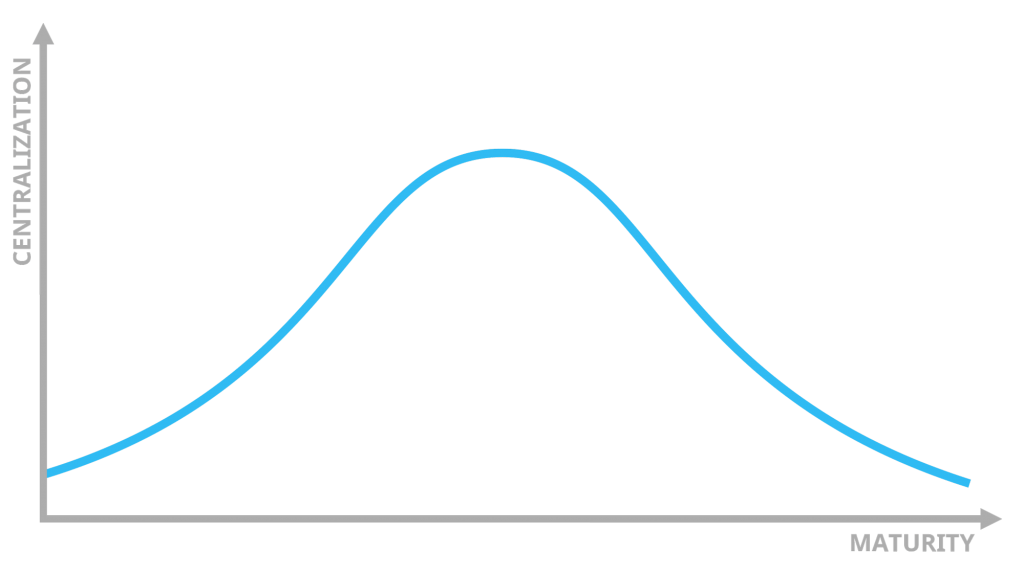
Re-Skilling and Upskilling People & Teams

Re-Skilling and Upskilling People & Teams

GUEST POST from Janet Sernack

The pandemic has increased the pace of change in a digitally accelerated world, and at the same time, it is forcing organizations, leaders, and teams to become more purposeful, human, and customer-centric. Where managing both the future and the present simultaneously requires people to unlearn what has worked in the past and relearn new mindsets and behaviors as to what might be possible, useful, and relevant in the future.

This is crucial to enabling people to perform at their best, and it requires investment in reskilling and upskilling people to be future-fit to meet the needs of previously unheard-of occupations, newly emerging flexible job options. All of which are being transformed by the pandemic, coupled with technologies created by accelerated digitization. Where organizations, leaders, and teams can increase speed, agility and improve simplicity and strategically generate new ways of tapping into the power of and harnessing and mobilizing people’s collective intelligence.

To better enable them to balance and resource organizational digital, agile, or cultural transformational initiatives with the needs of its people, users, customers, and communities, and execute them accordingly.

Collective Intelligence

Collective intelligence is group intelligence that emerges from the collaboration, efforts, and engagement of diverse groups, tribes, teams, and collectives. Which poses a great opportunity, which is also critical to recovery, for organizations to attract, retain, manage and leverage talent  through reskilling and upskilling people to be future-fit by:

  1. Enhancing flexible work options

The recent World Economic Forum Job Reset Summit reported that – “in 2020, the global workforce lost an equivalent of 255 million full-time jobs, an estimated $3.7 trillion in wages and 4.4% of global GDP, a staggering toll on lives and livelihoods.”

McKinsey & Co in a recent article state that – as many as 25 percent more workers may need to switch occupations than before the pandemic.

This means that in a hybrid work environment, without the constriction of location, and with the ability to leverage connection digitally, at little, or no cost, there is a greater talent pool to draw from. Including, according to a recent Harvard Business Review article “What your future employees want most” untapped pools of talent such as the “home force” which includes bringing people back into the workforce including people who put their careers on hold due to raising children, caring for the elderly and retired baby boomers.

It also means that some people will be more likely to prioritize lifestyle (family and personal interests) over proximity to work, and will pursue jobs in locations where they can focus on both – even if it means taking a pay cut. Workers will be more likely to move out of cities and other urban locations if they can work remotely for a majority of the time, creating new work hubs in rural areas.

  1. Measuring the value delivered and not the volume

Designing people and customer-centric work experiences, roles gives people the space to unlock their full potential, maximize their impact by delivering transformative results that contribute to the common good and to the future of humanity.

It also encourages cross-fertilization of creative ideas through teaming and networking, maximizing the power of collaboration and collaborative technologies to create and capture value, through inventing new business models, services, and products that users and customers appreciate and cherish.

  1. Prioritizing continuous learning, reskilling and upskilling

At the same time, customer expectations and preferences are also constantly changing, giving rise and opening doors to new roles and opportunities, that may have never previously existed.

Organizations also need to discover and explore new ways of competing and future-proofing against uncertainty and disruption. They also need to invent new ways of boosting productivity and improving efficiency, through adapting and flexing to flow with the new reality and to ultimately grow and thrive within it.

There are also opportunities to solve complex problems by increasing reciprocity and collaboration through cross-functional partnerships, collectives, tribes, and ecosystems, designed to capture and deliver value co-creatively.

Continuous learning

Reskilling and upskilling people to be future-fit by maximizing collective intelligence require disrupting complacency and stagnation and creating an environment of continuous learning and trust.

Where people are focused on delivering a great customer experience and have the permission and safety and are “allowed” to:

  • Value and leverage differences and diversity in ways that evoke, provoke, and create new ways of being through unlearning, and through relearning to adopt a beginner’s mind, develop a paradox lens, and elastic thinking strategies to pivot quickly into new roles and structures as situations demand.
  • Challenge the status quo, by withholding judgment and evaluation, through developing vital generative questioning, listening, and debating skills to deep dive into and unleash creative and inventive ideas.
  • Continuously learn, to remain both agile and adaptive, collaborative and innovative, to discover, evolve, and grow talent in ways that are both nimble and sustainable.
  • Create lines of sight between strategy, structures, systems, people, and customers, identifying and maximizing interdependencies, through intentional collaboration where everyone knows that their efforts contribute to, and make a difference to the delivery of organizational outcomes.
  • Provide rigor, discipline by driving accountability and by constantly measuring and sharing feedback and results to allow for engaging people in continuous learning, iterative process, and real-life pivots.

Leveraging collective genius

Only by prioritizing reskilling and upskilling people to be future-fit organizations will leverage people’s collective genius and enhance their agility to survive and thrive, flow, and flourish in a VUCA world.

Organizations that are future-focused will create meaningful and purposeful hybrid workplaces that increase peoples’ job satisfaction and support.  That provides flexible work options, continuous learning, and focus on generating value delivery will build people’s loyalty and retention and lower hiring costs over time.

An uncertain future

According to the World Economic Forum Job Reset Summit – “While vaccine rollout has begun and the growth outlook is predicted to improve, and even socio-economic recovery is far from certain”.

Yet, with so much uncertainty about the future, there is one thing that we can all control and is controllable, are our mindsets – how we think, feel, and choose to act in any situation, especially in our communication, problem-solving, and decision-making processes.

All of us have the freedom to choose, to develop our independent wills, and create new ways of being, thinking, feeling, and doing – to meet the needs of a wide range of previously unheard-of occupations that are emerging, to provide more flexible, meaningful and purposeful job options.

To leverage the current turning point, which is full of possibilities and innovative opportunities for enabling organizations, people, and customers to be more equitable, resilient, sustainable, and future-fit, in an ever-changing landscape, impacted by the technologies created by accelerated digitization.

This is the next blog a series of blogs, podcasts, and webinars on Developing a Human-Centric Future-Fitness organization

Find out more about our work at ImagineNation™

Find out about The Coach for Innovators Certified Program, a collaborative, intimate, and deep personalized innovation coaching and learning program, supported by a global group of peers over 8-weeks, starting October 19, 2021. It is a blended learning program that will give you a deep understanding of the language, principles, and applications of a human-centered approach to innovation, within your unique context. Find out more.

Image credit: Pixabay

Subscribe to Human-Centered Change & Innovation WeeklySign up here to get Human-Centered Change & Innovation Weekly delivered to your inbox every week.