Tag Archives: Human Resources

The Rise of Employee Relationship Management (ERM)

The Rise of Employee Relationship Management (ERM)

by Braden Kelley

What’s in a name?

From the early days when HR was referred to as workforce management or personnel management, to the emergence of scientific management and labor unions, the practice of human resources has been constantly evolving.

The name for the practice and principles of getting the most out of people in business has continued to change too, with the latest term ‘human resources’ coming into being along with an acceptance that human factors were more important than physical factors and monetary rewards for motivation.

The Accelerating Pace of Change

But, in an era when the pace of change and transformation are constantly accelerating and innovation is increasingly important to maintaining relevance, should we still be focused on ‘human resources’? Or does our view and language need to evolve?

Every day customer experience becomes more crucial to market success, and more people are talking about happy employees as being the key to happy customers. But, are employers backing up this talk?

Today most digital transformations have at their heart, several elements of an evolved customer relationship management (CRM) approach and often one or more customer journey maps.

The Shift from HCM to ERM

So, should we be shifting our views from a focus on Human Capital Management (HCM) to a focus on ERM (Employee Relationship Management) and EX (Employee Experience) to mirror how we are thinking about the importance of employees as something not to be managed but instead to be empowered, supported and developed?

And how will Generation Z change expectations of employers?

Making a shift in our mindset and our language when it comes to employees, could also cause us to focus on different metrics – shifting from a focus on controlling the costs of salaries and benefits to optimizing employee lifetime value (ELV).

Unlocking the True Value of Employees

Employees are not just a cost, they are a source of incredible value and to unlock their full potential we must invest in helping them maximize the value they can create, access, and translate for customers. Me must go beyond training and invest in even more powerful initiatives like human libraries and internal internships to help each employee not just do the job they were hired to do, but to do the job they were born to do.

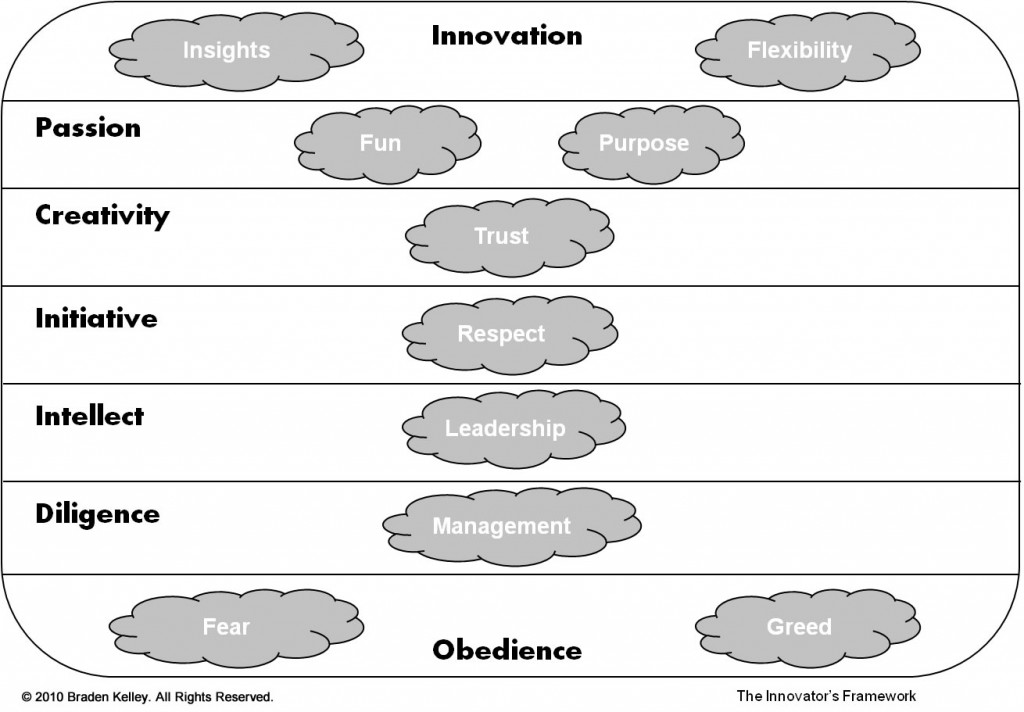
Innovators Framework(one of the many concepts introduced in my first book Stoking Your Innovation Bonfire)

Building on the work of London Business School’s Gary Hamel and shifting to an Employee Relationship Management (ERM) mindset we can get beyond the obedience, diligence and intellect that fear, greed, management and leadership can deliver, and instead focus on unlocking the initiative, creativity, passion and innovation that will drive the organization to higher levels of success and continuing relevance with customers.

Employee Relationship Management (ERM) is the Future of HR

We must reimagine our approach to the humans in our organizations and to recognize and leverage their uniqueness instead of treating them as replaceable cogs in a machine.

The time has come for organizations to manage both the experiences and the relationships with each of their employees as individuals to make the collective stronger, healthier, and more resilient.

Now is the time to build a conscious, measured, professional approach to Employee Relationship Management (ERM).

What say you?


Accelerate your change and transformation success

Subscribe to Human-Centered Change & Innovation WeeklySign up here to get Human-Centered Change & Innovation Weekly delivered to your inbox every week.

An Innovation Evangelist Can Increase Your Reputation and Innovation Velocity

Chief Evangelist Braden Kelley

by Braden Kelley

Building upon my popular article Rise of the Evangelist, I wanted to create an article for the global innovation community focused specifically on the importance of the innovation evangelist role.

In my previous article I defined five different types of evangelists that organizations may already have, or may want to hire, including:

  1. Chief Evangelist
  2. Brand Evangelists
  3. Product Evangelists
  4. Service Evangelists
  5. Innovation Evangelists

This specialization occurs when the evangelism an organization needs become too big for one evangelist to handle. At that point, a Chief Evangelist creates the evangelism strategy and manages the execution across the team of brand, innovation, and other evangelism focus areas.

When should an organization focus on innovation evangelism?

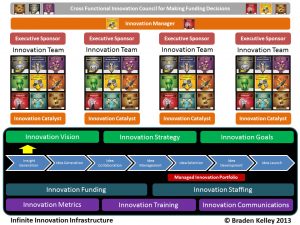
To continue to exist as a business, every organization should build an infrastructure for continuous innovation, but many don’t. If you’re not sure what this looks like, here is my Infinite Innovation Infrastructure (which leverages the Nine Innovation Roles):

Infinite Innovation Infrastructure

For those organizations investing in innovation, it is crucial to also invest in innovation evangelism when:

  1. Innovation is part of the company’s strategy
  2. Innovation is central to competitive differentiation
  3. The company wants to share their innovation stories
  4. The company wants to partner with customers to innovate
  5. The company wants to partner with suppliers to innovate
  6. The company wants to engage experts in innovation
  7. The company wants to engage the general public in innovation

You’ll notice many of these points hint at the need for an external talent strategy, and Innovation Evangelism must play a key role. Because of this, I encourage you to download and consult the success guide I created for Innocentive on Harnessing the Global Talent Pool to Accelerate Innovation which focuses on the elements and importance of external talent in any company’s innovation efforts.

Bill Joy, a co-Founder of Sun Microsystems, once famously said:

“There are always more smart people outside your company than within it.”

Any external talent strategy must accumulate energy and then unleash it in a focused direction. And part of the way to do that is by establishing a common language of innovation. The process begins by defining what innovation means to your organization. Consider looking at this as the WHO – WHAT – WHEN – WHERE – WHY – HOW of innovation:

  • WHO is to be involved in your innovation efforts?
  • WHAT does innovation mean to you? WHAT types of innovation are you focused on?
  • WHEN will you be looking for innovation input?
  • WHERE can people go to find out more? WHERE do they go to contribute?
  • WHY should people want to participate?
  • HOW can they participate?

Continue reading this article on InnovationManagement.se

… where we will answer these questions and more:

  • Should innovation evangelism be a role or a job?
  • What does an innovation evangelist do?
  • What makes a good innovation evangelist?


Accelerate your change and transformation success

Subscribe to Human-Centered Change & Innovation WeeklySign up here to get Human-Centered Change & Innovation Weekly delivered to your inbox every week.

Rise of the Evangelist

Chief Evangelist Braden Kelley

by Braden Kelley

What is an evangelist?

When many people hear this term, their minds used to picture Billy Graham or Pat Robertson, but this is changing. Why?

Our perceptions of evangelists are transforming as the pace of change accelerates to construct a new reality faster than most human brains can process the changes.

This creates a chasm in understanding and change readiness that evangelists can help bridge in a number of different ways.

Let us look at what an evangelist really is…

Oxford Dictionaries say an evangelist is a “zealous advocate of something.”

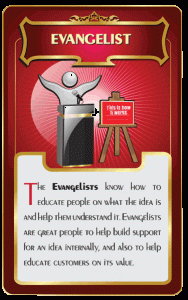
Nine Innovation Roles EvangelistIn business, the evangelist is a role that any of us can take on (with varying levels of success). Evangelism is very important to innovation success, which is why the evangelist is one of The Nine Innovation Roles™. This is how I define this particular role:

“The Evangelists know how to educate people on what the idea is and help them understand it. Evangelists are great people to help build support for an idea internally, and also to help educate customers on its value.”

Notice at this point we are talking about an evangelist as a role that can be played by one or more people, and not as a job that one or more people hold. Evangelism normally will be a role and not a job, but there are inflection points where this must change.

Outside of an innovation context, evangelism often falls on the shoulders of CEOs, business owners and product managers within organizations. When the need for evangelism is small, this can work. But for most organizations, this is no longer the case.

When should you hire an evangelist?

The time to cross over from evangelism as a role to evangelism as a job is when:

  1. The pace of internal change is accelerating faster than employees can grasp without help
  2. The pace of external change is accelerating faster than customers can understand without help
  3. Your company is facing disruption by new entrants or existing competitors
  4. You’re considering a digital transformation
  5. You’ve already embarked upon a digital transformation
  6. You’re using Agile in product development
  7. Your brand essence is being shifted by you or your customers
  8. You need a more human and personal presence in your marketing efforts to better connect with customers

When one or more of these conditions are true, you’ll find that it isn’t possible for CEOs, business owners and product owners to meet the needs for evangelism in the short spurts of time these people can dedicate to the necessary activities.

As highlighted by Agile Product Development’s presence in the list, organizations leveraging Agile to develop software-based products will find that their product managers are always engaged with the backlog with little time to focus on evangelism. They’re always focused on shipping something.

Some organizations will resist adding evangelists to their team, feeling that such a role is superfluous, but having one or more people focused on evangelism delivers value to the organization by executing a range of incredibly important activities, including:

  • Growing awareness
  • Building a community around the company and/or plugging the company into pre-existing external communities (potentially taking the brand to places it has never been before)
  • Generating interest
  • Working with customers and the marketing team to identify the stories that need to be told and the themes that need to be introduced and/or reinforced
  • Creating desire
  • Building and maintaining conversations with the community that cares about your products/services/brands
  • Engaging in an open and honest dialogue to help gather the voice of the customer
  • Facilitating action
  • Practicing a human-centered design mindset to continuously elicit needs and surface wants and desired outcomes

Depending on the size of the organization you may decide to have a single evangelist, or some larger organizations have more than one type of evangelist, including:

  1. Chief Evangelist
  2. Brand Evangelists
  3. Product Evangelists
  4. Service Evangelists
  5. Innovation Evangelists

This specialization occurs when the evangelism an organization needs become too big for one evangelist to handle. At that point a Chief Evangelist creates the evangelism strategy and manages the execution across the team of brand, product, service and other evangelism focus areas.

So what makes a good evangelist?

Evangelists arrive from a range of different job specialties, but key knowledge, skills and abilities include:

  • Empathetic
  • Passionate About the Company’s Mission, Products/Services, and Customers
  • Comfortable Public Speaker
  • Efficient and Effective Writer
  • Human-Centered Design Mindset
  • Experienced with Social Media, Audio and Video
  • Skilled Content Creator
  • Continuous Learner
  • Self-Directed and Comfortable with Ambiguity

… and ideally your chosen evangelists will already have some presence in the communities important to you, or the knowledge of how to establish a presence in these communities.

Customer buying journeys are notoriously unpredictable, meandering, long and non-linear. Evangelism is a critical part of helping to build relationships with potential buyers and increasing the chances that your brand will be top of mind when a non-buyer finally becomes a potential customer of your products or services.

It’s a long-term non-transactional investment, one that will pay dividends if you see the wisdom in making the expenditure.

Has your organization already invested in evangelists? What learnings would you like to share in the comments?

Are you ready for the evangelists to rise in your organization?

Or do you need help with evangelism? (contact me if you do)

Share the love!

p.s. I wrote a follow-up article for InnovationManagement.se that you might also enjoy — Increase Your Innovation Reputation and Velocity with an Innovation Evangelist


Accelerate your change and transformation success

Subscribe to Human-Centered Change & Innovation WeeklySign up here to get Human-Centered Change & Innovation Weekly delivered to your inbox every week.

Innovative Employee Recognition Programs

Going Beyond Traditional Rewards

Innovative Employee Recognition Programs

GUEST POST from Chateau G Pato

Employee recognition is a key component of fostering a positive workplace culture and driving employee engagement. While traditional rewards such as bonuses and gift cards are commonly used to recognize and reward employees, there is a growing trend towards more innovative and personalized recognition programs.

Companies that are truly invested in recognizing the hard work and dedication of their employees understand the importance of going beyond traditional rewards to create meaningful and lasting experiences that not only motivate employees but also foster a sense of belonging and appreciation. In this thought leadership article, we will explore two case studies of companies that have implemented innovative employee recognition programs with great success.

Case Study 1: Google’s Peer Bonus Program

Google is known for its innovative workplace culture, and its peer bonus program is no exception. Instead of relying solely on monetary rewards, Google gives employees the opportunity to nominate their peers for a bonus based on their contributions to the company. This program not only recognizes employees for their hard work but also fosters a culture of appreciation and collaboration.

Employees at Google have the opportunity to nominate their peers for a bonus of up to $1,000, which is awarded based on the impact of their work on the company. This not only incentivizes employees to go above and beyond in their roles but also creates a sense of camaraderie and support among team members.

Case Study 2: Salesforce’s Thank-You Economy

Salesforce, a leading customer relationship management company, takes employee recognition to the next level with its Thank-You Economy program. This program is centered around the idea of gratitude and appreciation, with employees encouraged to express their thanks to their colleagues in meaningful ways.

One unique aspect of Salesforce’s Thank-You Economy program is its emphasis on peer-to-peer recognition. Employees are given a platform to publicly recognize their colleagues for their contributions, whether it be a job well done on a project or going above and beyond to help a team member. This not only boosts employee morale but also reinforces a culture of appreciation and support within the company.

Conclusion

Traditional rewards are no longer enough to truly recognize and motivate employees. Companies that are committed to fostering a positive workplace culture and driving employee engagement are turning to innovative recognition programs that go beyond monetary rewards to create meaningful and personalized experiences for their employees. By implementing programs such as Google’s peer bonus program and Salesforce’s Thank-You Economy, companies can create a culture of appreciation and support that not only motivates employees but also strengthens team dynamics and drives organizational success.

Bottom line: Futurology is not fortune telling. Futurists use a scientific approach to create their deliverables, but a methodology and tools like those in FutureHacking™ can empower anyone to engage in futurology themselves.

Image credit: Pixabay

Subscribe to Human-Centered Change & Innovation WeeklySign up here to get Human-Centered Change & Innovation Weekly delivered to your inbox every week.

Talent Acquisition as Futurology

Hiring for Skills That Don’t Exist Yet

LAST UPDATED: December 21, 2025 at 6:34PM

Talent Acquisition as Futurology

GUEST POST from Chateau G Pato

The future of work is arriving faster than our hiring systems can adapt. Roles are dissolving, technologies are converging, and customer expectations are in constant motion. In this environment, talent acquisition must become less about matching resumes to roles and more about sensing the future.

As a human-centered change and innovation practitioner, I see talent acquisition as a form of applied futurology. It is the practice of anticipating emerging capabilities and building human systems resilient enough to evolve.

Why Prediction Is the Wrong Goal

Many organizations attempt to predict future skills with precision. This approach creates false confidence. The better strategy is to hire for people who can thrive amid uncertainty.

Curiosity, systems thinking, and learning agility consistently outperform narrowly defined technical skills when environments shift.

Reimagining the Talent Signal

Resumes and job titles are poor indicators of future capability. Human-centered organizations look for signals such as self-directed learning, cross-disciplinary experience, and the ability to make meaning from complexity.

This shift requires new assessment tools and interviewer training focused on how candidates learn and adapt.

Case Study One: IBM’s Capability-Centered Hiring Model

IBM’s move away from degree requirements in many roles was not about lowering standards. It was about aligning hiring with reality. Many emerging roles simply did not have established educational pathways.

By investing in internal learning and apprenticeships, IBM built a workforce capable of evolving with technology rather than chasing it.

Hiring as an Inclusion Strategy

Future-oriented hiring naturally expands access. When organizations focus on potential instead of pedigree, they unlock overlooked talent and improve diversity of thought.

Inclusion becomes a structural outcome rather than a stated goal.

Case Study Two: Spotify’s Culture of Adaptation

Spotify’s emphasis on mindset and mission alignment enables teams to reorganize without constant disruption. People are hired with the expectation that their roles will change.

This cultural clarity reduces friction and increases resilience as the organization experiments and scales.

Leadership Responsibilities

Leaders must reward learning, not just execution. Performance systems should recognize capability growth and collaboration across boundaries.

Talent acquisition cannot do this alone. It must be supported by culture, incentives, and leadership behavior.

“The organizations that win the future will not be the ones that predict it best, but the ones that build people capable of adapting fastest.”

— Braden Kelley

Conclusion

Hiring for skills that do not yet exist is not reckless. It is responsible. It acknowledges uncertainty and invests in human adaptability as the ultimate competitive advantage.

Talent acquisition as futurology is not about seeing the future clearly. It is about preparing people to meet it with confidence.

Frequently Asked Questions

Why are traditional job descriptions failing?

Because they assume stability in roles that are constantly evolving.

What capabilities matter most for future roles?

Learning agility, systems thinking, collaboration, and sense-making.

How can leaders support future-oriented hiring?

By aligning incentives, performance metrics, and learning investments with adaptability.

Extra Extra: Because innovation is all about change, Braden Kelley’s human-centered change methodology and tools are the best way to plan and execute the changes necessary to support your innovation and transformation efforts — all while literally getting everyone all on the same page for change. Find out more about the methodology and tools, including the book Charting Change by following the link. Be sure and download the TEN FREE TOOLS while you’re here.

Image credit: Google Gemini

Subscribe to Human-Centered Change & Innovation WeeklySign up here to get Human-Centered Change & Innovation Weekly delivered to your inbox every week.

Hiring the Right Chief Innovation Officer

Hiring the Right Chief Innovation Officer

Every company begins as the nimble startup, organized around the solution to a single customer problem and executing that solution better than anyone else in the market (including the incumbents with deep pockets). But at some point the hunter inevitably becomes the hunted and that nimble startup as it evolves and scales, eventually becomes that more complex (but capable) incumbent. Inevitably it finds itself so focused on capturing all of the business for its existing solutions, that it finds itself at risk of missing the next evolution in customer needs.

The companies that last the longest, manage to fulfill existing customer needs with well delivered solutions, and identify new customer needs they can satisfy as customer needs (or wants) continue to evolve. But many companies fail to do so quickly enough, especially in our new reality where it is easier than ever to start and scale a solution around the globe with limited resources. Innovation is the key to remaining relevant with customers. Innovation is the key to remaining alive.

It’s innovate or die, and this new reality leaves all companies focused on Winning the War for Innovation.

This quest to win the war for innovation has led many organizations to begin hiring Chief Innovation Officers (CINO), Innovation Managers, VP’s of Innovation, or Innovation Directors.

But many organizations have done so in haste…

There is a right way and a wrong way to hire a Chief Innovation Officer (or other innovation leader).

In this article we will look at the Do’s and Don’ts of successfully hiring the right Chief Innovation Officer.

First, the Don’ts:

  1. Don’t hire a Chief Innovation Officer before the Board of Directors and senior leadership understands what innovation is (AND ISN’T)
  2. Don’t hire a Chief Innovation Officer before the Board of Directors and senior leaders are all publicly committed to innovation
  3. Don’t hire a Chief Innovation Officer before the Board of Directors and senior leadership have created a budget to fund discrete innovation projects
  4. Don’t hire a Chief Innovation Officer before you move beyond the innovation as a project mindset to view innovation as a process and a capability that you need to build (like good governance or operational excellence)
  5. Don’t hire a Chief Innovation Officer before you understand how new product development (NPD), research and development (R&D), and innovation will differ in your organization

Being cognizant of the Don’ts will help you avoid hiring a Chief Innovation Officer before you’re able to help set them (and the organization) up for success.

We are now ready to look at the Do’s, the characteristics, skills, and abilities to look for as you search for a great Chief Innovation Officer (and team).

As I’ve written before in Death of the Chief Innovation Officer, when we think about hiring a Chief Innovation Officer (CINO) or an Innovation Director, VP of Innovation, or Innovation Manager, it is important to view your innovation leader, not as the person responsible for innovating, but instead as the person responsible for enabling innovation, encouraging it, inspiring it, facilitating it, and coordinating it. In short, what you are looking for is more of an Innovation Enablement Leader.

The implication? This person’s job should be to lead not to manage, and to enable instead of control. What you’re looking for is someone to facilitate the Seven C’s of a Successful Innovation Culture:

  1. Cultivating a Culture of Curiosity
  2. Collection of inspiration and insight
  3. Connections
  4. Creation
  5. Collaboration
  6. Commercialization
  7. Communications

1. Cultivating a Culture of Curiosity

Curiosity drives innovation, and so the more curious people you have in your organization, the more innovation you are going to be able to generate. A good Chief Innovation Officer (Innovation Enablement Leader) can help cultivate a culture of curiosity. Amplifying curiosity in your organization is one of the most important improvements you can make in your culture.

Many of my views on improving your innovation culture have been detailed in this white paper Five Ways to Make Your Innovation Culture Smell Better I wrote for Planview and in my popular book Stoking Your Innovation Bonfire.

2. Collection of Inspiration and Insight

Curiosity is driven by inspiration and insight, and so a good Innovation Enablement Leader excels at collecting and sharing inspiration and insight. This can include:

  • Teaching people inspiration gathering frameworks like the Four Lenses of Innovation from Rowan Gibson and idea generation methods like SCAMPER
  • Installing an insight gathering tool (which may or may not be merged together with an idea management solution)
  • Building a Global Sensing Network (click the link to learn more)

Building a Global Sensing Network

3. Connections

Innovation is about collecting and connecting the dots. A good Innovation Enablement Leader is good at building the connections inside (and outside) the organization that help to accelerate the gathering and dissemination of inspiration, insight, and the other elements crucial to effective (and sustained) innovation. Building on the idea of building a global sensing network (see #2), innovative organizations increasingly turn their attention outwards for innovation, recognizing that there are more smart people outside the organization than inside. This leads a good Innovation Enablement Leader to focus on Harnessing the Global Talent Pool to Accelerate Innovation.

4. Creation

The job of an Innovation Enablement Leader (or Innovation Facilitator) is to serve the rest of the organization and to work across the organization to help remove barriers to innovation and to focus on the Seven C’s of a Successful Innovation Culture. This could also mean providing a set of tools and methodologies for creative problem solving and other aspects of innovation work, organizing events, and other activities that support deepening capabilities across the Seven C’s of Successful Innovation Culture.

And because innovation is all about change, a good Innovation Enablement Leader will have a strong organizational change understanding and capabilities, including an understanding of the Five Keys to Successful Change from the Change Planning Toolkit™ (coming soon) and from my upcoming book Charting Change (Feb 2016):

Five Keys to Successful Change 550

A good Innovation Enablement Leader will know when to create a new innovation in-house, when to partner with an external entity like a University, startup, supplier, or other organization, and when to license a piece of technology or to acquire another company or startup in order to realize the desired innovation result for the company’s customers.

A good Innovation Enablement Leader knows which elements of the successful innovation they can best help to facilitate and where they need to call in help. This leads us nicely into #5.

5. Collaboration

Too often we treat people as commodities that are interchangeable and maintain the same characteristics and aptitudes. Of course, we know that people are not interchangeable, yet we continually pretend that they are anyway — to make life simpler for our reptile brain to comprehend. Deep down we know that people have different passions, skills, and potential, but even when it comes to innovation, we expect everybody to have good ideas.

I’m of the opinion that all people are creative, in their own way. That is not to say that all people are creative in the sense that every single person is good at creating lots of really great ideas, nor do they have to be. I believe instead that everyone has a dominant innovation role at which they excel, and that when properly identified and channeled, the organization stands to maximize its innovation capacity. I believe that all people excel at one of nine innovation roles, and that when organizations put the right people in the right innovation roles, that your innovation speed and capacity will increase.
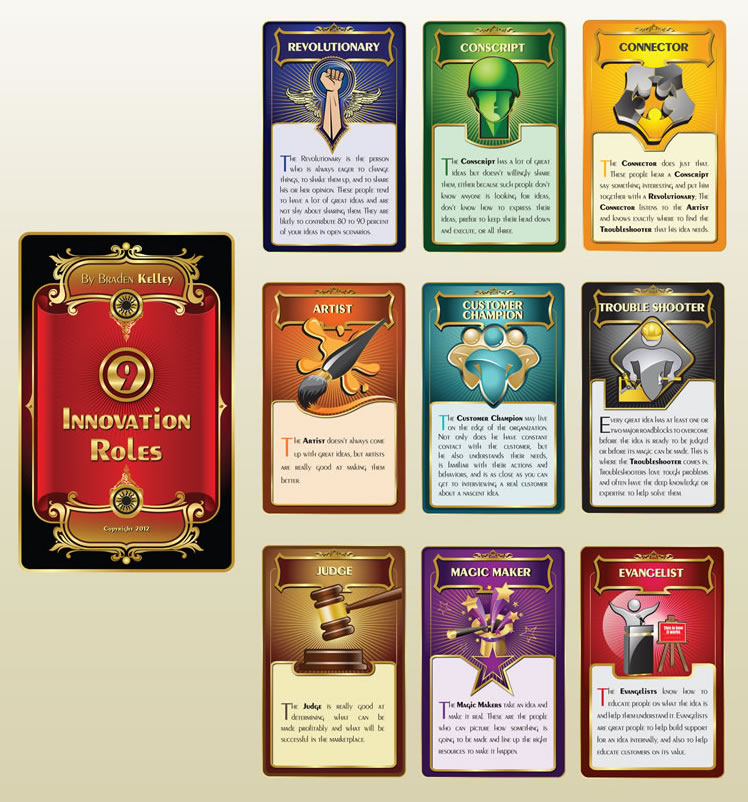
Nine Innovation Roles

Here are The Nine Innovation Roles:

1. Revolutionary

  • The Revolutionary is the person who is always eager to change things, to shake them up, and to share his or her opinion. These people tend to have a lot of great ideas and are not shy about sharing them. They are likely to contribute 80 to 90 percent of your ideas in open scenarios.

2. Conscript

  • The Conscript has a lot of great ideas but doesn’t willingly share them, either because such people don’t know anyone is looking for ideas, don’t know how to express their ideas, prefer to keep their head down and execute, or all three.

3. Connector

  • The Connector does just that. These people hear a Conscript say something interesting and put him together with a Revolutionary; The Connector listens to the Artist and knows exactly where to find the Troubleshooter that his idea needs.

4. Artist

  • The Artist doesn’t always come up with great ideas, but artists are really good at making them better.

5. Customer Champion

  • The Customer Champion may live on the edge of the organization. Not only does he have constant contact with the customer, but he also understands their needs, is familiar with their actions and behaviors, and is as close as you can get to interviewing a real customer about a nascent idea.

6. Troubleshooter

  • Every great idea has at least one or two major roadblocks to overcome before the idea is ready to be judged or before its magic can be made. This is where the Troubleshooter comes in. Troubleshooters love tough problems and often have the deep knowledge or expertise to help solve them.

7. Judge

  • The Judge is really good at determining what can be made profitably and what will be successful in the marketplace.

8. Magic Maker

  • The Magic Makers take an idea and make it real. These are the people who can picture how something is going to be made and line up the right resources to make it happen.

9. Evangelist

  • The Evangelists know how to educate people on what the idea is and help them understand it. Evangelists are great people to help build support for an idea internally, and also to help educate customers on its value.

As you can see, creating and maintaining a healthy innovation portfolio requires that you develop the organizational capability of identifying what role each individual is best at playing in your organization. It should be obvious that a failure to involve and leverage all nine roles along the idea generation, idea evaluation, and idea commercialization path will lead to suboptimal results. To be truly successful, you must be able to bring in the right roles at the right times to make your promising ideas stronger on your way to making them successful. Most organizations focus too much energy on generating the ideas and not enough on developing their ideas or their people.

A good Innovation Enablement Leader will recognize which of the Nine Innovation Roles they excel at and bring in other people into their organization that can help create a well rounded innovation team, and utilize the Nine Innovation Roles to build well-balanced innovation project teams during the execution phase.

Successful Innovation Enablement Leaders typically will be strong Revolutionaries, skilled Evangelists and passionate Customer Champions, but they also must work hard to be an impartial Judge.

At the same time, skilled Innovation Enablement Leaders will build strong relationships with the heads of strategy, digital, customer insight, research and development (R&D), new product development, and operations to both understand where to focus on creating new and differentiated value for customers, and how to create innovation that the company can successfully make, distribute, and support at scale.

6. Commercialization

You are hiring an Innovation Enablement Leader (whether that is a Chief Innovation Officer, VP of Innovation, Innovation Director, or Innovation Manager) not to shepherd a single potential innovation project from insight to market, but to build a sustainable, continuous source of innovation, and a culture that reinforces your method for creating continuous innovation. One tool I’ve created for all types of Innovation Enablement Leaders is the Eight I’s of Infinite Innovation™, which as you can see, places inspiration at the center of looping, infinite process (see #2).
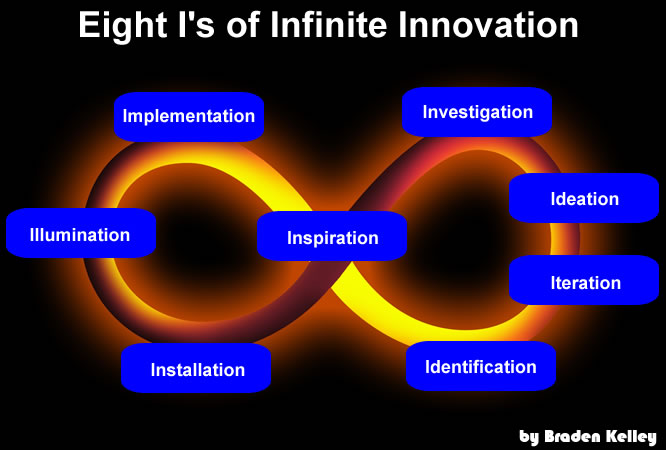
Eight I's of Infinite Innovation

7. Communications

Most organizations have innovated at least once in their existence, and in many organizations people are still innovating. A true Innovation Enablement Leader is more of a coach, supporting emergent innovation, and helping people test and learn, prototype and find the right channel to scale the most promising insight-driven ideas (or work with the organization to create new channels).

A good Innovation Enablement Leader excels at helping to define AND consistently communicate and reinforce the organization’s common language of innovation. Several companies all around the world have purchased my book Stoking Your Innovation Bonfire in large quantities for their senior leadership team (and even substantial parts of their organization) to help build their common language of innovation, or brought me in to help facilitate innovation workshops and knowledge transfer to help jumpstart their innovation program.

Conclusion

Are you seeking to control innovation with a Chief Innovation Officer or to facilitate it with an Innovation Enablement Leader?

Ultimately, the responsibility for innovation should remain with the business, under an innovation vision, strategy and goals set by the CEO and senior leadership. It’s okay to bring someone in from the outside to help get things off to a strong start, to build a strong foundation, and to set your Innovation Enablement Leader up for success.

Many organizations will want to have someone full-time on their payroll facilitating their innovation efforts, but as I’ll describe in my next post, some organizations may feel more comfortable bringing in a fractional (or part-time) Chief Innovation Officer (CINO) or Innovation Enablement Leader because of their size or their innovation maturity (or readiness), and that’s okay too.

So, stay tuned for an article on fractional or part-time Chief Innovation Officers (CINOs), and keep innovating!


P.S. If you’re looking to hire a Chief Innovation Officer (an Innovation Enablement Leader) on a full-time or part-time basis, drop me an email and I can either tackle the role or find someone else who can!


Image credit: blog.internshala.com

Accelerate your change and transformation success

Subscribe to Human-Centered Change & Innovation WeeklySign up here to get Human-Centered Change & Innovation Weekly delivered to your inbox every week.

A Peek Inside the Broken Corporate Hiring Model

A Peek Inside the Broken Corporate Hiring ModelI was reading with interest some of Linkedin’s recent #HowIHire series and in doing so it was interesting to see how many people are still operating under the old, broken hiring paradigm when it comes to the labor market.

The best of the bunch that I read was Beth Comstock’s You’re Hired. Now What which has more to do with what she thinks people should do after she gives them a job rather than how she hires, which I thought was a good angle to take.

My day job was recently eliminated in a budget reallocation, so I’m out there in the market looking for my next new challenge. Throughout this process (and my consulting work over the years), I’ve observed a number of different challenges that companies face with hiring, and identified some opportunities for companies to increase their return on human capital:

Challenge #1:

Scanning resumes and online applications for keywords is a very bad way to find talent. It’s very good however at finding people who at least know how to spell the keywords.

Challenge #2:

The way most organizations handle human resources is very much a product of the industrial age. Hiring new employees is still a very bureaucratic affair, a far cry from reflecting an Internet Age approach, and farther still from what’s needed in the era of Social Business and Digital Transformation. Having an outdated, bureaucratic hiring approach prevents many organizations from growing (or changing) as fast as they may need to maximize revenue and profits.

Challenge #3:

Building on Challenge #2, the hiring process is incredibly slow. It can take weeks or months to finalize and post job descriptions. It can take weeks to source candidates. It can take weeks or months for a hiring manager to get around to interviewing anyone because they are too busy. This can result in the loss of the best candidates, can lead to the loss of current employees picking up the slack (leading to more job openings), and impacts the financial performance of the organization.

Challenge #4:

With the exception of professional sports franchises, companies are so risk averse that they would rather hire someone with a lot of experience doing something in a mediocre way than someone with limited experience but a higher upside (higher capacity and capability). Following this analogy, most companies would never have hired a high school kid like Lebron James.

Challenge #5:

Automated and recruiter-led screening systems are better at identifying people that fit the job description than they are at identifying people that will thrive in the company culture and be a productive team member. You can’t train people to be a good cultural fit, but you can train smart people to do just about anything.

Opportunity #1:

Every company whether it likes it or not, is a technology company. So, if you’re running a technology company, and ideally a social business, shouldn’t you want to hire people who know how to use technology (or at least how to build a Linkedin profile)? And if they have a Linkedin profile, why wouldn’t you use that instead of asking them to create another profile on your careers site?

Opportunity #2:

Things are changing at an increasing rate. Hire people who embrace change and like to learn, because you’re always going to be asking people to learn something new as the world continues to change around you.

Opportunity #3:

Looking around the landscape, it seems like we’ve created more ways to help people find the ideal new romantic partner than the ideal new employee. Are there things that the recruiting industry could learn for the romance industry?

Opportunity #4:

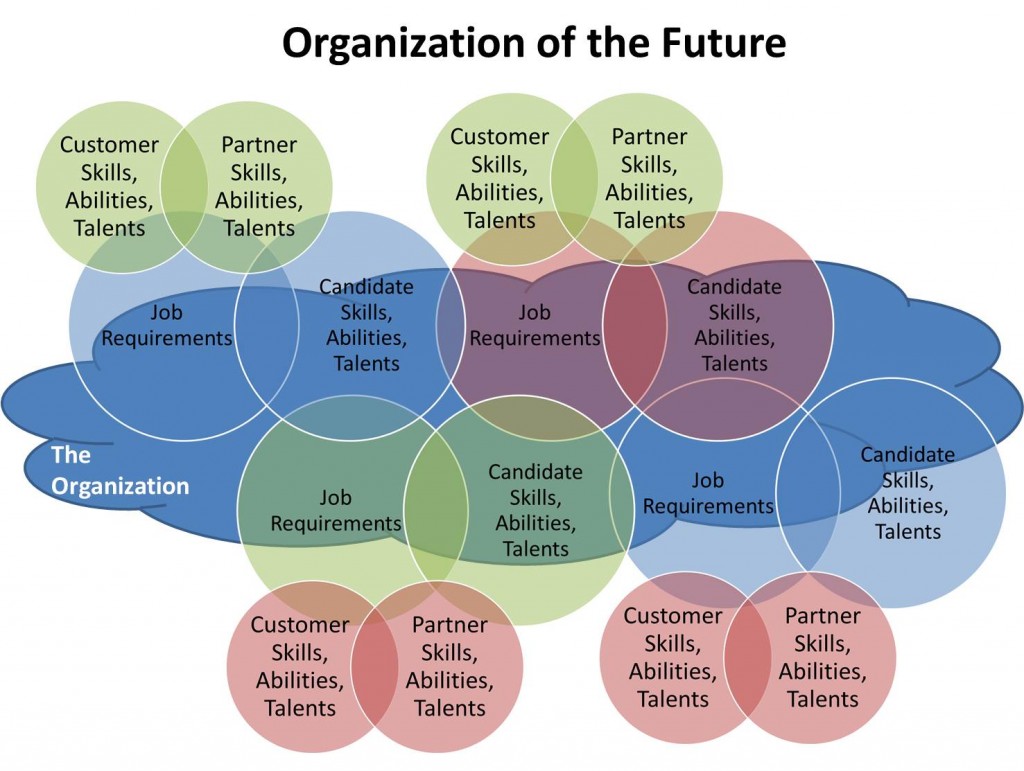
There is more to an employee than their intersection with the job description. In fact employees often have knowledge, skills and abilities that intersect with multiple job descriptions. Below you’ll find a visual depiction of this and of the increasingly less well-defined organizational boundaries:

Organization of the Future

Opportunity #5:

As the boundaries of the organization become less well-defined (see above) and as business makes increasing use of open innovation, partnerships, and co-opetition, hiring managers should consider not just matching the job description but also consider their ability to build and leverage external networks, and investigate the scope and quality of their existing networks.

Conclusion

Of course there are many more challenges and opportunities than I have space to list here, but I find these to be an interesting start to a conversation. What challenges or opportunities would you like to add to the conversation?

Image credit: businessnewsdaily.com


Accelerate your change and transformation success

Subscribe to Human-Centered Change & Innovation WeeklySign up here to get Human-Centered Change & Innovation Weekly delivered to your inbox every week.
The Wonderful World of Downsizing

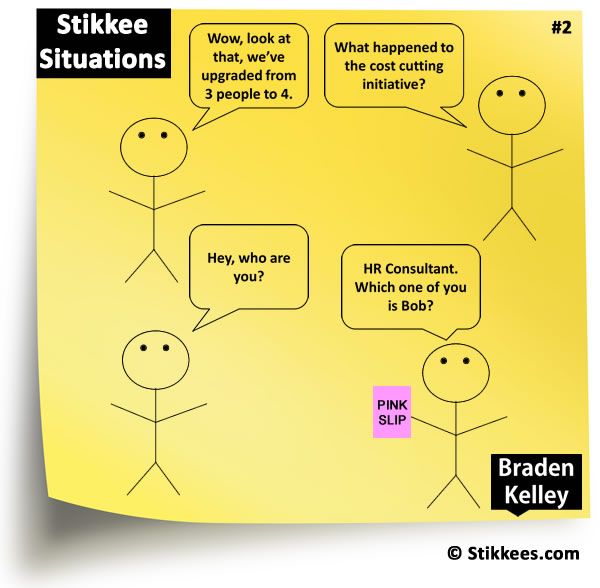
Stikkee Situations - Downsizing Cartoon

In Stikkee Situations we’ll try to take a humorous look at a lot of different serious business topics.

In this episode we poke fun at the wonderful world of downsizing.

Employees hate workforce reductions (aka downsizing), but some CEOs (even in profitable companies) seem to love these traumatic events as a tool to save their job and to drive short-term movements in the price of a company’s stock price, often coming on the heels of a company missing their earnings estimates.

But the positive short term stock price effects of an across the board workforce reduction come with heavy consequences, several of which greatly affect the innovation capacity of the organization, including:

  1. Destruction of trust within the organization
  2. Reduction in collaboration in the organization
  3. Loss of forward momentum on project work
  4. Loss of some of your best talent as they proactively find themselves jobs elsewhere
  5. Reduction in passion, creativity, and engagement among those who remain
  6. Elimination or reduction in the organization’s commitment to innovation

Now of course sometimes workforce reductions are necessary to avoid bankruptcy or for strategic realignment (removing human resources from business areas you are exiting), and they can be potentially healthy for the organization.

But, when downsizing is done purely to please wall street and in an untargeted way, in the long run I would assert that the organization suffers more than it benefits because any reduction in forward innovation momentum is an invitation to competitors and startups to speed past you.

So, keep innovating!

Please note the following licensing terms for Stikkee Situations cartoons:

1. BLOGS – Link back to https://bradenkelley.com/category/stikkees/ and you can embed them for free
2. PRESENTATIONS, please send $25 to me on PayPal by clicking the button 3. NEWSLETTERS & WEB SITES, please send me $50 on PayPal by clicking the button
License for presentations - $25
License for newsletters and web sites - $50

Subscribe to Human-Centered Change & Innovation WeeklySign up here to get Human-Centered Change & Innovation Weekly delivered to your inbox every week.

What Should the Role of Personal Branding be in Recruitment?

What Should the Role of Personal Branding be in Recruitment?I’ve been thinking a lot lately about personal branding, in part because several people have told me that I seem to do it pretty well, in spite of the fact that I would never call myself a personal branding expert or endeavor to make my living as a personal branding consultant.
While I think the personal branding topic is an interesting one, it is more because I am curious about:

  1. The role of personal branding in helping organizations achieve innovation success
  2. Whether or not organizations should be factoring in personal branding strength as part of their recruitment considerations

Now that we’ve hopefully made the case for the role of personal branding in helping organizations achieve innovation success in my previous post, let’s investigate whether or not organizations should be factoring in the strength of personal brand as part of their recruitment considerations.

Is the personal brand of an individual important to the brand of a collective and the brand equity that the organization is trying to build?

Well, look no further than organizations like Nike and Adidas that harness the personal brand equity of elite athletes like Michael Jordan, Kobe Bryant, and Derrick Rose.

Look no further than organizations like Target that harness the personal brand equity of Michael Graves, Isaac Mizrahi, Mossimo Giannulli, Jason Wu, and Phillip Lim. Meanwhile Macy’s has the Martha Stewart Home Collection (but JC Penney, Sears and Kmart also have Martha Stewart collections). So, harnessing the personal brand of designers and celebrities is obviously seen as beneficial to the brand of the collective in the minds of these organizations.

But it doesn’t stop there, the University of Phoenix is attempting to harness the personal brands of Clayton M. Christensen, Jeff Dyer, and Hal Gregersen to try and save their accreditation, London Business School harnesses the personal brand equity of Gary Hamel, Northwestern’s Kellogg School of Management harnesses the personal brand equity of Philip Kotler, and several consultancies harness the personal brand equity of famous professors to lend credibility to their consulting brands.

So, if at the highest levels, the organization’s brand equity benefits from harnessing the strength of the personal brands of certain individuals, shouldn’t organizations be considering the personal brand strength of applicants in the hiring process?

Not just for the reasons detailed above in relation to the increasingly open and interconnected organization, but also as content marketing becomes an increasingly important way for organizations to tell their brand story, and as innovative organizations seek to do the value translation component of innovation, shouldn’t the strength of personal brand equity be a consideration?

Now I don’t want to make this about me, or to say that my personal brand is nearly as strong as any of the individuals referenced before, and so I’ve made this as generic as possible:

  • Wouldn’t a McKinsey, Booz & Co., Deloitte, PWC, Bain, BCG, Innosight, Strategyn, ?WhatIf!, IDEO, Frog, Idea Couture, Fahrenheit 212, Jump Associates, or other consulting firm be better off (all other things being close to equal) hiring a consultant that could not just do great client work, but also a public evangelist for the firm at conferences and events, and bring visibility to the firm in print in the various media outlets that their personal brand has given them access to?
  • Wouldn’t a university be better off bringing in a candidate into a PhD research effort that would not just create a purely academic piece of research, but benefit more by partnering with a candidate that has a pre-existing publishing track record, pre-existing public visibility to help promote it, and whose personal brand equity could also bring potentially greater visibility to the degree granting institution?
  • Wouldn’t a company (all other things being roughly equal) be better off bringing in someone to lead their innovation efforts who has a strong personal brand in the innovation and/or startup communities, than someone who might have great program management capabilities, but limited personal brand equity and visibility? I mean, if one of the goals of an innovation program is to gather more insight-driven dots than your competitors, shouldn’t you base part of your selection criteria on the insight capacity of the individual and the connections that their personal brand equity brings?

These are just three examples of where organizations (and HR professionals) should be factoring personal branding into their recruitment criteria, but there are many more.

I have to say that too much of the focus on personal branding these days is from a social media perspective and making sure that the individual is not damaging their personal brand with careless social media involvement, or is focused on encouraging people to gather as many ‘friends’ as possible, or on the clothes that someone should wear, as if these things by themselves create a personal brand.

I’ve already given my thoughts about what the organization should do with personal branding.

Now here are my personal branding recommendations for the individual:

  1. Determine what your personal brand is. Start by thinking of the three words that define you. What do you want to be known for?
  2. Once you determine what your personal brand stands for, then make sure that all of your online profiles and other kinds of digital and physical assets (including your appearance) reinforce it.
  3. Create content for your online portfolio on the topics related to the three words that define you.
  4. Join the communities that intersect with your personal brand and your passions.
  5. Get out there and meet people. Look for those intersections of skills, abilities, talents, and passions that you have with others that are also consistent with your personal brand.
  6. Look to pursue activities that will strengthen your personal brand, not weaken it.
  7. Be authentic!
  8. Have fun!

Let’s close with a few questions:

  • What would you add to this list?
  • What is your personal brand, how strong is it, and how are you going to leverage this to power your career success?
  • How is your organization viewing personal brand when it comes to its recruitment efforts?

Keep innovating!


Build a common language of innovation on your team

Subscribe to Human-Centered Change & Innovation WeeklySign up here to get Human-Centered Change & Innovation Weekly delivered to your inbox every week.

New White Paper on External Talent Strategies

Innocentive - New White Paper on External Talent StrategiesFollowing on the heels of a recent thought leadership webinar (link to recording) on the same topic, this white paper explores the intersection of talent management and open innovation strategies. The paper dives into why having an external talent strategy is becoming increasingly important and how it can help your company accelerate innovation, shows how leading organizations manage their open innovation and crowdsourcing efforts (including case study examples of companies like P&G), and provides proven strategies and steps to take for attracting talent to your organization’s innovation efforts.

Download this Complimentary White Paper

Subscribe to Human-Centered Change & Innovation WeeklySign up here to get Human-Centered Change & Innovation Weekly delivered to your inbox every week.