
Tag Archives: collaboration

Taking Personal Responsibility – Seeing Self as Cause

Taking Personal Responsibility – Seeing Self as Cause

GUEST POST from Janet Sernack

In our last two blogs on Taking Personal Responsibility, we stated that when people aren’t taking personal responsibility, they cannot be accountable, they will fail in their jobs, and their teams, and fail to grow as individuals and as leaders. Taking personal responsibility is an especially crucial capability to develop self-awareness and self-regulation skills in the decade of both disruption and transformation. It all starts with seeing self as the cause of what happens to us, rather than baling it on the effects events and problems have on us! Where people can learn to recognize the structures at play in their lives and change them so that they can create what they really want to create in their lives, teams, or organizations.

In the last two blogs, we shared a range of tips for shifting people’s location, by creating a line of choice, to help them shift from being below the line and blaming others for their reactive response, to getting above the line quickly.  Through shifting their language from “you, they and them” to “I, we and us” and bravely disrupting and calling out people when they do slip below the line. How doing this allows people to also systemically shift across the maturity continuum, from dependence to independence and ultimately towards interdependence.

In a recent newsletter Otto Scharmer, from the Presencing Institute states “Between action and non-action there is a place. A portal into the unknown. But what are we each called to contribute to the vision of the emerging future? Perhaps these times are simply doorways into the heart of the storm, a necessary journey through the cycles of time required to create change”.

Creating the place – the sacred pause

When I made a significant career change from a design and marketing management consultant to becoming a corporate trainer, one of the core principles I was expected to teach to senior corporate managers and leaders was taking personal responsibility.

Little knowing, that at the end of the workshop, going back to my hotel room and beating myself up, for all of the “wrongs” in the delivery of the learning program, was totally out of integrity with this core principle.

Realising that when people say – those that teach need to learn, I had mistakenly thought that I had to take responsibility for enacting the small imperfections I had delivered during the day, by berating myself, making myself “wrong” and through below the line self-depreciation!

Where I perfectly acted out the harmful process of self-blame, rather than rationally assessing the impact of each small imperfection, shifting to being above the line where I could intentionally apply the sacred pause:

  • Hit my pause button to get present, accept my emotional state,
  • Connect with what really happened to unpack the reality of the situation and eliminate my distortions around it,
  • Check-in and acknowledge how I was truly feeling about what happened,
  • Acknowledge some of the many things that I had done really well,
  • Ask myself what is the outcome/result I want for participants next program?
  • Ask myself what can I really learn from this situation?
  • Consciously choose what to do differently the next time I ran the program.

I still often find myself struggling with creating the Sacred Space between Stimulus and Response and have noticed in my global coaching practice, that many of my well-intentioned clients struggle with this too.

The impact of the last two and a half years of working at home, alone, online, with minimal social interactions and contact, has caused many of them to languish in their reactivity, and for some of them, into drowning in a very full emotional boat, rather than riding the wave of disruptive change.

Being the creative cause

In our work at ImagineNation, whether we help people, leaders and teams adapt, innovate and grow through disruption, their ability to develop true self-awareness and be above the line is often the most valuable and fundamental skill set they develop.

It then enables us to make the distinction that creating is completely different from reacting or responding to the circumstances people find themselves in by applying the sacred pause.

When people shift towards seeing self as the cause they are able to create and co-create what they want in their lives, teams or organization by learning to create by creating, starting with asking the question:

  • What result do you want to create in your life?
  • What is the reality of your current situation?

This creates a state of tension, it is this tension that seeks resolution.

In his ground-breaking book The Path of Least Resistance Robert Fritz, goes on to describe and rank these desired results as “Fundamental Choices, Primary Choices, and Secondary Choices.”

Because there is one thing that we can all do right and is totally in our control – is to shift towards seeing self as the cause and make a set of conscious choices, with open hearts, minds, and wills, as to how we think, feel and choose to act.

“We are the creative force of our life, and through our own decisions rather than our conditions, if we carefully learn to do certain things, we can accomplish those goals.”

We all have the options and choices in taking responsibility, empowering ourselves and others to be imaginative and creative, and using the range of rapid changes, ongoing disruption, uncertainty, and the adverse pandemic consequences, as levers for shifting and controlling, the way we think, feel.

Benefits of seeing self as the cause and being above the line

Applying the sacred pause to make change choices in how we act – and being brave and bold in shifting across the maturity continuum, will help us to cultivate the creativity, interdependence, and systemic thinking we all need right now because it:

  • Helps people self-regulate their reactive emotional responses, be more open-hearted and emotionally agile, and helps develop psychologically safe work environments where people can collaborate and experiment, and fail without the fear of retribution or punishment.
  • Enables people to be more open-minded, imaginative, and curious and creates a safe space for continuous learning, maximizing diversity and inclusion, and proactive intentional change and transformation.
  • Promotes ownership of a problem or challenging situation and helps develop constructive and creative responses to problems and an ability to take intelligent actions.
  • Gives people an opportunity to impact positively on others and build empowered trusted and collaborative relationships.
  • Enables entrepreneurs and innovators to invent creative solutions and drive successful innovative outcomes.
  • Building the foundations for accountability, where people focus their locus of control on what they promise to deliver, enables them to be intrinsically motivated, and take smart risks on negotiating outcomes that they can be counted on for delivering.

Tips for seeing self as the cause and operating above the line

Taking personal responsibility and seeing self as the cause involves:

  • Acknowledging that “I/we had a role or contributed in some way, to the fact that this has not worked out the way “I/we wanted.”
  • Clarifying the outcome or result in you want from a specific situation or a problem.
  • Seeking alternatives and options for making intelligent choices and actions, and using the language of “I/we can” and “I/we will” to achieve the outcome.
  • Replacing avoiding, being cynical and argumentative, blaming, shaming, controlling, and complaining with courageous, compassionate, and creative language and acts of intention.
  • People become victors who operate from “self as cause” where they are empowered to be the creative forces in their own lives by making fundamental, primary, and secondary change choices.
  • Trust your inner knowing and deep wisdom that everything has a specific and definable cause and that each and every one of us has the freedom to choose how to respond to it.

Back to leadership basics

As Stephen Covey says, people need to deeply and honestly say “I am what I am today because of the choices I made yesterday” because it’s not what happens to us, it’s our reactive response to what happens that hurts us.

Being willing to step back, retreat, and reflect on the gap between the results you want, and the results you are getting all starts with stepping inward, backward, and forwards, using the sacred pause, to ask:

  • What happened? What were the key driving forces behind it?
  • How am I/we truly feeling about it?
  • What was my/our role in causing this situation, or result?
  • What can I/we learn from it?
  • What is the result/outcome I want to create in the future?
  • What can I/we then do to create it?

As a corporate trainer, consultant and coach, I found out the hard way that developing the self-awareness and self-regulation skills in taking personal responsibility and seeing self as the cause is the basis of the personal power and freedom that is so important to me, and almost everyone else I am currently interacting with.

It’s the foundation for transcending paralysis, overwhelm, and stuck-ness and activating our sense of agency to transform society and ourselves.

This is the third and final blog in a series of blogs on the theme of taking responsibility – going back to leadership basics. Read the previous two here:

Find out about our learning products and tools, including The Coach for Innovators, Leaders, and Teams Certified Program, a collaborative, intimate, and deeply personalized innovation coaching and learning program, supported by a global group of peers over 9-weeks, starting Tuesday, October 18, 2022. It is a blended and transformational change and learning program that will give you a deep understanding of the language, principles, and applications of an ecosystem focus,  human-centric approach, and emergent structure (Theory U) to innovation, and upskill people and teams and develop their future fitness, within your unique context.

Image credit: Pixabay

Subscribe to Human-Centered Change & Innovation WeeklySign up here to get Human-Centered Change & Innovation Weekly delivered to your inbox every week.

Taking Personal Responsibility – Creating the Line of Choice

Taking Personal Responsibility - Creating the Line of Choice

GUEST POST from Janet Sernack

In our last blog, we described how people’s personal power is diminished when they don’t take personal responsibility for the impact of their behaviors and actions and the results they cause. Where many people are feeling minimized and marginalized, anxious as a result of being isolated and lonely, worrying about losing their security and freedom, and dealing with the instability in their working environments.  Resulting in many people disengaging from the important conversations, job functions, key relationships, workplaces, and in some instances, even from society. Where managers and leaders lack the basic self-awareness and self-regulation skills to control the only controllable in uncertain and unstable times, is to choose how to respond, rather than react to it.

We have a unique moment in time to shift their defensiveness through being compassionate, creative, and courageous towards helping managers and leaders unfreeze and mobilize to exit our comfort zones.  To take intelligent actions catalyze and cause positive outcomes, that deliver real solutions to crises, complex situations, and difficult business problems.

Why do people avoid taking personal responsibility?

People typically avoid taking personal responsibility for reasons ranging from simple laziness, risk adversity, or a fear of failure, to feeling change fatigued, overwhelmed, or even victimized by the scale of a problem or a situation.

Resulting in a range of different automatic defensive, and a range of non-productive reactive responses including:

  • Avoidant behavior, where feel victimized and targeted, people passively “wriggle” and the buck gets passed onto others, and the real problem or issue does not get addressed or resolved.
  • Controlling behavior, where people ignore their role in causing or resolving the real problem or issue, and aggressively push others towards their mandate or solution, denying others any agency.
  • Argumentative behavior, where people play the binary “right-wrong” game, and self-righteously, triggered by their own values, oppose other people’s perspectives in order to be right and make the other person wrong.

Creating the line of choice

At Corporate Vision, we added a thick line of “choice” between “personal responsibility” and “blame, justification and denial” to intentionally create space for people to consider taking more emotionally hygienic options rather than:

  • Dumping their “emotional boats” inappropriately onto others, even those they may deeply care about,
  • Sinking into their habitual, and largely unconscious default patterns when facing complex problems, which results in the delivery of the same results they always have.
  • Not regulating their automatic reactive responses to challenging situations, and not creating the vital space to pause and reflect to think about what to do next.

To enable them to shift towards taking response-ability (an ability to respond) and introducing more useful options for responding in emotionally agile, considered, constructive, inclusive, and creative ways to the problem or the challenge.

Noticing that when we, or others we interact with, do slip below the line to notice whether to “camp” there for the long term or to simply choose to make the “visit” a short one!

Doing this demonstrates the self-awareness and self-regulation skills enabling people to take personal responsibility. Which initiates ownership and a willingness to be proactive, solutions, and achievement orientated – all of which are essential qualities for 21st century conscious leadership that result in innovative outcomes that result in success, growth, and sustainability.

Shifting your location – from “you, they and them” to “I, we and us”

Developing the foundations for transformational and conscious leadership involves:

  • Supporting people to acknowledge and accept that the problem or challenge is not “out there” and is within their locus of control or influence.
  • Shifting the “Maturity Continuum” to enable leaders and managers to be both independent and interdependent.
  • Creating a line of choice to think, act and do things differently.
  • Calling out people when they slip below the line.

It involves supporting people to let go of their expectation that “they” or someone else, from the outside, will fix it, and supporting them to adopt a stance where:

  • “I” or “we” can and are empowered to do it,
  • “I” or “we” are responsible for getting above the line,
  • “I” or “we” can choose a different way of being, thinking, and acting intelligently in this situation.

Developing conscious leadership

At any time, everyone is either above or below the line because it is elemental to the type of conscious leadership we all need to survive and thrive, in a world where people are seeking leaders, managers, and working environments that require interdependence.

To operate in the paradigm of “we” – we can do it; we can cooperate; we can combine our talents and abilities and create something greater together.

We cooperate together by creating the line of choice where we call out to ourselves and others when we slip below it, to get above the line as quickly as possible.

Where interdependent people and communities combine their efforts, and their self-awareness and self-regulation skills with the efforts of others to achieve their growth and greatest success by increasing:

  • Transparency and trust,
  • Achievement and accountability,
  • Diversity and inclusion,
  • Experimentation and collaboration.

All of these are founded on the core principle of taking personal responsibility, which is an especially crucial capability to develop self-awareness and self-regulation skills in the decade of both disruption and transformation.

Bravely calling out self and others

When we take responsibility for managing our own, “below the line” reactive responses, by habitually creating the line of choice, we can bravely call out ourselves and others when we slip below it.

Because when we don’t call ourselves and others we interact with, we are unconsciously colluding with their emotional boats, default patterns, and automatic reactive responses, which inhibit their ability to effect positive change.

When we safely awaken ourselves and others, we can get back above the line quickly and choose different ways of being, thinking, and acting intelligently in the situation.

Alternately, people aren’t taking personal responsibility, they cannot be accountable, they will fail in their jobs, and their teams, and fail to grow as individuals and as leaders.

In fact, developing a habitual practice of emotionally intelligent and conscious leadership by safely and bravely disrupting ourselves and our people, in the face of ongoing uncertainty, accelerating change, and continuous disruption.

This is the second in a series of three blogs on the theme of taking responsibility – going back to leadership basics.

Find out about our learning products and tools, including The Coach for Innovators, Leaders, and Teams Certified Program, a collaborative, intimate, and deeply personalized innovation coaching and learning program, supported by a global group of peers over 9-weeks, starting Tuesday, October 18, 2022. It is a blended and transformational change and learning program that will give you a deep understanding of the language, principles, and applications of an ecosystem focus,  human-centric approach, and emergent structure (Theory U) to innovation, and upskill people and teams and develop their future fitness, within your unique context.

Image credit: Unsplash

Subscribe to Human-Centered Change & Innovation WeeklySign up here to get Human-Centered Change & Innovation Weekly delivered to your inbox every week.

Taking Personal Responsibility – Back to Leadership Basics

Taking Personal Responsibility – Back to Leadership Basics

GUEST POST from Janet Sernack

I was first introduced to the principle of Taking Personal Responsibility when I attended a number of experiential workshops facilitated by Robert Kiyosaki who is now well known globally as the successful entrepreneurial author of the “Rich Dad Poor Dad” book series. At that time, in the late 1980s, the concept simply involved taking personal responsibility for your role in getting the results you get, in both challenging and problematic situations.

This principle has since evolved as the most crucial foundation for developing our emotionally intelligent, conscious, and transformational leadership capabilities. Largely through focusing on the development of self-awareness and self-regulation skillsets, which are especially important skills to cultivate in times of extreme uncertainty.

Blaming, Justifying, and Denying

Taking personal responsibility involves encouraging people to step up and out of blaming themselves or others, out of justifying their position or denying what is really going on to largely avoid the cognitive, emotional, and visceral results and consequences of their actions.

Which are essentially, largely unconscious defensive reactions to the problem or situation. So, it sounds quite simple, yet, even now, it’s still largely a countercultural principle, and a neurologically challenging one, because we are wired to survive (fight/flight/freeze) in the face of what we perceive as danger!

Especially when many of us are living in an oppositional blaming and shaming political environment, or within a passively or aggressively defensive organizational culture. Where a large section of the community, has been forced by the constraints of the pandemic, into fearing that their security and survival needs will not be met. Alternately, the great resignation and the nature of the virtual hybrid workplace have increased some people’s fears about even being able to get their jobs done!

All of this creates distorted thoughts and language that focus on “scarcity” where many people are fearing that they are not “enough” and do not have “enough” to deal with their current circumstances. Rather than leaning towards exploring and eliciting the possibilities and opportunities available in our abundant world.  As there is no clear playbook about how people can effectively and responsibly lead and manage in this unique 21st-century context, many people are floundering, languishing into largely emotionally overwhelmed states.

Where it is easier, and sometimes safer, to be a victim, blame and shame others for their helpless or powerless situation, or to justify and deny any need to change their perspective about it, never mind their role in causing their own anxious and unresourceful emotional states.

Back to Leadership Basics

Yet, it is more important than ever, for leaders and managers to help people:

  • Take ownership of their consequences and be responsible for the emotional, cognitive, and visceral results of their actions,
  • Authentically connect, empower, and enable people and communities to flourish,
  • Provide safe, transparent, trusted environments and interdependence where people can dare to think differently and potentially thrive.

This means that the range of crises, uncertainty, and disruptions we are experiencing now is forcing us to go back to basic 101 management and leadership principles.

According to McKinsey & Co in a recent article “A Leaders Guide – communicating with teams, stakeholders and communities during Covid 19” – “Crises come in different intensities. As a “landscape-scale” event, the coronavirus has created great uncertainty, elevated stress and anxiety, and prompted tunnel vision, in which people focus only on the present rather than toward the future. During such a crisis, when information is unavailable or inconsistent, and when people feel unsure about what they know (or anyone knows), behavioral science points to an increased human desire for transparency, guidance, and making sense out of what has happened”.

The Maturity Continuum – Shifting to I and We

The principle of taking personal responsibility has evolved and been enhanced significantly through the work of Steve Covey, in the “Seven Habits of Effective People” and provides the core foundations for transformational and conscious leadership through the “Maturity Continuum”:

  1. Dependence is the paradigm of you – you take care of me; you come through for me; you didn’t come through for me; I blame you for the results. Dependent and approval-seeking people need others to get what they want.
  2. Independence is the paradigm of I – I can do it; I am responsible; I am self-reliant; I can choose. Independent people get what they want through their own efforts.
  3. Interdependence is the paradigm of we – we can do it; we can cooperate; we can combine our talents and abilities and create something greater together. Interdependent people combine their efforts with the efforts of others to achieve their greatest success.

Putting the Maturity Continuum to Work

In the early 2000s I was an associate of Corporate Vision, Australia’s first culture change and transformation consultancy, now the globally successful Walking the Talk organisation, for fourteen years.

Where every culture, leadership, team development, or change program we designed and presented, introduced taking personal responsibility, as a fundamental, core learning principle. Aligning it with the principle of – For things to change first I must change, which deeply challenged and disrupted people’s belief systems, habitual mindsets, thinking styles, and ways of acting.

As a seasoned coach of twenty years, these two core principles seem to still profoundly challenge the majority of my coaching clients across the world, no matter how senior their role or position is, or how knowledgeable, skilled, and experienced they are!

Where many managers and leaders have failed to self-regulate, lack self-awareness, and have unconsciously slipped into feeling victimized, powerless, helpless, and in some instances, even hopeless about their futures where some are:

  • Feeling frozen, inert, paralyzed, overwhelmed, and immobilized in their abilities to affect any kind of positive change in both their work and home environments.
  • Unconsciously slipping into blaming and shaming others for their situations,
  • Justifying their inertia through a range of “reasonable reasons” and “elaborate stories” about how it’s “not their fault” or it’s not “up to them” to make any change.
  • Simply denying their current consequences, or the importance of needing to take positive actions, and make changes.
  • Unmotivated, lack any desire for control, or have the personal power to affect change in their situation.

Initiating Taking Personal Responsibility

To accept and share responsibility starts with being bravely willing to courageously connect with our whole selves and consciously stepping back to hit our internal pause button, retreat into silence and stillness, and compassionately ask:

  1. What happened?
  2. What can I/we learn from it?
  3. What can I/we then do to create it?

Taking personal responsibility becomes a compassionate, creative, and courageous exercise in continuous learning, self-awareness, and emotional self-regulation in ways that safely disrupt people’s defensiveness and awaken them to the possibility of being personally powerful in tough situations.

It is also the basis for taking intelligent actions catalyze and cause positive outcomes, that deliver real solutions to crises, complex situations, and difficult business problems.

This is the first in a series of three blogs on the theme of taking responsibility – going back to leadership basics.

Find out more about our work at ImagineNation™

Find out about our learning products and tools, including The Coach for Innovators, Leaders, and Teams Certified Program, a collaborative, intimate, and deeply personalized innovation coaching and learning program, supported by a global group of peers over 9-weeks, starting Tuesday, October 18, 2022. It is a blended and transformational change and learning program that will give you a deep understanding of the language, principles, and applications of an ecosystem focus,  human-centric approach, and emergent structure (Theory U) to innovation, and upskill people and teams and develop their future fitness, within your unique context. Find out more about our products and tools.

Image credit: Pixabay

Subscribe to Human-Centered Change & Innovation WeeklySign up here to get Human-Centered Change & Innovation Weekly delivered to your inbox every week.

Innovating Through Adversity and Constraints

Innovating Through Adversity and Constraints

GUEST POST from Janet Sernack

It’s been almost two and a half years since most of us shifted to working virtually and remotely, which, in turn, seriously disrupted most of our business-as-usual behaviors and learning habits. Interestingly, this also disrupted our habitual unconscious safety and comfort zones, and, in many cases, disconnected our overall sense of security. For some of us, our ability to make sense of ourselves and our futures, has been impacted, impacting our abilities to find new ways of being creative and innovating through the range of constraints and adverse situations.

Looking inward

Some of us have also had our confidence to survive and thrive in a world severely impacted, and many of us have felt exploited, exhausted, and depleted by our employers. According to Lynda Gratton, in a recent article in MIT Sloane Magazine “Making Sense of the Future” many of us are looking inward — working through the impact of our changing habits, networks, and skills, and begin to imagine other life trajectories and possible selves.

Looking outward

Again, according to Lynda Gratton, some of us are now also looking outward to analyze how talent markets are changing and what competitors are doing, which is creating momentum and a force for change, but also frustration and anxiety, given institutional lag and inertia.

The larger-than-life, terrible, and confronting conflict in Ukraine has also inflated, for some of us, a deeper sense of helplessness and exhaustion, and amplified our concerns and fears for a sustainable future.

The momentum for change is growing 

Yet some people have successfully responded to worries and concerns about the inertia holding our companies back, and have adapted to working, learning, and coaching online. Using this moment in time to help de-escalate our reactivity to what’s been going on to deeply connect, explore, discover, listen, and respond creatively to what is really important, to ourselves, our people, teams and our organizations.

To help shift the tension between today and tomorrow, through regenerating and replenishing ourselves and our teams, by shifting the dialogue towards renewing and innovating through constraints and adversity in uncertain and unstable times.

Innovating through constraints at ImagineNation™

Innovating through constraints enabled the collective at ImagineNation™ to design and deliver a bespoke, intense, and immersive learning journey for an executive team aiming at igniting and mobilizing their collective genius to step up to face their fears, adapt, take smart risks and innovate in uncertain and disruptive times!

Some of the constraints we collaboratively and creatively mastered included adapting to differing:

  • Geographies, we are based in Melbourne, Australia, and our client was based in Canada, which made managing time zone schedules challenging, including some very early 4.30 am starts for us –  Making flexibility and adaptiveness crucial to our success.  
  • Technologies, balancing Zoom-based online webinars and workshops, with Google chat rooms and jamboards, completing one on one coaching sessions, and assigning, completing, and presenting group action learning assignments – Reinforcing the need for constant iteration and pivoting to ensure the delivery of outcomes, as promised.
  • Communicating, including air freighting hard copy reflection packs, scheduling, and partnering virtually, all within a remote and fractured working environment –Ensuring that clarity and consistency would lead to the successful delivery of the outcomes, as promised.

Shifting the dialogue

Demonstrating that we can all be resilient and creative when we live in times of great uncertainty and instability through investing in reskilling people and teams to become more purposeful, human, and customer-centric.

We can all break the inertia by challenging our business-as-usual thinking and shifting the dialogue towards exploring our inner challenges and navigating the outer challenges of our current environment.

If we commit to doing this with more consciousness, hope, optimism, and control, to follow a direction rather than a specific destination by:

  • Perceiving this moment in time as an “unfreezing opportunity” and an opening to shift out of inertia and complacency, to re-generate and re-invent ourselves and our teams?
  • Knowing how to connect, explore, discover, generate and catalyze creative ideas to rapidly and safely unlearn, relearn, collaborate and innovate through constraints and adversity?
  • Committing to letting go of our “old baggage” and ways of making sense of our new reality, by experimenting with smart risk-taking, and making gamification accessible in an environment that is unpredictable?

Re-generating and re-inventing in uncertain and unstable times

In fact, many of us successfully adapted to online working, learning, and coaching environments by de-escalating any feelings of helplessness and hopelessness.

To bravely focus on regenerating and reinventing ourselves and our teams and using this moment in time to be curious, shift the dialogue, explore possibilities, harness collective intelligence and ask some catalytic questions:

  • What if we intentionally disrupted our current way of thinking?
  • How might we think differently to shift our perception and perceive our worlds with “fresh eyes”? What might be possible?
  • What if we shift the dialogue to engage people in innovating through constraints?
  • How might we shift the dialogue to activate and mobilize people towards taking intelligent risks through constraints?
  • How might thinking differently empower, enable and equip ourselves and our teams to navigate the current environment with more hope and optimism?
  • What if re-consider and perceive these constraints differently?
  • How might we support people to ignite their creativity?
  • How might we equip people to be creative and develop better ideas?
  • How might we resource people to force more change and innovation?
  • How might we discover new ways of creating value for people in ways that they appreciate and cherish?

Grappling with the future is paradoxical

Finally, Lynda Gratton suggests that we need to:

“Acknowledge that this is not straightforward. Right now, many leaders are stuck between two sources of tension: the tension of enlightenment, where they can begin to imagine what is possible, and the tension of denial, where they are concerned that more flexible working arrangements will negatively affect performance. They grapple with whether the change will be necessary or possible. These are legitimate tensions that are only exacerbated by the sense of exhaustion many people feel”.

If we perceive these constraints as catalysts for setting a clear focus and direction, it might force us to experiment with creative ways of acting and doing things differently.

It might also force us to make tougher decisions around our inner and outer priorities, by exploring and discovering more balanced, creative, and inventive ways of constantly iterating and pivoting whatever resources are available to get the important jobs done.

An opportunity to learn more

Find out about our learning products and tools, including The Coach for Innovators Certified Program, a collaborative, intimate, and deep personalized innovation coaching and learning program, supported by a global group of peers over 9-weeks, starting Tuesday, May 4, 2022.

Image Credit: Unsplash

Subscribe to Human-Centered Change & Innovation WeeklySign up here to get Human-Centered Change & Innovation Weekly delivered to your inbox every week.

You Must Be Comfortable with Being Uncomfortable

You Must Be Comfortable with Being Uncomfortable

GUEST POST from Janet Sernack

It’s been a tough two and a half for everyone since the COVID-19 crisis began. Some of us have been hit very, very hard, by the impact of the pandemic exacerbated by the rate of exponential change and now, by the impact of the conflict in Ukraine.

As result, many of us are feeling overwhelmed and exhausted and languishing in varying states of anxiety and discomfort. Some of us are struggling with “not knowing” how to deal with the extreme uncertainty existing within our business and personal environments, whilst many of us are optimistically seeking to prepare and manage for what might possibly come next.

At the same time, many of us are seeking collaborative partnerships to support us and explore options for keeping both ourselves, our people, and teams engaged in moving forward creatively in a constantly changing world.  Where both the work environment and the nature of work are in a state of flux, where we are going through exceptional and extraordinary changes, and, where to both survive and thrive, we need to get comfortable with being uncomfortable with it all.

Safely stepping into the unknown

This creates an opening and a threshold to partner with others in resourceful and creative ways to support them, to safely and bravely step into the unknown.

To perceive this unique moment in time as an opportunity for growth, shape-shifting, and change – by empowering and equipping them to cautiously abandon and exit their comfort zones and get comfortable with being uncomfortable. Because the patterned worlds of our “business as usual” existences, which traditionally kept us get comfortable and calm, and helped us stay emotionally and mentally even, free from anxiety and worry to a great degree, are no longer certain, predictable or stable.

Where constant and accelerating change, coupled with uncertainty are the harsh realities of today, and of tomorrow, in the decade emerging as one of both disruption and transformation.

Impact of our neurological survival mechanisms

As humans, we have an internal need for consistency, represented by our internally mapped, largely unconscious, neurological comfort zones, our own unique places for getting comfortable, and amenable to what we habitually do. When we experience cognitive dissonance, in an extremely uncertain and disruptive operating environment, we unconsciously encounter apparent inconsistencies between what is really happening and what we believe to be really true.

As result, we often, mostly unconsciously, slip into our auto-pilot range of varied aggressive and passive defensive, reactive responses: including avoidance, denial, anger, opposition, and resistance to change. Often described as the “retreat, freeze, or take flight or fight” reactions to what is “seemingly” going on. This is because we distort and generalize our thoughts or feelings into believing that have no control over events. Which is a normal and natural neurological, yet primitive, survival mechanism that enables us to cope with the situation.

However, when we operate this way, we lose our personal power and question our abilities to shape and manifest the outcomes we want, or feel we lack the ability to influence others or constructively impact our environments.

Resistance is futile

Manifesting as feelings of discomfort, most of us will do anything to move away from – because we want to avoid pervasive, visceral, challenging thoughts and feelings, derived from our conflicting beliefs and values.  Our auto-responses or neurological urges to remove the discomfort, and typically keep us in our comfort zones, where we procrastinate, make excuses, shift into denial, avoidance, and justification, resulting ultimately, in immobilisation and inaction.

The outcome is that we may feel paralysed, and become inert, inhibiting and preventing us from developing the mindsets, behaviours, and actions required to thrive in the future. Where our only “new normal” will depend on our abilities to flow with constant change, unpredictability, instability, and uncertainty and get comfortable with being uncomfortable.

Hidden costs of resistance

Resistance to change prevents us from:

  • Adapting to the current and future environment is not the survival of the fittest, it’s he or she who is the most adaptive, who ultimately survives, and thrives!
  • Exploiting this moment in time as an opportunity and threshold to improve our confidence, competence, and emotional capacity to effectively transition through the range of professional and personal crises, brought on by uncertainty and disruption.
  • Exploring possibilities and unleashing opportunities available in this moment in time as a turning point to learn and grow, as a coach, leader, or team.
  • Strategizing in the new global, hybrid, and virtual work environment to improve, competitiveness, productivity, and innovation grow our practices and help our members expand their roles, and grow their teams and businesses.
  • Breaking down silos that add to many of our member’s current states of disconnection and loneliness, and inhibit connection and collaboration.
  • Creating permission, tolerance, and safety for members to safely download and let go of their fears and anxieties, share their negativity and pessimism, fears of failure,  and co-create positivity and optimism towards thriving in an uncertain future, together.
  • Embracing the new world of digitisation and experimentation, from implementing change, enhancing individual and organisational agility, and developing the mindsets, behaviours, and skills to be comfortable in constantly changing contexts.

What can we do about it?

  • Being agile and adaptive

In normal times, creating a comfort zone is a healthy adaptation for controlling much of our lives. Yet having the boldness, bravery, and courage in extreme uncertainty, to step up and out of our comfort zones helps us be agile and adaptive in transitioning, growing, and transforming through the enormous challenges, disruptions, and adversities many of us are confronting.

  • Entering the learning zone

In fact, once we do take the first baby steps out of our comfort zones and into our fear zone (fear of loss, blame, shame, envy, punishment, retribution, opposition, being controlled, humiliation, being envied or made wrong) we can safely enter the learning zone. Being in the Learning Zone is the first stopping point toward generating creative energy and expanding our comfort zones.

  • Facing the fear

Doing this builds the foundations for being more comfortable with being uncomfortable by facing, feeling, acknowledging, and letting go of some of our deepest fears by dealing with them rationally and realistically, with empathy and compassion, and without bias and distortion.

  • Reducing our levels of anxiety

By withdrawing, discerning, and deciding to let go of the need to be constantly in charge and in control and be willing to enter the Growth Zone, where everything that happens is a resource for being tolerant, and accepting, of the possibilities for making positive change.

Stepping into being comfortable

This is a great opportunity to co-create a new playbook for ourselves, our people, and their teams by enabling and empowering the mindset shift to the Growth Zone, to transform cognitive dissonance, and use it as the creative tensions toward being comfortable with being uncomfortable.

This involves engaging in a set of consistent and regular practices, to build and support a willingness to embrace change, disruption, and uncertainty, to take on even the impossible.

  1. Hit your Pause Button: retreat from activity, get grounded in stillness and silence, and be fully present to your energetic state. Be mindful and pay deep attention to recognise your patterns, attune to what is really going on, and get unhooked from any internal chatter, stories, and unconscious default patterns.
  2. Label Your Thoughts and Emotions: be fully present and get connected to yourself and to others you are interacting with, feel the feeling, knowing that it is transient.
  3. Acknowledge and Accept: allow yourself to accept and embrace the range of feelings, be empathic, compassionate, and open-hearted with yourself and with others.
  4. Detach from and Observe your Thoughts and Emotions: be willing to create and sustain an open mind, be inquisitive and curious, explore the non-judgemental space between your feelings and how to effectively respond to them.
  5. Identify difficult feelings: as you experience them and find more appropriate ways of responding instead of reacting, be willing to become a “detached observer”.
  6. Be emotionally agile: learn to see yourself as the operating system, filled with possibilities, knowing that you are more than one part of it and flow with it
  7. Be courageous and brave: challenge the status quo, and your habitual thinking, feeling, and decision-making habits and build your confidence to reboot, consistently disrupt yourself and be comfortable with being uncomfortable.
  8. Be imaginative and creative: reimagine your most desirable future state, be optimistic and positive about choosing the best ways to reset, and walk your way forward into the unknown.

Focusing your attention and being intentional

Being comfortable with being uncomfortable, enables us to re-think creates openings and thresholds for developing 21st-century superpowers, limitless possibilities for change, growth, learning, and innovation.

By empowering us to respond positively to uncertainty, and dynamic change that respects and engages people’s values and humanity, in co-creative and innovative ways that improve the quality of people’s lives in ways they value, appreciate, and cherish.

An opportunity to learn more

Find out about our learning products and tools, including The Coach for Innovators Certified Program, a collaborative, intimate, and deep personalized innovation coaching and learning program, supported by a global group of peers over 9-weeks, starting Tuesday, May 4, 2022.

It is a blended and transformational change and learning program that will give you a deep understanding of the language, principles, and applications of an ecosystem focus,  human-centric approach, and emergent structure (Theory U) to innovation, and upskill people and teams and develop their future fitness, within your unique context.

Image Credit: Unsplash

Subscribe to Human-Centered Change & Innovation WeeklySign up here to get Human-Centered Change & Innovation Weekly delivered to your inbox every week.

A How To Guide for Overcoming Procrastination

A How To Guide for Overcoming Procrastination

GUEST POST from Janet Sernack

I often wonder why some people procrastinate by delaying, postponing, or avoiding solving problems, or by withdrawing from making smart decisions, taking calculated risks, or taking intelligent actions?

  • Why do they become paralyzed and unable to take the actions necessary to solve some of their key problems?
  • Why do they often resist making even the most necessary changes to support the delivery of their creative solutions?
  • Why do so many also avoid taking personal responsibility and being accountable towards achieving their desired outcomes and goals?
  • Why do people disengage, even when the situation or problem may be critical to their own, their teams, or their organizations success?

Despite knowing that there may be a range of negative consequences for procrastinating, involving a crippling, overwhelming, and paralyzing combination of reactive responses?

Which then typically impacts negatively on people’s self-efficacy and self-belief, self-worth, and self-esteem and diminishes their motivation, disengages them and immobilizes their ability to take the necessary actions and as a result, spiral downwards?

How do we help people overcome procrastination?

  • Why is this important?

It seems that procrastination is a challenge we and many others have faced at one point or another, where we struggle with being indecisive, delaying, ignoring, avoiding taking actions to initiate, progress, or completing tasks that may be important to us, as well as on issues that really matter to us, our teams, partners and organizations.

Ultimately leading to failures, and an inability to mitigate risks, or be creative and inventive and decreasing possibilities for innovation and increasing engagement, productivity, and improving performance.

Also potentially leading to feelings of loss, insecurity, inadequacy, frustration, disengagement, and depression and in extreme cases, client, project failures and job losses, and even burnout!

Why do people procrastinate?

  • The need for security and self-protection is the key root causes of procrastination

Procrastination is most often a self-protection strategy, a way of defending ourselves, rooted in fears that result in anxieties around feeling unsafe, vulnerable, and being judged or punished, especially in times of uncertainty, unpredictability, uncontrollability, and when feeling overwhelmed.

In most organizational contexts, procrastinators are likely to respond be risk-averse by:

  • Being apprehensive and even withdrawing energetically (dis-engaging) from people as well as from the creative conversation, coupled with a lack of commitment to the change process or towards achieving the agreed goal (lacking conviction and being worried about the future).
  • Not showing up and spending a lot of time and energy zigzagging around and away from what they feel is consuming them or making them feel threatened or uncomfortable (avoidance).
  • Blaming external people and factors for not “allowing” them to participate or succeed (time, workload, culture, or environment).
  • Denying that achieving the goal really matters, bringing up excuses, and reasonable reasons about why having the goal doesn’t really matter to them, as well as a willingness to take risks (non-committal).
  • Being fearful of the future, dreading what might be the range of possible negative and overwhelming events and situations (pessimism).

What are the key signals of an effective procrastinator?

The first step in noticing the key signals is to tune into our own, and peoples’ effective avoidance default pattern as to what is really going on from a systemic perspective.

By paying deep attention, and being non -judgmental and non evaluative to the range of signals outlined as follows:

Behavior Signals

  • “Playing it safe” or “being nice” by being unwilling to challenge and be challenged.
  • Resisting any change efforts, disengaging, and being reluctant to disclose and share authentically what is really going on for them.
  • Unwillingness to take risks.
  • Shying away from engaging with their partners, families, colleagues, group activities, and from having candid conversations.
  • Being overtly indecisive and non-committal.

Neurological State Signals

  • Increased anxiety and “attention deficit” syndrome.
  • Low motivation and self-confidence.
  • Diminished ability to self-regulate and self-control.
  • Diminished self-efficacy and self-concept.
  • Onslaught of the creeping doubts and the imposter syndrome.

Extrinsic or Environmental Signals Occur When Fearful of Perception of Others

  • Performing poorly, making mistakes, or failing.
  • Fearful of doing too well, or in being too successful.
  • Losing control, status, or role.
  • Looking stupid, or being disapproved of.
  • Avoids conflict situations.

Fear of Success Signals

Some of us are unconsciously afraid of success, because irrationally we secretly believe that we are not worthy of it and don’t deserve it, and then self-sabotage our chances of success!

  • Being shy, introverted, and uncomfortable in the spotlight.
  • Being publicly successful brings social or emotional isolation.
  • Alienating peers as a result of achievement.
  • People may think you’re self-promoting.
  • Being perceived as a “tall poppy”.
  • Believing that success may not be all it’s cracked up to be, and that it might change you, but not for the better.

Fear of Failure Signals

Some people’s motivation to avoid failure often exceeds their motivation to succeed, which can cause them to unconsciously sabotage their chances of success.

  • Cognitive biases or irrational beliefs act as filters distorting reality.
  • Past pains felt from being vulnerable, abandoned, punished, blamed, or shamed in front of others, or of being disapproved of, envied, rejected, or disliked by others.
  • Fearful of looking “bad” or incompetent, in front of others.
  • Feeling threatened, a sense of danger or potential punishment, causing them to move away (freeze, fight, take flight) from confronting dangerous, painful situations as threatening.

Overcoming Procrastination Tips 

  • Co-create a safe, compassionate, and collaborative relationship

As most people find safety in procrastination at some point in time, to be an effective leader, manager, or coach in these situations, it’s important to be empathic and compassionate and “work with” where they may be coming from in terms of underlying self-beliefs:

  • “I don’t want to get hurt”.
  • “I don’t want to expose myself to risk”.

As well as respond constructively to their thoughts about how others may see them including:

  • Lacking confidence,
  • Hesitant.

Noticing how they may perceive themselves:

  • “I am nowhere near as good as I should be”.
  • “I am inadequate.”

Then by paying deep attention, and being intentional in co-creating a safe creative, and collaborative conversation that builds safety, permission, rapport, and trust by being:

  • Gentle and non-threatening, being both kind and courageous,
  • Aware of being both too direct, fast, and too laid back.
  • Providing gentle guiding, assurance, and lots of patience.
  • Focused on encouraging engagement, commitment, and confidence towards setting and achieving the desired outcome.

Ultimately enabling and equipping people to overcome procrastination creates openings and thresholds for learning and growth, to become the best person, to themselves and others, they can possibly be, and achieve the changes they wish to make in the world.

Find out about The Coach for Innovators Certified Program, a collaborative, intimate, and deep personalized innovation coaching and learning program, supported by a global group of peers over 8-weeks, starting May 2022. It is a blended learning program that will give you a deep understanding of the language, principles, and applications of a human-centered approach to innovation, within your unique context. Find out more.

Contact us now at mailto:janet@imaginenation.com.au to find out how we can partner with you to learn, adapt, and grow your business, team and organisation through disruption.

Image credit: Unsplash

Subscribe to Human-Centered Change & Innovation WeeklySign up here to get Human-Centered Change & Innovation Weekly delivered to your inbox every week.

Dare to Think Differently

Dare to Think Differently

GUEST POST from Janet Sernack

As many of my colleagues are aware, I am at heart, a maverick, an unorthodox or independent-minded person. Who is curious and inquisitive, and finds change and challenging the status quo exciting, fascinating and stimulating. I am also, considered, by some, as a misfit, someone whose behaviors and attitudes sets them apart from others in an uncomfortably conspicuous way, that often rocks the boat. There is a range of consequences for people like me, who dare to think differently, especially now that I have also achieved the status of a Modern Elder – “the perfect alchemy of curious and wise, with curiosity leading to expansive inquiry while wisdom distills what’s essential.”

Coupled with both the challenges and constraints of the currently disrupted Covid-19 and digitized world, I am finding that the consequences of being different have intensified, become more impactful, and are often, quite confronting. Where differences cause resistance to change, divisiveness, and conflict, rather than maximizing differences in ways that embrace our humanity, diversity, to harness collective intelligence to make the organization, or world a better, more inclusive, and safer place.

Diversity is of the Essence

According to Jonathan Sacks, in his book “The Dignity of Difference- How to avoid the clash of civilizations,” he states that “we are living in the conscious presence of difference”.

Which exists in the home, in the street, in our workplaces, communities, and countries where we constantly encounter groups and cultures whose ideas and ideals are unlike ours. “That can be experienced as a profound threat to identity. Identity divides.” Considering that “the world is not a single machine, it is a complex, interactive ecology in which diversity – the biological, personal, cultural and religious – is of the essence.”

“When difference leads to war, both sides lose. When it leads to mutual enrichment, both sides gain.”

As is currently being evidenced by the tense and tentative Ukrainian and Russian border confrontation, with its potentially tragic consequences. Where Yuval Noah Harari states in a recent article in The Economist – “At the heart of the Ukraine crisis lies a fundamental question about the nature of history and the nature of humanity: is change possible? Can humans change the way they behave, or does history repeat itself endlessly, with humans forever condemned to re-enact past tragedies without changing anything except the décor”?

People Who Dare to Think Differently

Adam Grant, in his book “The Originals – How Non-Conformists Change the World” describes an original (n) as “A thing of singular or unique character; a person who is different from other people in an appealing or interesting way; a person of fresh initiative or inventive capacity”.

The book goes on to explain strategies, through studies and stories how to champion new ideas and fight groupthink, in constructive ways that maximize diversity and differences and promote dissent, as the basis for cultivating original thought to effect positive change.

Ray Dallio, in his book Principles explores this further, suggesting that “if you are like most people, you have no clue about how other people see things and aren’t good at seeking to understand what they are thinking because you’re too preoccupied with telling them what you yourself think is correct.” Often causing divisiveness rather than inclusion, resistance to change, and as a consequence, missing the possibilities and opportunities that may be present.

This also impedes our overall adaptiveness and creativity in an exponentially changing, world, to make real progress, and constructively change and limits the potential for innovation, growth and ability to contribute to the common good.

Change Management Has Changed

In a recent article from the Boston Consulting Group, they stated that  “Effective change management requires leaders to shift away from one-size-fits-all approaches and develop an expanded set of context-specific strategies”.

Which are truly adaptive, collaborative, energize, catalyze change, harness, and mobilize people’s and customers’ collective intelligence, in ways that are appreciated and cherished by all, and contribute to the common good.

To ultimately collectively co-create a set of different, empowered future-fit leaders, teams, and organizations – who courageously, compassionately, and creatively contribute toward an improved future, for customers, stakeholders, leaders, teams, organizations as well as for the good of the whole.

Welcoming Dissent and Thoughtful Disagreement

At ImagineNation™ we dare to think differently and teach train, and coach people and teams to maximize their potential to lead, manage, coach, through implementing and embedding change and innovation, differently.

We enable people to lead in the imagination age by empowering, enabling, and equipping them to be and think differently to:

  • Flow with some people’s need to be “right” and in control, when they are being defensive, abusive, and divisive, even when disagreement and conflict occur.
  • Artfully and skillfully use cognitive dissonance and creative tension to pull people towards a new possibility and envision a new and compelling future.
  • Be inclusive to support mutual enrichment, through co-sensemaking, that helps them create “order” (in their own context) and simplicity from complexity and change.
  • Self-regulate and self-manage emotionally in the face of uncertainty and volatility.
  • Be relatable, empathic, inspiring, and artfully and skillfully influential in helping people open their minds and hearts toward co-creation, collaboration, and experimentation that ensures a shared contribution for mutual gain.
  • Be creative and inventive to maximize their multiple and collective intelligences through learning, contrarian thinking, constructive debate, and creative conversations that generate discovery.

In ways that engage deep generative listening, inquiry, questioning, and differing that uses cognitive dissonance to unleash the creative energy that triggers and generates thinking differently.

When people are trusted and empowered to think differently, they co-create a frequency that allows, awakens, and activates their adaptive and innovative leadership qualities, consciousness, states, and qualities of mind and heart, to effect positive change.

Taking wise and intelligent action

It also enables them to wisely choose the most intelligent actions that result in adaptive and innovative outcomes.

This helps creativity to flourish and disrupts and interrupts those people, whose complacency, conformity, and rigidity create divisions, and feelings of desolation and exclusion that kill our capacity and competence to collaborate, create and invent.

Leaving me to wonder and inquire;

  • What if the “strangers” among us simply listen, with open minds and open hearts to the thought, feelings, and opinions of others, with both curiosity and detachment?
  • What if we could collectively co-create safe containers and collective holding spaces, that maximize our differences and diversity, and simply share a creative conversation about what could be possible?
  • How might we maximize our diversity of thought, to enable us to think differently about the issue, opportunity, or problem in ways that supported differences for mutual enrichment?

There is no wisdom on one point of view

Might this result in a deeper connection when there is polarization between people?

Might it be possible to co-sense and co-create a sense of inclusion, and an opening for a deeper philosophical exploration and discovery for thinking differently about the role, nature of and impact prescriptive points of view on how people truly feel, really think, and deeply act in our globalized and connected world?

Might it help us collectively to co-create making it a better place?

Find out more about our work at ImagineNation™

Find out about our learning products and tools, including The Coach for Innovators Certified Program, a collaborative, intimate, and deep personalized innovation coaching and learning program, supported by a global group of peers over 9-weeks, starting Tuesday, May 4, 2022. It is a blended and transformational change and learning program that will give you a deep understanding of the language, principles, and applications of an ecosystem focus, human-centric approach, and emergent structure (Theory U) to innovation, and to upskill people and teams and develop their future fitness, within your unique context. Find out more.

Image credit: Unsplash

Subscribe to Human-Centered Change & Innovation WeeklySign up here to get Human-Centered Change & Innovation Weekly delivered to your inbox every week.
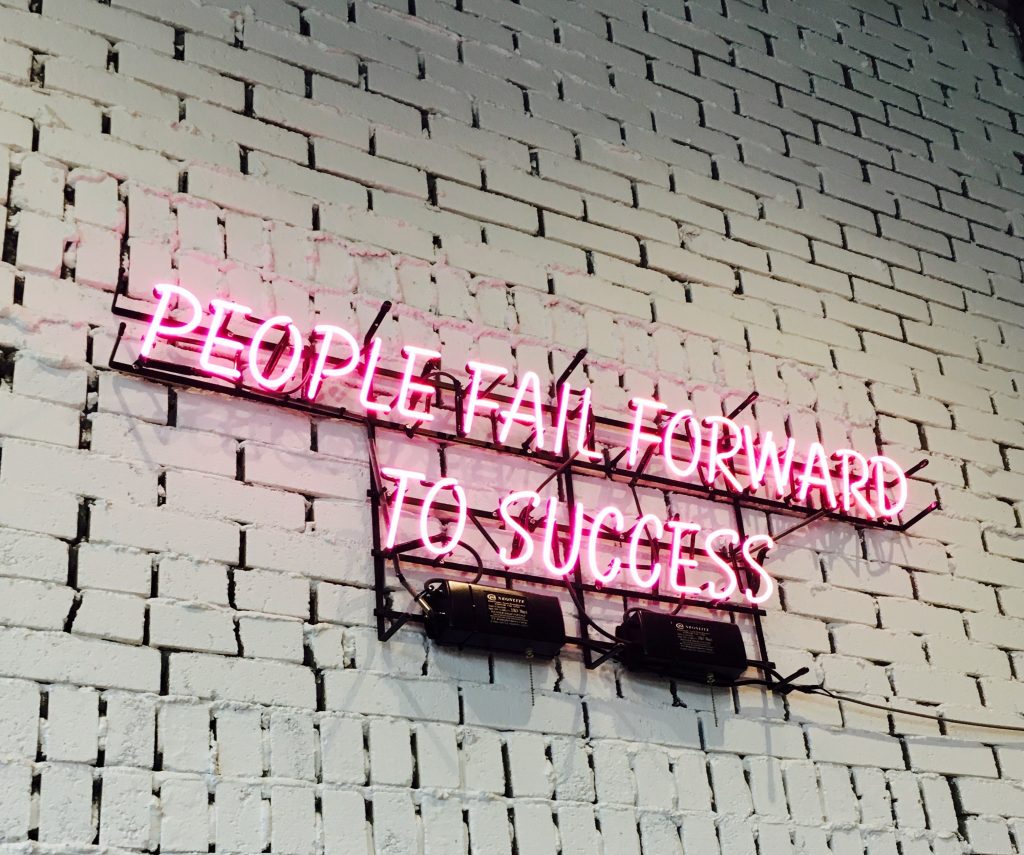
Everyone hates to fail, why do you?

Everyone hates to fail, why do you?

GUEST POST from Janet Sernack

If you have ever had a significant setback, made a serious mistake, or failed at completing an important task, you will have experienced some kind of deep emotional and visceral, largely unconscious, negative, reactive response to it.

By becoming passively or aggressively externally defensive and blaming and punishing others for the outcome, or by withdrawing internally, and attributing self-blame and self-punishment for what may have happened.

Everyone hates to fail because either type of reactive response stings and causes discomfort, dissonance, sorrow, suffering, and pain since you are feeling ashamed, judged, and shamed by yourself and by others. We need to re-think how we approach and digest failure, to scale and leverage it as one of our 21st-century superpowers.

Sabotaging your chances of success

According to a recent article in Psychology Today, this reactive response triggers your avoidance motivation, which then often exceeds your motivation to succeed!

Describing that the fear of failure causes us to then unconsciously sabotage our chances of success, as well as our ability to cultivate and manifest the superpowers necessary to thrive in the 21st century.

Self-doubt settles us into a denying the need to experiment, and a reluctance, full of excuses, to experiment further with adopting, iterating, and testing new and novel ideas. Or in taking smart risks, that help you connect, explore and discover and design opportunities for making important and necessary, personal and professional changes.

Pivot and adapt to disruptive events

Yet, our ability to experiment, test, validate and iterate creative ideas is critical to surviving and thriving through the current decade of both disruption and transformation – which more of us are viewing as a series of relentless, continuous, and exponential changes, requiring unlearning and radically new learning processes.

In a 2021 Deloitte survey of 2,260 private – and public-sector CXOs in 21 countries, 60% of the respondents said that they believe disruptions like those seen in 2020 will continue. The resulting challenge is underscored by another of the survey’s findings:

Seventy percent of the CXOs do not have complete confidence in their organisation’s ability to pivot and adapt to disruptive events.

This confidence can be developed by re-thinking how we approach and digest failure, to scale and leverage it as a 21st-century superpower.

Developing 21st-century superpowers

Here are the four key superpowers, to be supported by digital technologies:

  • Nimbleness: The ability to quickly pivot and move. (“We used to do this, and now we do that.”)
  • Scalability: The ability to rapidly shift capacity and service levels. (“We used to serve x customers; we now serve 100x customers.”)
  • Stability: The ability to maintain operational excellence under pressure. (“We will persist despite the challenges.”)
  • Optionality: The ability to acquire new capabilities through external collaboration. (“Our ecosystem of partners allows us to do things we couldn’t do previously do.”)

Rethinking our fears of failure

None of these 21st-century superpowers can be developed without experimentation and collaboration.

Where you are able to self-regulate your fears of making mistakes and failure, by becoming a smart risk-taker who willingly, stretches the envelope and steps outside of your safety and comfort zones.

This helps maximise your potential and ability to learn and develop in the growth zone, where we stop self-sabotaging our chances of adapting and learning, succeeding, and growing in an uncertain and unstable world.

Everyone hates to fail because it’s hard to self-regulate the basic emotions of disappointment, anger and frustration, and deep shame. Resulting from and the distorted thinking patterns that accompany failure, often immobilising you which results in an unwillingness and inability to disrupt yourself and take intelligent actions.

Slow down to rethink, respond, regroup, play and thrive

It all starts with leading, teaching, mentoring, and coaching people to slow down, to learn, and appreciate the value of taking “time-out” for retreat and reflection.

At ImagineNation, in last week’s blog, we described how this involves developing regular reflective practices, where people can pay deep attention, and learn how to master these basic emotions and unresourceful thought patterns. How this allows them to be playful and experimental in developing new mindsets, rethinking habits, and resourceful emotional states, which are foundational for developing 21st-century superpowers.

Failure can become valued as a process and resource for effecting significant human-centric change, deepening learning, and improving your future fitness.

Consequences of avoiding failure

According to the same article in Psychology today – “shame is a psychologically toxic emotion because instead of feeling bad about our actions (guilt) or our efforts (regret) shame makes us feel who we are”.

By getting to the core of your egos, your identities, your self-esteem, and your feelings of emotional well-being and resourceful thinking habits.

Because everyone hates to fail, we all unconsciously seek ways of mitigating the implications of a potential failure – “for example, by buying unnecessary new clothes for a job interview instead of reading up on the company – which allows us to use the excuse, “I just didn’t have time to fully prepare.”

Benefits of embracing failure

Rather than succumbing to the notion that everyone hates to fail, it is much more useful to develop healthier ways of embracing and flowing with it which might:

  • Motivate you to reflect deeply to consider and deliberate as to what might be the most intelligent and brave actions to take under the range of circumstances you find yourself in.
  • Inspire you to risk-taking those intelligent actions through developing sound risk anticipation, management, and mitigation strategies that help boost your confidence.
  • Commit to doing just a bit more, in inventive ways that add value to the quality of people’s lives as well to your customer’s experience of your product or service.
  • Encourage you to access your multiple and collective intelligence, be more courageous, compassionate, and creative in co-sensing, co-discovering, co-designing, and co-creating innovative solutions to complex problems.
  • Enable you to learn from others, and harness people’s collective intelligence to adapt and grow, through teaming, in ways that serve the common good.

Tips for rethinking and self-regulating fears of failure

A few tips to support you to rethink, respond, regroup and thrive that we will explore more deeply, through real-life stories and examples, in our next two ImagineNation™ blog posts (November and December):

  1. Be willing to redefine and reframe failure as what it means in your unique context, review past failures and see if you can find benefits that resulted from them.
  2. Set approach goals and not avoidance goals to view failure as a challenge that can be mastered.
  3. Control the controllable by intentionally managing your mindsets, shifting any negative perspective, and unpacking distortion and generalisations about failures and their negative consequences.
  4. Imagine yourself doing well, achieving your goals by composing and painting a picture or image of a desirable and compelling future success.
  5. Develop healthy self-compassion for when you do mess up, make mistakes and fail, by being kind and understanding, and empathic to your won humanness.
  6. Focus on every experience, no matter what it brings is an opportunity for deep learning and creative and inventive change.

Rather than living in a world where everyone hates to fail, why not adopt the rethink, respond, regroup, thrive pattern, be future-fit and develop your set of 21st-century superpowers in the face of the acute disruption of COVID-19?

Where it is expected that the business environment, over the next three to five years, will be the most exciting and innovative period that many of us may learn from and experience in our lifetimes?

Want to know why you might have a fear of failure?

Participate in our online research study “Ten Signs you may have a fear of failure” which we adapted from the article “10 Signs That You Might Have Fear of Failure… and 2 ways to overcome it and succeed” by Guy Winch Ph.D. in Psychology Today. Click here to access the survey.

We will happily share the results and findings with you if you leave your name and email address on the form provided. By sharing these details, you will also qualify for a complimentary 30 minute one on one online innovation coaching session, with one of our global professionally certified coaches to help you overcome your own anxieties and fears about failure and develop your 21st-century superpowers.

Join our next free “Making Innovation a Habit” masterclass to re-engage 2022!

Our 90-minute masterclass and creative conversation will help you develop your post-Covid-19 re-engagement strategy.  It’s on Thursday, 10th February at 6.30 pm Sydney and Melbourne, 8.30 pm Auckland, 3.30 pm Singapore, 11.30 am Abu Dhabi and 8.30 am Berlin. Find out more.

Image credit: Unsplash

Subscribe to Human-Centered Change & Innovation WeeklySign up here to get Human-Centered Change & Innovation Weekly delivered to your inbox every week.

You Must Play and Experiment to Create and Innovate

You Must Play and Experiment to Create and Innovate

GUEST POST from Janet Sernack

Growing up in the fashion industry, in 1980’s Paris, I forged an exciting global career and experienced, first hand, a diverse range of the most amazingly innovative fashion presentations ever.  It was the dawn of an explosive era where fashion really mattered and wonderful events became really fantastic happenings featuring a lot of playful and experimental theatrical performances and fabulous guest stars on the catwalk. “From Claude Montana to Thierry Mugler, from Giorgio Armani to Franco Moschino, from Jean Charles de Castelbajac to Christian Lacroix, there were many designers who shaped the aesthetics of the era with their creations and shows” – whose creativity, still impact us across the arts and other key industries today.

Being playful and experimental

Reinforcing that in the arts and other industries, and in our professional and personal lives, newness, creativity, and innovation only happen through people being willing to be both playful and experimental.

This is useful to know, especially with the range of constraints and restrictions occurring globally as a result of fierce governmental reactive response to managing the Covid-19 pandemic. Coupling these with the challenges and limitations of a remote and hybrid workplace, are combining to cause many of us to achingly long for more freedom, fun, play, and adventure.  Yet, many of us, are feeling bound to our laptops, TV’s and kitchens, and are locked within the boundaries of our homes and local neighbourhoods.

It is possible to shift the range of negative feelings that lockdowns produce by exploring possibilities and opportunities for expanding our knowledge and learning, by knowing how to be more playful and experimental, and especially by taking up a set of regular reflective practices.

A unique moment in time

Using this unique moment in time to take up a set of reflective practices to ignite our creative juices and expand our appetite and capacity for creativity.

At the same time, use this moment to explore opportunities to learn and expand our knowledge, because, knowledge plays an important role in the productivity and prosperity of economies, organisations, and individuals and the post-Covid-19 world is going to need a lot of new knowledge in the coming decade of both disruption and transformation.

Expanding our knowledge

Most of us are aware that, our desire to create, and actually be playful and experiential usually involves learning from some kind of direct experience.  Like painting, where our hands are likely to get dirty, where we may produce a number of poor efforts (which we often hide) before we eventually create one, we can accept and live with.

Learning from a direct experience is more effective if coupled with reflection – that is, the intentional attempt to synthesize, abstract, and articulate the key lessons taught by experience.

Where research reveals that the effect of reflection on learning is mediated by a greater perceived ability to achieve a goal in that it improves your confidence, self-belief, and conviction that you can achieve it.

Learning from reflecting on experience

Making the learning experience a playful and experimental one allows us to have fun, in ways that engage our multiple intelligences – our cognitive brains, and heart and gut brains in ways that create meta-shifts that challenge our mental maps.

This also helps us develop our learning agility – “learning what to do when you don’t know what to do” especially important in a world of constant and disruptive change.

Which will especially be a very vital and critical skill set to cultivate in the post-Covid-19 world, where there is no playbook, or reliable template for long-term planning the results we might want, in a disruptive and uncertain future.

Starting with elastic thinking

It starts with developing our elastic thinking skills, where according to Leonard Mlodinow  –  it is now prime time for people to harness the power of “elastic thinking” to navigate an unstable world and underpins our ability to adapt and be creative.

And involves “developing the capacity to let go of comfortable ideas and become accustomed to ambiguity and contradiction; the capability to rise above conventional mindsets and to reframe the questions we ask; the ability to abandon our ingrained assumptions and open ourselves to new paradigms; the propensity to rely on imagination as much as on logic and to generate and integrate a wide variety of ideas; and the willingness to experiment and be tolerant of failure.”

At ImagineNation™ we developed a four-step cognitive process to help people stretch their mental maps, feelings, thinking, behaviours, and actions, enabling them to be playful and experimental by focussing on these key elements that enable reflective practice:

  1. Discovering
  2. Sensemaking
  3. Internalising
  4. Applying

Exploring the role of failing fast

Getting to the creative and innovative outcomes, when playing and experimenting with thinking or acting differently, usually involves some kind of failure, where we fail flat on our faces!

Yet when being brave playful and courageous, and experimenting, you have to be willing to make mistakes and fail. The key is to try out things, and experiment, like children, do, and not worry about what others think and say about you, when you make a mistake or fail.

At the same time, adopting a reflective practice supports our willingness to let go and come from a beginners mind, to unlearn what may have worked previously, whilst being vulnerable and open-hearted, minded and willed to deeply reflect on what happened and what knowledge you may gain and what you might learn from it.

Continuously learning from reflective practice

This means that “work must become more learningful” where an organisations’ or teams’ collective aspiration is set free and people have permission, safety, and trust to be playful and experimental.

To “learn by doing and reflecting” through being:

  • Encouraged to continually expand their capacity to create the results they truly desire,
  • Re-educated to elasticize their thinking and develop new mental maps and where expansive patterns of feeling and thinking are nurtured,
  • Committed to continuously learning how to learn together, at a speed faster than the competition.

Resulting in the intelligence of the organisation or team exceeding the intelligence of individuals in the team and in the organisation, and by harnessing the collective’s capacity to create, invent and innovate through enacting a set of habitual reflective practices.

CCS Cards for play and critical reflection:

As a side note, it’s worth mentioning a tool we like to use that can provide both a sense of play and an opportunity for critical reflection. As many of you may know, CCS Cards are image cards containing a special set of photos, illustrations, and words. Just holding them, sorting them, and talking about what particular cards might mean for you, is an enjoyable, playful activity that often leads to fresh, creative responses.

Furthermore, as a tool for reflective practice, CCS Cards give people a powerful way to recall and recreate their lived experiences by incorporating their feelings and emotions. The cards provide participants with self-selected representations that they can link to all the associated concepts, feelings, words, and actions that were part of the lived experience. Armed with this clearer picture, they are better able to reflect upon and learn from their experience.  The cards also provide an easy way to share and compare their reflections with others, which is vital for effective collaboration.

Bringing together theory and practice

Enacting a set of reflective practices helps us effectively bring together and integrate theory and practice, where through reflection, people are able to:

  • Discover new mental maps, feelings, thoughts, and ideas,
  • Make sense of these in their own context or situation,
  • Internalize and assimilate the impact of these mental maps, thoughts, feelings, and actions by introducing options and choices for being, thinking, and acting differently,
  • Apply that information to add to their existing knowledge base and reach a higher level of understanding,
  • Adapt how they feel, think and act as resources in new, unknown, unexpected, and disruptive situations, as well as in how they plan, implement, and review their actions.

Surely, these might comprise a helpful set of strategies to embrace to help you thrive in these challenging times?

Isn’t there an inherent opportunity for all of us to discover and explore new ways of having more fun, by being playful and experimental?

Perhaps we might discover new ways of adapting and thriving individually and collectively co-create more individual freedom, wonderful fun, and exciting adventures that we are all craving, and become future-fit, in our constantly changing, uncertain, and unstable world.

Find out more about our work at ImagineNation™

Find out about our learning products and tools, including The Coach for Innovators Certified Program, a collaborative, intimate, and deep personalized innovation coaching and learning program, supported by a global group of peers over 9-weeks, starting Tuesday, February 1, 2022. It is a blended and transformational change and learning program that will give you a deep understanding of the language, principles, and applications of an ecosystem focus,  human-centric approach, and emergent structure (Theory U) to innovation, to upskill people and teams and develop their future fitness, within your unique context.

Join our next free “Making Innovation a Habit” masterclass to re-engage 2022!

Our 90-minute masterclass and creative conversation will help you develop your post-Covid-19 re-engagement strategy.  It’s on Thursday, 10th February at 6.30 pm Sydney and Melbourne, 8.30 pm Auckland, 3.30 pm Singapore, 11.30 am Abu Dhabi and 8.30 am Berlin. Find out more.

Image credit: Unsplash

Subscribe to Human-Centered Change & Innovation WeeklySign up here to get Human-Centered Change & Innovation Weekly delivered to your inbox every week.

Creating 21st Century Transformational Learning

Creating 21st Century Transformational Learning

GUEST POST from Janet Sernack

I was privileged to attend one of the first Theory U; Presencing Leadership for Profound Innovation and Change Workshops presented by the Sloane School of Management, in Boston in 2008. This means that I have been able to observe, engage with and participate, from both Israel and Australia, in the evolution of Presencing and Theory U as powerful resources and vehicles for effecting profound transformational change and learning.

Intentional Change and Learning

I have seen and experienced the growth of the global Presencing community, as it transformed from a small, diverse, thought-leading group in the USA, seeding a range of deeply disruptive core concepts, as described in their groundbreaking book – Presence: Human Purpose and the Field of the Future into a global movement.

Where they introduced a radical new theory about change and learning, I also participated in its evolution into its current manifestation, as a global movement for profound transformational change. Which seeks to create, within the whole system, intentional shifts that break old patterns of seeing and acting that continually create results, on a planetary level, that are no longer needed or wanted. Achieving this by encouraging deeper levels of attention and intention, as well as deep and continuous learning, to create an awareness of the larger systemic whole, ultimately leading to us to adopt new and different mindsets, behaviors, actions, and systems that can help to shape our evolution and our futures.

A Turning Point

It is suggested by many, that we are at a turning point, a critical moment in time, where all of us, individually and collectively, have the chance to focus our attention toward activating, harnessing, and mobilizing transformational change and learning to shape our evolution and our futures intelligently. To maximize the emergence, divergence, and convergence of new patterns of consumer and business behaviors that have emerged at extraordinary speed and can be sustained over long periods of time because digitization, coupled with the impact of the global pandemic, have accelerated changes faster than many of us believed previously possible.

Paradoxically, we are facing an uncertain future, where according to the World Economic Forum Job Reset Summit – “While vaccine rollout has begun and the growth outlook is predicted to improve, and even socio-economic recovery is far from certain” no matter where you are located or professionally aligned.

Leveraging the Turning Point

This turning point, is full of possibilities and innovative opportunities potentially enabling organizations, leaders, teams, people, and customers to embrace the opportunity to change and learning in creative and inventive ways to shape our evolution and to co-create our futures, in ways that are:

  • Purposeful and meaningful,
  • Embrace speed, agility, and simplicity,
  • Scale our confidence, capacity, and competence through unlearning, relearning, and innovation.

Resulting in improving equity for all, resilience, sustainability, growth, and future-fitness, in an ever-changing landscape, deeply impacted by the technologies created by accelerated digitization, by putting ourselves into the service of what is wanting to emerge in this unique turning point and moment of time.

Forward-looking leadership

This is validated by the Boston Consulting Group (BCG), who outlined, in a recent article the key strategies employed by most innovative companies in 2021 that “forward-looking leaders soon looked to broader needs affecting their companies’ futures, such as resilience, digital transformation, and customer relevance”.

Realizing, like the authors of Presence: Human Purpose and the Field of the Future, the need to build the systemic ability to drive change, learning and innovation, by transforming their ambitious aspirations into real results through:

  1. Clarifying a clear ambition: that is meaningful and purposeful, compelling and engaging that aligns to people’s values and helps build “one team” mindsets.
  2. Building systemic innovation domains: that are strategically and culturally aligned, enabling people and technology to connect, explore, discover, design, and deliver the ambition through making changes and learning, collective and ecosystems approach that provides clear lines of sight to stakeholders, users, and customers.
  3. Performance management: that acknowledges and rewards collaborative achievements, results in transformational change and learning through smart risk-taking, experimentation and drives accountability, and celebrates success.
  4. Project management: that provides rigor and discipline, through taking a human-centered, and agile approach that allows people and teams to make the necessary shifts in assigning and delivering commercially astute, ambitious, radical, and challenging breakthrough and Moonshot projects.
  5. Talent and culture: by exercising leadership that brings people and teams together, collaborating by fostering openness, transparency, permission, and trust so people can safely unlearn, relearn, adapt and innovate. By supporting and sponsoring change initiatives, by harnessing and mobilizing collective genius, by granting prestige to innovation roles and valuing radical candor, generating discovery and challenges to the status quo.

A Moment in Time

Some thirteen years later, in a recent Letter, Otto Scharmer, one of the original authors of the Presence book, shared with the global Presencing community, that it:

“feels as if we have collectively crossed a threshold and entered a new time. A time that was there already before, but more as a background presence. A time that some geologists proposed to refer to as the Anthropocene, the age of humans. Living in the Anthropocene means that basically all the problems, all the challenges we face on a planetary scale are caused by… ourselves”.

He then stated that “Being alive at such a profound planetary threshold moment poses a critical question to each and every one of us: What is my response to all of this, what is our response to this condition, how am I – and how are we – going to show up at this moment?

Showing up at this moment

Change and learning today involve people, developing their knowledge, mindsets, and behaviors, skills and habits. So, making a fundamental choice about how you wish to show up right now, as a leader or manager, business owner or employee, consultant, trainer, or coach, is crucial to making your contribution and commitment to shaping your own individual, and our collective evolution and our futures.

Taking just a moment

It may, in fact, be beneficial, to take just a moment – to hit your pause button, retreat into reflection, stillness, and silence and ask yourself Otto’s question – how am I, and how are we as a business practice, team or organization going to show up at this moment?

Drawing on my experience as an innovative start-up entrepreneur in Israel, people can either be forced to change and learn through necessity, conflict, and adversity in order to survive. Alternately, they can choose to change through seeing the world with fresh eyes, full of possibility, positivity, optimism, and self-transcendence, to innovate and thrive.

  • How might you develop the courage to make transformational and systemic changes and learning and innovation your key priorities to survive through necessity and adversity, or thrive through unleashing possibilities, optimism, and positivity?
  • How might you develop the compassion to focus on developing both customer and human centricity in ways that are purposefully meaningful and aligned to people’s values and contribute to the good of the whole (people, profit, and planet)?
  • How might you be creative in transforming your time, people, and financial investments in ways that drive out complacency, build change readiness and deliver the deep and continuous change and learning that equips and empowers people to deliver tangible results that are valued, appreciated, and cherished, now and in the future?

Not only to take advantage of the moment in time but to also use transformational change and learning to extend your practice or organizations future fitness and life expectancy, because, according to a recent article in Forbes –  “Half of the giants we now know may no longer exist by the next decade. In 1964, a company on the S&P 500 had an average life expectancy of 33 years. This number was reduced to 24 years in 2016 and is forecast to shrink further to 12 years by 2027”.

This is the final blog in our series of blogs, podcasts, and webinars on Developing a Human-Centric Future-Fitness organization.

Find out about our learning products and tools, including The Coach for Innovators Certified Program, a collaborative, intimate, and deep personalized innovation coaching and learning program, supported by a global group of peers over 8-weeks, starting Tuesday, October 19, 2021.

It is a blended and transformational change and learning program that will give you a deep understanding of the language, principles, and applications of a human-centered approach and emergent structure (Theory U) to innovation, within your unique context.  Find out more

Subscribe to Human-Centered Change & Innovation WeeklySign up here to get Human-Centered Change & Innovation Weekly delivered to your inbox every week.