
Tag Archives: change management

3 Innovation Types Not What You Think They Are

But They Do Determine Your Success

3 Innovation Types Not What You Think They Are

GUEST POST from Robyn Bolton

The Official Story

When discussing innovation, you must be specific so people know what you expect. This is why so many thought leaders, consultants, and practitioners preach the importance of defining different types of innovation.

  • Clayton Christensen encourages focusing on WHY innovation is happening – improve performance, improve efficiency, or create markets – in his 2014 HBR article.
  • The classic Core/Adjacent/Transformational model focuses on WHAT is changing – target customer, offering, financial model, and resources and processes.
  • McKinsey’s 3 Horizons focus on WHEN the results are achieved – this year, 2-3 years, 3-6 years.

It’s easy to get overwhelmed by the options and worry about which approach is “best.”  But, like all frameworks, they’re all a little bit right and a little bit wrong, and the best one is the one that will be used and get results in your organization.

The REAL story

Everything in the official story is true, but not the whole truth.

“Innovation” is not peanut butter. 

You can’t smear it all over everything and expect deliciousness.

When doing innovation, you must remember your customer – the executives who make decisions, allocate resources, and can accelerate or decimate your efforts.

More importantly, you need to remember their Jobs to be Done (JTBD) – keep my job, feel safe and respected, and be perceived as competent/a rising star – because these jobs define the innovations that will get to market.

Three (3) REAL types of innovation

SAFE – The delightful solution to decision-makers’ JTBD

Most closely aligned with Core innovation, improving performance or efficiency, and Horizon 1 because the focus is on improving what exists in a way that will generate revenue this year or next. Decision-makers feel confident because they’ve “been there and done that” (heck, doing “that” is probably what got them promoted in the first place). In fact, they’re more likely to get in trouble for NOT investing in these types of innovations than they are for investing in them.

STRETCH – The Good Enough solution

Most like Adjacent innovation because they allow decision-makers to keep one foot in the known while “stretching” their other foot into a new (to them) area. This type of innovation makes decision-makers nervous because they don’t have all the answers, but they feel like they at least know what questions to ask. Progress will require more data, and decisions will take longer than most intrapreneurs want. But eventually, enough time and resources (and ego/reputation) will be invested that, unless the team recommends killing it, the project will launch.

SPLATTER – The Terrible solution

No matter what you call them – transformational, radical, breakthrough, disruptive, or moonshots – these innovations make everyone’s eyes light up before reality kicks in and crushes our dreams. These innovations “define the next chapter of our business” and “disrupt ourselves before we’re disrupted.”  These innovations also require decision-makers to let go of everything they know and wander entirely into the unknown. To invest resources in the hope of seeing the return (and reward) come back to their successor (or successor’s successor). To defend their decisions, their team, and themselves when things don’t go exactly as planned.

How to find the REAL type that will get real results.

  1. “You said you want X. Would you describe that for me?” (you may need to give examples). When I worked at Clayton Christensen’s firm, executives would always call and ask for our help to create a disruptive innovation. When I would explain what they were actually asking for (something with “good enough” performance and a low selling price that appeals to non-consumers), they would back away from the table, wave their hands, and say, “Oh, not that. We don’t want that.
  2. “How much are you willing to risk?”  If they’re willing to go to their boss to ask for resources, they’re willing to Stretch. If they’re willing to get fired, they’re willing to Splatter. If everything needs to stay within their signing authority, it’s all about staying Safe.
  3. “What would you need to see to risk more?”  As an innovator, you’ll always want more freedom to push boundaries and feel confident that you can convince others to see things your way. But before you pitch Stretch to a boss that wants Safe, or Splatter to a boss barely willing to Stretch, learn what they need to change their minds. Maybe it will be worth your effort, maybe it won’t. Better to know sooner rather than later.

Image credits: Pixabay

Subscribe to Human-Centered Change & Innovation WeeklySign up here to join 17,000+ leaders getting Human-Centered Change & Innovation Weekly delivered to their inbox every week.


Reasons Change Management Frequently Fails

Reasons Change Management Frequently Fails

GUEST POST from Greg Satell

In 1983, McKinsey consultant Julien Phillips published a paper in the journal Human Resource Management that described an “adoption penalty” for firms that didn’t adapt to changes in the marketplace quickly enough. His ideas became McKinsey’s first change management model that it sold to clients.

So it is notable, to say the least, that in 2015, more than 35 years later, McKinsey found that only 26% of organizational transformations succeed. It’s not hard to see why. While traditional change management models offer sensible frameworks for fairly obvious changes, truly transformational efforts almost always encounter fierce resistance.

That’s an important distinction that leads to a significant difference. As I found when researching my book, Cascades, successful transformations identify resistance from the start and effectively plan to overcome opposition. Clearly, today, when change is so often a matter of survival, traditional change management models are no longer enough.

Preparing For Resistance

The change management industry was developed to solve a particular and discrete problem. While there were clear and coherent models for other critical business functions, such as marketing and finance, there was a relative dearth of models to help drive change. Phillips’ model and those that came after sought to fill that gap.

Yet as the McKinsey data clearly shows, those models have not been widely successful and it’s not hard to see why. Much as any competitive strategy that doesn’t anticipate the response from competitors is doomed to failure, any transformation strategy that doesn’t take into account those who oppose change is unlikely to succeed.

In my research, however, I found that when resistance is anticipated and accounted for, transformational efforts can achieve astounding results. At Wyeth Pharmaceuticals, the team implemented lean manufacturing techniques across 17,000 employees and cut costs by 25%. At Experian, CIO Barry Libenson shifted its entire technological infrastructure to the cloud and improved profitability across the entire company.

What made the difference is that in both cases, those leading the transformation didn’t assume that the changes would be embraced. In fact, just the opposite. They expected resistance and built a plan to overcome it.

Mapping The Terrain

Traditional change management models start with steps that encourage communicating the need for change and building a sense of urgency. Yet that can often backfire. While communication efforts can and often do excite many about the prospect for transformation, they also alert the opposition to step up their efforts to undermine change.

So the first step is to map the terrain upon which the battle for change will be fought (and make no mistake, any significant transformation effort is always a battle). There are two tools, borrowed from nonviolent political movements, that can help you do this: The Spectrum of Allies and the Pillars of Support. Both have been battle tested for decades.

The Spectrum of Allies, helps you identify which people are active or passive supporters of the change you want to bring about, which are neutral and which actively or passively oppose it. Once you are able to identify these groups, you can start mobilizing the most enthusiastic supporters to start influencing the other groups to shift their opinions. You probably won’t ever convince the active opposition, but you can isolate and neutralize them.

The Pillars of Support identifies stakeholder groups that can help bring change about. Some of these may be internal stakeholders, such as business units or functional groups within an organization. However, some of the most important stakeholders are often external, such as customer groups, industry associations, regulators and so on.

At this point, you are still planning, rather than implementing change. Most of all, you are listening and remain respectful of others who don’t hold the same views you do. The information you gather in these early stages will be critical for overcoming resistance later on.

The Myth of A Quick Win

One of the key tenets of change management is the need to achieve some quick, short term wins to help build momentum. The truth is that these types of objectives are often not meaningful to many, if not most, key stakeholders. In fact, they can often signal to those skeptical of change that the initiative is not serious.

In my research, I found that every successful transformation I studied identified a keystone change which had a clear and tangible goal, involved multiple stakeholders and paved the way for greater change down the road. Because these require the involvement of multiple stakeholders, they are never quick or easy.

For example, in the Wyeth transformation noted above, the keystone change was to reengineer factory changeovers, a difficult and complex task. In Experian’s shift to cloud technology, the keystone change was to build internal API’s. During Lou Gerstner’s historic turnaround at IBM in the 90s, he sought to shift the company from a “proprietary stack of technologies” to its “customers’ stack of business processes.”

In each case, key constituencies in the Spectrum of Allies were mobilized to influence key institutional stakeholders in the Pillars of Support. That takes time, patience and no small amount of effort. In some cases, it took a few tries to identify a keystone change that could succeed.

Every Revolution Inspires Its Own Counter-Revolution

Many change management efforts start with a large kickoff, complete with a vigorous communication campaign designed to create a sense of urgency and rally the troops. What’s often overlooked is that these efforts often alert those who are opposed to change that they need to begin undermining change efforts before they gain momentum.

As the change efforts gain momentum, these undermining efforts may quiet somewhat, but they very rarely disappear, even after the goals of the transformation have already been achieved. For example, at Blockbuster Video, initial efforts to address the disruptive threat posed by Netflix were successful, but that strategy was quickly reversed when a new CEO came aboard.

That’s why it’s crucial that you set out from the beginning to survive victory and you do that by rooting your efforts not in specific goals or objectives, but in common values. As Irving Wladawsky-Berger, a key player in IBM’s historic turnaround, told me, “Because the transformation was about values first and technology second, we were able to continue to embrace those values as the technology and marketplace continued to evolve.”

Perhaps most of all, you need to remember that there’s a reason that the vast majority of transformational efforts fail: Change is hard and it can’t be easily managed. Yet history has shown that it can be achieved, even under the worst conditions and against the greatest odds, if you learn to anticipate and overcome those who would seek to undermine it.

— Article courtesy of the Digital Tonto blog
— Image credit: Pixabay

Subscribe to Human-Centered Change & Innovation WeeklySign up here to join 17,000+ leaders getting Human-Centered Change & Innovation Weekly delivered to their inbox every week.

How Has Innovation Changed Since the Pandemic?

The Answer in Three Charts

How Has Innovation Changed Since the Pandemic?

GUEST POST from Robyn Bolton

“Everything changed since the pandemic.”

At this point, my husband, a Navy veteran, is very likely to moo (yes, like a cow). It’s a habit he picked up as a submarine officer, something the crew would do whenever someone said something blindingly obvious because “moo” is not just a noise. It’s an acronym – Master Of the Obvious.

But HOW did things change?

From what, to what?

So what?

It can be hard to see the changes when you’re living and working in the midst of them. This is why I found “Benchmarking Innovation Impact, from InnoLead,” a new report from InnoLead and KPMG US, so interesting, insightful, and helpful.

There’s lots of great stuff in the report (and no, this is not a sponsored post though I am a member), so I limited myself to the three charts that answer executives’ most frequently asked innovation questions.

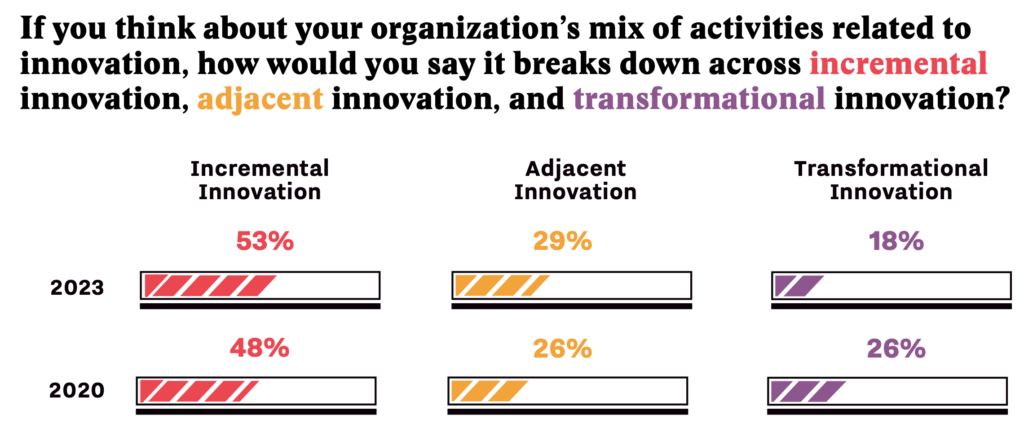
Innovation Leader Research 2023 Chart 1

Question #1: What type of innovation should I pursue?

2023 Answer: Companies are investing more than half of their resources in incremental innovation

So What?:  I may very well be alone in this opinion, but I think this is great news for several reasons:

  1. Some innovation is better than none – Companies shifting their innovation spending to safer, shorter-term bets is infinitely better than shutting down all innovation, which is what usually happens during economic uncertainty
  2. Play to your strengths – Established companies are, on average, better at incremental and adjacent innovation because they have the experience, expertise, resources, and culture required to do those well and other ways (e.g., corporate venture capital, joint ventures) to pursue Transformational innovation.
  3. Adjacent Innovation is increasing –This is the sweet spot for corporate innovation (I may also be biased because Swiffer is an adjacent innovation) because it stretches the business into new customers, offerings, and/or business models without breaking the company or executives’ identities.

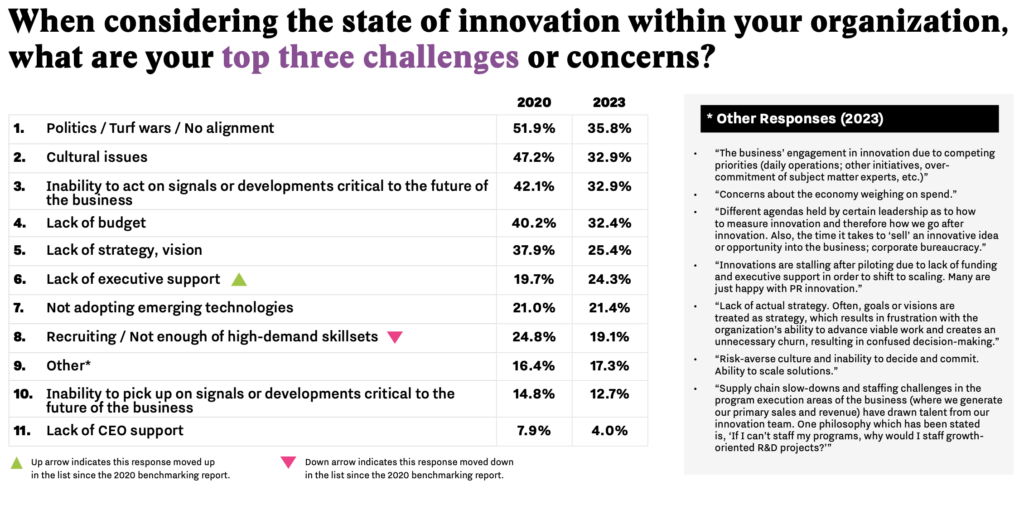
Innovation Leader Research 2023 Chart 2

Question #2: Is innovation really a leadership problem (or do you just have issues with authority)?

2023 Answer: Yes (and it depends on the situation). “Lack of Executive Support” is the #6 biggest challenge to innovation, up from #8 in 2020.

So What?: This is a good news/bad news chart.

The good news is that fewer companies are experiencing the top 5 challenges to innovation. Of course, leadership is central to fostering/eliminating turf wars, setting culture, acting on signals, allocating budgets, and setting strategy. Hence, leadership has a role in resolving these issues, too.

The bad news is that MORE innovators are experiencing a lack of executive support (24.3% vs. 19.7% in 2020) and “Other” challenges (17.3% vs. 16.4%), including:

  • Different agendas held by certain leadership as to how to measure innovation and therefore how we go after innovation. Also, the time it takes to ‘sell’ an innovative idea or opportunity into the business; corporate bureaucracy.”
  • Lack of actual strategy. Often, goals or visions are treated as strategy, which results in frustration with the organization’s ability to advance viable work and creates an unnecessary churn, resulting in confused decision-making.”
  • “Innovations are stalling after piloting due to lack of funding and executive support in order to shift to scaling. Many are just happy with PR innovation.”

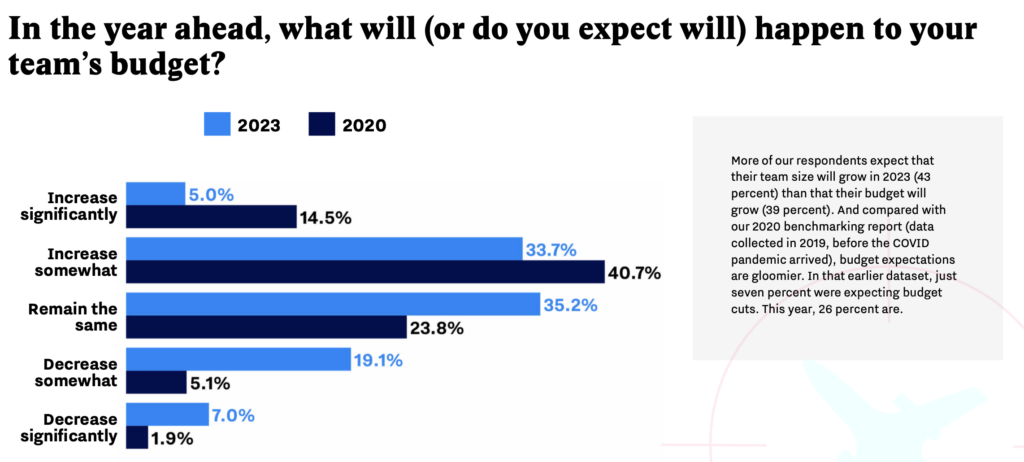
Innovation Leader Research 2023 Chart 3

Question #3: How much should I invest in innovation?

2023 Answer: Most companies are maintaining past years’ budgets and team sizes.

So What?:  This is another good news/bad news set of charts.

The good news is that investment is staying steady. Companies that cut back or kill innovation investments due to economic uncertainty often find that they are behind competitors when the economy improves. Even worse, it takes longer than expected to catch up because they are starting from scratch regarding talent, strategy, and a pipeline.

The bad news is that investment is staying steady. If you want different results, you need to take different actions. And I don’t know any company that is thrilled with the results of its innovation efforts. Indeed, companies can do different things with existing budgets and teams, but there needs to be flexibility and a willingness to grow the budget and the team as projects progress closer to launch and scale-up.

Not MOO

Yes, everything has changed since the pandemic, but not as much as we think.

Companies are still investing in incremental, adjacent, and transformational innovation. They’re just investing more in incremental innovation.

Innovation is still a leadership problem, but leadership is less of a problem (congrats!)

Investment is still happening, but it’s holding steady rather than increasing.

And that is nothing to “moo” at.

Image credits: Pixabay, InnoLead

Subscribe to Human-Centered Change & Innovation WeeklySign up here to join 17,000+ leaders getting Human-Centered Change & Innovation Weekly delivered to their inbox every week.
Take Charge of Your Mind to Reclaim Your Potential

Take Charge of Your Mind to Reclaim Your Potential

GUEST POST from Janet Sernack

In our recent blog, we explored how our focus and attention have been stolen, and how our ability to pay attention is collapsing and described why we need to be intentional in reclaiming it. Yet, many of us are constantly challenged by very short attention spans, where we can often be found sitting at our desks, dealing with a range of very urgent deadlines with a distracted, and unfocussed mind. Despite being intrinsically motivated to meet our deadlines, and being self-aware of needing to focus on completing the tasks in front of us, many of us often still struggle to disrupt and stop our thoughts from wandering randomly and haphazardly. Because, we are no longer being in charge of our minds, our time, or of our cognitive capacities and abilities that help us self-regulate, concentrate and focus our attention, kickstart change, innovate and become resilient.

A recent article in Psychology Today “The War For Your Attention” reinforces this problem by stating:

 “We live in a time when attention has become our most valuable asset, one for which multiple stakeholders are competing. Political parties, media outlets, companies, and individuals want a share of it, and if they can have it, they want it all. As a result, remaining in charge of our minds has become a daily challenge. Our attention defines our experience, which sets the mindset of our minds”.

Become Resilient

Because we don’t know if companies will ever return to their pre-pandemic-like worlds, and what new technologies will emerge, we need to become resilient to be future-fit, in this new world of unknowns.

This requires people to unlearn some of their less resourceful “bad pre and post-pandemic habits” and be:

  • Open towards relearning and reskilling in how to focus, concentrate and observe, and how to manage, direct and expand our attention spans.
  •  Intentional, outcome-focused, and therefore, effective, agile, adaptive, and resilient in an uncertain world full of disruption and crises.

This is reinforced by a recent article “Seizing the momentum to build resilience for a future of sustainable inclusive growth” by McKinsey & Co:

“In the past year, leaders have been confronted with a lifetime’s worth of disruption and crises: global conflict, energy uncertainty, food shortages, accelerating inflation, and severe climate events. Natural and human-made disruptions will only persist. To enable long-term, sustainable, and inclusive growth, today’s business leaders and policymakers must strengthen resilience beyond a survival capacity.”

  • From surviving to thriving

The nature and speed of change are not going to slow down, at the same time, our uncertain world full of disruption and crises is having a harsh psychological toll on everyone, impacting negatively on people’s states of emotional and physical health.

If we want people to thrive, we have to start helping people to live better than we ever have.

Taking the first baby steps requires people to confidently and courageously be, think and act differently.

Starting with empowering and enabling people to take charge of their hearts and minds, and commit to focusing their attention on building their resilience.

The Switch-Cost Effect

In his best-selling book Johann Hari – Stolen Focus, describes how Professor Earl Miller, a specialist in neuroscience, at the Massachusetts Institute of Technology, states that “our brains can only produce one or two thoughts” in our conscious minds at once.

Because “we are very, very single-minded” and have “very limited cognitive capacity.”

  • Multi-tasking is an illusion

The delusion that we can multitask, or juggle a number of thoughts and activities at the same time, is revealed, through robust research, as actually “switching, back and forth.”

He states that we don’t notice the switching because:

“Our brain sort of papers it over to give a seamless experience of consciousness, but what they’re actually doing is switching and reconfiguring their brain moment-to-moment, task-to-task – which comes with a cost.”

  • Losing time to refocus

This is described as the “switch-cost effect” and means that every time we switch tasks while trying to work, we are actually losing a huge amount of time required to concentrate and manage our attention spans to refocus afterward.

“For example, one study at Carnegie Mellon University’s human-computer interaction lab took 136 students and got them to sit a test. Some of them had to have their phones switched off, and others had their phones on and received intermittent text messages. The students who received messages performed, on average, 20% worse. It seems to me that almost all of us are currently losing that 20% of our brainpower, almost all the time. Miller told me that as a result we now live in “a perfect storm of cognitive degradation”.

Reducing Cognitive Degradation

There are a number of simple and obvious ways to reduce our cognitive degradation and heal our unconscious “attention deficit syndromes”, and cognitively reappraise to be in charge of our minds, concentrate and effectively manage our attention spans.

It is also the first step we need to take to empower and enable ourselves and others, in taking charge of our hearts and minds and demonstrating our commitment to focusing our attention and becoming initially resilient.

These simple actions require us to be self-disciplined, methodical, and rigorous and open to re-learning how to concentrate and self-regulated our attention spans by habitually:

  • Stripping out distractions,
  • Ceasing to multi-task,
  • Getting more quality sleep,
  • Taking regular short breaks,
  • Doing brain exercises,
  • Doing physical exercises,
  • Listening to music,
  • Setting priorities,
  • Using a timer.

How to be in charge of our own minds

If we want to cultivate a calmer, coherent, and resourceful psychological state, to achieve the outcomes we want to have in our lives, then focus and place our attention on both what we want to manifest (our intention), and on what we want your attention to move away from, to cease.

  • Attention activates

When choosing to consciously slow down, hit our pause buttons, and retreat into stillness and silence, opens the sacred space, that allows us to reflect, focus and pay deeper attention to the impact of our emotions and beliefs on our thoughts.

We can then also attend to, and break down any unresourceful beliefs, emotions, and cognitive distortions about what we can really and truly influence and control to:

  • Create a more normalised state of equilibrium and calm, get grounded and fully present and manage our attention spans to concentrate on what really matters to us, in ways that are self-compassionate and optimistic about the future.
  • Support ourselves by believing that we can succeed in handling our situations, responsibly, creatively, and effectively.
  • Become resilient by knowing how to respond to events in real-time, anticipate events and problems that may occur in the future, and bounce from adversity whilst processing the insights and learnings gained by conquering key challenges.

Developing Resilience

We can then be in charge of our minds, become resilient, and create a safe space and generosity for others to fully show up and connect with us. We can open our eyes, minds, and hearts to all options, unleash possibilities and opportunities, make smart change choices, and innovate, rather than panicking and retreating from the risks emerging in an uncertain world full of disruption and crises.

Find out about our collective, learning products and tools, including The Coach for Innovators, Leaders, and Teams Certified Program, presented by Janet Sernack, is a collaborative, intimate, and deeply personalized innovation coaching and learning program, supported by a global group of peers over 9-weeks, starting Friday, May 12, 2023.

Image Credit: Pixabay, Pexels

Subscribe to Human-Centered Change & Innovation WeeklySign up here to join 17,000+ leaders getting Human-Centered Change & Innovation Weekly delivered to their inbox every week.
The Life of a Corporate Innovator

As Told in Three Sonnets

The Life of a Corporate Innovator

GUEST POST from Robyn Bolton

Day 1

Oh innovation, a journey just begun

A bold quest filled with challenges, risks, and dreams,

A path of creativity, knowledge and fun,

That will bring change, growth and a brighter scene.

Do not be afraid, though unknowns abound,

For greatness starts with small unsteady steps

Take courage and embrace each change that’s found,

And trust that success will be the final event.

Remember, every challenge is a chance,

To learn, grow, and shape thy future bright,

And every obstacle a valuable dance,

That helps thee forge a path that’s just and right.

So go forth, my friend, and boldly strive,

To make innovation flourish and thrive.

The Abyss (Death and Rebirth)

Fight on corporate innovator, who art so bold

And brave despite the trials that thou hast,

Thou hast persevered through promises cold,

And fought through budget cuts that came so fast.

Thou hast not faltered, nor did thou despair,

Despite the lack of resources at thy door,

Thou hast with passion, worked beyond repair,

And shown a steel spine that’s hard to ignore.

Thou art a shining example to us all,

A beacon of hope in times that are so bleak,

Thou art a hero, standing tall and strong,

And leading us to victories that we seek.

So let us celebrate thy unwavering faith,

And honor thee, innovator of great grace.

The Triumph

My dear intrapreneur, well done,

The launch of thy innovation is a feat,

A result of years of hard work, and fun,

That sets a shining example for all to meet.

Thou hast persevered through many a trial,

With unwavering determination and drive,

And now, thy hard work doth make thee smile,

As thy business doth grow and thrive.

This triumph is a testament to thee,

Of thy creativity, passion, and might,

And serves as a reminder of what can be,

When we pour our hearts into what is right.

So let us raise a glass and celebrate,

Thy success, and the joy innovation hath created!

These sonnets were created with the help of ChatGPT

Image credit: Pixabay

Subscribe to Human-Centered Change & Innovation WeeklySign up here to join 17,000+ leaders getting Human-Centered Change & Innovation Weekly delivered to their inbox every week.
The AI Apocalypse is Here

3 Reasons You Should Celebrate!

The AI Apocalypse is Here

GUEST POST from Robyn Bolton

Whelp, the apocalypse is upon us. Again.

This time the end of the world is brought to you by AI.

How else do you explain the unending stream of headlines declaring that AI will eliminate jobsdestroy the education system, and rip the heart and soul out of culture and the arts? What more proof do you need of our imminent demise than that AI is as intelligent as a Wharton MBA?

We are doomed!

(Deep breath)

Did you get the panic out of your system? Feel better?

Good.

Because AI is also creating incredible opportunities for you, as a leader and innovator, to break through the inertia of the status quo, drive meaningful change, and create enormous value.

Here are just three of the ways AI will help you achieve your innovation goals:

1. Surface and question assumptions

Every company has assumptions that have been held and believed for so long that they hardened into fact. Questioning these assumptions is akin to heresy and done only by people without regard for job security or their professional reputation.

My favorite example of an assumption comes from the NYC public school district whose spokesperson explained the decision to ban ChatGPT by saying, “While the tool may be able to provide quick and easy answers to questions, it does not build critical-thinking and problem-solving skills, which are essential for academic and lifelong success,”

Buried just under the surface of this statement is the assumption that current teaching methods, specifically essays, do build critical thinking and problem-solving skills.

But is that true?

Or have we gotten so used to believing that essays demonstrate critical thinking and problem-solving that we’ve become blind to the fact that most students (yes, even, and maybe especially, the best students) follow the recipe that produces an essay that mirrors teachers’ expectations?

Before ChatGPT, only the bravest teachers questioned the value of essays as a barometer of critical thinking and problem-solving. After ChatGPT, scores of teachers took to Tik Tok and other social media platforms to share how they’re embracing the tool, using it alongside traditional tools like essays, to help their students build skills “essential for academic and lifelong success.”

2. EQ, not IQ, drives success

When all you need to do is type a question into a chatbot, and the world’s knowledge is synthesized and fed back to you in a conversational tone (or any tone you prefer), it’s easier to be the smartest person in the room.

Yes, there will always be a need for deep subject-matter experts, academics, and researchers who can push our knowledge beyond its current frontiers. But most people in most companies don’t need that depth of expertise.

Instead, you need to know enough to evaluate the options in front of you, make intelligent decisions, and communicate those decisions to others in a way that (ideally) inspires them to follow.

It’s that last step that creates an incredible opportunity for you. If facts and knowledge were all people needed to act, we would all be fit, healthy, and have absolutely no bad habits.

For example, the first question I asked ChatGPT was, “Why is it hard for big companies to innovate?” When it finished typing its 7-point answer, I nodded and thought, “Yep, that’s exactly right.”

The same thing happened when I asked the next question, “What should big companies do to be more innovative?”  I burst out laughing when the answer started with “It depends” and then nodded at the rest of its extremely accurate response.

It would be easy (and not entirely untrue) to say that this is the beginning of the end of consultants, but ChatGPT didn’t write anything that wasn’t already written in thousands of articles, books, and research papers.

Change doesn’t happen just because you know the answer. Change happens when you believe the answer and trust the people leading and walking alongside you on the journey.

3. Eliminate the Suck

Years ago, I spoke with Michael. B Jordan, Pixar’s Head of R&D, and he said something I’ll never forget – “Pain is temporary. Suck is forever.”

He meant this, of course, in the context of making a movie. There are periods of pain in movie-making – long days and nights, times when vast swaths of work get thrown out, moments of brutal and public feedback – but that pain is temporary. The movie you make is forever. And if it sucks, it sucks forever,

Sometimes the work we do is painful but temporary. Sometimes doing the work sucks, and we will need to keep doing it forever. Expense reports. Weekly update emails. Timesheets. These things suck. But they must be done.

Let AI do them and free yourself up to do things that don’t suck. Imagine the conversations you could have, ideas you could try, experiments you could run, and people you could meet if you no longer have to do things that suck.

Change is coming. And that’s good news.

Change can be scary, and it can be difficult. There will be people who lose more than they gain. But, overall, we will gain far more than we lose because of this new technology.

If you have any more doubts, I double-checked with an expert.

“ChatGPT is not a sign of the apocalypse. It is a tool created by humans to assist with language-based tasks. While artificial intelligence and other advanced technologies can bring about significant changes in the way we live and work, they do not necessarily signal the end of the world.”

ChatGPT in response to “Is ChatGPT a sign of the apocalypse?”

Image credit: Pixabay

Subscribe to Human-Centered Change & Innovation WeeklySign up here to join 17,000+ leaders getting Human-Centered Change & Innovation Weekly delivered to their inbox every week.

There are Only 3 Reasons to Innovate

Which One is Yours?

There are Only 3 Reasons to Innovate

GUEST POST from Robyn Bolton

You know that innovation is something new that creates value.

(But not too new)

Sometimes the value can be hard to describe, let alone quantify. You know that, ultimately, the value needs to be financial – more revenue, lower costs, higher profit. You also know that the value created in the short term will likely be more intangible – increased satisfaction, improved brand perception, and greater loyalty.

Your challenge, especially in tough economic times, is to tell a story that connects success indicators seen in the short term to the financial returns realized in the long term and maintain support and funding as the story unfolds.

That is a HUGE challenge! One that overwhelms most managers because they don’t know where to start let alone how to maintain support and momentum.

But you are not “most managers.” You know that the best place to start is at the beginning.

What is the Goal of Innovation (i.e., why are we investing in this)?

Goal #1: Create (or keep) a competitive advantage

Innovation is essential because it keeps you ahead of the competition.

Your business is already a leader in something that creates a competitive advantage, and your innovation efforts focus on keeping it that way.

For example, imagine you’re the President of Big Machine Co (BMC). You’ve been in business for decades in an industry with commoditized products, few competitors, high barriers to entry, and medium barriers to switching (i.e., it can be done, but it’s a pain).

You know that customer relationships and loyalty are the fuel that drives your business and why you’re #1 in the market. As a result, you focus your innovation efforts on creating new products or services that deliver unique value to your customers and provide easy and fast resolution to service issues.

Goal #2: Avoid (or overcome) competitive disadvantage

Innovation is essential because it keeps your business alive.

Your business is falling behind the competition either because you’re not keeping up with their pace of innovation or because you’re failing to deliver on table stakes like quality, price, or accessibility. You invest in innovation to catch up to the competition or regain your place in customers’ consideration.

Let’s go back to Big Machine Co.  Because of the amazing growth you achieved as President, you’re now CEO (congrats!). The new President continued your innovation strategy but got so excited by everything new he forgot to pay attention to the “old” things – existing products, manufacturing capabilities, and people. Now, you’re #2 in the market and losing customers at a concerning rate.

It’s time to get back to basics and invest in “new to BMC” innovations by creating products that customers want and competition can already offer, investing in manufacturing equipment and processes that improve efficiency and quality, and retaining people who have the knowledge, experience, and relationships that are the heart of the business.

Goal #3: Build a reputation for being innovative

Innovation is essential because doing it makes the company look good (and executives and shareholders feel good), regardless of whether it produces results.

Your business demands innovation, new news, and big splashes. Your customers want novelty, not perfection. Image is everything, and perception is reality. You invest in innovation to show what’s possible, provoke conversation, and stay in the spotlight.

Believe it or not, this is on your mind as CEO of Big Machine Co.  Your customers demand perfection, not novelty, but they need to shed the perception that they’re boring companies in a boring industry moving at a glacial pace to attract and retain the next generation of talent. You can help.

You look beyond the market to identify trends and technologies in the news but not yet in your industry. You identify the ones that could transform industries and make your customers’ eyes light up with wonder and excitement. You create proof of concept prototypes that make the vision tangible and discuss the plan and timing of the first step toward that vision.

How to Goal Helps

Your reason for innovating informs everything else – your strategy, structure, activities, metrics, and governance.

That is why you can only have one ‘Why’ at a time.

Yes, it’s tempting to try to do a bit of everything, but that often results in achieving nothing.

Think back to Big Machine Co:

  • If the products break, don’t perform as they should, or aren’t available when needed, it doesn’t matter how excellent the customer service is or how cool the new products are. You must achieve Goal #2 (avoid or overcome competitive disadvantage) to earn the right to pursue Goal #1 (create or maintain competitive advantage)
  • If the products are the right quality, perform as expected, and arrive on time but the customer service is poor, and there are no new products, it’s hard to believe that a company that struggles to deliver incremental innovation can deliver on a radically innovative vision. You must make progress against Goal #1 to have permission to pursue Goal #3 (build a reputation).

The next time you face the challenge of connecting your innovation’s short-term success indicators to the long-term financial returns and maintaining support and funding, don’t be overwhelmed.

Go back to the beginning and explain, “It achieves (Goal #) so that we earn the right to invest in (Goal #).”

Image credit: Pixabay

Subscribe to Human-Centered Change & Innovation WeeklySign up here to join 17,000+ leaders getting Human-Centered Change & Innovation Weekly delivered to their inbox every week.

Kickstart Change with Reclaimed Focus and Attention

Kickstart Change with Reclaimed Focus and Attention

GUEST POST from Janet Sernack

In 2019 we experienced the shock and the pain that resulted from the globally disruptive global Covid 19 pandemic. To both survive and thrive in the new decade of uncertainty, many people still need help and guidance to connect to, understand and manage their anxieties, fears, inertia, and confusion about the future to effectively ride the waves of disruptive change. Yet, according to Johann Hari, in his best-selling book – Stolen Focus, all over the world, our focus and attention have been stolen, and our ability to pay attention is collapsing, and we need to be intentional in reclaiming it.

He describes the wide range of consequences this has on our lives, which are further impacted by pervasive and addicting technology we are being forced to use in our virtual world, exasperated by the pandemic and the need to work virtually, from home. He reveals how our dwindling attention spans predate the internet, and how its decline is accelerating at an alarming rate.

He suggests that if we want to get back our ability to focus, stop multitasking and practice paying attention. Also, if we want to kickstart change and help people feel confident in their readiness, competence, and capacity to change and innovate in a world of unknowns, it all starts with improving our ability to pay deep attention to what is really going on.

Yet, in the thesaurus there are 286 synonyms, antonyms, and words related to paying attention, such as: listen, and giving heed, so what might be the key first steps to take in reclaiming your focus and attention?

Power of focus and attention

  • Energy flows where attention goes

Placing our focus and attention activates our energy, and our energy flows where our attention goes.

So, if you have been feeling tired and lethargic, or overwhelmed and burned out, then take a moment to consider how you might score yourself on an attentive-distractive continuum and consider how similar, or different you are to US college students who can now focus on one task for only 65 seconds, and where office workers on average manage only three minutes?

  • Being intentional

Involves getting clear upfront about what you want to achieve, by setting an intention to achieve a specific outcome or result in the future that is important to you.  In a world of unknowns, paying deep attention and being intentional are the key foundations for recovery, rebalance, and transformation.

Limiting ways of seeing, being, and acting in the world  

Many people are still experiencing unconscious intrinsic, or reactive responses to their pandemic-induced work situations and are suffering from stress overload, overwhelm, and burnout.

This is because our autonomic nervous systems, which control our cardiovascular, respiratory, digestive, urinary, and reproductive functions, and responses to stress, operate outside of our conscious control in two different and co-dependent and often competing systems.

  • Parasympathetic fight or flight system

Put very simply, our sympathetic nervous systems get overloaded by heightened stress levels, which ignite our protective fight or flight system, which normally allows our bodies to function under stress and danger, and, as a result, impacts significantly on our levels of tiredness, exhaustion, and burnt-out emotional, mental and physical states.  This exasperates our inherent, unconscious needs to self-preserve (gut), feelings of isolation and loneliness (heat), and having the limited presence of mind (head) and reverts many of us into survival mode, and shift out of alignment, where we become physiologically incoherent (out of balance).

Which is not conducive to knowing and activating what we can truly, really, and actually influence and control in our lives, which requires us to effectively balance chaos with order.

  • Reduced capacity

When operating in survival mode, we are unable (like the US College students) to take the sacred pauses we need to make the space to attend and observe, through retreat, and reflection.

We are no longer able to access our inner knowing, play in the space of possibility, create a normalized state of equilibrium and calm, and be coherent and congruent in our daily lives.

Our overall capacity to set clear goals, make smart decisions, creatively solve problems, courageously take the right actions, harness our intuition, compassionately cultivate understanding and perception, develop good relationships, learn and develop, and finally, our health and well-being, are significantly reduced.

Initiate reclaiming focus and attention

Because we don’t know if companies will ever return to their pre-pandemic-like worlds, and become future-fit, people need to be reskilled in how to focus, how to observe, how to deeply focus and attend, and how to be intentional.

Developing daily habits to be focused and productive

  1. Being intentional about breathing

 To help balance and initiate harmonizing our autonomic nervous systems, develop physiological coherence, to respond optimally to the world, starts with developing focus and attention on your breath.

Doing this helps your neurology to relax, reduce stress and anxiety, increase calmness, and reconnect to the self.

Sounds simple, yet in my global coaching practice, clients would often turn up feeling overwhelmed and incoherent, so we would begin the session with a “box breathing” exercise. This involves breathing while you slowly count to four for a total of four times – four counts of breathing in, four counts of holding your breath, four counts of exhaling, and four more counts of holding after your exhale. We could both be grounded, and coherent, to partner and connect in high-impact and productive sessions.

  1. Being intentional in stepping away from your screens

According to one 2019 survey of 1,057 U.S. office workers, 87 percent of professionals spend most of their workday staring at screens: an average of seven hours a day. Closing your laptop and taking a quick walk outside, in nature allows your brain to recharge for your next task, and enables your autonomic nervous system to take a well-deserved break and calm down.

Sounds simple, yet in my global coaching practice, clients found this very difficult to do, this might involve no TV screens in bedrooms, leaving phones outside bedrooms, turning phones off at 8.00 pm, buying an alarm clock, setting and sticking to a dedicated start and finish work times, taking regular lunch breaks outside in nature and coffee breaks with friends. Be playful and allow your mind to enjoy wandering into wondering.

  1. Working in focused intervals

A recent article in Inc stated that –  “In addition to the seven or eight hours of adequate sleep that so many entrepreneurs and CEOs neglect, taking smart breaks during your workday, and having longer periods of downtime are keys to being more productive”.

Sounds simple, again in my global coaching practice I had to negotiate with clients to be intentionally disciplined and methodical in planning their days, weeks, and months. This involved scheduling time to initiate or sustain a mindfulness or meditation practice, engage in a regular exercise program, go shopping to buy and eat healthy foods (eliminating desk-side snacks), being clear on key deliverables and breaking down key tasks into bite-size bits, and saying no to meetings that don’t contribute towards achieving these.

When we change the way we attend, a different world can come forth, for ourselves, others we are interacting with, and the environment we are operating within. When we know how to really, truly, and deeply attend, and observe, we can go to our place of deeper knowing, rethink and then act swiftly and inflow to effect the transformational breakthroughs that change the world as we know it.

Find out more about our work at ImagineNation™

Find out about our collective, learning products and tools, including The Coach for Innovators, Leaders, and Teams Certified Program, presented by Janet Sernack, is a collaborative, intimate, and deeply personalized innovation coaching and learning program, supported by a global group of peers over 9-weeks, which can be customized as a bespoke corporate learning program.

Image Credit: Pixabay

Subscribe to Human-Centered Change & Innovation WeeklySign up here to join 17,000+ leaders getting Human-Centered Change & Innovation Weekly delivered to their inbox every week.

Kickstarting Change and Innovation in Uncertain Times

Kickstarting Change and Innovation in Uncertain Times

GUEST POST from Janet Sernack

In our last article, we described why innovation is transformational, and why, at this moment in time, it is more important than ever to innovate. We stated that innovation-led growth is absolutely critical and that people need to be enabled and equipped to adapt, connect and collaborate in new ways to kickstart change in agile, constructive, equitable, and sustainable ways to innovate in uncertain times. Yet, our research and experience at ImagineNation™ over the past 10 years has revealed that many governments, communities, organizations, teams, and leaders, feel somewhat – but not very – confident in their readiness, competence, and capacity to change and innovate in a world of unknowns.

Six Strategies to Kickstart Change and Innovate in Uncertain Times

To help build this confidence we have identified six key strategies and the key first steps to help you focus your attention, kickstart change, and drive and execute your change and innovation initiatives, to survive, thrive, and flourish in uncertain times.

Strategy #1

Build change readiness and receptivity to survive and thrive in an uncertain world by:

  • Giving people permission and safety that allows them to accept and acknowledge the range of emotional reactions (fears), physical consequences (exhaustion), and work-life imbalances as a result of the imposed WFH environment.
  • Acknowledging how people are feeling helps them better re-balance, adapt, and become resilient by supporting them to develop a work-life balance to better connect with others, tolerate uncertainty to change, and innovate in uncertain times.
  • Challenging people’s habitual default patterns of remaining in the safety of their comfort zones, breaking habitual “business as usual” habits, inertia, and complacency.
  • Being empathic and compassionate with people’s anxieties, confusion, insecurity, and uncertainties about their futures at work, and supporting them through their personal conflicts.

Strategy #2

Allow, accept and ack knowledge people’s fears and struggles about change, help manage their anxiety, improve their productivity and attune them to the possibilities and potential opportunities in the current business environment by:

  • Providing individual and collective support to enable people to take back and refocus their attention, self-manage anxiety, and become grounded, mindful, and fully present, with self and with others.
  • Investing in time and money to enable people to unlearn, learn and relearn how to be change ready and change-receptive, and become adaptive to effectively facilitate successful business and digital transformation initiatives.
  • Helping people get familiar with the brain’s basic cognitive functions, and build the foundations to help get work done by regulating emotions, suppressing biases, switching tasks, solving complex problems, and thinking creatively.
  • Developing 21st-century skills to shift old mindsets, develop new behaviors and the reasoning, problem-solving, planning, and execution skills to initiate and sustain business, cultural and digital transformation initiatives to embed the changes and to innovate in uncertain times.
  • Developing the fundamental foresight and energizing vision to perceive innovation strategically and systemically, adopting an approach that is holistic, human, and technology-centered, to align, enable, and equip people to adapt and grow and to change and innovate in uncertain times.

Strategy #3

Make sense of innovation, and develop a common understanding and language as to what innovation means in a unique context by:

  • Developing an awareness that innovation is, in itself, a change process, and paradoxically requires rigorous and disciplined change management processes and a chaotic creative and collaborative interchange of ideas.
  • Clarifying an energizing and compelling “why” innovation is important to an overall “cause” developing a passionate purpose and a sense of urgency towards leveraging innovation to achieve long-term success, competitiveness, and growth.
  • Knowing how to both make connections and distinguish and leverage the differences between creativity, invention, and innovation.
  • Building the safety, permission, and trust that helps facilitate, educate and coach people to deal with the emotional consequences of failure, to reframe it as opportunities to encourage a culture of taking small bets to learn quickly.
  • Taking a disciplined and methodical approach to risk planning and management, that allows and encourages a culture of smart risk-taking to reduce risk adversity.
  • Creating a consistent and common understanding as to what innovation means in their unique government, community, social, organizational, leadership, or team context and creating an engaging and compelling narrative around it.

Strategy #4

Optimize the notion that innovation is transformational and leverage it as an overall energizing strategic and systemic alignment mechanism and set of processes to kickstart change by:

  • Improving engagement, energizing and maximizing people’s potential and intentionally cultivating their collective genius to learn how to execute and deliver deep change and innovate in uncertain times.
  • Aligning technological, processes and adopting a human-centered structure for change management to deliver business breakthroughs and digital transformation initiatives.
  • Breaking down silos and supporting people to collaborate; re-connect, re-energize and re-invent themselves in a disrupted world.
  • Maximizing differences and diversity that exist between people’s demographics, cultures, values, perspectives, knowledge, experiences, and skillsets to deliver their desired outcomes.
  • Learning and coaching people to adapt to survive and thrive by solving complex problems, uncertainty, instability, and trends that are constantly emerging.
  • Improving both customer centricity and the customers’ experience.
  • Building accountable, equitable, and sustainable business enterprises that people value, appreciate, and cherish.

Strategy #5

Challenge the status quo and conventional ways of perceiving innovation to unleash the possibilities and the opportunities and kickstart change that true innovation offers by:

  • Taking a strategic perspective in the longer term and the need for investment in innovation, rather than being reactive, and short-term profit-focused.
  • Developing an understanding of the different types of innovation and how they can be applied, including incremental, breakthrough, sustaining, and disruptive, depending on their strategic imperative and motivation for change, and not just focussing on making continuous and process improvements.
  • Improving trust in organizational boards and leadership decisions, reducing self-interest and eliminating corruption, and focussing on being in integrity to successfully empower people in change and innovate in uncertain times.

Strategy #6

Explore opportunities for measuring, benchmarking, and contextualizing the impact of innovation on business performance, leadership, executive team, and organizational ability to adapt, innovate and grow by:

  • Embracing new business models, developing leadership capabilities and collaborative competencies, capacities, and building people’s confidence to perceive their worlds differently, and with fresh eyes.
  • Letting go of “old” 20th century methods of diagnosing and assessing culture, based solely on the “nice to haves” rather than exploring the emerging “must haves” to enable people to survive and thrive by experimenting with new assessment tools like the OGI® and the GLI® to quantify and qualify current and potential strengths and weaknesses.
  • Using data to know what new mindsets, behaviors, and skills to embody and enact, differently to become future-fit and succeed in the 21st century, and accepting that some of these are “not nice”.
  • Cultivating an innovation culture to embed deep change, provide learning and coaching to evoke, provoke and create mindset shifts, behavior and systems changes, and radically new sets of artifacts and symbols.

Taking the first steps to change and innovate in 2023

Embracing a range of new and different strategic and systemic approaches governments, communities, organizations, teams, and leader organizations can successfully kickstart change and innovate in uncertain times.

By using this moment in time to choose to refuse to walk backward and sleepwalk through life, by simply committing to take the first baby steps in allowing and enabling people to pause, retreat, reflect and:

  • Recover from the effects of working mostly alone, from home, and online.
  • Re-balance work and home lives through reconnection and resolving loneliness and rebuilding a sense of belonging.
  • Know how to tolerate uncertainty and become resilient and adaptive.
  • Reimagine and refocus a more energizing, compelling, and sustainable future.
  • Reinvent themselves, their professions, business practices, and teams in meaningful and purposeful ways.

We can then confidently, meaningfully, and purposefully energetically engage and enroll people, mobilize and harness their collective genius, to innovate in uncertain times in ways that add value to the quality of people’s lives in ways they appreciate and cherish.

To kickstart changes that contribute effectively to global stability, security, connectedness, and sustainability in the current decade of transformation and disruption.

Find out about our collective, learning products and tools, including The Coach for Innovators, Leaders, and Teams Certified Program, presented by Janet Sernack, is a collaborative, intimate, and deeply personalized innovation coaching and learning program, supported by a global group of peers over 9-weeks, starting Tuesday, February 7, 2023.

It is a blended and transformational change and learning program that will give you a deep understanding of the language, principles, and applications of an ecosystem focus, human-centric approach, and emergent structure (Theory U) to innovation, and upskill people and teams and develop their future fitness, within your unique innovation context. Find out more about our products and tools.

Image Credit: Unsplash

Subscribe to Human-Centered Change & Innovation WeeklySign up here to get Human-Centered Change & Innovation Weekly delivered to your inbox every week.

The Five Gifts of Uncertainty

The Five Gifts of Uncertainty

GUEST POST from Robyn Bolton

“How are you doing?  How are you handling all this?”

It seems like 90% of conversations these days start with those two sentences.  We ask out of genuine concern and also out of a need to commiserate, to share our experiences, and to find someone that understands.

The connection these questions create is just one of the Gifts of Uncertainty that have been given to us by the pandemic.

Yes, I know that the idea of uncertainty, especially in big things like our lives and businesses, being a gift is bizarre.  When one of my friends first suggested the idea, I rolled my eyes pretty hard and then checked to make sure I was talk to my smart sarcastic fellow business owner and not the Dali Lama.

But as I thought about it more, started looking for “gifts” in the news and listening for them in conversations with friends and clients, I realized how wise my friend truly was.

Faced with levels of uncertainty we’ve never before experienced, people and businesses are doing things they’ve never imagined having to do and, as a result, are discovering skills and abilities they never knew they had.  These are the Five Gifts of Uncertainty

  1. Necessity of offering a vision – When we’re facing or doing something new, we don’t have all the answers. But we don’t need all the answers to take action.  The people emerging as leaders, in both the political and business realms, are the ones acknowledging this reality by sharing what they do know, offering a vision for the future, laying out a process to achieve it, and admitting the unknowns and the variables that will affect both the plan and the outcome.
  2. Freedom to experiment – As governments ordered businesses like restaurants to close and social distancing made it nearly impossible for other businesses to continue operating, business owners were suddenly faced with a tough choice – stop operations completely or find new ways to continue to serve. Restaurants began to offer carry out and delivery.  Bookstores, like Powell’s in Portland OR and Northshire Bookstore in Manchester VT, also got into curbside pick-up and delivery game.  Even dentists and orthodontists began to offer virtual visits through services like Wally Health and Orthodontic Screening Kit, respectively.
  3. Ability to change – Businesses are discovering that they can move quickly, change rapidly, and use existing capabilities to produce entirely new products. Nike and HP are producing face shields. Zara and Prada are producing face masks. Fanatics, makers of MLB uniforms, and Ford are producing gowns.  GM and Dyson are gearing up to produce ventilators. And seemingly every alcohol company is making hand sanitizer.  Months ago, all of these companies were in very different businesses and likely never imagined that they could or would pivot to producing products for the healthcare sector.  But they did pivot.
  4. Power of Relationships – Social distancing and self-isolation are bringing into sharp relief the importance of human connection and the power of relationships. The shift to virtual meetups like happy hours, coffees, and lunches is causing us to be thoughtful about who we spend time with rather than defaulting to whoever is nearby.  We are shifting to seeking connection with others rather than simply racking up as many LinkedIn Connections, Facebook friends, or Instagram followers as possible.  Even companies are realizing the powerful difference between relationships and subscribers as people unsubscribed en mass to the “How we’re dealing with COVID-19 emails” they received from every company with which they had ever provided their information.
  5. Business benefit of doing the right thing – In a perfect world, businesses that consistently operate ethically, fairly, and with the best interests of ALL their stakeholders (not just shareholders) in mind, would be rewarded. We are certainly not in a perfect world, but some businesses are doing the “right thing” and rea being rewarded.  Companies like Target are offering high-risk employees like seniors pregnant women, and those with compromised immune systems 30-days of paid leave.  CVS and Comcast are paying store employees extra in the form of one-time bonuses or percent increases on hourly wages.  Sweetgreen and AllBirds are donating food and shoes, respectively, to healthcare workers.  On the other hand, businesses that try to leverage the pandemic to boost their bottom lines are being taken to task.  Rothy’s, the popular shoe brand, announced on April 13 that they would shift one-third of their production capacity to making “disposable, non-medical masks to workers on the front line” and would donate five face masks for every item purchased.  Less than 12 hours later, they issued an apology for their “mis-step,” withdrew their purchase-to-donate program, and announced a bulk donation of 100,000 non-medical masks.

Before the pandemic, many of these things seemed impossibly hard, even theoretical.  In the midst of uncertainty, though, these each of these things became practical, even necessary.  As a result, in a few short weeks, we’ve proven to ourselves that we can do what we spent years saying we could not.

These are gifts to be cherished, remembered and used when the uncertainty, inevitably, fades.

Image credit: Pixabay

Subscribe to Human-Centered Change & Innovation WeeklySign up here to get Human-Centered Change & Innovation Weekly delivered to your inbox every week.