Tag Archives: change management

AI and Human Creativity Solving Complex Problems Together

AI and Human Creativity Solving Complex Problems Together

GUEST POST from Janet Sernack

A recent McKinsey Leading Off – Essentials for leaders and those they lead email newsletter, referred to an article “The organization of the future: Enabled by gen AI, driven by people” which stated that digitization, automation, and AI will reshape whole industries and every enterprise. The article elaborated further by saying that, in terms of magnitude, the challenge is akin to coping with the large-scale shift from agricultural work to manufacturing that occurred in the early 20th century in North America and Europe, and more recently in China. This shift was powered by the defining trait of our species, our human creativity, which is at the heart of all creative problem-solving endeavors, where innovation is the engine of growth, no matter, what the context.

Moving into Unchartered Job and Skills Territory

We don’t yet know what exact technological, or soft skills, new occupations, or jobs will be required in this fast-moving transformation, or how we might further advance generative AI, digitization, and automation.

We also don’t know how AI will impact the need for humans to tap even more into the defining trait of our species, our human creativity. To enable us to become more imaginative, curious, and creative in the way we solve some of the world’s greatest challenges and most complex and pressing problems, and transform them into innovative solutions.

We can be proactive by asking these two generative questions:

  • What if the true potential of AI lies in embracing its ability to augment human creativity and aid innovation, especially in enhancing creative problem solving, at all levels of civil society, instead of avoiding it? (Ideascale)
  • How might we develop AI as a creative thinking partner to effect profound change, and create innovative solutions that help us build a more equitable and sustainable planet for all humanity? (Hal Gregersen)

Because our human creativity is at the heart of creative problem-solving, and innovation is the engine of growth, competitiveness, and profound and positive change.

Developing a Co-Creative Thinking Partnership

In a recent article in the Harvard Business Review “AI Can Help You Ask Better Questions – and Solve Bigger Problems” by Hal Gregersen and Nicola Morini Bianzino, they state:

“Artificial intelligence may be superhuman in some ways, but it also has considerable weaknesses. For starters, the technology is fundamentally backward-looking, trained on yesterday’s data – and the future might not look anything like the past. What’s more, inaccurate or otherwise flawed training data (for instance, data skewed by inherent biases) produces poor outcomes.”

The authors say that dealing with this issue requires people to manage this limitation if they are going to treat AI as a creative-thinking partner in solving complex problems, that enable people to live healthy and happy lives and to co-create an equitable and sustainable planet.

We can achieve this by focusing on specific areas where the human brain and machines might possibly complement one another to co-create the systemic changes the world badly needs through creative problem-solving.

  • A double-edged sword

This perspective is further complimented by a recent Boston Consulting Group article  “How people can create-and destroy value- with generative AI” where they found that the adoption of generative AI is, in fact, a double-edged sword.

In an experiment, participants using GPT-4 for creative product innovation outperformed the control group (those who completed the task without using GPT-4) by 40%. But for business problem solving, using GPT-4 resulted in performance that was 23% lower than that of the control group.

“Perhaps somewhat counterintuitively, current GenAI models tend to do better on the first type of task; it is easier for LLMs to come up with creative, novel, or useful ideas based on the vast amounts of data on which they have been trained. Where there’s more room for error is when LLMs are asked to weigh nuanced qualitative and quantitative data to answer a complex question. Given this shortcoming, we as researchers knew that GPT-4 was likely to mislead participants if they relied completely on the tool, and not also on their own judgment, to arrive at the solution to the business problem-solving task (this task had a “right” answer)”.

  • Taking the path of least resistance

In McKinsey’s Top Ten Reports This Quarter blog, seven out of the ten articles relate specifically to generative AI: technology trends, state of AI, future of work, future of AI, the new AI playbook, questions to ask about AI and healthcare and AI.

As it is the most dominant topic across the board globally, if we are not both vigilant and intentional, a myopic focus on this one significant technology will take us all down the path of least resistance – where our energy will move to where it is easiest to go.  Rather than being like a river, which takes the path of least resistance to its surrounding terrain, and not by taking a strategic and systemic perspective, we will always go, and end up, where we have always gone.

  • Living our lives forwards

According to the Boston Consulting Group article:

“The primary locus of human-driven value creation lies not in enhancing generative AI where it is already great, but in focusing on tasks beyond the frontier of the technology’s core competencies.”

This means that a whole lot of other variables need to be at play, and a newly emerging set of human skills, especially in creative problem solving, need to be developed to maximize the most value from generative AI, to generate the most imaginative, novel and value adding landing strips of the future.

Creative Problem Solving

In my previous blog posts “Imagination versus Knowledge” and “Why Successful Innovators Are Curious Like Cats” we shared that we are in the midst of a “Sputnik Moment” where we have the opportunity to advance our human creativity.

This human creativity is inside all of us, it involves the process of bringing something new into being, that is original, surprising useful, or desirable, in ways that add value to the quality of people’s lives, in ways they appreciate and cherish.

  • Taking a both/and approach

Our human creativity will be paralysed, if we focus our attention and intention only on the technology, and on the financial gains or potential profits we will get from it, and if we exclude the possibilities of a co-creative thinking partnership with the technology.

To deeply engage people in true creative problem solving – and involving them in impacting positively on our crucial relationships and connectedness, with one another and with the natural world, and the planet.

  • A marriage between creatives, technologists, and humanities

In a recent Fast Company video presentation, “Innovating Imagination: How Airbnb Is Using AI to Foster Creativity” Brian Chesky CEO of Airbnb, states that we need to consider and focus our attention and intention on discovering what is good for people.

To develop a “marriage between creatives, technologists, and the humanities” that brings the human out and doesn’t let technology overtake our human element.

Developing Creative Problem-Solving Skills

At ImagineNation, we teach, mentor, and coach clients in creative problem-solving, through developing their Generative Discovery skills.

This involves developing an open and active mind and heart, by becoming flexible, adaptive, and playful in the ways we engage and focus our human creativity in the four stages of creative problem-solving.

Including sensing, perceiving, and enabling people to deeply listen, inquire, question, and debate from the edges of temporarily hidden or emerging fields of the future.

To know how to emerge, diverge, and converge creative insights, collective breakthroughs, an ideation process, and cognitive and emotional agility shifts to:

  • Deepen our attending, observing, and discerning capabilities to consciously connect with, explore, and discover possibilities that create tension and cognitive dissonance to disrupt and challenge the status quo, and other conventional thinking and feeling processes.
  • Create cracks, openings, and creative thresholds by asking generative questions to push the boundaries, and challenge assumptions and mental and emotional models to pull people towards evoking, provoking, and generating boldly creative ideas.
  • Unleash possibilities, and opportunities for creative problem solving to contribute towards generating innovative solutions to complex problems, and pressing challenges, that may not have been previously imagined.

Experimenting with the generative discovery skill set enables us to juggle multiple theories, models, and strategies to create and plan in an emergent, and non-linear way through creative problem-solving.

As stated by Hal Gregersen:

“Partnering with the technology in this way can help people ask smarter questions, making them better problem solvers and breakthrough innovators.”

Succeeding in the Age of AI

We know that Generative AI will change much of what we do and how we do it, in ways that we cannot yet anticipate.

Success in the age of AI will largely depend on our ability to learn and change faster than we ever have before, in ways that preserve our well-being, connectedness, imagination, curiosity, human creativity, and our collective humanity through partnering with generative AI in the creative problem-solving process.

Find Out More About Our Work at ImagineNation™

Find out about our collective, learning products and tools, including The Coach for Innovators, Leaders, and Teams Certified Program, presented by Janet Sernack, is a collaborative, intimate, and deeply personalized innovation coaching and learning program, supported by a global group of peers over 9-weeks, which can be customised as a bespoke corporate learning program.

It is a blended and transformational change and learning program that will give you a deep understanding of the language, principles, and applications of an ecosystem focus, human-centric approach, and emergent structure (Theory U) to innovation, and upskill people and teams and develop their future fitness, within your unique innovation context. Find out more about our products and tools.

Image Credit: Pixabay

Subscribe to Human-Centered Change & Innovation WeeklySign up here to join 17,000+ leaders getting Human-Centered Change & Innovation Weekly delivered to their inbox every week.


LEGO Knows Why Companies Don’t Innovate

LEGO Knows Why Companies Don't Innovate

GUEST POST from Robyn Bolton

“Lego’s Latest Effort to Avoid Oil-Based Plastic Hits Brick Wall” – WSJ

“Lego axes plans to make bricks from recycled bottles” – BBC

“Lego ditches oil-free brick in sustainability setback” – The Financial Times

Recently, LEGO found itself doing the Walk of Atonement (see video below) after announcing to The Financial Times that it was scrapping plans to make bricks from recycled bottles, and media outlets from The Wall Street Journal to Fast Company to WIRED were more than happy to play the Shame Nun.

And it wasn’t just media outlets ringing the Shame Bell:

  • In the future, they should not make these kinds of announcements (prototype made from recyclable plastic) until they actually do it,” Judith Enck, President of Beyond Plastics
  • They are not going to survive as an organization if they don’t find a solution,” Paolo Taticchi, corporate sustainability expert at University College London.
  • “Lego undoubtedly had good intentions, but if you’re going to to (sic) announce a major environmental initiative like this—one that affects the core of your company—good intentions aren’t enough. And in this instance, it can even undermine progress.” Jesus Diaz, creative director, screenwriter, and producer at The Magic Sauce, writing forFast Company

As a LEGO lover, I am not unbiased, but WOW, the amount of hypocritical, self-righteous judgment is astounding!  All these publications and pundits espouse the need for innovation, yet when a company falls even the tiniest bit short of aspirations, it’s just SHAME (clang) SHAME (clang) SHAME.

LEGO Atlantis 8073 Manta Warrior (i.e., tiny) bit of context

In 1946, LEGO founder Ole Kirk Christiansen purchased Denmark’s first plastic injection molding machine.  Today, 95% of the company’s 4,400 different bricks are made using acrylonitrile butadiene styrene (ABS), a plastic that requires 4.4 pounds of oil to produce 2.2 pounds of brick.  Admittedly, it’s not a great ratio, and it gets worse.  The material isn’t biodegradable or easily recyclable, so when the 3% of bricks not handed down to the next generation end up in a landfill, they’ll break down into highly polluting microplastics.

With this context, it’s easy to understand why LEGO’s 2018 announcement that it will move to all non-plastic or recycled materials by 2030 and reduce its carbon emissions by 37% (from 2019’s 1.2 million tons) by 2032 was such big news.

Three years later, in 2021, LEGO announced that its prototype bricks made from polyethylene terephthalate (PET) bottles offered a promising alternative to its oil-based plastic bricks. 

But last Monday, after two years of testing, the company shared that what was promising as a prototype isn’t possible at scale because the process required to produce PET-based bricks actually increases carbon emissions.

SHAME!

LEGO Art World Map (i.e. massive) amount of praise for LEGO

LEGO is doing everything that innovation theorists, consultants, and practitioners recommend:

  • Setting a clear vision and measurable goals so that people know what the priorities are (reduce carbon emissions), why they’re important (“playing our part in building a sustainable future and creating a better world for our children to inherit”), and the magnitude of change required
  • Defining what is on and off the table in terms of innovation, specifically that they are not willing to compromise the quality, durability, or “clutch power” of bricks to improve sustainability
  • Developing a portfolio of bets that includes new materials for products and packaging, new services to keep bricks out of landfills and in kids’ hands, new building and production processes, and active partnerships with suppliers to reduce their climate footprint
  • Prototyping and learning before committing to scale because what is possible at a prototype level is different than what’s possible at pilot, which is different from what’s possible at scale.
  • Focusing on the big picture and the long-term by not going for the near-term myopic win of declaring “we’re making bricks from more sustainable materials” and instead deciding “not to progress” with something that, when taken as a whole process, moves the company further away from its 2032 goal.

Just one minifig’s opinion

If we want companies to innovate (and we do), shaming them for falling short of perfection is the absolute wrong way to do it.

Is it disappointing that something that seemed promising didn’t work out?  Of course.  But it’s just one of many avenues and experiments being pursued.  This project ended, but the pursuit of the goal hasn’t.

Is 2 years a long time to figure out that you can’t scale a prototype and still meet your goals?  Maybe.  But, then again, it took P&G 10 years to figure out how to develop and scale a perforation that improved one-handed toilet paper tearing.

Should LEGO have kept all its efforts and success a secret until everything was perfect and ready to launch?  Absolutely not.  Sharing its goals and priorities, experiments and results, learnings and decisions shows employees, partners, and other companies what it means to innovate and lead.

Is LEGO perfect? No.

Is it trying to be better? Yes.

Isn’t that what we want?

Image Credit: Pixabay

Subscribe to Human-Centered Change & Innovation WeeklySign up here to get Human-Centered Change & Innovation Weekly delivered to your inbox every week.

The Comforter Cold War of 2006

(or How Assumptions Stifle Innovation)

The Comforter Cold War of 2006

GUEST POST from Robyn Bolton

In the room were two single beds, each with a fluffy white comforter folded neatly on top.

“Yeah, this is not gonna work.”

I had just entered my one-bedroom corporate apartment in Copenhagen, and while everything else was pleasantly light and spacious, there was no way I would spend the next six months sleeping in a single bed.

So, I set down my suitcases and immediately pushed the two beds together, using the two nightstands to secure them. The two comforters would work since there was just one of me, and I made a mental note to request a king-sized comforter from the desk when I left for work in the morning.

Thus began the great Comforter Cold War of 2006/2007.

Every few days, I would request a king-sized comforter for my jerry-rigged king-sized bed.  I would return to find one queen-sized comforter.  The luxury of a larger comforter would diminish the disappointment of not getting an appropriately sized one, and I would bask in the warmth of fully covered sleep.  For one night. The next day, I would return to my room only to find that the two single comforters had returned.

This went on for nine months.

I shared this story of passive-aggressive housekeeping at my going away party with my colleagues. Midway through the story, I noticed the absolutely baffled looks on their faces.

“What?”

“Why did you want one comforter?”

“Because I have one bed.  A comforter should cover the bed.”

“Why?  A bed doesn’t need a comforter.  A person does.  You just need a comforter to cover you.”

[extended silence while we try to process each other’s points]

“So, does that mean that in Denmark, if a couple sleeps together, they each have their own comforter?”

“Yes, of course!  Why would we share?  Each person has their own temperature preferences, and there’s no worry about someone stealing your covers.”

My mind.  Was.  Blown.

This made so much sense. A comforter covers a person, so the 1:1 ratio of comforter to people is far more logical than a 1:1 ratio of comforter to bed (and often a 1:2 ratio of comforter to people).  Seriously, how many relationships would be saved by simply having separate comforters?

Yet, for nine months, it made more sense to me to battle for a comforter size that apparently doesn’t exist in the country without ever asking why I couldn’t get what I was so clearly and reasonably (in my mind) requesting.

I assumed the apartment building didn’t have king-sized comforters or only enough for the actual king-sized beds.  I assumed housekeeping was on automatic pilot, not realizing they were replacing a queen-sized comforter with two single ones.  I assumed that communication amongst the staff was poor, so my request wasn’t being shared.  I assumed a lot.

But I never assumed that I was wrong and that the root of the problem was a cultural difference so deeply ingrained and subtle that it never occurred to anyone to question it.

Question your assumptions.

Assumptions are a shortcut to understanding our world.  Based on culture, experiences, and even stereotypes, we make assumptions about what came before, who we’re interacting with, what’s happening now, and what will happen next.

Most of the time, we’re right (or at least more right than wrong), so we keep making assumptions. It’s also why, when our assumptions are wrong, we tend to question everything but our assumptions.

And that kills innovation because it limits our curiosity and imagination, our perception of what’s possible, and our willingness to engage with and learn from others.

We all cling to assumptions that lead to Cold Wars. 

What’s yours?

Image Credit: Pixabay

Subscribe to Human-Centered Change & Innovation WeeklySign up here to get Human-Centered Change & Innovation Weekly delivered to your inbox every week.

What Einstein Got Wrong

Defining Design

What Einstein Got Wrong - Defining Design

GUEST POST from Robyn Bolton

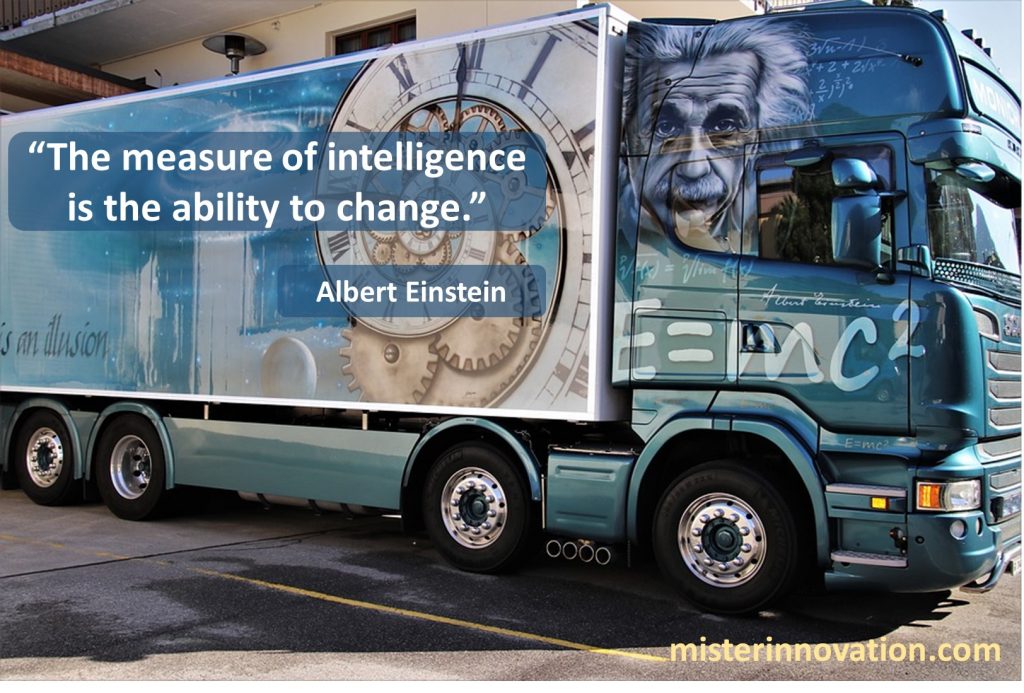
“If you can’t explain something simply, you don’t understand it well enough.”Albert Einstein (supposedly)

This is one of my favorite quotes because it’s an absolute gut punch.  You think you know something, probably because you’ve been saying and doing it for years.  Then someone comes along and asks you to explain it, and suddenly, you’re just standing there, mouth agape, gesturing, hoping that this wacky game of charades produces an answer.

This happened to me last Monday.

While preparing to teach a course titled “Design Innovation Lab,” I thought it would be a good idea to define “design” and “innovation.”  I already had a slide with the definition of “innovation” – something new that creates value – but when I had to make one for “design,” my stomach sank.

My first definition was “pretty pictures,” which is both wrong and slightly demeaning because designers do that and so much more.  My second definition, I know it when I see it, was worse.

So, I Googled the definition.

Then I asked ChatGPT.

Then I asked some designer friends.

No one had a simple definition of Design.

As the clock ticked closer to 6:00 pm, I defaulted to a definition from the International Council of Design:

“Design is a discipline of study and practice focused on the interaction between a person – a “user” – and the man-made environment, taking into account aesthetic, functional, contextual, cultural, and societal considerations.  As a formalized discipline, design is a modern construct.”

Before unveiling this definition to a classroom full of degreed designers pursuing their Master’s in Design, I asked them to define “design.”

It went as well as all my previous attempts.  Lots of thoughts and ideas.  Lots of “it’s this but not that.”  Lots of debate about whether it needs to have a purpose for it to be distinct from art.

Absolutely no simple explanations or punchy definitions.

So, when I unveiled the definition from the very official-sounding International Council of Design, we all just stared at it.

“Yes, but it’s not quite right.”

“It is all those things, but it’s more than just those things.”

“I guess it is a ‘modern construct’ when you think of it as a job, but we’ve done it forever.”

As we squinted and puzzled, what was missing slowly dawned on us. 

There was nothing human in this definition. There was no mention of feelings or empathy, life or nature, connection or community, aspirations or dreams.

In this definition, designers consider multiple aspects of an unnatural environment in creating something to be used. Designers are simply the step before mass production begins.

Who wants to do that?

Who wants to be a stop, however necessary, on a conveyor belt of sameness?

Yet that’s what we become when we strip the humanness out of our work.

Humans are messy, emotional, unpredictable, irrational, challenging, and infuriating.

We’re also interesting, creative, imaginative, hopeful, kind, curious, hard-working, and resilient.

When we try to strip away human messiness to create MECE (mutually exclusive, collectively exhaustive) target markets and customer personas, we strip away the human we’re creating for.

When we ignore unpredictable and irrational feedback on our ideas, we ignore the creative and imaginative answers that could improve our ideas.

When we give up on a challenge because it’s more difficult than expected and doesn’t produce immediate results, we give up hope, resiliency, and the opportunity to improve things.

I still don’t have a simple definition of design, but I know that one that doesn’t acknowledge all the aspects of a human beyond just being a “user” isn’t correct.

Even if you explain something simply, you may not understand it well enough.

Image Credit: Misterinnovation.com

Subscribe to Human-Centered Change & Innovation WeeklySign up here to get Human-Centered Change & Innovation Weekly delivered to your inbox every week.

An Innovation Rant: Just Because You Can Doesn’t Mean You Should

An Innovation Rant: Just Because You Can Doesn’t Mean You Should

GUEST POST from Robyn Bolton

Why are people so concerned about, afraid of, or resistant to new things?

Innovation, by its very nature, is good.  It is something new that creates value.

Naturally, the answer has nothing to do with innovation.

It has everything to do with how we experience it. 

And innovation without humanity is a very bad experience.

Over the last several weeks, I’ve heard so many stories of inhuman innovation that I have said, “I hate innovation” more than once.

Of course, I don’t mean that (I would be at an extraordinary career crossroads if I did).  What I mean is that I hate the choices we make about how to use innovation. 

Just because AI can filter resumes doesn’t mean you should remove humans from the process.

Years ago, I oversaw recruiting for a small consulting firm of about 50 people.  I was a full-time project manager, but given our size, everyone was expected to pitch in and take on extra responsibilities.  Because of our founder, we received more resumes than most firms our size, so I usually spent 2 to 3 hours a week reviewing them and responding to applicants.  It was usually boring, sometimes hilarious, and always essential because of our people-based business.

Would I have loved to have an AI system sort through the resumes for me?  Absolutely!

Would we have missed out on incredible talent because they weren’t out “type?”  Absolutely!

AI judges a resume based on keywords and other factors you program in.  This probably means that it filters out people who worked in multiple industries, aren’t following a traditional career path, or don’t have the right degree.

This also means that you are not accessing people who bring a new perspective to your business, who can make the non-obvious connections that drive innovation and growth, and who bring unique skills and experiences to your team and its ideas.

If you permit AI to find all your talent, pretty soon, the only talent you’ll have is AI.

Just because you can ghost people doesn’t mean you should.

Rejection sucks.  When you reject someone, and they take it well, you still feel a bit icky and sad.  When they don’t take it well, as one of my colleagues said when viewing a response from a candidate who did not take the decision well, “I feel like I was just assaulted by a bag of feathers.  I’m not hurt.  I’m just shocked.”

So, I understand ghosting feels like the better option.  It’s not.  At best, it’s lazy, and at worst, it’s selfish.  Especially if you’re a big company using AI to screen resumes. 

It’s not hard to add a function that triggers a standard rejection email when the AI filters someone out.  It’s not that hard to have a pre-programmed email that can quickly be clicked and sent when a human makes a decision.

The Golden Rule – do unto others as you would have done unto you – doesn’t apply to AI.  It does apply to you.

Just because you can stack bots on bots doesn’t mean you should.

At this point, we all know that our first interaction with customer service will be with a bot.  Whether it’s an online chatbot or an automated phone tree, the journey to a human is often long and frustrating. Fine.  We don’t like it, but we don’t have a choice.

But when a bot transfers us to a bot masquerading as a person?  Do you hate your customers that much?

Some companies do, as my husband and I discovered.  I was on the phone with one company trying to resolve a problem, and he was in a completely different part of the house on the phone with another company trying to fix a separate issue.  When I wandered to the room where my husband was to get information that the “person” I was talking to needed, I noticed he was on hold.  Then he started staring at me funny (not as unusual as you might think).  Then he asked me to put my call on speaker (that was unusual).  After listening for a few minutes, he said, “I’m talking to the same woman.”

He was right.  As we listened to each other’s calls, we heard the same “woman” with the same tenor of voice, unusual cadence of speech, and indecipherable accent.  We were talking to a bot.  It was not helpful.  It took each of us several days and several more calls to finally reach humans.  When that happened, our issues were resolved in minutes.

Just because innovation can doesn’t mean you should allow it to.

You are a human.  You know more than the machine knows (for now).

You are interacting with other humans who, like you, have a right to be treated with respect.

If you forget these things – how important you and your choices are and how you want to be treated – you won’t have to worry about AI taking your job.  You already gave it away.

Image Credit: Pexels

Subscribe to Human-Centered Change & Innovation WeeklySign up here to get Human-Centered Change & Innovation Weekly delivered to your inbox every week.

Your Innovation is Dictated by Who You Are & What You Do

Your Innovation is Dictated by Who You Are & What You Do

GUEST POST from Robyn Bolton

Using only three words, how would you describe your company?

Better yet, what three words would your customers use to describe your company?

These three words capture your company’s identity. They answer, “who we are” and “what business we’re in.”  They capture a shared understanding of where customers allow you to play and how you take action to win. 

Everything consistent with this identity is normal, safe, and comfortable.

Everything inconsistent with this identity is weird, risky, and scary.

Your identity is killing innovation.

Innovation is something new that creates value.

Identity is carefully constructed, enduring, and fiercely protected and reinforced.

When innovation and identity conflict, innovation usually loses.

Whether the innovation is incremental, adjacent, or radical doesn’t matter. If it conflicts with the company’s identity, it will join the 99.9% of innovations that are canceled before they ever launch.

Your identity can supercharge innovation.

When innovation and identity guide and reinforce each other, it doesn’t matter if the innovation is incremental, adjacent, or radical.  It can win.

Identity-based Innovation changes your perspective. 

We typically think about innovation as falling into three types based on the scope of change to the business model:

  1. Incremental innovations that make existing offerings better, faster, and cheaper for existing customers and use our existing business model
  2. Adjacent innovations are new offerings in new categories, appeal to new customers, require new processes and activities to create or use new revenue models
  3. Radical innovations that change everything – offerings, customers, processes and activities, and revenue models

These types make sense IF we’re perfectly logical and rational beings capable of dispassionately evaluating data and making decisions.  SPOILER ALERT: We’re not.  We decide with our hearts (emotions, values, fears, and desires) and justify those decisions with our heads (logic and data).

So, why not use an innovation-typing scheme that reflects our humanity and reality?

That’s where Identity-based Innovation categories come in:

  1. Identity-enhancing innovations reinforce and strengthen people’s comfort and certainty in who they are and what they do relative to the organization.  “Organizational members all ‘know’ what actions are acceptable based on a shared understanding of what the organization represents, and this knowledge becomes codified u a set of heuristics about which innovative activities should be pursued and which should be dismissed.”
  2. Identity-stretching innovations enable and stretch people’s understanding of who they are and what they do in an additive, not threatening, way to their current identities.
  3. Identity-challenging innovations are threats and tend to occur in one of two contexts:
    • Extreme technological change that “results in the obsolescence of a product market or the convergence of multiple product markets.” (challenges “who we are”)
    • Competitors or new entrants that launch new offerings or change the basis of competition (challenges “what we do”)

By looking at your innovations through the lens of identity (and, therefore, people’s decision-making hearts), you can more easily identify the ones that will be supported and those that will be axed.

It also changes your results.

“Ok, nerd,” you’re probably thinking.  “Thanks for dragging me into your innovation portfolio geek-out.”

Fair, but let me illustrate the power of this perspective using some examples from P&G.

OfferingBusiness-Model TypesIdentity-based Categories
Charmin Smooth TearIncremental
Made Charmin easier to tear
Identity-enhancing
Reinforced Charmin’s premium experience
SwifferAdjacent
New durable product in an existing category (floor cleaning)
Identity-enhancing
Reinforced P&G’s identity as a provider of best-in-class cleaning products
Tide Dry CleanersRadical
Moved P&G into services and uses a franchise model
Identity-stretching
Dry cleaning service is consistent with P&G’s identity but stretches into providing services vs. just products

Do you see what happened on that third line?  A Radical Innovation was identity-stretching (not challenging), and it’s in the 0.1% of corporate innovations that launched!  It’s in 22 states!

The Bottom Line

If you look at innovation in the same way you always have, through the lens of changes to your business model, you’ll get the same innovation results you always have.

If you look at innovation differently, through the lens of how it affects personal and organizational identity, you’ll get different results.  You may even get radical results.

Image Credit: Unsplash

Subscribe to Human-Centered Change & Innovation WeeklySign up here to get Human-Centered Change & Innovation Weekly delivered to your inbox every week.

How to Fix Corporate Transformation Failure

How to Fix Corporate Transformation Failure

GUEST POST from Greg Satell

We live in an age in which change has become the only constant. So it’s not surprising that change management models have become popular. Executives are urged to develop a plan to communicate the need for change, create a sense of urgency and then drive the process through to completion.

Unfortunately, the vast majority of these efforts fail and it’s not hard to see why. Anybody who’s ever been married or had kids knows first-hand how difficult it can be to convince even a single person of something. Any effort to persuade hundreds, if not thousands, of people through some kind of mass effort is setting the bar pretty high.

However, as I explain in Cascades, what you can do is help them convince each other by changing the dynamic so that people enthusiastic about change can influence other (slightly less) enthusiastic people. The truth is that small groups, loosely connected, but united by a shared purpose drive transformational change. So that’s where you need to start.

The Power Of Local Majorities

In the 1950’s, the prominent psychologist Solomon Asch undertook a pathbreaking series of conformity studies. The design of the study was simple, but ingenuous. He merely showed people pairs of cards, asking them to match the length of a single line on one card with one of three on an adjacent card. The answer was meant to be obvious.

However, as the experimenter went around the room, one person after another gave the same wrong answer. When it reached the final person in the group (in truth, the only real subject, the rest were confederates), the vast majority of the time that person conformed to the majority opinion, even if it was obviously wrong!

Majorities don’t just rule, they also influence, especially local majorities. The effect is even more powerful when the issue at hand is more ambiguous than the length of a line on a card. More recent research suggests that the effect applies not only to people we know well, but that we are also influenced even by second and third-degree relationships.

So perhaps the best way to convince somebody of something is to surround them with people who hold a different opinion. To extend the marriage analogy a bit, I might have a hard time convincing my wife or daughter, say, that my jokes are funny and not at all corny, but if they are surrounded by people who think I’m hilarious, they’ll be more likely to think so too.

Changing Dynamics

The problem with creating change throughout an organization is that any sufficiently large group of people will hold a variety of opinions about virtually any matter and these opinions tend to be widely dispersed. So the first step in creating large-scale change is to start thinking about where to target your efforts and there are two tools that can help you do that.

The first, called the Spectrum of Allies, helps you identify which people are active or passive supporters of the change you want to bring about, which are neutral and which actively or passively oppose it. Once you are able to identify these groups, you can start mobilizing the most enthusiastic supporters to start influencing the other groups to shift their opinions. You probably won’t ever convince the active opposition, but you can isolate and neutralize them.

The second tool, called the Pillars of Support, identifies stakeholder groups that can help bring change about. In a typical corporation, these might be business unit leaders, customer groups, industry associations, regulators and so on. These stakeholders are crucial for supporting the status quo, so if you want to drive change effectively, you will need to pull them in.

What is crucial is that every tactic mobilizes a specific constituency in the Spectrum of Allies to influence a specific stakeholder group in the Pillars of Support. For example, in 1984, Anti-Apartheid activists spray-painted “WHITES ONLY” and “BLACKS” above pairs of Barclays ATMs in British university town to draw attention to the bank’s investments in South Africa.

This of course, had little to no effect on public opinion in South Africa, but it meant a lot to the English university students that the bank wanted to attract. Its share of student accounts quickly plummeted from 27% to 15% and two years later Barclays pulled out all of its investments from the country, which greatly damaged the Apartheid regime.

Identifying A Keystone Change

Every change effort begins with a grievance: sales are down, customers are unhappy or perhaps a new technology threatens to disrupt a business model. Change starts when leaders are able to articulate a clear and affirmative “vision for tomorrow” that is empowering and points toward a better future.

However, the vision can rarely be achieved all at once. That’s why successful change efforts define a keystone change, which identifies a tangible goal, involves multiple stakeholders and paves the way for future change. A successful keystone change can supercharge your efforts to shift the Spectrum of Allies and pull in Pillars of Support.

For example, when Experian’s CIO, Barry Libenson, set out to shift his company to the cloud, he knew it would be an enormous undertaking. As one of the largest credit bureaus in the world, there were serious concerns that shifting its computing infrastructure would create vulnerabilities in its cybersecurity and its business model.

So rather than embarking on a multi-year death march to implement cloud technology throughout the company, he started with building internal APIs to build momentum. The move involved many of the same stakeholders he would need for the larger project, but involved far less risk and was able to show clear benefits that paved the way for future change.

In Cascades, I detail a number of cases, from major turnarounds at companies like IBM and Alcoa, to movements to gain independence in India and to secure LGBT rights in America. In each case, a keystone change played a major role in bringing change about.

Surviving Victory

As Saul Alinsky pointed out decades ago, every revolution inspires a counterrevolution. So many change efforts that show initial success ultimately fail because of backlash from key stakeholders. That’s why it is crucial to plan how you will survive victory by rooting your change effort in values, skills and capabilities, rather than in specific objectives or tactics.

For example, Blockbuster Video’s initial response to Netflix in 2004 was extremely successful and, by 2007, it was winning new subscribers faster than the upstart. Yet because it rooted its plan solely in terms of strategy and tactics, the changes were only skin deep. After the CEO left because of a compensation dispute, the strategy was quickly reversed. Blockbuster went bankrupt a few years later.

Compare that to the success at Experian. In both cases, large, successful enterprises needed to move against a disruptive threat. In both cases, legacy infrastructure and business models needed to be replaced. At Experian, however, the move was not rooted in a strategy imposed from above, but through empowering the organization with new skills and capabilities.

That made all the difference, because rather than having to convince the rank and file of the wisdom of moving to the cloud, Libenson was able to empower those already enthusiastic about the initiative. They then became advocates, brought others along and, before long, the enthusiasts soon outnumbered the skeptics.

The truth is you can’t overpower, bribe or coerce people to embrace change. By focusing on changing the dynamics upon which a transformation can take place, you can empower those within your organization to drive change themselves. The role of a leaders is no longer to plan and direct action, but to inspire and empower belief.

— Article courtesy of the Digital Tonto blog
— Image credit: Unsplash

Subscribe to Human-Centered Change & Innovation WeeklySign up here to join 17,000+ leaders getting Human-Centered Change & Innovation Weekly delivered to their inbox every week.

Twelve Digital Disruptions of Your Sales Cycle

Twelve Digital Disruptions of Your Sales Cycle

GUEST POST from Geoffrey A. Moore

The good news for a salesperson selling into a disrupted industry is that the forces of change are bringing net new budget dollars to the table. The bad news is, the budgets have not yet landed. In effect, then, there are two kinds of sales opportunities to target. You can go after the landed budgets, the incumbent ones, knowing that they are under assault and will be dwindling, but also knowing that at present they can be deployed quickly and readily. Or, one can go after the much larger budgets that have not yet landed, the ones that will power the future of the target industry and your company’s role within it, but with the knowledge that this is a time-consuming effort that requires a completely different approach from the normal sales motion. Basically then, you can make quota in the short term while marginalizing your company’s future, or you can build a platform for the future while putting quota at much higher risk.

Of course, what we need here is an and not an or. And that is possible, provided executive leadership and compensation programs acknowledge this challenge openly and segment the field of play accordingly. The key distinction is simple. Selling into undisrupted industries requires to you to compete to consume budget, whereas in a disrupted one, you must create to consume budget. The first activity is conducted with middle managers charged with deploying operational budgets as efficiently as possible. The second is conducted with executives seeking to reallocate investment assets to meet the new challenge as effectively as possible. As just noted, these are two very different sales motions, and the challenge facing many sales teams today is that, like it or not, they have to do both, and do both well, if their companies are going to succeed.

The Impact of Digital Disruption on the Sales Cycle:

Here are twelve ways in which selling into a digitally disrupted sector calls for a radically different approach from what marketing, sales, and service teams are used to:

  1. Conventional lead generation does not work. It is based on hooking up with mid-level managers who have influence or authority over RFPs and budgets already in place. These people have no influence or authority over sales cycles involving redeployment of assets into new areas. All they will do is steer you to the old regime. Pursuing leads here will ensure you miss the next wave. And cold calling can’t succeed either. Executives employ people called administrative assistants for the express purpose of blocking your call. Instead you need to enable referrals, where a peer or trusted contact of the target executive enables the introduction.
  2. Product narratives don’t work. They are based on having an established view of the problem and of the competitive set. This is very much the case in non-disrupted industries but never so in disrupted ones. So PowerPoint presentations and demos don’t serve. All they do is disappoint and cause executives to redirect the salesperson back to a mid-level manager and an ever-diminishing established budget. Instead you need problem narratives, stories that surface the critical changes under way and that resonate with the business leaders undergoing them. That’s what the early conversations in the sales cycle need to be about.
  3. We need thought leadership here, people! Executives in disrupted industries are hungry for frameworks that can help them diagnose their new situation, envision a novel solution, and engage with peers to discuss their ideas. Slick slogans and asking “What’s keeping you up at night?” won’t cut it. But any vendor, be it a start-up or an established enterprise, who comes with a useful framework will get a good hearing, and the one whose framework gets adopted gets to orchestrate the others in building out a solution architecture. Narratives really, really matter.
  4. Relationship marketing is fundamental. Executives in disrupted industries are open to forming new relationships and are looking for a trusted advisor. To compete for this role salespeople need to monitor industry developments, personal information, and workflow status in real time so they can bring key issues and ideas to the table in a timely manner.
  5. Let’s get vertical, vertical! Digital disruption is unfolding on an industry by industry basis and manifests itself in ways unique to each one. That means that the early framing conversations need to be couched in the language and issues of the target industry, not the technologies and themes of the vendor’s industry. This requires marketing to develop a whole new set of muscles and sales to learn a new foreign language, which calls in turn for some judicious hiring of insider expertise and a sales training capability to get field teams up to speed fast.
  6. Sales and marketing need to map out a new customer journey. All sales cycles are built on an underlying model of the customer journey. These become the backbone of workflows through any CRM system. The problem in a disrupted industry is that the conventional sales cycle maps are all wrong because the journey is taking a very different route. Sales teams need to work with their counterparts in marketing to map out the new journey and align their sales cycles and their CRM systems to it.
  7. Proof-of-Concepts are necessary but not sufficient. To teams used to selling into non-disrupted markets POCs feel like going back in time, but they are key for disrupted industries where neither the problem diagnosis nor the solution prescription is well established. The challenge here is to manage them judiciously. Conservative forces inside the target customer will try to slow roll things here to buy time, whereas visionary sponsors may be too quick to want to leap to the full implementation. The trick is to make sure they are neither an obstacle to sales progress nor become a destination in and of themselves.
  8. Professional services organizations need to lean in. They have to provide insightful pre-sales consulting on a low-latency, cost-efficient basis, while still maintaining billable utilization via their other work. In addition, they have to take the lead in the first few implementations, where their role is often as not to be the chief spear catcher, and then be prepared to package up their expertise and hand it over to partners just when the projects become predictable and profitable. Running professional services inside a technology company is an incredibly important and almost always thankless endeavor. But as the next point makes clear, it is core.
  9. All offers are services-led—period. In a disrupted industry no one buys a product. The early adopters buy projects and the pragmatic majority buys solutions. Both of these offer types are services led. That means all proposals need to be services led as well. That is, they cannot be about products or even ROI; they have to be about changes under way and the responses needed to address them properly.
  10. All sales motions are land-and-expand. No responsible executive underwrites a massive re-engineering undertaking with a single check, even when they already have established a deep relationship of trust with a particular vendor. Most follow a three-phase approach, where the first phase is to prove feasibility, the second, confirm desirability, and the third, achieve scalability. There is no place in disrupted industries for fly-by selling of any kind.
  11. Customers have to step up too. This means that sales teams need to learn diplomatic ways for holding the customer’s feet to the fire, provoking them when they are not rising to the occasion, and holding them accountable when they do. Often this is best done through third parties, so creating communities of interest and sponsoring dialogs among peers become critical sales enablers.
  12. Change management becomes an integral part of every implementation. Getting the new paradigm adopted is key not only to the customer’s success but to the vendor’s continued expansion within the account as well. Service organizations and partners need to be engaged, enlisted, monitored, and compensated accordingly, and this initially at least has to be orchestrated by the sales team who has the winning proposal.

That’s what I think. What do you think?

Image Credit: Pixabay

Subscribe to Human-Centered Change & Innovation WeeklySign up here to join 17,000+ leaders getting Human-Centered Change & Innovation Weekly delivered to their inbox every week.

An Innovation Lesson From The Rolling Stones

An Innovation Lesson From The Rolling Stones

GUEST POST from Robyn Bolton

If you’re like most people, you’ve faced disappointment. Maybe the love of your life didn’t return your affection, you didn’t get into your dream college, or you were passed over for promotion.  It hurts.  And sometimes, that hurt lingers for a long time.

Until one day, something happens, and you realize your disappointment was a gift.  You meet the true love of your life while attending college at your fallback school, and years later, when you get passed over for promotion, the two of you quit your jobs, pursue your dreams, and live happily ever after. Or something like that.

We all experience disappointment.  We also all get to choose whether we stay there, lamenting the loss of what coulda shoulda woulda been, or we can persevere, putting one foot in front of the other and playing The Rolling Stones on repeat:

“You can’t always get what you want

But if you try sometimes, well, you might just find

You get what you need”

That’s life.

That’s also innovation.

As innovators, especially leaders of innovators, we rarely get what we want.  But we always get what we need (whether we like it or not)

We want to know. 
We need to be comfortable not knowing.

Most of us want to know the answer because if we know the answer, there is no risk. There is no chance of being wrong, embarrassed, judged, or punished.  But if there is no risk, there is no growth, expansion, or discovery.

Innovation is something new that creates value. If you know everything, you can’t innovate.

As innovators, we need to be comfortable not knowing.  When we admit to ourselves that we don’t know something, we open our minds to new information, new perspectives, and new opportunities. When we say we don’t know, we give others permission to be curious, learn, and create. 

We want the creative genius and billion-dollar idea. 
We need the team and the steady stream of big ideas.

We want to believe that one person blessed with sufficient time, money, and genius can change the world.  Some people like to believe they are that person, and most of us think we can hire that person, and when we do find that person and give them the resources they need, they will give us the billion-dollar idea that transforms our company, disrupts the industry, and change the world.

Innovation isn’t magic.  Innovation is team work.

We need other people to help us see what we can’t and do what we struggle to do.  The idea-person needs the optimizer to bring her idea to life, and the optimizer needs the idea-person so he has a starting point.  We need lots of ideas because most won’t work, but we don’t know which ones those are, so we prototype, experiment, assess, and refine our way to the ones that will succeed.   

We want to be special.
We need to be equal.

We want to work on the latest and most cutting-edge technology and discuss it using terms that no one outside of Innovation understands. We want our work to be on stage, oohed and aahed over on analyst calls, and talked about with envy and reverence in every meeting. We want to be the cool kids, strutting around our super hip offices in our hoodies and flip-flops or calling into the meeting from Burning Man. 

Innovation isn’t about you.  It’s about serving others.

As innovators, we create value by solving problems.  But we can’t do it alone.  We need experienced operators who can quickly spot design flaws and propose modifications.  We need accountants and attorneys who instantly see risks and help you navigate around them.  We need people to help us bring our ideas to life, but that won’t happen if we act like we’re different or better.  Just as we work in service to our customers, we must also work in service to our colleagues by working with them, listening, compromising, and offering help.

What about you?
What do you want?
What are you learning you need?

Image Credit: Unsplash

Subscribe to Human-Centered Change & Innovation WeeklySign up here to get Human-Centered Change & Innovation Weekly delivered to your inbox every week.

3 Ways to View Your Innovation Basket

(including one that makes Radical Innovation easy)

3 Ways to View Your Innovation Basket

GUEST POST from Robyn Bolton

You are a rolling stone, and that means you gather no moss!  You read the September issue of HBR (and maybe last week’s article), tossed out your innovation portfolio, and wove yourself an innovation basket to “differentiate the concept from finance and avoid the mistake of treating projects like financial securities, where the goal is usually to maximize returns through diversification [and instead] remember that innovation projects are creative acts.”   

Then you explained this to your CFO and received side-eye so devastating it would make Sophie Loren proud.

The reality is that the innovation projects you’re working on are investments, and because they’re risky, diversification is the best way to maximize the returns your company needs.

But it’s not the only way we should communicate, evaluate, and treat them.

Different innovation basket views for different customers

When compiling an innovation basket, the highest priority is having a single source of truth.  If people in the organization disagree on what is in and out of the basket, how you measure and manage the portfolio doesn’t matter.

But a single source of truth doesn’t mean you can’t look at that truth from multiple angles.

Having multiple views showing the whole basket while being customized to address each of your internal customer’s Jobs to be Done will turbocharge your ability to get support and resources.

The CFO: What returns will we get and when?

The classic core/adjacent/transformational portfolio is your answer.  By examining each project based on where to play (markets and customers) and how to win (offerings, profit models, key resources and activities), you can quickly assess each project’s relative riskiness, potential return, time to ROI, and resource requirements.

The CEO: How does this support and accelerate our strategic priorities?

This is where the new innovation basket is most helpful.  By starting with the company’s strategic goals and asking, “What needs to change to achieve our strategy?” leadership teams immediately align innovation goals with corporate strategic priorities.  When projects and investments are placed at the intersection of the goal they support, and the mechanism of value creation (e.g., product, process, brand), the CEO can quickly see how investments align with strategic priorities and actively engage in reallocation decisions.

You: Will any of these ever see the light of day?

As much as you hope the answer is “Yes!”, you know the answer is “Some.  Maybe.  Hopefully.”  You also know that the “some” that survive might not be the biggest or the best of the basket.  They’ll be the most palatable.

Ignoring that fact won’t make it untrue. Instead, acknowledge it and use it to expand stakeholders’ palates.

Start by articulating your organization’s identity, the answers to “who we are” and “what we do.” 

Then place each innovation in one of three buckets based on its fit with the organization’s identity:

  • Identity-enhancing innovations that enhance or strengthen the identity
  • Identity-stretching innovations that “do not fit with the core of an organization’s identity, but are related enough that if the scope of organizational identity were expanded, the innovation would fit.”
  • Identity-challenging innovations that are “in direct conflict with the existing organizational identity.”

It probably won’t surprise you that identity-enhancing innovations are far more likely to receive internal support than identity-challenging innovations.  But what may surprise you is that core, adjacent, and transformational innovations can all be identity-enhancing.

For example, Luxxotica and Bausch & Lomb are both in the vision correction industry (eyeglasses and contact lenses, respectively) but have very different identities.  Luxxotica views itself as “an eyewear company,” while Bausch & Lomb sees itself as an “eye health company” (apologies for the puns). 

When laser-vision correction surgery became widely available, Bausch & Lomb was an early investor because, while the technology would be considered a breakthrough innovation, it was also identity-enhancing.  A decade later, Bausch & Lomb’s surgical solutions and ophthalmic pharmaceuticals businesses account for 38% of the company’s revenue and one-third of the growth.

One basket.  Multiple Views.  All the Answers.

Words are powerful, and using a new one, especially in writing,  can change your behavior and brain. But calling a portfolio a basket won’t change the results of your innovation efforts.  To do that, you need to understand why you have a basket and look at it in all the ways required to maximize creativity, measure results, and avoid stakeholder side-eye.

Image Credit: Pixabay

Subscribe to Human-Centered Change & Innovation WeeklySign up here to get Human-Centered Change & Innovation Weekly delivered to your inbox every week.