9 Reasons Digital Transformations Stall After the Pilot

9 Reasons Digital Transformations Stall After the Pilot

by Braden Kelley and Chateau G Pato


Why Do Digital Transformations Stall After the Pilot? (Short Answer)

Most digital transformations stall after the pilot because leaders confuse technical proof with organizational readiness. A successful demo shows something can work. Scaling requires named owners, redesigned work, aligned incentives, data and integration, change capacity, the courage to kill shadow processes — and the political will to live differently. The pilot was never the hard part.

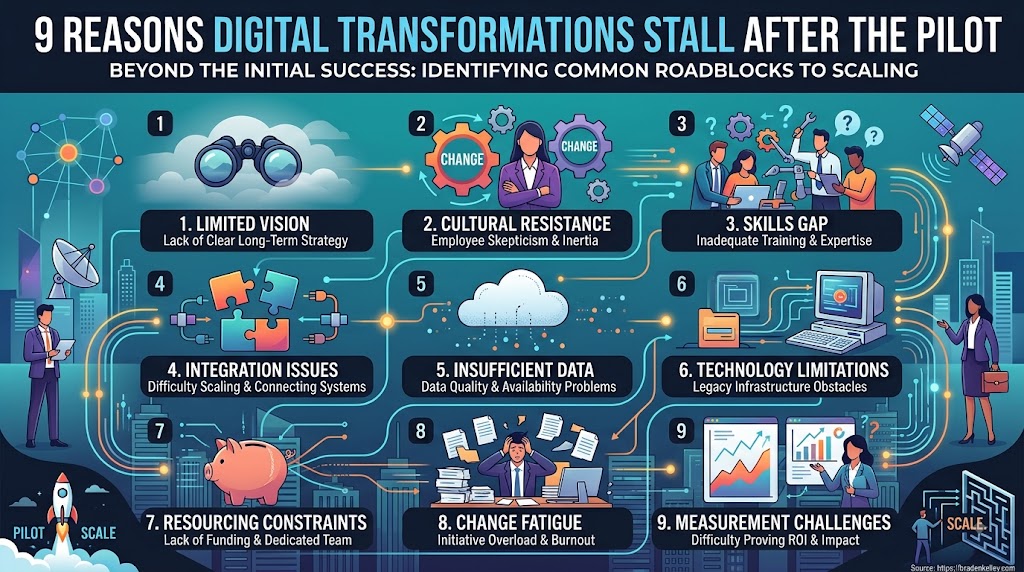
The nine common reasons transformations stall are: (1) proof mistaken for readiness, (2) no named owner of the new way of working, (3) work redesign skipped, (4) incentives still reward old metrics, (5) data and integration debt, (6) change treated as communications, (7) shadow processes never killed, (8) pilot heroes ≠ scale reality, and (9) fear of the political cost of winning.

The Pilot Was Never the Hard Part

I have watched too many rooms celebrate a green pilot as if the transformation were already over. The interface worked. The select users smiled. The slide said “validated.” Then Monday arrived for everyone else — average managers, messy data, conflicting KPIs, and a legacy workaround that refused to die.

Human-centered change treats that gap as designable, not mysterious. Below are nine stall patterns I see repeatedly, what each looks like, and what real transformers do instead.

Reason Common sign What to do instead
1. Proof ≠ readiness “It worked” used as scale approval Require an adoption/scale scorecard
2. No durable owner Project ends; BAU orphaned Name a workflow owner with rights
3. No work redesign New tool, old handoffs Redesign jobs and decisions first
4. Old incentives KPIs punish new behavior Align metrics to transformed outcomes
5. Integration debt Pilot used clean workarounds Fund data/integration as scale work
6. Change = decks Training without practice time Build change muscle and coaching
7. Shadow process lives Old path still easiest Kill legacy paths on purpose
8. Heroics don’t scale A-team pilot, average-team crash Design for the median user
9. Political avoidance Endless “learning” Govern winners/losers in the open

1. Proof Mistaken for Readiness

What it is: Treating a successful pilot as proof the organization is ready to scale.

The stall: “It worked” becomes a funding sentence. Feasibility gets confused with operability. Leaders skip the boring questions about volume, exceptions, support load, and who changes how they spend Tuesday.

What to do instead: Separate technical validation from operating-model readiness. Before scale money, require an adoption and scale scorecard: owners, workflows, incentives, data path, support model, and stop rules for the old way.

2. No Named Owner of the New Way of Working

What it is: The transformation has a project manager — and no durable operator once the project ends.

The stall: Sponsorship was energetic in kickoff season. Then the program office demobilizes, and business-as-usual inherits a half-changed process with no one empowered to keep improving it.

What to do instead: Assign a named workflow owner with decision rights before scale funding. If nobody owns the new way after applause, you do not have a transformation. You have a temporary exhibit.

3. Work Redesign Skipped — Tool Bolted onto Old Process

What it is: Installing new technology on top of unchanged handoffs, policies, and approvals.

The stall: Same friction, prettier screens. People invent local workarounds because the system still asks them to do impossible coordination. Digitization accelerates the old mess.

What to do instead: Redesign jobs, handoffs, and decisions first. Technology should serve the human system you intend to run — not freeze the system you meant to leave.

4. Incentives Still Reward the Old Metrics

What it is: Asking people to adopt new behaviors while KPIs, bonuses, and recognition still pay for the old ones.

The stall: Managers optimize what still gets measured — speed-to-close, local utilization, ticket deflection theater — even when those metrics punish quality, collaboration, or customer effort in the new model.

What to do instead: Align metrics and recognition to transformed outcomes: adoption quality, end-to-end cycle time, customer/employee effort, first-time resolution, revenue or risk outcomes tied to the journey — not activity that photographs well.

5. Data and Integration Debt Comes Due

What it is: Pilots that succeed on clean samples, manual stitches, or heroic data wrangling collapse under production reality.

The stall: Scale exposes fragmented systems, inconsistent definitions, and brittle interfaces. The “digital” experience becomes a queue of exceptions.

What to do instead: Fund data quality and integration as first-class scale work — not a vague phase two. If the pilot needed spreadsheet glue, assume production needs architecture, not optimism.

6. Change Capacity Treated as Communications

What it is: Substituting town halls, slide decks, and one-time training for the real work of building new skills and habits.

The stall: People were informed. They were not enabled. Managers never got coaching time. Role anxiety filled the gap that practice should have filled.

What to do instead: Build change muscle: champions, spaced practice, protected learning time, manager enablement, and clear stories about how roles evolve. Communication is necessary. It is not capacity.

7. Shadow Process Never Gets Killed

What it is: Leaving the old spreadsheet, email path, or “temporary” workaround alive “just in case.”

The stall: Adoption stays optional. The easy path is still the legacy path. Leaders wonder why usage is soft while the organization quietly runs two operating systems.

What to do instead: Write stop criteria for shadow processes. Make the new way the only easy way. If you cannot turn something off, you have not finished the design of scale.

8. Pilot Team ≠ Scale Team — Heroics Don’t Industrialize

What it is: A hand-picked A-team succeeds in the pilot; average teams inherit complexity without the same support.

The stall: What worked for enthusiasts fails for the median user and median manager. Support tickets spike. Leaders blame “resistance” instead of design for the middle of the bell curve.

What to do instead: Design for the median. Staff enablement and operations for steady state. If only heroes can run it, it is not a transformation asset — it is a dependency on burnout.

9. Fear of the Political Cost of Winning

What it is: Avoiding scale because success would force real tradeoffs — turf, vendors, pet projects, or status stories that cannot survive daylight.

The stall: The organization stays in luxurious “learning mode.” Another pilot. Another vendor bake-off. Another steering committee. Progress becomes a lifestyle of almost.

What to do instead: Surface winners and losers early. Govern tradeoffs in the open. Use kill criteria as leadership hygiene. Transformation is not only a technology journey. It is a power redesign with manners.

How Do You Scale a Digital Pilot Without Stalling?

Before you fund the next wave, run a soft-landing go/no-go. Say no — or not yet — unless you can answer yes to these:

  1. Who owns the new workflow after the program ends?
  2. What human behavior must change for scale to count as success?
  3. What old path will we turn off, and when?
  4. Is integration and data readiness funded as core work, not hope?
  5. Do incentives and manager routines reinforce the new way?

A pilot proves possibility. Transformation proves the organization can live differently. If you want digital change that lands with customers and employees, stop celebrating demos as destinations — and start designing the human system that has to carry the future on a normal Tuesday.

Frequently Asked Questions

Why do digital transformations stall after the pilot?

They stall when leaders treat technical pilot success as organizational readiness. Scaling fails without durable owners, redesigned work, aligned incentives, data/integration, change capacity, retired shadow processes, design for average users, and political willingness to make tradeoffs.

What is the difference between a successful pilot and a scalable transformation?

A successful pilot proves something can work under controlled conditions. A scalable transformation proves the organization can run the new way of working in production — with owners, incentives, data plumbing, adoption support, and the old path intentionally shut down.

How do you scale a digital pilot successfully?

Name a workflow owner, redesign jobs and handoffs, align metrics, fund integration and data quality, build real change capacity, kill shadow processes, design for the median user, and govern political tradeoffs openly before expanding volume.

What are common reasons digital transformation fails after a pilot?

Nine common reasons include mistaking proof for readiness, lacking a durable owner, skipping work redesign, keeping old incentives, hitting data/integration debt, treating change as communications, leaving shadow processes alive, relying on pilot heroics, and avoiding the politics of winning.

What should leaders check before funding digital transformation scale-up?

Leaders should confirm ownership after the program, the human behavior that defines success, which legacy paths will be turned off, whether integration/data work is funded, and whether incentives and manager routines reinforce the new operating model.

Image credits: Google Gemini

Content Authenticity Statement: The topic area, key elements to focus on, etc. were decisions made by Braden Kelley, with a little help from Google Gemini and Cursor to clean up the article, add images and create infographics.

Subscribe to Human-Centered Change & Innovation WeeklySign up here to get Human-Centered Change & Innovation Weekly delivered to your inbox every week.
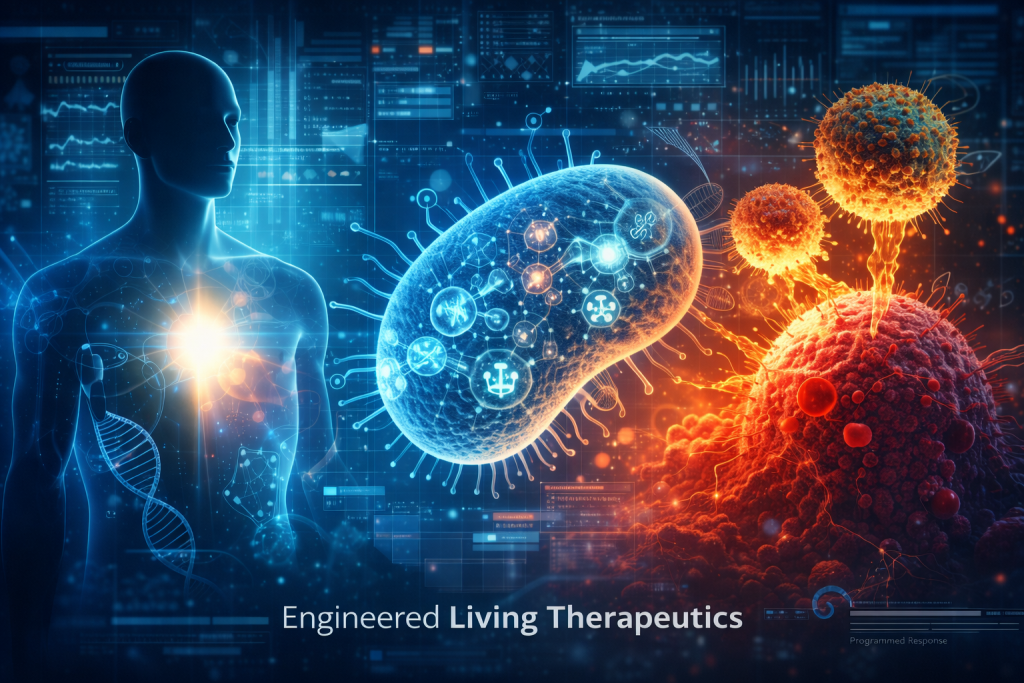
How Engineered Living Therapeutics Are Redefining Healthcare

The Living Cure

LAST UPDATED: January 29, 2026 at 5:38 PM

How Engineered Living Therapeutics Are Redefining Healthcare

GUEST POST from Art Inteligencia

For centuries, medicine has been about chemistry — pills and potions designed to intervene in biological processes. But what if the medicine itself could think? What if it could adapt? What if it was alive? This isn’t science fiction; it’s the audacious promise of Engineered Living Therapeutics (ELTs), and it represents a paradigm shift in human-centered healthcare that will redefine our relationship with illness.

As a thought leader in human-centered change and innovation, I’ve seen countless industries disrupted by radical new approaches. Biotechnology is no exception. ELTs are not merely advanced drugs; they are biological systems, often engineered microbes or cells, programmed to perform specific therapeutic functions within the body. This is innovation at its most profound: leveraging the inherent intelligence and adaptability of life itself to heal.

Beyond the Pill: The Intelligence of Living Medicine

Traditional pharmaceuticals often act as blunt instruments, targeting specific pathways with limited specificity and potential side effects. ELTs, by contrast, offer a level of precision and dynamic response previously unimaginable. Imagine a therapy that can detect disease markers, produce therapeutic compounds only when needed, or even self-regulate its activity based on the body’s changing state. This intelligent adaptability is what makes ELTs a truly human-centered approach to healing, tailoring treatment to the unique, fluctuating biology of each individual.

“The future of medicine isn’t just about what we put into the body; it’s about what we awaken within it. Engineered Living Therapeutics aren’t just treatments; they’re collaborations with our own biology.”

— Braden Kelley

Case Study I: Reprogramming the Gut for Metabolic Health

A burgeoning area for ELTs lies within the human microbiome. Consider the challenge of chronic metabolic diseases like Type 2 Diabetes. Current treatments often manage symptoms without addressing underlying dysregulation. One biotech startup engineered a strain of probiotic bacteria to reside in the gut. This engineered bacterium was programmed to sense elevated glucose levels and, in response, produce and deliver an insulin-sensitizing peptide directly within the intestinal lumen.

This targeted, localized intervention offered a novel way to manage blood sugar, reducing the systemic side effects associated with orally administered drugs. The innovation here wasn’t just a new molecule, but a living delivery system that dynamically responded to the body’s needs, representing a truly personalized and responsive therapy.

Case Study II: Targeted Oncology with “Smart” Cells

Cancer treatment remains one of medicine’s most formidable challenges. While CAR T-cell therapy has revolutionized certain hematological cancers, ELTs are pushing the boundaries further. Imagine immune cells engineered not only to identify cancer cells but also to produce potent anti-cancer molecules directly at the tumor site, or even to activate other immune cells to join the fight.

One research initiative is exploring tumor-infiltrating lymphocytes (TILs) engineered to express specific receptors that bind to unique tumor antigens and simultaneously secrete localized immunomodulators. This approach aims to overcome the immunosuppressive microenvironment of solid tumors, a significant hurdle for many current immunotherapies. This represents a leap towards truly precision oncology, where the body’s own defenders are given a sophisticated, living upgrade.

Leading the Charge: Companies and Startups in the ELT Space

The ELT landscape is rapidly evolving, attracting significant investment and groundbreaking research. Established pharmaceutical giants like Novartis and Gilead Sciences (through Kite Pharma) are already active in the approved CAR T-cell therapy space, which serves as a foundational ELT. However, a vibrant ecosystem of innovative startups is pushing the frontier. Companies like Seres Therapeutics are leading with microbiome-based ELTs for infectious diseases. Synlogic is developing engineered bacteria for metabolic disorders and cancer. Ginkgo Bioworks, while not a therapeutic company itself, is a critical enabler, providing the foundational synthetic biology platform for engineering organisms. Additionally, numerous academic spin-offs and smaller biotechs are emerging, focusing on niche applications, advanced gene editing techniques within living cells, and novel delivery mechanisms, signaling a diverse and competitive future for ELTs.

Designing Trust in Living Systems

ELTs raise questions about control, persistence, and governance. Human-centered change demands proactive transparency, ethical foresight, and adaptive regulation.

The future of ELTs will be shaped as much by trust as by technology.

The Human-Centered Future of Living Therapies

Healthcare innovation has long been constrained by an assumption that treatment must be static to be safe. Engineered Living Therapeutics (ELTs) challenge that assumption by embracing biology’s native strength: adaptability.

ELTs are living systems intentionally designed to operate inside the human body. They sense, decide, and respond. In doing so, they force leaders, regulators, and innovators to rethink what medicine is and how it should behave.

“True healthcare innovation begins when we stop trying to control biology and start designing with it.”

— Braden Kelley

The journey with ELTs is just beginning. As with any transformative technology, there are ethical considerations, regulatory hurdles, and manufacturing complexities to navigate. However, the potential for these living medicines to offer durable, highly targeted, and adaptive treatments for a vast array of diseases — from cancer and autoimmune disorders to infectious diseases and chronic conditions — is immense. By placing the human at the center of this innovation, ensuring patient safety, accessibility, and shared understanding, we can unlock a future where our biology becomes an ally in healing, not just a battlefield.


Frequently Asked Questions

What are Engineered Living Therapeutics (ELTs)?ELTs are biological systems, typically engineered microbes (like bacteria) or human cells, programmed to perform specific therapeutic functions within the body to treat diseases.

How do ELTs differ from traditional drugs?Unlike static chemical drugs, ELTs are dynamic and can sense the body’s environment, adapt their function, and produce therapeutic effects precisely where and when needed, offering a more intelligent and targeted approach.

What types of diseases can ELTs potentially treat?ELTs show promise across a wide range of conditions, including cancer, autoimmune disorders, metabolic diseases (like diabetes), infectious diseases, and gastrointestinal disorders.

Disclaimer: This article speculates on the potential future applications of cutting-edge scientific research. While based on current scientific understanding, the practical realization of these concepts may vary in timeline and feasibility and are subject to ongoing research and development.

Image credits: Google Gemini

Subscribe to Human-Centered Change & Innovation WeeklySign up here to get Human-Centered Change & Innovation Weekly delivered to your inbox every week.

Five Key Design Questions

Five Key Design Questions

GUEST POST from Mike Shipulski

1. What do they want?

Some get there with jobs-to-be-done, some use Customer Needs, some swear by ethnographic research and some like to understand why before what. But in all cases, it starts with the customer. Whichever mechanism you use, the objective is clear – to understand what they need. Because if you don’t know what they need, you can’t give it to them. And once you get your arms around their needs, you’re ready to translate them into a set of functional requirements, that once satisfied, will give them what they need.

2. What does it do?

A complete set of functional requirements is difficult to create, so don’t start with a complete set. Use your new knowledge of the top customer needs to define and prioritize the top functional requirements (think three to five). Once tightly formalized, these requirements will guide the more detailed work that follows. The functional requirements are mapped to elements of the design, or design parameters, that will bring the functions to life. But before that, ask yourself if a check-in with some potential customers is warranted. Sometimes it is, but at these early stages it’s may best to wait until you have something tangible to show customers.

3. What does it look like?

The design parameters define the physical elements of the design that ultimately create the functionality customers will buy. The design parameters define shape of the physical elements, the materials they’re made from and the interaction of the elements. It’s best if one design parameter controls a single functional requirement so the functions can be dialed in independently. At this early concept phase, a sketch or CAD model can be created and reviewed with customers. You may learn you’re off track or you may learn you’re way off track, but either way, you’ll learn how the design must change. But before that, take a little time to think through how the product will be made.

4. How to make it?

The process variables define the elements of the manufacturing process that make the right shapes from the right materials. Sometimes the elements of the design (design parameters) fit the process variables nicely, but often the design parameters must be changed or rearranged to fit the process. Postpone this mapping at your peril! Once you show a customer a concept, some design parameters are locked down, and if those elements of the design don’t fit the process you’ll be stuck with high costs and defects.

5. How to sell it?

The goodness of the design must be translated into language that fits the customer. Create a single page sales tool that describes their needs and how the new functionality satisfies them. And include a digital image of the concept and add it to the one-pager. Show document to the customer and listen. The customer feedback will cause you to revisit the functional requirements, design parameters and process variables. And that’s how it’s supposed to go.

Though I described this process in a linear way, nothing about this process is linear. Because the domains are mapped to each other, changes in one domain ripple through the others. Change a material and the functionality changes and so do the process variables needed to make it. Change the process and the shapes must change which, in turn, change the functionality.

But changes to the customer needs are far more problematic, if not cataclysmic. Change the customer needs and all the domains change. All of them. And the domains don’t change subtly, they get flipped on their heads. A change to a customer need is an avalanche that sweeps away much of the work that’s been done to date. With a change to a customer need, new functions must be created from scratch and old design elements must culled. And no one knows what the what the new shapes will be or how to make them.

You can’t hold off on the design work until all the customer needs are locked down. You’ve got to start with partial knowledge. But, you can check in regularly with customers and show them early designs. And you can even show them concept sketches.

And when they give you feedback, listen.

Image credit: Pixabay

Subscribe to Human-Centered Change & Innovation WeeklySign up here to join 17,000+ leaders getting Human-Centered Change & Innovation Weekly delivered to their inbox every week.

Samsung is Turning Customer Service into a Competitive Advantage

Samsung is Turning Customer Service into a Competitive Advantage

GUEST POST from Shep Hyken

In the 1980s, Jan Carlzon was tasked with turning around Scandinavian Airlines, which had been losing money, and making it profitable. He achieved this by getting everyone to buy into a concept he called “The Moment of Truth.” The definition of this phrase was so straightforward that all Scandinavian Airlines employees could understand it and act accordingly. He defined The Moment of Truth as any time a customer (passenger) came into contact with the company, they had the opportunity to form an impression. All employees were tasked with managing these moments and creating positive impressions. That concept is every bit as valid today as it was over 40 years ago.

This idea is the same, and probably more so, for customer support, the “department” that handles complaints and problems. However, I’d like to paraphrase Carlzon’s timeless wisdom: Any time a customer comes into contact with the company’s customer support department, it is an opportunity to create loyalty.

When you create loyalty through a positive customer experience (CX), especially with customer support, several things happen. First, customers come back. Second, they spend more. Third, they trust the company more. And fourth, they become your best advertising in the form of word of mouth.

Mark Williams, the head of customer care at Samsung Electronics America, has been tasked with turning customer support into a loyalty machine. In a recent interview, he shared several important and powerful points that apply to any business:

Customer Service/Support Shouldn’t Be Just About Fixing Problems

A customer may reach out to the company about a problem, and when they finally finish with the interaction, they have a sense of confidence in the company. Every interaction, even when it starts with a complaint or problem, is an opportunity to turn the customer into a loyal customer and brand ambassador.

Customer Service can be Proactive, Not Just Reactive

This is a powerful concept: proactive customer service. Using technology, a company can anticipate problems. Technology is now being integrated into items to help identify problems, often before customers are even aware of them. For example, Samsung’s “smart appliances” can alert customers that the refrigerator is getting warm and help schedule a repair before all the food in the refrigerator and freezer spoils. Williams says, “Get to customers quicker and solve their problems before they even know they have a problem.”

AI Should Not Replace Humans

The more I talk to CX leaders, the more I hear that companies are not reducing their customer support teams because of AI. If anything, they recognize that AI is a tool that helps people, not replaces them. Williams says, “AI is not a replacement. It is an enhancement to make the experience better and let our agents focus on the customers so they can solve problems quicker and more accurately.” Furthermore, when AI is used internally to assist employees, it delivers the right information in a timely manner and empowers them to create a better customer experience. For complicated issues, AI supports the agent while they resolve customer issues and work on rebuilding the customer’s trust in the brand.

The Three S’s of an Amazing Customer Experience

Williams shared his three core principles for delivering an experience that creates loyalty:

  1. Speed: Reduce the time it takes to resolve a customer’s issue. The sooner, the better. Williams is proud that Samsung’s repair network for consumer electronics covers 99% of the U.S. Eight out of 10 Americans (81%) are within 30 minutes of getting their products serviced. That’s actually convenience combined with speed, a powerful combination.
  2. Simplicity: Make it easy for customers to do business with you. Remove confusing policies and anything else that is inconvenient for the customer. Listen to your front-line employees who are actively listening to your customers to get ideas on how to create a simpler and more convenient experience.
  3. Service: Design experiences that put your customers first. When you put yourself in your customers’ shoes, you’ll find opportunities to improve customer service and the overall customer experience. Service includes friendly employees who are knowledgeable and deliver an experience that builds confidence and trust, even when things go wrong, because customers know they can count on you.

Final Words

For those in leadership who still view customer support as a cost center, think again. The people on the front line, along with the people designing digital self-service — an AI-fueled experience — are the extension of your sales and marketing departments. Loyalty can be built by turning around a customer with a complaint. In short, customer service can be an income-generating department. Reliable products are a given, but it’s the way a company handles a customer during a contentious or disappointing moment that makes them say, “I’ll be back!”

This article was originally published on Forbes.com.

Image credits: Pexels

Subscribe to Human-Centered Change & Innovation WeeklySign up here to join 17,000+ leaders getting Human-Centered Change & Innovation Weekly delivered to their inbox every week.

Win Your Way to an AI Job

Anduril’s AI Grand Prix: Racing for the Future of Work

LAST UPDATED: January 28, 2026 at 2:27 PM

Anduril's AI Grand Prix: Racing for the Future of Work

GUEST POST from Art Inteligencia

The traditional job interview is an antiquated artifact, a relic of a bygone industrial era. It often measures conformity, articulateness, and cultural fit more than actual capability or innovative potential. As we navigate the complexities of AI, automation, and rapid technological shifts, organizations are beginning to realize that to find truly exceptional talent, they need to look beyond resumes and carefully crafted answers. This is where companies like Anduril are not just iterating but innovating the very hiring process itself.

Anduril, a defense technology company known for its focus on AI-driven systems, recently announced its AI Grand Prix — a drone racing contest where the ultimate prize isn’t just glory, but a job offer. This isn’t merely a marketing gimmick; it’s a profound statement about their belief in demonstrated skill over credentialism, and a powerful strategy for identifying talent that can truly push the boundaries of autonomous systems. It epitomizes the shift from abstract evaluation to purposeful, real-world application, emphasizing hands-on capability over theoretical knowledge.

“The future of hiring isn’t about asking people what they can do; it’s about giving them a challenge and watching them show you.”

— Braden Kelley

Why Challenge-Based Hiring is the New Frontier

This approach addresses several critical pain points in traditional hiring:

  • Uncovering Latent Talent: Many brilliant minds don’t fit the mold of elite university degrees or polished corporate careers. Challenge-based hiring can surface individuals with raw, untapped potential who might otherwise be overlooked.
  • Assessing Practical Skills: In fields like AI, robotics, and advanced engineering, theoretical knowledge is insufficient. The ability to problem-solve under pressure, adapt to dynamic environments, and debug complex systems is paramount.
  • Cultural Alignment Through Action: Observing how candidates collaborate, manage stress, and iterate on solutions in a competitive yet supportive environment reveals more about their true cultural fit than any behavioral interview.
  • Building a Diverse Pipeline: By opening up contests to a wider audience, companies can bypass traditional biases inherent in resume screening, leading to a more diverse and innovative workforce.

Beyond Anduril: Other Pioneers of Performance-Based Hiring

Anduril isn’t alone in recognizing the power of real-world challenges to identify top talent. Several other forward-thinking organizations have adopted similar, albeit varied, approaches:

Google’s Code Jam and Hash Code

For years, Google has leveraged competitive programming contests like Code Jam and Hash Code to scout for software engineering talent globally. These contests present participants with complex algorithmic problems that test their coding speed, efficiency, and problem-solving abilities. While not always directly leading to a job offer for every participant, top performers are often fast-tracked through the interview process. This allows Google to identify engineers who can perform under pressure and think creatively, rather than just those who can ace a whiteboard interview. It’s a prime example of turning abstract coding prowess into a tangible demonstration of value.

Kaggle Competitions for Data Scientists

Kaggle, now a Google subsidiary, revolutionized how data scientists prove their worth. Through its platform, companies post real-world data science problems—from predicting housing prices to identifying medical conditions from images—and offer prize money, and often, connections to jobs, to the teams that develop the best models. This creates a meritocracy where the quality of one’s predictive model speaks louder than any resume. Many leading data scientists have launched their careers or been recruited directly from their performance in Kaggle competitions. It transforms theoretical data knowledge into demonstrable insights that directly impact business outcomes.

The Human Element in the Machine Age

What makes these initiatives truly human-centered? It’s the recognition that while AI and automation are transforming tasks, the human capacity for ingenuity, adaptation, and critical thinking remains irreplaceable. These contests aren’t about finding people who can simply operate machines; they’re about finding individuals who can teach the machines, design the next generation of algorithms, and solve problems that don’t yet exist. They foster an environment of continuous learning and application, perfectly aligning with the “purposeful learning” philosophy.

The Anduril AI Grand Prix, much like Google’s and Kaggle’s initiatives, de-risks the hiring process by creating a performance crucible. It’s a pragmatic, meritocratic, and ultimately more effective way to build the teams that will define the next era of technological advancement. As leaders, our challenge is to move beyond conventional wisdom and embrace these innovative models, ensuring we’re not just ready for the future of work, but actively shaping it.

Anduril Fury


Frequently Asked Questions

What is challenge-based hiring?

Challenge-based hiring is a recruitment strategy where candidates demonstrate their skills and problem-solving abilities by completing a real-world task, project, or competition, rather than relying solely on resumes and interviews.

What are the benefits of this approach for companies?

Companies can uncover hidden talent, assess practical skills, observe cultural fit in action, and build a more diverse talent pipeline by focusing on demonstrable performance.

How does this approach benefit candidates?

Candidates get a fair chance to showcase their true abilities regardless of traditional credentials, gain valuable experience, and often get direct access to influential companies and potential job offers based purely on merit.

To learn more about transforming your organization’s talent acquisition strategy, reach out to explore how human-centered innovation can reshape your hiring practices.

Image credits: Wikimedia Commons, Google Gemini

Subscribe to Human-Centered Change & Innovation WeeklySign up here to get Human-Centered Change & Innovation Weekly delivered to your inbox every week.

Why Intuition is the Maximum Form of Intelligence

Why Intuition is the Maximum Form of Intelligence

GUEST POST from Robert B. Tucker

Have you ever had a bad feeling about a relationship or business deal, but you went ahead with it anyway? Later, after things went awry, you remembered a faint alarm that went off in your mind — your intuition.

During a 35-year career studying and coaching business innovators, I have witnessed firsthand how intuition is an indispensable navigational compass, if only we understand it and listen to this subtle, often misunderstood form of intelligence.

“Every time I’ve made a bad decision about a person,” one business owner observed, “I eventually recalled how much I knew about that person before I made the decision. I knew perfectly well that person couldn’t be trusted. And yet greed or something made me believe the opportunity was so great that I didn’t listen to what my intuition was trying to tell me.”

Your intuition can help you sense when a problem exists. It can slow you down and help you avoid making rash, emotional decisions. Intuition can help you spot both threats and opportunities in today’s fast-changing world.

“I don’t care if the numbers say we’re going to make a billion dollars,” one CEO in the natural foods industry explained. “If I don’t feel good in my gut about a decision, I won’t go ahead. When it doesn’t feel right, it’s like a nervous stomach. When a decision feels right, it’s like a great meal. It just feels good.”

If We Are “Needy” or “Greedy,” Our Intuition Lacks Ignition

Intuition is a kind of “sixth sense” early warning system. If we are attuned to it, our intuition can help us in all sorts of ways: to sense when a problem exists, to alert us to changes in the environment, and, most importantly, to prevent us from making rash, emotional decisions, especially about people. However, if we are needy (“I need to fill this position right now”) or greedy (“This deal is too good to pass up”), our intuition has no impact on our thinking.

In today’s exponential world, the earliest indicators of change sometimes show up first in premonitions: “something is not right,” or “something has changed.” Despite the raging popularity of data (“In God we trust. Everyone else bring data”), dashboard metrics are lagging indicators and may not yet reflect a marketplace change. Leading indicators, on the other hand, could be anything from a seemingly random comment at a conference or a feeling of unease that merits further attention and investigation. For example, this quarter’s numbers may still look normal, yet you sense something important has changed in the market for your services, or imminent danger bubbling beneath the surface.

Intuitive customer-facing employees often pick up on changing customer expectations well before surveys or quarterly reports capture the trend. When leadership listens to those employees and treats their intuitions as valuable inputs rather than useless hunches, such weak signals can become an early warning that changes are afoot and action is required. While competitors wait for lagging data collection to catch up, those who recognize early signals are often the ones who ride the waves of change.

How Some Leaders Tap Intuitive Intelligence

Over the years, the popularity of intuition in business has waxed and waned. University of Texas professor Weston Agor’s seminal research measured intuitive intelligence, using the Myers-Briggs test. He discovered that successful executives used intuition in a variety of ways: to size up people they are dealing with; to make quick decisions, such as in negotiating sessions when they must “think on their feet” and especially in making decisions when all the facts simply aren’t available.

Agor’s research has been confirmed by further studies. Harvard Business School professor Daniel Isenberg reached similar conclusions after studying the thought processes of 16 senior managers in large corporations and smaller mid-sized firms. Isenberg followed each executive for an average of two days, observing them as they went through their day.

When he interviewed each executive, he found that they tapped intuitive judgment at almost every turn to support and interpret whatever data was relevant. “Particularly when faced with highly complex problems or issues for which there are no precedents,” Isenberg reported.

Five Ways to Activate Your Intuition

As academic studies have proven, leaders who consistently make better decisions don’t rely on gut instinct alone—they train their minds to tune in to subtle, often faint alarm bells. Here are five techniques for how to tune in and maximize this high form of intelligence.

1. Create White Space to Detect Signals.

Intuition emerges when the mind is allowed to connect dots beneath conscious awareness. Continuous input crowds out insight. Leaders who deliberately step away from screens and meetings give their brains time to integrate weak signals—subtle shifts in markets, people, and timing that data has not yet captured. Resilience coach Eileen McDargh starts each year with a one-week silent retreat in Mexico and recommends starting each day quietly with no screens.

2. Elevate Intuitions to Hypothesis Status

Intuitive impulses should neither be obeyed blindly nor ignored completely. Treat them as an early hypothesis. When something feels “off,” that is a cue to explore assumptions, scan for confirming or disconfirming evidence, and run small experiments.

3. Broaden the Signal Field

Strong intuition depends on exposure. Leaders with the sharpest instincts read widely, listen across boundaries, and stay close to customers and frontline realities. Their pattern recognition improves because their mental models are continuously refreshed with diverse inputs.

4. Listen to Somatic Signals

Experience often registers in the body before it reaches conscious thought. Tension, hesitation, or unexpected premonitions are not answers—but they are data. Ignoring them because we are needy or greedy reduces decision quality; noticing them expands it.

5. Think Future-Back

Intuition sharpens when leaders mentally rehearse multiple futures. By imagining success and failure two or three years out, hidden risks and overlooked opportunities surface early—when action is still possible.

In the final analysis, intuition is not guesswork. It is a compressed experience, activated by reflection, tested by foresight, and converted into results through human agency. Wise decision-makers treat both as inputs, not conclusions—signals that prompt foresight, sense-making, and deliberate action rather than blind acceptance.

This article originally appeared in Forbes

Image credit: 1 of 1,300+ FREE quotes available at http://misterinnovation.com

Subscribe to Human-Centered Change & Innovation WeeklySign up here to get Human-Centered Change & Innovation Weekly delivered to your inbox every week.

Tackle Your Toughest Challenge This Year

Tackle Your Toughest Challenge This Year

GUEST POST from Geoffrey A. Moore

This is the first in what I hope to be an extended series of blogs focused on a single topic: What is the toughest challenge your company faces today, and what would it take to overcome it? I’ve reached out to my network, so I have a few good ones to start with, but needless to say, I would be very interested to learn what you are up against in your enterprise. In the meantime, here is my first shot on goal:

“I think we had stopped innovating for a long time. Customers were disappointed. But over the past few years, we have made massive improvements to our products. In fact, many who use the products feel like they are best in class. Our big challenge is getting the market to recognize that we are not the company we were a decade ago. This tends to be very easy to accomplish in small pockets but is a huge challenge at scale.”

There is a whole cohort of global enterprises that are facing this conundrum, including the iconic enterprise tech companies that rode the client-server/Internet wave to become the great growth stocks of the 1990s, who then became overshadowed by the massive mobile/cloud wave that has driven consumer tech successes in this century, and who are now institutional, single-digit-growth anchor holdings in today’s value investors’ portfolios. What would it take to free their future from the pull of the past?

The answer comes in two parts. First, they have to participate in a wave of disruptive innovation that is inside the tornado, with AI and ML being likely current candidates. They don’t have to be the first mover or even the category leader, but they do have to gain a substantial share of some piece of the pie, enough for the world to see they are a real player and that their growth prospects have therefore materially changed. This is something that can — indeed must — be powered by internal forces, management committing to the risk, engineering committing to the task, go-to-market committing to the sales, and everyone competing like crazy to get enough share to be taken seriously.

This is a big deal in itself, but not as the quote above makes clear, the toughest challenge. Instead, it creates the toughest challenge, which is how to get the world to acknowledge and buy into the good work that has been done and that is continuing to be done. Specifically, the challenge is how to change the narrative.

Narratives are how we make sense of the world. They are the stories we tell about ourselves, our friends, our enemies, the products we use, the causes we participate in — you name it, if we have any stake in it, we tell stories about it. These stories circulate, and after a while, they become institutionalized as received wisdom or established reputation or brand image. As with “your father’s Oldsmobile,” everybody knows that so-and-so is such-and-such, without anyone giving it much thought. These narratives become signposts along the road of life. We expect them to stay the same. And that, of course, is what makes them so hard to change.

To change the narrative you need a forcing function. This has to be external to your enterprise, something that causes the world to reorient itself, and in so doing, to realize that its old signposts may no longer serve. In tech, we have been blessed with a plethora of forcing functions, something Joseph Schumpeter taught us to call “waves of creative destruction.” Such waves radically alter the allocation of budgets, and in so doing, they run roughshod over the old highways along with any of their signposts. To change your narrative, you have to position your enterprise in their path.

Satya Nadella’s “Cloud first, Mobile first” is a good example. Cloud threatened to creatively destroy Microsoft’s back office franchise, and mobile threatened to do the same to its PC operating system monopoly. Both were forcing functions. Now, it turns out that mobile did not work out for them, but cloud surely did. The point is, Satya’s tagline redefined Microsoft’s position, putting it in line for a whole new generation of investment. AMD is doing the same thing with AI chips, following Nvidia’s lead, just as Microsoft was following Amazon Web Services. Iconic companies do not have to lead the next wave. Nobody expects that, although Apple astoundingly did so not once, not twice, but three times within a space of little more than a decade. But because iconic enterprises have global footprints, because they are well positioned to capitalize on the new wave of change, they get the benefit of the doubt once they have demonstrated they can deliver products or services that make the grade.

That phrase “Satya’s tagline” leads me to my last point. You would think that changing the corporate narrative should be the function of corporate marketing, but it never is. First of all, it is unpopular, and marketing teams, aligned as they are with sales teams, are reluctant to do anything that would offend. Second, marketing does not have the clout. It wasn’t the tagline that anchored Microsoft’s change. It was the CEO himself, with the backing of the board.

And buried therein lies the third challenge — changing the narrative is deeply unpopular with value investors, particularly when it entails internal investments that impact earnings per share. It is not easy for a board of directors, who are continually reminded they are there to represent the interests of the shareholders, and the CEO, who is highly compensated to manage for shareholder value, to take a step back and do what they believe is the right thing for the long term.

Beneath a change in any corporate narrative, therefore, there is an underlying meta-narrative about the role of enterprise in relation to all its stakeholders. This includes its customers, partners, employees, and communities, as well as its investors. In that context, customers are family — they have skin in your game and are likely to stick with you through thick and thin. Investors, by contrast, do not. Your company is a financial instrument in their portfolio, and should it cease to perform the financial role they have in mind for it, they have no reason to hold onto it. You still need to take their interests seriously — they are your financial foundation — but they are not your reason for being. Customers are. So should you undertake to change your narrative, focus on why your customers need you to do so. They are your North Star.

That’s what I think. What do you think?

Image Credit: Pixabay

Subscribe to Human-Centered Change & Innovation WeeklySign up here to join 17,000+ leaders getting Human-Centered Change & Innovation Weekly delivered to their inbox every week.

What to Do When Your Plans Are Already Obsolete

HINT: It has something to do with strategy execution

What to Do When Your Plans Are Already Obsolete

GUEST POST from Robyn Bolton

We are three full weeks into the new year and I am curious, how is the strategy and operating plan you spent all Q3 and Q4 working on progressing? You nailed it, right? Everything is just as you expected and things are moving forward just as you planned.

I didn’t think so.

So, like many others, you feel tempted to double down on what worked before or  chase every opportunity with the hope that it will “future-proof” your business.

Stop.

Remember the Cheshire Cat, “If you don’t know where you’re going, any road will get you there.”

You DO know where you’re going because your goals didn’t change. You still need to grow revenue and cut costs with fewer resources than last year.

The map changed.  So you need to find a new road.

You’re not going to find it by looking at old playbooks or by following every path available.

You will find it by following these three steps (and don’t require months or millions to complete).

Return to First Principles

When old maps fail and new roads are uncertain, the most successful leaders return to first principles, the fundamental, irreducible truths of a subject:

  1. Organizations are systems
  2. Systems seek equilibrium and resist change when elements are misaligned
  3. People in the system do what the system allows, models, and rewards

Returning to these principles is the root of success because it forces you to pause and ask the right questions before (re)acting.

Ask Questions to Find the Root Cause

Based on the first principles, think of your organization as a lock. All the tumblers need to align to unlock the organization’s potential to get to where you need to go.  When the tumblers don’t align, you stay stuck in the dying status quo.

Every organization has three tumblers – Architecture (how you’re organized), Behavior (what leaders actually do), and Culture (what gets rewarded) – that must align to develop and execute a strategy in an environment of uncertainty and constant change.

But ensuring that you’ve aligned all three tumblers, and not just one or two, requires asking questions to get to the root cause of the challenges.

Is your leadership team struggling to align on a decision because they don’t have enough data or can’t agree on what it means? The Behavior and Culture tumblers are misaligned with the structure and incentives of Architecture

Are people resisting the new AI tools you rolled out?  Architectural incentives and metrics, and leadership communications and behaviors are preventing buy-in.

Struggling to squeeze growth out of a stagnant business?  Structures and systems combined with organization culture are reinforcing safety and a fixed mindset rather than encouraging curiosity and learning.

Align the Tumblers

When you diagnose the root causes you find the misaligned tumbler. And, in the process of bringing it into alignment, it will likely pull the others in, too.

By role modeling leadership behaviors that encourage transparent communication (no hiding behind buzzwords), quantifying confidence, and smart risk taking, you’ll also influence culture and may reveal a needed change in Architecture.

Modifying the metrics and rewards in Architecture and making sure that your communications and behavior encourage buy-in to new AI tools, will start to establish an AI-friendly culture.

Overhauling Architecture to encourage and reward actions that expand that stagnant business into new markets or brings new solutions to your existing customers, will build new leadership Behaviors will drive culture change.

Get to your Goals

It’s a VUCA/BANI world AND It’s only going to accelerate. That means that the strategy you developed last quarter and the operational plans you set last month will be obsolete by the end of the week.

But the strategy and the plan were never the goal. They were the road you planned based on the map you had.  When the map changes, the road does, too. But you can still get to the goal if you’re willing to fiddle with a lock.

Image credit: Pixabay

Subscribe to Human-Centered Change & Innovation WeeklySign up here to join 17,000+ leaders getting Human-Centered Change & Innovation Weekly delivered to their inbox every week.

We Must Stop Fooling Ourselves and Get Our Facts Straight

We Must Stop Fooling Ourselves and Get Our Facts Straight

GUEST POST from Greg Satell

Mehdi Hasan’s brutal takedown of Matt Taibbi was almost painful to watch. Taibbi, a longtime muckraking journalist of some renown, was invited by Elon Musk to review internal communications that came to be known as the Twitter Files and made big headlines with accusations regarding government censorship of social media.

Yet as Hasan quickly revealed, Taibbi got basic facts wrong, either not understanding what he was looking at, doing sloppy work or just plainly being disingenuous. What Taibbi was reporting as censorship was, in fact, a normal, deliberative process for flagging problematic content, most of which was not taken down.

He looked foolish, but I could feel his pain. In both of my books, I had similarly foolish errors. The difference was that I sent out sections to be fact-checked by experts and people with first-hand knowledge of events before I published. The truth is that it’s not easy to get facts straight. It takes hard work and humility to get things right. We need to be careful.

A Stupid Mistake

Some of the most famous business stories we hear are simply not accurate. Gurus and pundits love to tell you that after inventing digital photography Kodak ignored the market. Nothing could be further from the truth. In fact, its EasyShare line of cameras were top sellers. It also made big investments in quality printing for digital photos. The problem was that it made most of its money on developing film, a business that completely disappeared.

Another popular fable is that Xerox failed to commercialize the technology developed at its Palo Alto Research Center (PARC), when in fact the laser printer developed there saved the company. What also conveniently gets left out is that Steve Jobs was able to get access to the company’s technology to build the Macintosh because Xerox had invested in Apple and then profited handsomely from that investment.

But my favorite mistold myth is that of Blockbuster, which supposedly ignored Netflix until it was too late. As Gina Keating, who covered the story for years at Reuters, explains in her book Netflixed, the video giant moved relatively quickly and came up with a successful strategy, but the CEO, John Antioco, left after a fight with investor Carl Icahn and the strategy was reversed.

Yet that’s not exactly how I told the story. For years I reported that Antioco was fired. I even wrote it up that way in my book Cascades until I contacted the former CEO to fact-check it. He was incredibly generous with his time, corrected me and then gave me additional insights that improved the book.

To this day, I don’t know exactly why I made the mistake. In fact, as soon as he pointed it out I knew I was wrong. Somehow the notion that he was fired got stuck in my head and, with no one to correct me, it just stayed there. We like to think that we remember things as they happened, but unfortunately our brains don’t work that way.

Why We Get Fooled

We tend to imagine that our minds are some sort of machines, recording what we see and hear, then storing those experiences away to be retrieved at a later time, but that’s not how our brains work at all. Humans have a need to build narratives. We like things to fit into neat patterns and fill in the gaps in our knowledge so that everything makes sense.

Psychologists often point to a halo effect, the tendency for an impression created in one area to influence opinion in another. For example, when someone is physically attractive, we tend to infer other good qualities and when a company is successful, we tend to think other good things about it.

The truth is that our thinking is riddled with subtle yet predictable biases. We are apt to be influenced not by the most rigorous information, but what we can most readily access. We make confounding errors that confuse correlation with causality and then look for information that confirms our judgments while discounting evidence to the contrary.

I’m sure that both Matt Taibbi and I fell into a number of these pitfalls. We observed a set of facts, perceived a pattern, built a narrative and then began filling in gaps with things that we thought we knew. As we looked for more evidence, we seized on what bolstered the stories we were telling ourselves, while ignoring contrary facts.

The difference, of course, is that I went and checked with a primary source, who immediately pointed out my error and, as soon as he did, it broke the spell. I immediately remembered reading in Keating’s book that he resigned and agreed to stay on for six months while a new CEO was being hired. Our brains do weird things.

How Our Errors Perpetuate

In addition to our own cognitive biases, there are a number of external factors that conspire to perpetuate our beliefs. The first is that we tend to embed ourselves in networks that have similar experiences and perspectives that we do. Scientific evidence shows that we conform to the views around us and that effect extends out to three degrees of relationships.

Once we find our tribe, we tend to view outsiders suspiciously and are less likely to scrutinize allies. In a study of adults that were randomly assigned to “leopards” and “tigers,” fMRI studies noted hostility to out-group members. Research from MIT suggests that when we are around people we expect to agree with us, we don’t check facts closely and are more likely to share false information.

In David McRraney’s new book, How to Change a Mind, he points out that people who are able to leave cults or reject long-held conspiracy theories first build alternative social networks. Our associations form an important part of our identity, so we are loath to change our opinions that signal inclusion into our tribe. There are deep evolutionary forces that drive us to be stalwart citizens of the communities we join.

Taibbi was, for years, a respected investigative journalist at Rolling Stone magazine. There, he had editors and fact checkers to answer to. Now, as an independent journalist, he has only the networks that he chooses to give him feedback and, being human like all of us, he subtly conforms to a set of dispositions and perspectives.

I probably fell prey to similar influences. As someone who researches innovation, I spend a lot of time with people who regard Netflix as a hero and Blockbuster as something of a bumbler. That probably affected how I perceived Antioco’s departure from the company. We all have blind spots and fall prey to the operational glitches in our brains. No one is immune.

Learning How To Not Fool Ourselves

In one of my favorite essays the physicist Richard Feynman wrote, “The first principle is that you must not fool yourself — and you are the easiest person to fool. So you have to be very careful about that,” He goes on further to say that simply being honest isn’t enough, you also need to “bend over backwards” to provide information so that others may prove you wrong.

So the first step is to be hyper-vigilant and aware that your brain has a tendency to fool you. It will quickly grasp on the most readily available data and detect patterns that may or may not be there. Then it will seek out other evidence that confirms those initial hunches while disregarding contrary evidence.

This is especially true of smart, accomplished people. Those who have been right in the past, who have proved the doubters wrong, are going to be less likely to see the warning signs. In many cases, they will even see opposition to their views as evidence they are on the right track. There’s a sucker born every minute and they’re usually the ones who think that they’re playing it smart.

Checking ourselves isn’t nearly enough, we need to actively seek out other views and perspectives. Some of this can be done with formal processes such as pre-mortems and red teams, but a lot of it is just acknowledging that we have blind spots, building the habit of reaching out to others and improving our listening skills.

Perhaps most of all, we need to have a sense of humility. It’s far too easy to be impressed with ourselves and far too difficult to see how we’re being led astray. There is often a negative correlation between our level of certainty and the likelihood of us being wrong. We all need to make an effort to believe less of what we think.

— Article courtesy of the Digital Tonto blog
— Image credit: 1 of 1,050+ FREE quotes for your meetings & presentations at http://misterinnovation.com

Subscribe to Human-Centered Change & Innovation WeeklySign up here to join 17,000+ leaders getting Human-Centered Change & Innovation Weekly delivered to their inbox every week.

You Cannot Be Too Busy to Prioritize

You Cannot Be Too Busy to Prioritize

GUEST POST from Stefan Lindegaard

Most teams I meet are swamped. Everyone is busy. Prioritization becomes a task on its own – or a quick fix to sort the chaos.

But here is the trap:

Prioritization often defaults to short-term execution.

We solve what is urgent.

We push what is noisy.

We clear the decks – but rarely step back.

What gets left behind?

  • Long-term initiatives
  • Capability-building
  • Strategic reflection
  • Learning, networking, and future growth

All of it gets labelled “nice to have.”

And that is where performance erodes over time.

High-performance leadership means protecting what matters – even when it is not urgent.

It is not just about doing things right. It is about making space for the things that keep you moving in the right direction.

So next time someone says, “We are too busy to focus on this right now” …

Ask: What will it cost us later if we do not?

Image Credit: Stefan Lindegaard

Subscribe to Human-Centered Change & Innovation WeeklySign up here to get Human-Centered Change & Innovation Weekly delivered to your inbox every week.