10 Questions Employees Quietly Ask During Every Transformation

10 Questions Employees Quietly Ask During Every Transformation

by Braden Kelley and Chateau G Pato


What Questions Do Employees Quietly Ask During Transformation? (Short Answer)

During every transformation, employees quietly ask ten questions: Will my job still exist — and in what form? What will I stop doing? Who actually has the power to change this? Is this real, or another initiative costume? What happens if I speak up? Will I get time and practice — or a mandatory video? Who loses if this succeeds? How will you measure us when the old metrics still run promotions? What happens after go-live when things break? Why should I believe you this time? Silence is not buy-in. It is risk management.

People don’t withhold questions because they lack curiosity. They withhold them when honesty has a career cost.

Why Is the Hallway the Real Town Hall?

I have watched town halls end in applause and hallways begin in whispers. Official questions go on sticky notes. Real questions travel in chats, parking lots, and the careful silence of people who have learned what gets rewarded.

Leaders who treat quiet questions as “resistance” miss the brief. These ten questions are how employees test whether the transformation is a new way of working — or another costume with better branding. Soft landings are designed. Answering these questions honestly is part of the design.

Quiet question Non-answer signals Better answer
1. Will my job still exist? Vague “higher-value work” Named roles, timelines, transition paths
2. What will I stop doing? “In addition to your day job” Explicit stop/start list
3. Who has the power? “Everyone owns change” Named decision rights
4. Is this real? Branding louder than the work Dated changes to tools, handoffs, authority
5. If I speak up? Open-door theater Protected dissent; visible learning from bad news
6. Time and practice? Completions as capability Practice time, coaching, behavior measures
7. Who loses? Fake win-win Honest tradeoffs, managed in the open
8. How will you measure us? New KPIs; old reviews Retired metrics; dual scorecard for managers
9. After go-live breaks? Cutover party; no owners Hypercare, escalation, undo, accountability
10. Why believe this time? A better slogan Receipts and verifiable governance changes

1. Will My Job Still Exist — and in What Form?

Why they ask quietly: Fear of looking “not a team player.” Rumors fill every vacuum leaders leave.

Non-answer signal: Vague promises that AI or the new platform will “free you for higher-value work” with no role redesign.

Human-centered answer: Named role changes, timelines, and transition paths — including who is protected, retrained, or exited with dignity. Ambiguity is not kindness. It is fuel for fear.

2. What Will I Stop Doing?

Why they ask quietly: Initiatives already stack. Capacity is already gone. Another “and” feels like contempt for their calendar.

Non-answer signal: “In addition to your day job.”

Human-centered answer: An explicit stop/start list. What dies so the new way can live. If nothing stops, nothing new is real — it is only additional load wearing a transformation badge.

3. Who Actually Has the Power to Change This?

Why they ask quietly: They have watched sponsors clap while middle managers freeze the work. Applause is not authority.

Non-answer signal: “Everyone owns change.”

Human-centered answer: Named decision rights — who can change policy, incentives, staffing, and the system of record. Methods without power are cosplay. For leader myths that hide this gap, see 8 Change Myths Leaders Still Believe in 2026.

4. Is This Real, or Another Initiative Costume?

Why they ask quietly: Change fatigue. They have seen logo launches and quiet deaths.

Non-answer signal: Branding louder than operating-model moves.

Human-centered answer: What will look different in the work within a dated window — tools, handoffs, authority — not only in the deck. If the only new thing is the name, employees already know. For governance that optimizes slides over work, see 11 Signs Your Transformation Is Managing the Deck, Not the Work.

5. What Happens If I Speak Up — Especially About What’s Broken?

Why they ask quietly: Psychological safety is uneven. Messenger-shooting is remembered longer than the kickoff video.

Non-answer signal: “Open door” theater with no visible reward for bad news.

Human-centered answer: How dissent is protected. Examples of changes made because someone told the truth. If honesty is career-expensive, the hallway will always be smarter than the town hall.

6. Will I Get Time and Practice — or a Mandatory Video and a Quiz?

Why they ask quietly: Training that does not build skill feels like compliance. Completions do not make people competent.

Non-answer signal: Completions as the capability metric.

Human-centered answer: Contiguous practice time, coaching, and permission to be slow while learning — measured by behavior, not video minutes. Enablement is practice. A quiz is a receipt.

7. Who Loses If This Succeeds — and Are We Allowed to Say So?

Why they ask quietly: Power, status, and shadow processes have winners today. Pretending otherwise sends politics underground.

Non-answer signal: “Win-win for everyone.”

Human-centered answer: Honest tradeoffs. Who loses status or control. How conflict will be managed in the open. Transformations that cannot name losers cannot manage them.

8. How Will You Measure Us When the Old Metrics Still Run Promotions?

Why they ask quietly: Employees know what actually gets rewarded. They watch managers, not posters.

Non-answer signal: New KPIs on the wall; old scorecards in the review.

Human-centered answer: Which metrics retire. What the dual scorecard is. What managers will be judged on after go-live. If promotion still runs on the old path, the old path wins.

9. What Happens After Go-Live When Things Break?

Why they ask quietly: Go-live often ends sponsorship. The frontline inherits the mess while the program celebrates cutover.

Non-answer signal: Cutover party; no recovery owners.

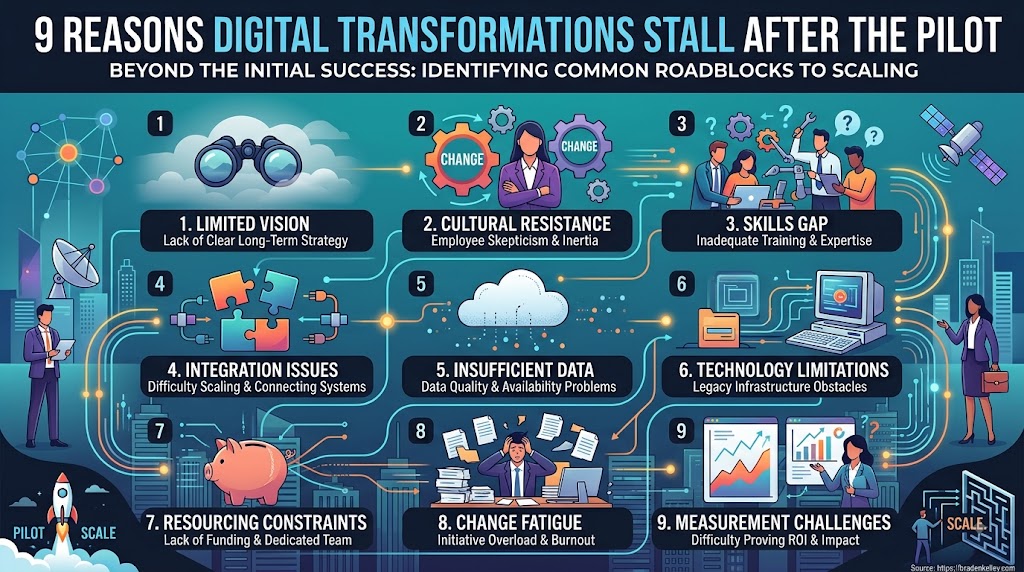
Human-centered answer: Named hypercare, escalation paths, undo options, and who stays accountable when the cake is gone. Adoption begins after go-live — it does not end there. For why pilots stall when operating readiness is missing, see 9 Reasons Digital Transformations Stall After the Pilot.

10. Why Should I Believe You This Time?

Why they ask quietly: Trust is a ledger. Prior transformations overdrew it. A better slogan does not reset the balance.

Non-answer signal: A bigger kickoff; a fresher narrative.

Human-centered answer: Receipts — what you stopped, funded, and kept promising last time; what is different in governance this time; how employees will verify progress without waiting for another town hall. Belief is earned in the work. For a method path that survives contact with reality, read 5 Steps of Human-Centered Change.

How Do Leaders Check Quiet Questions Before the Next Town Hall?

Before the next town hall, run five questions. If you cannot answer them in writing, you are asking employees to trust branding:

  1. Which of the ten have we answered — with names and dates, not slogans?
  2. Where are we still asking people to trust branding instead of operating-model proof?
  3. What stop list accompanies the start list?
  4. Who is safe to bring bad news — and how would employees know?
  5. How will employees verify that old metrics and old paths actually retired?

They’re not resisting. They’re waiting for answers that make honesty safer than silence.

Frequently Asked Questions

What questions do employees ask during transformation?

Employees quietly ask whether their job will exist and in what form, what they will stop doing, who has real power to change the system, whether the initiative is real, what happens if they speak up, whether they will get practice time, who loses if the change succeeds, how they will be measured, what happens after go-live when things break, and why they should believe leaders this time.

Why don’t employees speak up during change?

They often stay quiet when honesty has a career cost — uneven psychological safety, messenger-shooting, and open-door theater with no visible reward for bad news. Silence is usually risk management, not a lack of curiosity or buy-in.

How should leaders answer employee concerns about transformation?

Answer with names, dates, and operating-model proof: role paths, stop/start lists, decision rights, dated changes to work, protected dissent, practice time, honest tradeoffs, retired metrics, post-go-live recovery owners, and receipts that rebuild trust. Avoid slogans that leave the hallway smarter than the town hall.

What is change fatigue?

Change fatigue is the exhaustion that comes from stacked initiatives, branding louder than work redesign, and repeated launches that quietly die. Employees ask “is this real?” because they have lived costume transformations before — and capacity is already gone.

How do you rebuild trust during transformation?

Rebuild trust with receipts, not kickoffs: show what you stopped and funded, change governance so employees can verify progress, protect people who bring bad news, retire old metrics that contradict the new story, and keep sponsorship after go-live when things break. Trust is a ledger. Slogans do not reset it.

Image credits: Pixabay

Content Authenticity Statement: The topic area, key elements to focus on, etc. were decisions made by Braden Kelley, with a little help from Google Gemini and Cursor to clean up the article, add images and create infographics.

Subscribe to Human-Centered Change & Innovation WeeklySign up here to get Human-Centered Change & Innovation Weekly delivered to your inbox every week.

6 Leadership Conferences For Those Without a Davos Invite

6 Leadership Conferences For Those Without a Davos Invite

GUEST POST from Robert B. Tucker

If you didn’t receive an invitation to Davos, the annual World Economic Forum happening now in Davos, Switzerland, don’t feel deprived. By most accounts, Davos is no longer what it once was.

For decades, Davos was the most prestigious conference attended by global political and business leaders committed to improving the state of the world. Topics frequently included sustainability, corruption, and income inequality. But in an era defined by acceleration, authoritarianism, and disruptive technologies, Davos increasingly resembles what it has tried to avoid becoming: just another elite business meeting, heavy on power, light on moral imagination.

This year’s willingness to set aside core principles to accommodate political spectacle underscores how much the event has drifted from its founding spirit.

But the fading luster of Davos should not diminish the value of leadership conferences. As a business futurist and innovation speaker, these are my favorite and I highly recommend them. Stepping away from daily demands to engage in perspective-shifting conversation is especially important today when there is so much change. As someone who has participated in all sorts of conferences across industries and continents, I’ve found leadership conferences — done well — to be among the most personally rewarding investments leaders can make.

Unlike plain-Jane business conferences that focus on tactics or transactions, the best leadership gatherings expose you to ideas that stretch your assumptions. They introduce you to movers and shakers outside your usual orbit. And they help you align your organization — and your life — with the Mega-Forces shaping the future. At their best, such conferences allow you to “trade minds” with thinkers and practitioners who are wrestling seriously with the same questions you are.

What follows are six leadership conferences worth considering in 2026. Each offers a different doorway into the ideas, values, and conversations leaders need in the Age of Acceleration. Attend even one, and you’re likely to return changed — not just better informed.

1. SXSW Austin, Texas | March 12–18, 2026

I was so impressed after my attendance at SXSW in 2018 that I wrote a Forbes column about the experience. Founded in 1987 as a music festival, SXSW has evolved into one of the world’s most influential cross-disciplinary gatherings, drawing leaders from technology, media, film, music, and culture.

The conference endured a near-fatal crisis in 2020, when it was forced to cancel just days before opening due to COVID-19 — the first cancellation in its history. Subsequent virtual and hybrid iterations helped it survive, though many would agree the event is still rediscovering its pre-pandemic rhythm.

That said, if you can handle large crowds, SXSW remains a powerful collision point for ideas and serendipity. It offers a rare opportunity to see how cultural, technological, and societal shifts intersect — and where new possibilities may emerge.

2. Lead Where You Stand Conference, Santa Barbara, California | June 4–5, 2026

Founded in 2015 by visionary leader, Dr. Gayle Beebe, this intimate West Coast conference has become a quiet must-attend for business and NGO leaders seeking to create greater impact, no matter where they are planted. Anchored in Christian moral values, this annual gathering emphasizes character, community, and forward-thinking responsibility in leadership.

Since its inception, The New York Times columnist David Brooks has been a central voice and a guiding light. (Full disclosure: I’ve been invited to speak this year on “Leading and Flourishing in the Age of Acceleration.”)

Formerly held on Westmont College’s bucolic Montecito campus, sell-out demand has pushed Lead Where You Stand to move to a nearby resort hotel. The test ahead will be preserving its reflective intimacy as it scales.

3. ALIVE: Intentionally Evolving Our Futures, Asheville, North Carolina | April 23–25, 2026

ALIVE is not a conference in the conventional sense — it is an immersive experience designed for leaders who believe the future is not something to predict, but something to shape. Limited to 100 participants, the gathering brings together foresight practitioners and organizational leaders from around the world.

There are no traditional panels or slide decks at this conference. Instead, ALIVE unfolds as a co-creative journey organized around becoming future-ready, future-empowered, and future-conscious. Participants are invited to sit with uncertainty, learn alongside peers, and renew their sense of agency and empowerment to build a better future.

In an era saturated with screens and algorithms, the value of in-person, human-to-human engagement — free of bots and buzzwords—cannot be overstated.

4. The Future of Everything Festival, New York City | May 4–5, 2026

Produced by The Wall Street Journal, this high-impact convening brings together CEOs, scientists, policymakers, technologists, and cultural thinkers to examine the forces reshaping business and society. Topics range from AI and geopolitics to climate, health, and the future of work.

What distinguishes this conference is its intellectual range and seriousness. Big ideas are grounded in real-world implications. Attendees leave with sharper insight into emerging risks, overlooked opportunities, and the strategic choices leaders must make in an age of relentless change. This one is not about tactics — it’s about perspective.

5. Harvard Flourishing Summit, Cambridge, Massachusetts | March 18–19, 2026

Conceived by Harvard professor Tyler J. VanderWeele, Director of the Human Flourishing Program, this summit invites leaders to ask deeper questions about what success truly means. Drawing on research across public health, psychology, economics, and philosophy, the gathering reframes flourishing as a rigorous, evidence-based framework encompassing meaning, relationships, character, health, and contribution.

At a time when leadership conversations are dominated by speed and scale, the Summit offers something rare: space to reflect on values, direction, and purpose — and to ask not just how fast we are moving, but toward what kind of future.

6. Aspen Ideas Festival Aspen, Colorado | June 25 – July 1, 2026

Founded in 2005 by the Aspen Institute, a liberal think tank, the Aspen Ideas Festival has become a flagship gathering for exploring the world’s most pressing issues. Policymakers, business innovators, scientists, artists, and authors converge for a week of deep dialogue across disciplines.

With roughly 3,000 attendees and hundreds of sessions, the festival blends structured programming with informal exchanges over meals and mountain walks. Topics span public policy, technology, health, culture, economics, and leadership — offering both breadth and depth in equal measure.

Why One Leadership Conference a Year Matters

In a world moving faster than our institutions — and often our leadership capabilities — can keep up with, attending at least one leadership conference each year is no longer a luxury. It is a discipline. The right gathering can restore your sense of perspective, sharpen your foresight, and reconnect you to the values that first called you to leadership.

You don’t need an invitation to Davos to engage seriously with the many forces driving the future. You simply need the courage to step out of the day-to-day, enter an environment where ideas and values still matter, so that you return home prepared to build a better future.

This article originally appeared in Forbes

Image credit: Unsplash

Subscribe to Human-Centered Change & Innovation WeeklySign up here to get Human-Centered Change & Innovation Weekly delivered to your inbox every week.

Building Trust as a New Leader

Building Trust as a New Leader

GUEST POST from David Burkus

Most new leaders know they need to build trust with their team. But here’s where it gets tricky: what if it’s not your team — at least, not yet?

Imagine stepping into a leadership role where you didn’t get to pick the team. Maybe you were hired from outside the organization. Maybe you were promoted from another department. Either way, you’re the new leader, and the team you’re inheriting doesn’t know you yet. You don’t know if they’ve been burned before by a previous boss. You don’t know what scars or successes they carry. What you do know is that you need to build trust — and fast.

This is where most new leaders stumble. They try to shortcut the process. They launch a flurry of team-building exercises. They host lunches. They schedule marathon one-on-one meetings. These efforts come from a good place, but they often miss the mark. Because trust isn’t actually built. Trust isn’t even earned. Trust is reciprocated.

And if you’re serious about developing trust with a new team, you need to understand how that trust loop really works — and how to keep it moving forward.

Why Traditional Trust-Building Strategies Fall Short

When stepping into a new leadership role, it’s tempting to think that trust builds linearly — more lunches, more meetings, more smiles equals more trust. But that’s not how trust actually grows.

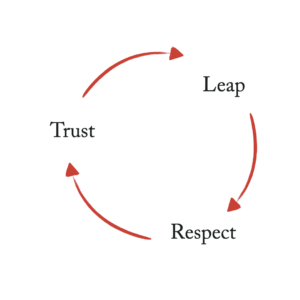
Trust moves in a loop, not a line. It starts with a small trust connection — maybe a conversation over coffee — and invites a tiny leap of faith from your team. Someone shares a new idea or dares to give you honest feedback. If you respond with respect — if you listen, appreciate, and show genuine curiosity — you complete the loop. You signal: It’s safe to trust me.

That small leap leads to slightly bigger risks. More candid conversations. More creative ideas. More vulnerability across the board. If you keep meeting those risks with respect, the trust loop keeps spinning faster and stronger. But if you miss those moments — or worse, get defensive — you stop the loop cold.

For a new leader, mastering this trust loop is everything.

Trust Loop

How a New Leader Can Truly Build Trust

Building trust with a team you didn’t pick requires deliberate, daily actions. Here are four research-backed strategies to get the trust loop turning — and keep it spinning.

1. Signal Vulnerability Early

Everyone already knows you’re new. They know you don’t have all the answers yet. Pretending otherwise just makes you seem insecure or out of touch. Instead, lean into your newness.

Say things like, “I’m still learning how this team works.” Then prove it by listening. Create a space where people feel safe to teach you. This early show of vulnerability sparks empathy — and empathy is the gateway to trust.

When a new leader admits they don’t have it all figured out, it invites others to open up, too. It shows that you’re not just here to impose your will — you’re here to learn and lead together.

2. Share Information Transparently

Eventually, as the new leader, you will need to drive change. That’s probably part of why you were brought in. But when you do, don’t operate behind closed doors.

Instead, treat your team like insiders. Pull back the curtain. Share early information about strategy shifts or organizational changes. Say things like, “This isn’t finalized yet, but here’s what I’m hearing and thinking — and I’d love your perspective.

Transparency builds belonging. It signals, I trust you with this information. And when people feel trusted, they’re much more likely to trust you in return.

3. Respond to Vulnerability with Respect

When your team members finally take a risk — whether it’s sharing a frustration, giving you feedback, or floating a bold idea — recognize it for what it is: a test.

They’re not trying to undermine you. They’re trying to see if you’re the real deal.

Your job isn’t to defend your decisions or your leadership history. It’s to listen. Ask clarifying questions. Thank them for being honest. Engage with their ideas sincerely — even if you don’t ultimately agree.

The way you respond to those early leaps of faith will define whether the trust loop accelerates — or seizes up.

4. Amplify Unheard Voices

One of the easiest ways to build trust with a new team is to ensure every voice is heard, especially the quieter ones. When historically quiet team members finally speak up, make it clear their input matters. Amplify their ideas in meetings. Circle back to them in discussions. Let the entire team see that contributions aren’t just tolerated — they’re valued. Without open communication, hierarchy and politics creep in fast. By contrast, when people feel heard and respected, they lean in with greater commitment and creativity.

Trust First, Change Second

Inheriting a team is tough. You’re stepping into a culture you didn’t create, with dynamics you don’t fully understand yet. And because you’re the new leader, it’s tempting to rush into action — prove yourself, make changes, shake things up. Resist that temptation.

The real work of a new leader is not about being liked. It’s about being vulnerable. Encouraging interpersonal risks. Meeting those risks with deep respect. That’s how you build trust. That’s how you turn a group of individuals into a committed team.

Because at the end of the day, you don’t want a compliant team that simply does what they’re told. You want a committed team that’s ready to go above and beyond — and commitment always starts with trust.

Image credit: Pixabay

Subscribe to Human-Centered Change & Innovation WeeklySign up here to get Human-Centered Change & Innovation Weekly delivered to your inbox every week.
The Greatest Inventor You’ve Never Heard of

Meet the Invisible Man of Innovation

The Greatest Inventor You've Never Heard of

GUEST POST from John Bessant

There’s a famous test, originally developed by psychologist J.P. Guilford, to give an idea of how ‘creative’ a person is. Ask them to think of as many uses as possible for an everyday object – a brick, a glass, a shoe, etc. The idea is that the more ideas you come up with (fluency) plus the number of different categories of idea (flexibility) gives an indication of your ability to think creatively.

If we tried the test with the simple safety pin it would certainly trigger some of the usual suspects – a nappy (diaper) pin, a clothes fastener, a medical device or an item of jewellery. Not so frequent a visitor to many peoples’ lists might be ‘a weightlifting aid’ – yet arguably that has been its most glorious moment so far. For one very good reason.

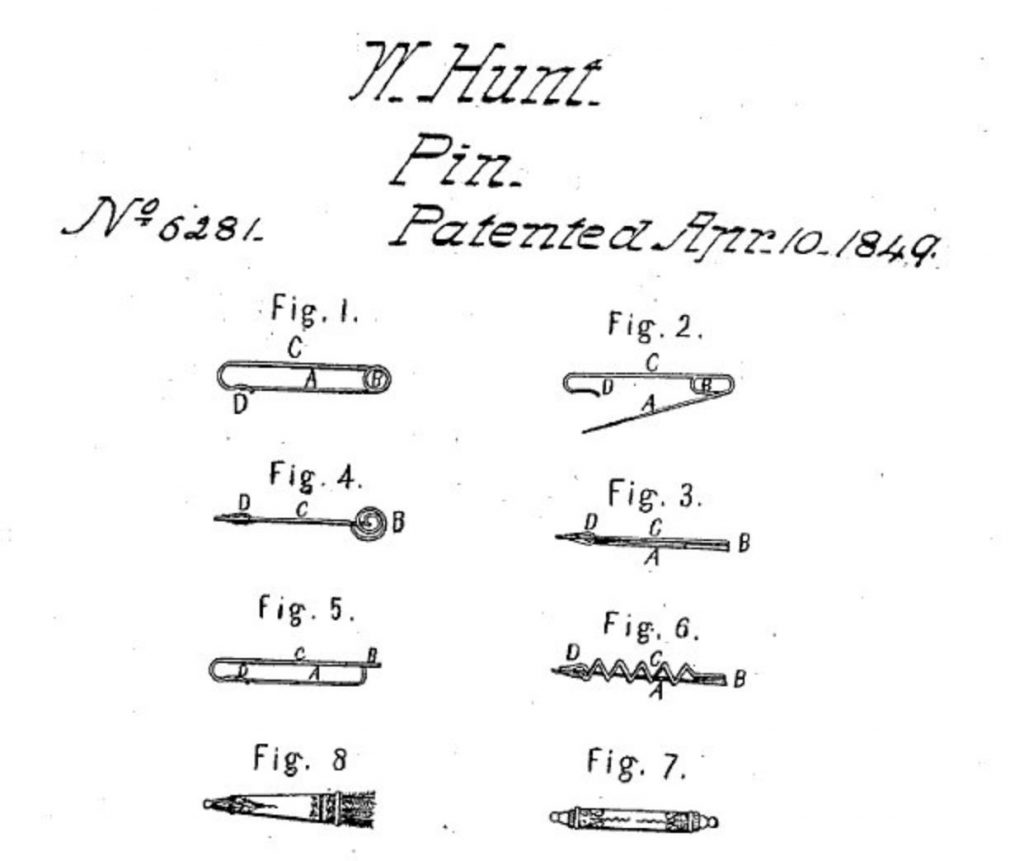
A $15 debt isn’t a big deal, even if it is incurred in 1849; its value would be around $600 in today’s money. An annoyance but not likely to bring on imminent bankruptcy if it remained unpaid. But for Walter Hunt there was a principle involved (he was, by all accounts a very moral man) and also the practical consideration that his relationship with his creditor (one J. R. Chapin) mattered. Chapin had helped him with a number of other projects as a draughtsman, providing the technical drawings needed for his patent applications. So Walter duly worried about how to repay the debt.

A period of hand wringing and fiddling which lasted about three hours, during some of which he picked up a piece of wire to keep his hands busy. And came up with the basic and still powerful principle behind the mechanism of the safety pin. Most pins up to that point were either simple and sharp with a point at the end or loops which came undone easily. These hadn’t changed much since the days when Roman legionaries pinned their cloaks with a fibula, a kind of simple brooch clasp pin.

By coiling the wire on itself he created a simple spring mechanism and by providing a catch at one end he was able to make the safe closure mechanism which we have come to know and love.

Quite a lot of us, in fact; estimates put the number of safety pins produced and sold per year around the world at around one billion, with specialised machines capable of turning out millions per day.

Walter Hunt was not a fool; he recognized that this idea could have value. And he was not inexperienced; he already had a healthy track record of successful innovation behind him and knew how to work the patent system. So he duly filed and was awarded patent number US6281A; he then offered this (and the accompanying rights it conferred) to the W R Grace company who snapped it up (excuse the pun), paying Hunt $400, enough to enable him to settle his debt and have some spare capital. And to lift a small but annoying weight from his shoulders…

It turned out to be a good deal for them; on an initial outlay of $15,000 in today’s money they secured profits running into millions over the next years.

Safety Pins

Image: U.S. Patent Office, public domain via Wikimedia

This kind of thing was second nature to him; he had a gift for seeing and solving problems in a practical way. By 1849 he’d already built a legacy of (mostly) useful items which he had (mostly) patented and had a growing reputation as an inventor. Though not necessarily an innovator – as in someone who can create value from their ideas. Hunt seems to have had a second ‘gift’; in addition to being a visionary inventor he seems to have been cursed with the inability to profit from his inventions.

The man who was labelled a ‘Yankee mechanical genius’ was born in 1796 in Lewis County, New York to a Quaker family. The eldest of thirteen children he was lucky to receive an education and went on to earn a master’s degree in masonry at the age of twenty-one. Although a practical skill much needed in a rural farming community masonry also involves a way of thinking which is much more than simply piling stones on top of each other. Arguably his understanding of interdependence and systems derived in part from this early experience – and enabled him to approach widely differing problems with a sense of their underlying similarities.

Yet if you look back at his track record of inventions he rapidly emerges as a serious contender for being the greatest inventor you’ve never heard of.

For example:

The repeater rifle, in 1848 – up there as a symbol of ‘how the West was won’ in a thousand cowboy movies and the undoubted making of the Winchester Repeating Arms Company with their Winchester rifle. Hunt not only developed the original idea for a ‘volition repeating rifle’ but also the ammunition it might use (his ‘rocket ball’) which was revolutionary in putting the powder charge in the bullet’s base. His designs weren’t very workable and he sold the patents; these changed hands a number of times in the growing armaments industry before being bought by Messrs Smith and Wesson who used them as the basis for a new company. The biggest investor in the new Volcanic Repeating Arms Company was one Oliver Winchester….

Think fountain pens and writing implements and the transition from goose quills to refillable devices and you may well think of the companies which made their name with the innovation. But whilst companies like Parker Pen created the market the foundations were laid by, amongst others, Walter Hunt who predated their work by decades. In 1847, he patented a fountain pen (U.S. Patent 4,927) combining inkstand and pen into one unit, “convenient for the pocket.”

Knife sharpening ? Nail making? Rope making? Castors to help move furniture around? Disposable paper collars? A coal burning stive which would radiate heat in all directions? A saw for cutting down trees? A flexible spring attachment for belts and braces? An attachment for boats to cut through ice? An inkstand? A non-explosive safety lamp? Bottle stoppers? Hunt turned his hand and imagination to hundreds of challenges across an almost impossibly wide spectrum. Leonardo da Vinci would have been proud of him, not least in his ability to draw together ideas and inspirations from many different fields.

His first patented invention was for an improved flax spinning machine in 1826. He worked as a farmer in a region dominated by textile milling and most of his family and friends were in the business of spinning wool and cotton. Faced with rising costs and falling product prices the local mill owner, Willis Hoskins, wanted to reduce wages; Hunt persuaded him to hold off and offered instead to develop a more efficient flax spinning machine. He patented this on June 22, 1826 and its contribution to improving productivity saved the jobs.

His motivation was often underpinned by a social concern. Another early invention (1827) was for a coach alarm system. Visiting New York to try and raise funds for developing the falx spinning machine further he witnessed an accident where a horse-drawn carriage ran over a child. The driver, his hands fully occupied with the reins of the team, had been unable to sound a warning horn in time. Hunt was shaken by this and the fact that this was not a rare occurrence; he began thinking of ways to help prevent these accidents. He came up with the idea of a metal gong with a hammer that could be operated by foot; his “Coach Alarm” was patented on July 30, 1827. Facing an uphill struggle he sold the rights to the stagecoach operators Kipp and Brown; the invention became a standard feature on streetcars across the United States, saving countless lives.

Late in life, Hunt addressed the laundry problem. In 1854 a crisp white collar was a mark of status, but keeping linen white required constant starching and ironing. Hunt invented the ‘paper shirt collar’ (U.S. Patent 11,376) which offered the advantage of looking like linen but being disposable after use.

Some of his ideas were, shall we say, a little fanciful though the prototypes proved their point. Inspired by the way flies negotiated ceilings his ‘antipodean apparatus’ was designed to help circus performers (and anyone else mad enough) to walk upside down. Although this one wasn’t patented it was still in use by performers a hundred years later!

antipodean apparatus

Altogether he was responsible for hundreds of patents and about two dozen of Hunt’s inventions are still used in the form in which he created them over one hundred years ago.

Including, of course, the really big one that got away – the sewing machine. The mid 19th century saw a flurry of inventive activity around trying to enable it, eventually converging on a dominant design which combined different elements for feeding, sewing with a lockstitch, holding the fabric, powering the feed, etc. Isaac Singer walked away with the prize in 1851 after a long and bitter battle with Elias Howe whose patent he liberally borrowed from and which predated his machine by several years.

What’s not always mentioned is that Howe’s idea wasn’t original; he’d based his 1846 machine on something he’d seen more than a decade before. In fact this ‘prior art’ was what Singer tried to use in his defence only to have the judge throw it out because the original idea, though clearly the core design for a working sewing machine, had never actually been patented.

The man who’d let this incredible opportunity slip through his fingers? Our very own Walter Hunt.

Sewing Machine

Image: National Museum of American History, public domain

In 1830, Barthelemy Thimonnier in France had patented a machine that used a hooked needle to make a chain stitch, but it was slow and fragile. Hunt’s experiments in the early 1830s led him to a new approach; he realized that a machine didn’t need to mimic a manual seamstress and in particular it didn’t need to pass the needle all the way through. Instead he designed a curved needle with the eye at the point; the needle would pierce the cloth, carrying a loop of thread with it and then a shuttle would pass a second thread through the loop formed by the needle. When the needle retracted, the two threads would lock together – lockstitch.

He kept it in the family, employing one of his many brothers, Adoniram, to improve on his wooden prototype by making a machine out of iron. It worked well, sewing straight seams with a durability and uniformity that manual sewing could not touch. By 1834 – twelve years before Elias Howe – Hunt had a working machine that could have made him one of the richest men in the world. But he held back from patenting it.

Not for want of experience or vision; he’d seen the possibilities which is why he’d been working on the idea. But his vision was partly shaped by his strong-willed and socially conscious daughter who saw it not as a labour-saving device but as a labour killer, threatening the livelihoods of women who worked as seamstresses to establish themselves and find a measure of financial independence. She persuaded Hunt to hold back from registering his patent though he had the working design ready a full twenty years before Singer’s successful entry.

Instead he allowed his invention to ‘slumber’, existing but not being patented or commercialised. He sold the rights to the prototype to George Arrowsmith, but Arrowsmith, the lack of a patent, also failed to commercialize it.

In the infamous ‘Sewing Machine Wars’ of the early 1850s the two big antagonists were Howe and Singer; as part of his campaign Singer discovered Hunt’s ideas and pressed him to search for any evidence of the earlier machine which might help invalidate Howe’s lockstitch-based patent. Eventually they found the rusty remnants of the 1834 machine and Hunt rebuilt it to working status, enabling Singer to argue that Howe was not the first inventor.

In 1854, Patent Commissioner Charles Mason issued a ruling that became a cornerstone of patent law; he acknowledged that Hunt had indeed invented the machine first. However, he ruled against Hunt based on the doctrine of laches (abandonment), writing that “…. When the first inventor allows his discovery to slumber for eighteen years, with no probability of its ever being brought into useful activity, and when its only resurrected to supplant and strangle an invention which has been given to the public… all reasonable presumption should be in favour of the inventor who has been the means of conferring the real benefit upon the world”.

The ruling forced Singer and other sewing machine manufacturers to settle their differences and operate a patent pool with each paying relevant royalties to the others for use of particular intellectual property. Hunt received a small payment from Singer for his testimony, but he missed out on the royalties that built the fortunes which came to Singer and Howe.

He was granted a patent for another improvement to the sewing machine dealing with feeding of material into the machine without jamming it. Singer eventually agreed in 1858 to pay Hunt $50,000 for this design – but Hunt didn’t live long enough to collect his due.

He died on June 8, 1859 of pneumonia in his workshop in New York City. His grave in Green-Wood Cemetery is marked by a modest granite shaft, a stark contrast to the massive monuments of other ‘Gilded Age’ entrepreneurs.

Although Hunt died without a fortune to his name he was no fool. His name might be missing from the pantheon of great inventors who changed the world through steel and steam – creating the products and the markets which defined a new industrial age. Yet anyone who could twist a piece of wire into a global success in three hours in order to settle a debt deserves a closer look.

His life reveals a complex man of high principles – a ‘benevolent Quaker’ – and possessed of an internal motivation owing much more to a fascination with solving problems and puzzles than the inspiration of a possible fortune. Someone who found joy in the quest rather than the goal, the ultimate ideas man.

An obituary published in the New York Tribune on June 13th, 1859 captured a little of this restless spirit. “For more than forty years, he has been known as an experiment in the arts. Whether in mechanical movements, chemistry, electricity or metallic compositions, he was always at home: and, probably in all, he has tried more experiments than any other inventor.”

Sometimes the quest is more exciting than the destination, sometimes the act of creating something new is its own reward.


You can find my podcast here and my videos here

And if you’d like to learn with me take a look at my online courses here

And subscribe to my (free) newsletter here

All images generated by Google Nanobanana or Substack AI unless otherwise indicated

Subscribe to Human-Centered Change & Innovation WeeklySign up here to join 17,000+ leaders getting Human-Centered Change & Innovation Weekly delivered to their inbox every week.

Temporal Agency – How Innovators Stop Time from Bullying Them

Temporal Agency - How Innovators Stop Time from Bullying Them

GUEST POST from Art Inteligencia

We live in an age where time feels like a relentless tyrant. Deadlines loom, inboxes overflow, and the constant hum of connectivity creates an illusion of urgency that often masks a deeper problem: our lack of agency over our most precious resource. We’ve been conditioned to believe that speeding up is the only solution, when in reality, the answer lies in a more profound re-engineering of our relationship with time itself.

This isn’t about magical thinking or finding shortcuts; it’s about deeply understanding the mechanisms of time perception, leveraging neuroscience, and consciously crafting environments that enable us to reclaim temporal agency. It’s about moving from being victims of the clock to becoming its conductors.

Innovation rarely fails because of insufficient intelligence or ambition. It fails because time is weaponized against the very thinking it requires. Urgency crowds out curiosity. Speed displaces sense-making. Motion replaces meaning.

The result is a paradox: organizations move faster while understanding less.

“The real superpower isn’t bending time. It’s designing conditions where time stops bullying us.”

— Braden Kelley

Time as an Environmental Problem

Most discussions about time focus on individual discipline. This framing is incomplete. Time pressure is largely environmental.

Every unnecessary meeting, notification, and premature deadline fragments attention. Each fragment shrinks perceived time. Over time, this creates a persistent sense of acceleration, even when output stagnates.

Innovators do not need to work harder. They need environments that allow thinking to breathe.

Designing Conditions That Stretch Time

Stretching time means increasing the quality of attention per moment.

Innovative organizations intentionally design for:

  • Subjective time expansion through focused engagement
  • Reliable flow states by aligning challenge and capability
  • Lower perceived urgency through clearer prioritization
  • Greater present-moment bandwidth by reducing cognitive clutter

These conditions transform how time is felt, even when clocks remain unchanged.

Case Study 1: A Product Team Slows Down to Speed Up

A digital product team consistently missed deadlines despite aggressive schedules. Workdays were filled with context switching.

Leadership eliminated status meetings and replaced them with a shared visual dashboard updated asynchronously. Teams gained uninterrupted blocks of time.

Perceived time pressure dropped immediately. Delivery speed improved within one quarter, and employee burnout declined.

Flow as Infrastructure

Flow is often treated as a personal peak experience. In reality, it can be operationalized.

Organizations that enable flow:

  • Limit work-in-progress
  • Clarify decision rights
  • Align incentives with learning, not visibility

Flow-friendly systems create temporal elasticity—time feels abundant because it is used coherently.

Case Study 2: A Research Organization Redesigns Urgency

A research organization found that “urgent” requests dominated scientist schedules.

Leaders introduced explicit urgency criteria and delayed non-critical decisions by default. Scientists regained long stretches of uninterrupted inquiry.

Breakthrough insights increased, not because more time was added, but because time was no longer under constant assault.

From Time Management to Time Relationship

Time management asks individuals to cope. Temporal agency asks leaders to design.

When innovators command their relationship with time, they:

  • Think more clearly
  • Learn more quickly
  • Create more meaningfully

Time does not need to be conquered. It needs to be respected.

When time stops bullying us, innovation finally gets the space it deserves.


The Myth of Speed and the Reality of Felt Time

Our objective measurement of time – seconds, minutes, hours – is immutable. But our subjective experience of time is incredibly fluid. Think of those moments when an hour flies by in a blur of deep work, or when five minutes waiting for a delayed flight feels like an eternity. This discrepancy is our greatest lever for change. Innovators and creatives, especially, must learn to manipulate this subjective experience, not to work longer, but to work smarter, deeper, and more meaningfully.

Altering Subjective Experience of Time

This isn’t about wishing time away or making it go faster. It’s about enriching the present moment to reduce the *felt* pressure of time. When we are deeply engaged, focused, and present, the anxiety associated with time pressure dissipates. This requires conscious effort to minimize distractions and cultivate environments conducive to concentration.

Entering Flow More Reliably

The concept of “flow state,” popularized by Mihaly Csikszentmihalyi, is the ultimate expression of temporal agency. In flow, time ceases to exist, and our productivity skyrockets. To enter flow more reliably, we need to design for it: clear goals, immediate feedback, and a balance between challenge and skill. It’s about creating rituals that signal to our brains: “It’s time to deeply engage.”

Reducing Felt Time Pressure

A significant portion of our “time crisis” is psychological. The constant fear of missing out (FOMO), the pressure of endless notifications, and the expectation of immediate responses create a chronic state of urgency. Reclaiming agency means consciously unplugging, setting boundaries, and understanding that not all demands are created equal. Prioritization isn’t just about what to do, but what not to do, and when.

Increasing Present-Moment Bandwidth

In our hyper-connected world, our attention is constantly fragmented. We’re often performing tasks while thinking about the next five things. This multitasking illusion significantly degrades our present-moment bandwidth. Practicing mindfulness, single-tasking, and deep work techniques expands our capacity to engage fully with the task at hand, making each unit of objective time more potent and less stressful.


Practical Ways to Reclaim Temporal Agency

1. The “Temporal Audit”

Before you can optimize, you must understand. Conduct a rigorous audit of how you spend your time, not just objectively, but also subjectively. Where does time drag? Where does it fly? What activities genuinely recharge you versus those that drain your energy and create more pressure?

2. Deep Work Blocks

Inspired by Cal Newport, schedule dedicated, uninterrupted blocks for your most cognitively demanding tasks. Turn off notifications, close irrelevant tabs, and commit to single-tasking. These aren’t just work blocks; they are flow-creation blocks.

3. Strategic Procrastination (with a twist)

Not all tasks require immediate attention. Consciously defer non-urgent tasks to specific “batching” periods. This reduces the mental load of constantly switching contexts and allows for deeper focus on critical items. The “twist” is that this is a conscious decision, not an avoidance tactic.

4. The “No Meeting Wednesday” (or similar)

Create specific days or half-days entirely free of meetings. This provides an oasis for deep work, strategic thinking, and creative exploration without the constant interruptions that fragment our schedules and minds.

5. Digital Detox Rituals

Implement daily, weekly, or even monthly periods of disengagement from digital devices. This isn’t just about reducing screen time; it’s about allowing your mind to wander, to connect disparate ideas, and to replenish its creative reserves without the constant demand for attention.


Case Studies in Temporal Mastery

Case Study 3: The Biotech Founder’s “Un-Schedule”

A biotech startup founder was overwhelmed by the demands of fundraising, product development, and team management. Instead of trying to pack more into her day, she adopted an “un-schedule” approach. She scheduled only 3-4 hours of high-value, deep work each day, with the rest of her time dedicated to reactive tasks, strategic thinking, or even intentional white space. By consciously limiting her scheduled workload, she created mental breathing room, leading to more breakthroughs and less burnout. Her team also reported feeling less pressured, as her clarity translated into more focused direction. The result was a 25% reduction in project timelines due to improved focus and decision-making.

Case Study 4: The Creative Agency’s “Momentum Days”

A boutique creative agency struggled with project delays and artist burnout due to constant client revisions and internal meetings. They implemented “Momentum Days” twice a week where all internal meetings were banned, and external client communication was batched into specific windows. These days were dedicated solely to creative execution. By protecting this uninterrupted time, the agency saw a dramatic improvement in output quality, a 15% increase in client satisfaction due to faster turnaround, and a noticeable boost in team morale and creative satisfaction.

Reclaiming temporal agency isn’t about finding more hours in the day; it’s about making the hours you have more meaningful, more productive, and less stressful. It’s an act of conscious design, a rebellion against the tyranny of the clock. By understanding and manipulating our subjective experience of time, by fostering flow, and by implementing disciplined practices, we can cease being bullied by time and start truly commanding our relationship with it, unlocking unprecedented levels of innovation and well-being.


Frequently Asked Questions

What does Braden Kelley mean by “temporal agency”?

Temporal agency refers to our ability to influence our subjective experience of time and control how we allocate our attention, rather than feeling constantly dictated by the clock or external pressures. It’s about commanding our relationship with time.

How can innovators enter flow state more easily?

To enter flow more reliably, innovators should design their environment with clear goals, immediate feedback loops, and tasks that strike a balance between challenge and their current skill level. Minimizing distractions and creating dedicated “deep work” rituals are key.

What is the “Temporal Audit”?

A “Temporal Audit” involves rigorously tracking and analyzing how one spends time, both objectively (what tasks are performed) and subjectively (how one feels about that time), to identify patterns of engagement, disengagement, and areas where time pressure is most acute.

Disclaimer: This article speculates on the potential future applications of cutting-edge scientific research. While based on current scientific understanding, the practical realization of these concepts may vary in timeline and feasibility and are subject to ongoing research and development.

Image credits: ChatGPT

Subscribe to Human-Centered Change & Innovation WeeklySign up here to get Human-Centered Change & Innovation Weekly delivered to your inbox every week.

11 Signs Your Transformation Is Managing the Deck, Not the Work

11 Signs Your Transformation Is Managing the Deck, Not the Work

by Braden Kelley and Chateau G Pato


What Does It Mean When a Transformation Manages the Deck, Not the Work? (Short Answer)

Your transformation is managing the deck, not the work, when governance energy goes to RAG colors, narrative polish, and workstream theater while the median employee’s Tuesday — tools, handoffs, incentives, and authority — stays the same. Eleven signs: RAG greener than reality, slide time over floor time, status agendas without decisions, activity reporting instead of behavior, risks that only live in registers, change as cascade and completions, dependencies as Gantt arrows, problems parked until next steering, go-live as finish line on the roadmap, vendor demos owning the room, and shadow process “managed” as residual risk.

A deck is a mirror. When the program starts performing for the mirror, the work has already left the room.

Green Decks, Red Tuesdays

I have sat in enough steering rooms to recognize the smell of a program that has become a reporting product. The slides are crisp. The RAG is mostly green. Workstreams have spoken. Risks have been “mitigated.” Someone thanks the PMO for the pack.

Then you walk the floor — or talk to the median person trying to do the new job with the old incentives — and Tuesday is still red.

That gap is not a communication problem. It is governance theater: managing the artifacts of transformation as if they are the transformation. The work — redesigned jobs, owned handoffs, killed shadow processes, practiced capability, and behavior after go-live — never gets the same energy as the deck.

Sign Deck reality Work reality
1. RAG greener than Tuesday Status looks healthy Workarounds still run the day
2. Slides over floor time Pack is polished Nobody watched the median user
3. Status, not decisions Tour complete Nothing killed or funded
4. Activity, not behavior Milestones hit Old path still preferred
5. Risks in the register Rated and reviewed Broken handoff still daily
6. Cascade = change Completions high Capability thin
7. Dependencies as arrows Gantt looks integrated Seams have no owner
8. Problems parked On next month’s agenda Blocker lives this week
9. Go-live as climax Roadmap peaks at cutover Adoption is a footnote
10. Vendor demos own the room Product theater Adopters absent
11. Shadow process “managed” Labeled residual / out of scope Old path still easy

1. Why Is a Green RAG a Warning Sign When Tuesday Is Still Red?

The sign: Status is amber or green while frontline effort, workarounds, and adoption quality are clearly red.

Why it seduces: Color coding is legible in fifty minutes. Lived experience is not. Leaders can leave the room feeling informed.

Manage the work instead: Dual truth — system status and human success. A green RAG cannot close the review if the experience is red. If status and Tuesday disagree, Tuesday wins.

2. What Does It Mean When Slide Production Outruns Floor Time?

The sign: The team’s scarce hours go to deck assembly, appendix hygiene, and “story alignment” — not ride-alongs, floor walks, or watching the median user struggle.

Why it seduces: The pack is a visible deliverable. Floor time looks soft and does not photograph in the steering invite.

Manage the work instead: Cap slide hours. Require evidence from contact with the work in every steering pack — a quote, a timed task, a workaround still in use. No floor signal, no green story.

3. How Do You Spot a Steering Agenda That Is Status, Not Decisions?

The sign: Steering meetings are tour updates. Few tradeoffs named. Few things stopped. Few owners assigned for next Tuesday.

Why it seduces: Status feels safe. Decisions create losers, vendors, and uncomfortable clarity.

Manage the work instead: Decision-first agenda — what must we choose, kill, fund, or unblock before we leave? If the meeting ends with “thanks for the update,” you managed the deck.

4. Why Is Reporting Activity Instead of Behavior a Transformation Trap?

The sign: Workstreams celebrate milestones, tickets closed, training launched, and “progress against plan” — not whether humans stopped the old path or succeeded on the new one.

Why it seduces: Activity is countable. Behavior change is political and harder to put in a chart.

Manage the work instead: One behavior metric per workstream — adoption quality, workaround retired, time-to-confidence. Progress that cannot name a human behavior is still theater.

5. When Do Risk Registers Become Governance Theater?

The sign: Risks are rated, mitigated on paper, and reviewed monthly — while the broken handoff still happens daily.

Why it seduces: Registers look like governance. Fixing the workflow looks like operations, which someone else is supposed to own.

Manage the work instead: Every top risk must map to an owned workflow change this sprint — or it is a slide, not a control. Mitigation without a Tuesday owner is fiction.

6. Why Isn’t Cascade Decks and Training Completions Real Change Management?

The sign: Comms plans, town halls, and training completion percentages are the change scorecard. Practice, coaching, and permission to stop the workaround are missing.

Why it seduces: Completions are procurable and reportable. You can screenshot the cascade. You cannot screenshot someone’s third Tuesday failing with the old incentives still in force.

Manage the work instead: An enablement scorecard — practice on real work, manager coaching, protected learning time. Informed is not enabled.

7. What Goes Wrong When Dependencies Are Arrows Instead of Owned Handoffs?

The sign: The Gantt shows neat dependencies. Nobody can name who owns the seam between teams when it breaks on Tuesday.

Why it seduces: Planning software creates the illusion of integration. Arrows feel like ownership.

Manage the work instead: Name seam owners. Design the handoff. Test the seam before you celebrate the milestone. Integration that only exists in the plan does not exist.

8. Why Is Parking Problems Until the Next Steering Pack a Red Flag?

The sign: Issues escalate into “for discussion next month” rather than a 48-hour fix with an owner. The deck becomes a waiting room.

Why it seduces: Cadence protects calendars. Urgency threatens the narrative and the RAG.

Manage the work instead: Fast-path ownership for anything blocking the median user’s success this week. If it can wait a month, it was never blocking the work — only the story.

9. Why Shouldn’t Go-Live Be the Finish Line on the Roadmap Slide?

The sign: The visual climax of the program is cutover. Hypercare is a thin bar. Adoption and BAU ownership are footnotes.

Why it seduces: Vendors and PMOs get paid at go-live. Steering committees want a date they can declare. Adoption is someone else’s Tuesday.

Manage the work instead: Make the roadmap climax a durable new way of working. Go-live is a technical event. Transformation is behavior that survives after the PMO leaves.

10. What Does It Mean When Vendor Demos Own the Room and Adopters Don’t?

The sign: Steering time goes to product walkthroughs and roadmap theater. The people who must live the change are absent, summarized, or reduced to a survey chart.

Why it seduces: Demos photograph well. Adopters complicate the story with workarounds, missing authority, and truths that do not fit the narrative.

Manage the work instead: Adopter voice as a standing agenda item — what broke, what workaround returned, what decision rights are missing. If adopters are not in the room, you are managing a brochure.

11. Why Is “Managing” Shadow Process as Residual Risk Still Failure?

The sign: The old spreadsheet, parallel path, or “just in case” process is acknowledged on a slide and left alive — draining adoption while status stays green.

Why it seduces: Killing the old way is political. Labeling it residual or out of scope feels tidy and keeps the RAG calm.

Manage the work instead: Explicit kill date and owner for the shadow path. Make the new way the only easy way. A residual risk that still runs the business is not residual. It is the operating model.

How Do You Test Whether You’re Managing the Deck or the Work?

Before the next RAG review, run five go/no-go questions. If you cannot answer them, you are performing transformation for an audience that can leave the room:

  1. What evidence from the floor is in this pack — not only from the plan?
  2. What decision will we make today — choose, kill, fund, or unblock?
  3. What behavior changed since last month for the median person?
  4. What will we stop — not only mitigate on a register?
  5. Who owns the median user’s Tuesday after go-live when the PMO leaves?

If the beliefs underneath the theater need naming, see 8 Change Myths Leaders Still Believe in 2026. If the pilot worked and scale did not, use 9 Reasons Digital Transformations Stall After the Pilot. Before the next funded experiment, run 11 Questions Before Funding Any Innovation Pilot.

If the deck is healthier than the work, you are not transforming. You are managing the mirror. Put the energy back into Tuesday — and let the slides catch up to reality, not the other way around.

Frequently Asked Questions

What does it mean when a transformation manages the deck, not the work?

It means the program optimizes RAG status, narrative polish, and workstream reporting while the median person’s tools, handoffs, incentives, and authority stay unchanged. Governance energy goes to slides instead of redesigned work, owned seams, killed shadow processes, and behavior after go-live.

How do you know a transformation is failing?

Warning signs include green status with red frontline experience, steering agendas that never make decisions, activity metrics instead of behavior change, risks that only live in registers, go-live treated as victory, and old shadow processes left alive while labeled “mitigated.”

What should a transformation steering committee focus on?

Focus on decisions — what to choose, kill, fund, or unblock — plus floor evidence, behavior change since last month, and who owns the median user’s Tuesday after go-live. Status tours and vendor demos are insufficient if adopters and seams have no voice or owner.

Why are transformation RAG statuses misleading?

RAG colors often track plan, milestones, and system readiness — not human success, workaround retirement, or adoption quality. A green RAG can coexist with a red Tuesday when the scorecard rewards narrative hygiene over lived experience.

How do you fix transformation governance theater?

Require floor evidence in every pack, run decision-first steering, add one behavior metric per workstream, map top risks to owned workflow changes, fund enablement over cascade completions, name seam owners, kill shadow paths on a date, and treat go-live as a technical event — not the finish line.

Image credits: Google Gemini

Content Authenticity Statement: The topic area, key elements to focus on, etc. were decisions made by Braden Kelley, with a little help from Google Gemini and Cursor to clean up the article, add images and create infographics.

Subscribe to Human-Centered Change & Innovation WeeklySign up here to get Human-Centered Change & Innovation Weekly delivered to your inbox every week.
Three Myths That Kill Change and Transformation

Three Myths That Kill Change and Transformation

GUEST POST from Greg Satell

In 1975, more than 80% of US corporate assets were tangible assets, things like factories, equipment and real estate. When leaders in an organization made decisions about change, they tended to involve tangible, strategic assets, such as building a new factory, entering a new market or launching a new line of products.

So when the modern practice of change management arose in the 1980s, that’s what it was designed to address. Managers began to recognize the need to communicate changes to the rank and file, so that they could better understand it and contribute to its success. An entire cottage industry of consultants arose to fill that need.

But now that situation has flipped and more than 80% of corporate assets are intangible. When we talk about change today we are usually talking about changes in people themselves, in how they think and how they act. Clearly, that’s a very different type of thing and we need to approach change differently. Unfortunately, too many people are mired in the past.

Myth #1: If People Understand Change, They Will Embrace It

Leaders like to be seen at the cutting edge and, to be effective, they need to believe in themselves. That’s what makes transformational initiatives so attractive. They’re much more fun than the more mundane aspects of managing an enterprise, like improving operations or cutting costs. Change gives leaders a chance to dream.

That’s what the practice of change management was designed to support. Someone high up in an organization would get an idea to, say, launch a new product line for a new market and the consultants would be brought in to help communicate the idea so that everyone could understand just how brilliant the idea was.

Of course, even if employees thought the idea was stupid there wasn’t much they could do about it. If a CEO wants to launch a new product line, invest in new factories and equipment and hire new people, there’s nothing the rank and file can do about it. Leadership has full control over tangible, strategic assets.

But today, when the vast majority of corporate assets are intangible, transformation initiatives involve changes in how people think and what they do, which leadership does not control. People have the power to resist and you can be sure they will. That’s why change fails, not because people don’t understand it, but because they don’t like it and actively sabotage it.

The truth is that humans form attachments to other people, ideas and things. When they feel those attachments are threatened, they will often lash out. That’s why when you ask people to change how they think or what they do, you will invariably offend some people’s identity, dignity and sense of self and they will act out in ways that are dishonest, underhanded and deceptive. That doesn’t make them bad people—we all do it—it just makes them human.

Myth #2: You Have To Convince The Skeptics

There is something baffling about human nature. Whenever we have an idea we are passionately about we feel intense desire to convince skeptics. Our inner marketers want to identify specific objections and then devise airtight arguments to counter them. We envision ourselves being dazzlingly persuasive and making our case.

Change management consultants encourage this type of thinking. They advise us to “provide simple, clear choices and consequences” and “show the benefits in a real and tangible way.” They also suggest that we have “open and honest conversations” and “even make a personal appeal” in order to “convert the strongest dissenters.”

This may make sense if the objections are rational, but often they are not. In fact, the most visceral dissent almost invariably has more to do with how people see themselves. That’s why change so often offends people’s dignity, because their identity is so often wrapped up in what they think and what they do. You can’t ask people to stop being who they think they are.

The good news is that you don’t have to. Consider the scientific evidence:

  • Sociologist Everett Rogers‘ “S-curve” research estimated that it takes only 10%-20% of a system to adopt an innovation for rapid acceptance by the majority to follow.
  • Professor Erica Chenoweth’s analysis of over 300 political revolutions in the past century finds that it only took 3.5% of active participation in a society to succeed, and many campaigns prevailed with less.
  • Recent research by sociologist Damon Centola at the University of Pennsylvania suggests that the tipping point for change is getting 25% of people in an organization on board.

There’s no need to waste time trying to convince people who hate your idea and want to undermine it in any way they can. Any engagement is very unlikely to be successful and very likely to frustrate and exhaust you. You are much better off focusing your energies on empowering those who are enthusiastic about change to succeed, so that they can bring in others who can bring in others still. That’s how you build traction.

Myth #3: Things Will Get Easier After A “Quick & Easy” Win

Change management pioneer John Kotter, who first started writing books about organizational transformation in the 1970s, has long advised to establish short-term wins. He stressed that these must be unambiguously successful, visible throughout the organization and clearly related to the change effort.

The concept is problematic for a number of reasons. First, and this isn’t really Kotter’s fault, but the idea of a “short-term win” is often understood to be a “quick and easy win,” which can backfire. If a change isn’t meaningful and relevant, then touting it can make a leader seem out of touch, discrediting the transformation effort.

More problematic is the idea that we should be shooting for projects that are unambiguously successful. That level of success is exceedingly rare. If we are going to wait for perfect projects, we may be waiting a long time. What we want to do is start with a Keystone Change and then learn from whatever successes and failures we encounter on the way.

Perhaps most dangerous of all is the notion that early projects should be visible to large numbers of people. Remember, if a change is significant and has the potential for impact, there will always be people who want to undermine it in ways that are dishonest, underhanded and deceptive. Why would we want to broadcast early efforts so they can knock them down?

The truth is that things don’t get easier after initial successes. They often get harder because those who oppose change now see it is really possible. That’s why you need to build a plan to anticipate resistance and Survive Victory from the start.

Change for the World We Live In

In the early 20th century, the great sociologist Max Weber noted that the sweeping industrialization taking place would lead to a change in organization. As cottage industries were replaced by large enterprises, leadership would have to become less traditional and charismatic and more organized and rational.

He also foresaw that jobs would need to be broken down into small, specific tasks and be governed by a system of hierarchy, authority and responsibility. This would require a more formal mode of organization—a bureaucracy—in which roles and responsibilities were clearly defined. Weber’s model reigned for a full century.

Over the past few decades we’ve undergone a similar shift from bureaucratic hierarchies to connected ecosystems and that affects how we need to approach transformation. The changes we need to implement today have less to do with decisions made about strategic, tangible assets and more to do with how people think and act. That presents a very different set of challenges and we need to adapt.

What we can’t do is pretend that the world is the same as it was 30 or 40 years ago and continue with practices that are so obviously failing. Just as Weber dispelled myths about infallible leaders a century ago, we need to break free of outdated concepts that have led to unacceptably poor results.

It’s time to leave myths behind and take a more clear-eyed approach to leading change.

— Article courtesy of the Digital Tonto blog
— Image credit: Pixabay

Subscribe to Human-Centered Change & Innovation WeeklySign up here to join 17,000+ leaders getting Human-Centered Change & Innovation Weekly delivered to their inbox every week.

8 Change Myths Leaders Still Believe in 2026

8 Change Myths Leaders Still Believe in 2026

by Braden Kelley and Art Inteligencia


What Change Myths Do Leaders Still Believe in 2026? (Short Answer)

In 2026, leaders still believe eight change myths: that a compelling story is enough, that resistance means the people are the problem, that go-live equals transformation, that AI reduces the need for change management, that you can run the new way and the old way until people are ready, that training equals capability, that incentives can wait, and that you can transform without anyone losing. Each myth feels efficient. Each one underwrites a hard landing — stalled adoption, burnt-out employees, and technology that never becomes a new way of working.

Human-centered change replaces those beliefs with enablement, work redesign, post-go-live ownership, job and decision-rights redesign for AI, explicit kill dates for shadow processes, practice over course completions, aligned metrics from day one, and honest tradeoffs.

New Tools, Old Myths

2026 did not retire the old change myths. It gave them better costumes. We now have agents, copilots, and “transformation offices” — and still the same comforting stories: If we message it well, they will come. If they don’t, they are resistant. If we went live, we transformed. If we bought AI, we need less change work.

Those stories survive because they are leader-friendly. Communication is visible. Blaming people is cheaper than redesigning power. Go-live is a date finance can calendar. Training is procurable. Dual systems feel kind. Leaving incentives untouched feels like peace. Pretending nobody loses feels like culture.

Humans still pay the invoice. Below are eight myths I still hear in rooms that should know better — why they feel true, and what to do instead.

Myth Human-centered truth What to do instead
1. Comms = change Informed ≠ enabled Fund practice, time, coaching
2. Resistance = people Often rational design failure Diagnose work and power first
3. Go-live = transformed Cutover is a technical event Measure behavior after day one
4. AI = less change work AI changes more roles and rights Redesign jobs and accountability
5. Dual systems until ready Shadow path makes adoption optional Time-box and kill the old way
6. Training = capability Completions ≠ competence Practice on real work; enable managers
7. Fix KPIs later Old metrics punish new behavior now Align a few measures with the change
8. Nobody has to lose Real change reallocates power Name tradeoffs in the open

1. “If We Communicate Well Enough, People Will Change”

The myth: Town halls, videos, cascade decks, and a stirring CEO note are change management.

Why it still feels true in 2026: Communication is visible, relatively cheap, and easy to put on a leader’s calendar. You can screenshot the town hall. You cannot screenshot someone’s third Tuesday trying to do the new job with the old incentives.

The truth: People were informed. They were not enabled. Capacity is practice, time, coaching, tools that work, and permission to stop the workaround. A perfect cascade into an impossible workflow is still an impossible workflow — now with better branding.

What to do instead: Treat communication as necessary and insufficient. Fund change muscle: champions, spaced practice, manager enablement, and protected learning time. If the only thing you can point to is “we told them,” you have a broadcast, not a transformation.

2. “Resistance Means the People Are the Problem”

The myth: Pushback is mindset, culture, or “they’re not ready.”

Why it still feels true in 2026: Blaming people is easier than redesigning handoffs, decision rights, staffing, or a tool that punishes the median user. “Change fatigue” becomes a character flaw instead of a design diagnosis.

The truth: Much of what we call resistance is rational. The new path takes longer. The workaround still works. Nobody can undo a bad system decision. Frontline staff are accountable for outcomes they lack authority to deliver. That is not a TED Talk problem. That is a work-design problem.

What to do instead: Diagnose design before you diagnose character. Ask what the current system rewards, what still gets blamed, and whether a competent person could succeed without heroics. Then fix that. Culture change that ignores power is a pep talk.

3. “Go-Live Means We Transformed”

The myth: Cutover day is the finish line. The program was green. Therefore the organization changed.

Why it still feels true in 2026: Transformations are still funded to a date. Vendors get paid at go-live. Steering committees want to declare victory. Adoption is someone else’s Tuesday.

The truth: Go-live is a technical event. Transformation is a new way of working that survives contact with the median user and the median manager — after the PMO leaves, after the hypercare slack channel goes quiet, after the old spreadsheet still sits on the shared drive.

What to do instead: Name the behavior that must change after day one. Keep a durable workflow owner. Measure usage quality, effort, and retired workarounds — not only whether the system was available. A green cutover with a red experience is not a win. It is a stall with cake.

4. “AI Means We Need Less Change Management”

The myth: Intuitive tools adopt themselves. Agents replace the messy human work of change. Buy the copilot; skip the operating-model conversation.

Why it still feels true in 2026: Vendor narratives and executive impatience. “It’s just ChatGPT for work” sounds cheaper than redesigning jobs, incentives, and decision rights.

The truth: AI changes more work, not less — roles, accountability, what counts as a good day, who is allowed to decide. Unmanaged AI is denser busywork or humans as rubber stamps. A soft landing automates glue and protects judgment. A hard landing is speed without a human contract.

What to do instead: Put job redesign, deep-work policy, escalation paths, and “what stays human-accountable” in the same business case as the model. If your AI investment has no change plan, you do not have an AI strategy. You have a procurement.

5. “We Can Run the New Way and the Old Way Until People Are Ready”

The myth: Dual systems are kindness. Keep the spreadsheet, the side channel, the legacy path “just in case.”

Why it still feels true in 2026: Turning something off has political cost. Coexistence looks like empathy. It is often avoidance with a humanitarian caption.

The truth: Shadow process makes adoption optional. The easy path stays the legacy path. You do not have one transformation. You have two operating systems and a workforce paying the switching tax every day.

What to do instead: Time-box coexistence. Publish an explicit kill date or trigger for the old way. Make the new way the only easy way — with support, not with a surprise lockout. If you cannot name when the workaround dies, you have not finished the design of change. You have postponed it.

6. “Training Equals Capability”

The myth: A course, a certification, a prompt workshop, or a learning-path completion rate creates the new operating system.

Why it still feels true in 2026: Training is procurable, schedulable, and reportable. Dashboards love completions. Boards can be shown a number.

The truth: Capability is spaced practice on real work, manager coaching, and a job designed so the new way is easier than the old one. Counting who finished the module is not the same as counting who can do the Tuesday without a hero.

What to do instead: Enable managers first. Practice in the workflow. Stop treating attendance as competence. If people pass the course and still run the shadow path, the course was not the intervention you needed.

7. “We’ll Fix Incentives After Adoption Stabilizes”

The myth: Don’t touch KPIs, bonuses, or scorecards until the dust settles. Metric fights feel like a second transformation.

Why it still feels true in 2026: Changing measures is politically expensive. Leaders hope behavior will magically precede the scorecard.

The truth: People do what still gets measured. Old metrics punish the new behavior in real time — speed-to-close over quality, tickets over resolution, utilization over judgment, containment over trust. Waiting to “stabilize” is how you train the organization to fake adoption while hitting last year’s numbers.

What to do instead: Align a few critical measures with the change, not after it. You do not need a perfect metrics overhaul. You need the handful of incentives that currently make the new way a career risk.

8. “We Can Transform Without Anyone Losing”

The myth: If we message it well enough, change can be all-upside. Harmony is available if we choose the right narrative.

Why it still feels true in 2026: Leaders want a clean story. Vendors want no villains. Culture decks want “win-win.” Nobody wants to say out loud that a pet process, a turf boundary, or a status role will shrink.

The truth: Real change reallocates power, attention, vendors, and status. Pretending otherwise produces symbolic change — principles without tradeoffs, maps without owners, AI without decision rights. Transformation that cannot name a loser cannot name a choice.

What to do instead: Surface winners and losers early. Govern tradeoffs in the open. Dignity for people is non-negotiable; immunity for obsolete operating models is not. Human-centered change is honest about cost so it can be fair about support.

How Do You Stop Believing Change Myths in 2026?

Before the next transformation review, put these five questions on the table. If you cannot answer them, you are still managing a myth:

  1. What did we enable — not only announce?
  2. What “resistance” is actually design — work, power, tools, time?
  3. What behavior after go-live counts as success for the median person?
  4. What old path and old metric still run the place?
  5. Who loses if this works — and have we said so, with a plan for the humans caught in the tradeoff?

Myths make change look cheaper. Humans still pay the invoice. In 2026, the leaders who land change will not be the ones with the best launch video. They will be the ones who stop confusing a story about change with the human system that has to live it on a normal Tuesday.

Frequently Asked Questions

What are common change management myths in 2026?

Eight myths still circulating: communication equals change; resistance means people are the problem; go-live equals transformation; AI reduces the need for change management; dual systems can run until people are ready; training equals capability; incentives can wait; and you can transform without anyone losing.

Does AI reduce the need for change management?

No. AI typically increases the need for change work because it alters jobs, decision rights, and what counts as a good day’s work. Tools do not adopt themselves. Unmanaged AI often creates denser busywork or humans rubber-stamping the model. A soft landing redesigns accountability and protects human judgment while automating glue work.

Why do transformations fail even with good communication?

Because being informed is not the same as being able to succeed. If the workflow, incentives, staffing, and permission structures still reward the old way, a perfect cascade will not produce adoption. Communication is necessary; enablement, work redesign, and killing shadow processes are what make change real.

Is employee resistance the main reason change fails?

Often no. Much so-called resistance is a rational response to bad design: tools that don’t fit the job, metrics that punish the new behavior, no authority to recover, and legacy paths that remain easier. Diagnose the system before you diagnose the people.

Does go-live mean a digital transformation succeeded?

No. Go-live is a technical cutover. Success is a new way of working that the median employee can run after the program team leaves — measured in behavior, retired workarounds, and aligned incentives, not only system availability.

Content Authenticity Statement: The topic area, key elements to focus on, etc. were decisions made by Braden Kelley, with a little help from Google Gemini and Cursor to clean up the article, add images and create infographics.

Image credits: Pixabay

Subscribe to Human-Centered Change & Innovation WeeklySign up here to get Human-Centered Change & Innovation Weekly delivered to your inbox every week.
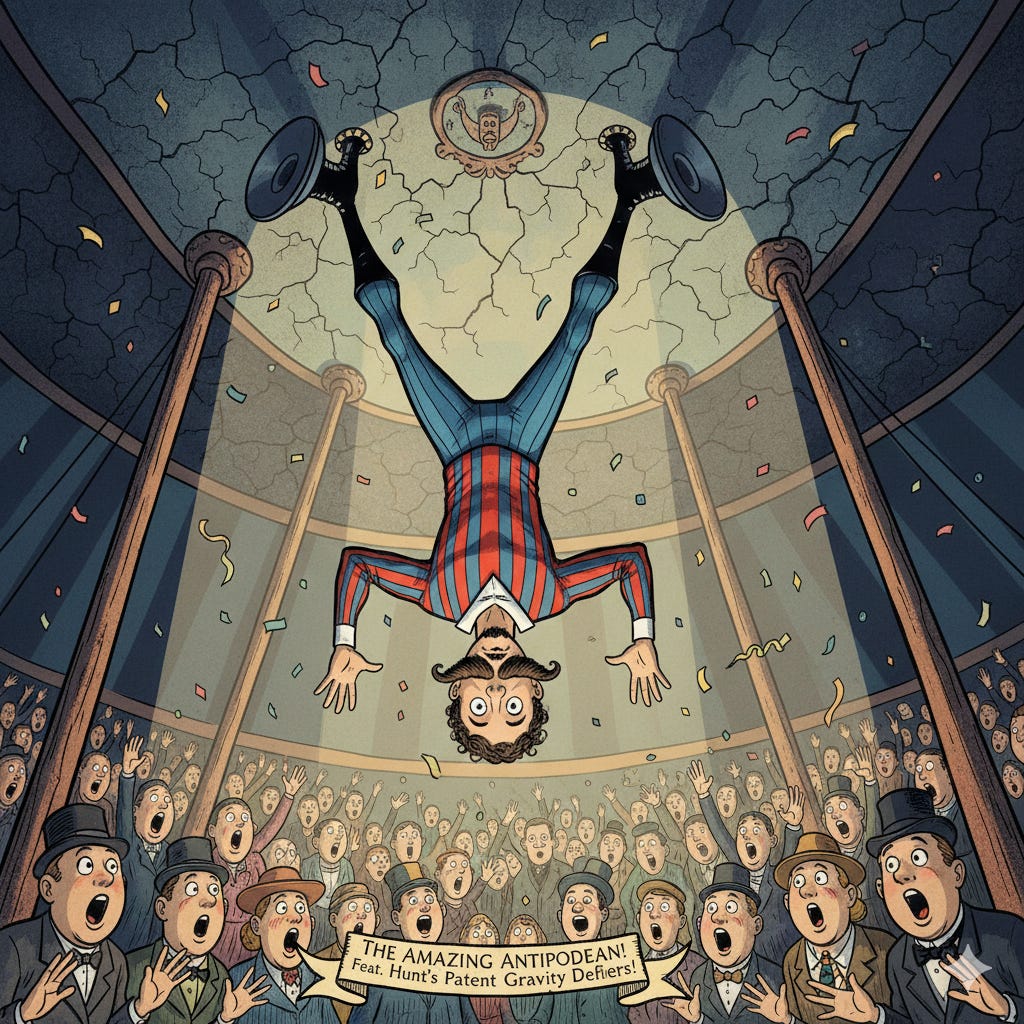
Why a Customer Experience Audit is Non-Negotiable in 2026

An Analysis of ROI, Retention, and Brand Resilience

Why a Customer Experience Audit is Non-Negotiable in 2026

LAST UPDATED: May 29, 2026 at 8:20PM

by Braden Kelley and Art Inteligencia

In the current business landscape, the traditional boundaries of competition have dissolved. Pricing is transparent, product features are rapidly emulated, and global logistics have leveled the playing field for distribution. What remains as the final, most defensible frontier is Customer Experience (CX). However, many organizations operate on assumptions rather than evidence, relying on outdated journey maps that don’t account for the rise of generative AI, omnichannel complexity, and the heightened emotional expectations of the modern consumer.

A Customer Experience Audit is not merely a “health check”; it is a rigorous diagnostic process designed to uncover the “silent killers” of conversion and loyalty. It bridges the gap between how a company thinks it is performing and how the customer actually feels at every touchpoint. By systematically evaluating the friction, flow, and emotional resonance of the brand journey, organizations can transform from being reactive service providers to proactive experience leaders. Below, we explore the ten most compelling reasons to initiate this audit, backed by the latest industry data.


Top 10 Reasons to Conduct a CX Audit

1. Identify and Eliminate Friction Points

An audit maps the real-world customer journey to find where users drop off. Small changes to these “micro-moments” can yield massive returns.

  • The Statistic: Simplifying a complex sign-up form can increase successful registrations by 20% (Reform).
  • The Insight: 53% of consumers say being kept on hold alone is reason enough to stop doing business with a brand (Webex/Futurum Group).

2. Improve Customer Retention and Reduce Churn

Acquiring a new customer is significantly more expensive than keeping an existing one. Audits identify the specific negative experiences that drive customers to competitors.

  • The Statistic: Resolving CX issues can reduce churn by 85% (Esteban Kolsky).
  • The Insight: 60% of customers will leave a brand after just one or two negative experiences (Zoom, 2025).

3. Maximize Revenue and Upsell Opportunities

Satisfied customers aren’t just loyal; they are less price-sensitive and more open to higher-value offers.

  • The Statistic: Companies that excel at CX see an average 80% increase in revenue (Zippia/Zendesk).
  • The Insight: 61% of customers will spend at least 5% more with a brand they know provides a good experience (Emplifi).

4. Optimize the Onboarding Experience

The first post-purchase interaction sets the tone for the entire relationship. Audits ensure your onboarding isn’t frustrating or confusing.

  • The Statistic: Effective onboarding makes customers 92% more likely to renew their subscriptions (TSIA/OnRamp).
  • The Insight: Interactive and engaging onboarding content can boost early product usage by 55% (Wyzowl).

5. Validate AI and Automation Strategy

Many companies layer AI over broken processes. An audit ensures your bots are actually helping rather than “getting stuck in loops.”

  • The Statistic: AI adoption can increase the number of issues resolved per hour by 15% (Quarterly Journal of Economics, 2025).
  • The Insight: 80% of customers expect bots to escalate to a human when needed, but only 38% say this actually happens (Zoom, 2025).

6. Align Internal Silos

Audits reveal when different departments (Sales, Marketing, Support) are providing conflicting information, which destroys customer trust.

  • The Statistic: 90% of customers expect consistent interactions across all channels (SDL/Renascence).
  • The Insight: 54% of organizations cite “fragmented or siloed data” as their biggest barrier to leveraging customer insights (Zendesk).

7. Benchmark Against Competitors

In 2026, CX is the primary differentiator as products and pricing become easier to replicate.

  • The Statistic: 89% of businesses are expected to compete primarily on CX this year (Gartner/OnRamp).
  • The Insight: Customer-centric brands are 60% more profitable than those that do not focus on CX (Deloitte).

8. Personalize with Purpose

Generic “Dear [Name]” emails no longer count as personalization. Audits help you use data to anticipate needs and determine the most authentic places to personalize customer interactions and experiences.

  • The Statistic: Brands with mature personalization are 71% more likely to report high customer loyalty (Deloitte).
  • The Insight: 80% of consumers are more likely to purchase from a brand that offers tailored experiences (Epsilon).

9. Enhance Employee Satisfaction

When customers are frustrated, frontline employees bear the brunt of that anger. Fixing the CX reduces agent burnout.

  • The Statistic: 62% of respondents identified a defined relationship between Ex and Cx, stating that the impact was “large” or “significant” and measurable. (Workstep).
  • The Insight: Companies with strong CX leadership are 2x more likely to have engaged employees (Temkin Group).

10. Turn Feedback into Action

Most companies collect feedback, but few act on it. An audit creates a structured roadmap for implementation.

  • The Statistic: Acting on customer feedback can lead to a 25% reduction in churn (Forrester/Renascence).
  • The Insight: 77% of customers view a brand more favorably if they proactively invite and act on feedback (Microsoft).

Summary Table of Audit Benefits

Benefit Impact Metric Source
Revenue Growth 80% increase Zippia/Zendesk
Retention 25-30% improvement Martin Newman
Profitability 60% higher than peers Deloitte
Operational Efficiency 10-15% cost savings Martin Newman

Conclusion: From Insight to Transformation

A Customer Experience Audit is the bridge between organizational intention and customer reality. In an era defined by rapid technological shifts and declining brand loyalty, the ability to see your business through the eyes of the consumer is your greatest competitive advantage. The statistics provided throughout this analysis make a clear case: companies that invest in understanding and optimizing their journey are not just surviving—they are significantly outperforming their peers in revenue, retention, and employee engagement.

However, an audit is only as valuable as the actions that follow (for more see Customer Experience Audit 101). The true power of this process lies in its ability to align internal silos, validate high-stakes investments in AI, and foster a culture of continuous improvement. As we move further into 2026, the question for leadership is no longer whether you can afford to conduct a CX audit (aka Customer Experience Risk and Revenue Leakage Diagnostic), but whether you can afford to continue operating without the clarity one provides. By prioritizing the human-centered elements of your business, you secure not just a transaction, but a long-term piece of your customer’s future.

Customer Experience Audit ROI Flipbook
Download the ‘Top 10 Reasons to Conduct a CX Audit’ flipbook PDF

Looking for someone to conduct an independent customer, partner or employee experience audit? Braden Kelley specializes in conducting these kinds of audits, mapping the relevant journeys and benchmarking your performance against select competitors.

Book Your Experience Audit Today


Image credits: ChatGPT

Content Authenticity Statement: The topic area, key elements to focus on, etc. were decisions made by Braden Kelley, with a little help from Google Gemini to clean up the article and add citations.

Subscribe to Human-Centered Change & Innovation WeeklySign up here to get Human-Centered Change & Innovation Weekly delivered to your inbox every week.

9 Reasons Digital Transformations Stall After the Pilot

9 Reasons Digital Transformations Stall After the Pilot

by Braden Kelley and Chateau G Pato


Why Do Digital Transformations Stall After the Pilot? (Short Answer)

Most digital transformations stall after the pilot because leaders confuse technical proof with organizational readiness. A successful demo shows something can work. Scaling requires named owners, redesigned work, aligned incentives, data and integration, change capacity, the courage to kill shadow processes — and the political will to live differently. The pilot was never the hard part.

The nine common reasons transformations stall are: (1) proof mistaken for readiness, (2) no named owner of the new way of working, (3) work redesign skipped, (4) incentives still reward old metrics, (5) data and integration debt, (6) change treated as communications, (7) shadow processes never killed, (8) pilot heroes ≠ scale reality, and (9) fear of the political cost of winning.

The Pilot Was Never the Hard Part

I have watched too many rooms celebrate a green pilot as if the transformation were already over. The interface worked. The select users smiled. The slide said “validated.” Then Monday arrived for everyone else — average managers, messy data, conflicting KPIs, and a legacy workaround that refused to die.

Human-centered change treats that gap as designable, not mysterious. Below are nine stall patterns I see repeatedly, what each looks like, and what real transformers do instead.

Reason Common sign What to do instead
1. Proof ≠ readiness “It worked” used as scale approval Require an adoption/scale scorecard
2. No durable owner Project ends; BAU orphaned Name a workflow owner with rights
3. No work redesign New tool, old handoffs Redesign jobs and decisions first
4. Old incentives KPIs punish new behavior Align metrics to transformed outcomes
5. Integration debt Pilot used clean workarounds Fund data/integration as scale work
6. Change = decks Training without practice time Build change muscle and coaching
7. Shadow process lives Old path still easiest Kill legacy paths on purpose
8. Heroics don’t scale A-team pilot, average-team crash Design for the median user
9. Political avoidance Endless “learning” Govern winners/losers in the open

1. Proof Mistaken for Readiness

What it is: Treating a successful pilot as proof the organization is ready to scale.

The stall: “It worked” becomes a funding sentence. Feasibility gets confused with operability. Leaders skip the boring questions about volume, exceptions, support load, and who changes how they spend Tuesday.

What to do instead: Separate technical validation from operating-model readiness. Before scale money, require an adoption and scale scorecard: owners, workflows, incentives, data path, support model, and stop rules for the old way.

2. No Named Owner of the New Way of Working

What it is: The transformation has a project manager — and no durable operator once the project ends.

The stall: Sponsorship was energetic in kickoff season. Then the program office demobilizes, and business-as-usual inherits a half-changed process with no one empowered to keep improving it.

What to do instead: Assign a named workflow owner with decision rights before scale funding. If nobody owns the new way after applause, you do not have a transformation. You have a temporary exhibit.

3. Work Redesign Skipped — Tool Bolted onto Old Process

What it is: Installing new technology on top of unchanged handoffs, policies, and approvals.

The stall: Same friction, prettier screens. People invent local workarounds because the system still asks them to do impossible coordination. Digitization accelerates the old mess.

What to do instead: Redesign jobs, handoffs, and decisions first. Technology should serve the human system you intend to run — not freeze the system you meant to leave.

4. Incentives Still Reward the Old Metrics

What it is: Asking people to adopt new behaviors while KPIs, bonuses, and recognition still pay for the old ones.

The stall: Managers optimize what still gets measured — speed-to-close, local utilization, ticket deflection theater — even when those metrics punish quality, collaboration, or customer effort in the new model.

What to do instead: Align metrics and recognition to transformed outcomes: adoption quality, end-to-end cycle time, customer/employee effort, first-time resolution, revenue or risk outcomes tied to the journey — not activity that photographs well.

5. Data and Integration Debt Comes Due

What it is: Pilots that succeed on clean samples, manual stitches, or heroic data wrangling collapse under production reality.

The stall: Scale exposes fragmented systems, inconsistent definitions, and brittle interfaces. The “digital” experience becomes a queue of exceptions.

What to do instead: Fund data quality and integration as first-class scale work — not a vague phase two. If the pilot needed spreadsheet glue, assume production needs architecture, not optimism.

6. Change Capacity Treated as Communications

What it is: Substituting town halls, slide decks, and one-time training for the real work of building new skills and habits.

The stall: People were informed. They were not enabled. Managers never got coaching time. Role anxiety filled the gap that practice should have filled.

What to do instead: Build change muscle: champions, spaced practice, protected learning time, manager enablement, and clear stories about how roles evolve. Communication is necessary. It is not capacity.

7. Shadow Process Never Gets Killed

What it is: Leaving the old spreadsheet, email path, or “temporary” workaround alive “just in case.”

The stall: Adoption stays optional. The easy path is still the legacy path. Leaders wonder why usage is soft while the organization quietly runs two operating systems.

What to do instead: Write stop criteria for shadow processes. Make the new way the only easy way. If you cannot turn something off, you have not finished the design of scale.

8. Pilot Team ≠ Scale Team — Heroics Don’t Industrialize

What it is: A hand-picked A-team succeeds in the pilot; average teams inherit complexity without the same support.

The stall: What worked for enthusiasts fails for the median user and median manager. Support tickets spike. Leaders blame “resistance” instead of design for the middle of the bell curve.

What to do instead: Design for the median. Staff enablement and operations for steady state. If only heroes can run it, it is not a transformation asset — it is a dependency on burnout.

9. Fear of the Political Cost of Winning

What it is: Avoiding scale because success would force real tradeoffs — turf, vendors, pet projects, or status stories that cannot survive daylight.

The stall: The organization stays in luxurious “learning mode.” Another pilot. Another vendor bake-off. Another steering committee. Progress becomes a lifestyle of almost.

What to do instead: Surface winners and losers early. Govern tradeoffs in the open. Use kill criteria as leadership hygiene. Transformation is not only a technology journey. It is a power redesign with manners.

How Do You Scale a Digital Pilot Without Stalling?

Before you fund the next wave, run a soft-landing go/no-go. Say no — or not yet — unless you can answer yes to these:

  1. Who owns the new workflow after the program ends?
  2. What human behavior must change for scale to count as success?
  3. What old path will we turn off, and when?
  4. Is integration and data readiness funded as core work, not hope?
  5. Do incentives and manager routines reinforce the new way?

A pilot proves possibility. Transformation proves the organization can live differently. If you want digital change that lands with customers and employees, stop celebrating demos as destinations — and start designing the human system that has to carry the future on a normal Tuesday.

Frequently Asked Questions

Why do digital transformations stall after the pilot?

They stall when leaders treat technical pilot success as organizational readiness. Scaling fails without durable owners, redesigned work, aligned incentives, data/integration, change capacity, retired shadow processes, design for average users, and political willingness to make tradeoffs.

What is the difference between a successful pilot and a scalable transformation?

A successful pilot proves something can work under controlled conditions. A scalable transformation proves the organization can run the new way of working in production — with owners, incentives, data plumbing, adoption support, and the old path intentionally shut down.

How do you scale a digital pilot successfully?

Name a workflow owner, redesign jobs and handoffs, align metrics, fund integration and data quality, build real change capacity, kill shadow processes, design for the median user, and govern political tradeoffs openly before expanding volume.

What are common reasons digital transformation fails after a pilot?

Nine common reasons include mistaking proof for readiness, lacking a durable owner, skipping work redesign, keeping old incentives, hitting data/integration debt, treating change as communications, leaving shadow processes alive, relying on pilot heroics, and avoiding the politics of winning.

What should leaders check before funding digital transformation scale-up?

Leaders should confirm ownership after the program, the human behavior that defines success, which legacy paths will be turned off, whether integration/data work is funded, and whether incentives and manager routines reinforce the new operating model.

Image credits: Google Gemini

Content Authenticity Statement: The topic area, key elements to focus on, etc. were decisions made by Braden Kelley, with a little help from Google Gemini and Cursor to clean up the article, add images and create infographics.

Subscribe to Human-Centered Change & Innovation WeeklySign up here to get Human-Centered Change & Innovation Weekly delivered to your inbox every week.