GUEST POST from Robert B. Tucker
Have you ever had a bad feeling about a relationship or business deal, but you went ahead with it anyway? Later, after things went awry, you remembered a faint alarm that went off in your mind — your intuition.
During a 35-year career studying and coaching business innovators, I have witnessed firsthand how intuition is an indispensable navigational compass, if only we understand it and listen to this subtle, often misunderstood form of intelligence.
“Every time I’ve made a bad decision about a person,” one business owner observed, “I eventually recalled how much I knew about that person before I made the decision. I knew perfectly well that person couldn’t be trusted. And yet greed or something made me believe the opportunity was so great that I didn’t listen to what my intuition was trying to tell me.”
Your intuition can help you sense when a problem exists. It can slow you down and help you avoid making rash, emotional decisions. Intuition can help you spot both threats and opportunities in today’s fast-changing world.
“I don’t care if the numbers say we’re going to make a billion dollars,” one CEO in the natural foods industry explained. “If I don’t feel good in my gut about a decision, I won’t go ahead. When it doesn’t feel right, it’s like a nervous stomach. When a decision feels right, it’s like a great meal. It just feels good.”
If We Are “Needy” or “Greedy,” Our Intuition Lacks Ignition
Intuition is a kind of “sixth sense” early warning system. If we are attuned to it, our intuition can help us in all sorts of ways: to sense when a problem exists, to alert us to changes in the environment, and, most importantly, to prevent us from making rash, emotional decisions, especially about people. However, if we are needy (“I need to fill this position right now”) or greedy (“This deal is too good to pass up”), our intuition has no impact on our thinking.
In today’s exponential world, the earliest indicators of change sometimes show up first in premonitions: “something is not right,” or “something has changed.” Despite the raging popularity of data (“In God we trust. Everyone else bring data”), dashboard metrics are lagging indicators and may not yet reflect a marketplace change. Leading indicators, on the other hand, could be anything from a seemingly random comment at a conference or a feeling of unease that merits further attention and investigation. For example, this quarter’s numbers may still look normal, yet you sense something important has changed in the market for your services, or imminent danger bubbling beneath the surface.
Intuitive customer-facing employees often pick up on changing customer expectations well before surveys or quarterly reports capture the trend. When leadership listens to those employees and treats their intuitions as valuable inputs rather than useless hunches, such weak signals can become an early warning that changes are afoot and action is required. While competitors wait for lagging data collection to catch up, those who recognize early signals are often the ones who ride the waves of change.
How Some Leaders Tap Intuitive Intelligence
Over the years, the popularity of intuition in business has waxed and waned. University of Texas professor Weston Agor’s seminal research measured intuitive intelligence, using the Myers-Briggs test. He discovered that successful executives used intuition in a variety of ways: to size up people they are dealing with; to make quick decisions, such as in negotiating sessions when they must “think on their feet” and especially in making decisions when all the facts simply aren’t available.
Agor’s research has been confirmed by further studies. Harvard Business School professor Daniel Isenberg reached similar conclusions after studying the thought processes of 16 senior managers in large corporations and smaller mid-sized firms. Isenberg followed each executive for an average of two days, observing them as they went through their day.
When he interviewed each executive, he found that they tapped intuitive judgment at almost every turn to support and interpret whatever data was relevant. “Particularly when faced with highly complex problems or issues for which there are no precedents,” Isenberg reported.
Five Ways to Activate Your Intuition
As academic studies have proven, leaders who consistently make better decisions don’t rely on gut instinct alone—they train their minds to tune in to subtle, often faint alarm bells. Here are five techniques for how to tune in and maximize this high form of intelligence.
1. Create White Space to Detect Signals.
Intuition emerges when the mind is allowed to connect dots beneath conscious awareness. Continuous input crowds out insight. Leaders who deliberately step away from screens and meetings give their brains time to integrate weak signals—subtle shifts in markets, people, and timing that data has not yet captured. Resilience coach Eileen McDargh starts each year with a one-week silent retreat in Mexico and recommends starting each day quietly with no screens.
2. Elevate Intuitions to Hypothesis Status
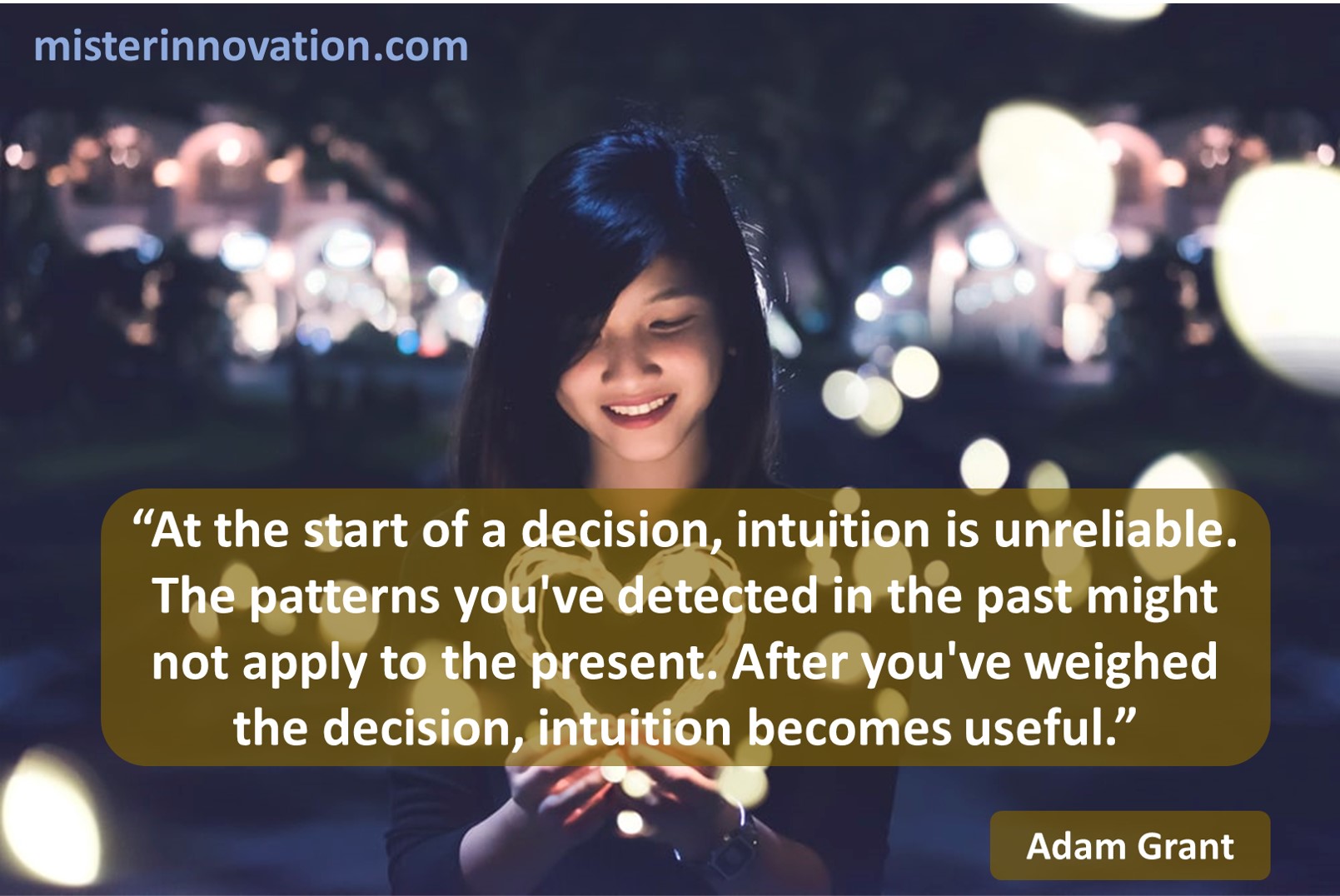
Intuitive impulses should neither be obeyed blindly nor ignored completely. Treat them as an early hypothesis. When something feels “off,” that is a cue to explore assumptions, scan for confirming or disconfirming evidence, and run small experiments.
3. Broaden the Signal Field
Strong intuition depends on exposure. Leaders with the sharpest instincts read widely, listen across boundaries, and stay close to customers and frontline realities. Their pattern recognition improves because their mental models are continuously refreshed with diverse inputs.
4. Listen to Somatic Signals
Experience often registers in the body before it reaches conscious thought. Tension, hesitation, or unexpected premonitions are not answers—but they are data. Ignoring them because we are needy or greedy reduces decision quality; noticing them expands it.
5. Think Future-Back
Intuition sharpens when leaders mentally rehearse multiple futures. By imagining success and failure two or three years out, hidden risks and overlooked opportunities surface early—when action is still possible.
In the final analysis, intuition is not guesswork. It is a compressed experience, activated by reflection, tested by foresight, and converted into results through human agency. Wise decision-makers treat both as inputs, not conclusions—signals that prompt foresight, sense-making, and deliberate action rather than blind acceptance.
This article originally appeared in Forbes
Image credit: 1 of 1,300+ FREE quotes available at http://misterinnovation.com
 Sign up here to get Human-Centered Change & Innovation Weekly delivered to your inbox every week.