
Tag Archives: Design Thinking

Design Thinking Facilitator Guide

A Crash Course in the Basics

Design Thinking Facilitator Guide

GUEST POST from Douglas Ferguson

Are you interested in facilitating a design thinking session at your workplace or for another organization? Have you learned about design thinking and want to get started or deepen your skills? If you are a newbie to design thinking facilitation, this is the guide for you. We’ve highlighted the basics you need to know to lead a design thinking or innovation workshop. Facilitation skills are essential to navigating complex business problems, and a skilled facilitator can supercharge the team’s performance. We encourage you to attend our Facilitation Lab, a weekly virtual meetup to support effective implementation.

Read this design thinking facilitator guide, and you’ll have solid tools to be successful from start to finish.

What is Design Thinking?

To start, let’s define some key terms. First, design thinking. Design thinking is a process used for creative problem-solving; a methodology that puts the end-user or customer at the center of decision-making. Design thinking is also characterized by an emphasis on prototyping and testing ideas and working in a highly collaborative manner with a cross-disciplinary team. Design thinking isn’t a passing business trend. It’s a powerful and widely-implemented approach to strategic work adopted by both startups and major corporations to tackle business challenges. Here are a few of our favorite design thinking books we recommend adding to your library for an in-depth background.

A design thinking facilitator leads collaborative working sessions that utilize design thinking practices to reinvigorate creative growth. The gatherings include brainstorms, innovation workshops, executive summits, design springs, multi-day workshops, and long-term projects.

A design thinking facilitator is a coach to innovative, productive group think and work.

Design thinking facilitators help teams focus on the customer throughout the process and uncover new insights and ideas typically aren’t revealed during business as usual (ex. the boss has an epiphany in the shower and tells the team to execute). In a nutshell, a design thinking facilitator is a conduit to innovative productive group discovery and creation. Facilitation skills are key to maximizing these outcomes.

Want to learn the basics of how to facilitate a design thinking workshop? Read our 7-step guide below, then consider our Workshop Design Course to help you get started.

Step 1: Get Focused

Your first task as a design thinking facilitator is to clarify and define what you need to accomplish through your workshop or meeting. You want to determine the focus based on team needs or challenges. Record the primary goal and high-level questions to answer, and make sure participants are aligned on defined objectives.

Pro-tip: Before planning the workshop, consider 30-60-minute conversations with each stakeholder before the design thinking session to make sure objectives are clear.

Step 2: Make the Guest List

Now that you’ve defined objectives, you and the key stakeholder(s) need to determine fitting participants. Who’s taking part in the workshop? Your client will likely have a strong hand in building the guest list. As the design thinking facilitator, it’s crucial that you advise here.

Too many people leads to chaos. Too few people means too few ideas.

Diversity in skillset, expertise, attitude, tenure, etc. is essential to an informed perspective. The more points-of-view that are represented, the more applicable your solutions. In terms of number of participants, somewhere between 7 to 15 is ideal. Too many people leads to chaos. Too few people means too few ideas.

Step 3: Make Your Agenda

With the objective and participants determined, the next step of facilitating a design thinking workshop is the agenda. A wise way to plan your agenda is to start at the end: With what tools do you need to leave the design thinking session? Are you prioritizing alignment? A system or process in place? A collection of novel ideas? Are you looking for a prioritized roadmap or a paper prototype of a new experience? When you clearly define your goals, you can plan the design thinking activities to build toward the conclusion.

The individual activities you will implement varies greatly based on the challenge. Need inspiration to kick off your Design Thinking activities? There are many free resources to help guide you and your team on your journey. We’ve also outlined exercises for virtual workshops here.) No matter your timeline, prioritize time for introductions, icebreakers, and short breaks to check inboxes.

Pro tip: Be generous when time-boxing your design thinking activities. Everything will take longer than you think. A good rule of thumb is to double the time you imagine an individual activity will take.

Step 4: Get Your Space

Next up: Where are you going to host your design thinking workshop? While it might sound like a minor detail, the space affects the day’s success.

We recommend getting participants out of their workspace(s) to inspire fresh thinking and distance from day-to-day work. Whether you need to offer a hybrid option, have the budget for an offsite space, or need to use the office, consider the following to enhance the experience:

  • Look for good natural light and character. (A windowless hotel conference room is not ideal.)
  • Provide comfortable seating for all. (Simple, but we’ve seen it happen.)
  • Guarantee wall space or boards for pinning materials and capturing ideas.
  • Don’t forget AV needs: a projector for presenting, a screen if someone needs to collaborate remotely, etc.

Want more information on choosing a space? Check out 7 Things to Consider When Choosing a Workshop Venue here.

Step 5: Gather Supplies

With space, participants, and a solid agenda, you now need supplies to execute your workshop. Your exact supplies will be driven by your activities, agenda, and chosen space. Here are some basics to get you started:

If you want to dive deeper into the specific supplies that are recommended for a design sprint (which are helpful for any workshop), read here.

Pro-Tip: If possible, bring a filling breakfast and lunch so you don’t have to leave to eat. Also, healthy snacks, water, and coffee will keep people engaged as the day goes on.

Step 6: Be the Leader

It’s the big day! It’s time for you to lead the group through the agenda and activities you worked so hard on. The more you facilitate, the more skilled you become. 

Make sure to be yourself and keep the following things in mind as you lead the team in design thinking:

  • You’re the boss: People are looking for you to guide them. You’re prepared and are the expert. Establish your authority early and feel confident making decisions and telling the group when it’s time to move forward in the agenda.
  • Establish rules: Let the group know the rules of the day. Encourage people to stay off their phones and to fully participate in the session. Let them know that there are designated breaks.

Give everyone a voice: As the facilitator, you are responsible for making sure everyone is heard. If you notice someone being quiet, pull them into the conversation. You designed the guest list with their contribution in mind.

Step 7: Wrap It Up & Play It Back

After the workshop has come to a close, recognize your role as a design thinking facilitator to equip the group with tools for long-term success. Consider these in the days afterward:

  • Photograph and document: Make sure you photograph important output from the meeting: Post-its, diagrams, or worksheets that may have been created.
  • Synthesize the learnings: Take time to reflect on the session and the ideas that came of it. Create a MURAL board or a short presentation to share with participants and their teammates.

Get the group back together: Schedule time to share back your learnings with the participants and make plans together for how to implement thinking and learnings into daily work.


Looking to become a Design Thinking Facilitator?

What’s the importance of bringing in a professional to lead the session? A design thinking facilitator positively disrupts the team dynamic. Read up on why professional facilitation can make a difference.

We hope you’re excited to become a Design Thinking facilitator. Voltage Control has design thinking facilitator training will maximize your facilitation skills. Our Facilitation Certification programs will guide you through key facilitation skills and provide you with ample opportunities to practice.

Article originally published at VoltageControl.com

Image credit: Pexels

Subscribe to Human-Centered Change & Innovation WeeklySign up here to join 17,000+ leaders getting Human-Centered Change & Innovation Weekly delivered to their inbox every week.


How Has Innovation Changed Since the Pandemic?

The Answer in Three Charts

How Has Innovation Changed Since the Pandemic?

GUEST POST from Robyn Bolton

“Everything changed since the pandemic.”

At this point, my husband, a Navy veteran, is very likely to moo (yes, like a cow). It’s a habit he picked up as a submarine officer, something the crew would do whenever someone said something blindingly obvious because “moo” is not just a noise. It’s an acronym – Master Of the Obvious.

But HOW did things change?

From what, to what?

So what?

It can be hard to see the changes when you’re living and working in the midst of them. This is why I found “Benchmarking Innovation Impact, from InnoLead,” a new report from InnoLead and KPMG US, so interesting, insightful, and helpful.

There’s lots of great stuff in the report (and no, this is not a sponsored post though I am a member), so I limited myself to the three charts that answer executives’ most frequently asked innovation questions.

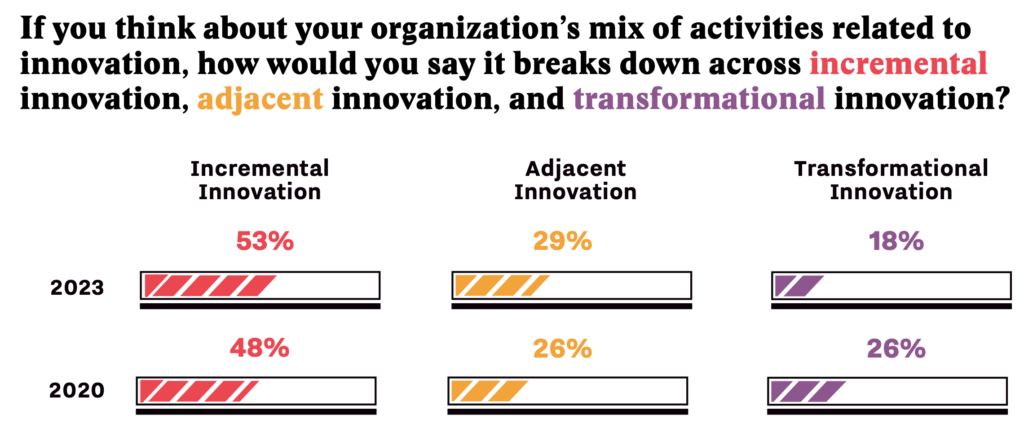
Innovation Leader Research 2023 Chart 1

Question #1: What type of innovation should I pursue?

2023 Answer: Companies are investing more than half of their resources in incremental innovation

So What?:  I may very well be alone in this opinion, but I think this is great news for several reasons:

  1. Some innovation is better than none – Companies shifting their innovation spending to safer, shorter-term bets is infinitely better than shutting down all innovation, which is what usually happens during economic uncertainty
  2. Play to your strengths – Established companies are, on average, better at incremental and adjacent innovation because they have the experience, expertise, resources, and culture required to do those well and other ways (e.g., corporate venture capital, joint ventures) to pursue Transformational innovation.
  3. Adjacent Innovation is increasing –This is the sweet spot for corporate innovation (I may also be biased because Swiffer is an adjacent innovation) because it stretches the business into new customers, offerings, and/or business models without breaking the company or executives’ identities.

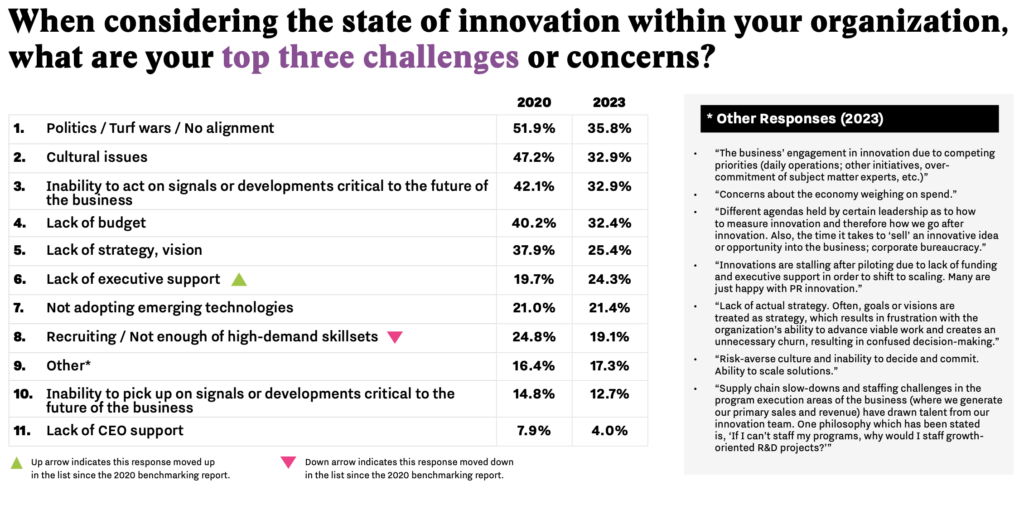
Innovation Leader Research 2023 Chart 2

Question #2: Is innovation really a leadership problem (or do you just have issues with authority)?

2023 Answer: Yes (and it depends on the situation). “Lack of Executive Support” is the #6 biggest challenge to innovation, up from #8 in 2020.

So What?: This is a good news/bad news chart.

The good news is that fewer companies are experiencing the top 5 challenges to innovation. Of course, leadership is central to fostering/eliminating turf wars, setting culture, acting on signals, allocating budgets, and setting strategy. Hence, leadership has a role in resolving these issues, too.

The bad news is that MORE innovators are experiencing a lack of executive support (24.3% vs. 19.7% in 2020) and “Other” challenges (17.3% vs. 16.4%), including:

  • Different agendas held by certain leadership as to how to measure innovation and therefore how we go after innovation. Also, the time it takes to ‘sell’ an innovative idea or opportunity into the business; corporate bureaucracy.”
  • Lack of actual strategy. Often, goals or visions are treated as strategy, which results in frustration with the organization’s ability to advance viable work and creates an unnecessary churn, resulting in confused decision-making.”
  • “Innovations are stalling after piloting due to lack of funding and executive support in order to shift to scaling. Many are just happy with PR innovation.”

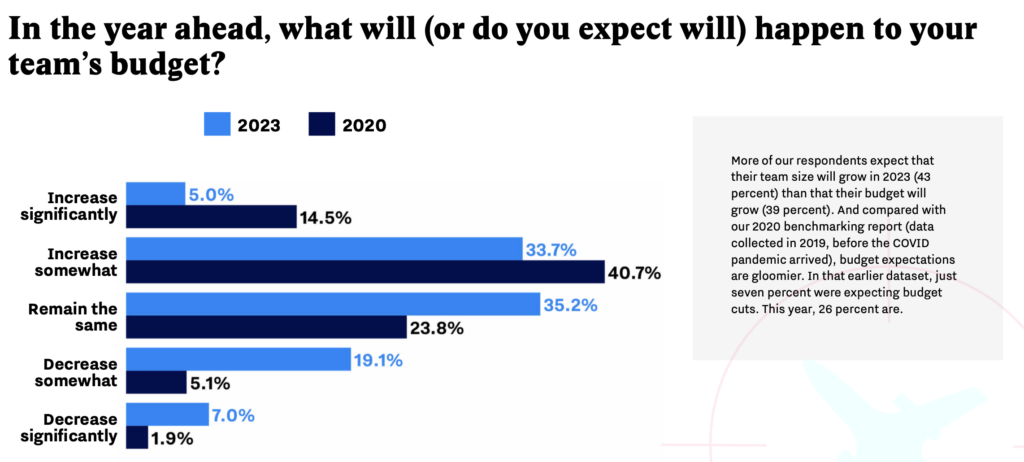
Innovation Leader Research 2023 Chart 3

Question #3: How much should I invest in innovation?

2023 Answer: Most companies are maintaining past years’ budgets and team sizes.

So What?:  This is another good news/bad news set of charts.

The good news is that investment is staying steady. Companies that cut back or kill innovation investments due to economic uncertainty often find that they are behind competitors when the economy improves. Even worse, it takes longer than expected to catch up because they are starting from scratch regarding talent, strategy, and a pipeline.

The bad news is that investment is staying steady. If you want different results, you need to take different actions. And I don’t know any company that is thrilled with the results of its innovation efforts. Indeed, companies can do different things with existing budgets and teams, but there needs to be flexibility and a willingness to grow the budget and the team as projects progress closer to launch and scale-up.

Not MOO

Yes, everything has changed since the pandemic, but not as much as we think.

Companies are still investing in incremental, adjacent, and transformational innovation. They’re just investing more in incremental innovation.

Innovation is still a leadership problem, but leadership is less of a problem (congrats!)

Investment is still happening, but it’s holding steady rather than increasing.

And that is nothing to “moo” at.

Image credits: Pixabay, InnoLead

Subscribe to Human-Centered Change & Innovation WeeklySign up here to join 17,000+ leaders getting Human-Centered Change & Innovation Weekly delivered to their inbox every week.

Innovation and the Silicon Valley Bank Collapse

Why It’s Bad News and Good News for Corporate Innovation

Innovation and the Silicon Valley Bank Collapse

GUEST POST from Robyn Bolton

Last week, as news of Silicon Valley Bank’s losses and eventual collapse, took over the news cycle, attention understandably turned to the devastating impact on the startup ecosystem.

Prospects brightened a bit on Monday with news that the federal government would make all depositors whole. Startups, VCs, and others in the ecosystem would be able to continue operations and make payroll, and SVB’s collapse would be just another cautionary tale.

But the impact of SVB’s collapse isn’t confined to the startup ecosystem or the banking industry.

Its impact (should have) struck fear and excitement into the hearts of every executive tasked with growing their business.

Your Portfolio’s Risk Profile Just Changed

The early 2000s were the heyday of innovation teams and skunkworks, but as these internal efforts struggled to produce significant results, companies started looking beyond their walls for innovation. Thus began the era of Corporate Venture Capital (CVC).

Innovation, companies realized, didn’t need to be incubated. It could be purchased.

Often at a lower price than the cost of an in-house team.

And it felt less risky. After all, other companies were doing it and it was a hot topic in the business press. Plus, making investments felt much more familiar and comfortable than running small-scale experiments and questioning the status quo.

Between 2010 and 2020, the number of corporate investors increased more than 6x to over 4,000, investment ballooned to nearly $170B in 2021 (up 142% from 2020), and 1,317 CVC-backed deals were closed in Q1 of 2020.

But, with SVB’s collapse, the perceived risk of startup investing suddenly changed.

Now startups feel riskier. Venture Capital firms are pulling back, and traditional banks are prohibited from stepping forward to provide the venture debt many startups rely on. While some see this as an opportunity for CVC to step up, that optimism ignores the fact that companies are, by nature and necessity, risk averse and more likely to follow the herd than lead it.

Why This is Bad News

As CVC, Open Innovation, and joint ventures became the preferred path to innovation and growth, internal innovation shifted to events – hackathons, shark tanks, and Silicon Valley field trips.

Employees were given the “freedom” to innovate within a set time and maybe even some training on tools like Design Thinking and Lean Startup. But behind closed doors, executives spoke of these events as employee retention efforts, not serious efforts to grow the business or advance critical strategies.

Employees eventually saw these events for what they were – innovation theater, activities designed to appease them and create feel-good stories for investors. In response, employees either left for places where innovation (or at least the curiosity and questions required) was welcomed, or they stayed, wiser and more cynical about management’s true intentions.

Then came the pandemic and a recession. Companies retreated further into themselves, focused more on core operations, and cut anything that wouldn’t generate financial results in 12 months or less.

Innovation muscles atrophied.

Just at the moment they need to be flexed most.

Why This is Good News

As the risk of investment in external innovation increases, companies will start looking for other ways to innovate and grow. Ways that feel less risky and give them more control.

They’ll rediscover Internal Innovation.

This is the silver lining of the dark SVB cloud – renewed investment in innovation, not as an event or activity to appease employees, but as a strategic tool critical to delivering strategic priorities and accelerating growth.

And, because this is our 2nd time around, we know it’s not about internal innovation teams OR external partners/investments. It’s about internal innovation teams AND external partners/investments.

Both are needed, and both can be successful if they:

  1. Are critical enablers of strategic priorities
  2. Pursue realistic goals (stretch, don’t splatter!)
  3. Receive the people and resources required to deliver against those goals
  4. Are empowered to choose progress over process
  5. Are supported by senior leaders with words AND actions

What To Do Now

When it comes to corporate innovation teams, many companies are starting from nothing. Some companies have files and playbooks they can dust off. A few have 1 or 2 people already working.

Whatever your starting point is, start now.

Just do me one favor. When you start pulling the team together, remember LL Cool J, “Don’t call it a comeback, I been here for years.”

Image credit: Wikimedia Commons

Subscribe to Human-Centered Change & Innovation WeeklySign up here to join 17,000+ leaders getting Human-Centered Change & Innovation Weekly delivered to their inbox every week.

The Life of a Corporate Innovator

As Told in Three Sonnets

The Life of a Corporate Innovator

GUEST POST from Robyn Bolton

Day 1

Oh innovation, a journey just begun

A bold quest filled with challenges, risks, and dreams,

A path of creativity, knowledge and fun,

That will bring change, growth and a brighter scene.

Do not be afraid, though unknowns abound,

For greatness starts with small unsteady steps

Take courage and embrace each change that’s found,

And trust that success will be the final event.

Remember, every challenge is a chance,

To learn, grow, and shape thy future bright,

And every obstacle a valuable dance,

That helps thee forge a path that’s just and right.

So go forth, my friend, and boldly strive,

To make innovation flourish and thrive.

The Abyss (Death and Rebirth)

Fight on corporate innovator, who art so bold

And brave despite the trials that thou hast,

Thou hast persevered through promises cold,

And fought through budget cuts that came so fast.

Thou hast not faltered, nor did thou despair,

Despite the lack of resources at thy door,

Thou hast with passion, worked beyond repair,

And shown a steel spine that’s hard to ignore.

Thou art a shining example to us all,

A beacon of hope in times that are so bleak,

Thou art a hero, standing tall and strong,

And leading us to victories that we seek.

So let us celebrate thy unwavering faith,

And honor thee, innovator of great grace.

The Triumph

My dear intrapreneur, well done,

The launch of thy innovation is a feat,

A result of years of hard work, and fun,

That sets a shining example for all to meet.

Thou hast persevered through many a trial,

With unwavering determination and drive,

And now, thy hard work doth make thee smile,

As thy business doth grow and thrive.

This triumph is a testament to thee,

Of thy creativity, passion, and might,

And serves as a reminder of what can be,

When we pour our hearts into what is right.

So let us raise a glass and celebrate,

Thy success, and the joy innovation hath created!

These sonnets were created with the help of ChatGPT

Image credit: Pixabay

Subscribe to Human-Centered Change & Innovation WeeklySign up here to join 17,000+ leaders getting Human-Centered Change & Innovation Weekly delivered to their inbox every week.
The AI Apocalypse is Here

3 Reasons You Should Celebrate!

The AI Apocalypse is Here

GUEST POST from Robyn Bolton

Whelp, the apocalypse is upon us. Again.

This time the end of the world is brought to you by AI.

How else do you explain the unending stream of headlines declaring that AI will eliminate jobsdestroy the education system, and rip the heart and soul out of culture and the arts? What more proof do you need of our imminent demise than that AI is as intelligent as a Wharton MBA?

We are doomed!

(Deep breath)

Did you get the panic out of your system? Feel better?

Good.

Because AI is also creating incredible opportunities for you, as a leader and innovator, to break through the inertia of the status quo, drive meaningful change, and create enormous value.

Here are just three of the ways AI will help you achieve your innovation goals:

1. Surface and question assumptions

Every company has assumptions that have been held and believed for so long that they hardened into fact. Questioning these assumptions is akin to heresy and done only by people without regard for job security or their professional reputation.

My favorite example of an assumption comes from the NYC public school district whose spokesperson explained the decision to ban ChatGPT by saying, “While the tool may be able to provide quick and easy answers to questions, it does not build critical-thinking and problem-solving skills, which are essential for academic and lifelong success,”

Buried just under the surface of this statement is the assumption that current teaching methods, specifically essays, do build critical thinking and problem-solving skills.

But is that true?

Or have we gotten so used to believing that essays demonstrate critical thinking and problem-solving that we’ve become blind to the fact that most students (yes, even, and maybe especially, the best students) follow the recipe that produces an essay that mirrors teachers’ expectations?

Before ChatGPT, only the bravest teachers questioned the value of essays as a barometer of critical thinking and problem-solving. After ChatGPT, scores of teachers took to Tik Tok and other social media platforms to share how they’re embracing the tool, using it alongside traditional tools like essays, to help their students build skills “essential for academic and lifelong success.”

2. EQ, not IQ, drives success

When all you need to do is type a question into a chatbot, and the world’s knowledge is synthesized and fed back to you in a conversational tone (or any tone you prefer), it’s easier to be the smartest person in the room.

Yes, there will always be a need for deep subject-matter experts, academics, and researchers who can push our knowledge beyond its current frontiers. But most people in most companies don’t need that depth of expertise.

Instead, you need to know enough to evaluate the options in front of you, make intelligent decisions, and communicate those decisions to others in a way that (ideally) inspires them to follow.

It’s that last step that creates an incredible opportunity for you. If facts and knowledge were all people needed to act, we would all be fit, healthy, and have absolutely no bad habits.

For example, the first question I asked ChatGPT was, “Why is it hard for big companies to innovate?” When it finished typing its 7-point answer, I nodded and thought, “Yep, that’s exactly right.”

The same thing happened when I asked the next question, “What should big companies do to be more innovative?”  I burst out laughing when the answer started with “It depends” and then nodded at the rest of its extremely accurate response.

It would be easy (and not entirely untrue) to say that this is the beginning of the end of consultants, but ChatGPT didn’t write anything that wasn’t already written in thousands of articles, books, and research papers.

Change doesn’t happen just because you know the answer. Change happens when you believe the answer and trust the people leading and walking alongside you on the journey.

3. Eliminate the Suck

Years ago, I spoke with Michael. B Jordan, Pixar’s Head of R&D, and he said something I’ll never forget – “Pain is temporary. Suck is forever.”

He meant this, of course, in the context of making a movie. There are periods of pain in movie-making – long days and nights, times when vast swaths of work get thrown out, moments of brutal and public feedback – but that pain is temporary. The movie you make is forever. And if it sucks, it sucks forever,

Sometimes the work we do is painful but temporary. Sometimes doing the work sucks, and we will need to keep doing it forever. Expense reports. Weekly update emails. Timesheets. These things suck. But they must be done.

Let AI do them and free yourself up to do things that don’t suck. Imagine the conversations you could have, ideas you could try, experiments you could run, and people you could meet if you no longer have to do things that suck.

Change is coming. And that’s good news.

Change can be scary, and it can be difficult. There will be people who lose more than they gain. But, overall, we will gain far more than we lose because of this new technology.

If you have any more doubts, I double-checked with an expert.

“ChatGPT is not a sign of the apocalypse. It is a tool created by humans to assist with language-based tasks. While artificial intelligence and other advanced technologies can bring about significant changes in the way we live and work, they do not necessarily signal the end of the world.”

ChatGPT in response to “Is ChatGPT a sign of the apocalypse?”

Image credit: Pixabay

Subscribe to Human-Centered Change & Innovation WeeklySign up here to join 17,000+ leaders getting Human-Centered Change & Innovation Weekly delivered to their inbox every week.
Struggling to Innovate? Try This Instead

Struggling to Innovate? Try This Instead

GUEST POST from Robyn Bolton

Everyone is an innovator on January 1.

That’s the day when each of us resolves to do something new that creates value.

  • Start working out so I lose weight, look better, and feel healthier.
  • Stop smoking, so I live longer.
  • Turn off my computer and phone at 6:00 pm so I focus on family.

Only 20% of people are innovators on February 1. The rest of us gave up our resolutions and decided to keep doing the same things that create (good enough) value.

Your business is no different.

At the start of the fiscal year, you resolve to innovate!

  • Explore new offerings, customers, and business models
  • Experiment with new ways to get things done
  • Enter new markets

Then something goes wrong, and you divert some people (not everyone!) from innovating to fixing an operational problem.

Then the first quarter starts coming in below expectations, and you cut budgets to stay on track to deliver the bottom line.

Then something else happens, and something else, and something else, and soon it’s “February 1,” and, for excellent and logical reasons, you give up your resolution to innovate and focus all your resources on operating and hitting your KPIs.

Resolve to Revive.

Innovation is something NEW that creates value.

New is hard. It’s difficult to start something new, and it’s challenging to continue doing it when things inevitably go awry. Investing in something uncertain is risky, primarily when more “certain” investment opportunities exist. It’s why New Year’s resolutions and Innovation strategies don’t stick.

Revival is the creation of new value from OLD.

When you work on Revival, you go back to the old things, the things you explored, tried, implemented, or even launched years ago that didn’t work then but could create more value than anything you’re doing today.

Your business is filled with Revival opportunities.

How to Reveal Revivals

Ask, “What did we do before…?”

Everything we do now – research, development, marketing, sales, communication, M&A – was done before smartphones, laptops, desktops, and even mainframes. Often new technology makes our work easier or more efficient. But sometimes, it just creates work and bad habits.

If you are trying to make Zoom/Teams calls less exhausting and more productive, try to remember meetings before Zoom/Teams. They were conference calls. So, next time you need to meet, revive and schedule a phone conference (or a cameras-off Zoom/Teams call).

Find the failures

Most companies are highly skilled at hiding any evidence of failure. But the memories and stories live on in the people who worked on them. Talk to them, and you may discover a blockbuster idea that failed for reasons you can quickly address.

Like Post-It Notes.

While some parts of the Post-Its story are true – the adhesive was discovered by accident and first used to bookmark pages in a hymnal, most people don’t know that 10 YEARS passed between hymnal use and market success. In that decade, the project was shelved twice, failed in a test market, and given away as free samples before it became successful.

Resurrect the Dead

The decision to exit a market or discontinue a product is never easy or done lightly. And once management makes the decision, people operate under the assumption that the company should never consider returning. But that belief can sometimes be wrong.

Consider Yuengling, America’s oldest brewery and one of its old ice cream shops.

In 1829, David G. Yuengling founded Eagle Brewing in Pottsville, PA. The business did well until, you guessed it, Prohibition. In 1920, D.G. Yuengling & Sons (formerly Eagle Brewing) built a plant across the street from their brewery and began producing ice cream. When Prohibition ends, brewing restarts, and ice cream production continues. Until 1985, when a new generation takes the helm at Yuengling and, under the guise of operational efficiency and business optimization, shut down the ice cream business to focus on beer. TWENTY-NINE YEARS later, executives looking for growth opportunities remembered the ice cream business and re-launched the product to overwhelming customer demand.

Just because you need growth doesn’t mean you need New.

Innovation is something new that creates value. But it doesn’t have to be new to the world.

Tremendous value can be created and captured by doing old things in new ways, markets, or eras.

After all, everything old is new again.

Image credit: Pexels

Subscribe to Human-Centered Change & Innovation WeeklySign up here to join 17,000+ leaders getting Human-Centered Change & Innovation Weekly delivered to their inbox every week.
Getting Through Grief Consciously

Getting Through Grief Consciously

GUEST POST from Tullio Siragusa

Life brings opportunities, happiness, and skyrocketing success when we decide to live it fully and without fear. Along with that, we will face challenging times that will cause us to grieve.

Globally, we are all facing a form of grief right now. Be it the loss of a loved one to Covid-19, or the loss of our free way of life — grief is all around us. Before this pandemic that we are experiencing collectively, you may have suffered the loss of loved ones for other reasons, or you may have gone through a divorce, a breakup, the loss of a friendship, or the loss of a pet.

There are many forms of loss. You can experience loss of money, your job, reputation, your faith, health, and even loss of hope.

“Loss is a normal part of life and grief is part of the healing process if we learn to face it with grace.”

To get through grief with grace it’s ideal to face it with the help of others, but for the most part you have to get through it alone. We are privileged to have family, friends, spiritual direction, therapists, life coaches and other support groups around us, but healing grief is essentially between you and yourself.

“In time of grief you need to embrace yourself, love yourself and cure yourself.”

It is easier said than done, but there is truly no other way around grief than to face it fully on your own, courageously, vulnerability and with grace.

Importance of Grace

We all, at some point in our lives, have felt as if we reached our breaking point, but eventually we wake up to the desire to not be broken for rest of our lives. For instance, while going through hard times we are not always acting our best selves. Harsh words are often exchanged with others out of the need to “dump the pain” on someone else to feel some sense of relief. After doing that, we often feel guilty about it and apologize.

It is not bad to apologize, but losing your temper and saying things you normally would not say can not only tarnish your image, but can scar someone badly enough that you lose their trust for a long time, and sometimes forever.

“When you manage your emotions while grieving, you hold on to grace, and grace is the energy of mercy for yourself and others.”

Our personality gets groomed with every pain we overcome. If we walk through life’s journey with a mindset that everything happens for a reason, and everything happens to teach us something new, then every challenging time becomes an opportunity to add strong positive and graceful traits to our personality.

The people who learn to manage their emotions during the toughest times without falling apart, add an unprecedented trait of composure, grace and an emotionally intelligent personality.

How to Get Through Grief with Grace

First, you need to fully acknowledge that grief is normal. It is not a disease. It is not a sign of weakness, or lack of emotional intelligence.

Our human body and mind is built to respond to situations. When we lose something, or someone precious, grief comes knocking. Trying to avoid that grief is not the right way to get over it. The best way to deal with grief is to embrace it and get through it.

One of my spiritual teachers used to say: “The only way to get to the other side of hell, is one more step deeper into it, that is where the exit door is waiting for you.”

“In order to grieve with grace, we need the courage to face loss as normal as anything else we experience in life.”

I know people who have avoided facing the loss of their loved ones for years, but ultimately, they had to go through it and face it. Grief will come for you no matter what, so why postpone it?

The foremost thing to handle any tough situation is to develop gratitude for all those blessed situations in your life that make it beautiful. No doubt, feeling gratitude while grieving is almost impossible, but if you develop a habit of being grateful on a daily basis, it becomes possible to feel it even during tough times.

If you are going through grief, find a peaceful place away from all those people reminding you of the loss, and try to connect to any happy moment you can recall. Feel that moment in your heart. Hold on to that feeling as long as possible and write it down later.

Whenever you feel broken, be mindful of such moments. You will soon be able to tap to a comparatively happy person inside you, anytime you need to.

“The way to develop your grace muscle is to live daily with gratitude and make a mental library of the happy moments in your life that you can borrow against, during difficult times.”

We have been living in a time in history void of pain. We are constantly seeking happiness and running from pain and suffering. Now we are being forced to face pain, suffering, uncertainty, and loss.

There are blessings inherent within loss and suffering. The blessings are always revealed on the other side of grief, and it is always hard to believe that the blessing is happening amidst grief and pain. However, if you look back in your life at the moments that defined you, the moments when you experienced the most Light, the most blessings — it was soon after your darkest hours.

“When we move through the process of grief believing in our ability to grow from the experience, we become more aware of the blessings in disguise that will come out of it.”

A sense of serenity can be achieved through releasing the pressure of the expectations of a set pattern for your life. There comes a moment when it is better to embrace what you can’t change, and develop the courage to strive for what you can.

“Acknowledging your capacities and the difference between what you can and what you can’t control, will make it easier to go through grief.”

What I am talking about is the power of surrendering to what is, instead of holding on to what could have been. For most people, grace is among the most precious trait of their personality and behavior.

If you have lost something or someone precious that is an irreparable loss, it is important to take care of yourself during those testing times. Remember that all chaos comes with an expiration date, and to surrender to the change you need to make to keep moving forward.

Remember the blessings in your life, be grateful for what is, has been, and will be, and be patient with yourself.

NOTE: For all those who have lost loved ones during the Covid-19 pandemic and have not been able to properly say goodbye, I wish that their memory be a blessing in your life.

Image credit: Pexels

Originally published at tulliosiragusa.com on April 27, 2020

Subscribe to Human-Centered Change & Innovation WeeklySign up here to get Human-Centered Change & Innovation Weekly delivered to your inbox every week.

99.7% of Innovation Processes Miss These 3 Essential Steps

99.7% of Innovation Processes Miss These 3 Essential Steps

GUEST POST from Robyn Bolton

Congratulations! You developed and are using a best-in-class Innovation Process.

You start by talking to consumers, studying mega-trends, and scanning the globe for emerging technologies and disruptive offerings.

Once you find a problem and fall in love with it, you start dreaming and designing possible solutions. You imagine what could be, focused on creating as many ideas as possible. Then you shift to quality, prioritizing ideas that fit the company’s strategy and are potentially desirable, viable, and feasible.

With prioritized ideas in hand, you start iterating, an ongoing cycle of prototyping and testing until you confidently home in on a solution that consumers desire, is technically feasible, and financially viable.

But you don’t stop there! You know that ideas are easily copied by innovative business models are the source of lasting competitive advantage, so you think broadly and identify financial, operational, and strategic assumptions before testing each one like the innovation scientist you are.

If (and when) a solution survives all the phases and stage gates and emerges triumphant from the narrow end of the innovation process, there is a grand celebration. Because now, finally, it is ready to go to market and delight customers.

Right?

Wrong.

The solution’s journey has only just begun.

What lies ahead can be far more threatening and destructive than what lies behind.

Unless you planned for it by including these three steps in your innovation process.

1. Partnership with Sales

During testing, you ask consumers to give feedback on solutions. But do you ask Sales?

Salespeople spend most of their time outside the office and in stores, talking to customers (e.g., retailers, procurement), consumers, and users. They see and hear what competitors are doing, what is working, and what isn’t. And they will share all of this with you if you ask.

When I ask why innovation processes don’t include Sales, I hear two things (1) “it’s too early to talk to Sales” and (2) “they always tell us the same thing – it’s too expensive.”

First, if you have a concept (or two or three) with a 50/50 shot of going to market, call a few Salespeople and ask for their reactions. Nothing formal, no meeting required—just a gut reaction. And once you get that, ask when they’d like to talk again because their perspective is essential.

Second, “too expensive” should never be the end of the conversation. It’s one piece of feedback, ask follow-up questions to understand why it’s too expensive, then ask, “What else?”  There’s always more, and some of it is useful. Plus, better to hear it now than months or years from now at the launch announcement.

2. Relay with Operations

Most companies have a process between the end of the innovation process and shipping the new offering. It’s where sourcing, manufacturing, shipping, inventory management, contracting, and many other crucial and practical decisions and plans are made.

Also, at most companies, the “transition” from the innovation process to the operational process is akin to chucking something over a wall. “Here you go,” Innovation seems to say, “we proved this will be a big business. Now go make it happen!”

Unfortunately, Supply Chain, Manufacturing, and everyone else affected usually stand on the other side of the wall, solution in hand, mouth agape, eyes wide, thinking, “Huh?”

Instead of an abrupt hand-off, the Innovation Process needs to identify when the relay-style hand-off starts, and Innovation and Operations run side-by-side, developing, adjusting, and honing the solution.

3. Hand-off to the Core Business

The hand-off to the Core Business is the most precarious of all moments for an innovation. The moment it leaves the Innovation team’s warm, nurturing, and forgiving nest and moves into the performance-driven reality of the Core Business.

The Core Business knows why it was added to the P&L, but they don’t understand how it came to be or why it is the way it is. And they definitely don’t love it as much as you do. All they see is a tiny, odd thing that requires lots of their already scarce resources to become something worthwhile.

Instead of depositing beloved solutions on the Core Business’ doorstep like an unwanted orphan, Innovation Process should ensure that the following three questions are answered and aligned to well before the hand-off occurs.

  • How material (revenue, profit) does a solution need to be to be welcomed into the Core Business?
  • Who runs the new business, and what else is on their plate?
  • What mechanisms are in place to ensure the Core Business supports the new solution during its tenuous first 1-3 years?

Create a process that creates innovation

Invention is something new.

Innovation is something new that creates value.

Innovation processes that focus solely on defining, designing, developing, and de-risking a solution run the risk of being Invention process because they result in something new but stop short of outlining how the innovation will be produced at scale, launched, scaled, and supported for years to come. You know, all those things required to create value.

BTW:

  • 99.7% isn’t an exact number. In my experience, it’s 100%. But I wanted to leave some wiggle room.
  • I am 100% guilty of forgetting these three things.
  • If you’re trying to innovate for the first time in a loooooooong time, it’s ok to focus on the front end of innovation (define, design, develop, de-risk) and tackle these three things later. But trust me, you will need to tackle them later.

Image credit: Pexels

Subscribe to Human-Centered Change & Innovation WeeklySign up here to get Human-Centered Change & Innovation Weekly delivered to your inbox every week.

What Business Are You In?

(Hint: It’s Probably Not What You Think)

What Business Are You In?

GUEST POST from Robyn Bolton

“What business are you in?”

How do you answer this all-too-common question?

Do you name the company you work for?

The industry you’re in?

The function you perform?

Bad news, your business isn’t defined by the company, the industry, and even your function.

Good news, the business you’re in is defined by your customers.

And their definition unlocks incredible potential for innovation and growth.

The 2:00 am Answer

In my first few months as an Assistant Brand Manager at P&G, I had a truly terrifying experience. Sitting in a training session, a senior executive locked eyes with me and asked, “What is Brand Equity?”

My first thought was, “you tell me, buddy. I’m the newbie here.”  My second thought, and the one that came out of my mouth, was probably something straight out of a marketing textbook.

“Wrong!” he exclaimed. “Brand equity is what a consumer says if you wake them up from a dead sleep at 2:00 am and scream ‘What is [brand]?’ in their face.”

I don’t know what scared me more, being yelled at for being wrong or the idea that breaking and entering and screaming brand names at unsuspecting sleepers was suddenly part of my job description.

The 2:00 am Answer is the business you’re in

The 2:00 am answer applies to more than just brand equity.

It reveals the business you’re in.

Because it’s the Job-to-be-Done your customers hire you to do

As the training went on, we learned how this mantra manifests in everything a brand (or company) does – its products, pricing, packaging, distribution, and marketing.

For example, if the most important thing to you about laundry is that clothes come out of the washing machine clean, you have dozens of options and probably buy the cheapest one.

But, if you want to be sure that clothes will be immaculate after the first wash because you know your kids will wear anything, even if it has stains, which will lead the other parents to judge you, you have one option – Tide.

Why the 2:00 am Answer matters

The 2:00 am Answer also defines where you have a right to play and to win.

Sometimes this space is bigger than you expect, revealing incredible opportunities for innovation and growth.

Sometimes it’s smaller than you want, exposing a strategic misalignment between what you offer and what your customers want. This happened to LEGO and took the company to the brink of bankruptcy.

In 1998, LEGO posted its first loss in company history. To reinvigorate growth, it shifted from being in the business of Toys to being in the business of Play. This led to two decisions that, while strategically aligned with Play, almost bankrupted the company. First was the introduction of new toys specifically designed to be built in less than 10 minutes so kids could start playing quickly. The second decision took LEGO into other aspects of play – video games, amusement parks, and a TV show supported by a line of action figures.

In 2003, LEGO reported a $238M loss, and with only one profitable product line, the future was bleak. So, LEGO started talking to customers (though probably not at 2:00 am). Through the conversations, LEGO learned that its expansion into all forms of play and the prioritization of Play over creation (building) wasn’t LEGO-y in the minds of consumers. So they rejected the new offerings. Instead, people loved LEGO because it offered “creative play” – the freedom and ability to turn ideas into tangible and interactive 3D models.

LEGO listened and went “back to the brick.”  The results speak for themselves. In 2015, LEGO overtook Ferrari to become the world’s most powerful brand. In 2021, LEGO earned $8.06B in revenue, a 27% increase from the prior year.

How to get and use the 2:00 am Answer (without committing a felony)

First, get clear on the business you WANT to be in. Ask yourself and your colleagues, what do we want our customers to hire us to do? Push beyond the easy and obvious answers (usually functional Jobs to be Done). How do you want customers to feel after hiring your company (emotional Jobs to be Done)? How do you want them to be perceived (social Jobs to be Done)? What Job to be Done do you want to do uniquely well?

Second, talk to your customers one-on-one at a time and place of their choosing. Ask them why they hire your business. Again, push beyond the easy and obvious answers to understand what they want to feel and be perceived after choosing you. Ask what other options they considered and why they hired your business.

Find and close the gap. What’s the difference between what you wanted to hear and what you actually heard? If the gap is bigger than expected, how can you expand and innovate your business to grow into all the Jobs people want to hire you to do? If the gap is smaller, how can you shift or redirect efforts to grow in ways where you have permission to operate?

The 2:00 am Answer can be the key to defining, growing, and transforming your business.

Who says nothing good happens after midnight?

Image credit: Unsplash

Subscribe to Human-Centered Change & Innovation WeeklySign up here to get Human-Centered Change & Innovation Weekly delivered to your inbox every week.

True Leaders Inspire Freedom

True Leaders Inspire Freedom

GUEST POST from Tullio Siragusa

A baby elephant was tied to a pole at the zoo. For years she tried to break free tugging at the pole by the rope tied around her neck.

She tried and tried and could never break free.

Many years later, she grew to be a very big and powerful elephant. She was still tied to the same pole. She could break free of her bondage so easily now that she had become a big elephant, but her mind conditioning will not allow her. She doesn’t even try.

Much like the elephant in this story, we have been conditioned for a very long time in a work culture that is based on commands and controls. A work culture supported by an education system that was developed for the assembly line, industrial revolution. An educational system that subtly teaches subservience.

From a society’s viewpoint, we have also been part of a narrative for thousands of years that encourages self-sacrifice, for the greater good, which is contrary to our nature as human beings.

Do we have a lot stacked up against us, or do we just have the baby elephant syndrome, and think we can’t break free?

I was in Russia three years ago. Specifically, in Siberia Russia where I met with Tomsk State University students to talk about freedom-based cultures. We talked about shared authority, self-managed teams, equivalence, and leaders versus bosses.

These young men and women were curious, and open, and had many questions. I had just finished talking about the sense of duplicity that is predominant in many people’s lives today.

Having to be one way at the office, and another at home. We talked about how duplicity causes stress, and worse how it does not foster trust among people because it does not encourage authenticity.

Are you the same person at the office, as you are at home? Does your work environment dictate what you should wear at the office? Do you have to show up and leave at a certain time? Do you have to do things you don’t care to do, just to please your boss? Do you compete with your peers, or work as a team? Are you free to speak your mind and offer up suggestions for company improvements?

Today’s work environment based on command and controls, does not foster innovation, or creativity. Today’s work environment demands conformity.

“Today’s work environment wants you to stay a baby elephant for the rest of your life.”

Freedom Cultures

I went on to explain how leaders earn followers because they are willing to serve, and they are willing to be of service.

What’s the difference between serving and being of service?

You can get paid to serve but being of service is a state of being that cannot be purchased. You enjoy being of service because it is part of who you are at your core.

“True authentic leaders are of service, because they desire to serve — it is a calling.”

The difference between a boss and a leader is that of control vs. freedom. One requires you conform to how things are done, the other encourages you to find better ways to do things, to create, to innovate, and to do things on your terms.

Why would companies not embrace freedom?

Fear is the main reason. The other reason is that much like the elephant they just accept things for how they have been, instead of how things could be.

Some of the questions and comments these young men and women asked me were:

  • How do you make the change from a command and control to freedom-based company?
  • How can companies adopt this in countries that don’t encourage free societies?
  • This is one of those big, change the world ideas, how can it be implemented?

The questions left me feeling a sense of hope and excitement that these university students saw the value of what was being presented and started to wonder about how to implement it.

I answered every question truthfully and made myself available for follow up with any of the students. The comment made about “changing the world” stood out for me.

I looked at the young man in the eyes and said to him: “It is someone like you, who will start a company, become the leader of one, and remember this presentation, that will make the change.

Then one of your people will do the same, and the trickled down effect of that will change a society, a country, and the world.”

Some of us are on a mission to start this change, to spark it, to inspire it, with a Radical Purpose Movement to help organizations embrace freedom and equivalence.

My personal mission and responsibility, as the author of the upcoming book “Emotionally Aware Leadership” is to stop the spread of a worldwide epidemic that fosters co-dependency and keeps us in a mind-set prison of not being able to break free of controls.

“The most pervasive disease that plagues all of humanity is low self-worth.”

True leaders operate from a high level of self-worth that is inner directed, not based on external outcomes, or input. Those leaders encourage others to believe in themselves and to grow.

Want to change the world?

You must break free of the limiting mindset conditioning. You can’t be a giant elephant and act like you are still a baby tied to a pole. More importantly as a leader you want to inspire freedom in your organization, at home, and in the world.

Freedom is synonyms with happiness.

Tomsk State University presentation about freedom-centered cultures:

Image credit: Pexels

Originally published at tulliosiragusa.com on April 29, 2019

Subscribe to Human-Centered Change & Innovation WeeklySign up here to get Human-Centered Change & Innovation Weekly delivered to your inbox every week.