Category Archives: Entrepreneurship

How AI is Democratizing the Power of Scale

The Micro-Enterprise Explosion

How AI is Democratizing the Power of Scale

GUEST POST from Chateau G Pato


The New Architecture of Scale

For over a century, the rules of business strategy have been dictated by a single, unyielding law: the law of physical and organizational scale. In the Industrial Era mindset, creating global impact required massive capital infusions, complex organizational hierarchies, and armies of specialized talent to navigate the friction of operations, logistics, and market outreach. Bigger meant more resources, wider distribution, and an impenetrable moat against smaller competitors.

Today, we are witnessing a profound structural shift. Artificial intelligence is completely decoupling operational capability from headcount. The historical paradigm where output was directly tied to the size of a workforce is collapsing. By replacing traditional bureaucratic infrastructure with autonomous digital workflows and intelligent orchestrator agents, the cost of scaling an idea has plummeted toward zero.

We are entering the era of the Micro-Enterprise Explosion. This is not merely a boom in freelancing or a digital iteration of the traditional small business; it is a fundamental democratization of the power of scale. Armed with generative tools and cognitive infrastructure, solitary innovators and lean teams can now design, deploy, and optimize world-class customer experiences on a global canvas — effectively leveling the playing field and challenging corporate giants on terms that were unimaginable just a decade ago.

I. From Organizational Scale to Cognitive Scale

To understand this revolution, we have to look past the idea of AI as a simple productivity tool. We are moving rapidly beyond the era of isolated text generation and basic autocomplete. The true catalyst of the micro-enterprise explosion is the emergence of a robust AI co-pilot ecosystem — highly specialized, autonomous functional multipliers.

Today, a single founder can deploy a network of agentic workflows to handle everything from legal vetting and predictive financial forecasting to localized market research and continuous code generation. Instead of managing people, the modern innovator orchestrates digital assets, transforming raw human intent into institutional-grade execution overnight.

This shift fundamentally lowers the friction of innovation. Historically, the journey from a validated spark of an idea to a functioning business was throttled by technical debt, administrative overhead, and capital constraints. Low-code and no-code platforms, fully supercharged by natural language processing, mean that a lack of traditional software engineering or venture capital backing is no longer a terminal diagnosis for a startup.

The proof is in the data. The rapid rise of the million-dollar, one-person business is shifting from a statistical anomaly into a repeatable, open-source blueprint. When cognitive capacity can be rented on demand via cloud APIs, scale becomes a measure of your imagination and organizational design, not the size of your payroll.

II. Human-Centered Change: Redefining the “Solopreneur” Identity

This democratization demands a massive psychological shift. We have to fundamentally redefine what it means to build a business alone. For years, the term “solopreneur” or “freelancer” conjured images of someone trading time for money — a lone operator locked in a perpetual hustle, writing every email, designing every slide, and chasing every invoice. AI shatters this ceiling by requiring a transition from linear technician to systemic architect.

True human-centered change starts with the individual creator. Change management is no longer just a discipline for Fortune 500 executives steering massive corporate ships; it is a deeply personal requirement for the modern founder. Navigating this transition means learning to manage our own cognitive load, trusting algorithmic partners with operational execution, and deliberately designing a brand-new workflow that prioritizes mental agility over sheer hours logged.

When operational and administrative tasks are effectively automated, a beautiful paradox emerges: the true competitive advantage shifts entirely back to the human premium. When anyone can generate a baseline marketing plan or build an API integration with a simple prompt, commodity execution loses its economic value.

The winners in this new micro-enterprise landscape will win because of their deeply human capabilities. Success will be driven by raw curiosity to find unaddressed problems, genuine empathy to understand user frustration, unique cultural insights, and the ability to build trusted, authentic relationships. AI handles the scale; humans provide the soul.

III. Experience Design (XD) in a Hyper-Personalized Market

In this new landscape, micro-enterprises do not just compete on cost or niche specialization — they compete on pure agility. Traditional, heavily matrixed corporate structures are inherently sluggish; a single strategic change or user experience modification can take months to clear committee approvals, compliance reviews, and technical deployment cycles. A lean, AI-empowered micro-enterprise can interpret real-time data and completely pivot a customer journey in hours, turning execution velocity into a profound competitive advantage.

This agility enables the deployment of what we can call the algorithmic concierge. By leveraging lightweight, highly contextualized AI models, small teams can provide enterprise-grade, hyper-personalized customer experiences that feel deeply tailored, proactive, and human. The customer no longer feels like a ticket number in a vast corporate system; instead, they experience a high-touch, context-aware journey where their specific needs are anticipated and met instantaneously.

Furthermore, this operational model naturally drives frictionless global operations. Historically, localizing an experience across multiple regions required vast international teams, massive translation budgets, and localized legal entities. Today, a micro-enterprise can act globally from day one. Automated cross-border compliance, real-time linguistic and cultural localization tools, and decentralized, API-driven supply chains allow a three-person team to serve customers worldwide with the same precision and polish as a multinational corporation.

IV. The Futurist’s View: The Macro Impact of Micro-Scales

Zooming out to a macro perspective reveals that this shift will trigger a profound structural reorganization of the global workforce. We are standing on the precipice of a massive unbundling of the traditional corporation. Historically, large firms acted as gravity wells, pulling in top-tier talent by offering resources, security, and operational scale. As AI completely democratizes access to those exact resources, the value proposition of corporate employment alters dramatically. High-performing individuals will increasingly choose to leave rigid corporate hierarchies to build, own, and orchestrate their own lean micro-empires.

This trend will not result in a fragmented, isolated business landscape, but rather in the rise of hyper-dynamic, collaborative ecosystems. The future of commerce will be defined by fluid networks of independent micro-enterprises. Utilizing smart contracts, decentralized autonomous frameworks, and shared, interoperable AI protocols, these agile nodes can instantly coalesce to tackle massive, enterprise-level projects, and then dissolve just as quickly once the objective is met.

However, an economy composed of millions of decentralized, high-output nodes will inevitably run into friction with legacy institutions. This systemic transition forces a major regulatory and economic evolution. Our current social safety nets, tax codes, intellectual property frameworks, and banking infrastructures were explicitly engineered for an era of predictable, centralized corporate employment. As the micro-enterprise explosion accelerates, society will be forced to reinvent its socioeconomic contracts, creating entirely new baseline safety nets and infrastructure tailored to support a highly agile, self-determined, and distributed workforce.

Conclusion: A Call to Action for Innovators

The democratization of capability is no longer a distant futurist theory — it is our immediate reality. The sophisticated technological tools that once required multi-million dollar IT budgets, specialized implementation teams, and massive infrastructure investments are now accessible to anyone with a web browser and an internet connection. The barrier to entry has officially fallen to zero. In this new landscape, capital and headcount are no longer the ultimate arbiters of business viability. The only remaining constraint is organizational imagination.

For builders, leaders, and entrepreneurs, the directive is clear: stop thinking about how to expand your headcount, and start focusing on how to maximize your cognitive leverage. The future of business does not belong to the entities that own the largest physical footprints or the most expansive corporate campuses. It belongs to the agile orchestrators — those who can most elegantly blend human empathy, strategic design, and machine intelligence to solve real, pressing human problems. The power of scale is in your hands; it is time to build.

Frequently Asked Questions

What exactly is the “Micro-Enterprise Explosion”?

It is the rapid rise of solo entrepreneurs and lean, small teams who utilize autonomous AI agents, workflows, and no-code tools to wield the operational capacity, global reach, and execution quality traditionally reserved for mid-to-large-sized corporations.

How does AI allow a small business to achieve enterprise-level scale?

AI decouples business capability from headcount. By deploying specialized AI agents to manage complex operations like localization, compliance, financial forecasting, and code generation, human creators can transition from linear tasks to system orchestration, drastically amplifying their output.

Does the rise of AI micro-enterprises eliminate the need for human talent?

No, it actually heightens the value of unique human skills. Because baseline operational tasks can be easily automated, competitive advantage shifts entirely to the “human premium” — core strengths like genuine empathy, deep customer understanding, unique insight, and authentic relationship-building.


Image credit: Gemini

Subscribe to Human-Centered Change & Innovation WeeklySign up here to get Human-Centered Change & Innovation Weekly delivered to your inbox every week.

The Anti-Bureaucracy Toolkit

Removing Roadblocks for Internal Startups

LAST UPDATED: February 2, 2026 at 12:54PM

The Anti-Bureaucracy Toolkit

GUEST POST from Chateau G Pato

In most large organizations, the immune system is hyper-active. It is designed to find anything “foreign”—a new business model, a non-standard procurement request, or a disruptive technology—and neutralize it. While these systems excel at protecting the core business and maintaining operational excellence, they are the primary cause of death for internal startups.

To innovate at the speed of the market, we must move beyond the “Innovation Theater” of colorful sticky notes and beanbag chairs. We need to dismantle the invisible fences of bureaucracy. This toolkit is about creating a “Green Lane” for innovation—a set of protocols that allow internal ventures to bypass the friction of the legacy machine without breaking the company.


The Core Components of the Toolkit

1. The “Metabolic Rate” Alignment

Bureaucracy thrives on annual budget cycles and quarterly reviews. Internal startups, however, operate on a weekly or even daily metabolic rate. Removing roadblocks starts with shifting from “Annual Budgeting” to “Metered Funding.” Instead of a massive upfront investment, provide small tranches of capital tied to the validation of specific hypotheses.

2. The Legal and Procurement “Sandbox”

Nothing kills a pilot faster than a 60-page Master Service Agreement (MSA) for a $5,000 experiment. The Anti-Bureaucracy Toolkit requires a pre-negotiated “Lite” contract framework. This allows internal teams to engage with external startups or vendors in days rather than months.

3. Governance as a Service (GaaS)

Instead of the innovation team seeking permission from HR, IT, and Finance, these departments should provide dedicated liaisons whose job is to say “How can we make this happen?” rather than “Here is why you can’t.”


Case Studies in Bureaucracy Busting

Case Study A: The Global Financial Services Pivot

A major European bank struggled to launch a mobile-first micro-investment app because the internal IT compliance checklist involved over 200 security gates designed for core banking systems. The innovation lead implemented a “Risk-Tiering” model. Since the app didn’t touch the core ledger in its Alpha phase, they bypassed 80% of the gates. Result: The app launched in 4 months instead of the projected 18, capturing a demographic the bank had previously ignored.

Case Study B: Manufacturing Giant’s Procurement Hack

A Fortune 500 manufacturer found that its internal startups were failing because they couldn’t buy specialized components from non-approved vendors. The solution was the creation of a “Strategic Experimentation Fund” with its own corporate credit card and a modified compliance charter. This empowered teams to source materials instantly, reducing prototype iteration time by 65%.


“Innovation is not a department; it is the byproduct of an ecosystem that values velocity over validation and curiosity over compliance. If your processes are designed to prevent failure, they are simultaneously designed to prevent growth.”

— Braden Kelley


The Real Cost of Bureaucracy

Bureaucracy is often invisible to those who benefit from it. For internal startups, it shows up as endless approvals, premature financial scrutiny, and rigid processes that assume certainty where none exists.

Every extra form, meeting, or gate sends a signal: avoid risk, avoid attention, avoid change. Over time, innovation teams stop behaving like startups and start behaving like survivors.

The cost is not just speed. It is lost insight, missed markets, and talent that learns to stop trying.

Designing Governance for Exploration

The goal of anti-bureaucracy is not chaos. It is alignment. Exploration requires different constraints than execution. Leaders must intentionally design operating models that reflect this reality.

The Anti-Bureaucracy Toolkit focuses on enabling movement while maintaining trust:

  • Exploration charters that define boundaries instead of permissions
  • Incremental funding tied to evidence, not forecasts
  • Pre-approved tools and vendors for rapid experimentation
  • Executive sponsors who remove friction in real time
  • Metrics that reward learning velocity

The Leadership Imperative

Anti-bureaucracy is a leadership behavior, not a process initiative. Leaders must actively protect internal startups from being measured by the wrong standards at the wrong time.

This means rewarding teams for evidence over polish, curiosity over certainty, and progress over perfection.

If bureaucracy is left unchallenged, it will always win. If it is redesigned with intent, innovation has a fighting chance.

Frequently Asked Questions

What is the biggest roadblock for internal startups?

The primary roadblock is often “organizational friction”—legacy processes in procurement, legal, and IT that are designed for risk mitigation in the core business rather than the speed and agility required for new ventures.

How can an innovation speaker help change this culture?

An innovation speaker like Braden Kelley provides the external perspective and framework necessary to align leadership, helping them see that bureaucracy is a choice and providing the tools to dismantle it while also helping to build an entrepreneurial mindset inside organizations.

What is metered funding?

Metered funding is an investment approach where capital is released in small increments based on the startup hitting specific learning milestones, rather than providing a large lump sum upfront.

To learn more about human-centered change and organizational agility, visit the work of Braden Kelley.

Image credits: ChatGPT

Subscribe to Human-Centered Change & Innovation WeeklySign up here to get Human-Centered Change & Innovation Weekly delivered to your inbox every week.

Chief Intrapreneur – A New Role for the Modern C-Suite

LAST UPDATED: December 13, 2025 at 10:09AM

Chief Intrapreneur - A New Role for the Modern C-Suite

GUEST POST from Chateau G Pato

In most established organizations, the C-Suite is designed for execution, optimization, and defense. The CEO drives overall vision, the COO manages efficiency, the CFO controls resources, and the CMO owns the market message. But who owns the necessary creative destruction? Who is the executive dedicated not just to sustaining today’s business, but to building the profitable version of the business five years from now? The traditional Chief Innovation Officer (CIO) role often gets bogged down in R&D or incremental IT improvements. What we need is an executive champion of the internal entrepreneur and the entrepreneurial mindset framework: The Chief Intrapreneur (CInO).

The CInO’s mandate is not product development, but cultural orchestration. They function as the internal venture capitalist, allocating seed funding, securing resources, and, most crucially, shielding disruptive projects from the antibodies of the core business. This role is the organizational answer to the reality of Human-Centered Innovation, recognizing that the biggest barrier to innovation is not external competition, but internal bureaucracy, short-term financial pressure, and political turf wars. The CInO ensures that the organization not only tolerates internal challenges but actively cultivates them. We must unlearn the habit of punishing failure and replace it with a system that rewards calculated, iterative risk-taking.

The Three-Part Mandate of the Chief Intrapreneur

The CInO’s responsibilities extend beyond the traditional R&D lab and into the core operations and culture of the enterprise:

1. The Barrier Breaker: Cultural and Political Shielding

The most important function of the CInO is to act as the executive shield. New ventures are fragile and can be easily destroyed by core business metrics (e.g., demands for unrealistic quarterly returns). The CInO reports directly to the CEO, giving them the authority to push back on operational leadership and create dedicated, protected spaces — “skunkworks” or innovation sandboxes — where new ideas can be measured by learning speed, not profit alone. This requires strong political capital to override the objections of department heads who see innovation as a threat to their budgets or control.

2. The Resource Orchestrator: Internal Venture Capitalist

Unlike a traditional CIO who manages the IT budget, the CInO manages an internal Venture Fund. They allocate capital based on lean experimentation models, prioritizing small, rapid funding rounds over large, slow appropriations. They treat internal ideas as a portfolio of startups, measuring success by the validated learning generated. This requires fluency in venture capital metrics like speed of validation, pivot capacity, and option value, not just traditional financial forecasting.

3. The Competency Builder: Unlearning and Re-Skilling

Innovation requires new ways of working (Design Thinking, Lean Startup, Agile). The CInO is responsible for fostering a culture of intrapreneurial competence across the entire organization. This means creating rotational programs, mentorships (connecting internal entrepreneurs with executive sponsors), and training pathways that teach employees how to identify white space, run disciplined experiments, and communicate failure as a valuable learning outcome. The goal is to embed intrapreneurial DNA into the workforce, making innovation a shared capability, not a siloed department.

Case Study 1: Transforming a Legacy Financial Institution

Challenge: Stagnation and Fear of Regulatory Disruption

A large, centuries-old investment bank (“CapitalCore”) suffered from Status Quo Bias and political resistance to change. Teams were generating good ideas for fintech platforms, but these projects were consistently killed by the Compliance and IT departments, which prioritized regulatory safety and system stability over growth.

CInO Intervention: The Innovation Sandbox and Direct Reporting Line

CapitalCore appointed a CInO with a direct reporting line to the CEO. The CInO established a fully compliant “Innovation Sandbox” — a ring-fenced technology and regulatory environment where new platforms could be tested with real customer data but without risking the core system. The CInO had the authority to compel the Head of Compliance and the CIO to provide resources for the sandbox, turning them from internal blockers into necessary partners.

  • The CInO’s team, using the sandbox, successfully launched three new products in 18 months, compared to zero in the previous three years.
  • The success was achieved because the CInO de-risked the regulatory challenge politically and technically, protecting the intrapreneurs from the inevitable friction of the core business.

The Innovation Impact:

By establishing the CInO role, CapitalCore shifted its culture from one of fear-based gatekeeping to one of controlled experimentation. The CInO did not invent the products; they invented the process and authority structure that allowed the internal teams to succeed — the essence of Human-Centered Innovation.

Case Study 2: The Intrapreneurial Talent Pipeline

Challenge: High Turnover of High-Potential Talent Seeking Autonomy

A large manufacturing firm (“ManuFuture”) kept losing its best young engineers and marketers to startups because these employees felt their ideas were too slow to implement and that the organization offered no path for autonomy and internal ownership.

CInO Intervention: The Internal Incubation Fund and Equity System

The CInO at ManuFuture established an Internal Incubation Fund (IIF) with clear criteria for submission and funding. Crucially, the CInO worked with HR to create a new compensation structure: if an intrapreneurial project spun out into a successful new business unit, the founding team members were granted a phantom equity stake tied to the new unit’s performance.

  • This created a clear, financial incentive for employees to take risks internally, directly mirroring the startup environment’s reward system.
  • The CInO personally mentored the IIF teams, providing air cover and brokering access to existing suply chain and distribution resources that a true startup could never access.

The Innovation Impact:

ManuFuture saw a dramatic decrease in the attrition of high-potential employees, and the IIF successfully launched two new product lines that targeted adjacent markets the core business was ignoring. The CInO became the executive champion who provided both the capital and the career path necessary for internal entrepreneurs to succeed, transforming talent retention into a disruption engine.

Conclusion: The CInO as the Integrator of Change

The creation of the Chief Intrapreneur role is a strategic acknowledgment that innovation is a political act that requires C-Suite authority to overcome organizational gravity. The CInO is the architect of the environment, not just the ideas. By shielding projects, orchestrating resources, and building true intrapreneurial competency across the firm, this executive ensures that the organization remains capable of self-disruption. In an era of accelerating change, having an executive whose success is measured by the growth of tomorrow’s revenue — even if it competes with today’s — is not optional. It is the core requirement of sustainable Human-Centered Innovation. The CInO is the future of corporate longevity.

“Innovation dies not from lack of ideas, but from lack of executive air cover.”

Frequently Asked Questions About the Chief Intrapreneur (CInO)

1. How is the CInO different from a traditional Chief Innovation Officer (CIO)?

A traditional CIO often focuses on technology implementation, R&D, and incremental process improvements. The CInO has a broader, higher authority mandate focused on internal disruption and cultural change. They act as a cross-functional venture capitalist and political shield, ensuring new business models can scale without being suffocated by the core business.

2. To whom should the Chief Intrapreneur report?

The CInO must report directly to the CEO. This is crucial because their primary function is to resolve cross-departmental conflict and override the objections of other executives (CFO, COO, CMO) who prioritize short-term returns. Without the direct authority of the CEO, the CInO’s disruptive projects will be easily marginalized or defunded.

3. What is the most critical cultural shift the CInO must achieve?

The most critical shift is moving the organization from punishing failure to rewarding validated learning. The CInO must establish metrics that celebrate rapid, low-cost failure when it generates high-value insights, ensuring that internal entrepreneurs are incentivized to test risky assumptions quickly, rather than concealing problems until it’s too late.

Your first step toward intrapreneurship: Identify the top two most promising new ideas currently stuck in political or budgetary limbo. Assign them an executive sponsor (ideally the CEO or a CInO if one exists) whose formal job description now includes removing the next three barriers for that idea to progress.

Extra Extra: Because innovation is all about change, Braden Kelley’s human-centered change methodology and tools are the best way to plan and execute the changes necessary to support your innovation and transformation efforts — all while literally getting everyone all on the same page for change. Find out more about the methodology and tools, including the book Charting Change by following the link. Be sure and download the TEN FREE TOOLS while you’re here.

Image credit: Pixabay

Subscribe to Human-Centered Change & Innovation WeeklySign up here to get Human-Centered Change & Innovation Weekly delivered to your inbox every week.

The Venture Client Model

Bringing the Outside In for Internal Disruption

LAST UPDATED: November 13, 2025 at 1:23PM
The Venture Client Model

GUEST POST from Chateau G Pato

For decades, large corporations have wrestled with a critical innovation problem: how to access the speed and agility of the startup ecosystem without choking it with bureaucracy or overpaying through premature acquisition. Corporate Venture Capital (CVC) offered a financial window, but often failed to translate investment into operational change. The solution is not more capital; it’s a new engagement model built on a human-centered relationship: the Venture Client Model.

The Venture Client Model transforms the relationship between the corporation and the startup. Instead of acting as a passive investor, the large company acts as a first, paying client — a crucial lighthouse customer. The startup receives a contract (not just equity) and the opportunity to pilot its technology within a real, complex industrial environment. The corporation, in turn, gains early, de-risked access to disruptive solutions and the ability to test future technologies for internal applications.

This model is inherently human-centered because it focuses on solving real, internal pain points with external ingenuity, forcing a necessary friction between established internal process and external disruptive speed. It moves innovation from the periphery of financial investment directly into the core of operational value creation, where change truly impacts the customer and the bottom line.

The Three Pillars of the Venture Client Advantage

The success of the Venture Client Model hinges on its unique structure, which addresses the primary failures of traditional internal R&D and CVC:

1. De-Risked Operational Access (The Speed Multiplier)

Traditional procurement processes are an innovation killer. They are designed for stability, not speed. The Venture Client Unit (VCU) operates with its own streamlined legal and commercial framework, allowing for the rapid deployment of proof-of-concept projects. This structure allows a startup solution to enter the corporate environment in weeks, not months, dramatically accelerating the time-to-value.

2. Focused Pain Point Sourcing (The Value Anchor)

Unlike traditional CVC, which often chases market hype, the VCU starts by rigorously identifying the top five systemic pain points within the parent organization (e.g., slow supply chain traceability, high energy consumption in a factory). They then source startups specifically to solve those problems. This ensures that every pilot project is anchored to an immediate, quantifiable operational return, overcoming internal resistance by delivering proven, tangible value right away.

3. Internal Cultural Catalyst (The Mindset Shift)

The most profound impact of the Venture Client Model is internal. When a lean, external solution fixes a multi-million-dollar internal process in six weeks, it creates a powerful cultural catalyst. It shows internal teams what is possible outside the traditional, risk-averse framework, directly increasing the Adaptability Quotient (AQ) of the workforce. It changes the mindset from “we can’t do that” to “who outside can help us do this?”

Case Study 1: The Automotive OEM and Process Optimization

Challenge: Inefficient Factory Floor Logistics

A major European automotive manufacturer was suffering from production bottlenecks due to outdated manual logistics tracking on its assembly lines. Traditional internal R&D struggled to find a quick, cost-effective solution that could integrate with decades-old legacy systems. The internal solution required a full-scale IT overhaul, demanding years and hundreds of millions.

Venture Client Intervention:

The manufacturer’s VCU identified a small startup specializing in computer vision-based inventory tracking. Within a specialized procurement sandbox, the VCU ran a three-month pilot. The startup’s off-the-shelf software was integrated with existing CCTV infrastructure to track component flow automatically. The result was a 15% reduction in assembly-line bottlenecks and an immediate, visible ROI. The manufacturer then scaled the solution across five factories within the next year.

The Human-Centered Lesson:

The success was not just technological; it was methodological. The Venture Client process forced internal operations teams to collaborate with a nimble external party on a real, immediate problem, breaking down “Not Invented Here” bias and proving the viability of external solutions.

The Crucial Distinction: Client vs. Investor

The Venture Client is fundamentally different from Corporate Venture Capital (CVC). CVC focuses on a financial return in 5-7 years, often funding startups outside the corporation’s direct operational sphere. The Venture Client focuses on an operational return in 6-12 months. The contract is for a product or service (not equity), though VCU often has an option for future equity if the pilot is successful. This immediate operational focus ensures that the initiative remains aligned with core business needs, securing necessary internal sponsorship.

Case Study 2: The Infrastructure Firm and Predictive Maintenance

Challenge: Reactive Maintenance in Remote Infrastructure

A global energy infrastructure firm maintained thousands of remote assets (pipelines, wind farms) and relied on scheduled or reactive maintenance, leading to costly downtime and emergency fixes. The internal data science team was too small and too focused on existing predictive models to develop a radically new solution.

Venture Client Intervention:

The VCU scouted a specialized startup utilizing acoustic sensing and advanced machine learning to detect micro-leaks and component wear in real-time, long before traditional vibration sensors flagged an issue. The firm acted as the first commercial client, providing the startup with critical, large-scale training data from their assets. The pilot demonstrated an increase in lead time for critical fixes by three weeks. The firm then moved from a pilot contract to a large-scale, multi-year vendor contract, securing a strategic advantage in predictive asset management.

The Human-Centered Lesson:

This highlights the mutual value exchange. The corporation gained a strategic, proprietary solution and validated a technology stream. The startup gained a massive, credible reference customer and the data necessary to rapidly mature its AI model. It’s a win-win built on the human-centered need for speed (startup) and stability (corporation).

Conclusion: Scaling External Ingenuity

The Venture Client Model is the ultimate tool for scaling external ingenuity for internal disruption. It turns the largest corporate asset — its scale, its budget, and its pain points — into a magnet for innovation. By establishing a dedicated, de-risked commercial channel, corporations can access game-changing technologies on their own terms, transforming innovation from a high-stakes financial bet into a continuous portfolio of strategic pilots that accelerate organizational learning.

“Stop waiting for the big acquisition to disrupt your business. Start paying the right startups to solve your most urgent problems today. That is the Venture Client Model.” — Braden Kelley

Your first step toward building a Venture Client capability: Identify the single biggest operational bottleneck in your organization that costs over $5 million annually, and commit to finding an external startup solution to pilot it within 90 days.

Extra Extra: Because innovation is all about change, Braden Kelley’s human-centered change methodology and tools are the best way to plan and execute the changes necessary to support your innovation and transformation efforts — all while literally getting everyone all on the same page for change. Find out more about the methodology and tools, including the book Charting Change by following the link. Be sure and download the TEN FREE TOOLS while you’re here.

Image credit: Pexels

Subscribe to Human-Centered Change & Innovation WeeklySign up here to get Human-Centered Change & Innovation Weekly delivered to your inbox every week.

Confessions of a Business Artist

Confessions of a Business Artist

I am an artist.

There, I’ve said it. This statement may confuse some people who know me, and come as a shock to others.

Braden, what do you mean you’re an artist? You’ve got an MBA from London Business School, you’ve led change programs for global organizations, helped companies build their innovation capabilities and cultures, are an expert in digital transformation, and you can’t even draw a straight line without a ruler. What makes you think you’re an artist?

Well, okay, that may all be true, but there are lots of different kinds of artists. I may not be a painter, a sculptor, a musician, an illustrator, or even a singer, but I am an artist, a business artist.

What is a business artist you ask?

A business artist sees through complexity to what matters most. A business artist loves working with PowerPoint and telling stories, often through keynote speeches and training facilitation, or through writing. A business artist loves to share, often doing so for the greater good, sometimes to their own financial detriment, in an effort to accelerate the knowledge, learning, and creating new capabilities in others. A business artist is a builder, often creating new businesses, new web sites, and new thinking. A business artist is comfortable stepping into a number of different business contexts and bringing a different energy and a different approach to creating solutions to complex requirements. Part of the reason a business artist can do this is because a business artist values their intuitive skills just as much as they value their intellectual skills, and may also consciously invest in getting in touch with higher levels of intuitive capabilities and an entrepreneurial mindset, enabling them to excel in roles that involve a great deal of what might be termed ‘organizational psychology’.

A business artist often appears to be a jack of all trades, sometimes bordering on what was portrayed in the television show The Pretender, and can be an incredibly powerful addition to any team tackling a big challenge, but a business artist’s incredible ability to contribute to the success of an organization is often discounted by the traditional recruiting processes of most human resource organizations because of its emphasis on skill matching and experience, skewing hiring in favor of someone with a lot of experience at being mediocre at a certain skillset over someone with limited experience but greater capability. A business artist often appears to be ahead of the curve, often to their own detriment, arriving too early to the party by grasping where organizations need to go before the rest of the organization is willing to accept the new reality. This is a real problem for business artists.

Now is the time for a change. Given human’s increasing access to knowledge, and the shorter time now required to acquire the necessary knowledge and skills required to perform a task, people who are comfortable with complexity, ambiguity, and capable of learning quickly are incredibly valuable to organizations as continual change becomes the new normal. Because experience is increasingly detrimental to success instead of a long-lived asset, given the accelerating pace of innovation and change, we need business artists now more than ever.

So how do we create more business artists?

Unfortunately our public schools are far too focused on indoctrination than education, on repetition over discovery. Our educational system specializes in creating trivia masters and kids that hate school, instead of building a new generation of creative problem solvers that love to learn and explore new approaches instead of defending status conferred based on mastery of current truths (which may be tomorrow’s fallacies). We are far too obsessed with STEM (Science Technology Engineering and Math) when we should be focused on STEAM (Science Technology Engineering Art and Music). Music is creative math after all. My daughter’s school has a limited music program and NO ART. How is this possible?

To create more business artists we need to shift our focus towards art, creative problem solving and demonstrated learning, and away from memorization, metrics, and repetition. Can we do this?

Can we create an environment where the status quo is seen not as a source of power through current mastery and instead towards a system where improvements to the status quo are seen as the new source of power?

Organizations that want to survive will do so. Countries that want to stay at the top of the economic pyramid will do so. So what kind of country do you want to live in? What kind of company do you want to be part of?

Do you have the courage to join me as a business artist or to help create a new generation of them?

Image credit: blogs.nd.edu

This article originally appeared on Linkedin


Accelerate your change and transformation success

Subscribe to Human-Centered Change & Innovation WeeklySign up here to get Human-Centered Change & Innovation Weekly delivered to your inbox every week.

Powering Monday Night Football with Feet?

Shell Kinetic Soccer Field in BrazilElectricity.

It’s not exactly cheap, and in rapidly modernizing countries (or even U.S. municipalities with budget woes) the idea of illuminating a neighborhood soccer field so kids and adults can play at night (especially in a poorer neighborhood), might seem like an impossibility.

But a couple of weeks ago Pelé (the Brazilian soccer player) and Shell (the global oil – ahem energy company) this week showed off a soccer revolution, a field located in the heart of Morro da Mineira, a Rio de Janeiro favela, capable of capturing the kinetic energy created by the movement of players around the field and combining it with nearby solar power to provide a source of renewable electricity for lighting the field.

The field uses two hundred high-tech, underground tiles to capture the energy created by players running around the field, along with energy created by solar panels next to the field and stores it in batteries next to the field. These new floodlights provides the players with a lit field and everyone else in the favela a safe and secure community area at night.

Until it was redeveloped by Shell, the soccer field was largely unusable and many young people were forced to play in the streets. The Morro da Mineira project shows how creative ideas delivered through committed partnerships can shape neighborhoods and transform communities.

The effort is a component of the Shell #makethefuture program, which endeavors to inspire entrepreneurs and young people to see science and engineering as potential career choices, and hopes to inspire both to use their minds to develop energy solutions for our planet’s future. The kinetic technology used at the soccer field was developed by a UK Shell LiveWIRE grant, which is designed to be a catalyst for young students and entrepreneurs seeking to grow promising ideas into viable and sustainable businesses.

Could we someday see a World Cup match lit by the players or maybe even a Monday Night Football game?

Only time, and a continued commitment to advancements in renewable energy generation and storage, will tell.

For other interesting kinetic energy inventions (and potential innovations), continue reading here (link broken).

Image Source: Treehugger


Build a common language of innovation on your team

Subscribe to Human-Centered Change & Innovation WeeklySign up here to get Human-Centered Change & Innovation Weekly delivered to your inbox every week.

Where Does Value Come From?

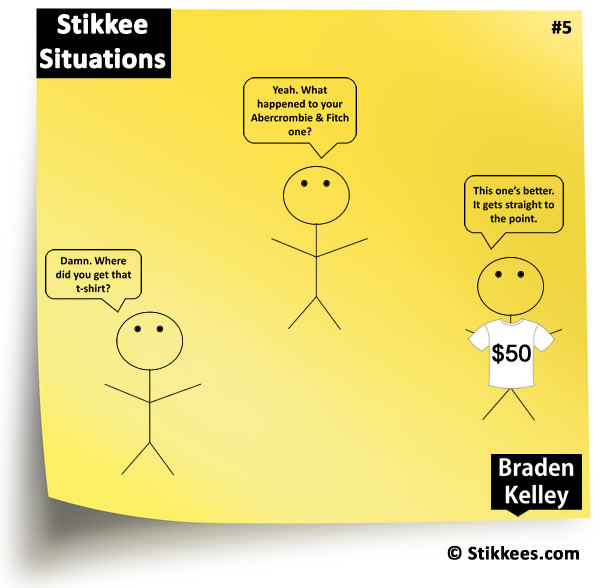
Stikkee 50 Dollar T-shirt

Where does value come from?

What makes people willing to pay $50 for a t-shirt that’s just like the one that ten other people are wearing in the club?

What makes people pay a premium for Apple products with features introduced by other companies months or years before?

If you are truly trying to be innovative, instead of creative or inventive, you MUST understand how your prospective customers assign value for the new solution you are about to introduce. This may require lots of customer interviews, ethnography, forced choices, and other upfront research, but it’s worth it, because if you don’t build your potential innovation on a new, unique insight then it has no chance of succeeding in the marketplace. And as I’ve said before, to achieve innovation you have to focus not just on creating value in the product or service itself, but all three sources of value:

  • Value Creation
  • Value Translation
  • Value Access

So, let’s get back to the $50 t-shirt…

Here in Seattle we are proud of Macklemore and Ryan Lewis, who became a chart topping rap music music act by choosing not to follow the traditional way of making it in the music business so they could not only maintain their creative freedom, but also to make more money. Their mega-hit “Thrift Shop” pokes fun at fashionistas and has helped to make thrift shopping cool instead of embarrassing. Thank you to their combination of skills, they’ve been able to do a lot of the hard work themselves to promote their music, including making this video:

By remaining independent, Macklemore and Ryan Lewis are free to collaborate with whomever they want, when they want, and with sponsors who add value in specific ways consistent with the current project they are working on, instead of a record company extracting a rent from all the artist’s activities (whether they are adding value or not). Here is one such project they undertook with another local artist, Fences, and sponsorship from a company headquartered here locally – T-Mobile USA. It’s a great song and a pretty cool video if you haven’t heard or seen it before:

I for one am grateful that Macklemore and Ryan Lewis didn’t sign a record deal, and record executives have candidly admitted that they would have totally ruined the act by forcing them to change to be more “marketable.” The success of Macklemore and Ryan Lewis (and others) serve to highlight the disruption in the music industry value chain that continues to occur, creating discontinuities that artists like Macklemore and Ryan Lewis can take advantage of. This is of course as long as they have the digital and social skills to get the word out and help their music spread.

Is there disruption happening in your industry’s value chain?

How can you take advantage of the discontinuities?

Please note the following licensing terms for Stikkee Situations cartoons:

1. BLOGS – Link back to https://bradenkelley.com/category/stikkees/ and you can embed them for free
2. PRESENTATIONS, please send $25 to me on PayPal by clicking the button 3. NEWSLETTERS & WEB SITES, please send me $50 on PayPal by clicking the button
License for presentations - $25
License for newsletters and web sites - $50

Subscribe to Human-Centered Change & Innovation WeeklySign up here to get Human-Centered Change & Innovation Weekly delivered to your inbox every week.

Why the Maker Movement Matters

Making MakersThe Maker movement is steadily gaining steam and some cities are looking to help it grow and thrive, seeing it as an opportunity to inspire artists and entrepreneurs. One such city is Edmonton, which lies in the Alberta province of Canada, and its program in their public library system to provide maker spaces staffed with library employees and equipped with 3D printers, computers with Apple’s Garage Band and Adobe’s Creative Suite, and more.

Here is a video of Peter Schoenberg of the Edmonton Public Library introducing the EPL MakerSpace:


If you’re not familiar with the Maker movement, then check out these pages:

Maker Faire
Maker Culture – Wikipedia

Or check out these quotes from Time magazine’s article titled “Why the Maker Movement is Important to America’s Future“:

“According to Atmel, a major backer of the Maker movement, there are approximately 135 million U.S. adults who are makers, and the overall market for 3D printing products and various maker services hit $2.2 billion in 2012. That number is expected to reach $6 billion by 2017 and $8.41 billion by 2020. According to USA Today, makers fuel business with some $29 billion poured into the world economy each year.”

“As someone who has seen firsthand what can happen if the right tools, inspiration and opportunity are available to people, I see the Maker Movement and these types of Maker Faires as being important for fostering innovation. The result is that more and more people create products instead of only consuming them, and it’s my view that moving people from being only consumers to creators is critical to America’s future. At the very least, some of these folks will discover life long hobbies, but many of them could eventually use their tools and creativity to start businesses. And it would not surprise me if the next major inventor or tech leader was a product of the Maker Movement.”

So what do you think?

How much of a contribution to the future of innovation will the Maker Movement make?

How important is supporting the maker movement to the future of an economy?

Is this trend sustainable?


Build a common language of innovation on your team

Subscribe to Human-Centered Change & Innovation WeeklySign up here to get Human-Centered Change & Innovation Weekly delivered to your inbox every week.

Johnson & Johnson’s Innovation Center

Video Provides a Peek Inside

As innovation becomes increasingly recognized as the sustaining lifeforce of any company, more organizations are investing in improving their connections to startups, entrepreneurs, academic institutions, researchers and other outside entities to strengthen their pipelines for insights, ideas, and collaboration.

To support this effort, some companies are even creating dedicated physical spaces for this collaboration to occur, and regular events to attract startups, entrepreneurs, and the like for collaboration events.


The embedded video provides a peek inside Johnson & Johnson’s Innovation Center and some of their efforts in this area.

Is your organization undertaking similar efforts?

Are they considering it?

And those of you that have done something like this already, have you been satisfied with the results?


Build a common language of innovation on your team

Subscribe to Human-Centered Change & Innovation WeeklySign up here to get Human-Centered Change & Innovation Weekly delivered to your inbox every week.

Innovation in Motion

Every once in a while someone comes along and takes what most people believe is a mature category and finds a way to inject new life, new innovation into it.

What’s even more impressive in the case that I’m about to talk about is that a new entrant has found a way to innovate in a category where the dominant player is often held up by innovation consultants and innovation keynote speakers (like myself) as a company that has an innovative culture and working environment, plus an open innovation program worth looking at.

What established player am I speaking of?

Lego

And if you’re not aware of their open innovation program, it is called Lego Cuusoo.


So how could someone come in and realistically challenge Lego?

By coming in with a building toy approach that is both Lego compatible but while simultaneously introducing new design and building capabilities.

The main thing that this new competitor is bringing to bear to compete with the dominant Lego, is motion.

Think about what would happen if you smashed together the basic tenets of Lego with the basic tenets of Hasbro’s Transformers (more than meets the eye), and you’ll start to get an idea of what this new competitor is bringing to their crashing of the Lego party.

Who is this Lego competitor?

They are called Ionix Bricks.

Ionix Bricks - Innovation in Motion

They launched into the marketplace with a Saturday morning cartoon called Tenkai Knights on the Cartoon network.


Here is a video review of some of the initial robot characters, showing how they transform and can be configured and played with:


At first glance they look pretty fun!

Will they catch on and take some of the building toy market away from Lego?

What do you think?

Personally, I think that they have a chance of doing so, and if nothing else I think that Ionix Bricks and the Tenkai Knights are a good reminder that even in categories that people might think are pretty mature and the dominant player is unlikely to be disrupted, that isn’t necessarily the case.

And if you get bored with the pieces that come in any of the Tenkai Knights building sets?

Well, because they are compatible with Lego and other leading building sets, you can attach all kinds of crazy, random Lego pieces that you might already have from castle, space, or other kinds of sets.

Ionix Bricks are a good example of the “C” from SCAMPER – Combine – as they are exactly the kind of outcome you would expect if you combined Legos with Transformers. I wonder what kind of other crazy toys some young toy designer out there could come up with by combining Legos with something else.

In the meantime, I challenge you to keep challenging your own orthodoxies about what your product or service should look like, and how your industry should operate. You never know what kind of crazy new potential innovation you might come up with if you never take your product or service as perfected and keep challenging things at the edges.

What things about your product or service could you challenge? How could SCAMPER or other ideation tools help you?

I will be at the Back End of Innovation conference (November 18-20, 2013) in Silicon Valley. I hope you’ll join me!

(Save 25% with code BEI13IX)


Build a common language of innovation on your team

Subscribe to Human-Centered Change & Innovation WeeklySign up here to get Human-Centered Change & Innovation Weekly delivered to your inbox every week.