The Micro-Enterprise Explosion
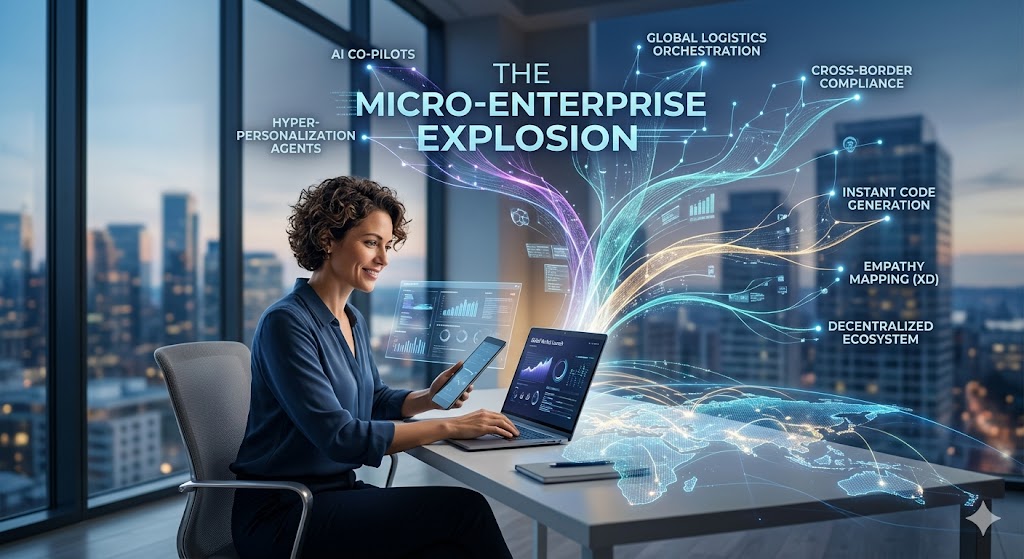
GUEST POST from Chateau G Pato
The New Architecture of Scale
For over a century, the rules of business strategy have been dictated by a single, unyielding law: the law of physical and organizational scale. In the Industrial Era mindset, creating global impact required massive capital infusions, complex organizational hierarchies, and armies of specialized talent to navigate the friction of operations, logistics, and market outreach. Bigger meant more resources, wider distribution, and an impenetrable moat against smaller competitors.
Today, we are witnessing a profound structural shift. Artificial intelligence is completely decoupling operational capability from headcount. The historical paradigm where output was directly tied to the size of a workforce is collapsing. By replacing traditional bureaucratic infrastructure with autonomous digital workflows and intelligent orchestrator agents, the cost of scaling an idea has plummeted toward zero.
We are entering the era of the Micro-Enterprise Explosion. This is not merely a boom in freelancing or a digital iteration of the traditional small business; it is a fundamental democratization of the power of scale. Armed with generative tools and cognitive infrastructure, solitary innovators and lean teams can now design, deploy, and optimize world-class customer experiences on a global canvas — effectively leveling the playing field and challenging corporate giants on terms that were unimaginable just a decade ago.
I. From Organizational Scale to Cognitive Scale
To understand this revolution, we have to look past the idea of AI as a simple productivity tool. We are moving rapidly beyond the era of isolated text generation and basic autocomplete. The true catalyst of the micro-enterprise explosion is the emergence of a robust AI co-pilot ecosystem — highly specialized, autonomous functional multipliers.
Today, a single founder can deploy a network of agentic workflows to handle everything from legal vetting and predictive financial forecasting to localized market research and continuous code generation. Instead of managing people, the modern innovator orchestrates digital assets, transforming raw human intent into institutional-grade execution overnight.
This shift fundamentally lowers the friction of innovation. Historically, the journey from a validated spark of an idea to a functioning business was throttled by technical debt, administrative overhead, and capital constraints. Low-code and no-code platforms, fully supercharged by natural language processing, mean that a lack of traditional software engineering or venture capital backing is no longer a terminal diagnosis for a startup.
The proof is in the data. The rapid rise of the million-dollar, one-person business is shifting from a statistical anomaly into a repeatable, open-source blueprint. When cognitive capacity can be rented on demand via cloud APIs, scale becomes a measure of your imagination and organizational design, not the size of your payroll.
II. Human-Centered Change: Redefining the “Solopreneur” Identity
This democratization demands a massive psychological shift. We have to fundamentally redefine what it means to build a business alone. For years, the term “solopreneur” or “freelancer” conjured images of someone trading time for money — a lone operator locked in a perpetual hustle, writing every email, designing every slide, and chasing every invoice. AI shatters this ceiling by requiring a transition from linear technician to systemic architect.
True human-centered change starts with the individual creator. Change management is no longer just a discipline for Fortune 500 executives steering massive corporate ships; it is a deeply personal requirement for the modern founder. Navigating this transition means learning to manage our own cognitive load, trusting algorithmic partners with operational execution, and deliberately designing a brand-new workflow that prioritizes mental agility over sheer hours logged.
When operational and administrative tasks are effectively automated, a beautiful paradox emerges: the true competitive advantage shifts entirely back to the human premium. When anyone can generate a baseline marketing plan or build an API integration with a simple prompt, commodity execution loses its economic value.
The winners in this new micro-enterprise landscape will win because of their deeply human capabilities. Success will be driven by raw curiosity to find unaddressed problems, genuine empathy to understand user frustration, unique cultural insights, and the ability to build trusted, authentic relationships. AI handles the scale; humans provide the soul.
III. Experience Design (XD) in a Hyper-Personalized Market
In this new landscape, micro-enterprises do not just compete on cost or niche specialization — they compete on pure agility. Traditional, heavily matrixed corporate structures are inherently sluggish; a single strategic change or user experience modification can take months to clear committee approvals, compliance reviews, and technical deployment cycles. A lean, AI-empowered micro-enterprise can interpret real-time data and completely pivot a customer journey in hours, turning execution velocity into a profound competitive advantage.
This agility enables the deployment of what we can call the algorithmic concierge. By leveraging lightweight, highly contextualized AI models, small teams can provide enterprise-grade, hyper-personalized customer experiences that feel deeply tailored, proactive, and human. The customer no longer feels like a ticket number in a vast corporate system; instead, they experience a high-touch, context-aware journey where their specific needs are anticipated and met instantaneously.
Furthermore, this operational model naturally drives frictionless global operations. Historically, localizing an experience across multiple regions required vast international teams, massive translation budgets, and localized legal entities. Today, a micro-enterprise can act globally from day one. Automated cross-border compliance, real-time linguistic and cultural localization tools, and decentralized, API-driven supply chains allow a three-person team to serve customers worldwide with the same precision and polish as a multinational corporation.
IV. The Futurist’s View: The Macro Impact of Micro-Scales
Zooming out to a macro perspective reveals that this shift will trigger a profound structural reorganization of the global workforce. We are standing on the precipice of a massive unbundling of the traditional corporation. Historically, large firms acted as gravity wells, pulling in top-tier talent by offering resources, security, and operational scale. As AI completely democratizes access to those exact resources, the value proposition of corporate employment alters dramatically. High-performing individuals will increasingly choose to leave rigid corporate hierarchies to build, own, and orchestrate their own lean micro-empires.
This trend will not result in a fragmented, isolated business landscape, but rather in the rise of hyper-dynamic, collaborative ecosystems. The future of commerce will be defined by fluid networks of independent micro-enterprises. Utilizing smart contracts, decentralized autonomous frameworks, and shared, interoperable AI protocols, these agile nodes can instantly coalesce to tackle massive, enterprise-level projects, and then dissolve just as quickly once the objective is met.
However, an economy composed of millions of decentralized, high-output nodes will inevitably run into friction with legacy institutions. This systemic transition forces a major regulatory and economic evolution. Our current social safety nets, tax codes, intellectual property frameworks, and banking infrastructures were explicitly engineered for an era of predictable, centralized corporate employment. As the micro-enterprise explosion accelerates, society will be forced to reinvent its socioeconomic contracts, creating entirely new baseline safety nets and infrastructure tailored to support a highly agile, self-determined, and distributed workforce.
Conclusion: A Call to Action for Innovators
The democratization of capability is no longer a distant futurist theory — it is our immediate reality. The sophisticated technological tools that once required multi-million dollar IT budgets, specialized implementation teams, and massive infrastructure investments are now accessible to anyone with a web browser and an internet connection. The barrier to entry has officially fallen to zero. In this new landscape, capital and headcount are no longer the ultimate arbiters of business viability. The only remaining constraint is organizational imagination.
For builders, leaders, and entrepreneurs, the directive is clear: stop thinking about how to expand your headcount, and start focusing on how to maximize your cognitive leverage. The future of business does not belong to the entities that own the largest physical footprints or the most expansive corporate campuses. It belongs to the agile orchestrators — those who can most elegantly blend human empathy, strategic design, and machine intelligence to solve real, pressing human problems. The power of scale is in your hands; it is time to build.
Frequently Asked Questions
What exactly is the “Micro-Enterprise Explosion”?
It is the rapid rise of solo entrepreneurs and lean, small teams who utilize autonomous AI agents, workflows, and no-code tools to wield the operational capacity, global reach, and execution quality traditionally reserved for mid-to-large-sized corporations.
How does AI allow a small business to achieve enterprise-level scale?
AI decouples business capability from headcount. By deploying specialized AI agents to manage complex operations like localization, compliance, financial forecasting, and code generation, human creators can transition from linear tasks to system orchestration, drastically amplifying their output.
Does the rise of AI micro-enterprises eliminate the need for human talent?
No, it actually heightens the value of unique human skills. Because baseline operational tasks can be easily automated, competitive advantage shifts entirely to the “human premium” — core strengths like genuine empathy, deep customer understanding, unique insight, and authentic relationship-building.
Image credit: Gemini
 Sign up here to get Human-Centered Change & Innovation Weekly delivered to your inbox every week.