Designing Work for Man and Machine to Do Together
by Braden Kelley
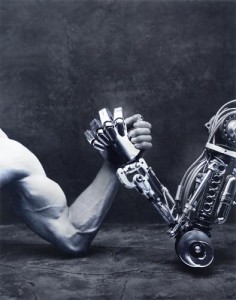 I am proud to bring you a downloadable PDF of a piece I created on The Crowd Computing Revolution and the redesign of work that is now possible thanks to new technology tools and business architecture thinking that will allow man and machine to work more efficiently together than ever before.
Anyone who has read even one or two science fiction books or watched one or two SciFi movies inevitably finds themselves dreaming of a day when machines will free of us of some of the mundane tasks in our lives. Companies dream of this too. Witness the eagerness of companies to outsource entire job functions (or even more recently whole business processes) to third parties either onshore or offshore. Hackers and spammers have become quite adept at programming their machines to send emails to people or attempt to break through security around the clock, around the globe. We have built automated factories, interactive voice response systems, and devised all kinds of ways to put machines to work for us.
Roger Martin, Dean of the Rotman School at the University of Toronto has a simple framework from his treatise on Design Thinking titled The Design of Business, that shows how as we learn more about a knowledge (or work) area, our understanding and abilities allow us to move the piece of knowledge (or work) from something that is mysterious and performed in an ad hoc way by experts, to a level of maturity where we start to observe the patterns (or heuristics) in the knowledge area (or piece of work), to a stage where the work or knowledge is well-understood and can be reduced to an algorithm (or set of best practices) performed by lower skilled employees, and possibly even implemented as a piece of code to be executed by a robot or computer.
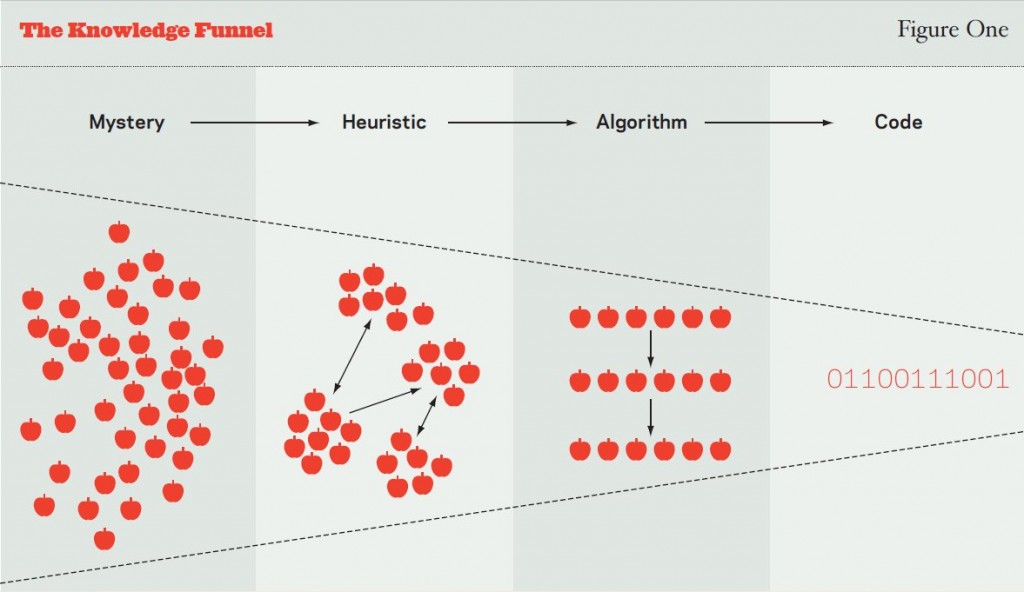
Source: The Design of Business by Roger Martin
But, as alluded to earlier, companies have not only become more comfortable with designing work to be executed by machines instead of employees, but also more amenable to many different sizes and shapes of work being completed by people outside the organization, including:
- Entire job functions (Contractors or Outsourcing Firms – Global Outsourcing Market was $95 Billion in 2011)
- Whole business processes (Business Process Outsourcing (BPO) Firms – 2011 Market in excess of $11 Billion)
- Projects or initiatives (Outside Consultants)
- Discrete tasks (99Designs, Crowdspring, etc.)
- Micro tasks (Amazon Mechanical Turk, etc.)
Task and Micro-Task Division
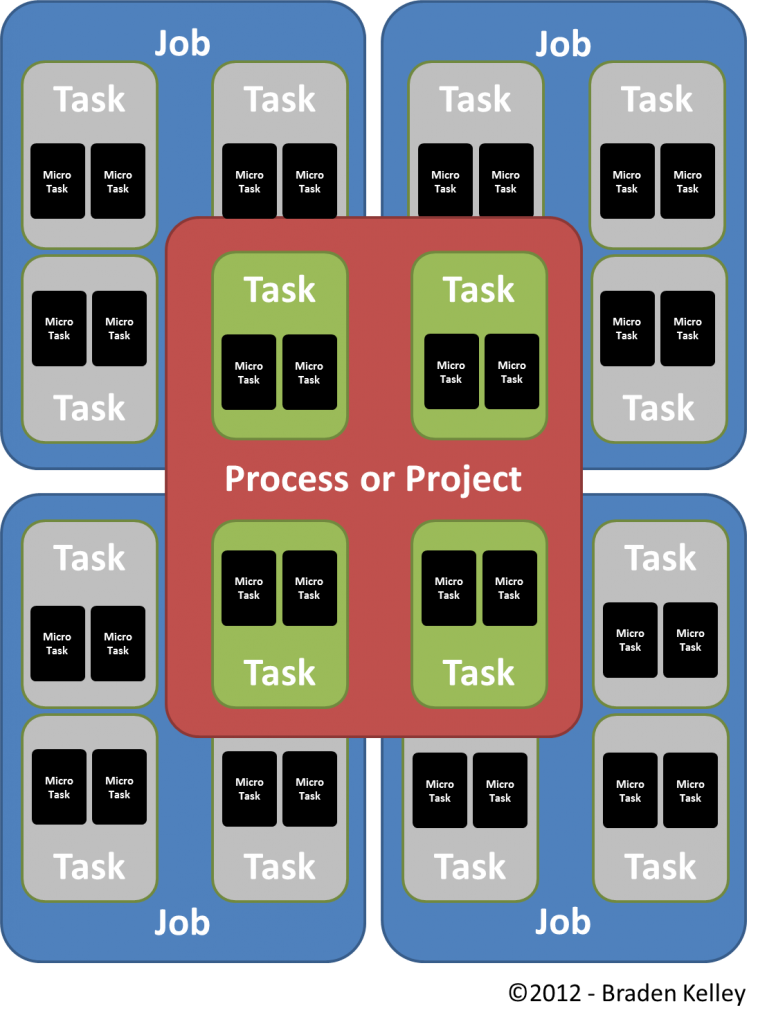
Over time the human race has moved from building simple machines that function as tools (like a forklift), allowing a man to do more with the help of the machine, to building machines and robots capable of completing a whole task (like painting a car or making an exact copy of a document). Has anyone seen a help wanted advertisement for a scribe lately? Meanwhile, our fully automated manufacturing and packaging plants use machines to complete an entire process. But machines aren’t suitable for every kind of work. They are appropriate for tasks that are well-defined and repeated continuously as part of a standardized process, but not a proper fit for tasks where judgment is required, particularly tasks with numerous exceptions, variability, or personalization.
As a result, typically machines and robots have been relegated most often to the production areas of a business, places where it has been easy to define specific tasks or even whole processes that can be designed for machines or robots to own and complete 24/7/365 if necessary.
Rethinking Who (or What) Does the Work
 Rise of the Crowd
There is another growing trend that is now rivaling the growing power of robotics and automation – crowdsourcing. It all started with prizes like The Longitude Prize, but now thanks to the power of the Internet, companies and individuals all around the world are breaking down their projects and processes and tapping into the power of the crowd using loosely-organized, non-employee workforces like Amazon’s Mechanical Turk to execute micro-tasks, getting whole tasks completed through sites like Top Coder and Crowdspring, or calling upon the crowd to solve difficult challenges using sites like Innocentive, NineSigma, and Idea Connection. Sites like these enable organizations to access knowledge, expertise, perspectives, or capacity that they don’t currently have in their organization (or to possibly to get a task or challenge completed at a lower cost). Check out my white paper Harnessing the Global Talent Pool to Accelerate Innovation to learn more about this topic and some of the strategies for successfully leveraging external talent.
Rise of the Business Architect
Our organizations face an innovation imperative amidst intensifying competition that is forcing an increasing number of industries to become commoditized. This increasing need for a sustained level of innovation and a requirement for innovation to be a repeatable and sustainable activity, has led to an increasing number of organizations to consciously design their approaches to the new businesses that they enter. This has led to the growth of two new business disciplines – business architecture and social business architecture.
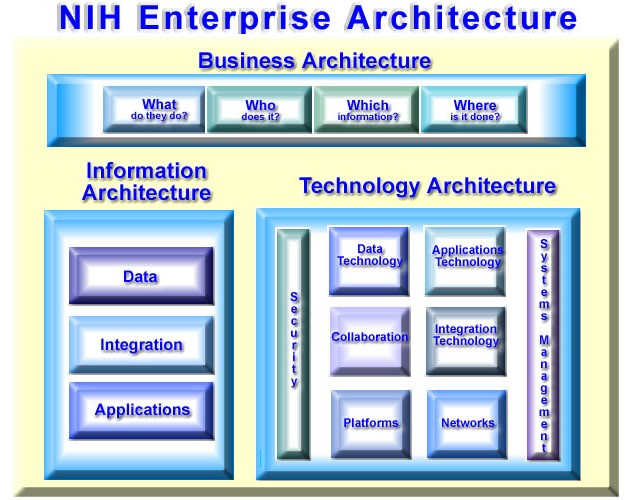
Source: National Institute of Health
Business Architecture, according to Wikipedia, is “a modern technology-oriented business occupation…. Working as a change agent with senior business stakeholders, the business architect plays a key part in shaping and fostering continuous improvement and business transformation initiatives. Business architects lead efforts aiming at building an effective architecture for the business process management (BPM) projects that make up the business change programme. The business architect implements business models that require business technology to work effectively.”
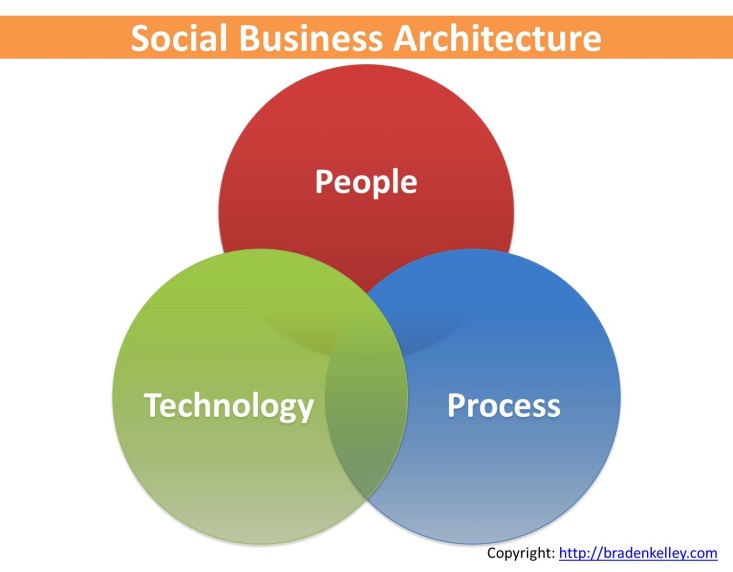
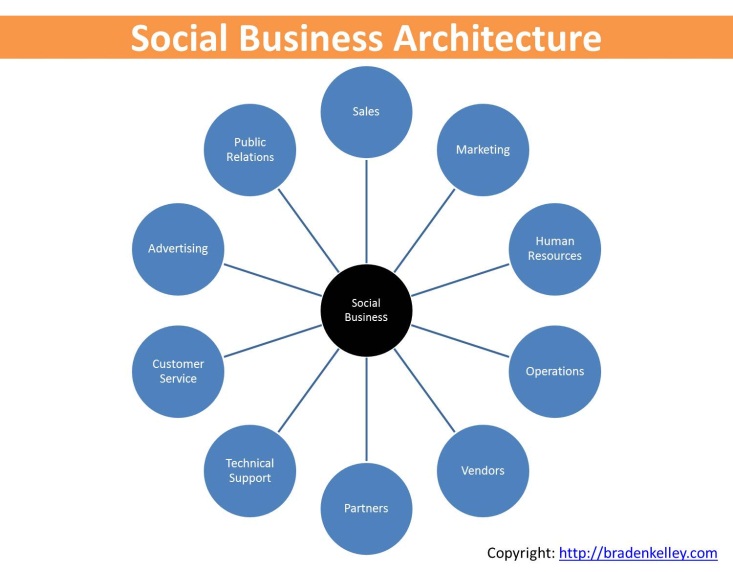
Social Business Architecture on the other hand, facilitates and optimizes the group dynamics and interactions inside the organization, and Social Business Architects specialize in identifying the different parts of an organization that need to interact with groups of people outside the organization, how those parts of the organization should work together to communicate with people outside the organization, and help to identify and implement communications solutions that connect the organization with the target groups so that a meaningful connection and conversation can be built, and then helps to manage the conversations and the information and learnings from their outcomes for the benefit of the organization.
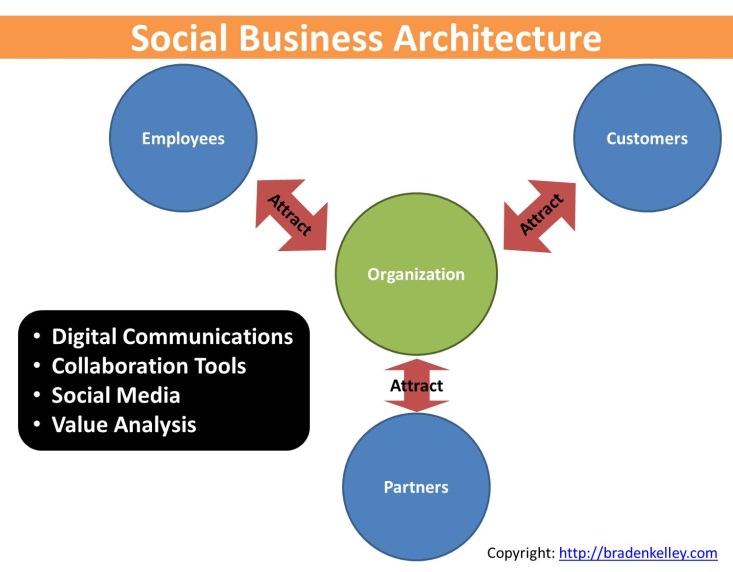
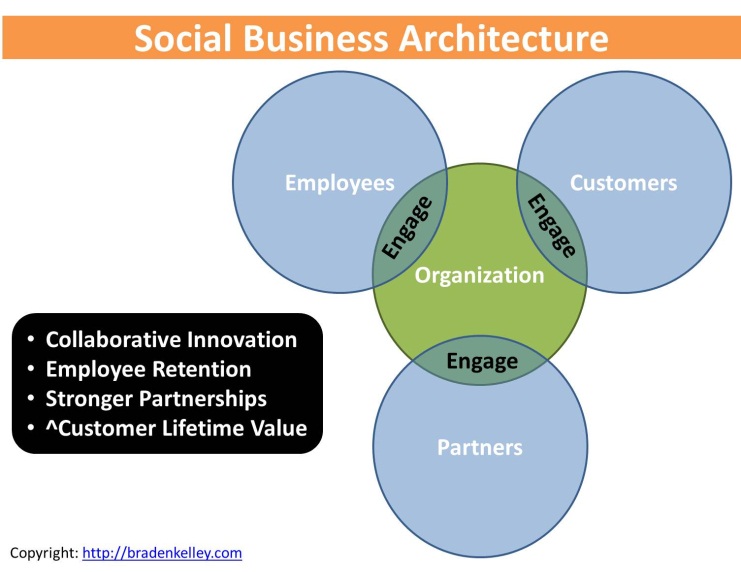
Few organizations employ or are even yet aware of the need for Social Business Architects, but there are an increasing number of help wanted postings for Business Architects. This is because not only do organizations recognize the need to architect their new lines of business for maximum efficiency and to , but also because there are so many different ways that work can be executed (employees, contractors, consultants, outsourcing, business process outsourcing (BPO), crowdsourcing, and micro-task execution, that for maximum efficiency it now increasingly requires someone to investigate all of the options, break down the work to be done into jobs, projects and processes, tasks and microtasks so that the right resources can be hired, contracted, briefed, or otherwise engaged to ensure that everything is completed as quickly and as cheaply as possible.
Investigating Examples of Crowd Computing
 Moving from The Design of Business to Redesigning Work
Business Architects have the opportunity to plan for the organization how work can move from mystery to heuristics to algorithms to code. Business Architects (or people filling this role in an organization) have the opportunity to redesign work in the most efficient way possible to leverage both man and machine to get the work done at the lowest cost possible. Technology now exists to allow Business Architects and managers to move beyond allocating work on a job, project, or process basis, and instead design flexible workflows that combine the use of humans and machines to complete the tasks that they are best suited for, or even for humans to augment the work of machines.
For example, imagine that you work in the purchasing department at a large multinational and every month you receive hundreds or thousands of invoices from suppliers all over the world in all different kinds of formats – electronic, mailed paper invoices, PDFs, scanned paper invoices, and even faxed invoices. Your job as purchasing (or accounts payable) manager is to track all of the invoices that you receive, get them entered into your ERP system, and ultimately make sure that they get paid. You can hire or use an existing employee or contractor to manually key them all in, or sign a big dollar outsourcing deal sufficient to support the hiring, training, and management of offshore resources by the outsourcer, or you could try and use OCR software to do the job, but it would fail because of the great deal of variability in both the input sources and formatting of the documents and you’ll end up needing human resources to interpret the OCR output anyways.
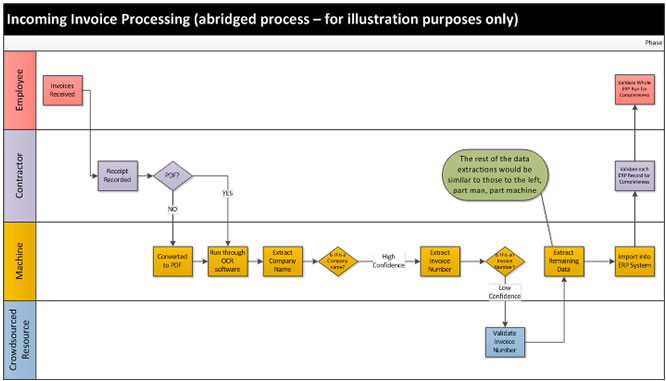
Or, you could examine the workflow of the process and identify which micro-tasks humans are best suited to perform and which micro-tasks machines are most efficient and cost-effective at performing. Then assign the right micro-task to the right resource. In the case of human resources, this could be an employee, a contractor, an external expert, or even a resource you don’t even know or control (via a crowd workforce like Amazon Mechanical Turk, Elance, etc.). And finally for each micro-task, assign a level of confidence in the quality of the assigned resource’s output and a define a process for grading it. In situations where you have a high level of confidence in the micro-task’s output quality, you can move directly on to the next micro-task in the workflow, but if you have a low level of confidence in a particular micro-task output performed by a machine, assign an alternate process to validate that output (such as using someone via Amazon Mechanical Turk to validate that “yes, this is a purchase order number”).
But that is not all that is possible these days. It is now possible for systems that facilitate the management of this kind of atomized work structure definition and workflow management and assignment, like those from Crowd Computing Systems, to also use artificial intelligence to both learn from the corrections that humans are making to a machine-driven, micro-task execution to get more accurate in the future, but also to learn how to do micro-tasks that humans are currently performing without machine assistance and to help identify the best performing crowd resources to inform work allocation decisions and to perform overall output quality optimization.
Conclusion
In much the same way that outsourcing felt awkward 20-25 years ago and Business Process Outsourcing (BPO) felt foreign a decade ago, the time has come for crowd computing to begin to be a tool that managers and Business Architects can keep in their toolbox to better allocate work across man and machine. The time is now for man and machine to work together in ways that they never have before, and to learn from each other. The time has come for businesses and work to not just be operated and executed, but designed for maximum efficiency. Should we be afraid as workers that the machines are going to take away our jobs and leave us with nothing to do?
No. In much the same way that tractors and steam shovels began freeing man and beast from back breaking work nearly two hundred years ago, there are many benefits for man to gain from the crowd computing revolution – the biggest being freedom from an increasing amount of mind numbing work. Organizations that embrace crowd computing stand to gain not only to potentially lower processing costs for many high volume processes, but also will benefit from acquiring the ability to reassign analysts and other highly-skilled and trained employees to higher value work – better leveraging their existing human resources while simultaneously increasing employee satisfaction, retention, and knowledge creation in the enterprise. Are you ready for the crowd computing revolution?
Click Here to Download The Crowd Computing Revolution PDF
Sources:
http://speakology101.com/welcome/2012/05/21/break-it-down-tasks-sequencing/
http://www.huffingtonpost.com/martin-ford/job-automation-is-a-futur_b_832146.html
http://www.statista.com/statistics/189788/global-outsourcing-market-size-since-2000/
http://www.rediff.com/business/report/bpo-market-to-be-worth-14-bn-in-2011/20110412.htm
 Sign up here to get Human-Centered Change & Innovation Weekly delivered to your inbox every week.

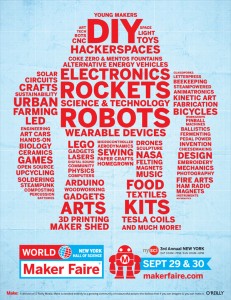 The Maker movement is steadily gaining steam and some cities are looking to help it grow and thrive, seeing it as an opportunity to inspire artists and entrepreneurs. One such city is Edmonton, which lies in the Alberta province of Canada, and its program in their public library system to provide maker spaces staffed with library employees and equipped with 3D printers, computers with Apple’s Garage Band and Adobe’s Creative Suite, and more.
 One thing that I find fascinating about the innovation space is that when it comes to innovation is the outcomes of competition within an industry. I talk alot about it being about
  Last August I wrote about
  Old School vs. Old School
 All of this inventory has been tagged for individual sale and is there every day, just in case the person who wants that size, color, style, whatever, walks into the store ready to take it home today.
 Apple Stores are a hybrid between the two. Accessories are out on the floor boxed for individual sale, while iMac and iBook computers, iPad tablets, and iPod mp3 players are all out of the box and display in droves for customers to try out and hopefully purchase. Then if they do, the box appears from the warehouse in the back.
 This has led to the rise of what physical retailers rail against, the concept of showrooming. If you’re not familiar with what showrooming is, it is the pattern of behavior where potential customers come into a physical retail store, explore the product, try it on if necessary, and then leave the store and buy the product online from a competitor like Amazon.

 Too often we all run around trying to pluck a gamechanging idea out of thin air that nobody has ever seen, solving a problem that has never been solved, when really if the truth be told, there are still lots of existing problems with lots of solutions that are still waiting for a simple, elegant solution.