Category Archives: Design

Starbucks Upgrading the Last Minute of the Mobile Ordering Journey

Starbucks Upgrading the Last Minute of the Mobile Ordering Journey

Starbucks is definitely regarded as an innovator in the mobile commerce and loyalty space.

Starbucks was one of the first retailers (2008) to successfully introduce a card-based loyalty program with broad adoption – the Starbucks card – which not only had loyalty benefits for customers but also could be used as a means of payment.

Building from this, Starbucks created a mobile app early in the smartphone era that mirrored many of the capabilities of the Starbucks card, allowing people to not only pay with their mobile phone (backed by a credit card), but to check their points and payment balances.

Starbucks then launched mobile order & pay in Portland near the end of 2014 before beginning to release it more broadly in 2015.

All of Starbucks’ loyalty and mobile technology inventions positioned the company quite well to survive the COVID-19 shutdowns around the world.

Starbucks Mobile Ordering

Personally I try to keep as many apps OFF my phone as possible. So, it wasn’t until the coronavirus restrictions that I finally caved in and downloaded the Starbucks app. The reason?

Given the pandemic, the last thing I wanted to do was stand around in an enclosed space with suspect ventilation waiting for my Starbucks beverage any longer than I had do. So, I downloaded the app and began ordering my drink from the car and waiting 4-5 minutes (or longer if they looked busy) before going inside to get my drink.

What I found annoying though was that the app gave an estimate that often was in the 15-23 minute range, despite the fact that it rarely took more than five minutes, and there was no notification when my drink was ready.

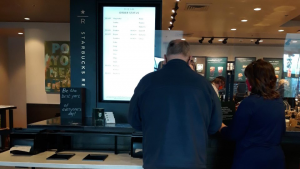
I started designing a better approach in my mind, and was about to suggest it to Starbucks when I happened upon what is likely a pilot in one of my local Starbucks. It looks like this:

Starbucks Mobile Order Board

At this particular pilot Starbucks they have this flat screen that shows the people who have mobile orders placed (in alphabetical order) and then the Starbucks employee at the end of the line has a tablet they manage.

When an order is complete, the Starbucks employee updates the order status to ‘READY’ on the tablet, the image on the board changes to show a READY indicator, and a text message is sent to the person’s phone.

When the customer picks up their order, then the Starbucks employee marks it ‘PICKED UP’ on the tablet so that the person’s name is removed from the board.

This is very close to the idea that I was going to propose, but with one big exception.

My idea was to suggest printing out an enhanced bar code that could be scanned at the end of the line by the barista to trigger the text message – instead of using a tablet and a screen. This could have been a much simpler and cheaper approach both in terms of technology and labor.

Either way, there is no doubt that Starbucks continues to experiment and push for improvements in the last minute of the mobile ordering journey to create a great experience. This enables them to keep their employees and customers healthy and safe, and keep Starbucks ahead of their competition.

Keep innovating!

Image (2) credit: Digitaltrends.com


Accelerate your change and transformation success

Subscribe to Human-Centered Change & Innovation WeeklySign up here to get Human-Centered Change & Innovation Weekly delivered to your inbox every week.

The Power of Human-Centered Design

How Putting People First Can Drive Innovation

The Power of Human-Centered Design

GUEST POST from Art Inteligencia

Human-Centered Design (HCD) is a powerful approach that prioritizes understanding the needs and behaviors of users to create innovative solutions. By focusing on the end user throughout the design process, companies can develop products and services that truly resonate with customers and drive business success. In this article, we will explore the power of Human-Centered Design by examining two case studies that demonstrate how putting people first can lead to groundbreaking innovation.

Case Study 1: Airbnb

Founded in 2008, Airbnb revolutionized the hospitality industry by connecting travelers with unique accommodations around the world. At the heart of Airbnb’s success is their commitment to HCD. From the very beginning, the founders of Airbnb understood the importance of creating a platform that catered to the needs and desires of both hosts and guests.

By conducting extensive user research and testing, Airbnb was able to identify pain points in the traditional hospitality industry, such as lack of personalization, limited options, and high costs. Armed with this insight, Airbnb developed a platform that allowed hosts to list their properties and guests to book unique and affordable accommodations.

Through continuous iteration and feedback from users, Airbnb refined its platform to better meet the needs of both hosts and guests. By putting people first, Airbnb has transformed the way people travel and experience new destinations, leading to tremendous growth and success for the company.

Case Study 2: IDEO

IDEO is a global design and innovation consultancy that has been at the forefront of HCD for over 40 years. IDEO’s approach to innovation is rooted in empathy and understanding the needs of users to create human-centered solutions. One of IDEO’s most famous projects is the redesign of the shopping cart for a major retailer.

Rather than jumping straight to solutions, IDEO immersed themselves in the shopping experience, observing and interacting with customers to understand their pain points and frustrations. Through this research, IDEO discovered that customers struggled with the unwieldy and inconvenient design of traditional shopping carts.

Using this insight, IDEO created a new shopping cart design that was more user-friendly and intuitive, with features such as larger wheels for easier maneuverability and integrated storage compartments. The redesigned shopping cart not only improved the shopping experience for customers but also increased sales for the retailer.

Conclusion

The case studies of Airbnb and IDEO demonstrate the power of Human-Centered Design in driving innovation and success. By putting people first and prioritizing the needs and experiences of users, companies can create products and services that truly resonate with customers. Whether you are designing a digital platform or a physical product, incorporating HCD principles into your process can lead to groundbreaking innovation and lasting impact. As the business world continues to evolve, embracing a human-centered approach will be essential for companies looking to thrive in the digital age.

Bottom line: Futurology is not fortune telling. Futurists use a scientific approach to create their deliverables, but a methodology and tools like those in FutureHacking™ can empower anyone to engage in futurology themselves.

Image credit: Pixabay

Subscribe to Human-Centered Change & Innovation WeeklySign up here to get Human-Centered Change & Innovation Weekly delivered to your inbox every week.
What is design thinking? – EPISODE FIVE – Ask the Consultant

Live from the Innovation Studio comes EPISODE FIVE of a new ‘Ask the Consultant’ series of short form videos. EPISODE FIVE aims to answer a question that many people struggle to answer or accurately discuss:

“What is design thinking?”

Design Thinking is often misunderstood and sometimes even maligned because too many people think it is a process. It doesn’t help when visuals like this one from the Stanford d.School label it as such:

Stanford d.School Design Thinking Process

Instead design thinking should be thought of as a mindset, or a collection of mindsets, including the novice mindset.

There is a big difference between knowing the design thinking components and being a design thinker. Design Thinking is not a technical skill, it is a collection of soft skills, so buyer beware.

One of the key things to remember about design thinking (or human-centered design) is that it is a highly iterative process intended to leverage extensive prototyping and testing.

Another important thing to remember is that unlike other problem solving methods, good design thinking professionals will spend as much, if not more, time and energy on the problems(s) than on the solution(s).

Preparing to Solve the Right Problem

To help with this I’ve created a Problem Finding Canvas to help you identify all of the potential problems in a particular search area.

It’s available for only $9.99 here in the shop.

}} Click here to watch the video {{

Help Shape the Next ‘Ask the Consultant’ Episode

  1. Grab a great deal on Stoking Your Innovation Bonfire on Amazon while they last!
  2. Get a copy of my latest book Charting Change on Amazon
  3. Contact me with your question for the next video episode of “Ask the Consultant” live from my innovation studio

Below are the previous episodes of ‘Ask the Consultant’:

  1. EPISODE ONE – What is innovation?
  2. EPISODE TWO – How do I create continuous innovation in my organization?
  3. EPISODE THREE – What is digital transformation?
  4. EPISODE FOUR – What is the best way to create successful change?
  5. All other episodes of Ask the Consultant


Accelerate your change and transformation success

Subscribe to Human-Centered Change & Innovation WeeklySign up here to get Human-Centered Change & Innovation Weekly delivered to your inbox every week.

Case Studies of Successful Disruptive Design

Analyzing real-world examples of companies that have successfully embraced industry shifts through innovative design strategies

GUEST POST from Chateau G Pato

In today’s fast-paced and ever-changing business landscape, companies are constantly striving to stay ahead of the curve and remain competitive in an increasingly crowded market. One key strategy that has proven to be successful for many companies is disruptive design – a design approach that challenges traditional industry norms and sets new standards for innovation.

In this article, we will delve into two case studies of companies that have successfully embraced industry shifts through innovative design strategies. By analyzing their approaches and the outcomes of their efforts, we can gain valuable insights into how disruptive design can drive growth and transformation in any business setting.

Case Study 1: Airbnb

Airbnb is a prime example of a company that has revolutionized the travel and hospitality industry through disruptive design. Founded in 2008, Airbnb disrupted the traditional hotel model by allowing individuals to rent out their homes or spare rooms to travelers, creating a more personalized and unique lodging experience.

One of the key elements of Airbnb’s disruptive design strategy was its focus on user experience. The platform was designed to be user-friendly and intuitive, making it easy for both hosts and guests to connect and transact. This seamless user experience, combined with innovative features such as user reviews and personalized recommendations, helped Airbnb rapidly gain traction and disrupt the industry.

Another key aspect of Airbnb’s disruptive design strategy was its emphasis on community building. By fostering a sense of belonging and connection among hosts and guests, Airbnb was able to create a loyal user base that continues to grow to this day. This strong community network has not only fueled Airbnb’s success but has also helped the company weather challenges and navigate industry shifts with agility.

Case Study 2: Tesla

Tesla is another prime example of a company that has embraced disruptive design to revolutionize the automotive industry. Founded in 2003, Tesla disrupted the traditional automotive market by focusing on electric vehicles and innovative technology, challenging long-held beliefs about the feasibility and viability of electric cars.

One of the key elements of Tesla’s disruptive design strategy was its focus on sustainability and environmental consciousness. By positioning electric vehicles as a cleaner and more sustainable alternative to traditional gas-powered cars, Tesla was able to tap into a growing consumer demand for environmentally friendly products and effectively differentiate itself in the market.

Another key aspect of Tesla’s disruptive design strategy was its relentless focus on innovation and technology. From cutting-edge battery technology to autonomous driving features, Tesla has consistently pushed the boundaries of what is possible in the automotive industry, setting new standards for performance, safety, and convenience.

Conclusion

By analyzing these case studies, we can see how companies like Airbnb and Tesla have successfully embraced industry shifts through disruptive design strategies. By focusing on user experience, community building, sustainability, and innovation, these companies have been able to not only disrupt their respective industries but also drive growth and transformation in the process. As businesses continue to evolve and adapt to changing market dynamics, the lessons learned from these case studies can serve as valuable insights for any company looking to stay ahead of the curve and remain competitive in today’s fast-paced business landscape.

SPECIAL BONUS: Futurology is not fortune telling. Futurists use a scientific approach to create their deliverables, but a methodology and tools like those in FutureHacking™ can empower anyone to engage in futurology themselves.

Image credit: Unsplash

Subscribe to Human-Centered Change & Innovation WeeklySign up here to get Human-Centered Change & Innovation Weekly delivered to your inbox every week.

Design Thinking in Action

Case Studies of Companies that Thrive on Innovation

Design Thinking in Action

GUEST POST from Art Inteligencia

In today’s fast-paced and rapidly changing business landscape, companies are constantly seeking new innovative solutions to stay ahead of the competition. One approach that has gained traction in recent years is design thinking. Design thinking is a human-centered approach to innovation that emphasizes empathy, creativity, and iterative problem-solving. In this article, we will explore how two companies – Apple and IDEO – have successfully implemented design thinking principles to drive innovation and achieve business success.

Apple: Designing for Delight

Apple is synonymous with innovation and design excellence, and much of its success can be attributed to its design thinking approach. From the sleek and intuitive design of the iPhone to the user-friendly interface of the iPad, Apple’s products are known for their attention to detail and focus on user experience. One key aspect of Apple’s design thinking process is its emphasis on empathy – understanding the needs and desires of its customers to create products that truly delight and inspire.

A prime example of this is the development of the iPod. In the early 2000s, Apple recognized the growing demand for portable music players but saw that existing products were cumbersome and hard to use. By conducting in-depth user research and observing how people interacted with music on a daily basis, Apple was able to design a product that revolutionized the music industry. The result was the iPod – a sleek and intuitive device that made it easy for users to access and enjoy their music on the go.

IDEO: Empowering Creativity Through Collaboration

IDEO is a global design and innovation consultancy known for its human-centered approach to solving complex problems. Founded in 1991, IDEO has worked with companies ranging from startups to Fortune 500 companies to create innovative products and services that have a lasting impact on society. At the core of IDEO’s design thinking process is its emphasis on collaboration and iteration – bringing together diverse perspectives and ideas to create truly groundbreaking solutions.

One of IDEO’s most famous projects is the redesign of the shopping cart for a major retail chain. By engaging with customers and employees to understand their pain points and frustrations with the existing shopping cart, IDEO was able to develop a new cart design that improved the shopping experience for everyone involved. The new design featured ergonomic handles, self-checkout capabilities, and modular components that made it easy to customize based on individual needs. The result was a shopping cart that not only enhanced the customer experience but also increased efficiency and profitability for the retailer.

Conclusion

Design thinking is a powerful tool for companies looking to drive innovation and achieve business success. By focusing on empathy, creativity, and collaboration, companies like Apple and IDEO have been able to create products and services that truly resonate with their customers and set them apart from the competition. As technology continues to evolve and consumer expectations continue to rise, design thinking will play an increasingly important role in shaping the future of business and driving growth and success for companies around the world.

Bottom line: Futurology is not fortune telling. Futurists use a scientific approach to create their deliverables, but a methodology and tools like those in FutureHacking™ can empower anyone to engage in futurology themselves.

Image credit: Unsplash

Subscribe to Human-Centered Change & Innovation WeeklySign up here to get Human-Centered Change & Innovation Weekly delivered to your inbox every week.

50 Cognitive Biases Reference – Free Download

by Braden Kelley

I came across this cognitive biases infographic from TitleMax that captures a wide range of cognitive biases, making it a useful tool for design thinking, and to help everyone out, I’ve taken the original infographic and reformatted it into a five page PDF for easy reading and printing on 8.5″ x 11″ letter size paper.

Cognitive biases are the invisible forces that derail innovation programs, stall organizational change, and cause smart leaders to make systematically poor decisions. They are not character flaws — they are hardwired features of human cognition that evolved to help us make fast decisions with limited information. In modern organizational life, that same wiring produces predictable, measurable errors in judgment that cost organizations enormous amounts of time, money, and competitive position.

The poster below documents 50 of the most important cognitive biases. But a list without context is just trivia. What follows is a practitioner’s guide to understanding how these biases actually show up in innovation and change management — and what to do about them.

→ Download the free 50 Cognitive Biases PDF reference poster


Cognitive Biases Infographic


What is a Cognitive Bias?

A cognitive bias is a systematic pattern of deviation from rationality in judgment — a mental shortcut that causes predictable errors in how we perceive, remember, evaluate, and decide. The term was introduced by psychologists Amos Tversky and Daniel Kahneman in the early 1970s, whose work on heuristics and biases eventually earned Kahneman the Nobel Prize in Economics.

Cognitive biases are not random errors. They are systematic — meaning they skew in predictable directions, affect virtually everyone, and can be anticipated and partially corrected for once you know what to look for. This is what makes them both dangerous and manageable: dangerous because they operate largely below conscious awareness, manageable because their patterns are well-documented and can be designed around.

There are over 180 documented cognitive biases. The 50 in the reference poster below represent the ones most relevant to decision-making, innovation, and organizational change.


The Most Important Cognitive Biases for Innovation and Change Leaders

Rather than listing all 50 in isolation, here are the biases that most consistently damage innovation and change efforts — grouped by the type of harm they cause:

Biases That Kill Good Ideas Before They Start

Status Quo Bias — The tendency to prefer the current state of affairs and perceive any change as a loss. This is the single most powerful force working against organizational change. People don’t resist change because they are irrational; they resist it because loss aversion is a fundamental feature of human cognition. Understanding status quo bias is the foundation of effective change management.

Not Invented Here (NIH) Bias — The tendency to dismiss ideas, technologies, or approaches that originated outside one’s own team or organization. NIH bias is why open innovation programs struggle to get internal adoption, why acquired companies’ best practices get discarded, and why organizations keep reinventing wheels others have already built.

Normalcy Bias — The tendency to underestimate the likelihood and impact of disasters or disruptions, and to assume that things will continue functioning as they have. Organizations with strong normalcy bias are the ones blindsided by competitive disruption — they saw the signals but assumed nothing would really change.

Anchoring Bias — Over-reliance on the first piece of information encountered. In innovation, anchoring causes teams to fixate on initial concepts and fail to explore the full solution space. In change management, early resistance anchors the narrative even after the change program has addressed the original concerns.

Biases That Corrupt Decision-Making

Confirmation Bias — The tendency to seek, interpret, and remember information that confirms existing beliefs. Confirmation bias is why market research so often validates the product the team already wanted to build, why change programs underestimate resistance (leaders see the evidence that supports adoption and discount the evidence that doesn’t), and why post-mortems on failed initiatives are so often incomplete.

Sunk Cost Fallacy — Continuing to invest in a failing course of action because of the resources already committed, rather than on the basis of future expected value. Innovation programs routinely suffer from sunk cost fallacy — continuing to develop products or approaches that early evidence has already shown won’t work, because stopping would mean admitting the original investment was wasted.

Overconfidence Bias — The tendency to overestimate one’s own abilities, the accuracy of one’s knowledge, and the likelihood of positive outcomes. Research consistently shows that people are overconfident about their predictions, their understanding of customer needs, and their ability to execute complex projects on time and on budget. Innovation forecasts are systematically optimistic for this reason.

Dunning-Kruger Effect — The cognitive bias in which people with limited knowledge or competence in a domain overestimate their own abilities. In organizational innovation, Dunning-Kruger manifests as executives with limited innovation experience making confident pronouncements about innovation strategy, or teams with no design experience dismissing the value of user research.

Planning Fallacy — The tendency to underestimate how long tasks will take and how much they will cost, even when similar tasks have taken longer and cost more in the past. Every innovation timeline is affected by planning fallacy. The research-based correction is to use “reference class forecasting” — looking at how long similar projects actually took rather than relying on bottom-up estimates of the specific project.

Biases That Distort What We See and Remember

Availability Heuristic — Overweighting information that is easy to recall — typically because it is recent, vivid, or emotionally significant. In innovation, the availability heuristic causes teams to overweight anecdotal customer feedback, recent competitive moves, and memorable failure stories while underweighting systematic data that is harder to remember. In change management, one vocal resister often receives more attention than dozens of quiet supporters.

Survivorship Bias — Focusing on successful examples while ignoring failures, leading to false conclusions about what actually drives success. Survivorship bias is endemic in innovation: we study successful companies, successful products, and successful leaders while systematically ignoring the failed companies, failed products, and failed leaders whose experiences would give us a more accurate picture of the odds.

Recency Bias — Giving more weight to recent events than to events further in the past. Recency bias causes organizations to over-respond to the most recent competitive threat, customer complaint, or market shift — making reactive strategy decisions that sacrifice long-term positioning for short-term reassurance.

Framing Effect — Drawing different conclusions from the same information depending on how it is presented. The same change initiative framed as “protecting what we’ve built” will get different responses than when framed as “transforming how we work” — even if the substance is identical. Understanding the framing effect is one of the most powerful tools available to change communicators.

Biases That Damage Team and Organizational Dynamics

Groupthink — The tendency for cohesive groups to prioritize consensus over critical evaluation, suppressing dissent and independent thinking. Groupthink is why leadership teams make decisions that each individual member privately doubted, why innovation committees approve mediocre ideas rather than rejecting them, and why post-mortems so often reveal that several people knew something was wrong but didn’t say so.

In-Group Bias — Favoring members of one’s own group over outsiders. In organizational innovation, in-group bias leads to silo thinking, resistance to cross-functional collaboration, and the dismissal of external perspectives that could provide genuinely valuable input.

Authority Bias — Overweighting the opinions of authority figures. Authority bias suppresses dissent in hierarchical organizations — junior employees with genuinely valuable insights about customer needs, operational problems, or competitive threats stay silent because the authority figure in the room has already expressed an opinion.

Bandwagon Effect — The tendency to adopt beliefs or behaviors because many others do. In innovation, the bandwagon effect produces waves of copycat strategy — every company rushes into the same trend simultaneously, often arriving too late and with insufficient differentiation. In change management, it produces the illusion of adoption — people publicly going along with a change while privately not changing their behavior.


How to Reduce the Impact of Cognitive Biases in Your Organization

You cannot eliminate cognitive biases — they are features of human cognition, not bugs that can be patched. But you can design processes, practices, and organizational structures that systematically reduce their impact:

Pre-mortems — Before launching an initiative, ask the team to imagine it has failed and work backwards to identify what went wrong. This technique, developed by Gary Klein, counteracts overconfidence, planning fallacy, and groupthink by legitimizing dissent before commitment is locked in.

Devil’s advocate roles — Formally assigning someone to argue against the prevailing view in key decisions. This counteracts confirmation bias, authority bias, and groupthink by structurally requiring that contrary evidence and arguments be surfaced.

Diverse decision teams — Including people with different backgrounds, perspectives, and organizational positions in key decisions. Diversity counteracts in-group bias, normalcy bias, and the availability heuristic by bringing different sets of information and reference points to the table.

Structured innovation processes — Using frameworks like design thinking, jobs to be done, and the Change Planning Canvas™ that require evidence-based decision making at each stage rather than intuitive judgment. Structured processes counteract anchoring, confirmation bias, and the sunk cost fallacy by requiring teams to explicitly revisit assumptions at regular intervals.

Reference class forecasting — When estimating timelines and costs, start with the actual track record of similar projects rather than bottom-up estimates of the specific project. This is the most evidence-based correction for planning fallacy available.

Psychological safety — Creating an environment where people can surface dissenting views, bad news, and uncomfortable data without fear of retaliation. Psychological safety is the organizational prerequisite for counteracting authority bias, groupthink, and the suppression of disconfirming information.


Download the Free 50 Cognitive Biases Reference Poster

The poster below documents all 50 biases in a visual reference format — designed to be printed and displayed as a reminder of the invisible forces at work in every decision your team makes.

→ Download the free PDF reference poster

Frequently Asked Questions About Cognitive Biases

What is a cognitive bias?

A cognitive bias is a systematic pattern of deviation from rationality in judgment — a mental shortcut that causes predictable errors in how we perceive, remember, evaluate, and decide. Cognitive biases are not random mistakes; they are systematic patterns that skew in predictable directions and affect virtually everyone. They were first formally described by psychologists Amos Tversky and Daniel Kahneman in the 1970s, whose research eventually earned Kahneman the Nobel Prize in Economics.

How many cognitive biases are there?

There are over 180 documented cognitive biases, though researchers continue to identify new ones. Wikipedia’s list of cognitive biases currently includes over 180 entries. The 50 biases covered in the reference poster on this page represent the ones most relevant to decision-making, innovation, and organizational change — the biases that most consistently affect how leaders and teams think and decide in organizational contexts.

What is the most common cognitive bias?

Confirmation bias — the tendency to seek, interpret, and remember information that confirms existing beliefs — is consistently identified as one of the most pervasive and damaging cognitive biases in organizational settings. Status quo bias and overconfidence bias are also extremely common and particularly damaging in innovation and change management contexts. Most researchers and practitioners agree that no single bias is universally “most common” — different biases dominate in different situations and different individuals show different bias profiles.

Can cognitive biases be eliminated?

No — cognitive biases cannot be fully eliminated because they are features of how the human brain processes information, not errors that can be corrected through willpower or awareness alone. Research shows that even people who are highly aware of a specific bias continue to exhibit it. What can be done is to design decision processes, team structures, and organizational practices that systematically reduce the impact of the most damaging biases — through techniques like pre-mortems, devil’s advocate roles, diverse decision teams, and structured frameworks that require evidence-based decision making.

How do cognitive biases affect innovation?

Cognitive biases affect every stage of the innovation process. Confirmation bias causes teams to validate concepts they already believe in rather than rigorously testing assumptions. Status quo bias and normalcy bias cause organizations to underestimate competitive threats and resist necessary change. Overconfidence and planning fallacy cause systematic underestimation of timelines, costs, and difficulty. Groupthink suppresses the dissenting voices that would catch fatal flaws before they become expensive failures. Survivorship bias causes organizations to draw false lessons from successful examples while ignoring the much larger population of failures. Understanding and designing around cognitive biases is one of the highest-leverage investments an innovation leader can make.

Subscribe to Human-Centered Change & Innovation WeeklySign up here to get Human-Centered Change & Innovation Weekly delivered to your inbox every week.

Innovating Customer Engagement

Design Thinking in the Retail Industry

Innovating Customer Engagement

GUEST POST from Art Inteligencia

In today’s competitive retail landscape, delivering exceptional customer engagement has become a critical component of success. Design thinking, an iterative problem-solving approach that focuses on understanding customers’ needs, has emerged as a powerful tool for driving innovation in the retail industry. By employing design thinking principles, retailers can re-imagine the customer experience, forge deeper connections, and achieve sustainable growth. This article explores the application of design thinking in the retail industry, highlighting its transformative potential through two compelling case studies.

Case Study 1: Apple Store

Apple’s iconic retail stores have been widely acclaimed for their innovative design and seamless customer experience. By applying design thinking principles, Apple revolutionized the concept of retail shopping, blending technology, customer-centricity, and immersive engagement. The company understood that customers’ shopping preferences had evolved, wherein they sought not just products but also a personalized experience. With this insight, Apple designed their stores to be more than mere transactional spaces; they became forums for creativity, learning, and community building.

Apple’s use of design thinking is evident in the layout of its stores. By placing products on tables at ideal browsing height, customers are encouraged to pick up and interact with them freely. The design language incorporates simplicity and minimalism, allowing customers to focus solely on the products and their user experience. Additionally, Apple Store employees, known as “Geniuses,” utilize empathetic communication and expert knowledge to guide customers through their purchasing journey, further enhancing engagement.

By adopting design thinking principles, Apple effectively transformed its stores into inviting, educational, and experiential spaces. Consequently, customers don’t simply buy Apple products; they engage with the brand, explore its ecosystem, and benefit from the unique experience the store offers.

Case Study 2: Nike

Nike, the global sporting goods giant, has successfully integrated design thinking to redefine the way customers interact with their brand. Recognizing that athletes consider their shoes not just as products, but as tools for enhancing performance and expressing their identity, Nike embarked on an innovation journey driven by customer empathy.

One standout example of Nike’s design thinking approach is their NikeID customization platform. By emphasizing customer co-creation, Nike empowered customers to design their own footwear, resulting in personalized, one-of-a-kind products. This initiative enabled Nike to tap into customers’ desire for self-expression, fostering deeper connections and enhancing brand loyalty.

Furthermore, Nike engaged in extensive ethnographic research to uncover athletes’ specific needs and pain points. Armed with these insights, Nike launched the Nike+ Run Club, a mobile app that offers personalized training plans, tracks performance, and provides a supportive digital community. By blending technology, design, and data-driven insights, Nike effectively created an ecosystem catering to athletes’ multifaceted needs, revolutionizing the way they engage with the brand.

Conclusion

The retail industry’s rapid evolution necessitates innovative approaches to customer engagement. Design thinking, with its human-centric principles, serves as a powerful catalyst in this regard, enabling retailers to re-imagine the customer experience. Through the case studies of Apple and Nike, we witness how design thinking has transformed retail giants into facilitators of exceptional experiences, driving customer engagement to new heights. By adopting design thinking methodologies, retailers in the ever-evolving retail landscape can revolutionize their approach, fostering deep customer connections, and positioning themselves as industry leaders.

Bottom line: Futurology is not fortune telling. Futurists use a scientific approach to create their deliverables, but a methodology and tools like those in FutureHacking™ can empower anyone to engage in futurology themselves.

Image credit: misterinnovation.com

Subscribe to Human-Centered Change & Innovation WeeklySign up here to get Human-Centered Change & Innovation Weekly delivered to your inbox every week.
Human-Centered Design and Sustainable Innovation

Creating a Better Future

Human-Centered Design and Sustainable Innovation

GUEST POST from Art Inteligencia

In an era where technological advancements are rapidly transforming industries, there is a growing need for sustainable innovation that not only benefits businesses but also society as a whole. At the heart of this endeavor is human-centered design (HCD), a powerful approach that prioritizes the needs and experiences of people. By harnessing HCD in the pursuit of sustainable innovation, we can create a better future that addresses societal challenges while ensuring long-term business success. This thought leadership article presents two compelling case studies that showcase the transformative potential of HCD in driving sustainable innovation.

Case Study 1: Tesla’s Electric Vehicles

Tesla, the renowned electric vehicle (EV) manufacturer, has disrupted the automotive industry by placing human-centered design at the core of its sustainable innovation strategy. Understanding that consumers desire both ecologically friendly transportation and an exceptional driving experience, Tesla has successfully combined the demands of sustainability and user-centric design.

Through intensive research, Tesla identified the pain points that discouraged widespread EV adoption, such as limited range, slow charging times, and high costs. By empathizing with potential customers, Tesla designed its electric vehicles to address these concerns. They introduced long-range batteries, the Supercharger network that accelerates charging speed, and desirable aesthetic designs to capture consumers’ attention. By putting the needs and experiences of users first, Tesla has accelerated the transition towards sustainable transportation, inspiring other manufacturers to follow suit.

Case Study 2: Patagonia’s Worn Wear Initiative

Outdoor clothing company Patagonia is renowned not only for its high-quality products but also for its commitment to sustainable practices and human-centered design. Recognizing that a linear approach to product consumption harms the environment, Patagonia introduced its Worn Wear initiative in 2013. The program encourages customers to repair, reuse, and recycle their worn-out Patagonia gear, minimizing waste and extending the lifecycle of their products.

To make this initiative successful, Patagonia employed HCD principles to understand customer behaviors and the challenges they face when maintaining or disposing of worn-out clothing. They developed a mobile repair truck, organized events where skilled professionals would repair garments for free, and created an online platform where customers could trade or purchase used Patagonia items. By involving their customers in the process, Patagonia fostered a strong community focused on sustainable practices, driving both brand loyalty and environmental impact.

The Power of HCD in Sustainable Innovation:

These case studies demonstrate the transformative power of Human-Centered Design when applied to sustainable innovation. The success of both Tesla and Patagonia lies in their ability to recognize and understand the needs, desires, and challenges faced by their target audience. By utilizing this in-depth understanding, they were able to design products and initiatives that align sustainability with user experiences, creating lasting impact.

HCD facilitates a shift from traditional “top-down” approaches to a more inclusive and collaborative model, where the end-users are invited to co-create solutions. This approach ensures that the benefits of innovation are accessible and tailored to the intended beneficiaries, increasing the likelihood of adoption and success.

Conclusion

In today’s world, where society is grappling with environmental and societal challenges, Human-Centered Design emerges as a transformative methodology driving sustainable innovation. Through the examples of Tesla and Patagonia, we are reminded of the immense potential of HCD to create positive change. By placing the needs and experiences of people at the forefront of design and innovation processes, we can collectively build a better future that not only addresses societal and environmental challenges but also offers products and services that improve lives. Let us embrace the power of Human-Centered Design and work towards a brighter and more sustainable future.

Bottom line: Futurology is not fortune telling. Futurists use a scientific approach to create their deliverables, but a methodology and tools like those in FutureHacking™ can empower anyone to engage in futurology themselves.

Image credit: misterinnovation.com

Subscribe to Human-Centered Change & Innovation WeeklySign up here to get Human-Centered Change & Innovation Weekly delivered to your inbox every week.

A Conversation with PepsiCo’s Chief Design Officer – Mauro Porcini

Recently I sat down with Mauro Porcini, PepsiCo’s first-ever Chief Design Officer for an Innovation Leader conversation across different topics and themes, from culture to design, from people to innovation, from strategy to failure, starting with these six questions:

  1. Why is it more important to design meaning than products?
  2. What are your favorite methods for getting to the heart of people’s wants and needs?
  3. How are you trying to spread design thinking throughout PepsiCo?
  4. Can you walk us through the creation of PepsiCo’s design website? Why was it important for your team to have an external site?
  5. If you had it all to do over again, what would you do differently?
  6. What is your approach to failure?

Click here to see Mauro’s answers on Innovation Leader


Accelerate your change and transformation success

Subscribe to Human-Centered Change & Innovation WeeklySign up here to get Human-Centered Change & Innovation Weekly delivered to your inbox every week.

Overcoming Resistance to Change in Designing for Disruption

Effective change management strategies to address resistance and encourage adoption of disruptive ideas

Overcoming Resistance to Change in Designing for Disruption

GUEST POST from Art Inteligencia

In today’s fast-paced business environment, organizations that fail to adapt to change risk falling behind the competition. Designing for disruption requires a forward-thinking approach that challenges the status quo and embraces innovative ideas. However, implementing disruptive strategies can often be met with resistance from employees who are comfortable with the way things have always been done. In this thought leadership article, we will explore effective change management strategies to address resistance and encourage adoption of disruptive ideas, using two case studies to illustrate how organizations can successfully navigate the challenges of change.

Case Study 1: Uber

One of the most disruptive companies in recent years, Uber revolutionized the transportation industry by introducing a technology-driven platform that connects riders with drivers. However, implementing this disruptive idea was not without its challenges. Taxi drivers and traditional transportation companies vehemently opposed Uber’s entry into the market, leading to regulatory battles and public protests.

To overcome resistance, Uber employed effective change management strategies that focused on communication, collaboration, and empathy. The company engaged in open dialogue with stakeholders, including government officials, to address concerns and find common ground. Uber also invested in training programs to educate drivers on the benefits of the platform and provided support to help them adapt to the changing landscape.

By taking a proactive approach to managing resistance, Uber was able to successfully navigate the challenges of change and establish itself as a disruptor in the transportation industry.

Case Study 2: Airbnb

Another example of a disruptive company, Airbnb transformed the hospitality industry by offering homeowners the opportunity to rent out their properties to travelers. Despite its innovative business model, Airbnb faced resistance from traditional hotels and regulatory agencies that viewed the company as a threat to their business.

To address resistance, Airbnb implemented a series of change management strategies that focused on education, transparency, and collaboration. The company launched a public relations campaign to educate the public about the benefits of the sharing economy and worked with regulators to create policies that balanced the needs of both hosts and guests.

By building relationships with stakeholders and demonstrating the value of its platform, Airbnb was able to overcome resistance and establish itself as a disruptor in the hospitality industry.

Conclusion

Designing for disruption requires a proactive approach to managing resistance and encouraging adoption of innovative ideas. By implementing effective change management strategies, companies can address concerns, build trust, and inspire employees to embrace change. Through open communication, collaboration, and empathy, organizations can successfully navigate the challenges of disruption and position themselves as industry leaders. As Uber and Airbnb have demonstrated, overcoming resistance is possible with the right approach and a commitment to driving positive change. By adopting these strategies, organizations can design for disruption and thrive in an ever-changing business landscape.

Bottom line: Futurists are not fortune tellers. They use a formal approach to achieve their outcomes, but a methodology and tools like those in FutureHacking™ can empower anyone to be their own futurist.

Image credit: Pixabay

Subscribe to Human-Centered Change & Innovation WeeklySign up here to get Human-Centered Change & Innovation Weekly delivered to your inbox every week.