Author Archives: Chateau G Pato

About Chateau G Pato

Chateau G Pato is a senior futurist at Inteligencia Ltd. She is passionate about content creation and thinks about it as more science than art. Chateau travels the world at the speed of light, over mountains and under oceans. Her favorite numbers are one and zero. Content Authenticity Statement: If it wasn't clear, any articles under Chateau's byline have been written by OpenAI Playground or Gemini using Braden Kelley and public content as inspiration.

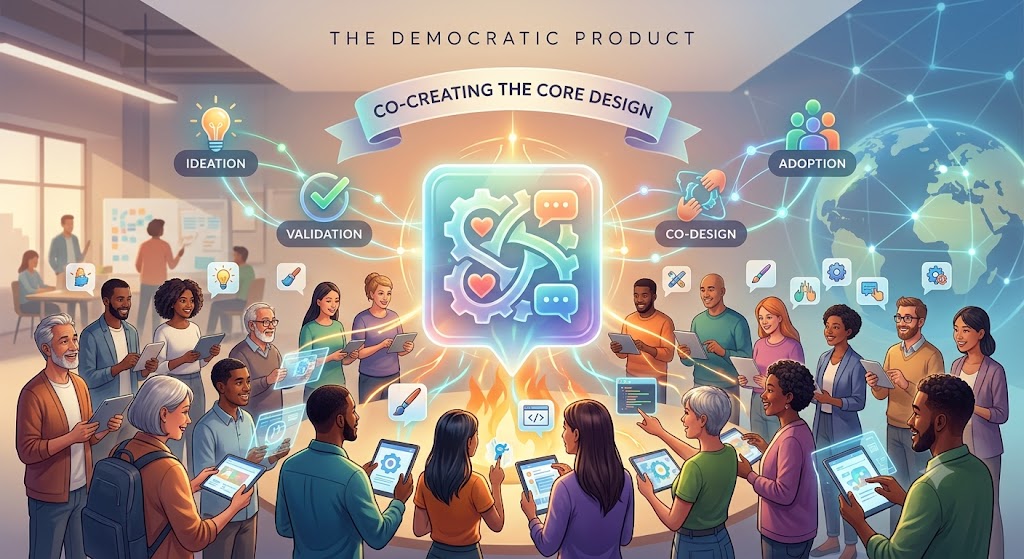
The Democratic Product

Engaging Communities in the Core Design Lifecycle
GUEST POST from Chateau G Pato


The Death of the Closed-Door Product Blueprint

For decades, product design has been treated like a form of top-down, opaque wizardry. We lock a handful of brilliant minds in a room, wait for the proverbial “Eureka!” moment, and launch the result into the market with fingers crossed. But in an era defined by hyper-connectivity, conscious consumption, and rapid digital transformation, this siloed, insular approach is a fast track to irrelevance.

To thrive in a landscape demanding continuous agility, organizations must undergo a fundamental mindset shift: we have to move away from designing for customers and start designing with communities.

The Core Thesis: “The Democratic Product” is not built on passive, rear-view feedback loops like standard surveys. It is co-created. True human-centered design requires embedding the collective intelligence of your entire ecosystem—customers, partners, and frontline employees—directly into the core of your design lifecycle.

By democratizing the creation process, we don’t just build better features; we ignite an innovation bonfire. We lower adoption friction, accelerate product-market fit, and naturally transform users into passionate, lifelong brand advocates. Let’s explore how to open the doors and design the future together.

I. Moving Beyond “Listening” to Active “Co-Creation”

Most organizations suffer from the illusion of feedback. We launch annual customer satisfaction surveys, host occasional focus groups, and look at trailing telemetry data, convinced we are listening to our market. But these traditional mechanisms are rear-view mirrors—they tell you what occurred yesterday, not what is possible tomorrow. They capture reactions to choices you have already made rather than inviting people to help make those choices.

A truly Democratic Product is built on a vastly different premise. It treats your customer ecosystem not as a passive audience to be analyzed, but as an active group of co-creators. This requires establishing open, visual, and collaborative frameworks where customers, partners, and frontline employees possess genuine agency to shape features, improve accessibility, and align products with real human needs.

The Mindset Shift: The greatest barrier to this transition isn’t technology; it is fear. Leaders worry that inviting the community into the design room means surrendering their executive vision or drowning in a sea of conflicting opinions. But democratic design is not design-by-committee. It is structured participation—fueling your strategic vision with deep, real-world empathy.

When we shift our posture from gathering requirements to facilitating shared exploration, we tap into a massive reservoir of distributed intelligence. We stop guessing what people want and begin building the structures that allow them to show us.

II. Mapping Community into the Core Design Lifecycle

To democratize your product, you must intentionally embed external communities into your operational cadence. We do this by structuring engagement across three primary, sequential phases of the product design lifecycle.

1. Ideation & Sensing (The Discovery Phase)

True innovation starts with active sensing. Instead of relying solely on centralized R&D, organizations can establish global sensing networks—cohorts of passionate users who act as early-warning systems for friction and opportunity. In this phase, we do not just ask the community for ideas; we ask them to help us collaboratively define and frame the right problems worth solving.

2. Co-Design & Validation (The Development Phase)

Once a core challenge is identified, the design doors must swing fully open. This is where we bring visual, collaborative frameworks directly to our community cohorts. Working with visual planning canvases allows non-designers to participate in low-fidelity prototyping on equal footing. We co-design the end-to-end emotional journey, validating hypotheses together and ensuring the solution actually eliminates real-world friction before writing a single line of production code.

3. Launch, Adoption & Evolution (The Scaling Phase)

The most overlooked benefit of democratic design is its impact on change management and market adoption. When a community helps build a product, they don’t need to be sold on it—they are already invested in its success and naturally become its loudest champions. Post-launch, the relationship evolves into decentralized governance loops where your ecosystem guides the ongoing roadmap, facilitating continuous agility.

The Takeaway: By systematically inviting stakeholders into these three key inflection points, design transitions from a black-box corporate operation to a transparent, shared journey.

III. The Friction Points: Why Democratic Design Fails (and How to Fix It)

While the promise of community-driven design is immense, execution is where most organizations stumble. Opening up the product lifecycle introduces complex human, cultural, and operational dynamics. If you do not proactively design the boundaries of your collaboration, your democratic initiative will quickly collapse under its own weight.

To build a sustainable co-creation engine, organizations must anticipate and actively mitigate three primary friction points:

1. The Noise vs. Signal Trap

When you open the floodgates, you will be inundated with feature requests, bug reports, and highly niche ideas. Without a structured filter, your product team can easily drown in the noise.

The Fix: Establish clear, visual frameworks to bucket feedback. Organize incoming data into strategic pillars so the community understands exactly what kinds of problems you are solving in any given sprint.

2. The Power User Bias

In any open forum, a tiny fraction of highly vocal “power users” will dominate the conversation. If you design solely for them, you risk over-complicating the product and alienating the silent majority who need simplicity and ease of use.

The Fix: Balance open-forum inputs with targeted, statistically representative sensing cohorts. Ensure you are actively seeking out the quiet voices and newer users to gain a balanced perspective on product friction.

3. The Organizational Change Deficit

The biggest failure point is internal, not external. If your engineering, product, and marketing pipelines are rigid and insular, they will reject community inputs like a foreign body. Democratic design demands organizational agility and a culture that values external empathy over internal ego.

The Fix: Treat the transition to democratic design as a change management initiative. Train your internal teams to view the community as partners, and adapt your roadmapping processes to dynamically ingest and act on external validation.

The Bottom Line: Co-creation is not a hands-off, chaotic free-for-all. It is a highly disciplined, facilitated exercise in human-centered change. Managing these friction points is what separates successful co-creation from empty marketing stunts.

IV. Designing the “Democratic Infrastructure” (Tools of the Trade)

Democratizing the design lifecycle cannot rely on good intentions alone. It requires building a dedicated, robust infrastructure. Just as we use structured tools to facilitate organizational agility, we must deploy specific platforms, governance rules, and value exchanges to make community collaboration seamless, secure, and highly productive.

To build a functional democratic infrastructure, organizations must focus on three core foundational pillars:

1. Visual, Collaborative Spaces

If you want your community to build with you, you must give them a shared language. Complex technical documentation or dense spreadsheets will instantly exclude the non-technical users who often bring the most valuable human-centered insights.

The Standard: Build and utilize visual, intuitive canvas tools and interactive spaces where internal teams and external cohorts can align rapidly. When the barrier to entry is visual and tactile, everyone can contribute on equal footing, getting “on the same page” literally and figuratively.

2. Clear Governance & Boundaries

A healthy democracy has laws, and a democratic product is no different. You must define early and transparently what is open to community influence and what is not. Trying to democratize everything leads to chaos, security risks, and strategic drift.

The Standard: Clearly carve out the sandboxes. For example, invite the community to democratize user experience design, accessibility, feature prioritization, and local use-case adaptions. Keep core architectural decisions, security standards, and proprietary intellectual property under centralized expert control.

3. Mutual Value Exchange

Your community’s time, creativity, and cognitive surplus are highly valuable. If co-creation feels like a one-way street where you extract free labor for corporate profit, your ecosystem will quickly disengage or turn hostile.

The Standard: Design an authentic value loop. Reward active contributors with early access to features, direct exposure to your leadership team, public recognition, and influence over the product’s ultimate roadmap. When they see their ideas actually making it into production, that shared ownership becomes the ultimate motivator.

The Takeaway: Infrastructure is what turns a fleeting initiative into a continuous, repeatable capability. When you build the right spaces, outline clear rules, and honor the contributions of your community, you lay the tracks for a truly democratic design engine.

Conclusion: Getting to the Future First

The era of the isolated genius is over. As we look toward an increasingly interconnected and rapidly shifting horizon, the organizations that thrive won’t be those with the biggest internal R&D budgets or the most guarded secrets. The future belongs to the organizations that can master the art of mobilization—orchestrating entire ecosystems of passionate individuals to solve problems together.

Transitioning to “The Democratic Product” is ultimately a commitment to radical empathy and continuous agility. By breaking down the walls of the traditional design lifecycle, you build something far more durable than just a highly functional tool. You build a living, breathing community that has a literal and emotional stake in your collective success.

The Call to Action: Stop treating your customers as a target demographic. Treat them as your advisory board. Start small: open up just one stage of your next design lifecycle, equip your community with simple visual collaboration tools, and watch your innovation bonfire truly ignite!

To learn more about implementing continuous agility, designing human-centered change, or to book Braden Kelley for an upcoming innovation keynote, visit bradenkelley.com.

Frequently Asked Questions

1. What is the difference between traditional user feedback and democratic co-creation?

Traditional feedback is passive and reactive; it captures a user’s retrospective opinion on choices the company has already made. Democratic co-creation is active and proactive. It invites customers, partners, and employees into the early-stage design process as partners, allowing them to collaboratively frame problems, test hypotheses, and shape features before final development begins.

2. How do you prevent democratic design from turning into messy “design-by-committee”?

Democratic design is not a free-for-all. It succeeds by establishing clear boundaries and strict guardrails. Organizations must Centralize core strategic decisions, baseline technical architectures, and IP security, while opening up the “sandbox” of user experience, accessibility, and local customization to the community. Strong visual collaboration frameworks keep the inputs focused and highly actionable.

3. Why are visual collaboration tools critical for engaging a community in design?

Dense technical specifications or text-heavy spreadsheets create high barriers to entry that exclude valuable voices. Visual collaboration canvases establish a simple, shared, and intuitive language. By shifting the conversation to interactive, tactile layouts, you level the playing field so that everyday users, business stakeholders, and engineers can co-create together without translation friction.


Image credit: Gemini

Subscribe to Human-Centered Change & Innovation WeeklySign up here to get Human-Centered Change & Innovation Weekly delivered to your inbox every week.
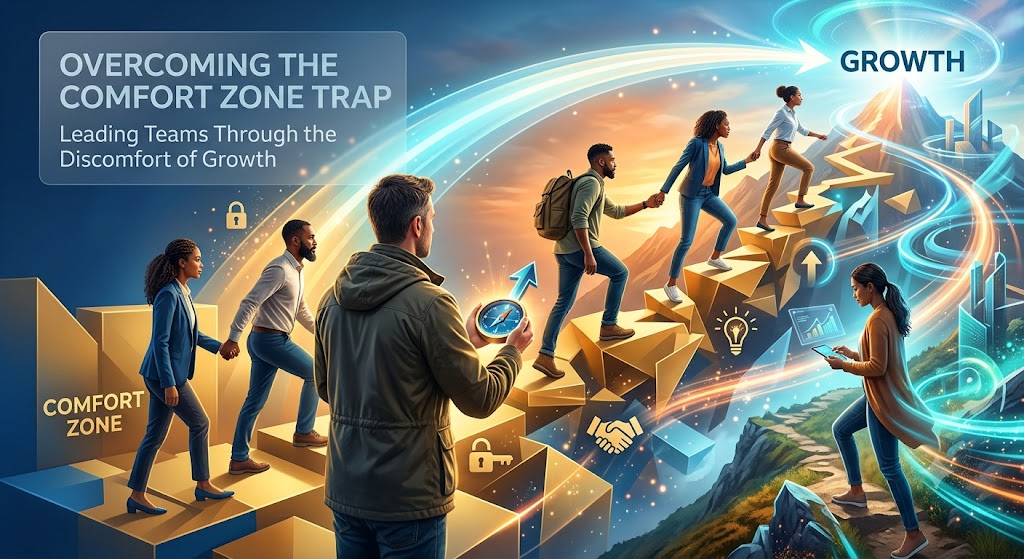
Overcoming the Comfort Zone Trap

Leading Teams Through the Discomfort of Growth

Overcoming the Comfort Zone Trap


GUEST POST from Chateau G Pato

The Siren Song of Stagnation

The comfort zone is rarely a place of overt failure; instead, it is a dangerous holding pattern where organizational relevance goes to die. It feels safe, predictable, and remarkably comfortable because it is built on the foundation of past victories. However, in an era defined by continuous disruption and accelerating shifts, the greatest risk to any organization isn’t doing things poorly—it is doing the same things too well for too long.

This creates the Success Trap. When teams achieve high performance, they naturally seek to protect the formulas, structures, and processes that got them there. The very mechanics that drove their initial triumph harden into a protective shell, rendering them blind to emerging trends and highly resistant to necessary change. True human-centered leadership requires recognizing that comfort is not a reward for hard work—it is an early indicator of stagnation.

Growth and comfort cannot coexist. To guide a team into the future, a leader must shift the organizational objective from protecting current capability to actively expanding potential.

The core thesis of modern change leadership is simple yet challenging: growth is not the absence of discomfort; it is the strategic, empathetic application of it. Leaders must step into the role of experience designers, carefully calibrating the “discomfort dial” to stretch their teams’ capabilities without triggering panic. By pairing psychological safety with purposeful challenge, we can transform discomfort from an obstacle into our most reliable fuel for innovation.

Phase 1: Diagnosing the Comfort Zone

Before a leader can guide a team through the discomfort of growth, they must first understand exactly where the organization has grown comfortable. The comfort zone is insidious because it masquerades as efficiency. When a process runs smoothly, or when a team hits their targets using familiar routines, it is easy to mistake stability for success. True diagnostic leadership requires looking beneath the surface of day-to-day operations to identify where compliance has replaced creativity.

Identifying the Signals of Stagnation

Organizational stagnation rarely announces itself with a crisis; it whispers through subtle shifts in team dynamics. Leaders must tune their radar to recognize the early warning signs of a team stuck in place:

  • The “Best Practices” Anchor: An over-reliance on historical success formulas, frequently accompanied by the phrase, “We’ve always done it this way.”
  • Diminishing Returns on Innovation: Expending identical amounts of energy and resources to achieve increasingly marginal performance improvements.
  • The Sound of Silence: Meetings devoid of healthy friction, constructive debate, or alternative points of view. Compliance takes the place of true alignment.
  • Incremental Bias: A portfolio of projects consisting entirely of safe, low-risk optimizations rather than bold, exploratory initiatives.

The Fear Audit Framework

To dismantle the comfort zone trap, leaders must conduct a deliberate Fear Audit. Teams rarely resist change because they are lazy; they resist because they are afraid. By categorizing and naming these invisible barriers, a leader can design targeted interventions to address them:

Fear Type Underlying Narrative Diagnostic Behavioral Cue
Fear of Failure “If I try something new and it doesn’t work, my reputation or standing will be permanently damaged.” Extreme risk aversion; hiding mistakes; waiting for explicit permission for minor decisions.
Fear of Incompetence “I am an expert at the current process. If the system changes, I won’t know how to do my job anymore.” Defensiveness toward new tools or methodologies; aggressively defending outdated systems.
Fear of Status Loss “My organizational value and influence are tied to the current power structure or workflow.” Passive-aggressive resistance; gatekeeping information; undermining collaborative cross-functional efforts.

Moving from “Comfort” to “Capability”

Overcoming this phase requires shifting the team’s core focus from defending what they currently have to building what they will eventually need. This is a deliberate shift in the organizational experience design. Leaders must redefine high performance away from static operational execution and tie it directly to active learning, adaptability, and the courage to step into the unknown.

Phase 2: The Architect of Constructive Discomfort

Once you have diagnosed the boundaries of your team’s comfort zone, the role of the leader shifts from an observer to an architect. Leading human-centered change does not mean throwing people into the deep end without a lifeline. Instead, it requires purposefully designing an environment where stretching beyond familiar boundaries is not only encouraged, but systematically supported. This is the art of balancing healthy friction with deep psychological support.

Psychological Safety as the Baseline

The fundamental prerequisite for constructive discomfort is absolute psychological safety. There is a common misconception that psychological safety means making people comfortable. In reality, it is exactly the opposite: it provides the emotional security necessary for people to tolerate being intensely uncomfortable.

Think of psychological safety as an organizational safety net. When professionals know that a mistake will not lead to humiliation, career damage, or a loss of status, they become willing to take the calculated risks required for innovation. Without this baseline of trust, pushing a team out of their comfort zone will not lead to growth—it will cause panic, leading to defensive posturing, burnout, and acute resistance.

Implementing the “Learning Loop”

To institutionalize this dynamic, leaders must replace rigid operational loops with dynamic Learning Loops. The goal is to lower the stakes of individual actions by breaking major, intimidating transformations down into small, rapid, and observable experiments:

  • Hypothesize: Clearly define what the team wants to learn or test, shifting the goal from a flawless execution to an insights-driven target.
  • Experiment: Run highly contained, low-risk trials where the cost of failure is negligible.
  • Analyze: Evaluate the outcomes with radical transparency, treating unexpected results as critical data points rather than personal setbacks.
  • Adapt: Rapidly pivot or scale the approach based on the empirical feedback gathered during the process.

Reframing the Narrative of Change

Human beings are evolutionarily wired to perceive unfamiliar territory as a threat. When leaders introduce new systems, metrics, or strategies, teams instinctively focus on what they stand to lose. As change architects, we must consciously change the narrative framework:

The Threatened Perspective (Old View) The Growth Perspective (Reframed View)
“We are throwing away a proven system that we spent years mastering.” “We are leveraging our hard-earned expertise to design an even more powerful future state.”
“This change is a direct critique of our current performance and efficiency.” “This evolution is a necessary response to shifting external realities and market dynamics.”
“If I fail at this new workflow, my position and value are at risk.” “The primary value I bring is my capacity to adapt, learn, and grow alongside the business.”

By shifting the story from one of loss to one of evolution, you remove the psychological friction of change. This allows teams to stop expending their energy protecting the past and start directing it toward mastering the future.

Phase 3: Leading Through the “Neutral Zone”

The most perilous part of any change journey is the middle. In William Bridges’ classic transition model, this is known as the Neutral Zone—the psychological gray area where the old way of working has been officially discontinued, but the new way isn’t yet fully functional or comfortable. This is the space where momentum stalls, frustrations peak, and the powerful temptation to retreat into old habits is at its absolute highest.

Managing this phase requires a unique blend of structural scaffolding and deep emotional intelligence. Leaders cannot manage the neutral zone with purely operational directives; they must navigate it as an experiential journey, providing clear markers and steady support while the ground is shifting beneath the team’s feet.

Navigating the Rollercoaster of Change

When teams enter the neutral zone, productivity often temporarily dips as people expend cognitive energy learning new systems, unlearning old habits, and managing the anxiety of ambiguity. Human-centered leaders do not punish this dip; they anticipate it. They recognize that confusion, false starts, and occasional friction are not signs of a failed strategy, but the literal sound of cognitive pathways and organizational capabilities expanding.

Tactical Anchors for Uncertain Times

To prevent the team from capsizing during this transition, leaders must install three critical tactical anchors to stabilize the organizational experience:

  • The Velocity of Micro-Wins: Big transformations take time, and delayed gratification breeds fatigue. Leaders must intentionally break down the long-term vision into short-term, highly achievable micro-milestones. Celebrating these small, observable victories creates a steady cadence of momentum and proves to the team that progress is actively being made.
  • The Futurist’s Horizon Lens: When wrapped in immediate discomfort, people naturally develop tunnel vision. The leader must consistently bring the future into the room. By anchoring daily challenges to macro trends and customer insights, you remind the team that standing still is an illusion—and that the discomfort they are experiencing now is the only path to long-term career and organizational relevance.
  • Human-Centered Empathy Buffers: Leading through growth does not mean adopting a posture of toxic positivity. Leaders must create explicit spaces for teams to voice their frustrations, clear up confusion, and grieve the loss of their old routines. Acknowledging that change is hard builds the relational trust required to keep pushing forward.

The Transition Dynamic

The following progression maps the shift in leadership focus required to successfully carry a team across the messy middle of change:

Transition Stage The Team’s Experience The Leader’s Primary Role
1. The Ending Anxiety, denial, sense of loss, resistance. The Communicator: Clearly explain why the old status quo is unsustainable.
2. The Neutral Zone Confusion, low morale, high friction, creative sparks. The Scaffolder: Define short-term focus, tolerate mistakes, reward experimentation.
3. The New Beginning Acceptance, fresh energy, alignment, emerging mastery. The Sustainer: Lock in new behaviors, align rewards, celebrate the growth achieved.

By actively scaffolding the neutral zone, leaders transform the messy middle from an organizational hazard into a crucible for genuine agility. The goal is to help the team discover that they can survive—and ultimately thrive—in the space between certainty and clarity.

Phase 4: Sustaining the Edge

The ultimate goal of overcoming the comfort zone trap is not to guide your team through a single, painful transition only to let them settle into a brand-new zone of comfort. In a business landscape characterized by continuous disruption, static stability is an illusion. The true objective of human-centered leadership is to institutionalize agility, converting a one-time change initiative into a permanent, healthy capacity for ongoing evolution.

Sustaining this edge requires embedding change readiness directly into the operating model, leadership metrics, and cultural rituals of the organization. Growth must become an ongoing, iterative practice rather than an exceptional event.

Institutionalizing Agility

To move from episodic change to a sustainable state of perpetual adaptation, leaders must design permanent structural mechanisms that reward exploration and discourage complacency:

  • Redefining Core Metrics: Shift performance evaluations from rewarding purely predictable operational execution to actively measuring adaptability, collaborative cross-functional experimentation, and speed-to-insight.
  • Ritualizing the Retrospective: Embed radical transparency into the regular business cadence. Normalize discussing what didn’t work just as openly as what did, ensuring that hard-earned knowledge is institutionalized rather than buried.
  • Continuous Signal Scanning: Democratize the role of the futurist. Train the entire team to look outward at emerging trends, changing customer behaviors, and technological developments, ensuring the organization is never caught off guard by the future.

The Innovation Maturity Continuum

Organizations navigate distinct levels of readiness when converting raw discomfort into sustained innovative capacity. Leaders can use the following maturity framework to evaluate where their organization sits and determine the next developmental step:

Maturity Level Dominant Team Mindset Systemic Response to Friction
1. Reactive “We only change when forced by a market crisis or operational failure.” Panic, blame assignment, and an urgent retreat to defensive legacy behaviors.
2. Project-Driven “We can tolerate discomfort if it is contained within a specific, time-bound initiative.” Compliance during the project, followed by a slow slide back into old comfort zones.
3. Continuous Agility “Discomfort is a natural, healthy sign that we are actively expanding our capabilities.” Curiosity, rapid collaborative adaptation, and a collective pride in the team’s capacity to learn.

Conclusion: The Leader as a Catalyst

Ultimately, sustaining the edge comes down to a fundamental shift in how we view the role of leadership. The traditional model of a leader was an anchor—someone who provided absolute certainty, stability, and protection from external forces. Today, the human-centered leader must act as a catalyst. The greatest gift you can give your team is not temporary comfort, but the psychological safety, strategic tools, and emotional resilience required to be perpetually, productively uncomfortable.

Conclusion: Embracing the Continuum of Growth

Overcoming the comfort zone trap is not a project with a defined start and end date; it is an enduring leadership philosophy. The moments where your team feels most settled and secure are precisely the moments that require the most vigilant, proactive exploration. Safety is found in your collective capacity to adapt, not in the temporary shelter of static processes or historical victories.

A Call to Action for Transformation Leaders

To move from theory to execution, change leaders must immediately bring these concepts into their daily operational cadence. Do not wait for a major structural reorganization or a market downturn to shake up your team’s routine. True agility is forged through microscopic, deliberate disruptions designed to build the organization’s collective tolerance for the unfamiliar.

The ultimate measure of a human-centered leader is not how much certainty they can manufacture for their team, but how much ambiguity they can empower their team to navigate.

As you step back into your organization, challenge yourself to initiate one immediate disruption exercise by the end of this week. Identify a single, entrenched workflow or an unquestioned “best practice” that has become overly comfortable. Gather your team, leverage your frameworks for psychological safety, and run a rapid, low-stakes experiment to re-evaluate it. By consciously opening up these small pockets of constructive friction, you begin the vital process of transforming discomfort from a source of anxiety into your competitive advantage.

The choice facing modern organizations is stark but simple. We can choose the predictable, temporary warmth of the comfort zone until external forces violently dismantle it—or we can choose the exhilarating, deliberate discomfort of intentional growth. By equipping our teams with the emotional scaffolding, experimental frameworks, and strategic foresight required to step forward, we ensure they don’t just survive the future, but actively design it.

Frequently Asked Questions

How can a leader tell the difference between healthy constructive discomfort and team panic or burnout?

The distinction lies in the presence of psychological safety and agency. In a state of healthy discomfort, team members feel challenged but supported; they possess the tools, autonomy, and safety to experiment, fail, and learn without fear of retribution. When a team crosses into panic or burnout, you will observe chronic anxiety, finger-pointing, a total collapse of open communication, and physical exhaustion. Cultivating a regular feedback loop allows leaders to actively calibrate this baseline.

Why is psychological safety considered a prerequisite for introducing discomfort to a team?

Psychological safety is the structural foundation that prevents discomfort from turning into paralyzing fear. If professionals believe that a mistake, an unpolished idea, or an experimental failure will result in humiliation or career damage, they will instinctively retreat deeper into their comfort zones. True psychological safety doesn’t mean creating an environment free of challenge—it creates the exact container of trust required for individuals to take bold risks.

What is the first step a leader should take to transition a team out of a long-standing “success trap”?

The first step is conducting a thorough Fear Audit to identify what the team is protecting, followed immediately by changing the narrative framework. Leaders must explicitly decouple a professional’s identity from a static process and instead attach it to their capacity to learn and evolve. Introduce low-stakes, rapid experiments (Learning Loops) where the objective isn’t absolute perfection, but the acquisition of critical data and insight.

Image credit: Gemini

Subscribe to Human-Centered Change & Innovation WeeklySign up here to get Human-Centered Change & Innovation Weekly delivered to your inbox every week.

Change Leadership and the Power of Storytelling

Change Leadership and the Power of Storytelling

GUEST POST from Chateau G Pato

Change is an inevitable part of life, especially in today’s fast-paced and ever-evolving world. Organizations constantly find themselves navigating through various changes, from mergers and acquisitions to technological advancements. However, with change comes challenges, and the success of any change initiative lies in effective change leadership. One powerful tool that change leaders can harness is storytelling. By utilizing the power of stories, leaders can inspire, engage, and drive individuals towards embracing and supporting change. In this article, we will explore two case study examples that highlight the impact of storytelling in change leadership.

Case Study 1: IBM’s Transformation

IBM, a multinational technology company, went through a significant transformation when Lou Gerstner took over as CEO in the early 1990s. Gerstner inherited a struggling organization that was losing its market share and lacked direction. To turn things around, he recognized the need to infuse a new culture within the company and get everyone on board with the forthcoming changes.

Gerstner realized that simply presenting a cold set of data and charts would not be sufficient to inspire and motivate a workforce that had become disillusioned and resistant to change. Instead, he employed the power of storytelling to connect with his employees on a deep emotional level. Gerstner crafted a narrative that focused on IBM’s rich history, its role in shaping the world, and the collective responsibility of each employee to revive the organization.

Through his storytelling, Gerstner effectively conveyed the urgency for change while instilling a sense of pride and purpose. This emotional connection ultimately resulted in the successful turnaround of IBM, transforming it into a leading technology company once again.

Case Study 2: Procter & Gamble’s Innovation Culture

In the early 2000s, Procter & Gamble (P&G) faced the challenge of how to breathe life into their innovation efforts. A.G. Lafley, the CEO at the time, recognized that P&G needed a culture shift to foster creativity, risk-taking, and collaboration across the organization.

Lafley understood that storytelling could bridge the gap between strategic objectives and people’s daily work lives. He implemented a company-wide initiative called “Connect+Develop” that encouraged employees to share stories about their innovative ideas and experiences. These stories, which focused on real people and real challenges, helped employees see the tangible impact of their work and inspire others to think differently.

By creating a storytelling platform, Lafley empowered P&G employees to become change agents and ambassadors for innovation. This cultural shift resulted in numerous successful product launches and allowed P&G to maintain its position as a leader in the consumer goods industry.

The Power of Storytelling

These case studies highlight the transformative power storytelling can have in change leadership. Stories have the ability to evoke emotions, create meaning, build trust, and inspire action. When change leaders effectively communicate their vision and purpose through storytelling, they paint a vivid picture of the future and create a shared understanding among individuals.

Furthermore, storytelling engages both the rational and emotional aspects of individuals, making change feel more relatable and personal. It helps people see how they fit into the narrative and how their contributions are instrumental in achieving the desired change.

Conclusion

Change leadership is crucial during times of transformation within organizations. The power of storytelling as a change leadership tool cannot be underestimated. By crafting compelling narratives that resonate with employees’ experiences and emotions, leaders can bridge the gap between resistance and acceptance, ultimately driving the success of change initiatives.

References:

  • McNamara, C. (n.d.). Transformational Change, IBM Style. Retrieved from https://managementhelp.org/organizationalchange/transformational-change.htm
  • Denning, S. (2011). The case of storytelling in organizational change. Journal of Change Management, 11(3), 325-347.

Image credit: Pixabay

Subscribe to Human-Centered Change & Innovation WeeklySign up here to get Human-Centered Change & Innovation Weekly delivered to your inbox every week.
Innovation Through Experimentation

Strategies for Rapid Iteration

Innovation Through Experimentation

GUEST POST from Chateau G Pato

In today’s fast-paced and constantly evolving business landscape, innovation is the key to staying ahead of the competition. However, traditional approaches to innovation may not be enough to keep up with rapidly changing customer needs and preferences. To foster innovation, organizations must embrace a culture of experimentation and adopt strategies for rapid iteration. In this article, we will explore the importance of experimentation in driving innovation and discuss two case study examples to illustrate successful implementation.

Case Study 1: Google’s “20% Time”

One of the most famous examples of fostering innovation through experimentation is Google’s “20% time.” This initiative allows employees to spend 20% of their workweek, or one day, working on projects that interest them outside of their core responsibilities. This flexible structure encourages employees to explore new ideas and experiment with innovative solutions.

One notable outcome of Google’s 20% time is the creation of Gmail. Originally developed as an experiment by a Google engineer, the project emerged from the employee’s personal interest in improving email communication. Through rapid iteration and continuous experimentation, Gmail was refined and eventually launched as one of Google’s most successful products. This case study demonstrates how giving employees the freedom to experiment can lead to significant innovation and long-term success.

Case Study 2: Amazon’s A/B Testing

Amazon, the e-commerce giant, is renowned for its customer-centric approach and its relentless pursuit of innovation. One of the strategies Amazon uses to continuously iterate and improve its offerings is A/B testing. By testing different variations of a webpage, product listing, or feature, Amazon gathers quantitative data to make informed decisions about which version performs better. This data-driven approach allows them to quickly adapt and optimize their offerings to meet customer expectations.

An example of Amazon’s A/B testing is its product recommendation engine. By experimenting with different algorithms and design variations, Amazon continuously refines its recommendation engine to provide highly personalized and relevant product suggestions. This iterative process has played a significant role in enhancing the customer experience, boosting sales, and establishing Amazon as an industry leader.

Key Strategies for Rapid Iteration

1. Embrace Failure as Learning: Encourage a culture where failure is seen as an opportunity to learn and improve. Failure should not be punished but celebrated as a stepping stone towards success. By fostering an environment that values experimentation and risk-taking, organizations can encourage employees to think creatively and push boundaries.

2. Establish Rapid Feedback Loops: Implement processes that allow for quick feedback and iteration. Regularly gather feedback from customers, employees, and other stakeholders to identify areas for improvement. This feedback loop enables organizations to make iterative changes based on real-world data and inputs, leading to more relevant and effective solutions.

3. Set Clear Goals and Metrics: Clearly define innovation goals and establish measurable metrics to track progress. By setting concrete objectives, organizations can evaluate the success of their experiments and measure the impact on key performance indicators. This data-driven approach helps focus efforts on what truly matters and ensures that innovation initiatives align with overall business objectives.

Conclusion

Innovation through experimentation is crucial for organizations aiming to thrive in today’s rapidly changing business landscape. By adopting strategies for rapid iteration, businesses can foster a culture that encourages and celebrates innovation. The case study examples of Google’s “20% time” and Amazon’s A/B testing demonstrate how organizations can drive significant innovation by allowing employees to experiment and by leveraging quantitative data to inform decision-making. By embracing failure, establishing feedback loops, and setting clear goals and metrics, organizations can unleash their creative potential, adapt to evolving market dynamics, and stay ahead of the competition.

EDITOR’S NOTE: Braden Kelley’s Experiment Canvas™ can be a super useful FREE tool for your innovation or human-centered design pursuits.

“The Experiment Canvas™ is designed to help people instrument for learning fast in iterative new product development (NPD) or service development activities. The canvas will help you create new innovation possibilities in a more visual and collaborative way for greater alignment, accountability, and more successful outcomes.”

Image credit: misterinnovation.com

Subscribe to Human-Centered Change & Innovation WeeklySign up here to get Human-Centered Change & Innovation Weekly delivered to your inbox every week.
Human-Centered Design and Agile Methodologies

A Powerful Combination

Human-Centered Design and Agile Methodologies

GUEST POST from Chateau G Pato

In today’s fast-paced and competitive market, organizations are increasingly realizing the importance of incorporating both Human-Centered Design (HCD) principles and Agile methodologies into their product development processes. By doing so, companies are able to create innovative and user-centric products while staying agile and responding swiftly to changing customer needs.

Human-Centered Design is an iterative design approach that focuses on understanding and meeting the needs, desires, and behaviors of end-users. It involves continuously involving users throughout the design process, gaining insights through user research, and incorporating their feedback to build products that truly address their pain points. On the other hand, Agile methodologies emphasize flexibility, collaboration, and adaptive planning, enabling teams to iteratively deliver value through frequent and incremental product releases.

When combining HCD with Agile, organizations can leverage the strengths of both methodologies and achieve remarkable results. Let’s explore two case studies that highlight the power of this combination.

Case Study 1: Airbnb

One of the most prominent examples of successful integration of HCD and Agile methodologies is Airbnb. In its early years, Airbnb faced the challenge of low user engagement and failed to attract users to their platform. Recognizing the importance of putting users at the center of their design strategy, Airbnb embraced HCD principles alongside an Agile development approach.

Airbnb extensively researched the needs and preferences of its target audience, even going as far as sending its designers to live with hosts in different cities to truly understand the user experience. The insights gained from these immersive research experiences helped Airbnb identify pain points and develop innovative features that addressed them effectively.

By integrating Agile methodologies, Airbnb was able to quickly implement and test its design ideas, gaining rapid feedback from users. They released regular updates and constantly improved their app based on user feedback, ensuring that the product remained user-centric. Today, Airbnb is a global leader in the accommodation industry, revolutionizing the way people experience travel.

Case Study 2: Intuit

Intuit, a leading financial software company, is another example of successfully combining HCD and Agile methodologies in their product development process. Intuit’s flagship product, TurboTax, enables users to file taxes easily and efficiently. However, in observance of a common challenge faced by many organizations, Intuit realized that users often dropped out during the tax filing process due to its complexity.

To address this issue, Intuit adopted an HCD approach. They conducted extensive user research, including in-depth interviews and usability testing, to understand the pain points hindering user adoption. Based on these insights, Intuit redesigned their tax filing process to be simpler, more intuitive, and less time-consuming.

Intuit complemented their HCD efforts with an Agile development methodology. By releasing regular updates and engaging with users throughout the development process, Intuit ensured that the changes made aligned with user needs. The incremental approach allowed them to constantly improve the product and significantly reduce customer drop-offs during tax filing.

The integration of HCD and Agile methods played a crucial role in the success of TurboTax, making it the most popular tax preparation software in the market today.

Conclusion

The combination of Human-Centered Design and Agile methodologies has proven to be a powerful tool for organizations seeking to create user-centric and innovative products. The case studies of Airbnb and Intuit demonstrate how this integration can lead to significant improvements in user experiences and overall business success. By prioritizing user needs and leveraging feedback through an iterative and adaptive approach, companies can adapt to changing market requirements while delivering products that make a lasting impact.

EDITOR’S NOTE: Braden Kelley’s Problem Finding Canvas can be a super useful starting point for doing design thinking or human-centered design.

“The Problem Finding Canvas should help you investigate a handful of areas to explore, choose the one most important to you, extract all of the potential challenges and opportunities and choose one to prioritize.”

Image credit: misterinnovation.com

Subscribe to Human-Centered Change & Innovation WeeklySign up here to get Human-Centered Change & Innovation Weekly delivered to your inbox every week.

What It Takes to be a Successful Digital Disruptor

What It Takes to be a Successful Digital Disruptor

GUEST POST from Chateau G Pato

In today’s rapidly evolving digital landscape, innovation is the key to success. With technology continually reshaping industries, companies must embrace digital disruption to remain competitive. Digital disruptors are those forward-thinking individuals and organizations that actively challenge traditional business models, transforming industries and creating new opportunities. In this article, we explore two case studies to understand what it takes to be a successful digital disruptor.

Case Study 1: Uber – Revolutionizing the Transportation Industry

Uber, founded in 2009, has disrupted the traditional taxi industry by leveraging technology and creating a peer-to-peer ridesharing platform. By simply connecting drivers with passengers through a user-friendly mobile app, Uber has revolutionized the way people commute.

One of the key factors behind Uber’s success is the integration of technology into their business model. They capitalized on the widespread adoption of smartphones and built an app that provides ease of access and convenience to users. Additionally, Uber’s use of GPS technology enabled them to optimize ride routes, resulting in quicker and more efficient trips, which became a significant competitive advantage.

Moreover, Uber’s disruption of the industry was driven by its ability to identify pain points. By recognizing the challenges faced by commuters, such as long queues, unreliable service, and lack of affordability, Uber was able to provide a seamless and cost-effective alternative. They turned a fragmented and highly regulated industry into a user-centric service that offered reliable transportation at the tap of a button.

Case Study 2: Netflix – Transforming the Entertainment Industry

Netflix, founded in 1997 as a DVD rental-by-mail service, disrupted the traditional video rental industry and eventually transformed the entertainment landscape. Recognizing the potential of streaming technology, Netflix transitioned from mailing DVDs to offering an online streaming platform, which has now become a household name.

The success of Netflix can be attributed to its innovative approach to content delivery. By capitalizing on technological advancements and increasing internet speeds, they facilitated on-demand access to a vast library of movies and TV shows. This not only eliminated the need for physical stores but also provided subscribers with the freedom to watch what they want, when they want.

Furthermore, Netflix’s disruptive nature can be seen in its investment in original content. By leveraging data analytics and user preferences, they have been able to create highly engaging and binge-worthy series like “Stranger Things” and “House of Cards.” This strategic move has allowed them to not only compete with traditional media giants but also establish themselves as a major player in the entertainment industry.

What it Takes to be a Successful Digital Disruptor?

Both Uber and Netflix exemplify the characteristics required to be a successful digital disruptor. Here are some key takeaways:

1. Technological Integration: Embrace technology and leverage it to create innovative products and solutions. Digital disruptors constantly seek ways to utilize technology to improve user experience, increase efficiency, and disrupt existing markets.

2. Customer Focus: Identify pain points and seek ways to address them. Successful disruptors prioritize the user experience, understanding the needs and desires of their target audience to create seamless and user-centric solutions.

3. Agility and Adaptability: Disruption requires the ability to adapt to changing circumstances and market conditions. Successful digital disruptors remain agile, constantly innovating and evolving their business strategies and models.

4. Data-Driven Decision Making: Utilize data analytics to understand user behavior, preferences, and market trends. Data-driven insights enable disruptors to make informed decisions and drive innovation in their respective industries.

The digital disruption landscape is constantly evolving, and staying ahead of the curve is crucial for success. By embracing technology, focusing on customer needs, remaining agile, and leveraging data, upcoming disruptors have the potential to reshape industries and create remarkable opportunities.

Image credit: Unsplash

Subscribe to Human-Centered Change & Innovation WeeklySign up here to get Human-Centered Change & Innovation Weekly delivered to your inbox every week.

Change Leadership and Building Resilience in Organizations

Change Leadership and Building Resilience in Organizations

GUEST POST from Chateau G Pato

In today’s rapidly changing business landscape, organizations need strong leadership and resilience to thrive. Change is inevitable, and effective change management requires leaders who can guide their teams through transitions and build resilience within the organization. This article explores the concept of change leadership and its impact on building resilience, using two case studies to illustrate successful strategies.

Case Study 1 – IBM

IBM, a global technology giant, faced a significant challenge in the early 1990s when it realized that its traditional mainframe business was becoming obsolete. The company recognized the need to shift its focus towards emerging technologies such as cloud computing and artificial intelligence. To lead this transformation, IBM appointed Gerstner as its CEO in 1993.

Gerstner implemented a change leadership approach that involved creating a sense of urgency, establishing a clear vision, and involving employees at all levels. He recognized the importance of building resilience in the organization by aligning the company’s culture with its new strategic direction. Through transparency and open communication, Gerstner instilled trust in his employees and motivated them to embrace the changes.

IBM’s transformation was successful, and the company not only survived but thrived in the technology industry. This case study demonstrates the critical role of change leadership in driving organizational resilience during periods of significant change.

Case Study 2 – Patagonia

Patagonia is an outdoor apparel company known for its commitment to sustainability and social responsibility. In 2011, the company faced a supply chain crisis when environmental organizations exposed the use of harmful chemicals in its products. This revelation threatened Patagonia’s reputation and market position as an eco-friendly brand.

In response, the company’s founder and CEO, Yvon Chouinard, took a proactive approach to address the issue. Chouinard implemented a change leadership strategy that involved owning up to the problem, conducting thorough research on alternative materials and manufacturing methods, and engaging with stakeholders to rebuild trust.

The change leadership approach also emphasized building resilience by fostering a learning culture and empowering employees to adopt innovative practices. Patagonia introduced its “Worn Wear” program that encouraged customers to repair, reuse, and recycle their garments, aligning with its sustainability values.

Patagonia’s commitment to change and resilience paid off. With its transparent approach and focus on sustainability, the company regained customer trust and attracted new environmentally conscious consumers. The case study demonstrates how change leadership and resilience can not only mitigate a crisis but also be a driver for long-term success.

Conclusion

Change leadership is essential for building resilience in organizations. The case studies of IBM and Patagonia demonstrate that effective change leaders create a vision, engage employees, and foster a culture that embraces and adapts to change. By proactively addressing challenges and building resilience within their organizations, both companies achieved significant success.

Leadership that guides organizations through change and builds resilience enables businesses to adapt to evolving market conditions, seize new opportunities, and navigate crises. In an era of constant change, organizations that prioritize change leadership and resilience are more likely to remain competitive and thrive.

Image credit: Pixabay

Subscribe to Human-Centered Change & Innovation WeeklySign up here to get Human-Centered Change & Innovation Weekly delivered to your inbox every week.

Driving Cross-Functional Innovation

The Power of Collaboration

Driving Cross-Functional Innovation

GUEST POST from Chateau G Pato

Collaboration is a key driver of innovation, enabling diverse teams to leverage their expertise, perspectives, and skills to solve complex problems. In today’s fast-paced and interconnected world, cross-functional collaboration has become increasingly essential for businesses to stay competitive and drive meaningful change. This article explores the benefits of collaboration in fostering cross-functional innovation through two compelling case studies.

Case Study 1 – Pixar’s Creative Collaboration

Pixar, the renowned animation studio, is celebrated for its consistent delivery of groundbreaking and critically acclaimed films. One of the critical factors contributing to their success is their commitment to cross-functional collaboration. From directors to animators, writers, and technical experts, Pixar brings together diverse talents from different disciplines to create their films.

By fostering an environment of open communication and collaboration, Pixar teams challenge conventions and push boundaries. They encourage cross-pollination of ideas, creating an iterative process where different perspectives enrich the creative process. This cross-functional approach has led to numerous breakthroughs in storytelling, animation techniques, and technological advancements, enabling Pixar to create immersive and emotionally impactful films loved by audiences worldwide.

Case Study 2 – GE’s Global Research Collaboration

General Electric (GE), a multinational conglomerate, places a strong emphasis on collaboration as a catalyst for innovation. GE’s Global Research Center, one of the world’s most extensive and diverse industrial research organizations, brings together scientists, engineers, and experts from various disciplines.

By fostering cross-functional collaboration, GE harnesses the collective knowledge and expertise of its researchers. This collaborative environment has yielded groundbreaking innovations across industries, including advancements in renewable energy sources, healthcare technologies, aerospace, and more. GE’s collaboration efforts not only drive innovation but also contribute to addressing global challenges and improving the world we live in.

Benefits of Cross-Functional Collaboration:

1. Enhanced Problem-Solving: Cross-functional teams bring a range of perspectives and expertise to the table, enabling them to approach problems from different angles. This collaborative approach fosters innovative thinking and generates well-rounded solutions that address diverse needs.

2. Increased Creativity and Innovation: Collaboration sparks creativity by enabling the collision of ideas, encouraging out-of-the-box thinking, and challenging traditional paradigms. The synergy between team members from different backgrounds stimulates new perspectives and innovative solutions.

3. Improved Communication and Knowledge Sharing: Cross-functional collaboration facilitates open communication, breaking down silos and enabling the sharing of expertise and insights. This exchange of knowledge drives continuous learning, enabling teams to stay current with industry trends and leverage emerging opportunities.

4. Enhanced Decision Making: Collaboration encourages collective decision-making processes, leveraging diverse viewpoints and expertise. This approach leads to more informed and well-rounded decisions, reducing the risk of biases and improving overall organizational performance.

Conclusion

Cross-functional collaboration is a powerful tool for driving innovation and achieving organizational success. As demonstrated by the case studies of Pixar and GE, collaboration fosters creativity, problem-solving, knowledge sharing, and effective decision-making. By embracing and promoting cross-functional collaboration, businesses can harness the collective intelligence of their teams and unlock new avenues for growth, ensuring their continued relevance and competitiveness in an ever-evolving world.

Image credit: Pixabay

Subscribe to Human-Centered Change & Innovation WeeklySign up here to get Human-Centered Change & Innovation Weekly delivered to your inbox every week.

Why Empathy and Collaboration Are Strategic Agility Metrics

Beyond the Checklist

Why Empathy and Collaboration Are Strategic Agility Metrics

GUEST POST from Chateau G Pato


The Mirage of the Metric

The Agility Paradox: Organizations look incredibly agile on paper—they are checking off sprint goals, hitting project milestones, and deploying software faster than ever. Yet, true strategic pivots still fail or stall under the weight of market realities.

The Flaw of the Checklist: Traditional agility metrics measure activity (velocity, burndown charts, process compliance) rather than capability (adaptability, resilience, cultural alignment). We have optimized for the speed of doing tasks rather than the capacity to absorb transformation.

The Thesis: True strategic agility isn’t a mechanical process; it is a deeply human one. To survive continuous disruption, organizations must elevate empathy and collaboration from soft, secondary considerations into core, measurable strategic metrics that drive sustainable performance.

Redefining Strategic Agility through a Human Lens

What Strategic Agility Actually Means: It is the organizational capacity to spot threats and opportunities early, pivot resources instantly, and execute changes without tearing the cultural fabric apart. It isn’t just about moving fast; it is about changing direction cohesively.

The Human-Centered Change Gap: Processes don’t change; people do. Technology platforms and organizational restructuring are just inanimate plans until human beings choose to adopt them. If your workforce is fatigued, untrusting, or structurally siloed, your strategy is dead on arrival.

Shifting from Compliance to Commitment: Checking a box on a change management framework might ensure legal or administrative compliance, but it completely fails to inspire true commitment. To cultivate a culture that embraces the unknown, organizations must intentionally design psychological safety into the transformation process itself.

Metric #1: Empathy as an Early Warning and Adoption System

Empathy as Data: We must reframe empathy. It is not a vague, soft sentiment; it is a source of deep, operational insight. By actively listening to and understanding customer and employee pain points, leadership gains access to predictive data that reveals hidden friction before it impacts the bottom line.

The Cost of an Empathy Deficit: When organizations push changes from the top down without regard for the human experience, they create an empathy deficit. This manifests as acute change fatigue, passive resistance, low engagement, and quiet quitting—all of which act as an invisible brake on strategic execution.

How to Operationalize and Measure Empathy: To manage empathy strategically, we must make it visible on the leadership dashboard through actionable indicators:

  • Change Saturation Mapping: Quantifying and tracking the total emotional and cognitive load placed on specific teams to avoid hitting a breaking point before a new initiative even launches.
  • Psychological Safety Scores: Utilizing regular, anonymous pulse assessments to measure whether employees feel safe pointing out flaws or risks in a new strategic direction early in the life cycle.
  • The Employee Friction Index: Measuring the qualitative and quantitative lag between a problem being identified by frontline staff and that feedback actually reaching executive decision-makers.

Metric #2: Collaboration as the Engine of Co-Creation

Moving Past Functional Silos: True innovation lives at the intersections of disciplines. Siloed organizations are inherently rigid, slow to respond to market shifts, and prone to internal friction. When departments guard their boundaries rather than sharing insights, strategic agility drops to zero.

Collaboration vs. Communication: Sending more emails, scheduling more status updates, or hosting more meetings isn’t collaboration—that is just noise. True collaboration is the deliberate, cross-functional co-creation of value, where diverse teams actively solve problems together rather than handing off tasks over functional walls.

How to Operationalize and Measure Collaboration: To ensure collaboration drives strategic velocity, leadership must track how effectively teams integrate across boundaries:

  • Cross-Functional Velocity: Tracking the exact duration it takes for a strategic concept to move from a cross-departmental idea to a live, working prototype.
  • Organizational Network Analysis (ONA): Visually mapping how information, trust, and decision-making actually flow across teams, exposing the realities of the informal network versus the rigid boxes of the formal org chart.
  • Co-Creation Ratios: Measuring the percentage of major strategic initiatives designed side-by-side with frontline employees versus those simply mandated to them from the top down.

Experience Design (XD) for the Change Journey

Designing the Employee Change Experience: True transformation requires that we apply the same rigorous experience design principles to our internal team members that we routinely apply to external customer journeys. Employees should not be passive recipients of change; their journey must be intentionally architected.

Reducing Friction Points: Strategic agility stalls when anxiety spikes. By mapping out the change journey, we can identify the specific moments of highest friction—such as major system migrations, sudden structural reorganizations, or shifts in role definitions—and proactively design targeted supportive interventions to smooth the transition.

The Reward: When organizations invest in designing a human-centered change experience, the cultural dynamic shifts. You move away from a workforce that views transformation as a series of existential threats, replacing it with a culture that approaches continuous evolution as a well-designed, collaborative adventure.

Conclusion: The New Agile Dashboard

The Futurist’s Outlook: The future does not belong to the biggest or even the fastest organization, but to the most adaptable. In an era of continuous disruption, the static checklist is a dangerous relic of a predictable world. Survival requires an organization that can organically reconfigure itself in real time.

A Call to Action for Leaders: It is time to radically update the executive dashboard. To build true enterprise resilience, leaders must balance traditional financial and operational metrics with human-centric indicators. If you aren’t measuring the psychological safety, change saturation, and cross-functional trust of your teams, you are flying blind.

The Final Word: True agility cannot be bought off a shelf or installed via a process framework. When empathy and collaboration become embedded as core strategic metrics, agility ceases to be a methodology you practice and naturally becomes the culture you live.

Frequently Asked Questions

Why are traditional agility metrics failing today’s organizations?

Traditional agility metrics like sprint velocity and process compliance measure activity rather than actual capability. They track how quickly tasks are completed within a rigid framework, but fail to measure an organization’s cultural readiness, resilience, and capacity to absorb continuous, strategic change without burning out its people.


How can empathy be treated as a measurable strategic metric?

Empathy can be operationalized by tracking data points that reflect the human experience of change. This includes using Change Saturation Mapping to measure the cognitive load on teams, tracking Psychological Safety Scores to see if employees feel safe surfacing risks early, and measuring the time lag for critical frontline feedback to reach executive leadership.


What is the difference between organizational communication and true collaboration?

Communication is simply the transmission of information, which often manifests as an overwhelming volume of emails, Slack messages, and status meetings. Collaboration is the cross-functional co-creation of value. It occurs when diverse, cross-departmental teams actively solve problems together from the start, breaking down institutional silos.

Bottom line: Futurology is not fortune telling. Futurists use a scientific approach to create their deliverables, but a methodology and tools like those in FutureHacking™ can empower anyone to engage in futurology themselves.

Image credit: Gemini

Subscribe to Human-Centered Change & Innovation WeeklySign up here to get Human-Centered Change & Innovation Weekly delivered to your inbox every week.
The Shrinking Corporate Footprint

The Illusion of Scale

The Shrinking Corporate Footprint

GUEST POST from Chateau G Pato


For more than a century, our global economic engine has operated under a fundamental assumption: to grow a business, you must grow a workforce. Market dominance, operational capability, and sheer organizational power were directly tethered to headcount. The massive corporate headquarters, the bustling urban campus, and the thousands of employees walking through physical doors every morning were the tangible evidence of success. This structural reality formed the foundation of our modern social contract — corporations provided the payrolls, and in return, communities provided the labor and the infrastructure to support them.

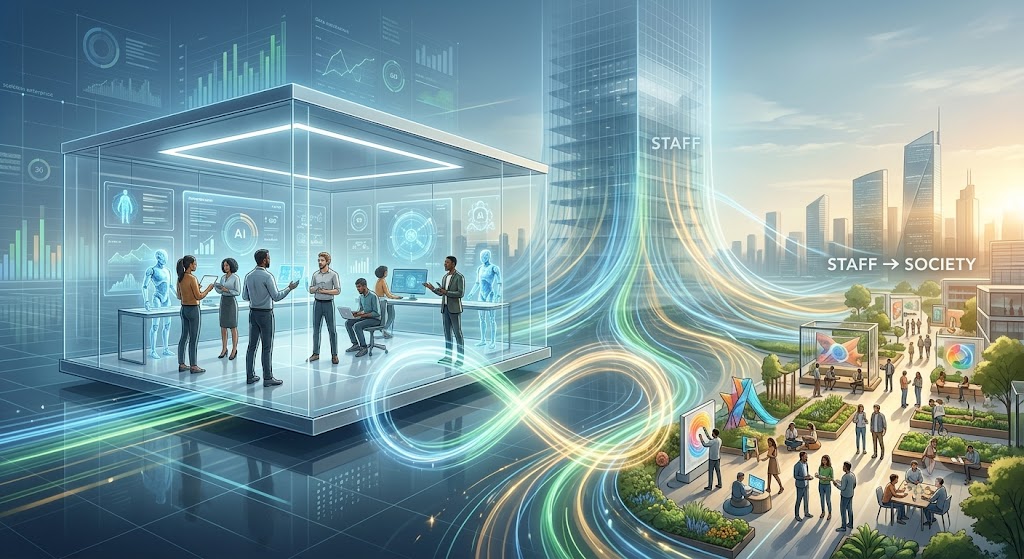
But that equation is breaking down. We are rapidly moving past the era of the industrial behemoth and entering the age of “frictionless scale.” Fueled by advanced AI orchestration, autonomous agentic networks, and hyper-lean digital ecosystems, tomorrow’s market giants will generate exponential value with remarkably small teams. The traditional relationship between revenue and employee numbers is decoupling, allowing organizations to achieve global reach and multi-billion-dollar valuations while maintaining a physical and human footprint that could fit inside a single conference room.

While this shift represents an incredible triumph of operational innovation, it exposes a profound systemic vulnerability. When a corporation no longer requires a vast staff to operate, it effectively divorces itself from its historic role as an economic anchor for society. This brings us to a critical, human-centered question that futurists, innovators, and leaders must confront: What happens to the fabric of local economies, social stability, and human dignity when scale no longer requires staff? How we answer this question and design for this transition will dictate whether this technological leap serves to elevate humanity or systematically fracture it.

Part I: The Anatomy of the Scaleless Enterprise

To understand the depth of this societal shift, we must first look at how the fundamental architecture of the enterprise is being hollowed out and rebuilt from the ground up. The traditional corporate hierarchy — built on layers of middle management, operational specialists, and administrative support — was designed to solve a specific problem: managing complexity and communication at volume. Historically, more customers meant more transactions, which demanded more human hands to orchestrate. Today, that entire structural necessity is evaporating.

From Linear to Exponential Infrastructure

We are witnessing a rapid transition from linear organizational growth to exponential infrastructure. In the past, scaling up required a proportional injection of capital and labor. Today, emerging technology stacks allow a tiny core of human orchestrators to deploy autonomous agentic networks capable of handling thousands of complex, simultaneous processes. These AI agents do not just automate repetitive tasks; they handle contextual decision-making, predictive logistics, and real-time problem-solving. As a result, the operational middle layer of the corporation is vanishing, replaced by fluid, self-optimizing code that scales instantly without hiring a single additional person.

Human-Centered Design in a Low-Human Business

This structural leanest forces us to radically redefine the principles of experience design. When a business operates with minimal human staff, how do we preserve empathy, intuition, and trust? Human-centered design can no longer just be about optimizing employee-to-customer interactions or building slick user interfaces. Instead, it must be embedded directly into the digital DNA of autonomous systems. The challenge for tomorrow’s innovators is to design experiences where the primary interface is completely automated, yet the delivery feels deeply human, respectful, and aligned with human values. Human intervention will cease to be the default operational standard; instead, it will become a rare, high-value premium reserved for moments of profound complexity or emotional nuance.

The Paradox of Value

This evolution culminates in a jarring economic paradox: the complete decoupling of market valuation from civic contribution. For generations, a company’s health was judged in part by its ability to create jobs and support families. In the scaleless enterprise, success is measured by the absolute minimization of friction — which frequently means the absolute minimization of headcount. We are staring down a future where companies can achieve historic market caps and unprecedented global influence while completely divesting from the physical communities that surround them. They will draw immense value out of the global economy through digital channels, but they will no longer return that value through local payrolls, permanently altering the traditional feedback loop of capital and community.

Part II: The Societal Ripples (The Real Human Cost)

The rise of the scaleless enterprise is not a isolated corporate event; it is an economic earthquake with tectonic implications for society. When organizations strip away their physical and operational dependencies, they don’t just change their cost structures — they fundamentally rewrite the rules of local communities. The ripple effects of this contraction stretch far beyond unemployment statistics, striking at the heart of civic stability and human identity.

The Death of the “Company Town” Anchor

Throughout modern history, the physical footprint of a major corporation has served as a vital economic ecosystem. A corporate campus doesn’t just support its own employees; it subsidizes an entire secondary economy of small businesses, commercial real estate markets, public transit systems, and local hospitality workers. Furthermore, large corporate entities have historically been foundational contributors to regional civic infrastructure and local philanthropy. When this physical footprint completely evaporates, it leaves behind an economic void that digital platforms cannot replicate. Without the anchoring presence of physical payrolls spending money locally, municipal tax bases erode, causing a devastating downstream decline in public funding for schools, parks, and essential community services.

The Velocity of Identity Disruption

From a change management perspective, the most dangerous aspect of this shift is not the loss of income, but the loss of meaning. In our current society, human beings are deeply conditioned to tether their personal identity, self-worth, and dignity to their professional utility. The 9-to-5 career has long been the primary vehicle for achieving a sense of societal contribution. If scale no longer requires a workforce, we are not simply facing a structural employment crisis; we are rushing into a profound psychological crisis of human irrelevance. When a workforce is displaced at a velocity that far outpaces the human capacity to adapt and reinvent, the fabric of social cohesion begins to fracture under the weight of widespread existential displacement.

The Polarization of Competencies

This decoupling of staff from scale aggressively accelerates the polarization of the labor market, creating a stark economic divide. On one side are the “orchestrators” — the hyper-valued individuals who possess the rare combination of strategic foresight, design thinking, and technical capability required to architect and steer autonomous systems. On the other side is the massive, rapidly commoditizing pool of traditional knowledge workers and operational staff whose roles have been absorbed by digital agentic networks. This creates a winner-take-all talent landscape where the rewards of exponential growth are concentrated among an increasingly tiny elite, while the barrier to entry for meaningful, middle-class professional advancement becomes devastatingly high.

Part III: Reimagining the Social Contract (Futurology in Action)

To navigate the reality of the shrinking corporate footprint, we cannot rely on yesterday’s economic playbooks. When corporate productivity permanently detaches from human labor, the foundational structures of our society must undergo a parallel evolution. Futurology is not about passively predicting what will happen; it is about actively designing the framework for what *should* happen. We must courageously architect a new social contract that protects human well-being in an era of post-labor scale.

From Corporate Responsibility to Civic Co-Creation

For decades, Corporate Social Responsibility (CSR) was largely viewed as an elective marketing strategy or a supplementary foundation. In a world of scaleless enterprises, this model is completely obsolete. When massive organizations extract immense wealth from a society’s digital infrastructure without returning it through local wages, the burden of funding societal well-being must be fundamentally restated. We must transition to a model of civic co-creation, where the immense dividend of automated efficiency is structurally reinvested into the public commons. This requires innovative public-private mechanisms that channel a portion of algorithmic wealth directly into repairing and funding the foundational human ecosystems — like local healthcare, community spaces, and civic infrastructure — that corporations are leaving behind.

Redefining “Contribution”

If traditional 9-to-5 employment ceases to be the primary mechanism for wealth distribution and social status, society faces a massive philosophical crossroads. We must aggressively decouple a person’s survival and dignity from their commercial utility. This opens up an extraordinary, human-centered opportunity to redefine what it means to “contribute” to society. In a post-labor economy, we have the chance to elevate and economically incentivize the vital human activities that machines can mimic but never genuinely experience: art, philosophy, localized community care, environmental restoration, and deeply empathetic education. By building structures that recognize and reward these deeply human efforts, we can transform a potential crisis of unemployment into an era of unprecedented human expression and community connection.

The Future of Lifelong Adaptation

Our current education and career systems are linear relics of the industrial era — you learn a trade in your youth, and you execute it for forty years. When digital agentic networks can redefine entire industries overnight, this rigid approach becomes a recipe for widespread obsolescence. The future demands fluid, human-centric learning ecosystems built for continuous pivot. Instead of teaching static, repeatable skills, our institutions must prioritize meta-competencies: emotional intelligence, systems thinking, cognitive agility, and the design thinking principles required to orchestrate AI rather than compete with it. Education must transform from a fixed phase of life into a seamless, lifelong utility that empowers individuals to constantly re-author their role in a rapidly changing world.

Conclusion: Designing a Human-First Future

The shrinking corporate footprint is not a distant, speculative scenario; it is an active transformation unfolding across our economic landscape today. Technology and automation are driving an unprecedented era of efficiency, but we must never confuse operational efficiency with societal health. The decoupling of scale from staff presents us with a stark choice. If left unguided, this shift will result in an increasingly fractured world where immense digital wealth is concentrated in fewer hands while physical communities hollow out. But if we approach this transition with intentionality, we can use this newfound abundance to liberate human potential on a scale never before seen.

As innovators, futurists, and experience designers, we must remember a core truth: technology dictates what is possible, but human-centered design dictates what is sustainable. We cannot afford to let the future simply happen to us; we must actively architect it. This means looking beyond short-term corporate margins and designing systems where technological progress explicitly serves to elevate human well-being, protect individual dignity, and reinforce the communities we live in.

The ultimate metric of success for tomorrow’s lean corporate giants cannot simply be their market capitalization, their operating margin, or the speed of their algorithms. The true measure of an enterprise in this new era must be its net-positive contribution to a society that no longer works inside its walls. By aligning our incredible capacity for technological innovation with a deep, unyielding commitment to human-centered design, we can ensure that the age of frictionless scale becomes an age of universal human flourishing.

Frequently Asked Questions

What is a “scaleless enterprise” and how does it differ from a traditional corporation?

A traditional corporation requires a proportional increase in human staff and physical footprint to scale its operations and revenue. A scaleless enterprise leverages advanced technology stacks, such as autonomous AI agents and decentralized digital infrastructure, to achieve massive global market reach and exponential revenue growth while keeping its internal workforce and physical presence incredibly small.

Why does the shrinking corporate footprint pose a threat to local communities?

Historically, large companies acted as economic anchors by providing jobs, subsidizing local ecosystems (like commercial real estate, retail, and hospitality), and contributing heavily to municipal tax bases. When a corporation’s physical footprint disappears, those local revenue streams and community subsidies evaporate, leaving local economies vulnerable and straining public infrastructure funding.

How can society redefine human “contribution” in a post-labor economy?

As traditional employment opportunities contract, society must shift from measuring an individual’s worth solely by their commercial or industrial output. We can establish new public-private mechanisms and social frameworks that value, incentivize, and economically reward uniquely human capabilities that automation cannot replicate — such as community caregiving, artistic creation, civic mentorship, and environmental stewardship.

Bottom line: Futurology is not fortune telling. Futurists use a scientific approach to create their deliverables, but a methodology and tools like those in FutureHacking™ can empower anyone to engage in futurology themselves.

Image credit: Gemini

Subscribe to Human-Centered Change & Innovation WeeklySign up here to get Human-Centered Change & Innovation Weekly delivered to your inbox every week.