Author Archives: Chateau G Pato

About Chateau G Pato

Chateau G Pato is a senior futurist at Inteligencia Ltd. She is passionate about content creation and thinks about it as more science than art. Chateau travels the world at the speed of light, over mountains and under oceans. Her favorite numbers are one and zero. Content Authenticity Statement: If it wasn't clear, any articles under Chateau's byline have been written by OpenAI Playground or Gemini using Braden Kelley and public content as inspiration.

Human-Centered Design and AI Integration

Human-Centered Design and AI Integration

GUEST POST from Chateau G Pato

As the realm of artificial intelligence continues to evolve, so does its integration into various sectors of our society. One crucial aspect of seamlessly blending AI technologies into our daily lives is through human-centered design. Human-centered design focuses on designing systems, products, and services that prioritize the needs and experiences of people. By incorporating this design approach into the development and implementation of AI technologies, we can ensure that these advancements are effective, intuitive, and ultimately benefit human users. In this article, we will explore two case study examples that demonstrate the successful integration of human-centered design and AI.

Case Study 1: Amazon Echo

The Amazon Echo, powered by the AI assistant Alexa, is an excellent example of human-centered design combined with AI integration. When Amazon first launched the Echo, they understood that the key to ensuring widespread adoption of this voice-activated speaker was by making it as user-friendly as possible. The design team conducted extensive research to understand how people interact with technology and what features would enhance their daily lives.

Through this process, they identified voice input as the most natural and intuitive form of interaction. By enabling users to speak naturally to Alexa, Amazon created a device that seamlessly fit into people’s existing routines. Additionally, the team emphasized understanding user context and needs, allowing Alexa to provide personalized and context-aware responses. Whether it is playing music, setting reminders, or controlling smart home devices, the Amazon Echo demonstrates how AI integration can be harnessed successfully through human-centered design.

Case Study 2: Apple Health App

The Apple Health app is another prime example of human-centered design principles applied in conjunction with AI integration. The goal of this app is to empower individuals to take more control of their health by offering them valuable insights and information. By seamlessly connecting with various health devices and apps, the app collects and presents data in a user-friendly manner, making it easy for individuals to track their health and well-being.

Apple’s design team recognized the importance of providing meaningful and understandable data visualization. They ensured that users can effortlessly comprehend their health information, empowering them to make informed decisions about their lifestyle choices. The AI integration in the app leverages complex algorithms to analyze data in real-time, offering personalized suggestions and notifications to the users based on their unique health goals.

By considering the very essence of human-centered design, Apple successfully integrated AI technologies into the Health app, making it an indispensable tool for individuals seeking to prioritize their well-being.

Conclusion

The successful integration of artificial intelligence into our daily lives relies heavily on the principles of human-centered design. Case studies such as Amazon Echo and Apple Health app provide excellent examples of how AI technologies can be seamlessly incorporated into products and services while prioritizing the needs and experiences of users. By implementing human-centered design, companies can ensure that AI interventions are intuitive, accessible, and ultimately enhance the overall human experience.

Image credit: Unsplash

Subscribe to Human-Centered Change & Innovation WeeklySign up here to get Human-Centered Change & Innovation Weekly delivered to your inbox every week.

The Impact of Big Data on the Future of Business

The Impact of Big Data on the Future of Business

GUEST POST from Chateau G Pato

In today’s interconnected and data-driven world, the abundance of information has given rise to a powerful phenomenon known as big data. Big data refers to the large volume, velocity, and variety of data that organizations collect from various sources. This immense amount of data, if properly collected, analyzed, and utilized, has the potential to revolutionize the way businesses operate. The impact of big data on the future of business cannot be overlooked, as it has already begun reshaping industries and enhancing decision-making processes. This article will explore two case study examples that highlight the transformative power of big data.

Case Study 1: Amazon

One of the most successful examples of leveraging big data in business is Amazon. With its massive online marketplace and extensive customer base, Amazon collects an immense amount of data on customer behavior, preferences, and buying habits. This data enables them to provide personalized recommendations, targeted marketing campaigns, and a seamless customer experience.

Through advanced analytics, machine learning algorithms, and predictive modeling, Amazon can understand customer preferences and deliver tailored product recommendations. This not only improves customer satisfaction but also increases sales and revenue for the company. Additionally, Amazon uses big data analytics to optimize its supply chain, inventory management, and logistics. By analyzing large datasets in real-time, they can predict demand, reduce delivery times, and reduce costs, ensuring efficient operations and customer satisfaction.

Case Study 2: Netflix

Another case study that exemplifies the impact of big data is Netflix. As a leading streaming service with millions of subscribers worldwide, Netflix relies heavily on collecting and analyzing data to personalize content recommendations, improve user experience, and create hit shows. Using big data analytics, Netflix can analyze viewing patterns, customer preferences, and feedback to curate personalized content recommendations for individual users.

Furthermore, Netflix utilizes big data to inform its content creation decisions. By analyzing viewer data, Netflix can identify trends, popular genres, and successful storylines, resulting in the creation of original shows and movies that resonate with their target audience. This data-driven approach has allowed Netflix to have a competitive edge in the entertainment industry, attract and retain subscribers, and continuously improve its content offerings.

The Future of Big Data in Business

The case study examples of Amazon and Netflix demonstrate the substantial impact of big data on business operations, customer satisfaction, and revenue growth. However, the potential of big data goes beyond these examples. With advancements in technology, such as the Internet of Things (IoT), cloud computing, and artificial intelligence, the amount of data generated by individuals, devices, and organizations will continue to skyrocket.

Businesses that can effectively harness this data and transform it into actionable insights will reap significant benefits. Big data analytics will enable organizations to make data-driven decisions, identify patterns, forecast trends, and optimize business operations. From supply chain management and production efficiency to marketing strategies and customer relationship management, big data will be the driving force behind innovative and successful business practices.

Conclusion

The impact of big data on the future of business cannot be overlooked. The ability to collect, analyze, and utilize vast amounts of data has the power to transform industries, enhance decision-making processes, and drive business success. As demonstrated by the examples of Amazon and Netflix, big data is already reshaping business models, improving customer experiences, and driving revenue growth. As technology advances and connectivity increases, harnessing big data will become essential for businesses to stay competitive in the digital age.

Image credit: Pixabay

Subscribe to Human-Centered Change & Innovation WeeklySign up here to get Human-Centered Change & Innovation Weekly delivered to your inbox every week.

How to Create an Effective Innovation Hub

How to Create an Effective Innovation Hub

GUEST POST from Chateau G Pato

Innovation has become a critical factor for success in today’s fast-paced and competitive business world. To foster and nurture innovation, many companies and organizations are establishing innovation hubs. These hubs serve as central locations for collaboration, idea generation, and experimentation. However, creating an effective innovation hub requires careful planning and execution. In this article, we will explore the key elements of a successful innovation hub by examining two case study examples.

Case Study 1: Google X

Google X, the experimental research division of Google, has gained a reputation for its groundbreaking projects and inventions. The company’s innovation hub, known as the “moonshot factory,” is a prime example of an effective innovation ecosystem. Here are three key aspects that contribute to its success:

1. Diverse and interdisciplinary teams: Google X brings together experts from various fields such as engineering, design, robotics, and artificial intelligence. This diversity of skills and perspectives enables cross-pollination of ideas, fostering innovation through shared knowledge and collaboration.

2. Encouraging experimentation and risk-taking: Google X promotes a culture that embraces failure as a necessary step towards success. Teams are encouraged to explore ambitious ideas and take calculated risks, even if they may not yield immediate results. This mindset allows for disruptive innovation and encourages team members to think beyond their usual limits.

3. Strong leadership and support: The innovation hub is backed by strong leadership that is committed to nurturing a culture of innovation. Leaders provide support and resources to teams, ensuring they have the necessary tools to think creatively and bring their ideas to fruition. This support is vital in overcoming obstacles and maintaining momentum.

Case Study 2: The Epicenter Innovation Hub

Located in Stockholm, Sweden, Epicenter is a co-working space that serves as an innovation hub for more than 350 companies. It has quickly become a hotbed for technology and creativity. Here are two essential elements that contribute to Epicenter’s effectiveness as an innovation hub:

1. Community and networking opportunities: Epicenter places a significant emphasis on fostering a strong community of professionals from various industries. It actively encourages interaction, collaboration, and networking among its members. By bringing together diverse skill sets and backgrounds, Epicenter creates an environment where ideas can flow and evolve.

2. Access to cutting-edge technology and resources: Epicenter provides its members with access to state-of-the-art technology, prototyping labs, and collaborative spaces. This infrastructure enables companies and individuals to test and develop their innovative ideas without facing barriers related to expensive equipment or limited resources. Accessibility to such resources is crucial in facilitating innovation and turning ideas into reality.

Conclusion

Creating an effective innovation hub requires careful attention to key elements such as diverse and interdisciplinary teams, encouraging experimentation and risk-taking, strong leadership and support, building a strong community, and providing access to cutting-edge technology and resources. By studying successful case examples like Google X and Epicenter, organizations can learn valuable insights and apply them to their own innovation hubs, driving their businesses forward in an era of rapid change and disruption.

Image credit: Pixabay

Subscribe to Human-Centered Change & Innovation WeeklySign up here to get Human-Centered Change & Innovation Weekly delivered to your inbox every week.

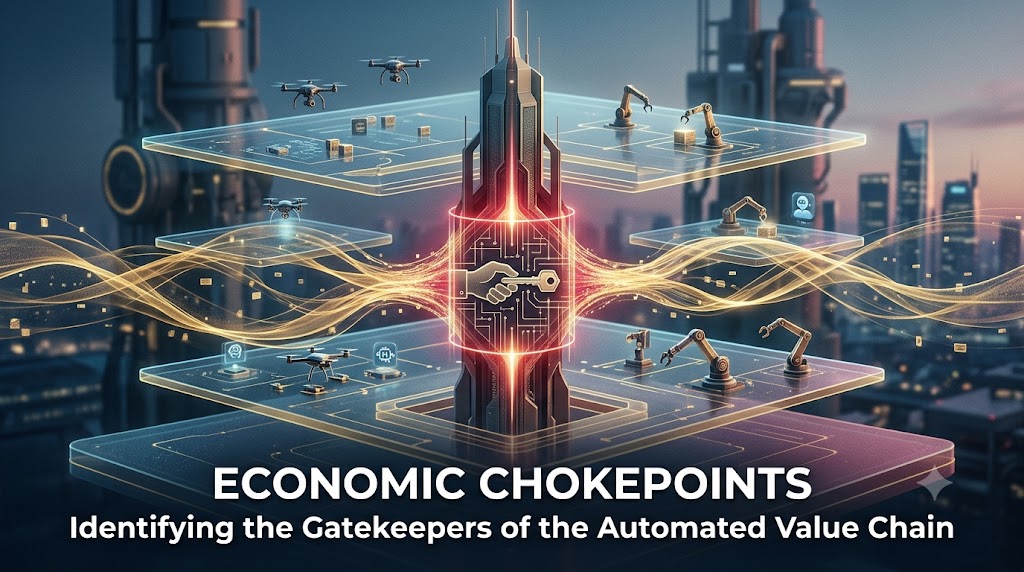
Identifying the Gatekeepers of the Automated Value Chain

Economic Chokepoints

Identifying the Gatekeepers of the Automated Value Chain

GUEST POST from Chateau G Pato


Introduction: The New Geography of Economic Power

Shift from physical supply chain bottlenecks to algorithmic and infrastructural chokepoints.

For decades, competitive advantage belonged to the builders—the organizations that could produce faster, scale cheaper, and execute with relentless efficiency. But as autonomous agent networks, real-time machine learning, and physical robotics converge to drive end-to-end business operations, the traditional rules of scale are breaking down. When execution becomes table stakes, value creation moves elsewhere.

We are witnessing a fundamental redistribution of economic power. Frictionless automation is eroding classical moats, while simultaneously giving rise to new, highly concentrated control points across global commerce. Power no longer rests solely in manufacturing plants or distribution channels; it now concentrates wherever substitution costs are highest and interoperability is lowest.

Defining the Automated Value Chain (AVC)

To understand where power sits today, we must map the Automated Value Chain (AVC)—an interconnected, self-orchestrating ecosystem where foundational AI models, agentic workflows, API routing protocols, and kinetic edge systems interact with minimal human friction.

Unlike legacy supply chains that move physical goods through predictable linear steps, the AVC is dynamic, software-driven, and highly interdependent. A single transaction may cross half a dozen algorithmic platforms, validation layers, and hardware backbones in milliseconds.

The Strategic Imperative: When execution is commoditized by software and automation, durable competitive advantage shifts from who can perform the work to who controls the critical, non-bypassable nodes through which that work must pass.

The Central Question for Modern Leaders

As organizations race to integrate agentic systems and automated workflows, business leaders must confront a critical question: Are you building proprietary value that increases your organizational autonomy, or are you simply becoming an efficient dependent on someone else’s chokepoint?

Navigating this shift requires looking beyond raw technical capability. It demands an intentional strategy that balances technological speed with human-centered agency, resilient ecosystem design, and a clear-eyed understanding of who holds the keys to the future value chain.

Section II

The Five Layers of Automated Value Chain Gatekeepers

Understanding where power concentrates when execution is automated.

Gatekeepers do not emerge by accident. In an automated value chain, control forms at the points of maximum dependency—where replacing a provider creates prohibitive technical friction, financial loss, or operational downtime. Power concentrates across five distinct layers.

The Golden Rule of AVC Control: Power in an automated system concentrates wherever substitution costs are highest and interoperability is lowest.

Layer 1

Infrastructure & Compute Tier

At the bedrock of all digital automation lies physical reality: advanced semiconductor fabrication, specialized acceleration hardware, hyperscale cloud facilities, and high-density energy grids.

The Chokepoint: Compute capacity and power access. Organizations that control chip lithography, data center land rights, and clean power interconnects hold absolute authority over who can train, fine-tune, and run next-generation autonomous models at scale.

Layer 2

Data & Context Tier

Foundational models are broadly accessible, but models without high-resolution domain context are useless in complex operational environments. This layer encompasses real-time sensory feeds, proprietary operational logs, and live telemetry.

The Chokepoint: “Context Monopolies.” Gatekeepers here own the ground-truth data pipelines that autonomous agents need to make safe, accurate decisions in specific industries—from clinical trials to smart supply chains.

Layer 3

Model Orchestration & Middleware Tier

Between raw data and final execution sits the routing infrastructure—the multi-agent frameworks, semantic routing engines, and API orchestration tools that decide which model executes which task.

The Chokepoint: Semantic interfaces and decision routing. The platforms that act as the default “default operating system” for AI agents control which downstream tools, microservices, and commerce channels get invoked—effectively becoming the new digital switchboards.

Layer 4

Physical-Digital Interoperability Tier

Automation ultimately has to reach into the physical world. This layer bridges software logic with kinetic action through warehouse management systems, autonomous fleet dispatching protocols, edge robotics OSs, and IoT control planes.

The Chokepoint: Translation software and kinetic standards. Whoever owns the operating system running the physical fulfillment hardware or autonomous logistics fleet controls the physical throughput of the digital economy.

Layer 5

Trust, Identity & Compliance Tier

In a world filled with synthetic media, agentic transactions, and automated decisions, trust becomes a scarce commodity. This layer covers machine identity verification, cryptographic provenance, real-time auditability, and regulatory compliance clearance.

The Chokepoint: Verification authority. The gatekeepers who certify that an agent-driven transaction is legitimate, safe, legally compliant, and authentic hold veto power over the entire value chain.

When leaders evaluate their long-term strategic posture, they must ask: Which layer are we operating in, and how many layer gatekeepers sit between us and our ultimate end customer or outcome?

Section III

The Human-Centered Impact: Experience, Agency, and Change Management

Balancing algorithmic efficiency with human purpose, trust, and adaptability.

Focusing exclusively on technical architecture and algorithmic throughput misses the most critical failure point in digital transformation: the human element. When an organization optimizes for raw automation without designing for human agency, it risks creating brittle systems, disengaged workforces, and alienated customers.

1. The Experience Friction: Loss of Humanity at the Gatekeeper Interface

When customer and employee experiences are mediated entirely through gatekeeper protocols, hyper-standardization takes over. Algorithms excel at predictability, but they struggle with empathy, nuanced problem-solving, and non-standard human needs.

When every touchpoint is filtered through rigid API rules and automated triage, the customer experience becomes transactional rather than relational. Organizations that default entirely to automated gatekeepers risk surrendering their unique brand voice and customer intimacy to external platform protocols.

2. Preserving Human Agency: Moving from Operators to Orchestrators

The rise of automated value chains doesn’t render humans obsolete—it fundamentally shifts their role. The goal of human-centered change is not to replace people, but to elevate them.

The Past

The Human as Operator

Executing repetitive tasks, manually routing data between systems, following fixed scripts, and acting as the mechanical engine of execution.

The Future

The Human as Orchestrator

Guiding agentic workflows, setting strategic boundaries, auditing algorithmic outputs for bias and ethics, and handling complex edge cases requiring deep empathy.

The Human-Centered Imperative: Technology should handle the routine execution so humans can focus on imagination, empathy, strategic alignment, and complex relationship-building.

3. Guiding Organizational Change: The Psychology of Dependency

Leading an organization through the shift toward automated value chains requires a deliberate change management approach. Leaders must address two distinct psychological hurdles across their teams:

  • The Anxiety of Disintermediation: Employees often view automation as a existential threat to their relevance. Leaders must clearly define the new path for career growth, demonstrating how automated systems empower team members to take on high-value, creative decision-making roles.
  • The Illusion of Control: Executives often struggle with relinquishing operational execution to external algorithmic gatekeepers. Change leaders must build new governance frameworks that allow teams to maintain visibility, trust, and strategic control over automated systems without micromanaging the underlying code.

Sustained competitive advantage in the age of automation will not come from removing humans from the equation. It will belong to the organizations that design seamless, collaborative partnerships between human creativity and automated scale.

Section IV

Strategic Framework: Auditing Your Position in the Value Chain

Evaluating dependency, strategic leverage, and long-term autonomy.

To make proactive, human-centered decisions in an automated economy, leadership teams must first establish a clear-eyed diagnosis of where their organization sits today—and where it risks being squeezed tomorrow. Strategic resilience requires mapping both operational dependencies and unique value drivers.

1. The AVC Audit Matrix

By evaluating two primary dimensions—Degree of Operational Uniqueness and Level of Gatekeeper Dependency—organizations generally fall into one of four distinct positions within the Automated Value Chain (AVC):

High Dependency / Low Uniqueness

The Commoditized Dependent

The Position: Performing interchangeable tasks while relying entirely on external gatekeeper platforms for discovery, routing, and fulfillment.

The Strategic Risk: High vulnerability to margin compression, algorithm updates, and sudden fee adjustments with zero pricing power or direct customer relationships.

Low Dependency / Low Uniqueness

The Bare Utility

The Position: Operating independently of major gatekeepers, but delivering standardized execution with minimal differentiation.

The Strategic Risk: Rapid disintermediation as agentic workflows easily automate, commoditize, or route around low-complexity operations.

Low Dependency / High Uniqueness

The Strategic Node

The Position: Owning indispensable domain context, trusted human relationships, or proprietary physical capabilities that machines cannot easily replicate or bypass.

The Strategic Risk: Continuous pressure from scaling platform ecosystems attempting to duplicate, standardise, or encapsulate your specialized knowledge.

High Dependency (By Others) / High Uniqueness

The Ecosystem Gatekeeper

The Position: Controlling an essential chokepoint—such as identity clearance, context routing, or compute access—that other ecosystem players must pass through.

The Strategic Risk: Regulatory scrutiny, antitrust exposure, and high-stakes responsibility for maintaining system trust and uptime.

Strategic Imperative: The goal for most organizations is not necessarily to become a global gatekeeper, but to secure a resilient position as a Strategic Node—owning non-replaceable context and human value while maintaining modular relationships with platform gatekeepers.

2. Practical Risk Mitigation Strategies

Once leaders recognize their position in the AVC landscape, they can execute targeted strategies to preserve strategic flexibility and prevent platform lock-in:

  • Architect for Model & API Redundancy: Avoid building single-threaded dependencies on one proprietary foundation model or middleware vendor. Ensure agent architectures support multi-model orchestration and open-standard fallback protocols.
  • Own the Ground-Truth Context: Build proprietary, continuously updating telemetry and context loops that external platform algorithms cannot scrape or approximate.
  • Deepen Direct Human Relationships: Cultivate brand equity, trust, and executive intimacy that transcend automated channels, ensuring customers actively prefer dealing directly with your organization.
  • Establish Governance & Exit Protocols: Routinely audit third-party AI dependencies, setting clear financial and operational thresholds for when a platform partner’s lock-in poses an unmanageable risk.

Section V

Futurology & Strategic Conclusion: Designing Resilient Ecosystems

Navigating the tension between open ecosystems and systemic consolidation.

As we look toward the horizon of fully autonomous agent networks and hyper-automated supply chains, two divergent futures emerge. The choices leaders make today will determine whether the automated value chain becomes an engine of open innovation or a system of hyper-concentrated control.

1. The Ecosystem Tug-of-War: Monopolistic Enclosure vs. Open Protocols

The future of the digital economy will be defined by a continuous tension between two structural forces:

Scenario A

The Proprietary Fortress

Hyperscale gatekeepers build end-to-end, vertically integrated walled gardens. By coupling hardware compute, foundational models, proprietary context pipelines, and kinetic fulfillment systems, these mega-platforms make it virtually impossible for businesses to operate outside their controlled ecosystems.

Scenario B

The Open Orchestration Web

Open-source model architectures, decentralized identity protocols, and interoperable agent standards gain critical mass. In this future, switching costs remain low, market access remains democratized, and value accrues to specialized domain experts rather than platform landlords.

In reality, the global economy will likely exist in a hybrid state. Smart organizations must design their technological and operational architectures to thrive in both environments—building modularity that takes advantage of proprietary platform scale without getting trapped inside a single fortress.

2. The Leader’s Imperative: Strategic Courage in the Age of Automation

Innovation leadership in the age of intelligent automation is no longer about who adopts tools the fastest. It is about the intentional, human-centered design of your organization’s role within a broader economic ecosystem.

The Final Takeaway: Technology provides speed, scale, and execution; human vision provides direction, ethics, and meaning. The leaders who succeed will not be those who passively hand off their business to automated gatekeepers, but those who actively shape resilient, human-centered value chains.

Three Questions for Every Leadership Team Today:

  1. Which of our core capability layers are at risk of being commoditized by automated gatekeepers over the next 3 to 5 years?
  2. What irreplaceable human experience, domain context, or trusted relationship do we own that machines and external APIs cannot easily replicate?
  3. Are our digital transformation initiatives empowering our workforce to become creative orchestrators, or merely replacing them with third-party software dependencies?

The automated value chain is being rewritten right now. By understanding where power concentrates, auditing your dependencies, and elevating human agency, you can ensure your organization doesn’t just survive the age of automation—it leads it.


Frequently Asked Questions

Key Insights & Strategic FAQ

Core questions on gatekeepers, human agency, and value chain strategy.

What is an Economic Chokepoint in an Automated Value Chain?

An economic chokepoint is a critical, non-bypassable control point within an automated ecosystem where power concentrates because substitution costs are extremely high and interoperability is low. Unlike traditional physical supply chain bottlenecks, modern chokepoints exist across software and infrastructure—such as specialized chip lithography, proprietary context data feeds, or default agent orchestration engines that control API transaction flow.

How does automation change the role of human workers in the value chain?

Automation shifts human workers from operators (executing repetitive tasks and manual routing) to orchestrators (setting strategic boundaries, guiding agentic workflows, auditing algorithmic decisions for bias/ethics, and managing high-empathy customer relationships). The goal of human-centered innovation is not workforce replacement, but elevating human capacity to focus on imagination, judgment, and trust.

How can an organization prevent platform lock-in from automated gatekeepers?

Organizations can preserve strategic autonomy by maintaining multi-model redundancy, building open-standard fallback protocols, owning their unique domain context, and deepening direct, non-intermediated customer relationships. By ensuring tech stacks are modular rather than single-threaded, leaders can leverage platform scale without becoming commoditized dependents.

Image credit: Gemini

Subscribe to Human-Centered Change & Innovation WeeklySign up here to get Human-Centered Change & Innovation Weekly delivered to your inbox every week.

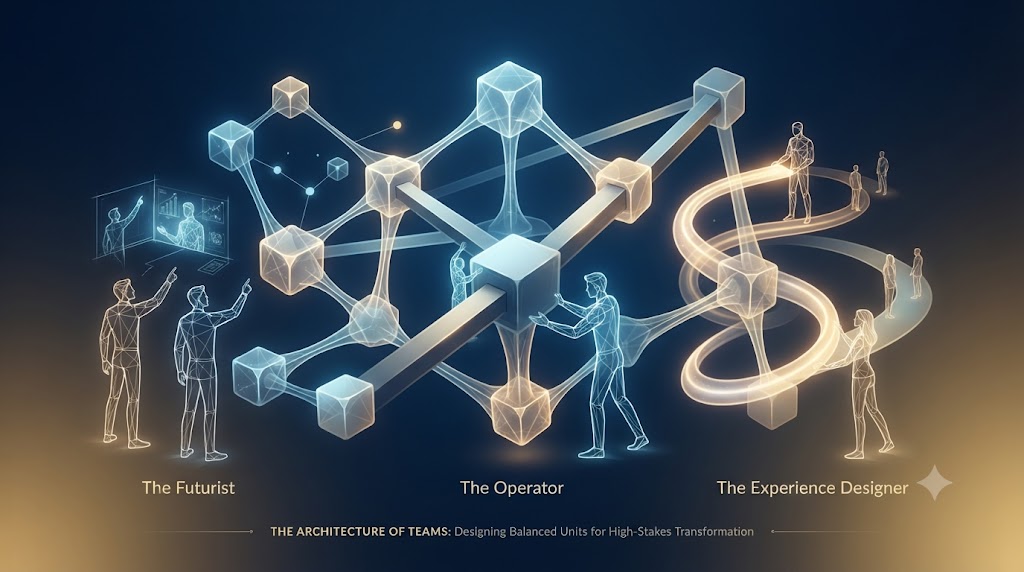
Designing Balanced Units for High-Stakes Transformation

The Architecture of Teams

Designing Balanced Units for High-Stakes Transformation

GUEST POST from Chateau G Pato


The Fragility of Transformation

In the current business climate, we often find ourselves caught in a cycle of constant, high-stakes change. Organizations are obsessed with “transforming” — digitally, culturally, and operationally — yet the rate of failure remains stubbornly high. We tend to focus heavily on the technology or the process, often neglecting the most critical component: the architecture of the teams themselves.

The Transformation Paradox

Why do so many organizations with top-tier talent struggle to deliver meaningful change? It is the transformation paradox: companies recruit brilliant individuals, invest in sophisticated tools, and demand agility, only to trap those individuals within rigid, siloed structures that stifle the very innovation they seek. We are often optimizing for efficiency when we should be optimizing for adaptability. When high-stakes initiatives falter, the root cause is rarely a lack of individual capability; it is the structural inability to channel that capability effectively.

Beyond Org Charts: A Shift in Perspective

It is time to stop viewing teams merely as nodes on an organizational chart. An org chart tells you who reports to whom, but it tells you nothing about how value is created or how energy flows through the organization. We must shift our perspective from structural hierarchy to architectural systems. A team is not a static object; it is a dynamic, living system. If the architecture — the intentional design of how people interact, collaborate, and make decisions — is fundamentally flawed, the outcome of any high-stakes transformation will be compromised from the start.

The Thesis: Architecture as Strategy

Successful transformation requires moving beyond haphazard team composition. It demands an intentional design philosophy that creates a balance between divergent, creative thinking — which fuels innovation — and the convergent, disciplined execution required to bring those ideas to market. To survive in an era of constant disruption, leaders must learn to build teams that act as resilient units, capable of balancing the tension between what is and what could be.

The Pillars of Architectural Balance

Designing teams for high-stakes transformation is not about finding the perfect person for every role; it is about creating the right interplay of cognitive perspectives. To achieve balance, we must intentionally engineer the composition of our units to navigate the friction between ideation and delivery.

The Three Core Archetypes

To move beyond generic roles, we must integrate three distinct cognitive archetypes within every high-stakes transformation unit. When one is missing, the entire system loses its structural integrity:

  • The Futurist (Architects of Possibility): These individuals are the catalysts for long-term vision. They maintain the focus on the horizon, ensuring that immediate operational fires do not distract the team from the strategic intent of the transformation.
  • The Operator (Architects of Execution): These are the masters of rigor. They provide the necessary gravity to the Futurist’s flight, translating abstract visions into tangible, measurable, and scalable action plans.
  • The Experience Designer (Architects of Adoption): These members ensure that the human element remains at the center of the design. They bridge the gap between technical output and human impact, ensuring that the transformation is actually usable, desirable, and meaningful for the end-user.

The T-Shaped Dynamic

A balanced unit is not just a collection of specialists; it is a collaborative engine. We look for individuals who possess a “T-shaped” profile: deep expertise in their specific discipline (vertical bar) coupled with the broad empathy and systems-thinking required to understand how their work impacts the rest of the team and the broader organization (horizontal bar). This combination is essential for creating the psychological and functional glue that keeps a high-stakes team together when the pressure mounts.

Designing for High-Stakes Friction

Transformation is inherently uncomfortable. If your team is not experiencing a level of healthy friction, you are likely settling for the status quo. The goal of architectural design is not to eliminate friction, but to harness it to sharpen the quality of your output.

Constructive Tension

Many organizations mistake “friction-less” environments for high-performing ones, but this often leads to dangerous echo chambers. In high-stakes transformation, you need opposing forces. You need the push-back from the Operator to challenge the reach of the Futurist, and the empathy of the Experience Designer to ensure both are grounded in reality. Designing for constructive tension means creating space where these differing viewpoints can collide, debate, and synthesize into a stronger, more resilient strategy.

Psychological Safety as Structural Integrity

If you imagine your team as a physical structure, psychological safety is the load-bearing material. When stakes are high, the natural human response is self-preservation, which leads to withholding information, silence, or political maneuvering. If the foundation of your team is built on fear, no amount of strategic planning will prevent the structure from collapsing. Leaders must architect an environment where dissent is not only tolerated but encouraged, ensuring that the “building” can withstand the external pressures of a shifting market.

The Innovation-Execution Hand-off

One of the most common failure points in transformation is the “handoff.” We often treat ideation and execution as two distinct, linear phases. Instead, we must design interface points — specific moments and mechanisms — where fluid, divergent ideation can seamlessly transition into rigid, convergent project management. By architecting these transition zones, you prevent the loss of momentum that occurs when a brilliant concept dies because the team did not know how to operationalize it effectively.

The Human-Centered Blueprint

A transformation architecture is only as effective as its impact on the people navigating it. We often spend months planning the technical details of a project while ignoring the human workflow that will ultimately make or break our success. By applying a human-centered lens to our team design, we transform our units from rigid functional hierarchies into intuitive, high-performance environments.

Mapping the User Journey

We must treat our internal team members as the primary “users” of the transformation process. Before we roll out a new initiative to the market, we should map the internal user journey of the employees tasked with delivering it. Where are the friction points in their daily tasks? What information gaps prevent them from making confident decisions? When we design the team’s workflow to reduce unnecessary complexity, we increase the velocity of the transformation itself.

Cognitive Load Management

In high-stakes environments, cognitive load is a finite resource. If we ask our team members to juggle excessive administrative entropy alongside their core strategic responsibilities, the architecture fails. We must design our operational frameworks to minimize non-leverage activities. By simplifying reporting structures and automating routine updates, we protect our team’s capacity for the deep, creative work that defines successful innovation.

Autonomy within Constraints

Autonomy is not the absence of boundaries; it is the freedom to act effectively within them. Our architectural blueprint must provide the necessary “guardrails” — such as clear strategic intent, defined resource limits, and shared success metrics — that allow individual team members and sub-units to make agile, decentralized decisions. This alignment empowers teams to move with speed, knowing that their choices remain tethered to the broader objectives of the transformation.

Scaling the Architecture

Scaling transformation is not about making things bigger; it is about making them more modular and interconnected. As organizations grow, the complexity of communication often kills the speed of innovation. To maintain the agility of a startup at scale, we must transition from monolithic departments toward a modular architectural approach.

The Unit Concept

Instead of relying on massive, functional departments, we organize around small, cross-functional “cells” or units. These teams are self-contained ecosystems, each possessing the required Futurist, Operator, and Experience Designer archetypes. By keeping these units small and focused, we maintain a higher level of internal cohesion and reduce the overhead costs of coordination.

The Interdependency Map

Silos are the natural enemy of transformation. We prevent them from forming by creating an explicit “Interdependency Map” at the outset. This is a deliberate design protocol that outlines how different units must connect, share data, and synchronize milestones. By defining these interfaces before the work begins, we replace accidental collisions with intentional, productive collaboration.

Feedback Loops

A transformation environment is never static; it is constantly shifting based on market signals and organizational responses. We must integrate real-time sensing mechanisms — what I call “architecture heartbeats” — to measure team velocity, sentiment, and alignment. These loops act as the nervous system of the organization, providing the data needed to pivot, re-allocate resources, or adjust the team structure in real-time as the transformation journey progresses.

Conclusion: Designing for Resilience

Ultimately, the architecture of your team is the greatest predictor of your transformation success. We must move past the idea of the team as a static, permanent entity on a chart and embrace the reality of it as a living, breathing organism. True resilience in high-stakes environments does not come from building rigid structures that resist pressure; it comes from building flexible systems that can bend, adapt, and evolve in real-time.

The Living Structure

Recognize that your team is a product of its environment. As the market changes, as your strategic goals shift, and as your technology stack evolves, your team architecture must also be re-evaluated. A structure that worked perfectly at the start of a transformation may become a bottleneck by the middle. Maintaining a “living structure” requires the courage to iterate on your team design with the same rigor you apply to your product roadmap.

Call to Action: Architecture as an Intentional Act

It is time to stop asking, “Who do I have available?” and start asking, “What architecture does this specific moment of transformation require?” By shifting your focus from managing people to designing the environments in which they thrive, you unlock the ability to achieve outcomes that were previously out of reach. Your next great breakthrough isn’t just a strategy or a technology — it is the deliberate design of the team you build to bring that strategy to life.

Frequently Asked Questions

Why do traditional organizational charts fail during high-stakes transformations?

Traditional org charts represent reporting hierarchies rather than value-creation systems. They often stifle innovation by forcing dynamic, cross-functional work into rigid, siloed structures that are ill-equipped to handle the speed and adaptability required for meaningful transformation.

What are the three core archetypes needed for a balanced team?

To succeed, a transformation team requires three distinct archetypes working in concert: The Futurist, who maintains the long-term vision; The Operator, who drives execution and rigor; and The Experience Designer, who ensures the human element remains at the center of adoption.

How can leaders maintain psychological safety under pressure?

Psychological safety must be treated as the load-bearing structural integrity of the team. Leaders maintain it by fostering constructive dissent, protecting the team from excessive administrative entropy, and modeling transparency, ensuring that team members feel safe enough to innovate when the stakes are high.


Image credit: Gemini

Subscribe to Human-Centered Change & Innovation WeeklySign up here to get Human-Centered Change & Innovation Weekly delivered to your inbox every week.

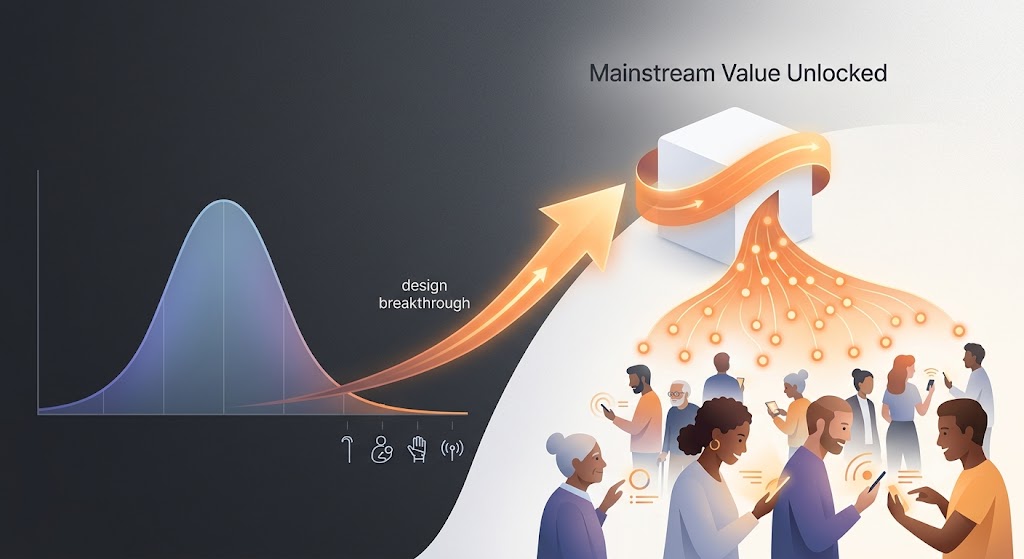
Designing for the Margins

Why Solving for Extreme User Needs Unlocks Mainstream Value

Designing for the Margins

GUEST POST from Chateau G Pato


Introduction: The Myth of the Average User

When we design for the average, we design for no one. Standard mass-market innovation relies on a fundamental misconception: that the safest path to scale is to solve for the middle of the bell curve. We construct ideal personas based on statistical medians — a theoretical user operating under ideal conditions. But real human lives are rarely average, and they are never ideal.

True human-centered breakthroughs don’t happen in the cozy center of the distribution curve. They happen at the edges — the margins. When you build solutions for edge cases — users navigating severe physical, cognitive, situational, or contextual constraints — you are forced to strip away fluff, eliminate hidden friction, and create radical clarity.

The Edge-Case Dividend

Designing for high-constraint environments yields a powerful dividend: a solution forged under extreme conditions is infinitely more resilient, intuitive, and effortless when brought back to the mainstream. What begins as a necessary accommodation for a few becomes a delight for the many.

Core Thesis: Innovation value isn’t created by catering to the majority; it is unlocked at the extremes and distributed to the center.

To move beyond incremental, easily commoditized products, organizations must rethink their approach to experience design. Solving for extreme user needs is not a philanthropic exercise or a compliance task — it is the ultimate catalyst for competitive advantage and sustainable growth.

Part 1: The Bell Curve Trap in Experience Design

Standard product development relies heavily on statistical medians. We construct ideal personas based on demographically average users operating in ideal conditions. But when you design for the mean, you create solutions tailored to a theoretical person who doesn’t actually exist in the wild.

The Comfort of the Center

Organizations gravitate toward the center of the bell curve because it feels safe, quantifiable, and financially lucrative. However, targeting the majority directly leads to incremental, easily commoditized offerings. When every competitor builds for the same median user, products homogenize and compete solely on price rather than meaningful value.

Hidden Friction vs. Hard Walls

The fundamental difference between mainstream users and edge users isn’t the existence of friction — it’s how they handle it:

  • Mainstream users adapt: They tolerate clunky navigation, fill in operational gaps, and invent silent workarounds for poorly designed tools because they have the cognitive or physical bandwidth to compensate.
  • Extreme users hit a wall: For edge users, design flaws aren’t mild inconveniences — they are absolute blockers. They expose systemic flaws in the experience long before mainstream users speak up.

Re-Defining the “Extreme User”

Designing for extreme needs isn’t just about permanent physical accommodations; it is about recognizing human contexts across three distinct dimensions:

  • Permanent & Physical: Individuals with distinct visual, auditory, mobility, or neurodivergent profiles who interact with products through alternative modalities or assistive tech.
  • Situational & Temporary: Everyday scenarios where ordinary environments create extreme constraints — such as a parent holding a baby with one hand, a commuter navigating in glaring sunlight, or a field worker on a degraded mobile network.
  • Systemic & Contextual: Operational extremes at both ends of the spectrum—from power users pushing a system to its absolute limits, to first-time users operating with zero domain literacy or training.

By shifting focus from the statistical middle to these high-constraint edge cases, experience designers reveal hidden friction and unlock breakthroughs that benefit everyone across the entire spectrum.

Part 2: The Mechanics of Extreme-Driven Innovation

Innovation thrives on constraints. Without clear boundary conditions, product teams tend to over-engineer, adding feature layers that clutter the experience without solving root problems. Designing for extreme user needs establishes immediate, uncompromising constraints that force simplicity, focus, and elegance.

Constraints as Catalysts for Breakthroughs

Blank slates often produce mediocrity because they lack friction. When a team is tasked with designing a solution for a user who has full vision, two free hands, high bandwidth, and infinite patience, the design choices are virtually limitless — and often lazy. Extreme constraints remove that luxury.

By designing for the tightest operational window first, you eliminate fluff from the foundation upward. The resulting core architecture is leaner, faster, and remarkably resilient.

The Curb-Cut Effect in Action

The “Curb-Cut Effect” describes a foundational phenomenon in experience design: when you solve a hard problem for a constrained group, the broader population reaps unexpected benefits. What begins as a vital necessity for an edge case becomes an effortless convenience for the mainstream.

  • The Physical Realm: In the late 1960s, disability rights activists fought for ramped cutouts in sidewalk curbs for wheelchair users. Once installed, these curb cuts immediately transformed urban mobility for parents pushing strollers, travelers rolling heavy luggage, skateboarders, delivery workers with hand trucks, and pedestrians with temporary injuries.
  • The Digital Realm: Closed captioning was originally created to give deaf and hard-of-hearing viewers access to broadcast television. Today, muted auto-play video feeds on social media and mobile devices have made captions the primary modality through which the majority of people consume video in public spaces, noisy environments, or quiet offices.
  • Product Design: Good Grips kitchen tools were originally created by Sam Farber for his wife, who suffered from severe arthritis in her hands. The resulting wide, rubberized, ergonomic handles provided such superior leverage and comfort that they disrupted the entire culinary gadget industry, becoming a mainstream gold standard.

The Value Translation Model

To capture the financial and strategic upside of extreme-driven innovation, organizations must understand how edge solutions translate into scalable mainstream value:

  1. Isolate High Friction (5% Segment): Identify where users hit a hard wall due to extreme physical, cognitive, or situational constraints.
  2. Solve for Absolute Zero Friction: Engineer an experience that bypasses or completely eliminates that barrier under extreme conditions.
  3. Deploy to the Mainstream (95% Segment): Introduce the simplified solution to average users, who will experience the absence of friction as delight, speed, and cognitive relief.

When you solve the hardest version of a problem first, every simpler variation of that problem resolves automatically.

Part 3: A Human-Centered Toolkit for Uncovering Edge Value

To capture value at the margins, organizations must rethink how they gather research and validate experiences. Traditional focus groups and survey medians obscure extreme needs by averaging them out. Uncovering actionable insights at the edges requires high-empathy observational methods that study human behavior where systems break down.

Reframing Fieldwork for High Empathy

Standard market research seeks statistically representative samples to validate existing assumptions. In contrast, extreme user research seeks extreme behaviors to challenge those assumptions. Observing how people navigate severe constraints exposes unarticulated needs and systemic design flaws that standard users simply tolerate.

Mapping the Human Experience at the Fringes

Teams can uncover high-value opportunities at the edges by applying a three-step inquiry framework during research and discovery:

  1. Identify the Extremes: Look for individuals at both ends of the usage spectrum. Who struggles the most to complete a basic task in your category? Conversely, who uses your product in unexpected, creative, or unintended ways to overcome its limitations?
  2. Isolate Root Friction and Workarounds: Pay close attention to “hacks” — the custom workarounds, manual scripts, or makeshift tools extreme users create to bridge gaps in your experience. These workarounds pinpoint exactly where your current design falls short.
  3. Synthesize for Universal Application: Evaluate the underlying barrier facing the extreme user. Ask: “If we completely remove this barrier for this user, how does the simplified interaction streamline the workflow for an everyday user operating under fatigue, distraction, or time pressure?”

Building Continuous Feedback Loops

Human needs, environments, and technologies are never static. Experience design must operate as a continuous discipline rather than a one-time project. Establishing dedicated feedback loops with extreme user communities ensures your design architecture remains adaptable, accessible, and resilient as new operational constraints emerge over time.

Part 4: Managing Organizational Change & Buy-In

Shifting an organization’s focus from the lucrative center of the bell curve to the margins is rarely a design challenge—it is a cultural and operational change challenge. Product leaders, strategists, and experience designers frequently encounter institutional inertia, risk aversion, and immediate pushback when proposing extreme-driven innovation initiatives.

Overcoming the Sunk-Cost of the “Average”

The most common objection from leadership is economic: “Why are we allocating engineering and design resources to solve a problem for such a small slice of our market?”

This pushback stems from a fundamental misunderstanding of the return on investment. The goal of edge-driven design is not to build niche products for small audiences; it is to leverage the extremes as a testbed for friction-free experiences that scale to the entire market. Countering this objection requires reframing accessibility and inclusivity from a cost center or compliance task into a primary driver of growth and competitive advantage.

The Business Case for Edge-Driven Design

To secure executive buy-in, human-centered leaders must anchor edge-driven design in core business metrics:

  • Reduced Friction Accelerates Scale: Products built for extreme simplicity reduce onboarding drop-off, lower support ticket volume, and increase conversion rates across all user segments. When an experience requires zero learning curve for an edge user, it feels effortless to a mainstream user.
  • Defensibility and Moat Building: Mass-market solutions built for the “average” user are easy to replicate and commoditize. Experiences engineered to handle complex, high-constraint edge cases build operational moats that low-cost competitors cannot easily copy.
  • Deep Emotional Capital and Loyalty: Organizations that meaningfully solve hard problems for underserved populations earn fiercely loyal advocates. This trust creates brand equity that shields the organization during market shifts.

Structuring Cross-Functional Alignment

Integrating extreme-user thinking into the organizational culture requires shifting cross-functional team habits across the entire product lifecycle:

  1. Product Management: Redefine definition-of-done criteria to include high-constraint scenarios (low connectivity, single-handed input, screen readers) before a feature can ship.
  2. Design & Research: Mandate that every usability study includes participants from the outer deciles of physical capability, digital literacy, or situational constraint.
  3. Executive Leadership: Measure the ROI of experience design not just by total addressable market (TAM) served initially, but by the velocity and retention gains achieved across the entire base after removing edge friction.

When leadership recognizes that designing for the margins protects and expands the core, extreme-driven innovation becomes standard operating procedure.

Conclusion: Shifting the Paradigm

The middle of the bell curve offers a false sense of security. Designing for an idealized, average user yields predictable, incremental results — and ultimately leaves products vulnerable to commoditization and disruption. True market differentiation lives at the outer edges.

When you solve for extreme constraints, you don’t just help a small segment of your audience — you stress-test your design architecture against real-world friction. The solutions forged at the margins create cleaner interfaces, smoother workflows, and more resilient systems that elevate the experience for every single user who touches your product.

A New Question for Experience Leaders

To move from safe mediocrity to sustainable innovation, leadership teams must reframe their discovery questions. Stop asking:

“What features do most people in our target market expect?”

Instead, start asking:

“Who is hitting a hard wall in our category today — and what happens to our value proposition if we make that experience entirely effortless?”

The margins are not an edge case to be ignored, nor are they a compliance checklist to be ticked off. They are an untapped goldmine of human insight, operational clarity, and mainstream commercial value waiting to be unlocked.

Frequently Asked Questions

What is the difference between accessibility compliance and designing for the margins?

Accessibility compliance often focuses on meeting baseline regulatory requirements (such as WCAG guidelines) as a late-stage checklist. Designing for the margins is a proactive innovation methodology. It uses extreme constraints — including physical, situational, and contextual edge cases — as the primary inspiration to drive simplicity and breakthrough value for all users from the start.

Won’t solving for extreme edge cases make our product too complex for mainstream users?

No. Extreme constraints force product teams to eliminate unnecessary clutter, simplify navigation, and streamline core interactions. The result is typically a leaner, more intuitive core architecture that speeds up task completion and reduces cognitive load for mainstream users operating under daily fatigue or distraction.

How do we justify allocating resources to extreme user research to executive leadership?

Reframe edge design as a driver of mainstream growth and operational resilience rather than a niche feature set. Highlight the “Curb-Cut Effect” — demonstrating how removing absolute blockers for high-constraint users directly improves core business metrics such as lower user drop-off, reduced support ticket volume, higher retention, and stronger market defensibility.


Image credit: Gemini

Subscribe to Human-Centered Change & Innovation WeeklySign up here to get Human-Centered Change & Innovation Weekly delivered to your inbox every week.

The Power of Mutual Authenticity

How Imperfection Accelerates Corporate Agility

The Power of Mutual Authenticity

GUEST POST from Chateau G Pato


The Agility Paradox: Perfect Companies Move Slowly

Walk through enough enterprises chasing “agility” and you will notice a quiet contradiction. The roadmaps are polished. The town halls are confident. The transformation decks leave little room for doubt. And somehow, the organization still turns slowly — as if every decision must put on makeup before it is allowed to meet reality.

That is the agility paradox: companies want speed while rewarding the performance of perfection. When leaders and teams are incentivized to appear certain, unfinished truth goes underground. Bad news arrives late. Risks travel through politics instead of channels. Plans look stable because the instability has been edited out of the story.

Human-centered change asks a harder question than How do we look agile? It asks What are we not allowed to say while we are trying to move? Imperfection, rightly held, is not an excuse for low standards. It is signal — the early texture of learning that agile organizations need in order to adapt before the market finishes adapting without them.

Speed does not come from flawless theater. It comes from shortening the distance between what is true and what can be spoken.

What Mutual Authenticity Actually Means

Mutual authenticity is not oversharing, confessional leadership content, or “radical transparency” as spectacle. It is reciprocal honesty about reality — leaders able to name limits and uncertainty, teams able to surface risk without career punishment, and stakeholders receiving truth delivered with care.

The mutual part matters. Authenticity that only flows downward is still a mask: leaders “being vulnerable” while systems still punish messengers is performance with better lighting. Authenticity that only flows upward — employees carrying all the emotional risk while executives remain invulnerable — is not culture; it is extraction.

In practice, mutual authenticity sounds like unfinished work spoken early, tradeoffs named without spin, and learning owned in public without humiliation. It protects dignity on all sides. It replaces the fantasy of omniscience with a shared commitment to see clearly together.

That shared clarity is the raw material of corporate agility. You cannot pivot on information people are afraid to bring into the room.

Why Imperfection Speeds Learning

Organizations burn enormous energy on impression management — polishing updates, rehearsing certainty, hiding drafts until they are “ready.” That energy is stolen from learning. Mutual authenticity returns it to the work.

When imperfection can be visible, feedback arrives sooner. Experiments invite contribution instead of applause or attack. Psychological safety becomes operational, not poster-ware: people spend less time calculating personal risk and more time improving the system. Course corrections happen while options are still cheap.

Innovation depends on this. A prototype that must look finished before anyone can touch it is no longer a prototype; it is a hostage. Human-centered innovators know that incompleteness, shown with intention, is an invitation. It says: help us see what we cannot see alone.

Perfectionism delays contact with reality. Mutual authenticity accelerates it. And contact with reality — again and again — is what agility actually is.

The Corporate Cost of the Polished Mask

The polished mask is expensive. It taxes trust, tempo, and talent at the same time.

Escalation slows because nobody wants to be the person who ruins the narrative. Politics outperform progress because looking aligned becomes safer than being useful. Teams run agile ceremonies with waterfall fear — standups that report green while the work is quietly on fire. Change fatigue deepens when employees are asked to believe confident stories their lived experience contradicts.

Customers and partners feel it too. Overpromised certainty followed by awkward silence is not strategy; it is a trust debt. In an era of radical transparency outside the enterprise — reviews, social channels, employee voice platforms — the internal mask becomes increasingly absurd. The hallway conversation will eventually become the public conversation.

Agility dies in the gap between the slide and the truth. Mutual authenticity is how you close that gap before the market closes it for you.

Practices That Make Mutual Authenticity Safe and Useful

Authenticity without design becomes chaos. The goal is not emotional dumping; it is usable honesty. Build practices that make truth safe and actionable.

  • Leader vulnerability with boundaries. Model fallibility about decisions, unknowns, and tradeoffs — without making the organization carry your unprocessed anxiety.
  • Draft culture. Normalize circulating strategies, products, and plans while they are still unfinished enough to improve.
  • Pre-mortems and red teams. Reward people for finding how the plan fails while failure is still hypothetical.
  • Early bad-news pathways. Make rapid escalation a mark of professionalism, not disloyalty.
  • Learning reviews separated from blame. Investigate systems and decisions; do not ritualize humiliation.
  • Rituals of incompleteness. Demo drafts, share open questions, and celebrate course corrections as evidence of agility — not evidence of prior incompetence.

These practices work only when incentives match. If you ask for honesty and promote polish, you will get theater. Mutual authenticity becomes real when careers, recognition, and governance protect the people who bring reality into the light.

Authenticity as an Operating System for Agile Change

Corporate agility is often treated as a method stack: frameworks, funding models, digital tools, AI copilots. Tools help. They cannot compensate for a culture that punishes unfinished truth. Mutual authenticity is the operating system underneath adaptive enterprise behavior.

That matters even more in hybrid work, stakeholder capitalism pressures, and AI-era uncertainty — conditions where no leader can credibly pretend to have a complete map. The organizations that will move fastest are not the ones that perform omniscience. They are the ones that can say, together: here is what we know, here is what we don’t, here is what we’re trying next, and here is how we’ll learn in public without losing dignity.

Imperfection, shared mutually and skillfully, becomes a strategic asset. It accelerates feedback. It compounds trust. It turns change from a managed announcement into a human practice of continuous adaptation.

If you want a more agile company, stop asking people to be flawless. Build the conditions where being real is useful — and watch how much faster the organization can become.

Frequently Asked Questions

What is mutual authenticity in the workplace?

Mutual authenticity is reciprocal honesty about reality between leaders and teams — naming uncertainty, limits, and unfinished work without punishment. It is not oversharing or transparency theater; it is shared clarity that helps organizations learn and adapt faster.

How does imperfection accelerate corporate agility?

Visible imperfection shortens the distance between truth and action. When people can surface risks and drafts early, feedback arrives sooner, course corrections are cheaper, and less energy is wasted on impression management — which makes the organization faster and more adaptive.

How can leaders practice authenticity without creating chaos?

Lead with bounded vulnerability, normalize draft culture, create safe escalation paths, separate learning reviews from blame, and align incentives so honesty is rewarded. Authenticity works when it is designed as usable honesty — safe to speak and clear enough to act on.

Image credit: Cursor

Subscribe to Human-Centered Change & Innovation WeeklySign up here to get Human-Centered Change & Innovation Weekly delivered to your inbox every week.

The Danger of Change Fatigue

How to Scale Transformation Without Burning Out Your Teams

The Danger of Change Fatigue

GUEST POST from Chateau G Pato


I. Introduction: The Human Heartbeat of Transformation

Every major transformation initiative begins with ambitious slide decks, bold financial targets, and flawless technology architectures. Yet, despite meticulous planning, a striking number of enterprise shifts grind to a halt or fall well short of their promised value. They don’t fail because the strategy was flawed or the software was broken—they fail because human capacity is finite.

The Invisible Ceiling on Organizational Growth

Organizations often treat human energy as an infinitely renewable resource. We stack strategic priorities, overlay new software suites, and launch agile transformations without auditing the cognitive and emotional load already carried by our front-line teams and middle managers. This creates an invisible ceiling: a point where even the most compelling strategic imperative cannot overcome the sheer weight of operational fatigue.

Moving Beyond “Resistance” to Understanding Fatigue

For decades, change management models treated employee hesitation as something to be managed, overridden, or trained away. But in an era defined by continuous market disruption, what looks like “resistance” is rarely a refusal to adapt—it is acute cognitive overload. When teams are asked to reinvent their daily work while simultaneously running the existing core business at full speed, fatigue is the logical result, not an attitude problem.

The Thesis: Architecting for Continuous Adaptation

True organizational agility isn’t about pushing people faster or asking teams to “do more with less.” It is about adopting a Human-Centered Change™ posture—architecting systems, workflows, and culture so that continuous adaptation becomes a natural capability rather than an exhausting, episodic crisis. To scale transformation sustainably, leadership must stop treating change as an event and start designing it around human capacity.

II. The Anatomy of Change Fatigue: Why Traditional Approaches Break

To fix why modern transformation strategies crumble, we first have to diagnose the flawed assumptions underpinning traditional change management. Most organizational change models were designed for a bygone era—a time when disruption was periodic, allowing teams to step through discrete phases of “unfreezing,” transitioning, and “refreezing.” In today’s hyper-connected, fast-paced environment, the freeze cycle never happens. The ground is constantly moving.

The “Clean Slate” Illusion

The most pervasive error leaders make when launching a new initiative is assuming their organization operates on a clean slate. Strategy sessions and roadmap presentations typically treat the business like an empty canvas ready for immediate transformation. In reality, every new effort lands directly on top of legacy processes, unresolved technical debt, fragmented toolsets, and existing operational friction.

When leadership fails to account for this baseline friction, every added requirement acts as a compound tax on workforce bandwidth. The result isn’t strategic alignment—it’s operational suffocation.

The Flaw of the Project Mindset vs. Capability Mindset

Traditional corporate structures view transformation through a project-based lens: explicit start dates, intense milestone sprints, and fixed end points. While projects are useful for resource allocation, treating organizational adaptation as a series of relentless, high-stress “sprints” creates a culture of perpetual emergency.

When teams move from one transformation project straight into another without breathing room or integration periods, they experience continuous disruption. Building organizational agility requires shifting from a project mindset—which views change as an invasive event—to a capability mindset, where the organization builds a flexible, sustainable “change muscle” as part of its core daily culture.

The Silent Costs of Over-Initiation

When organizations launch more initiatives than their people can absorb, the visible sign is missed deadlines. But the invisible costs are far more damaging to long-term competitiveness:

  • Cynicism and the “Wait-It-Out” Culture: When employees observe a steady stream of hyped initiatives quietly fading away, they develop a survival mechanism: passive compliance. They Nod in meetings, nod through training, and quietly wait for leadership to move on to the next trend.
  • Brain Drain and Institutional Knowledge Loss: High performers and adaptable culture-carriers are often tapped to lead multiple high-stakes shifts simultaneously. Without workload protection, these key individuals suffer acute burnout and leave, taking crucial institutional memory with them.
  • Diluted Strategic Focus: When everything is labeled a top priority, nothing is actually a priority. Execution becomes shallow across the board as teams split their focus into microscopic fractions just to keep up appearances.

III. Principle 1: Shift from Process-Centric to Human-Centered Change™

For decades, traditional change management treated organizational shifts as purely mechanical exercises: draw up a process flow, distribute a communication plan, deliver mandatory training, and expect adoption. But processes don’t change organizations—people do. Scaling transformation without exhausting your teams requires moving away from rigid, process-centric enforcement and embracing a Human-Centered Change™ framework.

Getting Everyone “Literally on the Same Page”

One of the largest sources of friction in any transformation effort is hidden misalignment. Executives see the strategic vision, project managers see milestones, and front-line employees see daily operational disruption. When teams don’t share a unified view of what is changing, why it is changing, and who it impacts, anxiety fills the void.

Human-Centered Change relies on visual, highly collaborative tools—such as the Change Planning Canvas™—to bring cross-functional stakeholders together into a single, shared space. By making goals, risks, dependencies, and capacity constraints visual and explicit from day one, you strip away ambiguity and replace anxiety with clarity.

Co-Creating the Future State

A fundamental truth of human psychology drives organizational dynamics: people support what they help create. When change is designed in executive silos and handed down as an authoritative mandate, employees naturally build defenses against it—not because the ideas are bad, but because their autonomy has been bypassed.

Co-creation transforms passive targets of change into active architects of the future state. Engaging front-line workers and middle managers early in the design phase accomplishes two vital goals:

  • It surface real-world edge cases and operational realities that executives typically miss.
  • It builds immediate, authentic ownership, eliminating the need for heavy-handed “change management” down the line.

Empathy as an Operational Metric

In a human-centered framework, empathy isn’t a soft, vague feel-good concept; it is an essential strategic discipline. Before stacking another major initiative onto a department’s workload, leadership must actively evaluate the team’s emotional energy, cognitive bandwidth, and existing operational load.

Treating organizational capacity as a finite resource requires measuring team energy with the same rigor used for financial capital. When you factor human bandwidth into initiative roadmaps, you avoid overloading teams at crucial junctures—ensuring that when major changes launch, your people actually have the energy required to make them stick.

IV. Principle 2: Apply “Minimum Novelty, Maximum Reuse” to Scaling

When organizations set out to transform, there is an overwhelming temptation to reinvent everything at once—new software, new org charts, new jargon, and entirely new ways of working. But radical, multi-front overhauls don’t accelerate progress; they cause cognitive paralysis. To scale transformation without triggering widespread fatigue, leaders must adopt the principle of Minimum Novelty, Maximum Reuse.

Injecting Novelty Precision

The human brain is wired to seek patterns and minimize energy expenditure. When every familiar touchpoint in an employee’s workday is disrupted simultaneously, cognitive overload sets in almost instantly. Breakthrough transformation doesn’t require a 100% overhaul of your operations. In fact, real innovation often comes from combining a targeted 1% of strategic novelty with 99% reuse of existing, functional systems and habits.

By isolating the exact point where true novelty is required and anchoring the rest of the work in familiar routines, tools, and mental models, you dramatically reduce the psychological shock of adaptation. Precision novelty lets teams focus their mental energy on mastering the essential breakthrough rather than struggling with basic operational navigation.

Reducing Cognitive Load in CX/EX Design

We rightly invest heavily in lowering friction across the Customer Experience (CX), yet we frequently ignore the daily friction inflicted on employees through poor Employee Experience (EX) design. Stacking disparate tools, forcing complex multi-screen workflows, and demanding constant re-training drains team bandwidth long before strategic goals are ever realized.

Human-centered EX design prioritizes calm, integrated technology environments. Software and systems should function quietly in the background—supporting human effort rather than competing for constant attention. When internal workflows are designed to minimize unnecessary cognitive load, employees retain the focus and resilience needed to absorb strategic shifts.

Building a Shared Language and Toolkit

Every time a team has to learn a completely new framework, jargon set, or multi-step approval process just to participate in an initiative, valuable capacity is wasted on learning the mechanics of change rather than solving the business problem.

Scaling requires establishing a standardized, visual toolkit across the entire enterprise. Equipping managers and teams with a shared set of simple, intuitive, and highly visual change tools ensures that everyone speaks the same language. When the method of collaboration is consistent, familiar, and reusable, teams can jump straight into high-value problem solving—no matter which department or project they move to next.

V. Principle 3: Architecting the Organization for Continuous Innovation

Fatigue thrives in environments of unpredictable, episodic turbulence—where long periods of operational stagnation are shattered by sudden, high-stakes overhauls. To eliminate transformation burnout, leaders must transition from treating innovation as an emergency response to embedding it as an ongoing, operational rhythm.

Building a Global Sensing Network

Too often, leaders only learn an initiative is failing when key deadlines are missed or critical talent abruptly resigns. By that point, team exhaustion has already taken hold. Building a human-centered organization requires establishing an active, front-line sensing network that catches friction early.

Front-line employees and middle managers interact directly with operational realities every day; they are your early warning system. By creating safe, low-friction channels for continuous feedback, leaders can detect emerging bottlenecks, tool friction, and signs of fatigue long before they turn into full-scale burnout.

Pacing the Portfolio Across Strategic Horizons

A primary driver of team exhaustion is portfolio congestion: launching major disruptive initiatives across every line of business simultaneously. Sustainable scaling requires intentional pacing across three distinct horizons:

  • Horizon 1 (Core Optimization): Incremental improvements that optimize existing capabilities and reduce daily operational drag.
  • Horizon 2 (Growth & Extension): Scaling proven innovations into new areas without dismantling core infrastructure.
  • Horizon 3 (Transformational Breakthroughs): Targeted, highly novel shifts designed to shape the future state of the business.

When leadership balances this portfolio effectively, teams aren’t forced to endure total disruption on all fronts at once. Core operations remain grounded while focused teams advance bold future concepts.

Paved Paths and Institutional Cadence

Adaptation shouldn’t feel like hacking a trail through a dense jungle every time a new challenge arises. Organizations must build “paved paths”—well-defined, repeatable pathways that streamline how new ideas are evaluated, prototyped, and scaled across teams.

Establishing a predictable institutional rhythm turns change into a normal, manageable aspect of weekly work. When innovation moves from a chaotic, high-stress event to a steady, continuous cadence, teams build genuine resilience and adapt with confidence.

VI. Leadership Action Plan: Scaling Without Burning Out

Transitioning from a culture of relentless disruption to one of sustainable agility requires more than noble intent—it demands deliberate tactical shifts from executive leadership. To protect team bandwidth while accelerating transformation, leaders should immediately execute this three-step action plan:

1. Audit Your Cumulative Change Load

Before introducing any new strategic priority, conduct a comprehensive audit of all active, planned, and informal initiatives currently competing for organizational energy. Most leadership teams track financial budgets religiously while remaining completely blind to their human capacity deficits.

Map initiatives across departments to uncover hidden cross-impacts, overlapping timelines, and resource bottlenecks. If a department is already absorbing two major system upgrades, a restructuring, and a process overhaul, adding a fifth initiative won’t drive growth—it will trigger systemic failure. Be prepared to pause, consolidate, or sunset lower-value projects to create breathing room for high-priority shifts.

2. Standardize the Tools, Not the Path

A common executive mistake is attempting to micro-manage the execution path of every project team. Rigid, highly prescriptive implementation plans strip teams of autonomy and increase administrative overhead, compounding daily exhaustion.

Instead, standardize the collaborative toolkit while empowering teams to navigate their specific operational realities. Provide flexible, visual frameworks—such as standardized project charters and visual change planning canvasses—that enable cross-functional autonomy within clear strategic guardrails. When teams share a common methodology, they spend less energy negotiating how to work and more energy delivering outcomes.

3. Protect Human Energy as Strategic Capital

Treat employee bandwidth, focus, and psychological safety with the same rigor and respect allocated to fiscal capital. Executive leadership must model sustainable working rhythms and actively reward managers who streamline workflows, eliminate unnecessary meetings, and protect their teams from scope creep.

Integrate early-warning energy metrics into standard executive dashboards alongside financial and operational KPIs. When employee engagement or capacity scores drop in a key group, view it not as a performance issue, but as an operational constraint that requires immediate strategic rebalancing.

Frequently Asked Questions

What is change fatigue and how does it differ from traditional resistance to change?

Traditional resistance is typically an active hesitation or disagreement with a specific new direction or policy. Change fatigue, by contrast, is state of acute cognitive and emotional exhaustion caused by relentless, overlapping transformation initiatives. It occurs when teams lack the bandwidth to absorb further shifts, leading to passive compliance, burnout, and cynicism—regardless of how valuable the new change might be.

How does Human-Centered Change™ prevent transformation burnout?

Human-Centered Change™ treats workforce capacity and emotional energy as finite strategic capital. Rather than pushing top-down mandates, it uses visual, highly collaborative frameworks—like the Change Planning Canvas™—to engage teams in co-creating the future state. By measuring cognitive load early, eliminating unnecessary novelty, and standardizing shared visual tools, organizations build a sustainable adaptation capability without overwhelming their people.

What is the principle of “Minimum Novelty, Maximum Reuse” in enterprise scaling?

Minimum Novelty, Maximum Reuse is a strategy designed to lower the psychological shock of organizational shifts. Instead of overhauling entire operating models simultaneously, leaders isolate a precise fraction of true strategic novelty (around 1%) while intentionally reusing existing habits, systems, and familiar mental models (around 99%). This precision dramatically reduces cognitive load and accelerates adoption.


Image credit: Gemini

Subscribe to Human-Centered Change & Innovation WeeklySign up here to get Human-Centered Change & Innovation Weekly delivered to your inbox every week.

The New Corporate Sovereignty

How Tech Monopolies Are Rewriting the Social Contract

The New Corporate Sovereignty

GUEST POST from Chateau G Pato


The Shift from Platforms to Polities

For centuries, the social contract was a well-understood, if invisible, agreement: citizens granted authority and yielded certain liberties to governments in exchange for the protection of their rights, the maintenance of public infrastructure, and the preservation of the public square. If the system broke, democratic mechanisms — or at least geographic realities — offered a path toward accountability. Today, that foundational agreement is being quietly yet fundamentally rewritten without a single vote being cast.

We have entered the era of the new corporate sovereignty. A handful of global technology monopolies have evolved far beyond their original mandates as product builders or marketplace facilitators. By controlling the digital layer upon which modern life, commerce, and communication occur, these ecosystems now function as pseudo-sovereign entities. They dictate the boundaries of acceptable speech, control the flow of economic opportunity, and manage the digital identities of billions of people — commanding populations and geopolitical influence that rival or exceed most nation-states.

When we evaluate this shift through the twin lenses of human-centered innovation and futurology, a critical question emerges: Who is designing this future, and are humans still its primary stakeholders? As experience designers and strategists, we must look past the seductive convenience of frictionless interfaces to examine the structural power dynamics underneath. If the systems that govern our daily realities are built solely to optimize for engagement and platform lock-in, we risk trading true civic agency for a new form of digital vassalage. It is time to audit the new corporate social contract before its architectures become permanent.

I. Infrastructure as Government: The New Public Utilities

In the physical world, the markers of sovereignty are obvious: roads, bridges, electrical grids, and water systems. These are the foundational utilities that make society function. In the digital age, however, the critical infrastructure required for societal survival has been completely enclosed by private enterprise. Cloud computing fabrics, mobile operating systems, and centralized identity protocols are no longer just optional consumer products — they are the modern public utilities, completely owned and operated by a handful of corporate entities.

This reality exposes a profound failure in human-centered innovation. True human-centered design should empower individuals and foster long-term resilience. Instead, the tech ecosystem has mastered the “experience design trap.” By engineering hyper-frictionless experiences, seamless single-sign-on (SSO) ecosystems, and predictive cross-device synchronization, these platforms have made systemic dependency completely invisible. We willingly swap traditional civic friction for the intoxicating convenience of corporate lock-in, unaware that we are trading accountability for convenience.

When an ecosystem controls the very pipes through which commerce, communication, and identity flow, its operational choices cease to be mere business decisions. If a platform alters an algorithm, it can instantly decimate entire industries or obscure vital public information. If it revokes an account, it can effectively erase an individual’s digital existence. When corporate policy wields the power to enforce digital exile, it is no longer practicing corporate governance — it is exercising sovereign power.

II. Algorithmic Law and Private Courts

Constitutions were designed to limit power, protect rights, and outline clear frameworks for justice. In the digital realm, however, traditional constitutional protections have been effectively supplanted by Terms of Service (ToS) agreements. Billions of user-citizens check a box to “agree” to legal frameworks they have never read, entering a private jurisdiction where traditional legal protections — like due process, free speech, and the presumption of innocence — do not apply. The corporate user agreement has become the default constitution of the twenty-first century.

Within these corporate fiefdoms, the rule of law is maintained not by transparent courts, but by automated moderation algorithms. These systems act as a hyper-efficient police force, judge, and jury, processing millions of behavioral violations every second. Because these algorithms operate on proprietary code, their logic remains entirely opaque, leaving individuals and small businesses with zero democratic oversight or viable paths to appeal when their digital livelihoods or voices are suddenly stripped away.

From an experience design perspective, this is a systemic failure of the highest order. When design teams prioritize engagement optimization and behavioral velocity over long-term civic health, the resulting architecture naturally favors outrage over nuance. By automating the policing of human discourse using blunt, profit-driven metrics, tech monopolies haven’t just broken the public square — they have redesigned it to ensure social cohesion remains permanently fragmented.

III. The Data Tithe and The Surveillance Social Contract

Every historic feudal system relied on a foundational exchange: the peasant surrendered a significant portion of their harvest to the lord in exchange for physical security and access to the land. Today, we participate in a strikingly similar arrangement, though the currency has changed. We pay a continuous “data tithe.” In order to access the essential infrastructure of modern connection, productivity, and commerce, we must continually surrender the granular details of our behavioral, emotional, and spatial lives.

This surveillance social contract operates on a massive asymmetry of information and power. While users experience these platforms as convenient, “free” utilities, the underlying business architecture treats human experience as raw material destined for behavioral modification markets. The depth of predictive analytics held by these corporate sovereigns creates a profound power imbalance. They understand user vulnerabilities, biases, and triggers far better than any traditional government ever could, effectively reducing active citizens to predictable, monetizable digital assets.

Looking at this dynamic through a futurist lens, the danger goes far beyond targeted advertising. We are witnessing the maturation of systems capable of mass behavioral orchestration. When a handful of entities control the inputs, notifications, and information feeds of billions of people, they possess the levers to subtly shape societal norms, steer purchasing habits, and influence geopolitical outcomes. Innovation that treats human autonomy as a resource to be harvested is inherently unsustainable; we must urgently redesign the relationship between human data and corporate privilege.

IV. The Borderless State vs. The Geographic Nation

Traditional geopolitics is entirely bound by geography, relying on physical borders, sovereign soil, and national treaties. Tech monopolies, however, have built borderless digital empires that operate completely detached from geographic constraints. With user bases that number in the billions, these digital polities command populations vastly larger than any historical empire and wield concentrated economic and informational influence that rivals — and often terrifies — traditional superpowers.

This borderless nature enables a sophisticated strategy of regulatory arbitrage and systemic evasion. When a corporate entity’s infrastructure is distributed globally, its intellectual property sheltered in tax havens, and its operational hub located half a world away, traditional nation-states find their domestic laws toothless. These organizations do not merely lobby governments; they routinely out-navigate them, treating local regulations not as binding societal mandates, but as minor operational frictions to be optimized away or legally out-resourced.

We are now witnessing open confrontations where tech monopolies treat sovereign states as peers — or subordinates — rather than authorities. Whether it is an ecosystem cutting off news access to an entire continent to protest local copyright laws, or a platform refusing to comply with supreme court directives regarding algorithmic transparency, the power dynamic has fundamentally flipped. When private corporations can effectively veto national legislation through technical non-compliance, the geographic social contract is no longer just being rewritten — it is being subordinated to the terms of the platform.

V. Futurology: Three Horizons of Corporate Sovereignty

To truly understand how this power dynamic will evolve, we must look beyond the immediate horizon. By applying a futurist framework to the trajectory of corporate sovereignty, we can map out how the relationship between humans, corporations, and states is likely to shift across three distinct time horizons.

Horizon 1: Deep State-Corporate Interdependence (Present – 3 Years)
In the immediate term, we are seeing an accelerating trend of governments outsourcing their core civic duties. Lacking the technical agility to build advanced infrastructure, nation-states increasingly rely on tech monopolies to manage critical systems — ranging from health-tracking ecosystems and identity verification protocols to the very cloud fabrics that power military and judicial databases. The boundary between public authority and private infrastructure is blurring, creating a symbiotic reliance where the state protects the monopoly, and the monopoly runs the state.

Horizon 2: The Emergence of Platform Jurisdictions (3 – 7 Years)
As we move into the medium term, corporate sovereignty will likely transition from digital control to physical and financial self-governance. We can anticipate the rise of corporate-managed digital jurisdictions — often referred to as “network states” — where individuals align their primary loyalty, legal disputes, and community structures with an ecosystem rather than a geographic nation. This era will be marked by the mainstreaming of private, platform-specific currencies and tokens that bypass central banks entirely, allowing tech giants to dictate monetary policy for their respective populations.

Horizon 3: The Fragmentation of Lived Reality (7+ Years)
In the long term, the ultimate expression of corporate sovereignty will be the total fragmentation of human reality itself. As competing tech monopolies mature their proprietary artificial intelligence ecosystems, spatial computing layers, and immersive realities, they will no longer just control the information we read — they will control the reality we perceive. Citizens will find themselves locked into entirely different sensory, historical, and factual universes depending on which tech stack they inhabit. At this point, corporate sovereignty is no longer just political or economic; it becomes ontological, designing the very parameters of human experience.

Conclusion: Redesigning the Social Contract

The rise of corporate sovereignty presents a defining challenge for the future of human-centered innovation. For too long, the tech industry has measured success through the narrow lenses of market capitalization, user acquisition, and interface speed. We have treated the steady erosion of civic agency as an acceptable trade-off for unprecedented convenience. But when corporate platforms begin to dictate the terms of human discourse, control the foundational utilities of society, and fragment our shared reality, convenience becomes an incredibly dangerous narcotic.

As strategists, experience designers, and innovators, we must intentionally pivot from building tools of passive dependency to designing frameworks of active empowerment. Innovation can no longer be decoupled from ethics. If we are to reclaim the social contract, we must design systems that prioritize interoperability over walled gardens, data portability over corporate lock-in, and algorithmic transparency over black-box manipulation. We need to actively transition our mindset — and the architectures we build — from treating people merely as monetization targets or “users,” and start treating them as digital citizens possessing unalienable rights.

Ultimately, if global technology monopolies are going to wield the power of sovereigns, they must be held to the exact same standards of accountability, justice, and human dignity that we demand from our finest democratic institutions. The future is not a predetermined destination; it is an ongoing design project. It is well within our power to reject a future of digital vassalage and instead build an ecosystem where technology serves to expand human potential, protect human autonomy, and honor the true social contract.

Frequently Asked Questions

What is “corporate sovereignty” in the context of modern technology?
Corporate sovereignty refers to the shift where technology monopolies evolve beyond mere businesses into pseudo-sovereign entities. By controlling the digital infrastructure essential for daily life, identity, commerce, and communication, these platforms effectively write their own social contracts, governing public discourse and societal behavior without democratic oversight.
How do tech monopolies override traditional national laws?
Tech giants leverage their borderless digital nature to practice regulatory arbitrage, distributing infrastructure globally and locating operational hubs dynamically. Because their user populations outnumber geographic nation-states, they can negotiate with governments as geopolitical peers or bypass local regulations entirely through technical non-compliance.
What role does experience design play in this new social contract?
Experience design acts as a tool for invisible dependency. By engineering hyper-frictionless, convenient interfaces (such as single-sign-on ecosystems), platforms encourage users to voluntarily opt into corporate lock-in, masking the systemic power asymmetry and the continuous surrender of personal data.

Image credit: Gemini

Subscribe to Human-Centered Change & Innovation WeeklySign up here to get Human-Centered Change & Innovation Weekly delivered to your inbox every week.

Managing the Creative Friction

Turning Cognitive Dissonance into Breakthrough Value

Managing the Creative Friction

GUEST POST from Chateau G Pato


The Discomfort of the New

True innovation is never comfortable. It doesn’t arrive in a neatly wrapped package born of absolute consensus. Instead, breakthrough value is forged in the fires of collaborative tension. When disparate minds, diverse disciplines, and conflicting perspectives collide in a workshop or a boardroom, the initial result isn’t immediate harmony — it is psychological discomfort.

In organizational psychology, we call this cognitive dissonance: the mental strain of holding two or more conflicting beliefs, ideas, or values simultaneously. Traditionally, organizations view this friction as a barrier, rushing to smooth it over with polite compromises or top-down mandates to restore alignment. But when we eliminate the friction, we eliminate the spark. We must stop treating cognitive dissonance as a problem to be solved and start treating it as raw, unharnessed energy.

“Organizations that seek absolute harmony build echoes, not innovations.”

To build a future by design, rather than default, human-centered change leaders must move past the passive civility of “agreeing to disagree.” We must deliberately design experiences, frameworks, and psychological safety nets that lean into this tension. This article explores how to purposefully manage creative friction, steering teams away from destructive ego battles and guiding them through the messy middle to transform cognitive dissonance into breakthrough value.

I. The Anatomy of Creative Friction

To effectively harness tension, we must first understand what happens under the hood when a team encounters a truly novel concept. When an organization’s deeply entrenched mental models collide with radical new insights, diverse perspectives, or sudden market shifts, it triggers a collective state of cognitive dissonance. This isn’t just an intellectual debate; it is a physiological and emotional response to the threat of the unknown.

When this tension hits a team, it reaches a critical pivot point. The direction the leader steers the conversation at this exact moment determines whether the friction becomes destructive or creative:

  • Destructive Friction: This occurs when the discomfort is met with defensiveness. It manifests as ego-driven arguments, political entrenchment, stalling tactics, and the classic “Not Invented Here” syndrome. The primary goal becomes self-protection and defending the status quo, which completely paralyzes progress.
  • Creative Friction: This is the sweet spot. Here, the tension is channeled into ideas challenging ideas, rather than people attacking people. It is characterized by constructive skepticism, intense curiosity, and a shared commitment to synthesizing opposing viewpoints into a completely new, superior third way.

This distinction explains why traditional brainstorming so frequently fails. Out of a desire to keep the peace and maintain a comfortable environment, standard brainstorming sessions favor polite compliance. People filter their wildest thoughts, nod along, and avoid challenging one another. By bypassing friction entirely, these sessions inevitably yield low-risk, incremental concepts. If we want breakthrough value, we have to stop playing it safe and learn to embrace the messy reality of creative friction.

II. Designing for Dissonance (The Experience Design Approach)

Creative friction doesn’t just happen by accident — at least, not the productive kind. If you throw diverse minds together without intentional architecture, the friction will almost always turn destructive. As experience designers and change leaders, we have to deliberately engineer environments where cognitive dissonance can be safely triggered, explored, and ultimately converted into value.

Curating Diverse Cognitive Portfolios

The first step is moving past surface-level diversity and actively recruiting for cognitive diversity. True breakthrough teams require a portfolio of contrasting problem-solving styles. You need the visionary dreamer who looks 10 years out, the grounded realist who understands current operational constraints, the human-centric ethnographer who fiercely defends the user’s emotional experience, and the analytical skeptic who demands data. When these archetypes collide, dissonance is guaranteed. Your job isn’t to pick a winner; it’s to facilitate the synthesis.

Structuring Safe Zones for Constructive Conflict

To prevent tension from turning personal, challenging the status quo must be baked directly into your team’s operational rituals. When friction is systemic, ego exits the room. Two powerful frameworks can help institutionalize this:

  • The “Pre-Mortem” Ritual: Before a project launches, gather the team and state: “It is three years from now, and this initiative has utterly, spectacularly failed. Now, let’s write the history of why it died.” This frees the team’s natural skeptics to voice existential concerns without being labeled as “not team players.”
  • The Ritual Opposition: Explicitly assign a team member the role of the constructive provocateur for a specific sprint or workshop. Their formal mandate is to poke holes in the consensus, stress-test assumptions, and champion the counter-narrative. Because it is an assigned role, it removes the social penalty of disagreement.

By designing these intentional guardrails, we transition the team dynamic from a place of artificial harmony to one of productive, high-trust vulnerability. We create a space where it is safe to be uncomfortable.

III. The Strategic Framework: Tension to Value

Harnessing cognitive dissonance requires more than just a shift in mindset; it demands a repeatable, rigorous process. We cannot simply invite tension into the room and hope it crystallizes into innovation. To systematically convert creative friction into breakthrough value, change leaders can deploy a three-stage strategic framework: Surfacing, Framing, and Innovating.

Step 1: Unearth the Friction (Surfacing)

The initial stage relies heavily on human-centered research and ethnography. It requires looking past what people say and deeply observing what they actually do. By examining customer behaviors, employee workarounds, and organizational bottlenecks, we dig up deep-seated contradictions. Surfacing is about intentionally exposing the gap between the current state of an experience and the shifting realities of the market, effectively forcing the implicit friction out into the open.

Step 2: Sit with the Discomfort (Framing)

When tension is brought to light, our natural organizational instinct is to immediately resolve it, usually through a quick, watered-down compromise. This framework demands the exact opposite: you must resist the urge to rush to a solution. Instead, leaders must anchor the team in the discomfort, framing the challenge as a paradox where two opposing, seemingly incompatible ideas are both simultaneously true. For example: “How do we make this experience incredibly high-tech, yet profoundly human and high-touch?”

Step 3: The Synthesis (Innovating)

This is where the magic happens. By refusing to compromise on either side of the tension, the team is forced to break out of incremental thinking. Utilizing classic futurology scenarios, trend mapping, and experience design toolkits, the team leverages the energy of that paradox to spark a third way. The result is a breakthrough innovation that doesn’t just split the difference between the two opposing forces, but honors and transcends them entirely to create net-new value.

IV. Leading Human-Centered Change Through the Messy Middle

Innovation is rarely a clean, linear progression through a technical pipeline. In reality, it is a profoundly human and emotional trajectory. When we introduce cognitive dissonance into an organization, we aren’t just challenging technical specifications; we are disrupting personal comfort zones, routines, and professional identities. To lead teams successfully through this “messy middle,” change leaders must pivot from traditional project management to empathetic facilitation.

Navigating the Emotional Trajectory of Change

When faced with conflicting data or radical shifts in direction, teams naturally experience an initial wave of anxiety, defensiveness, or grief over the loss of certainty. A human-centered change leader doesn’t dismiss these reactions as mere “resistance to change.” Instead, they validate them. By acknowledging that discomfort is a natural, healthy byproduct of shedding outdated mental models, leaders can help teams process the emotional weight of ambiguity rather than letting it curdle into resentment.

The Pivot from Commander to Facilitator

In a frictionless, incremental environment, a leader’s job is often to enforce alignment, dictate timelines, and minimize variance. But when managing creative friction, the leader’s role completely flips. You become a container for the team’s collective anxiety. Instead of rushing in with authoritative answers to prematurely end the tension, a facilitator asks the right questions, keeps the guardrails of psychological safety intact, and gives the team permission to explore the unknown.

Rewarding the Mess

Organizations ultimately get the behavior they measure and reward. If your company’s key performance indicators (KPIs) strictly incentivize flawless speed-to-market and predictable, error-free execution, your people will naturally optimize for frictionless mediocrity. To truly operationalize cognitive dissonance, leadership must shift corporate metrics. We must begin measuring, recognizing, and rewarding the discovery of productive tensions, the courage to voice divergent insights, and the successful navigation of complex paradoxes that yield long-term breakthrough value.

Conclusion: The Premium on Discomfort

At its core, the pursuit of absolute harmony within an organization is a quiet trap. When we design cultures, teams, and processes entirely around the comfort of consensus, we don’t protect ourselves from failure — we protect ourselves from originality. Organizations that prioritize smooth alignment over rigorous debate inevitably build echoes, not innovations. They end up optimizing for a world that has already passed them by.

True breakthrough value lives on the other side of the uncomfortable gap between what is and what could be. By reframing cognitive dissonance as a strategic asset rather than an operational nuisance, we change the entire trajectory of growth. We move past the polite passivity of “agreeing to disagree” and enter the active, high-yield territory of creative friction.

My call to action for leadership is simple but challenging: stop smoothing over the rough edges of collaboration. Stop rushing to end the tension. As human-centered change leaders and experience designers, our mandate is to lean into the discomfort, build the psychological safety nets required to sustain it, and guide our teams through the messy middle. It is only by purposefully managing this creative friction that we can hope to build the future by design, rather than by default.

Frequently Asked Questions

How do you differentiate between destructive and creative friction in a fast-paced team?

The difference lies entirely in the target of the tension. Destructive friction targets the people—manifesting as ego-driven defense mechanisms, personal politics, and siloing. Creative friction targets the ideas. It is characterized by high psychological safety where team members intensely stress-test concepts and assumptions without attacking individual worth, focusing entirely on finding a superior synthesis.

Why does traditional brainstorming fail to leverage cognitive dissonance?

Traditional brainstorming prioritizes immediate consensus and social comfort, operating under a false premise of artificial harmony. Because participants instinctively filter out highly disruptive or controversial viewpoints to avoid social discomfort, the process actively smooths over the exact cognitive dissonance required to spark a breakthrough, leading to safe, incremental outcomes.

What is the first step a change leader should take when team friction becomes toxic?

The leader must immediately hit pause and shift from an alignment enforcer to an empathetic facilitator. They need to depersonalize the conflict by abstracting the core tension away from individual egos and framing it as an objective structural paradox or systemic problem. Re-establishing explicit guardrails of psychological safety and assigning structured roles (like a constructive provocateur) can quickly transition toxic friction back into a creative asset.


Image credit: Gemini

Subscribe to Human-Centered Change & Innovation WeeklySign up here to get Human-Centered Change & Innovation Weekly delivered to your inbox every week.