Engaging Communities in the Core Design Lifecycle
GUEST POST from Chateau G Pato
The Death of the Closed-Door Product Blueprint
For decades, product design has been treated like a form of top-down, opaque wizardry. We lock a handful of brilliant minds in a room, wait for the proverbial “Eureka!” moment, and launch the result into the market with fingers crossed. But in an era defined by hyper-connectivity, conscious consumption, and rapid digital transformation, this siloed, insular approach is a fast track to irrelevance.
To thrive in a landscape demanding continuous agility, organizations must undergo a fundamental mindset shift: we have to move away from designing for customers and start designing with communities.
By democratizing the creation process, we don’t just build better features; we ignite an innovation bonfire. We lower adoption friction, accelerate product-market fit, and naturally transform users into passionate, lifelong brand advocates. Let’s explore how to open the doors and design the future together.
I. Moving Beyond “Listening” to Active “Co-Creation”
Most organizations suffer from the illusion of feedback. We launch annual customer satisfaction surveys, host occasional focus groups, and look at trailing telemetry data, convinced we are listening to our market. But these traditional mechanisms are rear-view mirrors—they tell you what occurred yesterday, not what is possible tomorrow. They capture reactions to choices you have already made rather than inviting people to help make those choices.
A truly Democratic Product is built on a vastly different premise. It treats your customer ecosystem not as a passive audience to be analyzed, but as an active group of co-creators. This requires establishing open, visual, and collaborative frameworks where customers, partners, and frontline employees possess genuine agency to shape features, improve accessibility, and align products with real human needs.
When we shift our posture from gathering requirements to facilitating shared exploration, we tap into a massive reservoir of distributed intelligence. We stop guessing what people want and begin building the structures that allow them to show us.
II. Mapping Community into the Core Design Lifecycle
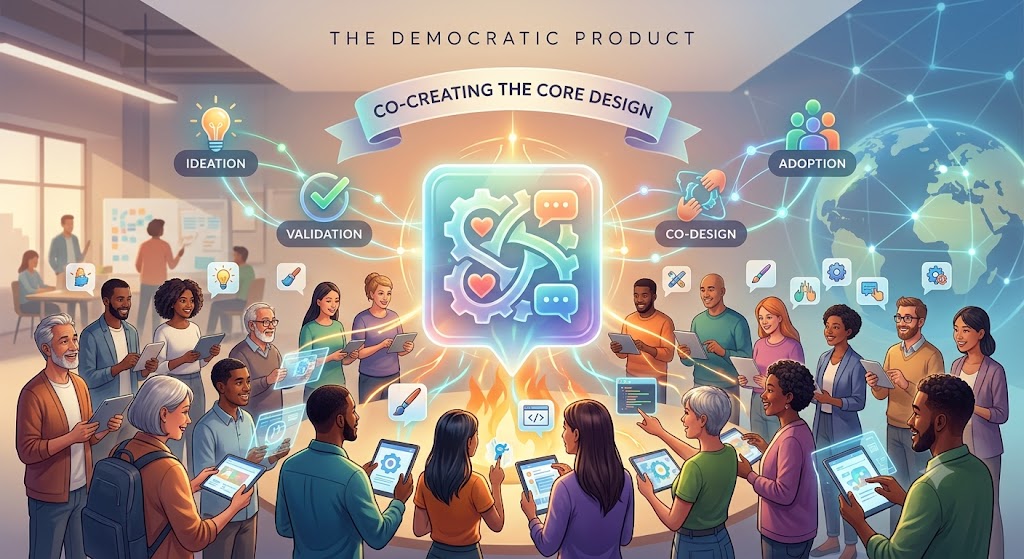
To democratize your product, you must intentionally embed external communities into your operational cadence. We do this by structuring engagement across three primary, sequential phases of the product design lifecycle.
1. Ideation & Sensing (The Discovery Phase)
True innovation starts with active sensing. Instead of relying solely on centralized R&D, organizations can establish global sensing networks—cohorts of passionate users who act as early-warning systems for friction and opportunity. In this phase, we do not just ask the community for ideas; we ask them to help us collaboratively define and frame the right problems worth solving.
2. Co-Design & Validation (The Development Phase)
Once a core challenge is identified, the design doors must swing fully open. This is where we bring visual, collaborative frameworks directly to our community cohorts. Working with visual planning canvases allows non-designers to participate in low-fidelity prototyping on equal footing. We co-design the end-to-end emotional journey, validating hypotheses together and ensuring the solution actually eliminates real-world friction before writing a single line of production code.
3. Launch, Adoption & Evolution (The Scaling Phase)
The most overlooked benefit of democratic design is its impact on change management and market adoption. When a community helps build a product, they don’t need to be sold on it—they are already invested in its success and naturally become its loudest champions. Post-launch, the relationship evolves into decentralized governance loops where your ecosystem guides the ongoing roadmap, facilitating continuous agility.
III. The Friction Points: Why Democratic Design Fails (and How to Fix It)
While the promise of community-driven design is immense, execution is where most organizations stumble. Opening up the product lifecycle introduces complex human, cultural, and operational dynamics. If you do not proactively design the boundaries of your collaboration, your democratic initiative will quickly collapse under its own weight.
To build a sustainable co-creation engine, organizations must anticipate and actively mitigate three primary friction points:
1. The Noise vs. Signal Trap
When you open the floodgates, you will be inundated with feature requests, bug reports, and highly niche ideas. Without a structured filter, your product team can easily drown in the noise.
The Fix: Establish clear, visual frameworks to bucket feedback. Organize incoming data into strategic pillars so the community understands exactly what kinds of problems you are solving in any given sprint.
2. The Power User Bias
In any open forum, a tiny fraction of highly vocal “power users” will dominate the conversation. If you design solely for them, you risk over-complicating the product and alienating the silent majority who need simplicity and ease of use.
The Fix: Balance open-forum inputs with targeted, statistically representative sensing cohorts. Ensure you are actively seeking out the quiet voices and newer users to gain a balanced perspective on product friction.
3. The Organizational Change Deficit
The biggest failure point is internal, not external. If your engineering, product, and marketing pipelines are rigid and insular, they will reject community inputs like a foreign body. Democratic design demands organizational agility and a culture that values external empathy over internal ego.
The Fix: Treat the transition to democratic design as a change management initiative. Train your internal teams to view the community as partners, and adapt your roadmapping processes to dynamically ingest and act on external validation.
IV. Designing the “Democratic Infrastructure” (Tools of the Trade)
Democratizing the design lifecycle cannot rely on good intentions alone. It requires building a dedicated, robust infrastructure. Just as we use structured tools to facilitate organizational agility, we must deploy specific platforms, governance rules, and value exchanges to make community collaboration seamless, secure, and highly productive.
To build a functional democratic infrastructure, organizations must focus on three core foundational pillars:
1. Visual, Collaborative Spaces
If you want your community to build with you, you must give them a shared language. Complex technical documentation or dense spreadsheets will instantly exclude the non-technical users who often bring the most valuable human-centered insights.
The Standard: Build and utilize visual, intuitive canvas tools and interactive spaces where internal teams and external cohorts can align rapidly. When the barrier to entry is visual and tactile, everyone can contribute on equal footing, getting “on the same page” literally and figuratively.
2. Clear Governance & Boundaries
A healthy democracy has laws, and a democratic product is no different. You must define early and transparently what is open to community influence and what is not. Trying to democratize everything leads to chaos, security risks, and strategic drift.
The Standard: Clearly carve out the sandboxes. For example, invite the community to democratize user experience design, accessibility, feature prioritization, and local use-case adaptions. Keep core architectural decisions, security standards, and proprietary intellectual property under centralized expert control.
3. Mutual Value Exchange
Your community’s time, creativity, and cognitive surplus are highly valuable. If co-creation feels like a one-way street where you extract free labor for corporate profit, your ecosystem will quickly disengage or turn hostile.
The Standard: Design an authentic value loop. Reward active contributors with early access to features, direct exposure to your leadership team, public recognition, and influence over the product’s ultimate roadmap. When they see their ideas actually making it into production, that shared ownership becomes the ultimate motivator.
Conclusion: Getting to the Future First
The era of the isolated genius is over. As we look toward an increasingly interconnected and rapidly shifting horizon, the organizations that thrive won’t be those with the biggest internal R&D budgets or the most guarded secrets. The future belongs to the organizations that can master the art of mobilization—orchestrating entire ecosystems of passionate individuals to solve problems together.
Transitioning to “The Democratic Product” is ultimately a commitment to radical empathy and continuous agility. By breaking down the walls of the traditional design lifecycle, you build something far more durable than just a highly functional tool. You build a living, breathing community that has a literal and emotional stake in your collective success.
To learn more about implementing continuous agility, designing human-centered change, or to book Braden Kelley for an upcoming innovation keynote, visit bradenkelley.com.
Frequently Asked Questions
1. What is the difference between traditional user feedback and democratic co-creation?
Traditional feedback is passive and reactive; it captures a user’s retrospective opinion on choices the company has already made. Democratic co-creation is active and proactive. It invites customers, partners, and employees into the early-stage design process as partners, allowing them to collaboratively frame problems, test hypotheses, and shape features before final development begins.
2. How do you prevent democratic design from turning into messy “design-by-committee”?
Democratic design is not a free-for-all. It succeeds by establishing clear boundaries and strict guardrails. Organizations must Centralize core strategic decisions, baseline technical architectures, and IP security, while opening up the “sandbox” of user experience, accessibility, and local customization to the community. Strong visual collaboration frameworks keep the inputs focused and highly actionable.
3. Why are visual collaboration tools critical for engaging a community in design?
Dense technical specifications or text-heavy spreadsheets create high barriers to entry that exclude valuable voices. Visual collaboration canvases establish a simple, shared, and intuitive language. By shifting the conversation to interactive, tactile layouts, you level the playing field so that everyday users, business stakeholders, and engineers can co-create together without translation friction.
Image credit: Gemini
 Sign up here to get Human-Centered Change & Innovation Weekly delivered to your inbox every week.