Author Archives: Braden Kelley

About Braden Kelley

Braden Kelley is a Human-Centered Experience, Innovation and Transformation practice lead at HCL Technologies, a popular innovation speaker, and creator of the FutureHacking™ and Human-Centered Change™ methodologies. He is the author of Stoking Your Innovation Bonfire from John Wiley & Sons and Charting Change (Second Edition) from Palgrave Macmillan. Braden is a US Navy veteran and earned his MBA from top-rated London Business School. Follow him on Linkedin, Twitter, Facebook, or Instagram.

Founding an American AI Sovereign Wealth Fund

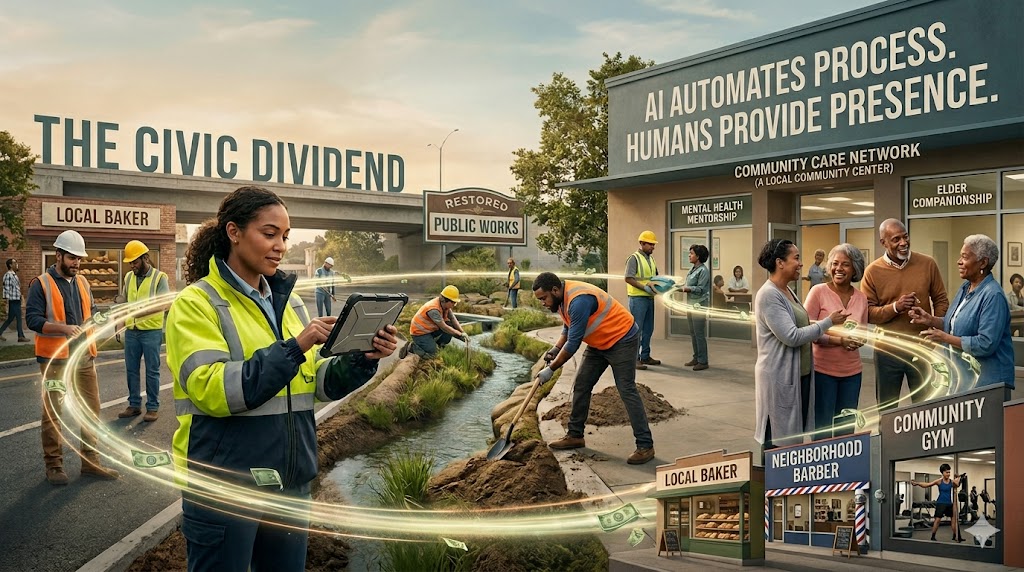
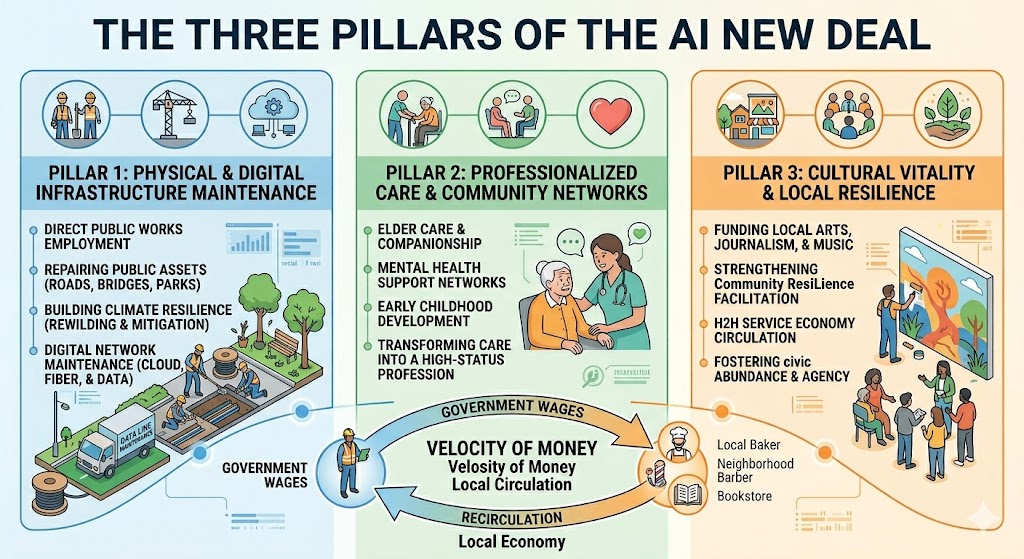
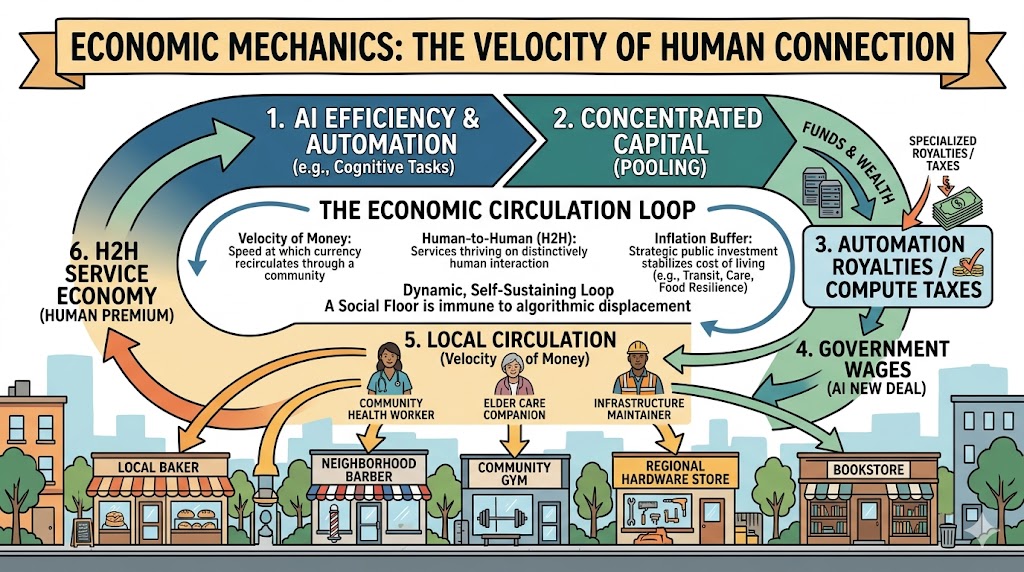
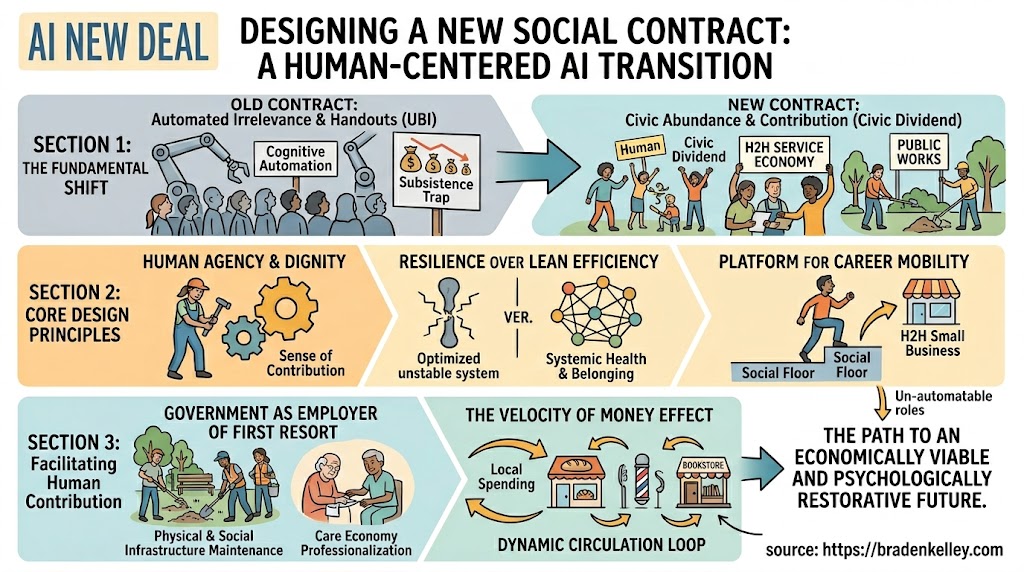
Another AI Soft Landing Scenario Exploration — The Digital Commons Dividend

LAST UPDATED: May 23, 2026 at 10:32 PM
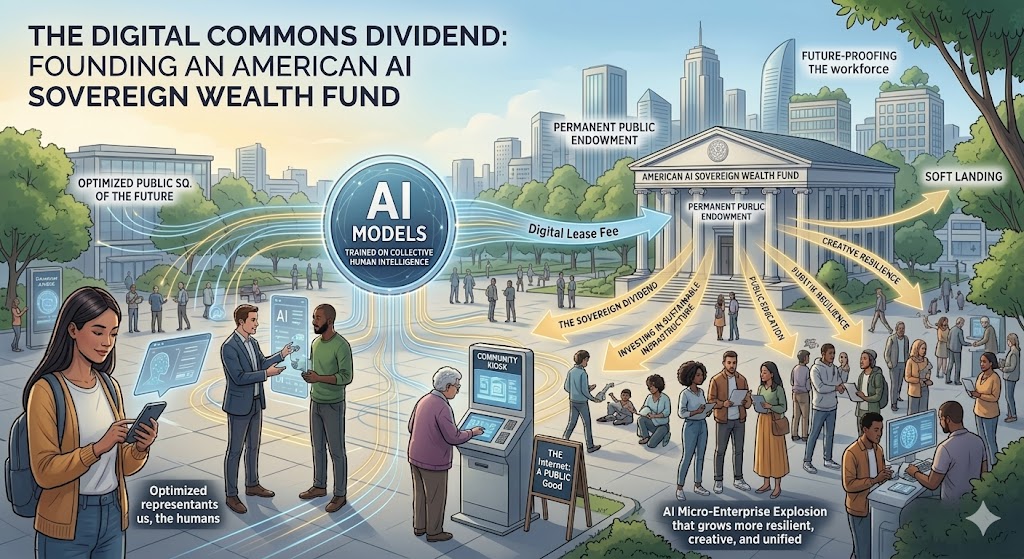
Founding an American AI Sovereign Wealth Fund

by Braden Kelley and Art Inteligencia


As we navigate the profound shifts brought about by generative and agentic AI, the question is no longer if the world will change, but how we will land. This article is the sixth installment in our AI Soft Landing series — a collection of hypotheses exploring how humanity and industry might transition into an AI-augmented future without systemic collapse.To understand the full context of this journey, you can explore the previous hypotheses here:

I. Introduction: The Silent Enclosure of the Digital Commons

The modern internet was built as a decentralized, public town square — a collective monument to human knowledge, cultural expression, and daily creativity. For decades, billions of individuals contributed their thoughts, art, code, and conversations under the shared assumption that they were participating in a living global community. Today, however, this vast digital landscape is being quietly enclosed and mined as the ultimate raw material for proprietary corporate infrastructure.

Large Language Models and generative AI systems do not exist in a vacuum. They are entirely dependent on the cumulative output of humanity; they cannot think, synthesize, or generate without the foundation of our collective history. As tech enterprises rapidly financialize this knowledge, we face a fundamental imbalance: the data is ours, but the immense financial dividend is theirs alone.

Rather than chasing this paradigm with endless, stagnant copyright litigation or choking progress with reactive, heavy-handed regulation, America needs a proactive framework of economic experience design. We must establish an American AI Sovereign Wealth Fund. By shifting the model from unchecked data extraction to a structured public lease agreement, we can transform corporate data consumption into a permanent public endowment that ensures human innovation and economic stability go hand in hand.
II. The Shared Foundation: Why the Internet is a Public Good

To understand the necessity of an AI Sovereign Wealth Fund, we must first reframe how we view the digital ecosystem. The internet is not a corporate invention; it is a foundational public good. The underlying infrastructure — from the early architecture of DARPA to foundational web protocols — was built on public funding, institutional research, and open-source collaboration. It was designed to belong to everyone and no one simultaneously.

The true value of this infrastructure, however, lies in what humanity built on top of it. Every blog post, forum reply, public photograph, open-source line of code, and digital article is a distinct product of human labor, creativity, and lived experience. When AI companies scrape the web to train their neural networks, they are not merely indexing information like a search engine; they are consuming and absorbing the collective cultural inheritance of humanity to create highly profitable, commercial alternatives to human labor.

In any other sector, the extraction of valuable resources from a shared public space requires a clear financial framework. When a mining or drilling company extracts minerals or oil from public land, they pay lease fees and royalties back to the state to compensate the public. The digital world should be no different. AI enterprises are operating in a “free extraction zone” that belongs to the public. If they wish to use the public commons to fuel their corporate innovations, they must pay a digital lease fee to the public who built it.

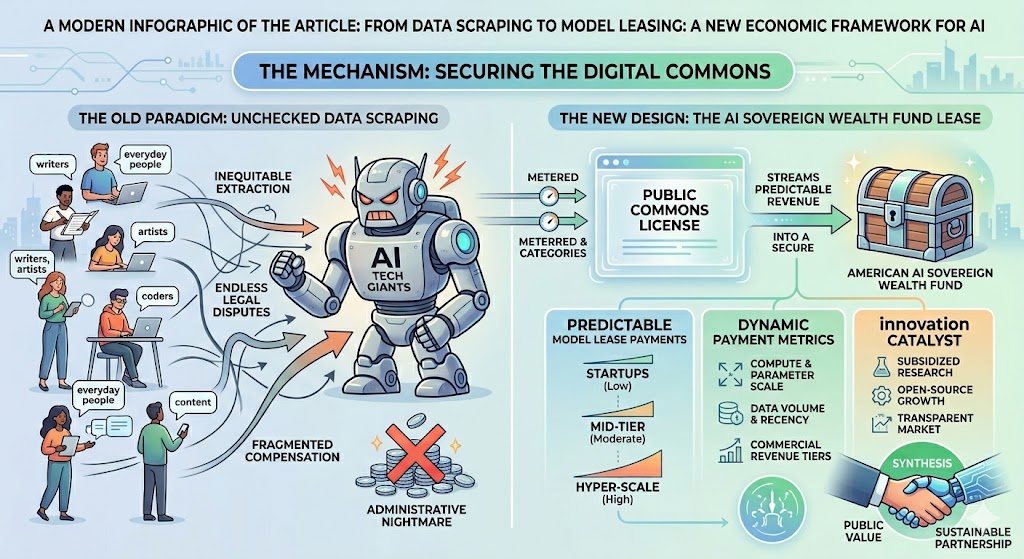
Securing the Digital Commons

III. The Mechanism: From “Data Scraping” to “Model Leasing”

Trying to protect the digital commons by paying individual users micro-cents for every tweet, review, or article is an administrative nightmare and a functional dead end. The value of human data does not reside in a single isolated post; it emerges from the collective synthesis of the entire public web. Therefore, the regulatory mechanism must treat the public web as a unified national asset, shifting the paradigm from transactional data purchasing to a systemic “Model Leasing” framework.

Under this design, any enterprise operating commercial AI models within the United States would be required to secure a Public Commons License. Instead of a one-time purchase of static datasets, this license functions as an ongoing lease. The lease payments would be structured dynamically to mirror the scale of the extraction, scaling across clear, predictable metrics:

  • Compute and Parameter Scale: Higher baseline fees for frontier models requiring massive infrastructure and massive ingestion footprints.
  • Data Volume and Recency: Fees tied to the continuous scraping and integration of real-time human data feeds.
  • Commercial Revenue Tiers: A sliding scale ensuring that monetized enterprise AI platforms contribute proportionally to their commercial success.

Crucially, this framework is designed to foster innovation rather than stifle it. By creating a transparent, predictable cost structure, we can offer low-cost or subsidized lease tiers for academic research, open-source developers, and early-stage startups. The heaviest financial responsibility will naturally rest on the hyper-scale tech giants who are driving the most aggressive commercialization of human output, turning a chaotic regulatory battlefield into a structured, reliable market mechanism.
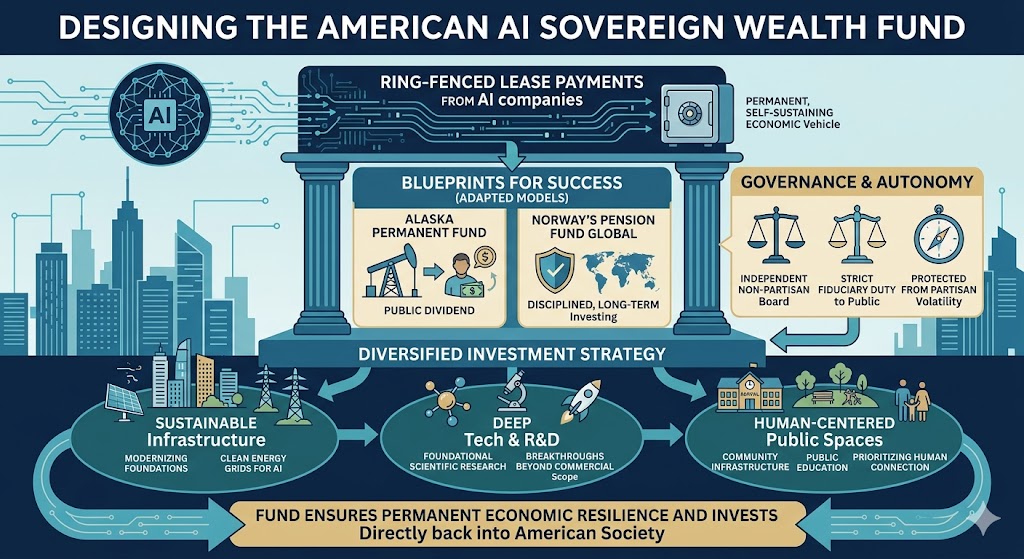
Designing the American AI Sovereign Wealth Fund

IV. Designing the American AI Sovereign Wealth Fund

An innovative revenue mechanism is only as effective as the architecture built to manage it. The digital lease payments collected from AI operators cannot simply disappear into the general federal budget to patch short-term deficits. Instead, they must be funneled directly into a dedicated, ring-fenced economic vehicle: the American AI Sovereign Wealth Fund. This fund will transform the temporary, fast-moving revenues of the technology boom into a permanent, self-sustaining financial legacy for all citizens.

While the United States has never established a national-level wealth fund, we have highly successful, battle-tested blueprints to draw from. The Alaska Permanent Fund has successfully turned non-renewable oil wealth into a continuous public dividend for decades, while Norway’s Government Pension Fund Global demonstrates how disciplined, long-term global investing can secure the financial future of an entire nation. The American AI Sovereign Wealth Fund will adapt these principles for the intangible, fast-growing digital asset class.

To protect the fund from political volatility and short-term legislative maneuvering, it must be established as an autonomous institution. It will be managed by an independent, non-partisan board of professionals with a strict fiduciary duty to the American public. The fund’s investment strategy will be diversified across a broad spectrum of resilient assets, including:

  • Sustainable Infrastructure: Directing capital into modernizing the physical foundations of the country, including clean energy grids capable of supporting next-generation computing.
  • Deep Tech and R&D: Investing in foundational scientific research and breakthroughs that lie outside the immediate commercial scope of venture capital.
  • Human-Centered Public Spaces: Funding physical community infrastructure, public education, and parks to ensure that a digital-first economy still prioritizes tangible human connection.

By building a robust, independent investment engine, the fund ensures that the immense wealth generated by AI efficiency is compound-invested directly back into the fabric of American society, establishing a foundation of permanent economic resilience.

V. The Human-Centered Dividend: Navigating the Great American Contraction

As artificial intelligence scales, it will fundamentally reorder the relationship between capital, productivity, and human labor. We are entering an era of unprecedented efficiency, yet this transition brings the distinct challenge of structural labor shifts — a phase of economic recalibration where traditional employment models will face intense pressure. In this environment, corporate productivity will skyrocket, but the traditional mechanism for distributing that wealth through 40-hour workweeks will become heavily disrupted.

The American AI Sovereign Wealth Fund is designed to serve as the critical macroeconomic cushion for this transition. The financial returns generated by the fund will be distributed directly to citizens as a Sovereign Dividend. It is vital to frame this payout correctly: this is not a welfare program or a government handout. It is a rightful return on investment for the citizen-creators whose collective human intelligence, data, and cultural history built the foundational engine of the entire AI economy. It treats the American public as shareholders in the technological future they co-created.

By providing a reliable, baseline dividend, we can orchestrate a “soft landing” that prevents widespread economic precarity. Instead of leaving individuals stranded by automation, this human-centered dividend provides the financial security needed to spark an explosion of grass-roots entrepreneurship. When citizens are unburdened from survival-level economic anxiety, they are empowered to take risks — funding local services, launching specialized consultancies, and building micro-enterprises. This safety net transforms a threat of labor contraction into an expansion of human creativity, allowing individuals to focus on what they do best: innovate, care for one another, and design unique human experiences.
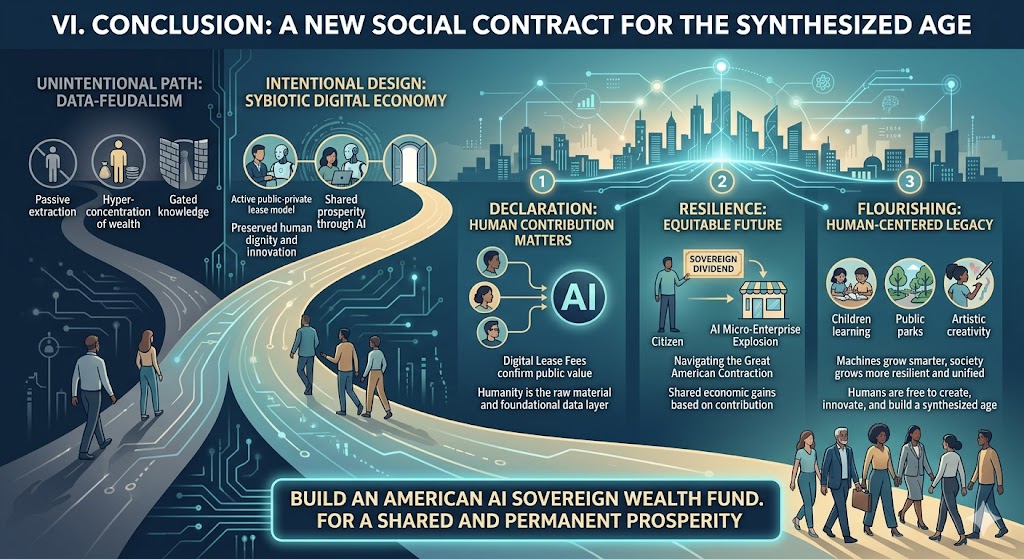
A New Social Contract for the Synthesized Age

VI. Conclusion: A New Social Contract for the Synthesized Age

We stand at a critical crossroads in the evolution of the digital economy. The rapid maturation of artificial intelligence has made it clear that the passive laissez-faire approach to data extraction is no longer sustainable. We can either slide quietly into a hyper-concentrated system of data-feudalism — where a handful of corporate entities gatekeep and monetize the synthesized sum of human knowledge — or we can intentionally design a system where technological progress directly funds human flourishing.

The creation of an American AI Sovereign Wealth Fund funded by model lease agreements is not a radical departure from American economic tradition; it is its logical evolution. It recognizes that innovation thrives when public assets are respected, valued, and paid for. By establishing this fund, we declare that human contribution is foundational, permanent, and worthy of equitable compensation.

As our machines grow smarter and more capable, our primary focus must remain on ensuring our society grows more resilient, unified, and creatively alive. By building this new macroeconomic bridge, we can navigate the structural shifts of the coming decades with confidence, transforming the immense promise of the AI era into a lasting, human-centered legacy that lifts up every single citizen who helped build it.

Frequently Asked Questions

1. Why should AI companies pay to use public internet data?

The modern internet is a public good built on government-funded infrastructure and decades of collective human contribution. AI models cannot generate value without training on the billions of articles, photos, and open-source code blocks created by real people. Just as a mining company pays a lease to extract minerals from public land, AI companies should pay a digital lease fee to extract value from the public digital commons.

2. Will a “Model Leasing” framework crush tech innovation?

No. The lease framework is designed to be tiered and predictable, specifically protecting early-stage startups and open-source developers. Subsidized or low-cost license tiers will ensure that academic research and grassroots innovation thrive, while the heaviest financial responsibility falls on hyper-scale tech giants who are generating massive commercial revenues directly from human data extraction.

3. How is the Sovereign Dividend different from traditional welfare?

The Sovereign Dividend is not a handout; it is a rightful return on investment. Because every citizen’s collective data and cultural history formed the foundational training material for AI, the American public acts as the foundational shareholders of the AI economy. Payouts from the fund are corporate-backed dividends reflecting the value of what humanity co-created.


EDITOR’S NOTE: This is a visualization of but one possible future. I will be publishing other possible futures as they crystallize in my mind (or as you suggest them for me to explore).

Image credits: Google Gemini

Content Authenticity Statement: The topic area, key elements to focus on, etc. were decisions made by Braden Kelley, with a little help from Google Gemini to clean up the article, add images and create infographics.

Subscribe to Human-Centered Change & Innovation WeeklySign up here to get Human-Centered Change & Innovation Weekly delivered to your inbox every week.
Revenue Leakage

The Customer Experience Failures Silently Draining Your P&L

Revenue Leakage

by Braden Kelley and Art Inteligencia

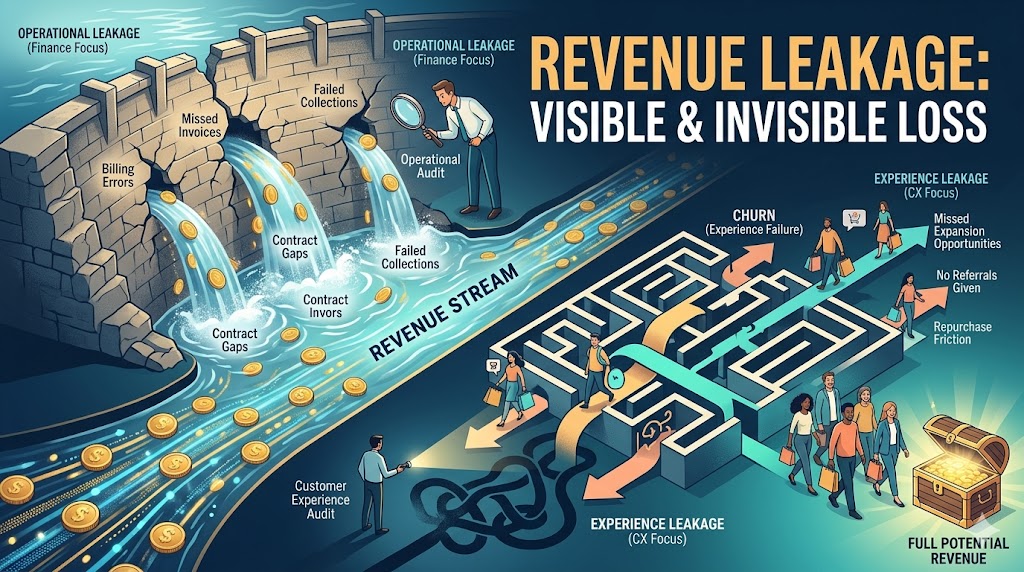
Revenue leakage is one of the most widely discussed topics in finance and operations — and one of the most narrowly defined. Ask most CFOs what revenue leakage means and they will describe billing errors, missed invoices, and contract compliance gaps. These are real problems worth solving. But they represent only the visible surface of a much larger issue.

The revenue leakage that does the most damage to most organizations is not found in the billing system. It is found in the customer experience — in the friction, failed moments, and unmet expectations that cause customers to buy less, expand less, renew less, and advocate less than they would if their experience were better. This form of revenue leakage is invisible in most financial reports. It shows up in churn rates, in Net Promoter Scores, in declining share of wallet, and in the slow erosion of customer lifetime value that compounds quietly over years.

This article addresses both: the operational revenue leakage that finance teams understand, and the experience revenue leakage that most organizations are leaving on the table without realizing it.

What is Revenue Leakage?

Revenue leakage is the gap between the revenue an organization should be capturing and the revenue it actually captures. The standard formula is:

Revenue Leakage % = (Total Potential Revenue − Actual Collected Revenue) ÷ Total Potential Revenue × 100

Industry benchmarks suggest that leakage under 3% is excellent, 3–5% is acceptable, and above 5% requires immediate attention. For a $100M revenue business, 5% leakage represents $5M walking out the door annually — before any consideration of the experience-driven leakage that rarely appears in these calculations at all.

Two Types of Revenue Leakage — and Why Most Organizations Only See One

Type 1: Operational Revenue Leakage

Operational revenue leakage is the form most commonly discussed in finance and RevOps contexts. It includes:

  • Billing errors — incorrect charges, missed charges, duplicate invoices, and pricing discrepancies between what was contracted and what was billed
  • Unbilled services — work performed or value delivered that was never invoiced, often due to disconnected systems between service delivery and billing
  • Contract compliance gaps — discounts that were meant to be temporary becoming permanent, usage overages that were never billed, and renewal terms that weren’t enforced
  • Failed collections — invoices issued but not collected due to expired payment methods, billing contact churn, or inadequate dunning processes
  • Handoff failures — context and commitments lost between sales, implementation, and customer success teams that result in under-delivering against what was sold

This form of leakage is well understood and increasingly addressable through better billing infrastructure, contract management systems, and revenue operations discipline. It is important and worth fixing. It is also, in most organizations, the smaller of the two leakage problems.

Type 2: Experience Revenue Leakage

Experience revenue leakage is the revenue an organization fails to capture — or actively destroys — because of failures in the customer experience. It is the harder-to-see, harder-to-measure, and almost always larger form of revenue leakage. It includes:

  • Churn driven by experience failure — customers who cancel, don’t renew, or stop purchasing because their experience fell below expectations, not because they found a cheaper alternative
  • Expansion revenue never realized — customers who could have bought more, upgraded, or expanded their relationship but didn’t because their experience gave them no reason to
  • Referrals never given — customers who would have recommended you to peers but didn’t because their experience was merely adequate rather than genuinely excellent
  • Repurchase cycles shortened or broken — customers who bought less frequently or in smaller amounts because friction in the experience made doing more business with you feel like more effort than it was worth
  • Price sensitivity artificially elevated — customers who demanded discounts or pushed back on pricing not because your prices were genuinely too high, but because the experience didn’t justify the value you were charging for
  • Recovery costs from poor experiences — the service calls, refunds, make-goods, and relationship repair investments required to address experience failures that should never have occurred

None of these show up cleanly in a billing audit. They are diffuse, difficult to attribute, and invisible in most financial reporting. But their combined scale is enormous. Bain & Company research found that companies that excel at customer experience grow revenues 4–8% above their market — meaning the gap between average and excellent experience represents revenue leakage of that magnitude for every organization that isn’t at the top.

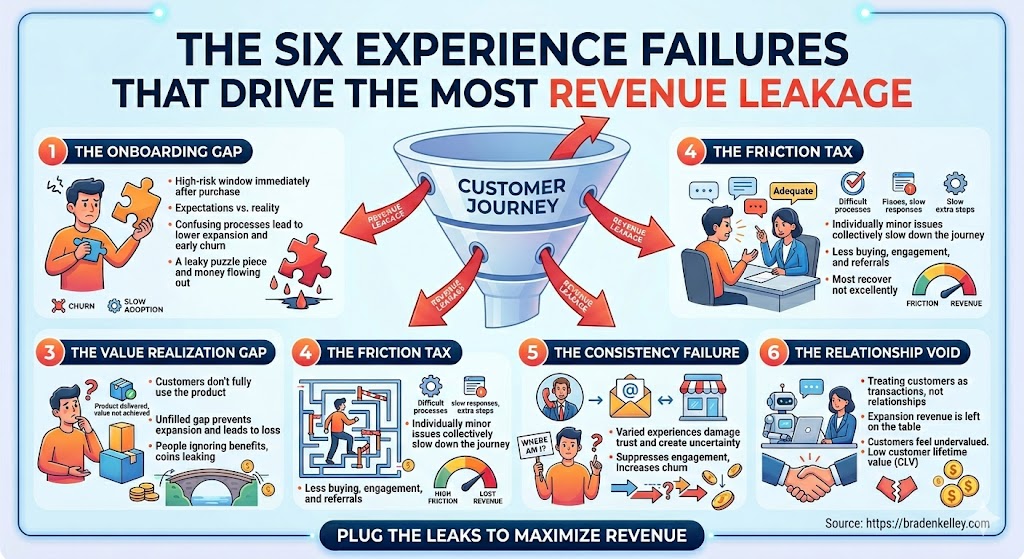
The Six Experience Failures That Drive the Most Revenue Leakage

1. The onboarding gap
The period immediately after purchase is the highest-risk window for experience revenue leakage. Customers arrive with expectations shaped by the sales process and are immediately confronted with the reality of onboarding — which is almost always harder, slower, and more confusing than what they were led to expect. Customers who never fully succeed with onboarding rarely expand, rarely renew enthusiastically, and frequently churn at the first renewal. The revenue lost to poor onboarding is rarely attributed to onboarding — it shows up months later as churn or non-renewal.

2. The service experience valley
Every customer relationship encounters service moments — billing questions, support issues, complaints, and problems that need resolving. These moments are disproportionately important to the overall experience because they are emotionally charged. A service experience handled badly damages trust in a way that no amount of good routine experience can quickly repair. The “service recovery paradox” — where a problem handled exceptionally well can produce higher loyalty than if no problem had occurred — is real, but it requires genuinely excellent recovery, not just adequate resolution. Most organizations deliver adequate. The gap between adequate and excellent is where experience revenue leakage lives.

3. The value realization gap
Customers who don’t fully realize the value they purchased don’t expand their relationship and are easy to lose. Value realization gaps are pervasive — they exist in virtually every B2B and B2C relationship where the product or service requires any customer effort to deliver its benefits. Organizations that actively help customers realize value retain more, expand more, and generate more referrals. Organizations that deliver the product and move on leave the value realization gap unfilled and lose the revenue that would have followed from success.

4. The friction tax
Friction accumulates across the customer journey in ways that are individually minor but collectively significant. Difficult processes, confusing interfaces, slow response times, unnecessary steps, and inconsistent experiences across channels all add to the friction tax customers pay to do business with you. As friction accumulates, customers do less: they buy less often, buy less per transaction, engage less with expansion opportunities, and recommend less enthusiastically. The revenue impact of accumulated friction is diffuse and hard to measure — which is exactly why it persists.

5. The consistency failure
Customers who have excellent experiences in some channels and poor experiences in others trust you less than customers who have consistently good experiences everywhere. Inconsistency is particularly damaging because it creates uncertainty — customers don’t know which version of your organization they are going to encounter. Uncertainty suppresses engagement. Customers who are uncertain about their experience buy less, recommend less, and churn more readily when alternatives present themselves.

6. The relationship void
Organizations that treat customers as transactions rather than relationships systematically leave expansion revenue on the table. Customers who feel known, understood, and valued by their providers spend more, stay longer, and are far more resistant to competitive alternatives. Most organizations are not building relationships — they are processing transactions and calling the result a customer relationship. The revenue gap between transactional and relational customer management is measurable and substantial.

Six Experience Failures That Drive Revenue Leakage

How to Identify Experience Revenue Leakage in Your Organization

Operational revenue leakage can be found through billing audits and contract reviews. Experience revenue leakage requires a different diagnostic approach — one that starts with the customer experience rather than the financial systems.

The most direct method is a customer experience audit — a systematic, human-centered evaluation of how customers actually experience your organization across every channel and touchpoint. An experience audit identifies the specific friction points, service experience failures, value realization gaps, and consistency failures that are driving the revenue leakage your P&L can’t fully explain.

Unlike financial audits that work backwards from revenue data, an experience audit works forward from the customer journey — finding the failures before they fully show up in the numbers. This is critical because experience revenue leakage compounds: a poor onboarding experience in month one doesn’t show up in revenue until month twelve when the renewal doesn’t happen. By the time the financial signal is visible, the customer relationship damage has been accumulating for a year.

Specific diagnostic questions an experience audit answers:

  • Where in the customer journey are the highest-friction moments — the ones customers endure without complaint but that silently reduce their willingness to expand or renew?
  • Which service experience failures are occurring most frequently, and how well are they being recovered from?
  • Are customers actually achieving the outcomes they purchased for, or is there a systematic value realization gap in specific segments or use cases?
  • How consistent is the experience across channels — and where are the inconsistency gaps largest?
  • How does the experience compare to key competitors — and where are you losing on experience quality rather than price?

Quantifying Experience Revenue Leakage

One of the reasons experience revenue leakage persists is that it is difficult to attach a specific number to it. Unlike billing errors, which have a clear dollar value, experience revenue leakage shows up indirectly — in churn rates, expansion rates, NPS scores, and competitive win/loss ratios. But it can be quantified with the right framework.

The Customer Experience Revenue Leakage diagnostic — part of the Experience Audit methodology — maps specific experience failures to their estimated revenue impact across five dimensions: churn contribution, expansion revenue foregone, referral revenue foregone, service recovery cost, and price sensitivity premium. This produces a prioritized estimate of where experience investment will generate the highest financial return — giving CFOs and CX leaders a common language for making the case for experience improvement investment.

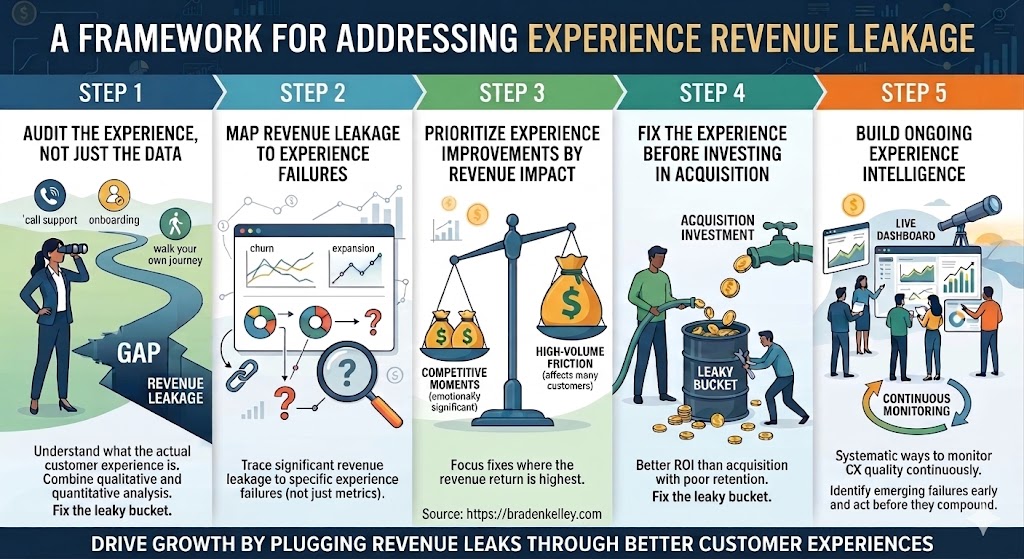
A Framework for Addressing Experience Revenue Leakage

Step 1: Audit the experience, not just the data
Before investing in retention programs, expansion campaigns, or NPS improvement initiatives, understand what the actual customer experience is. Walk your own journey. Call your own support line. Go through your own onboarding as a new customer. The gap between what you think the experience is and what it actually is almost always contains the most important revenue leakage.

Step 2: Map revenue leakage to experience failures, not to revenue metrics
For each significant revenue leakage source — high churn in a specific segment, low expansion in a specific cohort, low NPS in a specific channel — trace it back to the specific experience failures most likely driving it. This requires qualitative research, not just quantitative analysis.

Step 3: Prioritize experience improvements by revenue impact
Not all experience failures drive equal revenue leakage. Prioritize fixes that address high-volume friction (affecting many customers), high-stakes moments (emotionally significant interactions), and competitive gaps (experiences where alternatives are measurably better).

Step 4: Fix the experience before investing in acquisition
The most common and expensive mistake in revenue management is investing heavily in customer acquisition while experience failures are driving significant leakage. Fixing the leaky bucket before pouring more water in consistently delivers better ROI than acquisition investment against a poor retention foundation.

Step 5: Build ongoing experience intelligence
Experience revenue leakage is not a one-time problem to be solved — it is an ongoing management challenge. Organizations that achieve consistently low leakage have built systematic ways to monitor customer experience quality continuously, identify emerging failures early, and act on them before they compound into significant revenue impact.

Framework for Addressing Experience Revenue Leakage

Frequently Asked Questions About Revenue Leakage

What is revenue leakage?

Revenue leakage is the gap between the revenue an organization should be capturing and the revenue it actually captures. It includes both operational leakage — billing errors, unbilled services, contract compliance gaps, and failed collections — and experience leakage — the revenue lost because customer experience failures drive churn, suppress expansion, prevent referrals, and erode price realization. Most definitions of revenue leakage focus exclusively on operational causes, significantly underestimating the total revenue impact. The formula is: Revenue Leakage % = (Total Potential Revenue − Actual Collected Revenue) ÷ Total Potential Revenue × 100.

What causes revenue leakage?

Revenue leakage has two primary categories of causes. Operational causes include billing errors, missed charges, contract compliance failures, failed payment collections, and handoff failures between sales and service teams. Experience causes — which are typically larger in total impact but less visible — include poor onboarding that prevents value realization, service experience failures that damage trust and accelerate churn, friction accumulation across the customer journey that suppresses expansion and repurchase, inconsistent cross-channel experiences that undermine confidence, and transactional rather than relational customer management that leaves expansion revenue uncaptured.

How do you identify revenue leakage?

Operational revenue leakage is identified through billing audits, contract reviews, and revenue operations analysis. Experience revenue leakage requires a different diagnostic approach — specifically, a customer experience audit that walks the actual customer journey to identify the friction points, service failures, value realization gaps, and consistency failures driving churn, suppressing expansion, and eroding customer lifetime value. Financial data can signal that experience revenue leakage exists; only customer experience research can identify where it lives and what is causing it.

What is the difference between revenue leakage and customer churn?

Customer churn is one specific form of revenue leakage — the revenue lost when customers stop doing business with you entirely. Revenue leakage is a broader concept that includes churn but also encompasses revenue lost from customers who stay but buy less, expand less, refer less, and pay less than they would if their experience were better. A customer who renews but never expands their relationship, who would have recommended you but doesn’t, or who accepts your full price reluctantly rather than willingly — all of these represent revenue leakage that doesn’t show up in churn metrics but is nonetheless real and quantifiable.

How does a customer experience audit identify revenue leakage?

A customer experience audit identifies experience revenue leakage by walking the actual customer journey across all channels and touchpoints — finding the specific friction points, service failures, value realization gaps, and consistency failures that are driving revenue loss your financial reports can’t fully explain. Unlike data analysis that works backwards from revenue metrics, an experience audit works forwards from the customer journey (going beyond customer journey mapping), finding failures before they fully compound into financial impact. The result is a prioritized map of experience improvements ranked by their estimated revenue impact — giving leaders a clear, actionable roadmap for fixing the experience failures that are silently draining the P&L.

Ready to find the experience failures driving revenue leakage in your organization? Learn more about the Experience Audit →

Image credits: Google Gemini

Content Authenticity Statement: The topic area, key elements to focus on, etc. were decisions made by Braden Kelley, with a little help from Google Gemini to clean up the article, add images and create infographics.

Subscribe to Human-Centered Change & Innovation WeeklySign up here to get Human-Centered Change & Innovation Weekly delivered to your inbox every week.
The Great American Contraction Revisited

Preparing for the Post-Labor Knowledge Economy

The Great American Contraction - Preparing for the Post-Labor Knowledge Economy

by Braden Kelley and Art Inteligencia


I. Introduction: The Horizon of the Post-Labor Era

We are standing on the precipice of a profound structural shift. The rapid convergence of generative AI, autonomous agentic workflows, and evolving demographic realities is no longer just reshaping industries — it is fundamentally redefining the relationship between human labor and value creation. The traditional models that have governed the corporate world for decades are being challenged by an imminent economic phenomenon: The Great American Contraction.

This contraction is not a standard macroeconomic downturn or a temporary corporate downsizing cycle. Instead, it represents a permanent, structural reduction in the demand for traditional, volume-based knowledge work labor. As technology transitions from a tool used by humans to an autonomous entity capable of executing complex intellectual tasks, organizations must confront a stark new reality. We are moving rapidly toward a post-labor knowledge economy where market leadership will not be determined by the size of an enterprise’s headcount, but by the agility of its architecture and the depth of its human insight.

To navigate this shift successfully, forward-thinking executives, innovation leaders, and experience designers must look beyond short-term efficiency gains. Preparing for this next era requires a proactive commitment to human-centered change management and strategic futurology. This deep-dive builds upon the foundational concepts first introduced in the original framework on The Great American Contraction, providing a roadmap for organizations looking to transform disruption into an unprecedented competitive advantage.

II. Understanding ‘The Great American Contraction’

To successfully navigate the emerging economic landscape, we must first accurately diagnose the forces at play. The Great American Contraction is a term that describes the systemic decoupling of business productivity from traditional human labor hours. For the last century, scaling a knowledge-based business required a proportional scaling of headcount. If you wanted to process more claims, write more code, or manage more customer accounts, you hired more people. That linear relationship is permanently fracturing.

The Macro Drivers of Structural Shift

This contraction is fueled by three compounding macroeconomic and technological trends:

  • The Cognitive Automation Velocity: Unlike previous industrial revolutions that automated physical labor, current advancements target high-level cognitive tasks — data synthesis, legal analysis, software architecture, and creative asset generation — at near-zero marginal cost.
  • The Shift from Assets to Agents: Organizations are rapidly moving away from static software tools toward autonomous agentic ecosystems that require minimal human intervention to execute complex, multi-step business processes.
  • Demographic Realities: A naturally tightening labor market in specialized sectors is accelerating corporate incentives to build resilient, tech-driven operational frameworks that minimize dependency on scarce talent pools.

Why This Is Not a Standard Downsizing Cycle

It is a critical mistake for enterprise leaders to view this era through the lens of traditional corporate restructuring. In a typical economic recession, companies cut headcount to survive short-term revenue declines, only to rehire when demand rebounds. The Great American Contraction is entirely different. The labor demand is contracting because the capacity to execute knowledge work has been permanently commoditized by technology.

Value is rapidly migrating away from the execution of knowledge tasks and toward the orchestration, governance, and human validation of automated systems.

The Futurist Lens: Reimagining Organizational Scale

From a futurology perspective, this paradigm shift requires leaders to entirely reinvent how they define organizational maturity and scale. Historically, a “large” or “powerful” company was measured by its tens of thousands of full-time employees (FTEs). In the post-labor knowledge economy, market capitalization and societal impact will be driven by ultra-lean, highly leveraged enterprises. Success will belong to organizations that can orchestrate vast networks of AI capabilities, grounded firmly by human-centered strategy, empathy, and experience design.

III. Shifting from Labor to Orchestration: The New Knowledge Architecture

As the capacity to execute routine intellectual tasks becomes a cheap, ubiquitous commodity, the traditional structure of corporate departments must undergo a radical evolution. In the post-labor knowledge economy, value creation undergoes a massive migration. To survive The Great American Contraction, organizations must transition their human workforces away from direct task execution and toward system orchestration.

The Migration of Value

Historically, the bulk of corporate payroll has gone toward the doing of work — writing lines of code, drafting legal briefs, assembling financial models, or creating marketing assets. Today, autonomous agents can handle these tasks in fractions of a second. Consequently, human value is moving upstream. The new premium is placed on the following core activities:

  • Curating Intent: Framing the right problems to solve and defining the precise strategic boundaries for automated systems.
  • Auditing and Verification: Acting as the ultimate arbiter of truth, quality, and ethical alignment to ensure machine outputs meet human standards.
  • Continuous Innovation: Connecting disparate insights to create entirely new business models, experiences, and paradigms that data-driven algorithms cannot predict.

Human-Centered Design in an Automated World

When every competitor has access to the same powerful cognitive automation engines, technology ceases to be a sustainable competitive differentiator. Differentiation returns entirely to the human element. This is where experience design (CX/EX) and human-centered innovation frameworks become mission-critical. Enterprises must intentionally design customer journeys and employee experiences that preserve authentic empathy, trust, and emotional intelligence — qualities that machines can simulate but never genuinely possess.

Defining the “Orchestrator” Skillset

The workforce that remains must be rapidly upskilled to fit the profile of an Enterprise Orchestrator. This specialized role requires a unique hybrid of technical literacy and deeply human soft skills. The core competencies of the modern orchestrator include:

Traditional Knowledge Worker Role The Post-Labor Orchestrator Shift
Subject Matter Executor: Specializes in deep, narrow execution (e.g., manual copywriting or standard data analysis). Systems Architect: Understands how to connect multiple AI agents, databases, and human touchpoints to solve complex problems.
Content Creator: Focuses heavily on the volume and initial production of assets. Context Curator & Editor: Directs the vision, refines the nuance, and injects brand voice and human empathy into raw outputs.
Process Follower: Relies on linear, established operational playbooks. Adaptive Problem Solver: Thrives in ambiguity, continually redesigned workflows as technological capabilities shift.

By transforming your workforce from an army of creators into a lean team of orchestrators, your organization builds the structural resilience required to thrive amidst ongoing economic contraction.

IV. Strategic Imperatives for Enterprise Leaders

Navigating The Great American Contraction requires more than passive adaptation; it demands a aggressive, proactive overhaul of enterprise strategy. Leaders cannot afford to wait for the post-labor economy to fully stabilize before changing how they run their businesses. To maintain a competitive edge, corporate executives must immediately execute three strategic imperatives.

1. Redefining Corporate Capacity

For decades, procurement, HR, and finance departments have used Full-Time Equivalent (FTE) headcount as the primary metric to calculate corporate capacity and scale. In a post-labor knowledge economy, tracking headcount is an obsolete way to measure capability. Leaders must shift toward outcome-focused, algorithmic capacity modeling.

Instead of asking, “How many analysts do we need to launch this product?” the question must become, “What orchestration framework and human oversight are required to deliver this outcome at scale?” This shift untethers organizational growth from linear payroll inflation, allowing lean enterprises to achieve massive operational leverage.

2. Embedding Continuous Innovation as an Operational Core

When cognitive tasks can be commoditized and replicated by competitors almost instantly, static business models will decay at an unprecedented rate. Innovation can no longer be treated as a periodic workshop or a isolated R&D department — it must be embedded directly into the daily operational workflow.

Organizations must build structural systems that allow for constant experimentation. This means creating micro-feedback loops where insights from customer experience design (CX) are immediately fed into autonomous development cycles, allowing the business to continuously reinvent its value proposition before the market forces a collapse.

3. Upskilling for Cognitive Adaptability

The transition from a workforce of executors to a lean team of orchestrators cannot happen overnight without an intentional, empathetic commitment to human-centered change. Enterprise leaders have a responsibility to actively guide their talent through this friction point.

Training programs must pivot away from teaching specific software tools or rigid, linear processes, as those workflows will likely be automated within months. Instead, enterprise training must focus intensely on building cognitive adaptability. This includes deep development in:

  • Critical thinking and advanced prompt engineering curation
  • Strategic systems thinking and cross-functional integration
  • Empathy-driven user experience design and ethical risk management

By treating upskilling as a core pillar of your digital transformation strategy, you reduce organizational friction, honor the human side of change, and build a workforce capable of steering the company through the ongoing contraction.

V. Designing the Future: A Framework for Resilient Innovation

Surviving the structural shifts of The Great American Contraction requires a rigorous, repeatable methodology. Organizations cannot rely on ad-hoc technological adoption; they must intentionally design their future operating state. By combining the principles of strategic futurology, experience design, and human-centered change management, enterprise leaders can build a comprehensive framework for resilient innovation.

The Braden Kelley Approach to Human-Centered Change

Too often, digital transformation initiatives focus entirely on technological capabilities while ignoring the human element. This imbalance is exactly why large-scale corporate pivots fail. In a post-labor economy, successful transformation must lead with empathy. When introducing autonomous agents and cognitive automation, leaders must actively manage the psychological transition of their workforce. This means establishing psychological safety, framing automation as an expansion of human capability rather than a replacement of human worth, and transparently mapping new career pathways for evolving roles.

The Automation vs. Humanity Matrix

To avoid over-automating critical touchpoints — or under-automating operational bottlenecks — organizations must systematically audit their business architecture. Leaders should map organizational workflows across two primary variables: cognitive volume and emotional necessity. This creates a clear roadmap for where to deploy seamless technology versus where to deepen human presence:

Workflow Classification Strategic Action Operational Execution
High Volume / Low Emotional Touch
(e.g., standard billing, routine data migration)
Autonomous Automation Fully offload to autonomous agentic systems. Remove human friction entirely to achieve maximum operational efficiency.
High Volume / High Emotional Touch
(e.g., customer onboarding, complex escalations)
Human Orchestration Deploy AI engines to generate solutions behind the scenes, but utilize human experience designers to deliver the touchpoint with empathy.
Low Volume / High Emotional Touch
(e.g., high-value strategic partnerships, crisis management)
Pure Human Experience Intentionally restrict technology to a passive, supporting role. Maximize direct human-to-human connection, trust, and deep design thinking.

Practicing Agile Futurology

The post-labor knowledge economy moves far too quickly for traditional five-year strategic plans. Instead, innovation leaders must practice agile futurology. This involves building continuous signal-scanning networks across your industry to identify emerging technological capabilities, regulatory shifts, and economic contractions before they cause disruption. By converting these weak signals into actionable corporate experiments, your organization transitions from a defensive posture of reacting to change, to an offensive posture of actively driving it.

VI. Conclusion: The Opportunity Within the Contraction

While the phrase The Great American Contraction inherently signals a shrinking of traditional roles, it does not mean the future of business is bleak. For forward-thinking leaders, this macro-economic shift represents one of the greatest expansions of creative and strategic capability in human history. By removing the burden of manual, volume-based knowledge execution, we are effectively liberating human intellect to focus on what it does best: inventing, connecting, and empathizing.

The Optimistic Futurist Outlook

The transition into a post-labor knowledge economy should not be viewed as a destination of widespread professional obsolescence, but as an evolution toward higher-value contributions. When machines completely handle the commoditized execution of ideas, the human premium shifts entirely to the quality of our curiosity, the strength of our ethics, and the depth of our experience design. The organizations that thrive in this new era will be those that view automation not as a tool to cut costs, but as a mechanism to amplify human potential.

The Call to Action for Innovators

The post-labor economy is not a distant, theoretical concept — it is actively being constructed around us today. Waiting for the dust to settle before choosing a direction is a guaranteed path to irrelevance. Executive leaders, experience designers, and corporate strategists must seize the initiative immediately by taking tangible steps toward systemic transformation:

  • Begin dismantling legacy capacity models tied strictly to full-time equivalent headcount.
  • Audit operational workflows to systematically separate high-volume automation tasks from high-empathy human touchpoints.
  • Commit deeply to human-centered change management, ensuring your workforce is actively upskilled into strategic orchestrators.

The future of work will not be defined by what technology can do, but by how courageously human leaders choose to design the transition. To explore the foundational research, frameworks, and strategic insights driving this transformation, return to the original thesis and join the ongoing conversation and access the tools (FutureHacking, Human-Centered Change, etc.) here on bradenkelley.com.

Frequently Asked Questions

What is ‘The Great American Contraction’?

The Great American Contraction is a structural macroeconomic shift characterized by a permanent decoupling of business productivity from traditional human labor hours. Driven by advanced generative AI and autonomous agentic ecosystems, it represents a contraction in the market demand for volume-based, routine knowledge work execution, shifting the corporate premium toward human orchestration and strategic design.

What is a post-labor knowledge economy?

A post-labor knowledge economy is an economic landscape where the direct execution of cognitive and intellectual tasks (such as coding, basic analysis, and content generation) is largely commoditized and performed autonomously by technology at near-zero marginal cost. In this economy, human value centers entirely on orchestration, continuous innovation, ethical oversight, and empathy-driven experience design.

How should corporate leaders prepare for this economic shift?

Enterprise leaders must rapidly implement three strategic changes: redefine corporate capacity metrics away from full-time equivalent (FTE) headcount toward capability outcomes; systematically embed continuous innovation into daily operations; and aggressively invest in employee upskilling focused on cognitive adaptability, systems thinking, and human-centered change management.


Content Authenticity Statement: The topic area, key elements to focus on, etc. were decisions made by Braden Kelley, with a little help from Google Gemini to clean up the article, add images and create infographics.

Image credit: Gemini

Subscribe to Human-Centered Change & Innovation WeeklySign up here to get Human-Centered Change & Innovation Weekly delivered to your inbox every week.
What is an Innovation Keynote Speaker?

Innovation Keynote Speaker Braden Kelley

Most organizations know they need to innovate. Far fewer know how to build the conditions that make innovation actually happen — consistently, at scale, across teams and functions. This is the gap that a great innovation keynote speaker is uniquely positioned to close.

But the term gets used loosely. Not every speaker who mentions disruption or design thinking qualifies as an innovation keynote speaker in the meaningful sense. Understanding what the role actually involves — and what separates genuinely useful speakers from entertaining but forgettable ones — is worth your time before you commit budget to a booking.


What Is an Innovation Keynote Speaker?

An innovation keynote speaker is a subject matter expert who helps organizations understand, develop, and apply innovation capabilities through live presentations, workshops, and masterclasses. Unlike a generic motivational speaker, an innovation keynote speaker brings deep expertise in how organizations create new value — and the cultural, structural, and human factors that determine whether innovation efforts succeed or fail.

The best innovation speakers don’t just inspire. They equip. Audiences leave with frameworks they can apply, mental models that reframe stubborn problems, and a clearer sense of the specific actions that will move their organization forward.

A strong innovation keynote typically addresses some combination of:

  • Innovation strategy — how organizations choose where and how to innovate
  • Innovation culture — the leadership behaviors, structures, and norms that enable or block creative thinking
  • Human-centered design — building solutions around the real needs of real people
  • Change management — navigating the human side of transformation
  • Emerging technology and trends — understanding which forces are reshaping your industry and how to respond

What Does an Innovation Keynote Speaker Actually Do?

The format varies significantly depending on your event’s needs, budget, and goals. Here’s how the most common engagements work in practice.

Keynote Presentations

A 45 to 75-minute keynote is the most common format — typically delivered at a conference, leadership summit, or annual meeting. A well-designed innovation keynote sets the intellectual agenda for the event, gives attendees a shared language and framework, and creates the momentum that carries into breakout sessions and hallway conversations.

The best innovation keynotes challenge assumptions rather than confirming them. They introduce ideas the audience hasn’t encountered before, reframe familiar problems in ways that open new solutions, and leave people with a clear sense of what they can do differently starting Monday morning.

Workshops and Masterclasses

Workshops extend the keynote into active application. Rather than a one-way presentation, a workshop engages participants in using innovation frameworks on their own real challenges — building skills through practice rather than passive listening.

Innovation workshops are particularly valuable for leadership teams that need to move beyond general awareness into genuine capability building. A half-day or full-day workshop with the right facilitator can accomplish more than months of internal training on the same topics.

Webinars and Virtual Keynotes

Virtual formats have expanded access to innovation speakers significantly. A well-produced virtual keynote can reach distributed teams across multiple locations simultaneously, making innovation thinking accessible to organizations that couldn’t previously justify the investment in an in-person event.

Custom Research and Advisory

The deepest engagement level involves an innovation speaker working with your organization over time — developing custom frameworks, conducting research specific to your industry, and helping build internal capabilities rather than delivering a single keynote.


Innovation Keynote Speaker vs. Motivational Speaker — What’s the Difference?

This distinction matters more than most event planners realize when they’re making a booking decision.

A motivational speaker primarily works on mindset and emotional energy — leaving audiences feeling inspired, capable, and energized. That’s genuinely valuable in the right context. But motivation without a map doesn’t produce innovation. If your audience leaves feeling great but can’t articulate a single new framework or specific action they’ll take, the investment hasn’t generated a return.

An innovation keynote speaker works on both energy and capability. The best ones are genuinely inspiring — but the inspiration is grounded in substance. The audience doesn’t just feel differently, they think differently. They have new tools. They see their organization’s challenges through a new lens.

If your event goal is to energize your team before a busy quarter, a motivational speaker may be exactly right. If your goal is to build organizational capability, shift culture, or equip leaders with frameworks they’ll actually use, you need an innovation speaker.


What to Look for When Booking an Innovation Keynote Speaker

The speaking industry makes it easy to find charismatic presenters. It’s harder to find innovation speakers with genuine depth. Here’s what to look for.

Proprietary Frameworks and Original Thinking

Any speaker can summarize research and present trend lists. What distinguishes an exceptional innovation keynote speaker is original intellectual contribution — frameworks they’ve developed, models they’ve tested, insights that aren’t available in any business book. Ask what frameworks the speaker brings that are uniquely theirs. Look for powerful tools like Braden Kelley’s Nine Innovation Roles and Innovation Maturity Assessment. Look for comprehensive methodologies like Braden’s Human-Centered Innovation and frameworks like those in Stoking Your Innovation Bonfire.

Real-World Application Experience

Innovation theory is easy to talk about. Innovation practice is significantly harder. Look for speakers who have actually led innovation initiatives inside organizations — who understand the politics, the resource constraints, the cultural resistance, and the messy reality of trying to make new things happen inside existing institutions.

Genuine Customization

An innovation keynote that could be delivered identically to any audience in any industry is a warning sign. Strong innovation speakers invest real time understanding your organization’s specific challenges, your industry’s dynamics, and your audience’s level of sophistication before they set foot on stage. The best keynotes feel like they were written specifically for your people — because they were.

A Body of Work That Demonstrates Commitment

Books, frameworks, tools, research, years of consistent contribution to the field — these signal that a speaker has genuinely earned their expertise rather than recently rebranding as an innovation speaker because the label is in demand. Look at what they’ve built, not just how well they present.

Outcomes, Not Just Content

Ask what the speaker wants your audience to be able to do differently after the keynote. The answer tells you everything. Vague answers about inspiration or awareness signal a speaker focused on their own performance. Specific answers about behavioral changes, new frameworks the audience will apply, or decisions they’ll make differently signal a speaker focused on your organization’s outcomes.


Questions to Ask Before You Book

Use these in your vetting conversations to quickly identify the right fit:

  • What original frameworks do you bring that aren’t available elsewhere? Listen for genuine intellectual property, not trend summaries. Look for powerful frameworks like The Eight I’s of Infinite Innovation and FutureHacking.
  • How do you customize your content for different industries and audiences? A strong answer involves a discovery process. A weak one describes the same talk delivered everywhere.
  • What do you want our audience to be able to do differently after your keynote? Look for specific behavioral outcomes, not emotional ones.
  • Can you share an example of an insight you’ve delivered that wasn’t obvious at the time? This tests whether their thinking is genuinely ahead of the curve.
  • What formats beyond the keynote do you offer, and when are they most valuable? This helps you understand whether a workshop or masterclass would serve your goals better than a standalone keynote.
  • How do you measure whether a keynote has been successful? Speakers who think about impact tend to deliver it.

Why Organizations Hire Innovation Keynote Speakers

The specific reasons vary, but the most common situations where an innovation keynote speaker adds the most value include:

Annual conferences and leadership summits — where the right keynote sets the intellectual agenda for the year and gives distributed teams a shared framework to work from.

Culture change initiatives — where an external voice can say things internal leaders can’t, create psychological safety for new conversations, and help an organization see itself differently.

Strategy offsites — where a keynote or workshop challenges the assumptions underlying the current strategy before the planning process begins in earnest.

Industry conferences — where an innovation speaker positions your organization as a thought leader by association and delivers genuine value to attendees.

Learning and development programs — where innovation capability needs to be built systematically across a leadership population rather than inspired in a single event.


Ready to Book an Innovation Keynote Speaker?

Braden Kelley is an innovation keynote speaker and futurist who has spent decades helping organizations build the mindsets, frameworks, and capabilities to thrive through change. His human-centered approach to innovation and change management has been applied by organizations worldwide, and his proprietary frameworks — including the Human-Centered Change methodology — give audiences tools they can use immediately.

Whether you need a keynote that re-frames how your leadership team thinks about innovation, a workshop that builds practical capability, or a masterclass that equips your people with frameworks for navigating change, Braden brings the substance and the delivery to make your event memorable and genuinely useful.

Explore ten reasons to hire an innovation keynote speaker — then book Braden Kelley for your next event.


Explore more on innovation strategy, change management, and human-centered thinking at Human-Centered Change and Innovation.

What is a Futurist Speaker?

Futurist Speaker Braden Kelley

by Braden Kelley

Every organization faces the same fundamental challenge: the future is arriving faster than most leaders can process it. Artificial intelligence, shifting workforce dynamics, geopolitical disruption, and technological convergence are reshaping industries at a pace that leaves traditional planning frameworks struggling to keep up.

This is precisely why demand for futurist speakers has surged in recent years. But with so many people claiming the title — and event budgets too valuable to waste on the wrong choice — it pays to understand what a futurist speaker actually does, how they differ from other keynote speakers, and what separates the exceptional from the merely adequate.


What is a Futurist Speaker?

A futurist speaker is a keynote speaker who specializes in helping organizations anticipate, prepare for, and shape the future. Rather than simply motivating an audience or recapping industry trends, a futurist speaker brings a structured analytical lens to emerging signals — identifying patterns across technology, society, business, and culture to help leaders make better decisions today.

The best futurist speakers don’t predict the future with false precision. Instead, they build what futurists call “preferred futures” — coherent, evidence-based visions of where an organization or industry could go, and the choices that will determine which path is taken.

A futurist keynote speaker typically draws on:

  • Trend analysis and horizon scanning — identifying weak signals before they become obvious disruptions
  • Scenario planning — building multiple plausible futures to stress-test strategy
  • Cross-industry pattern recognition — finding the innovation lessons that travel across sectors
  • Human-centered frameworks — grounding future thinking in the people who will live and work through change

The result is an audience that leaves not just inspired, but genuinely better equipped to navigate uncertainty.


Futurist Speaker vs. Innovation Keynote Speaker — What’s the Difference?

These two roles overlap significantly, and many speakers occupy both spaces. But there are meaningful distinctions worth understanding when you’re making a booking decision.

A futurist speaker tends to focus on what’s coming — emerging technologies, societal shifts, and the long-range forces reshaping industries. The primary lens is anticipation: how do we see change before it arrives?

An innovation keynote speaker tends to focus on how organizations respond — building the cultures, processes, and capabilities to create value from change. The primary lens is action: how do we actually innovate effectively?

The most effective speakers in this space do both. They help audiences understand the forces reshaping the landscape and give them practical frameworks for responding. If your event needs both strategic foresight and actionable takeaways, look for a speaker who can credibly bridge both worlds rather than defaulting to one or the other.


What Does a Futurist Speaker Actually Do at an Event?

A common misconception is that futurist keynote speakers simply deliver a TED-style talk about technology trends and leave. The best futurist speakers offer significantly more, and understanding the full range of formats helps you match the right speaker to your event’s needs.

Keynote presentations are the most common format — a 45 to 90-minute talk that sets the intellectual agenda for a conference or leadership offsite. A strong futurist keynote opens minds, challenges assumptions, and gives attendees a shared framework for thinking about the future that they carry into breakout sessions and beyond.

Workshops and masterclasses go deeper. Rather than a one-way presentation, a futurist-led workshop engages participants in applying futures thinking tools to their own strategic challenges. These are particularly valuable for leadership teams who need to move from awareness to action.

Panels and facilitation leverage the futurist’s cross-industry perspective to enrich conversation and push groups beyond their existing mental models.

Custom research and white papers represent the highest engagement level — where a futurist speaker works with an organization over time to develop proprietary foresight outputs rather than a single keynote.

Most corporate bookings start with a keynote and evolve from there. The organizations that get the most value treat a futurist keynote as the beginning of a conversation, not the end of one.


What to Look For When Booking a Futurist Speaker

Not everyone who calls themselves a futurist speaker has earned the designation. Here’s what distinguishes genuine expertise from polished packaging.

Intellectual rigor over entertainment value. The speaking industry rewards charisma, and charisma matters. But a futurist who can only tell you what’s already obvious — that AI is changing things, that remote work is here to stay — isn’t adding value your leadership team couldn’t generate internally. Look for speakers who demonstrate original thinking, proprietary frameworks, and the ability to connect trends your audience hasn’t yet noticed.

Industry relevance balanced with cross-sector breadth. The most valuable insights often come from adjacent industries. A futurist speaker who only knows your industry well will reflect your assumptions back at you. One who understands multiple sectors can surface the pattern that your competitors haven’t seen yet.

Customization, not off-the-shelf content. A strong futurist keynote speaker invests time understanding your audience, your industry’s specific challenges, and your event’s strategic objectives. Generic content delivered to every audience is a warning sign.

Practical frameworks, not just predictions. Predictions without actionable frameworks leave audiences with anxiety rather than agency. The best futurist speakers give organizations tools they can actually apply — ways of scanning for signals, building scenarios, and making decisions under uncertainty.

A body of work that demonstrates commitment to the field. Books, research, tools, frameworks, and years of consistent output signal that a speaker has genuinely developed expertise rather than simply rebranding as a futurist because the label is in demand.


Questions to Ask Before You Book a Futurist Speaker

Use these questions in your vetting process to quickly separate genuine expertise from well-packaged generalism.

  1. What proprietary frameworks or research do you bring to this topic? — You’re listening for original thinking like FutureHacking™, not recycled trend reports.
  2. How do you customize your keynote for different industries and audiences? — A good answer involves a discovery process. A poor answer describes the same talk delivered everywhere.
  3. Can you share examples of specific insights you’ve delivered that weren’t obvious at the time? — This tests whether their foresight is genuinely ahead of the curve.
  4. What do you want audiences to be able to do differently after your keynote? — Futurist speakers should be able to articulate behavioral outcomes, not just emotional ones.
  5. How do you stay current, and what’s your research process? — Look for systematic horizon scanning, diverse information sources, and genuine intellectual curiosity.
  6. What formats beyond the keynote do you offer, and when do they add value? — This helps you assess whether deeper engagement is appropriate for your situation.

How Human-Centered Change Makes Futurism Actionable

One of the most common failures in futures thinking is the gap between insight and action. Organizations leave a futurist keynote energized and then return to the same meetings, the same processes, and the same assumptions that made the future feel distant in the first place.

The most durable approach to organizational foresight connects future thinking to the human dimension of change — recognizing that technologies and trends only matter insofar as people can understand, embrace, and act on them. This means going beyond trend lists and scenario matrices to build the organizational capabilities that allow people to navigate change continuously, not just react to it episodically.

This is the intersection where innovation strategy, change management, and futures thinking converge — and it’s where the most valuable futurist keynote speakers operate.


Ready to Book a Futurist Keynote Speaker?

Braden Kelley is an innovation keynote speaker and futurist who helps organizations build the mindsets, frameworks, and capabilities to thrive through change. Drawing on decades of experience across industries and the development of human-centered innovation and change frameworks used by organizations worldwide, Braden brings both the strategic foresight and the practical tools your audience needs to move from awareness to action.

Learn more about booking Braden Kelley as your futurist keynote speaker →


Explore more on futures thinking, innovation strategy, and human-centered change at Human-Centered Change and Innovation.

The End of AI Data Centers

Why Decentralized Compute is the Only Resilient Future

LAST UPDATED: May 11, 2026 at 11:24 AM

The End of AI Data Centers

by Braden Kelley and Art Inteligencia


I. Introduction: The Fragility of the AI “Crown Jewels”

The race to dominate artificial intelligence has triggered a global construction boom unlike anything the technology industry has ever seen. Governments and corporations are pouring hundreds of billions of dollars into massive AI data centers packed with advanced GPUs, specialized networking hardware, and enough electrical infrastructure to power small cities. These facilities are rapidly becoming the economic and strategic “crown jewels” of the twenty-first century.

But in the rush to scale AI capability, we may be building exactly the wrong architecture for the world that is emerging around us.

The current model of AI infrastructure is overwhelmingly centralized. Instead of distributing compute across millions of smaller nodes, we are concentrating unprecedented amounts of economic, military, and technological capability into a relatively small number of gigantic facilities. Each hyperscale AI campus represents not only a massive financial investment, but also a critical dependency for national competitiveness, intelligence operations, logistics, cybersecurity, and military decision-making.

In effect, the AI industry has unintentionally created the ultimate single point of failure.

As AI becomes increasingly essential to economic productivity and national defense, these centralized facilities naturally evolve from commercial assets into strategic targets. Their importance guarantees that adversaries will study them, map them, probe them, and eventually develop methods to disrupt or destroy them. The more valuable these AI fortresses become, the more irresistible they become as targets during geopolitical conflict.

This reality formed the basis of a previous argument that the AI data centers of 2030 may ultimately require sovereign-level protection — potentially functioning more like hardened military installations than traditional commercial real estate. Once AI infrastructure becomes critical to national security, protecting it may no longer be optional.

But militarizing data centers only treats the symptom, not the disease.

Building bigger walls around centralized AI infrastructure may delay catastrophe, but it does not eliminate the underlying strategic vulnerability. A fortress is still a fortress. It still has a location. It still has supply lines. It still has power dependencies. And most importantly, it still presents adversaries with a concentrated target whose destruction could create disproportionate economic and military disruption.

Modern warfare is increasingly demonstrating that concentration itself is becoming obsolete.

The emerging lesson from contemporary conflict is that large, static, centralized assets are becoming dangerously vulnerable in an era of cheap autonomous systems, distributed attacks, cyber-physical warfare, and AI-enabled targeting. Resilience no longer comes from concentrating strength behind thicker walls. Resilience comes from distribution, redundancy, mobility, and the elimination of obvious centers of gravity.

The future of AI infrastructure may therefore require a fundamental architectural shift — away from the “Fortress” model and toward something far more decentralized and resilient.

Instead of concentrating compute into a handful of hyperscale compounds, the smarter long-term strategy may be to distribute AI capability across millions of interconnected nodes embedded throughout society itself. Homes, businesses, vehicles, factories, and local energy systems could collectively form a resilient national AI fabric that is vastly harder to disrupt because it has no singular brain to destroy.

In other words, the ultimate defense against the vulnerabilities of centralized AI infrastructure may not be better fortifications at all.

It may be the elimination of the fortress entirely.

II. Lessons from the Front: Operation Spiderweb and the Death of “Large & Static”

For decades, military doctrine revolved around concentration of force. Nations projected power by building larger air bases, larger aircraft carriers, larger command centers, and larger logistical hubs. Strategic advantage often came from assembling overwhelming capability in centralized locations that could be defended through scale, distance, and hardened infrastructure.

But modern warfare is beginning to expose a dangerous flaw in that logic.

Ukraine’s Operation Spiderweb offered a glimpse into the future of asymmetric conflict — and a warning for anyone investing heavily in centralized AI infrastructure. In the operation, relatively inexpensive drones launched from concealed shipping containers reportedly destroyed or severely damaged billions of dollars of Russian military hardware. The attack demonstrated how low-cost autonomous systems can bypass traditional defensive assumptions and threaten even heavily protected strategic assets.

The significance of the operation was not merely tactical. It was architectural.

A modern military aircraft may cost tens or even hundreds of millions of dollars to build, maintain, and defend. Yet those investments can now be threatened by autonomous systems costing a tiny fraction of the target’s value. This is the new asymmetry of modern conflict: increasingly cheap offensive capabilities versus increasingly expensive centralized assets.

The implications extend far beyond the battlefield.

Hyperscale AI data centers are emerging as the civilian equivalent of concentrated military infrastructure. A single AI campus may contain billions of dollars worth of GPUs, networking equipment, transformers, cooling systems, and backup power infrastructure concentrated within a relatively small geographic footprint. These facilities consume enormous amounts of electricity, require extensive water access, and depend on stable transportation and communication links.

In strategic terms, they are ideal targets.

Even if protected by advanced cybersecurity systems, physical security barriers, and military-grade defenses, the economics of attack versus defense are increasingly unfavorable. A nation may spend tens of billions hardening an AI fortress, while adversaries invest comparatively little developing autonomous drones, cyber-physical sabotage systems, electromagnetic disruption tools, or attacks against supporting infrastructure such as substations and fiber routes.

The uncomfortable reality is that static concentration itself is becoming the vulnerability.

This same lesson is already reshaping military thinking. Around the world, defense planners are reconsidering centralized command structures, massive forward operating bases, and tightly clustered logistics hubs. The future military is likely to become more distributed, more mobile, and more redundant — relying on decentralized command systems, autonomous coordination, modular logistics, and dispersed operational assets that can continue functioning even when individual nodes are destroyed.

AI infrastructure must evolve the same way.

If artificial intelligence becomes the backbone of economic productivity, national security, industrial automation, cybersecurity, healthcare, transportation, and military operations, then centralized AI compute becomes too strategically important to remain concentrated in a handful of giant facilities. The more essential AI becomes, the more dangerous centralization becomes.

The lesson of Operation Spiderweb is not simply that drones are dangerous.

The deeper lesson is that resilient systems survive by distributing critical capability across wide networks rather than concentrating it into singular targets. A decentralized system may lose individual nodes without catastrophic failure. A centralized system risks collapse if its core infrastructure is compromised.

In the emerging era of autonomous conflict, resilience increasingly belongs to the distributed.

III. The Social & Political Bottleneck: The Rise of the “NIMBY” Data Center

Even if centralized AI mega-campuses could somehow be fully protected from military and cyber threats, they still face another growing obstacle that may ultimately prove just as limiting: public opposition.

Across the United States and around the world, communities are increasingly resisting the construction of massive data centers in their neighborhoods. What was once viewed as relatively harmless digital infrastructure is now being recognized as an enormous industrial footprint with significant demands on land, water, electricity, and local infrastructure.

Residents are beginning to ask uncomfortable questions.

Why should local communities absorb rising utility costs, water consumption concerns, constant construction traffic, backup generator noise, and visual blight so that a handful of technology companies can consolidate AI power? Why should neighborhoods sacrifice scarce electrical capacity for facilities that may create relatively few permanent local jobs compared to their physical scale and resource consumption?

As AI adoption accelerates, these tensions are likely to intensify rather than diminish.

The scale of future AI infrastructure requirements is staggering. Advanced AI models require immense amounts of compute power, and every new generation of models appears to demand exponentially more energy and hardware than the last. Entire regions are already experiencing concerns about grid strain, water availability, permitting delays, and environmental impact as hyperscale facilities compete for resources with local populations.

This creates a growing sovereignty conflict between national strategic priorities and local community interests.

From the perspective of national governments, AI infrastructure increasingly resembles critical infrastructure on par with ports, railroads, telecommunications networks, or energy systems. Nations that fail to secure sufficient AI compute capacity may find themselves economically disadvantaged, technologically dependent, or strategically vulnerable.

But from the perspective of local residents, a giant AI campus often appears as an unwanted industrial intrusion that consumes disproportionate resources while providing limited direct community benefit.

The collision between these perspectives could become one of the defining infrastructure battles of the next decade.

Governments may attempt to override local opposition through federal permitting reforms, strategic infrastructure designations, or national security arguments. Technology companies may offer tax incentives, local investments, or infrastructure improvements to secure approval. Yet none of these approaches fundamentally solve the underlying tension created by concentrating massive amounts of AI compute into highly visible facilities.

The more AI infrastructure grows in scale, the harder it becomes to hide its impact.

This is why decentralization may represent not only a strategic advantage, but also a political one. It is partly because of expected increases in opposition to terrestrial AI data centers that Elon Musk and others are advocating for space-based AI data centers. But, even on earth we can solve both for fragility/vulnerability and growing political/social opposition.

Instead of forcing communities to accept gigantic industrial AI campuses, future infrastructure could become embedded into the fabric of everyday life itself. Rather than concentrating compute into enormous fortified compounds, AI processing power could be distributed across homes, apartment buildings, offices, vehicles, factories, and local energy systems.

In this model, AI infrastructure becomes largely invisible.

The electrical grid itself offers an instructive analogy. Most people rarely think about the countless distributed components that collectively generate and manage electrical power. The system works precisely because it is distributed, redundant, and woven into the broader physical environment rather than concentrated into a few singular facilities.

Decentralized AI compute could evolve in much the same way.

Instead of building isolated industrial parks dedicated exclusively to AI, society could gradually transform millions of existing structures into intelligent compute nodes. Homes equipped with solar panels, battery storage, smart electrical systems, and AI acceleration hardware could collectively form a national compute fabric that scales organically alongside everyday infrastructure upgrades.

The strategic benefit is resilience.

The political benefit is acceptance.

Infrastructure people barely notice is often infrastructure they are far more willing to live with.

Distributed AI infrastructure - PulteGroup, Nvidia, and Span

IV. The New Architecture: Residential AI Nodes (The Nvidia-Pulte-Span Model)

The transition from centralized AI fortresses to distributed AI infrastructure may sound futuristic, but early versions of this architecture are already beginning to emerge.

One of the clearest signals came from the 2026 partnership between PulteGroup, Nvidia, and Span — an alliance that hinted at a radically different vision for the future of AI compute. Instead of treating homes solely as passive consumers of electricity and internet services, the partnership pointed toward a future where residential properties themselves become intelligent infrastructure nodes participating in a larger distributed compute network.

At the center of this shift is the growing convergence of three technologies that historically operated independently: AI acceleration hardware, residential energy systems, and intelligent electrical management.

Nvidia provides the AI compute layer through increasingly compact and energy-efficient GPU systems optimized for local inference and edge processing. Span contributes the intelligent electrical infrastructure capable of dynamically managing household energy loads, battery systems, solar generation, and grid interaction. PulteGroup represents the large-scale residential deployment mechanism capable of embedding these systems into new homes at scale.

Together, these technologies begin to transform the modern home into something entirely new: a residential AI node.

This concept fundamentally changes the role homes play within both the energy grid and the digital economy. Traditionally, homes consume electricity, bandwidth, and cloud services while contributing relatively little back into the broader infrastructure ecosystem. But with intelligent power management, local battery storage, rooftop solar generation, and dedicated AI hardware, homes can evolve into active participants in a distributed national compute fabric.

In practical terms, this means millions of homes could collectively provide enormous amounts of distributed AI inference capacity without requiring the construction of massive standalone data centers.

The timing of this shift is important because AI workloads themselves are evolving.

Training frontier AI models will likely continue requiring large-scale centralized infrastructure for the foreseeable future. But inference — the process of actually running AI models to serve applications, automate tasks, power agents, process data, and support real-time decision-making — is increasingly capable of operating on smaller, distributed hardware systems.

That distinction changes everything.

Instead of routing every AI request through hyperscale facilities, future AI ecosystems may distribute inference workloads dynamically across millions of geographically dispersed residential nodes. AI processing could occur closer to the end user, reducing latency, improving resilience, lowering bandwidth costs, and minimizing pressure on centralized infrastructure.

The energy implications are equally significant.

One of the biggest criticisms of hyperscale AI infrastructure is its extraordinary power consumption. Massive data centers require huge dedicated energy resources that often strain local grids and trigger political resistance. Distributed residential AI nodes offer a different model by leveraging energy systems that are already being deployed into homes for broader electrification efforts.

Homes equipped with solar panels and battery packs effectively become micro-energy systems capable of storing and managing local power generation. Smart electrical panels can determine when energy demand is low, when renewable generation is abundant, or when excess electricity would otherwise go unused. During those periods, AI inference workloads could be activated opportunistically across distributed residential infrastructure.

In effect, AI compute becomes partially synchronized with the natural rhythms of the electrical grid.

Instead of building ever-larger centralized facilities that demand constant peak power availability, distributed AI infrastructure could absorb excess off-peak generation, stabilize demand curves, and make more efficient use of existing electrical capacity.

The homeowner incentives could also be compelling.

Just as homeowners today can sell excess solar generation back to the grid, future residential AI systems could potentially generate compute revenue by contributing idle processing power to distributed inference networks. Reduced utility costs, subsidized hardware, lower internet expenses, and participation payments could transform homes from passive infrastructure liabilities into productive digital assets.

This creates a powerful alignment between national strategic interests and individual economic incentives.

Governments gain a far more resilient and geographically distributed AI infrastructure. Technology companies gain scalable edge compute capacity without constructing as many hyperscale facilities. Electrical grids gain flexible demand management capabilities. And homeowners gain direct economic participation in the AI economy itself.

Most importantly, the resulting system becomes dramatically harder to disrupt.

A centralized AI fortress presents adversaries with a concentrated target. A distributed residential AI fabric diffuses compute capability across millions of ordinary structures woven throughout society. What once existed inside a handful of highly visible compounds instead becomes embedded everywhere and nowhere at the same time.

In the emerging era of strategic AI competition, that distinction may prove decisive.

V. Strategic Advantages of the Distributed AI Grid

If centralized AI infrastructure represents a high-value target with concentrated risk, then decentralized AI infrastructure represents the opposite: a system designed around dispersion, redundancy, and continual adaptability. The advantages of this shift are not incremental — they are structural.

The most immediate benefit is what might be called kinetic resilience. In a centralized model, a single facility may represent a critical node whose disruption could degrade national AI capability in a meaningful way. In a distributed model, however, compute is spread across thousands or millions of independent nodes. No single strike, outage, or localized failure can meaningfully degrade the system as a whole. The network simply reroutes, reallocates, and continues operating.

This changes the strategic calculus entirely. Instead of defending a small number of high-value assets at extraordinary cost, resilience is achieved through ubiquity. The system becomes less like a fortress and more like a living ecosystem — continuously adapting to localized disruptions without systemic collapse.

A second advantage is power efficiency and grid stability. Hyperscale data centers often require dedicated energy infrastructure, new transmission lines, and significant upgrades to local grids. They tend to behave like industrial-scale energy sinks, demanding predictable and sustained power delivery at massive scale.

A distributed AI grid behaves differently. By embedding compute capability into residential and commercial environments already connected to the electrical system, AI workloads can be dynamically aligned with existing energy flows rather than forcing entirely new ones.

In practical terms, this enables several efficiencies:

  • Utilization of residential solar generation that would otherwise be unused or exported inefficiently
  • Charging and discharging of home battery systems in coordination with AI workload demand
  • Shifting inference tasks to off-peak hours when grid demand is lower and electricity is cheaper
  • Reducing the need for large new transmission infrastructure dedicated solely to AI growth

Instead of AI competing with other sectors for scarce centralized power capacity, it becomes a flexible participant in a broader distributed energy ecosystem.

A third advantage is latency reduction and proximity to the user. As AI becomes more embedded in daily life — powering assistants, autonomous systems, real-time translation, predictive services, and physical automation — the distance between compute and user begins to matter more.

Distributed inference at the edge of the network enables faster response times, reduced dependency on long-haul network routing, and greater robustness during partial connectivity disruptions. In many cases, AI systems embedded in homes, vehicles, and local infrastructure can respond instantaneously without requiring round trips to distant centralized servers.

Taken together, these advantages suggest that decentralization is not simply a defensive posture against geopolitical risk — it is also an optimization of efficiency, responsiveness, and system-wide adaptability.

Perhaps most importantly, the distributed model reduces systemic fragility at exactly the moment AI systems are becoming more deeply integrated into critical societal functions. The more intelligence we embed into infrastructure, the more dangerous it becomes to concentrate that intelligence into a small number of failure-prone locations.

In this sense, decentralization is not a retreat from progress. It is an evolution toward resilience.

VI. Conclusion: From Fortresses to Fabrics

The trajectory of AI infrastructure is often described as a race toward scale: larger models, larger clusters, larger data centers, and larger investments concentrated into fewer and fewer locations. On the surface, this appears to be the natural endpoint of technological progress — efficiency achieved through consolidation.

But that framing assumes a world where concentration remains an advantage. Increasingly, the opposite may be true.

As AI becomes more deeply embedded in national economies, critical infrastructure, and defense systems, the risks associated with centralization grow in parallel with its capabilities. What once looked like an optimization problem begins to resemble a resilience problem. And resilience, in complex systems, rarely comes from concentration.

The “AI Fortress” model — massive, highly capable, strategically critical data centers protected by layers of physical and digital security — may represent an important transitional phase. It enables rapid scaling of capability at a moment when demand is exploding and architectures are still stabilizing. But it is unlikely to represent the final stable equilibrium.

Over time, the logic of vulnerability, energy distribution, political friction, and technological enablement all converge on a different structure: one that is distributed by default, not by exception.

In that future, AI compute is no longer something that exists “somewhere.” It is something that exists everywhere — embedded into homes, vehicles, factories, grids, and local systems, continuously interacting with the physical world rather than being isolated from it.

This is the shift from fortresses to fabrics.

A fortress is defined by its boundaries: inside is protected, outside is excluded, and value is concentrated at the center. A fabric, by contrast, derives its strength from interconnection. It is resilient not because it is hardened in one place, but because it is woven across many places. Damage to one thread does not collapse the structure; it is absorbed, rerouted, and contained.

A distributed AI fabric would behave in the same way. Compute capacity would be ubiquitous but not centralized, powerful but not singularly fragile, intelligent but not dependent on any single point of control or failure.

In this model, the question is no longer how to protect the brain of the system by enclosing it within ever more secure walls. Instead, the question becomes how to ensure there is no single brain to target in the first place.

That shift has profound strategic implications.

It reframes AI infrastructure from something that must be defended at a few critical locations into something that must be designed as a resilient, adaptive system distributed across society itself. It also aligns national security objectives with individual participation, energy efficiency with compute demand, and technological advancement with infrastructural sustainability.

In an era shaped by asymmetric threats, autonomous systems, and rapidly evolving geopolitical risk, the most robust systems will not be those that concentrate power most effectively, but those that distribute it most intelligently.

The future of AI infrastructure may therefore not be a monument.

It may be a mesh.

And in that shift from fortresses to fabrics lies the real foundation of long-term resilience in the age of artificial intelligence.

FAQ: Decentralized AI Compute and Infrastructure Resilience

FAQ

Why are centralized AI data centers considered vulnerable?
Centralized AI data centers concentrate massive compute, energy, and strategic value into a small number of physical locations. This creates single points of failure that can be targeted by physical attacks, cyber operations, or infrastructure disruptions, potentially causing disproportionate economic and national security impact.

What is meant by a “distributed AI fabric”?
A distributed AI fabric refers to an architecture where AI compute is spread across millions of interconnected nodes such as homes, businesses, and edge devices. Instead of relying on a few large data centers, intelligence is embedded throughout the network, improving resilience, reducing latency, and eliminating critical single points of failure.

How could residential AI nodes support the power grid and economy?
Residential AI nodes can leverage solar power, home battery systems, and off-peak electricity to run AI inference workloads locally. This helps balance grid demand, utilize excess renewable energy, reduce strain on centralized infrastructure, and potentially allow homeowners to participate economically in distributed compute networks.

EDITOR’S NOTE: You should read this article to learn more about Why the AI Data Centers of 2030 Will Be Sovereign Fortresses.

Content Authenticity Statement: The topic area, key elements to focus on, etc. were decisions made by Braden Kelley, with a little help from ChatGPT and Google Gemini to clean up the article, add images and create infographics.

Image credits: Google Gemini, SPAN (via mortgagepoint.com)

Subscribe to Human-Centered Change & Innovation WeeklySign up here to get Human-Centered Change & Innovation Weekly delivered to your inbox every week.
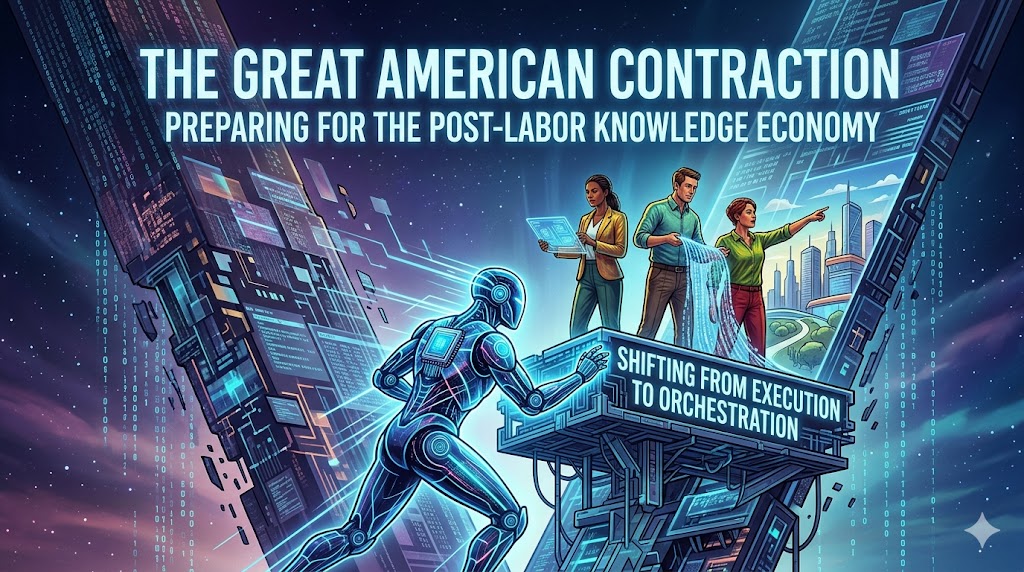
The AI New Deal

Another AI Soft Landing Scenario Exploration — Government as the Employer of First Resort

LAST UPDATED: May 2, 2026 at 5:33 PM

The AI New Deal

by Braden Kelley and Art Inteligencia


The Structural Gap: Why Process Automation Requires a Civic Pivot

As we navigate the accelerating displacement of cognitive and administrative labor, the conversation around the “AI soft landing” has reached a critical juncture. In my previous explorations, I’ve examined how our future might mirror the extreme wealth gaps of Victorian England and how we might witness a Human Premium Renaissance, where uniquely human traits become our most valuable currency.

However, a significant structural link is missing. While AI is exceptionally efficient at automating process, it is incapable of automating presence. This creates a dangerous void: as middle-class administrative roles evaporate, we risk losing the economic liquidity and social cohesion that sustain our communities.

The prevailing solution often discussed is Universal Basic Income (UBI). But as I have argued, UBI is a fiscal mirage — a passive mechanism that fails to account for the human need for agency and the staggering mathematical reality of devalued tax bases. We don’t need a handout; we need a Civic Dividend. We must move from a scarcity mindset focused on protecting obsolete jobs to an abundance mindset that funds the essential work we have historically neglected. This is the foundation of the AI New Deal: positioning the government as the Employer of First Resort.

The Fiscal and Psychological Mirage of UBI

Universal Basic Income (UBI) is often presented as the “silver bullet” for the AI age, but a closer look at the mechanics reveals it to be a flawed tool for a human-centered transition. From a design perspective, UBI solves for survival but fails to solve for contribution.

First, we must confront the Math Problem. Funding a meaningful UBI requires a robust and consistent tax base. However, as AI drives down the cost of labor toward zero, the income tax pool — the traditional engine of government revenue — shrinks alongside it. Relying on passive redistribution in a devalued labor market is a race to the bottom that risks a permanent “subsistence trap” for the majority of the population.

Second, there is the Agency Problem. Innovation thrives on human agency — the ability to act, create, and impact one’s environment. UBI provides a safety net but offers no platform for growth. By decoupling income from contribution, we risk creating a “useless class” not because humans lack value, but because we have failed to design systems that utilize their unique “Human Premium.”

Finally, we must consider the Inflation Trap. Without a mechanism to ensure the circulation of capital through local, human-to-human services, stagnant UBI payments are easily consumed by the rising costs of private-sector essentials. To achieve a soft landing, we need a dynamic model that prioritizes the Velocity of Money over the mere distribution of funds.

The Core Concept: The Civic Dividend

To bridge the gap between AI-driven efficiency and human necessity, we must introduce the Civic Dividend. This is not a social safety net designed for the desperate; it is a strategic economic platform designed for a high-functioning society. At its heart is a fundamental shift in the social contract: the Government as the Employer of First Resort.

In this model, the government doesn’t just step in when the private market fails; it proactively identifies and funds the “work that matters” — the essential maintenance of our physical, social, and cultural existence. These are the roles that require empathy, physical dexterity, and contextual judgment — capabilities that remain firmly in the human domain.

The Civic Dividend operates on the principle that human labor is a public asset. By offering potential employment in public works, care networks, and community resilience projects, the state ensures that most citizens have the opportunity to contribute. This creates a “Social Floor” of activity and income that is immune to algorithmic displacement.

Crucially, this work is not “make-work” intended to keep hands busy. It is the vital labor required to repair our crumbling infrastructure, support our aging population, and revitalize our neighborhoods. Unlike a handout, these wages are earned, providing the dignity of contribution while fueling the Velocity of Money. As these wages are spent at local bakeries, barbershops, and bookstores, they sustain a secondary human-to-human service economy that AI simply cannot replicate.

Three Pillars of AI New Deal

The Three Pillars of the AI New Deal

The success of the AI New Deal rests on a strategic focus on the “Un-automatable.” We must direct our collective energy toward three specific domains where human presence, judgment, and physical interaction are not just preferred, but essential for a thriving society.

Pillar 1: Physical and Digital Infrastructure

We are currently witnessing a “Tragedy of the Commons” in our physical world. Our bridges, transit systems, and power grids require more than just algorithmic optimization; they require physical intervention. The AI New Deal would mobilize a modern workforce to focus on Community Resilience — retrofitting cities for climate adaptation, urban “rewilding” to restore local ecosystems, and maintaining the physical nodes that allow our digital world to function. This work creates a tangible, high-quality public environment that serves as a shared wealth for all citizens.

Pillar 2: The Social and Care Fabric

As we automate cognitive tasks, the “Human Premium” in care becomes our most valuable asset. We are facing a global loneliness epidemic and an aging demographic that requires empathy, companionship, and nuanced psychological support. By professionalizing and scaling roles in elder care, mental health mentorship, and early childhood development, we transform these from marginalized sectors into the prestigious cornerstones of our new economy. These are roles where the goal is not “efficiency” (doing more with less time), but “effectiveness” (the quality of the human connection).

Pillar 3: Community Vitality and Cultural Resilience

In an era of AI-generated noise, local culture and verified information are at risk of erosion. The AI New Deal funds the “Civic Architects” — the local journalists, community theater directors, and public artists who document and celebrate the unique identity of a place. This pillar ensures that while our tools become more global and algorithmic, our lived experiences remain local, vibrant, and distinctly human. We aren’t just building roads; we are building the social connective tissue that prevents the isolation often triggered by rapid technological shifts.

Economic Mechanics: The Velocity of Human Connection

Economic Mechanics: The Velocity of Human Connection

The fiscal engine of the AI New Deal is built on a fundamental economic principle: the Velocity of Money. In a hyper-automated private sector, capital tends to pool at the top, concentrating in the hands of those who own the compute and the algorithms. Without a mechanism to pull that capital back into the hands of the many, the local economy — the shops, services, and neighborhood hubs — withers.

The Civic Dividend solves this by creating a continuous loop of circulation. When the government pays a living wage to a community health worker or a local infrastructure specialist, that income doesn’t sit idle. It is immediately recycled into the Human-to-Human (H2H) service economy. This worker buys bread from a local baker, gets a haircut from a neighborhood barber, and visits a local gym. These secondary businesses thrive precisely because their customers have earned, discretionary income to spend.

To fund this transition, we must look toward Automation Royalties or “Compute Taxes.” Rather than taxing labor — which AI is making artificially cheap — we shift the tax burden to the high-margin output of automated systems. This creates a sustainable cycle: the efficiency of AI funds the resilience of the human community.

Furthermore, the AI New Deal acts as a natural Inflation Buffer. By investing in public housing maintenance, efficient public transit, and community-led food resilience, we lower the “floor” of the cost of living. This ensures that the wages provided by the Civic Dividend maintain high purchasing power, shielding the population from the volatility of a purely algorithmic private market.

Addressing the Critics: Efficiency vs. Resilience

Critics often argue that government-led employment is inherently “inefficient” compared to the lean, optimized nature of the private sector. From the perspective of human-centered innovation, this critique misses the mark because it uses the wrong metric for success. In an AI-dominated age, social resilience is a far more valuable outcome than marginal efficiency.

The private sector’s drive for efficiency is exactly what is displacing workers. If we allow that same logic to dictate our social response, we end up with a society that is “optimized” into instability. The AI New Deal isn’t about competing with AI on speed or cost; it is about providing the stability that the private market, by its very nature, cannot offer. We are designing for systemic health, not just quarterly throughput.

Another common concern is the fear of “make-work” or a lack of individual choice. However, the AI New Deal is designed as a platform, not a cage. By providing a guaranteed social floor of meaningful work, we actually increase career mobility. When a citizen’s basic survival and dignity are secured through the Civic Dividend, they are more — not less — likely to take risks, launch their own H2H small businesses, or pursue creative endeavors in the Human Premium Renaissance.

Finally, we must recognize that this is a choice of design. We can choose to view displaced workers as a “surplus” to be managed, or we can view them as a massive, untapped reserve of human talent ready to be deployed toward the public good. The “inefficiency” of paying a human to do what an algorithm could do is only an inefficiency if you ignore the catastrophic social cost of a disengaged, impoverished populace.

AI New Deal: Designing a New Social Contract

Conclusion: Designing a New Social Contract

We stand at a unique design crossroads in human history. The rapid advancement of artificial intelligence has presented us with a fundamental choice: do we design a future of automated irrelevance, where a vast majority of the population subsists on a dwindling digital handout, or do we design a future of civic abundance?

The AI New Deal is more than an economic policy; it is a reaffirmation of the value of human contribution. It recognizes that while technology can manage our systems, only humans can care for our communities, preserve our culture, and maintain our physical world. By moving toward a model of the Government as the Employer of First Resort, we ensure that the wealth generated by the AI revolution is directly reinvested into the human experience.

This “soft landing” requires us to be bold. We must stop asking how we will survive without the jobs of the past and start asking what kind of world we could build if we finally had the resources and the hands to do it. The Civic Dividend offers a path where technology does the “tasks” so that humans can finally do the “work” of being human—creating a society that is not just more efficient, but more resilient, more connected, and more purposeful.

The tools are in our hands, and the need is all around us. Now, we simply need the courage to sign a new contract with ourselves and build the future we actually want to live in.


Braden Kelley is a leading futurist and trusted voice in human-centered innovation and change. Stay tuned for next week’s next installment in this series on the AI Soft Landing.

Frequently Asked Questions

How is the AI New Deal different from Universal Basic Income (UBI)?

While UBI provides a passive payment regardless of activity, the AI New Deal is a “Civic Dividend” based on active contribution. It positions the government as the Employer of First Resort, paying living wages for essential public work — such as infrastructure maintenance and care services — rather than providing a handout that lacks a connection to social agency or the local service economy.

How can the government afford to become the ‘Employer of First Resort’?

The funding shifts from taxing human labor to taxing the high-margin output of automated systems, often referred to as “Automation Royalties” or “Compute Taxes.” By capturing the wealth generated by AI-driven efficiency, the state can reinvest that capital into the Human-to-Human (H2H) economy, ensuring currency continues to circulate through physical communities.

Does this mean the government is creating ‘make-work’ just to keep people busy?

No. The AI New Deal focuses on the “Un-automatable” — high-value needs that are currently neglected, such as climate resilience, elder care, and mental health support. These are not arbitrary tasks; they are the essential services required for a functional, healthy society that AI cannot perform because they require human empathy, physical presence, and contextual judgment.

EDITOR’S NOTE: This is a visualization of but one possible future. I will be publishing other possible futures as they crystallize in my mind (or as you suggest them for me to explore).

Image credits: Google Gemini

Content Authenticity Statement: The topic area, key elements to focus on, etc. were decisions made by Braden Kelley, with a little help from Google Gemini to clean up the article, add images and create infographics.

Subscribe to Human-Centered Change & Innovation WeeklySign up here to get Human-Centered Change & Innovation Weekly delivered to your inbox every week.
Winning with Artificial Intelligence in 90 Days

Winning with Artificial Intelligence in 90 Days

Exclusive Interview with Charlene Li

The rapid evolution of artificial intelligence (AI) has shifted the technology from a futuristic curiosity to the primary engine of modern organizational growth. In an era defined by data-driven decision-making, the ability to effectively harness machine learning and predictive analytics is no longer just a competitive advantage; it is a fundamental requirement for long-term viability. However, the path to integration is rarely linear. Many organizations find themselves caught between the urgent need for transformation and the daunting reality of legacy infrastructure, talent shortages, and the cultural shifts required to move beyond small-scale pilots toward true enterprise-wide intelligence.

While the potential for increased efficiency and innovation is clear, the execution remains a significant hurdle.

The organizations that thrive in this new landscape are those that treat AI as a core strategic pillar rather than a plug-and-play software update. This requires a rethink of how human talent and machine intelligence coexist, ensuring that the technology enhances human capability rather than simply automating existing inefficiencies. Overcoming these challenges involves not just technical prowess, but a disciplined approach to change management and a clear vision for how intelligence will redefine the value the organization provides to its customers.

Today we will dive deep into what it takes to quickly achieve success with artificial intelligence with our special guest.

Creating a 90-Day Blueprint to Win with Artificial Intelligence

Charlene LiI recently had the opportunity to interview Charlene Li, a New York Times bestselling author, keynote speaker, and AI transformation strategist. Her latest book, Winning with AI: The 90-Day Blueprint for Success, co-authored with Dr. Katia Walsh, gives senior leaders a practical framework for moving from AI experimentation to measurable business value. Her prior books include The Disruption Mindset, Open Leadership, and Groundswell. Fast Company named her one of the most creative people in business, and she has worked with global organizations including 14 of the Dow Jones Industrial 30 companies. She is the founder of Altimeter Group (acquired by Prophet) and currently leads Quantum Networks Group.

Below is the text of my interview with Charlene and a preview of the kinds of insights you’ll find in Winning with AI: The 90-Day Blueprint for Success presented in a Q&A format:

1. What confusion is being created by speaking of “AI” as one thing when there are different kinds of AI, and how does this hold back AI adoption?

When people say “AI,” they’re usually thinking ChatGPT. But ChatGPT is generative AI — and that’s just one of three types of AI showing up in business today. There’s also predictive AI, which has been quietly running in your CRM, your fraud detection, and your streaming recommendations for years. And there’s agentic AI, which takes autonomous action toward a goal rather than waiting for a prompt.

The Oracle (predictive), the Creator (generative), and the Agent (agentic) — that’s how Katia and I describe them in Winning with AI. They do fundamentally different things, and they require fundamentally different things from you.

The conflation matters because it leads to bad decisions. Leaders see a generative AI demo, get excited, and ask their teams to “do something with AI” — when the actual business problem might be better solved with predictive AI (and probably already could’ve been three years ago). Or they hear “agentic AI” and assume their organization is ready to deploy autonomous agents when they haven’t even gotten generative AI into their workforce yet.

The winners aren’t choosing among types — they’re using all three strategically, in combination. A customer care transformation might use predictive AI to route inquiries, generative AI to draft responses, and agentic AI to handle routine cases autonomously. Once you can see the three distinctly, the question stops being “what can I do with AI?” and starts being “what can AI do for me?” That’s the question that actually unlocks value.

2. What are some of the key characteristics of AI inertia and some of the best ways to break free?

We call it pilot purgatory — and almost every organization we work with is stuck there. The signs are easy to spot: dozens of disconnected pilots, lots of conference attendance, lots of slide decks, no measurable financial impact. An MIT study found 95% of AI initiatives fail to scale. That’s not a technology failure. It’s a failure of leadership and culture.

The classic characteristics:

    • Use cases as a strategy. Many use cases equals procrastination. A long list of pilots is how organizations look busy without committing to anything.
    • Diffused accountability. When the CIO, CFO, and CMO all “share” responsibility for AI, no one owns the outcome.
    • Waiting for the foundation to be perfect. Clean data, the right platform, the perfect org structure — these become reasons to delay rather than constraints to solve through.
    • Confusing motion with progress. Running pilots feels like progress. It isn’t, unless those pilots are tied to your most important business problems.

To break free: pick your biggest strategic problems, figure out how AI solves them, invest heavily in those solutions, and move with urgency. Appoint one AI value owner who lives, breathes, and dreams AI outcomes. Kill pilots that aren’t on a path to scale. And replace “fail fast” with “learn fast” — nobody actually rewards failure, and the language of failure lets people walk away from things that should be pushed through.
Speed is the new moat. The companies that win aren’t the ones with the best technology. They’re the ones that adapt faster than their competitors.

3. There are still a lot of people out there not using AI (or not realizing that they are). What are some of the best ways for people to get started with AI?

Most people are already using AI — every spam filter, every Google Maps route, every recommendation on a streaming service is AI. So the real question is: how do you get started with the kind of AI that’s reshaping work right now, which is generative AI?

My advice is genuinely simple. Pick one of the major tools — Claude, ChatGPT, Gemini, Copilot — and start using it for one real task you do every week. Not a toy task. A real one. Drafting an email. Prepping for a meeting. Summarizing a long document. Brainstorming an approach to a problem you’re stuck on.

Two practical tips that make a big difference:

Write better prompts. A good prompt has a role (“Act as a marketing strategist”), instructions (what you want done), context (the background the AI needs), and an output format (memo, table, slide outline). Then refine through dialogue. Most people give AI two sentences and judge it on the result. Give it two paragraphs and you’ll be amazed.

Try the flipped interaction. Instead of asking AI for an answer, ask it to ask you questions until it has enough context to give a good answer. For example, at the end of a prompt, add this sentence: “Ask me any clarifying questions you may have.” It turns your prompt into a conversation.

I think of AI fluency as learning to eat with chopsticks: at first you’re concentrating on every motion, and eventually it’s just how you eat. You won’t get there by reading about it. You get there by using it. Every day. On real work.

4. Does AI safety really matter? It seems like all of the major AI players are just focused on speed and getting to AGI before China, am I wrong?

You’re not wrong about what the AI players are doing. But you’re probably not playing that game – more on that below. First, I’d push back on the framing that safety and speed are opposites.

Think of Formula 1. The drivers who win championships have absolute confidence in their brakes, their crash structures, their fire suppression systems. That’s why they can push so hard on speed. Safety is what makes speed possible. The companies moving fastest on AI adoption aren’t the ones cutting corners on responsibility — they’re the ones with the highest ethical standards, because trust eliminates friction. When your team knows where the guardrails are, when your customers trust your intentions, when your board has confidence in your approach, you can move at the speed AI demands.

The 2024 Edelman Trust Barometer found that 43% of people would reject AI in products and services if they don’t believe the innovation has been thoroughly scrutinized. That’s not a PR problem — it’s a revenue and competitive position problem.

On the AGI race specifically, the geopolitical framing oversimplifies what’s actually a much more textured conversation about how AI is deployed within companies, governments, and communities. Most leaders I work with aren’t worrying about AGI — they’re worrying about whether their AI customer service tool is treating customers fairly, whether their AI-driven hiring screen is introducing bias, and whether their data is being used in ways customers didn’t consent to. Those are the safety questions that matter for the next five years, regardless of what the frontier players are doing.

5. Where is the government being too hands off with AI and its impacts, and what conversations should governments and societies be having about AI and its impacts that they’re not?

I’ll be careful here because I’m not a policy person — I work with the leaders implementing AI inside organizations. But from that vantage point, a few things stand out.

The conversation we aren’t having enough is about workforce transition. Not “will AI take jobs” — we’ve been arguing about that abstractly for three years. The real question is what happens to the millions of people whose roles will substantially change in the next five years, and who’s responsible for helping them adapt. Right now, that’s mostly being left to individual employers, and the gap between what enlightened employers are doing and what the median employer is doing is enormous. That gap will become a societal problem long before regulators catch up.

The second underdiscussed conversation is about education. We’re training a generation of students with curricula designed for a pre-AI world. By the time we figure out what AI fluency looks like in K–12, the kids who needed it most will be in the workforce.

Third — and this is where I’d actually like to see governments lean in more — is data. Most AI regulation focuses on the models. The leverage is in the data: who owns it, how it can be used, what consent looks like in a world where data collected for one purpose can be repurposed for AI training that wasn’t imagined when it was collected.

That said, regulations always lag technology. Anchoring your responsible and ethical AI policy in your organization’s values rather than waiting for rules is the right move, regardless of what governments do.

6. What are the key pillars that form the basis of a strong AI foundation for those who seek to take full advantage of AI in their organization?

In Winning with AI, Katia and I lay out four building blocks. They develop together, not sequentially.

Mindset — the cultural ability to move at AI’s speed. Speed, focus, customer-centricity, experimentation, and learning from setbacks rather than treating them as evidence that the technology doesn’t work. Without the right mindset, you can have the best tools in the world, and they’ll sit unused.

Skillset — AI fluency across the workforce, not just in IT. Everyone needs to understand what AI can and can’t do, how to use it responsibly, and how to apply it to their actual work.

Toolset — the technical foundation. We tell leaders to build with LEGO, not cathedrals. Modular, interchangeable components you can swap as the technology evolves, sitting on top of data that’s good enough to start with.

Decision-set — the governance and decision-making structures that let you move fast without breaking things. Who decides what, how quickly, with what oversight.

The mistake organizations make is treating these as a sequence — first we’ll fix the data, then we’ll train people, then we’ll deploy. That sequence will take you a decade. The right approach is to build the blocks while delivering value, using each AI application to strengthen multiple blocks at once.

And one piece that wraps all four: leadership. Without active, visible commitment from the top, the four building blocks don’t compound. With it, they accelerate.

7. Of all the outcomes that the different types of AI can achieve, which activities create the most value for organizations?

Winning with AIWe frame the value AI creates in three areas: engagement, efficiencies, and reinvention.

Engagement is about deepening relationships with customers and employees through personalization, prediction, and proactive service. Anticipating what someone needs before they articulate it.

Efficiencies are about doing what you already do, faster and cheaper. This is where most organizations start — and where most get stuck. Efficiency gains are real, but they’re easy for competitors to replicate, which means they don’t create lasting advantage.

Reinvention is the most transformational and the most uncomfortable. It’s not asking “how can we do what we do faster?” — it’s asking “what becomes possible now that the old constraints are gone?” New business models. New revenue streams. New markets that were never economical before.

The trap is thinking efficiency is AI’s value. We call it the efficiency trap. Companies that limit themselves to efficiency are using a strategic weapon as a cost-cutting tool. The real competitive advantage comes from engagement and reinvention.

A great example: Coursera. Translation used to cost about $10,000 per course, which made global expansion economically impossible at the scale of their 5,000+ course catalog. Generative AI eliminated that constraint overnight. CEO Jeff Maggioncalda saw it immediately and launched Project Genesis by the end of 2022. That’s reinvention — AI removing a constraint that defined the business model.

If I had to pick one activity that creates the most value, it would be: using AI to remove a constraint that has shaped your industry’s economics for so long that nobody questions it anymore.

8. There was a lot of talk for a while about becoming an AI-first organization. Is this something that companies should be trying to do?

No. Be AI-ready instead.

“AI-first” is a technology company’s framing. It puts the technology in the driver’s seat, which sounds visionary but in practice produces dozens of disconnected pilots with no strategic impact. You end up chasing AI because it’s shiny rather than because it solves a real problem.

“AI-ready” is a business leader’s framing. It puts strategy in the driver’s seat. You’re building the culture, the skills, the decision systems, and the technical foundation that let AI create real value against the strategic priorities you already have.

Said simply: AI-first is a technology mindset. AI-ready is a business mindset.

You don’t actually need an AI strategy. You need a business strategy that uses AI. Anyone selling you on an AI strategy is selling you the wrong thing.

9. What should people be doing as individuals to maintain their value to their organizations and to grow their careers?

Three things, in order.

One: develop genuine AI fluency. Not “I’ve used ChatGPT a few times” fluency. Real fluency — the kind where AI is woven into how you think, prepare, decide, and communicate. The people and organizations who get to AI fluence in 2026 will pull dramatically ahead of those who don’t, and the gap will be very hard to close once it opens.

Two: deepen what’s uniquely human. AI can amplify cognition at speeds and scales no individual can match. What it can’t do is exercise empathy, self-reflection, intuition, judgment, and wisdom. These five traits — the foundation of what Katia and I call “superhumans” in the book — become more valuable, not less, as AI handles more of the cognitive work. The leaders who pair AI’s reach with these distinctly human capacities are the ones creating the most value.

Three: build a lifelong learning practice. The shelf life of any specific skill is shrinking. The skill that doesn’t depreciate is the ability to learn — quickly, repeatedly, with intellectual humility. Normalize not knowing. Embed reflection into how you work. Treat curiosity as a professional asset, not a side hobby.

If you do those three things, you’ll be more valuable in the future than you are today, regardless of what happens to your specific role.

10. What have organizations gotten wrong about rolling out AI and what can the early adopters do to recover from botched initial rollouts?

The biggest things organizations get wrong:

  • Treating AI as a technology project. It’s a business initiative for value creation that happens to use technology. When IT owns it, it stays small.
  • Use cases instead of strategy. A laundry list of pilots is procrastination dressed up as progress.
  • Diffused accountability. Without a single AI value owner, the work fragments.
  • Skipping the people work. Throwing tools at employees without addressing the fear underneath. Until fear is replaced by trust, no amount of training will change behavior.

If you’ve already botched the rollout, here’s the recovery path:

Stop and audit. What’s actually scaling, what’s not, what’s draining resources without producing value? Be honest. Sunset the dead ends.

Appoint one accountable AI leader. If no single person is accountable for AI value creation across the enterprise, fix that this quarter. Not part-time, not committee-led — one person whose performance is measured on the value that AI creates.

Pick one strategically meaningful problem and go after it. Not the easiest problem. The one whose solution would matter most to the business.

Learn from Ally Bank. When generative AI emerged, Ally’s CIO Sathish Muthukrishnan deliberately chose the most resistant audience — customer service agents — and a low-stakes problem: summarizing customer calls. The result was so valuable that the agents who’d been most skeptical became the loudest advocates: “Don’t take this away from me.” Targeting the skeptics with a real win is one of the most powerful change strategies we’ve seen.

A botched rollout isn’t a death sentence. It’s actually a useful clearing of the underbrush — assuming you learn from it.

11. Several studies have come out recently about the negative effects of AI on human cognition. Any tips for how to best use AI without degrading your brain?

This is a real concern and worth taking seriously. The risk isn’t AI itself — it’s lazy AI use. Using AI to skip thinking rather than to enhance it.

A few habits I’ve found useful:

Think first, then prompt. Before going to AI for an answer, write down what you think. Coursera’s Jeff Maggioncalda calls this cognitive bootstrapping — write your perspective on a decision, then ask AI to challenge it: “What are the strengths and weaknesses of this view? What are my blind spots? What would you recommend I improve?” AI sharpens your thinking instead of replacing it.

Treat AI outputs as drafts, not deliverables. Read critically. Push back. Ask why. Verify facts. The moment you stop questioning AI’s outputs is the moment your thinking starts to atrophy.

Protect deep work. Schedule time for thinking that doesn’t involve AI at all. Reading, writing, reflecting, walking — the unstructured time where your brain consolidates what it knows. AI can compress research, but it can’t compress wisdom. That still has to come from lived experience, integrated over time.

Notice the difference between using AI to accelerate something you understand and using AI to substitute for understanding. Acceleration is healthy. Substitution erodes you.

The promise of AI isn’t to do our thinking for us. It’s to help us think better. The discipline is staying on the right side of that line.

12. Any question you wish I had asked but didn’t?

Yes — I’d love a question about the human possibility on the other side of this.

Most AI conversation is about risk, displacement, and disruption. Those are real. But the conversation Katia and I get most excited about is what becomes possible when AI handles the cognitive work that has been depleting people for decades — the synthesis, the routing, the routine analysis — and frees up human capacity for what only humans can do.

We call those people “superhumans” — not because they’re enhanced by technology in some sci-fi sense, but because they finally have the room to be more deeply human. To exercise empathy, self-reflection, intuition, judgment, and wisdom at a level that’s been crowded out by cognitive overload.

The first companies to deliberately develop and organization filled with superhumans won’t just have a competitive advantage. They’ll be creating an entirely new form of value — one we haven’t fully named yet. That’s the future I want leaders thinking about. Not “how do I survive AI?” but “what becomes possible for my people on the other side of this?”

Dream it. Then build it.

Conclusion

Thank you for the great conversation Charlene!

I hope everyone has enjoyed this peek into the mind of one of the women behind the insightful new title Winning with AI: The 90-Day Blueprint for Success!

Image credits: Charlene Li, Pexels

Subscribe to Human-Centered Change & Innovation WeeklySign up here to join 17,000+ leaders getting Human-Centered Change & Innovation Weekly delivered to their inbox every week.

Designing Work for Humans and AI Agents to Do Together

LAST UPDATED: April 29, 2026 at 6:28 PM

Designing Work for Humans and AI Agents to Do Together

by Braden Kelley and Art Inteligencia


The Work Design Gap

We are not struggling to build artificial intelligence. We are struggling to design work for it.

Across industries, organizations are layering AI onto workflows that were never meant for collaboration. The result is predictable: inefficiency, mistrust, and unrealized value.

The real divide is not human versus AI. It is between work that is intentionally designed for collaboration and work that is not.

Why Traditional Tools Fail Us

Most of our management tools were built for a different era.

  • Process maps assume predictability
  • Org charts assume static roles
  • RACI models assume clear ownership

But human and AI collaboration is dynamic, contextual, and continuously learning. These tools help us optimize yesterday’s work, not design tomorrow’s.

What we need is a new visual language for collaboration.

Introducing the Human–AI Collaboration Canvas

The infographic below is not just a diagram. It is a thinking tool.

Its purpose is to make invisible interactions visible, clarify roles without over-constraining them, and embed judgment, trust, and learning into how work gets done.

This is a shift from process design to system design for collaboration.

Designing Work for Humans and AI Infographic

The Three-Lane Model: A More Honest Representation of Work

The canvas is built around three interconnected lanes:

The Human Lane

Where judgment, empathy, ethics, and accountability live. Humans frame the problem, not just solve it.

The AI Agent Lane

Where scale, speed, pattern recognition, and automation operate. AI expands what is possible.

The “Together” Lane

This is where value is actually created. Co-creation, co-decision, and co-learning happen here.

If you are not explicitly designing the middle lane, you are leaving value on the table.

The Work Journey: Sense → Decide → Act → Learn

Instead of rigid workflows, the canvas maps work as an adaptive cycle:

  • Sense: Understand context and gather signals
  • Decide: Blend human reasoning with AI recommendations
  • Act: Execute with scale and oversight
  • Learn: Reflect, adapt, and improve

Learning is not the end of the process. It feeds everything.

Collaboration Nodes: Where the Magic (or Failure) Happens

At key points in the journey are collaboration nodes—the moments where humans and AI interact.

Each node forces three critical questions:

  • Who leads?
  • What is the role of the other?
  • What is at stake?

Most AI failures are not technical failures. They are interaction design failures.

Making Judgment Visible

One of the biggest risks in AI adoption is invisible decision-making.

The canvas highlights:

  • Where human judgment is required
  • Where AI recommendations are sufficient
  • Where escalation is necessary

Automation without explicit judgment design is just risk at scale.

Designing for Trust, Not Just Performance

Capability alone is not enough. Systems must be trusted to be used effectively.

This requires:

  • Transparency
  • Explainability
  • Auditability

The real question is not “Can the AI do this?” but “Will humans trust and use this appropriately?”

Learning Loops: The System That Gets Smarter

The canvas includes two reinforcing learning loops:

  • AI Learning Loop: Data → Model → Output → Feedback → Improvement
  • Human Learning Loop: Experience → Reflection → Insight → Better decisions

The real competitive advantage is not AI itself. It is how quickly your combined system learns.

Risk, Ethics, and Failure by Design

No system is perfect. The best systems are designed with failure in mind.

The canvas highlights:

  • Bias and fairness
  • Privacy and security
  • Safety and compliance

It also asks essential questions:

  • What happens if the AI is wrong?
  • What happens if the human is wrong?
  • How do we recover?

Resilience comes from designing for breakdowns, not ignoring them.

Human-AI Agent Work Collaboration Canvas

How to Use This Canvas

This is a practical tool, not a theoretical one.

  • Use it in workshops to map collaboration
  • Audit existing workflows
  • Design new human–AI systems from scratch

A simple place to start:

  1. Map one critical workflow
  2. Identify collaboration nodes
  3. Redesign the “together” lane first

Designing for a More Human Future

AI does not reduce the need for humans. It raises the bar for how we design work.

The goal is not efficiency alone. The goal is better decisions, better experiences, and better outcomes.

The organizations that win will not be the ones with the most AI. They will be the ones who best design how humans and AI work together.

EDITOR’S NOTE: You should read this article too to learn more about atomizing work for man and machine to do together.

Content Authenticity Statement: The topic area, key elements to focus on, etc. were decisions made by Braden Kelley, with a little help from ChatGPT and Google Gemini to clean up the article, add images and create infographics.

Image credits: Google Gemini, ChatGPT

Subscribe to Human-Centered Change & Innovation WeeklySign up here to get Human-Centered Change & Innovation Weekly delivered to your inbox every week.
Go Beyond SLAs and Measure Human Success with the New XLM Matrix (free download)

An Experience Level Measure (XLM) is a metric that quantifies human experience success — not just system uptime or ticket speed. Where a traditional SLA (Service Level Agreement) commits to technical or operational performance, an XLM asks whether people can reach their goal without unnecessary friction, confusion, or cognitive fatigue.

The XLM (Experience Level Measure) Matrix™ is Braden Kelley’s visual workshop framework for moving from a specific “ugh” moment (friction) → to an XLM that measures the absence of that friction → to the innovation or design lever that improves it. Use it for customer, employee, partner, patient, or constituent experiences.

In short:

  • SLA = Did the system/process meet a technical threshold?
  • XLM = Did the human succeed without avoidable pain?
  • XLA (Experience Level Agreement) = A commitment to experience outcomes, informed by XLMs
  • XLM Matrix™ = The tool that connects friction → measure → fix

Free download: Get the XLM Matrix™ (11″×17″)
Related: Experience Design Glossary — XLM & XLA · Customer Experience Audit


Go Beyond SLAs and Measure Human Success with the XLM Matrix

by Braden Kelley


The Crisis of the “Efficient but Empty” Experience

In our current landscape of rapid digital transformation, we have achieved unprecedented levels of speed and automation. Organizations have mastered the “how” of delivery, yet many find themselves facing a growing paradox: processes are becoming more efficient while human satisfaction is simultaneously declining. We are successfully building faster systems that often leave the user feeling more like a cog in a machine than a valued participant.

The root of this issue lies in our reliance on traditional Service Level Agreements (SLAs). For decades, SLAs have served as the gold standard for operational success, measuring technical markers like system uptime, response times, and throughput. While these metrics are essential for maintaining infrastructure, they are fundamentally “cold” metrics. They can tell you that a system is functioning, but they cannot tell you if the person using that system is thriving, frustrated, or merely exhausted by the interaction.

To innovate effectively in a human-centered future, we must look beyond technical availability and begin measuring the actual quality of the human encounter. We need a shift in perspective—moving from monitoring system performance to measuring human success. This evolution requires a new framework: Experience Level Measures (XLMs). By focusing on how an innovation impacts the user’s cognitive load, sense of agency, and emotional resonance, we can move past “efficient but empty” outputs and toward solutions that deliver genuine value.

Introducing the XLM Matrix

To bridge the gap between technical output and human success, we developed the XLM (Experience Level Measure) Matrix. This visual framework is designed to help innovation teams move beyond abstract empathy and toward concrete, measurable experience improvements. By visualizing the relationship between friction, measurement, and action, teams can align their efforts with the outcomes that actually move the needle for their users.

The matrix is structured as a series of concentric rings, requiring teams to work from the “inside out” to ensure every innovation is rooted in a real-world human need:

  • The Inner Circle (The Friction Point): This is the starting line. Here, teams identify the specific “ugh” moment—the point in the journey where the user currently feels confused, slowed down, or disempowered.
  • The Middle Ring (The XLM): This layer transforms qualitative frustration into a quantitative metric. It asks: “How do we measure the absence of that friction?” An XLM isn’t about system uptime; it’s about the user’s success rate in reaching their goal without cognitive fatigue.
  • The Outer Ring (The Innovation Lever): Once the friction is identified and the metric is set, the outer ring focuses on the solution. It identifies the specific change in the product, service, or workflow that will directly influence the XLM and eliminate the friction point.

By using this “Target Logic,” teams ensure that they aren’t just innovating for the sake of novelty, but are strategically pulling levers that have a measurable impact on the human experience.

The XLM (Experience Level Measure) Matrix

The Four Pillars of Human-Centered Innovation

To provide a comprehensive view of the user experience, the XLM Matrix is divided into four critical quadrants. Each quadrant represents a fundamental pillar of how humans interact with technology and services. By examining an innovation through these four lenses, teams can uncover hidden friction points and prioritize improvements that resonate most deeply with their audience.

1. Cognitive Load

“Does this make the user’s life simpler or more complex?”

In an age of information abundance, mental energy is a finite resource. This pillar focuses on the mental effort required to complete a task. Innovation here is about reducing noise, simplifying navigation, and ensuring that the “cost of thinking” is kept to an absolute minimum.

2. Time-to-Value

“How quickly does the user reach their ‘Aha!’ moment?”

Success is often determined by the distance between a user’s first interaction and their first realization of value. This quadrant measures the speed of relevance. Effective innovation in this space removes barriers to entry and streamlines the path to a meaningful outcome.

3. Agency

“Does the user feel in control, or like a cog in the process?”

As systems become more autonomous, maintaining human agency is vital. This pillar explores whether a tool empowers the user or forces them into a rigid, predetermined path. High-agency innovations provide the user with the autonomy to make meaningful choices and direct the outcome.

4. Emotional Resonance

“Does the interaction build trust or cause frustration?”

Every interaction leaves an emotional footprint. This quadrant assesses the “vibe” of the experience. It looks beyond function to ask if the solution feels reliable, empathetic, and aligned with the user’s values, transforming a transactional moment into a relational one.

How to Use the Matrix with Your Team

The XLM Matrix is most effective when used as a collaborative workshop tool. By gathering cross-functional perspectives—from product and design to engineering and customer success—you can ensure a 360-degree view of the human experience. Follow these three steps to run your first experience audit:

Step 1: The Empathy Audit

Focus on the Inner Circle. Select one of the four quadrants and ask the team to identify the most persistent “ugh” moment currently facing the user. Be specific. Instead of saying “the checkout process is slow,” identify the exact friction point, such as “the user feels overwhelmed by the number of form fields.”

Step 2: Defining the Metric

Move to the Middle Ring. Once the friction point is clear, brainstorm how you would measure its absence. This is your Experience Level Measure (XLM). If the friction is cognitive overload from form fields, your XLM might be “reduction in time spent on the checkout page” or “a 20% increase in completion rate without support intervention.”

Step 3: Pulling the Innovation Lever

Reach the Outer Ring. Now, identify the specific technical or design change that will move that metric. This is your “Innovation Lever.” It could be an AI-driven auto-fill feature, a progress bar to improve the sense of agency, or a “save for later” option to reduce immediate emotional pressure.

Repeat this process for each quadrant to build a robust, human-centered innovation roadmap that prioritizes meaningful outcomes over simple feature checklists.

Conclusion: Creating a Human-Centered Future

The transition from measuring system performance to measuring human success is not just a technical shift; it is a cultural one. As we move deeper into an era of agentic AI and rapid digital acceleration, the organizations that thrive will be those that prioritize the human experience as their primary north star. Innovation is no longer defined solely by what we can build, but by how effectively we enable people to feel, act, and succeed.

The XLM Matrix provides a structured, repeatable path to this future. By moving from the friction of the “ugh” moment to the strategic clarity of the innovation lever, your team can ensure that every project delivers meaningful, human-centered value. It is time to stop guessing how our users feel and start building for their success.

Start Your Experience Transformation Today

Ready to move beyond SLAs? Download the high-resolution, 11″x17″ (works as A3 too) printable version of The XLM Matrix and begin identifying the measures that truly matter for your innovation team. You can also use it virtually by uploading it and locking it down as a background in Miro, Mural, LucidSpark, Figjam or the FREE Microsoft Whiteboard or Google Jamboard.


Download the Free XLM Matrix Canvas

Frequently Asked Questions

What is the difference between an SLA and an XLM?

A Service Level Agreement (SLA) measures technical system performance, such as uptime or response speed. An Experience Level Measure (XLM) focuses on human outcomes, measuring how effectively an innovation reduces cognitive load, increases user agency, or builds emotional resonance.

How does the XLM Matrix help innovation teams?

The XLM Matrix provides a visual framework to move from identifying user friction (“ugh” moments) to defining specific metrics and identifying the technical or design “levers” required to improve the human experience.

Can the XLM Matrix be used for internal digital transformation?

Yes. The matrix is highly effective for internal projects. By measuring the cognitive load and time-to-value for employees using new internal tools, organizations can ensure their digital transformation efforts actually increase productivity rather than just adding complexity.

Image credits: Braden Kelley, Google Gemini

Subscribe to Human-Centered Change & Innovation WeeklySign up here to get Human-Centered Change & Innovation Weekly delivered to your inbox every week.