A Complete Guide to Building Maps That Drive Decisions
by Braden Kelley and Art Inteligencia
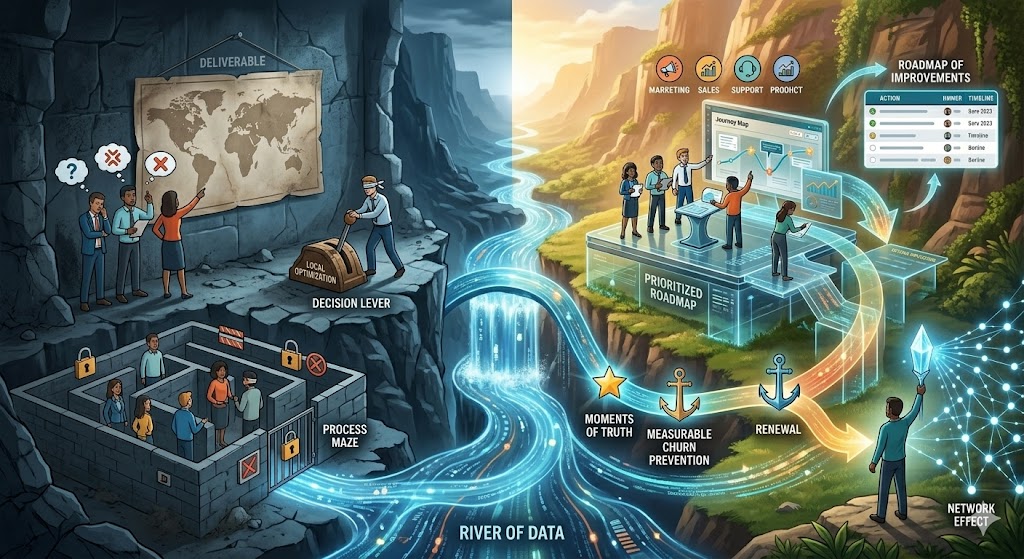
Customer journey mapping is one of the most powerful tools available to experience leaders — and one of the most frequently misused. Organizations create journey maps in workshops, hang them on walls, and then make the same experience investment decisions they would have made anyway. The map becomes a deliverable rather than a diagnostic, a picture of the experience rather than a catalyst for improving it.
Done well, customer journey mapping is the foundation of every significant customer experience improvement. It creates the shared organizational understanding of what customers actually experience — not what internal teams assume they experience — and translates that understanding into a prioritized roadmap of improvements with measurable revenue and retention implications.
The customer journey analytics market is valued at USD 17.91 billion in 2025 and is projected to reach USD 47.06 billion by 2032, growing at a CAGR of 14.8%. And 47% of businesses now use customer journey maps to identify and improve touchpoints — up sharply from a decade ago when this was niche UX work. The organizations investing in this capability are pulling ahead. This guide explains how to do it in a way that actually drives decisions.
What is Customer Journey Mapping?
Customer journey mapping is the process of creating a visual representation of every step, interaction, emotion, and decision a customer makes across their entire relationship with an organization — from first awareness through purchase, use, service, renewal, and advocacy.
A good journey map doesn’t just describe the customer journey — it guides it. It helps teams decide what to fix next, and why it matters. It integrates data, direct observation, and customer research to surface the gap between the experience you believe you are delivering and the experience customers are actually having.
Journey mapping is distinct from process mapping. A process map describes what your organization does. A journey map describes what the customer experiences — including the emotions, expectations, and frustrations that process maps systematically exclude. This distinction is why journey maps surface insights that internal process reviews consistently miss.
Why Customer Journey Mapping Matters
The business case for journey mapping is grounded in a simple reality: 52% of customers will switch to a competitor after a single negative interaction. Organizations that don’t systematically understand where their experience is falling short are making decisions about experience investment without the information needed to make them well.
Journey mapping delivers four specific organizational benefits:
Cross-functional alignment — Journey maps create a shared understanding of the customer experience across marketing, sales, support, and product teams. This shared understanding is a prerequisite for the cross-functional collaboration that experience improvement requires — you cannot fix a broken onboarding experience if product, marketing, and customer success are all looking at different parts of it.
Prioritized investment decisions — Maps highlight where to invest resources for the greatest return on customer experience improvements. Without a journey map, experience investment decisions are driven by whoever advocates most loudly, whatever the most recent customer complaint was, or whatever the current quarter’s metric is underperforming.
Proactive churn prevention — By identifying friction points before they cause churn, you can proactively address issues that drive customers away. Most churn is visible in the journey map long before it shows up in retention metrics.
Data-driven decisions — Journey maps replace intuition and assumption with evidence — creating an organizational baseline of what the experience actually is, against which investments can be evaluated and progress can be measured.
The Five Stages of the Customer Journey
While every organization’s customer journey has unique characteristics, most follow a common structural framework. A common model defines the key stages as: Awareness, Consideration, Purchase, Service, and Loyalty. Understanding what happens at each stage — and what can go wrong — is the foundation of effective journey mapping.
Stage 1: Awareness
The customer first discovers your organization exists. This may happen through search, social media, word of mouth, advertising, or a direct referral. The experience at awareness sets the first impression — the expectations that every subsequent touchpoint will be measured against. Common failure modes: unclear value proposition, inconsistent brand messaging across channels, poor search visibility for the queries that signal buying intent.
Stage 2: Consideration
The customer evaluates your organization against alternatives. They read reviews, compare features, visit your website, and may request a demo or trial. The experience at consideration determines whether interest converts to intent. Common failure modes: friction in the evaluation process (hard-to-find information, complex trial setups, slow response to inquiries), lack of social proof, and messaging that doesn’t address the specific concerns driving the evaluation.
Stage 3: Purchase
The customer makes the buying decision and completes the transaction. The experience at purchase either reinforces the confidence that drove the decision or introduces the first seeds of doubt. Common failure modes: complex purchase processes, unexpected fees or complications, hand-off failures between sales and implementation teams, and onboarding experiences that immediately disappoint the expectations set during the sales process.
Stage 4: Service and Use
The customer uses your product or service and encounters your support and service processes when needed. This is the longest stage of the journey and the one that most determines whether loyalty is built or eroded. Common failure modes: poor onboarding that prevents value realization, difficult-to-use products that generate avoidable service contacts, service interactions that resolve problems adequately but fail to rebuild confidence, and lack of proactive communication at high-risk moments.
Stage 5: Loyalty and Advocacy
The customer becomes a repeat buyer, expands their relationship, and ideally becomes an active advocate — recommending you to others. The experience at this stage determines whether customers are loyal because they genuinely prefer you or retained because switching is inconvenient. Common failure modes: transactional renewal conversations that don’t reinforce the relationship value, failure to recognize and reward loyal customers, and insufficient advocacy programs that leave willing promoters with no channel to express their support.
The Core Components of a Customer Journey Map
A complete customer journey map captures both the functional and emotional dimensions of the customer experience. Core elements to include are: Personas (general groups of customers based on demographics and psychographics), Actions (what the customer does at each touchpoint), and Timeline (the process of going through the touchpoints and phases of the journey). A fully developed map also includes:
Customer goals and expectations — What is the customer trying to accomplish at each stage? What do they expect from the experience? Understanding goals and expectations is what separates a journey map from a touchpoint list — it provides the context needed to evaluate whether the experience is actually serving the customer’s purpose.
Emotional journey — How does the customer feel at each touchpoint? Where is confidence building or eroding? A journey map without the emotion and pain-point layer is just a flowchart. Emotions are what connect functional experience data to loyalty outcomes — they are the mechanism through which experience quality translates into retention and advocacy.
Pain points and friction — Where is the experience creating unnecessary effort, confusion, or frustration? Pain points are the specific, actionable findings that make a journey map investable rather than decorative.
Moments of truth — The high-stakes touchpoints where the quality of the experience has a disproportionate impact on loyalty — typically first use, first service incident, and renewal. Moments of truth deserve particular attention in journey mapping because they are where trust is built or broken most rapidly.
Opportunity areas — Where are the specific improvements that would have the greatest impact on customer loyalty and revenue? These are the findings that translate a journey map into a business investment case.
Current-State vs Future-State Journey Mapping
A current-state journey shows how customers experience your brand right now — capturing real behavior, real friction, and real gaps between expectations and delivery. This creates a shared baseline where teams can see where customers hesitate, where effort piles up, and where trust is quietly lost.
A future-state journey map describes the experience you are designing toward — the ideal customer journey that addresses the pain points and gaps identified in the current state. Future-state mapping is where journey mapping connects to organizational strategy: it defines the experience standard you are building toward and provides a framework for evaluating whether specific improvements are moving you toward it.
The most effective journey mapping programs maintain both: using current-state maps to identify where to invest, and future-state maps to define what you are building toward. Customer journeys evolve constantly — which means journey maps must be treated as living documents rather than one-time deliverables.
How to Build a Customer Journey Map: A Practical Process
Step 1: Define scope and purpose
Before mapping, define which customer segment you are mapping, which stage of the journey you are focusing on (or whether you are mapping the full end-to-end journey), and what specific business question the map is designed to answer. Start with a clear purpose and scope — define which customer segment, journey stages, and key touchpoints you want to map. This focus creates a journey map that is specific and meaningful.
Step 2: Build evidence-based personas
Effective journey mapping requires genuine understanding of the customers being mapped — not internal assumptions about what customers want, but research-grounded profiles of who they actually are, what they are trying to accomplish, and what they experience today. Gathering data from customer feedback, behavioral data, demographic and persona details, and operational metrics ensures the personas reflect reality rather than organizational wishful thinking.
Step 3: Map the current-state journey
Document every touchpoint in the customer journey from the customer’s perspective — not the organization’s process map, but the sequence of interactions and experiences the customer actually encounters. For each touchpoint, capture what the customer is doing, what they are thinking and feeling, and where friction, confusion, or disappointment is occurring.
Step 4: Validate with real customers
The most common and most consequential journey mapping failure is building maps entirely from internal knowledge — documenting what employees believe customers experience rather than what customers actually experience. If you are still building journey maps from internal whiteboards and a few CSAT scores, you are mapping what your team thinks the customer feels — not what they actually feel. Direct customer research — interviews, observation, and journey walking — is essential for maps that produce genuine insight.
Step 5: Identify pain points and moments of truth
With the current-state journey documented and validated, identify the specific touchpoints where the experience is falling below customer expectations, creating unnecessary friction, or failing at high-stakes moments. Prioritize by frequency (how many customers encounter this pain point), severity (how significantly it affects loyalty and retention), and fixability (how much organizational effort and investment is required to address it).
Step 6: Translate insights into investment priorities
Identify the most important takeaways from your journey map, such as major pain points, customer expectations, or opportunities for delight. Translate these insights into concrete action items by assigning ownership to specific team members or departments. A journey map that doesn’t produce specific, owned actions with defined timelines is a decorative document, not a management tool.
Step 7: Build the future-state map
Define the experience you are designing toward — the journey that addresses the identified pain points, meets customer expectations at moments of truth, and delivers the consistency and emotional quality that builds genuine loyalty. Use the future-state map to evaluate proposed improvements against the standard you are working toward.
Common Journey Mapping Mistakes to Avoid
Mapping from the inside out — Building journey maps from internal process knowledge rather than customer research produces maps that describe what the organization does, not what customers experience. The gap between these two views is where the most valuable insights live.
Ignoring the emotional layer — Functional interactions matter, but emotions drive decisions. Include sentiment analysis at every touchpoint. A map that captures what customers do without capturing how they feel is missing the dimension that connects experience quality to loyalty outcomes.
Creating static maps — Customer journeys evolve constantly. A journey map created once and never updated quickly becomes a historical document rather than a current management tool. Build a process for regular review and update.
Mapping without clear ownership — Journey maps that are shared as organizational artifacts without specific improvement ownership consistently fail to produce action. Every pain point identified in the map should have an owner and a timeline.
Optimizing components in isolation — Improving individual touchpoints without considering their role in the full journey can produce local improvements that don’t translate to loyalty gains. Journey mapping is most valuable when it maintains the full customer perspective — evaluating each touchpoint in the context of the overall experience it contributes to.
Journey Mapping and the Experience Audit
A customer experience audit takes journey mapping to its fullest expression — combining the visual mapping of the customer journey with direct experience walking, competitive benchmarking, and quantitative data analysis to produce a complete, validated picture of where the experience is strong and where it is failing.
Where an internal journey mapping exercise is limited by organizational knowledge and assumptions, an experience audit brings external perspective — walking the journey with genuinely fresh eyes, comparing it against competitive alternatives, and applying practitioner experience from across industries to identify gaps that internal teams cannot see.
The result is a journey map that is not just accurate but prioritized by revenue impact — giving leaders a clear, actionable roadmap for experience investment that is grounded in competitive reality rather than internal benchmarks alone.
Frequently Asked Questions About Customer Journey Mapping
What is customer journey mapping?
Customer journey mapping is the process of creating a visual representation of every step, interaction, emotion, and decision a customer makes across their entire relationship with an organization — from first awareness through purchase, use, service, renewal, and advocacy. A journey map captures both the functional dimensions (what customers do) and the emotional dimensions (how customers feel) at each touchpoint, and uses this complete picture to identify where the experience is creating friction, falling below expectations, or missing opportunities to build loyalty. Done well, a customer journey map is a prioritized investment roadmap, not a decorative artifact.
What are the stages of the customer journey?
The most widely used customer journey framework defines five stages: Awareness (first discovery of the organization), Consideration (evaluation against alternatives), Purchase (the buying decision and transaction), Service and Use (ongoing use of the product or service and service interactions), and Loyalty and Advocacy (repeat purchasing, relationship expansion, and recommendation). Each stage has distinct customer goals, expectations, and common failure modes. A complete journey map examines all five stages and identifies the specific touchpoints within each where the experience is strengthening or undermining customer loyalty.
What is the difference between a customer journey map and a process map?
A process map describes what an organization does — the sequence of internal activities and handoffs that deliver a product or service. A customer journey map describes what the customer experiences — the sequence of interactions, emotions, and decisions the customer encounters from their perspective. The gap between these two views is often significant and revealing: process maps consistently omit the friction, confusion, and emotional reactions that determine whether customers are loyal or churning. Journey maps are most valuable precisely because they surface what process maps systematically miss.
How do you create a customer journey map?
Creating an effective customer journey map involves seven steps: define the scope and purpose of the map; build evidence-based customer personas from research rather than assumptions; map the current-state journey from the customer’s perspective; validate the map with direct customer research — interviews, observation, and journey walking; identify pain points and moments of truth prioritized by their impact on loyalty and revenue; translate insights into specific, owned improvement actions; and build a future-state map defining the experience you are designing toward. The most common mistake is building maps from internal knowledge alone — journey maps that aren’t validated against real customer research describe what organizations think happens, not what customers actually experience.
What is a moment of truth in customer journey mapping?
A moment of truth is a high-stakes touchpoint in the customer journey where the quality of the experience has a disproportionate impact on customer trust and loyalty. Common moments of truth include first product use (does it deliver on the sales promise?), first service incident (how does the organization respond when something goes wrong?), and renewal conversations (does the organization treat me as a valued customer or a transaction?). Moments of truth deserve particular attention in journey mapping because they are where trust is built or broken most rapidly — and where experience investment generates the greatest loyalty return.
How is customer journey mapping related to a customer experience audit?
Customer journey mapping is the foundation of a customer experience audit — but an experience audit takes mapping further by adding direct experience walking, competitive benchmarking, and quantitative data analysis to produce a complete, externally validated picture of where the experience is strong and where it is failing. An internal journey mapping exercise is limited by organizational knowledge and assumptions. An experience audit brings external perspective — walking the journey with fresh eyes, comparing it against competitive alternatives, and quantifying the revenue impact of identified gaps. The result is a journey map that is not just accurate but prioritized by competitive and financial impact.
Want a complete, validated map of your customer journey — with competitive benchmarks and prioritized improvement opportunities? Learn more about the Experience Audit →
Content Authenticity Statement: The topic area, key elements to focus on, etc. were decisions made by Braden Kelley, with a little help from Claude and Google Gemini to clean up the article, add images and create infographics.
Image credits: Google Gemini
 Sign up here to get Human-Centered Change & Innovation Weekly delivered to your inbox every week.
Pingback: Customer Service vs Customer Experience: Key Differences
Pingback: Customer Experience Benchmarking: How Do You Compare?
Pingback: Customer Loyalty: What Actually Builds It (It's Not Programs)