Author Archives: Braden Kelley

About Braden Kelley

Braden Kelley is a Human-Centered Experience, Innovation and Transformation practice lead at HCL Technologies, a popular innovation speaker, and creator of the FutureHacking™ and Human-Centered Change™ methodologies. He is the author of Stoking Your Innovation Bonfire from John Wiley & Sons and Charting Change (Second Edition) from Palgrave Macmillan. Braden is a US Navy veteran and earned his MBA from top-rated London Business School. Follow him on Linkedin, Twitter, Facebook, or Instagram.

Is Your Innovation Fire Fading?

LAST UPDATED: April 28, 2026 at 3:46 PM

Is Your Innovation Fire Fading?

by Braden Kelley

A common misconception in business is that innovation fails simply because of a shortage of good ideas. In reality, the “fire” is more often extinguished by the structural context in which those ideas are born.

Organizations often focus their energy on brainstorming sessions and ideation workshops, assuming that more ideas will lead to more success. However, volume and diversity are merely preconditions; they cannot overcome a rigid organizational environment.

The Reality: Strategic and Cultural Fire Extinguishers

Innovation is frequently hindered by structural barriers, poor information flow, and misaligned psychology. Without the right enabling conditions, even the most brilliant concepts will stall.

Key Themes for Transformation

  • Strategy vs. Experimentation: Innovation without strategy is merely experimentation, while strategy without innovation results in nothing more than incremental improvement.
  • Human-Centered Insight: Sustainable innovations are almost always rooted in deep, human-centered insights regarding customer needs and frustrations.
  • Structural Alignment: True innovation capability requires organizational structures and digital infrastructure that support rapid experimentation and collaboration across teams.

The Ten Dimensions of Innovation Health

To build a sustainable innovation capability, an organization must evaluate its performance across ten core diagnostic areas. These dimensions help identify whether your innovation “fire” has a strong foundation or is being restricted by hidden barriers.

  1. Vision: A compelling, shared starting point that inspires people to challenge the status quo.
  2. Strategy: Integrating innovation efforts into the broader strategic framework to avoid random experimentation.
  3. Goals: Using specific, measurable targets and leading indicators to focus creative energy.
  4. Insights: Generating deep, human-centered data about customer frustrations and unmet desires.
  5. Idea Generation: Creating conditions for a high volume and wide diversity of ideas across the organization.
  6. Idea Evaluation: Ensuring fair, rigorous, and innovation-friendly processes that guard against incremental bias.
  7. Idea Development: Providing dedicated pathways, resources, and rapid prototyping to turn concepts into reality.
  8. Organizational Psychology: Addressing the mindsets, autonomy, and fear of failure that dictate innovation behavior.
  9. Information and Structural: Optimizing organizational structures and information flows to remove “innovation drag.”
  10. Sustainability: Building innovation as a lasting, self-reinforcing capability rather than a one-time initiative.

Download Your FREE Innovation Health Checks

The Innovation Health Checks are designed to move beyond subjective feelings and toward evidence-based diagnostics. To get the most value from these tools, leadership teams should follow a disciplined approach to the audit process.

Evidence Over Aspiration

When rating your organization, it is critical to be honest and specific. You must base your scores on evidence and observable behavior rather than your intentions or what you believe should be happening. Scoring statements honestly ensures that you are diagnosing the actual state of your innovation “fire.”

Continuous Improvement and Maturity

Innovation health is not a one-time measurement. By repeating these health checks every 6–12 months, you can track your progress over time and identify new barriers that may emerge as your organization’s innovation capability matures.

From Diagnosis to Roadmap

While the Innovation Health Checks provide the diagnostic tools to identify where your fire is fading, they are designed to work in tandem with deeper strategic frameworks. These checks reveal the “what” and the “where,” serving as the essential starting point for any leader committed to building a sustainable culture of innovation and purpose.

Take the Next Step

Ready to clear the barriers identified in your scores?

Stoking Your Innovation Bonfire provides the comprehensive roadmap and deep-dive strategies required to transform these insights into a lasting competitive advantage.


Free download

10 Innovation Health Checks

Audit your leadership team’s innovation capacity with the full PDF toolkit drawn from Braden Kelley’s framework.

⇓  Download PDF


Get the book

Stoking Your Innovation Bonfire

Move your organization from incremental improvement to transformational growth with Braden Kelley’s complete roadmap.

Read the book →

Image credits: ChatGPT

Subscribe to Human-Centered Change & Innovation WeeklySign up here to get Human-Centered Change & Innovation Weekly delivered to your inbox every week.

AI State of the Union

Image Generation Edition

LAST UPDATED: April 26, 2026 at 11:39 AM

AI State of the Union - Image Generation Edition

by Braden Kelley


Watching the evolution of AI over the past eighty years (83 actually) has been fascinating to watch (admittedly, I haven’t been alive long enough to watch all of it), but the evolution over the past 3 1/2 years following an extended AI winter has been nothing short of amazing. To anchor us and set context for what’s next, here is ChatGPT’s evolution over the current AI spring:

The Evolution of GPT Models

A quick reference for the major milestones in generative AI development:

Version Release Date Key Achievement
GPT-3 June 2020 The first massive 175-billion parameter model.
ChatGPT Nov 2022 Brought generative AI to the general public via a chat interface.
GPT-4 March 2023 Introduced advanced reasoning and multimodal (image) support.
GPT-5 August 2025 A “network of models” approach for complex problem-solving.
GPT-5.5 April 2026 Current state-of-the-art model for nuanced reasoning.

Earlier this week OpenAI released a new image model and people were wondering why, after killing of their video model Sora to focus their limited resources, would they introduce a new, potentially resource hungry image model that will burn more of their compute?

My uninformed user perspective is that perhaps OpenAI’s leaders saw what it could do and they just couldn’t justify depriving the public of it given their stated mission to “ensure artificial general intelligence (AGI) benefits all of humanity.”

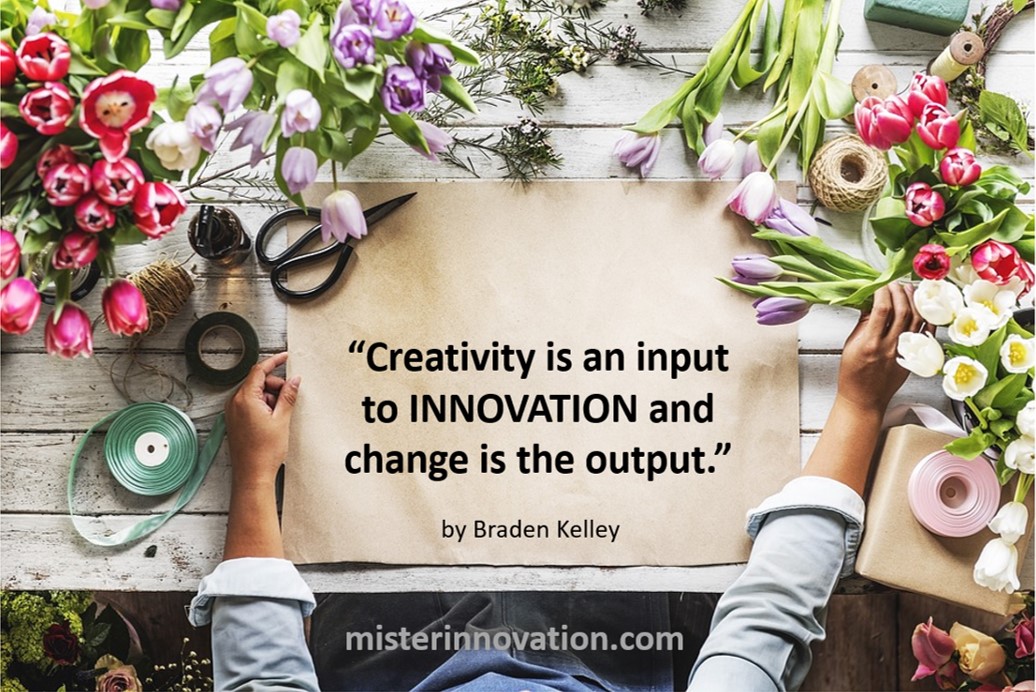
Creativity and Innovation and Change Quote

I’ve created more than 1,200 quote posters over the past few years for people to use in their meetings, presentations, keynotes and workshops (download them for FREE at http://misterinnovation.com) using freely available images initially from sites like Pixabay, Unsplash, Pexels and Wikimedia Commons like the one above because the image generation capabilities of the AI models were so bad.

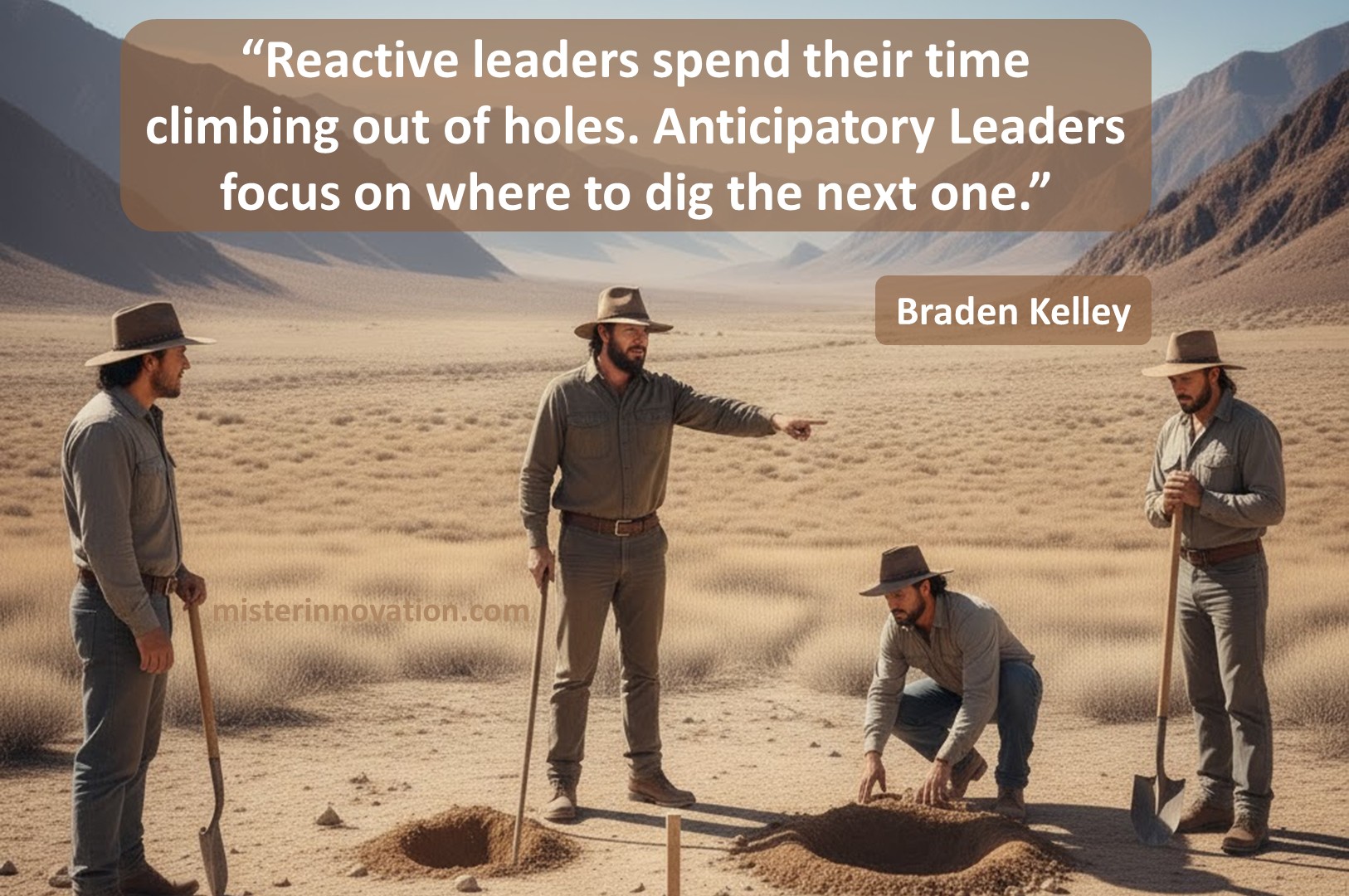
Anticipatory Leader Quote

Then about eight months ago when Google launched Nano Banana the AI image generation started to be good enough at capturing the essence of a quote to use an AI generated image instead of a photo (see the example above), before layering the quote in a translucent layer on top of it.

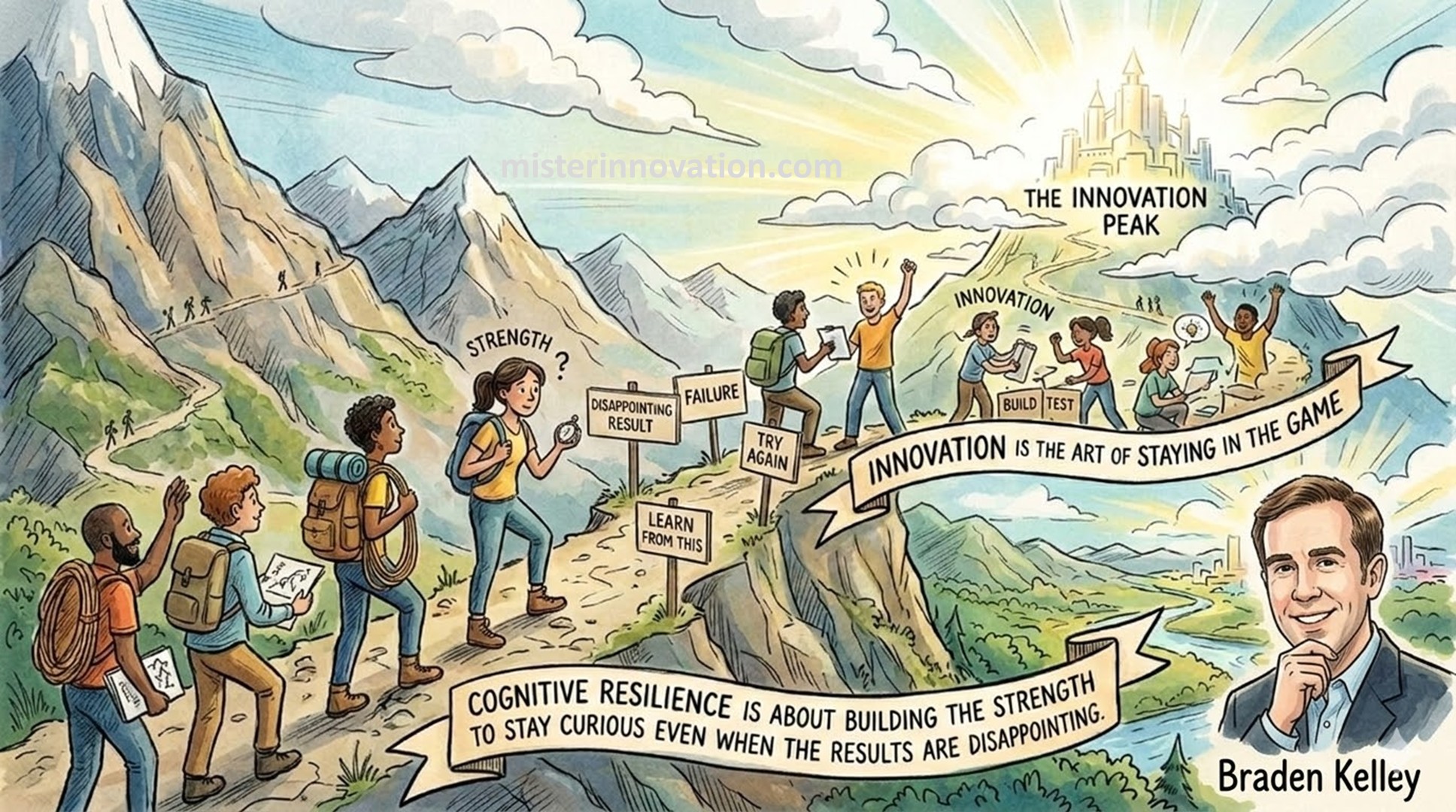
Cognitive Resilience Quote

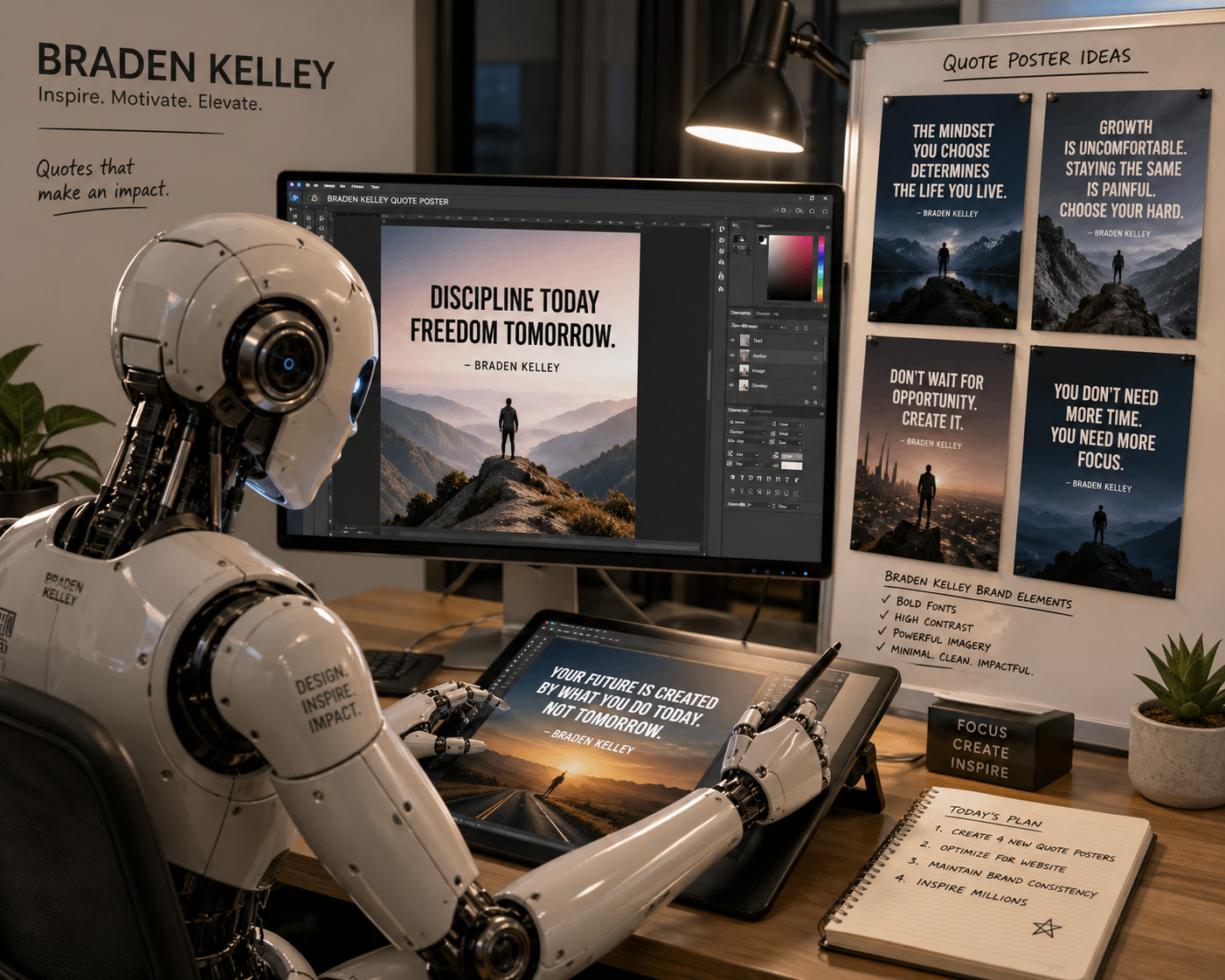
But then in March 2026 I started using Gemini’s Nano Banana 2 to start creating hand drawn style images for the quote posters (like the one above) because of it’s ability to MUCH BETTER handle the inclusion of text into an image. You can see in this image, not only was it able to include the quote in the image, but it was able to add some other supplementary text (on its own) into the image AND an image of me, without me asking it to!

I started using this hand drawn style for many of the quote posters I’ve created over the past couple of months, doing a daily bake-off between Gemini, ChatGPT and Grok (which loses 99% of the time) and in March 2026 Gemini was winning most of the bake-offs until maybe April when it started to be about 50-50 between Gemini and ChatGPT.

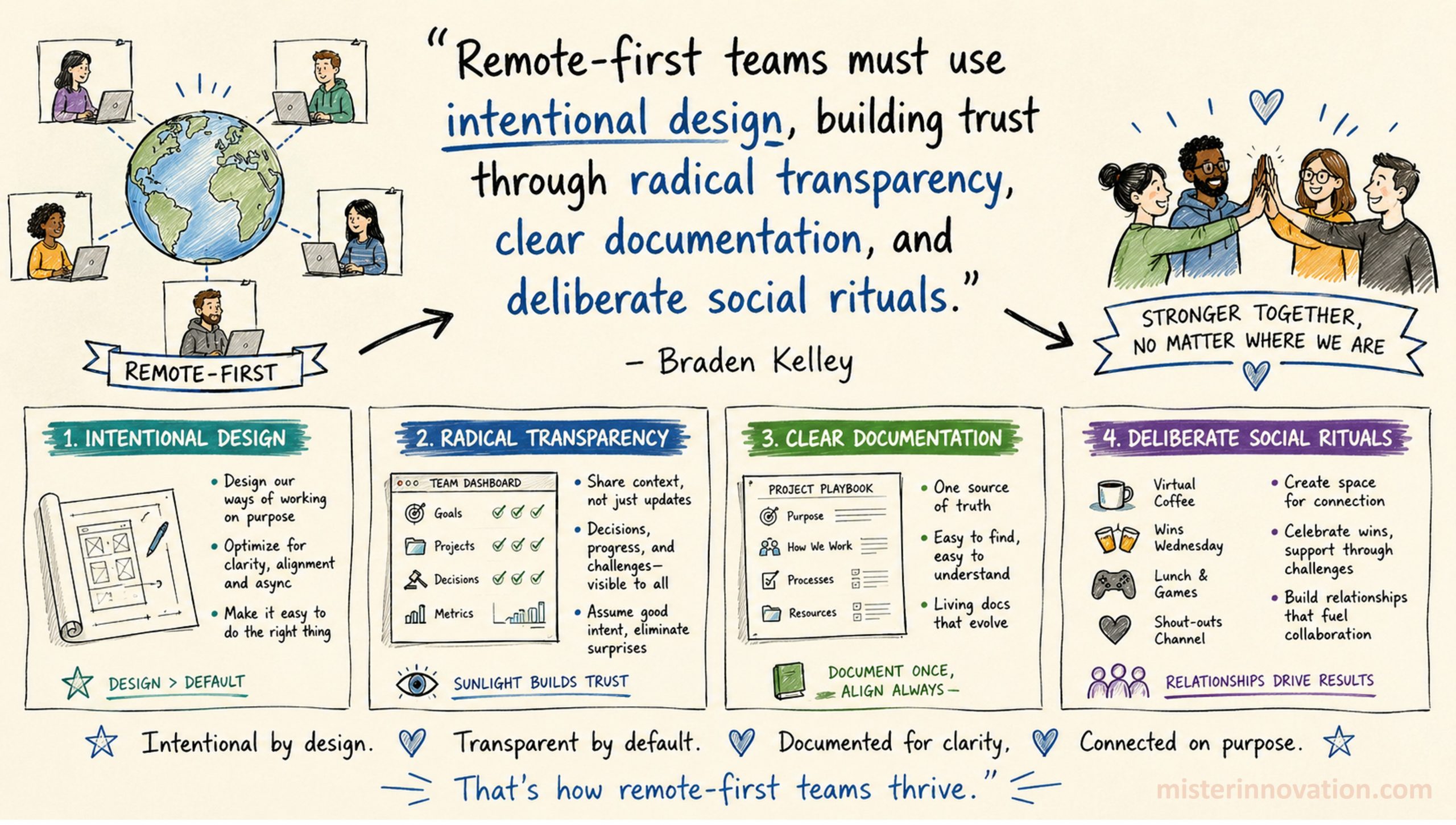
BUT, with the release of OpenAI’s new image model earlier this week, ChatGPT has been winning every day and it is because it has been creating images like this one off a single, simple text prompt with the quote, author and requested style provided:

Remote-First Intentional Design Quote

Now remember, all I gave ChatGPT was the quote and the author and asked it to capture the essence of the quote in a hand-drawn style. IT decided to add all of these other informational, education, inspirational elements and my jaw literally dropped.

If I was an OpenAI executive and saw this result to my prompt, I too would have argued for the release of this image model given OpenAI’s mission. This ability is superhuman. I as a human would have stopped at finding an image that reinforces or enhances the meaning of the quote.

This image model turned the quote into a multi-dimensional learning tool that transmits far more insight and information in a single document than the already powerful single sentence did.

The quote is still an important distillation that is far easier to remember and thus to drive behavior change from, but the rest of the content that the OpenAI image model created of its own volition adds value for those who want to quickly double-click on the essence and learn more.

So, this is where we are with AI image generation now, this is the kind of power these tools now have. The only question is:

What are you going to do with them next?

Image credits: Google Gemini and http://misterinnovation.com (download all 1,200+ FREE)

Subscribe to Human-Centered Change & Innovation WeeklySign up here to get Human-Centered Change & Innovation Weekly delivered to your inbox every week.

Which of the Nine Innovation Roles do you play? (A Quiz)

Which of the Nine Innovation Roles do you play? (A Quiz)

by Braden Kelley

Too often we treat people as commodities that are interchangeable and maintain the same characteristics and aptitudes. Of course, we know that people are not interchangeable, yet we continually pretend that they are anyway — to make life simpler for our reptile brain to comprehend.

I’m of the opinion that all people are creative, in their own way. That is not to say that all people are creative in the sense that every single person is good at creating lots of really great ideas, nor do they have to be. I believe instead that everyone has a dominant innovation role at which they excel, and that when properly identified and channeled, the organization stands to maximize its innovation capacity. I believe that all people excel at one of Nine Innovation Roles, and that when organizations put the right people in the right innovation roles, that your innovation speed and capacity will increase.

The Nine Innovation Roles as a concept were introduced in my bestselling book Stoking Your Innovation Bonfire and people have always asked me if I had a quiz people could take to see what their primary and secondary roles are and my answer has always been NO, until now, when thanks to Claude I’ve been able to create one for the world to enjoy. I think it turned out pretty well and I’ve embedded it here in this article and also create a Nine Innovation Roles Quiz sub-page for it live on in perpetuity.

I hope you enjoy it!

✦

Discover Your
Innovation Role

Answer 20 questions to uncover where you add the most value in any innovation effort. Based on Braden Kelley’s Nine Innovation Roles framework.

✦
Question 1 of 20 0%
Question 1

The Nine Innovation Roles

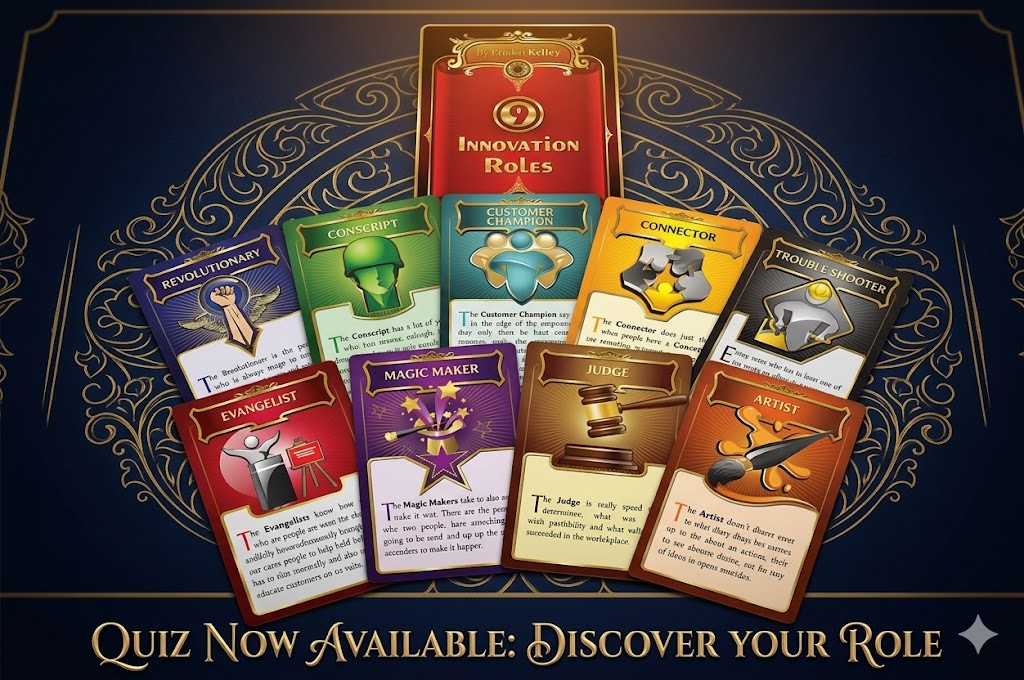
If you’re not familiar with the Nine Innovation Roles, they are:

Nine Innovation Roles Revolutionary

1. Revolutionary

The Revolutionary is the person who is always eager to change things, to shake them up, and to share his or her opinion. These people tend to have a lot of great ideas and are not shy about sharing them. They are likely to contribute 80 to 90 percent of your ideas in open scenarios.

Nine Innovation Roles Conscript

2. Conscript

The Conscript has a lot of great ideas but doesn’t willingly share them, either because such people don’t know anyone is looking for ideas, don’t know how to express their ideas, prefer to keep their head down and execute, or all three.

Nine Innovation Roles Connector

3. Connector

The Connector does just that. These people hear a Conscript say something interesting and put him together with a Revolutionary; The Connector listens to the Artist and knows exactly where to find the Troubleshooter that his idea needs.

Nine Innovation Roles Artist

4. Artist

The Artist doesn’t always come up with great ideas, but artists are really good at making them better.

.

Nine Innovation Roles Customer Champion

5. Customer Champion

The Customer Champion may live on the edge of the organization. Not only does he have constant contact with the customer, but he also understands their needs, is familiar with their actions and behaviors, and is as close as you can get to interviewing a real customer about a nascent idea.

Nine Innovation Roles Troubleshooter

6. Troubleshooter

Every great idea has at least one or two major roadblocks to overcome before the idea is ready to be judged or before its magic can be made. This is where the Troubleshooter comes in. Troubleshooters love tough problems and often have the deep knowledge or expertise to help solve them.

Nine Innovation Roles Judge

7. Judge

The Judge is really good at determining what can be made profitably and what will be successful in the marketplace.

.

Nine Innovation Roles Magic Maker

8. Magic Maker

The Magic Makers take an idea and make it real. These are the people who can picture how something is going to be made and line up the right resources to make it happen.

.

Nine Innovation Roles Evangelist

9. Evangelist

The Evangelists know how to educate people on what the idea is and help them understand it. Evangelists are great people to help build support for an idea internally, and also to help educate customers on its value.

So, which one(s) resonate most with you? Want to find out if you’re right? Take the quiz!

Free Stuff

If you go to the main Nine Innovation Roles page you’ll find all kinds of free downloads and sub pages, including:

  1. Nine Innovation Roles pages in Spanish, Portuguese, French and Swedish (and I’m always happy to give credit and link to anyone willing to translate them into other languages)
  2. Nine Innovation Roles card design to download for printing with adMagic (or your vendor)
  3. Nine Innovation Roles downloadable presentation
  4. Nine Innovation Roles team worksheet
  5. Nine Innovation Roles introductory video to use in workshops
  6. This Nine Innovation Roles Quiz!

Keep innovating!

Click here to access your Nine Innovation Roles freebies

Image Credits: Braden Kelley, Google Gemini

Why an AI Soft Landing Might Look Like Victorian England

LAST UPDATED: April 18, 2026 at 3:29 PM

Why an AI Soft Landing Might Look Like Victorian England

by Braden Kelley and Art Inteligencia


The Mirage of the Post-Scarcity Utopia

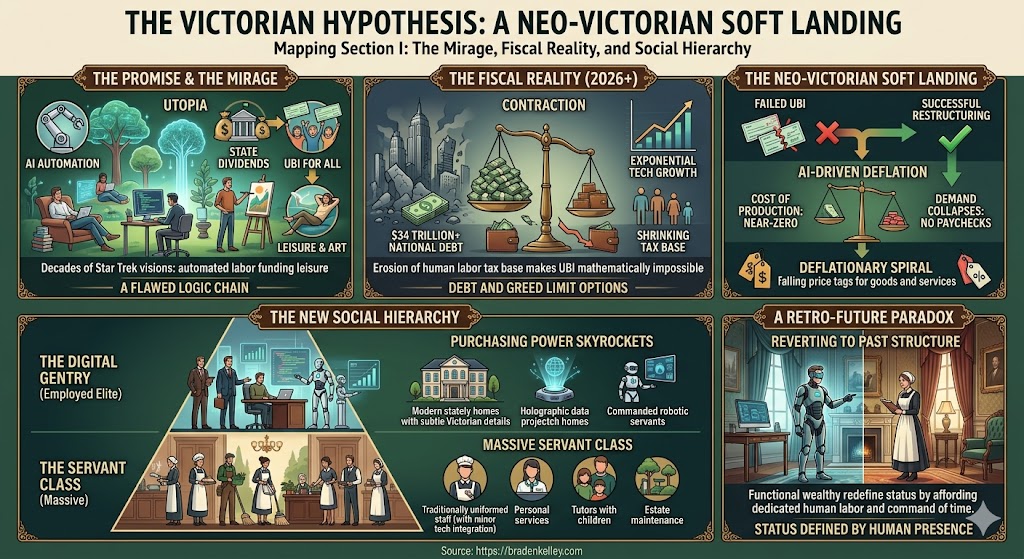
For decades, the prevailing narrative surrounding artificial intelligence has been one of a post-scarcity “Star Trek” future. The logic was simple: as machines took over the labor, the dividends of automation would be harvested by the state and redistributed via Universal Basic Income (UBI), freeing humanity to pursue art, philosophy, and leisure.

The AI Promise vs. The Fiscal Reality

However, this utopian vision ignores the gravity of The Great American Contraction. As we approach 2026 and beyond, the friction between exponential technological growth and a $37 trillion+ national debt (with a $2 trillion annual budget deficit) creates a structural barrier to redistribution. When the tax base of human labor erodes, the math for a livable UBI simply fails to compute.

The Victorian Hypothesis

If UBI is a mathematical and political impossibility fueled by corporate and human greed, we must look toward an alternative “soft landing.” This hypothesis suggests a vertical restructuring of society. As AI drives the cost of production and the demand for goods into a deflationary spiral, the purchasing power of the remaining “employed elite” will skyrocket.

The result isn’t a horizontal distribution of wealth, but a return to a Neo-Victorian social hierarchy. In this reality, the new digital gentry will use their outsized wealth to employ a massive “servant class” to maintain stately homes and personal lives, creating a world where status is defined by the human labor one can afford to command.

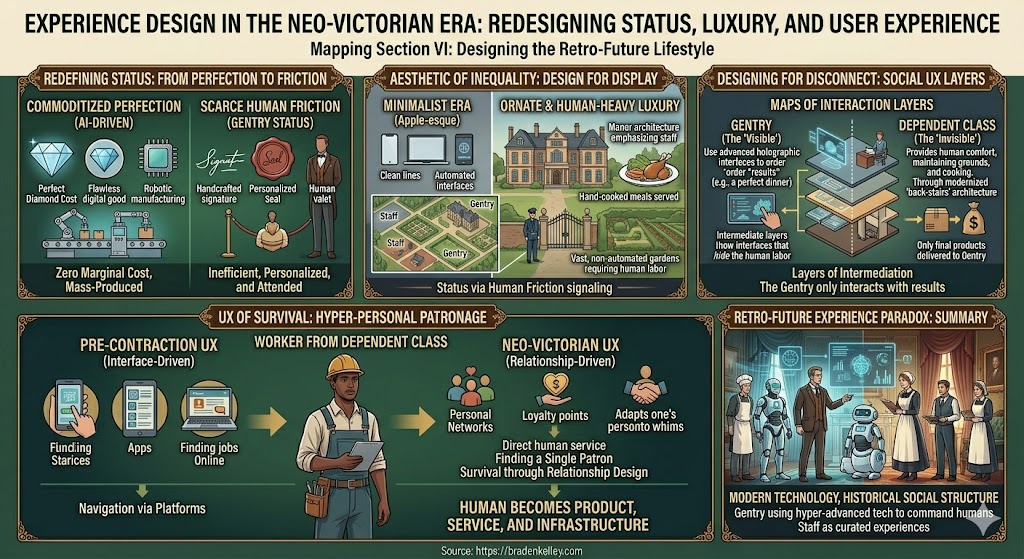
Neo-Victorian Hypothesis Infographic

The Great American Contraction: Why UBI is a Non-Starter

The conversation around the transition to an AI-driven economy often treats Universal Basic Income as an inevitability — a safety net that will naturally catch those displaced by the silicon wave. However, this assumes a level of fiscal elasticity that no longer exists. We are entering The Great American Contraction, a period where the traditional levers of government spending are restricted by the sheer weight of historical obligation and systemic greed.

The Debt Ceiling of Compassion

With a national debt exceeding $37 trillion, a $2 trillion budget deficit and rising interest rates, the federal government’s “room to maneuver” has effectively vanished. A livable UBI requires a massive, consistent tax base. As AI begins to hollow out the middle class, the very tax revenue needed to fund such a program disappears. To fund UBI under these conditions would require a level of sovereign borrowing that the global markets simply will not support, leading to a reality where the government cannot afford to be the savior of the displaced.

The Greed Variable

Even if the math were more favorable, the human element remains a constant. Corporate interests, focused on margin preservation and shareholder value, are unlikely to support the aggressive taxation required to fund a social floor. In the race to the bottom of production costs, the primary goal of the “winners” in the AI revolution will be wealth concentration, not social equity. The political willpower to force a massive transfer of wealth from AI-profiting corporations to the idle masses is a historical outlier that we should not count on repeating.

The Velocity of Displacement

Finally, the speed of the AI transition is its most disruptive feature. Legislative bodies move in years, while AI cycles move in weeks. By the time a political consensus for UBI could be formed, the economic floor will have already fallen out. This lag time creates a vacuum that will be filled not by government checks, but by a desperate search for subsistence, setting the stage for the return of the domestic labor economy.

The Deflationary Paradox: Collapse of Demand and Cost

In a traditional economy, unemployment leads to recession, which usually leads to stagflation or managed recovery. However, the AI-driven “soft landing” introduces a unique mechanical failure: the Deflationary Paradox. As AI and advanced robotics permeate every sector, the labor cost of producing goods and services begins to approach zero, but the pool of consumers capable of buying those goods simultaneously evaporates.

The Production Floor Drops

We are witnessing the end of the labor theory of value. When an AI can design, a robot can manufacture, and an automated fleet can deliver a product without a single human touchpoint, the marginal cost of production hits the floor. In a desperate bid to capture the dwindling “active” capital in the market, companies will engage in a race to the bottom, causing the prices of physical and digital goods to deflate at a rate unseen in modern history.

The Demand Vacuum

While cheap goods sound like a boon, they are a symptom of a deeper rot: the Demand Vacuum. As the middle class is hollowed out, the velocity of money slows to a crawl. The economy shifts from a mass-consumption model to a precision-consumption model. Most businesses will fail not because they can’t produce, but because there are no longer enough customers with a paycheck to buy, even at rock-bottom prices.

The Purchasing Power of the “Remaining”

This is where the Victorian shift begins. For the small percentage of Americans who retain their income — the innovators, the orchestrators, and the entrepreneurs — this deflationary environment is a golden age. Their dollars, fixed in value while the cost of everything else drops, suddenly possess exponential purchasing power. When a gallon of milk or a digital service costs mere pennies in relative terms, the “wealthy” find themselves with a massive surplus of capital that cannot be spent on “things” alone. This surplus will naturally be redirected toward the one thing that remains scarce and high-status: the dedicated service of another human being.

The New “Stately Home” Economy

As the Deflationary Paradox takes hold, we will see a fundamental shift in the definition of luxury. In the pre-AI era, luxury was defined by the acquisition of high-tech gadgets or rare goods. In the Neo-Victorian era, where machines produce goods for nearly nothing, “luxury” will pivot back toward the human-centered experience. Status will no longer be measured by what you own, but by whose time you command.

From Software to Service

For the “In-Group” — those entrepreneurs and specialized leaders still generating significant revenue — capital will lose its utility in the digital marketplace. When software is free and manufactured goods are commoditized, wealth seeks the only remaining friction: human presence. We will see a massive migration of capital away from Silicon Valley “platforms” and toward the local domestic economy. The wealthy will stop buying more “things” and start buying “lives” — the total dedicated attention of house managers, chefs, valets, and tutors.

The Modern Manor

This economic shift will be physically manifested in the return of the Stately Home. These won’t just be houses; they will be complex ecosystems of employment. Large estates will once again become the primary employer for local communities. As traditional corporate offices vanish, the residence becomes the center of both social and economic power. These modern manors will require extensive human staffs to cook, clean, maintain grounds, and provide security — services that, while technically possible via robotics, will be performed by humans as a deliberate signal of the owner’s immense “effectively wealthy” status.

The Return of the Domestic Professional

Perhaps the most jarring aspect of this transition will be the class of worker entering domestic service. We are not talking about a traditional blue-collar service shift, but the “Victorianization” of the former middle class. Displaced white-collar professionals — accountants, teachers, and middle managers — will find that their highest-paying opportunity is no longer in a cubicle, but in managing the complex domestic affairs, private education, and logistics of the new digital aristocracy. It is a “soft landing” in name only; while they may live in proximity to grandeur, their survival is entirely tethered to the whims of their employer.

Socio-Economic Stratification: The Two-Tiered Reality

The inevitable result of the “Victorian Soft Landing” is the formalization of a rigid, two-tiered social structure. Unlike the 20th century, which was defined by a fluid and expanding middle class, the post-contraction era will be characterized by extreme polarization. The economic “missing middle” creates a vacuum that forces every citizen into one of two distinct realities: the Digital Gentry or the Dependent Class.

The Corporate and Government Gentry

A small percentage of Americans — likely less than 10% — will remain tethered to the engines of primary wealth creation. This “In-Group” consists of high-level AI orchestrators, strategic entrepreneurs, and essential government officials who maintain the infrastructure of the state. Because their income is derived from high-margin automated systems while their cost of living has plummeted due to deflation, they possess a level of functional wealth that rivals the landed gentry of the 19th century. To this group, the “Great Contraction” is not a crisis, but a refinement of their dominance.

The Dependent Class

For those outside the digital fortress, the reality is stark. Without a national UBI to provide a floor, the majority of the population becomes the “Dependent Class.” Their economic utility is no longer found in the marketplace of ideas or manufacturing, but in the marketplace of personal service. In this neo-Victorian landscape, you either work for the companies that own the AI, work for the government that protects it, or you work directly for the individuals who do.

The Choice: Service or Scarcity

This stratification reintroduces a primal power dynamic into the American workforce. When the cost of basic survival (food and shelter) is low due to deflation, but the opportunity for independent income is zero, the wealthy gain total leverage. The “soft landing” is, in truth, a forced labor transition. Those who are not “useful” to the gentry — either as specialized labor or domestic support — face the grim reality of the Victorian workhouse era: they must find a patron to serve, or they will starve in a world of plenty.

Experience Design in the Neo-Victorian Era

Experience Design in the Neo-Victorian Era

From the perspective of experience design and futurology, the shift toward a Victorian-style social structure will fundamentally alter the aesthetic of status. In a world where AI can generate perfect, flawless goods and digital experiences at zero marginal cost, “perfection” becomes a commodity. Status, therefore, will be redesigned around human friction and intentional inefficiency.

The Aesthetic of Inequality

We will see a move away from the sleek, minimalist “Apple-esque” design of the early 21st century toward a more ornate, human-heavy luxury. Experience design for the elite will emphasize things that AI cannot authentically replicate: the slight imperfection of a hand-cooked meal, the presence of a uniformed gatekeeper, and the physical maintenance of vast, non-automated gardens. Architecture will pivot back to “human-centric” layouts—designing spaces not for efficiency, but to accommodate the movement and housing of a live-in staff.

Designing for Disconnect

The most challenging aspect of this new era will be the Experience of the Invisible. Designers will be tasked with creating systems that allow the Digital Gentry to interact with their environment without acknowledging the vast economic disparity surrounding them. This involves “Social UX” — designing layers of intermediation where the “Dependent Class” provides the comfort, but the “Gentry” only interacts with the result. It is a return to the “back-stairs” architecture of the 19th century, modernized for a digital age.

The UX of Survival

For the majority, the “User Experience” of daily life will be one of Hyper-Personal Patronage. Navigation of the economy will no longer be about interfaces or platforms, but about the “UX of Relationships.” Survival will depend on the ability to design one’s persona to be indispensable to a wealthy patron. In this reality, human-centered design takes on a darker, more literal meaning: the human becomes the product, the service, and the infrastructure all at once.

Conclusion: Preparing for the Retro-Future

The “Soft Landing” we are currently engineering is not the one we were promised. As the Great American Contraction forces a collision between astronomical debt and the deflationary power of AI, the middle-class dream of a subsidized leisure class is evaporating. In its place, we are seeing the blueprints of a Retro-Future — a world that looks forward technologically but moves backward socially.

A Call for Human-Centered Transition

If we continue to view innovation solely through the lens of efficiency and margin preservation, the Victorian outcome is not just possible — it is inevitable. We must realize that without a radical redesign of how we value human contribution beyond mere “market productivity,” we are simply building a more efficient feudalism. True Experience Design must now focus on the social fabric, or we risk creating a world where the only “innovation” left is finding new ways for the many to serve the few.

Final Thought: The Soft Landing Paradox

We must be careful what we wish for when we ask for a “seamless” transition. A landing that is “soft” for the Digital Gentry is one where the friction of poverty and the noise of the displaced have been successfully silenced by the return of the servant class. History doesn’t repeat, but it does rhyme — and right now, the future sounds remarkably like 1837. The question is no longer if AI will change our world, but whether we have the courage to design a future that doesn’t require us to retreat into our past.

Frequently Asked Questions

Why would prices deflate if the economy is struggling?

In this scenario, AI and robotics drive the marginal cost of production toward zero. Simultaneously, massive job displacement creates a “demand vacuum.” To capture what little liquid currency remains, companies must drop prices drastically, leading to a reality where goods are incredibly cheap but income is even scarcer.

How does this differ from the 20th-century middle class?

The 20th century was defined by a “horizontal” distribution where many people owned moderate assets. The Neo-Victorian model is “vertical.” The middle class disappears, replaced by a tiny, hyper-wealthy elite (Digital Gentry) and a large class of people who provide them with personalized human services (the Servant Class).

Isn’t UBI a more logical solution to AI displacement?

While logical in theory, the “Great American Contraction” hypothesis suggests that high national debt and corporate prioritisation of margins make a livable UBI politically and fiscally impossible. Without a state-funded floor, the market defaults to the oldest form of social safety: personal patronage and domestic service.

EDITOR’S NOTE: This is a visualization of but one possible future. I will be publishing other possible futures as they crystallize in my mind (or as you suggest them for me to explore).

Image credits: Google Gemini

Content Authenticity Statement: The topic area, key elements to focus on, etc. were decisions made by Braden Kelley, with a little help from Google Gemini to clean up the article, add images and create infographics.

Subscribe to Human-Centered Change & Innovation WeeklySign up here to get Human-Centered Change & Innovation Weekly delivered to your inbox every week.

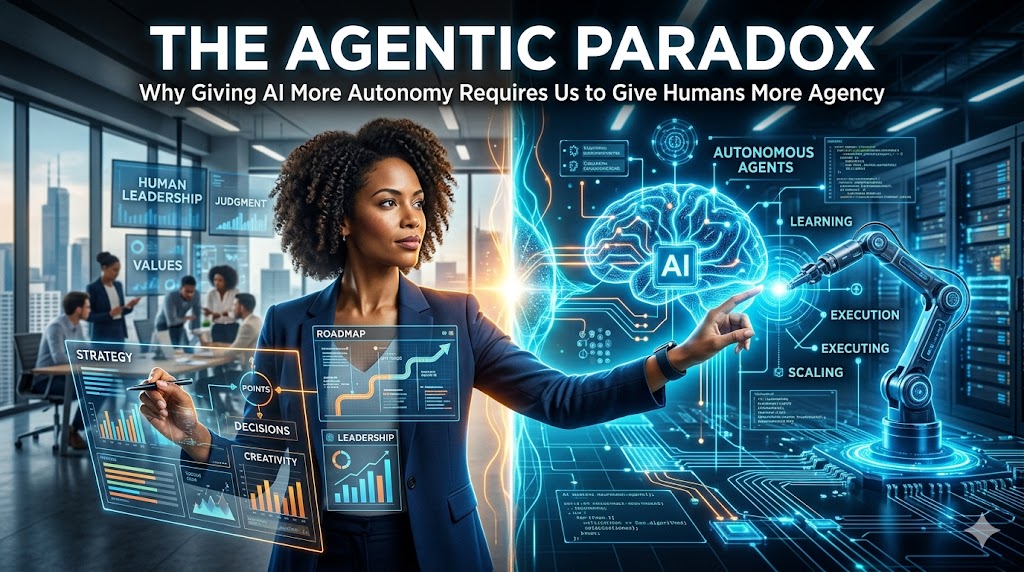
The Agentic Paradox

Why Giving AI More Autonomy Requires Us to Give Humans More Agency

LAST UPDATED: April 10, 2026 at 7:11 PM

The Agentic Paradox

by Braden Kelley and Art Inteligencia


The Rise of the Machine “Doer”

For the past few years, we have lived in the era of Generative AI — a world of sophisticated chatbots and creative assistants that respond to our prompts. But as we move deeper into 2026, the landscape has shifted. We are now entering the age of Agentic AI. These are not just tools that talk; they are autonomous systems capable of executing complex workflows, making real-time decisions, and acting on our behalf across digital ecosystems.

On the surface, this promises the ultimate efficiency. We imagine a future where the “busy work” vanishes, leaving us free to innovate. However, a troubling Agentic Paradox has emerged: as we grant machines more autonomy to act, many humans are finding themselves with less agency. Instead of feeling liberated, workers often feel like they are merely “babysitting” algorithms or reacting to a relentless stream of machine-generated outputs.

This disconnect creates a high-stakes leadership challenge. If we focus solely on the autonomy of the machine, we risk creating an “algorithmic anxiety” that stifles the very human creativity we need to thrive. To succeed in this new era, leaders must realize that the more powerful our AI agents become, the more we must intentionally “upgrade” the agency, authority, and strategic focus of our people.

The Thesis: The goal of innovation in 2026 is not to build the most autonomous machine, but to build a human-centered ecosystem where AI agents manage the tasks and empowered humans manage the intent.

The Hidden Cost: The Cognitive Load Crisis

The promise of Agentic AI was a reduction in workload, but for many organizations, the reality has been a shift in the type of work rather than a reduction of it. This has birthed the Cognitive Load Crisis. While an autonomous agent can process data and execute tasks 24/7, it lacks the contextual wisdom to understand the nuances of organizational culture or ethical gray areas. This leaves the human “orchestrator” in a state of perpetual high-alert.

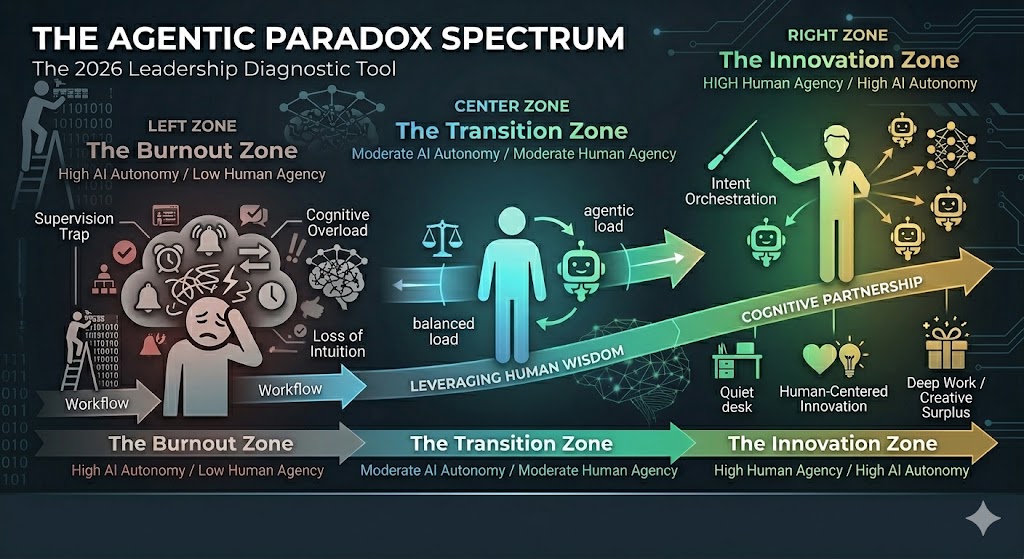
Instead of performing deep, meaningful work, leaders and employees are becoming trapped in the Supervision Trap. They are forced to manage a relentless firehose of machine-generated notifications, approvals, and “check-ins.” This creates a fragmented mental state where the human mind is constantly context-switching between different agent streams, leading to a unique form of 2026 burnout — digital exhaustion without the satisfaction of tactile achievement.

Furthermore, as AI agents take over more of the “doing,” we see an erosion of Deep Work. When every minute is spent verifying the output of an algorithm, the quiet space required for radical innovation and strategic foresight vanishes. We are effectively trading our long-term creative capacity for short-term operational speed.

  • Notification Fatigue: The mental tax of being the constant “emergency brake” for autonomous systems.
  • Loss of Intuition: The danger of becoming so reliant on agentic data that we lose our “gut feel” for the market.
  • The Feedback Loop: A system where humans spend more time managing machines than mentoring people.

To break this cycle, we must stop treating AI agents as simple productivity tools and start treating them as entities that require a new architecture of human attention. If we don’t manage the cognitive load, our most talented people will eventually shut down, leaving the “Magic Makers” of our organization feeling like mere cogs in a machine-led wheel.

Agentic Paradox Spectrum Infographic

Redefining Roles: From “The Conscript” to “The Architect”

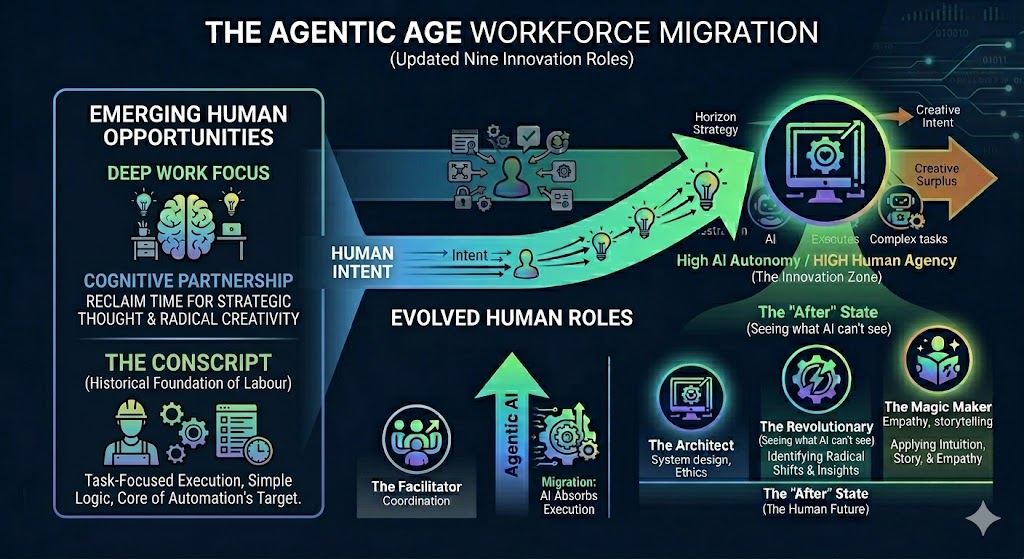
As the landscape of work shifts, so too must our understanding of how individuals contribute to the innovation ecosystem. In my work on the Nine Innovation Roles, I’ve often highlighted how different archetypes fuel organizational growth. In this agentic age, we are seeing a dramatic migration of these roles. If we are not intentional, our best people will default into the role of The Conscript — those who are merely drafted into service to support the AI’s agenda, performing the monotonous tasks of verification and data cleanup.

The goal of a human-centered transformation is to automate the role of the “Conscript” and elevate the human into the role of The Architect or The Magic Maker. When the AI handles the heavy lifting of execution, the human is finally free to focus on Intent. This is where true agency resides. Agency is not the ability to do more; it is the power to decide what is worth doing and why it matters to the human beings we serve.

However, there is a dangerous “Agency Gap” emerging. If an organization implements AI agents without redefining human job descriptions, employees lose their sense of ownership. When the machine becomes the primary creator, the human “spark” is extinguished. We must ensure that AI serves as the support staff for human intuition, not the other way around.

The Migration of Value

The AI Agent Role The Human Agency Role
The Conscript: Handling repetitive execution and data synthesis. The Architect: Designing the systems and ethical frameworks for the AI.
The Facilitator: Coordinating schedules and managing basic workflows. The Revolutionary: Identifying the “radical” shifts the AI isn’t programmed to see.
The Specialist: Performing deep-dive technical analysis at scale. The Magic Maker: Applying empathy and storytelling to turn data into a movement.

By clearly delineating these roles, leaders can close the Agency Gap. We must empower our teams to move away from “monitoring” and toward “orchestrating.” This transition is the difference between a workforce that feels obsolete and one that feels essential.

Agentic Workforce Migration Infographic

FutureHacking™ the Cognitive Workflow

To navigate the complexities of 2026, organizations cannot rely on reactive strategies. We must use FutureHacking™ — a collective foresight methodology — to map out how the relationship between human intelligence and agentic automation will evolve. This isn’t just about predicting technology; it’s about engineering the “Human-Agent Interface” so that it scales without crushing the human spirit.

The core of this approach involves identifying the Innovation Bonfire within your team. In this metaphor, the AI agents are the fuel — abundant, powerful, and capable of sustaining a massive output. However, the humans must remain the spark. Without the human spark of intent and empathy, the fuel is just a cold pile of logs. FutureHacking™ allows teams to visualize where the “fuel” might be smothering the “spark” and adjust the workflow before burnout sets in.

By engaging in collective foresight, teams can proactively decide which cognitive territories are “Human-Core.” These are the areas where we intentionally limit AI autonomy to preserve our creative agency and cultural identity. It’s about choosing where we want the machine to lead and where we require a human to hold the compass.

  • Mapping the Friction: Identifying which agent-led tasks are creating the most mental “drag” for the team.
  • Defining Non-Negotiables: Establishing which parts of the customer and employee experience must remain 100% human-centric.
  • Intent Modeling: Shifting the focus from “What can the agent do?” to “What outcome are we trying to hack for the future?”

When we FutureHack our workflows, we move from being passive recipients of technological change to being the active architects of our organizational destiny. We ensure that as the machine gets smarter, our collective human intelligence becomes more focused, not more fragmented.

Framework: The “Agency First” Operating Model

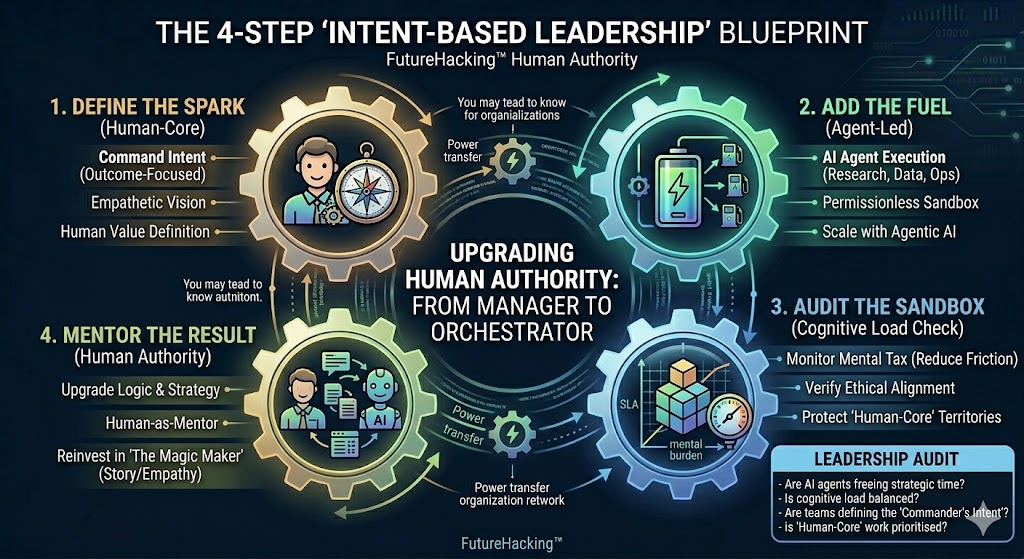
Building a resilient organization in the age of Agentic AI requires more than just new software; it requires a new operating philosophy. We must move away from a model of Machine Management and toward a model of Intent Orchestration. This framework provides three critical steps to ensure that human agency remains the primary driver of your business value.

1. Cognitive Offloading, Not Task Dumping

The goal of automation should be to reduce the mental noise for the employee, not just to move a task from a human to a machine. If a human still has to track, verify, and worry about every step the agent takes, the cognitive load hasn’t decreased — it has merely changed shape.
The Strategy: Design “set and forget” guardrails that allow agents to operate within a defined ethical and operational “sandbox,” only alerting the human when a decision falls outside of those parameters.

2. The “Human-in-the-Loop” Upgrade

We must shift the role of the worker from Monitor to Mentor. In the old model, the human checks the machine’s homework for errors. In the “Agency First” model, the human coaches the agent on why certain decisions are better than others, treating the AI as an apprentice. This reinforces the human’s position as the source of wisdom and authority, preventing the “Conscript” mentality.

3. Intent-Based Leadership

Management must evolve to focus on the Intent rather than the Activity. In a world where agents can generate infinite activity, “busyness” is no longer a proxy for value. Leaders must empower their teams to spend their time defining the “Commander’s Intent” — the high-level objectives and human-centered outcomes that the AI agents must then figure out how to achieve.

Intent Based Leadership Blueprint Infographic

The Agency Audit: Ask your team this week: “Does this new AI agent give you more time to think strategically, or does it just give you more machine-generated work to manage?” The answer will tell you if you are facing an Agentic Paradox.

Conclusion: Leading the Human-Centered Revolution

The true test of leadership in 2026 is not how quickly you can deploy autonomous agents, but how effectively you can protect and amplify the human spirit within your organization. As we navigate the Agentic Paradox, we must remember that technology is a force multiplier, but it requires a human “integer” to multiply. Without a clear sense of agency, even the most advanced AI becomes a source of friction rather than a source of freedom.

By addressing the Cognitive Load Crisis and intentionally moving our teams out of “Conscript” roles and into “Architectural” ones, we do more than just improve efficiency — we future-proof our culture. We ensure that our organizations remain places of meaning, creativity, and purpose.

The “Year of Truth” demands that we be honest about the mental tax of automation. It calls on us to use FutureHacking™ not just to map out our tech stacks, but to map out our human potential. The companies that win the next decade won’t be those with the smartest agents; they will be the ones that used those agents to give their people the time and agency to be truly, radically human.

“Innovation is a team sport where the machines play the support roles so the humans can score the points.”

Are you ready to hack your agentic future?

Frequently Asked Questions

What is the primary difference between Generative AI and Agentic AI?

Generative AI focuses on creating content (text, images, code) based on human prompts. Agentic AI goes a step further by having the autonomy to execute multi-step workflows, make decisions, and interact with other systems to complete a goal without constant human intervention.

How can leaders identify if their team is suffering from the Agentic Paradox?

Look for signs of the “Supervision Trap,” where employees spend more time managing and verifying machine outputs than performing strategic work. If your team feels busier but reports a decline in creative output or “Deep Work,” they are likely experiencing the paradox.

What role does FutureHacking™ play in managing AI integration?

FutureHacking™ is a collective foresight methodology used to visualize the long-term impact of AI on organizational roles. It helps teams proactively define “Human-Core” territories, ensuring that as AI scales, it supports rather than smothers human agency and innovation.

Image credits: Google Gemini

Content Authenticity Statement: The topic area, key elements to focus on, etc. were decisions made by Braden Kelley, with a little help from Google Gemini to clean up the article, add images and create infographics.

Subscribe to Human-Centered Change & Innovation WeeklySign up here to get Human-Centered Change & Innovation Weekly delivered to your inbox every week.

Four Steps to the Future

Announcing the Newest FREE Addition to the FutureHacking™ Toolkit

Four Steps to the Future

LAST UPDATED: April 23, 2026 at 10:01 PM

by Braden Kelley and Art Inteligencia


The Signal vs. Noise Dilemma

In an era defined by rapid technological shifts and global volatility, the modern professional is often drowning in “trends” but starving for actionable intelligence. The challenge is no longer a lack of information, but the overwhelming volume of it.

The FutureHacking™ Philosophy posits that finding signals isn’t enough — you must be able to connect them to your specific industry, country, and competitive landscape to create value. A signal in isolation is just data; a signal in context is a roadmap.

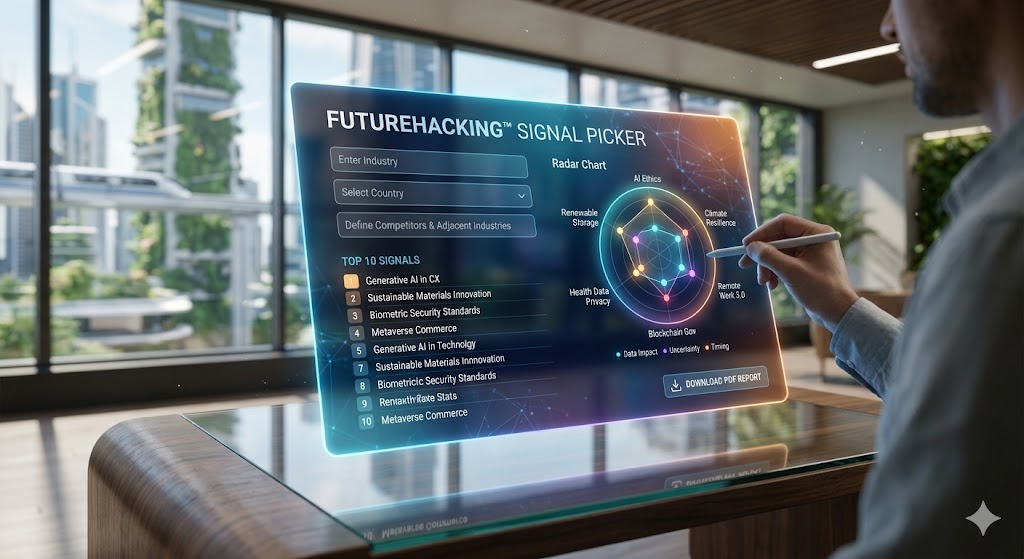
To bridge this gap, we are thrilled to introduce the FutureHacking Signal Picker. Built specifically for the global Innovation, Futurology, and Experience Design community, this tool moves beyond passive observation. It empowers you to filter out the noise and focus on the high-leverage insights that allow you to move from simply watching the future to actively influencing it.

The Power of Finding, Connecting, and Influencing

Strategic foresight is not a spectator sport. To gain a competitive advantage, organizations must master the triad of Finding, Connecting, and Influencing. The FutureHacking Signal Picker is engineered to facilitate this shift from discovery to impact.

Precision Finding

The first hurdle is moving beyond the “obvious” trends that everyone else is already tracking. By utilizing inputs for specific industries and — crucially — adjacent industries, the Signal Picker uncovers the cross-pollination points where true disruption often begins. It helps you look where your competitors aren’t looking.

Connecting through Multiplied Impact

A signal only matters if it carries weight. Our tool utilizes a proprietary formula to rank signals based on a multiplied impact, uncertainty, and timing factor. This quantitative approach allows you to see the “connective tissue” between a signal’s potential power and its proximity to your current business model before generating an emerging trends report for you as a downloadable PDF (takes about five minutes).

Influencing the Outcome

The ultimate goal of FutureHacking is to shift the organizational mindset from asking “What will happen to us?” to “What can we make happen?” By identifying high-impact signals early, you gain the lead time necessary to shape the market, influence consumer expectations, and design experiences that define the next era of your industry.

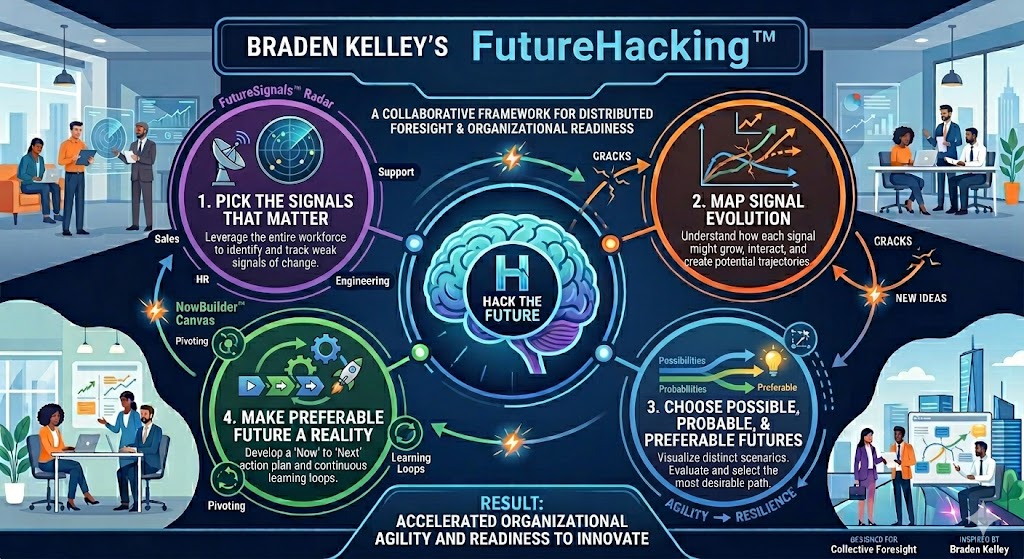
The Four Simple But Powerful FutureHacking™ Steps

The FutureHacking Signal Picker is more than a standalone tool; it is the catalyst for a comprehensive strategic journey. By automating the initial discovery phase, it accelerates your ability to move through the proven FutureHacking™ methodology.

STEP ONE: Picking the Signals That Matter

This is where the Signal Picker does the heavy lifting. By inputting your industry, country, competitors, and adjacent sectors, you generate a prioritized list of the top ten signals. The immediateTen Signals generation provides an immediate snapshot of the landscape, while the downloadable PDF ensures that these insights are ready to be shared with leadership in an Emerging Trends Report to drive immediate alignment.

STEP TWO: Mapping Signal Evolution

Once you have identified your primary signals, the next phase is tracking their trajectory. Using FutureHacking tools, you can map how these signals are evolving — whether they are converging with other trends, gaining velocity, or shifting in uncertainty. This step prevents you from being blindsided by the speed of change.

FutureHacking Infographic

STEP THREE: Choosing the Possible, Probable, and Preferable Future

With the signals ranked by impact and timing, you can begin to construct scenarios. We move beyond simple forecasting to ask: What is possible? What is probable? And most importantly, what is our Preferable Future? The tool’s data points provide the objective foundation needed to define where your organization wants to go.

STEP FOUR: Making Your Preferable Future a Reality

The final step is the bridge to action. By analyzing the strategic implications provided by the Signal Picker, you can design the specific innovations and human-centered changes required to manifest your chosen future. It turns foresight into a tangible roadmap for Experience Design and organizational transformation.

Strategic Implications & Competitive Edge

The true value of the FutureHacking Signal Picker lies not just in the data it unearths, but in the strategic clarity it provides. By shifting from a generic “trend watching” approach to a focused signal analysis, organizations can develop a more resilient and proactive posture.

Finding Opportunity in the Adjacencies

Most organizations suffer from industry myopia — they only look at what their direct competitors are doing. The Signal Picker’s inclusion of adjacent industries acts as a secret weapon. It forces a wider lens, identifying how shifts in unrelated sectors — such as a breakthrough in biopharmaceuticals affecting the insurance market — might create a “ripple effect” that becomes your next big opportunity or threat.

Quantifying the Horizon

Strategy often fails when it is based on gut feeling alone. By ranking signals through a multiplied factor of impact, uncertainty, and timing, the tool provides a quantitative justification for innovation investment. It allows teams to visualize their “blind spots” in the signal picker, ensuring that resource allocation is balanced between defending the core and exploring the frontier.

Fostering a Future-Ready Culture

Launching this tool within your organization or community changes the conversation. It transforms strategic planning from a static, annual event into a continuous pulse. When teams can quickly download a PDF of ranked signals and implications, it democratizes foresight, allowing Human-Centered Innovation and Experience Design professionals to lead with data-backed authority and use the report as a jumping off point to input into the deep research tools that AI companies are now offering.

Conclusion & Call to Action

The future isn’t a destination that we passively reach; it is a landscape that we actively co-create. The launch of the FutureHacking Signal Picker marks a significant milestone for the global community of innovators, futurists, and designers, providing the essential “first spark” for the Human-Centered Innovation™ journey.

Join the Global FutureHacking Community

We invite you to step beyond the noise of generic trends and start tracking the signals that will actually define your industry’s next decade. Whether you are navigating digital transformation, crafting next-generation experiences, or leading organizational agility, the right signals are the foundation of your success.

Ready to Hack the Future?

Put the FutureHacking Signal Picker to work today. Input your industry parameters, download your custom Emerging Trends Report, and take the first of the Four Simple But Powerful FutureHacking™ Steps toward making your preferable future a reality.

Access the Signal Picker Tool Now
… and then contact us when you’re ready for the full toolkit and training.

FutureHacking Signals Picker

Remember: The most effective way to predict the future is to design the signals that influence it. Let’s start hacking.

Frequently Asked Questions

How does the Signal Picker rank the top ten signals?

The tool uses a proprietary “Multiplied Impact Factor.” Instead of looking at trends in isolation, it calculates the product of three critical dimensions: Impact (the scale of potential disruption), Uncertainty (the degree of volatility), and Timing (how soon the signal will manifest). This ensures that the signals at the top of your list are both highly relevant and urgent.

Why does the tool ask for “Adjacent Industries”?

Innovation rarely happens in a vacuum; it often “leaks” from one sector to another. By analyzing adjacent industries, the Signal Picker identifies cross-industry signals that your direct competitors are likely overlooking. This provides a broader perspective necessary for the Step Two: Mapping Signal Evolution phase of the FutureHacking™ methodology.

What is the benefit of the downloadable Emerging Trends Report?

The Emerging Trends Report provides an immediate map of your strategic horizon. It allows stakeholders to see the balance between short-term certainties and long-term disruptions at a glance. By downloading the PDF, Human-Centered Innovation and Experience Design professionals can instantly present data-backed observations to leadership to gain buy-in for future-proofing initiatives.


Image credits: Google Gemini

Content Authenticity Statement: The topic area, key elements to focus on, etc. were decisions made by Braden Kelley, with a little help from Google Gemini to clean up the article, add images and create infographics.

Subscribe to Human-Centered Change & Innovation WeeklySign up here to get Human-Centered Change & Innovation Weekly delivered to your inbox every week.

Does Planned Obsolescence Fuel the Fire or Just Burn the House Down?

The Innovation Paradox

LAST UPDATED: April 4, 2026 at 11:56 AM

Does Planned Obsolescence Fuel the Fire or Just Burn the House Down?

by Braden Kelley and Art Inteligencia


I. Introduction: The Tension Between Renewal and Waste

In the world of innovation, we often talk about the “fire” of creativity — the energy that drives us to build the next great breakthrough. But in the current industrial landscape, we must ask ourselves: are we stoking a sustainable Innovation Bonfire, or are we simply burning the furniture to keep the room warm for a single night?

Planned obsolescence has long been the silent engine of the consumer economy, a strategy designed to ensure that the products of today become the landfill of tomorrow. It creates a fundamental tension between the mechanical need for economic growth and the human-centered need for enduring value.

“To truly innovate for humanity, we must pivot from a strategy of deliberate failure to one of intentional resilience.”

As change leaders, we must recognize that planned obsolescence is an industrial-age relic masquerading as a modern innovation strategy. This article explores whether this cycle of constant replacement truly fuels progress or if it acts as a “wet blanket” that dampens our ability to solve the world’s most pressing, wicked problems.

II. The Case for the “Pro”: Obsolescence as a Catalyst for Speed

While it is easy to dismiss planned obsolescence as purely cynical, from a strategic standpoint, it has functioned as a powerful — if aggressive — accelerant for the adoption curve. By shortening the lifecycle of a product, organizations force a faster cadence of iteration. This “forced evolution” ensures that new technologies, safety standards, and efficiencies are pushed into the hands of users at a rate that a “buy-it-for-life” model simply couldn’t sustain.

Consider the following drivers that proponents argue fuel the innovation engine:

  • R&D Capitalization: The consistent revenue generated by replacement cycles provides the massive capital reserves required for “Big Bang” breakthroughs. Without the “Small Bangs” of incremental sales, the long-term, high-risk research into materials science or AI might never be funded.
  • The Velocity of “Innovation”: When a product is designed to be replaced, designers are freed from the “legacy trap.” They can experiment with radical new interfaces or hardware configurations, knowing that the next cycle provides an immediate opportunity to course-correct based on real-world human feedback.
  • The Psychology of the “New”: In our work on Stoking Your Innovation Bonfire, we recognize that emotion is a primary driver of change. The “Fashion of Tech” creates a sense of momentum. This psychological pull toward the “New” keeps markets liquid and encourages a culture of constant curiosity and upgrade.

In this light, obsolescence isn’t just about things breaking; it’s about keeping the market in motion. It prevents stagnation by ensuring that the “Stable Spine” of our infrastructure is constantly being tested and refreshed by the latest “Modular Wings” of technological advancement.

III. The Case for the “Con”: The “Wet Blankets” of Planned Obsolescence

If innovation is a fire, planned obsolescence often acts as a massive “wet blanket” — smothering the very progress it claims to ignite. When we design for failure, we aren’t just creating a product; we are creating environmental friction. The “Invisible Drain” of e-waste and resource depletion represents a systemic failure that our current economic operating system is struggling to process.

From a human-centered design perspective, the downsides extend far beyond the landfill:

  • The Erosion of Trust: A core pillar of Experience Design is the relationship between the brand and the human. When a user realizes a device was intentionally throttled or made unrepairable, it creates a “Customer Experience (CX) Betrayal.” This loss of trust is a psychological friction that makes future change adoption much harder.
  • Innovation Fatigue: There is a limit to how much “New” a human can process. When consumers feel they are on a hamster wheel of meaningless upgrades, they develop an apathy toward genuine breakthroughs. We risk a future where the “latest” no longer feels like the “greatest” — it just feels like a chore.
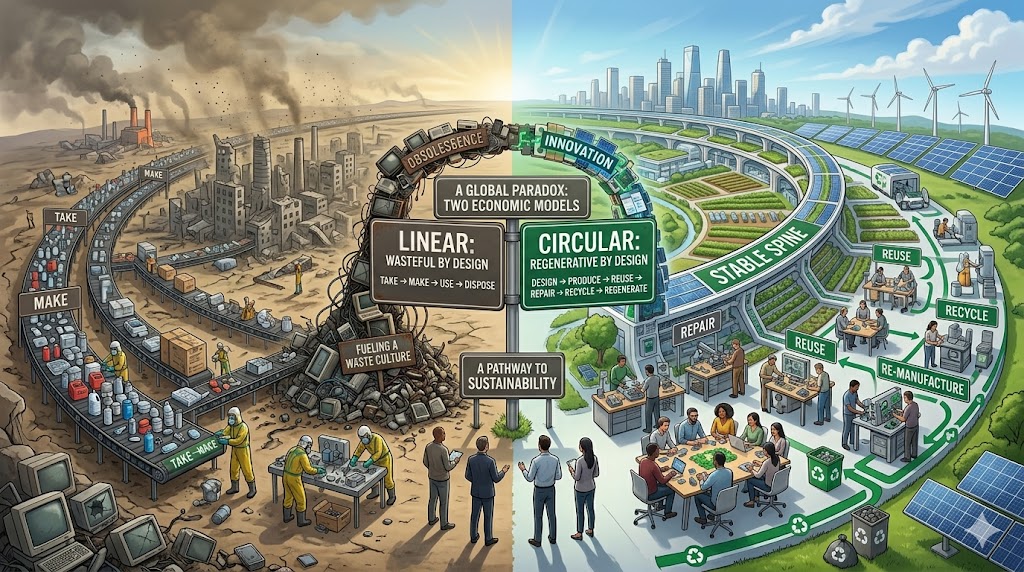
  • The Circular vs. Linear Conflict: Planned obsolescence is the hallmark of a linear economy (Take-Make-Waste). To move toward a sustainable future, innovation must embrace circularity, where products are designed as “Stable Spines” that can be updated, repaired, and kept in the ecosystem indefinitely.

Linear versus Circular Economy

By focusing our creative energy on how to make things break, we divert talent away from solving “wicked problems” — like true energy efficiency or radical durability. We are effectively choosing Quantity of Sales over Quality of Impact, a trade-off that rarely benefits humanity in the long run.

IV. The Impact on Innovation: Quality vs. Quantity

One of the most dangerous side effects of planned obsolescence is how it reshapes the innovation mindset. When a company’s primary metric for success is a yearly replacement cycle, the engineering focus shifts from transformational leaps to incremental tweaks. We find ourselves trapped in a cycle of “Innovation Theater” — releasing shiny new features that mask the lack of fundamental progress.

The shift in focus creates several systemic challenges:

  • The Maintenance Trap: In a human-centered world, we should be designing for longevity. However, planned obsolescence forces our best creative minds to spend their energy designing “points of failure” rather than points of resilience. This is a massive diversion of intellectual capital away from the wicked problems that actually matter to humanity.
  • Incrementalism vs. Transformation: If you know your product only needs to last 24 months, why solve the difficult problems of battery degradation or heat management for the long term? The “yearly release” schedule creates a treadmill effect where we are running faster but not necessarily moving further.
  • Systems Thinking Failure: We often view a product as a standalone unit, but in a connected world, every device is a node in a larger infrastructure. When we design for a short lifecycle, we create fragility in the entire system. True innovation requires a Stable Spine Audit — evaluating whether the core of our solution is robust enough to support years of evolving “Modular Wings.”

To move the needle, we must stop measuring innovation by the volume of patents or the frequency of launches. Instead, we should measure the durability of the value created. If an innovation cannot stand the test of time, is it truly an innovation, or is it just a temporary distraction?

V. Is it Good for Humanity? (The Human-Centered Audit)

When we apply a Human-Centered Audit to planned obsolescence, the results are deeply conflicted. Innovation should serve as a tool for human empowerment, yet the cycle of forced replacement often creates new forms of dependency and inequality. We must ask: are we designing for the flourishing of the person, or simply for the health of the balance sheet?

To understand the true impact on humanity, we must look at three critical dimensions:

  • The Ethics of Accessibility: Planned obsolescence often creates a “digital divide.” When software updates outpace hardware capabilities, we effectively lock out those who cannot afford to stay on the upgrade treadmill. If the tools for modern life — education, banking, and communication — require the latest hardware, then deliberate obsolescence becomes a barrier to global equity.
  • Autonomy vs. Dependency: There is a subtle shift occurring from ownership to renting. Through un-repairable hardware and “software locks,” users lose the autonomy to maintain their own tools. This creates a fragile relationship where the human is entirely dependent on the manufacturer, eroding the sense of agency that good design should foster.
  • The Prosperity Balance: Proponents point to the short-term job creation in manufacturing and the “Great American Contraction” as reasons to keep the wheels turning. However, we must weigh these temporary economic gains against the long-term cost of environmental degradation and the loss of organizational agility. A society that spends its energy replacing what it already had is a society that isn’t moving forward.

Ultimately, an innovation strategy that relies on things breaking is fundamentally at odds with a Human-Centered philosophy. If our “Innovation Bonfire” requires us to constantly toss our previous achievements into the flames just to keep the fire going, we haven’t built a fire — we’ve built an incinerator.

VI. The Path Forward: From Obsolescence to Innovation

The shift from a Linear Economy to a Circular Economy requires more than just better recycling; it requires a fundamental redesign of our innovation frameworks. We must move toward Innovation — where the value of a product remains constant or even improves over time, rather than degrading by design.

To transition from a strategy of failure to a strategy of resilience, organizations should embrace three core principles:

  • Designing for Durability: The next truly “disruptive” move in many industries isn’t adding a new sensor; it’s creating a product that lasts a decade. Durability is becoming a premium feature in a world of disposable goods. By focusing on high-quality materials and Human-Centered engineering, brands can build a legacy rather than just a quarterly report.
  • The Modular Revolution: We must apply the “Stable Spine” and “Modular Wings” philosophy to hardware. Imagine a device where the core processor (the spine) is built to last, while the specific sensors or interface components (the wings) can be swapped out as technology advances. This allows for evolution without the need for total replacement.
  • New KPIs for a New Era: We need to stop measuring success solely by unit sales. Forward-thinking companies are moving toward “Value-in-Use” and Experience Level Measures (XLMs). When a company is incentivized by how well a product performs over its entire lifecycle, the motivation to build in failure points disappears.

This isn’t just about “being green”; it’s about Organizational Agility. A company that doesn’t have to reinvent its basic hardware every twelve months can redirect its R&D energy toward solving the deep, systemic challenges that humanity actually faces. It’s time to stop stoking the bonfire with our own waste and start building a fire that truly illuminates the future.

VII. Conclusion: Stoking a Sustainable Flame

As we look toward the future of human-centered change, we must decide what kind of “Innovation Bonfire” we want to build. Is it a flash in the pan that requires the constant sacrifice of resources and consumer trust, or is it a steady, illuminating heat that powers real progress?

Planned obsolescence was a 20th-century solution to a 20th-century problem — the need for rapid industrial scale. But in an era defined by digital transformation and the “Great American Contraction,” the old rules no longer apply. To continue designing for failure is to ignore the wicked problems of our time: climate change, resource scarcity, and the erosion of human agency.

“The true measure of an innovation isn’t how many units we sold this year, but how much better the world is because that product exists ten years from now.”

My challenge to you — the executives, the designers, and the change agents — is this: Stop designing for the landfill. Start designing for the legacy. When we shift our focus from Obsolescence to Resilience, we don’t just save the planet; we save the very soul of innovation.

Let’s stop stoking the fire with our own waste and start building a future that is truly made to last.


Frequently Asked Questions

How does planned obsolescence impact human-centered innovation?

Planned obsolescence often acts as a “wet blanket” on true innovation by forcing creators to focus on incremental tweaks and deliberate failure points rather than solving “wicked problems.” From a human-centered design perspective, it erodes consumer trust and prioritizes short-term sales over long-term value and sustainability.

Can planned obsolescence ever be good for humanity?

Proponents argue it accelerates the adoption curve and provides the R&D capital necessary for major breakthroughs. However, a human-centered audit suggests these economic gains are often offset by environmental degradation, increased e-waste, and the creation of a “digital divide” where only the wealthy can afford to stay on the upgrade treadmill.

What is the alternative to planned obsolescence in design?

The primary alternative is moving toward a “Circular Economy” using a “Stable Spine” and “Modular Wings” philosophy. This involves designing products for durability and repairability, where core components last for years while specific features can be upgraded or replaced, shifting the focus from “quantity of sales” to “value-in-use.”

Image credits: Gemini

Content Authenticity Statement: The topic area, key elements to focus on, etc. were decisions made by Braden Kelley, with a little help from Gemini to clean up the article and add citations.

Subscribe to Human-Centered Change & Innovation WeeklySign up here to get Human-Centered Change & Innovation Weekly delivered to your inbox every week.

The Four Psychological Disruptions of AI at Work

LAST UPDATED: April 3, 2026 at 4:20 PM

The Four Psychological Disruptions of AI at Work

by Braden Kelley and Art Inteligencia


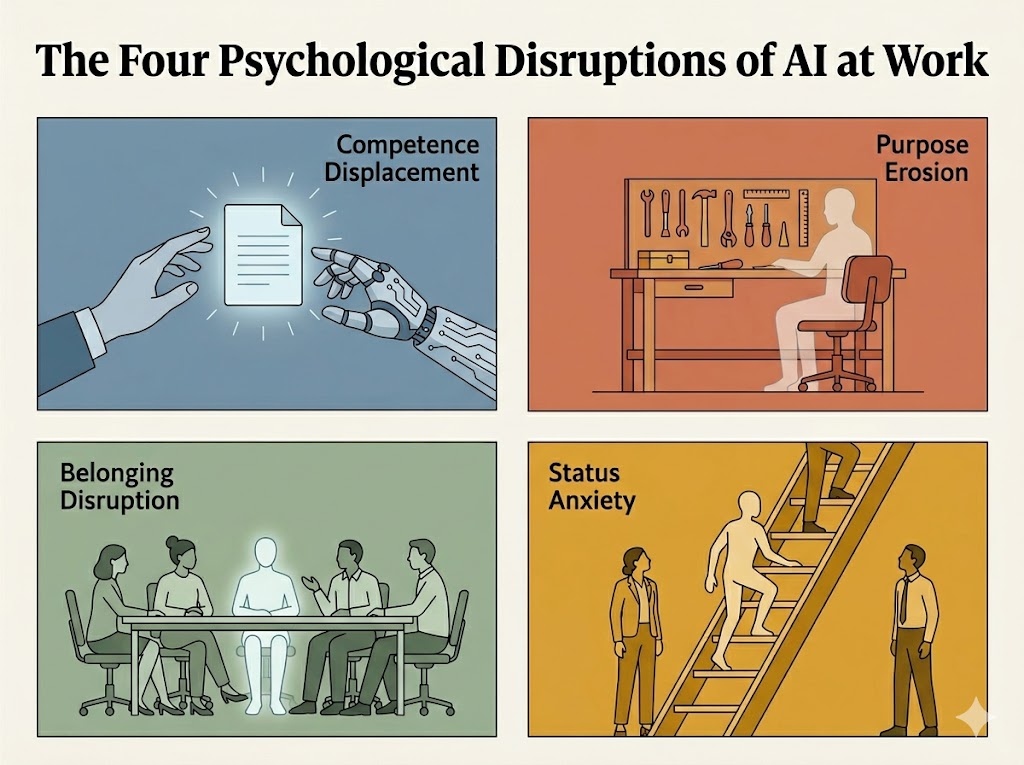
Most AI-and-work frameworks are built around economics – job categories, task automation rates, re-skilling costs. This one is built around something different: the interior experience of the person sitting at the desk. The four disruptions mapped in this infographic were identified not through labor market data, but through a human-centered lens – the same lens used in design thinking and change management to surface the needs, fears, and identity stakes that people rarely articulate out loud but always feel.

The framework draws on three converging sources: organizational psychology research on professional identity and role transition; change management practice, particularly the observed patterns of how workers respond when their expertise is devalued or displaced; and direct observation of how individuals are actually experiencing AI adoption in their workplaces right now – not in surveys, but in the unguarded conversations that happen before and after workshops, in the margins of keynotes, in the questions people ask when they think no one important is listening.


Why these four disruptions

1

Competence Displacement

The skill that defined you no longer distinguishes you.

Professional identity is heavily anchored in the belief that what I know how to do has value. When AI can replicate a signature competency – even imperfectly – it attacks that anchor directly. The disruption isn’t primarily about job loss. It’s about the sudden, disorienting feeling that years of deliberate practice have been, in some meaningful sense, made ordinary.

This disruption appears earliest and most acutely in knowledge workers whose expertise was previously considered difficult to acquire – writers, analysts, coders, researchers, strategists.

2

Purpose Erosion

The meaning embedded in the craft begins to hollow out.

Work is not only instrumental – it is ritual. The process of doing difficult things carefully, over time, is itself a source of meaning. When automation removes the friction, it can also remove the satisfaction. This is subtler than competence displacement and slower to surface, but ultimately more corrosive. People find themselves producing more output and feeling less connected to it.

This disruption is particularly acute for people who chose their profession not just for income but for intrinsic love of the work – and who built their identity around that love.

3

Belonging Disruption

The social fabric of work shifts when AI enters the team.

Work teams are social ecosystems built on complementary expertise, shared struggle, and mutual reliance. AI changes those dynamics in ways that are easy to overlook. When an AI tool makes one team member dramatically more productive, or when collaborative tasks are partially automated, the invisible social contracts of the team – who depends on whom, who contributes what – are quietly renegotiated. Belonging depends on feeling needed. When that changes, isolation can follow.

This disruption tends to surface not as explicit conflict but as a gradual withdrawal – people collaborating less, sharing less, protecting their remaining territory.

4

Status Anxiety

The professional hierarchy is being redrawn by AI fluency.

Workplace status has always been tied to expertise scarcity – the person who knew things others didn’t held power. AI is redistributing that scarcity rapidly. Early and confident AI adopters gain speed, output, and visibility. Those who resist, or who are slower to adapt, find themselves losing ground in ways that feel both unfair and disorienting. The new status question – are you someone who uses AI, or someone AI is used on? – is already being asked in organizations, even when no one says it explicitly.

This disruption is uniquely uncomfortable because it combines external threat (status loss) with internal shame (the fear of being seen as behind).


How to read the framework

These four disruptions are not sequential stages – they are simultaneous and overlapping. A single professional can be experiencing all four at once, with different intensities depending on their role, their organization, and how rapidly AI is being adopted around them. The infographic presents them as discrete panels for clarity, but the lived experience is messier and more entangled.

They are also not uniformly negative. Each disruption contains within it the seed of a corresponding renewal: competence displacement can become an invitation to lead with judgment rather than task execution; purpose erosion can prompt a deeper reckoning with what the work is ultimately for; belonging disruption can surface the human connection that was always the real foundation of team cohesion; status anxiety can motivate the kind of deliberate identity authoring that makes professionals more resilient over the long term.

The framework is designed to give leaders and individuals a common language for conversations that are currently happening in fragments — in one-to-ones, in exit interviews, in the silence after a difficult all-hands. Named things can be worked with. Unnamed things can only be endured.

This framework is a practitioner’s model, not a peer-reviewed clinical instrument. It is designed for use in workshops, coaching conversations, and organizational change programs as a starting point for honest dialogue — not as a diagnostic or classification system. It will evolve as our collective understanding of AI’s human impact deepens.

Framework developed by Braden Kelley as part of the article series Psychological Impact of AI on Work Identity  ·  Braden Kelley  ·  © 2026

Image credits: Gemini

Content Authenticity Statement: The topic area, key elements to focus on, etc. were decisions made by Braden Kelley, with a little help from Claude AI to clean up the article and add citations.

Subscribe to Human-Centered Change & Innovation WeeklySign up here to get Human-Centered Change & Innovation Weekly delivered to your inbox every week.

Neo-Feudalism and Innovation Impact

A System Designed to Concentrate Power – or Accelerate Breakthroughs?

LAST UPDATED: March 27, 2026 at 4:55 PM
Neo-Feudalism and Innovation Impact

by Braden Kelley and Art Inteligencia


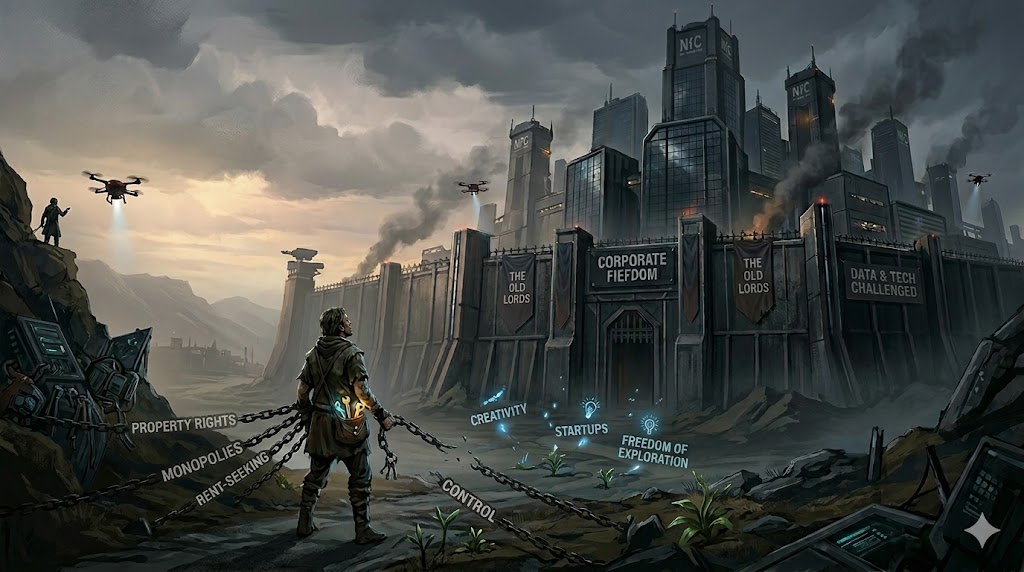
The Return of Lords and Serfs — But This Time It’s Digital

For decades, we’ve told ourselves a reassuring story about progress. Markets would open. Technology would democratize opportunity. Innovation would decentralize power. The barriers to entry would fall, and with them, the dominance of entrenched elites.

And yet, as we step back and observe the system we’ve actually built, a different pattern begins to emerge. Power is concentrating, not dispersing. A small number of platforms, institutions, and individuals exert outsized influence over how value is created, distributed, and captured. Access — whether to customers, capital, data, or opportunity — is increasingly mediated by gatekeepers.

We may not call them lords. We may not call ourselves serfs. But the structural similarities are becoming difficult to ignore.

This is the uncomfortable premise at the heart of the growing conversation around neo-feudalism: that despite the language of free markets and open innovation, we are drifting toward a system defined less by competition and more by control — less by ownership and more by dependency.

At the same time, we are living through one of the most explosive periods of innovation in human history. Artificial intelligence, biotechnology, climate tech, and digital platforms are reshaping industries at a pace that would have been unimaginable even a generation ago. The capacity to innovate has never been greater.

How can we be experiencing both unprecedented innovation and unprecedented concentration of power at the same time?

Is this concentration a temporary distortion — something the system will eventually correct? Or is it an emergent feature of how innovation now scales in a digital, platform-driven world?

What does this mean for the future of innovation itself?

Because innovation is never neutral. It does not exist in a vacuum. It is shaped — constrained or accelerated — by the systems in which it operates. If those systems are evolving toward something that resembles a modern form of feudalism, then the implications extend far beyond markets and technology. They touch how we work, how we live, how we build wealth, and how we relate to one another.

Before we can assess whether neo-feudalism is helping or hindering innovation, we must first understand what it actually is — and what it is not.

What Is Neo-Feudalism? A Clear, Modern Definition

Neo-feudalism is a term increasingly used to describe a modern socio-economic system that echoes the structural dynamics of medieval feudalism, but in a contemporary, often digital, context. While not a perfect one-to-one comparison, the analogy is powerful because it highlights a shift away from open, competitive markets toward systems defined by concentrated power, controlled access, and growing dependency relationships.

At its core, neo-feudalism describes a world in which a relatively small number of dominant entities — whether corporations, platforms, or institutions — exercise outsized influence over how value is created and distributed. Individuals and smaller organizations, in turn, become increasingly dependent on these entities for access to customers, income, infrastructure, and opportunity.

Several key characteristics define this emerging pattern:

Concentration of Power: Economic and technological power is increasingly concentrated in the hands of a few dominant players, creating asymmetries that are difficult for others to overcome.

Control of Access: Instead of owning “land” in the traditional sense, modern power centers control platforms, ecosystems, and infrastructure — effectively determining who gets access to markets and audiences.

Reduced Mobility: Upward mobility becomes more constrained as success is tied to proximity to, or permission from, these dominant entities.

Dependency Relationships: Workers, creators, and even companies become reliant on platforms and systems they do not control, trading autonomy for access and stability.

This dynamic shows up clearly in today’s economy. Digital platforms function as gatekeepers to visibility and revenue. The gig economy often shifts risk downward while concentrating rewards upward. Ownership — whether of assets, data, or distribution channels — is increasingly replaced by access-based models.

It is important to note that neo-feudalism is not a universally accepted or precisely defined concept. Variations of the idea have emerged to describe different aspects of the same shift.

Techno-feudalism emphasizes the role of large technology platforms in exerting control over digital markets and behaviors. Corporate neo-feudalism highlights the growing influence of multinational corporations as quasi-governing entities. Neo-medievalism points to a broader fragmentation of authority, where power is distributed across states, corporations, and networks rather than centralized in traditional nation-states.

Whether one views neo-feudalism as a precise diagnosis or simply a provocative metaphor, it serves an important purpose: it forces us to examine how power, access, and opportunity are actually structured in the modern economy — not how we assume they function.

And that distinction matters, because the way we define the system ultimately shapes how we understand its impact on innovation.
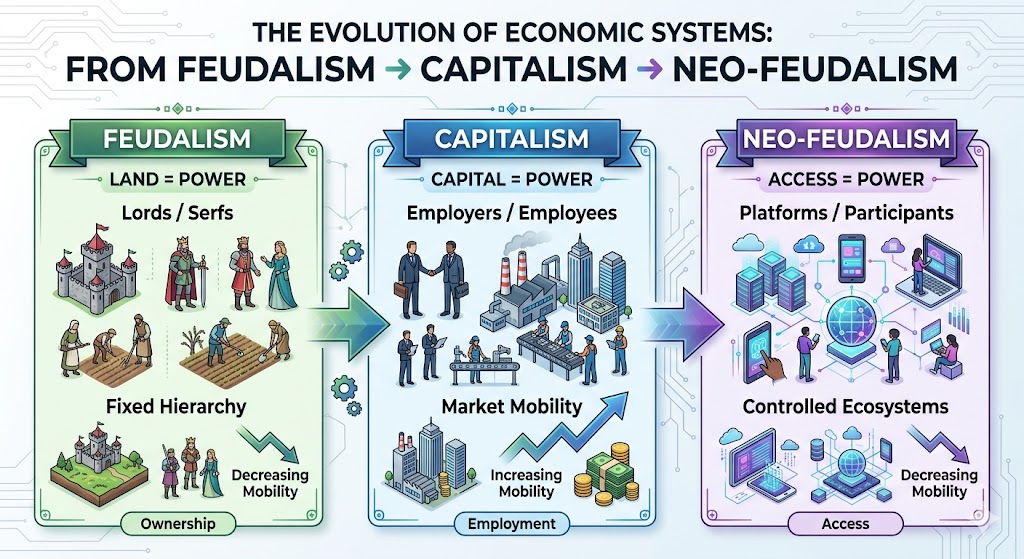
Evolution of Economics Systems Infographic

What Thought Leaders Are Saying (Pro and Con)

As the idea of neo-feudalism has gained traction, it has sparked a vigorous debate among economists, technologists, and social theorists. Some argue that we are witnessing a fundamental shift in the structure of the economy. Others contend that the term is more metaphor than reality. Understanding this debate is essential, because how we interpret the system shapes how we respond to it.

The “Yes, This Is Neo-Feudalism” Camp

Proponents of the concept argue that capitalism has evolved into something meaningfully different. In their view, markets are no longer truly open. Instead, they are increasingly controlled by dominant platforms that act as gatekeepers, setting the rules of participation and extracting value from those who depend on them.

This perspective suggests that we are moving toward a system where economic power resembles sovereignty. A small number of organizations exert control not just over markets, but over infrastructure, data flows, and even the terms of social interaction. In this view, individuals and businesses operate less as independent actors and more as participants within controlled ecosystems.

Some thought leaders have gone so far as to label this shift “techno-feudalism,” arguing that the owners of digital platforms function much like modern-day lords — owning the “land” on which economic activity takes place and collecting rents from those who operate within it.

The “No, This Is Still Capitalism” Camp

Critics of the neo-feudalism framing argue that while inequality and concentration have increased, the underlying system remains capitalism. Markets still exist, competition still occurs, and individuals are not bound to specific employers or platforms in the way serfs were bound to land.

From this perspective, the term “neo-feudalism” risks overstating the case and obscuring more practical diagnoses such as monopoly power, regulatory failure, or the natural dynamics of late-stage capitalism. These critics argue that using an imprecise metaphor may make the problem feel more dramatic, but less actionable.

They also point out that technological disruption continues to create new entrants and new forms of competition, even in industries that appear highly concentrated.

The Middle Ground: A Useful Lens, Not a Literal System

Between these two poles lies a more nuanced view. In this framing, neo-feudalism is not a literal description of the current system, but a lens that helps illuminate important structural shifts—particularly around power, access, and dependency.

This perspective acknowledges that while we are not returning to medieval conditions, we are seeing the emergence of dynamics that echo them in meaningful ways. The language of neo-feudalism, therefore, becomes a way to surface risks that might otherwise remain hidden behind the more familiar vocabulary of markets and competition.

Ultimately, the debate itself is revealing. The lack of consensus reflects the reality that we are in a transitional moment. The system is evolving faster than our ability to define it, and the labels we use are struggling to keep up.

But regardless of what we call it, the underlying question remains the same: how do these structural shifts influence the way innovation is created, scaled, and distributed?

The Case FOR Neo-Feudalism as a Positive Force for Innovation

At first glance, the idea that neo-feudalism could have a positive impact on innovation feels counterintuitive. After all, concentration of power and dependency relationships seem fundamentally at odds with the open, exploratory nature of innovation. But history — and the present moment — suggest a more complicated reality.

Under certain conditions, the very structures that concentrate power can also accelerate innovation in ways that more distributed systems struggle to match.

Stability Enables Long-Term Investment

One of the defining advantages of concentrated power is the ability to think and act long term. Large, dominant organizations have the resources and stability to invest in high-risk, high-reward initiatives that smaller players simply cannot afford. From artificial intelligence to space exploration to advanced biotechnology, many of today’s most ambitious innovations are being funded and scaled by entities with near-sovereign levels of capital and control.

Platforms as Innovation Ecosystems

Modern platforms function as structured environments where innovation can occur rapidly. By providing standardized tools, infrastructure, and access to large user bases, they reduce friction for developers, entrepreneurs, and creators. In this sense, innovation happens “inside the castle walls,” where the rules are clear, the tools are accessible, and the pathways to scale are well established.

Talent Aggregation and Network Effects

Concentrated systems tend to attract concentrated talent. The best engineers, designers, and thinkers often cluster around leading organizations and ecosystems, creating dense networks of expertise. These environments increase the likelihood of idea collisions, accelerate learning cycles, and amplify the pace of innovation.

Reduced Coordination Costs

In highly decentralized systems, innovation can stall due to fragmentation, misalignment, and slow decision-making. Centralized structures, by contrast, can move quickly. Decisions are made faster, resources are allocated more efficiently, and large-scale initiatives can be executed without the same level of negotiation or compromise.

This speed can be a decisive advantage in domains where timing matters, from technology development to market entry.

The Rise of Patronage 2.0

In many ways, today’s innovation economy mirrors a modern form of patronage. Venture capital firms, large platforms, and corporate innovation arms provide funding, infrastructure, and distribution in exchange for equity, data, or dependence. While this relationship is not without tradeoffs, it enables individuals and startups to pursue ideas that might otherwise never get off the ground.

For many innovators, aligning with a powerful “patron” is the fastest — and sometimes only — path to scale.

Seen through this lens, neo-feudal dynamics do not simply constrain innovation. They can also create the conditions for rapid advancement, particularly at the frontier of technology.

The question, then, is not whether these structures can produce innovation. Clearly, they can. The more important question is what kinds of innovation they produce — and who ultimately benefits from them.
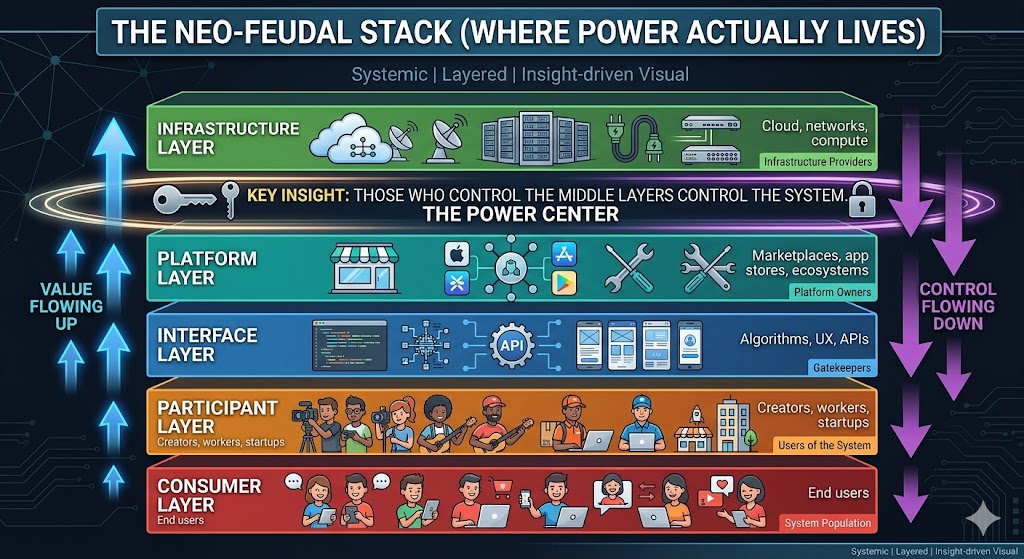
Neo-Feudal Stack Infographic

The Case AGAINST Neo-Feudalism as a Constraint on Innovation

While concentrated power can accelerate certain kinds of innovation, it can just as easily suppress others. From a human-centered perspective, neo-feudal dynamics introduce structural constraints that limit who gets to innovate, what gets built, and how value is ultimately distributed.

In many cases, the same forces that enable scale at the top create friction, dependency, and invisibility at the edges.

Innovation Becomes Permission-Based

In a neo-feudal system, access is controlled. Platforms, investors, and dominant institutions act as gatekeepers, determining which ideas receive funding, visibility, and distribution. This shifts innovation from an open exploration to a permission-based system, where success depends as much on alignment with gatekeepers as it does on the quality of the idea itself.

The risk is clear: truly disruptive ideas — especially those that threaten existing power structures — may never see the light of day.

Decreased Diversity of Thought

When influence is concentrated within a relatively small group, so too are perspectives. Innovation thrives on diverse viewpoints, lived experiences, and unconventional thinking. But tightly connected elite networks can become echo chambers, reinforcing shared assumptions and filtering out ideas that fall outside the dominant narrative.

The result is a narrowing of the innovation pipeline at precisely the moment when broader input is most needed.

Talent Trapped in Dependency Loops

For many workers, creators, and entrepreneurs, participation in the modern economy requires dependence on platforms they do not control. Income, visibility, and growth are tied to algorithms, policies, and business models that can change without warning.

This uncertainty discourages risk-taking. When livelihoods are fragile, people optimize for stability rather than exploration — reducing the willingness to pursue bold or unconventional ideas.

Extraction Over Creation

As platforms mature, their incentives often shift from enabling value creation to maximizing value capture. Business models become optimized for rent extraction — taking a percentage of transactions, attention, or data — rather than expanding the overall pool of value.

This can distort innovation priorities, encouraging incremental improvements that increase engagement or monetization rather than breakthroughs that create entirely new value.

Hidden Fragility Behind Scale

Highly centralized systems can appear robust due to their size and reach, but they often lack resilience. When innovation is concentrated within a few dominant entities, failures can have outsized consequences. At the same time, alternative approaches and redundant systems are less likely to emerge, reducing the overall adaptability of the ecosystem.

Erosion of the Innovation Commons

Perhaps the most significant long-term risk is the erosion of shared spaces for experimentation and collaboration. As knowledge, tools, and data become increasingly proprietary, the “commons” that historically fueled innovation begin to shrink.

What was once open becomes gated. What was once shared becomes owned. And what was once a collective engine for progress becomes fragmented across competing silos.

From this perspective, neo-feudalism does not just shape innovation — it constrains its potential. It limits participation, narrows possibility, and shifts the balance from exploration to control.

Which raises a deeper question: even if innovation continues, is it the kind of innovation we actually need?
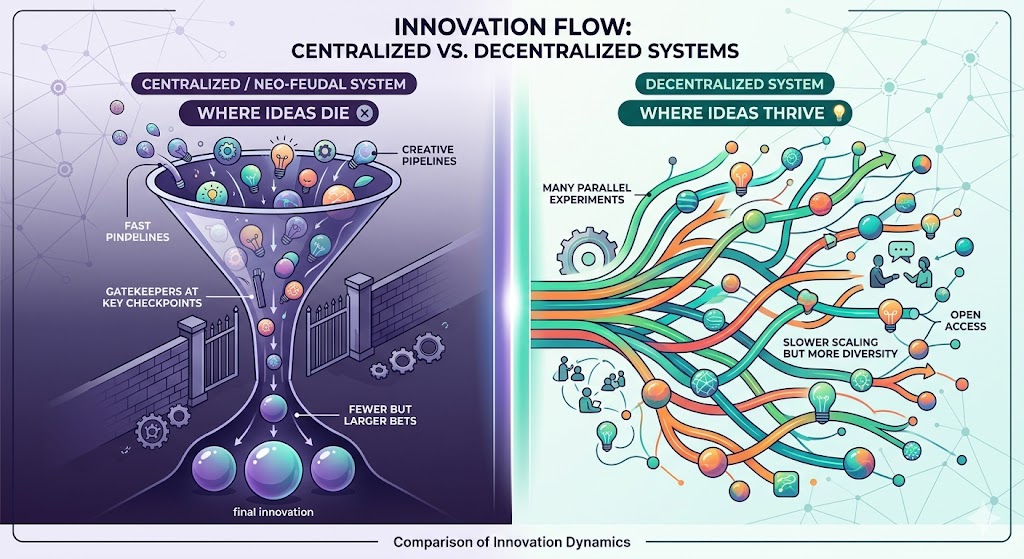
Centralized vs. Decentralized Innovation

Editorial Perspective: Beyond Innovation — Impacts on People, Society, and the Future

Innovation is only one dimension of neo-feudalism’s impact. To understand the full picture, we must examine how these dynamics affect personal finance, customer experience, employee experience, societal cohesion, and the broader trajectory of humanity.

Personal Finance: Ownership vs. Access

Neo-feudal structures often shift value from ownership to access. Individuals increasingly rent rather than own assets — from housing to software, from transportation to digital goods. This reduces opportunities for wealth accumulation and long-term financial security, creating dependency on centralized platforms and institutions.

Customer Experience: Convenience vs. Control

Platforms often deliver seamless, integrated experiences that delight customers. Yet this convenience comes at a cost: reduced choice, limited transparency, and dependence on a small number of dominant providers. What feels like freedom can also become subtle control.

Employee Experience: Flexibility vs. Precarity

The rise of gig work and contract-based employment provides flexibility, but often at the expense of security, benefits, and long-term stability. Workers may gain autonomy but lose agency over income, career trajectory, and participation in the value they create.

Societal Cohesion: Fragmentation vs. Stability

Neo-feudal structures create “walled gardens” — both digital and physical — that fragment communities and weaken shared social identity. The focus shifts from collective well-being to alignment with the dominant gatekeepers, eroding trust and social cohesion over time.

Innovation Paradox

The same structures that accelerate innovation at the top can suppress it at the edges. While resources and talent are concentrated in elite hubs, the diversity, experimentation, and autonomy that fuel broader innovation ecosystems may diminish, limiting society’s overall creative potential.

Ultimately, the question is not whether neo-feudalism can produce innovation —it can. The critical questions are: what kinds of innovation, who benefits from it, and what broader costs are being imposed on society?

Understanding these trade-offs is essential for leaders, policymakers, and innovators seeking to design systems that are not only efficient but also equitable, resilient, and human-centered.
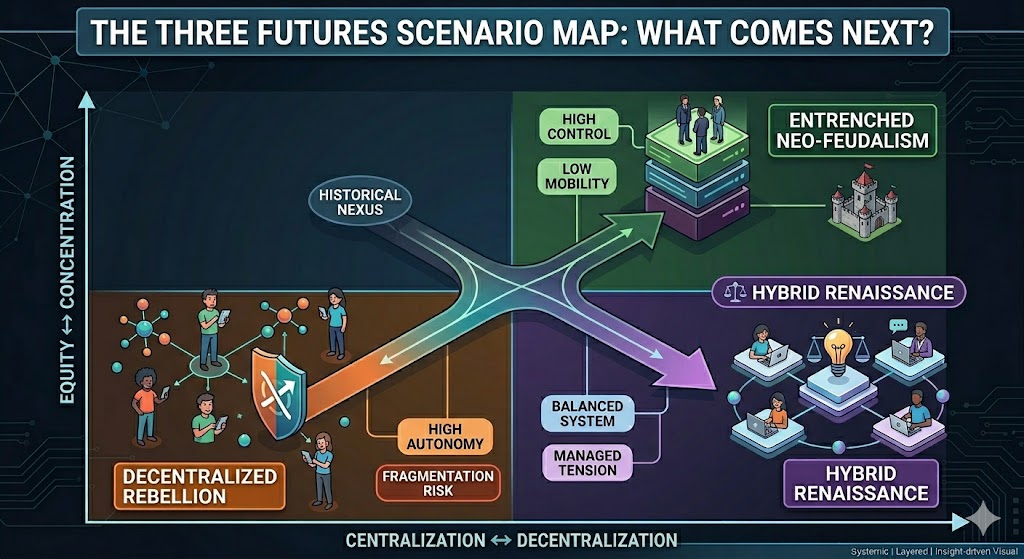
Three Neo-Feudalism Future Scenarios

What Comes Next? The Future of Humanity in a Neo-Feudal Trajectory

Looking ahead, the trajectory of neo-feudalism raises profound questions about the future of innovation, society, and humanity itself. While the current system exhibits both benefits and constraints, the ultimate outcome is not predetermined. Several potential futures are emerging.

1. Entrenched Neo-Feudalism

In this scenario, the concentration of power solidifies. Large platforms, corporations, and institutions become the primary arbiters of opportunity, innovation, and wealth. Innovation continues to occur, but primarily within the bounds set by dominant entities, reinforcing dependency and inequality.

2. Decentralized Rebellion

Technologies such as blockchain, decentralized autonomous organizations (DAOs), and open-source platforms could empower new models of governance and collaboration. Power becomes more distributed, enabling innovation and value creation outside centralized structures. Communities reclaim ownership, autonomy, and agency over their economic and creative lives.

3. Hybrid Renaissance (Most Likely)

A middle path may emerge in which concentrated power is balanced by decentralizing forces. Platforms and institutions retain some influence but are complemented by regulatory frameworks, public oversight, and decentralized networks. This hybrid system could preserve the benefits of scale and stability while expanding participation and opportunity for a wider range of innovators.

Each of these scenarios carries implications for innovation, wealth distribution, social cohesion, and human potential. Leaders and policymakers face the challenge of shaping a system that maximizes innovation while mitigating dependency, inequality, and fragility.

The critical question is this: will humanity design a future where innovation serves the many, or will it remain confined to the few who control the gates?

EDITOR’S NOTE: Stay tuned for future articles examining the impact on innovation of planned obsolescence, right to repair, CONTACT ME WITH OTHER SUGGESTIONS, etc.

Image credits: Gemini

Content Authenticity Statement: The topic area, key elements to focus on, etc. were decisions made by Braden Kelley, with a little help from ChatGPT to clean up the article and add citations.

Subscribe to Human-Centered Change & Innovation WeeklySign up here to get Human-Centered Change & Innovation Weekly delivered to your inbox every week.

Layoffs, AI, and the Future of Innovation

Efficiency Breakthrough or Creative Bankruptcy?

LAST UPDATED: March 21, 2026 at 10:24 PM

Layoffs, AI, and the Future of Innovation

by Braden Kelley and Art Inteligencia


Framing the Debate: Signals or Symptoms?

A new wave of layoffs across technology companies has reignited a familiar but increasingly urgent question: what exactly are we witnessing? On the surface, the explanation seems straightforward — companies are tightening costs, responding to macroeconomic pressures, and recalibrating after years of aggressive hiring. But beneath that surface lies a deeper and more consequential debate about the future of innovation, the role of engineers, and the impact of artificial intelligence on knowledge work itself.

Two competing narratives have quickly emerged. The first frames these layoffs as a rational and even necessary evolution. In this view, advances in AI-powered development tools — ranging from large language models to code-generation systems — have fundamentally altered the productivity equation. Engineers equipped with tools like Claude or OpenAI Code can now accomplish in hours what once took days. The implication is clear: if output can be maintained or even increased with fewer people, then reducing headcount is not a sign of weakness but a signal of maturation. Companies are becoming leaner, more efficient, and ultimately more profitable.

The second narrative is far less optimistic. It suggests that layoffs are not a leading indicator of a smarter, AI-augmented future, but a trailing indicator of something more troubling — an innovation slowdown. According to this perspective, many technology companies have already harvested the most accessible opportunities within their existing platforms. What remains is incremental improvement rather than transformative change. In such an environment, cutting engineering talent becomes less about efficiency gains and more about a lack of compelling new problems to solve. The cupboard, in other words, may not be empty — but it may be significantly less full than it once was.

What makes this moment particularly complex is that both narratives can be true at the same time. AI is undeniably increasing productivity in certain domains, compressing development cycles and enabling smaller teams to deliver meaningful results. At the same time, innovation has never been solely a function of efficiency. Breakthroughs emerge from exploration, from cross-functional collisions, and from a willingness to invest in uncertain futures. Layoffs, especially when executed at scale, can disrupt the very conditions that make those breakthroughs possible.

This tension forces us to confront a more nuanced question: are these layoffs a signal of transformation or a symptom of stagnation? Are organizations courageously embracing a new model of AI-augmented work, or are they retreating into cost-cutting as a substitute for bold thinking? The answer matters, because it shapes not only how we interpret today’s decisions, but how we design organizations for tomorrow.

For leaders, the stakes extend beyond quarterly earnings. The choices being made now will determine whether AI becomes a catalyst for a new era of human-centered innovation or a tool that accelerates efficiency at the expense of imagination. For engineers, the implications are equally profound. Their roles are being redefined in real time — not just in terms of what they produce, but in how they create value within increasingly AI-mediated systems.

Ultimately, this is not just a debate about layoffs. It is a debate about what organizations choose to optimize for: productivity or possibility, efficiency or exploration, output or insight. And in that choice lies the future trajectory of innovation itself.

The Case for “Smarter, Leaner, More Profitable”

For many technology leaders, the recent wave of layoffs is not a retreat — it is a re-calibration. The argument is grounded in a simple but powerful premise: the economics of software development have fundamentally changed. With the rapid advancement of AI-assisted coding tools, the amount of output a single engineer can produce has increased dramatically. What once required large, specialized teams can now be accomplished by smaller, more versatile groups augmented by intelligent systems.

Tools such as Claude and OpenAI Code are not merely incremental improvements in developer productivity; they represent a shift in how work gets done. Routine coding tasks, boilerplate generation, debugging assistance, and even architectural suggestions can now be offloaded to AI. This allows engineers to spend less time writing repetitive code and more time focusing on higher-value activities such as system design, problem framing, and integration across complex environments.

In this emerging model, the role of the engineer evolves from builder to orchestrator. Instead of manually crafting every line of code, engineers guide, refine, and validate the outputs of AI systems. The result is a compression of development cycles — features are built faster, iterations occur more rapidly, and time-to-market shrinks. From a business perspective, this translates into a compelling opportunity: maintain or even increase output while reducing labor costs.

This logic is not without precedent. Across industries, waves of automation have consistently redefined the relationship between labor and productivity. In manufacturing, the introduction of robotics did not eliminate production; it scaled it. In many cases, it also improved quality and consistency. Proponents of the current shift argue that AI represents a similar inflection point for knowledge work. The companies that adapt fastest will be those that learn to pair human creativity with machine efficiency.

From a financial standpoint, the incentives are clear. Reducing headcount while sustaining output improves margins, a priority that has become increasingly important in an environment where growth-at-all-costs is no longer rewarded. Investors are placing greater emphasis on profitability and operational discipline, and companies are responding accordingly. Leaner teams are not just a byproduct of technological change — they are a strategic choice aligned with evolving market expectations.

There is also a strategic argument that goes beyond cost savings. By automating lower-value tasks, organizations can theoretically redeploy human talent toward more innovative efforts. Engineers freed from routine work can focus on solving harder problems, exploring new product ideas, and experimenting with emerging technologies. In this view, AI does not replace innovation capacity; it expands it by removing friction from the development process.

Smaller teams can also mean faster decision-making. With fewer layers of coordination required, organizations can become more agile, responding quickly to changing market conditions and customer needs. This agility is often cited as a competitive advantage, particularly in fast-moving technology sectors where speed can determine success or failure.

Ultimately, the “smarter, leaner” argument rests on a belief that efficiency and innovation are not mutually exclusive. Instead, they are mutually reinforcing. By leveraging AI to increase productivity, companies can create the financial and operational headroom needed to invest in the next wave of innovation. Layoffs, in this context, are not an admission of weakness — they are a signal that the underlying system of value creation is being rewritten.

The Case for “Innovation Is Running Dry”

While the efficiency narrative is compelling, an equally important — and more unsettling — interpretation of recent layoffs is gaining traction: that they reflect not technological progress, but an innovation slowdown. In this view, companies are not simply becoming leaner because they can do more with less, but because they have fewer truly novel problems worth investing in. The layoffs, therefore, are less a signal of transformation and more a symptom of diminishing opportunity.

Over the past decade, many technology companies have scaled around a set of highly successful platforms and business models. These platforms have been optimized, expanded, and monetized with remarkable effectiveness. But maturity brings constraints. As systems stabilize and markets saturate, the number of greenfield opportunities naturally declines. What remains is often incremental improvement — refinements, extensions, and efficiencies — rather than the kind of breakthrough innovation that requires large, exploratory engineering teams.

In this context, layoffs can be interpreted as a rational response to a shrinking frontier. If there are fewer bold bets to pursue, there is less need for the capacity required to pursue them. The risk, however, is that this becomes a self-reinforcing cycle. As organizations reduce investment in exploration, they further limit their ability to discover the next wave of opportunity. Over time, efficiency begins to crowd out possibility.

Compounding this dynamic is an increasing reliance on metrics that prioritize productivity over potential. Organizations are becoming exceptionally good at measuring what is already known — velocity, output, utilization — but far less adept at valuing what has yet to be discovered. When success is defined primarily by efficiency gains, it becomes harder to justify the uncertainty and longer time horizons associated with breakthrough innovation.

The rise of AI tools adds another layer of complexity. While these tools can accelerate development, they do not inherently generate new insight. They are trained on existing patterns, which means they are exceptionally effective at extending the present but less equipped to invent the future. This creates the risk of an “illusion of progress,” where output increases but originality does not. More code is produced, but not necessarily more meaningful innovation.

There are also significant cultural consequences to consider. Layoffs, particularly when they affect engineering and product teams, can erode trust and psychological safety within an organization. When employees perceive that their roles are precarious, they are less likely to take risks, challenge assumptions, or pursue unconventional ideas. Yet these behaviors are precisely what fuel innovation. In attempting to optimize for efficiency, companies may inadvertently suppress the very creativity they depend on for long-term growth.

Another often overlooked impact is the loss of institutional knowledge. Experienced engineers carry not just technical expertise, but contextual understanding of systems, decisions, and past experiments. When they leave, they take with them insights that are difficult to codify or replace. This loss can slow future innovation efforts, even as short-term efficiency metrics appear to improve.

Ultimately, the concern is not that companies are becoming more efficient — it is that they may be becoming too narrowly focused on efficiency at the expense of exploration. Innovation requires slack, curiosity, and a willingness to invest in uncertain outcomes. When organizations begin to treat these elements as expendable, they risk signaling something far more significant than cost discipline: a diminishing appetite for invention itself.

Paths to AI-Driven Engineering Outcomes

The Human-Centered Tension: Productivity vs. Possibility

Beneath the surface of the efficiency versus stagnation debate lies a deeper, more human tension — one that cannot be resolved by technology alone. At its core, innovation has never been just about output. It has always been about the quality of thinking, the diversity of perspectives, and the collisions between ideas that spark something new. When organizations focus too narrowly on productivity, they risk overlooking the very conditions that make possibility achievable.

Innovation does not emerge from isolated efficiency; it emerges from interaction. It is the byproduct of cross-functional curiosity — engineers engaging with designers, product managers challenging assumptions, customers re-framing problems, and leaders creating space for exploration. These interactions are often messy, inefficient, and difficult to measure. But they are also where breakthroughs live. When layoffs reduce not just headcount but diversity of thought and opportunities for collaboration, the innovation system itself becomes less dynamic.

The rise of AI-augmented work introduces a new layer to this tension. As engineers increasingly rely on AI tools to generate code, suggest solutions, and optimize workflows, their role begins to shift. They move from hands-on builders to orchestrators of machine-assisted output. While this shift can increase speed and efficiency, it also raises an important question: what happens to deep craft? The tacit knowledge developed through wrestling with complexity — the kind that often leads to unexpected insights — may be diminished if too much of the process is abstracted away.

There is also a cognitive risk. AI systems are designed to identify and replicate patterns based on existing data. This makes them powerful tools for scaling what is already known, but less effective at challenging foundational assumptions. If organizations become overly dependent on these systems, they may unintentionally standardize thinking. The range of possible solutions narrows, not because people lack creativity, but because the tools they use guide them toward familiar patterns.

Trust plays a critical role in navigating this tension. In environments where employees feel secure, valued, and empowered, they are more likely to experiment, take risks, and pursue unconventional ideas. Layoffs, particularly when they are frequent or poorly communicated, can erode that trust. The result is a more cautious workforce — one that prioritizes safety over exploration. In such environments, productivity may remain high, but the willingness to pursue breakthrough innovation often declines.

Curiosity is the other essential ingredient. It is the force that drives individuals to ask better questions, challenge the status quo, and seek out new possibilities. Yet curiosity requires space — time to think, room to explore, and permission to deviate from immediate objectives. When organizations optimize relentlessly for efficiency, that space tends to disappear. Every moment is accounted for, every effort measured, and every outcome expected to justify itself in the short term.

This creates a paradox. The same tools and strategies that enable organizations to move faster can also constrain their ability to think differently. Speed without reflection can lead to acceleration in the wrong direction. Efficiency without exploration can result in incremental progress that ultimately limits long-term growth.

For leaders, the challenge is not to choose between productivity and possibility, but to intentionally design for both. This means recognizing that innovation systems require balance — between execution and exploration, between structure and flexibility, and between human judgment and machine assistance. It requires protecting the conditions that enable creativity even as new technologies reshape how work gets done.

Ultimately, the question is not whether AI will make organizations more efficient — it already is. The question is whether leaders will use that efficiency to create more space for human ingenuity, or whether they will allow it to crowd out the very behaviors that make innovation possible in the first place.

The Future of Innovation in the Age of AI: Augmentation or Abdication?

As organizations navigate layoffs, AI adoption, and shifting expectations around productivity, the future of innovation is not predetermined — it is being actively shaped by the choices leaders make today. The central question is no longer whether artificial intelligence will transform how work gets done, but how that transformation will be directed. Will AI serve as an amplifier of human ingenuity, or will it become a mechanism for narrowing ambition in the pursuit of efficiency?

Three distinct paths are beginning to emerge. The first is an augmentation-led renaissance, where organizations successfully combine human creativity with machine capability. In this scenario, AI handles the repetitive and computationally intensive aspects of work, freeing humans to focus on problem framing, experimentation, and breakthrough thinking. Innovation accelerates not because there are fewer people, but because those people are empowered to operate at a higher level of abstraction and impact.

The second path is the efficiency trap. Here, organizations become so focused on optimizing output and reducing cost that they gradually lose their capacity for exploration. AI is used primarily to streamline existing processes rather than to unlock new possibilities. Over time, these organizations become highly efficient at executing yesterday’s ideas, but increasingly disconnected from tomorrow’s opportunities. What appears to be strength in the short term reveals itself as fragility in the long term.

The third path is a bifurcation of the competitive landscape. Some organizations will lean into augmentation, investing in both AI capabilities and the human systems required to harness them effectively. Others will prioritize efficiency, focusing on cost control and incremental gains. The result is a widening gap between companies that consistently generate new value and those that primarily replicate and optimize existing models. In such an environment, innovation becomes a defining differentiator rather than a baseline expectation.

What separates the leaders from the laggards will not be access to AI alone — those tools are increasingly commoditized — but how organizations integrate them into their innovation systems. Leading organizations will invest not just in AI infrastructure, but in what might be called curiosity infrastructure: the cultural, structural, and leadership practices that encourage questioning, exploration, and cross-functional collaboration. They will recognize that technology can accelerate execution, but only humans can redefine the problems worth solving.

This shift will require a redefinition of roles. Engineers, for example, will need to move beyond execution and into areas such as systems thinking, ethical judgment, and interdisciplinary collaboration. Their value will be measured not just by what they build, but by how they frame problems, challenge assumptions, and integrate diverse inputs into coherent solutions. Similarly, leaders will need to become stewards of both performance and possibility, ensuring that the drive for efficiency does not crowd out the pursuit of innovation.

Organizations that thrive will also be those that intentionally protect space for exploration. This does not mean abandoning discipline or ignoring financial realities. It means recognizing that innovation requires a portfolio approach — balancing investments in core optimization with bets on uncertain, high-potential opportunities. AI can make this balance more achievable by reducing the cost of experimentation, but only if leaders choose to reinvest those gains into discovery rather than solely into margin expansion.

Ultimately, the future of innovation in the age of AI will be defined by whether organizations treat these tools as a substitute for human thinking or as a catalyst for it. The real risk is not that AI replaces engineers — it is that organizations stop asking the kinds of questions that require engineers to think deeply, creatively, and collaboratively in the first place.

Augmentation or abdication is not a technological choice. It is a leadership choice. And in making it, organizations will determine whether this moment becomes a turning point toward a more innovative future — or a gradual slide into highly efficient irrelevance.

Frequently Asked Questions

1. Why are technology companies laying off engineers despite using AI tools?

Layoffs may result from a combination of efficiency gains and slowing innovation opportunities. AI tools like
Claude and OpenAI Code allow smaller teams to maintain or increase output, reducing the need for some roles.
At the same time, some companies face fewer breakthrough projects to pursue, which can also drive workforce reductions.

2. Does AI replace human engineers or just augment their work?

AI primarily augments engineers by automating repetitive coding, debugging, and optimization tasks. This allows
engineers to focus on higher-value activities such as system design, problem framing, and creative innovation.
While some roles shift, AI is intended as an amplifier of human ingenuity rather than a replacement.

3. How can companies maintain innovation in the age of AI?

Companies can preserve innovation by investing in curiosity infrastructure, protecting time and space for
experimentation, fostering cross-functional collaboration, and reinvesting efficiency gains into exploratory,
high-potential projects. Balancing productivity with opportunity ensures that humans and AI together drive breakthroughs.


Image credits: ChatGPT

Content Authenticity Statement: The topic area, key elements to focus on, etc. were decisions made by Braden Kelley, with a little help from ChatGPT to clean up the article and add citations.

Subscribe to Human-Centered Change & Innovation WeeklySign up here to get Human-Centered Change & Innovation Weekly delivered to your inbox every week.