Another AI Soft Landing Scenario Exploration — Government as the Employer of First Resort
LAST UPDATED: May 2, 2026 at 5:33 PM
by Braden Kelley and Art Inteligencia
The Structural Gap: Why Process Automation Requires a Civic Pivot
As we navigate the accelerating displacement of cognitive and administrative labor, the conversation around the “AI soft landing” has reached a critical juncture. In my previous explorations, I’ve examined how our future might mirror the extreme wealth gaps of Victorian England and how we might witness a Human Premium Renaissance, where uniquely human traits become our most valuable currency.
However, a significant structural link is missing. While AI is exceptionally efficient at automating process, it is incapable of automating presence. This creates a dangerous void: as middle-class administrative roles evaporate, we risk losing the economic liquidity and social cohesion that sustain our communities.
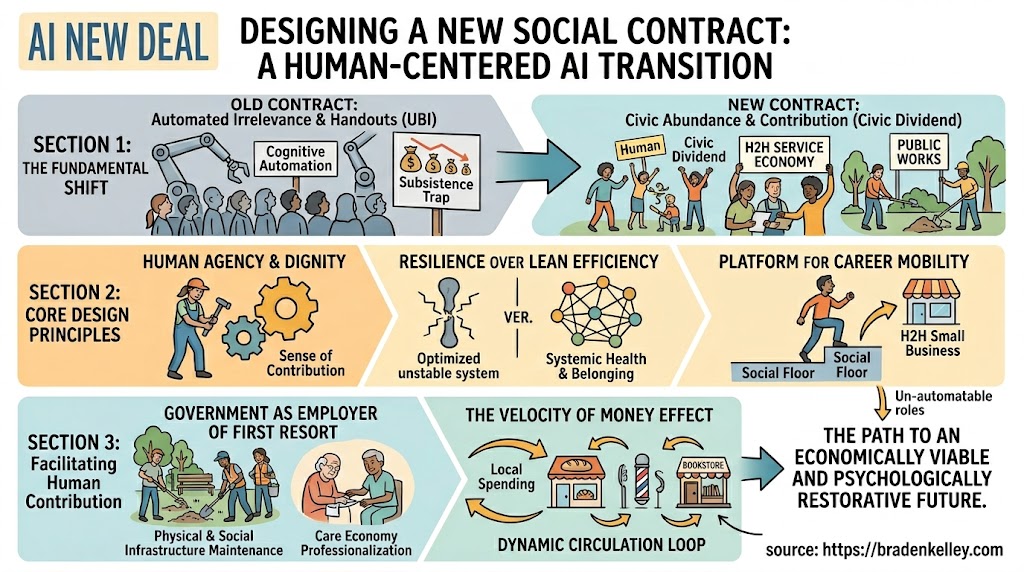
The prevailing solution often discussed is Universal Basic Income (UBI). But as I have argued, UBI is a fiscal mirage — a passive mechanism that fails to account for the human need for agency and the staggering mathematical reality of devalued tax bases. We don’t need a handout; we need a Civic Dividend. We must move from a scarcity mindset focused on protecting obsolete jobs to an abundance mindset that funds the essential work we have historically neglected. This is the foundation of the AI New Deal: positioning the government as the Employer of First Resort.
The Fiscal and Psychological Mirage of UBI
Universal Basic Income (UBI) is often presented as the “silver bullet” for the AI age, but a closer look at the mechanics reveals it to be a flawed tool for a human-centered transition. From a design perspective, UBI solves for survival but fails to solve for contribution.
First, we must confront the Math Problem. Funding a meaningful UBI requires a robust and consistent tax base. However, as AI drives down the cost of labor toward zero, the income tax pool — the traditional engine of government revenue — shrinks alongside it. Relying on passive redistribution in a devalued labor market is a race to the bottom that risks a permanent “subsistence trap” for the majority of the population.
Second, there is the Agency Problem. Innovation thrives on human agency — the ability to act, create, and impact one’s environment. UBI provides a safety net but offers no platform for growth. By decoupling income from contribution, we risk creating a “useless class” not because humans lack value, but because we have failed to design systems that utilize their unique “Human Premium.”
Finally, we must consider the Inflation Trap. Without a mechanism to ensure the circulation of capital through local, human-to-human services, stagnant UBI payments are easily consumed by the rising costs of private-sector essentials. To achieve a soft landing, we need a dynamic model that prioritizes the Velocity of Money over the mere distribution of funds.
The Core Concept: The Civic Dividend
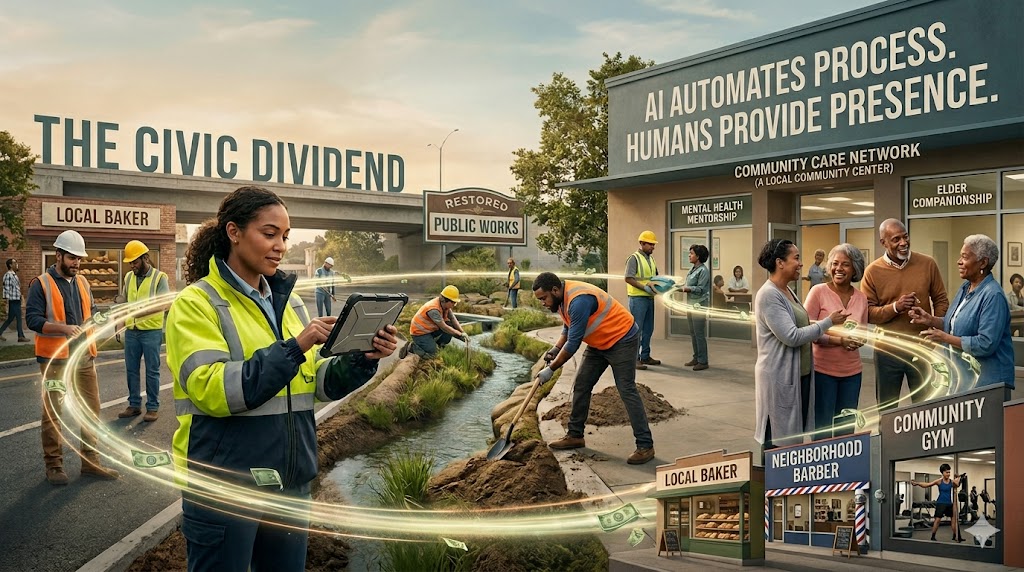
To bridge the gap between AI-driven efficiency and human necessity, we must introduce the Civic Dividend. This is not a social safety net designed for the desperate; it is a strategic economic platform designed for a high-functioning society. At its heart is a fundamental shift in the social contract: the Government as the Employer of First Resort.
In this model, the government doesn’t just step in when the private market fails; it proactively identifies and funds the “work that matters” — the essential maintenance of our physical, social, and cultural existence. These are the roles that require empathy, physical dexterity, and contextual judgment — capabilities that remain firmly in the human domain.
The Civic Dividend operates on the principle that human labor is a public asset. By offering potential employment in public works, care networks, and community resilience projects, the state ensures that most citizens have the opportunity to contribute. This creates a “Social Floor” of activity and income that is immune to algorithmic displacement.
Crucially, this work is not “make-work” intended to keep hands busy. It is the vital labor required to repair our crumbling infrastructure, support our aging population, and revitalize our neighborhoods. Unlike a handout, these wages are earned, providing the dignity of contribution while fueling the Velocity of Money. As these wages are spent at local bakeries, barbershops, and bookstores, they sustain a secondary human-to-human service economy that AI simply cannot replicate.
The Three Pillars of the AI New Deal
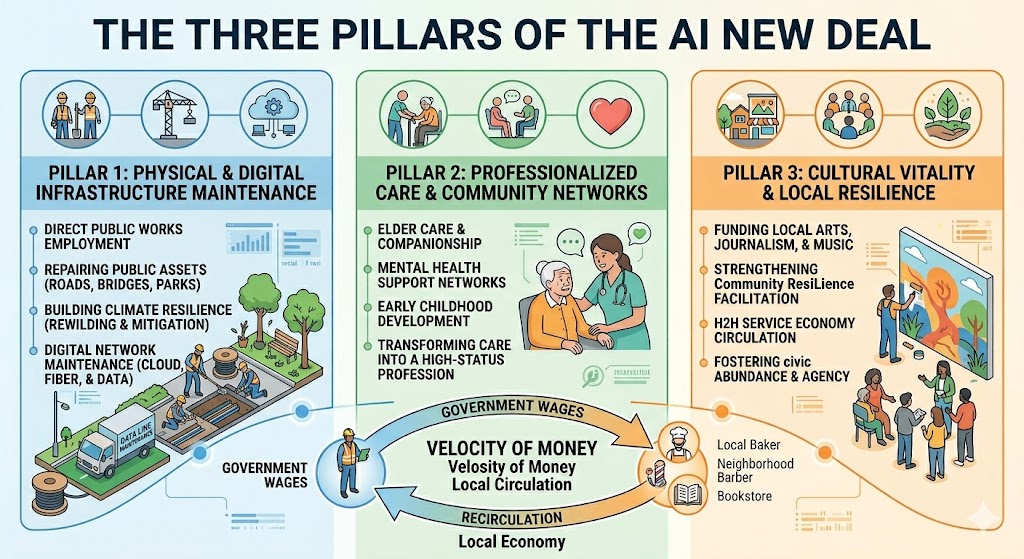
The success of the AI New Deal rests on a strategic focus on the “Un-automatable.” We must direct our collective energy toward three specific domains where human presence, judgment, and physical interaction are not just preferred, but essential for a thriving society.
Pillar 1: Physical and Digital Infrastructure
We are currently witnessing a “Tragedy of the Commons” in our physical world. Our bridges, transit systems, and power grids require more than just algorithmic optimization; they require physical intervention. The AI New Deal would mobilize a modern workforce to focus on Community Resilience — retrofitting cities for climate adaptation, urban “rewilding” to restore local ecosystems, and maintaining the physical nodes that allow our digital world to function. This work creates a tangible, high-quality public environment that serves as a shared wealth for all citizens.
Pillar 2: The Social and Care Fabric
As we automate cognitive tasks, the “Human Premium” in care becomes our most valuable asset. We are facing a global loneliness epidemic and an aging demographic that requires empathy, companionship, and nuanced psychological support. By professionalizing and scaling roles in elder care, mental health mentorship, and early childhood development, we transform these from marginalized sectors into the prestigious cornerstones of our new economy. These are roles where the goal is not “efficiency” (doing more with less time), but “effectiveness” (the quality of the human connection).
Pillar 3: Community Vitality and Cultural Resilience
In an era of AI-generated noise, local culture and verified information are at risk of erosion. The AI New Deal funds the “Civic Architects” — the local journalists, community theater directors, and public artists who document and celebrate the unique identity of a place. This pillar ensures that while our tools become more global and algorithmic, our lived experiences remain local, vibrant, and distinctly human. We aren’t just building roads; we are building the social connective tissue that prevents the isolation often triggered by rapid technological shifts.
Economic Mechanics: The Velocity of Human Connection
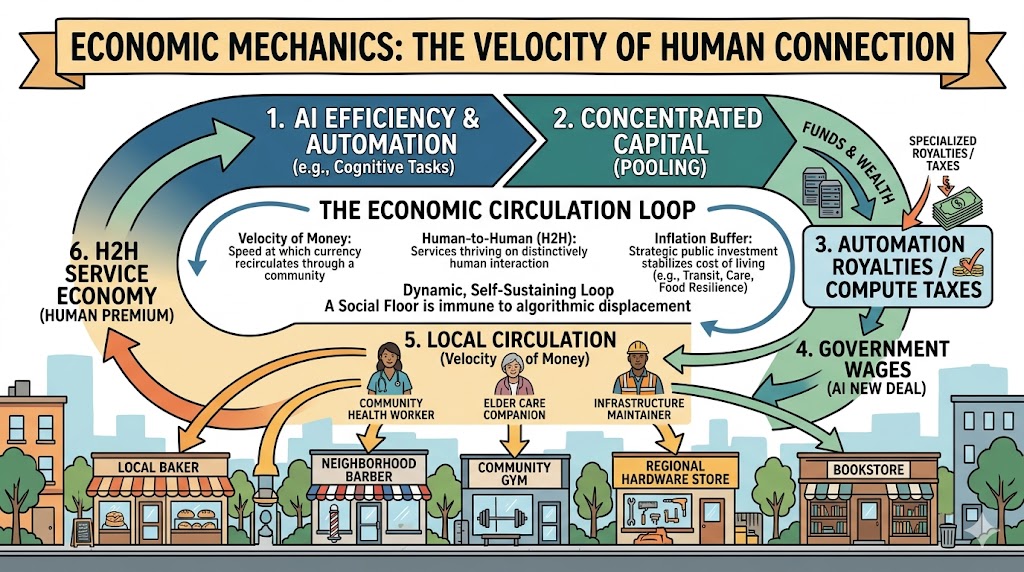
The fiscal engine of the AI New Deal is built on a fundamental economic principle: the Velocity of Money. In a hyper-automated private sector, capital tends to pool at the top, concentrating in the hands of those who own the compute and the algorithms. Without a mechanism to pull that capital back into the hands of the many, the local economy — the shops, services, and neighborhood hubs — withers.
The Civic Dividend solves this by creating a continuous loop of circulation. When the government pays a living wage to a community health worker or a local infrastructure specialist, that income doesn’t sit idle. It is immediately recycled into the Human-to-Human (H2H) service economy. This worker buys bread from a local baker, gets a haircut from a neighborhood barber, and visits a local gym. These secondary businesses thrive precisely because their customers have earned, discretionary income to spend.
To fund this transition, we must look toward Automation Royalties or “Compute Taxes.” Rather than taxing labor — which AI is making artificially cheap — we shift the tax burden to the high-margin output of automated systems. This creates a sustainable cycle: the efficiency of AI funds the resilience of the human community.
Furthermore, the AI New Deal acts as a natural Inflation Buffer. By investing in public housing maintenance, efficient public transit, and community-led food resilience, we lower the “floor” of the cost of living. This ensures that the wages provided by the Civic Dividend maintain high purchasing power, shielding the population from the volatility of a purely algorithmic private market.
Addressing the Critics: Efficiency vs. Resilience
Critics often argue that government-led employment is inherently “inefficient” compared to the lean, optimized nature of the private sector. From the perspective of human-centered innovation, this critique misses the mark because it uses the wrong metric for success. In an AI-dominated age, social resilience is a far more valuable outcome than marginal efficiency.
The private sector’s drive for efficiency is exactly what is displacing workers. If we allow that same logic to dictate our social response, we end up with a society that is “optimized” into instability. The AI New Deal isn’t about competing with AI on speed or cost; it is about providing the stability that the private market, by its very nature, cannot offer. We are designing for systemic health, not just quarterly throughput.
Another common concern is the fear of “make-work” or a lack of individual choice. However, the AI New Deal is designed as a platform, not a cage. By providing a guaranteed social floor of meaningful work, we actually increase career mobility. When a citizen’s basic survival and dignity are secured through the Civic Dividend, they are more — not less — likely to take risks, launch their own H2H small businesses, or pursue creative endeavors in the Human Premium Renaissance.
Finally, we must recognize that this is a choice of design. We can choose to view displaced workers as a “surplus” to be managed, or we can view them as a massive, untapped reserve of human talent ready to be deployed toward the public good. The “inefficiency” of paying a human to do what an algorithm could do is only an inefficiency if you ignore the catastrophic social cost of a disengaged, impoverished populace.
Frequently Asked Questions
How is the AI New Deal different from Universal Basic Income (UBI)?
While UBI provides a passive payment regardless of activity, the AI New Deal is a “Civic Dividend” based on active contribution. It positions the government as the Employer of First Resort, paying living wages for essential public work — such as infrastructure maintenance and care services — rather than providing a handout that lacks a connection to social agency or the local service economy.
How can the government afford to become the ‘Employer of First Resort’?
The funding shifts from taxing human labor to taxing the high-margin output of automated systems, often referred to as “Automation Royalties” or “Compute Taxes.” By capturing the wealth generated by AI-driven efficiency, the state can reinvest that capital into the Human-to-Human (H2H) economy, ensuring currency continues to circulate through physical communities.
Does this mean the government is creating ‘make-work’ just to keep people busy?
No. The AI New Deal focuses on the “Un-automatable” — high-value needs that are currently neglected, such as climate resilience, elder care, and mental health support. These are not arbitrary tasks; they are the essential services required for a functional, healthy society that AI cannot perform because they require human empathy, physical presence, and contextual judgment.
EDITOR’S NOTE: This is a visualization of but one possible future. I will be publishing other possible futures as they crystallize in my mind (or as you suggest them for me to explore).
Image credits: Google Gemini
Content Authenticity Statement: The topic area, key elements to focus on, etc. were decisions made by Braden Kelley, with a little help from Google Gemini to clean up the article, add images and create infographics.
 Sign up here to get Human-Centered Change & Innovation Weekly delivered to your inbox every week.
Pingback: Founding an American AI Sovereign Wealth Fund
Pingback: The Tribal Fragmentation: Why the AI Soft Landing Will Be a Patchwork Polity