Tag Archives: experience level measures

Go Beyond SLAs and Measure Human Success with the New XLM Matrix (free download)

An Experience Level Measure (XLM) is a metric that quantifies human experience success — not just system uptime or ticket speed. Where a traditional SLA (Service Level Agreement) commits to technical or operational performance, an XLM asks whether people can reach their goal without unnecessary friction, confusion, or cognitive fatigue.

The XLM (Experience Level Measure) Matrix™ is Braden Kelley’s visual workshop framework for moving from a specific “ugh” moment (friction) → to an XLM that measures the absence of that friction → to the innovation or design lever that improves it. Use it for customer, employee, partner, patient, or constituent experiences.

In short:

  • SLA = Did the system/process meet a technical threshold?
  • XLM = Did the human succeed without avoidable pain?
  • XLA (Experience Level Agreement) = A commitment to experience outcomes, informed by XLMs
  • XLM Matrix™ = The tool that connects friction → measure → fix

Free download: Get the XLM Matrix™ (11″×17″)
Related: Experience Design Glossary — XLM & XLA · Customer Experience Audit


Go Beyond SLAs and Measure Human Success with the XLM Matrix

by Braden Kelley


The Crisis of the “Efficient but Empty” Experience

In our current landscape of rapid digital transformation, we have achieved unprecedented levels of speed and automation. Organizations have mastered the “how” of delivery, yet many find themselves facing a growing paradox: processes are becoming more efficient while human satisfaction is simultaneously declining. We are successfully building faster systems that often leave the user feeling more like a cog in a machine than a valued participant.

The root of this issue lies in our reliance on traditional Service Level Agreements (SLAs). For decades, SLAs have served as the gold standard for operational success, measuring technical markers like system uptime, response times, and throughput. While these metrics are essential for maintaining infrastructure, they are fundamentally “cold” metrics. They can tell you that a system is functioning, but they cannot tell you if the person using that system is thriving, frustrated, or merely exhausted by the interaction.

To innovate effectively in a human-centered future, we must look beyond technical availability and begin measuring the actual quality of the human encounter. We need a shift in perspective—moving from monitoring system performance to measuring human success. This evolution requires a new framework: Experience Level Measures (XLMs). By focusing on how an innovation impacts the user’s cognitive load, sense of agency, and emotional resonance, we can move past “efficient but empty” outputs and toward solutions that deliver genuine value.

Introducing the XLM Matrix

To bridge the gap between technical output and human success, we developed the XLM (Experience Level Measure) Matrix. This visual framework is designed to help innovation teams move beyond abstract empathy and toward concrete, measurable experience improvements. By visualizing the relationship between friction, measurement, and action, teams can align their efforts with the outcomes that actually move the needle for their users.

The matrix is structured as a series of concentric rings, requiring teams to work from the “inside out” to ensure every innovation is rooted in a real-world human need:

  • The Inner Circle (The Friction Point): This is the starting line. Here, teams identify the specific “ugh” moment—the point in the journey where the user currently feels confused, slowed down, or disempowered.
  • The Middle Ring (The XLM): This layer transforms qualitative frustration into a quantitative metric. It asks: “How do we measure the absence of that friction?” An XLM isn’t about system uptime; it’s about the user’s success rate in reaching their goal without cognitive fatigue.
  • The Outer Ring (The Innovation Lever): Once the friction is identified and the metric is set, the outer ring focuses on the solution. It identifies the specific change in the product, service, or workflow that will directly influence the XLM and eliminate the friction point.

By using this “Target Logic,” teams ensure that they aren’t just innovating for the sake of novelty, but are strategically pulling levers that have a measurable impact on the human experience.
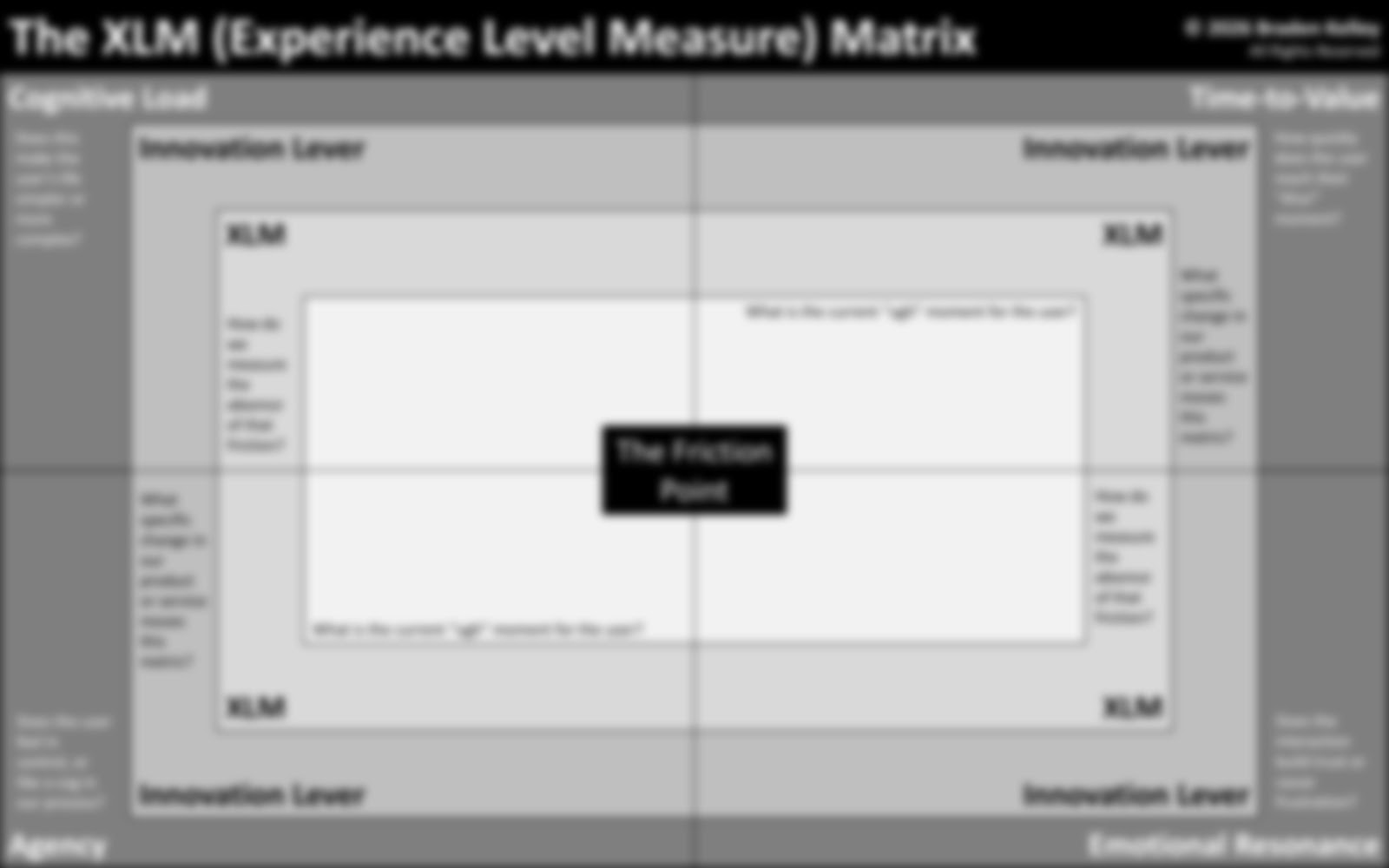
The XLM (Experience Level Measure) Matrix

The Four Pillars of Human-Centered Innovation

To provide a comprehensive view of the user experience, the XLM Matrix is divided into four critical quadrants. Each quadrant represents a fundamental pillar of how humans interact with technology and services. By examining an innovation through these four lenses, teams can uncover hidden friction points and prioritize improvements that resonate most deeply with their audience.

1. Cognitive Load

“Does this make the user’s life simpler or more complex?”

In an age of information abundance, mental energy is a finite resource. This pillar focuses on the mental effort required to complete a task. Innovation here is about reducing noise, simplifying navigation, and ensuring that the “cost of thinking” is kept to an absolute minimum.

2. Time-to-Value

“How quickly does the user reach their ‘Aha!’ moment?”

Success is often determined by the distance between a user’s first interaction and their first realization of value. This quadrant measures the speed of relevance. Effective innovation in this space removes barriers to entry and streamlines the path to a meaningful outcome.

3. Agency

“Does the user feel in control, or like a cog in the process?”

As systems become more autonomous, maintaining human agency is vital. This pillar explores whether a tool empowers the user or forces them into a rigid, predetermined path. High-agency innovations provide the user with the autonomy to make meaningful choices and direct the outcome.

4. Emotional Resonance

“Does the interaction build trust or cause frustration?”

Every interaction leaves an emotional footprint. This quadrant assesses the “vibe” of the experience. It looks beyond function to ask if the solution feels reliable, empathetic, and aligned with the user’s values, transforming a transactional moment into a relational one.

How to Use the Matrix with Your Team

The XLM Matrix is most effective when used as a collaborative workshop tool. By gathering cross-functional perspectives—from product and design to engineering and customer success—you can ensure a 360-degree view of the human experience. Follow these three steps to run your first experience audit:

Step 1: The Empathy Audit

Focus on the Inner Circle. Select one of the four quadrants and ask the team to identify the most persistent “ugh” moment currently facing the user. Be specific. Instead of saying “the checkout process is slow,” identify the exact friction point, such as “the user feels overwhelmed by the number of form fields.”

Step 2: Defining the Metric

Move to the Middle Ring. Once the friction point is clear, brainstorm how you would measure its absence. This is your Experience Level Measure (XLM). If the friction is cognitive overload from form fields, your XLM might be “reduction in time spent on the checkout page” or “a 20% increase in completion rate without support intervention.”

Step 3: Pulling the Innovation Lever

Reach the Outer Ring. Now, identify the specific technical or design change that will move that metric. This is your “Innovation Lever.” It could be an AI-driven auto-fill feature, a progress bar to improve the sense of agency, or a “save for later” option to reduce immediate emotional pressure.

Repeat this process for each quadrant to build a robust, human-centered innovation roadmap that prioritizes meaningful outcomes over simple feature checklists.

Conclusion: Creating a Human-Centered Future

The transition from measuring system performance to measuring human success is not just a technical shift; it is a cultural one. As we move deeper into an era of agentic AI and rapid digital acceleration, the organizations that thrive will be those that prioritize the human experience as their primary north star. Innovation is no longer defined solely by what we can build, but by how effectively we enable people to feel, act, and succeed.

The XLM Matrix provides a structured, repeatable path to this future. By moving from the friction of the “ugh” moment to the strategic clarity of the innovation lever, your team can ensure that every project delivers meaningful, human-centered value. It is time to stop guessing how our users feel and start building for their success.

Start Your Experience Transformation Today

Ready to move beyond SLAs? Download the high-resolution, 11″x17″ (works as A3 too) printable version of The XLM Matrix and begin identifying the measures that truly matter for your innovation team. You can also use it virtually by uploading it and locking it down as a background in Miro, Mural, LucidSpark, Figjam or the FREE Microsoft Whiteboard or Google Jamboard.


Download the Free XLM Matrix Canvas

Frequently Asked Questions

What is the difference between an SLA and an XLM?

A Service Level Agreement (SLA) measures technical system performance, such as uptime or response speed. An Experience Level Measure (XLM) focuses on human outcomes, measuring how effectively an innovation reduces cognitive load, increases user agency, or builds emotional resonance.

How does the XLM Matrix help innovation teams?

The XLM Matrix provides a visual framework to move from identifying user friction (“ugh” moments) to defining specific metrics and identifying the technical or design “levers” required to improve the human experience.

Can the XLM Matrix be used for internal digital transformation?

Yes. The matrix is highly effective for internal projects. By measuring the cognitive load and time-to-value for employees using new internal tools, organizations can ensure their digital transformation efforts actually increase productivity rather than just adding complexity.

Image credits: Braden Kelley, Google Gemini

Subscribe to Human-Centered Change & Innovation WeeklySign up here to get Human-Centered Change & Innovation Weekly delivered to your inbox every week.

5 Stages from SLAs to XLAs (A CX Maturity Roundup)

5 Stages from SLAs to XLAs (A CX Maturity Roundup)

by Braden Kelley and Art Inteligencia


What Are the Five Stages from SLAs to XLAs? (Short Answer)

Five CX maturity stages from SLAs to XLAs: (1) SLA Default — green metrics, miserable humans; (2) Experience Sensing — listening without power; (3) XLM Definition — human success becomes measurable; (4) XLA Adoption — experience becomes a commitment; (5) Experience-Led Management — XLAs steer, SLAs enable. An SLA (Service Level Agreement) tells you the service ran. An XLM (Experience Level Measure) tells you whether humans succeeded. An XLA (Experience Level Agreement) is how you promise and manage that success.

CX maturity is not “more surveys.” It is whether human success can change a budget meeting. Mature organizations rarely delete SLAs — they demote them from the steering wheel to the dashboard lights.

Why Do Green Dashboards Hide Red Tuesdays?

I have lost count of how many “healthy” service reviews I have sat through where every SLA was green and every human in the room was exhausted.

The portal was up. The tickets closed. The vendor collected their availability credit theater. And somehow employees still needed three workarounds to finish one task, customers still repeated their story to four people, and leaders still wondered why loyalty and productivity refused to follow the scorecard.

That is not a tooling failure. It is a maturity failure. Organizations learn to manage what they can defend in a contract — uptime, response, resolution — and then mistake green for good. Cold metrics create warm fiction.

This roundup is the map: five stages from steering by SLA to managing by human success. Each stage has a trap, an exit signal, and a different Tuesday when you climb.

Stage Managing by… Trap Exit signal
1. SLA Default SLAs and SLA-like KPIs Optimizing the metric, not the human Admit green ≠ good; structured listening on one journey
2. Experience Sensing SLAs + ad hoc listening Listening theater — dashboards, same decisions Defined XLMs with owners and baseline
3. XLM Definition SLAs + human-success measures Too many XLMs; “experience = speed” XLA language with targets and cadence
4. XLA Adoption SLAs and experience commitments Paper XLAs — no funding or teeth Portfolio led by XLA/XLM outcomes
5. Experience-Led Management XLAs first, SLAs as enablers Stage 5 in town hall, Stage 1 in payroll Red XLA stops a green review

1. What Is Stage 1 — SLA Default?

The stage: Service performance is managed through SLAs (or SLA-like KPIs), often inconsistently across teams and vendors. Experience shows up as complaints, escalations, or heroic recoveries — not as a managed system.

Primary question: Did we meet the technical target?

The trap: Optimizing the metric — faster closes, defensive ticket hygiene, throughput over outcome — instead of the human result.

Exit signal: Leaders admit SLA-green ≠ experience-good, and begin structured listening beyond tickets for at least one critical journey.

On Tuesday: Employees and customers can be miserable while every SLA is green. Cold metrics, warm fiction.

2. What Is Stage 2 — Experience Sensing?

The stage: SLAs still run the operating rhythm. Beside them appears experience signal: surveys, VoC, shadowing, journey maps, advisory boards. Insight exists; it is not yet designed into commitments or tradeoff decisions.

Primary question: What are people feeling, and where does it hurt?

The trap: Listening theater — more dashboards, same decisions. Frontline cynicism grows: “we surveyed again.” Sensing without power to act is worse than not listening.

Exit signal: For a priority journey, a small set of XLMs tied to human success — effort, confidence, agency — with owners and a baseline.

On Tuesday: Frontline staff often know the truth first. The organization hears pain; it does not yet manage by it. For scorekeeping disguised as CX, see 11 Signs Your CX Program Is Scorekeeping, Not Sense-Making.

3. What Is Stage 3 — XLM Definition?

The stage: The organization deliberately designs Experience Level Measures — translating friction into measurable human outcomes. XLMs sit beside SLAs: task effort, time-to-confidence, sense of agency, repeat contact for the same intent, EX enablement to deliver CX. Not SLAs renamed.

Primary question: Which human outcomes must improve for this journey to count as successful?

The trap: Too many XLMs; or “experience = speed” — SLAs in disguise. A metric that only celebrates faster failure is still cold.

Exit signal: Stakeholders agree to XLA language — targets, review cadence, consequences — for at least one service, vendor, or internal shared service.

On Tuesday: Teams can finally argue for fixes that do not move an SLA but remove massive human struggle. Human success becomes a number you can improve — and defend.

4. What Is Stage 4 — XLA Adoption?

The stage: Experience Level Agreements sit beside SLAs. A dual scorecard: SLA health and XLA attainment. Joint reviews; XLAs in charters or SOWs; escalation when XLMs breach even if SLAs pass.

Primary question: Did we keep our promise about how this should feel and work for humans — not only whether the system was up?

The trap: Paper XLAs — beautiful agreements with no funding, no decision rights, no repair paths at the moment of truth.

Exit signal: Portfolio priorities and vendor tradeoffs begin led by XLA/XLM outcomes. SLAs remain hard constraints but are no longer the primary definition of success.

On Tuesday: Authority starts matching empathy. Recovery power is designed into the system — not left as an accident of character on the front line.

5. What Is Stage 5 — Experience-Led Management?

The stage: The organization manages by XLAs first. Reliability is table stakes. Human success is how strategy, funding, and continuous improvement are judged. Innovation is evaluated on XLM lift, not demo applause.

Primary question: Where is human success leaking — and what will we stop, start, or redesign to recover it?

The trap: Declaring Stage 5 in a town hall while Stage 1 incentives still run payroll and promotions.

Signs you are actually here: A green SLA cannot close an executive review if the XLA is red. Vendors are retained or exited on experience outcomes, not only uptime credits. Journey owners can fund repairs that improve XLMs without waiting for an outage.

On Tuesday: People stop choosing between “hit the SLA” and “do right by the human.” The system expects both — and funds the second.

How Do You Check CX Maturity Before the Next Review?

Before the next service or CX review, run five honest questions. If you cannot answer them, you are reporting maturity you have not earned:

  1. Are we steering by SLA or by human success? — Who owns the experience outcome, not only the uptime number?
  2. Is listening changing decisions — or decorating decks?
  3. Do we have XLMs we would defend in a budget fight? — Not vanity scores; human outcomes with baselines.
  4. Do XLAs have owners, cadence, and teeth? — Or paper promises?
  5. Would a red XLA stop a green review? — If not, you are still in Stage 1 with better graphics.

One-journey climb (without boiling the ocean):

  1. Pick one critical journey.
  2. Keep SLAs as reliability rails.
  3. Define 3–5 XLMs that measure human success on that journey.
  4. Baseline current performance.
  5. Commit — turn XLMs into an XLA with owners and cadence.
  6. Rewire escalations so red XLAs trigger action as reliably as red SLAs — then scale.

For the full framework — stuck points, governance detail, and the one-pager — read The XLA Maturity Model: How Organizations Move from SLA Theater to Human Success. For why belief in CX rarely survives the budget meeting, see 9 Reasons Companies Underinvest in CX. For economics that fund the climb, use 7 Ways to Calculate CX ROI Without Hope-Based Slideware.

SLAs measure whether the service ran. XLMs measure whether humans succeeded. XLAs are how we promise — and manage — that success.

Frequently Asked Questions

What are the stages from SLA to XLA?

Five stages: (1) SLA Default — managing by uptime and handle time; (2) Experience Sensing — listening without commitment; (3) XLM Definition — human success becomes measurable; (4) XLA Adoption — experience becomes a shared commitment; (5) Experience-Led Management — XLAs steer, SLAs enable reliability underneath.

What is the difference between SLA, XLM, and XLA?

An SLA (Service Level Agreement) commits to operational performance — uptime, response, resolution. An XLM (Experience Level Measure) tracks human success — effort, confidence, agency, emotional residue. An XLA (Experience Level Agreement) is a shared commitment to defined experience outcomes, governed with XLMs. SLAs tell you the machine worked; XLMs tell you whether humans succeeded; XLAs are how you promise and manage that success.

What is XLA maturity?

XLA maturity is how far an organization has moved from steering by SLAs alone to managing by human success through XLMs and XLAs. Low maturity means green dashboards and red Tuesdays. High maturity means experience outcomes influence funding, vendor decisions, and executive reviews — with SLAs as reliability rails, not the definition of success.

How do you move from SLAs to XLAs?

Start with one critical journey. Keep SLAs as reliability constraints. Define 3–5 XLMs tied to human success, baseline them, then commit via an XLA with owners and review cadence. Rewire escalations so red XLMs trigger action like red SLAs. Scale to vendors and shared services once one journey proves the model.

What is experience-led management?

Experience-led management is Stage 5 CX maturity: the organization steers by XLAs and human-success outcomes first, with SLAs as enabling conditions underneath. Portfolio priorities, vendor scorecards, and innovation bets are judged on XLM lift. A green SLA cannot close a review if the experience commitment is red.

Image credits: Pixabay

Content Authenticity Statement: The topic area, key elements to focus on, etc. were decisions made by Braden Kelley, with a little help from Google Gemini and Cursor to clean up the article, add images and create infographics.

Subscribe to Human-Centered Change & Innovation WeeklySign up here to get Human-Centered Change & Innovation Weekly delivered to your inbox every week.

Holistic Metrics for Customer Experience Innovation

Beyond NPS

Holistic Metrics for Customer Experience Innovation

GUEST POST from Art Inteligencia

In the world of customer experience (CX), the Net Promoter Score (NPS) has become the gold standard. With its simple, elegant question — “How likely are you to recommend us to a friend or colleague?” — it has given leaders a seemingly clear and powerful metric to track customer loyalty. And while NPS has served its purpose, it has, in my opinion, become a crutch. As a human-centered change and innovation thought leader, I am here to argue that chasing a single score is a dangerous oversimplification. It tells you what is happening, but it provides almost no insight into why or how to fix it. The future of customer experience innovation belongs to organizations that move beyond a single number and embrace a holistic, multi-dimensional metric framework that captures the full, rich tapestry of the customer journey.

The problem with a metric like NPS is that it is a lagging indicator. It measures the outcome of an experience, but it doesn’t diagnose the cause. It’s like a doctor taking your temperature and knowing you have a fever, but having no idea if the cause is a minor cold or a serious infection. This singular focus can lead to a host of negative consequences: a lack of actionable insight, a disconnection from real customer behavior, and a dangerous internal obsession with “gaming the number” at the expense of genuine customer value. To truly innovate the customer experience, we must stop chasing a score and start understanding the human story behind it. We need to measure not just what customers say, but what they do and how they feel.

Building a Holistic CX Metric Framework: The Three Dimensions

A more effective approach to measuring customer experience involves a framework that looks at three distinct, yet interconnected, dimensions. These are your essential innovation levers:

  • 1. Behavioral Metrics (The “What”): These are the objective data points that show what your customers are actually doing. Metrics like repeat purchase rate, average session time, feature adoption, time to resolution for a support ticket, or product usage frequency provide hard, undeniable facts about customer engagement. These tell you if your product or service is truly creating value.
  • 2. Perceptual Metrics (The “How They Think”): This is where traditional scores can be useful, but in a more nuanced way. Metrics like Customer Effort Score (CES) — “How much effort did you have to put in to get your issue resolved?” — or Customer Satisfaction (CSAT) on a specific interaction are incredibly powerful. They tell you if the experience was easy, simple, and satisfying.
  • 3. Emotional Metrics (The “How They Feel”): This is the most critical and often overlooked dimension. It goes beyond a simple number to capture the emotional state of the customer. Use sentiment analysis on open-ended survey responses, call center transcripts, or social media comments. Qualitative feedback, such as an interview where a customer shares a story of a “wow” moment or a frustrating interaction, provides the color and context that no score ever could.

In the pursuit of holistic experience management, many of my clients are turning to strategic partners to help them build the necessary infrastructure. A great example of this is the work being done by companies like HCLTech, which helps clients implement Experience Management Offices (XMOs). These are not just new departments; they are a centralized command center for an organization’s entire experience ecosystem. By creating a dedicated XMO, companies can move beyond siloed efforts and begin to measure and manage experiences for their customers, partners, and employees as a unified whole. This includes the deployment of Experience Level Measures (XLMs), a set of sophisticated metrics that go far beyond a simple NPS score. XLMs capture the full journey, measuring everything from emotional sentiment and perceived effort to behavioral data and digital engagement. It’s a fundamental shift from a reactive, score-based approach to a proactive, human-centered one, ensuring that every touchpoint is optimized for a truly superior experience.

“The best metric is not a score; it’s a story. And a holistic framework gives you the chapters, the characters, and the plot points you need to innovate.”


Case Study 1: Zappos and the Obsession with “Wow”

The Challenge:

In the early 2000s, Zappos faced the monumental challenge of building a viable e-commerce business for shoes, a category that many believed would never succeed online due to the need for a physical try-on. The challenge was not just to sell shoes but to create a customer experience so exceptional that it would overcome the inherent friction of online retail and build a brand on trust and loyalty.

The Holistic Metrics Response:

Zappos’ innovation was not just in their business model, but in their metric framework. While they tracked revenue, they were obsessed with delivering “wow” moments. They didn’t just measure Customer Satisfaction; they actively encouraged employees to spend a minimum of an hour on a single customer service call to build a deep, human connection. They measured the number of free shipping upgrades to delight customers. The company was willing to spend money on a customer call or shipping because they understood the immense, long-term value of an emotional connection. Their core metric wasn’t NPS; it was the number of times they could surprise and delight a customer. Their behavioral metric was the high rate of repeat purchases, which they knew was a direct result of the positive emotions they fostered.

The Result:

Zappos became famous for its customer service. The emotional and behavioral metrics they prioritized directly led to high customer lifetime value and an army of loyal brand advocates. This focus on the holistic experience was their primary innovation, and it created a level of brand love that was almost impossible for competitors to replicate. The lesson: by measuring the moments that matter, you can build a more resilient and beloved business.


Case Study 2: HubSpot’s Proactive Customer Health Score

The Challenge:

In the world of B2B SaaS, customer churn is a constant threat. Historically, companies would rely on a lagging indicator — cancellation — to know when a customer was at risk. The challenge for HubSpot, a leader in marketing and sales software, was to move from a reactive posture to a proactive one. They wanted to know a customer was unhappy or disengaged long before they decided to leave.

The Holistic Metrics Response:

HubSpot developed a “Customer Health Score” as their primary innovation metric. This wasn’t a simple survey result; it was a holistic metric composed of three key dimensions:

  1. Behavioral: How often were they logging in? Were they adopting and using the key features of the software? Was their team size expanding or contracting?
  2. Perceptual: What was their satisfaction with the support team?
  3. Emotional: What was the sentiment from a recent check-in call with their account manager?

By combining these dimensions, HubSpot could see a comprehensive view of a customer’s health. For example, a customer who was logging in less frequently and had a recent low satisfaction score would be flagged as at-risk, even if they hadn’t expressed a desire to leave. This gave the team a chance to intervene and innovate the experience — by offering more training, providing personalized support, or addressing a specific pain point — before it was too late.

The Result:

HubSpot’s proactive, holistic approach to customer health significantly reduced churn and increased customer lifetime value. By moving beyond a single metric like NPS and instead focusing on the full story of customer behavior, perception, and emotion, they were able to build a more resilient customer base and a product that continuously evolved to meet customer needs. This case study proves that a holistic metric framework is not just a tool for measurement but a powerful engine for continuous innovation.


Conclusion: The Future of Experience is Human

A single score, no matter how elegant, is an oversimplification of the complex human experience. It is a tool for the passive manager, not the human-centered innovator. The most successful organizations of the future will be those that have the courage to move beyond the comfort of a single number and embrace the messy, beautiful complexity of their customers’ lives. By building a holistic metric framework that measures what people do, how they think, and how they feel, we can move from simply managing customer satisfaction to truly innovating the human experience.

The time has come to stop chasing a number and start listening to the human story. The next great innovation is not hiding in a spreadsheet; it’s waiting for you to find it in the heart of your customer’s journey.

Extra Extra: Futurology is not fortune telling. Futurists use a scientific approach to create their deliverables, but a methodology and tools like those in FutureHacking™ can empower anyone to engage in futurology themselves.

Image credit: Unsplash

Subscribe to Human-Centered Change & Innovation WeeklySign up here to get Human-Centered Change & Innovation Weekly delivered to your inbox every week.