The Final Frontier of Experience Design

Sensing the Future via Digital Olfaction

LAST UPDATED: May 15, 2026 at 6:56 PM

The Final Frontier of Experience Design

GUEST POST from Art Inteligencia


Breaking the Tyranny of the Screen

For decades, digital transformation has been trapped in a flat, two-dimensional paradigm. We have poured billions of dollars into refining pixels, expanding screen real estate, and perfecting spatial audio. Yet, despite these massive leaps in graphics and computational power, our digital interactions remain fundamentally detached from the full spectrum of human biology. We live in a world of glass and glare — a sensory monoculture that prioritizes sight and sound while leaving our other senses completely starved.

The Sensory Deficit in Modern UX/CX

This heavy reliance on visual and auditory stimuli has created a profound sensory deficit in modern user experience (UX) and customer experience (CX) design. Today’s digital landscape feels cold, clinical, and transactional. Whether we are navigating a corporate dashboard, exploring a virtual reality environment, or interacting with an e-commerce platform, the experience is mediated by barriers that keep us isolated from the physical world.

As experience designers and innovation leaders, we must ask ourselves: Have we reached the limits of what sight and sound can achieve for human engagement? When every brand possesses a sleek logo and a curated sonic identity, visual and auditory channels become noisy, overcrowded, and subject to diminishing returns. To truly differentiate and build deeper connections, we must look — and sniff — beyond the screen.

The Emotional Gravity of Smell

This is where the biological reality of olfaction changes everything. Unlike sight and sound, which are processed, filtered, and rationalized by the thalamus before reaching the higher brain, our olfactory system possesses a direct, unmediated highway to the limbic system — the evolutionary ancient seat of memory, emotion, and behavioral drive.

When we smell something, we don’t just process data; we feel it instantly. Scent has an unparalleled emotional gravity. It can trigger deep nostalgia, alter cortisol levels, shift cognitive focus, and inspire trust in a fraction of a second. By ignoring this hardwired human superpower, traditional digital design misses the ultimate tool for meaningful behavioral change, authentic memory retention, and empathetic engagement.

The Core Thesis: Moving Toward Molecular Awareness

Digital olfaction — or olfactory digitization — is not a marketing gimmick, a transient trend, or a sci-fi novelty. It represents a foundational shift toward a molecule-aware world.

By building the infrastructure to digitize, transmit, and synthesize scent data, we are introducing an entirely new layer of contextual intelligence to technology. This infrastructure will fundamentally redefine how humans interact with machines, environments, and brands. It transitions us away from merely manipulating data on a screen and guides us toward a future where technology adapts to, respects, and enriches the holistic human experience.

The Technical Frontier: Mapping the Unmappable

To build a molecule-aware world, we must first solve a massive engineering and translation problem. Nature is a breathtakingly complex designer; the biological nose has spent millions of years evolving to detect microscopic chemical shifts in real time. Replicating this capability in silicon and software requires us to bridge the gap between organic chemistry, data science, and advanced hardware. It is a frontier defined by two distinct structural barriers and a fundamental challenge of standardization.

The Dual Barriers of Machine Olfaction

True digital olfaction requires a system to do two things simultaneously: capture a physical molecule and understand what it means. In the field of machine olfaction, these are known as the two structural limits:

  • The Limit of Detection: This is a hardware challenge. A digital nose must possess near-single-molecule sensitivity to match the resolution of biological systems. It means engineering sensors capable of registering minuscule traces of volatile organic compounds (VOCs) drifting through highly chaotic, real-world environments.
  • The Limit of Recognition: This is a software and artificial intelligence challenge. Even if a sensor detects a plume of molecules, it must accurately decode the complex chemical signature. A single familiar scent — like fresh morning coffee or rain on hot asphalt — is rarely a single molecule; it is an intricate dance of dozens of compounds mixed together. Advanced AI classifiers are required to isolate, identify, and categorize these dynamic patterns against a noisy background.

The Standardization Hurdle: Why Smell Isn’t RGB

Why has digital olfaction lagged so far behind computer vision and digital audio? The answer lies in the lack of a universal data standard.

In digital vision, we conquered the world by breaking light down into three primary color channels: Red, Green, and Blue (RGB). By mixing varying intensities of these three channels, a screen can replicate almost any color the human eye can perceive. Audio functions similarly, mapping neatly onto measurable wave frequencies.

Scent possesses no such simplicity. There are no “primary smells” that can be combined to recreate every odor in the universe. Instead, olfaction relies on thousands of unique chemical structures interacting with hundreds of highly specialized biological receptors. Because of this multi-dimensional complexity, the industry currently lacks a consensus on the optimal sensor modality or a unified digital language to catalog the molecular world. We are essentially building the internet of scent before agreeing on the protocol.

The Modern Sensor Toolkit

Despite these hurdles, a sophisticated toolkit of biomachine noses is emerging, moving us away from bulky laboratory equipment and toward nimble, edge-computing devices. Innovation leaders should watch three primary sensor modalities:

Metal-Oxide (MOx) Sensors: These are the reliable workhorses of industrial gas detection. When volatile molecules hit a heated metal-oxide surface, a change in electrical resistance occurs. While excellent for detecting specific gases or simple environmental hazards, traditional MOx arrays often struggle with the nuanced, multi-layered scent profiles required for complex experience design.

Electrochemical Arrays: Operating via chemical reactions that produce measurable electrical currents, these sensors offer excellent sensitivity. They are increasingly deployed in localized industrial settings and specialized quality control loops where target chemical compounds are well-defined.

Peptide-Functionalized Optoelectronic Platforms: This represents the cutting edge of human-centered sensory innovation. By coating silicon-photonic chips with engineered synthetic peptides — microscopic strings of amino acids designed to mimic human scent receptors — these devices combine biological precision with light-based data transmission. When a scent molecule binds to the peptide, it alters the path of light through the chip, creating an instantaneous, highly accurate digital “fingerprint” of the odor.

Human-Centered Experience Design (UX/CX)

As experience designers, our ultimate goal has always been to close the gap between human intent and digital execution. We strive to create environments that feel natural, intuitive, and profoundly resonant. By introducing digital olfaction into our design toolkit, we move past the constraints of traditional user interfaces. We are no longer just designing interfaces for the eyes and fingers; we are designing holistic ecosystems for the entire human nervous system.

From Interfacing to Immersing: Achieving True Presence

The rise of spatial computing, augmented reality (AR), and virtual reality (VR) has exposed the limitations of purely visual and auditory immersion. You can render a flawless, photorealistic forest in a headset, and you can surround the user with the directional audio of wind rustling through leaves — but if the air smells like a sterile corporate office or a plastic headset, the illusion remains fragile. The user’s brain recognizes the sensory mismatch, preventing total cognitive buy-in.

When we integrate localized, precise olfactory cues alongside visual, auditory, and haptic feedback, something extraordinary happens: we unlock a state of genuine presence. Scent anchors the subconscious mind. By introducing the crisp note of pine or the damp aroma of earth at the exact moment the user steps into that virtual forest, we align the sensory inputs. This multisensory harmony deepens engagement, accelerates learning retention in training environments, and elevates digital storytelling from a passive viewing experience to an unforgettable lived event.

Designing Olfactory Brand Identities: The Invisible Logo

For decades, enterprise branding has relied heavily on the visual and the vocal. Organizations spend millions curating color palettes, typography, and sonic logos or jingles. Yet, the most emotionally direct channel for brand equity remains completely unmapped.

In a molecule-aware future, progressive organizations will design intentional, digitized olfactory brand identities. Imagine a luxury automotive brand delivering a subtle, signature digital scent through the cabin’s climate system the moment an autonomous vehicle picks up a passenger. Or consider an upscale hospitality brand synchronizing a digital scent profile across its physical lobbies, its digital unboxing experiences, and its virtual travel previews. Because scent bypasses critical filters and triggers historical nostalgia instantly, these invisible logos build an emotional stickiness that traditional visual advertising simply cannot match. It transforms a transaction into a relationship.

Sensory Assistive Technologies: Empathy in Innovation

Perhaps the most profound application of digital olfaction lies not in commerce, but in empathetic, human-centered innovation. When we look at experience design through the lens of accessibility and care, digital scent becomes a powerful tool for cognitive bridging and behavioral support.

Consider the design of environments for individuals living with advanced dementia or cognitive decline. As cognitive faculties diminish, traditional visual signs and auditory reminders can become confusing or anxiety-inducing. Digital olfaction offers a gentler, more deeply rooted alternative. By utilizing automated, sensory-based design architectures, care facilities can introduce specific ambient scents — such as the distinct aroma of baked bread or fresh citrus — just prior to mealtime. This subconscious cue naturally stimulates appetite, reduces anxiety, and provides a comforting sense of emotional grounding and temporal orientation without requiring complex cognitive processing. Here, innovation ceases to be about technological novelty and becomes an act of profound human empathy.

Strategic Industry Vectors: Where “Digital Sniffing” Disrupts First

While the consumer applications of digital olfaction in gaming and brand marketing grab headlines, the most immediate, high-value disruptions are occurring deep within enterprise operations. Digital sniffing is transitioning from a novelty to critical infrastructure. By operationalizing ambient chemical data, forward-thinking industries are solving legacy challenges that have resisted traditional digitization for decades. The vanguard of this molecular revolution is concentrated across three strategic vectors.

Healthcare & Non-Invasive Diagnostics: The Breath as a Biometric

For centuries, medicine has been a largely reactive discipline — we treat illnesses after symptoms manifest. Digital olfaction turns this paradigm on its head by transforming the human breath into a continuous, non-invasive biometric stream. Every metabolic process in the human body leaves behind a specific trail of Volatile Organic Compounds (VOCs) that escape through our breath, sweat, and fluids. Diseases like lung cancer, diabetes, and even early-stage Parkinson’s alter these VOC signatures long before a patient feels sick.

By embedding AI-powered biomachine noses into everyday medical devices, smartphones, or public wellness kiosks, we can detect these microscopic shifts with incredible accuracy. This unlocks low-cost, ultra-early screening platforms that democratize preventative care. The human-centered impact here cannot be overstated: we are moving away from invasive, anxiety-inducing diagnostic procedures toward a future of passive, continuous health monitoring that catches threats when they are most treatable.

Agribusiness & Food Safety: Dynamic Freshness Over Static Dates

The global food supply chain is plagued by a massive structural inefficiency: our reliance on arbitrary, static “best by” or expiration dates. These dates are often conservative estimates calculated months in advance, leading to staggering amounts of premature food waste, or conversely, failing to prevent outbreaks of foodborne illnesses when supply chains break down.

Digital olfaction introduces real-time, molecular transparency to agribusiness. By deploying sensor arrays within shipping containers, cold-storage warehouses, and processing facilities, companies can constantly monitor the chemical outgassing of produce, meat, and dairy. Instead of guessing freshness based on a calendar, logistics networks can track actual degradation, optimize shipping routes based on real-time shelf life, and instantly flag contamination or spoilage. This optimization reduces waste, enhances food security, and protects margins across the entire ecosystem.

Security & Defense: Decentralized Threat Detection

In high-stakes security environments, biological working dogs have long been the gold standard for detecting explosives, narcotics, and hazardous materials. However, K9 units are a finite, highly resource-intensive asset. Dogs get tired, require extensive training, and face immense physical danger in active threat zones.

Autonomous, localized digital olfaction platforms are stepping in to complement and augment these biological heroes. Highly ruggedized, peptide-functionalized sensor arrays can be integrated into stationary security checkpoints, autonomous drones, or robotic ground vehicles. These systems work continuously without fatigue, mapping invisible chemical plumes and identifying airborne hazards in real time. By decentralizing threat detection, we can safeguard critical infrastructure and protect human lives without putting operators — or animals — in harm’s way.

The Market Shapers: Leading Companies and Startups to Watch

The digital olfaction ecosystem is accelerating rapidly, moving from academic labs to commercial viability. For innovation leaders and experience designers, keeping a pulse on this landscape is no longer optional — it is a baseline requirement for future readiness. The market is currently being shaped by specialized pioneers who are building the foundational hardware, software, and chemical registries required to make technology molecule-aware.

To navigate this emerging sector, organizations should closely monitor these three trailblazing companies, each approaching the challenge from a distinct technological modality and targeting unique strategic markets:

Company / Startup Core Technology Modality Primary Strategic Target Market
Osmo AI-powered molecular scent mapping and predictive chemical synthesis. Built on a foundation of machine learning models that can predict how a molecule smells based solely on its molecular structure. Fragrance formulation, sustainable ingredient design, raw material sourcing, and digital scent replication for consumer goods.
Aryballe Peptide-functionalized, silicon-photonic optoelectronic noses. They combine biochemical sensors that mimic human olfactory receptors with advanced machine learning to deliver precise, repeatable digital scent fingerprints. Food and beverage quality control, automotive cabin diagnostics, industrial fluid monitoring, and supply chain integrity.
OVR Technology Micro-cartridge scent-dispensing hardware and spatial audio-visual integration tools. They specialize in ultra-precise, localized burst technology that releases and completely clears scents in milliseconds. Immersive professional training, spatial computing (AR/VR/XR), therapeutic digital wellness, and next-generation entertainment ecosystems.

Navigating the Ecosystem

What makes this landscape fascinating from an innovation perspective is that these players are not necessarily in direct competition; rather, they are constructing different pieces of the same puzzle. While Osmo acts as the brain cataloging and synthesizing the molecular world, Aryballe serves as the highly sensitive diagnostic receptor, and OVR Technology operates as the delivery mechanism for human interaction.

As these technologies mature and converge, they will form the backbone of a standardized internet of scent. Strategic leaders should begin identifying which modality aligns with their organizational needs — whether they need to decode the environment (Aryballe), predict chemical design (Osmo), or deliver a transformative user experience (OVR Technology).

Deep-Dive Case Study: Nondestructive Quality Control in Luxury Agribusiness

To truly understand the power of innovation, we must look at how it solves real-world, high-stakes problems where trust and value intersect. Theory inspires, but application instructs. To see digital olfaction in action, we look at the luxury agribusiness sector — specifically, the global market for Extra Virgin Olive Oil (EVOO), a premium product where liquid gold meets legacy fraud.

The Challenge: The Fragility of Premium Trust

Extra Virgin Olive Oil is one of the most economically vulnerable agricultural products in the world. It is highly susceptible to two critical vulnerabilities: natural degradation via oxidation, and deliberate financial fraud. Because true EVOO commands a premium price, bad actors frequently blend it with lower-grade seed oils or older, rancid inventories, passing it off as fresh, single-origin product.

For luxury brands, this is a catastrophic customer experience and brand equity risk. Yet, defending the supply chain has historically been a logistical nightmare. Traditional laboratory verification methods — such as Gas Chromatography-Mass Spectrometry (GC-MS) or panels of human sensory tasters—are slow, incredibly expensive, and completely destructive to the product sample being tested. A brand cannot easily or cost-effectively test every batch at every point of transfer, leading to a reactive, backward-looking quality assurance model that only catches fraud after the consumer has already had a subpar experience.

The Innovation: Upgrading to the Electronic Nose

To disrupt this cycle, progressive producers deployed an innovative solution built on a portable, peptide-functionalized silicon-photonic electronic nose platform (utilizing technology similar to Aryballe’s NeOse Advance). Instead of destroying the oil or waiting weeks for lab results, operators use handheld digital sniffing devices right on the factory floor and at receiving docks.

The process leverages headspace analysis. By capturing the volatile organic compounds vaporizing in the empty space right above the liquid oil, the digital nose pulls in the molecular “aroma plume” without ever touching or contaminating the product itself. The synthetic peptides on the sensor chip bind with the specific VOCs characteristic of pure, fresh olives. The device then uses machine learning algorithms to instantly compare the resulting digital fingerprint against an established baseline registry of verified EVOO profiles.

The Result: Shifting from Post-Mortem to Real-Time Experience

The integration of digital olfaction fundamentally transformed the agribusiness value chain, shifting quality control from a clinical post-mortem to a proactive, real-time design asset:

  • Instant Fraud Detection: The AI-driven platform can instantly flag if an oil has been cut with a cheaper alternative, identifying the molecular mismatch in under 60 seconds at a fraction of the cost of traditional lab tests.
  • Dynamic Shelf-Life Monitoring: Because the system detects the earliest microscopic markers of oxidation long before a human palate can taste the rancidity, producers can dynamically reroute inventories, ensuring only peak-condition product ever hits retail shelves.
  • Nondestructive Integrity: Zero product is wasted during testing. The supply chain remains completely fluid, transparent, and verified from grove to table.

By digitizing smell, this luxury agribusiness application proves that human-centered innovation isn’t just about building cooler apps; it’s about deploying invisible infrastructure that fiercely protects human trust, operational integrity, and the authenticity of the consumer experience.

The Ethics of Invisible Data & Change Management

Every profound technological leap brings a shadow side, and digital olfaction is no exception. As we build the infrastructure to sense the molecular world, we are introducing data streams that are entirely invisible to the naked eye. In human-centered design, innovation cannot be divorced from ethics. If we fail to design the governance frameworks around these technologies with the same care we use to build the sensors, we risk creating a deeply invasive future that erodes the very human trust we aim to build.

The Privacy of Odor Plumes: Non-Consensual Surveillance

We are accustomed to managing our digital footprints — we clear our browser cookies, turn off location services, and cover our webcams. But we cannot stop breathing, and we cannot stop shedding chemical signatures into the air around us. Every human being constantly leaves behind a unique, dynamic “odor plume” filled with metabolic, emotional, and environmental data.

The rise of decentralized molecular tracking creates intense new ethical dilemmas regarding privacy and non-consensual surveillance. If a retail environment can deploy passive digital noses to detect stress hormones in a customer’s sweat, or if an employer can passively scan an office to monitor health conditions or substance use, we cross a dangerous line from contextual assistance into dystopian violation. Innovation leaders must champion strict boundary lines: molecular data must be treated with the same weight as biometric or genomic data, requiring explicit user consent, radical transparency, and robust edge-computing privacy protections.

Organizational Adaptation: Navigating the Change Management of Data Fusion

Beyond the societal ethics, bringing digital olfaction into an enterprise requires a massive shift in organizational culture and change management. For legacy operations and engineering teams, integrating “ambient chemical data” into existing IoT architectures can feel overwhelming, disruptive, and unnecessary. People naturally resist what they do not understand, and a machine that “smells” can easily be misconstrued as an invasive policing tool or an eccentric, unstable gimmick.

To successfully guide organizations through this transition, change leaders must focus on two core pillars:

  • Demystifying the Technology: Frame digital olfaction not as an omniscient surveillance apparatus, but as a collaborative asset. Teams need to see the electronic nose as an extension of their own capabilities — a tool that automates tedious quality checks or safeguards their environment, rather than a system designed to audit their individual performance.
  • Emphasizing Human-Centered Data Fusion: Avoid the temptation to turn molecular insights into rigid, punitive metrics. Instead, design workflows where chemical data functions as a supportive layer of contextual intelligence. When a sensor flags a supply chain variance, the system should empower the human operator with options and insights, maintaining human agency at the center of the loop.

True transformation happens when technology aligns with human behavior, not when it forces humans to bend to the technology. By proactively managing the ethical guardrails and cultural shifts today, we ensure that the molecule-aware organizations of tomorrow remain profoundly human-centered.

Conclusion: Designing a Molecule-Aware World

We stand at a unique crossroads in the history of innovation. The digital architectures we have built over the last half-century are incredibly powerful, yet they remain fundamentally incomplete. By treating the human being as an organism that merely looks and listens, we have built a digital ecosystem that operates at a fraction of our true experiential capacity. Digital olfaction is the bridge that closes this gap, moving us from an era of superficial digital interaction to one of deep, molecule-aware integration.

The Innovation Mandate: Why Waiting is a Losing Strategy

When encountering an emerging frontier like olfactory digitization, the default corporate reflex is often to wait. Leaders look at the lack of a universal “RGB standard” for scent or the early stage of sensor convergence and decide to kick the container down the road, waiting for the market to mature and settle on a single victor.

This is a critical strategic blunder. The organizations that dominate the next decade will not be those that waited for absolute standardization, but those that began experimenting with the messy, beautiful reality of sensory enhancement today. The infrastructure is already viable. Whether you are using peptide-functionalized chips to protect a premium supply chain, or utilizing micro-burst delivery systems to deepen immersion in spatial computing, the tools to build a competitive advantage exist right now.

The mandate for innovation leaders is clear: begin auditing your customer and user journeys today. Look for the friction points, the cold zones, and the sensory deficits where emotional gravity and memory retention are lacking. That is where your digital olfaction roadmap begins.

The Future Smells Real

Ultimately, human-centered change is about designing a world that respects the entirety of the human experience. It is about using technology not to isolate us further behind sheets of glass, but to reconnect us to the rich, multi-layered textures of reality.

As we step boldly into this next horizon, we must remember that the ultimate destination of digital transformation isn’t a more complex virtual simulation — it is a more vibrant, authentic human existence. The future of technology will not just look sleek and sound sharp. It will smell real.

Digital Olfaction: Frequently Asked Questions

What is digital olfaction, and why does it matter for experience design?

Digital olfaction (or olfactory digitization) is the technology infrastructure used to capture, analyze, transmit, and synthesize scent data, effectively creating a molecule-aware world. For experience designers and innovation leaders, it matters because smell is the only sense that bypasses the logical brain and interacts directly with the limbic system — the seat of emotion and memory. Integrating digital olfaction allows us to move past a two-dimensional visual-auditory monoculture and build experiences with profound emotional gravity, accelerated learning retention, and authentic human connection.

How do machines actually “smell” without a universal standard like RGB?

Because scent relies on thousands of unique chemical structures rather than simple wave frequencies, it cannot be neatly mapped into an “RGB” equivalent. Instead, machine olfaction requires a dual-layer approach. The hardware layer utilizes biomachine noses — ranging from metal-oxide sensors to cutting-edge peptide-functionalized optoelectronic chips — to catch volatile organic compounds (VOCs). The software layer then uses advanced AI classifiers to analyze the resulting chemical patterns, matching the multi-dimensional “scent print” against digital registries to identify and decode the smell.

What are the primary ethical and change management risks of olfactory digitization?

The foremost ethical risk is privacy; humans constantly shed invisible odor plumes containing metabolic, emotional, and health data that cannot be turned off, opening the door to non-consensual biometric tracking if guardrails are not established. On an organizational level, the primary change management challenge is demystifying the technology. Leaders must proactively design workflows where digital noses are framed as collaborative assets that empower human operators and protect supply chains, rather than punitive, invasive surveillance tools.


Disclaimer: This article speculates on the potential future applications of cutting-edge scientific research. While based on current scientific understanding, the practical realization of these concepts may vary in timeline and feasibility and are subject to ongoing research and development.

Image credits: Gemini

Subscribe to Human-Centered Change & Innovation WeeklySign up here to get Human-Centered Change & Innovation Weekly delivered to your inbox every week.

Make Life Easier for Your Customers

Make Life Easier for Your Customers

GUEST POST from Mike Shipulski

Companies that have products want to improve them year-on-year. This year’s must be better than last year’s. For selfish reasons, we like to improve cost, speed and quality. Cost reduction drops profit directly to the bottom line. Increased speed reduces overhead (less labor per unit) and increases floor space productivity (more through the factory). Improved quality reduces costs. And for our customers, we like to improve their productivity by helping them do more value-added work with fewer resources. More with less! But there’s a problem – every year it gets more difficult to improve on last year, especially with our narrowly-defined view of what customers value.

And some companies talk about creating the next generation business model, though no one’s quite sure of what the business model actually is and what makes for a better one.

To break out of our narrow view of “better” and to avoid endless arguments over business models, I suggest an approach based on a simple mantra – Make It Easy.

Make it easy for the customer to _____________.

And take a broad view of what customers actually do. Here are some ideas:

Make it easy to find you. If they can’t find you, they can’t buy from you.

Make it easy to understand what you do and why you do it. Give them a reason to buy.

Make it easy to choose the right solution. No one likes buying the wrong thing.

Make it easy to pay. If they need a loan, why not find one for them?

Make it easy to receive. Think undamaged, recyclable packaging, easy to get off the truck.

Make it easy to install. Don’t think user manuals, think self-installation.

Make it easy to verify it’s ready to go. No screens, no menus. One green light.

Make it easy to deliver the value-added benefit. We over-focus here and can benefit by thinking more broadly. Make it easy to set up, easy to verify the setup, easy to know how to use it, easy change over to the next job.

Make it easy to know the utilization. The product knows when it’s being used, why not give it the authority to automatically tell people how much free time it has?

Make it easy to maintain. When the fastest machine in the world is down for the count, it becomes tied for the slowest machine in the world. Make it easy to know what needs be replaced and when, make it easy to know how to replace it, make it easy to order the replacement parts, make it easy to verify the work was done correctly, make it easy to notify that the work was done correctly, and make it easy to reset the timers.

Make it easy to troubleshoot. Even the best maintenance programs don’t eliminate all the problems. Think auto-diagnosis. Then, like with maintenance, all the follow-on work should be easy.

Make it easy to improve. As the product is used, it learns. It recognizes who is using it, remembers how they like it to behave, then assumes the desired persona.

Though this list is not exhaustive, it provides some food for thought. Yes, most of the list is not traditionally considered value-added activities. But, customers DO value improvements in these areas because these are the jobs they must do. If your competition is focused narrowly on productivity, why not differentiate by making it easy in a more broader sense? When you do, they’ll buy more.

And don’t argue about your business model. Instead, choose important jobs to be done and make them easier for the customer. In that way, how you prioritize your work defines your business model. Think of the business model as a result.

And for a deeper dive on how to make it easy, here’s one of my favorite posts. The takeaway – Don’t push people toward an objective. Instead, eliminate what’s in the way.

Image credit: Pexels

Subscribe to Human-Centered Change & Innovation WeeklySign up here to join 17,000+ leaders getting Human-Centered Change & Innovation Weekly delivered to their inbox every week.

Are Happy Customers or Employees More Valuable?

Are Happy Customers or Employees More Valuable?

GUEST POST from Shep Hyken

Do happy employees make happy customers, or is it the other way around? Do happy customers make employees happy?

I’ve written in many articles and books that a focus on the employee experience will improve the customer experience. The logic makes sense. If you treat employees well, they will be more engaged with their customers and fellow employees. My mantra has been:

What happens on the inside of an organization is felt on the outside by customers.

I had the chance to interview Sean Crichton-Browne, co-author of The Human Culture Imperative, for an episode of Amazing Business Radio. He challenges the concept, and in his book, he discusses how happy customers actually create happier and more engaged employees.

Crichton-Browne’s insights stem from his years of sales experience. He said, “I was happy when my customers were happy. Because at the end of the day, when I received that phone call from a disgruntled customer, I became exceptionally unhappy.” In other words, the emotional climate of a customer’s happiness (or unhappiness) had a direct impact on employee satisfaction.

Crichton-Browne’s “outside-in” approach flips the traditional “happy employees equals happy customers” approach and asks us to start with the end in mind. He argues that when customers are happy, employees will take greater pride in their work, stay longer and be more engaged.

While this idea makes sense, I’m still of the “happy employees first” mentality. No matter how great your product is, if you don’t support it with great service, the customer eventually moves on to the competition. That great service is the result of great employees positively engaging with their customers. You don’t want to make employees who control the customer experience unhappy. Again, what’s happening on the inside of the organization is felt on the outside by customers.

We did find some middle ground. There is no doubt that happy customers elevate employee morale. It’s like a continuous loop. Employees feel good when customers are happy, and customers feel good when employees are happy. Crichton-Browne says, “One cannot exist successfully without the other.”

So, what’s the takeaway from our conversation? First, don’t get caught up in the chicken-or-the-egg debate. The truth is that employee happiness and customer happiness feed off each other. Customers feel good when employees are engaged, and employees feel good when customers are happy. One can’t exist without the other, and together they create the kind of momentum that makes both employees and customers say, “I’ll be back!”

Image Credit: Gemini

Subscribe to Human-Centered Change & Innovation WeeklySign up here to join 17,000+ leaders getting Human-Centered Change & Innovation Weekly delivered to their inbox every week.

If Inertia is Not Your Friend Then Time is Your Enemy

If Inertia is Not Your Friend Then Time is Your Enemy

GUEST POST from Geoffrey A. Moore


As managers, because we are always in the middle of something, we can easily forget how much our operating model depends on inertia for its success. We count on our supply chain to deliver more or less as promised, we expect our quarterly bookings to be pretty much as forecasted, and we count on our customer churn to be within its normal range. This is the world of the Performance Zone and the Productivity Zone, one we measure largely based on its financial performance, something that is made possible by inertia, the tendency of objects in motion to continue in motion, albeit with well-timed well-directed boosts from ourselves and our partners.

Disruptive innovation breaks this pattern. When successful, it can generate spectacular momentum with early adopters, but that fizzles out when things hit the chasm. The whole point of crossing the chasm is to restart the engine of inertia, first around a single compelling use case in a single beachhead target market, then building out to adjacent use cases and segments. Wherever inertia can get established, reliable supply chains, forecastable bookings, and manageable churn will follow.

But here is the thing to keep in mind while this effort is underway: the clock is ticking! That’s why we say, when inertia is not your friend, time is your enemy. As a consequence, whenever you are managing anything disruptive, be that an external offering to customers or an internal revamping of your business model, operating model, or infrastructure model, you must prioritize time to tipping point over all other variables.

The single most valuable tactic for staying on top of your time budget is establishing a cadence of weekly commits. Each commit is tied to a change in state that will be brought about within the next seven days, each change in state representing a meaningful step towards the tipping point. You can’t afford to ignore your finances, but do not let financial metrics distract you from prioritizing time to tipping point. Until you have established inertial momentum, financial performance is ephemeral, and not a good predictor of business health.

Finally, because weekly commits is a challenging discipline, it is critical to enlist your team in the higher cause that warrants extraordinary efforts on their behalf. It does no good to shame people who have missed a commit. Rather the motto is win or learn. Either make the commit and take the next step, or understand the root cause of why you missed the commit and adjust accordingly. Do not get discouraged. Be resilient.

That’s what I think. What do you think?

Image Credit: Gemini, Geoffrey Moore

Subscribe to Human-Centered Change & Innovation WeeklySign up here to join 17,000+ leaders getting Human-Centered Change & Innovation Weekly delivered to their inbox every week.

The Micro-Enterprise Explosion

Another AI Soft Landing Scenario Exploration — Entrepreneurship or Bust

LAST UPDATED: May 9, 2026 at 3:38 PM

The Micro-Enterprise Explosion

by Braden Kelley and Art Inteligencia


As we navigate the profound shifts brought about by generative and agentic AI, the question is no longer if the world will change, but how we will land. This article is the fourth installment in our AI Soft Landing series — a collection of hypotheses exploring how humanity and industry might transition into an AI-augmented future without systemic collapse.To understand the full context of this journey, you can explore the previous hypotheses here:

In this edition, we move from the contraction of the old to the explosion of the new. We will investigate the Micro-Enterprise Explosion, a future where AI collapses the minimum viable scale of entrepreneurship, turning the “middle class” into a league of self-orchestrated, high-output firms.

Over the next six sections, we will break down the collapse of organizational friction, identify the un-automatable human pillars of value, and confront the tensions of a fragmented, autonomous economy.

I. Introduction: Beyond the Cubicle and the Gig

The prevailing discourse around Artificial Intelligence often traps us in a binary trap: either AI is a job-destroyer that will leave millions idle, or it is a productivity booster that will simply make our 9-to-5s more efficient. Both perspectives miss a much more fundamental shift. We are moving beyond the traditional “gig economy” and the standard corporate cubicle into a new era of Economic Orchestration.

Historically, the “Theory of the Firm” suggested that large corporations existed because the costs of coordinating tasks — legal, marketing, accounting — were too high for individuals to manage alone. You needed a department for everything. AI is systematically dismantling those barriers, collapsing the minimum viable scale of a global enterprise.

“The future middle class may not be employed. It may be self-orchestrated.”

In this new landscape, AI doesn’t just automate tasks; it democratizes the infrastructure of the corporation. This is the Micro-Enterprise Explosion. It is a future where the “Human Premium” is applied at the smallest possible scale, allowing individuals to operate as high-output firms capable of delivering what once required an entire floor of a skyscraper.

Instead of giant corporations absorbing everyone, we are witnessing the rise of “Nano-Capitalism,” where the primary skill is no longer technical execution, but the ability to orchestrate an AI-driven fleet.

Nano-Capitalism and the Collapse of Organizational Friction

II. The Collapse of Organizational Friction

For over a century, the size of a company was dictated by “transaction costs.” As first proposed by economist Ronald Coase, firms grew large because it was cheaper to manage employees internally than to find, contract, and coordinate with outside specialists for every single task. You built a marketing department, a legal team, and an accounting wing because the friction of the marketplace was too high to do otherwise.

AI is the ultimate friction-reduction engine. By acting as an ubiquitous operational layer, AI agents are now capable of absorbing the coordination costs that once justified massive corporate hierarchies.

  • From Hiring to Prompting: Tasks that previously required a week of cross-departmental meetings — such as drafting a multi-state employment contract, reconciling complex international accounts, or generating a localized go-to-market strategy — can now be orchestrated by a single individual utilizing specialized AI agents.
  • Infrastructure on Demand: AI provides the back-office “bones” of a corporation (Legal, IT, Accounting, and Customer Service) as a software-defined utility rather than a payroll-defined burden.

This shift leads us directly into “Nano-Capitalism.” In this model, the high-output individual isn’t just a freelancer “gigging” for others; they are a low-overhead, high-leverage firm. When the cost of organizational complexity drops toward zero, the competitive advantage of the “Giant Corporation” begins to evaporate, paving the way for a swarm of agile micro-enterprises.

The Human Premium

III. The Migration of Value: Where Humans Still Win

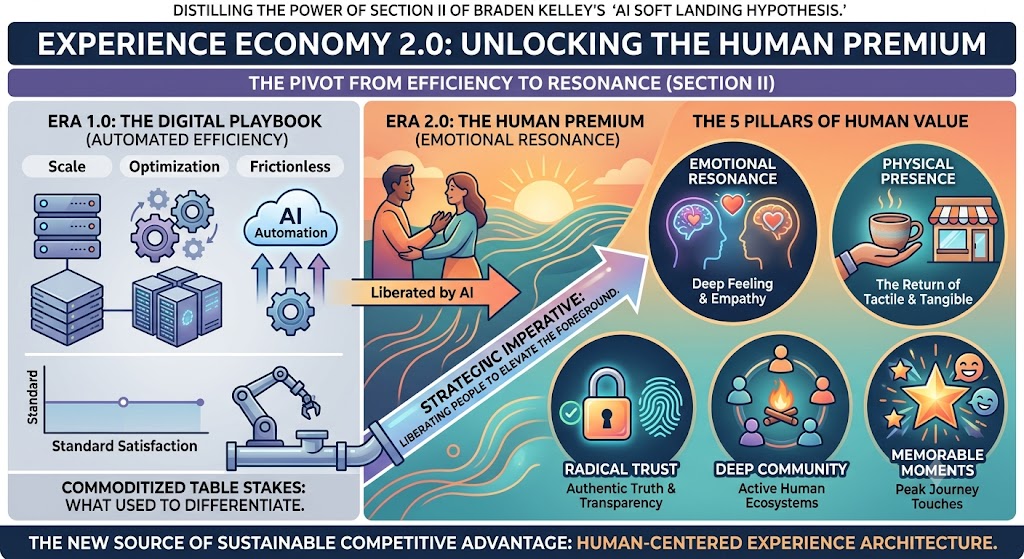
If AI can handle the “how” of business — the technical execution, the data crunching, and the administrative heavy lifting — then where does the value go? As we have discussed in the Human Premium concept, value migrates away from routine competence and toward the uniquely human elements that machines cannot replicate.

In the era of the micro-enterprise, the “orchestrator” succeeds by focusing on five critical pillars of human value:

  • Taste & Curation: In a world of infinite AI-generated content and products, the human ability to say “this is good” or “this matters” becomes the ultimate filter. Success is driven by aesthetic and strategic judgment.
  • Trust & Authenticity: As deepfakes and automated interactions proliferate, humans will crave the “Proof of Personhood.” People want to buy from, and partner with, individuals they can hold accountable.
  • Niche Expertise: AI is excellent at the average of all human knowledge, but it often struggles with “the last mile” — the hyper-specific, local, or experimental context that only a specialist understands.
  • Relationships: Business remains a social endeavor. The ability to navigate complex office politics, build long-term partnerships, and provide true empathy is an un-automatable asset.
  • Community Identity: Micro-enterprises don’t just sell products; they build “tribes.” Value is generated by fostering a sense of belonging and shared identity that a black-box algorithm cannot feel.

The shift is clear: We are moving from a world where you are paid for what you can do to a world where you are paid for who you are and how you see the world. Technical execution is now a commodity; human insight is the new scarcity.

Agentic Intuition

IV. The Great Fragmentation: Tensions and Trade-offs

While the collapse of the traditional corporate ladder offers a path toward a “Soft Landing,” it also introduces a significant structural tension. The move away from centralized institutions toward a decentralized swarm of micro-enterprises creates a Great Fragmentation of the workforce.

This transition is not without its friction. As we move into this new reality, we must navigate several critical trade-offs:

  • Autonomy vs. Volatility: The micro-enterprise offers unparalleled freedom and the ability to “captain your own vessel.” However, it replaces the steady (if often illusory) paycheck of the 9-to-5 with the market-driven volatility of a solo practitioner. The safety net is no longer provided by the employer; it must be built by the individual.
  • The Death of Institutional Loyalty: Traditional careers were built on a social contract of mutual loyalty between the “Company Man” and the organization. In a fragmented economy, that contract dissolves. Relationship-building shifts from vertical (climbing the ladder) to horizontal (networking across the ecosystem).
  • From Specialized Doer to Generalist Orchestrator: The most successful participants in the micro-enterprise explosion will be those who embrace a FutureHacking mindset. Success requires moving beyond a single specialized skill to becoming a generalist who can direct multiple AI agents across diverse domains like marketing, strategy, and operations.

This fragmentation creates a world that is more resilient in the aggregate — millions of small nodes are harder to break than a few giant pillars — but more demanding on the individual. The “Soft Landing” depends on our ability to manage this newfound autonomy without falling into the trap of isolation or burnout.

Economic Participation vs Traditional Employment

V. Economic Participation vs. Traditional Employment

The most startling statistic of the next decade may be a widening gap between “employment” numbers and “economic participation.” In a world of AI-leveraged firms, traditional payrolls may shrink while productivity and value creation actually accelerate. This is the heart of the “Soft Landing”: decoupling the idea of a livelihood from the idea of a job.

To navigate this shift, we must redefine what a “middle class” looks like:

  • The Self-Orchestrated Middle Class: For the last century, the middle class was defined by its relationship to a large employer (and the benefits that came with it). The future middle class will likely consist of “Portfolio Professionals” — individuals managing multiple revenue streams, intellectual property, and AI-driven services.
  • GDP Without Payroll: We are entering an era where a company can reach a billion-dollar valuation with fewer than ten employees. This means wealth will be generated through equity and ownership of micro-assets rather than hourly wages.
  • The Infrastructure Gap: The “Soft Landing” becomes a “Hard Crash” if our social structures don’t evolve. We urgently need to transition toward:
    • Portable Benefits: Health insurance and retirement plans that belong to the individual, not the employer.
    • Decentralized Professional Guilds: New versions of unions that provide community, collective bargaining for AI tool pricing, and continuous upskilling.

Ultimately, a decline in traditional employment isn’t a sign of failure; it’s a sign of a fundamental architectural change in how value is captured. The goal is a society where high economic participation is the norm, even if the “9-to-5” becomes a historical relic.

Orchestrating Your Own Landing

VI. Conclusion: Orchestrating Your Own Landing

The “Soft Landing” for the AI era isn’t a passive event that happens to us; it is a future we must actively orchestrate. As we have explored in this hypothesis, the Micro-Enterprise Explosion represents a pivot from a world of massive, rigid institutions to a world of agile, high-leverage individuals.

We are moving toward a reality where the primary competitive advantage is no longer the size of your workforce, but the clarity of your vision and the quality of your human-centered judgment. To thrive in this environment:

  • Adopt a Captain’s Mindset: Stop looking for a seat on someone else’s ship. Start learning how to captain your own AI-powered vessel. The tools to build, market, and scale are now at your fingertips.
  • Double Down on the Human: While AI handles the operational layer, focus your energy on the “Human Premium” — your unique taste, your deep relationships, and the trust you build within your niche.
  • Practice FutureHacking: Success in a fragmented economy requires the ability to see signals early and pivot quickly. Treat your career as a series of experiments in value creation rather than a linear path.

The goal is no longer to find “safety” in a large corporation, but to find resilience in your own ability to create. The Micro-Enterprise Explosion is our opportunity to reclaim agency over our work, turning the threat of automation into the fuel for a new era of human-centered entrepreneurship.


Call to Action: Identify one “departmental” task — be it legal drafting, basic market research, or data analysis — that you can offload to an AI agent this week. Begin your transition from a “Doer” to an “Orchestrator” today.

Frequently Asked Questions

What exactly is a “Micro-Enterprise”?

A micro-enterprise is a business operating at a very small scale — typically one to five people — that leverages AI to perform the operational tasks (legal, marketing, support) that previously required large corporate departments. This allows individuals to maintain high-level output with minimal overhead.

How does the “Human Premium” apply to small businesses?

The Human Premium is the value assigned to qualities AI cannot replicate: unique taste, personal trust, niche expertise, and deep relationships. In a micro-enterprise, these qualities become the primary competitive advantage as technical execution becomes commoditized by AI tools.

What is the difference between the Gig Economy and Nano-Capitalism?

The gig economy often involves individuals performing commoditized tasks for large platforms. Nano-capitalism, or the micro-enterprise model, involves individuals owning the “means of orchestration,” using AI to act as independent firms that create and capture high-margin value through their own intellectual property and brands.


EDITOR’S NOTE: This is a visualization of but one possible future. I will be publishing other possible futures as they crystallize in my mind (or as you suggest them for me to explore).

Image credits: Google Gemini

Content Authenticity Statement: The topic area, key elements to focus on, etc. were decisions made by Braden Kelley, with a little help from Google Gemini to clean up the article, add images and create infographics.

Subscribe to Human-Centered Change & Innovation WeeklySign up here to get Human-Centered Change & Innovation Weekly delivered to your inbox every week.

The End of AI Data Centers

Why Decentralized Compute is the Only Resilient Future

LAST UPDATED: May 11, 2026 at 11:24 AM

The End of AI Data Centers

by Braden Kelley and Art Inteligencia


I. Introduction: The Fragility of the AI “Crown Jewels”

The race to dominate artificial intelligence has triggered a global construction boom unlike anything the technology industry has ever seen. Governments and corporations are pouring hundreds of billions of dollars into massive AI data centers packed with advanced GPUs, specialized networking hardware, and enough electrical infrastructure to power small cities. These facilities are rapidly becoming the economic and strategic “crown jewels” of the twenty-first century.

But in the rush to scale AI capability, we may be building exactly the wrong architecture for the world that is emerging around us.

The current model of AI infrastructure is overwhelmingly centralized. Instead of distributing compute across millions of smaller nodes, we are concentrating unprecedented amounts of economic, military, and technological capability into a relatively small number of gigantic facilities. Each hyperscale AI campus represents not only a massive financial investment, but also a critical dependency for national competitiveness, intelligence operations, logistics, cybersecurity, and military decision-making.

In effect, the AI industry has unintentionally created the ultimate single point of failure.

As AI becomes increasingly essential to economic productivity and national defense, these centralized facilities naturally evolve from commercial assets into strategic targets. Their importance guarantees that adversaries will study them, map them, probe them, and eventually develop methods to disrupt or destroy them. The more valuable these AI fortresses become, the more irresistible they become as targets during geopolitical conflict.

This reality formed the basis of a previous argument that the AI data centers of 2030 may ultimately require sovereign-level protection — potentially functioning more like hardened military installations than traditional commercial real estate. Once AI infrastructure becomes critical to national security, protecting it may no longer be optional.

But militarizing data centers only treats the symptom, not the disease.

Building bigger walls around centralized AI infrastructure may delay catastrophe, but it does not eliminate the underlying strategic vulnerability. A fortress is still a fortress. It still has a location. It still has supply lines. It still has power dependencies. And most importantly, it still presents adversaries with a concentrated target whose destruction could create disproportionate economic and military disruption.

Modern warfare is increasingly demonstrating that concentration itself is becoming obsolete.

The emerging lesson from contemporary conflict is that large, static, centralized assets are becoming dangerously vulnerable in an era of cheap autonomous systems, distributed attacks, cyber-physical warfare, and AI-enabled targeting. Resilience no longer comes from concentrating strength behind thicker walls. Resilience comes from distribution, redundancy, mobility, and the elimination of obvious centers of gravity.

The future of AI infrastructure may therefore require a fundamental architectural shift — away from the “Fortress” model and toward something far more decentralized and resilient.

Instead of concentrating compute into a handful of hyperscale compounds, the smarter long-term strategy may be to distribute AI capability across millions of interconnected nodes embedded throughout society itself. Homes, businesses, vehicles, factories, and local energy systems could collectively form a resilient national AI fabric that is vastly harder to disrupt because it has no singular brain to destroy.

In other words, the ultimate defense against the vulnerabilities of centralized AI infrastructure may not be better fortifications at all.

It may be the elimination of the fortress entirely.

II. Lessons from the Front: Operation Spiderweb and the Death of “Large & Static”

For decades, military doctrine revolved around concentration of force. Nations projected power by building larger air bases, larger aircraft carriers, larger command centers, and larger logistical hubs. Strategic advantage often came from assembling overwhelming capability in centralized locations that could be defended through scale, distance, and hardened infrastructure.

But modern warfare is beginning to expose a dangerous flaw in that logic.

Ukraine’s Operation Spiderweb offered a glimpse into the future of asymmetric conflict — and a warning for anyone investing heavily in centralized AI infrastructure. In the operation, relatively inexpensive drones launched from concealed shipping containers reportedly destroyed or severely damaged billions of dollars of Russian military hardware. The attack demonstrated how low-cost autonomous systems can bypass traditional defensive assumptions and threaten even heavily protected strategic assets.

The significance of the operation was not merely tactical. It was architectural.

A modern military aircraft may cost tens or even hundreds of millions of dollars to build, maintain, and defend. Yet those investments can now be threatened by autonomous systems costing a tiny fraction of the target’s value. This is the new asymmetry of modern conflict: increasingly cheap offensive capabilities versus increasingly expensive centralized assets.

The implications extend far beyond the battlefield.

Hyperscale AI data centers are emerging as the civilian equivalent of concentrated military infrastructure. A single AI campus may contain billions of dollars worth of GPUs, networking equipment, transformers, cooling systems, and backup power infrastructure concentrated within a relatively small geographic footprint. These facilities consume enormous amounts of electricity, require extensive water access, and depend on stable transportation and communication links.

In strategic terms, they are ideal targets.

Even if protected by advanced cybersecurity systems, physical security barriers, and military-grade defenses, the economics of attack versus defense are increasingly unfavorable. A nation may spend tens of billions hardening an AI fortress, while adversaries invest comparatively little developing autonomous drones, cyber-physical sabotage systems, electromagnetic disruption tools, or attacks against supporting infrastructure such as substations and fiber routes.

The uncomfortable reality is that static concentration itself is becoming the vulnerability.

This same lesson is already reshaping military thinking. Around the world, defense planners are reconsidering centralized command structures, massive forward operating bases, and tightly clustered logistics hubs. The future military is likely to become more distributed, more mobile, and more redundant — relying on decentralized command systems, autonomous coordination, modular logistics, and dispersed operational assets that can continue functioning even when individual nodes are destroyed.

AI infrastructure must evolve the same way.

If artificial intelligence becomes the backbone of economic productivity, national security, industrial automation, cybersecurity, healthcare, transportation, and military operations, then centralized AI compute becomes too strategically important to remain concentrated in a handful of giant facilities. The more essential AI becomes, the more dangerous centralization becomes.

The lesson of Operation Spiderweb is not simply that drones are dangerous.

The deeper lesson is that resilient systems survive by distributing critical capability across wide networks rather than concentrating it into singular targets. A decentralized system may lose individual nodes without catastrophic failure. A centralized system risks collapse if its core infrastructure is compromised.

In the emerging era of autonomous conflict, resilience increasingly belongs to the distributed.

III. The Social & Political Bottleneck: The Rise of the “NIMBY” Data Center

Even if centralized AI mega-campuses could somehow be fully protected from military and cyber threats, they still face another growing obstacle that may ultimately prove just as limiting: public opposition.

Across the United States and around the world, communities are increasingly resisting the construction of massive data centers in their neighborhoods. What was once viewed as relatively harmless digital infrastructure is now being recognized as an enormous industrial footprint with significant demands on land, water, electricity, and local infrastructure.

Residents are beginning to ask uncomfortable questions.

Why should local communities absorb rising utility costs, water consumption concerns, constant construction traffic, backup generator noise, and visual blight so that a handful of technology companies can consolidate AI power? Why should neighborhoods sacrifice scarce electrical capacity for facilities that may create relatively few permanent local jobs compared to their physical scale and resource consumption?

As AI adoption accelerates, these tensions are likely to intensify rather than diminish.

The scale of future AI infrastructure requirements is staggering. Advanced AI models require immense amounts of compute power, and every new generation of models appears to demand exponentially more energy and hardware than the last. Entire regions are already experiencing concerns about grid strain, water availability, permitting delays, and environmental impact as hyperscale facilities compete for resources with local populations.

This creates a growing sovereignty conflict between national strategic priorities and local community interests.

From the perspective of national governments, AI infrastructure increasingly resembles critical infrastructure on par with ports, railroads, telecommunications networks, or energy systems. Nations that fail to secure sufficient AI compute capacity may find themselves economically disadvantaged, technologically dependent, or strategically vulnerable.

But from the perspective of local residents, a giant AI campus often appears as an unwanted industrial intrusion that consumes disproportionate resources while providing limited direct community benefit.

The collision between these perspectives could become one of the defining infrastructure battles of the next decade.

Governments may attempt to override local opposition through federal permitting reforms, strategic infrastructure designations, or national security arguments. Technology companies may offer tax incentives, local investments, or infrastructure improvements to secure approval. Yet none of these approaches fundamentally solve the underlying tension created by concentrating massive amounts of AI compute into highly visible facilities.

The more AI infrastructure grows in scale, the harder it becomes to hide its impact.

This is why decentralization may represent not only a strategic advantage, but also a political one. It is partly because of expected increases in opposition to terrestrial AI data centers that Elon Musk and others are advocating for space-based AI data centers. But, even on earth we can solve both for fragility/vulnerability and growing political/social opposition.

Instead of forcing communities to accept gigantic industrial AI campuses, future infrastructure could become embedded into the fabric of everyday life itself. Rather than concentrating compute into enormous fortified compounds, AI processing power could be distributed across homes, apartment buildings, offices, vehicles, factories, and local energy systems.

In this model, AI infrastructure becomes largely invisible.

The electrical grid itself offers an instructive analogy. Most people rarely think about the countless distributed components that collectively generate and manage electrical power. The system works precisely because it is distributed, redundant, and woven into the broader physical environment rather than concentrated into a few singular facilities.

Decentralized AI compute could evolve in much the same way.

Instead of building isolated industrial parks dedicated exclusively to AI, society could gradually transform millions of existing structures into intelligent compute nodes. Homes equipped with solar panels, battery storage, smart electrical systems, and AI acceleration hardware could collectively form a national compute fabric that scales organically alongside everyday infrastructure upgrades.

The strategic benefit is resilience.

The political benefit is acceptance.

Infrastructure people barely notice is often infrastructure they are far more willing to live with.

Distributed AI infrastructure - PulteGroup, Nvidia, and Span

IV. The New Architecture: Residential AI Nodes (The Nvidia-Pulte-Span Model)

The transition from centralized AI fortresses to distributed AI infrastructure may sound futuristic, but early versions of this architecture are already beginning to emerge.

One of the clearest signals came from the 2026 partnership between PulteGroup, Nvidia, and Span — an alliance that hinted at a radically different vision for the future of AI compute. Instead of treating homes solely as passive consumers of electricity and internet services, the partnership pointed toward a future where residential properties themselves become intelligent infrastructure nodes participating in a larger distributed compute network.

At the center of this shift is the growing convergence of three technologies that historically operated independently: AI acceleration hardware, residential energy systems, and intelligent electrical management.

Nvidia provides the AI compute layer through increasingly compact and energy-efficient GPU systems optimized for local inference and edge processing. Span contributes the intelligent electrical infrastructure capable of dynamically managing household energy loads, battery systems, solar generation, and grid interaction. PulteGroup represents the large-scale residential deployment mechanism capable of embedding these systems into new homes at scale.

Together, these technologies begin to transform the modern home into something entirely new: a residential AI node.

This concept fundamentally changes the role homes play within both the energy grid and the digital economy. Traditionally, homes consume electricity, bandwidth, and cloud services while contributing relatively little back into the broader infrastructure ecosystem. But with intelligent power management, local battery storage, rooftop solar generation, and dedicated AI hardware, homes can evolve into active participants in a distributed national compute fabric.

In practical terms, this means millions of homes could collectively provide enormous amounts of distributed AI inference capacity without requiring the construction of massive standalone data centers.

The timing of this shift is important because AI workloads themselves are evolving.

Training frontier AI models will likely continue requiring large-scale centralized infrastructure for the foreseeable future. But inference — the process of actually running AI models to serve applications, automate tasks, power agents, process data, and support real-time decision-making — is increasingly capable of operating on smaller, distributed hardware systems.

That distinction changes everything.

Instead of routing every AI request through hyperscale facilities, future AI ecosystems may distribute inference workloads dynamically across millions of geographically dispersed residential nodes. AI processing could occur closer to the end user, reducing latency, improving resilience, lowering bandwidth costs, and minimizing pressure on centralized infrastructure.

The energy implications are equally significant.

One of the biggest criticisms of hyperscale AI infrastructure is its extraordinary power consumption. Massive data centers require huge dedicated energy resources that often strain local grids and trigger political resistance. Distributed residential AI nodes offer a different model by leveraging energy systems that are already being deployed into homes for broader electrification efforts.

Homes equipped with solar panels and battery packs effectively become micro-energy systems capable of storing and managing local power generation. Smart electrical panels can determine when energy demand is low, when renewable generation is abundant, or when excess electricity would otherwise go unused. During those periods, AI inference workloads could be activated opportunistically across distributed residential infrastructure.

In effect, AI compute becomes partially synchronized with the natural rhythms of the electrical grid.

Instead of building ever-larger centralized facilities that demand constant peak power availability, distributed AI infrastructure could absorb excess off-peak generation, stabilize demand curves, and make more efficient use of existing electrical capacity.

The homeowner incentives could also be compelling.

Just as homeowners today can sell excess solar generation back to the grid, future residential AI systems could potentially generate compute revenue by contributing idle processing power to distributed inference networks. Reduced utility costs, subsidized hardware, lower internet expenses, and participation payments could transform homes from passive infrastructure liabilities into productive digital assets.

This creates a powerful alignment between national strategic interests and individual economic incentives.

Governments gain a far more resilient and geographically distributed AI infrastructure. Technology companies gain scalable edge compute capacity without constructing as many hyperscale facilities. Electrical grids gain flexible demand management capabilities. And homeowners gain direct economic participation in the AI economy itself.

Most importantly, the resulting system becomes dramatically harder to disrupt.

A centralized AI fortress presents adversaries with a concentrated target. A distributed residential AI fabric diffuses compute capability across millions of ordinary structures woven throughout society. What once existed inside a handful of highly visible compounds instead becomes embedded everywhere and nowhere at the same time.

In the emerging era of strategic AI competition, that distinction may prove decisive.

V. Strategic Advantages of the Distributed AI Grid

If centralized AI infrastructure represents a high-value target with concentrated risk, then decentralized AI infrastructure represents the opposite: a system designed around dispersion, redundancy, and continual adaptability. The advantages of this shift are not incremental — they are structural.

The most immediate benefit is what might be called kinetic resilience. In a centralized model, a single facility may represent a critical node whose disruption could degrade national AI capability in a meaningful way. In a distributed model, however, compute is spread across thousands or millions of independent nodes. No single strike, outage, or localized failure can meaningfully degrade the system as a whole. The network simply reroutes, reallocates, and continues operating.

This changes the strategic calculus entirely. Instead of defending a small number of high-value assets at extraordinary cost, resilience is achieved through ubiquity. The system becomes less like a fortress and more like a living ecosystem — continuously adapting to localized disruptions without systemic collapse.

A second advantage is power efficiency and grid stability. Hyperscale data centers often require dedicated energy infrastructure, new transmission lines, and significant upgrades to local grids. They tend to behave like industrial-scale energy sinks, demanding predictable and sustained power delivery at massive scale.

A distributed AI grid behaves differently. By embedding compute capability into residential and commercial environments already connected to the electrical system, AI workloads can be dynamically aligned with existing energy flows rather than forcing entirely new ones.

In practical terms, this enables several efficiencies:

  • Utilization of residential solar generation that would otherwise be unused or exported inefficiently
  • Charging and discharging of home battery systems in coordination with AI workload demand
  • Shifting inference tasks to off-peak hours when grid demand is lower and electricity is cheaper
  • Reducing the need for large new transmission infrastructure dedicated solely to AI growth

Instead of AI competing with other sectors for scarce centralized power capacity, it becomes a flexible participant in a broader distributed energy ecosystem.

A third advantage is latency reduction and proximity to the user. As AI becomes more embedded in daily life — powering assistants, autonomous systems, real-time translation, predictive services, and physical automation — the distance between compute and user begins to matter more.

Distributed inference at the edge of the network enables faster response times, reduced dependency on long-haul network routing, and greater robustness during partial connectivity disruptions. In many cases, AI systems embedded in homes, vehicles, and local infrastructure can respond instantaneously without requiring round trips to distant centralized servers.

Taken together, these advantages suggest that decentralization is not simply a defensive posture against geopolitical risk — it is also an optimization of efficiency, responsiveness, and system-wide adaptability.

Perhaps most importantly, the distributed model reduces systemic fragility at exactly the moment AI systems are becoming more deeply integrated into critical societal functions. The more intelligence we embed into infrastructure, the more dangerous it becomes to concentrate that intelligence into a small number of failure-prone locations.

In this sense, decentralization is not a retreat from progress. It is an evolution toward resilience.

VI. Conclusion: From Fortresses to Fabrics

The trajectory of AI infrastructure is often described as a race toward scale: larger models, larger clusters, larger data centers, and larger investments concentrated into fewer and fewer locations. On the surface, this appears to be the natural endpoint of technological progress — efficiency achieved through consolidation.

But that framing assumes a world where concentration remains an advantage. Increasingly, the opposite may be true.

As AI becomes more deeply embedded in national economies, critical infrastructure, and defense systems, the risks associated with centralization grow in parallel with its capabilities. What once looked like an optimization problem begins to resemble a resilience problem. And resilience, in complex systems, rarely comes from concentration.

The “AI Fortress” model — massive, highly capable, strategically critical data centers protected by layers of physical and digital security — may represent an important transitional phase. It enables rapid scaling of capability at a moment when demand is exploding and architectures are still stabilizing. But it is unlikely to represent the final stable equilibrium.

Over time, the logic of vulnerability, energy distribution, political friction, and technological enablement all converge on a different structure: one that is distributed by default, not by exception.

In that future, AI compute is no longer something that exists “somewhere.” It is something that exists everywhere — embedded into homes, vehicles, factories, grids, and local systems, continuously interacting with the physical world rather than being isolated from it.

This is the shift from fortresses to fabrics.

A fortress is defined by its boundaries: inside is protected, outside is excluded, and value is concentrated at the center. A fabric, by contrast, derives its strength from interconnection. It is resilient not because it is hardened in one place, but because it is woven across many places. Damage to one thread does not collapse the structure; it is absorbed, rerouted, and contained.

A distributed AI fabric would behave in the same way. Compute capacity would be ubiquitous but not centralized, powerful but not singularly fragile, intelligent but not dependent on any single point of control or failure.

In this model, the question is no longer how to protect the brain of the system by enclosing it within ever more secure walls. Instead, the question becomes how to ensure there is no single brain to target in the first place.

That shift has profound strategic implications.

It reframes AI infrastructure from something that must be defended at a few critical locations into something that must be designed as a resilient, adaptive system distributed across society itself. It also aligns national security objectives with individual participation, energy efficiency with compute demand, and technological advancement with infrastructural sustainability.

In an era shaped by asymmetric threats, autonomous systems, and rapidly evolving geopolitical risk, the most robust systems will not be those that concentrate power most effectively, but those that distribute it most intelligently.

The future of AI infrastructure may therefore not be a monument.

It may be a mesh.

And in that shift from fortresses to fabrics lies the real foundation of long-term resilience in the age of artificial intelligence.

FAQ: Decentralized AI Compute and Infrastructure Resilience

FAQ

Why are centralized AI data centers considered vulnerable?
Centralized AI data centers concentrate massive compute, energy, and strategic value into a small number of physical locations. This creates single points of failure that can be targeted by physical attacks, cyber operations, or infrastructure disruptions, potentially causing disproportionate economic and national security impact.

What is meant by a “distributed AI fabric”?
A distributed AI fabric refers to an architecture where AI compute is spread across millions of interconnected nodes such as homes, businesses, and edge devices. Instead of relying on a few large data centers, intelligence is embedded throughout the network, improving resilience, reducing latency, and eliminating critical single points of failure.

How could residential AI nodes support the power grid and economy?
Residential AI nodes can leverage solar power, home battery systems, and off-peak electricity to run AI inference workloads locally. This helps balance grid demand, utilize excess renewable energy, reduce strain on centralized infrastructure, and potentially allow homeowners to participate economically in distributed compute networks.

EDITOR’S NOTE: You should read this article to learn more about Why the AI Data Centers of 2030 Will Be Sovereign Fortresses.

Content Authenticity Statement: The topic area, key elements to focus on, etc. were decisions made by Braden Kelley, with a little help from ChatGPT and Google Gemini to clean up the article, add images and create infographics.

Image credits: Google Gemini, SPAN (via mortgagepoint.com)

Subscribe to Human-Centered Change & Innovation WeeklySign up here to get Human-Centered Change & Innovation Weekly delivered to your inbox every week.
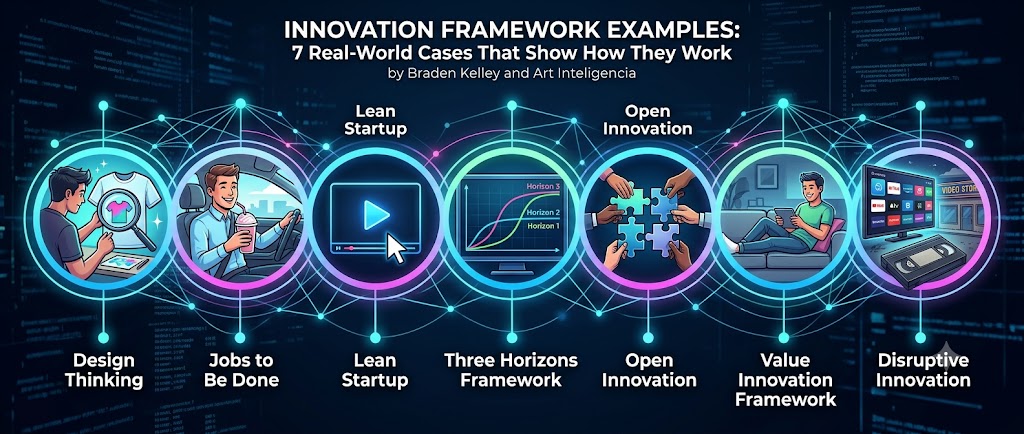
Better to be Careful than Smart

Better to be Careful than Smart

GUEST POST from Greg Satell

Not too long ago, I had a post about the danger of trusting your feelings go viral on LinkedIn. The reason it was so popular wasn’t necessarily that everyone liked it, but because many wanted to voice their disapproval. A surprising number of people vehemently objected to the idea that they should interrogate their feelings or keep them in check.

Make no mistake. While it is true that our emotions can alert us to dangers that our rational mind fails to recognize, they can also lead us wildly astray. Our hippocampus, where our memories reside, has a bee line to our amygdala, which plays a role in governing our emotions, circumventing our rational brain in the prefrontal corpus.

We tend to assume that good judgment is a function of intelligence and education, but often it’s not. We need to recognize that there are glitches in our neural machinery and that our gut feelings can be triggered by random events as well as by people who seek to manipulate us. That’s why we need to be careful. It’s always the suckers who think they’re playing it smart.

Why Smart People Are So Easily Fooled

For decades, the global elite revered Bernie Madoff as one of the world’s most talented asset managers until it was all exposed to be, in his own words, “one big lie.” Elizabeth Holmes’s prominent board at Theranos were so clueless that they put their reputations behind a product that didn’t exist. Anna Sorokin, the daughter of a Russian truck driver, was able to convince the glitterati that she was, in fact, a fabulously wealthy heiress.

In each case, there was no shortage of opportunities to unmask the fraud. Inconsistencies in Madoff’s records were reported to regulators a number of times, but were ignored. Holmes wasn’t able to produce a single peer-reviewed study during 10 years in business to support her claims and there was no shortage of whistleblowers from inside and outside the company. Anna Sorokin left unpaid bills all over town.

Still, many bought the ruses and would interpret facts to support them. Madoff’s secrecy was seen as confirmation that he had a proprietary method. In Holmes’ case, her eccentricities were taken as evidence that she truly was a genius, in the mold of Steve Jobs or Mark Zuckerberg. Sorokin’s unpaid bills were seen as proof of her wealth. After all, who but the fabulously rich could be so nonchalant with money?

People should have known better. Stock market regulators are trained to recognize fraud. Prominent Theranos board members like George Shultz, David Bois and Henry Kissinger, earned their reputations over decades. Hotels allowed Sorokin to stay in luxury suites for weeks at a time before demanding payment. How could they have been so naive?

But what if smart people get taken in because they’re smart? They have a track record of seeing things others don’t, making good bets and winning big. People give them deference, come to them for advice and laugh at their jokes. They’re used to seeing things others don’t. For them, a lack of discernible evidence isn’t always a warning sign. It can be an opportunity.

Gated Community Elites And TED Talk Elites

Living in a gated community necessarily cuts you off from your surroundings. People outside can’t wander in and you can’t wander out. New businesses don’t sprout up and old ones don’t die. Routines are familiar and protected, you remain in your comfort zone and any random disturbance is immediately removed.

On the other end of the spectrum, when you go to fancy conferences your imagination becomes overstimulated. You are inundated with the new and unfamiliar. The normal human experiences begin to seem passé, a remnant of a lost age, while visions of the future begin to appear more genuine than the present reality.

The truth is that both of these environments are manufactured for the tastes of the well-heeled. Gated communities are built for those who want a simple sanctuary in a messy and complex world that doesn’t always follow a linear and understandable logic. The conference world tends to overemphasize the power of imagination and possibility, ignoring the fact that the status quo exerts a power of its own.

The best indicator of what we think and what we do is what the people around us think and do. We tend to conform to the opinions and behaviors of those around us and this effect extends out to three degrees of relationships. So not only our friends’ friends, influence us deeply, but their friends too—people that we don’t even know—affect what we think.

Confirming Our Priors

Clearly, the way we tend to self-sort ourselves into homophilic, homogeneous groups shapes how we perceive what we see and hear, but it will also affect how we access information. When a team of researchers at MIT looked into how we share information—and misinformation—with those around us. What they found was troubling.

When we’re surrounded by people who think like us, we share information more freely because we don’t expect to be rebuked. We’re also less likely to check our facts, because we know that those we are sharing the item with will be less likely to inspect it themselves. So when we’re in a filter bubble, we not only share more, we’re also more likely to share things that are not true. Greater polarization leads to greater misinformation.

We’re prone to think of our brains as biological forms of computers that take in and analyze data leading to rational conclusions. That’s not true. We tend to seize upon the most easily available information, rather than the most reliable sources. We then seek out information that confirms those beliefs and reject evidence that contradicts existing paradigms.

That’s the glitch in our mental machinery that Madoff, Holmes and Sorokin exploited. The investors in Madoff’s funds felt privileged to be allowed into an exclusive investment. Theranos board members thought they were building a better future. Sorokin made those around her feel like they had access to an aristocracy of sorts.

These weren’t mere notions or passing thoughts, but assertions of identity, which is why the shills were so eager to advocate for — and actively protect — their swindlers.

Making Allowances For The Glitches In Our Mental Machinery

We all like to have opinions and like act on them. When, for instance, people were asked if they supported bombing Agrabah, the fictional hometown of the Disney character Aladdin, 30% of Republicans and 19% of Democrats said yes. Yet our urge to make judgments has nothing to do with our ability to make wise choices.

Humans tend to think in terms of narratives. We like things to fit into neat patterns and fill in the gaps in our knowledge so that everything makes sense. People who are “smart,” have a greater ability to retain and process information than most and can use their imagination to build robust visions, but that’s no guarantee those visions will conform to reality.

We need to be hyper-aware that a track record of success makes us more confident and confidence in our judgments is inversely correlated to their accuracy. That’s why it’s often better to be careful than smart. There are formal processes that can help us do that, such as pre-mortems and red teams, but most of all we need to keep ourselves in check.

Perhaps most important is to appreciate that there are glitches in our mental machinery and we are greatly influenced by our social networks. The people around us tend to have access to similar information as we do and our perceptions are colored by prior judgments we’ve made. We are surrounded by mental minefields and the only way out is to proceed with caution.

There’s a sucker born every minute and they’re usually the ones who think they’re playing it smart.

— Article courtesy of the Digital Tonto blog
— Image credit: Google Gemini

Subscribe to Human-Centered Change & Innovation WeeklySign up here to join 17,000+ leaders getting Human-Centered Change & Innovation Weekly delivered to their inbox every week.

Making Change Stick

Making Change Stick

GUEST POST from David Burkus

You’ve poured hours into developing a brilliant new strategy. Maybe it’s a streamlined process, a novel team ritual, or a bold cultural shift you know will improve how your team works. You present it to the team. Heads nod. There’s excitement. Applause, even.

And then…nothing.

A few weeks go by and everything’s back to the old way. People are still using the outdated process. The team ignores the new meeting cadence. That cultural initiative? Forgotten. It’s as if your big idea evaporated the moment the meeting ended.

So what happened?

As frustrating as it is, this scenario is all too common. And it reveals an important truth about making change stick: it’s not the brilliance of your idea that matters most. It’s how well that idea is presented and remembered. And for most leaders, that’s where the real challenge begins.

The Flawed Approach to Leading Change

For decades, leaders have looked to process improvement and efficiency as the holy grail of organizational success. From Frederick Taylor’s scientific management to modern methodologies like Six Sigma or Agile, there’s no shortage of change initiatives aimed at helping teams get better.

And in theory, many of them work.

But research from UNC’s Brad Staats and Oxford’s Matthias Holweg and David Upton tells a different story about what happens after rollout. According to their study of over 200 process improvement initiatives across a major European bank, roughly 50% of those projects were abandoned within the first year. And after two years? Only one in three remained.

They call it the improvement paradox—the fact that even successful initiatives often fade over time. And the reason isn’t because the ideas were bad. It’s because of how those ideas were introduced and sustained—or, more accurately, how they weren’t.

Why Good Ideas Don’t Stick

The researchers identified several culprits behind why making change stick is so difficult. And if you’ve ever led a change that didn’t last, these may sound familiar.

Initiative Fatigue
When every quarter brings a new mandate or buzzword, people stop getting excited and start getting cynical. It becomes easier to nod along in the meeting and quietly keep doing things the old way.

Lack of Personal Benefit

When change feels like it’s for the company but not for the individual, motivation suffers. People ask, “What’s in it for me?” And if they can’t find a compelling answer, they’re unlikely to put in the effort required to make the change real.

Loss of Ownership

Many initiatives are handed down from above—or worse, handed over from highly paid consultants—as rigid prescriptions rather than collaborative efforts. When people feel forced to comply instead of invited to contribute, they disengage.

Curse of Knowledge

But perhaps the most overlooked obstacle is this: we fall in love with our own ideas and forget what it’s like not to understand them.

Psychologists call this the curse of knowledge. Once you know something well, it becomes almost impossible to imagine what it’s like not to know it. Which means that when we communicate our change initiatives, we often assume too much.

A classic study by Stanford Ph.D. student Elizabeth Newton illustrates this. Participants were asked to tap out the rhythm of a popular song while another person tried to guess what it was. Tappers thought their partners would guess the song about 50% of the time. In reality? Only 2.5% of the time.

Why? Because the tappers could hear the melody in their head. But to the listener, it was just tapping. They didn’t have the context.

The same thing happens with change efforts. Leaders have been thinking about their new strategy for weeks or months. They’ve connected the dots. They see how it all fits. But their teams haven’t been part of that process—and as a result, they don’t hear the melody. Just the tapping.

Making Change Stick

So how do you overcome the curse of knowledge, and the other traps that make change initiatives fade?

You don’t need to be more charismatic. You don’t need a better slide deck. You need a better design for your message. Authors Chip and Dan Heath argue that “sticky” ideas share a few key principles. And when it comes to making change stick, these three are especially powerful.

1. Be Simple: Find the Core Message

Don’t oversimplify. But do clarify. Strip away the jargon, the background noise, the long-winded rationale—and identify the one idea you want your team to remember.

What’s the slogan behind your initiative? What’s the one phrase they can use to guide their decisions?

If your team walks away from your message and forgets everything else, what’s the one thing they must retain? Then say that. A lot.

2. Make It Concrete: Use Sensory and Tangible Language

People don’t latch onto abstract mission statements. They remember vivid images. One of the best examples of this comes from Jeff Hawkins, lead designer of the original Palm Pilot.

To keep the device simple and user-friendly, he carried around a block of wood shaped like the Palm Pilot. Any time someone proposed a new feature, he’d pull it out and ask, “Where are we going to put it?”

It was a tangible symbol of the constraints—and priorities—of the team. And it worked.

You can do the same by anchoring your message in real-world actions, visuals, or metaphors. Don’t say “streamline communication.” Say, “We’re cutting weekly meetings in half so you can get your Wednesdays back.”

3. Use Stories: Help People Feel the Message

Data informs. Stories stick.

The oldest tool for spreading ideas is still the most effective. When you tell a story—about a time the team nailed collaboration, or a moment when things fell apart because the process wasn’t followed—you help people emotionally experience the change you’re trying to create.

Stories give people something to believe in. Something to remember. And something to model their behavior after. Before your next rollout, ask: What stories do I have that illustrate what good looks like? Or what happens when we get it wrong?

You don’t need a slide deck for this. You just need a story.

The Bottom Line

Making change stick isn’t about shouting louder or using fancier words. It’s about designing your message in a way that overcomes fatigue, sparks ownership, and connects emotionally.

That means asking yourself:

  • Is my idea simple enough to remember?
  • Is it concrete enough to visualize?
  • Is it wrapped in a story people want to be part of?

Because ultimately, people don’t follow mandates. They follow meaning. And your job as a leader is to help them see themselves in the better future your change is meant to bring.

Want to make your next change effort stick? Start by telling a better story.

Image credit: Google Gemini

Subscribe to Human-Centered Change & Innovation WeeklySign up here to get Human-Centered Change & Innovation Weekly delivered to your inbox every week.

Leveraging Multi-Agent Orchestration Frameworks for Innovation

Orchestrating the Human-Centered Future

LAST UPDATED: May 7, 2026 at 7:10 PM

Leveraging Multi-Agent Orchestration Frameworks for Innovation

GUEST POST from Art Inteligencia


From Solitary Bots to Orchestrated Teams

The current innovation landscape is hitting a ceiling. While single-model AI has provided significant individual productivity gains, it often fails when faced with the multifaceted complexity of enterprise-scale digital transformation. We are witnessing the transition from isolated AI interactions to a paradigm of integrated digital ecosystems.

The Innovation Bottleneck

Relying on a single “jack-of-all-trades” model often leads to context collapse and a lack of depth. For true innovation to thrive, we need diverse perspectives and specialized expertise. Multi-Agent Orchestration (MAO) addresses this by moving us away from “chatting with AI” toward orchestrating outcomes through a coordinated digital workforce.

Defining the MAO Shift

MAO is the connective tissue that allows multiple AI agents — each with specific roles, tools, and personas — to collaborate on complex goals. It turns a series of prompts into a dynamic workflow, ensuring that the right “expert” agent is handling the right task at the right time, while maintaining a persistent thread of strategic intent.

The Human-Centered Lens

In this new era, the human role evolves rather than diminishes. An orchestrated framework still requires a conductor. Our focus remains on the human-centered design principles that ensure these agent swarms are aligned with real human needs, ethical guardrails, and the overarching vision of the organization.

The Anatomy of an Innovation-Ready MAO Framework

Building an orchestration framework for innovation requires more than just connecting APIs; it requires a structural design that mirrors high-performing human teams. To move beyond simple automation and toward true creative problem-solving, an MAO framework must balance three core pillars: specialization, communication, and persistence.

Specialization vs. Generalization

The era of the “Generalist Bot” is yielding to the Specialized Agent Swarm. In an innovation context, this means deploying distinct agents with narrow, deep mandates. You might have “The Researcher” scanning global patent databases, “The Devil’s Advocate” specifically programmed to find flaws in business models, and “The Rapid Prototyper” generating code or wireframes. This role-based approach prevents the cognitive dilution often seen in large, single-model prompts.

The Orchestration Layer: Solving “Context Collapse”

The true power of MAO lies in the orchestration layer — the “manager” that handles agent hand-offs. This layer uses standardized communication protocols to ensure that when a task moves from a researcher to a designer, the strategic intent isn’t lost. This solves the “broken telephone” problem, allowing for complex, multi-step innovation cycles that can run autonomously while remaining aligned with the initial human vision.

State Management and Shared Memory

Innovation is rarely linear; it is an iterative journey. A robust MAO framework utilizes persistent state management. By maintaining a “shared memory” across the swarm, agents can reference earlier pivots, discarded ideas, and customer feedback from previous sessions. This ensures the digital workforce isn’t just reacting to the latest prompt, but is learning and evolving alongside the project’s lifecycle.

Strategic Applications in the Innovation Lifecycle

Multi-Agent Orchestration (MAO) transforms innovation from a series of manual tasks into a scalable, high-velocity engine. By embedding intelligent agents across the innovation funnel, organizations can move from reactive problem-solving to proactive future-shaping.

FutureHacking and Trend Spotting

Traditional trend scanning is often limited by human bandwidth. Using MAO, we can deploy Agent Swarms to scan disparate data sources — from patent filings to social sentiment — simultaneously. These agents act as “Signal Pickers,” synthesizing weak signals into cohesive foresight scenarios. This allows leaders to “hack” the future by identifying emerging opportunities months or years before they become mainstream.

Rapid Concept Validation via “Digital Personas”

One of the most powerful applications of MAO is the ability to stress-test ideas before investing significant capital. We can create Synthetic Customer Personas — digital agents programmed with specific demographic data, behaviors, and pain points. These “synths” provide immediate, iterative feedback on new experience designs, ensuring that human-centered design principles are baked into the concept from the very first draft.

Closing the XLM Gap

While traditional metrics focus on system performance, Experience Level Measures (XLMs) focus on human outcomes. MAO frameworks can be configured to monitor these XLMs in real-time across digital and physical touchpoints. When friction is detected, agents don’t just alert a dashboard; they can autonomously propose friction-lessening interventions or prototype alternative workflows, ensuring the experience remains seamless and human-centric.

Managing the Change: The Human-Agent Work Collaboration

The successful integration of Multi-Agent Orchestration (MAO) isn’t just a technical deployment; it is a profound organizational shift. To leverage these frameworks effectively, we must redesign our workflows to treat AI agents as collaborative partners rather than just automated scripts.

The New Org Chart: Integrating Digital Agents

As we move toward hybrid teams, our organizational structures must evolve to include “digital coworkers.” This requires moving beyond traditional silos to create Human-AI Work Collaboration models. In this setup, digital agents are assigned specific roles — such as data synthesis or rapid iteration — allowing human team members to focus on high-level strategy, creative direction, and empathy-driven decision-making.

Avoiding the Trap of “Automated Austerity”

A critical challenge in the age of MAO is avoiding a race to the bottom. Organizations must resist the “Vicious Cycle of Automated Austerity,” where AI is used solely to cut costs and displace human labor. Instead, the focus should be on augmentation — using agent swarms to expand our capacity for innovation and to create new forms of value that were previously impossible to achieve.

Governance and “Escalation Gates”

Trust is the foundation of any collaborative system. To maintain this, MAO frameworks must include Escalation Gates — predefined points where autonomous processes must pause for human review. Whether it’s an ethical check, a brand alignment review, or a strategic pivot, these gates ensure that the “digital workforce” remains accountable to human leadership and organizational values.

The Skill Shift: From Prompting to Orchestration

The core competency for future leaders is shifting from “Prompt Engineering” to Orchestration Leadership. This involves the ability to design complex workflows, define agent personas, and manage the hand-offs between human and digital actors. It’s about being the conductor of the orchestra, ensuring every “player” is in sync to produce a harmonious and innovative outcome.

The Ecosystem: Leading Frameworks and Players to Watch

The shift toward Multi-Agent Orchestration (MAO) is supported by a rapidly maturing ecosystem of enterprise-grade platforms and agile, open-source frameworks. For innovation leaders, selecting the right stack is about balancing the need for governance with the requirement for creative flexibility.

The Infrastructure Giants: Enterprise-Grade Orchestration

The “Big Three” have moved beyond simple model hosting to provide full-lifecycle agent runtimes.

  • Microsoft (Azure AI Foundry & Semantic Kernel): The primary choice for organizations heavily invested in the .NET and Microsoft 365 stacks. Azure AI Foundry (formerly AI Studio) provides hierarchical orchestration, allowing a “manager” agent to delegate tasks to role-specific sub-agents with built-in SOC 2 and HIPAA compliance.
  • Google Cloud (Gemini Enterprise Agent Platform): Launched at Next ’26, this platform features a re-engineered Agent Runtime with sub-second cold starts and an Agent Memory Bank that allows agents to recall high-accuracy details for long-term project context.
  • AWS Bedrock (AgentCore): A serverless powerhouse that excels in model diversity. Its AgentCore platform is designed for production-scale autonomous agents, offering a 25-30% cost-performance advantage for inference-heavy innovation workloads.
  • IBM (watsonx Orchestrate): Remains the leader for highly regulated industries, focusing on sovereign AI and “hard” governance where every agentic action must be auditable and tied to legacy systems like SAP or Salesforce.

The Agile Frameworks: The Innovator’s Toolkit

For teams building bespoke innovation workflows, these frameworks offer the most granular control.

  • LangGraph (by LangChain): The “gold standard” for stateful, controllable workflows. It treats agent interactions as directed cyclic graphs, making it the best choice when you need precise control over branching, retries, and human-in-the-loop “time travel” debugging.
  • CrewAI: Known for its role-based paradigm. It is the most “human-centered” framework, allowing you to define a “crew” (e.g., Researcher, Writer, Reviewer) that mirrors real-world team dynamics. It is currently the fastest path from a conceptual “innovation roles” model to a working prototype.
  • Pydantic AI: A newcomer that has gained rapid adoption for its focus on “Type-Safe” Python agents. It is essential for projects where data integrity is non-negotiable, such as financial modeling or technical engineering simulations.

Startups to Watch: The Next Wave of “Agentic” Innovation

These private companies are defining specialized niches within the orchestration space.

  • Sierra: Led by Bret Taylor, Sierra is at the forefront of autonomous customer experience orchestration, moving beyond chatbots to agents that can actually execute complex transactions and resolutions.
  • Decagon & Maven AGI: These players are transforming support and operations into “proactive experience management,” using multi-agent systems to anticipate friction before it occurs.
  • XBOW: A critical player in the security and compliance layer, ensuring that as your agent swarms grow, they remain within legal and ethical guardrails.
  • Cognition AI & Anysphere (Cursor): While focused on coding, their “agentic” approach to software development provides a blueprint for how AI can handle complex, multi-step creative projects from start to finish.

Conclusion: Stoking the Digital Bonfire

We stand at a pivotal moment in the evolution of work and creativity. Multi-Agent Orchestration is not merely a “tech stack” upgrade; it is the infrastructure for a new era of human-augmented intelligence. By moving away from siloed tools and toward an orchestrated digital workforce, we can finally overcome the bottlenecks that have long slowed the innovation lifecycle.

However, the technology is only as effective as the vision behind it. As we deploy these frameworks, our guiding principle must remain human-centered. We don’t build agent swarms to replace the “magic maker” or the “conscript”; we build them to amplify the impact of every role within the innovation team.

The Call to Action: Don’t just build a bot; build a capability. Start by identifying the “Experience Level Measures” that matter most to your customers, and then design an orchestration framework specifically to move those needles.

MAO is the connective tissue that allows human creativity to scale. By offloading the coordination, data synthesis, and rapid prototyping to an orchestrated framework, we free up human innovators to do what they do best: dream, empathize, and decide. It’s time to stop managing software and start conducting the future.

Frequently Asked Questions

1. What is the difference between an AI Agent and Multi-Agent Orchestration (MAO)?

A single AI agent is a tool designed to perform a specific task or conversation. Multi-Agent Orchestration (MAO) is the framework that manages a “team” of these agents, handling the hand-offs, memory, and strategy required to complete complex, multi-step innovation projects without manual human intervention at every step.

2. How does MAO improve the innovation process?

MAO accelerates the innovation lifecycle by automating the “busy work” of research, prototyping, and validation. By deploying specialized agents (like a digital “Devil’s Advocate” or “Trend Spotter”), teams can stress-test more ideas in less time, ensuring only the most viable, human-centered concepts move forward.

3. Is MAO intended to replace human innovation teams?

No. In a human-centered framework, MAO is designed for augmentation. It offloads data-heavy and repetitive tasks to digital agents so that humans can focus on high-value roles—providing strategic vision, ethical oversight, and the emotional intelligence necessary to create meaningful experiences.

Disclaimer: This article speculates on the potential future applications of cutting-edge scientific research. While based on current scientific understanding, the practical realization of these concepts may vary in timeline and feasibility and are subject to ongoing research and development.

Image credits: Gemini

Subscribe to Human-Centered Change & Innovation WeeklySign up here to get Human-Centered Change & Innovation Weekly delivered to your inbox every week.

How to Test Your Business Model

How to Test Your Business Model

GUEST POST from Mike Shipulski

Sometimes we get caught up in the details when we should be working on the foundation. Here’s a rule: If the underlying foundation is not secure, don’t bother working on anything else.

If you’re working on a couple new technologies, but the overall business model won’t be profitable, don’t work on the new technologies. Instead, figure out a business model that is profitable, then do what it takes (technology, simplification, process improvement) to make it happen. But, often, that’s not what we do.

Often, we put the cart before the horse. We create projects to make prototypes that demonstrate a new technology, but the whole business premise is built on quicksand. There’s a reason why foundations are made from concrete and not quicksand. It’s because you can build on top of a base made of concrete. It supports the load. It doesn’t crack, nor does it fall apart. Think Pyramid of Giza.

Because foundations are big and expensive they can be difficult and expensive to test. For example, if an innovation is based on a new foundation, say, a new business model, building a physical prototype of the new business model is too expensive and the testing will not happen. And what usually happens is the foundation goes untested, the higher level technology work is done, the commercialization work is completed and the business model fails because it wasn’t solid.

But you don’t have to build a full-scale prototype of the Pyramid of Giza to test if a pyramid will stand the test of time. You can build a small one and test it, or you can run an analysis of some sort to understand if the pyramid will support the weight. But what if you want to test a new business model, a business model that has never been done before, using new products and services that have never seen the light of day? What do you do? In this case, it doesn’t make sense to make even a scale model. But it does make sense to create a one page sales tool that describes the whole thing and it does make sense to show it to potential customers and ask them what they think about it.

The open question with all new things is – will customers like it enough to buy it. And, it’s no different with the business model. Instead of creating a new website, staffing up, creating new technologies and products, create a one-page sales tool that describes the new elements and show it to potential customers. Distill the value proposition into language people can understand, describe the novelty that fuels the value, capture it on one page, show it to customers, and listen.

And don’t build a single, one-page sales tool, build two or three versions. And then, ask customers what they think. Odds are, they’ll ask you questions you didn’t think they’d ask. Odds are, they’ll see it differently than you do. And, odds are, you’ll have to incorporate their feedback into an improved version of the business model. The bad new is you didn’t get it right. The good news is you didn’t have to staff up and build the whole business model, create the technologies and launch the products. And more good news – you can quickly modify the one-page sales tool and go back to the customers and ask them what they think. And you can do this quickly and inexpensively.

Don’t develop the technology until you know the underlying business model will be profitable. Don’t staff up until you know if the business model holds water. Don’t launch the new products until you verify customers will buy what you want to sell.

Creating a new business model from scratch is an expensive proposition. Don’t build it until you invest in validating it’s worth building.

The worst way to validate a business model is by building it.

Image credit: Gemini

Subscribe to Human-Centered Change & Innovation WeeklySign up here to join 17,000+ leaders getting Human-Centered Change & Innovation Weekly delivered to their inbox every week.