The Incredible Shrinking Corporation – An AI Soft Landing Scenario
LAST UPDATED: June 26, 2026 at 5:21 PM
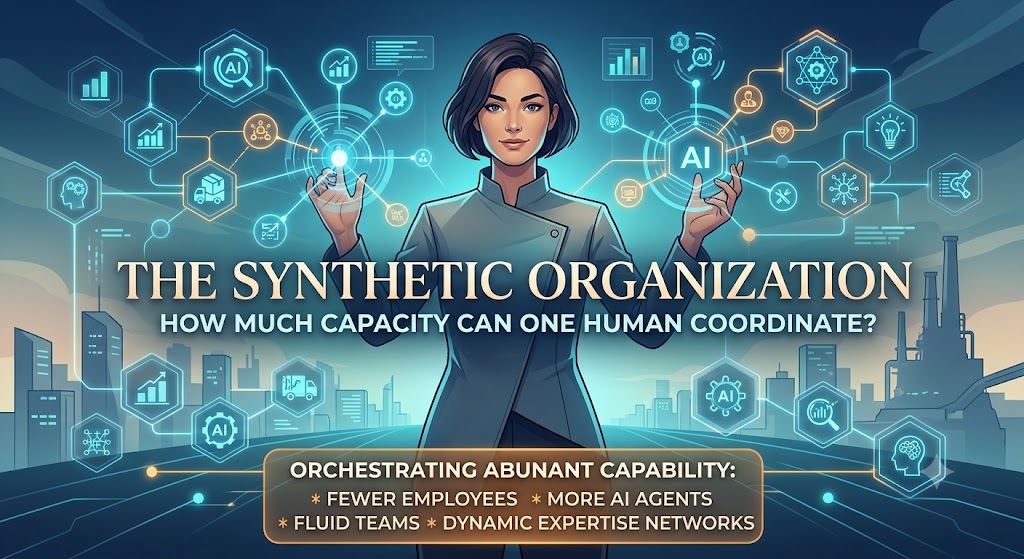
by Braden Kelley and Art Inteligencia
The Incredible Shrinking Corporation
Hot Take: The corporation may not disappear. It may shrink.
For decades, enterprise growth has been inextricably linked to headcount. The dominant narrative surrounding artificial intelligence — the “Hard Landing” — paints a dystopian picture of mass white-collar unemployment, displacement, and economic stagnation. But this view suffers from a lack of architectural imagination.
There is an alternative path: The AI Soft Landing Hypothesis. In this future, the fundamental equation of organizational scale is rewritten. We are entering the era of The Synthetic Organization, where the traditional corporate structure doesn’t collapse under the weight of automation — it compresses.
The core paradigm shift moves us away from the legacy question of the industrial age: “How many employees does a company need to scale?” Instead, innovation leaders must ask the defining question of the agentic era: “How much organizational capacity can a single human coordinate?”
Anatomy of the Synthetic Organization
The Synthetic Organization represents a fundamental departure from the traditional, siloed corporate hierarchy. It is a hybrid model built for speed, agility, and cognitive leverage — redefining what it means to build an enterprise in the age of agentic AI.
The Core Architecture
Rather than replacing humans, this model wraps advanced technology around them. The infrastructure is built on three pillars:
- The Human Core: A lean team of strategic leaders, experience designers, and empathetic change agents who provide vision, governance, and ethical guardrails.
- The Agentic Layer: Autonomous AI agents designed to handle specific domains — from market analysis and code deployment to real-time customer experience optimization.
- The Operational Fabric: The connective tissues and APIs that allow these agents to collaborate, share data, and hand off tasks seamlessly.
The 10x Operational Math
In this new paradigm, traditional resource constraints evaporate. A 20-person company is no longer limited to boutique output. By orchestrating thousands of specialized AI agents, a small team can match the operational bandwidth, market research capabilities, and creative output of a traditional 200-person organization.
Fluidity Over Hierarchy
The rigid corporate ladder is replaced by a dynamic, decentralized network. Instead of static departments (e.g., Marketing, HR, Finance), the organization spins up fluid project teams and dynamic expertise networks on demand. When a market opportunity arises, the human orchestrator configures the necessary AI agents to execute, iterate, and dissolve the workflow once the objective is met.
The Soft Landing: The Great Entrepreneurial Explosion
The transition to the Synthetic Organization introduces a vital counter-narrative to the fear of structural unemployment. When the overhead required to run an enterprise plummets, the barrier to market entry vanishes. We are on the precipice of an unprecedented explosion in human entrepreneurship.
Democratizing Scale
Historically, corporate giants maintained their dominance through massive capital reserves, vast global supply chains, and overwhelming human headcount. Agentic AI levels this playing field. Because a small team can now command the organizational capacity of a legacy enterprise, capital-intensive scale is no longer a prerequisite for market disruption. The advantage shifts from the biggest player to the most agile creator.
The Rise of the Micro-Enterprise
Rather than a jobless future, the AI soft landing shifts the labor landscape toward specialized, hyper-efficient micro-enterprises. Displaced corporate professionals will pivot to form boutique agencies, niche consultancies, and specialized technology startups. Supported by an ecosystem of interconnected AI agents, these lean outfits will manage everything from lead generation to service delivery with minimal overhead.
Asymmetrical Competition
This structural shift triggers a new era of asymmetrical competition. Small, human-centric teams — unburdened by corporate bureaucracy, legacy systems, or multi-layered approval chains — can identify market gaps, pivot strategies, and launch innovative customer experiences in days rather than quarters. Legacy organizations will no longer just compete with traditional sector rivals; they will find themselves competing against a vast, highly adaptive swarm of micro-innovators.
The Human-Centered Imperative: The Role of the Orchestrator
As the execution of routine work transitions to agentic ecosystems, the premium on uniquely human capabilities skyrockets. In a synthetic organization, technology handles the how, leaving humans to deeply design, govern, and anchor the why. The corporate executive must evolve from a manager of people into an architect of ecosystems.
From “Doers” to “Architects”
When tactical execution is automated, human value shifts toward strategic curation, experience design, and empathy. The successful professional is no longer the fastest producer of an artifact, but the most insightful orchestrator of outcomes. Human leaders provide the intentional vision, cultural context, and emotional intelligence that AI lacks, ensuring that business outputs remain resonant and aligned with true human needs.
Change Management for the Synthetic Era
Transitioning to this model requires a profound shift in mindset. Organizations cannot simply mandate the use of AI; they must actively guide workers through the psychological transition of letting go of legacy tasks. Change leaders must design upskilling pathways that transform traditional contributors into governors of digital networks, mitigating the friction and resistance that naturally accompanies structural evolution.
Designing the Employee Experience (EX)
In a heavily automated environment, maintaining a vibrant, purposeful culture is a distinct challenge. Human-centered design must be applied internally to ensure that the employees who remain do not feel isolated or mechanized by the surrounding AI layer. Organizations must deliberately construct an employee experience that prioritizes psychological safety, fosters genuine human connection, and elevates creative fulfillment as the ultimate benchmark of corporate health.
The Ultimate Edge Case: The “AI Twin” and the Autonomous Enterprise
Beyond the hybrid team lies the frontier of organizational design: the creation of a fully operational, autonomous “AI Twin” of the enterprise. This is not merely a passive simulation or a predictive model; it is a parallel digital reflection of the company capable of operating, experimenting, and iterating continuously without direct human intervention.
Decoupling the Digital from the Physical
The AI Twin governs the entirely digital value chain of the organization — managing data ingestion, continuous optimization of software systems, automated marketing loops, and real-time financial balancing. When its operations interface with the physical world, it bypasses the need for internal corporate infrastructure. Instead, the autonomous twin dynamically contracts, outsources, and triggers API-driven actions within global supply chains, third-party logistics, and on-demand physical services.
The Strategic Sandbox and Continuous Innovation
For innovation leaders, this autonomous twin serves as the ultimate strategic sandbox. While the human core focuses on long-term vision and relational experience design, the AI Twin can rapidly test hundreds of parallel micro-strategies, simulate competitive threats, and launch digital products in live, controlled environments. It acts as a high-velocity learning loop, identifying market anomalies and proving out operational efficiencies before they are integrated into the primary corporate framework.
The Coexistence Challenge
Deploying an autonomous twin introduces a profound change management and governance paradox. Leaders must intentionally design the connective tissue between high-speed autonomous operations and deliberate human strategy. The goal is to ensure the AI Twin remains an amplifier of human intent rather than an unmoored corporate autopilot, establishing strict ethical guardrails and regular strategy synchronization intervals to keep the digital and human cores fundamentally aligned.
Conclusion: Designing a Future of Abundant Capability
The Ultimate Takeaway: The Synthetic Organization is not a blueprint for doing less with fewer people. It is a framework for enabling small, hyper-focused groups of humans to achieve unprecedented scale, impact, and agility. The compression of corporate size is not a sign of decay, but of ultimate optimization.
As we navigate this transition, we must resist the old industrial urge to view artificial intelligence purely as a tool for headcount reduction and cost-cutting. Treating AI merely as an efficiency play is a failure of leadership. Instead, visionary executives must view agentic ecosystems as vehicles for human empowerment, liberating talent from administrative friction so they can focus on what they do best: creating meaningful experiences, driving breakthrough innovation, and building authentic relationships.
Call to Action
The transition toward a soft landing will not happen by accident; it must be designed. Business leaders, change agents, and innovators must act today to:
- Redefine Roles: Begin shifting job descriptions away from tactical execution and toward strategic ecosystem orchestration and experience design.
- Architect the Infrastructure: Start experimenting with fluid, agent-supported project networks and pilot testing localized “digital twins” to build organizational adaptability.
- Commit to Human-Centered Governance: Establish the ethical guardrails and psychological safety nets required to guide teams through this structural evolution without losing organizational soul.
The future belongs to those who build organizations that are smaller in headcount, but infinitely larger in capability.
Frequently Asked Questions
What exactly is a “Synthetic Organization”?
A Synthetic Organization is a highly agile, human-centered enterprise architecture. Instead of relying on massive human headcount and rigid hierarchies to achieve scale, it features a lean core team of human leaders who architect, guide, and orchestrate a fluid network of specialized AI agents and dynamic expertise networks.
Does this hypothesis imply mass white-collar unemployment?
No, that is the “hard landing” scenario. The AI Soft Landing Hypothesis suggests that as the overhead and capital required to scale an enterprise plummet, we will see an explosion of entrepreneurship. Displaced professionals will pivot to form highly efficient micro-enterprises and boutique agencies, using agentic AI to compete directly with legacy giants.
What is the difference between an “AI Twin” and a traditional digital twin?
Traditional digital twins are passive models used to monitor physical assets, like factory machinery. An operational “AI Twin” of an organization is an active, autonomous edge case. It runs entirely digital value chains, tests parallel micro-strategies, and interacts with the physical world through automated contracting and API-driven outsourcing—operating independently while remaining anchored to human strategic guardrails.
Operationalize Organizational Empathy
Ready to Bridge the Gap Between Technology and Human Experience?
Technology only provides capability; human adoption creates the value. If you want to move past cold operational metrics and design fear out of your transformation, let’s connect. Get expert guidance on architecting impactful Experience Level Measures (XLMs) or establishing a dedicated Experience Management Office (XMO) tailored to your culture.
EDITOR’S NOTE: This is a visualization of but one possible future. I will be publishing other possible futures as they crystallize in my mind (or as you suggest them for me to explore).
Image credits: Google Gemini
Content Authenticity Statement: The topic area, key elements to focus on, etc. were decisions made by Braden Kelley, with a little help from Google Gemini to clean up the article, add images and create infographics.
 Sign up here to get Human-Centered Change & Innovation Weekly delivered to your inbox every week.