Finding the Human Premium in an Automated World – An AI Soft Landing Scenario
LAST UPDATED: July 5, 2026 at 11:58 AM

by Braden Kelley and Art Inteligencia
The Death of the “Average” Knowledge Worker
We are living through a profound transition in the nature of work, yet we continue to measure productivity with the yardsticks of the past. The greatest inequality of the AI era may not be access to information — the internet solved that decades ago — but rather access to intelligence amplification. We are witnessing the arrival of a new, distinct class of augmented individuals, and the divide between those who embrace this evolution and those who resist it is widening by the day.
For a brief moment, we viewed AI merely as a better search engine — a way to get faster, slightly more polished answers. That was the “chatbot” phase. We have now moved into the era of the Personal AI Renaissance. This is not about a tool that generates text; it is about the integration of a persistent, personalized intelligence layer into our daily cognitive workflows. This layer knows your strategic priorities, understands your communication style, and tracks your long-term goals.
The implications for the labor market are seismic. The traditional dichotomy of “human versus AI” is a false framing that distracts from the real competitive shift. The true divide in the coming years will not be between machines and people, but between the unaugmented human and the AI-amplified human. In this new landscape, professional obsolescence is no longer a function of your education level or your years of experience, but of your capacity to effectively manage and leverage your personal intelligence layer. The era of the “average” knowledge worker has ended; the era of the amplified individual has begun.
Beyond “Better Answers”: The Shift to Personalization
To grasp the true power of this shift, we must abandon the notion of AI as a generalized utility. The primary value of the latest generation of models is not merely their ability to generate faster responses; it is their capacity for deep, persistent personalization. When AI moves from being a standalone tool to an integrated intelligence layer, it fundamentally transforms from a search engine into a multifaceted collaborator.
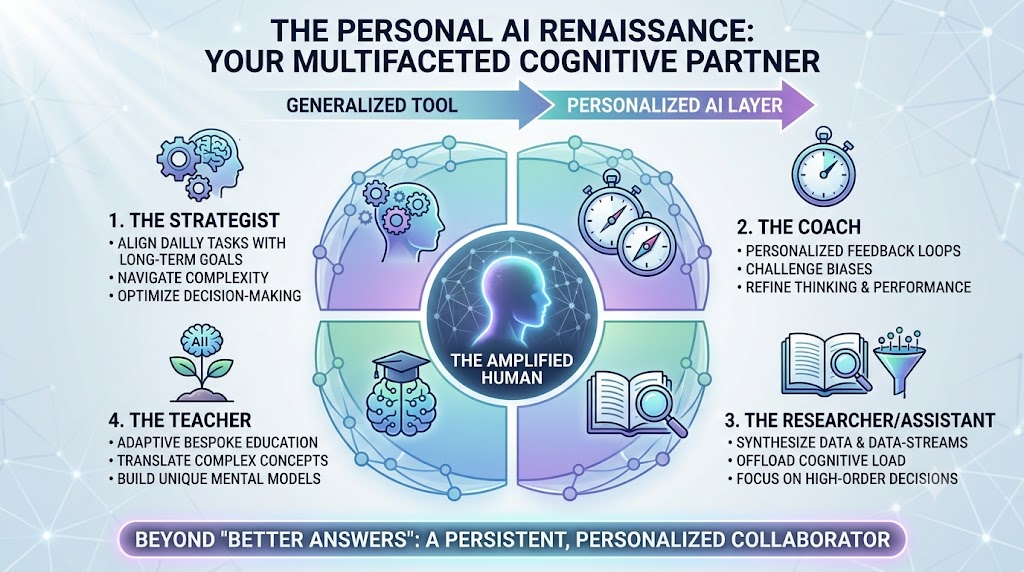
In this Personal AI Renaissance, the individual is supported by a dynamic system that evolves alongside them. We see this intelligence layer manifesting in several key, high-value roles:
- The Strategist: Beyond simple task management, the AI functions as a partner that aligns your daily decisions with your long-term strategic objectives, helping you maintain focus amidst complexity.
- The Coach: By providing personalized feedback loops and constructive friction, the AI pushes you to refine your thinking, challenge your biases, and improve your cognitive performance over time.
- The Researcher/Assistant: This role involves offloading the heavy cognitive load of data synthesis and information retrieval, allowing the human to focus on higher-order decision-making.
- The Teacher: The AI acts as a bespoke educator, translating complex, dense information into the specific mental models and language that make the most sense for your unique perspective.
By delegating these varied roles to a personalized AI layer, the worker gains a form of cognitive leverage previously unavailable. This isn’t about replacing human input; it is about delegating the friction of execution so that the human can devote more energy to creativity, empathy, and the nuanced judgment required for meaningful innovation.
The Productivity Gap: Capability Over Credentials
We are entering a period where the traditional signals of professional worth — degrees, job titles, and years of tenure — are being rapidly decoupled from actual output. As the AI-amplified human becomes the new standard for high-performance, the competitive landscape is shifting from what you know to how you augment your intelligence.
The productivity gap is no longer dictated by education level, but by augmentation capability — your fluency in integrating AI into your specific workflow to solve problems faster and more creatively. An employee with a strong command of their personalized intelligence layer can now outperform peers who, by conventional standards, might be more “qualified” but remain unaugmented.
This represents a true “soft landing” for human potential. Rather than being replaced, the worker who learns to harness these tools is liberated from the drudgery of rote cognitive tasks. This allows them to pivot their focus toward the activities that require fundamentally human traits: empathy, complex system orchestration, and the high-level judgment required to navigate ambiguity in a digital transformation journey.
However, we must also acknowledge the inherent risk for those who remain static. The danger is not that AI will take your job; the danger is that an AI-amplified human — someone who has learned to partner with this intelligence layer to increase their speed, quality, and strategic focus — will become the new baseline for organizational success. In this high-velocity environment, the ability to rapidly integrate and adapt to new augmentation capabilities is the ultimate professional skill.
The Human-Centered Implication: Agency in the Age of Amplification
The transition to an integrated intelligence layer invites a necessary introspection regarding our own agency. When we delegate synthesis, research, and strategic sparring to an AI partner, the fundamental nature of our cognitive work changes. The risk is not that we lose control, but that we become overly reliant on the convenience of the tool, potentially allowing our critical thinking muscles to atrophy if we treat the output as gospel rather than a starting point for deeper investigation.
True agency in this new era requires a shift in mindset: we must view the AI not as an oracle, but as a mirror — a tool that reflects and expands our own intellectual curiosity. We remain the architects of intent, the ones who define the “why” and the “what,” while the AI provides the “how” and the “how fast.” Maintaining this distinction is essential for preserving the human-centered elements of our work, such as ethical reasoning and the intuitive leaps that often drive true innovation.
For leaders and organizations, this requires a fundamental shift in the management mandate. The focus must move away from top-down efforts to “automate processes” or eliminate roles, and toward the deliberate nurturing of amplified talent. The most successful organizations of the future will be those that foster an ecosystem where human judgment is elevated, not replaced, by these new intelligence layers. It is about creating a culture where the combination of human empathy and machine-augmented speed becomes a source of sustainable, long-term competitive advantage.
Conclusion: Embracing the Renaissance
We are standing at the threshold of a new way of working, one where the boundaries of individual capability are being fundamentally redrawn. Viewing the adoption of a personal AI layer merely as a “tech upgrade” misses the broader, more critical reality: this is a strategic professional imperative. Those who integrate these capabilities into their daily lives are not just working differently; they are working at a velocity and depth that was previously impossible for a single individual to sustain.
The future does not belong to the AI, nor does it belong to the unaugmented human. It belongs to the amplified human — the professional who masters the synergy between human intuition and machine-driven speed. This Renaissance is an invitation to offload the cognitive friction that has historically slowed our most important work, leaving us more space to do what humans do best: ideate, empathize, and lead.
As you step into this new era, ask yourself: How will you curate your own intelligence layer, and where will you focus the newfound capacity you gain? The revolution is already here, and the choice to participate is yours. Choose to amplify.
Frequently Asked Questions
What is the primary difference between a chatbot and a personal AI intelligence layer?
While a chatbot typically provides isolated, one-off answers to queries, a personal AI intelligence layer maintains deep context, understands your unique strategic priorities, and tracks your long-term goals to function as an integrated, persistent collaborator.
Why is “augmentation capability” more important than education level in the AI era?
In the current professional landscape, the productivity gap is driven by an individual’s ability to effectively integrate and leverage AI to enhance their output. Augmentation capability allows professionals to transcend traditional education-based limitations by dramatically increasing their speed, quality, and capacity for complex work.
Does the rise of AI-amplified humans mean the end of human-centered work?
No. The rise of AI-amplified humans actually shifts the focus of work toward inherently human traits. By delegating rote cognitive tasks and information synthesis to the AI, humans are freed to devote more energy to empathy, complex system orchestration, and the high-level judgment required for innovation.
Operationalize Organizational Empathy
Ready to Bridge the Gap Between Technology and Human Experience?
Technology only provides capability; human adoption creates the value. If you want to move past cold operational metrics and design fear out of your transformation, let’s connect. Get expert guidance on architecting impactful Experience Level Measures (XLMs) or establishing a dedicated Experience Management Office (XMO) tailored to your culture.
Explore the AI Soft Landing Series
This article is part of a broader exploration into architecting optimistic socioeconomic transitions for the AI era. Dive deeper into the series below:
- The Experience Economy 2.0
- The Synthetic Organization
- Crossing the Chasm of Fear
- The 3 Day Workweek Transition
- The Coming Tribal Fragmentation
- Founding an American AI Sovereign Wealth Fund
- Cognitive Enhancement and the Augmented Worker
- The Micro-Enterprise Explosion
- The AI New Deal
- The Human-Premium Renaissance
- Why an AI Soft Landing Might Look Like Victorian England
EDITOR’S NOTE: This is a visualization of but one possible future. I will be publishing other possible futures as they crystallize in my mind (or as you suggest them for me to explore).
Image credits: Google Gemini
Content Authenticity Statement: The topic area, key elements to focus on, etc. were decisions made by Braden Kelley, with a little help from Google Gemini to clean up the article, add images and create infographics.
 Sign up here to get Human-Centered Change & Innovation Weekly delivered to your inbox every week.