Multimodal Affective Computing via Remote Photoplethysmography (rPPG)
LAST UPDATED: July 10, 2026 at 5:50 PM
GUEST POST from Art Inteligencia
Beyond the “Mask” of Traditional Sentiment Analysis
For too long, the design and innovation communities have relied on the “performance” of emotion. Traditional sentiment analysis and basic facial expression tracking are inherently flawed — they capture superficial, easily masked, or culturally misinterpreted reactions. We have spent decades designing experiences based on what people say they feel, or what they choose to show us, rather than the raw reality of their experience.
In our quest for true, human-centered innovation, we must move beyond these superficial layers. We are entering an era of Affective Computing that allows us to bypass the conscious “mask” and read the underlying biology of the user directly, from a distance, and without friction.
The Shift to Biological Truth
The core thesis of this shift is profound: we are transitioning from measuring post-experience reflection to measuring real-time physiological reality. By leveraging Remote Photoplethysmography (rPPG), we stop treating emotion as a subjective opinion and start treating it as observable, quantifiable biological data. This shift fundamentally changes how we understand human interaction by allowing us to:
- Identify micro-moments of cognitive load and frustration that a user might completely omit in a post-interaction survey.
- Validate moments of true delight by observing authentic autonomic nervous system responses.
- Establish a continuous, objective feedback loop that captures the real emotional temperature of a human-system interaction.
Demystifying rPPG: The Invisible Data Stream
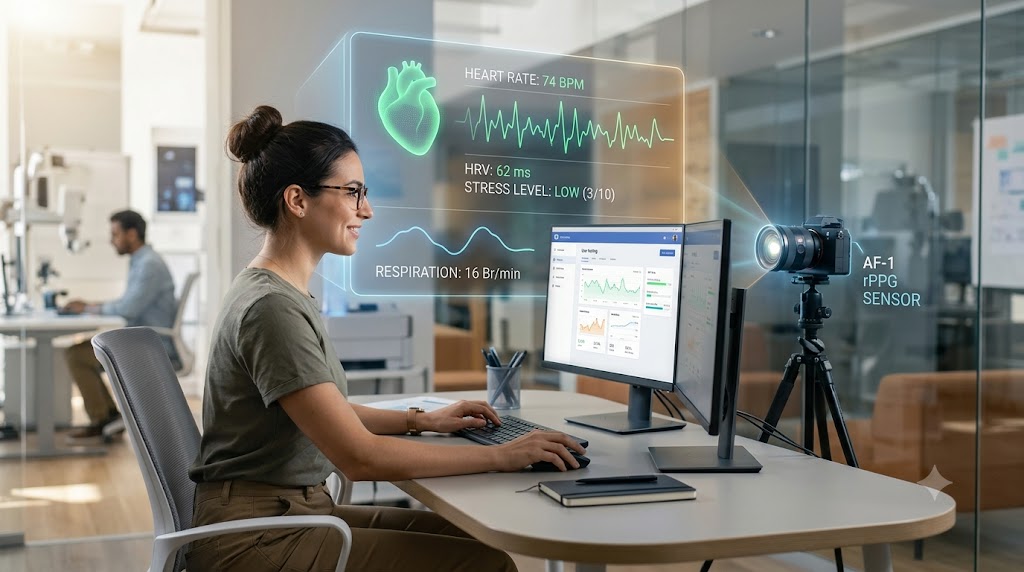
To understand the power of this shift, we have to look at the underlying technology. Remote Photoplethysmography (rPPG) sounds complex, but its premise is brilliantly elegant. Every time your heart beats, blood pumps into your face, changing the volume of blood vessels in the skin. While these micro-fluctuations are completely invisible to the human eye, advanced algorithms paired with standard, high-resolution camera sensors can detect them with incredible precision.
This isn’t about scanning a face for a forced smile; it is about extracting pure, unadulterated physiological metrics from a distance without any physical contact or invasive wearables. By analyzing the ambient light reflecting off a user’s skin, rPPG provides an objective window into the human autonomic nervous system.
The Triad of Physiological Metrics
By shifting our focus from outer expressions to inner biology, rPPG allows us to capture three critical dimensions of the human state in real time:
- Heart Rate Variability (HRV): The gold standard for measuring stress, focus, and emotional resilience. High volatility or sharp drops in HRV give us immediate insight into a user’s cognitive load and anxiety levels.
- Respiration Rate: Changes in breathing patterns are immediate, involuntary responses to stimuli. Sudden, shallow breathing flags moments of friction, confusion, or sudden panic during an interaction.
- Autonomic Nervous System (ANS) Response: By aggregating these metrics, we move from interpreting a user’s subjective feedback to observing their direct biological reality — separating what they say happened from how their body actually processed it.
The Evolution of Metrics: From SLAs to XLMs
For decades, organizations have managed operations using Service Level Agreements (SLAs). We track server uptime, average handle times, and page load speeds. But as I have long argued, SLAs are lagging indicators of operational efficiency, not leading indicators of human satisfaction. A system can meet every technical SLA perfectly while still delivering an experience that leaves the user feeling completely alienated, exhausted, or frustrated.
To design a future that honors the human element, we must transition to Experience Level Measures (XLMs). While SLAs measure the mechanics of a transaction, XLMs measure the quality of the interaction. This is exactly where rPPG becomes a game-changer: it bridges the gap between mechanical performance and biological reality, providing the objective, real-time data stream that true XLMs require.
Quantifiable Empathy in Action
The true value of integrating rPPG into an XLM framework is the creation of continuous, objective feedback loops. Instead of relying on a lagging, retrospective Net Promoter Score (NPS) or a post-interaction survey — which are warped by recency bias and emotional fatigue — we can map physiological data directly to specific touchpoints. This gives design and innovation teams access to a whole new class of experience data:
- Real-Time vs. Retrospective Data: Capturing a physiological stress spike exactly when a user encounters a confusing form field, rather than trying to reconstruct that frustration through a survey twenty minutes later.
- Continuous Feedback Loops: Establishing a dynamic understanding of user sentiment throughout an entire digital or physical journey, allowing systems to adapt fluidly to the user’s real-time emotional state.
- Quantifiable Empathy: Moving empathy out of the realm of abstract design thinking principles and transforming it into hard, validating metrics. We no longer have to guess if an experience causes genuine delight or hidden frustration — the data shows us.
Strategic Applications: Where Human-Centered Innovation Meets Biology
The strategic value of rPPG lies in its ability to be deployed passively and non-invasively in real-world scenarios. We no longer need to strap sensors onto a user’s wrists or place them in artificial lab environments to understand their physiological reality. By integrating rPPG into our innovation toolkits, we can elevate several core pillars of experience design and product development.
From Lab Testing to Living Journeys
By bringing objective biological data into the wild, design and innovation teams can radically transform how products and ecosystems are evaluated across three primary frontiers:
- Next-Generation UX Testing: Traditional usability tests heavily rely on “think-aloud” protocols, which force users to consciously articulate their actions — frequently disrupting their natural cognitive flow. By pairing screen interactions with rPPG data, we transition to physiological-validation protocols. We can pinpoint the exact microsecond an interface element creates an involuntary cognitive spike, validating friction points without asking the user to say a word.
- Customer Journey Touchpoint Evaluation: In physical environments — like a retail showroom, a bank branch, or an airport terminal — understanding how a customer navigates a physical space has historically been based on observation or post-trip interviews. Deploying rPPG through ambient, high-resolution camera networks allows brands to safely map the “emotional temperature” of a space. We can visually correlate design choices, waiting times, or staff interactions directly with aggregate, anonymized stress or comfort metrics.
- High-Stress Training and Simulations: For workforce development in high-stakes fields—such as healthcare, aviation, or emergency response — performance isn’t just about technical accuracy; it is about emotional regulation. Utilizing rPPG during simulation training allows coaches to monitor a trainee’s stress threshold and recovery rates in real time. This ensures that learners are pushed into the optimal “stretch zone” for neuroplasticity and retention without crossing over into debilitating anxiety.
The rPPG Ecosystem: Pioneers and Startups to Watch
The transition toward physiological Experience Level Measures (XLMs) is no longer a theoretical exercise. A sophisticated ecosystem of established tech giants, niche health-tech innovators, and agile software startups is actively commercializing Remote Photoplethysmography. For experience designers and corporate strategists, these are the key market players driving the infrastructure of affective computing:
Established Pioneers and Enterprise Platforms
- Philips Biosensing (by rPPG): As an undisputed heavyweight in HealthTech, Philips has leveraged its massive IP portfolio in optics and signal processing to offer robust, motion-resistant rPPG licensing. Their enterprise-ready algorithms are explicitly targeted at automotive tracking (detecting driver fatigue and stress) and large-scale consumer applications.
- Blue Spark Technologies (VitalTraq™): Known for clinical-grade wearables, Blue Spark’s VitalTraq platform blends continuous temperature patches with rapid 30-to-60-second rPPG facial scans. They are a prime example of how contactless biometrics are modernizing decentralized clinical trials and consumer experience checkpoints.
Emerging Startups and Core SDK Innovators
- Circadify (A.Y. Health Technologies): Operating out of Palo Alto, Circadify is aggressively democratizing contactless vitals. Crucially for experience designers, their deep learning models heavily over-sample diverse skin tones across the full Fitzpatrick scale — directly solving the algorithmic blind spots and demographic bias that plague first-generation emotion AI.
- Darwin Edge: Based in Switzerland, this startup provides highly optimized Software Development Kits (SDKs) that run rPPG processing locally on the edge (including mobile browsers and Raspberry Pi). Their approach is vital for human-centered design because it eliminates cloud dependency, protecting user privacy out of the box.
- IntelliProve: Hailing from Belgium, this startup is heavily engaged in academic and clinical validation, proving that camera-based physiological biomarkers can hold up in real-world environments without expensive laboratory equipment.
The Human-Centered Imperative: Ethics and the “AI Soft Landing”
As an advocate for human-centered innovation, I must emphasize that the power to read a person’s inner biological state carries profound ethical responsibility. This technology must never be used to build a corporate surveillance state or to manipulate consumer behavior. If we weaponize physiological data for hyper-targeted emotional exploitation, we destroy the fundamental trust required for meaningful human-device collaboration.
To achieve what I call an “AI Soft Landing” — where emerging technologies elevate human potential rather than automate away human dignity — the deployment of rPPG must be governed by strict ethical guardrails. The focus must always remain on designing systems that adapt to support the human, not systems that exploit human vulnerability.
Architecting a Trust-Based Infrastructure
To successfully integrate affective computing into our organizations without compromising our values, leaders must anchor their strategies in three critical pillars:
- Absolute Privacy and Consent: Physiological data is deeply personal. Users must have explicit, transparent control over when their metrics are gathered, how they are anonymized, and complete assurance that this data is processed locally at the edge rather than stored in a permanent cloud registry.
- Designing for Intent Orchestration: As labor transitions from manual execution to intent orchestration — where humans direct AI agents to do the heavy lifting — machines must understand our capacity. rPPG acts as a cognitive thermostat, signaling to an AI assistant when to step in, when to simplify an interface, or when to back off based on the user’s real-time stress levels.
- The AI Apprenticeship Economy: By pairing rPPG with our experience design, we allow AI systems to learn from our biological feedback loops. This transforms the technology into a true apprentice — one that becomes deeply attuned to human cadence, proactively smoothing out friction, and cultivating an environment where humans can thrive in flow states.
Conclusion: Closing the Gap Between System and Soul
The convergence of computer vision, advanced algorithms, and human physiology represents a monumental shift in the design landscape. For decades, we have been forced to design for a caricature of the user — one built from incomplete survey data, delayed analytics, and superficial emotional masks. With Remote Photoplethysmography (rPPG), we finally have the tools to design for the authentic, unfiltered human reality.
This technological milestone is ultimately an evolution in how we define and honor the human experience. By transforming passive observations into deep, quantifiable empathy metrics, we can firmly move away from rigid, lagging operational agreements and step into a future powered by real-time Experience Level Measures (XLMs).
The Path Forward for Experience Leaders
As we look to navigate the complexities of digital transformation and the emerging AI economy, our mandate as innovation strategists and experience designers is clear:
- Shift the Paradigm: Challenge your organization to stop evaluating experiences solely based on task completion, and start measuring the literal, physiological impact your ecosystem has on human beings.
- Design for Wellbeing: Treat biometric transparency not as a novel data pipeline, but as an opportunity to actively reduce friction, alleviate cognitive fatigue, and foster digital environments that respect the human nervous system.
- Lead with Purpose: Ensure that your application of affective computing remains fiercely human-centered, grounded in trust, and explicitly engineered to support an intentional, elegant soft landing for both your customers and your workforce.
Frequently Asked Questions: Understanding rPPG and XLMs
What is rPPG and how does it detect emotions?
Remote Photoplethysmography (rPPG) is a non-invasive technology that uses standard, high-resolution camera sensors and advanced computer vision algorithms to track blood volume pulses. Every time the heart beats, it causes micro-fluctuations in skin color that are completely invisible to the human eye. By analyzing these subtle changes from a distance, rPPG measures real-time physiological metrics like heart rate variability (HRV) and respiration rate, giving us an objective, biological look at cognitive load, stress, and genuine engagement without requiring any physical contact or wearable sensors.
How do rPPG metrics integrate into Experience Level Measures (XLMs)?
Traditional Service Level Agreements (SLAs) only track technical mechanics, like page load speeds or uptime. Experience Level Measures (XLMs) focus entirely on the quality of the human experience. rPPG provides the continuous, real-time data layer that makes XLMs actionable. Instead of relying on lagging, retrospective surveys that suffer from memory bias, rPPG acts as a tool for quantifiable empathy. It maps exact physiological spikes — such as sudden stress or relaxed engagement — directly to specific touchpoints along a digital or physical customer journey.
What are the ethical guardrails for using biometric data in experience design?
Because physiological data is deeply personal, it must never be used for employee surveillance or predatory behavioral manipulation. To achieve an ethical “AI Soft Landing,” organizations must follow three core pillars: absolute transparency and informed user consent, local edge processing to ensure biometric data is never stored or transmitted to a permanent cloud registry, and an explicit focus on intent orchestration — using the data solely to help systems adaptively support and reduce friction for the human user.
FutureHacking™ Is Coming
FutureHacking™ is Braden Kelley’s strategic foresight methodology — and a paid download and training program is launching soon. Register your interest now to be the first to know when it’s available, and get early access pricing.
Disclaimer: This article speculates on the potential future applications of cutting-edge scientific research. While based on current scientific understanding, the practical realization of these concepts may vary in timeline and feasibility and are subject to ongoing research and development.
Image credits: Gemini
 Sign up here to get Human-Centered Change & Innovation Weekly delivered to your inbox every week.