GUEST POST from Chateau G Pato
I. The Generated Abundance Paradox
The Cost-of-Entry Trap: When Infinite Output Meets Marginal Cost Zero
For decades, digital transformation was built on a simple promise: digitize the asset, remove transaction friction, and scale without incremental cost. Generative artificial intelligence, autonomous agents, and synthetic content engines represent the logical conclusion—and sudden break—of that paradigm. Today, software can instantly generate bespoke software code, synthesize personalized marketing campaigns, generate infinite media, and automate transactional interactions at near-zero marginal cost.
However, this capabilities explosion creates a profound strategic trap for organizational leadership. When every enterprise gains access to the same generative foundation models and automated execution engines, speed and volumetric production collapse into baseline expectations. When content, code, and basic interactions become infinitely abundant, their standalone economic value trends toward zero. Hyper-efficiency and automated generation cease to be source advantages; they become mere cost-of-entry table stakes.
The Strategic Inversion: The Commoditization of Efficiency
This reality forces a fundamental strategic inversion. In the traditional business playbook, competitive advantage was earned by optimizing processes, shortening turnaround times, and eliminating human touchpoints to drive efficiency. In a post-AI landscape, because efficiency is universally accessible via API, it can no longer deliver long-term differentiation.
The strategic leverage point flips completely:
- Old Paradigm: Value lived in the production and execution layer (building, drafting, calculating, scheduling, and transaction handling).
- New Paradigm: The production layer is automated, shifting value upward to intent, curation, context, and emotional resonance.
Organizations that attempt to compete solely on automated volume or algorithmic speed find themselves trapped in a race to the bottom—a commodity treadmill where every participant offers instantaneous, highly competent, yet completely unmemorable outputs.
The Shift to Experience Economy 2.0
In B. Joseph Pine II and James H. Gilmore’s original framing of the Experience Economy, businesses progressed from commodities to goods, goods to services, and services to staged experiences. In the AI era, we are witnessing the emergence of Experience Economy 2.0.
If digital services and automated interactions become ambient and invisible, economic scarcity moves from the efficiency of digital delivery to the authenticity of human connection. Customers and employees alike do not suffer from a lack of information, choice, or automated response; they suffer from noise, synthetic overload, and relational fatigue.
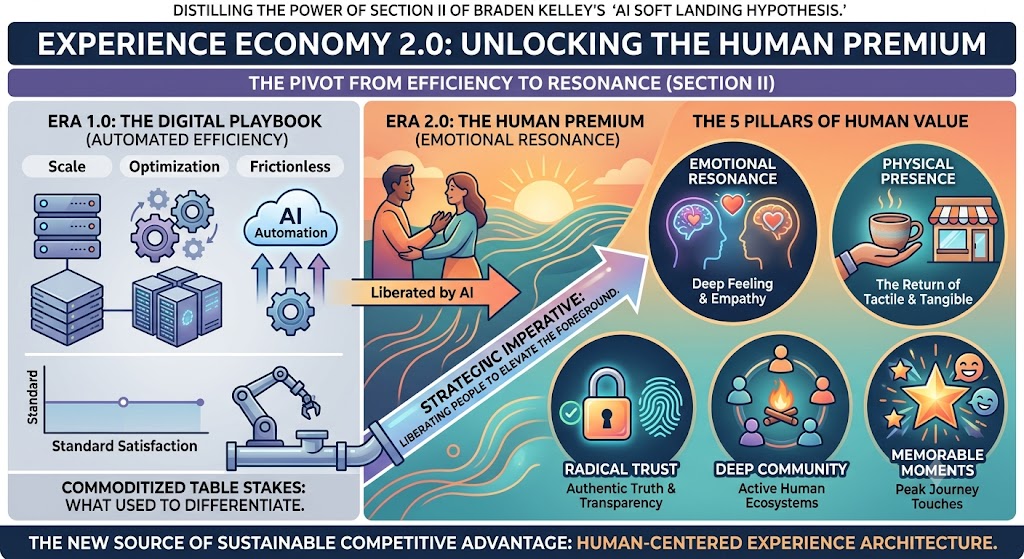
Experience Economy 2.0 re-anchors economic value around what algorithms cannot replicate:
- Contextual Wisdom over Synthetic Information: Moving from generating data to applying human judgment, ethics, and nuance.
- Shared Human Reality over Algorithmic Isolation: Prioritizing authentic physical presence, tactile engagement, and verified human craftsmanship.
- Radical Trust over Automated Convenience: Building deep relational equity in an ecosystem saturated with synthetic noise and machine-driven interactions.
To win in this next era, executive leaders must stop treating AI as a tool for cutting human touch points out of the value chain. Instead, they must deploy AI to absorb transactional friction, liberating human capital to architect meaningful, high-empathy experiences that drive lasting loyalty and organizational resilience.
II. The Four Pillars of Human Value in the Post-AI Landscape
As algorithmic capability scales across every industry, executives must ask a fundamental question: When competent task execution is free, instant, and ubiquitous, what creates durable value? The answer lies in four human-centered pillars that cannot be synthesized by mathematical models or generative loops. These pillars form the structural bedrock of strategy and experience design in a post-AI world.
1. Emotional Resonance Over Frictionless Scale
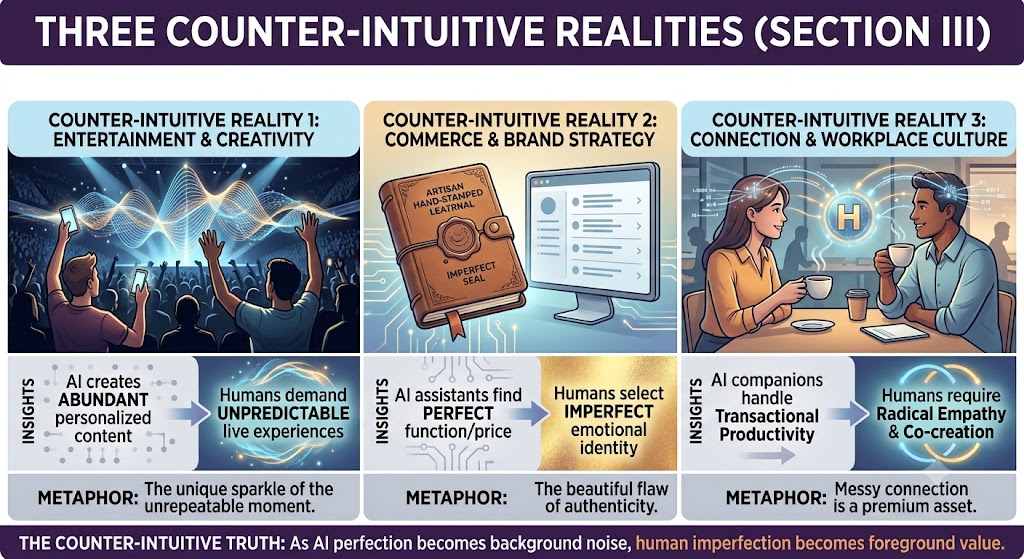
For two decades, experience design was dominated by the pursuit of frictionless transactions. Companies streamlined checkouts, automated customer service, and optimized digital flows to minimize effort. In an AI-saturated market, however, frictionless interaction is merely the baseline expectation, not a differentiator. Cold, hyper-optimized algorithmic touchpoints—no matter how fast or accurate—fail to build emotional equity.
When consumers interact with frictionless AI interfaces all day, flawless performance becomes invisible, while synthetic coldness becomes grating. Sustainable loyalty is built through emotional resonance—the intentional design of moments that evoke feeling, demonstrate empathy, and convey genuine human intent. Brands that thrive in Experience Economy 2.0 do not merely solve problems efficiently; they architect interactions that make people feel seen, valued, and understood.
2. The Premium of Physicality & Presence
As digital content, virtual assistants, and synthetic media flood every channel, digital experiences suffer from systemic devaluation. When anything can be generated on a screen in seconds, screen-bound interactions lose their novelty and weight. Consequently, a powerful counter-trend emerges: a dramatic resurgence in the value of physical, tactile, and spatially shared experiences.
Physicality carries an inherent proof of commitment and effort that digital pixels cannot mimic. Whether through face-to-face executive advisory, tactile product design, immersive physical environments, or locally anchored community spaces, physical presence provides grounding in an increasingly synthetic world. Experience architects must treat physical spaces not as legacy real estate costs, but as high-value sanctuaries for authentic human connection.
3. Radical Trust & Verified Authenticity
The proliferation of generative models, synthetic voices, automated communications, and deepfakes creates a climate of pervasive cognitive fatigue and skepticism. When customers cannot easily distinguish whether an article, email, video, or support agent is human or synthetic, trust becomes the rarest and most fragile organizational asset.
Radical trust is not built through compliance statements or marketing claims; it is forged through radical transparency, verified origin, and consistent operational integrity. Organizations must cultivate clear boundaries regarding where synthetic automation ends and human accountability begins. Brands that openly protect human authenticity and consistently honor their commitments build an unshakeable moat of trust that algorithmic competitors cannot erode.
4. Human Judgment & Discernment
Generative AI is an extraordinary engine for possibility generation—it can produce hundreds of design variations, draft dozens of strategies, or analyze millions of data points instantly. However, synthetic generation lacks taste, moral responsibility, and contextual wisdom. Abundance without direction yields chaos.
This reality elevates human judgment and discernment from secondary supervisory tasks to the primary engine of strategic value. True innovation shifting from “What can we generate?” to “What should we create?” Human discernment applies ethics, cultural nuance, strategic alignment, and empathy to curate options and make meaningful choices. In Experience Economy 2.0, the ultimate competitive advantage lies not in the volume of ideas generated, but in the wisdom applied to select and execute the right ones.
III. Redesigning the Experience Architecture
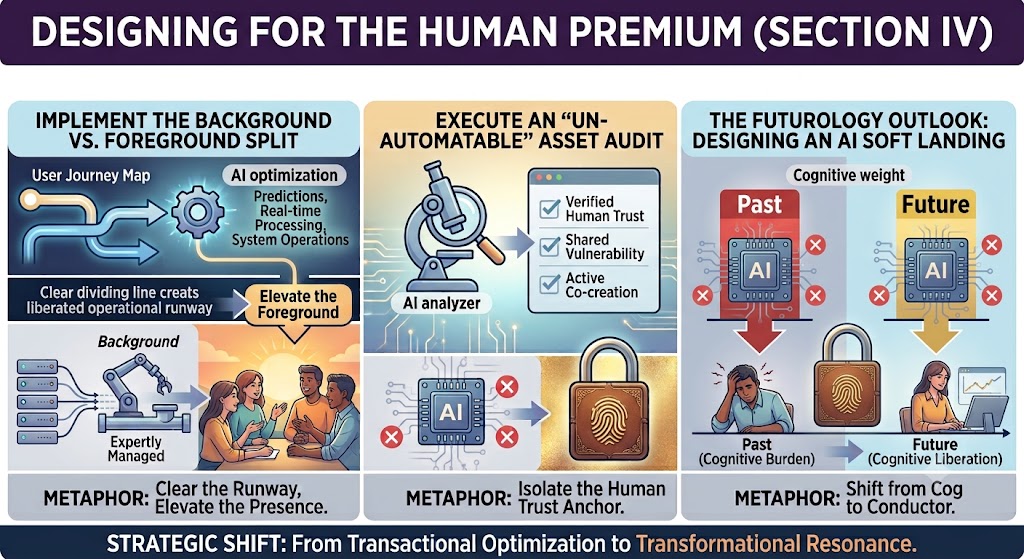
To capture the value generated by human context, emotional resonance, and radical trust, organizations must fundamentally overhaul their experience architecture. Traditional enterprise systems were designed to standardize human behavior into repeatable, assembly-line tasks. In Experience Economy 2.0, the goal is inverted: we must systemize algorithmic work into invisible background infrastructure, liberating human workforce capability to deliver high-empathy, high-discernment value at every critical touchpoint.
1. Invisible Infrastructure vs. Human Touchpoints
Architecting experiences in a post-AI landscape requires a rigorous division between back-stage operations and front-stage human engagement. AI models, predictive analytics, and automated workflows belong in the background—acting as a high-speed engine that eliminates administrative friction, anticipates needs, and surfaces relevant context in real time.
When customer-facing or employee-facing interactions occur, the technology should feel invisible, acting as an empowering proxy rather than a barrier. The front stage must be intentionally reserved for human connection, creative direction, and relational depth. By drawing a clear boundary between machine prediction and human presentation, leaders ensure that technology handles the routine data processing while humans drive the meaningful interactions that build brand equity.
2. Overcoming the Four Psychological Disruptions
Transforming experience architecture is impossible if the internal workforce is paralyzed by technological change. As AI assumes cognitive and analytical tasks, employees experience four distinct psychological disruptions that leaders must proactively address:
- Worker Anxiety: The existential fear of displacement by automated agents, which leads to passive resistance or quiet withholding of expertise.
- Purpose Erosion: The loss of professional identity when routine tasks that once defined daily achievement are performed instantly by software.
- Competence Displacement: The frustration that occurs when legacy skills become obsolete overnight, requiring new modes of human-machine orchestration.
- Belonging Disruption: The isolation stemming from reduced interpersonal collaboration as workers interact increasingly with algorithmic tools rather than peers.
Human-centered innovation strategies must address these disruptions directly by redefining career pathways, emphasizing high-value judgment roles, and cultivating an organizational culture where technology liberates human potential rather than replacing it.
3. From Service Level Agreements (SLAs) to Experience Level Measures (XLMs)
Traditional operational management relies heavily on Service Level Agreements (SLAs)—metrics focused on speed, volume, uptime, and transactional efficiency (e.g., average handle time, response latency, ticket resolution counts). In a world where AI can resolve basic queries instantly, SLA-driven metrics become vanity indicators that fail to capture genuine customer satisfaction or relational health.
Forward-thinking organizations must transition to Experience Level Measures (XLMs). While SLAs evaluate operational throughput, XLMs measure the emotional, cognitive, and relational impact of an interaction. XLMs shift the diagnostic focus from efficiency to efficacy:
| Metric Domain |
Traditional SLA Focus (Operational Efficiency) |
Post-AI XLM Focus (Human-Centered Value) |
| Customer Support |
Average Handle Time (AHT) & Ticket Speed |
Empathy Index, Friction Reduction & Trust Equity |
| Product Design |
Feature Count & Deployment Velocity |
Cognitive Clarity, Delight & Physical Ergonomics |
| Employee Experience |
Task Throughput & Process Adherence |
Creative Autonomy, Purpose Alignment & Empowerment |
| Client Advisory |
Report Generation & Meeting Frequency |
Strategic Clarity, Confidence & Judgment Quality |
By measuring progress through Experience Level Measures, executive leaders align operational goals with true value creation—ensuring that efficiency gains powered by AI directly elevate the human experience for both customers and employees.
IV. Strategic Imperatives for Innovation Leaders
Navigating the transition into Experience Economy 2.0 requires C-suite executives and innovation leaders to fundamentally reassess how they measure value, deploy capital, and orchestrate their organizational capabilities. When generative tools render transactional tasks universally accessible, competitive advantage is no longer determined by how aggressively an organization cuts human costs, but by how effectively it leverages technology to liberate human empathy, creativity, and strategic foresight.
1. Resisting the Cost-Cutters’ Trap
The most dangerous trap facing executive leadership in the AI era is the temptation to view advanced automation purely as a headcount reduction exercise. When algorithms can draft copy, synthesize data, or manage basic customer inquiries at negligible cost, short-term financial pressure creates an urgency to replace human workers with synthetic touchpoints across the entire value chain.
This efficiency-first mindset leads to corporate anorexia—a condition where an organization strips out the very human presence, emotional resonance, and relational trust that give its brand distinct meaning. While cutting human touchpoints may yield an immediate, temporary margin expansion, it simultaneously erodes long-term pricing power and brand equity. When every competitor uses the same generative models to deliver identical, frictionless interactions, the automated enterprise becomes an interchangeable commodity. Leaders must resist this trap, redirecting cost savings from routine automation into funding high-empathy, high-touch human experiences that create sustainable market moats.
2. Orchestrating Human-AI Symbiosis
True competitive differentiation in a post-AI landscape stems from human-machine orchestration—a strategic paradigm where artificial intelligence and human discernment reinforce one another in a continuous feedback loop. AI serves as the ultimate systemic liberator, handling complex pattern recognition, background predictive analytics, synthetic prototyping, and administrative friction at scale.
This liberation allows human workforce capability to focus on what algorithms inherently lack:
- Contextual Wisdom: Interpreting nuanced, ambiguous customer needs that fall outside historical training data.
- Ethical Stewardship: Ensuring strategic decisions, automated outputs, and customer engagements align with human values and organizational integrity.
- Creative Synthesis: Connecting disparate ideas across domain boundaries to invent entirely new categories, business models, and experience frameworks.
- Relational Depth: Building authentic, high-trust connections that inspire confidence during moments of crisis, complexity, or transformation.
By positioning AI as a cognitive copilot rather than a human replacement, organizations build an agile, adaptive operating model where technology elevates human potential rather than suppressing it.
3. Building for Lasting Differentiation
To lead effectively in Experience Economy 2.0, executive teams must pivot their strategic planning horizons from managing transactional volume to cultivating brand soul, physical engagement, and verified authenticity. Lasting differentiation requires a commitment to three core organizational capabilities:
| Strategic Vector |
Legacy Approach (Transaction-Centric) |
Post-AI Approach (Experience-Centric) |
| Value Proposition |
Speed, volume, and cost minimization per transaction. |
Emotional resonance, trust equity, and transformational outcomes. |
| Technology Deployment |
Paving front-stage customer touchpoints with automated bots. |
Embedding AI into invisible back-stage operations to empower front-stage staff. |
| Core Competency |
Process execution and task standardization. |
Human discernment, taste, judgment, and high-empathy curation. |
| Success Architecture |
Measured by Service Level Agreements (SLAs) and throughput. |
Governed by Experience Level Measures (XLMs) and relational lifetime value. |
Ultimately, the post-AI era does not herald the obsolescence of human effort; it marks a profound renaissance of human value. Leaders who recognize this shift early will move beyond the race for synthetic abundance, building resilient, human-centered organizations that thrive at the intersection of technological efficiency and authentic human experience.
Frequently Asked Questions
What is Experience Economy 2.0 in the context of AI?
Experience Economy 2.0 is a strategic shift where automated generation, synthetic content, and hyper-efficient digital transactions become table stakes. As AI commoditizes transactional efficiency to near-zero marginal cost, economic scarcity and value shift toward what machines cannot replicate: human discernment, physical presence, emotional resonance, and radical trust.
How do Experience Level Measures (XLMs) differ from traditional SLAs?
Service Level Agreements (SLAs) evaluate operational efficiency and throughput, measuring metrics like response times, handle times, and ticket volumes. Experience Level Measures (XLMs) assess the qualitative, emotional, and relational impact of an interaction, tracking indicators such as empathy, cognitive clarity, trust equity, and friction reduction.
Why is replacing human touchpoints strictly with AI a strategic trap for brands?
Viewing AI purely as a tool for headcount reduction strips out the human presence and relational depth that give a brand distinct meaning. When competitors leverage the same generative foundation models to deliver identical, frictionless interactions, the enterprise becomes an interchangeable commodity, eroding long-term pricing power and brand equity.
Bottom line: Futurology is not fortune telling. Futurists use a scientific approach to create their deliverables, but a methodology and tools like those in FutureHacking™ can empower anyone to engage in futurology themselves.
Image credit: Gemini
 Sign up here to get Human-Centered Change & Innovation Weekly delivered to your inbox every week.
 Drum roll please…