Tag Archives: Innovation

Struggling to Innovate? Try This Instead

Struggling to Innovate? Try This Instead

GUEST POST from Robyn Bolton

Everyone is an innovator on January 1.

That’s the day when each of us resolves to do something new that creates value.

  • Start working out so I lose weight, look better, and feel healthier.
  • Stop smoking, so I live longer.
  • Turn off my computer and phone at 6:00 pm so I focus on family.

Only 20% of people are innovators on February 1. The rest of us gave up our resolutions and decided to keep doing the same things that create (good enough) value.

Your business is no different.

At the start of the fiscal year, you resolve to innovate!

  • Explore new offerings, customers, and business models
  • Experiment with new ways to get things done
  • Enter new markets

Then something goes wrong, and you divert some people (not everyone!) from innovating to fixing an operational problem.

Then the first quarter starts coming in below expectations, and you cut budgets to stay on track to deliver the bottom line.

Then something else happens, and something else, and something else, and soon it’s “February 1,” and, for excellent and logical reasons, you give up your resolution to innovate and focus all your resources on operating and hitting your KPIs.

Resolve to Revive.

Innovation is something NEW that creates value.

New is hard. It’s difficult to start something new, and it’s challenging to continue doing it when things inevitably go awry. Investing in something uncertain is risky, primarily when more “certain” investment opportunities exist. It’s why New Year’s resolutions and Innovation strategies don’t stick.

Revival is the creation of new value from OLD.

When you work on Revival, you go back to the old things, the things you explored, tried, implemented, or even launched years ago that didn’t work then but could create more value than anything you’re doing today.

Your business is filled with Revival opportunities.

How to Reveal Revivals

Ask, “What did we do before…?”

Everything we do now – research, development, marketing, sales, communication, M&A – was done before smartphones, laptops, desktops, and even mainframes. Often new technology makes our work easier or more efficient. But sometimes, it just creates work and bad habits.

If you are trying to make Zoom/Teams calls less exhausting and more productive, try to remember meetings before Zoom/Teams. They were conference calls. So, next time you need to meet, revive and schedule a phone conference (or a cameras-off Zoom/Teams call).

Find the failures

Most companies are highly skilled at hiding any evidence of failure. But the memories and stories live on in the people who worked on them. Talk to them, and you may discover a blockbuster idea that failed for reasons you can quickly address.

Like Post-It Notes.

While some parts of the Post-Its story are true – the adhesive was discovered by accident and first used to bookmark pages in a hymnal, most people don’t know that 10 YEARS passed between hymnal use and market success. In that decade, the project was shelved twice, failed in a test market, and given away as free samples before it became successful.

Resurrect the Dead

The decision to exit a market or discontinue a product is never easy or done lightly. And once management makes the decision, people operate under the assumption that the company should never consider returning. But that belief can sometimes be wrong.

Consider Yuengling, America’s oldest brewery and one of its old ice cream shops.

In 1829, David G. Yuengling founded Eagle Brewing in Pottsville, PA. The business did well until, you guessed it, Prohibition. In 1920, D.G. Yuengling & Sons (formerly Eagle Brewing) built a plant across the street from their brewery and began producing ice cream. When Prohibition ends, brewing restarts, and ice cream production continues. Until 1985, when a new generation takes the helm at Yuengling and, under the guise of operational efficiency and business optimization, shut down the ice cream business to focus on beer. TWENTY-NINE YEARS later, executives looking for growth opportunities remembered the ice cream business and re-launched the product to overwhelming customer demand.

Just because you need growth doesn’t mean you need New.

Innovation is something new that creates value. But it doesn’t have to be new to the world.

Tremendous value can be created and captured by doing old things in new ways, markets, or eras.

After all, everything old is new again.

Image credit: Pexels

Subscribe to Human-Centered Change & Innovation WeeklySign up here to join 17,000+ leaders getting Human-Centered Change & Innovation Weekly delivered to their inbox every week.


How to Lead Innovation and Embrace Innovative Leadership

How to Lead Innovation and Embrace Innovative Leadership

GUEST POST from Diana Porumboiu

Leaders are bombarded from all directions with advice on how to behave as leaders. It seems like we all know what it takes to lead innovation, at least in theory, yet the attention is mostly focused on famous innovators who oftentimes are the exceptions, rather than the rule.

What’s more, we tend to forget that the greatest, most famous innovators, with all their qualities and contributions to the world, are not necessarily the best of leaders. Great leaders who rarely make the headlines, if they ever do, are usually less controversial.

However, their lack of fame doesn’t diminish their innovativeness. That’s why this article wants to provide some insights into what it takes to lead innovation with the practices, methods, behaviors, and mindsets of successful innovation leaders.

As our previous article focused on nurturing innovative behaviors in employees, this time we’re down to some practical aspects of leading innovation at an organizational level.

Innovative leadership and commitment

McKinsey research sheds some light on what successful innovators get right, and how their organizations become high performing by committing to a set of essential practices.

In short, their survey revealed that the bar is rising among innovators, and during the past five years they have become more successful at innovation as they committed to a larger array of operating models. In 2016 high performing innovators focused mostly on vision and strategy. But In 2021 they pulled further away from competitors by extending their focus to new business models and to scaling their innovations faster and more effectively.

These are all interesting insights into how innovation practices support the growth of organizations. But what are they telling us about specific abilities and behaviors required to lead innovation? To better understand this, let’s look into some of the research conducted by Linda A. Hill, top expert on leadership, change and innovation, who paints a clearer picture of the specific qualities.

  • Adaptability

In times filled with ambiguity and uncertainty, it’s becoming more difficult to make decisions and guide others on the right path. Adaptability might come natural to some people, but others need to cultivate it through practice, exposure to different circumstances and activities. Developing adaptive behavior helps in taking bolder decisions, an essential aspect for innovation.

We’ve seen in other cases how innovators with strong convictions on their vision or new ideas are not very open to new data. This is tough to balance: maintaining your confidence and showing the way for the team, while remaining adaptable.

Practical tip: Instead of building a detailed project plan for an innovation project, try building a plan based around clear goals and time framed milestones, but leave room for the team to figure out the path to get to them.

  • Comfort with ambiguity

This is closely linked to the previous point because to become comfortable with ambiguity you also have to adapt and operate in a somehow hazy and confusing reality. This is very important especially in the early beginnings of innovation, when the fuzzy front-end stage of the innovation process creates a lot of ambiguity.

But as you might know, innovation means to dive in the unknown from time to time. As a leader you need to navigate the tough road of visualizing the goals for the team while admitting that you might not always know the way. At the same time, you want to get the team on the same journey and help them feel comfortable with that ambiguity.

Practical tip: Managing innovation is one way of becoming more comfortable with ambiguity. We created a free, in-depth guide on how to manage innovation which you might find useful. This is a comprehensive toolkit that can help you plan your strategy, build your processes, and drive more innovation in the oganization. You can find it here.

  • Curiosity

Curiosity pushes innovators to new discoveries. It’s also what fuels learning and change. As a leader you need to be able to learn and prepare for the future. Sure, curiosity, even more than adaptability can’t be easily measured or taught. But curious leaders should always ask questions, and not just any questions.

The best innovators understand things deeply and address root problems, not just surface level symptoms.

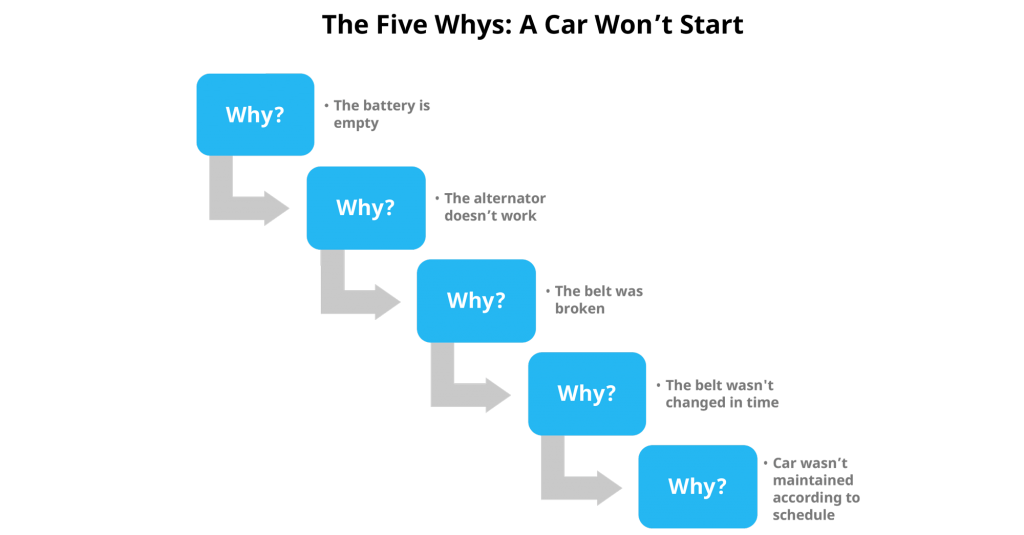
Practical tip: Whether you are naturally curious or trying to boost curiosity in the team, the five whys is an effective technique for getting to the root of underlying problems. The idea behind this technique is to ask “why” five times in a row, whether you think you previously received a good answer or not.

Viima Five Whys

  • Creativity

Creativity plays an important role in innovation, whether it fosters novel ideas or ingenious solutions. However, being creative is not enough to make innovation happen. Many leaders consider creativity an important skill for leading innovation. This begs the question: should leaders be the most creative ones, or should they work to enable creativity in others?

The answer lies somewhere in the middle, as creative leadership is essential in bringing clarity and purpose to the team. A creative leader can change perceptions and show the way. However, the strength of leaders who lead for innovation lies in managing for creativity. So as a leader you don’t have to be the source of all genius ideas but engage people at the right time to do the creative work.

To sum this up, there is a role for leaders in creative work, but not in the traditional sense of generating ideas and asking others to implement them.

Practical tip: If you want to spur creativity in your team try setting constraints and challenge the team to come up with solutions despite perceived challenges. Inevitably, the environment in which you operate will come with some constraints, whether those are operational, financial, legal or of a different nature.

Don’t look at constraints as negative things. Research shows that innovators usually succeed because of constraints, not despite of them. Brian Chesky, Airbnb co-founder & CEO believes “constraints create creativity” and without some of those he probably wouldn’t have done half the creative decisions that would lay the foundations for Airbnb’s remarkable success.

Practical steps to lead innovation

If leading innovation were that simple, we’d have more leaders and organizations excelling at it. However, as difficult as it might sound it’s not impossible and luckily, we have plenty of examples to learn from.

survey conducted by Forbes among 100 innovation leaders revealed that their success lies in actively trying to build and shape their organization for the future. This means that they actively challenge the status quo, experiment, ask questions, are keen observers and engage in conversations with people who are very different from them.

This discovery work of observing, learning, and experimenting leads to better decision making on less risky ideas with higher impact.

Start with the big picture…

The best innovation leaders aren’t just visionaries, who set big goals that show the way to the future. They also enable people to work through the challenges by removing barriers and empowering them to hop on the same boat towards that future.

  • Start with the strategy because any innovation program should be anchored to an organization-wide strategy. Just with the vision and without a tangible business case you don’t really have innovation.
  • Come up with a plan that stirs everyone in the same direction.

Many innovators, especially those who disrupt their industry, are not the best executors and sometimes they don’t have to be, if they have the right people on the job. To this end, collaboration and co-creation are essential, just as it is the empowerment of those who are knowledgeable to make important decisions to get to those goals.

A high-level plan which serves as a good example of how innovators set clear, ambitious goals is Elon Musk’s series of Master Plans, from 2006, 2016 and the 2022 one, to be released soon. These plans played an important role in Tesla’s success, giving a clear direction for the future illustrating how they are actually going to move towards fulfilling their mission of accelerating world’s transition to sustainable energy.

Tesla Unsplash

Of course, there’s more to a plan than an ambitious statement, but people need to be inspired, to feel that through their work they can change the world around them. That being said, an ambitious plan still needs to be flexible to some degree to allow for different ways of achieving it.

The cleverness of these master plans lies in their simplicity which makes them easy to understand and remember. They capture the big picture but still leave room for the team to find the best way of accomplishing them.

…then zoom in on the details

  • To achieve those ambitious goals, leaders need innovative teams, and to nurture internal talent.

With internal scouting systems organizations can develop the skills of existing teams. As is the case with innovation, if you can’t buy something, you have to build it yourself.

It’s beyond the scope of this article to talk about the winning strategies in the war for talent, but there should be a stronger focus on nurturing existing talent and creating the capabilities to innovate through talent development programs, learning opportunities, and a positive employee experience.

Innovation can come from various areas of the organization, and it all comes down to how employees are led to innovate. Former Volkswagen CMO, Luca de Meo managed to unify VW’s branding by discovering and nurturing the mutual sense of purpose of the employees.

He achieved this by involving employees in the creation of a centralized brand. For example, one brainstorming workshop was organized as a design lab to prototype, test, analyze and openly discuss ideas with employees from different departments and areas of expertise.

Engaging employees in innovation work can unlock the wealth of knowledge in an organization. Empowering them to innovate it’s even more powerful, as employees become innovators themselves. As Linda Hill also observes, people’s talents are not used to their fullest, but when it eventually happens, the results show up as well. In Volkswagen’s case, de Meo’s approach was fruitful, the brand moving up the global ranks from 55th to 39th.

…and take one step at a time towards that goal

The last piece to the puzzle, and maybe the most important is to take things one at a time while keeping your options open. There’s a lot of emphasis on the bigger picture, planning and strategy, but these won’t eliminate ambiguity.

So, the best way forward is to keep that vision in mind and help the organization move towards it. You don’t need to know each step in your path in advance, as long as you keep up a good pace and keep moving in the right direction, one step at a time.

Like with all innovative work, you’ll encounter challenges and things won’t ever go as planned, so be prepared to alter the initial plan. That’s why it’s not advised to put all your eggs in one basket. As John Carter explains, you need two interlinked systems that can help you select and grow the best products or ideas.

  • An annualsystematic portfolio planning process, tied to budgeting, and
  • An ongoing, agile, portfolio management process

Another thing to consider is the modular approach, which helps speed up learning. As Rita McGrath explains in this recent article, making your offerings modular you can begin to generate benefits early in the projects’ life. Put together, these two approaches are very helpful in building capabilities that provide economies of scale while still remaining flexible.

Leading innovation by example

In the following section we didn’t go for single success stories of leaders because systematic innovation doesn’t come down to one person. Instead, we’ll show at a higher level how leadership models enabled everyone in the organization to turn innovation into an everyday habit.

Netflix

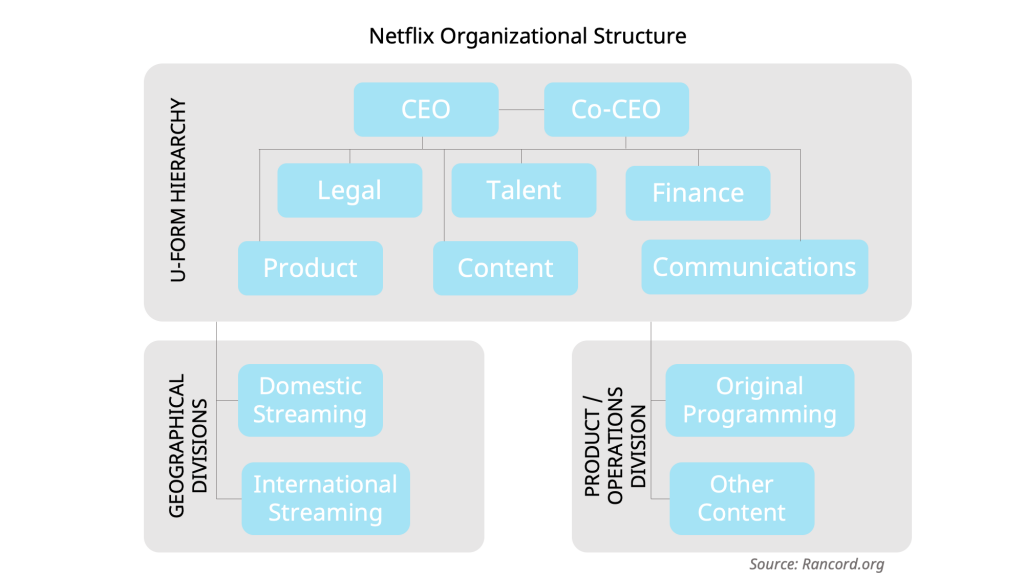
Even though Netflix might go through a rough patch, we can’t deny its leading position as an innovator in the entertainment industry. From a DVD sales and rental company to a global streaming service, the current organizational structure at Netflix provides plenty of freedom and responsibility to its employees.

Netflix is divided in three main divisions and is maintaining the principles of total quality management: the functional team (CEO, legal, content communication etc.), geographical teams (in charge of local and international streaming) and the product teams who ensures the effectiveness of operations. This unitary form, the corporate headquarters direct strategies implemented in geographical divisions.

Viima Netflix Org Structure

  • The first division, the functional one, is led by Reed Hastings, CEO and Ted Sarandos, Co-CEO. They meet regularly with the R-staff, the group made of Netflix veterans and the general counsel.
  • The next in line is the E-staff group, made of executives who oversee different teams within the company. They each have a different area of focus, like platform engineering, regional marketing and content.
  • There is also a group of directors, below the vice presidents, who meet to review the current state of the company.

The flat organizational structure at Netflix encourages a culture of independent decision making, openness, high effectiveness, and flexibility. This approach to leadership is based on their business need of staying ahead of the curve by making decisions fast.

Apple

Apple is to this day one of the most innovative companies, and much of its success is attributed to Steve Jobs. However, in this case we won’t focus on his leadership skills, which are rather controversial, but on his legacy and how the company’s structure has evolved over the years.

What makes Apple unique is that it’s organized around expertise, rather than the traditional business units.

This requires open mindedness from senior leaders, to inspire, and influence colleagues to contribute towards the goals. Ultimately, decisions are made in a coordinated manner by the most qualified people. There are no general managers at Apple. Instead, there are expert leaders who need to have 3 main characteristics.

  • Deep expertise.

It’s easier to train an expert to be a manager than to train a manager to be an expert. So, at Apple experts lead experts. They have over 600 experts working on camera hardware technology, and they are led by Graham Townsend (a camera expert himself).

  • Deep immersion in the details.

In Apple’s case leaders should know the details of their organization 3 levels down and be able to push, probe and smell an issue and know which issue is important and where to focus attention. For example, they are very particular with the shape of the corners of their devices. Apple leaders insist on continuous curves, a small difference but executing it demands that they commit to precise manufacturing.

This relentless pursuit of perfection is what differentiates some companies. Even though overdoing it can lead to micromanagement and make feel employees like they are not trusted, you need to strike a balance between the two.

  • Willingness to collaboratively debate.

Having so many teams of experts requires a lot of back and forth and debate. An overly polite culture can hinder creativity, as people might not speak up because they don’t want to upset someone. So, creative abrasion is very important in collaborative work.

To develop the dual lens camera portrait mode, Apple had 40 teams of specialists working together and they disagreed, pushed back, promoted or rejected ideas and build on top of each other’s ideas.

At the same time, leaders should be able to make decisions even when there’s no data available. For this, they first have to listen to everyone. It might be that there is no agreement or reliable information that can help in the decision making, but that’s where good leaders excel and what Jobs did at Apple as well. He used his own judgment to make decisions, even though not everyone was happy about those. Otherwise, debates could go on forever, become bottlenecks or compromises that lead to substandard results.

Apple Unsplash

However, there are also challenges that come with Apple’s managerial structure, which is not very common in other companies. When organizations grow, their leadership also needs to adapt and scale accordingly.

For example, while the number of employees grew eight times, the number of VPs reporting to executives only doubled. To handle all the new responsibilities, they could no longer be immersed in the details. So, they decided to focus on a few core activities that bring most value and those that require less attention are pushed down to people who are trained to handle them. That being said, leadership models need to be flexible in any innovative, growing organization.

Conclusion

With the right leadership, processes and structures in place, innovation can thrive in your organization. As leaders is important to set ambitious goals which can inspire and show the way for your team.

Innovation can seem like an insurmountable task. Even though the details matter and aspiring to excellence is important, you always have to keep focused on the end goal and take one step at a time towards that. At the same time, keep an open mind, stay curious and inspire others to follow suit.

In the end, leading innovation also means building the capabilities, processes and environment that foster innovation and encourage others to become innovators.

This article was originally published in Viima’s blog.

Image credits: Viima, Unsplash, Pexels

Subscribe to Human-Centered Change & Innovation WeeklySign up here to get Human-Centered Change & Innovation Weekly delivered to your inbox every week.

The Ultimate Guide to the Phase-Gate Process

The Ultimate Guide to the Phase-Gate Process

GUEST POST from Dainora Jociute

While improvisation might bring the zest to a comedy performance or to your Saturday night’s Bolognese sauce, in the world of innovation a systematic approach is the way to go. And the zest here is a fitting and well-thought-through innovation management process.

It has been a hot minute since we last covered the topic. So, for the New Year, we will dust off our knowledge and insights and share updated guides to innovation management techniques.

In this guide, we will take a deep dive into the Phase-Gate process, arguably one of the best-known innovation management techniques. What is it, and why it might be just the right approach to innovation management for your organization? Let’s jump right into it.

What is the Phase-Gate Process?

A more linear, sequential approach such as the Phase-Gate process to product innovation and management isn’t all that new.

Already in the mid-20th century, engineering companies were adapting a segmented manufacturing journey with the aim of better allocating their budgets or shutting down projects that are failing to deliver expected results.

However, a refined version of the Phase-Gate process (under the name Stage-Gate© Discovery-to-Launch Process) was offered by Dr. Robert G. Cooper in the 1980s. It was originally introduced as a faster way to manage product innovation.

So, what exactly is the Phase-Gate process?

In short, it is a segmented (do-review) innovation management and New Product Development (NPD) technique. It is used to efficiently manage resources, prioritize initiatives, and lead the project from the early ideation steps, through development and prototyping to launch.

Cooper’s Stage-Gate process has a very specific and rigid structure, and while many use that term to refer to their management techniques, in reality, most organizations tweak the original structure and adapt it to their unique circumstances and ways of developing products.

Thus, any process that has a linear, segmented model with regular assessments and go/no-go decisions is commonly referred to as a Phase-Gate process.

How does it Work?

Since day one, the goal of the technique has been to divide a lengthy product development process into several well-defined steps (phases) to ease its evaluation along the way. Such an approach allowed managers to see whether the project is still on track to fulfill the promise of the initial idea or has it missed the perfect time to enter the market.

Just like with anything popular and well-known, the Phase-Gate process attracts a healthy amount of criticism. It is mainly criticized for its rigid structure which can stifle creativity since it is based on extensive research, detailed planning, and continuous double-checking. However, this strict structure and frequent check-ins are also the reason why the Phase-Gate is still popular, decades after its introduction.

Regular review processes allow organizations to identify and address issues early in the development stage. If any shortcomings would be discovered during the regular check-ins (gates), the project would be killed, paused, or sent back for a rework. In return, the elimination of weak projects would allow the organization to save time and money, as well as unlock more value by reallocating resources to more lucrative ideas.

Likewise, a project deemed valuable and promising would be green-lighted and would proceed to the next phase, be it prototyping, testing or launch.

At the end of the day, the Phase-Gate process gives an opportunity for the organization to manage the development of a product systematically and efficiently, minimizing risks, and ensuring that resources get allocated to the most viable projects, thus increasing the chances of the overall innovation portfolio being successful.

The objective of the Phase-Gate process is to minimize risks in product or service development, allocate resources more efficiently, and increase the overall chance of success for the innovation portfolio.

Who Can Benefit from Using the Phase-Gate Process?

The Phase-Gate process can be a great fit for big organizations where a hefty upfront investment (time /money) is typically needed to deliver a product to the market, or in industries where there are specific regulatory constraints.

For example, complicated projects like developing and manufacturing a new drug, or a smartphone device while difficult and requiring a very diligent, well-coordinated approach, are fundamentally predictable, hence they can be successfully planned out in advance and benefit from the Phase-Gate process.

So, common examples of industries where the process is used include the pharmaceutical sector, construction industry, electronics, manufacturing, and similar. Usually, as the applicable industries indicate, those organizations are quite large.

On the other hand, if you are running a low-risk project or a complex, disruptive initiative, the Phase-Gate process might become burdensome and too time-consuming.

A good example of low-risk cases might be any small incremental improvements to an existing product, a customer pre-ordering or committing to a contract, then part of the risk consideration is the customer’s responsibility, and rigorous gatekeeping becomes counterproductive.

Complex projects, on the other hand, such as creating a completely new type of business, a disruptive product, etc. are all unpredictable. It means that you can’t know in advance how changing one thing will affect another, so it’s nearly impossible to plan in advance. For these situations, more iterative and agile methods are likely to win against the Phase-Gate technique.

Thus, it is important to know when to adapt the Phase-Gate process to your own projects and when to green-light small endeavors from the get-go and just see them unfold.

While its roots and main benefits come from and for NPD processes, any complicated and time-consuming project can benefit from a well-structured Phase-Gate approach.

any complicated and time-consuming project can benefit from a well-structured Phase-Gate approach

Even in unpredictable projects, key ideas of the process can be useful, shifting focus on eliminating risks one at a time and granting funding in tiers as the team makes progress, not all at once.

To get a better understanding of what parts of the process could be used and when, let’s take a look at all its elements one by one.

The Structure of the Phase-Gate Process

To kick off the Phase-Gate process, you need to have an idea. It can derive from early-stage brainstorming sessions, a fruitful chat over coffee, or maybe even a well-planned ideation process. Either way, this idea-generation period in the Phase-Gate process is called the discovery phase or phase 0.

In an innovation process, the discovery focuses on identifying the right problem or opportunity to address. On top of all the brainstorming and creative thinking, it often includes a lot of field research.

Once you have the idea, you then work toward scoping it (phase 1), ensuring it is feasible (phase 2), developing (phase 3), testing and validating (phase 4), then finally launching it (phase 5). So, in total, the Phase-Gate process consists of six distinct idea development steps: discovery, scoping, feasibility, development, validation, and launch.

The Phase-Gate process consists of six distinct idea development steps: discovery, scoping, feasibility, development, validation, and launch

In addition, there are five continuous and one post-project review point – the so-called gates. Gates are pre-defined checkpoints where decision-makers assess the progress of the process and decide either to cancel the project or grant additional resources to it.

Viima Phase Gate 1

Thus, a review is necessary to harness the full value of your project. The gate review can also act as a short break for a difficult launch, pausing the development or sales process to implement fixes or improvements.

So, in short, the Phase-Gate process might look a little bit like this:

  1. Discovery phase: an innovation opportunity is discovered, and the initial idea is screened for the first time.
  2. Scoping phase: if the idea passes the first gate, the scope will be defined. The idea is thus refined into a proper concept and screened for the second time.
  3. Feasibility: accepted idea moves to the feasibility phase, where a business case is built, and the concept gets screened at the third gate.
  4. Development and Validation: the innovation’s first prototypes are created and evaluated, and testing takes place.
  5. Launch: when the innovation has been validated based on pre-defined criteria, it is launched to the market. After that, a post-launch review takes place

The above is a simplified version of a typical process. However, the Phase-Gate process can be molded to your unique needs, and many organizations indeed choose to do so.

But before we touch on that subject, let’s get a better understanding of each phase and the structure of the most common gates.

Discovery

First, to kick off the innovation process, you need ideas worth developing. In Phase-Gate, this step is called the discovery phase. Discovery creates a perfect environment for the ideation process, during which you and your team are generating and communicating ideas.

For NPD, where the Phase-Gate process is used the most, the discovery phase focuses on the problem or opportunity. Here, it is crucial to know what your potential customer’s needs and wants are. So, for that purpose, an organization can employ a framework such as the Jobs To Be Done theory.

It is worth noting that one should not limit themselves to ideas from their team only. Suggestions can come from outside your organization too, they can be sourced from inter-departmental brainstorming sessions, market research, collecting feedback from customers, suppliers, product teams, etc.

Scoping

In short, during the discovery, you generate a good idea, and during the Scoping phase, you map out some of the key risks and hypotheses associated with the idea and turn it into a tangible concept that you could start to develop.

During this step, the initial feasibility is considered, and market research is conducted. The Scoping phase is an excellent time to utilize SWOT or PESTEL analysis.

During the Scoping phase, it is crucial to understand the current supply and demand in the market, to determine what can be offered.

However, not every good-sounding idea is worth developing and during the scoping phase, it should be evaluated based on the organization’s priorities, not only the market fit.

Feasibility

The Feasibility phase (often referred to as Business Case or Business Viability) is the glue that pulls and holds your project together. In short, it is an important step of the Phase-Gate process, during which an actionable plan for the development of the product/service is created.

If your project gets the green light after this phase, it will move to the development step, thus use this time wisely and consider all “what ifs” in advance to avoid any possible hiccups.

The feasibility phase is complicated and time-consuming, and it is recommended to divide it into the following steps:

Viima Phase Gate 2

  • Product definition and analysis: one of the first steps is to determine whether the product is desirable and whether it solves the earlier discovered problem. User research during this step can help answer such crucial questions as how to satisfy customers’ needs and according to those, what features should the product have. Both quantitative and qualitative research should be conducted (i.e., interviews, surveys, and focus groups). Additional market and competitive analyses also take place during this phase.
  • Building the business case: a business case is a document that compares the project’s benefits against the costs, with a focus on whether the benefits truly outweigh the expenditure. It allows decision-makers to understand if the plan is realistic.
  • Feasibility study: While your business case analyses whether a project should be done, the feasibility study evaluates whether it could be.  And at its core, it answers the simple yet key question: in case of launch, will the outcomes of the project justify the cost needed to develop it?
  • Building the project plan: your project plan will determine whatwherewhen, and by whom. Think of it as a schedule for your business plan, that overlooks all the steps that you will take to move through the Phase-Gate process. It covers resources needed to complete the project, estimating how much time it would take to develop, and test, and finally when to launch the product.

Development

The developing phase is meant to work on a “tangible” prototype of the new product or service. Design and development teams should work according to pre-set goals and clear KPIs. The SMART goals approach can be a useful tool to break down the process into actionable steps.

In addition to product/service development and design, it is time to focus on a marketing campaign and plan how to reach your target audience.

Early-stage (alpha- or lab-) testing might take place during the development phase. The ideal goal of this stage is to prepare an early working prototype, ready and set to go into the testing phase.

Validation

The goal of the Validation phase is naturally to validate your prototype and for that, testing takes place. It is important to determine whether the prototype delivers any value and did it really meet the needs and objectives defined in the earlier stages. This step is all about polishing the rough edges, testing marketing, and distribution channels, and testing processes around the product.

Early-stage testing took place in the previous phase, but now it is time to see the product in action and gather as much feedback as possible. You do not want to rush a half-operating, half-failing product to the launch phase hoping for the best. You want to be ahead of all the possible issues and during this phase, you should ensure the following tests are taking place:

  • Near Testing: Run an in-house test involving people who are familiar with the product and process. During this test, the focus is set on finding any issues or bugs and eliminating them before the product hits the market or even before it moves to the beta-testing step.
  • Field (BetaTesting: This is the time for your project to leave its nest and get tested in a real-world setting. Typically, this testing involves your customers, partners or to play it super safe – internal staff that has never been part of the development process. The goal of beta testing is to see how testers are using the product, what features they like or find useless, and how much workload, wear and tear it can withhold. Flaws identified in this phase should get fixed.
  • Market Testing: Now that you have a perfected product, and you have a better understanding of how your future customers will use it, it is time to utilize this knowledge to adjust your earlier set marketing plan. Test several different marketing scenarios, positioning and messaging alternatives, different price points, and channels to see which ones seem to work the best. There is a plethora of different things to test and methods to use and the right ones depend on your unique situation and the hypothesis you need to test.

Launch

The validation step gives a chance to make the final tweaks and fixes to the project and if it passes the post-validation review step, it successfully moves to the launch phase.

However, while it sounds simple on paper, the launch phase is the step where all of the departments meet and have to work in perfect sync. Alongside the marketing department working their magic and the knowledgeable sales team, you must ensure the following are in order too: volume of production, methods, and channels for customer acquisition and delivery.

One thing that is important to plan for the launch is customer support. You might exhaust all the means of testing the product pre-launch, yet you will never be able to 100% predict how it will really behave in the market. In case your product gets a lot of attention, be it good or bad, a knowledgeable and dedicated support team will eliminate possible bottlenecks.

With that said, the launch phase is a long journey away from those first, shy ideation steps you take in the discovery phase. Your initial idea will be analyzed and scrutinized under a magnifying glass during the full Phase-Gate cycle and it will have to pass several gates first.

What is a Gate Review Process?

Traditionally, a project managed with the Phase-Gate process will go through 4 control gates (Idea ScreeningSecond Screening, Go-to- DevelopmentGo-to-Market Test) until reaching the final pre-launch gate – Launch. If during the final gate, the project gets approved and reaches the launch phase, the last thing that should be done is a post-launch Review, which could be considered as the final gate.

However, the Phase-Gate process can be adapted to the individual organization’s needs and the number of gates can be increased. Or, if a company is using a simplified process for smaller scale projects – decreased. No matter which path you pick for your project, remember that the quality of your gates can determine the quality of your project.

The quality of the gate review process can determine the quality of the whole project.

Gatekeeping

Normally, people responsible for reviewing and gatekeeping the project depend on the organization’s size, type, and scope of the product. Usually, it is a cross-functional executive committee or a steering group.

In a nutshell, this group or person is responsible for ensuring that the project gets a green light to move forward or gets stopped. In addition, they provide feedback and guidance to the project development teams to help them identify risks and to avoid unnecessary mistakes.

For the gatekeeper, it is important to understand all practicalities around the project. While there is a budget to keep an eye on, the progress will be doomed if it’s just the numbers that get looked at. The gatekeeper needs to deeply understand the market, technology, and customers, not just compare business cases and pick the one with the bigger numbers.

Whether the organization assigns a committee or a single supervisor for the gate review process, the crucial part is to ensure that the gatekeeper is not directly related to the project (project sponsor, project manager), to avoid biased assessment.

During the gate review, resources, budget, KPIs, and other success criteria get decided for the next project development phase. In addition, each gate review provides the committee with an update on the status of their innovation portfolio. It also gives an opportunity for both sides of the project (the project team and the evaluating committee) to challenge one another or to have a discussion that would put them on the same page.

However, it should not become a battleground, but rather a safe space to focus on learning, and the clearer the goals and KPIs you have set, the easier to manage and more efficient the gate review process will be.

Assessment of the Quality of the Idea

Gate reviews are checkpoints for assessing the potential, risks, and progress of the project, and making the decision on whether or not to allocate additional resources to it. They also provide a great opportunity to share feedback with all teams involved. This review typically includes a few different steps:

  • Quality of execution: to evaluate the quality of execution of the previous phase.
  • Business Rationale: to determine whether the project can be fruitful considering the assessments performed beforehand. It should include a list of key assumptions or hypotheses that the idea relies upon to become successful.
    If the project has issues or the assumptions are unrealistic the business rationale step in the gate assessment is when said issues get discovered, and unless a solution is found, the project gets killed.
  • Action Plan: to evaluate whether the expectations are reasonable and whether there are enough resources to implement all the planned or desired steps.
    If the idea is feasible and just the resources are lacking, it is common to pause the project and re-assess it later.

Gate Review Components

The review process must be clear, strict, and simple to leave little to no space for maybes and to make it as easy as possible to weed out weak projects. Usually, it relies on a points-based evaluation system.

There are two groups of criteria for a gate review:

  • Must meet: Objectives that the project must include and meet at a certain point of the process. If the project failed to meet one, the project is killed (or paused) outright. Usually, it is a checklist of questions that can be answered either yes or no.
  • Should meet: Objectives that are desirable for the project to meet. While the first group is simple in its structure (no = kill, yes = greenlight), this criterion is evaluated on a point system. Each objective is given points worth and at the end of the step final points get calculated and compared to the in advance set marking system.

Gate Outcomes

There are 4 possible outcomes for each assessment step.

  • Go – the project is feasible enough to get the green light. The go phase should include an agreement on what the project should deliver in the next phase (having this in place will make the next gate review much easier).
  • Kill – the project is not feasible and gets shut down. If a project does not have sufficient merit – the kill decision should just put an end to it.
  • Hold or Pause – the project is considered feasible but not at the current time or state and gets put on hold.
  • Conditional Go or Rework – the project can proceed to the next phase only if it meets certain requirements and conditions after a rework.

Viima Phase Gate 3

Quite often the Phase-Gate process is seen in black and white – you either kill or launch a project. For some, the outcome is as clear as that, however, it is not the case for every project. Conditional Go is just as important and crucial an outcome as Go or Kill.

For example, some strategically important projects might be sent back for a rework several times just to make them truly viable and garner their full potential. And while to some working on the project, this back-and-forth might be seen as a challenge, it only means that the Phase-Gate process works as intended.

Remember – the gate process is not just a basic review. It is the decision-making point where the project might be completely rejected and killed and for some people, it might be a breaking point in their careers.

Of course, it is always best to nurture a safe environment at work, where a failed project is not seen as a personal problem or career killer, rather failed project should be seen as an opportunity for everyone to learn from mistakes and just improve upon future projects.

Viima Phase Gate 4

Challenges and Benefits of the Phase-Gate Process

As mentioned before, there are those who swear by the Phase-Gate, and there are those, who argue against it. If you are wondering, which camp should you be joining and whether the Phase-Gate would be the right innovation management technique for you, first consider the challenges and benefits of the process.

Challenges

  • The rigid structure lacks flexibility. As the traditional Phase-Gate process follows a strict flow and rigid review process, it can limit creativity, and lead some projects to spend too much on bureaucracy as opposed to solving the real problems. As development must follow a pre-agreed set of rules and creative changes might cause the project to be rejected during the gate review phase. So, at the end of the day, in some situations, the process can be too heavy and demotivating for innovators.
  • Can lead to a lack of customer focus. The Phase-Gate process might lead to tunnel vision both for the project developing team and the review committee. The prior might feel pressured to focus on checking off tasks on a strict to-do list before the Gate review phase, instead of focusing on the bigger picture and real customer needs, while the latter might focus too much on early-stage market research, unwilling to accept sorely needed changes later on in the process.
  • A narrow focus on the business case. Even if the project does fit all the business case set criteria, it means very little in the grand scheme of things. First, every business case is always wrong: some just a little, but some massively so. Plus, there is a built-in incentive for teams to game the numbers to get to work on the project and acquire more resources, so unless reviews are done well, all the wrong projects might get funded. Plus, it doesn’t really account for poor execution or scenarios like a competitor coming out with a similar product, the geopolitical environment changing, or customer preferences changing during the project.
  • Focus on short-term results and risk aversion. The Phase-Gate process is designed to reduce risk and increase the project’s chances of success, but that can sometimes lead to undesirable biases. It can be tempting to reject a project on the grounds that it is too costly and instead, invest money in easy-to-predict improvements on existing products. In such cases, a risky and unpredictable innovation that might generate the most profit might always lose in favor of quick, predictable, and short-term oriented projects.
  • Competitive and divisive approach. The Phase-Gate process might create a competitive environment where teams are battling for funding for their project against one another, as well as create “sides” – one that develops the project and another that evaluates it. So, instead of innovation being a strategic pursuit of common goals for everyone in the organization, it might create tension, division, and competition instead.
  • Not accepting any unpredictability. In many cases, it’s impossible to gather all the evidence before making decisions related to innovation. Some companies strive to eliminate all uncertainty or require detailed business cases for everything when it might be impossible to create it accurately early on in the process. This is highly counterproductive and frustrating for innovators.

Benefits

  • Eliminates “dead-end” projects. It isn’t uncommon for some projects to get lost or stuck in big organizations. By requiring regular reviews, the Phase-Gate process ensures no project will be forgotten or left pending, hogging valuable resources.
  • Identifies issues early on. Every idea must pass several reviews. And if the idea is good but the planning around is poor, it simply gets paused and sent for a rework. This way the organization does not lose a good idea and gives it a standing chance.
  • Minimizes costs and time spent. By eliminating those “dead-end” projects and troubleshooting projects early, the organization is able to save resources. Also, the earlier you can identify, eliminate, and prevent issues, the cheaper it is, both in terms of time and money spent. That is usually preferable to pushing out a broken product into the market and then having to deal with the panic, complaints, returns, brand damage, and so on.
  • Prevents “politics”. By entailing the same rules, requirements, and stringent review process for each project, the Phase-Gate can prevent top executives from investing too much in their pet projects, freeing resource allocation and giving a fair chance for every project.
  • Facilitates joint decision-making. Instead of one project manager overseeing, managing, forecasting, and deciding upon the progress of the NPD process, in the Phase-Gate process, multiple stakeholders and teams can influence the decision-making process, making it more objective and inclusive.

In addition, it is important to note that a well-planned and well-structured Phase-Gate process counters some of the challenges that many fear experiencing while implementing it.

If done correctly, the Phase-Gate process can and will:

  • Foster holistic thinking. When done well, it helps to make sure everyone is thinking about the problems holistically: e.g., business, customer, and technology, which helps avoid unnecessary mistakes.
  • Systematize innovation. The structured approach gives clarity to the process, eliminates challenges, and bottlenecks, and gives a set of rules on how to make your idea into an innovative, valuable solution. While some might find this frustrating, it can also help turn more employees into successful innovators.
  • Reduce riskMaking a list, and checking it twice does help avoid unnecessary waste, mistakes, and any other mishaps. In addition, the Phase-Gate approach makes you detail all of your assumptions before you move forward with the project which allows solving all the potential issues before they have a chance to arise.

Tips to Improve the Phase-Gate Process

The Phase-Gate process is an adaptable and scalable approach that can help transform your business by identifying new opportunities and unlocking more innovation. And while on paper it all sounds pretty straightforward, in reality, it requires a dedicated management team to make it work for your organization’s unique business environment and culture.

To reach its full potential, consider some of the following:

  • Clear gate criteria. Set clear, objective criteria to pass each gate in advance, communicate it across all the involved teams and ensure they are accepted by each team before you move on. In addition, consider if you will want to proceed with a point-based rating system or whether another type of evaluation fits your processes better.
  • Clear gate function. While the primary goal of your gates is to stop/green-light a project, they should also work as a guide to the teams on what to do next. Make sure each gate makes the team outline and test the assumptions built into their plans and business models. Reviews should help guide teams on the right track, not just pass judgment. Finally, discuss and determine the types of meeting you will hold in-person, virtual, or hybrid. Which one caters to the needs of everyone and delivers the best results for your organization?
  • Diverse and educated gatekeepers. First, gather a diverse, multidisciplinary gate review committee that understands the customers and the technology intimately. Gatekeepers will after all determine the overall success of the Phase-Gate process. And second, as the gate review process touches on every possible aspect of product or service development, make sure your review committee is knowledgeable and constantly up to date on market changes, customer needs, legal or regulatory aspects, etc.
  • Regular check-ins. The timeline of your process will vary depending on the project you are developing, but either if it is moving at a fast or slow pace, regular (at least monthly) meetings are important to keep all projects moving. And this applies to meetings during each phase, not just during the review steps. It will allow teams to stay aligned and on top of resources.
  • Customer-first. Unless you are implementing changes aimed at improving employee engagement or other internal aspects, customers should always remain the focus of your attention. Staying customer-focused through every phase and gate will help you avoid internal politics, unnecessary competitiveness, and friction that might arise between project-developing and project-reviewing teams. And of course, it will ensure that you are still working on a relevant product or service.
  • Input from stakeholders. Retain open communication channels. First of all, it ensures transparency and trust top-down and bottom-up, by giving a clear view of the process to everyone involved. In addition, it improves the overall flow of the process and reviews steps by providing additional insights and feedback that otherwise might have been missed.

Lastly, consider your organization’s unique culture. It can take time and sometimes even resistance to introducing a completely new innovation management process.But patience, planning, clear communication, and internal support will set you on the right track to successfully implementing the Phase-Gate process.

Conclusion

Overall, the Phase-Gate process is a valuable tool for managing the development of new products and services, and it can help your organization to be more efficient, effective, and innovative.

For some, the Phase-Gate process might work great, while other organizations might need something a little different.

The Phase-Gate approach might have the biggest name in the group, but it is not the only innovation management process out there. If after reaching the end of the article you are still not sure whether it is the right fit for your organization, you can check our past entries on Innovation Management. Maybe it will help you discover just the thing you’ve been searching for.

But, if you are curious to proceed with the Phase-Gate process, you can try it on for size for example via the Viima app. To make your onboarding experience smooth, and your innovation project management easy, we have created a Phase-Gate process template ready to be used just after a few clicks.

This article was originally published on Viima’s blog.

Image Credit: Viima, Unsplash

Subscribe to Human-Centered Change & Innovation WeeklySign up here to get Human-Centered Change & Innovation Weekly delivered to your inbox every week.

Using Limits to Become Limitless

Using Limits to Become Limitless

GUEST POST from Rachel Audige

While it dates back to the 1970s, the expression ‘think outside the box’ is still in vogue. Yet the idea of creativity being best when unrestrained is at best a bit of a fable and at worst, unhelpful – particularly when we are confined to the four walls of our home! What is really helpful is when people actually impose constraints on their thinking. It’s counter-intuitive but creativity loves constraints.

So, what sort of constraints does it love? In my experience, there are five. The first — contrary to popular belief — is to artificially create a frame or a ‘box’. In her inspiring TEDx talk at Newark Academy, Tess Callahan spoke about “the love affair between creativity and constraint.” We all admire people who think outside the box but how do they do it? What if the key to thinking ‘outside the box’ is to create a box to think outside of?”, she says.

For many, thinking ‘outside the box’ means exploring new paths and “being open-minded” and “brainstorming without judgement”. This makes sense but how to do this is not very clear. Subject to the rigour of the facilitator, brainstorming sessions are likely to generate a huge list of ideas that are more or less out of reach. I call these ‘aromatherapy ideas’ (inspired by an ad where the brainstorm led to aromatherapy candles in the hire car putting everyone — even the driver! — to sleep). The team feels empowered and hyped but months later when nothing has happened to their ideas, they are cynical and will boot out the next person who wants to talk innovation.

In workshops we illustrate the difference between outside and inside-the-box thinking by asking people to go create a piece of exercise equipment that we’ve never seen before. Faces look blank, the buzz is low but the pairs come up with a few nice ideas. In a second round we ask them to do the same but to make it exercise equipment that we can use at the wheel of our car. The noise level trebles, ideas fuse and even those who had nothing have some interesting ideas (along with the odd aromatherapy one!). We then ask them ‘Which exercise was easier?’. 95% will say the second (there’s always an outlier or two…). Give people the context; the box. Zoom in and work from there. This gives people focus and avoids the blank canvas syndrome.

The second constraint loved by creativity is the natural corollary of the first: once you have a defined ‘box’, you should follow a path of most resistance and limit the resources you can use to ideate or create.

Systematic Inventive Thinking (SIT), the Israeli company and innovation method that I believe really enhances creative thinking (as opposed to simply providing a process) is grounded in this belief that constraints foster creativity. The founders were so convinced of this that they imposed an artificial constraint on the creative process so that you have to strive to only use resources that are inside what we call the ‘Closed World’. The key to this is being systematic about how you go through the ‘inventory’ of this closed world. If you’re not, your cognitive biases will blind you to some great ideas…

That brings us to the third idea: once you have limited your frame and your resources, creativity is enhanced by drawing on inspiration; on templates. These help bust these biases and take a different path through our minds. When artists want to paint, they often learn by copying the masters. Likewise, in creative thinking and innovation it is powerful to draw on the most inventive ideas. There are countless templates to draw from. Biomimicry is based on the templates tried and tested by Mother Nature. The Speedo swimsuits inspired by shark skin to reduce drag were banned in the Olympics were seen to be a nice example of this. TRIZ (the inspiration for SIT) covers 40 patterns that not only inspire but are said to serve as predictive models for future innovations…

In SIT we work with five inventive thinking tools that come from five patterns present in the 80% of the most inventive ideas (‘surprising for some but there is a sort of DNA to creative ideas). They include removing an essential component (like Apple did with the Shuffle) or dividing up a process or product and moving a component in time or space (like H&M did when they moved the step of paying from the end of the shopping process to the moment the decision is made in the fitting room). The brilliant thing is that these templates not only increase our chances of coming up with something exciting but they help bust the cognitive biases that may lead us to miss resources that are right under our nose.

The fourth constraint is to diligently follow a workflow. In design thinking we have learnt to start with our customers’ needs and pain points (the “function”) and develop a solution (the “form”) to fit. This has been a crucial shift that taught organisations to stop product push but what if we could learn another workflow? And what if this workflow could help us suspend our embedded thinking so that we can unearth more original ideas?

Back in the early 90’s, a group of psychologists made an interesting discovery. When it comes to creating, people are innately better at uncovering the potential benefits of a given form than creating a new form to satisfy a given need. Or, to put it differently, we struggle to come up with a solution to a problem more than a problem for a given solution. Those of us who work with this find that this “back-to-front” approach is great way to stop ourselves from default thinking and embedding the structures, functions and relationships that we are used to into the new idea.

In SIT we call this ‘Function Follows Form’ and the more strictly we apply this workflow constraint, the more impactful it is on our creative thinking. We start by defining the closed world and listing the resources we have available. We then apply a template (depending on the most likely cognitive fixedness). This manipulation leads to a ‘virtual’ process, product or ‘situation’. This is when our resistance is greatest and if we are not strict about limiting our thinking to this oddly manipulated virtual form, we are likely to reject it and possibly miss the opportunities it offers. Once we have visualised it and described how it could work, we then explore its desirability, feasibility and viability, make any necessary adaptations and then test the idea if it warrants it. It is invaluable to know how to think both form to function as well as function to form.

The last constraint is that of embracing unchosen limitations. Phil Hansen (TEDxKC) tells a beautiful story of how he harnessed the power of embracing a ‘shake’’ to create even more extraordinary art.

After years of painting with a method of tiny dots, Hansen developed a shake in the hand that made it impossible to paint as he was used to doing. His dots “had become tadpoles”. It was good for “shaking a can of paint” but for Phil it was “the destruction of his dream of becoming an artist.” He left art school and he left art.

This didn’t work for him, however, so, after a while, he went to see a neurologist who diagnosed him with permanent nerve damage. This wasn’t great. What was great though was what he said to him: “ Why don’t you just embrace the shake?”

So he went home and started making art with nothing but scribbles . He then limited himself to his feet. He then moved to wood… He moved to larger materials where his hand wouldn’t hurt. He started with a single way of painting and ended up with endless possibilities. “This was the first time that I encountered the idea that embracing limitation could actually drive creativity,” he says.

He finished up school and got a new job. This enabled him to afford more art supplies. He explains that he “went nuts” buying stuff and took it home with the intention to do something incredible. He sat there for hours and nothing came. Same thing the next day. And the next. He was “creatively blank”; paralysed by all these choices that he never had before. That was when he thought about what the neurologist had said…

He realised that if he ever wanted his creativity back, he had to quit trying so hard to think outside of the box, and “get back into it”. In fact, he started exploring the idea that he could get more creative by actually looking for limitations? “We need to first be limited in order to become limitless, he says, very poignantly.

He took this approach to being ‘inside the box’ and did a series of artworks where he imposed tight constraints: he could only paint on his chest, or he could only create with karate chops or what if he created art to destroy after its creation (an image of Jimmy Hendricks made out of 7000 matches — crazy!), what if he used frozen wine…“What I thought would be the ultimate limitation turned out to be the ultimate liberation as each time I created the destruction brought me back to a place of neutrality where I felt fresh to start a new project,” he explains.

He found myself in a state of constant creation “coming up with more ideas than ever…”

We don’t all have the honed creative skills of my new artist friend or of the astonishing Phil Hansen but that’s all the more reason to boost our creative potential. As individuals and in organisations, we need learnable, robust, repeatable tools to be more skilled inventive thinkers — and to be able to harness this on demand. We need methods that impose limitations. So try getting back inside the box and embrace the constraints!

Subscribe to Human-Centered Change & Innovation WeeklySign up here to get Human-Centered Change & Innovation Weekly delivered to your inbox every week.

Kickstarting Change and Innovation in Uncertain Times

Kickstarting Change and Innovation in Uncertain Times

GUEST POST from Janet Sernack

In our last article, we described why innovation is transformational, and why, at this moment in time, it is more important than ever to innovate. We stated that innovation-led growth is absolutely critical and that people need to be enabled and equipped to adapt, connect and collaborate in new ways to kickstart change in agile, constructive, equitable, and sustainable ways to innovate in uncertain times. Yet, our research and experience at ImagineNation™ over the past 10 years has revealed that many governments, communities, organizations, teams, and leaders, feel somewhat – but not very – confident in their readiness, competence, and capacity to change and innovate in a world of unknowns.

Six Strategies to Kickstart Change and Innovate in Uncertain Times

To help build this confidence we have identified six key strategies and the key first steps to help you focus your attention, kickstart change, and drive and execute your change and innovation initiatives, to survive, thrive, and flourish in uncertain times.

Strategy #1

Build change readiness and receptivity to survive and thrive in an uncertain world by:

  • Giving people permission and safety that allows them to accept and acknowledge the range of emotional reactions (fears), physical consequences (exhaustion), and work-life imbalances as a result of the imposed WFH environment.
  • Acknowledging how people are feeling helps them better re-balance, adapt, and become resilient by supporting them to develop a work-life balance to better connect with others, tolerate uncertainty to change, and innovate in uncertain times.
  • Challenging people’s habitual default patterns of remaining in the safety of their comfort zones, breaking habitual “business as usual” habits, inertia, and complacency.
  • Being empathic and compassionate with people’s anxieties, confusion, insecurity, and uncertainties about their futures at work, and supporting them through their personal conflicts.

Strategy #2

Allow, accept and ack knowledge people’s fears and struggles about change, help manage their anxiety, improve their productivity and attune them to the possibilities and potential opportunities in the current business environment by:

  • Providing individual and collective support to enable people to take back and refocus their attention, self-manage anxiety, and become grounded, mindful, and fully present, with self and with others.
  • Investing in time and money to enable people to unlearn, learn and relearn how to be change ready and change-receptive, and become adaptive to effectively facilitate successful business and digital transformation initiatives.
  • Helping people get familiar with the brain’s basic cognitive functions, and build the foundations to help get work done by regulating emotions, suppressing biases, switching tasks, solving complex problems, and thinking creatively.
  • Developing 21st-century skills to shift old mindsets, develop new behaviors and the reasoning, problem-solving, planning, and execution skills to initiate and sustain business, cultural and digital transformation initiatives to embed the changes and to innovate in uncertain times.
  • Developing the fundamental foresight and energizing vision to perceive innovation strategically and systemically, adopting an approach that is holistic, human, and technology-centered, to align, enable, and equip people to adapt and grow and to change and innovate in uncertain times.

Strategy #3

Make sense of innovation, and develop a common understanding and language as to what innovation means in a unique context by:

  • Developing an awareness that innovation is, in itself, a change process, and paradoxically requires rigorous and disciplined change management processes and a chaotic creative and collaborative interchange of ideas.
  • Clarifying an energizing and compelling “why” innovation is important to an overall “cause” developing a passionate purpose and a sense of urgency towards leveraging innovation to achieve long-term success, competitiveness, and growth.
  • Knowing how to both make connections and distinguish and leverage the differences between creativity, invention, and innovation.
  • Building the safety, permission, and trust that helps facilitate, educate and coach people to deal with the emotional consequences of failure, to reframe it as opportunities to encourage a culture of taking small bets to learn quickly.
  • Taking a disciplined and methodical approach to risk planning and management, that allows and encourages a culture of smart risk-taking to reduce risk adversity.
  • Creating a consistent and common understanding as to what innovation means in their unique government, community, social, organizational, leadership, or team context and creating an engaging and compelling narrative around it.

Strategy #4

Optimize the notion that innovation is transformational and leverage it as an overall energizing strategic and systemic alignment mechanism and set of processes to kickstart change by:

  • Improving engagement, energizing and maximizing people’s potential and intentionally cultivating their collective genius to learn how to execute and deliver deep change and innovate in uncertain times.
  • Aligning technological, processes and adopting a human-centered structure for change management to deliver business breakthroughs and digital transformation initiatives.
  • Breaking down silos and supporting people to collaborate; re-connect, re-energize and re-invent themselves in a disrupted world.
  • Maximizing differences and diversity that exist between people’s demographics, cultures, values, perspectives, knowledge, experiences, and skillsets to deliver their desired outcomes.
  • Learning and coaching people to adapt to survive and thrive by solving complex problems, uncertainty, instability, and trends that are constantly emerging.
  • Improving both customer centricity and the customers’ experience.
  • Building accountable, equitable, and sustainable business enterprises that people value, appreciate, and cherish.

Strategy #5

Challenge the status quo and conventional ways of perceiving innovation to unleash the possibilities and the opportunities and kickstart change that true innovation offers by:

  • Taking a strategic perspective in the longer term and the need for investment in innovation, rather than being reactive, and short-term profit-focused.
  • Developing an understanding of the different types of innovation and how they can be applied, including incremental, breakthrough, sustaining, and disruptive, depending on their strategic imperative and motivation for change, and not just focussing on making continuous and process improvements.
  • Improving trust in organizational boards and leadership decisions, reducing self-interest and eliminating corruption, and focussing on being in integrity to successfully empower people in change and innovate in uncertain times.

Strategy #6

Explore opportunities for measuring, benchmarking, and contextualizing the impact of innovation on business performance, leadership, executive team, and organizational ability to adapt, innovate and grow by:

  • Embracing new business models, developing leadership capabilities and collaborative competencies, capacities, and building people’s confidence to perceive their worlds differently, and with fresh eyes.
  • Letting go of “old” 20th century methods of diagnosing and assessing culture, based solely on the “nice to haves” rather than exploring the emerging “must haves” to enable people to survive and thrive by experimenting with new assessment tools like the OGI® and the GLI® to quantify and qualify current and potential strengths and weaknesses.
  • Using data to know what new mindsets, behaviors, and skills to embody and enact, differently to become future-fit and succeed in the 21st century, and accepting that some of these are “not nice”.
  • Cultivating an innovation culture to embed deep change, provide learning and coaching to evoke, provoke and create mindset shifts, behavior and systems changes, and radically new sets of artifacts and symbols.

Taking the first steps to change and innovate in 2023

Embracing a range of new and different strategic and systemic approaches governments, communities, organizations, teams, and leader organizations can successfully kickstart change and innovate in uncertain times.

By using this moment in time to choose to refuse to walk backward and sleepwalk through life, by simply committing to take the first baby steps in allowing and enabling people to pause, retreat, reflect and:

  • Recover from the effects of working mostly alone, from home, and online.
  • Re-balance work and home lives through reconnection and resolving loneliness and rebuilding a sense of belonging.
  • Know how to tolerate uncertainty and become resilient and adaptive.
  • Reimagine and refocus a more energizing, compelling, and sustainable future.
  • Reinvent themselves, their professions, business practices, and teams in meaningful and purposeful ways.

We can then confidently, meaningfully, and purposefully energetically engage and enroll people, mobilize and harness their collective genius, to innovate in uncertain times in ways that add value to the quality of people’s lives in ways they appreciate and cherish.

To kickstart changes that contribute effectively to global stability, security, connectedness, and sustainability in the current decade of transformation and disruption.

Find out about our collective, learning products and tools, including The Coach for Innovators, Leaders, and Teams Certified Program, presented by Janet Sernack, is a collaborative, intimate, and deeply personalized innovation coaching and learning program, supported by a global group of peers over 9-weeks, starting Tuesday, February 7, 2023.

It is a blended and transformational change and learning program that will give you a deep understanding of the language, principles, and applications of an ecosystem focus, human-centric approach, and emergent structure (Theory U) to innovation, and upskill people and teams and develop their future fitness, within your unique innovation context. Find out more about our products and tools.

Image Credit: Unsplash

Subscribe to Human-Centered Change & Innovation WeeklySign up here to get Human-Centered Change & Innovation Weekly delivered to your inbox every week.

The Five Gifts of Uncertainty

The Five Gifts of Uncertainty

GUEST POST from Robyn Bolton

“How are you doing?  How are you handling all this?”

It seems like 90% of conversations these days start with those two sentences.  We ask out of genuine concern and also out of a need to commiserate, to share our experiences, and to find someone that understands.

The connection these questions create is just one of the Gifts of Uncertainty that have been given to us by the pandemic.

Yes, I know that the idea of uncertainty, especially in big things like our lives and businesses, being a gift is bizarre.  When one of my friends first suggested the idea, I rolled my eyes pretty hard and then checked to make sure I was talk to my smart sarcastic fellow business owner and not the Dali Lama.

But as I thought about it more, started looking for “gifts” in the news and listening for them in conversations with friends and clients, I realized how wise my friend truly was.

Faced with levels of uncertainty we’ve never before experienced, people and businesses are doing things they’ve never imagined having to do and, as a result, are discovering skills and abilities they never knew they had.  These are the Five Gifts of Uncertainty

  1. Necessity of offering a vision – When we’re facing or doing something new, we don’t have all the answers. But we don’t need all the answers to take action.  The people emerging as leaders, in both the political and business realms, are the ones acknowledging this reality by sharing what they do know, offering a vision for the future, laying out a process to achieve it, and admitting the unknowns and the variables that will affect both the plan and the outcome.
  2. Freedom to experiment – As governments ordered businesses like restaurants to close and social distancing made it nearly impossible for other businesses to continue operating, business owners were suddenly faced with a tough choice – stop operations completely or find new ways to continue to serve. Restaurants began to offer carry out and delivery.  Bookstores, like Powell’s in Portland OR and Northshire Bookstore in Manchester VT, also got into curbside pick-up and delivery game.  Even dentists and orthodontists began to offer virtual visits through services like Wally Health and Orthodontic Screening Kit, respectively.
  3. Ability to change – Businesses are discovering that they can move quickly, change rapidly, and use existing capabilities to produce entirely new products. Nike and HP are producing face shields. Zara and Prada are producing face masks. Fanatics, makers of MLB uniforms, and Ford are producing gowns.  GM and Dyson are gearing up to produce ventilators. And seemingly every alcohol company is making hand sanitizer.  Months ago, all of these companies were in very different businesses and likely never imagined that they could or would pivot to producing products for the healthcare sector.  But they did pivot.
  4. Power of Relationships – Social distancing and self-isolation are bringing into sharp relief the importance of human connection and the power of relationships. The shift to virtual meetups like happy hours, coffees, and lunches is causing us to be thoughtful about who we spend time with rather than defaulting to whoever is nearby.  We are shifting to seeking connection with others rather than simply racking up as many LinkedIn Connections, Facebook friends, or Instagram followers as possible.  Even companies are realizing the powerful difference between relationships and subscribers as people unsubscribed en mass to the “How we’re dealing with COVID-19 emails” they received from every company with which they had ever provided their information.
  5. Business benefit of doing the right thing – In a perfect world, businesses that consistently operate ethically, fairly, and with the best interests of ALL their stakeholders (not just shareholders) in mind, would be rewarded. We are certainly not in a perfect world, but some businesses are doing the “right thing” and rea being rewarded.  Companies like Target are offering high-risk employees like seniors pregnant women, and those with compromised immune systems 30-days of paid leave.  CVS and Comcast are paying store employees extra in the form of one-time bonuses or percent increases on hourly wages.  Sweetgreen and AllBirds are donating food and shoes, respectively, to healthcare workers.  On the other hand, businesses that try to leverage the pandemic to boost their bottom lines are being taken to task.  Rothy’s, the popular shoe brand, announced on April 13 that they would shift one-third of their production capacity to making “disposable, non-medical masks to workers on the front line” and would donate five face masks for every item purchased.  Less than 12 hours later, they issued an apology for their “mis-step,” withdrew their purchase-to-donate program, and announced a bulk donation of 100,000 non-medical masks.

Before the pandemic, many of these things seemed impossibly hard, even theoretical.  In the midst of uncertainty, though, these each of these things became practical, even necessary.  As a result, in a few short weeks, we’ve proven to ourselves that we can do what we spent years saying we could not.

These are gifts to be cherished, remembered and used when the uncertainty, inevitably, fades.

Image credit: Pixabay

Subscribe to Human-Centered Change & Innovation WeeklySign up here to get Human-Centered Change & Innovation Weekly delivered to your inbox every week.

Hyper-Innovation

A Change Management Strategy for Better, Faster Ideas

Hyper-Innovation

GUEST POST from Douglas Ferguson

The nature of innovation is that it is a hyper-fluid force that is never fully predictable. A well-curated change management strategy helps to harness the power of innovative change.

Innovation plays a significant role in driving positive change, as 51% of organizations attribute their success to innovative initiatives, all of whom also experienced an 11% increase in revenue.

In this article, we trace the pathway to innovative change in the following topics:

  • The Plan for Change
  • Designing Strategies for Change
  • An Agile Approach to Transformation
  • Getting Curious About Change

The Plan for Change

In charting a course to bigger and better ideas, a clear change management strategy helps to identify a direct path forward. Creating a thoughtful change management strategy allows you to plan several steps ahead and steer change in your favor.

The most intentional change management strategies focus on proactive change. The following are key elements in creating a proactive path for change:

1. Prepare to Plan

Preparing to create a change management strategy is essentially planning to plan. As you consider the best approach to creating change, take time to map out each step of your strategy. While it may seem more effective to just dive in, remember that intentionality is the name of the game in lasting change.

2. Cultivate Transparency

Many changes are unexpected and unwanted. For this reason, many organizations make the mistake of keeping changes quiet from the rest of the team. However, this type of secrecy can sabotage your organizational transformation.

Make it a point to cultivate a sense of transparency at every level of your organization. By including all parties in your plans for change, you’ll get a head start on driving innovation. When team members feel included in major decisions like a big change, they are more likely to accept and support it going forward.

3. Encourage High Tolerance

Tolerance for change is a muscle that should be exercised. Challenge your team members to fight their resistance to change by sharing the benefits of change. Explaining “what’s in it for me” gives team members a reason to root for change while increasing their tolerance for the unknown.

4. Monitor and Measure 

Just as true change is a long-term endeavor, creating a change management strategy isn’t just a one-time event. Successful strategies for change will never be static, making monitoring and measuring key performance indicators a perpetual part of the change management process.

Design a fluid change management strategy by teaching your team to measure success, monitor potential problems, and resolve issues as efficiently as possible. This way, your strategy for change will evolve according to your needs.

Designing Strategies for Change

A design thinking change management strategy places team members at the heart of a change. This people-first approach to purposeful change lets team leaders curate a strategy with the greatest benefits for all parties involved. At Voltage Control, we explore design thinking as a change management practice to inspire the most innovative ideas, allowing team members to shape new initiatives together.

Apply design thinking to your change management strategy in the following ways:

1. Find the ‘What’ of Change

Design thinking facilitates purposeful change. Shape your change management strategy by determining the “what” of your change to inform your path to the most viable and innovative solutions.

2. Center Empathy

Successful changes tap into our emotions. Design thinking cuts to the heart of a change by prioritizing empathy from the very beginning. Harness empathy in your next change by considering your team members’ mindsets and perspectives before implementing change. Continue to research how all participants will be impacted by a change as you incorporate empathy into your change strategy.

3. Use Divergent Thinking

Employ divergent thinking in your change management strategy. Through a design-centered approach, shape a plan for change that encourages collaborative thinking, integrated innovation, and holistic decision-making.

4. Practice Constant Experimentation

Experimentation is the beating heart of design thinking. Make the strategizing process more tangible by testing new ideas and running experiments to see what works. By testing an idea on a small scale, you’ll be able to make the necessary changes to help shape your initiative for real change.

An Agile Approach to Transformation

An agile approach to change management zeroes in on a faster, more urgent need for transformation. Agile principles offer a valid framework for transformation. Agile is tailor-made for systemic problem-solving, allowing team members to find the most groundbreaking solutions to the most persistent problem.

According to Carie Davis, a corporate innovation specialist, inventing new methods for problem-solving is the key to driving innovative change. Regardless of how powerful an initial initiative is, lasting change won’t take hold until it truly transforms an organization. For this reason, Davis suggests that businesses initiate long-term shifts by starting small and by making little changes at the core of the company. These smaller changes are a key part of Agile change management strategy and are instrumental in catalyzing lasting transformation.

Consider applying agile methodology to your change strategy in the following ways:

1. Go Lean

  • Focus on a change strategy that provides increased value and positive change. Going lean allows for rapid transformation by limiting factors that waste resources, energy, and time.

2. Practice Continuous Improvement

  • Agile champions continuous improvement through small changes over time. These small changes lead to the most significant shifts.

3. Encourage Employee Authorship

  • Innovative change doesn’t happen with a top-down approach. Create an agile-informed change management strategy by bringing your employees into the decision-making process. This way, all team members can determine the most pressing areas for improvement and make meaningful contributions as they work together to co-create the next change.
  • 4. Practice Reflective Improvement 

  • In shaping a change management strategy to grow with your organization, practicing reflective improvement guarantees consistent long-term change. Regularly evaluate your organization’s performance and initiatives as you continue to shape your change management strategy into a better, leaner plan.
  • Getting Curious About Change

    In designing the most innovative change management strategy, don’t forget to consider a sense of curiosity. Thrive through change and drive innovation by cultivating a curious desire to be better than ever.

    Research shows that curiosity allows us to welcome new experiences with less defensiveness and aggressiveness. By responding to the unknown in uniquely positive and inquisitive ways, your teams can dream up the most imaginative solutions on their path to lasting change.

    In addition to helping teams accept change, facilitating a sense of curiosity is an essential component in designing an innovative workplace. In creating a culture of curiosity, you’ll encourage team members to become change agents themselves. With a desire to learn more, be more, and do more, you’ll be able to reframe the potential pitfalls of change and the fears that come with it as an opportunity to get better and better.

    Innovation and change are infinitely interconnected. Harness the power of both by designing a change management strategy that continues to transform your organization in the best ways possible. Explore our offerings to learn more about taking change management to the next level.

    Image credit: Pixabay

    Article first seen at VoltageControl.com 

    Subscribe to Human-Centered Change & Innovation WeeklySign up here to get Human-Centered Change & Innovation Weekly delivered to your inbox every week.

    Will CHATgpt make us more or less innovative?

    Will CHATgpt make us more or less innovative?

    GUEST POST from Pete Foley

    The rapid emergence of increasingly sophisticated ‘AI ‘ programs such as CHATgpt will profoundly impact our world in many ways. That will inevitably include Innovation, especially the front end. But will it ultimately help or hurt us? Better access to information should be a huge benefit, and my intuition was to dive in and take full advantage. I still think it has enormous upside, but I also think it needs to be treated with care. At this point at least, it’s still a tool, not an oracle. It’s an excellent source for tapping existing information, but it’s (not yet) a source of new ideas. As with any tool, those who understand deeply how it works, its benefits and its limitations, will get the most from it. And those who use it wrongly could end up doing more harm than good. So below I’ve mapped out a few pros and cons that I see. It’s new, and like everybody else, I’m on a learning curve, so would welcome any and all thoughts on these pros and cons:

    What is Innovation?

    First a bit of a sidebar. To understand how to use a tool, I at least need to have a reasonably clear of what goals I want it to help me achieve. Obviously ‘what is innovation’ is a somewhat debatable topic, but my working model is that the front end of innovation typically involves taking existing knowledge or technology, and combining it in new, useful ways, or in new contexts, to create something that is new, useful and ideally understandable and accessible. This requires deep knowledge, curiosity and the ability to reframe problems to find new uses of existing assets. A recent illustrative example is Oculus Rift, an innovation that helped to make virtual reality accessible by combining fairly mundane components including a mobile phone screen and a tracking sensor and ski glasses into something new. But innovation comes in many forms, and can also involve serendipity and keen observation, as in Alexander Fleming’s original discovery of penicillin. But even this requires deep domain knowledge to spot the opportunity and reframing undesirable mold into a (very) useful pharmaceutical. So, my start-point is which parts of this can CHATgpt help with?

    Another sidebar is that innovation is of course far more than simply discovery or a Eureka moment. Turning an idea into a viable product or service usually requires considerable work, with the development of penicillin being a case in point. I’ve no doubt that CHATgpt and its inevitable ‘progeny’ will be of considerable help in that part of the process too.   But for starters I’ve focused on what it brings to the discovery phase, and the generation of big, game changing ideas.

    First the Pros:

    1. Staying Current: We all have to strike a balance between keeping up with developments in our own fields, and trying to come up with new ideas. The sheer volume of new information, especially in developing fields, means that keeping pace with even our own area of expertise has become challenging. But spend too much time just keeping up, and we become followers, not innovators, so we have to carve out time to also stretch existing knowledge. But if we don’t get the balance right, and fail to stay current, we risk get leapfrogged by those who more diligently track the latest discoveries. Simultaneous invention has been pervasive at least since the development of calculus, as one discovery often signposts and lays the path for the next. So fail to stay on top of our field, and we potentially miss a relatively easy step to the next big idea. CHATgpt can become an extremely efficient tool for tracking advances without getting buried in them.

    2. Pushing Outside of our Comfort Zone: Breakthrough innovation almost by definition requires us to step beyond the boundaries of our existing knowledge. Whether we are Dyson stealing filtration technology from a sawmill for his unique ‘filterless’ vacuum cleaner, physicians combining stem cell innovation with tech to create rejection resistant artificial organs, or the Oculus tech mentioned above, innovation almost always requires tapping resources from outside of the established field. If we don’t do this, then we not only tend towards incremental ideas, but also tend to stay in lock step with other experts in our field. This becomes increasingly the case as an area matures, low hanging fruit is exhausted, and domain knowledge becomes somewhat commoditized. CHATgpt simply allows us to explore beyond our field far more efficiently than we’ve ever been able to before. And as it or related tech evolves, it will inevitably enable ever more sophisticated search. From my experience it already enables some degree of analogous search if you are thoughtful about how to frame questions, thus allowing us to more effectively expand searches for existing solutions to problems that lie beyond the obvious. That is potentially really exciting.

    Some Possible Cons:

    1. Going Down the Rabbit Hole: CHATgpt is crack cocaine for the curious. Mea culpa, this has probably been the most time consuming blog I’ve ever written. Answers inevitably lead to more questions, and it’s almost impossible to resist playing well beyond the specific goals I initially have. It’s fascinating, it’s fun, you learn a lot of stuff you didn’t know, but I at least struggle with discipline and focus when using it. Hopefully that will wear off, and I will find a balance that uses it efficiently.

    2. The Illusion of Understanding: This is a bit more subtle, but a topic inevitably enhances our understanding of it. The act of asking questions is as much a part of learning as reading answers, and often requires deep mechanistic understanding. CHATgpa helps us probe faster, and its explanations may help us to understand concepts more quickly. But it also risks the illusion of understanding. When the heavy loading of searching is shifted away from us, we get quick answers, but may also miss out on the deeper mechanistic understanding we’d have gleaned if we’d been forced to work a bit harder. And that deeper understanding can be critical when we are trying to integrate superficially different domains as part of the innovation process. For example, knowing that we can use a patient’s stem cells to minimize rejection of an artificial organ is quite different from understanding how the immune system differentiates between its own and other stem cells. The risk is that sophisticated search engines will do more heavy lifting, allow us to move faster, but also result in a more superficial understanding, which reduces our ability to spot roadblocks early, or solve problems as we move to the back end of innovation, and reduce an idea to practice.

    3. Eureka Moment: That’s the ‘conscious’ watch out, but there is also an unconscious one. It’s no secret that quite often our biggest ideas come when we are not actually trying. Archimedes had his Eureka moment in the bath, and many of my better ideas come when I least expect them, perhaps in the shower, when I first wake up, or am out having dinner. The neuroscience of creativity helps explain this, in that the restructuring of problems that leads to new insight and the integration of ideas works mostly unconsciously, and when we are not consciously focused on a problem. It’s analogous to the ‘tip of the tongue’ effect, where the harder we try to remember something, the harder it gets, but then comes to us later when we are not trying. But the key for the Eureka moment is that we need sufficiently deep knowledge for those integrations to occur. If CHATgpt increases the illusion of understanding, we could see less of those Eureka moments, and the ‘obvious in hindsight ideas’ they create.

    Conclusion

    I think that ultimately innovation will be accelerated by CHATgpt and what follows, perhaps quite dramatically. But I also think that we as innovators need to try and peel back the layers and understand as much as we can about these tools, as there is potential for us to trip up. We need to constantly reinvent the way we interact with them, leverage them as sophisticated innovation tools, but avoid them becoming oracles. We also need to ensure that we, and future generations use them to extend our thinking skill set, but not become a proxy for it. The calculator has in some ways made us all mathematical geniuses, but in other ways has reduced large swathes of the population’s ability to do basic math. We need to be careful that CHATgpt doesn’t do the same for our need for cognition, and deep mechanistic and/or critical thinking.

    Image credit: Pixabay

    Subscribe to Human-Centered Change & Innovation WeeklySign up here to get Human-Centered Change & Innovation Weekly delivered to your inbox every week.

    99.7% of Innovation Processes Miss These 3 Essential Steps

    99.7% of Innovation Processes Miss These 3 Essential Steps

    GUEST POST from Robyn Bolton

    Congratulations! You developed and are using a best-in-class Innovation Process.

    You start by talking to consumers, studying mega-trends, and scanning the globe for emerging technologies and disruptive offerings.

    Once you find a problem and fall in love with it, you start dreaming and designing possible solutions. You imagine what could be, focused on creating as many ideas as possible. Then you shift to quality, prioritizing ideas that fit the company’s strategy and are potentially desirable, viable, and feasible.

    With prioritized ideas in hand, you start iterating, an ongoing cycle of prototyping and testing until you confidently home in on a solution that consumers desire, is technically feasible, and financially viable.

    But you don’t stop there! You know that ideas are easily copied by innovative business models are the source of lasting competitive advantage, so you think broadly and identify financial, operational, and strategic assumptions before testing each one like the innovation scientist you are.

    If (and when) a solution survives all the phases and stage gates and emerges triumphant from the narrow end of the innovation process, there is a grand celebration. Because now, finally, it is ready to go to market and delight customers.

    Right?

    Wrong.

    The solution’s journey has only just begun.

    What lies ahead can be far more threatening and destructive than what lies behind.

    Unless you planned for it by including these three steps in your innovation process.

    1. Partnership with Sales

    During testing, you ask consumers to give feedback on solutions. But do you ask Sales?

    Salespeople spend most of their time outside the office and in stores, talking to customers (e.g., retailers, procurement), consumers, and users. They see and hear what competitors are doing, what is working, and what isn’t. And they will share all of this with you if you ask.

    When I ask why innovation processes don’t include Sales, I hear two things (1) “it’s too early to talk to Sales” and (2) “they always tell us the same thing – it’s too expensive.”

    First, if you have a concept (or two or three) with a 50/50 shot of going to market, call a few Salespeople and ask for their reactions. Nothing formal, no meeting required—just a gut reaction. And once you get that, ask when they’d like to talk again because their perspective is essential.

    Second, “too expensive” should never be the end of the conversation. It’s one piece of feedback, ask follow-up questions to understand why it’s too expensive, then ask, “What else?”  There’s always more, and some of it is useful. Plus, better to hear it now than months or years from now at the launch announcement.

    2. Relay with Operations

    Most companies have a process between the end of the innovation process and shipping the new offering. It’s where sourcing, manufacturing, shipping, inventory management, contracting, and many other crucial and practical decisions and plans are made.

    Also, at most companies, the “transition” from the innovation process to the operational process is akin to chucking something over a wall. “Here you go,” Innovation seems to say, “we proved this will be a big business. Now go make it happen!”

    Unfortunately, Supply Chain, Manufacturing, and everyone else affected usually stand on the other side of the wall, solution in hand, mouth agape, eyes wide, thinking, “Huh?”

    Instead of an abrupt hand-off, the Innovation Process needs to identify when the relay-style hand-off starts, and Innovation and Operations run side-by-side, developing, adjusting, and honing the solution.

    3. Hand-off to the Core Business

    The hand-off to the Core Business is the most precarious of all moments for an innovation. The moment it leaves the Innovation team’s warm, nurturing, and forgiving nest and moves into the performance-driven reality of the Core Business.

    The Core Business knows why it was added to the P&L, but they don’t understand how it came to be or why it is the way it is. And they definitely don’t love it as much as you do. All they see is a tiny, odd thing that requires lots of their already scarce resources to become something worthwhile.

    Instead of depositing beloved solutions on the Core Business’ doorstep like an unwanted orphan, Innovation Process should ensure that the following three questions are answered and aligned to well before the hand-off occurs.

    • How material (revenue, profit) does a solution need to be to be welcomed into the Core Business?
    • Who runs the new business, and what else is on their plate?
    • What mechanisms are in place to ensure the Core Business supports the new solution during its tenuous first 1-3 years?

    Create a process that creates innovation

    Invention is something new.

    Innovation is something new that creates value.

    Innovation processes that focus solely on defining, designing, developing, and de-risking a solution run the risk of being Invention process because they result in something new but stop short of outlining how the innovation will be produced at scale, launched, scaled, and supported for years to come. You know, all those things required to create value.

    BTW:

    • 99.7% isn’t an exact number. In my experience, it’s 100%. But I wanted to leave some wiggle room.
    • I am 100% guilty of forgetting these three things.
    • If you’re trying to innovate for the first time in a loooooooong time, it’s ok to focus on the front end of innovation (define, design, develop, de-risk) and tackle these three things later. But trust me, you will need to tackle them later.

    Image credit: Pexels

    Subscribe to Human-Centered Change & Innovation WeeklySign up here to get Human-Centered Change & Innovation Weekly delivered to your inbox every week.

    Engaging Consciousness in the Emotional Work of Organizational Transformation

    Engaging Consciousness in the Emotional Work of Organizational Transformation

    GUEST POST from Douglas Ferguson

    Organizational transformation is a uniquely human endeavor. Navigating the journey to change starts with understanding the employee experience and creating space for emotional safety in the workplace.

    According to organizational behavior expert Sigal Barsade, emotions are the key to encouraging higher performance and achievement. Her research shows that emotions influence employees’ wellness in addition to driving productivity. Thus, to influence organizational transformation, leaders need to take a closer look at how emotions factor into the employee experience.

    In this article, we’ll discuss emotions and their role to change management in the following topics:

    • The Employee Experience
    • The Transformation Timeline
    • Emotions at Work
    • An Engagement of Consciousness

    The Employee Experience

    Without a keen understanding of the employee experience and your team’s emotional state, sustainable change is more fantasy than reality. In your efforts to initiate organizational transformation, consider first transforming employees’ work experience to promote a sense of emotional well-being.

    In shaping the employee experience, it’s critical to understand employees’ expectations for emotional safety in the workplace. As most employees value their mental health above all else, they expect their working environment to promote trust, purpose, and social cohesion. Moreover, they want to know that leadership recognizes their contributions and that there is room and opportunity for sustainable growth and development. Similarly, team members want their personal sense of purpose to be in alignment with the organization.

    With increased emotional wellness comes higher employee engagement and a more motivated workforce. With a stronger sense of emotional safety in the employee experience, leaders will find that their team is prepared to engage in organizational transformation.

    The Transformation Timeline

     “You have to attract people… you can’t bribe or coerce transformation.”
    Greg Satell

    Once you prioritize the employee experience in your change strategy, you can begin the organizational transformation timeline. Organizational transformation is a process that happens through gradual change, resulting in sustainable behavioral transformation. This type of comprehensive change can only occur through a series of repeatable actions and innovative systems, not one-time initiatives.

    Take steps towards sustainable change with the following phases of organizational transformation:

    Phase One: Fight Resistance

    To sustain organizational transformation, leaders and team members need a solid strategy for managing resistance. Resistance often stems from the discomfort that change brings.

    To move beyond this fear, leaders should explain that while transformation involves many unknown factors, the forthcoming change will bring overall positive results. By showing team members how they will benefit from a change, leaders can overcome resistance and encourage their employees to support the initiative.

    • Freezing of Behaviors
      In Lewis’ Change management model, change is broken into three steps: freezing, changing, and refreezing.

      In the first phase of organizational transformation, the “unfreezing” process will occur. This involves recognizing one’s need for change and defining new behaviors that replace the former methods and practices. During this very fluid phase, team members and leaders identify and share data that supports a need for change.

    Phase Two: Facilitate Adjustment

    After strategically managing resistance to change, the next phase in achieving organizational transformation is facilitating the adjustment period. During this phase, team members are no longer actively resisting transformation but still need time to adjust to the changes the new initiative brings.

    In the adjustment period, changes are discussed in detail, and team members are invited to provide criticism and feedback. This phase allows team members to personalize the change as they recognize their individual roles in achieving organizational transformation. In a successful adjustment phase, every team member is aligned with the necessary actions for the next phase: acceptance.

    • Changing

    Within the adjustment phase of organizational transformation, team leaders will actively change their old habits. At this time, all stakeholders work to replace undesired behaviors with desired ones.

    Phase Three: Foster Acceptance

    In phase three of the organizational transformation timeline, you’ll lead your team into the acceptance phase with a solid vision and strategy for sustaining the changes over time.

    • Refreezing

    In the foster acceptance phase, refreezing occurs when changes are stabilized and become the new normal. As the organizational transformation nears completion, team members are in the best position to cement these changes by ensuring a legacy of growth.

    Phase Four: Ensure Consistency

    The fourth phase of organizational transformation establishes consistent and sustainable growth. Consistency is a direct result of repeatable actions from strategic processes, intentional routines, and innovative practices that allow each team member to enact changes that carry into the future continuously.

    Emotions at Work

    A clear strategy for long-term change is only a roadmap to organizational transformation. After setting the stage for change to take place, leaders must engage in the emotional work of transformation.

    Change takes emotional labor, requiring an environment that is uniquely attuned to address employees’ emotional needs. In the workplace, emotions can be an accelerator for transformation. To engage emotions in the most effective way, leaders can create conditions that ensure psychological safety.

    Research shows that to solidify organizational transformation, we must mitigate emotional harm and, in doing so, foster emotional commitment from team members. While emotional harm isn’t tangible, it presents itself in certain ways that can create anxiety, fear, and similar negative responses in employees. Essentially, working to facilitate positive experiences alongside potentially negative emotions is the key to harnessing a safe space for transformation. Leaders that are able to manage the effects of stress successfully can transform a high-pressure environment into a space for high performance.

    Sonja Kresojevic, the founder of Spinnaker Co. and a proponent of using agile principles for organizational change, firmly believes that true transformation is a product of an empowered organization. According to  Kresojevic, the more we humanize change through emotional labor and healing initiatives, the more we are able to influence others and start shifting organizations in the direction of transformation.

    Leaders can promote healing and psychological safety by allowing employees to share their thoughts and criticisms freely and without retribution. With an increase in support and emotional safety, your team will be ripe for organizational transformation.

    An Engagement of Consciousness

    An organization’s penchant for the unknown is essential in driving organizational transformation. In your efforts to humanize change management, it’s crucial to understand and accept human nature’s role in experiencing change. In understanding our natural inclinations toward risk aversion in the face of change, we can work to replace this avoidance of uncertainty with curiosity, vulnerability, and authenticity in the workplace. This approach to change management will transform the way we work, the risks we take, and our willingness to accept change.

    Much of organizational transformation is dependent on accepting uncertainty: that the future is unclear and we don’t have all the answers. The real secret to driving organizational transformation is empowering people to develop and accept new ideas on their own. Managing the uncertainty of organizational transformation takes time, allowing for the unfreezing, changing, and refreezing process to take place as stakeholders consider their options.

    Rob Evans, Master Coach of Collaboration and Transformation Designer, shares that giving people a chance to court the unknown, is essential for change acceptance as it allows new ideas to seep in and take hold.

    Practicing patience during the change management process allows for “engagement in the full consciousness,” in which leaders can kickstart the organizational transformation timeline and encourage employees to buy into the change. By pairing deliberate strategy with time for authentic employee engagement, radical transformation is an inevitability.

    Ready to start the journey to organizational transformation? Consider a new approach to the employee experience. Voltage Control can help you and your team define the best path for your organization’s transformation. 

    This article originally appeared at VoltageControl.com

    Image credit: Pixabay

    Subscribe to Human-Centered Change & Innovation WeeklySign up here to get Human-Centered Change & Innovation Weekly delivered to your inbox every week.