Tag Archives: connectedness

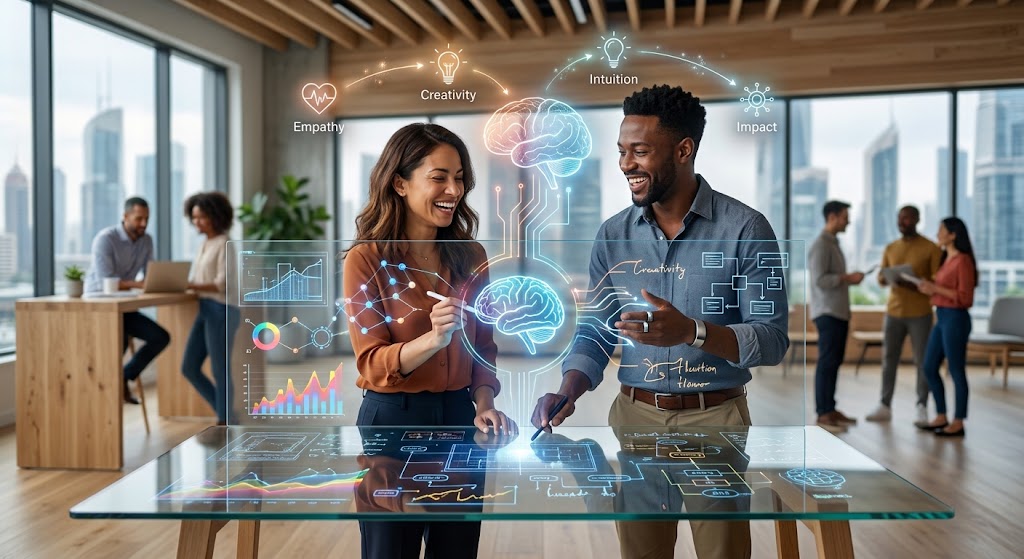
Artificial Intelligence and Connectedness

Artificial Intelligence and Connectedness

GUEST POST from Janet Sernack

Many leaders, large organizations, and SMEs are currently using AI tools as a viable and cost-effective means to enhance productivity and efficiency, as well as to drive business growth and improve sustainability. While this approach is fundamentally sound, it may fall short because it often overlooks critical human and cultural factors that make change and inovation happen. Taking a holistic, people-centered approach to change management, in conjunction with AI, is essential for a successful business or digital transformation or reinvention.

This involves taking a bird’s-eye perspective that understands:

  • How people feel, think, and act in different contexts – to predict behaviour and design techniques and practices that help people develop presence and make perceptual shifts.
  • Educating people in the mindset and behaviour changes that connect and give them agency and autonomy to creatively lead the delivery of strategic and target outcomes.
  • How AI is the most consequential technology of our times – it is shaped by forces far beyond the technology itself, and its effects reach just as widely, yet still require significant cultural, systems and process changes, which are usually executed by upskilled people.

According to Singularity University, in a recent article, “The Next Frontier is Not Artificial Intelligence, it is Artificial Societies”, there is a temptation to divide the future of AI into two possibilities: utopia or catastrophe. Neither extreme is particularly helpful. The more interesting possibility is messier—and requires a step-shift in our thinking, from artificial intelligence to AI societies.

Evoking, provoking and generating creative ideas and innovative solutions

Mapping how the pieces impact, interconnect and interact helps people see what could influence its course and where hurdles and opportunities may emerge. It is already changing how people feel, think, act, and work, and where it goes from there is uncertain. Especially as AI is restricted to delivering content-based answers that are now tending to converge and potentially enforce “sameness” that results in mediocrity. People’s neurology allows them to collaborate and experiment with diverging ideas, think critically and evoke, provoke and generate creative ideas that lead to the innovative solutions organisations and society need in the 21st century.

Viewing AI systemically

Viewing AI systemically requires mapping the connections between it and physical resources, institutions, businesses, markets, geopolitics, and people—all of which shape AI and change in response.

Rather than overlaying yet another structure, transformation and innovation initiatives need to be human-centric and systemically focused on enabling leaders and engaging people. This means creating conditions that safely allow people to experience how their roles and words can be perceived differently, leading them to think and act differently as they consciously co-create a new operating rhythm for value creation and capture.

It also involves seeing and utilising AI as an interconnected system that can help organisations adopt and adapt AI to deliver productivity growth, innovation, new demand, new jobs, free up time, shift capital, and impact the business landscape, influence geopolitics, and improve people’s well-being and quality of life.

Role of Connectedness 

Connectedness is crucial to the success of transformation and innovation initiatives and is rooted in the belief that everything—people, events, decisions, technologies and experiences—is interrelated and even interdependent.

  • AI as an interconnected system

AI is shaped by forces far beyond the technology itself, and its effects reach just as widely. Mapping how the pieces interconnect and interact helps people see what could influence its course and where hurdles and opportunities may emerge. It is already changing how people feel, think, act, and work, and where it goes from there is uncertain.

According to a recent article by McKinsey & Co, “The AI economy: Interconnected forces, feedback loops and the speeds of change”:

“Risks and bottlenecks arise because different parts of the AI system are moving at vastly different paces. AI capabilities are advancing exponentially by some measures. Progress in building data centres, power grids, chip factories, and mines is more linear. Redesigning how a business and its people work spans years. As one constraint eases, others can be exposed”.

In the AI era, leaders and teams must learn to manage at multiple speeds by leveraging AI and connectedness.

Progress may slow when infrastructure or organisations cannot keep up, while risks can grow when adoption outruns safeguards, governance, or public acceptance. Sometimes the answer is to accelerate what is lagging; other times it may be to slow down.

  • Seeing the larger story

This involves perceiving the world through a wide-angle lens, fostering a worldview that cultivates unity, connection and quiet confidence. It presupposes that each person, process, and event plays a role in a larger story and offers a grounding presence that helps others slow down and reflect on meaning.

In times of volatility, uncertainty, ambiguity, and complexity in our incomprehensible and brittle world, connectedness can calm people and offer a fresh perspective by suggesting that each moment has purpose—even if that purpose isn’t immediately clear.

According to a Gallup article, “Connectedness: Seeing the Bigger Picture in Every Moment,” connectedness thrives when it feels part of something greater than itself. These individuals are energised when their contributions support a higher purpose. They need opportunities to build bridges, time to connect the dots, and space to create meaning. They are fulfilled when their efforts contribute to a broader mission or long-term goal. They also benefit from partners and leaders who help them connect daily tasks to the bigger picture. When others help highlight the meaning behind the work, Connectedness becomes even more engaging and insightful. They also connect people and ideas in meaningful ways. Whether drawing parallels or spotting hidden patterns, they help teams find alignment. Their sense of awe for life’s unseen connections brings clarity and purpose to those around them.

Challenges ahead

Seeing AI as an interconnected system can help organisations adopt and adapt it to deliver productivity growth, innovation, new demand, new jobs, free up time, enable capital shifts, impact the business landscape, influence geopolitics, and improve people’s well-being and quality of life.

The Singularity University article, “The Next Frontier is Not Artificial Intelligence, it is Artificial Societies”, states that the deeper challenge is what happens when millions of AI chatbots interact at scale. It suggests that once agents can cooperate, compete, and resolve conflicts with one another, we are no longer dealing with isolated machines—we are dealing with a society. Thus, the next frontier is not artificial intelligence; it is artificial societies.

Without establishing these elements of core interconnectedness, no matter how many resources organisations include in their AI transformation and innovation initiatives, they will not succeed in creating and capturing the desired and potential value that people appreciate and cherish, nor make their lives better.

Find out more about our work at ImagineNation™ and The Start-Up Game.™ Discover our collective learning products and tools that can be customized as playful bespoke corporate learning programs. Our blended and transformational change and learning programs provide a deep understanding of the language, principles, and applications of an ecosystem-focused, human-centric approach and emergent structure (Theory U) to innovation and entrepreneurship. It will also upskill people and teams, developing their future fitness within your unique digital transformation and innovation initiatives. Please find out more about our products and tools.

Image Credit: Gemini

Subscribe to Human-Centered Change & Innovation WeeklySign up here to join 17,000+ leaders getting Human-Centered Change & Innovation Weekly delivered to their inbox every week.


Reset and Reconnect to Increase our Connectedness

Reset and Reconnect to Increase our Connectedness

GUEST POST from Janet Sernack

In our second blog in the Reconnect and Reset series of three blogs, we stated that now is not the time to panic. Nor is it a time to languish from change fatigue, pain, and emotional lethargy. It is a significant moment in time to focus, rehabilitate, rebuild, repair, regrow and reset to increase our connectedness through linking human touchpoints that increase people-power in the fourth industrial revolution.

In the current environment, where chaos and order are constantly polarizing, it’s crucial to touch people with empathy, reignite their social skills, and enable them to become healthily self-compassionate and more self-caring to:

  • Patiently support, lead, manage, mentor, and coach them towards finding their own balance to flow with mitigating the challenges of the fourth industrial revolution.
  • Take advantage of new technologies, networks, and ecosystems to re-engage and collaborate with others and with civil society in positive ways that contribute to the whole.
  • Do the good work that creates a more compelling, inclusive, resilient, and sustainable future, that serves the common good.

The Landscape Has Changed and So Have the Solutions

As the fourth industrial revolution continues to implode, we need to zoom out and consider the bigger picture. Where a recent Harvard Review article What Will Management Look Like in the Next 100 Years?” states that we are entering an era, which is fundamentally transforming the way we operate. Which is defined by the disruptive growth in blockchain technology, robotics, artificial intelligence, high-performance computing, and other core digital capabilities.

All of which, in some way, is dependent on linking the key human touchpoints that increase people’s power and our connectedness.

  • An era of empathy

In the same article, management scholar Rita Gunther McGrath argued that management practices based on command and control, and expertise would ultimately make way for empathy.

Where work is centred around value creation conducted through networks and collaboration, that rely on increasing the connectedness between machines and humans rather than through rigid structures and relationships to thrive through increasing people-power in the fourth industrial revolution.

  • Capable of better

The Qualtrics 2022 Employee Experience Trends Report also states that the landscape has changed.  Where people are choosing to work flexibly, to work in the places that work best for them, and to take time for their own well-being, families, and friends.

Where people are demanding change because they care, about their leaders and their organizations, and want to be capable of developing better ideas; better innovations; and delivering better performances.

The report outlines the four things your people need you to know:

  1. There will be an exodus of leaders – and women will be the first out the door.
  2. People will demand better physical and digital workspaces.
  3. The lack of progress in diversity, inclusion, and belonging won’t be accepted.

People don’t want to become irrelevant, nor do they want their managers, leaders, and organizations to become irrelevant. People know that they can’t, and won’t go back to the old ways of doing things. People also know that they are already living in the new normal and that they need to start working there, too and to do that, we need to increase our connectedness.

Which is especially important for building people’s power and mitigating the challenges emerging in the fourth industrial revolution.

  • A transformative moment for employees and employers

Businessolver’s Eighth Annual Report on the State of Workplace Empathy describes how the pandemic has impacted on employees’ personal lives, the labor market, and the economy, and states that “we are living through a renegotiation of the social contract between employees and employers”.

Their data shows that amid the return to the office, fewer employees view their organizations as empathetic, and that workplace empathy has clear implications for employee well-being, talent retention, business results, and increases people-power:

  • About 70% of employees and HR professionals believe that empathetic organizations drive higher employee motivation.
  • While 94% of employees value flexible work hours as empathetic, the option is only offered in 38% of organizations.
  • 92% of CEOs say their response to returning to in-person work is satisfactory, compared to 78% of employees.
  • 82% of employees say their managers are empathetic, compared to 69% who say the same about their organization’s chief executive.

Yet, there seems to be a true lack of understanding, especially in the corporate sector, of what it means to be empathetic, and a shortage of time and energy to develop the mindsets, behaviors, and skills to practice it and make it a habit.

It is also a fundamental way of being to increase our connectedness and building peoples-power.

Make a Fundamental Choice to Increase our Connectedness

Even though each person is a distinct physical being, we are all connected to each other and to nature, not only through our language but also by having a deeper sense of being.

Human connectedness is a powerful human need that occurs when an individual is aware and actively engaged with another person, activity, object or environment, group, team, organization, or natural environment.

It results in a sense of well-being.

The concept is applied in psychology as a sensation or perception where a person does not operate as a single entity – we are all formed together to make another, individual unit, which is often described as wholeness.

Which is especially important for our well-being and people power in the face of the challenges of the fourth industrial revolution.

Strategies for Developing Quality Connections

  • Be grounded, mindful and conscious

Being grounded and mindful enables people to become fully present to both themselves and to others. It is a generous gift to unconditionally bestow on others. Especially at this moment in time, where the pandemic-induced social isolation, has caused many people to become unconsciously and unintentionally self-absorbed.

There is an opening to become aware of, and to cultivate our attending and observing skillsets, to sense and see the signals people are sending, at the moment they are sending them. To help people identify the source of their issues to re-establish a sense of influence and control that reduces their autonomic nervous system reactions and help them restore their calmness.

This is the basis to increase our connectedness, by attuning and becoming empathetic as to what thoughts and feelings lay behind their behaviours and actions, with detachment, allowing and acceptance.

  • Be open-hearted and open-minded 

Being curious about what others are feeling and thinking, without evaluating, judging, and opposing what they are saying. By knowing how to listen deeply for openings and doorways that allow possibilities and opportunities to emerge, to generate great questions that clarify and confirm what is being both said and unsaid.

To support people by creating a safe and collective holding space, that reduces their automatic unconscious defensive responses.  To defuse situations by being empathic and humble and increase our connectedness by asking how you might help or support them, and gaining their permission and trust to do so.

Increase our connectedness through being vulnerable in offering options so they make the best choice for themselves, to reduce their dependence, help them identify and activate their circles of influence and control and sustain their autonomy.

  • Help people regenerate

Now is the moment in time to focus on building workforce capabilities and shifting mindsets for generating a successful culture or digital transformation initiative by harnessing, igniting, and mobilizing people’s motivation and collective intelligence and building people power.

It is crucial to acknowledge and leverage the impact of technology through increasing people-power by developing new mindsets, behaviors, skills, and new roles, which are already emerging as fast as other roles change.

Be willing to invest in the deep learning challenges that build people’s readiness and receptivity to change, so they can embrace rather than resist it, and be willing to unlearn, and relearn, differently, by collaborating with other people, leaders, teams, and organizations across the world.

Ultimately, it all depends on being daring and willing to increase our connectedness, through adapting, innovating, and collectively co-creating strategies, systems, structures that serve the common good, and contribute to the well-being of people, deliver profits and nurture a sustainable planet.

Find out more about our work at ImagineNation™

Find out about our collective, learning products and tools, including The Coach for Innovators, Leaders, and Teams Certified Program, a collaborative, intimate, and deeply personalized innovation coaching and learning program, supported by a global group of peers over 9-weeks, starting Tuesday, February 7, 2023.

It is a blended and transformational change and learning program that will give you a deep understanding of the language, principles, and applications of an ecosystem focus, human-centric approach, and emergent structure (Theory U) to innovation, and increase people-power, upskill people and teams and develop their future fitness, within your unique context. Find out more about our products and tools.

This is the final in a series of three blogs on the theme of reconnecting and resetting, to create, invent and innovate in an increasingly chaotic world.

You can also check out the recording of our 45-minute masterclass, to discover new ways of re-connecting through the complexity and chaos of dis-connection to create, invent and innovate in the future! Find out more.

Image credit: Pixabay

Subscribe to Human-Centered Change & Innovation WeeklySign up here to get Human-Centered Change & Innovation Weekly delivered to your inbox every week.

What Will the Smart Home of the Future Look Like?

What Will the Smart Home of the Future Look Like?

GUEST POST from Art Inteligencia

In recent years, the concept of a smart home has become increasingly popular. From voice-activated virtual assistants to interconnected devices, the technological advancement in home automation has revolutionized the way we live. With rapid advancements in artificial intelligence and the Internet of Things (IoT), it is intriguing to speculate about what the smart home of the future will look like. In this article, we will explore two case studies that offer a glimpse into the potential future of smart homes.

Case Study 1: The Connected Oasis

Imagine walking into a home where everything is interconnected, and your every need is anticipated. This vision of the future smart home is epitomized in the concept of the “Connected Oasis.” One example of this is showcased through the collaboration between Samsung and BMW. The companies are working on integrating their respective technologies to create a seamless experience between the car and the home.

Using artificial intelligence and sensors, the smart home of the future can recognize when the car is approaching and prepare everything accordingly. As you near your home, the lights automatically turn on, the temperature adjusts to your preferred setting, and the door unlocks as you approach it. Once inside, your smart home assistant greets you with personalized suggestions based on your daily routine and preferences. The smart home can even sync with your car, automatically setting GPS directions based on your calendar events or providing traffic updates as you prepare to leave.

Case Study 2: Sustainable and Energy-Efficient Living

With growing concerns about climate change and environmental sustainability, the future smart home is likely to prioritize energy efficiency and sustainable living. The GreenSmartHome project, developed by researchers at the University of Nottingham, envisions a home that utilizes renewable energy sources, maximizes energy efficiency, and encourages eco-friendly practices.

This smart home incorporates various features such as smart thermostats, solar power generation, and energy management systems. By analyzing data from smart sensors and weather forecasts, the home can optimize energy usage by controlling heating, cooling, and lighting systems. The smart home can also provide real-time feedback on energy consumption, offering homeowners insights to reduce their carbon footprint.

Furthermore, the GreenSmartHome integrates waste management systems, promoting recycling and composting practices. It even has a smart garden, where irrigation systems are automatically adjusted based on weather conditions and moisture levels in the soil, ensuring efficient water usage.

Conclusion

The smart home of the future holds vast potential, with a focus on enhanced convenience, interconnectivity, sustainability, and energy efficiency. From the Connected Oasis, where homes and cars seamlessly communicate, to the GreenSmartHome promoting eco-friendly practices, these case studies offer a glimpse into what we can expect from the future of smart homes.

While these concepts may seem like science fiction today, advancements in AI, IoT, and sustainable technologies suggest that these visions are within reach. As technology continues to evolve, the smart home of the future will likely become an integral part of our lives, shaping the way we interact with our homes and the environment.

Bottom line: Futurists are not fortune tellers. They use a formal approach to achieve their outcomes, but a methodology and tools like those in FutureHacking™ can empower anyone to be their own futurist.

Image credit: Pixabay

Subscribe to Human-Centered Change & Innovation WeeklySign up here to get Human-Centered Change & Innovation Weekly delivered to your inbox every week.