GUEST POST from Janet Sernack
Many leaders, large organizations, and SMEs are currently using AI tools as a viable and cost-effective means to enhance productivity and efficiency, as well as to drive business growth and improve sustainability. While this approach is fundamentally sound, it may fall short because it often overlooks critical human and cultural factors that make change and inovation happen. Taking a holistic, people-centered approach to change management, in conjunction with AI, is essential for a successful business or digital transformation or reinvention.
This involves taking a bird’s-eye perspective that understands:
- How people feel, think, and act in different contexts – to predict behaviour and design techniques and practices that help people develop presence and make perceptual shifts.
- Educating people in the mindset and behaviour changes that connect and give them agency and autonomy to creatively lead the delivery of strategic and target outcomes.
- How AI is the most consequential technology of our times – it is shaped by forces far beyond the technology itself, and its effects reach just as widely, yet still require significant cultural, systems and process changes, which are usually executed by upskilled people.
According to Singularity University, in a recent article, “The Next Frontier is Not Artificial Intelligence, it is Artificial Societies”, there is a temptation to divide the future of AI into two possibilities: utopia or catastrophe. Neither extreme is particularly helpful. The more interesting possibility is messier—and requires a step-shift in our thinking, from artificial intelligence to AI societies.
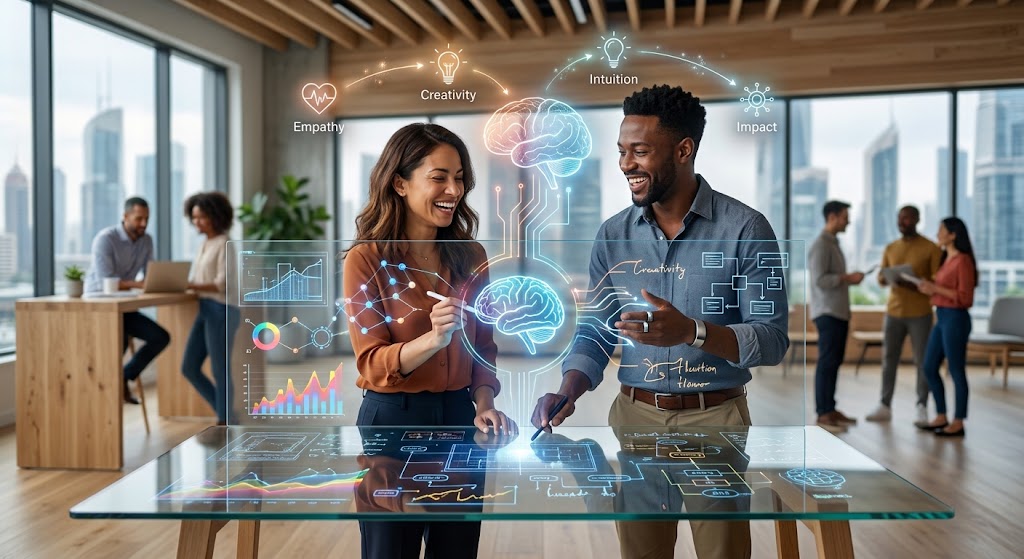
Evoking, provoking and generating creative ideas and innovative solutions
Mapping how the pieces impact, interconnect and interact helps people see what could influence its course and where hurdles and opportunities may emerge. It is already changing how people feel, think, act, and work, and where it goes from there is uncertain. Especially as AI is restricted to delivering content-based answers that are now tending to converge and potentially enforce “sameness” that results in mediocrity. People’s neurology allows them to collaborate and experiment with diverging ideas, think critically and evoke, provoke and generate creative ideas that lead to the innovative solutions organisations and society need in the 21st century.
Viewing AI systemically
Viewing AI systemically requires mapping the connections between it and physical resources, institutions, businesses, markets, geopolitics, and people—all of which shape AI and change in response.
Rather than overlaying yet another structure, transformation and innovation initiatives need to be human-centric and systemically focused on enabling leaders and engaging people. This means creating conditions that safely allow people to experience how their roles and words can be perceived differently, leading them to think and act differently as they consciously co-create a new operating rhythm for value creation and capture.
It also involves seeing and utilising AI as an interconnected system that can help organisations adopt and adapt AI to deliver productivity growth, innovation, new demand, new jobs, free up time, shift capital, and impact the business landscape, influence geopolitics, and improve people’s well-being and quality of life.
Role of Connectedness
Connectedness is crucial to the success of transformation and innovation initiatives and is rooted in the belief that everything—people, events, decisions, technologies and experiences—is interrelated and even interdependent.
- AI as an interconnected system
AI is shaped by forces far beyond the technology itself, and its effects reach just as widely. Mapping how the pieces interconnect and interact helps people see what could influence its course and where hurdles and opportunities may emerge. It is already changing how people feel, think, act, and work, and where it goes from there is uncertain.
According to a recent article by McKinsey & Co, “The AI economy: Interconnected forces, feedback loops and the speeds of change”:
“Risks and bottlenecks arise because different parts of the AI system are moving at vastly different paces. AI capabilities are advancing exponentially by some measures. Progress in building data centres, power grids, chip factories, and mines is more linear. Redesigning how a business and its people work spans years. As one constraint eases, others can be exposed”.
In the AI era, leaders and teams must learn to manage at multiple speeds by leveraging AI and connectedness.
Progress may slow when infrastructure or organisations cannot keep up, while risks can grow when adoption outruns safeguards, governance, or public acceptance. Sometimes the answer is to accelerate what is lagging; other times it may be to slow down.
- Seeing the larger story
This involves perceiving the world through a wide-angle lens, fostering a worldview that cultivates unity, connection and quiet confidence. It presupposes that each person, process, and event plays a role in a larger story and offers a grounding presence that helps others slow down and reflect on meaning.
In times of volatility, uncertainty, ambiguity, and complexity in our incomprehensible and brittle world, connectedness can calm people and offer a fresh perspective by suggesting that each moment has purpose—even if that purpose isn’t immediately clear.
According to a Gallup article, “Connectedness: Seeing the Bigger Picture in Every Moment,” connectedness thrives when it feels part of something greater than itself. These individuals are energised when their contributions support a higher purpose. They need opportunities to build bridges, time to connect the dots, and space to create meaning. They are fulfilled when their efforts contribute to a broader mission or long-term goal. They also benefit from partners and leaders who help them connect daily tasks to the bigger picture. When others help highlight the meaning behind the work, Connectedness becomes even more engaging and insightful. They also connect people and ideas in meaningful ways. Whether drawing parallels or spotting hidden patterns, they help teams find alignment. Their sense of awe for life’s unseen connections brings clarity and purpose to those around them.
Challenges ahead
Seeing AI as an interconnected system can help organisations adopt and adapt it to deliver productivity growth, innovation, new demand, new jobs, free up time, enable capital shifts, impact the business landscape, influence geopolitics, and improve people’s well-being and quality of life.
The Singularity University article, “The Next Frontier is Not Artificial Intelligence, it is Artificial Societies”, states that the deeper challenge is what happens when millions of AI chatbots interact at scale. It suggests that once agents can cooperate, compete, and resolve conflicts with one another, we are no longer dealing with isolated machines—we are dealing with a society. Thus, the next frontier is not artificial intelligence; it is artificial societies.
Without establishing these elements of core interconnectedness, no matter how many resources organisations include in their AI transformation and innovation initiatives, they will not succeed in creating and capturing the desired and potential value that people appreciate and cherish, nor make their lives better.
Find out more about our work at ImagineNation™ and The Start-Up Game.™ Discover our collective learning products and tools that can be customized as playful bespoke corporate learning programs. Our blended and transformational change and learning programs provide a deep understanding of the language, principles, and applications of an ecosystem-focused, human-centric approach and emergent structure (Theory U) to innovation and entrepreneurship. It will also upskill people and teams, developing their future fitness within your unique digital transformation and innovation initiatives. Please find out more about our products and tools.
Image Credit: Gemini
 Sign up here to join 17,000+ leaders getting Human-Centered Change & Innovation Weekly delivered to their inbox every week.