According to a recent research study published by the IBM Institute for Business Value, outperforming organizations are 79% more likely to establish dedicated innovation teams.
For those of you who don’t have time to download, print, and read the whole thing, I’ve taken the liberty of collecting the highlights for you.
IBM’s analysis revealed three key categories that separate Outperformers from the rest:
Organizational structures and functions that support innovation
Cultural environments to make innovation thrive
Processes to convert ideas into innovation
IBM found that Outperformers approach innovation differently. They:
Align innovation with business goals
Structure open forms of innovation
Create specialized teams
Lead with an innovation focus
Encourage innovative behaviors
Sustain innovation momentum
Generate new ideas from a wide range of sources
Fund innovation
Measure innovation outcomes
Another important point to keep in mind, but not highlighted in the report, is the tension between inefficiency and innovation. The more inefficient the organization, the fewer resources available to invest in innovation.
Something to think about…
But more about that later in another post, so stay tuned!
If you missed the download link above, here it is again.
Sign up here to get Human-Centered Change & Innovation Weekly delivered to your inbox every week.
“We need to out-innovate, outeducate, and outbuild the rest of the world”
– United States President Barack Obama
In the quote above the American President implies that it is somehow the role of the government to drive innovation? But can they? And should they?
Governments and leaders around the world spend a great deal of time talking about innovation and its importance to their economies, but nearly all political leaders and governments have no idea about how to actually foster innovation.
There is a model for how governments can encourage innovation, and boost the performance of their economy as a result, and it is really quite simple. I call it the ICE Model of Innovation, and it’s focused on three key areas where the government can focus its investments of time and money, and both facilitate and fund efforts to advance the public involvement and education deeper into these three areas of ICE:
Invention
Collaboration
Entrepreneurship
1. Invention
Innovation in any country, especially in the short term, is not achieved by pumping huge sums of money into government-sponsored research and development efforts. Yes, many successful innovations have resulted from government research investments, but we need to take a more strategic approach to these efforts.
The Internet itself may be one of the most successful government research and development efforts, and it has served as a platform for an enormous amount of other innovations to build upon. This type of platform innovation is where governments should target their investment dollars. We need more of these types of platform innovation investments, not just spending on basic research. Governments need to think strategically and fund those research efforts that could serve as platform innovations to power a whole new wave of innovative business ideas and job-creating companies in their country.
At the same time governments need to take another look at what they are teaching the children in their country. Let’s face facts. Today’s schools are designed to mass-produce trivia experts and basic competency in reading, writing, and arithmetic (and maybe some history, science, and other important subjects).
But, to succeed in the innovation economy, the next generation is going to need to be proficient in at least these ten things:
Creativity
Lateral Thinking
Problem Solving
Innovation (of course!)
Interpersonal Skills
Collaboration
Negotiation
Partnerships
Entrepreneurship
And much, much more…
And parents can either pray that the government will revise the curriculum and start focusing more energy on teaching some of these things, or band together and create supplemental learning opportunities for their kids. Seth Godin and I spoke about education and other topics in this interview from 2010:
Some of the work that Dean Kamen is doing with FIRST is a great example of how individuals and non-profits can supplement the educational work of the government to give kids the invention skills and inspiration that they’ll need to help invent a better future.
2. Collaboration
Another important component of innovation is collaboration. People learn more when they connect and share, idea fragments have the opportunity to collect and connect into potentially viable innovation ideas, and are made stronger from additional perspectives and new inputs. In every economy the government has a role to play in helping to encourage collaboration.
Every potential innovation always needs additional human and financial resources to thrive. When done well, the government can help to foster collaboration directly or indirectly. One of my favorite examples of this is the work that NESTA does in the United Kingdom (UK). If you’re not familiar with the organization, it is a charity that was funded by the UK government and NESTA stands for National Endowment for Science Technology and the Arts, and their mission is to help people and organizations bring great ideas to life.
What does Nesta do? Watch the video:
They host a series of innovation, entrepreneurship, science and technology events for citizens of the United Kingdom, produce a collection of complimentary research publications, and are quite active in the social sharing of information (including their own popular blog).
In the United States, the government encourages collaboration through events hosted by the Small Business Administration (SBA) and its public universities around the country to connect scientists, businesspeople and entrepreneurs for collaboration purposes.
And several countries’ efforts to encourage university-business research collaboration is referenced in this report.
3. Entrepreneurship
Everywhere you go cities, states, countries, universities, and private companies are setting up incubators or startup accelerators to encourage entrepreneurship and innovation. This is important, but the importance of entrepreneurship is not limited only to the entrepreneur. At the same time, we must not forget the importance of intrapreneurship to the continuing health of our organizations.
In some ways, intrapreneurship is MORE important to the innovation success of a country than entrepreneurship because collaborative, creative intrapreneurship is the flavor of entrepreneurship that keeps a country’s great companies alive (through this innovation intersection of course).
Entrepreneurs and intrapreneurs are both important and we must consciously try to grow both in a successful society, and while intrapreneurs may not have the same tolerance for risk as an entrepreneur, they also need to understand how to make a business case and other core tenets of entrepreneurship.
There are many government sponsored efforts all around the world to encourage entrepreneurship, including SCORE (Service Corp of Retired Executives), which while technically a charity and not a government entity, received a great deal of support from the SBA in getting started as a national organization and the two entities continue to partner together to encourage, guide, and help entrepreneurs in the United States.
But, the best government programs in the world will still fail to encourage entrepreneurship unless you work to remove the social stigma of failure and examine the penalties for bankruptcy in your country. In countries like the United States and the United Kingdom where bankruptcy penalties are much lower, the level of entrepreneurship is higher. Coincidence?
Conclusion
I hope by now you see that it is possible (but difficult) for governments to encourage innovation IF they focus on increasing the support and skill bases around – invention, collaboration and entrepreneurship. Which countries will have the courage to completely revamp their educational systems to focus on teaching the skills that drive these behaviors? Which countries will create the policies, organizations, events and connections that accelerate these ICE capabilities?
Achieving innovation success is not easy. Sustaining innovation success is even harder. The list of innovative companies that no longer exist is long, and some of the biggest enemies of innovation are ultimately complacency and resistance to change.
So what is the key to innovation success?
What lies beneath the artifacts of innovation success that we could point to in individuals or companies that we hold up as innovation heroes?
Well, as I tell the audiences of my keynotes, workshops and masterclasses around the world, innovation success rises up from the intersection of invention (which includes creativity), collaboration, and entrepreneurship. This is why you see these topics covered so much here on Human-Centered Change & Innovation.
Invention
Invention and creativity are incredibly important to innovation, but invention is not innovation and creativity is not innovation. Invention and creativity are but one component to creating successful innovation. And so yes, teaching your employees new creativity tools like SCAMPER or SIT, engaging in brainstorming activities after teaching people how to brainstorm properly, or providing your employees the space and time in their work lives to innovate will help you achieve greater innovation success, but they are not the secret. They are but one part.
Collaboration
There are a number of people traveling through the world of business and innovation literature spreading the myth that people are either innovative or they or not, that people either possess the innovator’s DNA or they don’t. To that I say “hogwash” (or sometimes something a little bit stronger). Innovation is a team sport and we all have a role to play. It is because of this belief that I created the Nine Innovation Roles and this framework for team-based innovation has resonated well with people all around the world. As a result, the Nine Innovation Roles from my book Stoking Your Innovation Bonfire have already been translated into Spanish, French, and Swedish, with Dutch and Chinese translations on the way soon. If you’re not familiar with the Nine Innovation Roles, they are:
Revolutionary
Artist
Connector
Magic Maker
Customer Champion
Judge
Troubleshooter
Conscript
Evangelist
But understanding which of the Nine Innovation Roles you play on effective innovation teams is just the beginning. At the same time, we must begin to train our employees in the basic principles that power collaboration and teach them how to become effective collaborators. But collaboration is also only one component.
Entrepreneurship
Other than leadership, no other topic probably occupies a greater percentage of the space for business books in an American book store than entrepreneurship. This topic captivates the minds of people in the United States and in many other countries, and everywhere you go cities, states, countries, universities, and private companies are setting up incubators or startup accelerators to encourage entrepreneurship and innovation. This is important, but the importance of entrepreneurship is not limited only to the entrepreneur. At the same time, we must not forget the importance of intrapreneurship to the continuing health of our organizations. In some ways, intrapreneurship is MORE important to the innovation success of a country than entrepreneurship because collaborative, creative intrapreneurship is the flavor of entrepreneurship that keeps a country’s great companies alive (through this innovation intersection of course). Entrepreneurs and intrapreneurs are both important and we must consciously try to grow both in a successful society, and while intrapreneurs may not have the same tolerance for risk as an entrepreneur, they also need to understand how to make a business case and other core tenets of entrepreneurship.
The Need to Integrate and Educate
I can state in no uncertain terms the importance for companies that are serious about innovation, and yes even countries or states or cities that are serious about innovation, to educate their people in the core knowledge, skills and abilities that relate to invention, collaboration and entrepreneurship. Companies need to educate their employees. Governments AND parents need to collaborate to teach their children. If you do this, your employees or your future citizens will have a much better chance of helping you achieve innovation success for your company or for your society. But even actively encouraging the intersection of invention, collaboration and entrepreneurship knowledge, skills, abilities and practice are not enough. The reason is because the power of this intersection does not represent the secret of innovation success. This intersection is central to sustained innovation success, but the secret lies elsewhere.
So what is the key to innovation success?
In one word?
The answer is…
CURIOSITY
Dictionary.com defines curiosity as “the desire to learn or know about anything; inquisitiveness.”
Merriam-Webster defines curiosity as “Desire to know… Inquisitive interest in others’ concerns…Interest leading to inquiry “
The reason that curiosity is the secret to innovation success is that the absence of curiosity leads to acceptance and comfort in the status quo. The absence of curiosity leads to complacency (one of the enemies of innovation) and when organizations (or societies) become complacent or comfortable, they usually get run over from behind. When organizations or societies lack curiosity, they struggle to innovate. Curiosity causes people to ask ‘Why’ questions and ‘What if’ questions. Curiosity leads to inspiration. Inspiration leads to insight. Insights lead to ideas. And in a company or society where invention, collaboration and entrepreneurship knowledge, skills, abilities and practice are encouraged, ideas lead to action.
So, if you want to have innovation success in your company or in your society, you must work to create a culture that encourages curiosity instead of crushing it. Unfortunately technology and the educational system in the United States and the rallying cry of “More STEM!” are having the unintended consequence of crushing creativity and creating a generation of trivia experts and linear thinkers for our society. We as parents and educators and managers must as a result seek to undo some of this damage. If you haven’t already read it, I encourage you to check out my article ‘Stop Praying for Education Reform‘.
We must find ways to reawaken the curiosity of our employees, to keep them curious, and to keep the curiosity of our children alive. We must find a way to fight against the tyranny of linear thinking and the ‘right’ answer, and instead inspire our children to continue asking ‘why’ – despite the fact that sometimes it can be annoying. 😉
To close I will leave you with a bastardized quote from the most interesting man in the world:
“Stay curious my friend.”
Sign up here to get Human-Centered Change & Innovation Weekly delivered to your inbox every week.
I’m proud to share with you the link to my latest radio interview. This time I had the opportunity to sit down and chat with LeAnna J. Carey (@LeannaJCarey), host of the popular radio program The Health Maven – Innovation Talk.
We spend the 30 minutes talking about The Nine Innovation Roles and how organizations around the world are increasingly utilizing The Nine Innovation Roles to help them build more effective innovation teams. Curious which ones I think LeAnna fills or that I see myself typically filling?
In this webinar hosted by Innocentive I explore how organizations can utilize open innovation and crowdsourcing resources as an essential talent management strategy to drive their business.
You can engage me to create a webinar or white paper for your audience here.
Sign up here to get Human-Centered Change & Innovation Weekly delivered to your inbox every week.
Social media serves an incredibly important role in innovation. Social media functions as the glue to stick together incomplete knowledge, incomplete ideas, incomplete teams, and incomplete skillsets. Social media is not some mysterious magic box. Ultimately it is a tool that serves to connect people and information.
I’m reminded of a set of lyrics from U2’s “The Fly”:
“Every artist is a cannibal, every poet is a thief
All kill their inspiration and sing about their grief”
Social media can help ideas grow and thrive that would otherwise wither and die under the boot of the perfectionist in all of us.
Do you remember the saying “it takes a village to raise a child”? Well, it takes a village to create an innovation from an idea as well, and social media helps to aggregate and mobilize the people and knowledge necessary to do just that.
But, that is social media working in the positive. We must remember that social media tools are just that – tools.
Just as easily as social media tools can be an accelerator for innovation, they can also be an inhibitor – if the participants or the presenters manage to make the less active majority feel that innovation is not something for them.
If you don’t want to be a fool with a tool, then you must be careful to make sure that the social media tools in your organization are fulfilling their role in a positive way and leveraging existing knowledge management and collaboration toolsets:
To make innovative ideas visible and accessible
To allow people to have conversations
To build community
To facilitate information exchange
To enable knowledge sharing
To assist with expert location
To power collaboration on idea evolution
To help people educate themselves
To connect people to others who share their passion
To surface the insights and strategy that people should be building ideas from
The better you become at the above, the stronger your organization’s innovation capability will become, the more engaged your employees will become, and the more ready you will become to engage successfully in open innovation.
For the most part, what I’ve been talking about is the role of social media in innovation inside the organization. When you leverage social media for innovation outside the organization, it gets a whole lot more complicated.
But, maybe that’s a conversation for another day.
In the meantime, please consider the ways in which social media in your organization might be able to strengthen inter-disciplinary cooperation, make the organization itself more adaptable, and how it could help to create an organization with the power to transform more ideas into innovations.
You might also enjoy these four FREE white papers:
“The more successful an organization becomes the bigger it gets. The bigger it gets the more it focuses on optimizing its resources. The more it optimizes it resources the more it eliminates variation. Innovation requires variation. We have seen the enemy and he is us.”
– Jeff DeGraff
“It is in identifying which of The Nine Innovation Roles are vacant (or sub-optimally filled) that you will be able to see some of the areas where your efforts are likely to come up short, and then can take actions to improve your chances of innovation success.”
– Braden Kelley
“It is not enough to simply go through the motions. In order to build our abilities, cognitive or otherwise, we must think about what we’re doing, concentrate while we’re doing it and then review what we have done. Further, we need to seek out mentors and peers who will critique our efforts.”
– Greg Satell
What are some of your favorite innovation quotes?
Add one or more to the comments, listing the quote and who said it, and I’ll share the best of the submissions as future innovation quotes of the day!
Sign up here to get Human-Centered Change & Innovation Weekly delivered to your inbox every week.
I came across the web site for a Microsoft-sponsored alternative computing form factor contest a few years ago, and even still I must say there were a few interesting ideas that might help people begin to see the future of computing.
The most interesting concept was coincidentally the winner of the contest, the Napkin PC.
If you follow the link above you’ll see the artist conceptions and get a good sense of the vision. The gist is that some of the greatest advances in the world have been conceived on the lowly paper napkin in restaurants and coffee shops all over the world, so why not take the napkin high tech. Just don’t try and wipe up spilled coffee with it.
The concept consists of a rack to contain and potentially recharge the OLED “napkins” and the styluses that go with them. These “napkins” provide a computing interface much like a tablet computer and can be pinned up on a board or connected together to make a larger display.
The concept is targeted squarely at the brainstorming, ideation, collaboration space and if the designer can ever manage to pull it off, I think it would be a welcome tool for organizations everywhere.
“Innovation can come from anyone, but it is required from everyone for an organization to remain successful.”
Or taken another way:
“Innovation can come from anywhere, but you must be looking everywhere to find it.”
Innovation comes from good listening, observing, watching, waiting, connecting, and synthesizing.
Innovation comes from the creation of a unique, differentiated customer insight that you can build your ideation, your experimentation, your collaboration, and your commercialization efforts around. The goal of course is to turn that unique, differentiated insight into solutions valued above every existing alternative. Solutions that not only create value, but that you also stand ready and able to help people access and understand the need for and relevance in their life.
It is because innovation can come from anywhere and can involve everyone in the organization in making innovation happen that I created The Nine Innovation Roles and my innovation value framework, to help people make sense of what is necessary to make innovation successful as they form their innovation project teams and process, and to give people a simple framework to hold close as they think about creating innovation success.
 More Than Magic
 Sign up here to get Human-Centered Change & Innovation Weekly delivered to your inbox every week.
 “We need to out-innovate, outeducate, and outbuild the rest of the world”
 Innovation in any country, especially in the short term, is not achieved by pumping huge sums of money into government-sponsored research and development efforts. Yes, many successful innovations have resulted from government research investments, but we need to take a more strategic approach to these efforts.
 Achieving innovation success is not easy. Sustaining innovation success is even harder. The list of innovative companies that no longer exist is long, and some of the biggest enemies of innovation are ultimately complacency and resistance to change.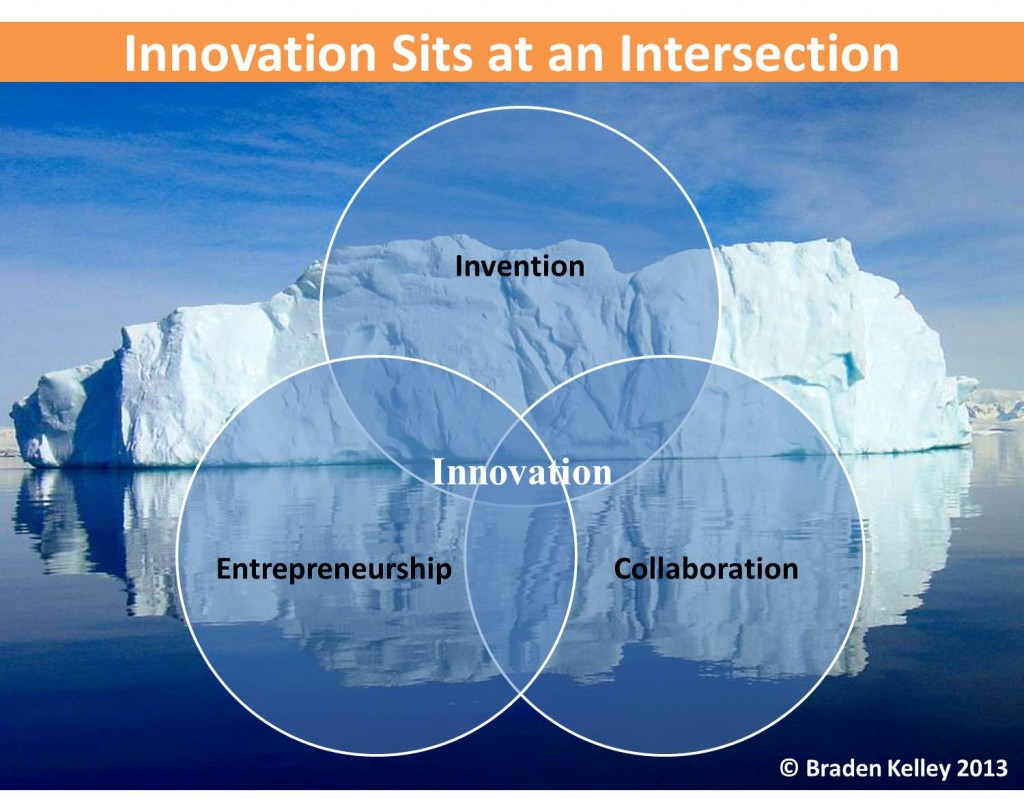

 Dictionary.com defines curiosity as “the desire to learn or know about anything; inquisitiveness.”
 We must find ways to reawaken the curiosity of our employees, to keep them curious, and to keep the curiosity of our children alive. We must find a way to fight against the tyranny of linear thinking and the ‘right’ answer, and instead inspire our children to continue asking ‘why’ – despite the fact that sometimes it can be annoying. 😉
 Social media serves an incredibly important role in innovation. Social media functions as the glue to stick together incomplete knowledge, incomplete ideas, incomplete teams, and incomplete skillsets. Social media is not some mysterious magic box. Ultimately it is a tool that serves to connect people and information.
 I came across the web site for a Microsoft-sponsored alternative computing form factor contest a few years ago, and even still I must say there were a few interesting ideas that might help people begin to see the future of computing.
 “Innovation can come from anyone, but it is required from everyone for an organization to remain successful.”