Category Archives: Psychology

Change Resistance is Not Inevitable

Change Resistance is Not InevitableThe idea that people always resist change is a lie, and it is extremely damaging to organization’s seeking to increase their organizational agility.

The truth is that people only resist changes that they either do not understand or for which they do not interpret there to be benefits great enough to offset the costs of their participation.

The truth is also that the natural response to a potential change in an organization is greatly impacted by the level of trust in an organization.

While it is a lie that change resistance is inevitable, it is true that executing change is hard. If it wasn’t, 70 percent of change efforts wouldn’t fail, but they do. There are many reasons for this, including the fact that most change efforts are communicated not explained.

Let’s look at definitions of both words from Dictionary.com to see the root of this difference:

Communication: A document or message imparting news, views, information, etc.

Explanation: A mutual declaration of the meaning of words spoken, actions, motives, etc., with a view to adjusting a misunderstanding or reconciling differences

You’ll notice here a big difference between the two mindsets – seeking to communicate versus seeking to explain. When you focus on explaining the change, you are focusing on ensuring UNDERSTANDING, and when people understand the change, and the purpose for the change they will be more likely to support the change.

We don’t resist change, WE RESIST THAT WHICH WE DON’T UNDERSTAND.

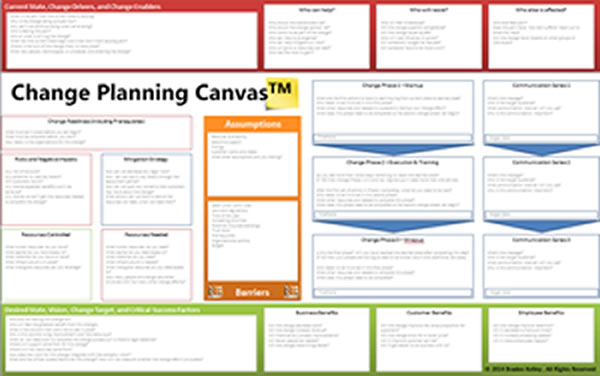
One great way for increasing your ability to explain change is the use of a tool like the Change Planning Canvas™ to involve more people in the planning of a change, which increases the number of people capable of explaining the change and its purpose, plus it provides a visual map of the change effort that explains the change at a glance.

This is not say that even when people completely understand a potential change and the purpose for it, that they still might not not fight against it, but they will be more likely to support the change.
.

Change Planning Canvas

(For Illustration Purposes Only – Get the toolkit or the book for a clear copy)

.

The Change Planning Canvas™ is one of the more than fifty tools that make up my new Change Planning Toolkit™ that is now available via individual licenses for educational use and site licenses for professional and commercial use. It helps you move away from the incredibly counter-productive practice of planning change in isolation.

Organizations that do a better job of explaining their changes and the purposes for them, not coincidentally also tend to build up a higher level of trust over time, and organizations that do a better job at change explanation and maintain higher levels of trust are able to change faster!

But some people may still resist, why?

Some people may resist your change effort for a number of different reasons, but you need to identify up-front not only why people resist but also who will likely resist. Change Planning Toolkit™ users will want to capture the group’s thoughts on who will resist in the middle box of the People Worksheet from the toolkit and the corresponding box on the Change Planning Canvas™.

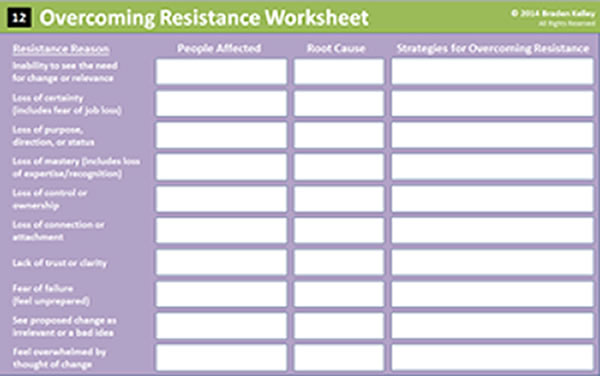
Some of the typical reasons why people will resist include:

  • inability to see the need for change or relevance;
  • loss of certainty (includes fear of job loss);
  • loss of purpose, direction, or status;
  • loss of mastery (includes loss of expertise/recognition);
  • loss of control or ownership;
  • loss of connection or attachment;
  • lack of trust or clarity;
  • fear of failure (feel unprepared);
  • see proposed change as irrelevant or a bad idea;
  • feel overwhelmed by thought of change.

You’ll want to identify the individuals or groups who have one of the above reasons for resisting change, and you will want to plan from the start to overcome that resistance in the same way that any good salesperson plans for objections, learns to hear them, and practices how to overcome them (for example, by developing and sharing strategies with coworkers).
.

Overcoming Resistance Worksheet

(For Illustration Purposes Only – Get the toolkit for a clear copy)

.

In the Change Planning Toolkit™ I’ve provided space in the Overcoming Resistance Worksheet for your team to brainstorm both the groups and individuals likely to feel any of these reasons for resistance, together with space to capture some ideas for overcoming these objections (aka resistance).

The Change Planning Toolkit™ also provides the Five Change Reactions Worksheet which allows you to identify which groups and individuals tend towards each of the five change reactions highlighted in this worksheet and explained in my book Charting Change.. These five change reactions typically occur in a standard distribution (aka bell curve) and you can increase the chances of your change success by shifting enough people to the left along the curve.

So, there you have it, a quick look at The Big Change Management Lie about the inevitability of change resistance and some ways that it can be avoided or at least mitigated, and an introduction to how some of the tools from the Change Planning Toolkit™ can provide even more help.

Accelerate your change and transformation success

Subscribe to Human-Centered Change & Innovation WeeklySign up here to get Human-Centered Change & Innovation Weekly delivered to your inbox every week.

Innovation is Human

Innovation is Human

In many ways organizations are like humans, and others have described organizations and organizational change in biological terms before. But this biological context applies to innovation as well, and I’d like to put it forward quickly in simple terms.

As humans we must eat to survive, but if we focus too much on eating, we get unhealthy.

If we don’t focus enough on eating or if we eat the wrong things, we get unhealthy.

If we don’t enjoy enough variety in our experiences, we get unhealthy.

If we don’t spend enough time synthesizing those new experiences to uncover insights via sleep, we get unhealthy.

If we don’t eliminate our waste, we get unhealthy.

And finally, and probably most important to our health, we must exercise to increase our strength, flexibility, agility, reduce our stress levels, to build new capabilities, and to increase our longevity.

But, you can exercise too much, and get unhealthy as well.

The key is balance.

And the same is true for organizations, and parallels for all of these human activities can be drawn to the activities of organizations as well.

And while our interactions with food can be compared to our focus on the day to day operations within the context of the organization, the pursuit of innovation is the exercise for the organization.

And in much the same way that many people resist exercise even though they know it is good for them, many organizations do as well.

But for organizations to stay fit and enjoy a long and productive life, they must strike that balance between a healthy diet and exercise.

So, is your organization going to be fit or fat?

And next time someone in your organization says that innovation isn’t important, or that they can’t focus on it right now, ask them if they think exercise is important, then remind them that innovation like exercise is how we reinvigorate our organizations and keep them vibrant and alive, and go find yourself a carrot stick.

Keep innovating!

Image credit: fitinafatworld.wordpress.com

Subscribe to Human-Centered Change & Innovation WeeklySign up here to get Human-Centered Change & Innovation Weekly delivered to your inbox every week.

Change the World – Step Two

Change the World - Step TwoAre you and your organization ready for change?

Too often organizations define the change effort they want to pursue without first identifying whether there are people, resources, legislation, etc. present that must be in place before the change effort can begin. We will explore the circumstances you may want to explore before beginning any change effort and the areas to explore as potential prerequisites to the change program and its eventual success.

During the course of any change initiative many different challenges will appear, and the most successful change efforts will anticipate those challenges and have a plan for dealing with them. Part of that anticipation begins with identifying how ready the organization is for change and understanding what some of the top challenges are.

In a 2008 global CEO study conducted by IBM on the enterprise of the future, IBM identified the top challenges to successfully implementing strategic change as:

  1. Changing mindsets and attitudes (58%)
  2. Corporate culture (49%)
  3. Underestimation of complexity (35%)
  4. Shortage of resources (33%)
  5. Lack of higher management commitment (32%)
  6. Lack of change know-how (20%)
  7. Lack of motivation of involved employees (16%)

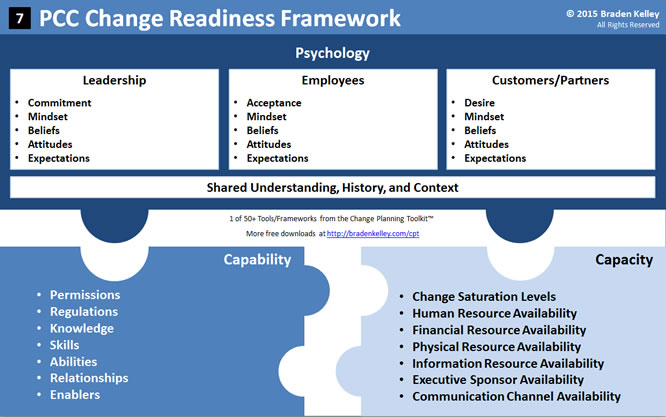
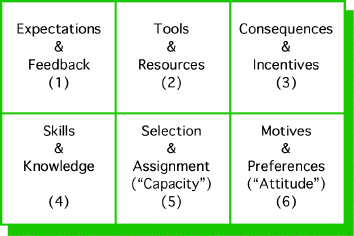
You will notice that many of the items on this list are more about the people factors of change rather than the process or technology factors of change. The weight of the human dimensions of change is reflected in my PCC Change Readiness Framework™. This framework focuses on the psychology of key groups surrounding the identified change, the capabilities needed to successfully execute the change, and the organization’s capacity to tackle this change effort (along with everything else).

PCC Change Readiness Framework

You will notice that I don’t speak about organizational psychology or culture in my PCC Change Readiness Framework™. The reason I don’t highlight culture in the same way that many other people do is that in today’s more social, customer-centric business, we must look more broadly than the typical inward focus of company culture when it comes to identifying the readiness of not only employees, but leaders, customers, and partners too. Inevitably many of our change efforts will have some impact on one or more external groups (possibly even non-profit entities and one or more governments).

You will notice that within the PSYCHOLOGY box there is a common focus on the mindsets, attitudes, beliefs and expectations of the individuals. Culture is incorporated into the psychology realm by focusing on what the shared understandings are around the potential change, but more broadly too. And, finally you will notice that my PCC Change Readiness Framework™ highlights the need for successful change efforts to move towards gaining commitment to the change from leadership, acceptance of the change by employees, and a desire for the change from customers and partners.

Within the CAPABILITY box of my PCC Change Readiness Framework™ we must investigate whether our change effort has any regulatory or statutory implications and whether we are ready to adapt, adopt or influence the changes necessary in this sphere. We must also ask ourselves a series of questions:

  • “Do we need to get permission from anyone to do this?”
  • “What knowledge, skills, and abilities needed for this change do we already possess?”
  • “What knowledge, skills, and abilities needed for this change do we need to acquire?”
  • “What relationships do we possess that will be useful in advancing the change?”
  • “What relationships do we need to build to help advance the change?”
  • “What are the enablers of making this change successful?”

Within the CAPACITY box we have to look at where our resources are approaching, or have already achieved, change saturation. This means they are unable to productively participate in any more change efforts or adopt any more change. But we also have to look at the availability of our resources:

  • Human
  • Financial
  • Physical
  • Information
  • Executive Sponsors
  • Space in our desired communication channels

It is easy to take for granted that the organization will have the capacity to undertake your change effort, but often there are capacity constraints that you will run into, especially as the pace and volume of change increases inside an organization. The one that is easiest to overlook and fail to plan for, is making sure that you’re going to be able to communicate your change messages in your desired messaging channels (they may already be full).

In my upcoming collaborative, visual Change Planning Toolkit™ you will find the companion tools for the PCC Change Readiness Framework™, two large format change readiness worksheets to download for printing that will help you collaboratively explore all of these topics and more.

Be sure and sign up for the Braden Kelley newsletter to receive the latest news on my new book on the best practices and next practices of organizational change (January 2016) and the licensing options for the Change Planning Toolkit™.

Finally, when you consider all of the potential stumbling blocks in advance of the change that we highlighted above, evaluate your readiness in each area, and make a plan for closing any gaps (before you even begin your change effort), you will greatly increase the chances of its success. But, there are certain items that are not just good to know in advance, but are actually prerequisites for change, and we will explore that topic in the book, so stay tuned!

EDITOR’S NOTE: I’ve gone ahead and created a free downloadable flipbook PDF for people to grab. It was inspired by Art Inteligencia’s article titled Change Readiness: What It Is and How to Achieve It.

PCC Change Readiness Framework Flipbook

P.S. In case you missed it, click to read Change the World – Step One


Accelerate your change and transformation success

Subscribe to Human-Centered Change & Innovation WeeklySign up here to get Human-Centered Change & Innovation Weekly delivered to your inbox every week.

Making People Dance Instead of Jaywalk

Making People Dance Instead of JaywalkI love anything that is fun and investigates human psychology, especially crowd psychology, and the investigation of how you can use fun to potentially influence human behavior for social good (i.e. the piano stairs example I’ve shared before).

Nobody likes to wait at pedestrian crossings. Traffic lights can be dangerous for impatient pedestrians trying to save a few seconds to cross the street (and willing to risk their lives in the process).

The folks at Smart created The Dancing Traffic Light, an experiential marketing concept providing a fun and safe way to keep people from venturing too early into the street. They started by placing a dance room on a square in Lisbon, Portugal and invited random pedestrians to go into the box and dance. Their movements were then displayed on a few traffic lights in real time. This resulted in 81% more people stopping and waiting at those red lights.

It’s a genius marketing gimmick because it reinforces the brand value of fun by making people dance in a box that looks, imagine that, a bit like a smart car.

The question brought up by this example of a marketing campaign that claims that fun can be used to achieve social good, is that it claims a benefit, that without an extended test could be attributed to novelty…

Does the benefit hold up over time?

Or does it stop being fun and impactful after people have seen it once or twice or the live video component goes away and it becomes a recording? Do people then start jaywalking again at the normal rate?

What do you think?


Build a common language of innovation on your team

Subscribe to Human-Centered Change & Innovation WeeklySign up here to get Human-Centered Change & Innovation Weekly delivered to your inbox every week.

Unlock Marketing Innovation with a WGAS Focus

Unlock Marketing Innovation with a WGAS FocusBack in 2011 when election season was fast approaching, one thing that you heard repeatedly during election coverage was analysts talking about the importance of the undecided vote. Often in an election it is the undecided who swing the vote for one candidate over another. As a result, there is an incredible amount of focus placed on understanding why people are still undecided between two major candidates (think Obama vs. Romney) and so as a result campaign strategists and speech writers are obsessed with capturing the imagination of the undecided. But, there is a lot of complexity in those undecided numbers, as they include:

  • People that are truly undecided
  • People that don’t want either candidate to win
  • People that didn’t even know there was an election going on
  • People that feel the whole system is corrupt
  • People that can’t tell the difference between the two candidates
  • And so on

So if the undecided are so important in politics, why shouldn’t they be in business?

If we are the Coca Cola company, do we really think that an advertisement or a marketing campaign is going to turn a loyal Pepsi drinker into a Coke drinker? Are we going to be able to turn Red Bull or milk drinkers into Coke drinkers?

People prefer to drink a lot of other things over something thick and syrupy like Coke and Pepsi most of the time, and while a lot of people may drink Coke either regularly or occasionally, a lot of people don’t and won’t. So if we are the Coca Cola company we are advertising to:

  • Remind Coke drinkers how great Coke is
  • Make occasional Coke drinkers think about having one again soon
  • Convince people that aren’t sure about Coke that they should really try it

This reminds me of the old saying “Half the money I spend on advertising is wasted; the trouble is I don’t know which half.” (John Wanamaker)

Personally, I believe the percentage of waste is much, much higher than fifty percent because:

  • Probably less than fifty percent even see the advertisement
  • Twenty percent or more will never buy the product no matter what you do
  • Twenty percent or less already buy the product
  • Leaving MAYBE ten percent of the people exposed to the advertisement to be swayed by it

The above are just my intuitive estimates. I’m sure someone out there probably has done the research on this and could share a more precise number, and if that’s you, please share in the comments!

A lot of this waste comes from the fact that we as marketers focus on the volume of exposure we can achieve for a product or service, even if we’re using complicated segmentations, personas, and/or behavioral targeting. No matter what, we always end up coming back to the volume of exposure we are able to achieve, because it is something we can measure. We try to segment the market and target our chosen segments with a carefully crafted message and creative, but ultimately most marketers attack the problem by asking this question:

  • What do the people who buy my product look like?

When we should all be asking the question:

  • Who gives a @*!%?

I like to call this WGAS marketing.

The premise behind it is that there is only a very small, diverse subset of people out there who have any interest in what it is that you’re selling. And so, by trying to talk to everyone that looks like that subset – by age, gender, race, tax bracket or whatever other segmentation parameters you might select to target based on, then you’re still wasting a huge amount of time – and money. Instead, we should be looking at creative ways to expose only those people who have a need (or maybe a want) that we can satisfy with what we’re selling.

Jobs-to-be-Done Isn’t Just for Innovation

We talk about identifying unmet needs and jobs-to-be-done when it comes to innovation, but there is no reason why we shouldn’t keep that line of thinking in mind when it comes to our marketing of a potential innovation (or any product or service). Thinking about the jobs-to-be-done or the needs that the customer is trying to satisfy instead of the commonalities of prospective customers from a targeting/segmentation might change the kind of marketing strategy and execution that you come up with.

You might think in different ways about what success looks like, or consider marketing methods you might otherwise skip. For example, while doing in-store demos of a new food or beverage may cost more per potentially engaged person than traditional advertising, you are much more likely to turn the people you do engage with into customers, and to have a conversation with them, so is it really more expensive?

Or you might do something like what Safeway has started doing, as shown in this New York Times article. Safeway is using its vast amounts of shopper data to engage in WGAS Marketing by offering variable pricing – offering different prices to different customers on the same product. But unlike, the variable pricing of airlines that is based on availability and timing, Safeway is varying the price based on individual shopper behavior.

Done properly, pull marketing can use content as a WGAS Marketing strategy. The key of course if to create content that your WGAS audience will find value in and that will cause them to either take action or to develop a stronger affinity for your brand so that when they are ready to take action that you are either the only brand that they will consider, or firmly planted at the heart of their consideration set.

Another way of engaging in WGAS Marketing is to engage in activities that your WGAS audience will engage with. Companies like Red Bull and Life is Good use events very successfully as a WGAS Marketing strategy mixed together with a traditional segmentation and targeting approach. Red Bull focuses so much on their WGAS audience that their product isn’t even featured on their home page.

For better or worse Camel cigarettes and McDonald’s identified kids as the ‘undecided’ potential customers in their markets and chose to target them as a way of increasing their current and future sales. Larry Popelka in his book Moneyball Marketing talked about how Clorox identified new mothers as a group of ‘undecided’ potential bleach buyers who had something that they wanted really white (diapers) that Clorox could target and grow into long-term profitable customers.

So, as you can see, one of the keys of WGAS Marketing is to not just identify what your current customers look like and to try and attract more of them, but to identify the underlying reasons why someone may have a need to consider your solution (think jobs-to-be-done), or become open to a new solution such as yours because their life circumstances have changed.

So, WGAS about your product or service? Or WGAS about the problem that your solution addresses (if it is something new or innovative)?

Finding the answer to one or both of these questions is the key you need to unlock a source of tremendous new revenue and profits for your business. Are you ready to look for the things that will cause people to care? Are you open to considering alternative marketing approaches that will help you reach the people WGAS?

Subscribe to Human-Centered Change & Innovation WeeklySign up here to get Human-Centered Change & Innovation Weekly delivered to your inbox every week.

Shocking People into Buying Your Product

It costs a lot of money to make a television commercial, and at its core what is a television advertisement? It’s a short piece of video designed to reinforce brand values and attachment, or possibly with any luck, to drive purchasing behavior. But there are other ways to distribute video now of course, other than buying time on the major networks or the hundreds of cable networks. And sometimes alternative methods of video distribution actually work better for some creative ideas than traditional media buys.

And what do you do when you have a product that isn’t necessarily that easy to advertise in the traditional ways, for example horror movies or ultra high-definition televisions?

Products that in your advertising that you might WANT to shock people, because they like that, in the case of horror movies. Or in the case of a tech product where people are reasonably happy with what they have, your might actually NEED to find a way to shock people in order them to perceive the incremental benefits of what you’re offering versus what they already have.

In the first case, the people behind the new Carrie movie set out to create a telekinetic café prank in New York City to promote the movie:

While in the case of ultra high-definition televisions, which let’s be honest, aren’t SOOOO much better than HDTV’s that people are camping out in front of the electronics retailers to get one. So, companies like LG are going to have to go to extreme lengths to highlight the incremental value delivered by an ultra high-definition television over an HDTV. LG decided to engage some of the public in shocking scenarios utilizing their product (and film the whole thing) to try and show not just the people involved in the pranks, but the rest of the world at the same time, the shocking visual clarity of their ultra high-definition televisions. A great creative strategy, and a smart value translation approach for their potential innovations.

Here is an LG elevator prank:

Here is an LG job interview prank from Latin America:

And finally here is another LG prank in the men’s restroom:

So, as you are thinking about advertising your own new products and services, think about whether or not buying media is the best way of distributing any video advertising you might want to create. And also think about whether or not you might need to shock people into buying your product or service because they believe their existing product or service is “good enough”?

And is your product or service better than the existing ones by a wide enough margin to make customers care?

Something to think about…


Build a common language of innovation on your team

Subscribe to Human-Centered Change & Innovation WeeklySign up here to get Human-Centered Change & Innovation Weekly delivered to your inbox every week.

Key to Innovation Success Revealed!

Key to Innovation Success Revealed!Achieving innovation success is not easy. Sustaining innovation success is even harder. The list of innovative companies that no longer exist is long, and some of the biggest enemies of innovation are ultimately complacency and resistance to change.

So what is the key to innovation success?

What lies beneath the artifacts of innovation success that we could point to in individuals or companies that we hold up as innovation heroes?

Well, as I tell the audiences of my keynotes, workshops and masterclasses around the world, innovation success rises up from the intersection of invention (which includes creativity), collaboration, and entrepreneurship. This is why you see these topics covered so much here on Human-Centered Change & Innovation.

Innovation is Invention Collaboration Entrepreneurship

Invention

Invention and creativity are incredibly important to innovation, but invention is not innovation and creativity is not innovation. Invention and creativity are but one component to creating successful innovation. And so yes, teaching your employees new creativity tools like SCAMPER or SIT, engaging in brainstorming activities after teaching people how to brainstorm properly, or providing your employees the space and time in their work lives to innovate will help you achieve greater innovation success, but they are not the secret. They are but one part.

Collaboration

There are a number of people traveling through the world of business and innovation literature spreading the myth that people are either innovative or they or not, that people either possess the innovator’s DNA or they don’t. To that I say “hogwash” (or sometimes something a little bit stronger). Innovation is a team sport and we all have a role to play. It is because of this belief that I created the Nine Innovation Roles and this framework for team-based innovation has resonated well with people all around the world. As a result, the Nine Innovation Roles from my book Stoking Your Innovation Bonfire have already been translated into Spanish, French, and Swedish, with Dutch and Chinese translations on the way soon. If you’re not familiar with the Nine Innovation Roles, they are:

  1. Revolutionary
  2. Artist
  3. Connector
  4. Magic Maker
  5. Customer Champion
  6. Judge
  7. Troubleshooter
  8. Conscript
  9. Evangelist

But understanding which of the Nine Innovation Roles you play on effective innovation teams is just the beginning. At the same time, we must begin to train our employees in the basic principles that power collaboration and teach them how to become effective collaborators. But collaboration is also only one component.

Entrepreneurship

Other than leadership, no other topic probably occupies a greater percentage of the space for business books in an American book store than entrepreneurship. This topic captivates the minds of people in the United States and in many other countries, and everywhere you go cities, states, countries, universities, and private companies are setting up incubators or startup accelerators to encourage entrepreneurship and innovation. This is important, but the importance of entrepreneurship is not limited only to the entrepreneur. At the same time, we must not forget the importance of intrapreneurship to the continuing health of our organizations. In some ways, intrapreneurship is MORE important to the innovation success of a country than entrepreneurship because collaborative, creative intrapreneurship is the flavor of entrepreneurship that keeps a country’s great companies alive (through this innovation intersection of course). Entrepreneurs and intrapreneurs are both important and we must consciously try to grow both in a successful society, and while intrapreneurs may not have the same tolerance for risk as an entrepreneur, they also need to understand how to make a business case and other core tenets of entrepreneurship.

Build a Common Language of Innovation

The Need to Integrate and Educate

I can state in no uncertain terms the importance for companies that are serious about innovation, and yes even countries or states or cities that are serious about innovation, to educate their people in the core knowledge, skills and abilities that relate to invention, collaboration and entrepreneurship. Companies need to educate their employees. Governments AND parents need to collaborate to teach their children. If you do this, your employees or your future citizens will have a much better chance of helping you achieve innovation success for your company or for your society. But even actively encouraging the intersection of invention, collaboration and entrepreneurship knowledge, skills, abilities and practice are not enough. The reason is because the power of this intersection does not represent the secret of innovation success. This intersection is central to sustained innovation success, but the secret lies elsewhere.

So what is the key to innovation success?

In one word?

The answer is…

CURIOSITY

Importance of Curiosity to InnovationDictionary.com defines curiosity as “the desire to learn or know about anything; inquisitiveness.”

Merriam-Webster defines curiosity as “Desire to know… Inquisitive interest in others’ concerns…Interest leading to inquiry

The reason that curiosity is the secret to innovation success is that the absence of curiosity leads to acceptance and comfort in the status quo. The absence of curiosity leads to complacency (one of the enemies of innovation) and when organizations (or societies) become complacent or comfortable, they usually get run over from behind. When organizations or societies lack curiosity, they struggle to innovate. Curiosity causes people to ask ‘Why’ questions and ‘What if’ questions. Curiosity leads to inspiration. Inspiration leads to insight. Insights lead to ideas. And in a company or society where invention, collaboration and entrepreneurship knowledge, skills, abilities and practice are encouraged, ideas lead to action.

So, if you want to have innovation success in your company or in your society, you must work to create a culture that encourages curiosity instead of crushing it. Unfortunately technology and the educational system in the United States and the rallying cry of “More STEM!” are having the unintended consequence of crushing creativity and creating a generation of trivia experts and linear thinkers for our society. We as parents and educators and managers must as a result seek to undo some of this damage. If you haven’t already read it, I encourage you to check out my article ‘Stop Praying for Education Reform‘.

Key to Innovation Success Revealed!We must find ways to reawaken the curiosity of our employees, to keep them curious, and to keep the curiosity of our children alive. We must find a way to fight against the tyranny of linear thinking and the ‘right’ answer, and instead inspire our children to continue asking ‘why’ – despite the fact that sometimes it can be annoying. 😉

To close I will leave you with a bastardized quote from the most interesting man in the world:

“Stay curious my friend.”

Subscribe to Human-Centered Change & Innovation WeeklySign up here to get Human-Centered Change & Innovation Weekly delivered to your inbox every week.

Join me for Innovation Teams Webinar on July 25, 2013

Join me for Innovation Teams Webinar on July 25, 2013We speak too much in our society about the lone innovator, but the truth is that innovation is a team sport.

Thomas Edison, Alexander Graham Bell, and Steve Jobs all had teams of people behind them making the innovations happen that they often get credited with.

So if innovation doesn’t come from the lone genius, then where does it come from?

In a couple of weeks I will participate in an ExecuNet webinar on July 25, 2013 at 1PM EDT, and we will explore my nine innovation roles that must be filled for innovation efforts to succeed in today’s organizations. During this exclusive ExecuNet webinar, I will also highlight several other innovation principles that impact business growth and performance during this event that will be free for ExecuNet members and only $99.95 for guests.


Build a common language of innovation on your team

Subscribe to Human-Centered Change & Innovation WeeklySign up here to get Human-Centered Change & Innovation Weekly delivered to your inbox every week.

Optimizing Innovation Resonance

Optimizing Innovation ResonanceWhat does resonance mean to you?

The word has many different dictionary definitions depending on the context, but most of them focus on vibrations reaching an ideal state.

Here are two of the most relevant dictionary definitions for our innovation resonance context today:

  • “a quality of evoking response” (Merriam-Webster)
  • “the effect of an event or work of art beyond its immediate or surface meaning” (Bing)

Here also are a couple of my favorite resonance quotes:

  • “I think whatever resonance I may be able to achieve is in part simply from the amount of reading and learning that I acquired along the way.” – Robert B. Parker
  • “I think if the movie has resonance and stimulates the viewer to talk about it, you can have as large an audience as you want.” – Andy Garcia

I’ve written in the past about how innovation is all about value and about how innovation veracity is more important than innovation velocity. Now it is time to take the innovation conversations about value and veracity to the next level – to innovation resonance – and how difficult it is to achieve and maintain.

Optimizing Innovation ResonanceAchieving innovation resonance is about going from 1+1=2 to a state where 1+1+1+1=7, where the sum of the valuable parts in some new potential innovation suddenly becomes greater than the individual components and value may be created that you might not have even anticipated. When you reach this state of innovation nirvana, the power of resonance pushes your invention over the line from invention to innovation, and adoption becomes widespread. People start talking about, spreading it like a virus, and ultimately supplementing your marketing efforts in much more effective ways.

To achieve innovation resonance you must create value with innovation veracity and deliver it in a product or service with the right velocity and course corrections as you bring your potential innovation into the marketplace. Innovation veracity is about identifying the truths that are important to the customer in the problem space you are investigating, the inspirations and the insights that will hopefully lead to better ideas, more value creation, and hopefully, eventually – innovation resonance.

You’ll notice that I used the words hopefully and eventually in the last sentence in relation to achieving innovation resonance, and this is because our best attempts to anticipate the wants and needs of the marketplace will not always be immediately correct, and may require course corrections in the product or service to better match the expected or desired value.

And the ultimate value encompassed in a potential innovation attempting to achieve resonance, comes from three main sources:

1. Value Creation
2. Value Access
3. Value Translation

Innovation = Value Creation * Value Access * Value Translation

You’ll notice in this equation that the parts multiply, and as a result if you do any of the three badly, your potential innovation will fail. But do ALL three well and you will have the opportunity to achieve innovation resonance.

Innovation Resonance Venn Diagram

Optimizing Innovation Resonance

To optimize the value creation component of innovation, you must seek innovation veracity early on, identifying the fundamental truths upon which your potentially innovative solution will be built. During the value creation process you must prototype early and often to test and learn whether your insights are correct and resonating in their expression within the product or service as you expect. From the reactions to your prototypes you must evolve the solution to create more value.

To optimize the value access piece of innovation, you must seek to identify where friction is created in the delivery of your solution and seek to remove it. Carefully observe both where things are awkward or difficult for you to produce and scale the solution, and for your customer to consider and consume it. These friction points represent an opportunity to remove barriers to adoption and to increase potential innovation resonance through better production, purchase and consumption experiences.

To optimize the value translation piece of innovation, you must first identify the gaps in understanding and readiness among your target customers, your plan for working to close these gaps and prepare the market for your launch, and then you’ll want to find your picture or image that communicates a thousand words. Most importantly, you must be aware that the more disruptive your potential innovation the more you may have to educate your potential customers before you even try to sell to them, and so you must build the appropriate amount of market preparation time into the launch plan for your potential innovation plan. Thought leadership marketing and innovation marketing strategies can be very powerful here to help customers understand how the new solution will fit into their lives and why they will want to abandon their existing solution – even if it is the ‘do nothing’ solution.

Resonance Example #1 – The BMW Mini – Barbie in Motion

Barbie Mini CooperOne of those most fun, visually appealing vehicles on the road has to be BMW’s re-release of the Mini. I don’t have one, have only ridden in one once, but whenever I see one driving around, it makes me smile. And if you have any question about whether or not the Mini has achieved a level of resonance (at least in the USA and probably elsewhere), then how would you explain the photo of the Mini on the left that shows you can buy a Mini to drive Ken and Barbie around in? Can you buy a convertible Chrysler LeBaron for Barbie to drive around in? No, but you can buy a Fiat 500, another car achieving resonance here in the USA.

Resonance Example #2 – iPod Nano – Falling from the Pinnacle

iPod Nano 6th GenerationThe iPod Nano is a great example of the rise and fall of innovation resonance. The iPod took three years to take off (right about the time the iPod Nano was released). The trigger for innovation resonance was the Windows version of iTunes (Value Creation), combined with the launch of Apple Retail Stores (Value Access), combined with the iconic advertising campaigns (Value Translation). The iPod became a phenomenon with sales peaking in 2008 right after the iPhone release. Sales have been falling since then, but during this decline came the September 2010 release of the 6th Generation iPod Nano – which resonates to this day – so much so that Apple replaced the design six months ago to protect the market for their upcoming iWatch.

Maintaining Innovation Resonance

As we know from music, to maintain resonance, you must continue to inject energy and focus into the system – a bell won’t ring forever. And as we know from human psychology, just because you continue to ring the bell doesn’t mean that people will continue to want to listen to it in the same way forever. Tastes change, preferences change, the definition of value for each component creating value for customers can potentially change. And so to remain the market leader, to maintain innovation resonance, you must continue to observe, to learn, and to modify your solution to optimize the innovation value equation as needed over time.

One great example of an innovative organization losing resonance over time was Dell. They (and a handful others) came into the PC marketplace with a disruptive business model, captured market share, rose to #1, and then gradually started to lose their position because they didn’t recognize a shift in the relative value of cost vs. design in the marketplace, causing them to lose market share to HP, Apple and others.

One way to look at the difference in strategies between HP and Dell might be to use the Strategy Canvas from the Blue Ocean Strategy methodology. You can see an example of a Strategy Canvas for the wine industry here:

Blue Ocean Strategy Canvas

But traditional Blue Ocean Strategy (or Value Innovation) is very static. As you can see, building a Strategy Canvas using Blue Ocean Strategy methods is a snapshot in time looking at the relative performance of a company on a selected set of value dimensions against its competition. To sail into a Blue Ocean the theory goes, you must select certain value dimensions to either:

  1. Raise
  2. Eliminate
  3. Reduce
  4. Create

But as we know, value dimension performance, value dimension importance, and the competitive dynamics within the industry are not static, but change over time.

It is because of this weakness in the Blue Ocean Strategy methodology that I layer on the investigation of value dimension performance and importance onto any Value Innovation work that I might do. You can see in the two example images below related to the Dell vs. HP example about how changes in performance over time on certain value dimensions relative to what is “good enough” in the minds of customers can lead to changes in the relative importance of various value dimensions in the mind of the customers.

Value Dimension Performance Value Dimension Importance

Because we cannot perfectly predict how customers will consume our product or service when we bring it to market, and because of the shifting sands of value force you to continuously re-evaluate the current situation with value dimensions and value importance, we must re-evaluate where we see the innovation process beginning and ending. Smart companies are recognizing that is not just about coming up with a great idea, or having a great launch, but about creating a commitment to launching, learning, and dialing in success by working to create and then maintain innovation resonance. Whirlpool Corporation, one of the early pioneers of a systematic pursuit of innovation excellence, has seen this and has created a commitment to launching and learning and has added a third diamond to their double diamond innovation methodology called ‘Deliver and Grow’.

Whirlpool Triple Diamond Process

Moises Norena, the Global Director of Innovation at the Whirlpool Corporation, was kind enough to share these thoughts:

“While we put a significant emphasis in the front end of innovation and in the commercialization phase, we recognize that you can not launch a product and sit and wait for its success. With the third diamond we assure that innovation teams stay engaged in the product management while it is in the market, contrasting the results with the predictions, not only on business performance but against the consumer and trade promise they were designed to deliver. We also ask these teams to use the innovation tools and process to identify opportunities to experiment and to maximize value extraction from the market.”

Conclusion

To achieve and maintain innovation resonance, you must nurture a commitment to learning fast, both during the innovation development process and after the launch of a potential innovation. You must maintain a laser focus on how you are creating value, helping people access that value, and translating that value for people so they can understand how your potential innovation may fit into their lives. So, do you have processes in place as part of your innovation methodology for measuring and evolving solutions in place to help you get to innovation resonance?

If not, keep a focus on value creation, value access, and value translation, use my evolutions of the Blue Ocean Strategy framework, and have a look at The Eight I’s of Infinite Innovation framework that I created or at the Whirlpool Corporation’s Triple Diamond methodology to help you deliver and grow more successful innovation into your organization, and hopefully reach some level of innovation resonance.


Build a common language of innovation on your team

Subscribe to Human-Centered Change & Innovation WeeklySign up here to get Human-Centered Change & Innovation Weekly delivered to your inbox every week.

Making Innovation Sustainable – Part 4 of 4

Click on Part 1 or Part 2 or Part 3 if you missed them

Innovation Is Social

These quotes from John Hagel’s article are important because they reinforce the notion that innovation is a social activity. While many people give Thomas Edison, Alexander Graham Bell, and the modern – day equivalent, Dean Kamen, credit for being lone inventors, the fact is that the lone inventor myth is just that — a myth. All these gentlemen had labs full of people who shared their passion for creative pursuits. Innovation requires collaboration, either publicly or privately, and is realized as an outcome of three social activities.

1. Social Inputs

  • From the very beginning when an organization is seeking to identify key insights to base an innovation strategy or project on, organizations often use ethnographic research, focus groups, or other very social methods to get at the insights. Great innovators also make connections to other industries and other disciplines to help create the great in sights that inspire great solutions.

2. Social Evolution

  • We usually have innovation teams in organizations, not sole inventors, and so the activity of transforming the seeds of useful invention into a solution valued above every existing alternative is very social. It takes a village of passionate villagers to transform an idea into an innovation in the marketplace. Great innovators make connections inside the organization to the people who can ask the right questions, uncover the most important weaknesses, help solve the most difficult challenges, and help break down internal barriers within the organization — all in support of creating a better solution.

3. Social Execution

  • The same customer group that you may have spent time with, seeking to understand, now requires education to show them that they really need the solution that all of their actions and behaviors indicated they needed at the beginning of the process. This social execution includes social outputs like trials, beta programs, trade show booths, and more. Great innovators have the patience to allow a new market space to mature, and they know how to grow the demand while also identifying the key shortcomings with customers who are holding the solution back from mass acceptance.

When it comes to insights, these three activities are not completely discrete. Insights do not expose themselves only in the social inputs phase, but can also expose themselves in other phases — if you’re paying attention. Flickr famously started out as a company producing a video game in the social inputs phase, but was astute enough during the social execution phase to recognize that the most used feature was one that allowed people to share photos. Recognizing that there was an unmet market need amongst customers for easy sharing of photos, Flickr reoriented its market solution from video game to photo sharing site and reaped millions of dollars in the process when they ultimately sold their site to Yahoo!. Ultimately, action is more important than intent, and so as an innovator you must always be listening and watching to see what people do and not just what they say. Build your solution on the wrong insight and nobody will be beating a path to your door.

Bringing It All Together

If your organization is struggling to sustain its innovation efforts, then I hope you will do the following things.

  • Find the purpose and passion that everyone can rally around.
  • Create the flexibility necessary to deal with the constant change that a focus on innovation requires for both customers and the organization.
  • Make innovation the social activity it truly must be for you to become successful.

If your organization has lost the courage to move innovation to its center and has gotten stuck in a project-focused, reactive innovation approach, then now is your chance to regain the higher ground and to refocus, not on having an innovation success but on building an innovation capability. Are you up to the challenge?

You can read ahead by getting the book or downloading the sample chapter, or by checking out the other parts here:

Subscribe to Human-Centered Change & Innovation WeeklySign up here to get Human-Centered Change & Innovation Weekly delivered to your inbox every week.