Author Archives: Braden Kelley

About Braden Kelley

Braden Kelley is a Human-Centered Experience, Innovation and Transformation practice lead at HCL Technologies, a popular innovation speaker, and creator of the FutureHacking™ and Human-Centered Change™ methodologies. He is the author of Stoking Your Innovation Bonfire from John Wiley & Sons and Charting Change (Second Edition) from Palgrave Macmillan. Braden is a US Navy veteran and earned his MBA from top-rated London Business School. Follow him on Linkedin, Twitter, Facebook, or Instagram.

Service Redesign – Lost T-Mobile Smartphone

Service Redesign - Lost T-Mobile Smartphone

Given the health risks of carrying a smartphone (or any kind of mobile device) too close to the body for extended periods, I try to always remove electronic devices from my pockets whenever I can. For ten years this has never caused a problem until Saturday. This marked the first time in more than a decade that I walked off and forgot my smartphone.

Now I’ve had the joy of reporting my lost phone to T-Mobile and getting a less than helpful response. Not because the agent I spoke with didn’t try to be helpful, but because the customer service representative was trapped inside of a service experience that wasn’t designed to meet the goals of the customer.

First I must mention that I don’t have a find my phone type app installed on my phone because I don’t like the idea of someone tracking me all the time. Second, yes, I know that even with location awareness or GPS turned off that my phone is being tracked anyways, but I still like to maintain the illusion that my every move isn’t being tracked. So, please humor me.

The fact is that T-Mobile could tell me exactly where my phone is even without such an app, but then they would have to breach the illusion and admit that they’re always tracking where every phone is at all times. Not such a good customer experience.

Redesigning the Lost Smartphone Experience

I’m only one person so this list won’t be as good as if I was working on this with a small team and prototyping with customers, but let’s ignore that for now and try to come up with a list of customer goals (and thus opportunities to delight) in the lost smartphone scenario:

  1. I don’t want someone to use my phone after I lose it to make calls that I’ll have to pay for (international calls, premium calls, etc.)
  2. I don’t want someone to buy anything (apps, music or other content that I’ll have to pay for)
  3. I don’t want someone to call my contacts
  4. I don’t want someone to use my apps and make in app purchases
  5. I don’t want someone to use my texting function (SMS) – read, send, etc.
  6. I don’t want someone to use my email – read, send, etc.
  7. I don’t want someone accessing my photos
  8. I don’t want someone to steal information about my contacts
  9. I want to be able to call my phone to try and speak with the person who found it so I can try and get it back
  10. I want the person to be able to call me or T-Mobile to let me know that they’ve found my phone

In short, I don’t want someone who finds my phone to be able to do anything other than contact me to let me know when and where I can come pick it up.

But, when I called to T-Mobile to report my phone lost the only option was to have the phone disabled. Prior to doing so, calling my phone was going straight to voicemail, and maybe I should have left a voicemail, but I didn’t, I thought I would try again later. After they disabled my phone, instead of getting voicemail I got a message saying the phone has been reported lost and that I wouldn’t be able to leave a voicemail. This is partially helpful, but not completely. Now I can’t call the phone and if someone has found the phone, they can’t try to contact anyone to arrange a pickup.

T-Mobile has met goal #1 (and possibly #2-4), but likely they could access #5-8 (able to read but probably not to send).

But, there are many other goals that have not been met. Most importantly, T-Mobile has actually made it less likely that I will get my phone back because I have no way of communicating with the person who may have my phone.

What could T-Mobile do to make this experience better?

Simple.

When a phone is reported lost, T-Mobile should make it so that the phone can only call T-Mobile. If the person calls, then T-Mobile knows which number is calling, can get information from the caller to connect the two parties to arrange a pickup, and pass on the contact details to the subscriber via pre-arranged methods.

Second, T-Mobile should allow designated numbers to call the phone, so that the subscriber can try to get in touch with whoever found the phone.

Third, T-Mobile could call the phone every 15-30min with a robot until someone answers and connect them with a T-Mobile representative.

These three small changes to their lost phone service design would make an immediate positive impact in the customer experience for thousands of customers.

How else could T-Mobile make the experience better?

Image credit: easyhacker.com

Subscribe to Human-Centered Change & Innovation WeeklySign up here to get Human-Centered Change & Innovation Weekly delivered to your inbox every week.

Charting Change Off to a Strong Start

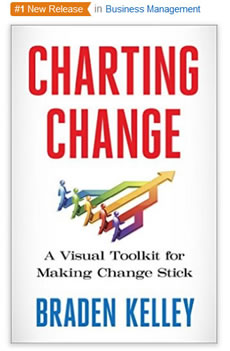
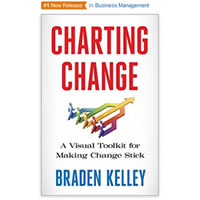
Charting Change is Number OneI’m super excited to announce that my new Charting Change is off to a strong start. People around the world have sent me pictures of the book after they received it via Twitter (@innovate). Keep them coming!

Put yourself in the picture holding the book and I’ll post it here.

Charting Change has been the number one new release on Amazon for at least “Business Management” and “Production & Operations” so far. It has also definitely been the #2 new release for “Organizational Change” and probably #1 too (but I think I missed getting a screenshot).

The book is currently available as a hardcover, and the eBook has unfortunately been delayed. I’m trying to stay on top of the publisher to get it out as quickly as possible, so stay tuned!

I will announce on my blog here when the eBook is available for Kindle, etc.

For those of you who already have the book, I hope you are enjoying it and leave an Amazon review when you finish! 🙂

Please feel free to ask questions about the book below.

Subscribe to Human-Centered Change & Innovation WeeklySign up here to get Human-Centered Change & Innovation Weekly delivered to your inbox every week.

The Eight Change Mindsets

“While there is risk to change, just like with innovation, there is often potentially more risk associated with doing nothing.” – Braden Kelley

The Eight Change MindsetsIf your organization is seeking to create a continuous change capability, it must have a strong focus on increasing its organizational agility.

As you use the Change Planning Toolkit™ to kick off your next project or your next change initiative, keep thinking about what the minimum viable progress (MVP) might be in order to maintain momentum. This is very similar to the idea of a minimum viable product, a key lean startup concept popularized by Eric Ries, author of the bestselling book, The Lean Startup.

Minimum viable progress means that for change initiatives and projects to be successful, it is mandatory to have a successful planning session where strong buy-in is achieved at the start. It is equally important at all stages of the process to show a level of progress sufficient to maintain the momentum and support for the project or change initiative you worked so hard to achieve at the start.

This is where the agile principles highlighted later in this article come into play. The goal of our change or project planning efforts should be not just to prototype what the change might look like, but to also build a plan that breaks up the work into a cadence the organization can cope with and successfully implement into a new standard operating procedure. Many thought leaders extol the virtues of quick wins, but I believe structuring your project or change effort into a series of similarly sized sprints will give you a sustainable flow of wins (and thus momentum) throughout all of the transitions that will lead to success. In the end, momentum wins.

Quick Wins versus Momentum

One of the ways to create sustainable momentum is to take an agile approach to change and to segment your overall change effort into a series of work packages that you can properly staff, execute, and celebrate. Many projects and change efforts get off to a roaring start, achieve a few quick wins, but stall when longer, more substantial pieces of the work must be completed, often with only limited communication and little visible progress.

The change initiative then begins to lose the support of key stakeholders (and potentially resources) as members of the change leadership team begin to lose enthusiasm, break solidarity, and withdraw support. This dooms the effort, preventing it from ever being completed as intended.

Momentum beats quick wins, and engaging in a more visual, collaborative, agile change planning method like the one described in my book Charting Change will lead you to more successful change efforts because these methods can help you maintain momentum. The Agile Change Management Kanban is a useful tool that toolkit buyers can leverage to visualize and track change effort progress.

Building and Maintaining Momentum

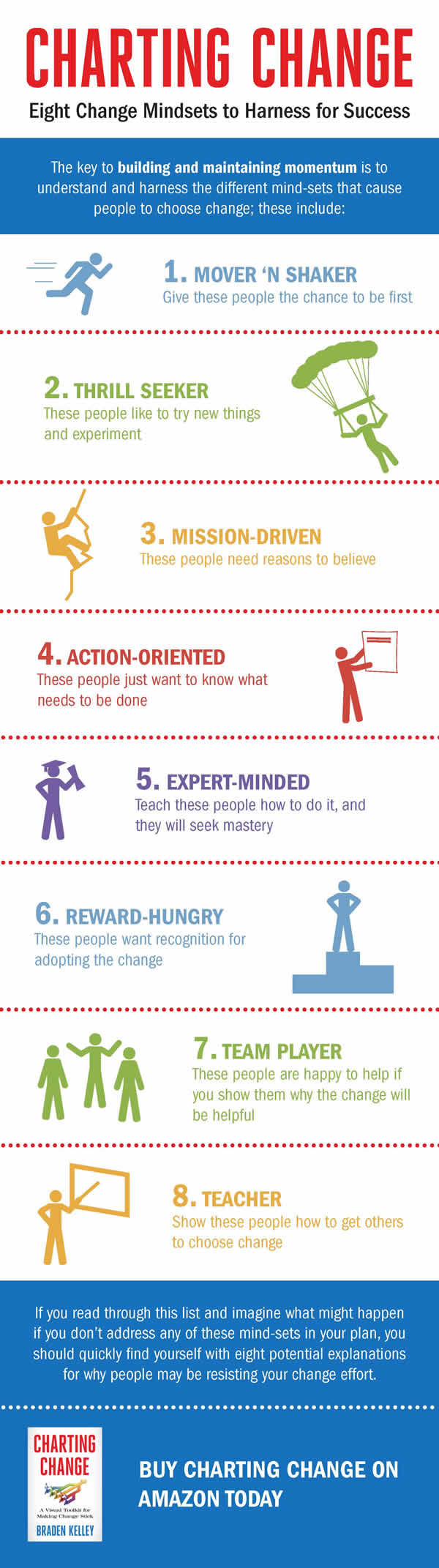
There are many different reasons why people will do the right thing to help you build and maintain the momentum for your change initiative and to help you achieve sustained, collective momentum. The key to building and maintaining momentum is to understand and harness the different mindsets that cause people to choose change; these include:

1. Mover ’n’ Shaker

  • give these people the chance to be first

2. Thrill Seeker

  • these people like to try new things and experiment

3. Mission-Driven

  • these people need reasons to believe

4. Action-Oriented

  • these people just want to know what needs to be done

5. Expert-Minded

  • teach these people how to do it, and they will seek mastery

6. Reward-Hungry

  • these people want recognition for adopting the change

7. Team Player

  • these people are happy to help if you show them why the change will be helpful

8. Teacher

  • show these people how to get others to choose change

Change leaders and project managers should read through this list and imagine what might happen if you don’t address any of these mindsets in your change plan. In doing so, you might find yourself quickly identifying eight potential explanations for why people may be resisting your change effort. If any of these mindsets are playing out in the negative, then you must try and identify ways to turn these individuals back toward the positive as you work through the different phases of change.

Please include attribution to BradenKelley.com with this graphic.
Embed code available below (click here to request a PDF download)
Eight Change Mindsets Infographic

Share this Image On Your Site


(click here to request a PDF download)

Bringing More Elements of Agile to Change

As you begin to move from the widespread chaos-driven change management model (“we do it differently every time”) to using the concepts presented in my book Charting Change and reinforced through the use of the Change Planning Toolkit™ to spread the knowledge of how to use the collaborative, visual change planning process, you will crave a more coordinated approach to change readiness evaluation. Instead of looking at change readiness on a case-by-case basis for each individual project or change initiative, you will quickly find yourself considering the use of a more agile approach to managing change readiness. You may begin asking yourself these ten (10) questions:

  1. Is it possible to have a change backlog?
  2. Do we need a burndown chart to measure how quickly we are burning through our backlog?
  3. Is it necessary to begin prioritizing the change backlog in order to phase in change into different parts of the organization at a pace each part can absorb?
  4. Should we carve up our change initiatives into a predictable series of sprints with a regular cadence?
  5. How long should our change sprints be?
  6. How much of the change initiative can the organization absorb at any one time in order to maintain forward momentum?
  7. Is there a need for periods of settling in (scheduled periods of equilibrium) between change sprints?
  8. Is there a need for the status of various projects and change initiatives to be visible throughout the organization?
  9. Is there a need for a business architect to build a business capability heatmap that highlights the amount of change impacting different business capabilities?
  10. Do you have a business capability map? Do you have business architects in your organization?

If your organization is trying to become more capable of continuous change, then answering many of these questions in the affirmative and taking appropriate action will result in an accelerated change planning capability and faster change absorption.

An Appropriate Pace of Change

For your change effort to be a success you need to find the appropriate pace of change. Finding the right pace of change is very similar to trying to fly an airplane: Go too slow and your change effort will stall. Go too fast and you will face an increasing amount of resistance, potentially depleting the support for your change faster than expected.

In many cases, using up the energy for change too fast may prevent you from reaching your intended destination. One other danger of trying to change too fast, especially if you are trying to run too many change initiatives (or projects) at the same time in the same areas of the company, is that you may run into issues of change saturation.

The key for you as change leader is to identify a regular cadence for your change initiative (or project) that is comfortable for the organization as a whole. That cadence must be slow enough so that the incremental change can be readily adopted and absorbed but fast enough so that your positive forward momentum, executive sponsorship, and overall support are maintained. The pacing and the approach must ultimately help enlist the broader organization in the change effort by reducing feelings of uncertainty, reinforcing that the change is a team effort, and accumulating reasons to believe in the change outcomes and so that people choose change.

Finally, you must have a plan for harnessing each of the eight change mindsets in your organization and leveraging them to advance your change effort, otherwise these mindsets will occupy themselves in negative ways and actively resist your change initiative or project. So, harness these mindsets, leverage the infographic and link back to this article using the embed code, and get yourself a copy of the #2 new release on Amazon for Organizational Change, my new book – Charting Change.

Thank you for your support and Amazon reviews are always appreciated! 🙂

Get the PDF version of the Eight Change Mindsets framework:

Eight Change Mindsets to Harness for Success PDF

Subscribe to Human-Centered Change & Innovation WeeklySign up here to get Human-Centered Change & Innovation Weekly delivered to your inbox every week.

Why Change is Accelerating

Why Change is Accelerating

In previous articles I’ve spoken about how the pace of change is accelerating, and how for many people (and organizations) things are changing so fast that they feel overwhelmed and that things may be changing faster than some of us humans are able to absorb. I’ve spoken about how we are in the middle of a period of discontinuity thrust upon us by the rapid advances in computing and mobile connectivity that have put a supercomputer in everyone’s pocket and a target on most organizations’ backs.

Why are things changing so fast?

Is it that we’ve hit some sort of inflection point never achieved before in human history that is allowing us to innovate and displace the status quo faster than ever before?

Maybe.

Have we reached some sort of perfect storm where the innovation curve has gone vertical and the singularity will be here tomorrow?

Probably not.

So if we are not necessarily innovating faster than ever before or destined to reach the singularity tomorrow and become one with machines, then what is creating the feeling that things are changing more rapidly?

One word…

“Expectations”

Changing Customer Expectations

It feels as if the world is changing faster than ever before because the expectations of our customers and our expectations as customers are changing faster than ever before. Why?

Because we as consumers are seeing better customer experiences enabled by digital technologies in parts of our personal lives and more efficient and effective business processes in parts of our business lives, we are now expecting every organization (not just companies) and every aspect of that organization to deliver an efficient, effective experience and information exchange in whatever channel we choose, whenever we want to experience it.

This incredible change in expectations is being thrust upon all organizations simultaneously and threatening the very existence of entities that have existed for dozens or even hundreds of years. This discontinuity has created immense technical debt for organizations large and small to overcome and the only way for an incumbent organization to recover and to survive in this new digital age will be to undergo a complete digital transformation.

This doesn’t mean creating a digital strategy to address one part of the organization or a single constituency, but a path to a complete transformation that brings digital approaches to both every part of the organization and its operations, but also to all of its constituencies, at the same time. This means re-imagining every system, every policy, every procedure, and every process as a digital native organization looking to enter and disrupt your industry might, and then make a plan for transforming yourself. This will require IMMENSE amounts of change, and is no small task given the 70% change failure rate, but it is the key to your organization’s survival.

The problem is that the organizational change thought leadership status quo isn’t up to the task of planning and executing the scope and scale of change required for existing organizations to survive the digital evolution underway. A new set of tools is needed. My new book Charting Change and the accompanying Change Planning Toolkit™ were designed to inspire a change revolution to free people from the tyranny of the blank word document and poorly planned change efforts.

Why the Pace of Change is Accelerating

Economics 101

Because the challenge we face is not a static one. Organizations that focus on catching up to where the customer is today and wedging their efforts into existing budget constraints are those that will find themselves falling further behind the curve of changing customer expectations.

No longer is it a victory to be seen by customers as ‘best in class’. No, now customers are expecting every organization to be ‘world class’. This means that increasingly customer satisfaction will be achieved only by providing one of the best experiences in the world. Talk about changing expectations!

And so given the time to develop new technology solutions, you should be aiming not to incrementally improve your current experience to get closer to the leaders in your industry, but instead investing in a solution that will anticipate what the best customer experience allowed by technology 12-18 months from now and start building that instead.

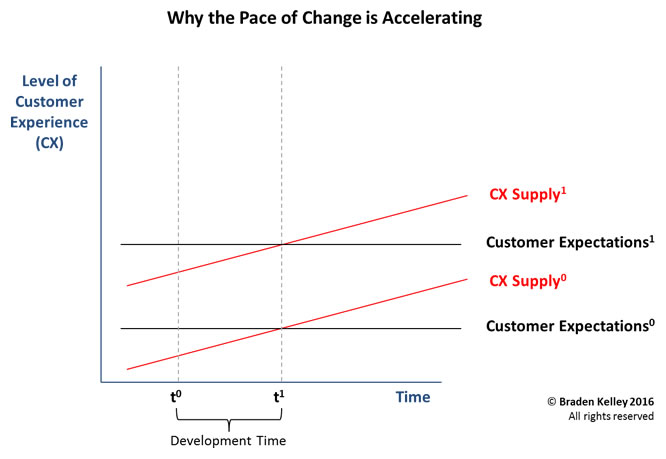
It’s Economics 101 all over again. In today’s reality, as most organizations seek to move up the customer experience supply curve, the customer experience demand curve is constantly shifting outward, leading your share of the market to wither and die unless you make the strategic investment required to actually shift your customer experience (CX) supply curve outward as well.

I’ve tried to capture the scenario in the figure above titled ‘Why the Pace of Change is Accelerating’. Most organizations when they see at Time0 that their level of customer experience is below Customer Expectations0 they invest in projects to increase their CX Supply0 up the CX Supply curve to CX Supply1 thinking that they will then be meeting the customers’ level of expectations at Time1. But that’s not how it works in the digital world of today, as customer expectations are changing (shifting upward) just as fast as the technology used to create better customer experiences. So, organizations that invest in moving up the CX Supply curve to catch up with current customer expectations find themselves continuously falling short of future customer expectations.

Conclusion

The reason nearly every organization follows this approach of climbing the CX Supply curve to close the gap on customer expectations is usually financial. Most managers are forced (or compelled) to try and close the gap with existing budgetary resources and by creating a digital strategy as part of these efforts. Very few organizations have visionary leaders willing to invest in a digital transformation and fundamentally re-think the architecture and capabilities the organization needs to successfully compete in a digital age. Very few organizations see how to properly use technology to fulfill the mission of the organization and to exceed customer expectations, and as a result create a shift outwards in the CX Supply Curve itself.

Choosing not to digitally transform your organization, creates the space in the market for new digital native organizations to enter and establish a beachhead and attack the incumbents.

At the same time, as our world and organizations continue to digitize this will result in decreasing variable costs and increasing fixed costs, leading to increased consolidation in many fragmented industries. Those organizations bold enough to invest in shifting their customer experience supply curves outward by undergoing a true digital transformation will improve their position to be a buyer instead of a seller as this consolidation occurs. So the real question is…

If we are living in an era of survival of the digital fittest, which side of the digital evolution do you want to be on?

I hope you’ll join the change revolution, get your copy of Charting Change today and check out the Change Planning Toolkit™!

Image credit: Winggz.com

Accelerate your change and transformation success

Subscribe to Human-Centered Change & Innovation WeeklySign up here to get Human-Centered Change & Innovation Weekly delivered to your inbox every week.

Charting Change Book Launch Special – Free Visual Project Charter™ Poster Download

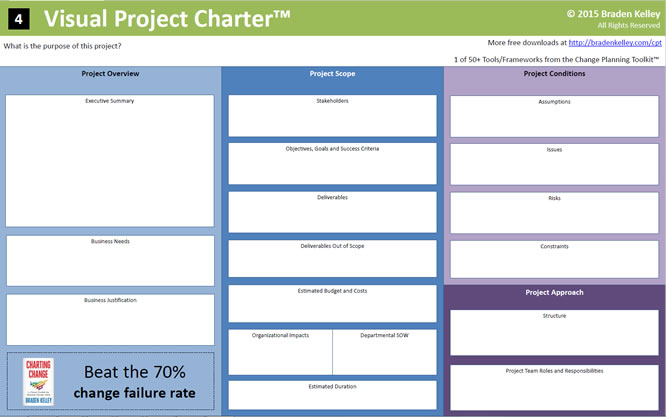
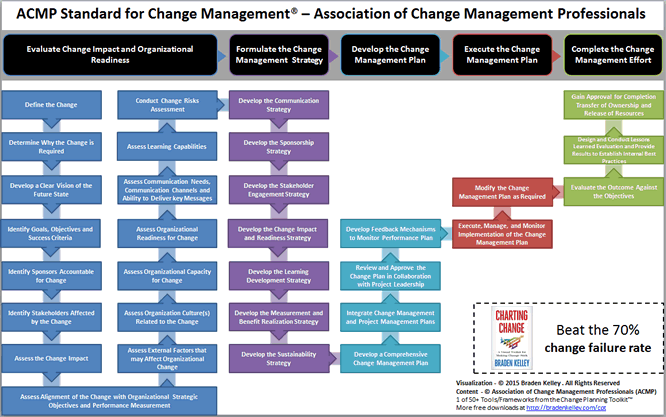
Charting Change Number One New ReleaseIn celebration of the launch of Braden Kelley’s latest book – Charting Change – we are proud to make two new poster size downloads from the Change Planning Toolkit™ available for a limited time for FREE:

  1. Visual Project Charter™ – 35″x56″ scalable PDF download
  2. ACMP Standard for Change Management® (Visualization) – 35″x56″ scalable PDF download

11″x17″ scalable PDF downloads of these two tools will remain as free downloads from the Change Planning Toolkit™ here on the site. BUT, these 35″x56″ poster size versions are only available as free downloads for a LIMITED TIME here on the site. If you run marketing for a consulting firm or a software company targeting change management or project management professionals, I am looking for sponsors to help keep them free.

Contact me to sponsor one or both.

The Visual Project Charter™ helps organizations:

  • Move beyond the Microsoft Word document
  • Make the creation of Project Charters more fun!
  • Kickoff projects in a more collaborative, more visual way
  • Structure dialogue to capture the project overview, project scope, project conditions and project approach

Use it in planning your projects in a more visual and collaborative way for greater alignment, accountability, and more successful outcomes.

Visual Project Charter™

One good place to get it printed at the 35″x56″ size to put up on your wall for your cross-fuctional project charter collaborative meeting is PosterPrintHouse.com for about $50.00 plus or minus depending on any specials they might be running.

The ACMP Standard for Change Management®:

  • Outlines generally accepted practices, processes, tasks and activities used by change management practitioners across multiple roles, organizations and industries.
  • Provides a clear and consistent vocabulary of essential change management terminology and offers guidance for organizational change mgmt. for any type of change.
  • Supports organization decision making regarding change management resources.

ACMP Standard Visualization

So grab these 35″x56″ poster size free downloads while you can, and get yourself a copy of Braden Kelley’s books:

Keep innovating and making positive change!

Accelerate your change and transformation success

Subscribe to Human-Centered Change & Innovation WeeklySign up here to get Human-Centered Change & Innovation Weekly delivered to your inbox every week.

Let’s Start a Change Revolution

Start a Change Revolution

The pace of change is accelerating, and for many people (and companies) things are changing so fast that they feel overwhelmed and retreat to the familiar instead of embracing the change. In fact we are approaching a tipping point where what is becoming interesting to the young is not the new, but the old. Vintage Michael Jordan sneakers, vinyl albums, rotary telephones, and analog amplifiers all have growing numbers of fans. In fact, vinyl album sales are increasing as CD sales decrease.

People are becoming so overwhelmed by the speed of change that the next new thing doesn’t always feel so new, and so those seeking to be on the cutting edge are increasingly looking backward for inspiration. Beards and hats have made a comeback, and before you know it the tattoo craze will have run its course. But is it the accelerating pace of change that people feel overwhelmed by, in their work lives and their personal lives, or is it a lack of tools for successfully planning and executing change that leads to people feel overwhelmed and paralyzed by the constant need to change?

Some people would argue that the pace of change is outstripping our ability as humans to cope with all of the changes we are being expected to absorb. I would argue that we are in the middle of a period of discontinuity thrust upon us by the rapid advances in computing and mobile connectivity that have put a supercomputer in everyone’s pocket and a target on most companies’ backs.

Digital Transformation is Being Forced Upon Us

Because we as consumers are seeing better customer experiences enabled by digital technologies in parts of our personal lives and more efficient and effective business processes in parts of our business lives, we are now expecting every company and every aspect of that company to deliver an efficient, effective experience and information exchange in whatever channel we choose, whenever we want to experience it.

This incredible change in expectations is being thrust upon all organizations simultaneously and threatening the very existence of entities that have existed for dozens or even hundreds of years. This discontinuity has created immense technical debt for organizations large and small to overcome and the only way for an incumbent organization to recover and to survive in this new digital age will be to undergo a complete digital transformation. This doesn’t mean creating a digital strategy to address one part of the organization or a single constituency, but a path to a complete transformation that brings digital approaches to both every part of the organization and its operations, but also to all of its constituencies, at the same time.

This means re-imagining every system, every policy, every procedure, and every process as a digital native company looking to enter and disrupt your industry might, and then make a plan for transforming yourself. This will require IMMENSE amounts of change, and is no small task given the 70% change failure rate, but it is the key to your organization’s survival.

A Problem and A Solution Emerge

The problem is that in twenty years of research, travels around the world delivering keynote speeches and workshops interacting with countless audiences on the topics of innovation and change, I have not uncovered one set of tools that makes change seem less scary, that can make the change planning process more human, and change execution more successful. The organizational change thought leadership status quo isn’t up to the task of planning and executing the scope and scale of change required for existing organizations to survive the digital evolution underway. A new wave of change thinking and a new set of tools are needed to displace the old guard. In short, I’ve decided to start a change revolution to free people from the tyranny of the blank word document and poorly planned change efforts. Who’s with me?

Charting ChangeToday I am excited to announce the availability of the Change Planning Toolkit™, a Quickstart Guide to help explain what each of the more than fifty (50+) frameworks, worksheets and other tools are for, and most importantly, my latest book Charting Change to introduce you to the concepts behind the toolkit and its proper use. What I did find in my travels and my research referenced above were some good theories on behavior change and change leadership, and those, along with a couple of great case studies from Qualcomm and Britain’s National Health Service (NHS) and guest expert pieces from nearly a dozen hand-picked contributors, you will find in Charting Change. For my part, I’ve created a lot of great new theories and frameworks that you can put into practical use with the accompanying Change Planning Toolkit™. People who purchase a copy of the book will get access to an educational license for 26 of the 50+ frameworks, worksheets and other tools contained in the toolkit, including the Change Planning Canvas™ to pull your plan all together on one page (a $500 value). Individual and site licenses for the full version of the toolkit are available.

But I can’t do it alone.

Come Join the Change Revolution

I’m seeding the clouds with Charting Change and with the Change Planning Toolkit™, but I need you to make it rain.

The first 50+ tools in the toolkit are my own, the result of thousands of hours of work and years of effort. But I know once you download the 10 Free Downloads, or buy a copy of the book and get access to the first 26 of the 50+ tools in toolkit, or upgrade to the full toolkit and unlock all 50+ tools, that some of you may want to:

  1. Contribute a new tool to the Change Planning Toolkit™ (with full credit of course) to help accelerate change capabilities in organizations around the world
  2. Use the Change Planning Toolkit™ in your consulting business to help your clients and increase your revenue
  3. Become a preferred provider by translating the Change Planning Toolkit™ into additional languages, and earn a portion of any revenue from your translation at the same time
  4. Attend a train the trainer session to become a certified Change Planning Toolkit™ professional in order to spread the knowledge across your organization, or if you’re a consultant, to offer training sessions as an additional business offering

The reason I’m not trying to hold everything dear is that I have a full-time job transforming the insurance business and can’t be running around the world doing consulting work for clients. Instead I thought it made more sense to empower as many consultants and practitioners as possible to properly use the intellectual property I’ve created (and the additional intellectual property that others are likely to contribute) to help your organizations (or your clients’ organizations) cope with the accelerating pace of change.

I know that together we can change how we plan and execute changes big and small all around the world. And for those of you who think that the toolkit and methods are designed to only help plan and execute large changes (‘Capital C’ changes like mergers, acquisitions, transformations, etc.), I would like to remind you that small changes (‘lowercase c’ changes like projects and campaigns) can use the toolkit too. The fact is that every project changes something, and so every project is a change effort. That is why in my Architecting for Change framework, project management is shown as a subset of change management, not the other way around. So, whether you are a consultant, a professor, a teacher, a project manager, a vice president or a CIO, I hope you’ll join the change revolution, get your copy of Charting Change today and check out the Change Planning Toolkit™!

¡Viva la Revolución!

Contact me about doing a Change Planning Toolkit™ translation

Get information about Change Planning Toolkit™ public training sessions

Get information about Change Planning Toolkit™ private training sessions

Image credit: freevector.com


SPECIAL BONUS:

Click here to hear Tanveer Naseer interview me about my new book Charting Change on his Leadership Biz Cafe podcast.
.
.


Subscribe to Human-Centered Change & Innovation WeeklySign up here to get Human-Centered Change & Innovation Weekly delivered to your inbox every week.

What innovation hasn’t changed something?

What innovation hasn't changed something?Can you think of a single innovation that didn’t change something?

I didn’t think so.

Innovation is change, or at least, innovation requires change.

In my role as an innovation keynote speaker and workshop facilitator, I recently led a German-based industrial company’s North American IT leadership team through an innovation workshop, during which we spent part of the time working to define their common language of innovation (as described in my book Stoking Your Innovation Bonfire). For companies looking to build a sustainable innovation capability this is an important first step.

One of the biggest reasons it is important to define innovation and to spend time creating a common language of innovation is that the word innovation means something different to every individual. It is very easy for companies to spin their wheels when people don’t have the same understanding of what constitutes innovation and what doesn’t.

Because of this danger, when working with companies to help build an innovation system I always make sure that we define what they want innovation to mean in their organization and what their vision, strategy and goals are going to be for innovation. This helps get everyone on the same page and causes people to start seeing some of the changes required in order to build a strong innovation capability in the organization.

Defining Innovation

As part of this most recent workshop discussion around what constitutes innovation I shared my definition of innovation and we worked together to create a definition that is going to fit their culture and their business.

My own personal definition of innovation is:

“Innovation transforms the useful seeds of invention into widely adopted solutions valued above every existing alternative.”

I’ve worked pretty hard over the years to refine this definition, and I like my definition because it highlights a couple of inherent tensions and relationships that people must consider. These include:

  • Invention vs. innovation
  • Useful vs. valuable
  • The requirement for an innovation to be widely adopted
  • The requirement for an innovation to replace the existing solution

Because innovation requires change, a potential innovation must:

  1. Create so much value that people are willing to go through the discomfort of abandoning or migrating away from their existing solution (even if it is the oft-ignored ‘do nothing’ solution);
  2. At the same time, you must also do an outstanding job of helping people access that value through design, packaging, education, etc. so that the product or service is a delight to use and so that you potentially simultaneously increase the overall value of the solution;
  3. And, finally you must provide a very clear value translation for your potential customers of how this new solution will fit into their lives and is worth the disruption that comes with adopting it.

For those of you familiar with my book Stoking Your Innovation Bonfire, or with my other writings, you may recognize my Value Innovation Framework and my views on what it takes to achieve successful innovation captured in the above three points.

Organization Size and History Matters

Inside a large organization (or one with a longer history), a potential innovation often inflicts a lot of change on the organization. Inside a large organization or an organization with a longer history, the organization will have grown up around one or two initial solutions and built an infrastructure to maximize the success of those initial solutions. As a result, any potential innovation will often require knowledge, skills, and other resources in order to build and scale it that are new to the organization. This may involve building new distribution channels, hiring people with the necessary skills and expertise, and many more changes required to build the capabilities needed to make the potential innovation a success.

Inside a startup organization this is not the case, and this is the reason why it is often easier and faster for a startup to create and implement a potential innovation than an established company. Because everything is new, there is nothing to change, other than the minds of the customers in order to get them to replace their existing solution and the minds of potential partners to convince them to work with you. This is the advantage that startups have over existing companies.

But the disadvantage startups have is that startups usually have to spend more of their time chasing the funding they need to transform their idea into a realized innovation. Whether the advantages or the disadvantages are larger depends on the startup. And, whether the startup can beat the established organization depends on how good the established organization is at managing change, and how fast it can change.

Final Thoughts

Most of us work in established organizations that have either grown large because of successful leadership, strategic vision, efficient operations, and continuous improvement and innovation, or we work for an organization that has at least established some level of longevity as a going concern. This means that for most of us we MUST get better at change. We must accept change as a constant and as a key (along with innovation) to our organization continuing to thrive in a sea of rising global competition. We must also get FASTER at change.

One way to do this is to change HOW we change by embracing a new more visual, more collaborative approach to planning our change efforts using tools like my Change Planning Toolkit™. I will be introducing this toolkit in my new book Charting Change, releasing March 9, 2016. People who buy a copy of my book Charting Change will get access to the Change Planning Canvas™ and 25 other tools from the toolkit. As a special gift for everyone else, I will be making a series of 10 free downloads available on my web site from the 50+ frameworks, worksheets and other tools contained in the toolkit (including the popular Visual Project Charter™).

I hope it is now clear that to be successful at innovation that you must become better at change, and I encourage you all to do so!

Accelerate your change and transformation success

This article originally appeared on the Planview blog

Subscribe to Human-Centered Change & Innovation WeeklySign up here to get Human-Centered Change & Innovation Weekly delivered to your inbox every week.

First Interview about ‘Charting Change’

Charting ChangeI was lucky enough to (a) get Tanveer Nasser to contribute some thought leadership to my new book Charting Change (launching March 9, 2016!) and (b) to be a guest recently on his leadership podcast.

Here is a quick snippet from Tanveer’s site about the content of our interview:

“In today’s faster paced, interconnected world, there’s little doubt that change is the new reality; the new standard by which we now have to operate. But if leaders recognize change as being a new constant in our organization’s field of view, why then are so many leaders struggling to effectively drive change in their organization? It’s the question that serves as the basis of my talk with innovation expert and author, Braden Kelley.”

Click here for more information and to listen to the interview

Tanveer NaseerTanveer Naseer is an award-winning and internationally-acclaimed leadership writer and keynote speaker. He is also the Principal and Founder of Tanveer Naseer Leadership, a leadership coaching firm that works with executives and managers to help them develop practical leadership and team-building competencies to guide organizational growth and development.

Accelerate your change and transformation success

Subscribe to Human-Centered Change & Innovation WeeklySign up here to get Human-Centered Change & Innovation Weekly delivered to your inbox every week.

Digital Transformation versus Digital Strategy

by Braden Kelley

In my last article, Digital Transformation Matters, we looked at the accelerating pace of change, the case for digital transformation, and our evolving interactions with technology. We also asked a simple question:

Are you ready to do business in a digital way for the digital age?

In our digital age all companies must change how they think, change how they interact with customers, partners, and suppliers, and change how the business works inside. Customer, partner, and supplier expectations have changed and a gap is opening between what they expect from their interaction with companies, and what those companies are currently able to deliver. Companies must immediately work to close this expectation gap or the entire business is at risk.

There are groups of digital natives out there that are extremely capable, have greater access to capital than ever before, and are very likely to re-imagine your business and your entire industry from the ground up if you don’t start making the necessary changes in your business to eliminate the opportunity.

If they attack, they will do it with a collection of digital strategies that utilize the power of the digital mindset to more efficiently and effectively utilize the available people, tools and technology, and to design better, more seamlessly interconnected and automated processes that can operate with only the occasional human intervention.

To defend your company’s very existence, you must start thinking like a technology company or go out of business. Part of that thinking is to fundamentally re-imagine how you structure and operate your business. You must look at your business and your industry in the same way that a digital native startup will if they seek to attack you and steal your market. To make this easier you can ask yourself five questions:

  1. If I were to build this business today, given everything that I know about the industry and its customers, and given all of the advances in people, process, technology and tools, how would I design it?
  2. From the customers’ perspective, where does the value come from?
  3. What structure and systems would deliver the maximum value with the minimum waste?
  4. What are the barriers to adoption and the obstacles to delight for my product(s) and/or service(s) and how will my design help potential customers overcome them?
  5. Where is the friction in my business that the latest usage methods of people, process, technology, and tools can help eliminate?

There are of course potentially other questions you may want to ask, but these five should get you most of the way to where you need to go in your initial strategic planning sessions. If you have other key questions that you think I’ve missed, please add them in the comments.

Digital Strategy vs. Digital Transformation

But how much appetite for going digital do you have?

This is where the question of digital strategy versus digital transformation comes in.

The two terms are often misused, in part by being used interchangeably when they are in fact two very different things.

A digital strategy is a strategy focused on utilizing digital technologies to better serve one particular group of people (customers, employees, partners, suppliers, etc.) or to serve the needs of one particular business group (HR, Finance, Marketing, Operations, etc.). The scope of a digital strategy can be quite narrow, such as using digital channels to market to consumers in a B2C company, or broader, such as re-imagining how marketing could be made more efficient through the use of digital tools like CRM, marketing automation, social media monitoring, etc. and hopefully become more effective at the same time.

Meanwhile, a digital transformation is an intensive process that begins by effectively building an entirely new organization from scratch utilizing:

  • All of the latest DIGITAL TECHNOLOGIES (artificial intelligence, predictive analytics, BPM, crowd computing, etc.)
  • The latest TOOLS (robotics, sensors, etc.)
  • The latest best practices and emerging next practices in PROCESS (continuous improvement, business architecture, lean startup, Business Process Management (BPM), crowd computing, and continuous innovation using a tool like The Eight I’s of Infinite Innovation™)
  • The optimal use of the other three to liberate the PEOPLE that work for you to spend less time on bureaucratic work and more time imagining the changes necessary to overcome barriers to adoption and obstacles to delight through better leadership methods, reward/recognition systems, physical spaces, collaboration and knowledge management systems, etc.

And ends with a plan for making the transformation from the old way of running the business to the new way.

The planning of the digital transformation is of course all done collaboratively on paper, whiteboards, and asynchronous electronic communication (hopefully not email, but more on that later). The goal is to think like a digital native, to think like a startup, to approach the idea of designing a company to utilize all of the advances in people, process, technology and tools to kill off your own company (at least as you know it). Because, if you don’t re-invent your company now and set yourself up with a new set of capabilities that enable you to continuously re-invent yourself as a company, then some venture capitalist is going to see an opportunity, find the right team of digital natives, and give them the necessary funding to enter your market and re-invent your entire industry for you.

It’s All About the Interfaces

People are fascinated with startups like Uber and with good reason because they have changed the lexicon and the way that we think about entire categories of products and services. Whether or not you believe there is causation, the fact remains that Yellow Cab in San Francisco filed for bankruptcy, and that Uber has placed an immense amount of pressure on taxi and airport limousine companies. But you should also be looking at what established technology companies like Amazon are doing because established technology companies are looking for growth and new markets too, and they might decide yours looks attractive, so you have to think like a technology company or go out of business.

One way that technology companies differ from non-technology companies is that they naturally focus on the interfaces, because that is where complex systems often fail. And so, if you are pursuing a digital strategy on your way to a digital transformation, you must first pick an interface, and then optimize the experience at that interface. It could be the interface between the company and customers, it could be the company to employee or employee to employee interface, or even the company to partner or company to supplier interface. Whatever interface you choose, your goal is to ultimately look at that interface with a fresh modern lens, and then utilize all of the latest (and emerging) approaches from a people, process, and technology perspective, to create a more efficient and more effective (aka better) experience.

The better job you do as an organization at removing friction at the interfaces, the more likely you are to become a partner of choice, supplier of choice, employer of choice, and/or a brand of choice. The value of becoming any or all of these could be the difference between the survival and growth of the organization, and a slow, agonizing death at the hands of a new, digital entrant or a digitizing incumbent that completes a digital transformation before your leadership team can agree it’s even necessary.

Architecting Your Organization for Change

One thing that both a digital strategy and a digital transformation have in common is that they will inflict change (in varying amounts) upon the organization, and with a more visual, collaborative approach to planning that change – like that enabled by the Change Planning Toolkit™ that I introduce in my new book Charting Change (available February 24, 2016) – you will increase your odds of beating the 70% change failure rate and of successfully achieving your digital change goals.

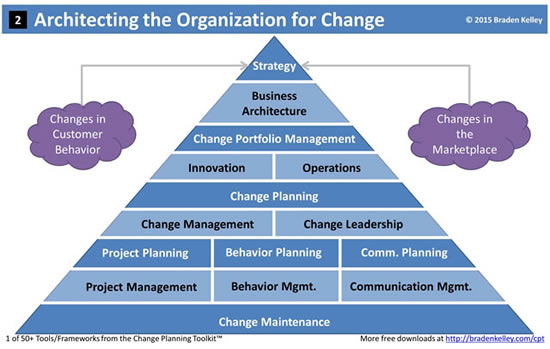
As you plan your change efforts it helps if you keep in mind the Five Keys to Successful Change™ and that you consider Architecting Your Organization for Change. Below you will see visualizations of both concepts and both are available as free downloads from the Change Planning Toolkit™, which is a collection of frameworks, worksheets, and other tools (including the Change Planning Canvas™).

Five Keys to Successful Change 550

Architecting the Organization for Change

Click to access these frameworks as scalable 11″x17″ PDF downloads

These two frameworks will help you take a more holistic view of organizational change wider than just change management or change leadership, and helps organizations:

  1. Visualize a new way to increase organizational agility
  2. Integrate changes in the marketplace and customer behavior into the strategy
  3. Create a new organizational architecture that integrates all five elements of organizational change
  4. Make project, behavior and communications planning and management a central component of your change efforts
  5. One thing that should immediately jump out as you look at the Architecting the Organization for Change framework is that The Five Keys to Successful Change™ are embedded it.

Change Maintenance forms the foundation of a change-centric organization, ensuring that the changes necessary to ensure a healthy firm continue to persist (or are “maintained”), while the top of the organizational pyramid is driven by a conscious strategy that evolves over time, informed by changes in customer behavior and changes in the marketplace.

The strategy of the firm then determines the appropriate business architecture, and as the organization’s strategy changes, the business architecture may also need to change. Any necessary changes in the architecture of the business (new or updated capabilities or competencies) then will lead to modifications to the portfolio of change initiatives and projects (and remember every project is a change effort). These projects and initiatives will consist of innovation initiatives and efforts to create positive changes in the operations of the business.

The change efforts and projects identified as necessary and invested in as part of the change portfolio then represent projects that impact the innovation and operations for the firm, and in order to successfully execute them in the short term includes change planning, management, and leadership, and in the longer term the maintenance of the required changes.

And for the change efforts and projects to be successful the organization must also focus on project planning and management, behavior planning and management, and communications planning and management. The related projects, behaviors, and communications must all be effectively planned and managed in a way that keeps all three in sync.

I hope you see that by increasing your focus on the Change Planning discipline and through increased use of tools like the Architecting the Organization for Change framework from the Change Planning Toolkit™, your business will be able to more collaboratively and visually plan change efforts as large as a digital transformation or as small as a digital strategy and to increase your organizational agility.

More on organizational agility soon, so stay tuned!

In the meantime, please get yourself a copy of Charting Change as a hardcover (ebook coming soon) and get your free downloads from the Change Planning Toolkit™ (or go ahead and purchase a license now).

Buy the Change Planning Toolkit™ NowNow you can buy the Change Planning Toolkit™ – Individual Bronze License – Advance Purchase Edition here on this web site before the book launches.

This article originally appeared on Linkedin

Subscribe to Human-Centered Change & Innovation WeeklySign up here to get Human-Centered Change & Innovation Weekly delivered to your inbox every week.

Increasing Organizational Agility

Agility vs Flexibility — What’s the Difference?

Increasing Organizational Agilityby Braden Kelley

Agility and flexibility are related but distinct capabilities, and confusing them leads organizations to invest in the wrong things.

Flexibility is the capacity to bend without breaking — to absorb stress, accommodate variation, and adapt to different conditions without losing structural integrity. A flexible organization can handle a wider range of situations within its existing model. Flexibility is primarily about tolerance and range.

Agility is the ability to sense change coming and respond to it faster than competitors — not just absorbing variation but actively redirecting in response to new information. An agile organization doesn’t just survive disruption; it moves toward opportunity before others see it. Agility is primarily about speed and direction.

The practical distinction: a flexible supply chain can handle demand fluctuations within a known range. An agile supply chain can reconfigure itself in response to a disruption it didn’t anticipate. Flexibility keeps you stable; agility keeps you competitive.

Most organizations need both — flexibility as the foundation that prevents brittleness, and agility as the capability that enables proactive response. The article below focuses specifically on how to build organizational agility — the harder and more strategically valuable of the two.


Companies seeking to cope with the pace of accelerating change are looking for ways to go faster, and managers in non-technical disciplines have become increasingly infatuated with the Agile Software Development methodology and many are finding ways to adapt parts of it to create agile change or agile marketing or other such things. Sure agility sounds like a good thing and sure agile marketing sounds like it must be better than regular marketing, but is it?

What is agility really?

According to Dictionary.com, agility is:

“The power of moving quickly and easily; nimbleness”
OR
“The ability to think and draw conclusions quickly; intellectual acuity”

When it comes to a business context, I however prefer to define agility a bit more simply, a bit more concisely. Agility, or organizational agility in our case, is:

“How quickly an organization can change directions”

Many people, especially in an organizational or commercial context, get confused between agility and flexibility. They are NOT the same thing.

Agile vs. Flexible

Organizational agility is about how quickly an organization can change directions, while flexibility in an organization gives it the ability to do different things with the same resources, often by purchasing more flexible equipment (at a higher price) or by training people to do more than one thing (resulting in higher training costs) or by hiring people that are skilled at more than one thing (higher salary/benefit costs). Flexibility definitely has its benefits (being able to shift resources among purposes) but it also has costs like the ones mentioned above, and probably more importantly, flexibility usually decreases the efficiency of systems.

Fixedness on the other hand, reduces variability, allows you to focus on the things that do vary and get really good at executing all aspects of a system, including the acquisition of the very best tools and technology to perform each particular function. But, as you can imagine, fixedness has its downside too. If a human resource goes down due to illness or a piece of production equipment breaks, potentially, the whole system grinds to a halt.

So, as you can imagine, increased organizational agility is achieved by establishing the right balance between flexibility and fixedness.

The Organizational Agility Framework

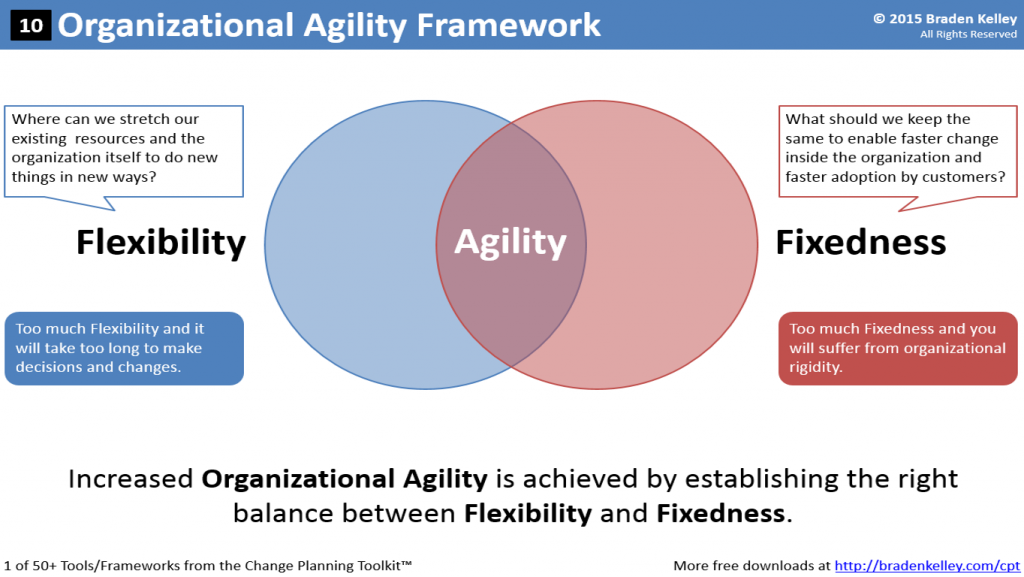
I have captured this principle below in the Organizational Agility Framework:

Organizational Agility Framework


Click to access this framework as a scalable 11″x17″ PDF download
(Tooklit purchasers also get access to the Organizational Agility Worksheet)

The Organizational Agility Framework helps organizations:

  • Adapt to changing environmental conditions
  • Stretch existing resources and the organization itself to do new things in new ways
  • Enable faster change inside the organization and faster adoption by customers
  • Evolve profitable customer relationships to keep the organization strong and vibrant

The Organizational Agility Framework (and corresponding worksheet in the Change Planning Toolkit™) also helps you ask two key questions:

  1. Where can we stretch our existing resources and the organization itself to do new things in new ways?
  2. What should we keep the same to enable faster change inside the organization and faster adoption by customers?

Flexibility vs. Fixedness

Too much Flexibility and it will take too long to make decisions and changes.

Too much Fixedness and you will suffer from organizational rigidity.

Companies seeking increased organizational agility and an improved ability to cope with the accelerating pace of change and ever-evolving customer expectations must seek to strike that optimal balance between fixedness (so you can go fast) and flexibility (so you can quickly adapt to changing customer needs).

Organizational Agility Examples

The following real-world examples illustrate what organizational agility looks like in practice — and what distinguishes truly agile organizations from those that merely talk about agility:

Amazon — Structural agility through two-pizza teams
Amazon’s famous “two-pizza team” rule — no team should be larger than what two pizzas can feed — is a structural agility mechanism. Small, autonomous teams can make decisions, experiment, and ship without navigating layers of approval. This structure is why Amazon was able to launch AWS, Prime, and Alexa as distinct businesses while its core retail operation continued growing. The organizational design itself creates agility rather than relying on individual heroics.

Netflix — Strategic agility through willingness to cannibalize itself
Netflix demonstrated organizational agility when it pivoted from DVD-by-mail to streaming in 2007 — deliberately cannibalizing its own most profitable business to move toward the future it saw coming. It did this again when it shifted from licensing content to producing originals. Most organizations cannot make these moves because their structure and incentives protect the existing business. Netflix’s agility came from leadership’s willingness to disrupt themselves before a competitor did.

Spotify — Process agility through the Squad model
Spotify’s Squad model — autonomous cross-functional teams organized around customer outcomes rather than functional departments — is one of the most widely studied organizational agility frameworks. Squads own their roadmaps, make their own architectural decisions, and deploy independently. The result is a company that can run hundreds of simultaneous experiments and ship features continuously without coordination bottlenecks.

Toyota — Operational agility through lean manufacturing
Toyota’s production system is the original organizational agility framework — the ability to sense quality problems in real time, stop the line immediately, solve the root cause, and resume without the defect propagating downstream. The principle of jidoka (automation with a human touch) and andon cords give frontline workers the authority and responsibility to act on problems instantly. This operational agility is why Toyota consistently outperforms competitors on quality and efficiency despite producing at massive scale.

ING Bank — Enterprise agility through full organizational transformation
ING Bank’s 2015 transformation from a traditional hierarchical bank to an agile organization — restructuring 3,500 employees in the Netherlands into squads, tribes, chapters, and guilds inspired by Spotify — is one of the most cited examples of enterprise-scale organizational agility. The transformation reduced time-to-market for new features from months to weeks, improved employee engagement significantly, and positioned ING as a digital banking leader. It also demonstrated that organizational agility is achievable in highly regulated, risk-conscious industries — not just in tech startups.

What these examples have in common: In each case, organizational agility was not achieved through an agile training program or a methodology adoption. It was achieved through deliberate structural, cultural, and leadership decisions that removed the friction slowing response time and pushed decision-making authority closer to where information actually lived. The organizations that are genuinely agile have designed their agility in — not bolted it on.

Can your organization find the right balance?

More on digital transformation and organizational agility soon, so stay tuned!

In the meantime, please get yourself a copy of Charting Change as a hardcover (or ebook) and get your free downloads from the Change Planning Toolkit™ (or go ahead and purchase a license now).

Subscribe to Human-Centered Change & Innovation WeeklySign up here to get Human-Centered Change & Innovation Weekly delivered to your inbox every week.