
Monthly Archives: November 2022

We Must Begin Investing in Resilience

We Must Begin Investing in Resilience

GUEST POST from Greg Satell

In 1964, as the financial revolution was gathering steam, an MIT economist named Paul Cootner published a collection of essays called The Random Character of Stock Market Prices. Based largely on an obscure dissertation by a forgotten frenchman, it laid the foundations for a new era of financial engineering.

Yet among the papers included was one that told quite a different story. Written by Benoit Mandelbrot—a mathematician not an economist—it showed that the seemingly sophisticated models significantly underestimated volatility and risk. In effect, he was predicting that these models would massively blow up one day.

No one disputed Mandelbrot’s facts, because they were clear and indisputable. Nevertheless, reputations were invested and there was of money to be made. So Mandelbrot’s warnings, although not altogether forgotten, were put in the back seat and we paid an enormous price. Clearly, then as now, we failed to invest in resiliency. Will we ever learn our lesson?

The Path to Pandemic

The Coronavirus crisis, for all of its severity, shouldn’t have been a surprise. There was the SARS pandemic in 2003, the Swine Flu outbreak in 2009, MERS in 2012 and, of course, Ebola in 2014. Each of these had potential for global catastrophe that was, thanks to some decisive action and no small amount of luck, averted.

There were also no shortage of warnings. George W. Bush sounded the alarm back in 2005, saying, “If we wait for a pandemic to appear, it will be too late to prepare.” RAND issued a report in 2012. Bill Gates was explicit about our lack of preparedness in his 2015 TED Talk.


To highlight the risk, before leaving office the Obama administration set up an exercise for the incoming Trump administration based on their earlier experience with pandemics.

Yet to say we dithered greatly understates the problem. From its very first year in office, the current administration proposed deep cuts to the NIH and CDC. Even in January 2020, when it was clear that the danger from the virus was growing, it was calling for cuts to those same agencies. Administration officials then doubled down on these cuts as late as March.

The lights had been blinking red. There had been 4 major outbreaks in the last 20 years. Experts and public officials had repeatedly called for preparations. Instead, we got tax cuts and deregulation. The pandemic’s path was cleared by public inattention and government inaction. While the ship was sinking, the crew was sleeping.

Unfortunately, our problems don’t end there.

Multiple Ticking Clocks

Clearly the Coronavirus crisis is a tragedy, yet it’s not the only light that has been blinking red for a while now. Just as Mandelbrot warned of the financial meltdown that came in 2008 and experts had been warning about the danger of pandemics for at least 20 years, there are a number of crises waiting to happen that we’re currently ignoring.

Take the climate crisis for example. A 2018 climate assessment published by the US government warned that we can expect climate change to “increasingly affect our trade and economy, including import and export prices and U.S. businesses with overseas operations and supply chains.” Another study found that the damages from climate related disasters since 1980 exceeds $1.7 trillion. That will only grow.

In the US our debt had already been a concern, especially considering that Medicare spending is set to explode. Now, with the Coronavirus crisis, we can expect to be adding trillions more to that, which doesn’t even include our massive environmental debt and infrastructure debt. Add it all up and our debts could easily exceed $30 trillion and possibly much more than that

It doesn’t end there either. Our electricity grid is insecure and vulnerable to cyberattack. As we increasingly delegate decisions to machines, we are realizing that we often do not understand how many of those decisions are made and we desperately need to make artificial intelligence explainable, auditable and transparent. We are also in the beginning of a genomics revolution, which will also create profound challenges.

A Proven Model

The challenges we face today, while profound and potentially catastrophic, are not at all unprecedented. In the 1950s, when we first began to understand the possibility of a nuclear holocaust, Albert Einstein and Bertrand Russell issued a manifesto highlighting the dangers of nuclear weapons, which was signed by 10 Nobel Laureates. Later, a petition signed by 11,000 scientists helped lead to the Partial Test Ban Treaty.

In the 1970s, when the dangers of gene editing became real, Paul Berg, one of the leading researchers, organized the Asilomar Conference to establish guidelines. The result, now known as the Berg Letter called for a moratorium on the riskiest experiments until the risks were better understood and instituted norms that were respected for decades.

Both efforts benefitted from a broad array of expertise. It was the partnership of Einstein, the world’s most famous physicist and the prominence of Bertrand Russell as a philosopher that jump-started the non-proliferation movement. The Asilomar conference included not only scientists, but also lawyers, politicians and members of the media.

In a similar vein, the Partnership on AI, which was formed to address ethical issues in artificial intelligence, includes not only leading tech companies, but also organizations like the ACLU, Human Rights Watch and Chatham House. CRISPR pioneer Jennifer Doudna has called for a similar effort to establish guidelines for synthetic biology, especially as it relates to germ-line editing.

Either Way, We Pay the Price

In a response to Mandelbrot’s paper in 1964 about the dangers of financial models, Cootner wrote that it forced economists “to face up in a substantive way to those uncomfortable empirical observations that there is little doubt most of us have had to sweep under the carpet until now.” He then added, “but surely before consigning centuries of work to the ash pile, we should like to have some assurance that all of our work is truly useless.”

In other words, the concerns were real, but the costs of addressing them seemed too great to bear. The era of financial engineering had begun and, although there were some hiccups along the way, such as a major stock market crash in 1987, things went relatively smoothly until the bottom fell out in 2008. It was only then that concepts like kurtosis and fat-tailed models came into wide-use to create more resilience in the system.

It was that same line of thinking that led congress to underfund our emergency medical stockpile to save money. It’s easy to underinvest today for a future risk that may never come. To many, it can even seem like the prudent thing to do. At any given time, the needs of the present can seem overwhelming. Borrowing from the future can help address those needs.

Yet as we’ve seen, in 2008 and 2020, eventually we pay the price, one way or another. Just as we will pay the price for some future catastrophe, whether it is a financial crisis, a pandemic, a climate event, social unrest or some other calamity. We can choose to invest in greater resilience now and save untold suffering in the future. We have that power.

Unfortunately, if recent events are any indication, we still haven’t learned our lesson.

— Article courtesy of the Digital Tonto blog
— Image credit: Pixabay

Subscribe to Human-Centered Change & Innovation WeeklySign up here to get Human-Centered Change & Innovation Weekly delivered to your inbox every week.

Open Source Innovation is Sharing for Greater Impact

Open Source Innovation is Sharing for Greater Impact

GUEST POST from Art Inteligencia

For decades, the competitive landscape has been dominated by a zero-sum mentality: innovation was a tightly guarded secret, proprietary technology was the ultimate moat, and intellectual property was a weapon. But as a human-centered change and innovation thought leader, I argue that this closed-loop model is becoming increasingly obsolete in a world defined by exponential complexity and interconnected challenges. The future belongs to a more expansive, collaborative paradigm: Open Source Innovation. This isn’t just a technical methodology for software development; it’s a profound strategic philosophy that leverages collective intelligence, accelerates problem-solving, and cultivates an ecosystem of shared value. It’s about moving from a mindset of hoarding knowledge to one of sharing for greater impact, proving that when you give away your best ideas, you often get something far more valuable in return.

The core principle of open source innovation is simple yet radical: by making certain intellectual assets (code, designs, data, research) freely available for others to use, modify, and distribute, you tap into a global network of talent and creativity that far surpasses the capacity of any single organization. This collaborative ecosystem drives faster iteration, more robust solutions, and greater societal benefit. The perceived “loss” of proprietary control is vastly outweighed by the gains in adoption, collective improvement, and the establishment of industry standards. It’s a human-centered approach to problem-solving, built on trust, transparency, and a shared belief that many minds are better than one, especially when tackling grand challenges.

The Strategic Imperatives of Open Source Innovation

Embracing open source innovation requires a significant shift in corporate culture and strategy. It’s about strategically deciding *what* to open and *how* to engage with the community:

  • 1. De-Risking and Acceleration: By exposing nascent ideas or foundational technologies to a wider community, you gain diverse perspectives, catch bugs faster, and accelerate development cycles. The collective scrutiny and contribution dramatically de-risk the innovation process.
  • 2. Building Ecosystems and Standards: Open sourcing foundational technologies can establish them as industry standards, creating network effects that benefit everyone, including the original contributor. It fosters a collaborative ecosystem that attracts talent and partners.
  • 3. Enhancing Trust and Transparency: In an era of increasing skepticism, open source demonstrates a commitment to transparency and community. It builds trust by showing a willingness to share, inviting external review and collaboration.
  • 4. Focusing on Higher-Value Activities: By open-sourcing non-differentiating “commodity” components, organizations can free up internal resources to focus on proprietary innovations that truly create unique value and competitive advantage.

“True innovation is not found in guarding secrets, but in inspiring shared discovery. Open source is the engine of collective genius.” — Braden Kelley


Case Study 1: Linux – The OS Built by the World

The Challenge:

In the early days of personal computing, operating systems were proprietary, expensive, and controlled by a few large corporations. This limited access, stunted innovation, and created vendor lock-in. The challenge was to create a robust, reliable, and accessible operating system that could compete with commercial giants without the resources of a corporate entity.

The Open Source Solution:

In 1991, Linus Torvalds released the initial version of the Linux kernel under an open-source license. This simple act invited developers worldwide to contribute, audit, and improve the code. What started as a personal project rapidly evolved into a global collaborative effort, harnessing the collective genius of thousands of programmers. The open development model allowed for:

  • Rapid Iteration: Bugs were found and fixed faster, and new features were integrated at an unprecedented pace.
  • Community Ownership: Developers felt a deep sense of ownership, driving unparalleled commitment and quality.
  • Unprecedented Customization: The open nature allowed Linux to be adapted for an incredible array of devices, from supercomputers to smartphones (Android is built on a Linux kernel).

The Human-Centered Result:

Linux fundamentally reshaped the technology landscape. It provided a powerful, free, and incredibly flexible operating system that became the backbone of the internet, enterprise servers, and mobile devices. It democratized access to powerful computing, fostering an explosion of innovation that would have been impossible under a proprietary model. Linux is the ultimate testament to the power of shared intellectual capital, proving that collective endeavor can create solutions far more robust and impactful than any single corporate entity.


Case Study 2: Arduino – Democratizing Hardware Innovation

The Challenge:

Microcontroller platforms, essential for building electronic prototypes and interactive objects, were traditionally complex, expensive, and geared towards professional engineers. This created a high barrier to entry for artists, designers, educators, and hobbyists who wanted to innovate with hardware.

The Open Source Solution:

In 2005, the Arduino project was launched, offering an open-source hardware and software platform. The physical circuit boards (hardware schematics) and the integrated development environment (software) were made freely available under open licenses. This meant anyone could build their own Arduino board, modify its software, or create extensions. This open approach led to:

  • Massive Accessibility: Lower cost and simpler programming made electronics accessible to a non-expert audience.
  • Explosive Innovation: A global community emerged, sharing thousands of projects, tutorials, and libraries, collectively innovating on the platform far beyond what a single company could achieve.
  • Educational Impact: Arduino became a staple in STEM education, teaching foundational principles of coding and electronics.

The Human-Centered Result:

Arduino revolutionized the maker movement and democratized access to hardware innovation. It empowered countless individuals to turn their ideas into tangible prototypes, leading to everything from home automation systems to interactive art installations and educational robots. By choosing an open-source model, Arduino didn’t just sell products; it built a vibrant ecosystem of creators and learners, proving that sharing foundational technology can unlock exponential human creativity and societal impact.


Conclusion: The Future is Collaborative, Not Proprietary

The lessons from open source are clear: in an increasingly complex world, no single organization holds a monopoly on good ideas or the talent to execute them. The greatest innovations often emerge from the intersections of diverse perspectives and collaborative efforts. Open source innovation is not about altruism alone; it is a powerful strategic choice that fosters speed, resilience, and an unprecedented capacity for solving shared challenges.

Leaders must actively explore how to strategically embrace open source principles—whether by contributing to existing projects, open-sourcing internal non-core technologies, or fostering a culture of internal transparency. By moving beyond a mindset of proprietary hoarding to one of strategic sharing, organizations can tap into the collective genius of the world, driving greater impact, building stronger ecosystems, and ultimately, ensuring a more innovative and collaborative future for all.

Extra Extra: Futurology is not fortune telling. Futurists use a scientific approach to create their deliverables, but a methodology and tools like those in FutureHacking™ can empower anyone to engage in futurology themselves.

Image credit: 1 of 950+ FREE quote slides for your meetings and presentations at http://misterinnovation.com

Subscribe to Human-Centered Change & Innovation WeeklySign up here to get Human-Centered Change & Innovation Weekly delivered to your inbox every week.

How Do You Measure Power?

How Do You Measure Power?

GUEST POST from Geoffrey A. Moore

In a recent blog, I argued that management needs to be accountable not only for delivering current performance but also for investing in power initiatives that will fuel future performance. Compensation systems that focus solely on the former too often result in a hollowing out of the enterprise, as we have seen with any number of iconic companies that have “performed” their way to the sidelines.

But this begs a key question—how do you measure power? Specifically, what kind of metrics could supply a stable foundation for management accountability and executive compensation?

In my book Escape Velocity, when discussing managing for shareholder value, we introduced a framework called the Hierarchy of Powers. The idea is that investors, who are buying a share of your enterprise’s future performance, value your company based on how much power they think it has relative to other investments they could be making. In this context, we claimed there were five classes of power that got evaluated in the following order of priority:

  1. Category Power. Is your core business in a category that is growing, stable, or declining? This, we claimed, is the single biggest predictor of future performance.
  2. Company Power. Within that category, where is your company in the pecking order of companies? If you are number one, that is a huge advantage. If you are number two, it also provides tailwinds. After that, there are no more tailwinds to be had.
  3. Market Power. For companies that focus on one or more vertical markets, is your company the default choice for major prospects and customers in that segment? Wherever this is the case, it gives a material boost to your sales momentum and thus your company’s valuation.
  4. Offer Power. Do you get preference and/or premium pricing due to the differentiation of your offer? Do you win the lion’s share of any competitive bake-offs?
  5. Execution Power. Do you have a history of meeting or beating guidance on a consistent basis?

The model has stood up well over the years, but there is still the question of how to ensure accountability for investing in power when so much of our attention (and compensation) is focused on creating the next quarter’s performance. To that end, my colleague Philip Lay and I have been sorting through objective measures that signal material gains in power, ones that executive teams could readily track, and compensation programs could use to calibrate bonuses.

Here’s what we propose should be the top two metrics for each class of power:

Category Power. The focus here is on portfolio valuation—how many categories does the enterprise participate in, and how is each category faring. Meaningful changes in category power typically come through M&A, often supplementing organic innovation that is looking to scale quickly. Top two metrics for each category assessed:

  1. Category Maturity Life Cycle status. The key stages are secular growth, cyclical growth, stagnant, and declining.
  2. Technology Adoption Life Cycle status. This model focuses specifically on the period of secular growth, breaking it up into the following stages: Early Market, Chasm, Beachhead, Bowling Alley, Tornado, and Main Street. The two big valuation changers are winning a beachhead market segment in the Bowling Alley and participating with meaningful share in the Tornado.

Company Power. In high-growth categories, the focus is on bookings growth and competitive win rates. In mature categories, it is on the stability of the installed base as well as bargaining power both with suppliers and with customers. The top two metrics are:

  1. Market share within each category. By far the most important metric, as market ecosystems organize around and give preference to the category leader.
  2. Balanced mix of power and performance categories. For global enterprises, in particular, portfolio balance creates optionality to deal with both bull and bear markets.

Market Power. In emerging categories, dominating a target market segment, as opposed to merely participating in it, is critical to crossing the chasm and creating a sustainable franchise. In mature categories, target market segment focus is key to creating above-market growth. The top two metrics are:

  1. Segment share. The most important metric because ecosystems that serve market segments organize around a segment leader only when it has dominant segment share.
  2. Growth rates within target market segments. This is particularly important in any economic downturn that impacts different market segments to highly varying extents.

Offer Power. This metric and the next are closely aligned with delivering performance in the current fiscal year. That said, they still signal successful investments in power. The top two power metrics are:

  1. Magic quadrant status. This is the most widely circulated third-party measure of offer power.
  2. Win/loss record in head-to-head competitions. This is the most credible measure of offer power.

Execution Power. This really is the land of performance, but there is still power in reputation. Top two metrics are:

  1. History of “meeting or beating” commits, be they forecast or, release dates. This is what gives confidence to customers and partners to give your team the nod.
  2. Customer success metrics. These include Net Expansion Rate, Net Retention Rate, and Promoter Score, all of which validate that you are keeping your sales promises.

Guidelines for Using the Metrics

Metrics are a device to ensure visibility and accountability, and nowhere is this more important than when dealing with something as abstract as power. The key is to associate the right metrics with the right people, the ones who can have the most impact on the level of power in question. This works out as follows:

  • Top Executives: Category Power, Company Power. The two key levers here are using M&A to strategic advantage and using the annual budgeting process to allocate resources asymmetrically to achieve strategic objectives.
  • Middle Management: Market Power, Offer Power. The two key levers here are using market segmentation to strategic advantage and allocating the resources under your control asymmetrically to achieve dominant shares in target market segments.
  • Front Line: Execution Power. The key lever here is to align and focus the resources under your control or influence them in order to deliver the performance you have committed to.

For purposes of compensation, promotion, and overall alignment, these metrics align well with OKR objectives and can be used wherever OKRs are focused on increasing power. Again, the goal is not to replace performance metrics but rather to complement them.

That’s what Philip and I think. What do you think?

Image Credit: Unsplash

Subscribe to Human-Centered Change & Innovation WeeklySign up here to get Human-Centered Change & Innovation Weekly delivered to your inbox every week.

Tailoring Experiences at Scale

The Power of Personalization

Tailoring Experiences at Scale

GUEST POST from Chateau G Pato

For decades, the dominant logic in business was mass production and mass consumption. The goal was simple: optimize for the average customer. But in today’s hyper-connected, hyper-competitive marketplace, the average customer no longer exists. They are individuals demanding recognition, relevance, and respect for their unique context. As a human-centered change and innovation thought leader, I argue that the future of competitive advantage lies in mastering The Power of Personalization — the ability to deliver tailored, meaningful experiences to millions of people, simultaneously and seamlessly. This is the ultimate convergence of human-centered design and technological scale: using data and intelligence to make every single customer feel profoundly understood. Innovation must move beyond simple segmentation to anticipatory intimacy.

Personalization is not just about slapping a name on an email. True personalization is a strategic innovation challenge that addresses the fundamental human need for relevance. When a product, service, or communication is relevant, it eliminates friction, conserves the user’s valuable time, and builds trust. Conversely, irrelevant experiences create “digital noise,” foster annoyance, and actively erode loyalty. The challenge for leaders is to establish the infrastructure—both technical and human—that allows the organization to perceive, remember, and respond to the unique needs and behaviors of its individual customers, moving from a transaction-based relationship to a personalized partnership.

The Three Dimensions of Human-Centered Personalization

Effective personalization at scale requires a deliberate strategic focus across three integrated dimensions, ensuring that technology serves human purpose:

  • 1. Contextual Intelligence (The When and Where): Personalization fails when it is delivered out of context. This dimension involves using real-time behavioral data, location, time, and device context to deliver the right message at the exact moment of need. It’s about being helpful, not just interruptive. For example, offering a specific type of coffee to a regular when they step within range of their usual store, not hours later at home.
  • 2. Behavioral Prediction (The Anticipatory Insight): Moving beyond “what they bought” to “what they are about to need.” This requires deep data analytics to model future behavior and latent needs. The innovation here is in creating proactive experiences—solving a problem the customer hasn’t even fully articulated yet. This is the difference between recommending a product and recommending a solution to a future pain point.
  • 3. Ethical Transparency (The Trust Equation): The more personal your service, the higher the need for trust. Personalization must be built on a foundation of ethical consent and clarity. Customers must understand what data is being used, why it benefits them, and have meaningful control over it. Lack of transparency transforms personalization from helpful to “creepy,” immediately destroying the human relationship you were trying to build.

“The best personalization doesn’t guess the customer’s mind; it anticipates their next human need.”


Case Study 1: Netflix – Personalizing the Discovery Experience

The Challenge:

With thousands of titles in its library, Netflix faced a monumental human-centered challenge: choice overload. An average customer who spends too long searching often quits out of frustration, leading to churn. The vastness of the library became a liability rather than an asset.

The Personalization Solution:

Netflix innovated by turning its entire platform into a hyper-personalized discovery engine. Their personalization extends far beyond basic recommendation rows. They use data to:

  • Personalize Artwork: Displaying different title images for the same movie based on the viewer’s previous habits (e.g., showing a romantic image to a romance watcher, or an action scene to a thriller fan).
  • Personalize Rows: Creating unique rows that reflect highly specific taste segments (e.g., “Visually Stunning Sci-Fi Movies with a Strong Female Lead”).
  • Behavioral Prediction: Using complex algorithms to anticipate the titles most likely to be watched next, drastically reducing the cognitive effort required to choose.

The result is a service where the entire interface is tailored to the individual, solving the human problem of choice overload.

The Human-Centered Result:

By investing in personalization as its core product strategy, Netflix dramatically increased customer engagement and reduced churn. The experience feels curated and intimate, creating a strong sense of value. It proved that in the digital age, relevance is the killer feature, and the best way to innovate around a huge catalog is to make it feel small and tailored to each person.


Case Study 2: Spotify – Tailoring the Moment of Discovery

The Challenge:

The music world is characterized by an infinite library of new content. For Spotify, the challenge was helping users feel connected to new artists and music they would love, without relying solely on manual searching or static genre lists. The innovation needed to capture the highly personal, emotional nature of music discovery.

The Personalization Solution:

Spotify’s innovation, particularly the Discover Weekly playlist, is a masterclass in anticipatory personalization. The system uses a complex blend of collaborative filtering (what similar users like) and natural language processing (analyzing articles and blogs about music) to create a wholly unique, algorithmically-generated playlist for each user, delivered every Monday.

  • Contextual Delivery: The timing (Monday morning) positions the playlist as a fresh start and a soundtrack for the week.
  • Ethical Partnership: The playlist format feels like a gift from a trustworthy, knowledgeable friend, minimizing the “creepy” factor because the value exchange is clear: “We observe your taste, and in return, we give you this high-quality, personalized content.”

This system essentially turns data analysis into an act of creative, personalized curation.

The Human-Centered Result:

Discover Weekly became one of Spotify’s most successful features, driving massive engagement. It demonstrated that personalization can be an act of generosity, giving the user a valuable, curated product that is better than anything they could have created themselves. It solidified Spotify’s role not just as a music player, but as a trusted curator and partner in the user’s emotional relationship with music.


Conclusion: The Future of Business is Individual

The Power of Personalization is the core strategic challenge of our time. It requires leaders to embrace a fundamental truth: human connection scales. You don’t need to choose between mass market reach and intimate relationships; technology has finally allowed us to achieve both.

To succeed, organizations must move from seeing personalization as a marketing tactic to recognizing it as a holistic innovation imperative — a guiding principle for product design, service delivery, and ethical governance. By leveraging contextual intelligence and behavioral prediction with unwavering ethical transparency, we can create a future where every customer feels understood, valued, and served with a precision that delights. The most profitable innovations will be those that master the art of the individual experience, delivered on a global stage.

Extra Extra: Because innovation is all about change, Braden Kelley’s human-centered change methodology and tools are the best way to plan and execute the changes necessary to support your innovation and transformation efforts — all while literally getting everyone all on the same page for change. Find out more about the methodology and tools, including the book Charting Change by following the link. Be sure and download the TEN FREE TOOLS while you’re here.

Image credit: Pexels

Subscribe to Human-Centered Change & Innovation WeeklySign up here to get Human-Centered Change & Innovation Weekly delivered to your inbox every week.

Metrics for Purpose-Driven Innovation

Measuring What Matters

Metrics for Purpose-Driven Innovation

GUEST POST from Art Inteligencia

In the innovation world, we often fall into the trap of measuring what is easy, not what is essential. We celebrate vanity metrics—the number of patents filed, the size of the R&D budget, or the raw number of ideas generated—while the true measures of impact, those tied to human value and organizational purpose, remain stubbornly abstract. As a human-centered change and innovation thought leader, I am here to argue that the way we measure innovation fundamentally dictates the kind of innovation we pursue. If your metrics are focused solely on short-term financial returns, you will stifle the kind of purpose-driven, deeply impactful innovation that drives long-term success and true societal change. Measuring what matters means placing human outcomes at the heart of your data strategy.

Purpose-driven innovation requires a shift from Output Metrics (e.g., number of projects launched, revenue from new products) to Outcome Metrics (e.g., reduction in customer effort, improvement in employee well-being, quantifiable social impact). The goal is to create a holistic measurement system that tracks not just the financial success of an innovation, but its measurable contribution to the company’s stated mission and its impact on the people it serves. This is about establishing a direct, measurable link between your innovation efforts and your commitment to a future that is not just more profitable, but more human-centered.

The Purpose-Driven Metrics Framework

To accurately measure purpose-driven innovation, leaders must look beyond the balance sheet and adopt a three-tiered framework that captures the human, organizational, and strategic value being created:

  • 1. Human Impact Metrics (The “Heart”): These metrics quantify the change in user and employee experience. They are the strongest signal of purpose alignment. Examples include:
    • Customer Effort Score (CES): Did the innovation make the customer’s life measurably easier?
    • Well-being Index: How did the innovation impact employee stress, engagement, or capacity for deep work?
    • Reduction in Friction: Quantifying the time or steps saved for the user/employee.
  • 2. Learning & Agility Metrics (The “Mind”): These metrics track the efficiency and intelligence of the innovation pipeline itself, rewarding the behaviors that drive continuous change. Examples include:
    • Failure Rate of Experiments: A *healthy* failure rate (e.g., 7 out of 10 ideas fail) shows the team is taking enough risks.
    • Cycle Time Reduction: The time elapsed from ideation to testing.
    • Innovation Literacy Score: A measure of how well employees understand and engage with the innovation process.
  • 3. Purpose Alignment Metrics (The “Mission”): These metrics link innovation directly to the organization’s greater purpose, often encompassing Environmental, Social, and Governance (ESG) factors. Examples include:
    • Resource Efficiency: Reduction in waste, water, or energy use per unit of output.
    • Inclusion Score: Percentage of new products/services designed to explicitly serve previously underserved communities.
    • Social Value Creation (SVC): A quantifiable measure of positive social impact tied to the innovation’s core function.

“What you measure is what you become. Measure only money, and you’ll create a short-sighted organization. Measure purpose, and you’ll create a resilient future.”


Case Study 1: Patagonia – Measuring Environmental Footprint as a Core Metric

The Challenge:

For decades, Patagonia’s core mission has been “Build the best product, cause no unnecessary harm, use business to inspire and implement solutions to the environmental crisis.” The challenge was how to measure the success of innovation—a new jacket, a revised supply chain—against this specific purpose, rather than just against sales figures.

The Purpose-Driven Solution:

Patagonia innovated its measurement system by making environmental and social impact metrics non-negotiable in the product development lifecycle. They treat their Footprint Chronicles — a detailed public record of the environmental and social impact of their products, from raw material to delivery — as a core innovation metric. For any new product or material, the innovation team is primarily measured on metrics such as:

  • Percentage of Recycled Content: Did the innovation increase the use of recycled or regenerative materials?
  • Reduction in Water/Energy Use: Did the new manufacturing process measurably decrease resource intensity?
  • Fair Trade Certification: Is the innovation elevating the social standard of the supply chain?

The financial success of the product is a secondary, supportive metric. The primary goal is to minimize environmental harm, making purpose the leading indicator for investment.

The Human-Centered Result:

By prioritizing Purpose Alignment Metrics, Patagonia consistently drives innovations like the use of recycled polyester, organic cotton, and radical supply chain transparency. This strategic alignment has fostered fierce customer loyalty and premium pricing, proving that measuring and achieving purpose is the most effective path to enduring financial success.


Case Study 2: Microsoft – Quantifying AI’s Impact on Employee Productivity and Well-being

The Challenge:

Microsoft’s massive investment in AI and tools like Copilot threatened to fall into the classic trap of only measuring adoption or revenue. The true innovation challenge was demonstrating that AI didn’t just automate tasks, but measurably improved the human experience of work — making employees more creative, more focused, and less burdened by “digital debt.”

The Purpose-Driven Solution:

Microsoft developed sophisticated Learning & Agility and Human Impact Metrics to quantify the value of AI in a human-centered way. They moved beyond simple usage rates to metrics like:

  • Focus Time Recovery: Quantifying the number of uninterrupted work hours AI tools helped to create.
  • Meeting Load Reduction: Measuring the percentage decrease in unnecessary or redundant meetings.
  • Cognitive Load Score (in internal studies): Measuring the perceived mental effort required to complete tasks before and after AI integration.

These metrics directly link the technological innovation of AI to the human outcome of enhanced well-being and creativity.

The Human-Centered Result:

By measuring the quality of life improvements, Microsoft ensures its AI innovations are human-centered by design. This strategy allows them to prove that the core value of their technology is not just in efficiency, but in empowering human potential — freeing up time and mental capacity for the uniquely human tasks of judgment, creativity, and empathy. The emphasis on these metrics guides their development teams to optimize for human outcomes, creating a powerful feedback loop for purpose-driven innovation.


Conclusion: The Moral Compass of Measurement

The innovation landscape is complex, but the path to meaningful, resilient growth is clear: Measure your purpose first, and the profits will follow. Your metrics are your moral compass. If you measure only financial return, you will only create financial products. If you measure social impact, employee empowerment, and environmental stewardship, you will create innovations that build a better, more resilient future for everyone.

Leaders must champion this shift, insisting that every new project, product, or pivot carries a dedicated set of Human Impact and Purpose Alignment Metrics. This commitment moves your organization beyond simple performance and into the realm of true significance, proving that the greatest innovations are those that measure and maximize the value they create for humanity.

Extra Extra: Futurology is not fortune telling. Futurists use a scientific approach to create their deliverables, but a methodology and tools like those in FutureHacking™ can empower anyone to engage in futurology themselves.

Image credit: Pexels

Subscribe to Human-Centered Change & Innovation WeeklySign up here to get Human-Centered Change & Innovation Weekly delivered to your inbox every week.

Why Small Teams Kick Ass

Why Small Teams Kick Ass

GUEST POST from Mike Shipulski

When you want new thinking or rapid progress, create a small team.

When you have a small team, they manage the hand-offs on their own and help each other.

Small teams hold themselves accountable.

With small teams, one member’s problem becomes everyone’s problem in record time.

Small teams can’t work on more than one project at a time because it’s a small team.

And when a small team works on a single project, progress is rapid.

Small teams use their judgment because they have to.

The judgment of small teams is good because they use it often.

On small teams, team members are loyal to each other and set clear expectations.

Small teams coordinate and phase the work as needed.

With small teams, waiting is reduced because the team members see it immediately.

When something breaks, small teams fix it quickly because the breakage is apparent to all.

The tight connections of a small team are magic.

Small teams are fun.

Small teams are effective.

And small teams are powered by trust.

Image credit: Pixabay

Subscribe to Human-Centered Change & Innovation WeeklySign up here to get Human-Centered Change & Innovation Weekly delivered to your inbox every week.

Preparing Your Workforce for Collaborative Intelligence

Upskilling for the AI Era

Preparing Your Workforce for Collaborative Intelligence

GUEST POST from Chateau G Pato

The rise of Artificial Intelligence is not a distant threat looming on the horizon; it is the fundamental reality of business today. Yet, the conversation is often dominated by fear—the fear of job replacement, of technical obsolescence, and of organizational disruption. As a human-centered change and innovation thought leader, I argue that this narrative misses the most profound opportunity: the chance to redefine the very nature of human work. The true imperative for leaders is not to acquire AI tools, but to upskill their human workforce for a symbiotic partnership with those tools. We must shift our focus from automation to Collaborative Intelligence, where the strength of the machine (speed, data processing) complements the genius of the human (creativity, empathy, judgment).

The AI Era demands a strategic pivot in talent development. We need to move past reactive technical training and invest in the skills that are uniquely human, those that machines can augment but never truly replicate. The future of competitive advantage lies not in owning the best algorithms, but in cultivating the workforce most skilled at collaborating with algorithms. This requires a shift in mindset, skills, and organizational design, ensuring that every employee — from the frontline associate to the senior executive — understands their new role as an AI partner, strategist, and ethical steward.

The Three Pillars of Collaborative Intelligence

Preparing your workforce for the AI era means focusing on three critical, human-centric skill areas that machines will struggle to master:

  • 1. Strategic Judgment and Empathy: AI excels at calculation, but it lacks contextual awareness, cultural nuance, and empathy. The human role shifts to interpreting the AI’s output, exercising ethical judgment, and translating data into emotionally resonant actions for customers and colleagues. This requires deep training in human-centered design principles and ethical decision-making.
  • 2. Creative Problem-Solving and Experimentation: The most valuable new skill is not coding, but prompt engineering and defining the right questions. Humans must conceptualize new use cases, challenge the AI’s assumptions, and rapidly prototype new solutions. This demands a culture of psychological safety where continuous experimentation and failure are encouraged as essential steps toward innovation.
  • 3. Data Literacy and AI Stewardship: Every employee must become literate in data and AI concepts. They don’t need to write code, but they must understand how the AI makes decisions, where its data comes from, and why a result might be biased or flawed. The human is the ethical backstop and the responsible steward of the algorithm’s power.

“The AI won’t take your job; a person skilled in AI will. The upskilling challenge is not about the technology; it’s about the partnership.” — Braden Kelley


Case Study 1: The Global Consulting Firm – From Analyst to Interpreter

The Challenge:

A major global consulting firm faced the threat of AI automation taking over their junior analysts’ core tasks: data aggregation, slide creation, and basic research. They realized that their competitive edge was not in performing these routine tasks, but in their consultants’ ability to synthesize, communicate, and build client trust—all uniquely human skills.

The Collaborative Intelligence Solution:

The firm launched a massive internal upskilling initiative focused on transforming the junior analyst role from “data processor” to “AI interpreter and client strategist.” The training focused heavily on non-technical skills: narrative storytelling (using AI-generated data to craft compelling client stories), ethical deliberation (identifying bias in AI-generated recommendations), and active listening (improving client empathy). AI was positioned not as a replacement, but as an instant, tireless research assistant that handled 80% of the routine work.

The Human-Centered Result:

By investing in human judgment and communication, the firm increased the value of its junior workforce. Consultants spent less time creating slides and more time on high-impact client interactions, leading to stronger relationships and more innovative solutions. This shift proved that the ultimate value-add in a service industry is the human capacity for strategic synthesis and trustworthy communication — skills that thrive when augmented by AI.


Case Study 2: Leading Retail Bank – Embedding AI into Customer Service

The Challenge:

A large retail bank implemented AI chatbots and automated routing systems to handle routine customer inquiries, intending to reduce call center costs. However, customer satisfaction plummeted because complex or emotionally charged issues were being mishandled by the automation. The human agents felt demoralized, fearing redundancy.

The Collaborative Intelligence Solution:

The bank pivoted its strategy, creating a new role: the Augmented Human Agent. The human agents were upskilled in two key areas. First, they received intensive training in emotional regulation and conflict resolution to handle the high-stress, complex calls that the AI flagged and escalated. Second, they were trained in “AI tuning” — learning to review the chatbot’s transcripts, identify common failure points, and provide direct feedback to the AI development team. This turned the agents from passive recipients of technology into active partners in its improvement.

The Human-Centered Result:

This approach restored customer trust. Customers felt valued because their most difficult problems were routed quickly to a highly skilled, emotionally intelligent human. Employee engagement improved because agents felt empowered and recognized as essential collaborators in the bank’s digital transformation. The result was a successful blend: AI handled the volume and efficiency, while highly skilled humans handled the emotion and complexity, achieving both cost savings and higher customer satisfaction.


Conclusion: The Future of Work is Partnership

The AI Era is not about a technological race; it is about a human race to redefine skills, value, and purpose. The most forward-thinking leaders will treat AI deployment as a catalyst for human capital development. This means shifting budget from outdated legacy training programs to investments in judgment, ethics, creativity, and empathy. The future of work is not about the “Man vs. Machine” conflict, but the Man with Machine partnership.

Your competitive advantage tomorrow will be determined by how effectively your people can collaborate with the intelligent systems at their disposal. By focusing your upskilling efforts on the three pillars of Collaborative Intelligence, you ensure that your workforce is not just surviving the AI revolution, but actively leading it—creating a future that is not just efficient, but fundamentally human-centered and more innovative.

Extra Extra: Because innovation is all about change, Braden Kelley’s human-centered change methodology and tools are the best way to plan and execute the changes necessary to support your innovation and transformation efforts — all while literally getting everyone all on the same page for change. Find out more about the methodology and tools, including the book Charting Change by following the link. Be sure and download the TEN FREE TOOLS while you’re here.

Image credit: Pixabay

Subscribe to Human-Centered Change & Innovation WeeklySign up here to get Human-Centered Change & Innovation Weekly delivered to your inbox every week.
Age Discrimination in the Workplace is Real

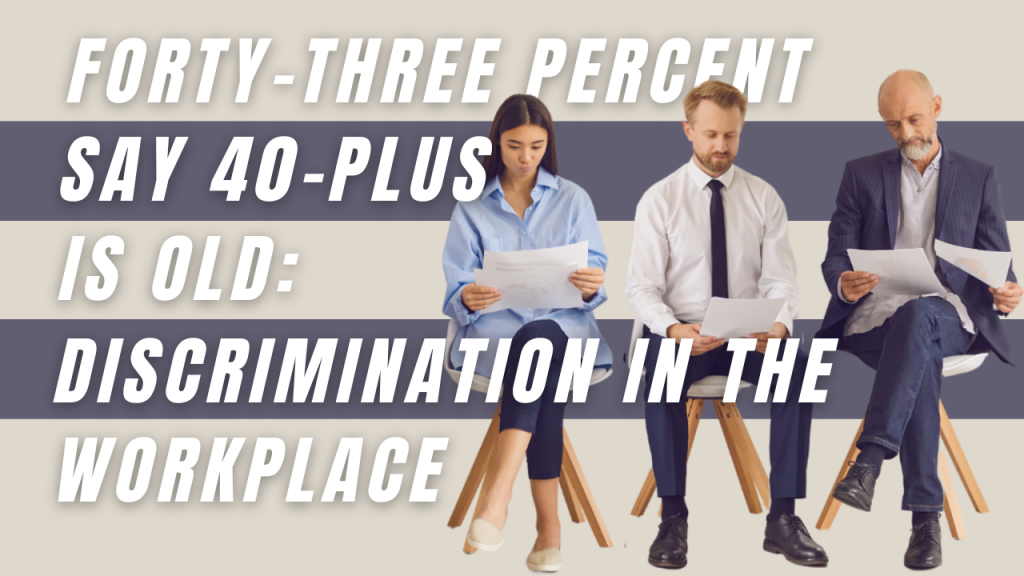
Forty-Three Percent Say 40-Plus Is Old

Age Discrimination in the Workplace is Real

GUEST POST from Shep Hyken

Diversity, equity and inclusion, known as DEI, is a popular yet sensitive topic in the workforce today. Leadership and HR that recognize this are finding ways to ensure employees from all races, ethnicities, abilities, sexual orientations, religions, etc., are represented. Sometimes included, but often left out, is age.

Age shows no color, race, religion, sex, etc. It just is. People get older, and as they do, workplace biases may become evident. It’s important to be aware of this issue. A 2022 study by LiveCareer, ‘Older People & the Workplace’, revealed some intriguing findings regarding age-related stereotypes and discrimination. More than 1,000 workers were surveyed to “investigate their opinions about older people in the workplace.”

Eight in ten respondents claimed age stereotypes were still alive in the workplace.

What is considered old? Forty-three percent of those surveyed said 40-plus is old. Twenty-six percent said 50-plus is old. And 21% said 60-plus is old. So, if you are 50, with probably 15 or more years until retirement, 69% of the people you work with think you are old.

Here are some more findings from LiveCareer’s study to get you thinking about how your organization treats aging employees:

  • 74% of the respondents aged 50-plus said they had been fired because of their age.
  • 86% aged 50-plus felt that most job postings were addressed to people younger than them.
  • 72% of respondents claimed that older employees were a target for workplace bullying.
  • 77% of the respondents said: I haven’t been hired for a job because of my age.
  • 69% said: I’m afraid to lose my job because of my age.

If over 50 is old, then leadership is … old. According to Zippia, there are over 38,700 CEOs currently employed in the U.S., and their average age is 52 years old. If you look at the Fortune 500, the average age of a CEO is 57. Several companies on the Fortune list are run by CEOs ranging from 71 to 91!

Consider the age of the most powerful executives in the United States. President Biden was 78 when he became president. Donald Trump was 70. Barak Obama seems like a baby considering he entered the Oval Office when he was just 47. The overall average age of a United States president entering office is 56 (almost 57).

Some companies and brands are taking a proactive position against age discrimination. Dove and Wendy’s in Canada reacted to CTV news firing Canadian news anchor Lisa LaFlamme for letting her hair go gray. Dove Canada responded with a #KeepTheGrey campaign on its social media postings. They wrote, “Age is beautiful. Women should be able to do it on their own terms, without consequences.” Wendy’s tweeted, “Because a star is a star regardless of hair color.”

Companies are evaluating their retirement policies, recognizing the value of older employees. Target recently announced it is eliminating the mandatory retirement age of 65. Its current CEO, Brian Cornell, will be turning 64 on his next birthday, and Target doesn’t seem ready to start planning for his successor. While Target’s reason for changing the policy may seem self-serving, you can’t ignore that they have come to realize the value in keeping their best employees, regardless of age. Other major companies like 3M, Merck and Boeing are also changing their policies on mandatory retirement.

The OECD (Organization for Economic Co-operation and Development), an international group of economists based in Paris, with more than 38 member countries, predicts that by 2050, more than four in ten individuals (that’s 40%) in the world’s most advanced economies are likely to be older than 50. The workforce is aging even more rapidly as younger people are starting work at an older age, and older people are staying employed.

We’re not getting any younger. We’re older today than yesterday, both in life and at work. We can’t fight that. It’s just a fact, and you can’t ignore it. The U.S. Bureau of Labor Statistics shows the workforce is also getting older. In 2000 the average age of a worker in the U.S. was 39.3. In 2010, that jumped to 41.7. In 2020, it increased to 42.8.

Despite these changes and observations, age bias still exists. It needs to be considered—and eradicated—the same as other DEI issues.

This article originally appeared on Forbes

Image Credit: Pixabay

Subscribe to Human-Centered Change & Innovation WeeklySign up here to get Human-Centered Change & Innovation Weekly delivered to your inbox every week.

Mindfulness for Mavericks

Finding Calm in the Chaos of Innovation

Mindfulness for Mavericks - Finding Calm in the Chaos of Innovation

GUEST POST from Art Inteligencia

The world of the innovator — the Maverick — is inherently chaotic. It is defined by relentless speed, constant pivoting, the terror of the unknown, and the inevitable sting of failure. For too long, we have celebrated the myth of the stressed-out, high-octane leader who fuels breakthrough with sheer exhaustion and adrenaline. But this model is not only unsustainable; it is strategically deficient. Exhausted minds make predictable mistakes, miss subtle signals, and react impulsively. As a human-centered change and innovation thought leader, I argue that the single most powerful, yet overlooked, strategic tool for any innovator is Mindfulness — the non-judgmental awareness of the present moment. Mindfulness is not a “soft” wellness trend; it is the hard skill required to cultivate clarity, enhance resilience, and make smarter, more ethical decisions in the face of constant organizational chaos.

Innovation lives in the space between stimulus and response. When an unexpected challenge arises — a competitor’s sudden move, a prototype failure, or a market rejection — the unmindful leader reacts based on fear, bias, or past trauma. The mindful leader, however, creates a brief, intentional pause. This pause is where wisdom resides. It allows them to observe the emotional surge without being hijacked by it, ensuring that their response is strategic and deliberate, not emotional and reactionary. The capacity to be fully present, focused, and non-reactive is, therefore, the core competitive advantage in any fast-moving market. Calm is the new creativity.

Mindfulness as a Strategic Capability

Embedding mindfulness into the innovation culture is not a matter of employee benefit; it is a strategic imperative that directly impacts your bottom line and your capacity for disruptive thought. Here is why it belongs on the strategy table:

  • Reduces Cognitive Bias: Innovation is plagued by confirmation bias and anchoring bias. Mindfulness trains the brain to observe thoughts, feelings, and assumptions as temporary phenomena, not as absolute truths. This ability to decenter from one’s own immediate judgments is vital for seeing new solutions and avoiding fatal strategic blind spots.
  • Accelerates Resilience: Failure is oxygen for innovation. Mindfulness equips teams to process setbacks faster. By practicing non-judgmental observation, innovators learn to treat failure not as a personal crisis, but as neutral data — a valuable data point that requires analysis, not anguish. This allows for quicker pivots and less wasted time mourning a failed concept.
  • Enhances Deep Listening: Human-centered innovation demands empathy. Mindfulness sharpens our ability to listen—not just to the words being said in a user interview, but to the unspoken emotions, the subtle body language, and the unarticulated needs. This deep listening capability is the raw fuel for breakthrough insights.

“The mind is not a vessel to be filled, but a fire to be stoked. Mindfulness is the bellows that focuses the flame.” — Braden Kelley (author of Stoking Your Innovation Bonfire)


Case Study 1: Google’s Search Inside Yourself (SIY) Program – Institutionalizing Calm

The Challenge:

Even at a place like Google, where technical brilliance is abundant, high pressure, rapid scaling, and information overload were creating burnout and hindering effective cross-functional leadership. The challenge was finding a way to enhance emotional intelligence and focus that was rigorous, scientific, and acceptable to a highly analytical culture.

The Mindfulness Solution:

In 2007, Google launched Search Inside Yourself (SIY), a now-famous program pioneered by engineer Chade-Meng Tan. It was a six-week course designed not just for “wellness,” but explicitly to enhance emotional intelligence, self-awareness, and focus through mindfulness training. The program used neurological data and a practical, secular approach to teach engineers and leaders how to manage stress and respond more skillfully to complex workplace situations. By linking mindfulness directly to measurable outcomes like improved collaboration and reduced conflict, the program integrated it as a strategic leadership tool.

The Human-Centered Result:

SIY proved that institutionalizing mindfulness could be scaled, even in the most demanding tech environments. The program fostered a generation of leaders better equipped to handle ambiguity and lead with empathy. It demonstrated that by training the mind to be calm and present, you directly improve the capacity for high-stakes problem-solving and sustainable innovation—making it a core capability, not a peripheral perk.


Case Study 2: Tactical Mindfulness in High-Stakes Environments – The Intentional Pause

The Challenge:

In fields where chaos is the norm—such as emergency medicine, aviation, or high-level tactical operations—decision-making must be instantaneous, precise, and free of panic. A sudden system failure in a cockpit or a rapid-fire sequence of events in a surgical theater demands peak cognitive performance under immense stress. Traditional training focuses on technical checklists, but often fails to address the cognitive breakdown that occurs when fear takes over.

The Mindfulness Solution:

High-reliability organizations, from Navy SEALs to commercial aviation safety experts, increasingly incorporate elements of Tactical Mindfulness into their training. This is not about long meditation sessions; it is about practicing the Intentional Pause. Techniques like “Box Breathing” or a quick “Sensory Scan” (grounding oneself by noting five things they can hear, see, or feel) are used to rapidly interrupt the panic cycle. This returns the prefrontal cortex—the rational decision-making center—to control. The goal is to maximize the time between the chaotic stimulus (e.g., a warning light) and the response, ensuring the action is deliberate and based on training, not terror.

The Human-Centered Result:

This application of mindfulness strips away any lingering stigma and positions it as a non-negotiable performance multiplier. By cultivating the capacity for calm under fire, these professionals significantly reduce error rates. This translates directly to the innovation world: the ability to execute an intentional pause when a major product launch fails, or a critical pivot is required, ensures the team moves from crisis to calculated action with speed and clarity—the very definition of resilient innovation.


Conclusion: The Ultimate Future-Proofing Skill

Mindfulness is the ultimate tool for FutureHacking. It allows the Maverick to rise above the noise of the market and the internal anxiety of their own ambition, creating the necessary cognitive space to see truly disruptive opportunities. Leaders must recognize that their most powerful asset is the clarity of their team’s attention. By modeling and supporting mindfulness, you are not just offering a pathway to reduced stress; you are building an organization that is inherently more focused, more empathetic, more resilient, and ultimately, more capable of sustainable innovation.

The time has come to stop chasing the next distraction and start prioritizing the depth of your presence. The future of change belongs not to the fastest to react, but to the most skilled at pausing. Find the calm within the chaos, and you will find the answers you seek.

Extra Extra: Futurology is not fortune telling. Futurists use a scientific approach to create their deliverables, but a methodology and tools like those in FutureHacking™ can empower anyone to engage in futurology themselves.

Image credit: Wikimedia Commons

Subscribe to Human-Centered Change & Innovation WeeklySign up here to get Human-Centered Change & Innovation Weekly delivered to your inbox every week.

Using Leading and Lagging Indicators to Drive Your Business Forward

You get what you measure, so make sure you’re tracking the right things.

Using Leading and Lagging Indicators to Drive Your Business Forward

GUEST POST from Soren Kaplan

I’ve seen a lot of organizations create strategies, programs, and projects focused on optimizing operations, streamlining processes, and driving innovation. Leadership teams put lots of energy coming up with the next big thing. But amazingly few teams think about how they’ll measure results. They may say they want revenue growth or cost savings, but that’s about the extent of it. Digging into the details by defining the specific metrics that will help track progress and forecast whether they’re going to achieve their goals in the future often gets neglected.

I’ve used this Key Performance Indicators template to address this challenge. Here’s the basis of why it’s important to use KPIs for your strategy and innovation initiatives, and how to use the template.

Strategy Without Successful Execution Is Just Brainstorming

Between developing strategy and executing it, there’s a step that requires creativity coupled with analytical thinking. It’s defining leading and lagging indicators. Many manufacturing companies and organizations that embrace Six Sigma know the importance of the metrics. Metrics help you quantify success, so you know when you’re achieving it and when you’re not.

Most companies focus on lagging indicators, like how much revenue they made in the last quarter, how many products they sold, or how many new customers they acquired. That’s important information, but those measures are obtained by looking in the rear-view mirror of what’s already happened. In addition to these things, you also need leading indicators to help you predict what will happen in the future. Here’s how to use both of these indicators to translate strategy into tangible implementation plans.

Leading Indicators Help You Predict the Future

Leading Indicators predict how you will perform in the future. They are more easily managed than lagging indicators but are harder to define. For example, if you’re looking to increase sales, you might measure the number of emails you send or sales calls you make. If you know that one in 10 calls results in a sale, the more contacts you make, the higher your sale forecast. Same goes for if you’re running a manufacturing organization. Leading Indicators for a manufacturing plant might include number of incidents that cause production slowdowns or the availability of specific materials in the supply chain.

Lagging Indicators Tell You How You Did

Lagging Indicators are easier to measure because they quantify what happened in the past. For example, a lagging indicator for sales would be measuring the number of products sold last month or number of new customers that signed up for a service. This information is usually easy to obtain and measure. Lagging Indicators are essential for charting progress but are not necessarily that helpful when looking at the inputs needed for achieving your overall desired results.

Create Your Dashboard

If you want innovation, reduced costs, and greater performance, you need to figure out how to do it, and what it looks like when you get it. Creating a set of lagging indicators gives you targets to achieve. But lagging indicators without leading indicators won’t provide focus around what to do–or early warning signals that things might be off track. If you’re manufacturing products, for example, if you’re not measuring whether your suppliers are delivering your materials on time, you might get surprised one day when you realize you don’t have the raw materials you need to achieve your manufacturing targets.

Here’s how to create a simple dashboard that contains both leading and lagging indicators:

  1. Convene your team and identify the specific quantifiable targets that you need to achieve (your lagging indicators). Ask: What does success look like and how do we measure it?
  2. Once you have your lagging indicators, define the inputs needed to achieve them. Ask: What specific things need to happen for us to achieve these targets and how do we measure those things? (your leading indicators)
  3. With your lagging and leading indicators defined, use specific tools to gather and report on your data, whether a spreadsheet or online dashboard.

Management guru Peter Drucker once said, “What’s measured, improves.” If you want to improve your processes and business, figure out what you’re measuring. If you measure only the outputs (lagging indicators), your success will be far less predictable than if you’re also measuring the things that will get you where you want to go.

Image Credit: Praxie.com

This article was originally published on Inc.com and has been syndicated for this blog.

Subscribe to Human-Centered Change & Innovation WeeklySign up here to get Human-Centered Change & Innovation Weekly delivered to your inbox every week.