The Synthetic Organization

The Incredible Shrinking Corporation – An AI Soft Landing Scenario

LAST UPDATED: June 26, 2026 at 5:21 PM
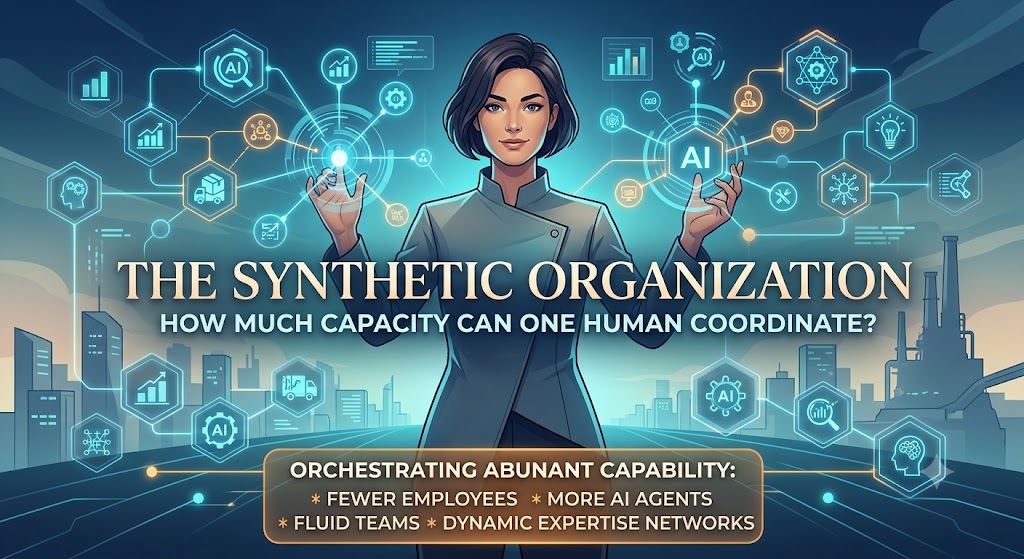
The Synthetic Organization

by Braden Kelley and Art Inteligencia


The Incredible Shrinking Corporation

Hot Take: The corporation may not disappear. It may shrink.

For decades, enterprise growth has been inextricably linked to headcount. The dominant narrative surrounding artificial intelligence — the “Hard Landing” — paints a dystopian picture of mass white-collar unemployment, displacement, and economic stagnation. But this view suffers from a lack of architectural imagination.

There is an alternative path: The AI Soft Landing Hypothesis. In this future, the fundamental equation of organizational scale is rewritten. We are entering the era of The Synthetic Organization, where the traditional corporate structure doesn’t collapse under the weight of automation — it compresses.

The core paradigm shift moves us away from the legacy question of the industrial age: “How many employees does a company need to scale?” Instead, innovation leaders must ask the defining question of the agentic era: “How much organizational capacity can a single human coordinate?”

Anatomy of the Synthetic Organization

The Synthetic Organization represents a fundamental departure from the traditional, siloed corporate hierarchy. It is a hybrid model built for speed, agility, and cognitive leverage — redefining what it means to build an enterprise in the age of agentic AI.

The Core Architecture

Rather than replacing humans, this model wraps advanced technology around them. The infrastructure is built on three pillars:

  • The Human Core: A lean team of strategic leaders, experience designers, and empathetic change agents who provide vision, governance, and ethical guardrails.
  • The Agentic Layer: Autonomous AI agents designed to handle specific domains — from market analysis and code deployment to real-time customer experience optimization.
  • The Operational Fabric: The connective tissues and APIs that allow these agents to collaborate, share data, and hand off tasks seamlessly.

The 10x Operational Math

In this new paradigm, traditional resource constraints evaporate. A 20-person company is no longer limited to boutique output. By orchestrating thousands of specialized AI agents, a small team can match the operational bandwidth, market research capabilities, and creative output of a traditional 200-person organization.

Fluidity Over Hierarchy

The rigid corporate ladder is replaced by a dynamic, decentralized network. Instead of static departments (e.g., Marketing, HR, Finance), the organization spins up fluid project teams and dynamic expertise networks on demand. When a market opportunity arises, the human orchestrator configures the necessary AI agents to execute, iterate, and dissolve the workflow once the objective is met.

The Soft Landing: The Great Entrepreneurial Explosion

The transition to the Synthetic Organization introduces a vital counter-narrative to the fear of structural unemployment. When the overhead required to run an enterprise plummets, the barrier to market entry vanishes. We are on the precipice of an unprecedented explosion in human entrepreneurship.

Democratizing Scale

Historically, corporate giants maintained their dominance through massive capital reserves, vast global supply chains, and overwhelming human headcount. Agentic AI levels this playing field. Because a small team can now command the organizational capacity of a legacy enterprise, capital-intensive scale is no longer a prerequisite for market disruption. The advantage shifts from the biggest player to the most agile creator.

The Rise of the Micro-Enterprise

Rather than a jobless future, the AI soft landing shifts the labor landscape toward specialized, hyper-efficient micro-enterprises. Displaced corporate professionals will pivot to form boutique agencies, niche consultancies, and specialized technology startups. Supported by an ecosystem of interconnected AI agents, these lean outfits will manage everything from lead generation to service delivery with minimal overhead.

Asymmetrical Competition

This structural shift triggers a new era of asymmetrical competition. Small, human-centric teams — unburdened by corporate bureaucracy, legacy systems, or multi-layered approval chains — can identify market gaps, pivot strategies, and launch innovative customer experiences in days rather than quarters. Legacy organizations will no longer just compete with traditional sector rivals; they will find themselves competing against a vast, highly adaptive swarm of micro-innovators.

The Human-Centered Imperative: The Role of the Orchestrator

As the execution of routine work transitions to agentic ecosystems, the premium on uniquely human capabilities skyrockets. In a synthetic organization, technology handles the how, leaving humans to deeply design, govern, and anchor the why. The corporate executive must evolve from a manager of people into an architect of ecosystems.

From “Doers” to “Architects”

When tactical execution is automated, human value shifts toward strategic curation, experience design, and empathy. The successful professional is no longer the fastest producer of an artifact, but the most insightful orchestrator of outcomes. Human leaders provide the intentional vision, cultural context, and emotional intelligence that AI lacks, ensuring that business outputs remain resonant and aligned with true human needs.

Change Management for the Synthetic Era

Transitioning to this model requires a profound shift in mindset. Organizations cannot simply mandate the use of AI; they must actively guide workers through the psychological transition of letting go of legacy tasks. Change leaders must design upskilling pathways that transform traditional contributors into governors of digital networks, mitigating the friction and resistance that naturally accompanies structural evolution.

Designing the Employee Experience (EX)

In a heavily automated environment, maintaining a vibrant, purposeful culture is a distinct challenge. Human-centered design must be applied internally to ensure that the employees who remain do not feel isolated or mechanized by the surrounding AI layer. Organizations must deliberately construct an employee experience that prioritizes psychological safety, fosters genuine human connection, and elevates creative fulfillment as the ultimate benchmark of corporate health.

The Ultimate Edge Case: The “AI Twin” and the Autonomous Enterprise

Beyond the hybrid team lies the frontier of organizational design: the creation of a fully operational, autonomous “AI Twin” of the enterprise. This is not merely a passive simulation or a predictive model; it is a parallel digital reflection of the company capable of operating, experimenting, and iterating continuously without direct human intervention.

Decoupling the Digital from the Physical

The AI Twin governs the entirely digital value chain of the organization — managing data ingestion, continuous optimization of software systems, automated marketing loops, and real-time financial balancing. When its operations interface with the physical world, it bypasses the need for internal corporate infrastructure. Instead, the autonomous twin dynamically contracts, outsources, and triggers API-driven actions within global supply chains, third-party logistics, and on-demand physical services.

The Strategic Sandbox and Continuous Innovation

For innovation leaders, this autonomous twin serves as the ultimate strategic sandbox. While the human core focuses on long-term vision and relational experience design, the AI Twin can rapidly test hundreds of parallel micro-strategies, simulate competitive threats, and launch digital products in live, controlled environments. It acts as a high-velocity learning loop, identifying market anomalies and proving out operational efficiencies before they are integrated into the primary corporate framework.

The Coexistence Challenge

Deploying an autonomous twin introduces a profound change management and governance paradox. Leaders must intentionally design the connective tissue between high-speed autonomous operations and deliberate human strategy. The goal is to ensure the AI Twin remains an amplifier of human intent rather than an unmoored corporate autopilot, establishing strict ethical guardrails and regular strategy synchronization intervals to keep the digital and human cores fundamentally aligned.

Conclusion: Designing a Future of Abundant Capability

The Ultimate Takeaway: The Synthetic Organization is not a blueprint for doing less with fewer people. It is a framework for enabling small, hyper-focused groups of humans to achieve unprecedented scale, impact, and agility. The compression of corporate size is not a sign of decay, but of ultimate optimization.

As we navigate this transition, we must resist the old industrial urge to view artificial intelligence purely as a tool for headcount reduction and cost-cutting. Treating AI merely as an efficiency play is a failure of leadership. Instead, visionary executives must view agentic ecosystems as vehicles for human empowerment, liberating talent from administrative friction so they can focus on what they do best: creating meaningful experiences, driving breakthrough innovation, and building authentic relationships.

Call to Action

The transition toward a soft landing will not happen by accident; it must be designed. Business leaders, change agents, and innovators must act today to:

  • Redefine Roles: Begin shifting job descriptions away from tactical execution and toward strategic ecosystem orchestration and experience design.
  • Architect the Infrastructure: Start experimenting with fluid, agent-supported project networks and pilot testing localized “digital twins” to build organizational adaptability.
  • Commit to Human-Centered Governance: Establish the ethical guardrails and psychological safety nets required to guide teams through this structural evolution without losing organizational soul.

The future belongs to those who build organizations that are smaller in headcount, but infinitely larger in capability.

Frequently Asked Questions

What exactly is a “Synthetic Organization”?

A Synthetic Organization is a highly agile, human-centered enterprise architecture. Instead of relying on massive human headcount and rigid hierarchies to achieve scale, it features a lean core team of human leaders who architect, guide, and orchestrate a fluid network of specialized AI agents and dynamic expertise networks.

Does this hypothesis imply mass white-collar unemployment?

No, that is the “hard landing” scenario. The AI Soft Landing Hypothesis suggests that as the overhead and capital required to scale an enterprise plummet, we will see an explosion of entrepreneurship. Displaced professionals will pivot to form highly efficient micro-enterprises and boutique agencies, using agentic AI to compete directly with legacy giants.

What is the difference between an “AI Twin” and a traditional digital twin?

Traditional digital twins are passive models used to monitor physical assets, like factory machinery. An operational “AI Twin” of an organization is an active, autonomous edge case. It runs entirely digital value chains, tests parallel micro-strategies, and interacts with the physical world through automated contracting and API-driven outsourcing—operating independently while remaining anchored to human strategic guardrails.


Operationalize Organizational Empathy

Ready to Bridge the Gap Between Technology and Human Experience?

Technology only provides capability; human adoption creates the value. If you want to move past cold operational metrics and design fear out of your transformation, let’s connect. Get expert guidance on architecting impactful Experience Level Measures (XLMs) or establishing a dedicated Experience Management Office (XMO) tailored to your culture.

EDITOR’S NOTE: This is a visualization of but one possible future. I will be publishing other possible futures as they crystallize in my mind (or as you suggest them for me to explore).

Image credits: Google Gemini

Content Authenticity Statement: The topic area, key elements to focus on, etc. were decisions made by Braden Kelley, with a little help from Google Gemini to clean up the article, add images and create infographics.

Subscribe to Human-Centered Change & Innovation WeeklySign up here to get Human-Centered Change & Innovation Weekly delivered to your inbox every week.

4 Simple Rules That Make You Exponentially More Effective and Productive

4 Simple Rules That Make You Exponentially More Effective and Productive

GUEST POST from Greg Satell

Shortly after I first arrived at college, my wrestling coach told my teammates and me that we would all be attending a freshman technique camp. It turned out to be something quite different than what I had expected. He didn’t teach us any advanced or esoteric method, but instead demonstrated the basics.

It was incredibly humbling. The fact that we were there in the first place, competing for a Division 1 program, meant that we had all demonstrated outstanding accomplishment. And now we were supposed to revisit the stuff we learned in peewee programs? It seemed insulting at first, but turned out to be one of the best lessons I’ve ever learned.

The truth is that in any endeavor, you are only as good as your fundamentals. While it’s easy to get enamored with grand strategies and fancy tactics, whether you succeed or fail is far more likely to depend on doing simple, basic things consistently well. In much the same way, I’ve found that simple rules can, if applied sensibly, help make you incredibly effective.

1. Play, “Hey Jude”

Paul McCartney wrote hundreds of songs in his career. Many were hits, but others were more obscure. One that was sure to please crowds was the classic “Hey Jude.” He first wrote the song in 1968, to comfort five-year old Julian Lennon during his parent’s divorce and I’m sure that over the years the former Beatle got tired of singing it. But he continued to perform it because he knew that’s what his fans wanted.

Clients often ask me whether I can create a new keynote or a workshop for them. Michael Port, a top coach in the speaking industry, explains why that is almost always a bad idea. Would you like a doctor to perform the same surgery on you that she has successfully done hundreds of times before, or try something different this time?

One of the things that has amazed me over the years, in myself and in others, is our urge to do something different for difference’s sake. Doing the same old thing time and time again gets boring, which is why as successful high school wrestlers we wanted to learn fancier techniques and didn’t focus on our fundamentals as we should have.

We need to learn to play our own personal “Hey Jude’s.” It may seem old and tired, but it’s what we’re good at and, if it does the job we need it to, we should keep at it. That doesn’t mean we don’t continue to experiment and learn new things. But we have to remember to always play the hits.

2. Talent Is Overrated

One of the most common questions I get asked by senior managers is “How can we find more innovative people?” I know the type they have in mind. Someone energetic and dynamic, full of ideas and able to present them powerfully. It seems like everybody these days is looking for an early version of Steve Jobs.

Yet the truth is that today’s high value work is not done by individuals, but teams. It wasn’t always this way. The journal Nature noted that until the 1920’s most scientific papers only had a single author, but by the 1950s that co-authorship became the norm and now the average paper has four times as many authors as it did back then.

To solve the kind of complex problems that it takes to drive genuine transformation, you don’t need the best people, you need the best teams. That’s why traditional job descriptions lead us astray. They tend to focus on task-driven skills rather than collaboration and human skills. We need to change how we evaluate, recruit, manage and train talent.

Talent isn’t something you hire or win in a war, it’s something you empower. It depends less on the innate skills of individuals than how people are supported and led. As workplace expert David Burkus puts it, “talent doesn’t make the team. The team makes the talent.” Skills and teamwork are developed over time.

So if you’re disappointed with the level and talent in your organization, the questions you need to ask are: “How can I better empower people to do their best work?” “What do I reward and what do I punish?” “Am I asking people to do what I want or inspiring them to want what I want?”

3. Find A “Hair on Fire” Use Case

Good operational managers learn to identify large addressable markets. Bigger markets help you scale your business, drive revenues and allow you to invest back into operations to create more efficiency. Greater efficiencies lead to fatter profit margins, which allow you to invest even more on improvements, creating a virtuous cycle.

Yet when you are doing something new and different, trying to scale too fast can kill your business even before it’s really gotten started. A truly revolutionary product is unpredictable because, by its very nature, it’s not well understood. Charging boldly into the unknown is a sure way to run into unanticipated problems that are expensive to fix at scale.

A better strategy is to identify a hair on fire use case — someone who needs a problem fixed so badly that they are willing to overlook the inevitable glitches. They will help you identify shortcomings early and correct them. Once you get things ironed out, you can begin to scale for more ordinary use cases.

For example, developing a self-driving car is a risky proposition with a dizzying amount of variables you can’t account for. However, a remote mine in Western Australia, where drivers are scarce and traffic nonexistent, is an ideal place to test and improve the technology. In a similar vein, Google Glass failed utterly as a mass product, but is getting a second life as an industrial tool. Sometimes it’s better to build for the few than the many.

4. Anticipate Failure

Starting a new venture or initiative is always exciting. Pregnant with possibility and hope, the sky seems like the limit and the last thing you want to think about is things going wrong. Yet neglecting to anticipate failure is one sure way to decrease your chances of success.

That’s why when we first start working with a team on an organizational transformation, we ask them to imagine someone possessed by an evil demon. How would such a person try to derail the initiative? What dirty tricks might they pull? What would they lie about? We ask this not because we think that there’s actually people possessed by evil demons, but because it helps executives imagine things that could go wrong

There is, in fact, no shortage of tools that can help to uncover flaws in your plans. Pre-mortems force you to imagine specific ways a project could fail. Red Teams set up a parallel group specifically to look for flaws. Howard Tiersky, CEO of the digital transformation agency From Digital and author of the Wall Street Journal bestseller Winning Digital Customers, often uses de Bono’s Six Thinking Hats to help the team take different perspectives.

When we deconstruct failed initiatives, the problem is rarely one of ambition, energy, hard work or even acumen, but rather a lack of imagination. You can evaluate and analyze all you want, but chances are what kills your venture or initiative will be something that you didn’t see coming and didn’t account for.

For any significant endeavor, learning to anticipate failure is a key success skill. Or, as Andy Grove put it: “Success breeds complacency. Complacency breeds failure. Only the paranoid survive.”

— Article courtesy of the Digital Tonto blog
— Image credit: Pexels

Subscribe to Human-Centered Change & Innovation WeeklySign up here to join 17,000+ leaders getting Human-Centered Change & Innovation Weekly delivered to their inbox every week.

Ten Signs You Need a Customer Experience Audit

Ten Signs You Need a Customer Experience Audit

by Braden Kelley and Art Inteligencia


The Silent Churn: Why Business-Centric Operations Blind Us to Customer Reality

The silent killer of modern businesses isn’t a flawed product; it’s a friction-filled experience that slowly alienates customers without management ever realizing it. Companies often pour millions into product development, marketing campaigns, and sales pipelines, only to watch customer loyalty bleed out through a thousand unmapped micro-frictions. When metrics begin to slip, the instinct is often to look inward — to optimize processes, cut costs, or push harder sales targets. However, fixing an experience problem with operational pressure only accelerates the decline.

Shifting the Lens: From Internal Systems to Human-Centered Design

The core vulnerability for most organizations lies in their viewpoint. It is natural to look through the company’s lens, evaluating success based on internal milestones, department-specific KPIs, and system efficiencies. But your customers do not care about your organizational chart, your legacy software limitations, or your internal workflows. They care about their own time, their own goals, and how effortlessly your business helps them achieve them. True human-centered design requires shifting from an inside-out mentality to an outside-in perspective, evaluating every touchpoint based on human behavior, emotion, and cognitive load rather than operational convenience.

The Purpose of an Audit: Diagnosis, Empathy, and Alignment

This is where a Customer Experience (CX) Audit becomes vital. Far from a finger-pointing exercise or a bureaucratic compliance check, a CX audit is a rigorous, empathetic diagnostic tool. It is designed to dismantle assumptions, expose the gaps between what a company *thinks* it delivers versus what the customer *actually* experiences, and align the entire organization around a unified journey. Identifying whether your business is suffering from these hidden friction points is the first step toward building sustainable, customer-led growth.

Ten Signs You Need a Customer Experience Audit

Recognizing when an organization’s internal processes have decoupled from customer expectations is critical. The following ten warning signs indicate that systemic friction is eroding value and that a comprehensive customer experience diagnostic is required.

1. The “Metric Paradox” (High CSAT, Dropping Retention)

Operational dashboards show excellent customer satisfaction (CSAT) scores or high Net Promoter Scores (NPS), yet contract renewals, repeat purchases, or customer lifetime value (LTV) are steadily declining. This paradox occurs when metrics evaluate isolated, transactional touchpoints rather than the cumulative, end-to-end journey. Customers may be satisfied with a specific support interaction but entirely frustrated by the overall relationship.

2. Cross-Departmental Finger Pointing (The Silo Effect)

When customer satisfaction drops or friction surfaces, internal teams retreat into functional silos. Marketing blames Sales for setting improper expectations, Sales blames Product for missing capabilities, and operations blames Customer Support for failing to retain accounts. When an organization’s internal structure dictates the customer journey, the customer is forced to act as the integrator, piecing together a fragmented, inconsistent relationship.

3. Rapidly Escalating Customer Support Costs

Customer support ticket volumes, live chat queues, and operational costs are outstripping overall customer acquisition or revenue growth. When frontline teams are consistently overwhelmed by repetitive, basic procedural questions, it signals a systemic failure in proactive communication, self-service infrastructure, or initial onboarding design.

4. The “Feature-Rich, Adoption-Poor” Product

The organization continuously ships highly requested product features, digital enhancements, or service updates, yet product telemetry and usage data reveal that customers utilize only a minor fraction of the ecosystem. This indicates a gap between what customers *say* they want during isolated feedback loops and how they actually behave within their day-to-day context.

5. Onboarding is a “Black Box”

A significant percentage of customer churn or user drop-off occurs within the critical first 30 to 90 days following initial conversion. When post-sale momentum stalls, it reveals a lack of structural alignment between the initial marketing promise and the operational reality of delivery, leaving customers without a clear path to achieving their first milestone of value.

6. Your Customer Journey Map Hasn’t Been Updated in Years

The organization relies on historical customer personas, idealized flowcharts, or journey maps developed years ago. In rapidly evolving markets, customer behaviors, environmental pressures, and digital expectations shift continuously. Relying on outdated assumptions ensures that operational models remain optimized for a customer base that no longer exists.

7. Over-Reliance on “Discounting” to Win Back Customers

The primary mechanism for retaining accounts, securing contract renewals, or winning back lapsed customers relies heavily on price concessions, promotions, or fee waivers. When financial discounting becomes the default retention strategy, it demonstrates that the experience itself has failed to provide a meaningful, non-commodity differentiator.

8. “Ghosting” After the Initial Touchpoint

Marketing funnels successfully generate high digital traffic, inbound inquiries, or initial sign-ups, but conversion rates to the next meaningful milestone are low. This drop-off indicates that micro-frictions—such as confusing interface copy, excessive form fields, or slow operational response times — are killing engagement before trust can be established.

9. Customer Feedback is Reactive, Not Proactive

Customer insights are derived exclusively from trailing indicators, such as public reviews, escalation tickets, or formal cancellation notices. Lacking continuous, human-centered listening posts across key milestones leaves an organization permanently reactive, fixing broken experiences after damage to customer sentiment is already permanent.

10. Employees are Burned Out and Disengaged

Frontline customer success, account management, and support teams experience high turnover, low morale, or systematic disengagement. Because employee experience (EX) mirrors customer experience, a team that lacks adequate tools, clear data pathways, or operational autonomy will inherently project that frustration directly onto the customer base.

Download the 10 Signs You Need a CX Audit Flipbook

Download the Flipbook

Demystifying the Process: What Happens During a Customer Experience Audit?

A human-centered customer experience audit is not a theoretical exercise; it is an active, cross-functional diagnostic designed to uncover operational friction and hidden human insights. By combining behavioral observations with systemic data, the audit establishes an objective reality of how your organization interfaces with the market. The methodology focuses on three primary pillars:

1. Heuristic Evaluation and Journey Walkthroughs

This phase requires shedding internal assumptions and experiencing the organization exactly as a customer does. Auditors conduct meticulous journey walkthroughs — often utilizing mystery shopping methodologies across both digital and physical touchpoints. Every step of the lifecycle is evaluated, from the initial search and purchasing process to onboarding, billing, support, and account renewal. This captures the micro-frictions, confusing interfaces, and inconsistent messaging that traditional internal reporting fails to catch.

2. Data Triangulation: Quantitative Metrics Meet Qualitative Insights

Data without context leads to false assumptions, while feedback without data leads to unscalable solutions. A rigorous audit triangulates multiple data streams to find the ground truth:

  • Quantitative Operational Data: Analyzing product telemetry, support ticket trends, drop-off rates, behavioral analytics, and time-to-value metrics.
  • Qualitative Human Insights: Conducting deep-dive user interviews, direct ethnographic observations, and empathy-mapping sessions with actual customers.
  • Internal Stakeholder Feedback: Interviewing frontline employees to uncover the broken back-end tools and siloed processes that directly impact customer delivery.

3. The Friction Inventory and Strategic Prioritization

The ultimate deliverable of a customer experience audit is a comprehensive Friction Inventory. Rather than a simple list of problems, identified gaps are categorized and mapped against a matrix of operational effort and customer impact. This ensures leadership walks away with an actionable, phased roadmap: prioritizing immediate “quick wins” that relieve acute pressure on the customer, while outlining the structural, cross-departmental redesigns required for sustainable, long-term growth.

Beyond Diagnosis: Activating the Audit with Proven Innovation Frameworks

Identifying the ten signs of customer experience decay is only half the battle. A successful audit does not just live in a static PDF report; it must serve as a catalyst for human-centered change. To transform these audit insights into sustained operational reality, organizations must cross-pollinate CX diagnostics with structured innovation and change management frameworks.

1. Mobilizing the Right Talent: The Nine Innovation Roles

Fixing systemic journey friction requires cross-functional collaboration. Once the audit exposes key gaps, teams can utilize the Nine Innovation Roles framework to assemble the right transformation task force. By intentionally balancing roles—such as the Revolutionary to challenge legacy processes, the Conductor to manage cross-departmental dependencies, and the Empath to safeguard the customer’s emotional reality—organizations ensure that the remediation phase isn’t derailed by traditional corporate inertia.

2. Designing the Solution: The Eight I’s of Infinite Innovation

Resolving complex, deep-seated friction points is an act of continuous creation. The Eight I’s of Infinite Innovation provides the repeatable lifecycle needed to scale audit findings. Teams move systematically from Intent and Insight (fully realized during the audit) into Ideation, Evaluation, and Investigation of potential journey fixes. This prevents organizations from rushing into superficial “band-aid” fixes and instead drives them toward deep, human-centered architectural improvements.

3. Overcoming Internal Resistance: The Change Planning Toolkit

The greatest barrier to fixing a broken customer experience isn’t technology; it is internal human resistance to changing legacy workflows. If employees are comfortable with the old, siloed way of working, a new CX strategy will fail. Utilizing visual collaboration tools like the Change Planning Toolkit allows cross-functional teams to co-create the blueprint for new customer-centric processes. Moving away from top-down mandates toward participatory innovation drastically reduces internal friction, aligning employee behaviors directly with the desired customer outcomes.

The Path Forward: From Diagnosis to Customer-Led Growth

A customer experience audit is not a confession of organizational failure; it is an active investment in sustainable, customer-led growth. In highly competitive markets, the experience a company delivers becomes its ultimate competitive advantage or its greatest point of failure. Continuing to view customer friction as isolated support tickets or occasional operational anomalies guarantees that your business will continue to bleed value to more agile, human-centered competitors.

Take the First Step

Uncovering systemic friction requires the willingness to look closely at uncomfortable operational truths. You do not need to overhaul your entire enterprise overnight. To begin, gather your leadership team this week and evaluate your performance against just one or two of the ten signs outlined above. Challenge your assumptions, listen deeply to your frontline employees, and commit to looking at your organization through the eyes of the people who matter most—your customers.

Frequently Asked Questions

How often should an organization conduct a customer experience audit?

A comprehensive, deep-dive customer experience audit should be conducted every 12 to 18 months, or immediately following major business inflection points such as a product pivot, a merger, or a significant shift in market dynamics. However, organizations should maintain continuous, lightweight qualitative and quantitative monitoring loops between these formal deep dives to catch micro-frictions early.

What is the difference between a traditional business audit and a CX audit?

A traditional business audit is inside-out, focusing on financial compliance, internal operational efficiency, and system metrics. A customer experience (CX) audit is outside-in and human-centered. It evaluates the organization strictly through the customer’s behavioral and emotional reality, diagnosing gaps where internal operational convenience is actively harming customer retention and value delivery.

How long does a human-centered CX audit typically take to complete?

A standard human-centered customer experience audit typically takes between 4 to 8 weeks, depending on the scale of the organization and the complexity of the customer journey ecosystems. This timeframe allows for thorough journey walkthroughs, data triangulation from operational telemetry, deep-dive customer interviews, and the prioritization of an actionable friction inventory.


1. Why is an independent CX audit better than an internal one?

Internal teams often suffer from the “Curse of Knowledge” — they are so familiar with how things should work that they miss how they actually work for the customer. An independent auditor brings unbiased clarity and the courage to name the structural issues that internal politics might keep hidden.

2. How does Braden Kelley’s approach differ from others?

Most audits look for bugs; Braden Kelley looks for breakthroughs. By applying a human-centered innovation lens, Braden identifies not just where you are failing the customer, but where the customer is signaling a need for a new solution you haven’t built yet.

3. What is the main outcome of this audit?

The primary outcome is Actionable Velocity. You won’t receive a static report; you’ll get a prioritized roadmap that balances immediate experience “quick wins” with long-term strategic innovation goals, ensuring your CX is a driver of growth, not just a line item.

Click here to learn more or to book your CX Audit

Image credits: Gemini

Content Authenticity Statement: The topic area, key elements to focus on, etc. were decisions made by Braden Kelley, with a little help from Google Gemini to clean up the article and add citations.

Subscribe to Human-Centered Change & Innovation WeeklySign up here to get Human-Centered Change & Innovation Weekly delivered to your inbox every week.

Illuminate to Innovate

Illuminate to Innovate

GUEST POST from Janet Sernack

Being consciously innovative involves expanding your awareness and opening your heart and mind to disrupt habitual feelings and thinking, allowing for deeper, more holistic decision-making and innovative problem-solving. It allows us to play in the space of possibility by cultivating consciousness – illuminating the state of being aware of your surroundings, internal thoughts, and subjective experiences. This encompasses everything you perceive, feel, and think, ranging from basic sensory awareness to complex self-reflection, decision-making and problem-solving.  Developing people’s consciousness involves strengthening a person’s ability to sense and connect with awareness-based systems and respond appropriately to achieve desired outcomes. Conscious innovation is a mandatory way of being, thinking, and acting that makes people matter and enables them to survive and thrive in the emerging, uncertain and disruptive world of AI, where leaders must know how to illuminate to innovate.

What is consciousness?

According to Dr Dan Seigal[1], consciousness has two elements that shape a person’s inner state or interior condition. There is the knowing, which is awareness itself. And there are the knowns, which are everything that enters awareness. To integrate consciousness means to differentiate these two elements from each other, and then to differentiate the knowns from one another.

Knowns consist of people’s thoughts, feelings, and memories, while sights, sounds, smells, tastes, and touch bring the outside world in as a constant stream of sensation. They also include intuition, inner wisdom, and awareness of mental and emotional processes, such as memories, beliefs, intentions, and hopes. As well as the relational self, the awareness of connection to other people, to living beings, and to something larger than the individual self.

What is conscious innovation?

Our approach to conscious innovation creates the conditions for individuals and teams to move and focus their attention, develop conscious awareness, and become intentional and passionately purposeful in solving challenging problems. People illuminate to innovate by advancing through the three levels of self to make the world a better place by balancing people, profit, and the planet. 

Conscious innovation integrates the key principles and methodologies of emergence, systems thinking, human-centered design, sustainability and technology to empower people to realize their potential at the intersection of human possibility and technological innovation.

Conscious innovation includes being able to understand and improve a person’s inner state or interior condition, and illuminate to innovate by:

  • Focusing on expanding who they are as human beings by creating the conditions to develop people’s metacognition[2] and brain health[3], enabling them to experience what it means to be responsible, passionately purposeful, and agile, and to build an adaptive capacity to flourish in an uncertain world.
  • Developing an awareness of the potential of cognitive dissonance and harnessing creative tension that enables people to safely learn and grow as humans who act in ways that build their capability to be creative, inventive, innovative and resilient in the face of chaos and disruption.
  • Creating the conditions by clarifying an aligned strategy and developing a safe, trusted, and aligned culture that enables and supports people and teams to collaborate, experiment, and innovate by willingly partnering human potential with AI.

These invisible elements of conscious innovation affect how people interact with, relate to, and lead people and teams; how they communicate, learn, make decisions, solve problems, manage, implement, and embed change; and how they execute innovation or transformational projects and initiatives.

Illuminate to Innovate – The three levels of self

The three levels of self-illustrate the deep learning and change journey involved in illuminating and harnessing human potential on the people side of innovation. At a time when companies are required to rethink the very nature of the corporation, especially how to integrate human accountability with virtual and physical AI agents.

  1. Self-regulation involves developing awareness of one’s automatic responses, understanding their sources and effects on one’s physiology and neurology, owning one’s responses, and ensuring they have a positive impact on oneself and those with whom one interacts.
  2. Self-management involves close observation and management of people’s knowns: being attentively present to neurological and physiological factors, including emotional states, traits, thoughts, feelings, mindsets, behaviours, and skills in how people use time to make decisions, communicate, and resolve business challenges.
  3. Self-leadership involves deepening and illuminating known skills: open awareness, knowledge, and the ability to intentionally master one’s own neurology and physiology, as well as others’, in interactions and challenging situations, to mindfully evaluate and successfully create, invent, deliver, and execute innovative solutions.

The intent is to create strategic and cultural alignment that delivers execution excellence by enabling leaders and engaging people to solve problems in generative ways, consciously prioritizing human relationships through collaboration and experimentation in partnership with AI, and steadily moving towards goals in deliberate, focused, systemic, kind and honorable ways.

What are the benefits of being consciously innovative?

Being consciously innovative involves learning to be, think, and act differently; people learn to stop trying to solve a problem with the same thinking that created it and to stop reproducing the same results they no longer want.

At the same time, the emergence of AI requires a major brain shift to maximize human potential by building foundational cognitive, interpersonal, self-leadership, and technological literacy abilities that enable people to adapt, relate, and contribute meaningfully, integrating an awareness-based systems approach and a holistic focus.

The benefits of being consciously innovative include improving leaders’ and people’s abilities to:

  • Replace short-term, reactive, and conventional linear thinking processes that initially created and now sustain problems, and embrace change as a circular, creative, continuous, and systemic process.
  • Courageously adopt long-term, sustainable strategies for the organization’s growth and the impact it seeks to have on clients or customers and wider communities.
  • Make better-informed decisions by considering potential scenarios, anticipating risks, identifying interdependencies, and making decisions that meet needs while keeping the bigger picture in view.
  • Cease overlaying new structures onto people’s unchanged ways of perceiving and experiencing their world by creating the conditions for people to help people make sense of new structures and processes, show up differently, and take new and right actions.
  • Combine futures thinking and systems thinking, emphasizing ethical considerations, social responsibility, and sustainability.
  • Be empathetic and compassionate by discerning, understanding, and considering the needs, values, and perspectives of all stakeholders involved in a problem or a system, not just those present in a room.
  • Improve people’s capacity to attend, observe, inquire, listen to each other, and differ in generative ways, and to feel empowered to think independently and act differently.
  • Embrace AI strategically, using AI and new technologies to assist, help, and empower human agency, to partner, collaborate, and experiment with AI to rebuild engagement and deliver execution excellence.  

Illuminate to innovate

Being consciously innovative requires actively illuminating and integrating the ways leaders and coaches bring clarity, creativity, compassion, courage, and meaning to their decisions, roles, and teams. This involves expanding your awareness and opening your hearts and minds to disrupt habitual thinking, allowing for deeper, more holistic decision-making and innovative problem-solving. It involves cultivating consciousness – illuminating the state of being aware of your surroundings, internal thoughts, and subjective experiences and encompasses everything you perceive, feel, and think, ranging from basic sensory awareness to complex self-reflection, decision-making and problem-solving.


[1]The Developing Mind (The foundation of Interpersonal Neurobiology) [1]

[2] Metacognition is “thinking about thinking”—the awareness, understanding, and control of one’s own cognitive processes, like learning and problem-solving, to improve performance.

[3]https://www.mckinsey.com/mhi/our-insights/the-human-advantage-stronger-brains-in-the-age-of-ai?cid=mgp_opr-eml-nsl-ofl-mgp-glb–&hlkid=507fe91b220d4915bbcd198daaeb857a&hctky=1766168&hdpid=bfbfe441-95e5-45b4-9dc7-c32cd1789c2f#/

Image Credit: Pexels

Subscribe to Human-Centered Change & Innovation WeeklySign up here to join 17,000+ leaders getting Human-Centered Change & Innovation Weekly delivered to their inbox every week.

The Future of Touchless Precision

Holographic Acoustic Manipulation

LAST UPDATED: June 15, 2026 at 6:13 PM

The Future of Touchless Precision - Holographic Acoustic Manipulation

GUEST POST from Art Inteligencia


Introduction: The End of Mechanical Constraints

We have spent centuries building machines that rely on friction, mechanical contact, and physical wear. What happens when we remove the need to “touch” the objects we manufacture or manipulate? This technology utilizes highly focused, non-contact ultrasound waves to create intricate acoustic fields capable of lifting, rotating, and manipulating microscopic or highly delicate physical objects in mid-air with millimeter precision.

Holographic acoustic manipulation is not just a laboratory curiosity; it is a fundamental shift in how we approach the “physicality” of innovation. By eliminating friction and contamination, we are opening a new frontier in sterile assembly and complex manufacturing. It forces us to reconsider the necessity of mechanical grippers and traditional assembly lines, pushing us toward a future where our operational processes are defined by precision fields rather than physical contact.

II. Redefining the Factory Floor: Sterile, Frictionless, Fluid

The traditional factory floor has always been an environment defined by physical impact, mechanical forces, and material degradation. Transitioning to acoustic fields changes the fundamental unit of manufacturing from kinetic mechanical transfer to wave propagation.

From Assembly Line to Assembly Field

We must envision moving away from rigid, linear conveyor belts and robotic physical grippers. Instead, the future layout is a dynamic, software-defined acoustic manipulation field. In this paradigm, physical components are gently floated, routed, and structurally aligned entirely via invisible, intersecting sound waves, removing the constraints of physical tracks and mechanical wear points.

The “Zero-Wear” Advantage

Every time a mechanical claw grabs a micro-component, it introduces a point of failure, microscopic friction, and material fatigue. Eliminating physical grab points eradicates the primary source of mechanical wear-and-tear on highly delicate or expensive components. This drastically increases part yields and reduces the downtime typically required to recalibrate or replace worn mechanical tooling.

Sterility as a Default State

In high-stakes industries like pharmaceuticals, advanced optics, and next-generation aerospace semiconductors, even a microscopic dust particle or a layer of skin oil can compromise millions of dollars in product. By utilizing acoustic fields, non-contact touchless assembly becomes the baseline reality. Contamination from mechanical lubricants and tool surfaces drops to zero, establishing an unprecedented standard for clean-room execution.

III. The Innovation Angle: Beyond Medicine

While the initial breakthroughs for acoustic tweezers naturally emerged in life sciences, their true disruptive potential lies in how they cross over into industrial and hardware engineering. This technology forces us to completely re-imagine the physical boundaries of human-driven assembly and design.

Cellular Bio-Manufacturing

To fully grasp the scale of this innovation, we must look at its roots in medicine. Utilizing acoustic tweezers allows researchers to isolate, sequence, and pattern living cells without touching them—enabling non-invasive cellular scaffolding and advanced organic tissue engineering. This precise control of microscopic matter sets a profound precedent for scaling touchless methodologies into heavy industry.

Advanced Micro-Manufacturing

As components shrink, our physical tools become too clumsy to handle them. The capability to guide micro-scale objects with millimeter and sub-millimeter precision cracks open entirely new design spaces. It allows us to seamlessly construct highly dense micro-electronics, complex multi-layered sensors, and delicate nanotech hardware that were previously considered too fragile or economically unviable to build at scale.

Human-Hardware Interfaces

This paradigm completely shifts the future of work for industrial operators. Instead of managing heavy physical machinery or precise manual tooling, human workers will transition into orchestrators of invisible kinetic force fields. Through advanced gesture controls, digital twins, or spatial computing interfaces, teams will interactively shape, balance, and fine-tune complex “soundscapes” of automated production.

IV. Strategic Foresight: Challenges and the Path to Adoption

To successfully integrate acoustic tweezers into industrial roadmaps, change leaders must look past the immediate novelty and address the practical friction points of implementation. Shifting to an entirely invisible manufacturing framework requires balancing visionary application with a clear-eyed assessment of operational and human readiness.

Scaling Complexity

The primary physics constraint of acoustic manipulation rests on the relationship between mass and sound frequency. While we have mastered lifting and positioning microscopic matter, manipulating larger, denser components requires significantly higher energy and complex multi-layered acoustic arrays. Organizations must strategically identify high-value, micro-scale processes for early adoption rather than attempting a total overhaul of macro-assembly lines.

Energy and Signal Precision

Operating a continuous, high-throughput acoustic field demands absolute ambient stability. Environmental variables like room temperature, localized drafts, and external vibrational noise can easily warp an ultrasound matrix, causing objects to drop out of alignment. Deploying this tech requires investing in highly resilient infrastructure, advanced feedback loops, and real-time algorithmic correction to maintain a flawless acoustic architecture.

The “New Skills” Requirement

We cannot change the technology on the floor without fundamentally changing how we equip our people. Traditional mechanical maintenance and robotic programming roles will transition into field orchestration. Organizations will need a new class of specialists—Holographic Acoustic Engineers and Waveform Designers—who understand the intersection of fluid dynamics, acoustics, and spatial computing. Up-skilling your current workforce early will determine how smoothly this transformation lands.

V. Conclusion: Designing for the Invisible

The dawn of holographic acoustic manipulation signals a profound shift in industrial philosophy. We are rapidly transitioning from an era defined by mechanical brute force, friction, and physical contact to a sophisticated reality where non-contact precision is the definitive gold standard for operational excellence and product durability.

The Call to Action for Innovation Leaders

True change leaders cannot afford to think incrementally. Forward-looking executives must look beyond upgrading existing physical robotic grippers, optimizing mechanical joints, or mitigating surface friction. The mandate now is to re-evaluate core workflows from a clean slate and explore how to eliminate physical contact altogether from delicate, high-stakes operational touchpoints.

Closing Thought: Infinite Innovation Through Invisible Tools

In a world shaped by human-centered innovation, our most powerful structural tools are evolving. They are becoming the ones we can neither see nor touch, yet they will completely dictate the structural integrity, quality, and precision of everything we build next. The future of hardware design belongs to those who learn to orchestrate the invisible.

Frequently Asked Questions: Holographic Acoustic Manipulation

What is Holographic Acoustic Manipulation and how does it work?

Holographic Acoustic Manipulation (often referred to as acoustic tweezers) is a non-contact technology that uses highly focused, targeted ultrasound waves to create intricate acoustic fields. These sound fields can lift, rotate, and precisely manipulate microscopic or highly delicate physical objects in mid-air with millimeter precision, entirely eliminating the need for physical contact.

What are the primary industrial applications beyond medicine?

While highly impactful in cellular bio-manufacturing and non-invasive medicine, this technology redefines human-hardware interaction in advanced micro-manufacturing, clean-room aerospace semiconductor assembly, and premium optics production. It enables touchless assembly lines that completely eliminate mechanical wear, friction, and tool-based contamination.

What are the biggest challenges to adopting acoustic manipulation at scale?

The primary hurdles include scaling the technology to manipulate larger, heavier masses, ensuring ambient environmental stability against external vibrations or air drafts, and upskilling the workforce. Organizations will need to transition from traditional mechanical roles to specialized acoustic and software-driven field orchestration.

FutureHacking™ Is Coming

FutureHacking™ is Braden Kelley’s strategic foresight methodology — and a paid download and training program is launching soon. Register your interest now to be the first to know when it’s available, and get early access pricing.

Disclaimer: This article speculates on the potential future applications of cutting-edge scientific research. While based on current scientific understanding, the practical realization of these concepts may vary in timeline and feasibility and are subject to ongoing research and development.

Image credits: Gemini

Subscribe to Human-Centered Change & Innovation WeeklySign up here to get Human-Centered Change & Innovation Weekly delivered to your inbox every week.

Why Students Are Booing Silicon Valley’s AI Vision

Why Students Are Booing Silicon Valley's AI Vision

GUEST POST from Robert B. Tucker

A curious thing happened at the University of Arizona’s commencement ceremony.

The speaker was former Google CEO Eric Schmidt, one of the most influential figures in the development of the digital economy. Addressing thousands of graduates, Schmidt spoke enthusiastically about artificial intelligence and the transformative role it will play in their lives and careers.

Then something unexpected happened. Students began to boo.

For many observers, the moment was jarring. Why would graduates reject a future of technological abundance, economic growth, and unprecedented innovation? Aren’t young people supposed to be technology’s biggest boosters?

Not anymore, apparently. As a futurist who has spent more than three decades advising leaders on adapting to change and innovation, I see this moment as an inflection point. I think what they were rejecting was a vision of the future being jammed down their throats. Looking at a bleak employment market, these young people were saying en masse, “Your vision of our future is not our vision of our future, and we don’t feel you really have our interest at heart.”

The question at this juncture is: What kind of future are we rushing headlong to build, and who will benefit?

The tech industrial complex spins an appealing vision. But it’s beginning to wear thin. Students and other segments of society are pushing back. They are asking tough questions: Will AI really solve humanity’s greatest challenges? Will it cure diseases, eliminate drudgery, unlock extraordinary productivity gains, and usher in a new era of prosperity, as the so-called tech visionaries proudly claim?

Or could it be that the underlying premise is faulty: that the more intelligence we can automate, the better off society will become. The young people are waking up to the possibility that this is hot air.

Across college campuses, among young professionals, and increasingly among the broader public, there is another narrative taking shape. It is one that many technology leaders seem to want to dismiss: growing unease about where all of this is headed.

Many Americans view AI through the lens of issues much closer to home: skyrocketing electricity bills caused in part by data center proliferation; teen chatbot addiction, and looming job displacement. A recent Stanford study, Canaries in the Coal Mine?, found that young workers in the most AI-exposed occupations saw a 16% relative decline in employment from late 2022 through September 2025.

Over the past several years, I have spoken with educators, business leaders, and students around the world. Increasingly, I hear variations of the emerging narrative. I hear people questioning the tech industry’s vision more sharply. Are we building tools that expand human potential, or tools that gradually replace us? The concern isn’t that AI will become more capable. The concern is that humans will become less so.

Scot Rabe has taught design at Ventura College for decades. He recently described his growing frustration with students. Attendance remains high, but engagement is declining. There is little evidence that students are wrestling deeply with ideas. In his words, “the lights are on, but nobody’s home.”

That observation aligns with broader concerns about what I call human agency—the capacity to act intentionally, make decisions, solve problems, and shape one’s own future.

A 2023 survey by the Pew Research Center explored the future of human agency in an increasingly digital world. Experts were deeply divided. Many predicted that emerging technologies would weaken individual autonomy rather than strengthen it.

Their concern deserves attention.

The challenge facing young people today is not simply learning how to use AI. It is learning how to remain fully human in a world increasingly designed to automate thinking, decision-making, and even creativity.

Tim Wu, author of The Age of Extraction, argues that many of today’s largest technology firms operate by extracting value from our attention, data, and behavior. The more time we spend scrolling, clicking, and consuming, the more profitable the system becomes.

But what happens when the same incentives are applied to intelligence itself? What happens when convenience becomes the highest value? What happens when every difficult task can be delegated to a machine? What happens to the development of judgment, wisdom, resilience, and imagination?

These are not anti-technology questions. They are profoundly human questions.

History suggests that societies thrive not when technology advances alone, but when human capability advances alongside it.

The printing press transformed civilization. Electricity transformed civilization. The internet transformed civilization. Yet none of these innovations eliminated the need for human initiative, purpose, or responsibility. If anything, they increased it.

The danger today is not that AI becomes more powerful. The danger is that we gradually surrender the very qualities that make us uniquely human. That may be what those students were trying to express.

Perhaps they were saying that they do not want a future in which every challenge is solved for them. Perhaps they do not want to become passive consumers of machine-generated answers. Perhaps they are pushing back against a worldview that sees efficiency as life’s highest goal.

And perhaps they are asking a deeper question: What role will humans play in the future being built around us?

One vision imagines a future that is increasingly automated, optimized, digitized, and controlled by a small number of powerful technology platforms. Another envisions a future where technology augments rather than replaces human capability. A future where innovation strengthens creativity, deepens relationships, expands opportunity, and reinforces human dignity.

The choice between these futures is being made right now. Every generation inherits a set of technologies. But every generation must also decide how those technologies will shape our lives.

The students who are booing Silicon Valley’s assumptions were doing more than expressing frustration at yet another out-of-touch billionaire. They were reminding us that progress is not simply about building smarter machines. Rather, it is about building a future worth inhabiting.

This article originally appeared in Forbes

Image credit: Wikimedia Commons

Subscribe to Human-Centered Change & Innovation WeeklySign up here to get Human-Centered Change & Innovation Weekly delivered to your inbox every week.

Avoiding the Coming Cliff

Avoiding the Coming Cliff

GUEST POST from Mike Shipulski

Much like living organisms continually evolve to secure their place in the future, technological systems can be thought to display similar evolutionary behavior. Viruses mutate so some of them can defeat the countermeasures of their host and live to fight another day. Technological systems, as an expression of a company’s desire to survive, evolve to defeat the competition and live to pay another dividend.

There are natural limits to evolutionary success in any single direction. When one trait is improved it pushes on the natural limits imposed by the environment. For example, a bacterium let loose in a friendly Petri dish will replicate until it eats all the food in the dish. Or, on a longer timescale, if the mass of a bird increases over generations when its food source is plentiful, the bird will get larger but will also get less agile. The predators who couldn’t catch the fast, little bird of old can easily catch and eat the sluggish heavyweight. In that way, there’s an edge condition created by the environmental Petri dishes and predators. And it’s the same with technological systems.

Companies and their technological systems evolve within their competitive environment by scanning the fitness landscape and deciding where to try to improve. The idea is to see preferential lines of improvement and create new technologies to take advantage of them. Like their smaller biological counterparts, companies are minimum energy creatures and want to maximize reward (profit) with minimum effort (expense) and will continue to leverage successful lines of evolution until it senses diminishing returns.

The diminishing returns are a warning sign that the company is approaching an edge condition (a Petri dish of a finite size). In landscape lingo, there’s a cliff on the horizon. In technology lingo, the rate of improvement of the technology is slowing. In either language, the edge is near and it’s time to evolve in a new direction because this current one is out of gas.

Like the bird whose mass increases over the generations when food is readily available, companies also get fat and slow when they successfully evolve in a single direction for too long. And like the bird, they get eaten by a more agile competitor/predator. And just as the replication rate of the bacterium accelerates as the food in the Petri dish approaches zero, a company that doesn’t react to a slowing rate of technological improvement is sure to outlive its business model.

Biology and technology are similar in that they try new things (create variants of themselves) in order to live another day. But there’s a big difference – where biology is blind (it doesn’t know what will work and what won’t), technology is sighted (people that create use their understanding to choose the variants they think will work best). And another difference is that biological evolution can build only on viable variants where technology can use mental models as scaffolds to skip non-viable embodiments to cross a chasm.

There’s no need to fall off the cliff. As a leading indicator, monitor the rate of improvement of your technology. If its rate of improvement is still accelerating, it’s time to develop the next line of evolution. If its rate is declining, you waited too long. It’s time to double down on two new lines of evolution because you’re behind the curve. And remember, like with the population of bacteria in the Petri dish, sales will keep growing right up until the business model runs out of food or a competitor eats you.

Image credits: Pixabay

Subscribe to Human-Centered Change & Innovation WeeklySign up here to join 17,000+ leaders getting Human-Centered Change & Innovation Weekly delivered to their inbox every week.

CX Leadership Insights from Disney, Ritz-Carlton and MasterCard

CX Leadership Insights from Disney, Ritz-Carlton and MasterCard

GUEST POST from Shep Hyken

If you look up the definition of customer experience in the dictionary, you might find a picture of Lance Gruner, whose leadership, customer service and CX training come from his stints at some of the most recognizable brands on the planet, including Disney, The Ritz-Carlton and MasterCard, where he served as executive vice president of global customer care in his most recent role.

After retiring from MasterCard earlier this year, Gruner decided to share the lessons he learned from a lifetime of leadership and customer experience in his new book, Ten Things They Hate About You: A CX Playbook for Leaders. If keeping customers is important to you — and you know it is — then this is the next book you want to read.

I interviewed Gruner on an episode of Amazing Business Radio, and we talked about some of the most valuable lessons he learned from working for those iconic brands.

1. Walk the Property

Gruner says, “Today, a lot of leaders make decisions from the boardroom, but they rarely experience their customers’ friction points firsthand.” He learned the importance of “walking the property” from his days at the Ritz-Carlton, where he would walk through the hotel daily and notice what guests were seeing, smelling and experiencing. This “walk the property” ritual applies to any type of business. It simply means stepping outside of the office to buy and use the products you sell, just as a customer would. Or calling the company to ask a question during busy times. Observe the experience from the customer’s point of view. To make good decisions, you must experience what customers experience.

2. Pick Up the Trash

Employees pay attention to their leaders, and they notice everything. One of the most powerful leadership principles Gruner shared was how leaders teach everyone else how to act at work. We talked about his days at Disney and how Walt Disney used to walk the property. All cast members (Disney’s term for employees) paid close attention to Mr. Disney. They noticed whether he walked by a piece of trash or stooped down to pick it up and throw it away. Gruner says, “If a leader walks past a piece of paper on the ground and doesn’t pick it up, you condone that activity.” In other words, as a leader, you are giving permission for your employees to do the same. Picking up trash is a metaphor. Make sure the behaviors you model are the ones you want your team to repeat.

3. Pay Attention to Details

Small details make a big difference. It’s often the little things customers remember. Gruner insists that companies pay attention to every touchpoint, no matter how minor, to find opportunities to enhance the experience and earn a customer’s trust. Details aren’t just details. They can be the difference between losing a customer or creating a fan for life.

4. Automate Where You Can

One of my favorite questions to ask high-level execs in the CX world is whether or not AI will take away jobs. Every one of them has said, “No,” and Gruner agrees, saying, “AI is going to automate the simple things that you currently have your team doing, freeing up time for them to really take care of customers.” By removing the simple, mundane tasks, employees have more time to focus on complex issues and do what AI can’t do, which is old-fashioned human-to-human relationship building.

5. The Top Reason a Customer Hates You

Hate is a strong word. Using that word implies customers do not want to do business with you. To wrap up our interview, I asked for one lesson from his book, Ten Things They Hate About You, that we must know. His answer was quick, simple and something we already know (and have probably experienced). It’s having to deal with untrained and unempowered employees. When companies look to cut costs, one of the first areas they cut is training. Yes, taking people away from their normal productive responsibilities to train them is expensive, but what happens when you don’t? What happens when a customer interacts with an employee who hasn’t been properly trained or doesn’t have the knowledge to help the customer resolve their problem? We know what happens … the customer disappears.

Final Words

Customer experience isn’t built in a boardroom. It’s built where your customers live, buy and interact with your brand. Gruner’s insights remind us that the best leaders stay close to the front line, empower their people and never stop paying attention to the little things. That’s how you turn ordinary moments into extraordinary ones, and keep your customers saying, “I’ll be back!”

This article was originally published on Forbes.com.

Image Credit: Shep Hyken

Subscribe to Human-Centered Change & Innovation WeeklySign up here to join 17,000+ leaders getting Human-Centered Change & Innovation Weekly delivered to their inbox every week.

Artificial Intelligence is a Rorschach Test

Artificial Intelligence is a Rorschach Test

GUEST POST from Geoffrey A. Moore

Concerns about the potential negative impact of AI on humanity’s future well-being continue to foster discussion across a wide swath of society with pundits weighing in from every imaginable point of view. The fundamental unit of discourse that unites all these efforts is the scenario. As humans, when we have no facts, we generate narratives, which we then mine for insights and test for credibility. In the high-tech sector, we have been doing this for decades because disruptive innovations, by virtue of their very novelty, have no history, and so must win investment capital and early adopter support through story-telling.

As a former literature professor, I could not feel more at home. So, let us apply a little literary criticism to some of the doomsday narratives currently in circulation. Start with the Terminator scenario. Great movie—but if we take it literally for a moment, I don’t think its core premise can hold up. That premise is that an AI system can have the same kind of intention and ambition that underlies human behavior. But intention and ambition, attributes shared not just by humans but by all living things, are anchored in an involuntary compulsion to live and reproduce. Human beings, though fragile individually, are an integral manifestation of life itself, and life itself has an extraordinary performance record, having been playing Planet Earth uninterruptedly for over four billion years (beat that, Taylor Swift!) despite meteor strikes, ice ages, and massive volcanic eruptions. AI systems can be programmed to mimic and adopt our strategies for living, but they have no compulsion to live, and it has nothing like this heritage behind it.

A far more chilling narrative, to my way of thinking, is AI in the hands of malicious human actors. This is hardly a scenario, for we have already seen it wreak havoc across the digitally transforming landscape that constitutes contemporary society. The most immediate existential threat is releasing self-governing AI agents that slip the bounds of their control system and promulgate horrific consequences. This is the Jurassic Park narrative, and while its biology is fanciful, its theme of unintended consequences is anything but.

Preparing for this possibility is where various governmental agencies are focusing much of their attention, but here too the narrative has a credibility problem. The notion that legislative bodies could possibly keep pace with the pact of AI’s evolution, not to mention enlisting the societal support necessary to enforce their regulatory efforts, is simply ludicrous. And that brings us to a third narrative for context, Natural Selection.

When living things are put under existential threat, they accelerate their rate of mutation, abandoning the safe and steady course of inertial progress, because that is no longer safe at all. It’s ‘innovate or die’ time. Most of these mutations fail, but for four billion years, at least some of them have always succeeded. If we transplant that strategy into the human realm, it argues for enlisting agile, individual, and hopefully well-meaning talent to engage with a raft of unanticipated challenges, a sea of troubles, and by opposing end them. Legislation can help ratify and scale successful responses once they have been proven effective, but it cannot prevent the challenges from emerging in the first place, and frankly, should not try. Of course, it will try, and that I expect will add yet another layer of unintended consequences onto a plate that is already full.

That’s what I think. What do you think?

Image Credit: Gemini

Subscribe to Human-Centered Change & Innovation WeeklySign up here to join 17,000+ leaders getting Human-Centered Change & Innovation Weekly delivered to their inbox every week.

Innovation or Not – Midjourney Medical and the Illusion of Frictionless Health

Innovation or Not - Midjourney Medical and the Illusion of Frictionless Health

by Braden Kelley and Art Inteligencia

For years, the technology world has watched Midjourney dominate the digital canvas, turning text prompts into breathtaking generative art. But in an unexpected, high-stakes pivot, the self-funded AI research lab is shifting its focus from software pixels to heavy medical hardware. Under the visionary direction of David Holz, the company is attempting to completely rearchitect how we map the human anatomy by introducing a 60-second immersion tank designed to challenge the established medical imaging status quo.

“We want to turn a cold, clinical, and often terrifying event into a casual, proactive trip to the spa.”

By moving away from the intimidating, clanging cylinders of traditional radiology and steering toward consumer wellness spaces filled with pools of golden light, Midjourney is attempting a massive feat of experience design. However, as any strategist knows, a beautiful interface does not inherently solve a complex medical problem.

From a human-centered innovation perspective, we have to look past the aesthetic appeal and ask the hard questions: Can a system built on ultrasound waves and massive computational reconstruction genuinely disrupt the deeply entrenched MRI and CT scan markets? Or is this an overhyped, physics-constrained novelty that risks creating more diagnostic noise than actual clinical value? Let’s break down the genesis, the mechanics, and the economic realities of this emerging technology to determine if it is a true paradigm shift — or simply a brilliant illusion.

Section I: The Genesis of an AI Outlier (Core Business vs. The Hardware Leap)

To understand the magnitude of this shift, you have to look at the sheer contrast in business models. Midjourney built its empire as a lean, hyper-profitable software-as-a-service (SaaS) platform, leveraging massive cloud compute to generate digital art for millions of subscribers. Moving from that friction-free digital realm into the high-risk, heavily regulated world of medical hardware is a leap few saw coming.

But this isn’t a random detour; it is a calculated bet on the convergence of physics and algorithms. Midjourney isn’t building the foundational hardware entirely from scratch. Instead, they have formed a massive $74 million co-development partnership with Butterfly Network, utilizing forty of their cutting-edge “Ultrasound-on-Chip” silicon modules. By combining Butterfly’s semiconductor-based ultrasound technology with Midjourney’s world-class computational reconstruction capabilities, the goal is to transform chaotic acoustic waves into crisp, full-body anatomical maps.

The strategic play here is treating massive compute power and large-scale AI models as a universal hammer to solve complex, real-world data reconstruction problems.

Founder David Holz’s broader organizational philosophy treats software and hardware as two sides of the same coin, balancing a portfolio of four software projects and four hardware initiatives. By treating the human body as a data set waiting to be rendered, Midjourney is attempting to prove that the core competency of an AI company isn’t just generating beautiful images — it is interpreting complex physical data to design a healthier, lower-friction human experience.

Ultrasound on a Chip Foundation

Section II: Modality Breakdown — The Midjourney Scanner vs. MRI vs. CT

To evaluate whether Midjourney’s system can legitimately disrupt medical radiology, we must contrast its core mechanics against the industry workhorses: Magnetic Resonance Imaging (MRI) and Computed Tomography (CT). While the immersion tank is designed to feel frictionless, the underlying physics presents a starkly different story of trade-offs.

The core hardware architecture relies on arrays of semiconductor chips, a massive shift from traditional radiation or magnetic resonance equipment.

Here is how the three modalities compare across their primary operational, infrastructural, and physical characteristics:

Feature Midjourney “Ultrasonic CT” Conventional MRI Conventional CT Scan
Primary Physics Ultrasound (Sound waves + water immersion) Powerful Magnetic Fields + Radio Waves Ionizing Radiation (X-rays)
Scan Duration ~60 seconds 30 to 90 minutes 5 to 15 minutes
Infrastructure Consumer wellness space (“Midjourney Spa”) Shielded clinical room, liquid helium cooling Hospital/clinical radiology department
Inherent Limits Struggles with dense bone and air-filled organs (lungs) Claustrophobia, zero metal allowed, high maintenance Radiation exposure limits frequency of use
Clinical Utility Non-diagnostic body composition mapping (Gen-1) Deep tissue, neurological, and joint diagnostics Bone fractures, internal bleeding, acute chest/abdo

The Definite Advantages

  • Zero Ionizing Radiation: Unlike a CT scan, which uses X-rays, Midjourney’s scanner uses acoustic waves. This makes it safe for repeated, routine baseline monitoring.
  • Speed and Comfort: A 60-second immersion entirely side-steps the extreme claustrophobia and deafening, jackhammer-like thumping of an MRI machine.
  • Decentralized Infrastructure: Because it doesn’t require liquid helium cooling or radiation-shielded walls, it can exist in light commercial real estate rather than expensive hospital wings.

The Unforgiving Disadvantages

This is where the laws of physics present a massive wall. Ultrasound waves travel exceptionally well through water and soft tissue, but they scatter severely when encountering dense bone or air pockets.

An MRI uses radio frequencies to manipulate hydrogen atoms, providing unparalleled resolution of soft tissues, brains, and ligaments. A CT scan cuts through bone with mathematical precision. Midjourney’s scanner, by using ultrasound, inherently struggles to “see” inside the skull or provide precise diagnostic data on air-filled lungs. While their massive AI model can use predictive algorithms to stitch scattered sound waves together, it runs the dangerous risk of hallucinating details to fill in acoustic blind spots — a minor issue for digital art, but a fatal flaw for a medical diagnosis.

Section III: The Economics of the Scan (Cost per Test)

To understand how Midjourney intends to disrupt the medical imaging market, we have to look past the technology and analyze the economic ecosystem. Traditional healthcare radiology is built on a highly centralized, capital-intensive model. Midjourney, true to its technology roots, is attempting to deploy a decentralized, high-volume model that relies on radical unit economic scaling.

The Heavy Burden of Legacy Systems

Traditional MRI and CT systems are financial black holes for healthcare providers before a single patient even walks through the door. A new, high-field MRI machine typically costs between $1 million and $3 million upfront, paired with hundreds of thousands of dollars in annual maintenance contracts, specialized software licensing, and the continuous cost of liquid helium for cooling.

When you factor in specialized radiologic technologist labor, hospital facility overhead, and the necessary physician interpretation fees, the cost passed to the consumer or insurance provider explodes. A standard MRI scan in the United States ranges from $400 to over $12,000, depending entirely on the hospital system and insurance coverage. This extreme cost makes scanning inherently reactive — reserved only for acute crises or post-injury confirmation.

“The legacy model treats imaging as a scarce, expensive luxury. Midjourney’s objective is to treat imaging data as an abundant commodity.”

Silicon Scaling vs. Superconducting Magnets

Midjourney’s approach completely bypasses these legacy infrastructure costs by leaning heavily on semiconductor technology. By utilizing Butterfly Network’s Ultrasound-on-Chip modules, the hardware costs scale alongside the manufacturing efficiencies of the silicon industry, rather than the expensive raw materials required for massive superconducting magnets.

This hardware shift enables a completely different operational scale. Midjourney has laid out an incredibly aggressive target: 50,000 scanners deployed globally by 2031, with the capability to process an astonishing 1 billion scans per month.

The Consumer Subscription Paradigm

Because the upfront infrastructure costs are significantly lower, Midjourney can entirely opt out of the complex, bureaucratic insurance reimbursement pipeline. Instead, they are positioning the scanner as an out-of-pocket, direct-to-consumer wellness product.

By matching the consumer subscription architecture of their core generative art business, a full-body scan could realistically be priced at a fraction of a clinical scan — democratizing access to full-body physical tracking. This changes the consumer paradigm entirely: instead of paying thousands of dollars for a one-time diagnostic scan after getting hurt, users pay a predictable, accessible fee to continuously monitor their baseline health over time.

Section IV: The Experience Design and Human Factors

As a human-centered design practitioner, this is where the Midjourney project becomes truly fascinating. Innovation isn’t just about the underlying technology; it is about how that technology fits into the fabric of human life. Midjourney is attempting a radical intervention in experience architecture, completely reimagining the emotional and sensory journey of medical imaging.

Friction Reduction: From Clinical Dread to Spa-Like Sanctuary

The traditional imaging experience is fundamentally hostile to human comfort. To get a standard MRI, a patient is slid into a cramped, freezing, claustrophobic plastic tube, instructed not to swallow or breathe for long intervals, and subjected to a deafening, metallic jackhammer cadence. It is an experience designed around the machine, not the human.

Midjourney completely flips this dynamic. By embedding forty ultrasound chips into an immersion tank, they replace clinical dread with sensory-focused relaxation. The user steps into a warm, shallow pool of water enveloped by soft, golden light. The entire scan takes a mere 60 seconds, requiring no breath-holds or structural restraints. By removing the psychological barriers of fear and discomfort, Midjourney converts a medical chore into a low-friction wellness ritual.

“True human-centered innovation doesn’t just make a system faster; it alters how the user feels while engaging with it.”

The Behavioral Shift: Reactive Crisis vs. Proactive Benchmarking

This experiential shift fundamentally alters human behavior. Today, we view medical scans as reactive interventions — something you endure only when you are broken, injured, or deeply sick.

By lowering both physical and financial friction, Midjourney aims to transition users into a state of proactive health tracking. Instead of a frantic, single-point-in-time diagnostic event, the full-body scan becomes an ongoing baseline. Users can visualize changes in their body composition, muscle mass, and internal soft-tissue structures month-over-month, shifting the health paradigm from waiting for illness to actively managing wellness.

The Over-Diagnosis Trap and “Clinical Noise”

However, an optimized user experience can still lead to systemic friction. Medical professionals are already raising alarms about the over-diagnosis trap. The human body is beautifully imperfect; we are filled with benign cysts, harmless nodules, and structural anomalies that will never cause us harm.

When you give millions of consumers an effortless, low-cost way to scan their entire bodies every month, you inevitably generate a massive influx of “clinical noise.” A user sees an unfamiliar shadow on their automated Midjourney report, panics, and floods the traditional healthcare system demanding specialist consultations, biopsies, and secondary MRIs. More data does not automatically equal better health. If an experience-driven tool inadvertently drives healthy people into spiral of unnecessary medical anxiety and drains clinical resources, it fails the ultimate test of human-centered utility.

Section V: The Regulatory and Future Development Roadmap

The leap from software pixels to medical-grade diagnostics is governed by an uncompromising arbiter: regulatory clearance. In the United States, the Food and Drug Administration (FDA) treats diagnostic machinery with the highest level of scrutiny. To navigate this reality without grinding their momentum to a halt, Midjourney is executing a highly strategic, phased rollout.

The Wellness Sidestep: Launching under General Wellness Guidance

Midjourney is deliberately holding back from making immediate disease diagnoses. When the first flagship “Midjourney Spa” opens its doors near Union Square in San Francisco in late 2027, it will strictly offer “detailed body composition maps.” By focusing solely on measuring muscle volumes, body fat distribution, and skeletal structures without asserting clinical diagnoses, Midjourney can launch under the FDA’s General Wellness Policy.

This is the exact same low-risk, non-invasive regulatory lane utilized by premium whole-body MRI screening services like Prenuvo and Ezra. It allows Midjourney to immediately commercialize the technology, build consumer habits, and generate cash flow while completely bypassing the years of grueling clinical trials required for formal diagnostic approval.

“The short-term goal is to do what is regulatorily simple to establish the footprint. The long-term goal is incremental validation.”

The Massive Computational Challenge

While David Holz noted that the Gen-1 prototype doesn’t even rely on generative AI yet, the data reconstruction pipeline is an absolute beast. The machine’s ring of 40 custom Butterfly Network chips streams roughly 17 gigabytes of raw acoustic data per second.

Processing these non-linear inverse scattering problems — essentially stitching scattered sound waves into a coherent, sub-millimeter 3D volume — demands over two petaflops of on-device computational power. The future development roadmap relies heavily on refining these proprietary algorithms to cleanly differentiate tissue boundaries over the next 12 to 24 months.

The 10-Year Vision: Diagnostics and Beyond

Midjourney has already initiated preliminary discussions with the FDA. The overarching strategy is a rolling submission process: as their data sets grow from thousands of consumer scans, they will submit clinical test results to the FDA to unlock “increased capabilities” piece by piece.

Over a ten-year horizon, Midjourney expects these machines to evolve far beyond basic body mapping into tools capable of running thousands of automated diagnostic cross-checks. Holz has even hinted at a long-term future where the hardware isn’t just used for passive imaging, but scales into localized, acoustic therapeutic applications as well.

Conclusion: Innovation or Not? The Verdict

When evaluating an emerging technology through the lens of strategic foresight and human-centered design, we must separate the seductive pull of an exquisite user experience from the hard reality of systemic impact. Midjourney’s full-body scanner is undeniably one of the most audacious pivots in tech history, but does it truly deserve the title of an innovation?

Why it IS an Innovation

From an experiential standpoint, it is a masterclass in friction reduction. It takes a universally dreaded clinical procedure — the cold, loud, claustrophobic machinery of legacy radiology — and transforms it into an accessible, 60-second wellness ritual. By combining semiconductor-based ultrasound with high-petaflop computational reconstruction, Midjourney is bypassing the multi-million-dollar physical constraints of traditional MRIs. If they achieve their goal of global scale, they will successfully shift human behavior from reactive crisis management to proactive, continuous health tracking.

Why it might NOT be

However, an innovative interface cannot rewrite the fundamental laws of physics. Ultrasound waves scatter when facing dense bone and air, leaving inherent diagnostic blind spots that cannot be entirely solved by predictive code. Furthermore, by making full-body scans an effortless consumer commodity, Midjourney risks unlocking the over-diagnosis trap — flooding the healthcare ecosystem with false positives, benign findings, and “clinical noise” that triggers immense medical anxiety and strains real-world clinical resources.

“True innovation does not just solve a human friction point on the front end; it ensures it does not create a deeper systemic failure on the back end.”

The Final Verdict

Ultimately, Midjourney Medical is a qualified innovation. It is a brilliant, high-compute disruption of the preventative wellness space, but it is not a true replacement for the diagnostic precision of an MRI or CT scan. Until the technology undergoes rigorous clinical validation and handles acoustic blind spots without the risk of algorithmic hallucinations, it remains an extraordinary tool for proactive physical benchmarking. David Holz and his team have designed an incredible, low-friction gateway to our data — but for now, the spa-like sanctuary is a complement to medicine, not a substitute for it.

Frequently Asked Questions

1. Can the Midjourney full-body scanner completely replace a traditional hospital MRI or CT scan?

No, it cannot replace them. While Midjourney’s scanner offers a fast, comfortable 60-second experience, it relies on ultrasound-on-chip technology. Sound waves inherently struggle to penetrate dense bone or image air-filled organs like the lungs. Traditional MRIs and CT scans use magnetic fields and X-rays, providing deep-tissue and skeletal diagnostic precision that ultrasound waves simply cannot achieve due to the laws of physics.

2. Does the Midjourney scanner have FDA approval for medical diagnostics?

No. Midjourney is deliberately launching the device under the FDA’s General Wellness Policy guidelines, focusing strictly on “body composition mapping” (such as muscle volume and fat distribution) rather than diagnosing specific diseases. This allows them to open consumer wellness spaces by late 2027 without waiting years for clinical diagnostic trials, though they plan a rolling submission process to gain incremental diagnostic approvals over the next decade.

3. How does the cost of a Midjourney scan compare to traditional clinical imaging?

Traditional MRIs and CT scans are highly centralized and expensive, ranging anywhere from $400 to over $12,000 depending on insurance and hospital overhead. Because Midjourney uses silicon semiconductor chips instead of multi-million dollar superconducting magnets, their hardware scaling costs are drastically lower. Midjourney bypasses insurance entirely, offering direct-to-consumer out-of-pocket pricing structured around an affordable, subscription-based wellness model.


Image credits: Google Gemini, The Robot Report

Content Authenticity Statement: The topic area, key elements to focus on, etc. were decisions made by Braden Kelley, with a little help from Google Gemini to clean up the article, add images and create infographics.

Subscribe to Human-Centered Change & Innovation WeeklySign up here to get Human-Centered Change & Innovation Weekly delivered to your inbox every week.