Tag Archives: CX Audit

Ten Signs You Need a Customer Experience Audit

Ten Signs You Need a Customer Experience Audit

by Braden Kelley and Art Inteligencia


The Silent Churn: Why Business-Centric Operations Blind Us to Customer Reality

The silent killer of modern businesses isn’t a flawed product; it’s a friction-filled experience that slowly alienates customers without management ever realizing it. Companies often pour millions into product development, marketing campaigns, and sales pipelines, only to watch customer loyalty bleed out through a thousand unmapped micro-frictions. When metrics begin to slip, the instinct is often to look inward — to optimize processes, cut costs, or push harder sales targets. However, fixing an experience problem with operational pressure only accelerates the decline.

Shifting the Lens: From Internal Systems to Human-Centered Design

The core vulnerability for most organizations lies in their viewpoint. It is natural to look through the company’s lens, evaluating success based on internal milestones, department-specific KPIs, and system efficiencies. But your customers do not care about your organizational chart, your legacy software limitations, or your internal workflows. They care about their own time, their own goals, and how effortlessly your business helps them achieve them. True human-centered design requires shifting from an inside-out mentality to an outside-in perspective, evaluating every touchpoint based on human behavior, emotion, and cognitive load rather than operational convenience.

The Purpose of an Audit: Diagnosis, Empathy, and Alignment

This is where a Customer Experience (CX) Audit becomes vital. Far from a finger-pointing exercise or a bureaucratic compliance check, a CX audit is a rigorous, empathetic diagnostic tool. It is designed to dismantle assumptions, expose the gaps between what a company *thinks* it delivers versus what the customer *actually* experiences, and align the entire organization around a unified journey. Identifying whether your business is suffering from these hidden friction points is the first step toward building sustainable, customer-led growth.

Ten Signs You Need a Customer Experience Audit

Recognizing when an organization’s internal processes have decoupled from customer expectations is critical. The following ten warning signs indicate that systemic friction is eroding value and that a comprehensive customer experience diagnostic is required.

1. The “Metric Paradox” (High CSAT, Dropping Retention)

Operational dashboards show excellent customer satisfaction (CSAT) scores or high Net Promoter Scores (NPS), yet contract renewals, repeat purchases, or customer lifetime value (LTV) are steadily declining. This paradox occurs when metrics evaluate isolated, transactional touchpoints rather than the cumulative, end-to-end journey. Customers may be satisfied with a specific support interaction but entirely frustrated by the overall relationship.

2. Cross-Departmental Finger Pointing (The Silo Effect)

When customer satisfaction drops or friction surfaces, internal teams retreat into functional silos. Marketing blames Sales for setting improper expectations, Sales blames Product for missing capabilities, and operations blames Customer Support for failing to retain accounts. When an organization’s internal structure dictates the customer journey, the customer is forced to act as the integrator, piecing together a fragmented, inconsistent relationship.

3. Rapidly Escalating Customer Support Costs

Customer support ticket volumes, live chat queues, and operational costs are outstripping overall customer acquisition or revenue growth. When frontline teams are consistently overwhelmed by repetitive, basic procedural questions, it signals a systemic failure in proactive communication, self-service infrastructure, or initial onboarding design.

4. The “Feature-Rich, Adoption-Poor” Product

The organization continuously ships highly requested product features, digital enhancements, or service updates, yet product telemetry and usage data reveal that customers utilize only a minor fraction of the ecosystem. This indicates a gap between what customers *say* they want during isolated feedback loops and how they actually behave within their day-to-day context.

5. Onboarding is a “Black Box”

A significant percentage of customer churn or user drop-off occurs within the critical first 30 to 90 days following initial conversion. When post-sale momentum stalls, it reveals a lack of structural alignment between the initial marketing promise and the operational reality of delivery, leaving customers without a clear path to achieving their first milestone of value.

6. Your Customer Journey Map Hasn’t Been Updated in Years

The organization relies on historical customer personas, idealized flowcharts, or journey maps developed years ago. In rapidly evolving markets, customer behaviors, environmental pressures, and digital expectations shift continuously. Relying on outdated assumptions ensures that operational models remain optimized for a customer base that no longer exists.

7. Over-Reliance on “Discounting” to Win Back Customers

The primary mechanism for retaining accounts, securing contract renewals, or winning back lapsed customers relies heavily on price concessions, promotions, or fee waivers. When financial discounting becomes the default retention strategy, it demonstrates that the experience itself has failed to provide a meaningful, non-commodity differentiator.

8. “Ghosting” After the Initial Touchpoint

Marketing funnels successfully generate high digital traffic, inbound inquiries, or initial sign-ups, but conversion rates to the next meaningful milestone are low. This drop-off indicates that micro-frictions—such as confusing interface copy, excessive form fields, or slow operational response times — are killing engagement before trust can be established.

9. Customer Feedback is Reactive, Not Proactive

Customer insights are derived exclusively from trailing indicators, such as public reviews, escalation tickets, or formal cancellation notices. Lacking continuous, human-centered listening posts across key milestones leaves an organization permanently reactive, fixing broken experiences after damage to customer sentiment is already permanent.

10. Employees are Burned Out and Disengaged

Frontline customer success, account management, and support teams experience high turnover, low morale, or systematic disengagement. Because employee experience (EX) mirrors customer experience, a team that lacks adequate tools, clear data pathways, or operational autonomy will inherently project that frustration directly onto the customer base.

Download the 10 Signs You Need a CX Audit Flipbook

Download the Flipbook

Demystifying the Process: What Happens During a Customer Experience Audit?

A human-centered customer experience audit is not a theoretical exercise; it is an active, cross-functional diagnostic designed to uncover operational friction and hidden human insights. By combining behavioral observations with systemic data, the audit establishes an objective reality of how your organization interfaces with the market. The methodology focuses on three primary pillars:

1. Heuristic Evaluation and Journey Walkthroughs

This phase requires shedding internal assumptions and experiencing the organization exactly as a customer does. Auditors conduct meticulous journey walkthroughs — often utilizing mystery shopping methodologies across both digital and physical touchpoints. Every step of the lifecycle is evaluated, from the initial search and purchasing process to onboarding, billing, support, and account renewal. This captures the micro-frictions, confusing interfaces, and inconsistent messaging that traditional internal reporting fails to catch.

2. Data Triangulation: Quantitative Metrics Meet Qualitative Insights

Data without context leads to false assumptions, while feedback without data leads to unscalable solutions. A rigorous audit triangulates multiple data streams to find the ground truth:

  • Quantitative Operational Data: Analyzing product telemetry, support ticket trends, drop-off rates, behavioral analytics, and time-to-value metrics.
  • Qualitative Human Insights: Conducting deep-dive user interviews, direct ethnographic observations, and empathy-mapping sessions with actual customers.
  • Internal Stakeholder Feedback: Interviewing frontline employees to uncover the broken back-end tools and siloed processes that directly impact customer delivery.

3. The Friction Inventory and Strategic Prioritization

The ultimate deliverable of a customer experience audit is a comprehensive Friction Inventory. Rather than a simple list of problems, identified gaps are categorized and mapped against a matrix of operational effort and customer impact. This ensures leadership walks away with an actionable, phased roadmap: prioritizing immediate “quick wins” that relieve acute pressure on the customer, while outlining the structural, cross-departmental redesigns required for sustainable, long-term growth.

Beyond Diagnosis: Activating the Audit with Proven Innovation Frameworks

Identifying the ten signs of customer experience decay is only half the battle. A successful audit does not just live in a static PDF report; it must serve as a catalyst for human-centered change. To transform these audit insights into sustained operational reality, organizations must cross-pollinate CX diagnostics with structured innovation and change management frameworks.

1. Mobilizing the Right Talent: The Nine Innovation Roles

Fixing systemic journey friction requires cross-functional collaboration. Once the audit exposes key gaps, teams can utilize the Nine Innovation Roles framework to assemble the right transformation task force. By intentionally balancing roles—such as the Revolutionary to challenge legacy processes, the Conductor to manage cross-departmental dependencies, and the Empath to safeguard the customer’s emotional reality—organizations ensure that the remediation phase isn’t derailed by traditional corporate inertia.

2. Designing the Solution: The Eight I’s of Infinite Innovation

Resolving complex, deep-seated friction points is an act of continuous creation. The Eight I’s of Infinite Innovation provides the repeatable lifecycle needed to scale audit findings. Teams move systematically from Intent and Insight (fully realized during the audit) into Ideation, Evaluation, and Investigation of potential journey fixes. This prevents organizations from rushing into superficial “band-aid” fixes and instead drives them toward deep, human-centered architectural improvements.

3. Overcoming Internal Resistance: The Change Planning Toolkit

The greatest barrier to fixing a broken customer experience isn’t technology; it is internal human resistance to changing legacy workflows. If employees are comfortable with the old, siloed way of working, a new CX strategy will fail. Utilizing visual collaboration tools like the Change Planning Toolkit allows cross-functional teams to co-create the blueprint for new customer-centric processes. Moving away from top-down mandates toward participatory innovation drastically reduces internal friction, aligning employee behaviors directly with the desired customer outcomes.

The Path Forward: From Diagnosis to Customer-Led Growth

A customer experience audit is not a confession of organizational failure; it is an active investment in sustainable, customer-led growth. In highly competitive markets, the experience a company delivers becomes its ultimate competitive advantage or its greatest point of failure. Continuing to view customer friction as isolated support tickets or occasional operational anomalies guarantees that your business will continue to bleed value to more agile, human-centered competitors.

Take the First Step

Uncovering systemic friction requires the willingness to look closely at uncomfortable operational truths. You do not need to overhaul your entire enterprise overnight. To begin, gather your leadership team this week and evaluate your performance against just one or two of the ten signs outlined above. Challenge your assumptions, listen deeply to your frontline employees, and commit to looking at your organization through the eyes of the people who matter most—your customers.

Frequently Asked Questions

How often should an organization conduct a customer experience audit?

A comprehensive, deep-dive customer experience audit should be conducted every 12 to 18 months, or immediately following major business inflection points such as a product pivot, a merger, or a significant shift in market dynamics. However, organizations should maintain continuous, lightweight qualitative and quantitative monitoring loops between these formal deep dives to catch micro-frictions early.

What is the difference between a traditional business audit and a CX audit?

A traditional business audit is inside-out, focusing on financial compliance, internal operational efficiency, and system metrics. A customer experience (CX) audit is outside-in and human-centered. It evaluates the organization strictly through the customer’s behavioral and emotional reality, diagnosing gaps where internal operational convenience is actively harming customer retention and value delivery.

How long does a human-centered CX audit typically take to complete?

A standard human-centered customer experience audit typically takes between 4 to 8 weeks, depending on the scale of the organization and the complexity of the customer journey ecosystems. This timeframe allows for thorough journey walkthroughs, data triangulation from operational telemetry, deep-dive customer interviews, and the prioritization of an actionable friction inventory.


1. Why is an independent CX audit better than an internal one?

Internal teams often suffer from the “Curse of Knowledge” — they are so familiar with how things should work that they miss how they actually work for the customer. An independent auditor brings unbiased clarity and the courage to name the structural issues that internal politics might keep hidden.

2. How does Braden Kelley’s approach differ from others?

Most audits look for bugs; Braden Kelley looks for breakthroughs. By applying a human-centered innovation lens, Braden identifies not just where you are failing the customer, but where the customer is signaling a need for a new solution you haven’t built yet.

3. What is the main outcome of this audit?

The primary outcome is Actionable Velocity. You won’t receive a static report; you’ll get a prioritized roadmap that balances immediate experience “quick wins” with long-term strategic innovation goals, ensuring your CX is a driver of growth, not just a line item.

Click here to learn more or to book your CX Audit

Image credits: Gemini

Content Authenticity Statement: The topic area, key elements to focus on, etc. were decisions made by Braden Kelley, with a little help from Google Gemini to clean up the article and add citations.

Subscribe to Human-Centered Change & Innovation WeeklySign up here to get Human-Centered Change & Innovation Weekly delivered to your inbox every week.

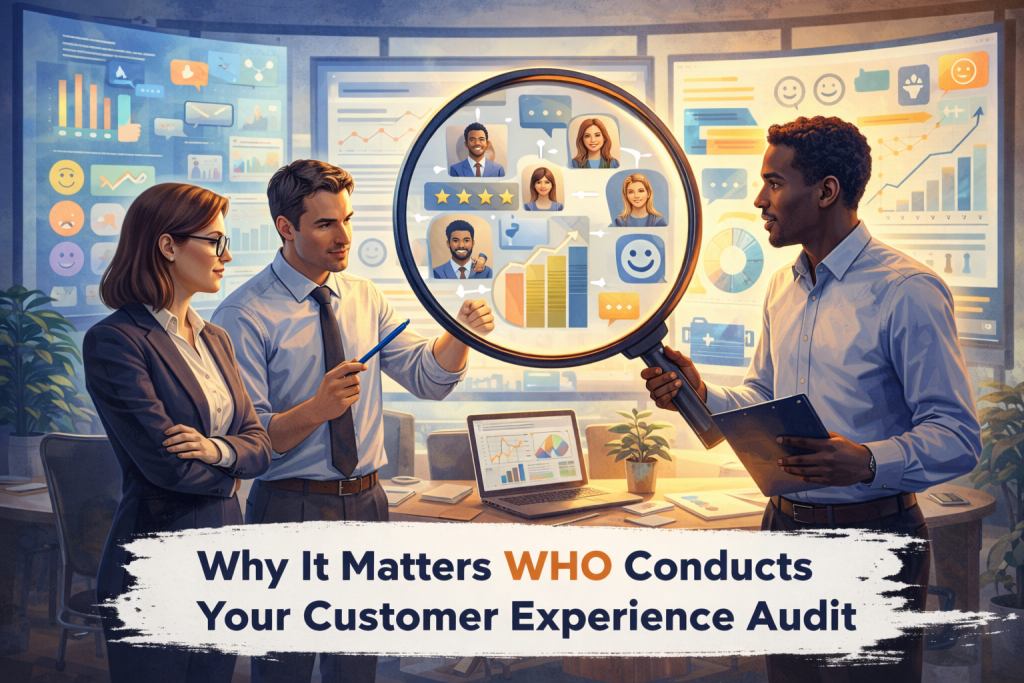
Why It Matters WHO Conducts Your Customer Experience Audit

LAST UPDATED: May 29, 2026 at 4:42 PM

Why It Matters WHO Conducts Your Customer Experience Audit

by Braden Kelley and Art Inteligencia

I. Introduction: The Audit as a Mirror

In the hyper-competitive landscape of 2026, many organizations are drowning in data but starving for insight. They perform audits, yet the fundamental “why” of customer friction remains elusive.

The Diagnostic Gap

Most companies have more tools than ever to track clicks, bounce rates, and conversion funnels. Yet, there remains a persistent Diagnostic Gap: the distance between knowing what a customer did and understanding why they felt compelled to do it. Organizations often fail to see their own blind spots because they are looking into a mirror they’ve polished themselves.

The Core Thesis: Perspective over Procedure

A Customer Experience (CX) Audit (aka Customer Experience Risk and Revenue Leakage Diagnostic) is more than a technical inspection; it is an act of empathy. If the auditor lacks a human-centered innovation lens, the resulting report will be mathematically correct but strategically hollow. It might tell you that a button is in the wrong place, but it won’t tell you that your entire value proposition is losing its soul.

The Stakes in 2026

In today’s market, brand loyalty is fragile. A single friction point isn’t just an inconvenience — it’s a broadcast signal to your competitors that there is an opening to disrupt you. Who you choose to hold up the mirror determines whether you see a minor blemish or a structural crack that needs immediate innovation.

Key Takeaways: You cannot solve a problem using the same level of consciousness that created it. The value of an audit is not in the findings, but in the new perspective that allows your team to stop fearing the “How” of the present and start building the “Why” of the future.

II. Internal Audits: The Myth of Objectivity

While internal teams possess deep product knowledge, that very proximity often creates a “distortion field” that obscures the true customer experience.

The “Curse of Knowledge”

Internal teams are often too close to the project to see the friction. Because they know how the system is supposed to work, they subconsciously compensate for poor design. They skip over the confusing copy and ignore the lag because they have developed internal workarounds. A customer doesn’t have that luxury; they only see the barrier, not the intent behind it.

The Hidden Pressure of Internal Politics

An internal audit rarely exists in a vacuum. There is often an unspoken pressure to validate previous executive decisions or to protect the “babies” of influential departments. When the person auditing the experience reports to the person who designed it, the “truth” is often softened to avoid conflict, leading to incremental tweaks rather than the bold innovation required in 2026.

The Efficiency Trap vs. Customer Delight

Internal audits tend to focus on operational efficiency — how can we make this process faster or cheaper for us? While important, this lens often misses the emotional resonance of the journey. You might have a process that is 100% efficient but 0% engaging. Internal teams often solve for “Done,” while customers are looking for “Delight.”

Key Takeaways: You cannot read the label from inside the bottle. Internal audits are great for maintenance, but they are rarely the catalyst for breakthrough change. To find the “Why” of the future, you need a lens that isn’t colored by the “How” of your internal legacy.

III. Independent Audits: The Power of the Outsider

The greatest value an independent auditor brings isn’t just a new set of eyes — it’s a different set of experiences and the freedom to be radically honest.

Fresh Eyes and Cross-Industry Intelligence

An independent auditor lives outside your corporate “echo chamber.” They bring insights from diverse sectors — retail, healthcare, tech, and hospitality — to identify “unobvious” friction points you’ve grown accustomed to. In 2026, your customers don’t just compare you to your direct competitors; they compare you to the best experience they had earlier that morning. An outsider helps you measure up to that global standard.

Closing the “Accountability Gap”

Truth is the primary currency of a successful audit. An independent voice can speak truth to power without the fear of internal repercussions or career friction. This objectivity allows for a “radical transparency” that internal teams often find impossible. By closing the accountability gap, the independent auditor ensures that the real barriers to innovation are named, faced, and eventually dismantled.

Bridging the ‘Why’ and the ‘How’

While internal audits often provide a checklist of “How” to fix specific bugs, an independent auditor investigates the “Why” behind the customer’s emotional journey. They look at the narrative, not just the nodes. This perspective shift allows an organization to move beyond mere troubleshooting and into the realm of strategic experience design.

Key Takeaways: An independent auditor is the customer’s ultimate advocate. When you bring in an outside perspective, you aren’t just buying a report; you are investing in the clarity required to see your organization as the world sees it. Only then can you begin to change it.

IV. The Braden Kelley Edge: Beyond the Checklist

A standard audit tells you where the leaks are; my audit tells you how to change the flow. My approach integrates human-centered change directly into the diagnostic process.

Human-Centered Change as a Methodology

I don’t view Customer Experience as a series of static touchpoints on a map. I view it as a living ecosystem of human interactions. My “Edge” comes from treating the audit as an organizational change exercise. We don’t just look for technical errors; we look for where your internal culture and external experience have lost alignment. By centering the human — both employee and customer — we identify the psychological barriers to a seamless journey.

The Innovation Integration

Most auditors stop at “What is broken?” I start at “Where is the opportunity?” My lens is uniquely calibrated to find where your next innovation is hiding within your current customer friction. If a customer is struggling with a specific step, that isn’t just a bug — it’s a signal of unmet need. I help you translate that struggle into a roadmap for a new product, service, or business model that your competitors haven’t even imagined yet.

Strategic Alignment and Brand Soul

A “good” experience isn’t enough in 2026; it must be your experience. I ensure that every touchpoint is strategically aligned with your unique brand soul and ethical guardrails. An audit under my guidance ensures that efficiency never comes at the cost of authenticity. We solve for the “How” of the present while keeping a relentless focus on your “Why” for the future.

Key Takeaways: An audit shouldn’t just result in a list of repairs; it should result in a vision for renewal. When I audit your experience, I am looking for the spark of innovation that turns a satisfied customer into a lifelong advocate.

V. Why Braden Kelley is the Perfect Partner for Your CX Audit

Selecting an auditor is about trust, legacy, and the ability to translate observation into transformation.

A Legacy of Innovation Leadership

With years of experience as a globally recognized innovation thought leader, I don’t just see a customer journey; I see a competitive battlefield. My background in human-centered design ensures that every recommendation is grounded in the reality of human behavior. I have spent my career helping organizations navigate the complexities of change, making me uniquely qualified to identify the structural hurdles that prevent your team from delivering excellence.

The “Resilient Auditor” Framework

I apply the same resilience routines I advocate for in my speaking and writing to the audit process. This ensures a level of focus, objectivity, and deep synthesis that standard consulting firms often miss. I don’t provide “off-the-shelf” solutions; I provide a custom diagnostic that accounts for the psychological and operational resilience of your specific organization.

Actionable Velocity

The biggest failure of most CX audits is that they sit on a shelf. My goal is Actionable Velocity. I deliver a roadmap that doesn’t just list what’s wrong, but prioritizes fixes based on their potential for ROI and innovation impact. I provide your team with the “Why” they need to stay motivated and the “How” they need to execute immediately.

The Braden Kelley Promise: When I conduct your audit, you aren’t just getting a consultant; you are getting a partner dedicated to making your organization smart enough to solve its own most complex problems. We will bridge the gap between where you are and where the future demands you to be.

VI. Conclusion: Choosing Your Mirror

Ultimately, a Customer Experience Audit is an investment in clarity. In an era where disruption is the only constant, you cannot afford to look through a distorted lens. Whether you choose an internal review for maintenance or an independent audit for transformation, remember that the quality of the insight is entirely dependent on the perspective of the auditor.

Don’t Just Audit the Past — Design the Future

The goal of a world-class audit isn’t just to find out where you’ve been, but to illuminate where you are capable of going. By choosing an auditor who understands human-centered change and innovation strategy, you ensure that your organization doesn’t just fix the “How” of today, but masters the “Why” of tomorrow.

The mirror you choose today will determine the reflection your customers see tomorrow. Make sure it is a mirror that shows the full potential of your brand’s soul.

Ready to Transform Your Customer Journey?

Stop guessing and start innovating. Let’s work together to find the “unobvious” opportunities hidden within your customer experience.

— Braden Kelley

Ready to find your Customer Experience innovation opportunities?

Request a Customer Experience Audit

For more on Customer Experience Audits check out:

Customer Experience Audit 101
Why a Customer Experience Audit is Non-Negotiable in 2026
Is Your Customer Experience a Lie?

CX Audit: Frequently Asked Questions

1. Why is an independent CX audit better than an internal one?

Internal teams often suffer from the “Curse of Knowledge” — they are so familiar with how things should work that they miss how they actually work for the customer. An independent auditor brings unbiased clarity and the courage to name the structural issues that internal politics might keep hidden.

2. How does Braden Kelley’s approach differ from others?

Most audits look for bugs; Braden Kelley looks for breakthroughs. By applying a human-centered innovation lens, Braden identifies not just where you are failing the customer, but where the customer is signaling a need for a new solution you haven’t built yet.

3. What is the main outcome of this audit?

The primary outcome is Actionable Velocity. You won’t receive a static report; you’ll get a prioritized roadmap that balances immediate experience “quick wins” with long-term strategic innovation goals, ensuring your CX is a driver of growth, not just a line item.

Image credits: ChatGPT

Content Authenticity Statement: The topic area, key elements to focus on, etc. were decisions made by Braden Kelley, with a little help from Google Gemini to clean up the article and add citations.

Subscribe to Human-Centered Change & Innovation WeeklySign up here to get Human-Centered Change & Innovation Weekly delivered to your inbox every week.

Why a Customer Experience Audit is Non-Negotiable in 2026

An Analysis of ROI, Retention, and Brand Resilience

Why a Customer Experience Audit is Non-Negotiable in 2026

LAST UPDATED: May 29, 2026 at 8:20PM

by Braden Kelley and Art Inteligencia

In the current business landscape, the traditional boundaries of competition have dissolved. Pricing is transparent, product features are rapidly emulated, and global logistics have leveled the playing field for distribution. What remains as the final, most defensible frontier is Customer Experience (CX). However, many organizations operate on assumptions rather than evidence, relying on outdated journey maps that don’t account for the rise of generative AI, omnichannel complexity, and the heightened emotional expectations of the modern consumer.

A Customer Experience Audit is not merely a “health check”; it is a rigorous diagnostic process designed to uncover the “silent killers” of conversion and loyalty. It bridges the gap between how a company thinks it is performing and how the customer actually feels at every touchpoint. By systematically evaluating the friction, flow, and emotional resonance of the brand journey, organizations can transform from being reactive service providers to proactive experience leaders. Below, we explore the ten most compelling reasons to initiate this audit, backed by the latest industry data.


Top 10 Reasons to Conduct a CX Audit

1. Identify and Eliminate Friction Points

An audit maps the real-world customer journey to find where users drop off. Small changes to these “micro-moments” can yield massive returns.

  • The Statistic: Simplifying a complex sign-up form can increase successful registrations by 20% (Reform).
  • The Insight: 53% of consumers say being kept on hold alone is reason enough to stop doing business with a brand (Webex/Futurum Group).

2. Improve Customer Retention and Reduce Churn

Acquiring a new customer is significantly more expensive than keeping an existing one. Audits identify the specific negative experiences that drive customers to competitors.

  • The Statistic: Resolving CX issues can reduce churn by 85% (Esteban Kolsky).
  • The Insight: 60% of customers will leave a brand after just one or two negative experiences (Zoom, 2025).

3. Maximize Revenue and Upsell Opportunities

Satisfied customers aren’t just loyal; they are less price-sensitive and more open to higher-value offers.

  • The Statistic: Companies that excel at CX see an average 80% increase in revenue (Zippia/Zendesk).
  • The Insight: 61% of customers will spend at least 5% more with a brand they know provides a good experience (Emplifi).

4. Optimize the Onboarding Experience

The first post-purchase interaction sets the tone for the entire relationship. Audits ensure your onboarding isn’t frustrating or confusing.

  • The Statistic: Effective onboarding makes customers 92% more likely to renew their subscriptions (TSIA/OnRamp).
  • The Insight: Interactive and engaging onboarding content can boost early product usage by 55% (Wyzowl).

5. Validate AI and Automation Strategy

Many companies layer AI over broken processes. An audit ensures your bots are actually helping rather than “getting stuck in loops.”

  • The Statistic: AI adoption can increase the number of issues resolved per hour by 15% (Quarterly Journal of Economics, 2025).
  • The Insight: 80% of customers expect bots to escalate to a human when needed, but only 38% say this actually happens (Zoom, 2025).

6. Align Internal Silos

Audits reveal when different departments (Sales, Marketing, Support) are providing conflicting information, which destroys customer trust.

  • The Statistic: 90% of customers expect consistent interactions across all channels (SDL/Renascence).
  • The Insight: 54% of organizations cite “fragmented or siloed data” as their biggest barrier to leveraging customer insights (Zendesk).

7. Benchmark Against Competitors

In 2026, CX is the primary differentiator as products and pricing become easier to replicate.

  • The Statistic: 89% of businesses are expected to compete primarily on CX this year (Gartner/OnRamp).
  • The Insight: Customer-centric brands are 60% more profitable than those that do not focus on CX (Deloitte).

8. Personalize with Purpose

Generic “Dear [Name]” emails no longer count as personalization. Audits help you use data to anticipate needs and determine the most authentic places to personalize customer interactions and experiences.

  • The Statistic: Brands with mature personalization are 71% more likely to report high customer loyalty (Deloitte).
  • The Insight: 80% of consumers are more likely to purchase from a brand that offers tailored experiences (Epsilon).

9. Enhance Employee Satisfaction

When customers are frustrated, frontline employees bear the brunt of that anger. Fixing the CX reduces agent burnout.

  • The Statistic: 62% of respondents identified a defined relationship between Ex and Cx, stating that the impact was “large” or “significant” and measurable. (Workstep).
  • The Insight: Companies with strong CX leadership are 2x more likely to have engaged employees (Temkin Group).

10. Turn Feedback into Action

Most companies collect feedback, but few act on it. An audit creates a structured roadmap for implementation.

  • The Statistic: Acting on customer feedback can lead to a 25% reduction in churn (Forrester/Renascence).
  • The Insight: 77% of customers view a brand more favorably if they proactively invite and act on feedback (Microsoft).

Summary Table of Audit Benefits

Benefit Impact Metric Source
Revenue Growth 80% increase Zippia/Zendesk
Retention 25-30% improvement Martin Newman
Profitability 60% higher than peers Deloitte
Operational Efficiency 10-15% cost savings Martin Newman

Conclusion: From Insight to Transformation

A Customer Experience Audit is the bridge between organizational intention and customer reality. In an era defined by rapid technological shifts and declining brand loyalty, the ability to see your business through the eyes of the consumer is your greatest competitive advantage. The statistics provided throughout this analysis make a clear case: companies that invest in understanding and optimizing their journey are not just surviving—they are significantly outperforming their peers in revenue, retention, and employee engagement.

However, an audit is only as valuable as the actions that follow (for more see Customer Experience Audit 101). The true power of this process lies in its ability to align internal silos, validate high-stakes investments in AI, and foster a culture of continuous improvement. As we move further into 2026, the question for leadership is no longer whether you can afford to conduct a CX audit (aka Customer Experience Risk and Revenue Leakage Diagnostic), but whether you can afford to continue operating without the clarity one provides. By prioritizing the human-centered elements of your business, you secure not just a transaction, but a long-term piece of your customer’s future.

Customer Experience Audit ROI Flipbook
Download the ‘Top 10 Reasons to Conduct a CX Audit’ flipbook PDF

Looking for someone to conduct an independent customer, partner or employee experience audit? Braden Kelley specializes in conducting these kinds of audits, mapping the relevant journeys and benchmarking your performance against select competitors.

Book Your Experience Audit Today


Image credits: ChatGPT

Content Authenticity Statement: The topic area, key elements to focus on, etc. were decisions made by Braden Kelley, with a little help from Google Gemini to clean up the article and add citations.

Subscribe to Human-Centered Change & Innovation WeeklySign up here to get Human-Centered Change & Innovation Weekly delivered to your inbox every week.