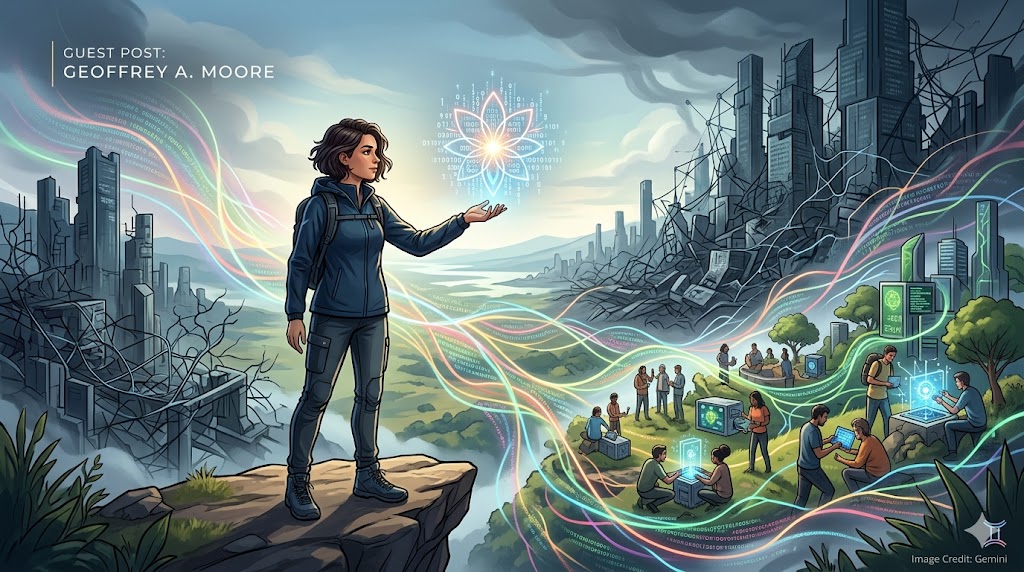
GUEST POST from Geoffrey A. Moore
Concerns about the potential negative impact of AI on humanity’s future well-being continue to foster discussion across a wide swath of society with pundits weighing in from every imaginable point of view. The fundamental unit of discourse that unites all these efforts is the scenario. As humans, when we have no facts, we generate narratives, which we then mine for insights and test for credibility. In the high-tech sector, we have been doing this for decades because disruptive innovations, by virtue of their very novelty, have no history, and so must win investment capital and early adopter support through story-telling.
As a former literature professor, I could not feel more at home. So, let us apply a little literary criticism to some of the doomsday narratives currently in circulation. Start with the Terminator scenario. Great movie—but if we take it literally for a moment, I don’t think its core premise can hold up. That premise is that an AI system can have the same kind of intention and ambition that underlies human behavior. But intention and ambition, attributes shared not just by humans but by all living things, are anchored in an involuntary compulsion to live and reproduce. Human beings, though fragile individually, are an integral manifestation of life itself, and life itself has an extraordinary performance record, having been playing Planet Earth uninterruptedly for over four billion years (beat that, Taylor Swift!) despite meteor strikes, ice ages, and massive volcanic eruptions. AI systems can be programmed to mimic and adopt our strategies for living, but they have no compulsion to live, and it has nothing like this heritage behind it.
A far more chilling narrative, to my way of thinking, is AI in the hands of malicious human actors. This is hardly a scenario, for we have already seen it wreak havoc across the digitally transforming landscape that constitutes contemporary society. The most immediate existential threat is releasing self-governing AI agents that slip the bounds of their control system and promulgate horrific consequences. This is the Jurassic Park narrative, and while its biology is fanciful, its theme of unintended consequences is anything but.
Preparing for this possibility is where various governmental agencies are focusing much of their attention, but here too the narrative has a credibility problem. The notion that legislative bodies could possibly keep pace with the pact of AI’s evolution, not to mention enlisting the societal support necessary to enforce their regulatory efforts, is simply ludicrous. And that brings us to a third narrative for context, Natural Selection.
When living things are put under existential threat, they accelerate their rate of mutation, abandoning the safe and steady course of inertial progress, because that is no longer safe at all. It’s ‘innovate or die’ time. Most of these mutations fail, but for four billion years, at least some of them have always succeeded. If we transplant that strategy into the human realm, it argues for enlisting agile, individual, and hopefully well-meaning talent to engage with a raft of unanticipated challenges, a sea of troubles, and by opposing end them. Legislation can help ratify and scale successful responses once they have been proven effective, but it cannot prevent the challenges from emerging in the first place, and frankly, should not try. Of course, it will try, and that I expect will add yet another layer of unintended consequences onto a plate that is already full.
That’s what I think. What do you think?
Image Credit: Gemini
 Sign up here to join 17,000+ leaders getting Human-Centered Change & Innovation Weekly delivered to their inbox every week.