Tag Archives: organizational change

Let’s Start a Change Revolution

Start a Change Revolution

The pace of change is accelerating, and for many people (and companies) things are changing so fast that they feel overwhelmed and retreat to the familiar instead of embracing the change. In fact we are approaching a tipping point where what is becoming interesting to the young is not the new, but the old. Vintage Michael Jordan sneakers, vinyl albums, rotary telephones, and analog amplifiers all have growing numbers of fans. In fact, vinyl album sales are increasing as CD sales decrease.

People are becoming so overwhelmed by the speed of change that the next new thing doesn’t always feel so new, and so those seeking to be on the cutting edge are increasingly looking backward for inspiration. Beards and hats have made a comeback, and before you know it the tattoo craze will have run its course. But is it the accelerating pace of change that people feel overwhelmed by, in their work lives and their personal lives, or is it a lack of tools for successfully planning and executing change that leads to people feel overwhelmed and paralyzed by the constant need to change?

Some people would argue that the pace of change is outstripping our ability as humans to cope with all of the changes we are being expected to absorb. I would argue that we are in the middle of a period of discontinuity thrust upon us by the rapid advances in computing and mobile connectivity that have put a supercomputer in everyone’s pocket and a target on most companies’ backs.

Digital Transformation is Being Forced Upon Us

Because we as consumers are seeing better customer experiences enabled by digital technologies in parts of our personal lives and more efficient and effective business processes in parts of our business lives, we are now expecting every company and every aspect of that company to deliver an efficient, effective experience and information exchange in whatever channel we choose, whenever we want to experience it.

This incredible change in expectations is being thrust upon all organizations simultaneously and threatening the very existence of entities that have existed for dozens or even hundreds of years. This discontinuity has created immense technical debt for organizations large and small to overcome and the only way for an incumbent organization to recover and to survive in this new digital age will be to undergo a complete digital transformation. This doesn’t mean creating a digital strategy to address one part of the organization or a single constituency, but a path to a complete transformation that brings digital approaches to both every part of the organization and its operations, but also to all of its constituencies, at the same time.

This means re-imagining every system, every policy, every procedure, and every process as a digital native company looking to enter and disrupt your industry might, and then make a plan for transforming yourself. This will require IMMENSE amounts of change, and is no small task given the 70% change failure rate, but it is the key to your organization’s survival.

A Problem and A Solution Emerge

The problem is that in twenty years of research, travels around the world delivering keynote speeches and workshops interacting with countless audiences on the topics of innovation and change, I have not uncovered one set of tools that makes change seem less scary, that can make the change planning process more human, and change execution more successful. The organizational change thought leadership status quo isn’t up to the task of planning and executing the scope and scale of change required for existing organizations to survive the digital evolution underway. A new wave of change thinking and a new set of tools are needed to displace the old guard. In short, I’ve decided to start a change revolution to free people from the tyranny of the blank word document and poorly planned change efforts. Who’s with me?

Charting ChangeToday I am excited to announce the availability of the Change Planning Toolkit™, a Quickstart Guide to help explain what each of the more than fifty (50+) frameworks, worksheets and other tools are for, and most importantly, my latest book Charting Change to introduce you to the concepts behind the toolkit and its proper use. What I did find in my travels and my research referenced above were some good theories on behavior change and change leadership, and those, along with a couple of great case studies from Qualcomm and Britain’s National Health Service (NHS) and guest expert pieces from nearly a dozen hand-picked contributors, you will find in Charting Change. For my part, I’ve created a lot of great new theories and frameworks that you can put into practical use with the accompanying Change Planning Toolkit™. People who purchase a copy of the book will get access to an educational license for 26 of the 50+ frameworks, worksheets and other tools contained in the toolkit, including the Change Planning Canvas™ to pull your plan all together on one page (a $500 value). Individual and site licenses for the full version of the toolkit are available.

But I can’t do it alone.

Come Join the Change Revolution

I’m seeding the clouds with Charting Change and with the Change Planning Toolkit™, but I need you to make it rain.

The first 50+ tools in the toolkit are my own, the result of thousands of hours of work and years of effort. But I know once you download the 10 Free Downloads, or buy a copy of the book and get access to the first 26 of the 50+ tools in toolkit, or upgrade to the full toolkit and unlock all 50+ tools, that some of you may want to:

  1. Contribute a new tool to the Change Planning Toolkit™ (with full credit of course) to help accelerate change capabilities in organizations around the world
  2. Use the Change Planning Toolkit™ in your consulting business to help your clients and increase your revenue
  3. Become a preferred provider by translating the Change Planning Toolkit™ into additional languages, and earn a portion of any revenue from your translation at the same time
  4. Attend a train the trainer session to become a certified Change Planning Toolkit™ professional in order to spread the knowledge across your organization, or if you’re a consultant, to offer training sessions as an additional business offering

The reason I’m not trying to hold everything dear is that I have a full-time job transforming the insurance business and can’t be running around the world doing consulting work for clients. Instead I thought it made more sense to empower as many consultants and practitioners as possible to properly use the intellectual property I’ve created (and the additional intellectual property that others are likely to contribute) to help your organizations (or your clients’ organizations) cope with the accelerating pace of change.

I know that together we can change how we plan and execute changes big and small all around the world. And for those of you who think that the toolkit and methods are designed to only help plan and execute large changes (‘Capital C’ changes like mergers, acquisitions, transformations, etc.), I would like to remind you that small changes (‘lowercase c’ changes like projects and campaigns) can use the toolkit too. The fact is that every project changes something, and so every project is a change effort. That is why in my Architecting for Change framework, project management is shown as a subset of change management, not the other way around. So, whether you are a consultant, a professor, a teacher, a project manager, a vice president or a CIO, I hope you’ll join the change revolution, get your copy of Charting Change today and check out the Change Planning Toolkit™!

¡Viva la Revolución!

Contact me about doing a Change Planning Toolkit™ translation

Get information about Change Planning Toolkit™ public training sessions

Get information about Change Planning Toolkit™ private training sessions

Image credit: freevector.com


SPECIAL BONUS:

Click here to hear Tanveer Naseer interview me about my new book Charting Change on his Leadership Biz Cafe podcast.
.
.


Subscribe to Human-Centered Change & Innovation WeeklySign up here to get Human-Centered Change & Innovation Weekly delivered to your inbox every week.

What innovation hasn’t changed something?

What innovation hasn't changed something?Can you think of a single innovation that didn’t change something?

I didn’t think so.

Innovation is change, or at least, innovation requires change.

In my role as an innovation keynote speaker and workshop facilitator, I recently led a German-based industrial company’s North American IT leadership team through an innovation workshop, during which we spent part of the time working to define their common language of innovation (as described in my book Stoking Your Innovation Bonfire). For companies looking to build a sustainable innovation capability this is an important first step.

One of the biggest reasons it is important to define innovation and to spend time creating a common language of innovation is that the word innovation means something different to every individual. It is very easy for companies to spin their wheels when people don’t have the same understanding of what constitutes innovation and what doesn’t.

Because of this danger, when working with companies to help build an innovation system I always make sure that we define what they want innovation to mean in their organization and what their vision, strategy and goals are going to be for innovation. This helps get everyone on the same page and causes people to start seeing some of the changes required in order to build a strong innovation capability in the organization.

Defining Innovation

As part of this most recent workshop discussion around what constitutes innovation I shared my definition of innovation and we worked together to create a definition that is going to fit their culture and their business.

My own personal definition of innovation is:

“Innovation transforms the useful seeds of invention into widely adopted solutions valued above every existing alternative.”

I’ve worked pretty hard over the years to refine this definition, and I like my definition because it highlights a couple of inherent tensions and relationships that people must consider. These include:

  • Invention vs. innovation
  • Useful vs. valuable
  • The requirement for an innovation to be widely adopted
  • The requirement for an innovation to replace the existing solution

Because innovation requires change, a potential innovation must:

  1. Create so much value that people are willing to go through the discomfort of abandoning or migrating away from their existing solution (even if it is the oft-ignored ‘do nothing’ solution);
  2. At the same time, you must also do an outstanding job of helping people access that value through design, packaging, education, etc. so that the product or service is a delight to use and so that you potentially simultaneously increase the overall value of the solution;
  3. And, finally you must provide a very clear value translation for your potential customers of how this new solution will fit into their lives and is worth the disruption that comes with adopting it.

For those of you familiar with my book Stoking Your Innovation Bonfire, or with my other writings, you may recognize my Value Innovation Framework and my views on what it takes to achieve successful innovation captured in the above three points.

Organization Size and History Matters

Inside a large organization (or one with a longer history), a potential innovation often inflicts a lot of change on the organization. Inside a large organization or an organization with a longer history, the organization will have grown up around one or two initial solutions and built an infrastructure to maximize the success of those initial solutions. As a result, any potential innovation will often require knowledge, skills, and other resources in order to build and scale it that are new to the organization. This may involve building new distribution channels, hiring people with the necessary skills and expertise, and many more changes required to build the capabilities needed to make the potential innovation a success.

Inside a startup organization this is not the case, and this is the reason why it is often easier and faster for a startup to create and implement a potential innovation than an established company. Because everything is new, there is nothing to change, other than the minds of the customers in order to get them to replace their existing solution and the minds of potential partners to convince them to work with you. This is the advantage that startups have over existing companies.

But the disadvantage startups have is that startups usually have to spend more of their time chasing the funding they need to transform their idea into a realized innovation. Whether the advantages or the disadvantages are larger depends on the startup. And, whether the startup can beat the established organization depends on how good the established organization is at managing change, and how fast it can change.

Final Thoughts

Most of us work in established organizations that have either grown large because of successful leadership, strategic vision, efficient operations, and continuous improvement and innovation, or we work for an organization that has at least established some level of longevity as a going concern. This means that for most of us we MUST get better at change. We must accept change as a constant and as a key (along with innovation) to our organization continuing to thrive in a sea of rising global competition. We must also get FASTER at change.

One way to do this is to change HOW we change by embracing a new more visual, more collaborative approach to planning our change efforts using tools like my Change Planning Toolkit™. I will be introducing this toolkit in my new book Charting Change, releasing March 9, 2016. People who buy a copy of my book Charting Change will get access to the Change Planning Canvas™ and 25 other tools from the toolkit. As a special gift for everyone else, I will be making a series of 10 free downloads available on my web site from the 50+ frameworks, worksheets and other tools contained in the toolkit (including the popular Visual Project Charter™).

I hope it is now clear that to be successful at innovation that you must become better at change, and I encourage you all to do so!

Accelerate your change and transformation success

This article originally appeared on the Planview blog

Subscribe to Human-Centered Change & Innovation WeeklySign up here to get Human-Centered Change & Innovation Weekly delivered to your inbox every week.

Digital Transformation Matters

Digital Transformation Matters

The pace of change is accelerating.

Much has changed since we all started to dial in with our modems and connect to online services like America Online or Compuserve and eventually directly onto the Internet and the World Wide Web. Elements of our digital world continue to invade our language and our consciousness.

  • “Text me later.”
  • “Skype me tomorrow.”
  • “Google it.”
  • “#hashtag”
  • “rtofl”

Whether we like it or not the physical world and the digital world, and people are more likely to freak out about leaving their mobile phone at home than their wallet. Soon you won’t even need to carry a wallet (unless you want to). Canada stopped making pennies. In Sweden many businesses no longer take cash. Have you tried buying a drink on an airplane lately? (no cash accepted there either)

We now live in a digital age.

Not because technology is new, but because the way we react to technology and interact with it is different.

We’ve had technology for a while, but we used it primarily for performing calculations, and then for information storage and retrieval. But now, because the computer has moved from being a machine in a lab programmed with punch cards, to something nearly every one of us carries in our pocket or wears on our wrist, we’re beginning to form relationships with machines and more importantly, to use our machines to form, maintain, and even deepen, our human relationships.

So what does this mean for you as a business person?

It means that people like me have to drag you kicking and screaming away from the way you’ve always done business, away from the way you’ve always structured your enterprise, away from the ways you’ve facilitated communication among employees and between you and your customers, partners, and suppliers and towards a fundamentally different way of organizing and operating your business.

Are you ready to do business in a digital way for the digital age?

No?

Well, your market is large and attractive to me and my digital native friends. While you struggle under the weight of your legacy systems and the denial that you must change how you think, change how you interact with customers, change how your business works inside, maybe we will re-imagine your business and your entire industry from the ground up with a collection of digital strategies that utilize the power of the digital mindset to more efficiently and effectively utilize people, process and technology with some venture capital backing to challenge the incumbents and put them out of business. People are fascinated with startups like Uber and with good reason, but they should also be looking at what established technology companies like Amazon are doing because you’re either have to think like a technology company or go out of business.

In my next article on digital transformation we will circle back to discuss Uber in a bit more detail as we explore the difference between a digital strategy and a digital transformation. Because they are not the same and are vastly different in what they require to be successful. The one thing they both have in common is that they will inflict change (in varying amounts) upon the organization, and with a more visual, collaborative approach to planning that change – like that enabled by the Change Planning Toolkit™ that I introduce in my new book Charting Change – you will increase your odds of beating the 70% change failure rate and successfully achieving your digital change goals.

Stay tuned!

This article originally appeared on Linkedin

Accelerate your change and transformation success

Subscribe to Human-Centered Change & Innovation WeeklySign up here to get Human-Centered Change & Innovation Weekly delivered to your inbox every week.

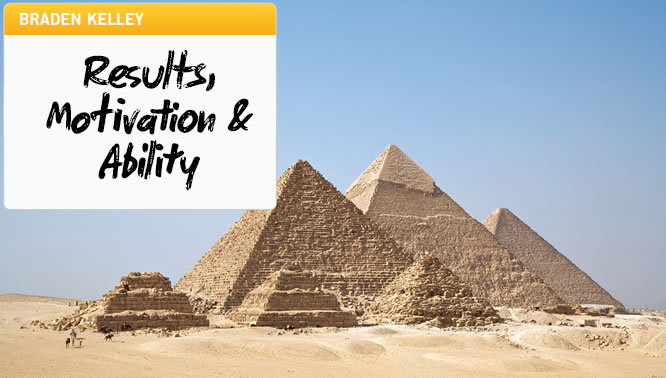
The Pyramid of Results, Motivation and Ability

Changing Outcomes, Changing Behavior

Pyramid of Results, Motivation and Ability

by Braden Kelley

When engaging in a change effort it is important to focus not on outputs but on outcomes. The difference is sometimes subtle for people, but the biggest difference is that outputs are usually activity-based where outcomes are behavior-based.

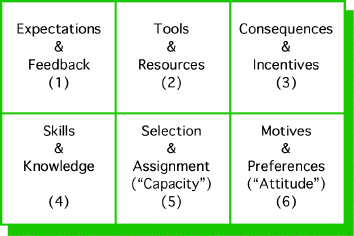
There are several good behavior modification frameworks out there including the Six Boxes framework from Carl Binder, the Six Sources of Influence framework from VitalSmarts, and the Results Pyramid® from Partners in Leadership that start with the desired performance changes, results or outcome shifts and work backwards.

Six Boxes Approach - Carl Binder

Six Boxes Approach – Carl Binder

Potential Benefits of Using the Six Sources of Influence

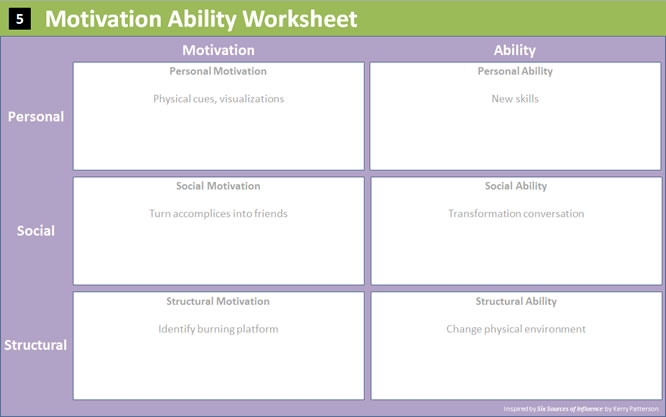
The Six Sources of Influence framework from VitalSmarts, a framework designed for personal change has some usefulness as we look at organizational change. Here are some of my thoughts on how this personal change framework is relevant, centered on the fact that successful change happens one individual at a time. The Six Sources of Influence framework looks at motivation and ability on one axis, and how they are affected across three other variables, which include:

  1. Personal
  2. Social
  3. Structural

Taken together they form the Six Sources of Influence (see the Motivation Ability Worksheet in Figure 1) and can be used to change behavior one individual at a time. And it is from these changes in behavior that the transitions towards the new way of doing things begin to happen.

Motivation Ability Worksheet

Figure 1

To utilize personal ability to influence the change will require teaching people the new skills to be successful at the new way of doing things. Consider breaking up the learning into short intervals where you can give people immediate feedback and prepare for people to have regressions back to the status quo. Work to identify those moments where people will be most tempted to regress to the status quo and create strategies that reinforce the new way of doing things.

To influence the change through personal motivation will require visualizing the change for people and utilizing physical and other cues (including vivid storytelling) to help reinforce that the change is desirable. Help people see, feel and believe in the new way of doing things (the desired state).

Social motivation can be used to influence change adoption by turning accomplices (status quo advocates) into friends (people practicing and supporting the new way of doing things), while any attempt to use social ability as an influencer for change adoption will require open and honest conversations to transform people from accomplices into friends .

Finally, utilizing structural motivation will require selling the problem in a way that people are influenced to abandon the status quo (visualize it, prototype it, etc.) and structural ability can be used to motivate people by changing the physical environment to reinforce the change. Instead of using a stick to motivate people to change, consider using carrots and the threat of losing carrots. It’s a slight twist away from using a stick, but it’s a powerful one. Finally, reward small wins and use incentives (carrots) in combination and in moderation.

Devotees of the Six Sources of Influence may find the free Motivation Ability Worksheet useful.

Using the Results Pyramid® to Create New Results

The Results Pyramid® framework from Tom Smith and Roger Connors’ book titled Change the Culture, Change the Game focuses on the importance of building a culture of accountability. Leaders can accelerate the change and results that they seek by working with the bottom half of the pyramid (“beliefs” and “experiences”). The Results Pyramid® has four main components that I would love to show below in Figure 2 but can’t:

Figure 2 would have gone here

Transformational change is most often lasting and sustainable in achieving the desired new results when leaders work to change the beliefs and experiences that people have and ensuring that people begin having new experiences that lead to new beliefs that lead to new actions that ultimately support the desired new results.

I was trying to help bring additional readers to the authors via the Results Pyramid® Worksheet, but it didn’t quite work out, so you’ll have to do without the visuals and imagine how the tool from Change the Culture, Change the Game could be used to:

  1. First focus on identifying the new results that the group wants to achieve after making the change.
  2. Second, ask employees and partners what new experiences they think that people will need to have in order to not only begin to leave the old way of doing things behind, but to both support the new results you want to achieve AND to help them believe the organization is serious and committed to the new results and that the leadership can be trusted.
  3. Third, ask what new beliefs they think that people will need to have in order to commit to leaving the old way of doing things behind and prepare them to take new actions.
  4. Finally, ask what new actions they think that people will need to take in order to achieve the new results that you are hoping to have in the desired state.

In most cases you will find that your current set of experiences, beliefs, actions, and results have achieved a sort of equilibrium or alignment and that one of the keys to achieving successful change is to move from your current state of equilibrium or alignment to a new set of experiences, beliefs, and actions that create a new state of equilibrium centered around your new results. By identifying where you want to move the top of the pyramid, your can start moving the base of the pyramid followed sequentially be the layers above it, and in doing so, prevent the pyramid from toppling over.

Potential Benefits of Using the Results Pyramid®

The Results Pyramid® is based on the idea that too many organizations focus on the results they want to achieve in the shift from the current state to the desired state and that just by communicating the desired results that the organization will see these new results manifest. But, the reality that the Results Pyramid® captures is that in order to achieve a shift from the current state to the desired state, and to achieve a new set of results, you must do more than define the new results you want to achieve. And you must provide a new set of experiences, beliefs, and actions that will help you achieve those results. The other key component of the Results Pyramid® theory is that too often companies demand new actions to get new results, but the truth is that these four things (results, actions, beliefs, and experiences) are organized like a pyramid and you can’t just move the top of the pyramid without also moving the supporting layers as well.

Meaning, that to create a shift in results (or outcomes), you must create a new set of experiences that lead to a new set of beliefs that lead to a new set of actions that result in the new results that you are hoping for as a result of your change effort. And of course by planning out consciously the shift in results that you’re trying to achieve, you can work as a change planning team to identify the new experiences, beliefs, and actions that you need to create in order to achieve the new results

I find this a useful tool to consider using as you analyze the desired behavior changes and new outcomes you are seeking to achieve with your change effort as you go through your change planning meetings or off-site.

Devotees of the Results Pyramid® would have found the Results Pyramid® Worksheet useful but, sigh, you can’t see it.

Conclusion

In this article we looked at the role of changing behaviors in achieving changed outcomes, and how we might use a couple personal behavior modification frameworks, the Six Sources of Influence and the Results Pyramid® to help us organize our conscious attempts to modify the behavior of individuals as part of our attempts to achieve our desired group behavior change and to ultimately to achieve the intended successful outcomes of our change effort.

So, check out the work of Carl Binder and grab yourself copies of Change the Culture, Change the Game and Change Anything and get started!

Get our Human-Centered Change & Innovation Weekly newsletter in your inbox

Click to access your FREE scalable 11″x17″ PDF downloads

Image source: ecsellinstitute.com

Buy the Human-Centered Change™ methodology nowNow you can buy the Change Planning Toolkit™ Basic License – Instant Access Edition here on this web site.

Accelerate your change and transformation success

Subscribe to Human-Centered Change & Innovation WeeklySign up here to get Human-Centered Change & Innovation Weekly delivered to your inbox every week.

13th Annual Change Management Conference Wrapup

13th Annual Change Management Conference WrapupRecently I had the opportunity to attend the 13th Annual Change Management Conference in New York, NY, hosted by The Conference Board. The event represented a convening of 200+ change management professionals from around the United States.

200+ attendees is a pretty decent size, but this larger number of attendees is quite small when you consider the number of people serving in official or unofficial change management roles around the world (either as employees or consultants), or when compared to the number of project managers (estimated at 16.5 million people around the world) and potentially as many as 1.5 million six sigma black belts and green belts sprinkled around the world.

Meanwhile, a couple of the leading training organizations in the change management space have trained just short of 100,000 people in the principles of change management.

If you agree that proactively managing change in organizations is at least as important as the practice of Six Sigma, and potentially as important as project management, that means that as the pace and importance of change continues to gather steam, there could be the need to train between 1.4 million and 16.4 million change management professionals in the next few years.

Insights from The Conference Board’s Council on Change Management

The tweet stream kicked off with a tweet from Joe Rafter of PG&E (@jrafter65) capturing the essence of what was to come:

“Investing in better change & transformation today. Change is in everyone’s role.”

The first session highlighted the Council’s Five Guiding Principles for Changing How We Change:

  1. Agile, Conitnuous and Iterative
  2. Future Focused
  3. Dynamic Conversation & Engagement
  4. Change Leadership From All Levels
  5. Adoption & Behavior Change

Kinthi Sturtevant of IBM highlighted that they are rarely seeing 2, 3 or 4 year projects. Now it’s 30-60-90 day change projects.

We heard John Horn of Prudential talking about their transformation to a focus on talent as a differentiator that is not hr led, but leader led. Interesting that Prudential has talent catalysts in the same way as Intuit has design catalysts.

We heard Barbara Mitchell of Mayo Clinic talking about the importance of embedding your change plan in your project plan. But I disagree with this strategy. The focus should be the reverse. Your project plan should be part of your change plan. In my estimation, project planning should be part of our change planning efforts, but to make this happen we need more change planning tools like my upcoming Change Planning Toolkit™.

Wendy Branche of Tyco spoke about how organizations must make change a capability not just a competency. Distributing and democratizing change must be a priority. At Tyco change is a business process and a leadership competency and positioning change in such a manner has accelerated participation in change.

People First in Change Management

Gisela Paulsen of Genentech spoke about leading people through a difficult transition, and her feelings were captured well in this quote:

“If you lead change with integrity and transparency you can’t go wrong.”

The company had to deal with a product that was dying in two years as a superior product came on the market from a competitor, and one of the ways they dealt with it was by allowing employees to start spending 40% of their time on career development activities.

She spoke about the importance of paying attention to the community and its well-being during the change process, and how leading on the way down is a lot harder and you learn more about leadership than learning during a growth phase.

One other key message from Gisela was that as a change leader, you must be courageous, and not be afraid to ask for things. Who knows? Leadership might say yes!

The Innovation Accelerator

Roberto Masiero and Dr. Eric Hieger of ADP spoke about their efforts to accelerate innovation, and it was funny that they intentionally dressed different to highlight the difference between the old ADP and the new ADP. There

One key question they asked was:

Do we intentionally accelerate pace amplitude scale and complexity in a VUCA environment?
(VUCA being Volatile, Uncertain, Complex, and Ambiguous)

How Do You Measure Change Success?

Tim Creasey of ProSci spoke a lot about the importance of metrics and scorecards. Here are a couple of the key takeaways:

Tim Creasey’s definition of Change Management is “catalyzing individual transitions to deliver organizational results.”

  1. Most of the people at the conference feel they do a poor job of measuring change management performance
  2. My big takeaway was that many times the ROI of change mgmt activities are likely baked into the overall ROI for systems projects especially, but the investment and the commitment is not. You need to highlight this for people. Vendors are going to highlight their most successful projects in helping calculate ROI, but those projects are also most likely to have invested in change management.

Rethinking Change

Lior Arussy of Strativity spoke about rethinking change including the following question:

What would happen if your scorecard was stories you collected instead?

Change is not an island.

The talk prompted this question in my mind:

Does everyone agree that transformation is used for change with a capital c?

Most organizations still don’t recognize need for a sustainable change management practice. This must change.

The $1 Billion Wakeup Call

Melanie Francis spoke about her observations of how as organizations approach $1 Billion in revenue that change management begins to become formalized into the organization.

Do You Speak Digital?

Sheila Chavda of McDonald’s spoke about some of the changes they’ve undergone in building a stronger digital focus at the company, including some of their focus areas:

  1. Direction and Leadership
  2. Culture, Climate, and Accountability
  3. Coordination and Control
  4. Capabilities, Motivation and External Orientation
  5. Innovation and Learning

Sheila shared a great story about an ophthalmologist who created an application called Peek that is capable of turning a smartphone into an eye exam tool (without the corresponding usual expense), making eye care more accessible worldwide.

Here is a great quote from Sheila:

“Game changing insights aren’t enough, without repeatable processes they become hallucinations of a really smart guy.”

Meanwhile, in the other session Chris Gray of Bridge Consulting shared this gem – “A butterfly is not a better caterpillar.”

Korn Ferry Research Results

Scott Stevenson of Korn Ferry shared some of their findings from research focusing on learning agility and change leadership. Their findings included:

  • People must decide to learn something new for change success to occur
  • Change management requires accurately predicting how a group will learn what is needed and managing to their individual/collective learning styles
  • Innovation strategies require more mental agility and change agility

Finally, Scott shared how he was always surprised by how little organizations invest in understanding employee drivers.

Leading Through Change

Shannon Wallace of GM shared stories of their transition in HR from executive HR to shared services model and the unexpected resistance they faced from HR employees.The resistance came from people being used to being the person people depended on. People were used to being firefighters. They decided to use pie charts to show difference in how people will spent their time before the change and how they will spend it post change. They also developed a “What would you do?” set of scenarios based on all of the different questions they got from people. They also created ~50 different modules to help people understand how different scenarios were going to change in the new model.

Creating the Future Together

Kelley Kurtzman of Verizon Wireless spoke about how as technology shifts, peoples expectations shift, and how their approach to employees and change focuses on three stages:

  1. Engage
  2. Educate
  3. Empower

Kelley also mentioned that any great employee engagement program has to be grounded in employee concerns.

One thing Verizon Wireless did to increase employee engagement and cooperation was to create ride-along video snippets so people can see what different tasks look like. Kelley talked about the power of involving employees in designing the solutions that will make them more productive. One result was to provide front line call center supervisors at Verizon Wireless with tablets with call metrics on them so they can be on the floor instead of off in a separate cubicle.

Finally, Kelley shared a great metaphor about the interaction between EQ and IQ as it relates to Emotional Intelligence:

“EQ is the front wheel of bicycle (Direction) while IQ is the back wheel (Power).”

Is Your Change Management Agile?

Paul O’Keeffe and Randy Wandmacher of Accenture Strategy spoke first about how in the digital age, expectations are different. We’ve heard people say at the conference that if they can’t see results this quarter, it’s too slow.

They continued on by discussing how research shows that change doesn’t cause organizations to go off track, it exposes organizational dysfunction. Too much change too fast is not destructive, high performing organizations go at a pace slightly faster than that of ordinary ones. The reason this is true is that people don’t have to go through the prototypical change ‘valley of despair’. High performing organizations have the agility to skip the ‘valley of despair’. One way they do is by building and maintaining a high level of trust in the organization.

People’s acceptance of #change is not a smooth curve, but a step function, increasing where intellectual understanding intersects with emotional agreement. The best organizations realize the benefits of change, build people’s change capabilities, end in good place with each change effort, so there is an appetite to do more change and to continue to improve business performance.

Becoming change agile means building a capability to successfully manage change on a daily basis. The steps in our change model to enable agility include:

  1. Clearly define the intended business performance and desired benefits
  2. Understand the organizational context/health
  3. Vision
  4. Leadership
  5. Resources
  6. Discipline
  7. Energy

The insights from Vision, Leadership, Resources, Discipline and Energy are used to master the dynamics occurring in the organization.

Poor performing organizations have a disconnect in perceived performance on Leadership and Teamwork. Poor performing organizations have a higher level of fear and frustration. Organizations that attain the highest levels of performance are those that truly thrive on change.

Most organizations would like to be more agile according to votes here at the conference, but few have it as C-suite priority. In fact, most organizations miss an opportunity during big projects like ERP to build capabilities for the future in change and agility.

The future of change agility should be to focus on insight-driven change, building capabilities and being change navigators.

Finally, it’s crazy that @innovate has more Twitter followers than @AccentureStrat. 😉

Closing Session with The Conference Board’s Council on Change Management

In the closing session Molly Breazeale shared this quote to keep in mind about relationships as you think through your change efforts:

“The conversation is the relationship.” – Susan Scott

Kent Greenes of The Conference Board spoke about co-creation and the difference between involvement and inclusion and the importance of organizing management and non-management input together in a common group to help move people from ‘I’ to ‘We’. “Imagine the look you’re going to get from your CEO when you say that leading change from the top is not enough.”

Isabelle Suares of Cisco spoke about how the speed of market changes requires greater speed internally in order to realize an ROI on our products. Increasingly shorter windows of opportunity to monetize intellectual property before newer technology supplants it. Co-Design embedded in all initiatives at Cisco, in all phases, in an iterative process with full participation.

Lauren Chesley of Verizon Communications spoke about how they wanted leaders to drive transformation, deliver on priorities, and be strong people managers for culture.

Andrea Tennyson of Cargill spoke about how they focus on nine key stakeholders including: customers, suppliers, consumers, employees, communities, governments, and three more. Some of their key focus areas sometimes conflict and from a change standpoint this can be difficult as they look to co-create. For transformation they leveraged their Leadership Forum (1,575 participants – 1,325 virtual & 250 local), and their Change Leader Network, Change Community of Practice, Leadership Academy Alumni, and Corporate Center. They made a shift in decision making away from Change Leadership Team and pushed the ability farther down into the organization.

Finally, a closing thought from Twitter from Tim Creasey of ProSci, and I’m not sure who to attribute it to, but I definitely heard it at the event:

“Go where the bright spots are in your organization – on gaining sponsorship for change management.”

The conference definitely was a whirlwind, and I’d like to thank The Conference Board for putting on a great 13th Annual Change Management Conference and to the organizers for inviting me to cover the event for the Innovation Excellence audience. Hopefully they’ll have me back as a speaker next year at their 14th annual event.

In 2016 my new change management content site will be in full swing and my second book for Palgrave Macmillan (@PalgraveBiz) comes out in January 2016 to highlight the best practices and next practices of organizational change and introduces my new collaborative, visual Change Planning Toolkit™. I’ve got some great guest experts and case studies to include in the book, so stay tuned!

Accelerate your change and transformation success

Subscribe to Human-Centered Change & Innovation WeeklySign up here to get Human-Centered Change & Innovation Weekly delivered to your inbox every week.
Measuring Organizational Agility – The Triple T Metric v1.0

Measuring Organizational Agility - The Triple T MetricThere is an increasing amount of chatter and confusion out there around what organizational agility is and feeling that it must be important to organizational success.

But, before we discuss organizational agility, it is important to define what we mean by the term.

BusinessDictionary.com has a decent definition:

“The capability of a company to rapidly change or adapt in response to changes in the market. A high degree of organizational agility can help a company to react successfully to the emergence of new competitors, the development of new industry-changing technologies, or sudden shifts in overall market conditions.”

Usually people begin speaking about organizational agility and its importance to the success of the organization when they speak about the increasing pace of change, and the challenge the organization faces in keeping up.

Because of this, one of the key measures of organizational agility you may want to consider using, I like to call the Triple T Metric:

Time
to
Transform

The Triple T Metric is a measure of how long it takes an organization to make a transformation. But to measure your progress on the Triple T Metric over time, you must define it and measure it in a consistent manner. So, if a transformation is like a trip from Point A to Point B, we must define Point A and Point B.

  • Point A = the point in time at which the organization recognizes a change is needed away from the steady state
  • Point B = the point in time at which the organization successfully arrives at the new steady state

You’ll notice that Point A doesn’t start at the point at which people AGREE that a change is needed and AGREE to make it, but at the point the organization RECOGNIZES a change is needed. This is because there is great opportunity to increase your organizational agility by increasing the speed at which the organization moves from recognizing the need for change, to agreeing to change, to planning the change, to executing the change.

This is just v1.0 of our discussion of the Triple T Metric, to introduce the concept. We’ll get into more detail in a future post.

All of these transitions must be included because organizational agility is ultimately about how quickly the organization can successfully plan, lead, and execute (manage and maintain) a change effort, increasing your organizational agility requires that you increase both your change capability and your change capacity.

How fast can your organization change?

If you want to learn how to change faster, and make your organization more agile, grab a copy of Charting Change and the supporting materials for book buyers!


Accelerate your change and transformation success

Subscribe to Human-Centered Change & Innovation WeeklySign up here to get Human-Centered Change & Innovation Weekly delivered to your inbox every week.

Change the World – Step Two

Change the World - Step TwoAre you and your organization ready for change?
Too often organizations define the change effort they want to pursue without first identifying whether there are people, resources, legislation, etc. present that must be in place before the change effort can begin. We will explore the circumstances you may want to explore before beginning any change effort and the areas to explore as potential prerequisites to the change program and its eventual success.

During the course of any change initiative many different challenges will appear, and the most successful change efforts will anticipate those challenges and have a plan for dealing with them. Part of that anticipation begins with identifying how ready the organization is for change and understanding what some of the top challenges are.

In a 2008 global CEO study conducted by IBM on the enterprise of the future, IBM identified the top challenges to successfully implementing strategic change as:

  1. Changing mindsets and attitudes (58%)
  2. Corporate culture (49%)
  3. Underestimation of complexity (35%)
  4. Shortage of resources (33%)
  5. Lack of higher management commitment (32%)
  6. Lack of change know-how (20%)
  7. Lack of motivation of involved employees (16%)

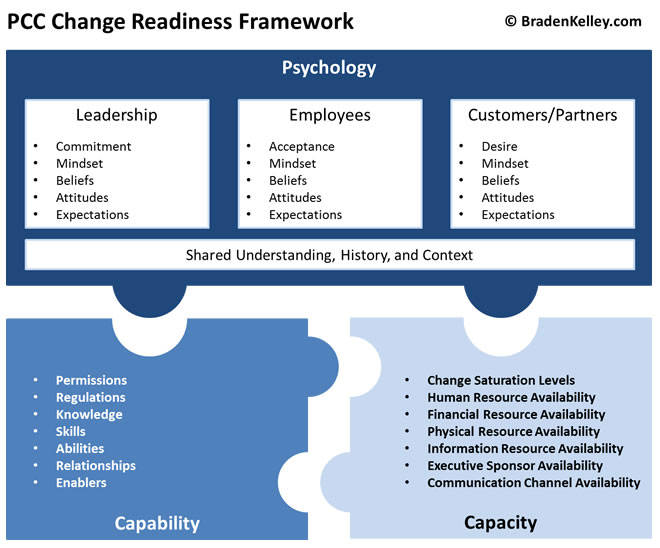
You will notice that many of the items on this list are more about the people factors of change rather than the process or technology factors of change. The weight of the human dimensions of change is reflected in my PCC Change Readiness Framework™. This framework focuses on the psychology of key groups surrounding the identified change, the capabilities needed to successfully execute the change, and the organization’s capacity to tackle this change effort (along with everything else).

PCC Change Readiness Framework

You will notice that I don’t speak about organizational psychology or culture in my PCC Change Readiness Framework™. The reason I don’t highlight culture in the same way that many other people do is that in today’s more social, customer-centric business, we must look more broadly than the typical inward focus of company culture when it comes to identifying the readiness of not only employees, but leaders, customers, and partners too. Inevitably many of our change efforts will have some impact on one or more external groups (possibly even non-profit entities and one or more governments).

You will notice that within the PSYCHOLOGY box there is a common focus on the mindsets, attitudes, beliefs and expectations of the individuals. Culture is incorporated into the psychology realm by focusing on what the shared understandings are around the potential change, but more broadly too. And, finally you will notice that my PCC Change Readiness Framework™ highlights the need for successful change efforts to move towards gaining commitment to the change from leadership, acceptance of the change by employees, and a desire for the change from customers and partners.

Within the CAPABILITY box of my PCC Change Readiness Framework™ we must investigate whether our change effort has any regulatory or statutory implications and whether we are ready to adapt, adopt or influence the changes necessary in this sphere. We must also ask ourselves a series of questions:

  • “Do we need to get permission from anyone to do this?”
  • “What knowledge, skills, and abilities needed for this change do we already possess?”
  • “What knowledge, skills, and abilities needed for this change do we need to acquire?”
  • “What relationships do we possess that will be useful in advancing the change?”
  • “What relationships do we need to build to help advance the change?”
  • “What are the enablers of making this change successful?”

Within the CAPACITY box we have to look at where our resources are approaching, or have already achieved, change saturation. This means they are unable to productively participate in any more change efforts or adopt any more change. But we also have to look at the availability of our resources:

  • Human
  • Financial
  • Physical
  • Information
  • Executive Sponsors
  • Space in our desired communication channels

It is easy to take for granted that the organization will have the capacity to undertake your change effort, but often there are capacity constraints that you will run into, especially as the pace and volume of change increases inside an organization. The one that is easiest to overlook and fail to plan for, is making sure that you’re going to be able to communicate your change messages in your desired messaging channels (they may already be full).

In my upcoming collaborative, visual Change Planning Toolkit™ you will find the companion tools for the PCC Change Readiness Framework™, two large format change readiness worksheets to download for printing that will help you collaboratively explore all of these topics and more.

Be sure and sign up for the Braden Kelley newsletter to receive the latest news on my new book on the best practices and next practices of organizational change (January 2016) and the licensing options for the Change Planning Toolkit™.

Finally, when you consider all of the potential stumbling blocks in advance of the change that we highlighted above, evaluate your readiness in each area, and make a plan for closing any gaps (before you even begin your change effort), you will greatly increase the chances of its success. But, there are certain items that are not just good to know in advance, but are actually prerequisites for change, and we will explore that topic in the book, so stay tuned!

EDITOR’S NOTE: I’ve gone ahead and created a free downloadable flipbook PDF for people to grab. It was inspired by Art Inteligencia’s article titled Change Readiness: What It Is and How to Achieve It.

PCC Change Readiness Framework Flipbook

P.S. In case you missed it, click to read Change the World – Step One


Accelerate your change and transformation success

Subscribe to Human-Centered Change & Innovation WeeklySign up here to get Human-Centered Change & Innovation Weekly delivered to your inbox every week.

Change the World – Step One

Change the World - Step OneDo you want to change the world?

Even just one tiny corner of your own world?

Change often feels overwhelming, scary even, and frequently we don’t know where to begin.

Stoking Your Innovation Bonfire focused on helping organizations identify and remove barriers to innovation, and has also served as a great innovation primer for innovation practitioners all over the world.

As people choose and commit to going down the innovation path in a measured way, one of the first things they discover is that many things will have to change inside the organization and in how the entity engages with others outside the organization for their new product or service ideas to successfully walk the transitional path from insight to idea to experiment to implementation project to market offering and market success.

Because of this, my next book and most of my future articles here on Innovation Excellence in the run up to the release of my Change Planning Toolkit™ will be focused on helping people build a strong foundation for achieving successful organizational change. This series of articles will culminate with the launch of a new book from Palgrave Macmillan in January 2016 on the best practices and next practices of organizational change and an introduction to my Change Planning Toolkit™.

So, if we’re hoping to change the world, our world, whether that is with a big W or a little one, where should we begin?

Let’s begin by painting a background for the landscape of organizational change.

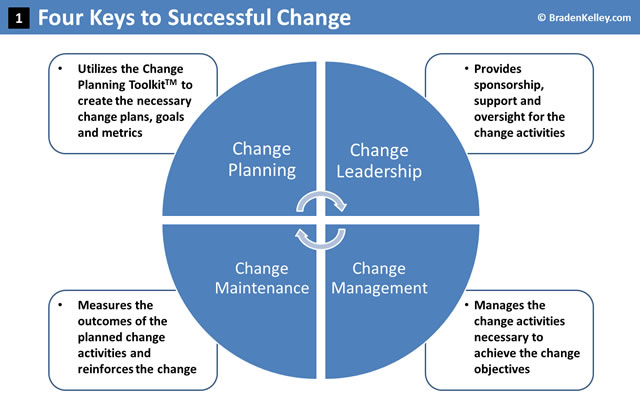
Four Keys to Successful Change

Above you’ll see a visualization of the Four Keys to Successful Change. Leave one out and eventually your change effort, no matter how big or small, will eventually fail. If you’re setting setting out to change the world, even a small corner of it, then you’ll want to be sure to consider each of the four keys and make sure that you proceed in a measured way that takes each into account.

Let’s look at each briefly in turn before we look at each area in more detail in future posts, and eventually in the book in January 2016.

The Four Keys to Successful Change

1. Change Planning

Change Planning is the first key to successful organizational change, and it focuses on drawing out the key issues of the necessary change and puts some structure and timeline around them. You will find you have a better experience and a more successful outcome if you use a more visual, collaborative method using something like the Change Planning Toolkit™ I will be releasing soon to help you create the necessary change plans, goals, metrics, etc.

2. Change Leadership

Change Leadership is the second key to successful organizational change, and is important because good change leadership provides the sponsorship, support and oversight necessary for the change activities to receive the visibility, care, and attention they need to overcome inertia and maintain momentum throughout the process of transformation.

3. Change Management

Change Management represents the third key to successful organizational change, and it is probably the one most people think of when they think about organizational change because it focuses on managing the change activities necessary to achieve the change objectives. The term itself has some challenges however as the term also refers to the management of code changes during the software development process and its relationship with project management is confused. We will dig more into the relationship between project management and change management in a future article.

4. Change Maintenance

Change Maintenance represents the fourth and probably most neglected key to successful organizational change. Many change leaders lose interest after the major launch milestones are achieved, and this is a real risk to sustained success of the change effort. During the change maintenance phase is when you measure the outcomes of the planned change activities and reinforce the change, to make sure the change effort has met the change objectives and when you ensure that the behavior change becomes a permanent one. Neglect this phase and people often slip back into their old, well worn patterns of behavior.

Conclusion

This is the first article in a series to help make changing the world seem a little less overwhelming, a little less scary. I hope you have found the article and the framework a useful first building block as we work together to build a strong foundation for successful organizational change. To be alerted when the Change Planning Toolkit™ becomes available, please be sure and click the link below to join the mailing list, and stay tuned for the next article in this series!

Sign up for updates on the Change Planning Toolkit™ (Charting Change Insiders)

Image credit: Youthventure.org


Accelerate your change and transformation success

Subscribe to Human-Centered Change & Innovation WeeklySign up here to get Human-Centered Change & Innovation Weekly delivered to your inbox every week.

Your Chance to Help Change Change

Your Chance to Help Change ChangeMy first book Stoking Your Innovation Bonfire was designed to help organizations identify and remove barriers to innovation, but readers also found it to be a great primer on how to take a structured, sustainable approach to innovation, and as a result the book has found its way into university courses and libraries around the world.

I’ve been thinking over the last few years about where I could provide the most value in a follow-up book, and it came to me that innovation is really all about change and that where most organizations fail to achieve innovation is in successfully making all of the changes necessary to transform their inventions into innovations. At the same time, the world has changed, the pace of change is accelerating and organizations are struggling to cope with the speed of changes required of them, including the digital transformation they need to make.

So, my next book, this time for Palgrave Macmillan, will focus on highlighting the best practices and next practices of organizational change. And where does any successful change effort begin?

With good planning. But it is really hard for most people to successfully plan a change effort, because it is hard to visualize everything that needs to be considered and everything that needs to be done to affect the changes necessary to support an innovation, a digital transformation effort, a merger integration, or any other kind of needed organizational change.

But my Change Planning Toolkit™ and my new book (January 2016) are being designed to help you get everyone literally all on the same page for change. Both the book and my collaborative, visual Change Planning Toolkit™ are nearly complete. But before they are, I’d like to engage you, the intelligent, insightful Innovation Change Management community to help contribute your wisdom and experience to the book.

I’m looking for a few change management tips and quotes attributable to you (not someone else) to include in the book along with the other best practices and next practices of organizational change that I’ve collected and the introduction to my Change Planning Toolkit™ that I’m preparing.

It’s super simple to contribute. Just fill out the form, and the best contributions will make it into the book or into a series of articles that I’ll publish here and on a new site focused on organizational change that I’m about ready to launch.

I look forward to seeing your great organizational change quotes and tips!

UPDATE: The book is now out! Grab a copy here:


Accelerate your change and transformation success

Subscribe to Human-Centered Change & Innovation WeeklySign up here to get Human-Centered Change & Innovation Weekly delivered to your inbox every week.

Agile Change Management is Coming

Agile Change Management

How fast is your organization capable of changing to continue to remain relevant and successful in the marketplace?

The world is changing at an accelerating pace as new technologies are discovered, developed, released and adopted by consumers faster than ever before. At the same time companies are rising to global scale faster and large, successful companies are disappearing faster too.

In this new reality that we all face, organizations of all types are going to need to:

  • Change how they change
  • Increase their organizational agility
  • Increase the flexibility of the organization
  • Become capable of continuous change
  • Inhibit the appearance and/or growth of change gaps that can doom your company

It is because of this tidal wave of change and a recognition that there is a need in the marketplace for more human change processes and tools that make change seem less overwhelming, that my next book for Palgrave Macmillan will focus on the best practices and next practices of organizational change (aka change management), and I’ve developed a new collaborative, visual change planning toolkit to go with it (but more about that later).

One way to do all of the items in the bulleted list above is to take more of an agile approach to change, to adopt some of the values and principles of the Agile Software Development methodology and use those to create a set of what could be described as Agile behaviors within the organization. If you are not familiar with the Agile Software Development methodology, I have included below the Agile Software Development Manifesto from http://agilemanifesto.org that details the values and principles of Agile Software Development. As you read through the manifesto I hope you’ll see that the values and principles can easily be applied to other endeavors outside of software development, whether that might in the project management discipline of your organization, or within your larger change initiatives.

Manifesto for Agile Software Development

We are uncovering better ways of developing software by doing it and helping others do it.

Through this work we have come to value:

  1. Individuals and interactions over processes and tools
  2. Working software over comprehensive documentation
  3. Customer collaboration over contract negotiation
  4. Responding to change over following a plan

That is, while there is value in the items on the right, we value the items in bold more.

Principles behind the Agile Manifesto

We follow these principles:

  • Our highest priority is to satisfy the customer through early and continuous delivery of valuable software.
  • Welcome changing requirements, even late in development. Agile processes harness change for the customer’s competitive advantage.
  • Deliver working software frequently, from a couple of weeks to a couple of months, with a preference to the shorter timescale.
  • Business people and developers must work together daily throughout the project.
  • Build projects around motivated individuals. Give them the environment and support they need, and trust them to get the job done.
  • The most efficient and effective method of conveying information to and within a development team is face-to-face conversation.
  • Working software is the primary measure of progress.
  • Agile processes promote sustainable development. The sponsors, developers, and users should be able to maintain a constant pace indefinitely.
  • Continuous attention to technical excellence and good design enhances agility.
  • Simplicity–the art of maximizing the amount of work not done–is essential.
  • The best architectures, requirements, and designs emerge from self-organizing teams.
  • At regular intervals, the team reflects on how to become more effective, then tunes and adjusts its behavior accordingly.

Agile and Constant Change

FIGURE 1

You will see in FIGURE 1 that constant change sits at the center, Agile Values providing the initial direction for an organization with a committed goal of becoming more agile. Radiating out from Agile Values as we pursue success in coping with constant change will be our Agile Principles. But, ultimately we can’t live our values or follow our principles if we don’t exhibit behaviors that personify those values and principles. Unless our organizations begin to behave in a more agile way then the potential of truly becoming more agile will remain just words, and go largely unfulfilled.

It is because of the challenge of behaving in a new way that I encourage all of your to make a move towards a formal pursuit of organizational agility. To help you in this pursuit, I will soon be releasing my brand new collaborative, visual change planning toolkit for companies to use on their own (with free training for a select few who agree to use it and document their experience for the book). In addition I will be launching separate training for consultants so they can use the tools with clients in their change management and project management practices. Please register your interest here.

Using this new set of change planning and execution tools and processes will not only make change seem less overwhelming, but it will also help you build alignment behind your effort, help you work through as a group how to LITERALLY all get on the same page for change, and create a more agile organization as adoption of the tools spreads.

Stay tuned for more great change content coming soon!

In the meantime, check out the different ways to get involved.


Accelerate your change and transformation success


SPECIAL BONUS: You can now access my latest webinar ‘Innovation is All About Change’ compliments of CoDev with passcode 1515 (link expired)


Subscribe to Human-Centered Change & Innovation WeeklySign up here to get Human-Centered Change & Innovation Weekly delivered to your inbox every week.