Tag Archives: Learning

Learning From Public Sector Innovation Failures

LAST UPDATED: April 15, 2026 at 11:41 AM

Learning From Public Sector Innovation Failures

GUEST POST from Chateau G Pato


The High Cost of Playing It Safe

In the public sector, the greatest risk is often the refusal to take one. While private enterprises fear losing market share, public institutions face a more daunting specter: the erosion of public trust. When we play it too safe, we don’t actually avoid failure; we simply invite a slow, systemic decay that I call the “Invisible Friction.”

The Paradox of Public Innovation

There is a fundamental tension between the “Burning Platform” and FutureHacking.” Many government agencies only innovate when forced by a crisis — a literal or metaphorical fire. This reactive stance leads to “Crisis Innovation,” which is a sprint for survival rather than a strategic move toward a better future. To break this cycle, we must move beyond mere compliance and embrace a mindset that treats stagnation as the ultimate failure.

Defining the Gap

We are currently witnessing a widening chasm between private sector user experience (UX) standards and public sector service delivery. Citizens who experience seamless, human-centered design in their daily digital lives find it increasingly unacceptable to navigate opaque, bureaucratic hurdles for essential services. This gap is where trust goes to die.

The Thesis: Failure as a Data Point

Innovation in the public square isn’t about chasing the “New” — it’s about pursuing the “Better.” We must redefine failure as our most expensive form of research and development. In this article, we will explore how to stop fearing the setback and start mining it for the insights required to solve meaningful problems that people actually care about.

The Anatomy of Public Sector Failure

To fix a system, we must first be willing to perform the autopsy on our unsuccessful initiatives. In my work with change leaders, I’ve observed that public sector failures are rarely the result of a single “bad idea.” Instead, they are the byproduct of systemic misalignments and the “Manager Mindset” overshadowing human-centered design.

The “Mousetrap” Trap

Perhaps the most common pitfall is falling in love with a solution before truly understanding the problem. In the rush to appear “innovative,” agencies often procure expensive technology — currently, this is often generative AI — without first identifying a human friction point it is meant to solve. We end up building a “better mousetrap” in a building that actually has a plumbing problem.

Siloed Success is Systemic Failure

Public innovation often suffers from the “Island of Excellence” syndrome. A single department may execute a brilliant pilot, but because the broader organizational infrastructure (procurement, HR, and legal) remains rooted in 20th-century logic, the innovation cannot scale. When we fail to build an Innovation Commons, we ensure that great ideas remain trapped in silos, eventually dying of neglect.

The Policy-Delivery Disconnect

There is often a massive chasm between the legislative intent of a policy and the lived experience of the citizen trying to access it. This is where Experience Design fails. When policy is designed in a vacuum, ignoring the “hidden social contracts” and the emotional reality of the end-user, the digital service delivery becomes a source of frustration rather than empowerment. Failure here isn’t just a technical glitch; it’s a breach of the social contract.

“Innovation isn’t about the technology; it’s about the sociology. If you don’t design for the human heart and the bureaucratic reality, your ‘digital transformation’ is just an expensive way to do the wrong things faster.”

Applying the “Eight I’s of Infinite Innovation” to the Public Square

To move beyond the cycle of trial and error, we must apply a repeatable framework that accounts for the complexity of the public ecosystem. Braden Kelley’s Eight I’s of Infinite Innovation framework provides a lens to see exactly where a public sector project lost its way and how to course-correct for the future.

Inspiration & Ideation: Beyond the Budget Line

Public innovation often fails at the Inspiration stage because it is framed as a mandate rather than a mission. Without a compelling vision that connects to a human outcome, Ideation becomes a sterile exercise in “brainstorming” rather than a purposeful attempt to “FutureHack” a better reality for the citizen. We must ask: What is the human story we are trying to change?

Investigation: The Lens of Empathy

In the public sector, Investigation is often mistaken for simple data collection. True innovation requires moving past labor statistics and demographic charts to understand the “identity stakes” of the people involved. We need to investigate not just the technical requirements, but the emotional barriers and “invisible friction” that prevent a service from being adopted.

Implementation & Integration: Bridging the “Valley of Death”

Most public sector failures happen during Integration. It is relatively easy to run a pilot program (Implementation), but it is incredibly difficult to weave that pilot into the existing fabric of government. To succeed, we must design for the Innovation Commons — creating shared resources and language that allow a new solution to survive the transition from a “cool project” to a “core service.”

By diagnosing failures through these stages, we can identify if our project lacked the right Insights or if it simply failed because we didn’t plan for the Institutional resistance that accompanies any meaningful change.

The Human Element: Overcoming Resistance

Innovation is never a purely technical or administrative exercise; it is a psychological one. In the public sector, the greatest barrier to progress isn’t a lack of funding or outdated software — it is the human response to change. To learn from failure, we must acknowledge that every innovation is a disruption of someone’s status quo.

Anticipating the Counter-Revolution

Newton’s Third Law applies to bureaucracy: every action provokes an equal and opposite reaction. I often talk about the “Counter-Revolution” — the systemic pushback from those who feel their expertise, job security, or “identity stakes” are threatened by a new way of working. Failure often occurs because we design for the citizen but forget to design for the civil servant who must deliver the service.

The “Craic” and Psychological Safety

To innovate effectively, we need to foster a culture of psychological safety. In my work, I often reference the Irish concept of the “Craic” — creating an environment where people can speak the truth, acknowledge the absurdity of a broken process, and “fail safely.” If a mistake in a pilot program leads to a congressional hearing or a front-page scandal, no one will ever take a risk again. We must build containers where “failing forward” is a protected activity.

Admitting Weakness as Strength

The most resilient public sector leaders are those who are transparent about what didn’t work. When we hide our failures, we lose the opportunity to build Radical Transparency with the public. Admitting that a digital portal failed to meet user needs isn’t a sign of weakness; it’s a demonstration of commitment to the human outcome. It shifts the conversation from “Who is to blame?” to “How do we fix this together?”

“You cannot mandate innovation, but you can certainly legislate it out of existence by punishing the curiosity required to find a better way.” — Braden Kelley

Strategic Shifts: From Reactive to Proactive

To truly evolve, public institutions must stop treating innovation as an emergency response. Learning from failure requires a fundamental shift in our temporal perspective — moving away from fixing the past and toward designing the future we want to inhabit.

The Crisis Innovation Trap

Most public sector breakthroughs are born of necessity during a catastrophe. While “Crisis Innovation” proves that bureaucracy can move fast, it is a sustainable strategy for exactly zero organizations. It creates a culture of “Sprints for Survival,” where the moment the pressure subsides, the organization snaps back to its original shape like a rubber band. We must transition these temporary bursts of energy into a permanent capacity for change.

FutureHacking™ the Public Sector

We don’t need better crystal balls; we need better hammers. FutureHacking™ is about identifying the “seeds of the future” that already exist in the present. By analyzing where previous innovations failed to take root, we can identify the systemic blockages — whether they are outdated procurement laws or rigid hierarchical structures — and “hack” them before the next crisis arrives. Proactive innovation is about building the bridge while the weather is still clear.

Reward Curiosity, Not Just Results

If we only reward successful outcomes, we inadvertently incentivize people to only propose “sure bets” — which are rarely innovative. To break the cycle of failure, we must change our Key Performance Indicators (KPIs). We should measure:

  • Velocity of Learning: How quickly did we identify that a path was incorrect?
  • Reduction of Friction: Did this attempt make the next attempt easier?
  • Human Insight: What do we now know about our citizens that we didn’t know six months ago?

By rewarding the curiosity to explore and the candor to report a failure, we create a public sector that is resilient, adaptive, and — most importantly — human.

Conclusion: The Time to Innovate is Always Now

Innovation in the public sector is never a neutral act — it either empowers the citizen or it excludes them. When we fail, we aren’t just losing time or money; we are missing an opportunity to reaffirm the relevance of our institutions in an increasingly complex world. The failures of the past are not anchors; they are the foundation upon which we must build a more responsive, human-centered government.

A Call to Action for Changemakers

To the leaders and civil servants in the trenches: stop chasing the “better mousetrap.” Our goal is not to digitize bureaucracy, but to humanize it. We must have the courage to name the unnamed things — to call out the processes that no longer serve us and to protect the “Conscripts” and “Magic Makers” within our organizations who are trying to find a better way.

The Final Thought

We must move from a state of constant “crisis management” to a permanent state of intentional evolution. In the public square, the greatest innovation isn’t a piece of software or a new policy — it is the persistent, collective courage to try, fail, learn, and try again until the human experience matches the public promise.

“The future isn’t something that happens to us; it’s something we build together. If you aren’t failing occasionally, you aren’t reaching far enough into the future.” — Braden Kelley

This is how we FutureHack the public sector. Let’s get to work.

Frequently Asked Questions

Why do public sector innovation projects fail more visibly than private ones?

Public sector failures are high-stakes because they involve public trust and taxpayer funds. Unlike the private sector, where a product can simply be “sunsetted,” public services are essential; when they fail, they create “invisible friction” that impacts social equity and institutional credibility.

What is the “Mousetrap Trap” in government innovation?

The “Mousetrap Trap” occurs when agencies fall in love with a technical solution — like Generative AI — before clearly defining the human problem. This leads to building “better mousetraps” for buildings that actually have plumbing problems, wasting resources on tools that don’t improve the citizen experience.

How can public leaders foster a culture of “safe failure”?

Leaders must move from a Manager Mindset to a Changemaker Mindset by creating “Innovation Commons.” This involves rewarding curiosity and the “velocity of learning” rather than just successful launches, ensuring teams have the psychological safety to report setbacks without career-ending consequences.

Image credit: Google Gemini

Subscribe to Human-Centered Change & Innovation WeeklySign up here to get Human-Centered Change & Innovation Weekly delivered to your inbox every week.

Building the Team Habit of Learning and Pivoting

Continuous Calibration

LAST UPDATED: December 17, 2025 at 11:49AM

Building the Team Habit of Learning and Pivoting

GUEST POST from Chateau G Pato

The pace of change has exposed a dangerous illusion in modern organizations: the belief that certainty is achievable if we plan hard enough. In reality, performance today depends on how quickly teams can sense change, learn from experience, and adapt. This is the discipline I call continuous calibration.

Continuous calibration is not about abandoning strategy or creating instability. It is about treating learning as a core operating capability rather than a retrospective activity. Teams that calibrate continuously do not panic when conditions shift. They pivot with intention.

Why Planning Alone Is No Longer Enough

Traditional planning assumes a relatively stable environment. But markets, technologies, and customer expectations now evolve faster than planning cycles. When teams cling too tightly to static plans, they confuse consistency with effectiveness.

Continuous calibration replaces rigid adherence with disciplined learning. Teams set direction, test assumptions, observe outcomes, and adjust course. The goal is not to change constantly, but to change deliberately.

Case Study One: Pixar and Learning Before It Is Too Late

Pixar’s creative success is powered by its commitment to early and frequent learning. Through the Braintrust, filmmakers receive candid feedback at multiple stages of development. Problems are surfaced while they are still solvable.

Because the Braintrust cannot impose decisions, teams remain accountable for outcomes while benefiting from diverse perspectives. This creates a powerful calibration loop that improves quality without eroding ownership.

The Human Conditions for Calibration

Calibration fails when people feel unsafe speaking honestly. Psychological safety is the foundation that allows teams to share weak signals, question assumptions, and admit when something is not working.

Leaders who reward transparency and curiosity create conditions where learning outpaces fear. Without this foundation, teams default to defending decisions instead of improving them.

Case Study Two: Microsoft’s Cultural Recalibration

Microsoft’s resurgence under Satya Nadella was driven by a shift in mindset. The organization embraced learning as a core expectation, not a remedial activity. Teams were encouraged to experiment, reflect, and adjust quickly.

This cultural recalibration enabled Microsoft to pivot effectively toward cloud platforms and ecosystem partnerships. Learning velocity became a competitive advantage.

Turning Calibration into a Team Habit

Continuous calibration is sustained through simple, repeatable behaviors. Effective teams hold regular retrospectives, define clear success criteria, and shorten feedback loops wherever possible.

What matters most is frequency. Small, regular adjustments outperform dramatic pivots made too late.

Leadership in a Calibrating Organization

In calibrating teams, leaders shift from being decision authorities to sense-making partners. They ask better questions, surface patterns, and help teams interpret signals.

This does not weaken leadership. It strengthens it by distributing intelligence across the organization.

Conclusion: Learning Is the Strategy

Continuous calibration is not a process you install. It is a habit you cultivate. Organizations that embed learning into daily work adapt faster, waste less effort, and build greater resilience.

In an unpredictable world, the most reliable strategy is the ability to learn and pivot together.

Frequently Asked Questions

What is continuous calibration?

Continuous calibration is the ongoing practice of learning from results, adjusting direction, and realigning team behaviors based on real-world feedback.

How does continuous calibration improve performance?

It allows teams to identify problems early, adapt deliberately, and avoid costly late-stage corrections.

What role do leaders play in continuous calibration?

Leaders create the conditions for learning by encouraging honesty, asking reflective questions, and supporting informed pivots.

Extra Extra: Because innovation is all about change, Braden Kelley’s human-centered change methodology and tools are the best way to plan and execute the changes necessary to support your innovation and transformation efforts — all while literally getting everyone all on the same page for change. Find out more about the methodology and tools, including the book Charting Change by following the link. Be sure and download the TEN FREE TOOLS while you’re here.

Image credit: Pexels

Subscribe to Human-Centered Change & Innovation WeeklySign up here to get Human-Centered Change & Innovation Weekly delivered to your inbox every week.

Using Boredom to Help Students Learn

Bored Game TeacherWhat do you get when you take the technology away from a group of 10 and 11 year olds and ask them to be creative with a handful of household objects?

Well, Thomas Fraser, a teacher at Crestwood Elementary School in Edmonton, Canada, troubled by the short attention spans of today’s youngsters endeavored to find out by creating what he calls the Bored Game, which involves giving students a handful of common household objects with the only instruction being to do something interesting with them.

The reaction at first from his group of always on youngsters were perplexed looks of how can I create something without an iPad, smartphone or a computer?

Then they started to get into it, and were sad when they didn’t get to play the Bored Game.

CTV recorded an interview about the Bored Game that you can watch here:

(sorry, video is no longer available)

My favorite part of the story is that they’re finding that the performance of the children in a range of subjects is increasing as the children have this periodic time to play and engage their creative problem solving skills.

So, maybe we need less technology in the classroom if we want to teach kids how to learn?

In my opinion, we focus too much on teaching kids to repeat activities, facts, and figures, focusing and what they’re able to memorize and regurgitate and not enough on actually teaching kids creative problem solving and how to learn. We don’t need a new generation of trivia experts, we need a new generation of problem solvers that can help repair the world.

We’ve all heard the saying “If you give a man a fish he’ll eat for a day, if you teach a man to finish he’ll never go hungry.”

If you want your child to be more successful, you have to do the same thing…

“Good teachers teach kids how to do well on the test, great teachers teach kids how to learn so they do well in life.”

For more, I encourage you to check out the Edmonton Journal Article (link expired)

Image credit: Edmonton Journal


Accelerate your change and transformation success

Subscribe to Human-Centered Change & Innovation WeeklySign up here to get Human-Centered Change & Innovation Weekly delivered to your inbox every week.

The Challenge of Autonomous Teaching Methods

The Challenge of Autonomous Teaching Methods

An estimated 250 million children around the world cannot read, write, or demonstrate basic arithmetic skills. Many of these children are in developing countries without regular access to quality schools or teachers. While programs exist to build schools and train teachers, traditional models of education are not able to scale fast enough to meet demand. We simply cannot build enough schools or train enough teachers to meet the need. We are at a pivotal moment where an innovative approach is necessary to eliminate existing barriers to learning, enabling the seeds of innovation to be imparted to every child, regardless of geographic location or economic status.

XPRIZE Chairman and CEO, Dr. Peter H. Diamandis announced the $15M Global Learning XPRIZE today to help solve these challenges. The Global Learning XPRIZE is a five-year competition challenging teams to develop an open source solution that can be iterated upon, scaled and deployed around the world, bringing quality learning experiences to children no matter where they live. Enabling children in developing countries to teach themselves basic reading, writing and arithmetic.

At the same time, XPRIZE will launch an online crowdfunding campaign to mobilize a global street team of supporters to get involved with the Global Learning XPRIZE. Every dollar pledged will go towards optimizing the success of the prize, specifically focusing on supporting team recruitment globally and expanding field testing.

The Global Learning XPRIZE will launch with a six-month team registration period followed by 18 months of solution development. A panel of third-party expert judges will then evaluate and select the top five teams to proceed in the competition, and award each of them a $1M award. Solutions will be tested in the field with thousands of children in the developing world, over an 18-month period. The $10M top prize will ultimately be awarded to the team that develops a technology solution demonstrating the greatest levels of proficiency gains in reading, writing and arithmetic.

The learning solutions developed by this prize will enable a child to learn autonomously. And, those created by the finalists will be open-sourced for all to access, iterate and share. This technology could be deployed around the world, bringing learning experiences to children otherwise thought unreachable, who do not have access to quality education, and supplementing the learning experiences of children who do.

The impact will be exponential. Children with basic literacy skills have the potential to lift themselves out of poverty. And that’s not all. By enabling a child to learn how to learn, that child has opportunity – to live a healthy and productive life, to provide for their family and their community, as well as to contribute toward a peaceful, prosperous and abundant world.

XPRIZE believes that innovation can come from anywhere and that many of the greatest minds remain untapped.

What might the future look like with hundreds of millions of additional young minds unleashed to tackle the world’s Grand Challenges?

The Global Learning XPRIZE is funded by a group of donors, including the Dick & Betsy DeVos Foundation, the Anthony Robbins Foundation, the Econet Foundation, the Merkin Family Foundation, Scott Hassan, John Raymonds and Suzanne West.

For more information, visit http://learning.xprize.org.

COMMENTARY

I am very excited about this new effort, as I am a big believer that we should live in a world where the next Einstein could come from anywhere, but I have a few of concerns:

  • It seems to be focused on the use of technology
  • Five years is a long time (will they get a five-year-old solution?)
  • It doesn’t engage the target users in co-creation throughout the whole process (it’s outside in)
  • It seems to ignore the infrastructure in place in areas of the greatest need (where students don’t even have desks)
  • The most capable solutions may be too expensive to implement in the target areas
  • The goal should be to build an autonomous learning system that can be used for reading, writing, and arithmetic, but also extended to do much more
  • Teaching students skills autonomously is fine as long as there is social practice as part of the curriculum
  • An over-reliance on autonomous teaching will lead to less innovation not more
  • We are already seeing negative effects in first-world society from too much reliance on technology
  • If we want more innovation, we need to be teaching our kids ICE skills not just STEM, ICE being Invention, Collaboration, and Entrepreneurship – these are all social skills that don’t need technology (but can use it)

For more on my views on improving education (which doesn’t require education reform or new technology), please see my article Stop Praying for Education Reform.

For those of you who are going to enter a team, I look forward to seeing what you come up with and I hope that you’ll keep some of the above in mind!


Build a common language of innovation on your team

Subscribe to Human-Centered Change & Innovation WeeklySign up here to get Human-Centered Change & Innovation Weekly delivered to your inbox every week.

Innovation Quotes of the Day – May 28, 2012


“The more successful an organization becomes the bigger it gets. The bigger it gets the more it focuses on optimizing its resources. The more it optimizes it resources the more it eliminates variation. Innovation requires variation. We have seen the enemy and he is us.”

– Jeff DeGraff


“It is in identifying which of The Nine Innovation Roles are vacant (or sub-optimally filled) that you will be able to see some of the areas where your efforts are likely to come up short, and then can take actions to improve your chances of innovation success.”

– Braden Kelley


“It is not enough to simply go through the motions. In order to build our abilities, cognitive or otherwise, we must think about what we’re doing, concentrate while we’re doing it and then review what we have done. Further, we need to seek out mentors and peers who will critique our efforts.”

– Greg Satell


What are some of your favorite innovation quotes?

Add one or more to the comments, listing the quote and who said it, and I’ll share the best of the submissions as future innovation quotes of the day!

Subscribe to Human-Centered Change & Innovation WeeklySign up here to get Human-Centered Change & Innovation Weekly delivered to your inbox every week.

Innovation Quotes of the Day – May 17, 2012


“Indeed parents of some of the most innovative young people whom I interviewed for this book carefully monitor and limit ‘screen time’…the Innovation Generation, have extraordinary latent talent for – and interest in – innovation and entrepreneurship, likely more than any generation in history.”

– Tony Wagner


“The faster you get at learning from unforeseen circumstances and outcomes, the faster you can turn an invention into an innovation by landing smack on what the customer finds truly valuable (and communicating the value in a compelling way).”

– Braden Kelley


“It’s a lot easier to name the things that stifle innovation like rigid bureaucratic structures, isolation, and a high-stress work environment.”

– Senior IBM Executive


What are some of your favorite innovation quotes?

Add one or more to the comments, listing the quote and who said it, and I’ll share the best of the submissions as future innovation quotes of the day!

Subscribe to Human-Centered Change & Innovation WeeklySign up here to get Human-Centered Change & Innovation Weekly delivered to your inbox every week.

Innovation QuickStart Guide

Innovation QuickStart GuideYou know how sometimes when you order a product you get this inch-thick instruction manual that you never read, but also how there is sometimes a QuickStart Guide of 5-10 simple steps to get you up and running quickly?

Well, Stoking Your Innovation Bonfire is the instruction manual that an increasing number of organizations are ordering for teams to help them with their innovation efforts. But, I’m sure companies could also use an Innovation QuickStart. So, here is one you could use (excerpted in part from my book):

10 Steps to Get Your Innovation Efforts Off to a Good Start

1. Conduct an Innovation Audit

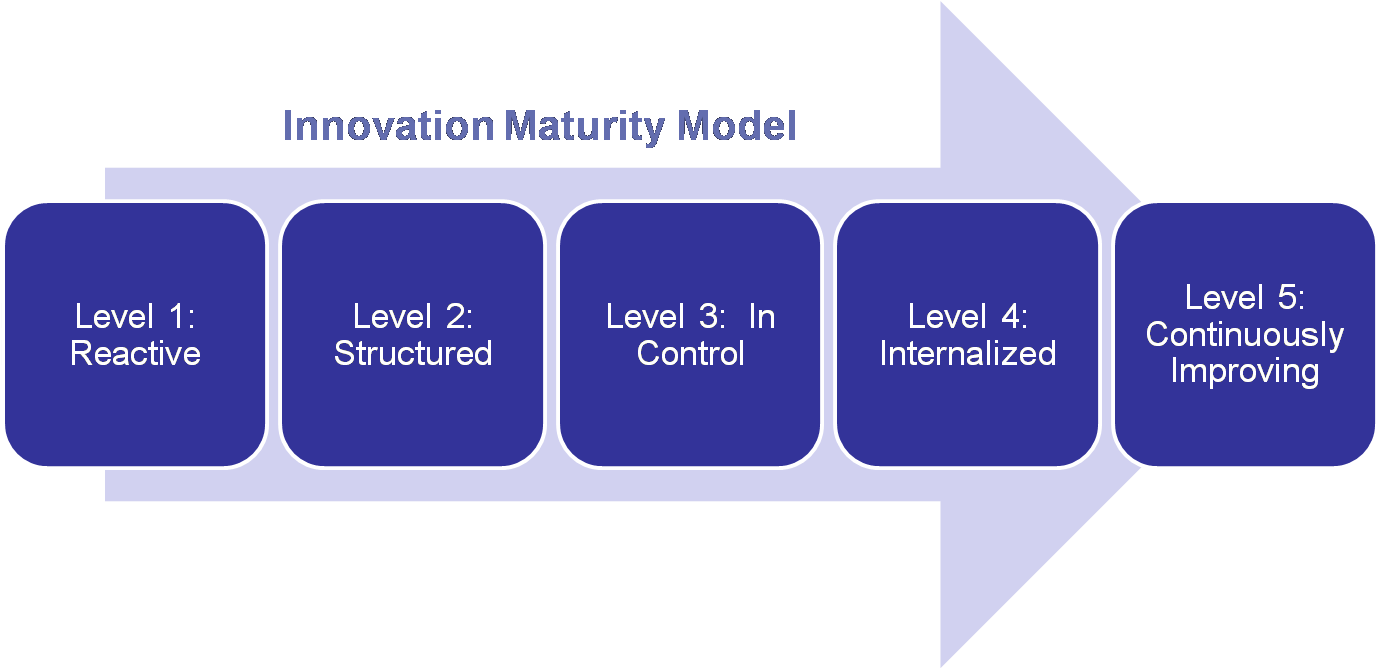
How can you know where you are going to go with innovation if you don’t first know where you already are? For this reason I created a 50 question innovation audit and linked it to an Innovation Maturity Model from Karl T. Ulrich and Christian Terwiesch of Wharton Business School.
Innovation Maturity Model

2. Define What Innovation Means for Your Organization

Here is a simple exercise you can do next time you get together in your organization to talk about innovation. Have everyone in the group write down what their definition of innovation is, and then compare that to the official definition of innovation for the organization (if you have one) and the innovation definitions of others in the group. Defining innovation as an organization is important because it helps you determine what kinds of innovation you are focusing on as an organization, and what kinds of innovation you ARE NOT focusing on.

3. Create a Common Language of Innovation

Creating a definition of innovation is the first step in creating a common language of innovation. The importance of creating a common language of innovation is that language is one of the most important components of culture. If people in your organization don’t talk about innovation in a consistent way and see communications reinforcing the common language, how can you possibly hope to embed innovation in the culture of the organization? Ensuring consistent language in presentations, emails, etc. and having people read the same book on innovation or taking the same training courses are just some ways to help create and reinforce a common language of innovation.

4. Define Your Innovation Vision

A startup begins life as a single-minded entity focused on innovating for one set of customers with a single product or service. Often as a company grows to create a range of products and/or services, the organization can start to lose track of what it is trying to achieve, which customers it is trying to serve, and the kind of solutions that are most relevant and desired by them.

Jack Welch, CEO of GE once said, “Good business leaders create a vision, articulate the vision, passionately own the vision, and relentlessly drive it to completion.”

Vision is about focus and vision is about the ‘where’ and the ‘why’ not the ‘what’ or the ‘how’. A vision gives the business a sense of purpose and acts as a rudder when the way forward appears uncertain. An innovation vision is no less important, and it serves the same basic functions. An innovation vision can help to answer some of the following questions for employees:

  • Is innovation important or not?
  • Are we focusing on innovation or not?
  • What kind of innovation are we pursuing as an organization?
  • Is innovation a function of some part of the business?
  • Or, is innovation something that we are trying to place at the center of the business?
  • Are we pursuing open or closed innovation, or both?
  • Why should employees, suppliers, partners, and customers be excited to participate?

When people have questions, they tend not to move forward. For that reason it is crucial that an organization’s leadership both has a clear innovation vision, and clearly and regularly communicates it to key stakeholders. If employees, suppliers, partners, and customers aren’t sure what the innovation vision of the organization is, how can they imagine a better way forward?

Pre-Order Nine Innovation Roles Card Decks

5. Define Your Innovation Strategy

Many organizations take the time to create an organizational strategy and a mission statement, only to then neglect the creation of an innovation vision and an innovation strategy. An innovation strategy is not merely a technology roadmap from R&D or an agenda for new product development. Instead, an innovation strategy identifies who will drive a company’s profitable revenue growth and what will represent a strong competitive advantage for the firm going forward. Under this umbrella the innovation goals for the organization can be created.

An innovation strategy sets the innovation direction for an organization towards the achievement of its innovation vision. It gives members of the organization an idea of what new achievements and directions will best benefit the organization when it comes to innovation. As with organizational strategy, innovation strategy must determine WHAT the organization should focus on (and WHAT NOT to) so that tactics can be developed for HOW to get there.
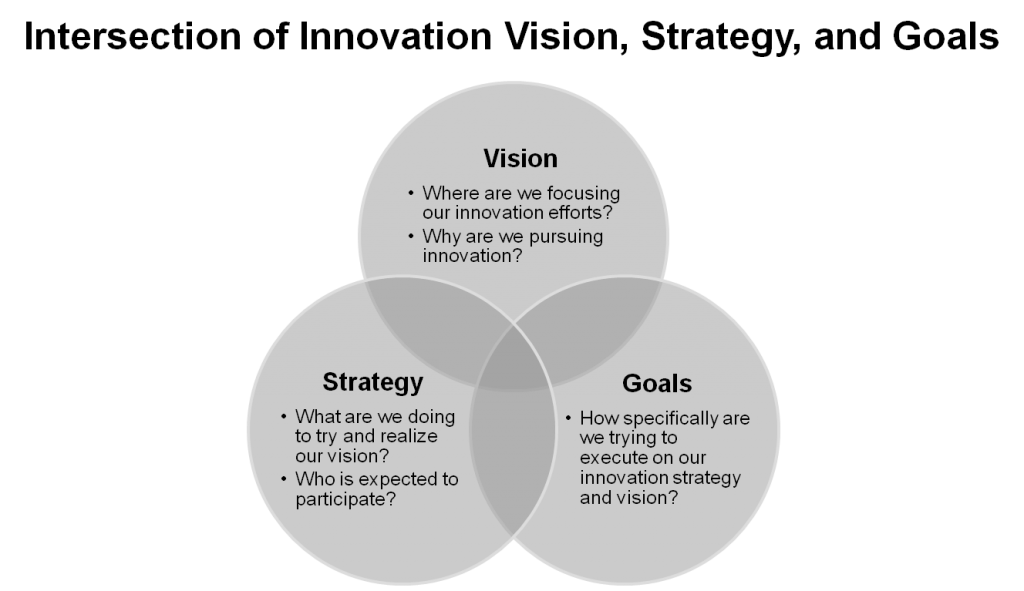
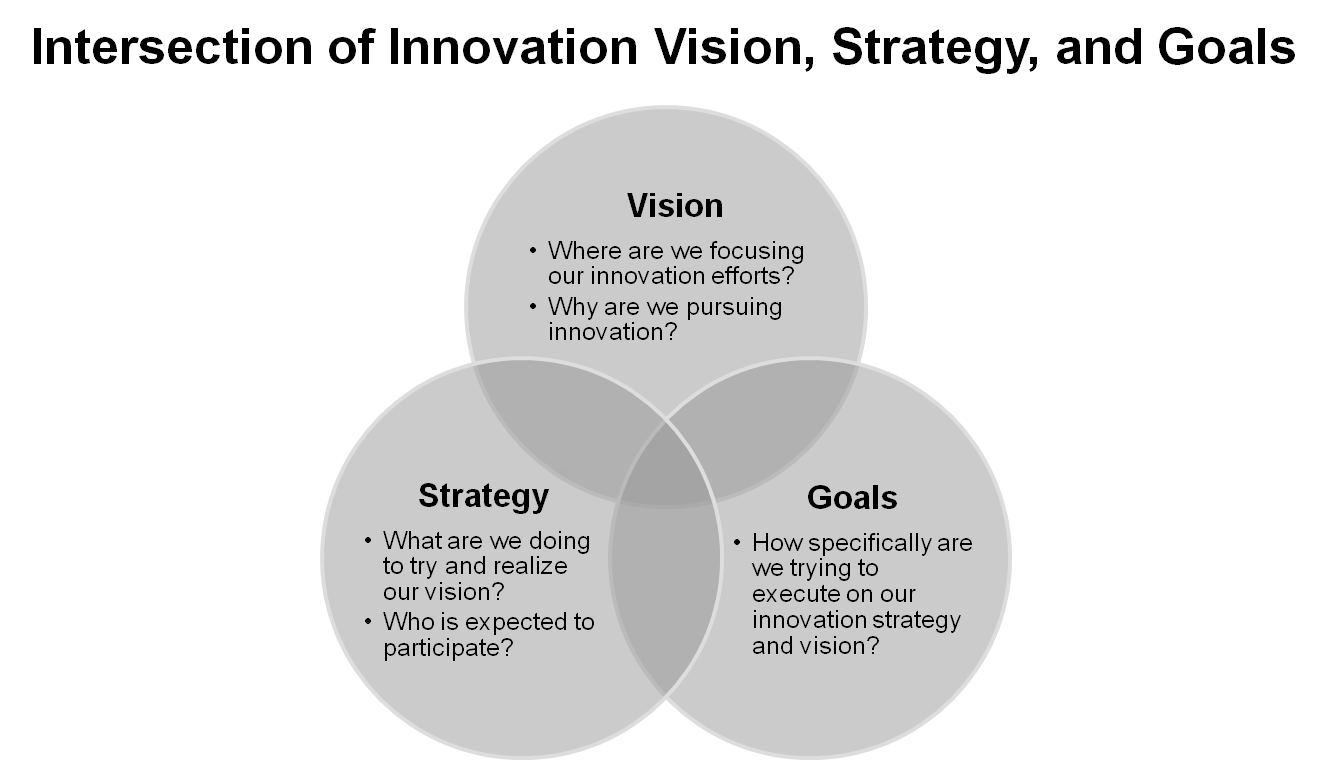
Innovation Vision Strategy Goals

6. Define Your Innovation Goals

Just as managers and employees need goals to know what to focus on and to help them be successful, organizations need innovation goals too. Clear innovation goals, when combined with a clear innovation strategy and a single-minded innovation vision for the organization, will maximize the instinctual innovation that emerges from employees and the intellectual innovation that occurs on directed innovation projects.

While an innovation vision determines the kinds of innovation that an organization, and an innovation strategy determines what the organization will focus on when it comes to innovation, it is the innovation goals that break things down into tangible objectives that employees can work against. Let’s look at P&G as an example to see how these three things come together at the highest level:

Innovation Vision

  • Reach outside the company’s own R&D department for innovation

Innovation Strategy

  • Create a formal program (Connect + Develop) to focus on this vision

Innovation Goal

  • Source 50% of the company’s innovation from outside

The 50% goal gives employees and management something to measure against, and it sets a very visible benchmark that the whole organization can understand and visualize how big the commitment and participation must be in order to reach it. It is at this point of communicating the innovation goals that senior management also has to communicate how they intend to support their efforts and how they will help employees reach the innovation goals.

7. Create a Pool of Money to Fund Innovation Projects

Product managers leading product groups and general managers leading business units typically have revenue numbers they are trying to hit, and they will spend their budgets trying to hit those numbers. As a result, there are often precious little financial resources (and human resources) available for innovation projects that don’t generate immediate progress toward this quarter’s business goals. As a result, many organizations find themselves setting money aside outside of the product or business unit silos that can be allocated on the future needs of the business instead of the current needs of the product managers and general managers. This also allows the organization to build an innovation portfolio of projects with different risk profiles and time horizons. But, however you choose to fund innovation projects, the fact remains that you need to have a plan for doing so, or the promising projects that form your future innovation pipeline – will never get funded.

8. Create Human Resource Flexibility to Staff Innovation Projects

Some organizations allow employees to spend a certain percentage of their time on whatever they want, but most don’t. Some organizations allow employees to pitch to spend a certain percentage of their time on developing a promising idea, but most organizations are running so lean that they feel there is no time or money for innovation. Often this is true and so employees sometimes work on promising ideas on their own time, but they shouldn’t have to. And if you make them do so, it will be much more likely that they will develop the promising idea with others outside the company and the organization will gain nothing from these efforts.

Don’t turn your motivated intrapreneurs into entrepreneurs.

You must find a way to create resource flexibility. Organizations that want to continue to grow and thrive must staff the organization in a way that allows managers to invest a portion of their employees’ time into promising innovation projects. One model to consider is that of Intuit, which allows employees to form project teams and to accumulate percent time and then schedule time off to work on an innovation project with co-workers in the same way that they schedule a vacation. This allows the manager to plan for the employees’ absence from the day-to-day and allows the employee to focus on the innovation project during that scheduled leave from their workgroup. But that’s just one possible way to create human resource flexibility.

Pre-Order Nine Innovation Roles Card Decks

9. Focus on Value – Innovation is All About Value

Value creation is important, but you can’t succeed without equal attention being paid to both value access and value translation because innovation is all about value…

Innovation = Value Creation (x) Value Access (x) Value Translation = Success!

Now you will notice that the components are multiplicative not additive. Do one or two well and one poorly and it doesn’t necessarily add up to a positive result. Doing one poorly and two well can still doom your innovation investment to failure. Let’s look at the three equation components in brief:

Value Creation is pretty self-explanatory. Your innovation investment must create incremental or completely new value large enough to overcome the switching costs of moving to your new solution from the old solution (including the ‘Do Nothing Solution’). New value can be created by making something more efficient, more effective, possible that wasn’t possible before, or create new psychological or emotional benefits.

Value Access could also be thought of as friction reduction. How easy do you make it for customers and consumers to access the value you’ve created. How well has the product or service been designed to allow people to access the value easily? How easy is it for the solution to be created? How easy is it for people to do business with you?

Value Translation is all about helping people understand the value you’ve created and how it fits into their lives. Value translation is also about understanding where on a continuum between the need for explanation and education that your solution falls. Incremental innovations can usually just be explained to people because they anchor to something they already understand, but radical or disruptive innovations inevitably require some level of education (often far in advance of the launch). Done really well, value translation also helps to communicate how easy it will be for customers and consumers to exchange their old solution for the new solution.

The key thing to know here is that even if you do a great job at value creation, if you do a poor job at either value access or value translation, you can still fail miserably.

10. Focus on Creating a Culture of Learning Fast

There is a lot of chatter out there about the concept of ‘failing fast’ as a way of fostering innovation and reducing risk. Sometimes the concept of ‘failing fast’ is merged with ‘failing cheap’ to form the following refrain – ‘fail fast, fail cheap, fail often’.

Now don’t get me wrong, one of the most important things an organization can do is learn to accept failure as a real possibility in their innovation efforts, and even to plan for it by taking a portfolio approach that balances different risk profiles, time horizons, etc.

But when it comes to innovation, it is not as important whether you fail fast or fail slow or whether you fail at all, but how fast you learn. And make no mistake, you don’t have to fail to innovate (although there are always some obstacles along the way). With the right approach to innovation you can learn quickly from failures AND successes.

The key is to pursue your innovation efforts as a discrete set of experiments designed to learn certain things, and instrumenting each project phase in such a way that the desired learning is achieved.

The central question should always be:

“What do we hope to learn from this effort?”

When you start from this question, every project becomes a series of questions you hope to answer, and each answer moves you closer to identifying the key market insight and achieving your expected innovation. The questions you hope to answer can include technical questions, manufacturing questions, process questions, customer preference questions, questions about how to communicate the value to customers, and more. AND, the answers that push you forward can come from positive discrete outcomes OR negative discrete outcomes of the different project phases.

The ultimate goal of a ‘learning fast’ approach to innovation is to embed in your culture the ability to extract the key insights from your pursuits and the ability to quickly recognize how to modify your project plan to take advantage of unexpected learnings, and the flexibility and empowerment to make the necessary course corrections.

The faster you get at learning from unforeseen circumstances and outcomes, the faster you can turn an invention into an innovation by landing smack on what the customer finds truly valuable (and communicating the value in a compelling way). Fail to identify the key value AND a compelling way to communicate it, and you will fail to drive mass adoption.

Click the image to download a PDF flipbook:
Summary

When you start with an innovation audit and creating a common language of innovation (including a definition of innovation), it sets you up well to create a coherent innovation vision, strategy, and goals. And then if you build in the financial and human resource flexibility necessary to create a focus on value creation, access and translation – and support it with a culture that is focused on learning fast – YOU WILL have built a solid foundation for your innovation efforts to grow and mature on top of. Are there more things that go into embedding innovation into your culture and creating sustainable innovation success? Absolutely. But, if you work diligently on these ten items you will get your innovation efforts off to a strong start.

What are you waiting for?

Image Credits: Stoking Your Innovation Bonfire

Build a Common Language of Innovation
Subscribe to Human-Centered Change & Innovation WeeklySign up here to get Human-Centered Change & Innovation Weekly delivered to your inbox every week.

Innovation Quotes of the Day – April 25, 2012


“Figure out how to take risks that keep you in the game even if you fail.”

– Seth Godin


“Over the last couple of decades, companies have increasingly found that employees who pursue what they do with passion will outperform an employee with a gun to their head every time.”

– Braden Kelley


“Reading, after a certain age, diverts the mind too much from its creative pursuits. Any man who reads too much and uses his own brain too little falls into lazy habits of thinking.”

– Albert Einstein


What are some of your favorite innovation quotes?

Add one or more to the comments, listing the quote and who said it, and I’ll share the best of the submissions as future innovation quotes of the day!

Subscribe to Human-Centered Change & Innovation WeeklySign up here to get Human-Centered Change & Innovation Weekly delivered to your inbox every week.

Innovation Quotes of the Day – April 7, 2012


“Maybe innovation is the reaction to the prototype”

– Michael Schrage, MIT Media Lab
– Submitted by Julie Anixter


“Failure is what happens when you don’t recognize a ‘learning opportunity’.”

– Braden Kelley


What are some of your favorite innovation quotes?

Add one or more to the comments, listing the quote and who said it, and I’ll share the best of the submissions as future innovation quotes of the day!

Subscribe to Human-Centered Change & Innovation WeeklySign up here to get Human-Centered Change & Innovation Weekly delivered to your inbox every week.