Tag Archives: Customer Experience Audit

Is Your Customer Experience a Lie?

LAST UPDATED: February 12, 2026 at 10:40 AM

Is Your Customer Experience a Lie?

by Braden Kelley and Art Inteligencia

In the high-stakes theater of modern business, many leaders have developed a remarkable talent for a dangerous form of “experience narcissism.” They stand in boardrooms, surrounded by glowing dashboards and rising Net Promoter Scores (NPS), convincing themselves of a comforting delusion: that they already know exactly what it feels like to be their customer. They assume that because the machine is running, it must be well-oiled. But as a champion of Customer Experience Audits, I have seen far too many organizations fail not because they lacked a great product, but because they lacked the courage to look in the mirror.

The refusal to conduct regular, rigorous customer experience audits is rarely a matter of resources; it is a defensive reflex. It is the Corporate Antibody Response protecting the status quo. Leaders tell themselves that their digital analytics tell the whole story, or that “if it were truly broken, we’d hear about it.” These are the lies that create Invisible Friction — the silent, compounding drag that prevents an invention from ever reaching its potential as a true innovation.

When we avoid the audit, we aren’t just saving time; we are actively choosing to ignore the hurdles that drive customers into the arms of more agile competitors. We treat the customer journey as a static map we drew five years ago, rather than a living, breathing, and often messy reality. To be a leader in the age of Purpose-Driven Innovation, you must be willing to trade your comfortable assumptions for the uncomfortable truth.

1. The Lie of “We Already Know Our Customers”

The first, and perhaps most seductive, lie that leaders tell themselves is the myth of the “Static Persona.” This is the belief that because the leadership team spent six months on a deep-dive research project three years ago, they now possess a permanent, intuitive understanding of their customer’s psyche. They treat customer knowledge as a milestone to be reached rather than a perishable asset. Competitors change the baseline for “convenience,” global events shift priorities, and technology alters how customers view value. Without a regular audit, leaders are effectively navigating today’s stormy seas using a map of a coastline that has already eroded.

This lie often manifests as “Experience Narcissism,” where executives assume their own personal interactions with the brand are representative of the average user’s journey. They use the latest flagship hardware on a high-speed corporate network and wonder why the front-line customer, using a three-year-old device on a spotty cellular connection, is frustrated. They confuse their authority with empathy. A rigorous audit acts as a necessary “ego-check,” stripping away the polished executive view to reveal the Invisible Friction that customers face every single day.

Furthermore, leaders frequently mistake “Customer Data” for “Customer Truth.” They point to demographic reports and purchase histories as proof of their intimacy with the market. But data tells you the what, while an audit tells you the why. You might know that a customer abandoned their cart, but without an audit of the experience, you won’t know if they left because of a technical glitch, a confusing shipping policy, or a sudden moment of brand distrust. To ignore the audit is to choose to lead from a spreadsheet rather than from the soul of the customer journey.

2. The Lie of “Digital Analytics Tells the Whole Story”

The second great deception is the worship of the “Dashboard Delusion” — the belief that a green arrow on a conversion chart is synonymous with a satisfied customer. Leaders often hide behind quantitative data because it feels objective, safe, and controllable. They see a steady flow of traffic and a predictable checkout rate and conclude that the Value Access path is clear. However, digital analytics are purely evidentiary; they show you where the footprints are, but they never show you the “ghosts”—the thousands of potential customers who looked at your landing page, felt a subtle pang of confusion or distrust, and vanished without leaving a single data point behind.

An audit is required because analytics cannot measure what didn’t happen. They don’t capture the frustration of a user who successfully completed a task but vowed never to return because the process was emotionally draining. They don’t show the Invisible Friction of a customer who had to open a separate tab to search for an explanation of your jargon. When leaders skip the audit, they are essentially trying to understand a symphony by looking at a spreadsheet of decibel levels; they see the volume, but they completely miss the dissonance.

Furthermore, relying solely on digital metrics often leads to “Local Maxima” thinking. You might optimize a button color or a headline to increase a click-through rate by $2\%$, but an experience audit might reveal that the entire feature is redundant or misaligned with the customer’s actual goal. Analytics tell you how to do the wrong thing more efficiently, while auditing tells you if you are doing the right thing at all. As I often emphasize, true Value Translation happens in the heart of the user, a place where Google Analytics has no login credentials.

3. The Lie of “We’ll Hear About It If It’s Broken”

The third lie is perhaps the most comfortable, and therefore the most catastrophic: the “Silence is Golden” fallacy. Leaders often operate under the assumption that their customers act as a free, 24/7 quality assurance team. They believe that if a friction point were truly detrimental to the brand, it would trigger a flood of support tickets or a viral social media outcry. This creates a false sense of security that I call the Reactive Trap. In reality, the vast majority of customers do not have the time, energy, or desire to help you fix your business. When they encounter a broken experience, they don’t complain — they simply evaporate.

This silence is not a sign of health; it is the sound of Silent Churn. For every one customer who takes the time to write a detailed email about a confusing interface or a lackluster service interaction, there are dozens more who quietly moved their business to a competitor who made the “Value Access” feel effortless. By the time a problem is “loud” enough to reach the executive suite without an audit, the organization has likely already lost significant market share. An audit is a proactive hunt for these silent killers, allowing for Human-Centered Change™ before the damage becomes irreversible.

Relying on complaints also skews a leader’s perspective toward “extreme” failures while ignoring the “death by a thousand cuts” that truly defines a brand’s reputation. A customer might not complain about a slightly slow load time, a mildly confusing confirmation email, or a repetitive form field, but the cumulative Cognitive Load of these micro-frictions erodes trust over time. As an innovation speaker, I frequently remind my clients that “no news” is often just a polite way of saying “I’ve found someone better.”

4. The Lie of “It’s Too Expensive and Time-Consuming”

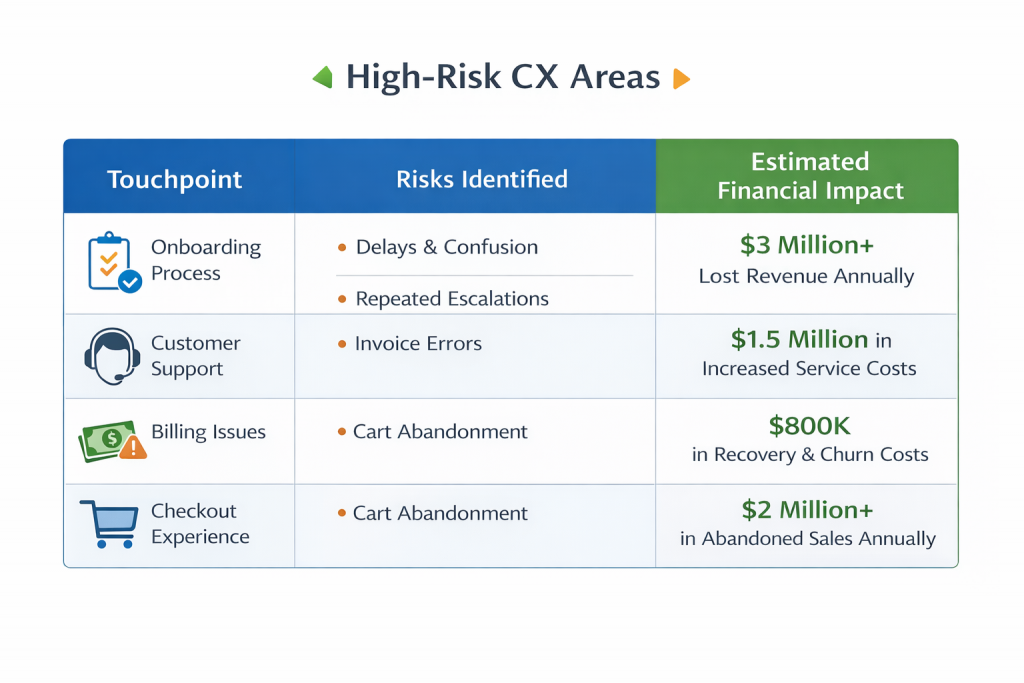
The fourth lie is a classic case of “Accounting Myopia” — the belief that a customer experience audit is a discretionary expense rather than a fundamental investment in Value Creation. Leaders often look at the price tag of a comprehensive audit or the internal hours required to map a journey and immediately relegate it to the “maybe next year” pile. They view the audit as a cost center, a luxury to be indulged only when the budget is flush. What they fail to realize is that they are already paying for the audit every single day — not in invoices, but in the “Friction Tax” of lost conversions, increased support costs, and skyrocketing customer acquisition fees.

When you refuse to audit, you are essentially pouring expensive marketing “water” into a leaky bucket. You might spend millions on a new brand campaign, but if your Value Access path is riddled with Invisible Friction, a significant portion of that investment is being wasted. I’ll argue that if you think an audit is expensive, you haven’t calculated the cost of the “Experience Void” — the revenue left on the table by customers who encountered a hurdle and walked away. An audit doesn’t cost money; it recovers stolen profit.

Furthermore, the “Time-Consuming” argument is often a mask for a lack of organizational agility. Leaders fear that an audit will uncover a mountain of technical debt or procedural flaws that they aren’t prepared to fix, so they avoid the diagnosis to avoid the surgery. But in the age of Purpose-Driven Innovation, time is your most precious commodity. Every month you spend operating with a flawed experience is a month you give your competitors to build a better relationship with your audience. Let’s be honest: “You don’t have time not to audit.” You can either spend the time now to fix the journey, or spend the time later explaining to the board why your market share has evaporated.

5. The Lie of “Our NPS Score is Great”

The final, and perhaps most insidious, deception is the “Metric Shield” — the belief that a high Net Promoter Score (NPS) is a definitive certificate of health that renders a customer experience audit unnecessary. Leaders often cling to this single, shiny number as a way to soothe their egos and pacify the board. They argue that if the “score is up,” the customers must be happy. However, as any customer experience practitioner knows, NPS is a trailing indicator that is notoriously easy to manipulate and dangerously void of context. It tells you the temperature of the room, but it doesn’t tell you if the air is toxic.

When leaders use NPS to bypass an audit, they are choosing to prioritize a vanity metric over Value Translation. An NPS score can be high simply because your customers have no better alternative at the moment, or because your team has learned to “game” the survey by sending it only after successful interactions. It fails to capture the Invisible Friction of the silent majority who were too frustrated to even take the survey. An audit, by contrast, dives into the “Why” behind the number. It reveals the cracks in the foundation that a single-digit score is designed to cover up.

Relying on NPS without an audit is like checking your heart rate and assuming you’re fit for a marathon without checking if your legs are broken. You might have “Promoters” who love your brand’s mission but are secretly exhausted by your checkout process. These are “Fragile Promoters” who will defect the moment a competitor offers a lower Cognitive Load. Often the most dangerous place for a leader to be is standing on top of a high NPS score, refusing to look down at the crumbling experience beneath their feet.

Conclusion

The greatest threat to your organization’s future isn’t a lack of vision or a shortage of capital — it is the comfort of your own assumptions. Every lie you tell yourself about the state of your customer journey acts as a Corporate Antibody, attacking the very innovation you claim to champion. By avoiding the regular, rigorous mirror of a customer experience audit, you are essentially choosing to drive a high-performance vehicle with the windshield blacked out, relying solely on a GPS map that hasn’t been updated in years. True leadership requires the humility to admit that what you think you know about your customer is likely outdated, and what your dashboards are telling you is likely incomplete.

The path to success in 2026 is paved with the friction you choose to remove today. If you are ready to stop hiding behind “Experience Narcissism” and vanity metrics, you must treat auditing not as a chore, but as a strategic competitive advantage. For those ready to take the first step toward a clearer perspective, I encourage you to explore my deep-dive guide in Customer Experience Audit 101 or understand the shifting landscape in Why a Customer Experience Audit is Non-Negotiable in 2026. The wilderness of the market is moving fast, and only those who constantly tend to their “customer garden” will survive.

I have spent my career helping leaders turn their Invisible Friction into visible opportunity. Don’t wait for your customers to tell you it’s broken by leaving; be proactive and reclaim the experience excellence they deserve. Do you need help conducting a transformative customer experience audit?

Let’s work together to ensure your innovation doesn’t just look good on paper, but feels incredible in the hands of your customers.

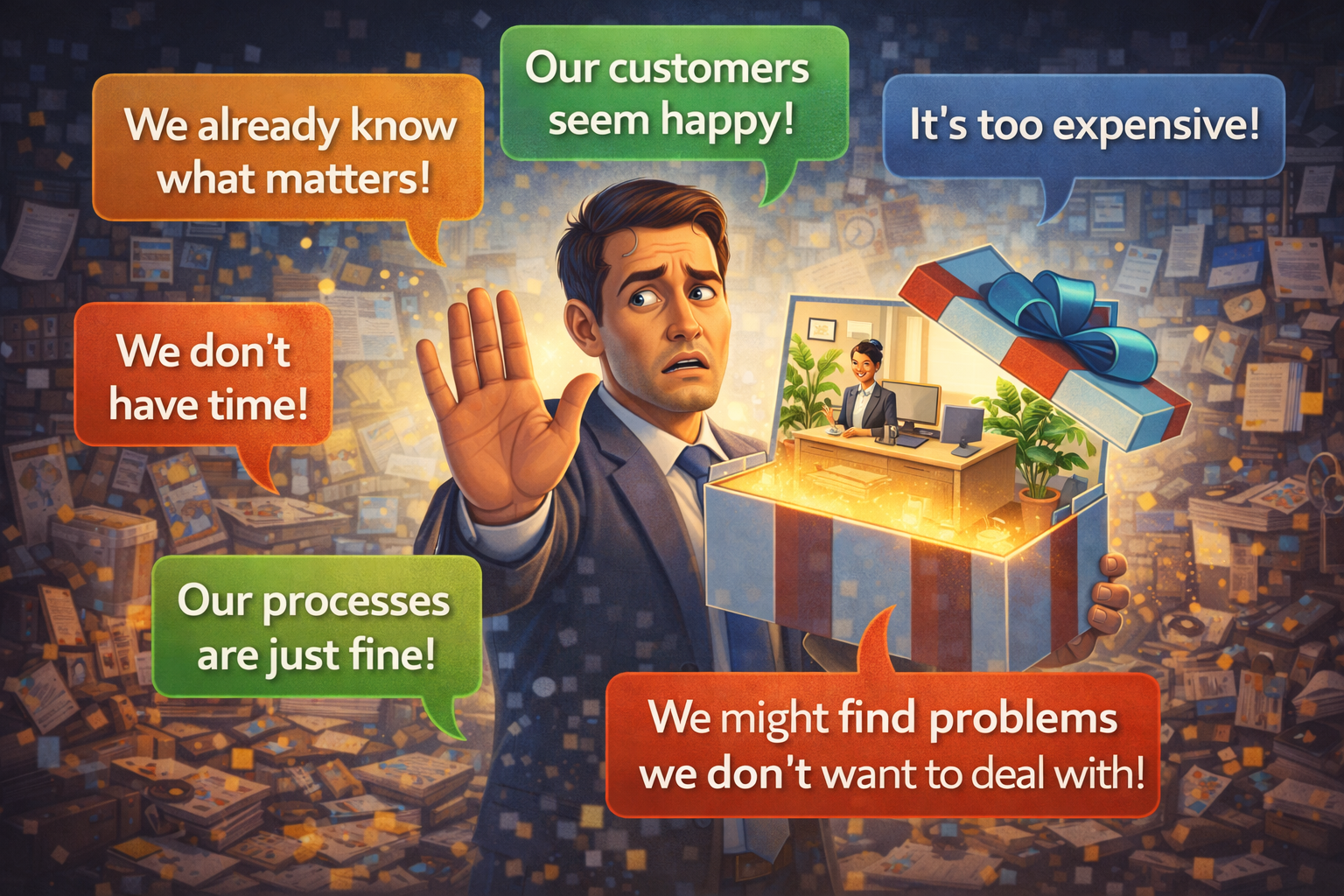
Five Lies Leaders Tell Themselves About CX

Download the Five Lies Leaders Tell Themselves About CX Flipbook as a PDF by clicking the link or the image above.

Image credits: ChatGPT

Content Authenticity Statement: The topic area, key elements to focus on, etc. were decisions made by Braden Kelley, with a little help from Google Gemini to clean up the article and add citations.

Subscribe to Human-Centered Change & Innovation WeeklySign up here to get Human-Centered Change & Innovation Weekly delivered to your inbox every week.
Why a Customer Experience Audit is Non-Negotiable in 2026

An Analysis of ROI, Retention, and Brand Resilience

Why a Customer Experience Audit is Non-Negotiable in 2026

LAST UPDATED: February 7, 2026 at 8:20PM

by Braden Kelley and Art Inteligencia

In the current business landscape, the traditional boundaries of competition have dissolved. Pricing is transparent, product features are rapidly emulated, and global logistics have leveled the playing field for distribution. What remains as the final, most defensible frontier is Customer Experience (CX). However, many organizations operate on assumptions rather than evidence, relying on outdated journey maps that don’t account for the rise of generative AI, omnichannel complexity, and the heightened emotional expectations of the modern consumer.

A Customer Experience Audit is not merely a “health check”; it is a rigorous diagnostic process designed to uncover the “silent killers” of conversion and loyalty. It bridges the gap between how a company thinks it is performing and how the customer actually feels at every touchpoint. By systematically evaluating the friction, flow, and emotional resonance of the brand journey, organizations can transform from being reactive service providers to proactive experience leaders. Below, we explore the ten most compelling reasons to initiate this audit, backed by the latest industry data.


Top 10 Reasons to Conduct a CX Audit

1. Identify and Eliminate Friction Points

An audit maps the real-world customer journey to find where users drop off. Small changes to these “micro-moments” can yield massive returns.

  • The Statistic: Simplifying a complex sign-up form can increase successful registrations by 20% (Reform).
  • The Insight: 53% of consumers say being kept on hold alone is reason enough to stop doing business with a brand (Webex/Futurum Group).

2. Improve Customer Retention and Reduce Churn

Acquiring a new customer is significantly more expensive than keeping an existing one. Audits identify the specific negative experiences that drive customers to competitors.

  • The Statistic: Resolving CX issues can reduce churn by 85% (Esteban Kolsky).
  • The Insight: 60% of customers will leave a brand after just one or two negative experiences (Zoom, 2025).

3. Maximize Revenue and Upsell Opportunities

Satisfied customers aren’t just loyal; they are less price-sensitive and more open to higher-value offers.

  • The Statistic: Companies that excel at CX see an average 80% increase in revenue (Zippia/Zendesk).
  • The Insight: 61% of customers will spend at least 5% more with a brand they know provides a good experience (Emplifi).

4. Optimize the Onboarding Experience

The first post-purchase interaction sets the tone for the entire relationship. Audits ensure your onboarding isn’t frustrating or confusing.

  • The Statistic: Effective onboarding makes customers 92% more likely to renew their subscriptions (TSIA/OnRamp).
  • The Insight: Interactive and engaging onboarding content can boost early product usage by 55% (Wyzowl).

5. Validate AI and Automation Strategy

Many companies layer AI over broken processes. An audit ensures your bots are actually helping rather than “getting stuck in loops.”

  • The Statistic: AI adoption can increase the number of issues resolved per hour by 15% (Quarterly Journal of Economics, 2025).
  • The Insight: 80% of customers expect bots to escalate to a human when needed, but only 38% say this actually happens (Zoom, 2025).

6. Align Internal Silos

Audits reveal when different departments (Sales, Marketing, Support) are providing conflicting information, which destroys customer trust.

  • The Statistic: 90% of customers expect consistent interactions across all channels (SDL/Renascence).
  • The Insight: 54% of organizations cite “fragmented or siloed data” as their biggest barrier to leveraging customer insights (Zendesk).

7. Benchmark Against Competitors

In 2026, CX is the primary differentiator as products and pricing become easier to replicate.

  • The Statistic: 89% of businesses are expected to compete primarily on CX this year (Gartner/OnRamp).
  • The Insight: Customer-centric brands are 60% more profitable than those that do not focus on CX (Deloitte).

8. Personalize with Purpose

Generic “Dear [Name]” emails no longer count as personalization. Audits help you use data to anticipate needs and determine the most authentic places to personalize customer interactions and experiences.

  • The Statistic: Brands with mature personalization are 71% more likely to report high customer loyalty (Deloitte).
  • The Insight: 80% of consumers are more likely to purchase from a brand that offers tailored experiences (Epsilon).

9. Enhance Employee Satisfaction

When customers are frustrated, frontline employees bear the brunt of that anger. Fixing the CX reduces agent burnout.

  • The Statistic: 62% of respondents identified a defined relationship between Ex and Cx, stating that the impact was “large” or “significant” and measurable. (Workstep).
  • The Insight: Companies with strong CX leadership are 2x more likely to have engaged employees (Temkin Group).

10. Turn Feedback into Action

Most companies collect feedback, but few act on it. An audit creates a structured roadmap for implementation.

  • The Statistic: Acting on customer feedback can lead to a 25% reduction in churn (Forrester/Renascence).
  • The Insight: 77% of customers view a brand more favorably if they proactively invite and act on feedback (Microsoft).

Summary Table of Audit Benefits

Benefit Impact Metric Source
Revenue Growth 80% increase Zippia/Zendesk
Retention 25-30% improvement Martin Newman
Profitability 60% higher than peers Deloitte
Operational Efficiency 10-15% cost savings Martin Newman

Conclusion: From Insight to Transformation

A Customer Experience Audit is the bridge between organizational intention and customer reality. In an era defined by rapid technological shifts and declining brand loyalty, the ability to see your business through the eyes of the consumer is your greatest competitive advantage. The statistics provided throughout this analysis make a clear case: companies that invest in understanding and optimizing their journey are not just surviving—they are significantly outperforming their peers in revenue, retention, and employee engagement.

However, an audit is only as valuable as the actions that follow (for more see Customer Experience Audit 101). The true power of this process lies in its ability to align internal silos, validate high-stakes investments in AI, and foster a culture of continuous improvement. As we move further into 2026, the question for leadership is no longer whether you can afford to conduct a CX audit, but whether you can afford to continue operating without the clarity one provides. By prioritizing the human-centered elements of your business, you secure not just a transaction, but a long-term piece of your customer’s future.

Customer Experience Audit ROI Flipbook
Download the ‘Top 10 Reasons to Conduct a CX Audit’ flipbook PDF

Looking for someone to conduct an independent customer, partner or employee experience audit? Braden Kelley specializes in conducting these kinds of audits, mapping the relevant journeys and benchmarking your performance against select competitors.

Book Your Experience Audit Today


Image credits: ChatGPT

Content Authenticity Statement: The topic area, key elements to focus on, etc. were decisions made by Braden Kelley, with a little help from Google Gemini to clean up the article and add citations.

Subscribe to Human-Centered Change & Innovation WeeklySign up here to get Human-Centered Change & Innovation Weekly delivered to your inbox every week.
MrBeast and the Customer Experience Audit

MrBeast and the Customer Experience Audit

by Braden Kelley

There is a reason why Walmart is flipping the typical retail salary model on its head to pay managers in stores MORE than some managers at its corporate headquarters. The stores pay for the HQ, not the other way around! AND, the stores is where the best information lives for manufacturers selling to Walmart and other retailers.

Enter MrBeast, who sells most of his Feastables chocolate through Walmart. So, what has he been doing since launching the product – over and over and over again?

Conducting a partial customer experience audit by visiting stores all around the country to see how the displays look, sometimes enlisting third parties (even customers and impromptu GoPro cameras) to help him gather information when he isn’t doing it first-hand.

Here is a snippet of a recent video podcast interview of him talking about it:

Some other retailers, like Starbucks, try, but not very hard, to have corporate managers spend time in the stores (a few hours when they first join, never to return) but I think the last CEO might have done away with it completely. It will be interesting to see if the new CEO encourages corporate HQ staff to get out into the stores more – after he finishes laying off 10% of the headquarters staff.

Does your company require headquarters staff to spend time in the field?

Or, do a high percentage of them voluntarily do it regularly?

Doing so does not replace regular independent customer experience audits, but it helps.

Do you need someone to come conduct an independent experience audit of your customer, employee and/or partner experiences?


Accelerate your change and transformation success
Subscribe to Human-Centered Change & Innovation WeeklySign up here to get Human-Centered Change & Innovation Weekly delivered to your inbox every week.
Experience Audits Are Crucial for 2025 Success

Experience Audits Are Crucial for 2025 Success

GUEST POST from Art Inteligencia

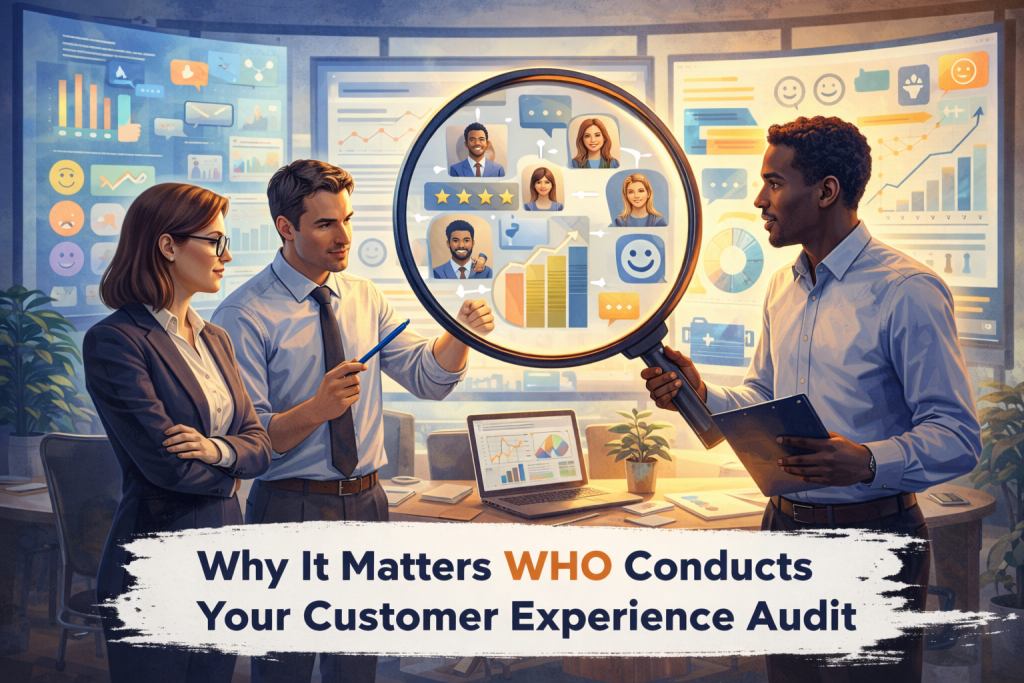
In an ever-evolving business landscape, companies striving for success in 2025 and beyond must focus on creating exceptional experiences for their employees, customers, and partners. The traditional approaches to delivering value are no longer sufficient; organizations must re-imagine their strategies to remain competitive. One pivotal approach is conducting thorough INDEPENDENT experience audits, which are not merely about evaluation but about discovering new pathways to elevate interaction and engagement by having a third party actually walk and document the performance of the different aspects of your experiences.

Understanding Experience Audits

Experience audits are systematic evaluations designed to assess and understand the quality of interactions across different stakeholder groups—employees, customers, and partners. They provide a structured approach to examining every touchpoint and interaction, allowing organizations to identify areas for improvement and innovation. These audits focus on enhancing intuitive and delightful experiences, which play a significant role in an organization’s success.

Benefits of Conducting Experience Audits

1. Enhanced Employee Experience

Employees are the heart of any organization, and their experience significantly affects productivity and morale. Conducting INDEPENDENT employee experience audits can uncover pain points related to workplace culture, communication, technology, and work-life balance that internal audits miss or rationalize.

  • Increased Engagement: When employees feel heard and valued, engagement levels increase, leading to higher productivity and retention. Experience audits illuminate areas where improvements can lead to a more engaged workforce.
  • Fostering Innovation: By identifying bottlenecks and friction in daily operations, organizations can create environments that foster creativity and innovation.
  • Improved Well-being: Understanding employee needs and stressors helps tailor benefits and wellness initiatives that improve overall well-being, reducing burnout and absenteeism.

2. Enhanced Customer Experience

Customer experience is a critical differentiator in today’s market. Through independent experience audits, companies can gain a comprehensive and unbiased understanding of the customer journey and identify opportunities for enhancement.

  • Personalization: By understanding customer preferences and behaviors, businesses can deliver more personalized and relevant experiences that increase loyalty and satisfaction.
  • Consistency: Experience audits help ensure consistency across all touchpoints, from first contact to after-sales service, building trust and brand reliability.
  • Innovation in Service Delivery: Recognizing gaps in service allows for innovative solutions that elevate the customer experience, potentially leading to new market opportunities.

3. Enhanced Partner Experience

In a globalized economy, organizations often rely heavily on partnerships to deliver their products and services. Experience audits in this area focus on optimizing collaboration and synergy by identifying which parts of the experience works well for partners and which elements are full of friction or lacking in value.

  • Streamlined Processes: Identifying and removing inefficiencies in partnership interactions can lead to smoother operations and reduced time-to-market.
  • Strengthened Relationships: Understanding partner needs and pain points helps cultivate stronger, more beneficial relationships, enhancing cooperation and mutual growth.
  • Co-Innovation Opportunities: Comprehensive audits can reveal possibilities for co-innovation, where partners work together creatively to develop new offerings or enter new markets.

Implementing Experience Audits

For independent experience audits to be successful, they must be implemented thoughtfully with a structured approach that respects and supports their independence:

  1. Define the Scope: Determine which experiences you aim to audit and the specific objectives that each audit should achieve.
  2. Engage Stakeholders: Involve employees, customers, and partners early in the audit process to gather diverse insights and foster buy-in.
  3. Utilize Diverse Metrics: Employ both qualitative and quantitative metrics to gain a comprehensive understanding of experiences across different touchpoints.
  4. Prioritize Actionable Insights: Focus on insights that can drive immediate and impactful improvements, aligning with overall strategic goals.
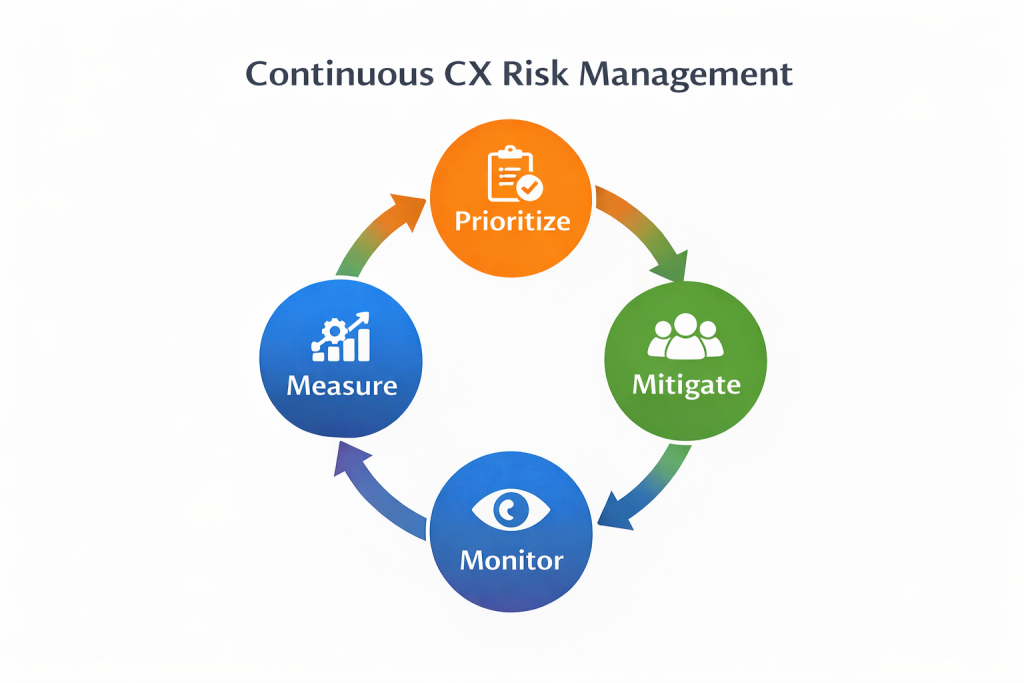
  5. Iterate and Improve: Audits should be an ongoing process, with regular evaluations and improvements, to adapt to changing needs and expectations.

Conclusion

As 2025 begins, the importance of independent experience audits in securing organizational success cannot be overstated. By fostering a deep understanding of the interactions that define employee, customer, and partner relationships, businesses are better equipped to create meaningful, positive experiences that set them apart from the competition. In embracing these audits as a fundamental component of their strategy, organizations are not just preparing for the future, they are actively shaping it, and getting unbiased perspectives from the outside the organization to do so.

If you would like to engage me to do an independent experience audit for you across your customer, partner or employee experiences (or all three), please let me know.

Image credit: Pixabay

Subscribe to Human-Centered Change & Innovation WeeklySign up here to get Human-Centered Change & Innovation Weekly delivered to your inbox every week.

99% of Companies Failed to Do This Last Year

99% of Companies Failed to Do This Last Year

GUEST POST from Art Inteligencia

In today’s rapidly changing business landscape, one essential activity that 99% of companies failed to prioritize last year is conducting regular independent customer and employee experience audits. These audits are critical for understanding the current state and potential improvements needed to enhance engagement, loyalty, and satisfaction among customers and employees.

For most companies, customer and employee experiences are the backbone of their success. A business can’t thrive without satisfied customers buying their products or services, and employees are the driving force behind delivering these experiences. Despite this understanding, many businesses neglect the proactive steps necessary to evaluate and enrich these experiences systematically utilizing unbiased external third parties to walk the experiences and document friction points and opportunities.

Is your company part of the 99% that failed to conduct both an independent customer experience audit and an independent employee experience audit last year?

If you are part of the 1%, please be sure and leave some thoughts about the experience (no pun intended) in the comments!

Why Independent Experience Audits Matter

Independent experience audits are comprehensive reviews of interactions customers and employees have with a company performed by an unbiased external resource. They help identify pain points and opportunities for improvement. These audits should be performed regularly as they can reveal insights into:

  • The alignment between company offerings and customer needs.
  • The effectiveness of internal processes in promoting a positive work environment.
  • The coherence of brand values with actual customer and employee experiences.
  • Emerging trends and preferences that might impact future strategies.

“73% of customers are willing to pay more for a great customer experience.” – Temkin Group

Despite the apparent value proposition of these independent audits, why are so many companies still overlooking them? The constraints are often a mix of perceived complexity, lack of in-house expertise, or prioritization of immediate financial metrics over strategic insights. However, history has shown that organizations that adapt ahead of changes in expectations are better positioned to succeed over those that react out of necessity.

Case Study 1: An Overlooked Opportunity – Company X

Company X, a well-established retail brand, faced declining sales figures and employee turnover. Their product line remained strong, and pay scales were competitive. However, deeper insights revealed that customer experiences were inconsistent, and employees often felt disengaged due to a lack of communication and growth opportunities.

Recognizing the signs, Company X engaged in a comprehensive independent experience audit. The audit discovered two key issues:

  • Customer Experience: Customers reported a lack of personalization in their shopping journey, expressing frustration over disconnected in-store and online experiences.
  • Employee Experience: Employees felt unappreciated, with inadequate feedback channels and professional development options.

Armed with these insights, Company X implemented a strategy that enhanced personalized shopping experiences using AI-driven recommendations and integrated both digital and physical stores for seamless customer journeys. Simultaneously, they developed a robust internal communication framework that empowered employees through regular feedback and offered career progression pathways.

Within six months post-intervention, Company X witnessed a 15% increase in customer satisfaction scores and a 20% decrease in employee turnover—solidifying the importance of independent experience audits.

Case Study 2: A Success Story – Company Y

Company Y, on the other hand, already valued independent customer and employee experience audits as a vital component of their corporate strategy. As a result, they experienced steady growth and minimal churn rates despite operating in the highly competitive tech industry.

Company Y conducts bi-annual audits using a company like HCLTech, reviewing user interactions with their software products and collecting feedback through employee surveys intertwined with one-on-one interviews. They discovered that:

  • Customer Experience: The need for improved user interface intuitiveness was prevalent, prompting a user-centered design overhaul that optimized performance and usability.
  • Employee Experience: Although engagement levels were high, team collaboration across departments showed potential for enhancement.

By proactively addressing these issues, Company Y not only improved its software product, which increased customer retention by 25%, but also invested in team-building exercises and diversified project teams, leading to more innovative solutions and a dynamic organizational culture.

How to Implement Experience Audits in Your Organization

To avoid the common pitfalls highlighted, businesses need to incorporate independent experience audits into their regular strategic evaluations. Here’s a simplified approach to getting started:

  1. Define Objectives: Clearly identify what you aim to discover with the audit. Are you focusing on loyalty, satisfaction, efficiency, or a combination?
  2. Select a Partner: Choose an independent resource that is experienced, trustworthy and thorough in their activities to assess and document their findings as they walk the critical components of your customer and employee experiences.
  3. Gather Data: Utilize surveys, interviews, focus groups, and data analytics to collect comprehensive insights.
  4. Analyze Findings: Categorize feedback to identify consistent patterns, pain points, and potential areas for improvement.
  5. Develop an Action Plan: Prioritize issues by impact and feasibility, then devise a strategy that aligns with your company’s goals.
  6. Implement Changes: Address the identified opportunities with targeted interventions, ensuring stakeholders are engaged and informed.
  7. Measure Impact: Continuously track the effectiveness of changes and refine strategies as necessary.

Conclusion

Independent experience audits are not just a ‘nice to have’ but a strategic necessity. Companies can no longer afford to be complacent; they must take actionable insights from these audits to craft memorable and meaningful experiences for their customers and employees. Companies like Y that put independent experience audits at the heart of their strategy invariably found themselves robust against industry challenges, offering lessons that the broader business community should heed.

“Companies that excel at customer experience are 60% more profitable than their peers.” – Gartner

If you would like to engage an unbiased external person like Braden Kelley to conduct a customer experience and/or employee audit for you this year to join the 1% leapfrogging their competition, contact us!

Bottom line: Futurology is not fortune telling. Futurists use a scientific approach to create their deliverables, but a methodology and tools like those in FutureHacking™ can empower anyone to engage in futurology themselves.

Image credit: Pixabay

Subscribe to Human-Centered Change & Innovation WeeklySign up here to get Human-Centered Change & Innovation Weekly delivered to your inbox every week.
Top 10 Human-Centered Change & Innovation Articles of December 2024

Top 10 Human-Centered Change & Innovation Articles of December 2024Drum roll please…

At the beginning of each month, we will profile the ten articles from the previous month that generated the most traffic to Human-Centered Change & Innovation. Did your favorite make the cut?

But enough delay, here are December’s ten most popular innovation posts:

  1. Top Six Trends for Innovation Management in 2025 — by Jesse Nieminen
  2. Best Team Building Exercise Around — by David Burkus
  3. You Are Doing Strategic Planning Wrong (According to Seth Godin) — by Robyn Bolton
  4. Why Annual Employee Experience Audits Are Important — by Braden Kelley and Art Inteligencia
  5. Don’t ‘Follow the Science’, Follow the Scientific Method — by Pete Foley
  6. Artificial Innovation — by Braden Kelley
  7. Dynamic Thinking — by Mike Shipulski
  8. The State of Customer Experience and the Contact Center — by Shep Hyken
  9. The Duality of High-Performing Teams — by David Burkus
  10. Uber Economy is Killing Innovation, Prosperity and Entrepreneurship — by Greg Satell

BONUS – Here are five more strong articles published in November that continue to resonate with people:

If you’re not familiar with Human-Centered Change & Innovation, we publish 4-7 new articles every week built around innovation and transformation insights from our roster of contributing authors and ad hoc submissions from community members. Get the articles right in your Facebook, Twitter or Linkedin feeds too!

SPECIAL BONUS: While supplies last, you can get the hardcover version of my first bestselling book Stoking Your Innovation Bonfire for 44% OFF until Amazon runs out of stock or changes the price. This deal won’t last long, so grab your copy while it lasts!

Build a Common Language of Innovation on your team

Have something to contribute?

Human-Centered Change & Innovation is open to contributions from any and all innovation and transformation professionals out there (practitioners, professors, researchers, consultants, authors, etc.) who have valuable human-centered change and innovation insights to share with everyone for the greater good. If you’d like to contribute, please contact me.

P.S. Here are our Top 40 Innovation Bloggers lists from the last four years:

Subscribe to Human-Centered Change & Innovation WeeklySign up here to get Human-Centered Change & Innovation Weekly delivered to your inbox every week.

Top 10 Human-Centered Change & Innovation Articles of November 2024

Top 10 Human-Centered Change & Innovation Articles of November 2024Drum roll please…

At the beginning of each month, we will profile the ten articles from the previous month that generated the most traffic to Human-Centered Change & Innovation. Did your favorite make the cut?

But enough delay, here are November’s ten most popular innovation posts:

  1. A Shared Language for Radical Change — by Greg Satell
  2. Leadership Best Quacktices from Oregon’s Dan Lanning — by Braden Kelley
  3. Navigating Uncertainty Requires a Map — by John Bessant
  4. The Most Successful Innovation Approach is … — by Howard Tiersky
  5. Don’t Listen to These Three Change Consultant Recommendations — by Greg Satell
  6. What We Can Learn from MrBeast’s Onboarding — by Robyn Bolton
  7. Does Diversity Increase Team Performance? — by David Burkus
  8. Customer Experience Audit 101 — by Braden Kelley and Art Inteligencia
  9. Daily Practices of Great Managers — by David Burkus
  10. An Innovation Leadership Fable – Wisdom from the Waters — by Robyn Bolton

BONUS – Here are five more strong articles published in October that continue to resonate with people:

If you’re not familiar with Human-Centered Change & Innovation, we publish 4-7 new articles every week built around innovation and transformation insights from our roster of contributing authors and ad hoc submissions from community members. Get the articles right in your Facebook, Twitter or Linkedin feeds too!

SPECIAL BONUS: While supplies last, you can get the hardcover version of my first bestselling book Stoking Your Innovation Bonfire for 51% OFF until Amazon runs out of stock or changes the price. This deal won’t last long, so grab your copy while it lasts!

Build a Common Language of Innovation on your team

Have something to contribute?

Human-Centered Change & Innovation is open to contributions from any and all innovation and transformation professionals out there (practitioners, professors, researchers, consultants, authors, etc.) who have valuable human-centered change and innovation insights to share with everyone for the greater good. If you’d like to contribute, please contact me.

P.S. Here are our Top 40 Innovation Bloggers lists from the last four years:

Subscribe to Human-Centered Change & Innovation WeeklySign up here to get Human-Centered Change & Innovation Weekly delivered to your inbox every week.

Customer Experience Audit 101

Your Guide to Elevating the Customer Journey and Future Proofing Your Business

LAST UPDATED: February 10, 2026
Customer Experience Audit 101

by Braden Kelley and Art Inteligencia

As a customer experience professional it is always surprising when I encounter a flawed experience that would have easily been caught if the experience had been walked by someone that’s distant from the experience design process – an auditor. To oversimplify things, think of it as secret shopping on steroids informed by the expertise and methods of customer experience professionals that map, compare and improve different experiences for a living.

Companies are in the habit of hiring an auditor for providing an external perspective on their financial reporting, but most (if not all) fail to engage in a similar annual audit for their customer, partner or employee experiences. Given that companies exist only as long as their customers permit them to, this seems short-sighted and incredibly risky.

To explore this situation in more detail, it only makes sense that we should first look at some of the basics of the customer experience and then the equally important customer experience audit.

Understanding the Basics of Customer Experience

At its core, Customer Experience (CX) is the culmination of all interactions a customer has with your brand. Whether it’s a visit to your website, a call to your support team, or the experience of using your product or service, each touchpoint contributes to how your brand is perceived. A robust CX strategy is not only a competitive advantage but a requirement in today’s market. This is where the Customer Experience Audit comes into play.

The Importance of a Customer Experience Audit

Conducting a Customer Experience Audit helps you identify gaps, inconsistencies, and opportunities in your current customer journey. This systematic approach allows you to enhance interactions, fostering loyalty and driving growth. A well-executed audit provides insights that guide innovations and improvements, ensuring that your brand is always delivering value and delight to your customers.

Six Key Components of a Customer Experience Audit

  • Customer Touchpoint and Journey Mapping: Identify all the points of interaction between customers and your organization across the different phases of the customer journey.
  • Feedback Analysis: Gather and analyze customer feedback through surveys, reviews, and direct communications.
  • Performance Metrics: Review key performance indicators (KPIs) such as Net Promoter Score (NPS) and Customer Satisfaction Score (CSAT).
  • Competitive Benchmarking: Evaluate your CX against industry peers to identify best practices and areas for improvement.
  • Customer Journey Step and Touchpoint Walking: A lot can be learned by having an outsider walk the key touchpoints and steps in your customer journey, especially those connected to your moments of truth. These are the critical touchpoints in a customer’s journey that significantly impact their perception and relationship with your brand. These moments are pivotal in determining customer satisfaction, loyalty, and advocacy, and addressing them effectively can create lasting positive impressions and drive meaningful engagement – and revenue!
  • Journey Analytics: Use analytics tools to track customer behavior and identify bottlenecks.

Pro tip: Involve cross-functional teams and outsiders in the audit process to gain diverse perspectives and insights.

Six Steps to Conducting a Successful Customer Experience Audit

  1. Define Objectives: Clearly outline what you aim to achieve with the audit.
  2. Gather Data: Collect quantitative and qualitative data from various sources.
  3. Analyze Findings: Identify patterns, pain points, and opportunities from the collected data.
  4. Implement Changes: Develop a roadmap to address identified issues and enhance the CX.
  5. Monitor and Iterate: Continuously monitor the impact of changes and refine strategies as needed.
  6. Rinse and Repeat: Conduct a customer experience audit at least once a year to track your progress and the success of your improvement project pursuits, while also creating an opportunity to identify new deficiencies that have been introduced as your customer experience continues to evolve.

Conclusion

By undertaking a Customer Experience Audit, you’re not only future-proofing your business but also prioritizing the needs and expectations of your customers. Remember, a remarkable customer experience is not a one-time effort but an ongoing commitment. As you embark on this journey, keep in mind that customer-centric innovation is the cornerstone of sustainable success.

Commit to a culture of continuous improvement, and you will see your brand not just meet, but exceed customer expectations. Let’s create experiences that are not only memorable but transformative.

If you are interested in conducting a customer experience audit of your business, please contact me.

Customer Experience Audit 101 Flipbook
Download the Customer Experience Audit 101 Flipbook as a PDF by clicking the link or the image above.

Image credits: Unsplash

Subscribe to Human-Centered Change & Innovation WeeklySign up here to get Human-Centered Change & Innovation Weekly delivered to your inbox every week.

Content Authenticity Statement: The core premise and structure for this article was created by Braden Kelley. The OpenAI Playground, taking on the role of human-centered change and innovation thought leader Braden Kelley has helped to flesh out the content of the article with supplementary content added by Braden Kelley – including the creation of the downloadable PDF flipbook.

Top 10 Risks of Not Doing Annual Customer Experience Audits

Top 10 Risks of Not Doing Annual Customer Experience Audits

GUEST POST from Chateau G Pato

Organizations today are more focused than ever on delivering superior customer experiences. However, when businesses neglect to conduct annual Customer Experience (CX) audits, they expose themselves to numerous risks that can undermine their success. Identifying and addressing these risks is crucial to maintaining not just customer satisfaction, but also overall business health.

Risk 1: Ignoring Customer Needs

Failing to audit your customer experience annually can result in blind spots regarding what your customers truly need. Markets change, and so do customer expectations. If you do not periodically examine your customer interactions, you may overlook evolving preferences and miss opportunities for innovation.

Risk 2: Increased Customer Churn

Without reassessing your customer experience, it’s possible to miss signs of dissatisfaction that lead to customer churn. Regular CX audits help identify areas causing friction, allowing you to address them before it’s too late.

Risk 3: Damage to Brand Reputation

Negative customer experiences can quickly damage a brand’s reputation in the age of social media. An annual audit helps spot potential issues in customer touchpoints and interactions before they snowball into damaging reviews and negative word-of-mouth.

Risk 4: Competitive Disadvantage

Companies that ignore customer experience audits may find themselves losing ground to competitors who leverage these audits to innovate and improve their offerings. Staying competitive requires a proactive approach to understanding and enhancing the customer journey.

Case Study: Company X’s Wake-Up Call

Company X, a retail giant, believed that their customer satisfaction scores were sufficient proof of their customer experience success. They skipped CX audits for several years, only to discover widespread customer dissatisfaction that culminated in a measurable drop in sales. Once identified, issues such as outdated return policies and slow customer service were rapidly addressed, but the company had already suffered a substantial competitive setback.

Risk 5: Loss of Employee Engagement

An overlooked aspect of customer experience is its impact on employees. When organizations neglect regular audits, they may miss recognizing areas where employee-customer interactions could be improved, resulting in decreased employee engagement and morale.

Risk 6: Financial Consequences

Poor customer experiences can have direct financial repercussions. From loss of sales to increased marketing spend needed to win back lost customers, the absence of annual CX audits could hit the bottom line hard.

Risk 7: Inadequate Personalization

In today’s market, personalization is key. Without annual audits, organizations might fail to recognize the shift towards personalized customer experiences, falling behind competitors who adeptly grasp and apply this knowledge.

Risk 8: Inaccurate Market Positioning

Without annually measuring the customer experience, businesses may inadvertently misposition themselves over time relative to their market and customer expectations.

Case Study: Hotel Z’s Strategic Pivot

Hotel Z thought they understood their clientele, but declining bookings told a different story. After finally undertaking a comprehensive CX audit, they discovered shifting demographics amongst their guests towards younger tourists seeking tech-savvy environments. By pivoting their strategy to offer digital concierge services, they rejuvenated their business model and saw an upsurge in bookings.

Risk 9: Regulatory Non-Compliance

Often overlooked, regulatory compliance is an area that could be at risk without regular audits. Changes in laws and consumer protection guidelines need to be constantly monitored to ensure ongoing compliance.

Risk 10: Missed Innovation Opportunities

Customer feedback gleaned during an audit can serve as a catalyst for innovation. Companies that forgo these audits may miss critical insights into how they can enhance or transform their offerings.

Conclusion

In an era where customer expectations are rapidly evolving, not conducting regular Customer Experience audits can subject firms to significant risks. From eroding brand reputation to losing competitiveness, understanding these pitfalls highlights the necessity of integrating CX audits as a staple in any comprehensive business strategy. For more insights on enhancing your business strategies, consider visiting these articles on Innovative Ways to Gather Customer Feedback and Understanding Customer Needs and Expectations.

Extra Extra: Because innovation is all about change, Braden Kelley’s human-centered change methodology and tools are the best way to plan and execute the changes necessary to support your innovation and transformation efforts — all while literally getting everyone all on the same page for change. Find out more about the methodology and tools, including the book Charting Change by following the link. Be sure and download the TEN FREE TOOLS while you’re here.

Image credit: Pexels

Subscribe to Human-Centered Change & Innovation WeeklySign up here to get Human-Centered Change & Innovation Weekly delivered to your inbox every week.

The Link Between Innovation and Customer Experience Audits

The Link Between Innovation and Customer Experience Audits

GUEST POST from Chateau G Pato

In today’s fiercely competitive market, organizations strive to outshine their competitors not only through groundbreaking products and services but also by transforming their customer experience. One approach that has gained significant traction is the integration of innovation and customer experience (CX) audits. This integration helps in uncovering hidden opportunities, thus driving continuous improvement and differentiation.

Customer experience audits go beyond traditional market research by diving deeper into the customer journey blueprint. They scrutinize each touchpoint where a customer interacts with a brand, paving the way for innovative solutions tailored to enhance customer satisfaction and loyalty. Let’s delve into two case studies illustrating how companies have leveraged CX audits to propel their innovation capabilities.

Case Study 1: Ritz-Carlton Hotel Company’s “Mystique” Innovation

Ritz-Carlton, a name synonymous with luxury and service excellence, constantly reinvents itself to keep meeting and exceeding customer expectations. Conducting regular customer experience audits revealed an opportunity to innovate within their guest experiences. Through in-depth assessments, they discovered that personalization was a cornerstone of remarkable guest experiences.

With insights drawn from these audits, Ritz-Carlton developed its “Mystique” data-driven platform. It innovatively gathers and utilizes customer preferences to tailor guest interactions, from preferred room settings to curated dining experiences. This innovation not only elevated customer satisfaction but also set a new standard in luxury hospitality, distinguishing Ritz-Carlton from their competitors.

Case Study 2: Starbucks’ Drive-Thru Redesign

Starbucks has long been a leader in customer experience innovation. However, they realized their drive-thru services lagged in providing a seamless experience. Through thorough customer experience audits, Starbucks identified bottlenecks and areas of friction in their drive-thru operations.

Inspired by these findings, Starbucks redesigned their drive-thru lanes, implemented digital menu boards, and integrated a real-time queuing system. These changes minimized wait times and allowed for a more personalized approach to orders via the Starbucks mobile app. This innovation not only improved customer satisfaction but also boosted sales during peak hours.

The aforementioned cases clearly demonstrate that innovation and customer experience audits go hand in hand. By understanding customer pain points, needs, and desires through audits, companies can ideate impactful innovations that lead to superior experiences.

For more insights on innovation and customer experience, check out these other articles:

In conclusion, to stay competitive and relevant, companies must consistently audit and innovate their customer experiences. Are you ready to conduct your next customer experience audit and uncover the innovation opportunities waiting for your organization?

Extra Extra: Futurology is not fortune telling. Futurists use a scientific approach to create their deliverables, but a methodology and tools like those in FutureHacking™ can empower anyone to engage in futurology themselves.

Image credit: Dall-E

Subscribe to Human-Centered Change & Innovation WeeklySign up here to get Human-Centered Change & Innovation Weekly delivered to your inbox every week.