Category Archives: Psychology

Measuring Change Readiness

Measuring Change ReadinessAre you and your organization ready for change?

Too often organizations define the change effort they want to pursue without first identifying whether there are people, resources, legislation, etc. present that must be in place before the change effort can begin. We will explore the circumstances you may want to explore before beginning any change effort and the areas to explore as potential prerequisites to the change program and its eventual success.

During the course of any change initiative many different challenges will appear, and the most successful change efforts will anticipate those challenges and have a plan for dealing with them. Part of that anticipation begins with identifying how ready the organization is for change.

The Change Planning Toolkit™ is designed to assist your change planning team by making the planning process easier with its collection of 50+ frameworks, methodologies and other tools.

One of the keys to change planning success is carefully identifying the prerequisites for change, including:

  1. What must we know? (Knowledge)
  2. What must we have? (Tools)
  3. What must be completed? (Foundation)

This information is captured in one of the worksheets in the toolkit.

One other concept we should stop and discuss briefly is the idea of change saturation. This concept captures the idea that organizations in general, and certain individuals in specific, can only absorb so much change at one time. One frequent occurrence with change efforts is the situation where more than one project or larger change effort may require the same human, financial, physical, information or other resources at the same time. To become aware of this situation and to enable you to work to mitigate the effects of change saturation, you will want to build a heat map identifying the different timing, duration, and intensity of the different requirements all of the different projects and change efforts will place on the different types of resources within the organization. This too is a prerequisite.

Another prerequisite for change is having a deep understanding for what the current state looks like, including having answers for the following:

  • Who is feeling the pain? Pushing for the change?
  • What is the pain caused by the current state?
  • Where is the bulk of the change likely to take place?
  • When did the current state start causing pain?
  • Why is the change being pursued

These questions can be asked and answered during your change planning session, but they must be asked and the answers must be integrated into your examination of your readiness for this change BEFORE you actually begin the change.

An additional prerequisite for change is also having a deep understanding for what the desired state will look like, including answers for the following:

  • Who are we making this change for? Who will feel the greatest benefit from this change?
  • Where will the resources and support come from?
  • When do we need/want to complete the change process by? Is there a legal deadline?
  • What solution would we like to see in place?
  • Why is this solution better than the status quo?

Finally, to be ready to pursue a change the organization must have people in place to look after each of the Five Keys to Successful Change and should be familiar with both the Architecting the Organization for Change framework and my PCC Change Readiness Framework (these are three of the free downloads from the toolkit).

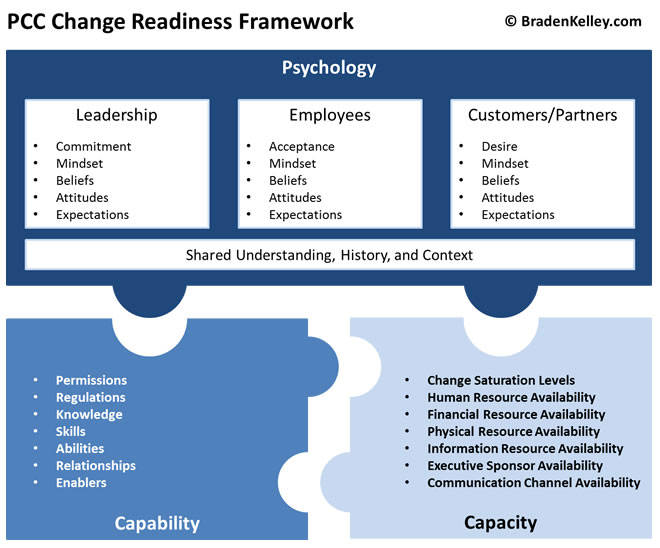
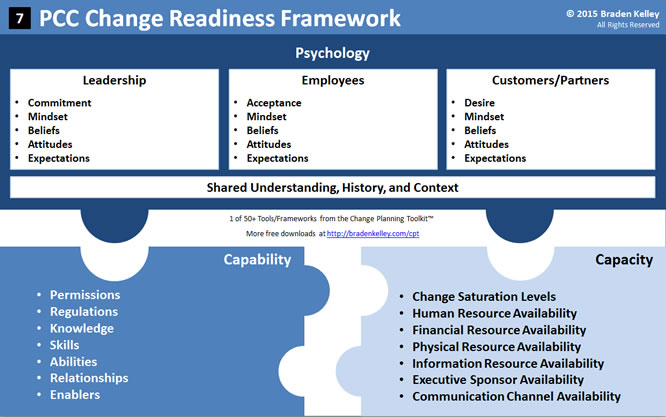
My PCC Change Readiness Framework focuses on the psychology of key groups surrounding the identified change, the capabilities needed to successfully execute the change, and the organization’s capacity to tackle this change effort (along with everything else).
PCC Change Readiness Framework

You will notice that I don’t speak about organizational psychology or culture in my PCC Change Readiness Framework. The reason I don’t highlight culture in the same way that many other people do is that in today’s more social, customer-centric business, we must look more broadly than the typical inward focus of company culture when it comes to identifying the readiness of not only employees, but leaders, customers, and partners too. Inevitably many of our change efforts will have some impact on one or more external groups (possibly even non-profit entities and one or more governments).

You will notice that within the PSYCHOLOGY box there is a common focus on the mindsets, attitudes, beliefs and expectations of the individuals. Culture is incorporated into the psychology realm by focusing on what the shared understandings are around the potential change, but more broadly too. And, finally you will notice that my PCC Change Readiness Framework highlights the need for successful change efforts to move towards gaining commitment to the change from leadership, acceptance of the change by employees, and a desire for the change from customers and partners.

Within the CAPABILITY box of my PCC Change Readiness Framework we must investigate whether our change effort has any regulatory or statutory implications and whether we are ready to adapt, adopt or influence the changes necessary in this sphere. We must also ask ourselves a series of questions:

  1. “Do we need to get permission from anyone to do this?”
  2. “What knowledge, skills, and abilities needed for this change do we already possess?”
  3. “What knowledge, skills, and abilities needed for this change do we need to acquire?”
  4. “What relationships do we possess that will be useful in advancing the change?”
  5. “What relationships do we need to build to help advance the change?”
  6. “What are the enablers of making this change successful?”

Within the CAPACITY box we have to look at where our resources are approaching, or have already achieved, change saturation. This means they are unable to productively participate in any more change efforts or adopt any more change. But we also have to look at the availability of our resources:

  1. Human
  2. Financial
  3. Physical
  4. Information
  5. Executive Sponsors
  6. Space in our desired communication channels

It is easy to take for granted that the organization will have the capacity to undertake your change effort, but often there are capacity constraints that you will run into, especially as the pace and volume of change increases inside an organization. The one that is easiest to overlook and fail to plan for, is making sure that you’re going to be able to communicate your change messages in your desired messaging channels (they may already be full).

There is a worksheet that goes with the PCC Change Readiness Framework that will help you capture information around the:

  • History
  • Capability
  • Capacity
  • Partners
  • Context
  • Leadership
  • Employees
  • Customers
  • Shared Understanding
  • Strategic Alignment (Commitment)
  • Cultural Alignment (Acceptance)
  • Brand Alignment (Desire)

EDITOR’S NOTE: I’ve gone ahead and created a free downloadable flipbook PDF for people to grab. It was inspired by Braden’s article titled Change the World – Step Two, which was the follow-up predictably to Change the World – Step One.
PCC Change Readiness Framework Flipbook

You will find these companion tools for the PCC Change Readiness Framework in the Change Planning Toolkit™ to download for printing and use in your collaborative exploration of your change readiness.
Get Your Copy of Charting ChangeIn my next book Charting Change we will investigate additional aspects of change readiness and have a special section from one of my invited guest experts in the book, Beth Montag Schmaltz of PeopleFirm looking at several topics including change fatigue, where the change threshold lies, why people resist change, how to reduce change fatigue, how to build change capability, what change capable employees look like, and how you can embed change behavior into the very fabric of your organization.

The book is available for pre-order, and has received several strong endorsements, so I hope you’ll pick up a copy (or one for each member of your team). You can find more information on the Charting Change book page.

Subscribe to Human-Centered Change & Innovation WeeklySign up here to get Human-Centered Change & Innovation Weekly delivered to your inbox every week.
The Pyramid of Results, Motivation and Ability

Changing Outcomes, Changing Behavior

Pyramid of Results, Motivation and Ability

by Braden Kelley

When engaging in a change effort it is important to focus not on outputs but on outcomes. The difference is sometimes subtle for people, but the biggest difference is that outputs are usually activity-based where outcomes are behavior-based.

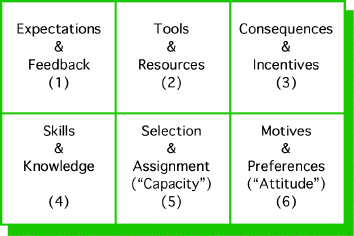
There are several good behavior modification frameworks out there including the Six Boxes framework from Carl Binder, the Six Sources of Influence framework from VitalSmarts, and the Results Pyramid® from Partners in Leadership that start with the desired performance changes, results or outcome shifts and work backwards.

Six Boxes Approach - Carl Binder

Six Boxes Approach – Carl Binder

Potential Benefits of Using the Six Sources of Influence

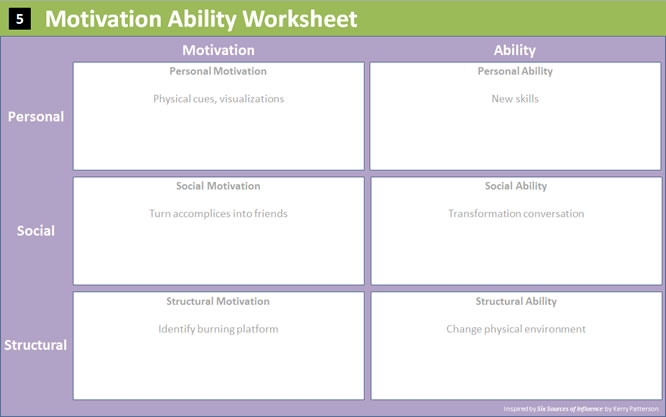
The Six Sources of Influence framework from VitalSmarts, a framework designed for personal change has some usefulness as we look at organizational change. Here are some of my thoughts on how this personal change framework is relevant, centered on the fact that successful change happens one individual at a time. The Six Sources of Influence framework looks at motivation and ability on one axis, and how they are affected across three other variables, which include:

  1. Personal
  2. Social
  3. Structural

Taken together they form the Six Sources of Influence (see the Motivation Ability Worksheet in Figure 1) and can be used to change behavior one individual at a time. And it is from these changes in behavior that the transitions towards the new way of doing things begin to happen.

Motivation Ability Worksheet

Figure 1

To utilize personal ability to influence the change will require teaching people the new skills to be successful at the new way of doing things. Consider breaking up the learning into short intervals where you can give people immediate feedback and prepare for people to have regressions back to the status quo. Work to identify those moments where people will be most tempted to regress to the status quo and create strategies that reinforce the new way of doing things.

To influence the change through personal motivation will require visualizing the change for people and utilizing physical and other cues (including vivid storytelling) to help reinforce that the change is desirable. Help people see, feel and believe in the new way of doing things (the desired state).

Social motivation can be used to influence change adoption by turning accomplices (status quo advocates) into friends (people practicing and supporting the new way of doing things), while any attempt to use social ability as an influencer for change adoption will require open and honest conversations to transform people from accomplices into friends .

Finally, utilizing structural motivation will require selling the problem in a way that people are influenced to abandon the status quo (visualize it, prototype it, etc.) and structural ability can be used to motivate people by changing the physical environment to reinforce the change. Instead of using a stick to motivate people to change, consider using carrots and the threat of losing carrots. It’s a slight twist away from using a stick, but it’s a powerful one. Finally, reward small wins and use incentives (carrots) in combination and in moderation.

Devotees of the Six Sources of Influence may find the free Motivation Ability Worksheet useful.

Using the Results Pyramid® to Create New Results

The Results Pyramid® framework from Tom Smith and Roger Connors’ book titled Change the Culture, Change the Game focuses on the importance of building a culture of accountability. Leaders can accelerate the change and results that they seek by working with the bottom half of the pyramid (“beliefs” and “experiences”). The Results Pyramid® has four main components that I would love to show below in Figure 2 but can’t:

Figure 2 would have gone here

Transformational change is most often lasting and sustainable in achieving the desired new results when leaders work to change the beliefs and experiences that people have and ensuring that people begin having new experiences that lead to new beliefs that lead to new actions that ultimately support the desired new results.

I was trying to help bring additional readers to the authors via the Results Pyramid® Worksheet, but it didn’t quite work out, so you’ll have to do without the visuals and imagine how the tool from Change the Culture, Change the Game could be used to:

  1. First focus on identifying the new results that the group wants to achieve after making the change.
  2. Second, ask employees and partners what new experiences they think that people will need to have in order to not only begin to leave the old way of doing things behind, but to both support the new results you want to achieve AND to help them believe the organization is serious and committed to the new results and that the leadership can be trusted.
  3. Third, ask what new beliefs they think that people will need to have in order to commit to leaving the old way of doing things behind and prepare them to take new actions.
  4. Finally, ask what new actions they think that people will need to take in order to achieve the new results that you are hoping to have in the desired state.

In most cases you will find that your current set of experiences, beliefs, actions, and results have achieved a sort of equilibrium or alignment and that one of the keys to achieving successful change is to move from your current state of equilibrium or alignment to a new set of experiences, beliefs, and actions that create a new state of equilibrium centered around your new results. By identifying where you want to move the top of the pyramid, your can start moving the base of the pyramid followed sequentially be the layers above it, and in doing so, prevent the pyramid from toppling over.

Potential Benefits of Using the Results Pyramid®

The Results Pyramid® is based on the idea that too many organizations focus on the results they want to achieve in the shift from the current state to the desired state and that just by communicating the desired results that the organization will see these new results manifest. But, the reality that the Results Pyramid® captures is that in order to achieve a shift from the current state to the desired state, and to achieve a new set of results, you must do more than define the new results you want to achieve. And you must provide a new set of experiences, beliefs, and actions that will help you achieve those results. The other key component of the Results Pyramid® theory is that too often companies demand new actions to get new results, but the truth is that these four things (results, actions, beliefs, and experiences) are organized like a pyramid and you can’t just move the top of the pyramid without also moving the supporting layers as well.

Meaning, that to create a shift in results (or outcomes), you must create a new set of experiences that lead to a new set of beliefs that lead to a new set of actions that result in the new results that you are hoping for as a result of your change effort. And of course by planning out consciously the shift in results that you’re trying to achieve, you can work as a change planning team to identify the new experiences, beliefs, and actions that you need to create in order to achieve the new results

I find this a useful tool to consider using as you analyze the desired behavior changes and new outcomes you are seeking to achieve with your change effort as you go through your change planning meetings or off-site.

Devotees of the Results Pyramid® would have found the Results Pyramid® Worksheet useful but, sigh, you can’t see it.

Conclusion

In this article we looked at the role of changing behaviors in achieving changed outcomes, and how we might use a couple personal behavior modification frameworks, the Six Sources of Influence and the Results Pyramid® to help us organize our conscious attempts to modify the behavior of individuals as part of our attempts to achieve our desired group behavior change and to ultimately to achieve the intended successful outcomes of our change effort.

So, check out the work of Carl Binder and grab yourself copies of Change the Culture, Change the Game and Change Anything and get started!

Get our Human-Centered Change & Innovation Weekly newsletter in your inbox

Click to access your FREE scalable 11″x17″ PDF downloads

Image source: ecsellinstitute.com

Buy the Human-Centered Change™ methodology nowNow you can buy the Change Planning Toolkit™ Basic License – Instant Access Edition here on this web site.

Accelerate your change and transformation success

Subscribe to Human-Centered Change & Innovation WeeklySign up here to get Human-Centered Change & Innovation Weekly delivered to your inbox every week.
Change Resistance is Not Inevitable

Change Resistance is Not InevitableThe idea that people always resist change is a lie, and it is extremely damaging to organization’s seeking to increase their organizational agility.

The truth is that people only resist changes that they either do not understand or for which they do not interpret there to be benefits great enough to offset the costs of their participation.

The truth is also that the natural response to a potential change in an organization is greatly impacted by the level of trust in an organization.

While it is a lie that change resistance is inevitable, it is true that executing change is hard. If it wasn’t, 70 percent of change efforts wouldn’t fail, but they do. There are many reasons for this, including the fact that most change efforts are communicated not explained.

Let’s look at definitions of both words from Dictionary.com to see the root of this difference:

Communication: A document or message imparting news, views, information, etc.

Explanation: A mutual declaration of the meaning of words spoken, actions, motives, etc., with a view to adjusting a misunderstanding or reconciling differences

You’ll notice here a big difference between the two mindsets – seeking to communicate versus seeking to explain. When you focus on explaining the change, you are focusing on ensuring UNDERSTANDING, and when people understand the change, and the purpose for the change they will be more likely to support the change.

We don’t resist change, WE RESIST THAT WHICH WE DON’T UNDERSTAND.

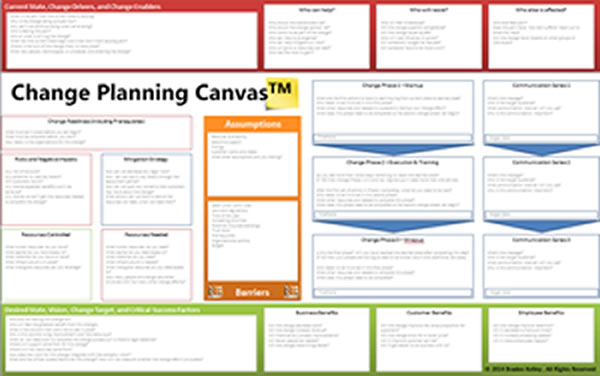
One great way for increasing your ability to explain change is the use of a tool like the Change Planning Canvas™ to involve more people in the planning of a change, which increases the number of people capable of explaining the change and its purpose, plus it provides a visual map of the change effort that explains the change at a glance.

This is not say that even when people completely understand a potential change and the purpose for it, that they still might not not fight against it, but they will be more likely to support the change.
.

Change Planning Canvas

(For Illustration Purposes Only – Get the toolkit or the book for a clear copy)

.

The Change Planning Canvas™ is one of the more than fifty tools that make up my new Change Planning Toolkit™ that is now available via individual licenses for educational use and site licenses for professional and commercial use. It helps you move away from the incredibly counter-productive practice of planning change in isolation.

Organizations that do a better job of explaining their changes and the purposes for them, not coincidentally also tend to build up a higher level of trust over time, and organizations that do a better job at change explanation and maintain higher levels of trust are able to change faster!

But some people may still resist, why?

Some people may resist your change effort for a number of different reasons, but you need to identify up-front not only why people resist but also who will likely resist. Change Planning Toolkit™ users will want to capture the group’s thoughts on who will resist in the middle box of the People Worksheet from the toolkit and the corresponding box on the Change Planning Canvas™.

Some of the typical reasons why people will resist include:

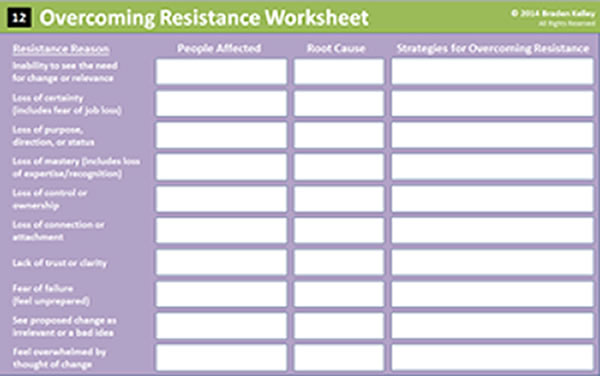
  • inability to see the need for change or relevance;
  • loss of certainty (includes fear of job loss);
  • loss of purpose, direction, or status;
  • loss of mastery (includes loss of expertise/recognition);
  • loss of control or ownership;
  • loss of connection or attachment;
  • lack of trust or clarity;
  • fear of failure (feel unprepared);
  • see proposed change as irrelevant or a bad idea;
  • feel overwhelmed by thought of change.

You’ll want to identify the individuals or groups who have one of the above reasons for resisting change, and you will want to plan from the start to overcome that resistance in the same way that any good salesperson plans for objections, learns to hear them, and practices how to overcome them (for example, by developing and sharing strategies with coworkers).
.

Overcoming Resistance Worksheet

(For Illustration Purposes Only – Get the toolkit for a clear copy)

.

In the Change Planning Toolkit™ I’ve provided space in the Overcoming Resistance Worksheet for your team to brainstorm both the groups and individuals likely to feel any of these reasons for resistance, together with space to capture some ideas for overcoming these objections (aka resistance).

The Change Planning Toolkit™ also provides the Five Change Reactions Worksheet which allows you to identify which groups and individuals tend towards each of the five change reactions highlighted in this worksheet and explained in my book Charting Change.. These five change reactions typically occur in a standard distribution (aka bell curve) and you can increase the chances of your change success by shifting enough people to the left along the curve.

So, there you have it, a quick look at The Big Change Management Lie about the inevitability of change resistance and some ways that it can be avoided or at least mitigated, and an introduction to how some of the tools from the Change Planning Toolkit™ can provide even more help.

Accelerate your change and transformation success

Subscribe to Human-Centered Change & Innovation WeeklySign up here to get Human-Centered Change & Innovation Weekly delivered to your inbox every week.
Innovation is Human

Innovation is Human

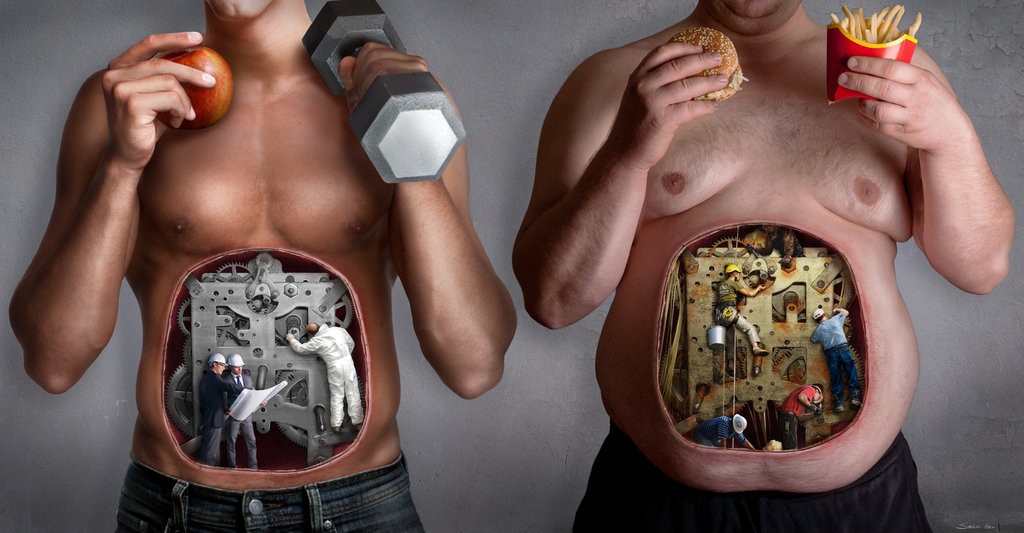
In many ways organizations are like humans, and others have described organizations and organizational change in biological terms before. But this biological context applies to innovation as well, and I’d like to put it forward quickly in simple terms.

As humans we must eat to survive, but if we focus too much on eating, we get unhealthy.

If we don’t focus enough on eating or if we eat the wrong things, we get unhealthy.

If we don’t enjoy enough variety in our experiences, we get unhealthy.

If we don’t spend enough time synthesizing those new experiences to uncover insights via sleep, we get unhealthy.

If we don’t eliminate our waste, we get unhealthy.

And finally, and probably most important to our health, we must exercise to increase our strength, flexibility, agility, reduce our stress levels, to build new capabilities, and to increase our longevity.

But, you can exercise too much, and get unhealthy as well.

The key is balance.

And the same is true for organizations, and parallels for all of these human activities can be drawn to the activities of organizations as well.

And while our interactions with food can be compared to our focus on the day to day operations within the context of the organization, the pursuit of innovation is the exercise for the organization.

And in much the same way that many people resist exercise even though they know it is good for them, many organizations do as well.

But for organizations to stay fit and enjoy a long and productive life, they must strike that balance between a healthy diet and exercise.

So, is your organization going to be fit or fat?

And next time someone in your organization says that innovation isn’t important, or that they can’t focus on it right now, ask them if they think exercise is important, then remind them that innovation like exercise is how we reinvigorate our organizations and keep them vibrant and alive, and go find yourself a carrot stick.

Keep innovating!

Image credit: fitinafatworld.wordpress.com

Subscribe to Human-Centered Change & Innovation WeeklySign up here to get Human-Centered Change & Innovation Weekly delivered to your inbox every week.

Change the World – Step Two

Change the World - Step TwoAre you and your organization ready for change?

Too often organizations define the change effort they want to pursue without first identifying whether there are people, resources, legislation, etc. present that must be in place before the change effort can begin. We will explore the circumstances you may want to explore before beginning any change effort and the areas to explore as potential prerequisites to the change program and its eventual success.

During the course of any change initiative many different challenges will appear, and the most successful change efforts will anticipate those challenges and have a plan for dealing with them. Part of that anticipation begins with identifying how ready the organization is for change and understanding what some of the top challenges are.

In a 2008 global CEO study conducted by IBM on the enterprise of the future, IBM identified the top challenges to successfully implementing strategic change as:

  1. Changing mindsets and attitudes (58%)
  2. Corporate culture (49%)
  3. Underestimation of complexity (35%)
  4. Shortage of resources (33%)
  5. Lack of higher management commitment (32%)
  6. Lack of change know-how (20%)
  7. Lack of motivation of involved employees (16%)

You will notice that many of the items on this list are more about the people factors of change rather than the process or technology factors of change. The weight of the human dimensions of change is reflected in my PCC Change Readiness Framework™. This framework focuses on the psychology of key groups surrounding the identified change, the capabilities needed to successfully execute the change, and the organization’s capacity to tackle this change effort (along with everything else).

PCC Change Readiness Framework

You will notice that I don’t speak about organizational psychology or culture in my PCC Change Readiness Framework™. The reason I don’t highlight culture in the same way that many other people do is that in today’s more social, customer-centric business, we must look more broadly than the typical inward focus of company culture when it comes to identifying the readiness of not only employees, but leaders, customers, and partners too. Inevitably many of our change efforts will have some impact on one or more external groups (possibly even non-profit entities and one or more governments).

You will notice that within the PSYCHOLOGY box there is a common focus on the mindsets, attitudes, beliefs and expectations of the individuals. Culture is incorporated into the psychology realm by focusing on what the shared understandings are around the potential change, but more broadly too. And, finally you will notice that my PCC Change Readiness Framework™ highlights the need for successful change efforts to move towards gaining commitment to the change from leadership, acceptance of the change by employees, and a desire for the change from customers and partners.

Within the CAPABILITY box of my PCC Change Readiness Framework™ we must investigate whether our change effort has any regulatory or statutory implications and whether we are ready to adapt, adopt or influence the changes necessary in this sphere. We must also ask ourselves a series of questions:

  • “Do we need to get permission from anyone to do this?”
  • “What knowledge, skills, and abilities needed for this change do we already possess?”
  • “What knowledge, skills, and abilities needed for this change do we need to acquire?”
  • “What relationships do we possess that will be useful in advancing the change?”
  • “What relationships do we need to build to help advance the change?”
  • “What are the enablers of making this change successful?”

Within the CAPACITY box we have to look at where our resources are approaching, or have already achieved, change saturation. This means they are unable to productively participate in any more change efforts or adopt any more change. But we also have to look at the availability of our resources:

  • Human
  • Financial
  • Physical
  • Information
  • Executive Sponsors
  • Space in our desired communication channels

It is easy to take for granted that the organization will have the capacity to undertake your change effort, but often there are capacity constraints that you will run into, especially as the pace and volume of change increases inside an organization. The one that is easiest to overlook and fail to plan for, is making sure that you’re going to be able to communicate your change messages in your desired messaging channels (they may already be full).

In my upcoming collaborative, visual Change Planning Toolkit™ you will find the companion tools for the PCC Change Readiness Framework™, two large format change readiness worksheets to download for printing that will help you collaboratively explore all of these topics and more.

Be sure and sign up for the Braden Kelley newsletter to receive the latest news on my new book on the best practices and next practices of organizational change (January 2016) and the licensing options for the Change Planning Toolkit™.

Finally, when you consider all of the potential stumbling blocks in advance of the change that we highlighted above, evaluate your readiness in each area, and make a plan for closing any gaps (before you even begin your change effort), you will greatly increase the chances of its success. But, there are certain items that are not just good to know in advance, but are actually prerequisites for change, and we will explore that topic in the book, so stay tuned!

EDITOR’S NOTE: I’ve gone ahead and created a free downloadable flipbook PDF for people to grab. It was inspired by Art Inteligencia’s article titled Change Readiness: What It Is and How to Achieve It.

PCC Change Readiness Framework Flipbook

P.S. In case you missed it, click to read Change the World – Step One


Accelerate your change and transformation success

Subscribe to Human-Centered Change & Innovation WeeklySign up here to get Human-Centered Change & Innovation Weekly delivered to your inbox every week.
Making People Dance Instead of Jaywalk

Making People Dance Instead of JaywalkI love anything that is fun and investigates human psychology, especially crowd psychology, and the investigation of how you can use fun to potentially influence human behavior for social good (i.e. the piano stairs example I’ve shared before).

Nobody likes to wait at pedestrian crossings. Traffic lights can be dangerous for impatient pedestrians trying to save a few seconds to cross the street (and willing to risk their lives in the process).

The folks at Smart created The Dancing Traffic Light, an experiential marketing concept providing a fun and safe way to keep people from venturing too early into the street. They started by placing a dance room on a square in Lisbon, Portugal and invited random pedestrians to go into the box and dance. Their movements were then displayed on a few traffic lights in real time. This resulted in 81% more people stopping and waiting at those red lights.

It’s a genius marketing gimmick because it reinforces the brand value of fun by making people dance in a box that looks, imagine that, a bit like a smart car.

The question brought up by this example of a marketing campaign that claims that fun can be used to achieve social good, is that it claims a benefit, that without an extended test could be attributed to novelty…

Does the benefit hold up over time?

Or does it stop being fun and impactful after people have seen it once or twice or the live video component goes away and it becomes a recording? Do people then start jaywalking again at the normal rate?

What do you think?


Build a common language of innovation on your team

Subscribe to Human-Centered Change & Innovation WeeklySign up here to get Human-Centered Change & Innovation Weekly delivered to your inbox every week.

Unlock Marketing Innovation with a WGAS Focus

Unlock Marketing Innovation with a WGAS FocusBack in 2011 when election season was fast approaching, one thing that you heard repeatedly during election coverage was analysts talking about the importance of the undecided vote. Often in an election it is the undecided who swing the vote for one candidate over another. As a result, there is an incredible amount of focus placed on understanding why people are still undecided between two major candidates (think Obama vs. Romney) and so as a result campaign strategists and speech writers are obsessed with capturing the imagination of the undecided. But, there is a lot of complexity in those undecided numbers, as they include:

  • People that are truly undecided
  • People that don’t want either candidate to win
  • People that didn’t even know there was an election going on
  • People that feel the whole system is corrupt
  • People that can’t tell the difference between the two candidates
  • And so on

So if the undecided are so important in politics, why shouldn’t they be in business?

If we are the Coca Cola company, do we really think that an advertisement or a marketing campaign is going to turn a loyal Pepsi drinker into a Coke drinker? Are we going to be able to turn Red Bull or milk drinkers into Coke drinkers?

People prefer to drink a lot of other things over something thick and syrupy like Coke and Pepsi most of the time, and while a lot of people may drink Coke either regularly or occasionally, a lot of people don’t and won’t. So if we are the Coca Cola company we are advertising to:

  • Remind Coke drinkers how great Coke is
  • Make occasional Coke drinkers think about having one again soon
  • Convince people that aren’t sure about Coke that they should really try it

This reminds me of the old saying “Half the money I spend on advertising is wasted; the trouble is I don’t know which half.” (John Wanamaker)

Personally, I believe the percentage of waste is much, much higher than fifty percent because:

  • Probably less than fifty percent even see the advertisement
  • Twenty percent or more will never buy the product no matter what you do
  • Twenty percent or less already buy the product
  • Leaving MAYBE ten percent of the people exposed to the advertisement to be swayed by it

The above are just my intuitive estimates. I’m sure someone out there probably has done the research on this and could share a more precise number, and if that’s you, please share in the comments!

A lot of this waste comes from the fact that we as marketers focus on the volume of exposure we can achieve for a product or service, even if we’re using complicated segmentations, personas, and/or behavioral targeting. No matter what, we always end up coming back to the volume of exposure we are able to achieve, because it is something we can measure. We try to segment the market and target our chosen segments with a carefully crafted message and creative, but ultimately most marketers attack the problem by asking this question:

  • What do the people who buy my product look like?

When we should all be asking the question:

  • Who gives a @*!%?

I like to call this WGAS marketing.

The premise behind it is that there is only a very small, diverse subset of people out there who have any interest in what it is that you’re selling. And so, by trying to talk to everyone that looks like that subset – by age, gender, race, tax bracket or whatever other segmentation parameters you might select to target based on, then you’re still wasting a huge amount of time – and money. Instead, we should be looking at creative ways to expose only those people who have a need (or maybe a want) that we can satisfy with what we’re selling.

Jobs-to-be-Done Isn’t Just for Innovation

We talk about identifying unmet needs and jobs-to-be-done when it comes to innovation, but there is no reason why we shouldn’t keep that line of thinking in mind when it comes to our marketing of a potential innovation (or any product or service). Thinking about the jobs-to-be-done or the needs that the customer is trying to satisfy instead of the commonalities of prospective customers from a targeting/segmentation might change the kind of marketing strategy and execution that you come up with.

You might think in different ways about what success looks like, or consider marketing methods you might otherwise skip. For example, while doing in-store demos of a new food or beverage may cost more per potentially engaged person than traditional advertising, you are much more likely to turn the people you do engage with into customers, and to have a conversation with them, so is it really more expensive?

Or you might do something like what Safeway has started doing, as shown in this New York Times article. Safeway is using its vast amounts of shopper data to engage in WGAS Marketing by offering variable pricing – offering different prices to different customers on the same product. But unlike, the variable pricing of airlines that is based on availability and timing, Safeway is varying the price based on individual shopper behavior.

Done properly, pull marketing can use content as a WGAS Marketing strategy. The key of course if to create content that your WGAS audience will find value in and that will cause them to either take action or to develop a stronger affinity for your brand so that when they are ready to take action that you are either the only brand that they will consider, or firmly planted at the heart of their consideration set.

Another way of engaging in WGAS Marketing is to engage in activities that your WGAS audience will engage with. Companies like Red Bull and Life is Good use events very successfully as a WGAS Marketing strategy mixed together with a traditional segmentation and targeting approach. Red Bull focuses so much on their WGAS audience that their product isn’t even featured on their home page.

For better or worse Camel cigarettes and McDonald’s identified kids as the ‘undecided’ potential customers in their markets and chose to target them as a way of increasing their current and future sales. Larry Popelka in his book Moneyball Marketing talked about how Clorox identified new mothers as a group of ‘undecided’ potential bleach buyers who had something that they wanted really white (diapers) that Clorox could target and grow into long-term profitable customers.

So, as you can see, one of the keys of WGAS Marketing is to not just identify what your current customers look like and to try and attract more of them, but to identify the underlying reasons why someone may have a need to consider your solution (think jobs-to-be-done), or become open to a new solution such as yours because their life circumstances have changed.

So, WGAS about your product or service? Or WGAS about the problem that your solution addresses (if it is something new or innovative)?

Finding the answer to one or both of these questions is the key you need to unlock a source of tremendous new revenue and profits for your business. Are you ready to look for the things that will cause people to care? Are you open to considering alternative marketing approaches that will help you reach the people WGAS?

Subscribe to Human-Centered Change & Innovation WeeklySign up here to get Human-Centered Change & Innovation Weekly delivered to your inbox every week.

The Power of Purposeful Tangents

According to a recent Huffington Post/YouGov poll 28% of Americans did not read a book last year. As an author, I find this both disappointing and yet not surprising.

Fortunately most people read.

But is what you are reading enhancing your creativity, or just furthering your intellect?

Most people who read for business purposes focus on deepening their expertise. They read books, business magazines, and trade journals about their topic. For example, if you are finance expert, you most likely read primarily about money. The training classes you take are also most likely financially focused. And professionally, you probably hang out with other people in your industry.

Of course this is valuable. Deepening one’s skills is critical.

However, if you want to be even more successful, try broadening your horizons.

I am a professional speaker on the topic of innovation. However, less than 50% of my personal development time is focused on speaking or innovation.

Learning from fellow speakers and innovators can only take me so far. There are countless studies that show that true breakthroughs rarely, if ever, come from the domain experts. In others words, if I want to be the same as other innovators, learning from them is fine. But if I want to be different/better than other innovators, I can’t learn from them.

I recently signed up for a 6 day magic master class. I’m partly interested in it for the performance aspect; it will improve my speaking skills. Most good magicians do an amazing job at holding the attention of an audience. I am also interested in magic from the “brain science” perspective. Magic exploits various quirks of the brain, and I believe that understanding these helps me be a better innovator. Magic is about making the impossible possible. Let’s face it, most innovation programs have difficulty making the possible possible.

Although I read Harvard Business Review, I spend even more time reading magazines about the brain/neuroscience (e.g., “Scientific American Mind” magazine), psychology, and sports performance. I learn from entrepreneurs who are not involved in either speaking or innovation. And for pleasure, I read mysteries as they seem to strengthen my problem solving abilities.

None of these topics were chosen at random.

In addition to being topics I enjoy, they are what I call “purposeful tangents.” They are related to my areas of expertise, but they not the same.

Do you work in the gas pipeline industry? Learning from others in that field can of course be valuable. But you may gain breakthrough level insights from cardiovascular experts as they too deal with the movement of fluids through a vessel. In fact, there is a group in Houston called Pumps & Pipes; cardiologists and gas pipeline experts who share insights from their respective fields. These are purposeful tangents. They are related.

What are your purposeful tangents? What could you read/study that is similar to your area of expertise, but different?

Of course there are valuable lessons to be learned anywhere. But looking for insights in random places may lead to random value. It is less predictable and may dissipate your energies.

But again, focusing too much on your area of expertise only leads to incremental improvements.

Purposeful tangents can lead to breakthrough learning with a high level of predictability.

Subscribe to Human-Centered Change & Innovation WeeklySign up here to join 17,000+ leaders getting Human-Centered Change & Innovation Weekly delivered to their inbox every week.

Shocking People into Buying Your Product

It costs a lot of money to make a television commercial, and at its core what is a television advertisement? It’s a short piece of video designed to reinforce brand values and attachment, or possibly with any luck, to drive purchasing behavior. But there are other ways to distribute video now of course, other than buying time on the major networks or the hundreds of cable networks. And sometimes alternative methods of video distribution actually work better for some creative ideas than traditional media buys.

And what do you do when you have a product that isn’t necessarily that easy to advertise in the traditional ways, for example horror movies or ultra high-definition televisions?

Products that in your advertising that you might WANT to shock people, because they like that, in the case of horror movies. Or in the case of a tech product where people are reasonably happy with what they have, your might actually NEED to find a way to shock people in order them to perceive the incremental benefits of what you’re offering versus what they already have.

In the first case, the people behind the new Carrie movie set out to create a telekinetic café prank in New York City to promote the movie:

While in the case of ultra high-definition televisions, which let’s be honest, aren’t SOOOO much better than HDTV’s that people are camping out in front of the electronics retailers to get one. So, companies like LG are going to have to go to extreme lengths to highlight the incremental value delivered by an ultra high-definition television over an HDTV. LG decided to engage some of the public in shocking scenarios utilizing their product (and film the whole thing) to try and show not just the people involved in the pranks, but the rest of the world at the same time, the shocking visual clarity of their ultra high-definition televisions. A great creative strategy, and a smart value translation approach for their potential innovations.

Here is an LG elevator prank:

Here is an LG job interview prank from Latin America:

And finally here is another LG prank in the men’s restroom:

So, as you are thinking about advertising your own new products and services, think about whether or not buying media is the best way of distributing any video advertising you might want to create. And also think about whether or not you might need to shock people into buying your product or service because they believe their existing product or service is “good enough”?

And is your product or service better than the existing ones by a wide enough margin to make customers care?

Something to think about…


Build a common language of innovation on your team

Subscribe to Human-Centered Change & Innovation WeeklySign up here to get Human-Centered Change & Innovation Weekly delivered to your inbox every week.

All Ideas Can't Be Good Ideas

GUEST POST from Stephen Shapiro

The other day I was at Mohegan Sun, which is a casino about an hour and a half outside of Boston. And while I’m there I love to speak with the gamblers because each of them believe they have a system. They believe they have a method to ensure that they win. And they’re all convinced they’ve won more money than they’ve lost.

Well, of course, this is not true. Casinos are not in the habit of giving money out to people. The house always wins. We know this to be true.

Why do people believe that they win more than they lose? It’s something called confirmation bias, and confirmation bias is the brain’s processing mechanism by which it finds evidence to support its belief structure. Whatever you believe, you will find evidence to support that, and you will subconsciously ignore anything that refutes your belief structure. That’s why we can have such powerful beliefs in spite of evidence to the contrary.

It’s very important for innovators to understand this concept, because every person is convinced they have a billion dollar idea. They’ve got the next big idea that’s going to change the world and make them rich. But what happens is their confirmation bias only allows them to see the evidence that supports their belief that they have a great idea. Their brain doesn’t allow them to see all the evidence that proves it’s actually a bad idea.

There’s a reason why 70 to 90 percent of new innovations fail. It’s not because these aren’t well intentioned, motivated, or excited people. But they’re people who, like all people, have confirmation bias. As a result they will subconsciously ignore the evidence that proves that what they think is a great idea, is in fact not such a good idea.

As innovators, as entrepreneurs, as individuals it’s important to recognize this. Now how do we counterbalance this?

It’s difficult for us to find evidence that refutes a strongly held belief. So what we need to do is, when we’re working on something, partner with a devil’s advocate. Find someone who’ll be the contrary point, somebody whose sole purpose is to find evidence that proves your idea is a bad idea.

Now it may be hard to hear what that person has to say. You will want to reject what they have to say. But if you can open up your mind and be willing to hear the contrary points of view, you may be able to refine your product, service, or idea, and come up with something that’s better. Or you may learn it’s just such a bad idea and you shouldn’t invest the time and money in this one. Find a different one.

This is really important for all organizations (big or small) and individuals.

We know that every gambler doesn’t win more than they lose. And we know that every idea is not a great idea.

The question is:

“What are you going to do to make sure that you invest your time, money, and energy in the things that have the highest likelihood of paying off?”

Subscribe to Human-Centered Change & Innovation WeeklySign up here to join 17,000+ leaders getting Human-Centered Change & Innovation Weekly delivered to their inbox every week.