Category Archives: Psychology

Key to Innovation Success Revealed!

Key to Innovation Success Revealed!Achieving innovation success is not easy. Sustaining innovation success is even harder. The list of innovative companies that no longer exist is long, and some of the biggest enemies of innovation are ultimately complacency and resistance to change.

So what is the key to innovation success?

What lies beneath the artifacts of innovation success that we could point to in individuals or companies that we hold up as innovation heroes?

Well, as I tell the audiences of my keynotes, workshops and masterclasses around the world, innovation success rises up from the intersection of invention (which includes creativity), collaboration, and entrepreneurship. This is why you see these topics covered so much here on Human-Centered Change & Innovation.
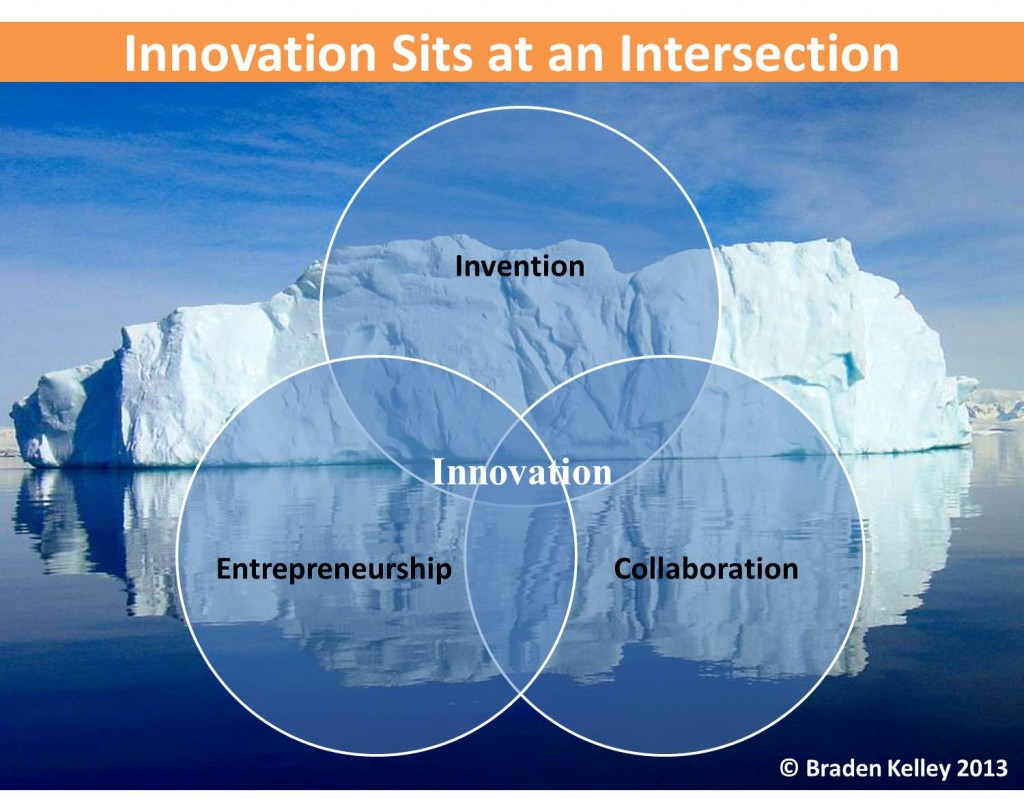
Innovation is Invention Collaboration Entrepreneurship

Invention

Invention and creativity are incredibly important to innovation, but invention is not innovation and creativity is not innovation. Invention and creativity are but one component to creating successful innovation. And so yes, teaching your employees new creativity tools like SCAMPER or SIT, engaging in brainstorming activities after teaching people how to brainstorm properly, or providing your employees the space and time in their work lives to innovate will help you achieve greater innovation success, but they are not the secret. They are but one part.

Collaboration

There are a number of people traveling through the world of business and innovation literature spreading the myth that people are either innovative or they or not, that people either possess the innovator’s DNA or they don’t. To that I say “hogwash” (or sometimes something a little bit stronger). Innovation is a team sport and we all have a role to play. It is because of this belief that I created the Nine Innovation Roles and this framework for team-based innovation has resonated well with people all around the world. As a result, the Nine Innovation Roles from my book Stoking Your Innovation Bonfire have already been translated into Spanish, French, and Swedish, with Dutch and Chinese translations on the way soon. If you’re not familiar with the Nine Innovation Roles, they are:

  1. Revolutionary
  2. Artist
  3. Connector
  4. Magic Maker
  5. Customer Champion
  6. Judge
  7. Troubleshooter
  8. Conscript
  9. Evangelist

But understanding which of the Nine Innovation Roles you play on effective innovation teams is just the beginning. At the same time, we must begin to train our employees in the basic principles that power collaboration and teach them how to become effective collaborators. But collaboration is also only one component.

Entrepreneurship

Other than leadership, no other topic probably occupies a greater percentage of the space for business books in an American book store than entrepreneurship. This topic captivates the minds of people in the United States and in many other countries, and everywhere you go cities, states, countries, universities, and private companies are setting up incubators or startup accelerators to encourage entrepreneurship and innovation. This is important, but the importance of entrepreneurship is not limited only to the entrepreneur. At the same time, we must not forget the importance of intrapreneurship to the continuing health of our organizations. In some ways, intrapreneurship is MORE important to the innovation success of a country than entrepreneurship because collaborative, creative intrapreneurship is the flavor of entrepreneurship that keeps a country’s great companies alive (through this innovation intersection of course). Entrepreneurs and intrapreneurs are both important and we must consciously try to grow both in a successful society, and while intrapreneurs may not have the same tolerance for risk as an entrepreneur, they also need to understand how to make a business case and other core tenets of entrepreneurship.

Build a Common Language of Innovation

The Need to Integrate and Educate

I can state in no uncertain terms the importance for companies that are serious about innovation, and yes even countries or states or cities that are serious about innovation, to educate their people in the core knowledge, skills and abilities that relate to invention, collaboration and entrepreneurship. Companies need to educate their employees. Governments AND parents need to collaborate to teach their children. If you do this, your employees or your future citizens will have a much better chance of helping you achieve innovation success for your company or for your society. But even actively encouraging the intersection of invention, collaboration and entrepreneurship knowledge, skills, abilities and practice are not enough. The reason is because the power of this intersection does not represent the secret of innovation success. This intersection is central to sustained innovation success, but the secret lies elsewhere.

So what is the key to innovation success?

In one word?

The answer is…

CURIOSITY

Importance of Curiosity to InnovationDictionary.com defines curiosity as “the desire to learn or know about anything; inquisitiveness.”

Merriam-Webster defines curiosity as “Desire to know… Inquisitive interest in others’ concerns…Interest leading to inquiry “

The reason that curiosity is the secret to innovation success is that the absence of curiosity leads to acceptance and comfort in the status quo. The absence of curiosity leads to complacency (one of the enemies of innovation) and when organizations (or societies) become complacent or comfortable, they usually get run over from behind. When organizations or societies lack curiosity, they struggle to innovate. Curiosity causes people to ask ‘Why’ questions and ‘What if’ questions. Curiosity leads to inspiration. Inspiration leads to insight. Insights lead to ideas. And in a company or society where invention, collaboration and entrepreneurship knowledge, skills, abilities and practice are encouraged, ideas lead to action.

So, if you want to have innovation success in your company or in your society, you must work to create a culture that encourages curiosity instead of crushing it. Unfortunately technology and the educational system in the United States and the rallying cry of “More STEM!” are having the unintended consequence of crushing creativity and creating a generation of trivia experts and linear thinkers for our society. We as parents and educators and managers must as a result seek to undo some of this damage. If you haven’t already read it, I encourage you to check out my article ‘Stop Praying for Education Reform‘.

Key to Innovation Success Revealed!We must find ways to reawaken the curiosity of our employees, to keep them curious, and to keep the curiosity of our children alive. We must find a way to fight against the tyranny of linear thinking and the ‘right’ answer, and instead inspire our children to continue asking ‘why’ – despite the fact that sometimes it can be annoying. 😉

To close I will leave you with a bastardized quote from the most interesting man in the world:

“Stay curious my friend.”

Subscribe to Human-Centered Change & Innovation WeeklySign up here to get Human-Centered Change & Innovation Weekly delivered to your inbox every week.

Join me for Innovation Teams Webinar on July 25, 2013

Join me for Innovation Teams Webinar on July 25, 2013We speak too much in our society about the lone innovator, but the truth is that innovation is a team sport.

Thomas Edison, Alexander Graham Bell, and Steve Jobs all had teams of people behind them making the innovations happen that they often get credited with.

So if innovation doesn’t come from the lone genius, then where does it come from?

In a couple of weeks I will participate in an ExecuNet webinar on July 25, 2013 at 1PM EDT, and we will explore my nine innovation roles that must be filled for innovation efforts to succeed in today’s organizations. During this exclusive ExecuNet webinar, I will also highlight several other innovation principles that impact business growth and performance during this event that will be free for ExecuNet members and only $99.95 for guests.


Build a common language of innovation on your team

Subscribe to Human-Centered Change & Innovation WeeklySign up here to get Human-Centered Change & Innovation Weekly delivered to your inbox every week.

Optimizing Innovation Resonance

Optimizing Innovation ResonanceWhat does resonance mean to you?

The word has many different dictionary definitions depending on the context, but most of them focus on vibrations reaching an ideal state.

Here are two of the most relevant dictionary definitions for our innovation resonance context today:

  • “a quality of evoking response” (Merriam-Webster)
  • “the effect of an event or work of art beyond its immediate or surface meaning” (Bing)

Here also are a couple of my favorite resonance quotes:

  • “I think whatever resonance I may be able to achieve is in part simply from the amount of reading and learning that I acquired along the way.” – Robert B. Parker
  • “I think if the movie has resonance and stimulates the viewer to talk about it, you can have as large an audience as you want.” – Andy Garcia

I’ve written in the past about how innovation is all about value and about how innovation veracity is more important than innovation velocity. Now it is time to take the innovation conversations about value and veracity to the next level – to innovation resonance – and how difficult it is to achieve and maintain.

Optimizing Innovation ResonanceAchieving innovation resonance is about going from 1+1=2 to a state where 1+1+1+1=7, where the sum of the valuable parts in some new potential innovation suddenly becomes greater than the individual components and value may be created that you might not have even anticipated. When you reach this state of innovation nirvana, the power of resonance pushes your invention over the line from invention to innovation, and adoption becomes widespread. People start talking about, spreading it like a virus, and ultimately supplementing your marketing efforts in much more effective ways.

To achieve innovation resonance you must create value with innovation veracity and deliver it in a product or service with the right velocity and course corrections as you bring your potential innovation into the marketplace. Innovation veracity is about identifying the truths that are important to the customer in the problem space you are investigating, the inspirations and the insights that will hopefully lead to better ideas, more value creation, and hopefully, eventually – innovation resonance.

You’ll notice that I used the words hopefully and eventually in the last sentence in relation to achieving innovation resonance, and this is because our best attempts to anticipate the wants and needs of the marketplace will not always be immediately correct, and may require course corrections in the product or service to better match the expected or desired value.

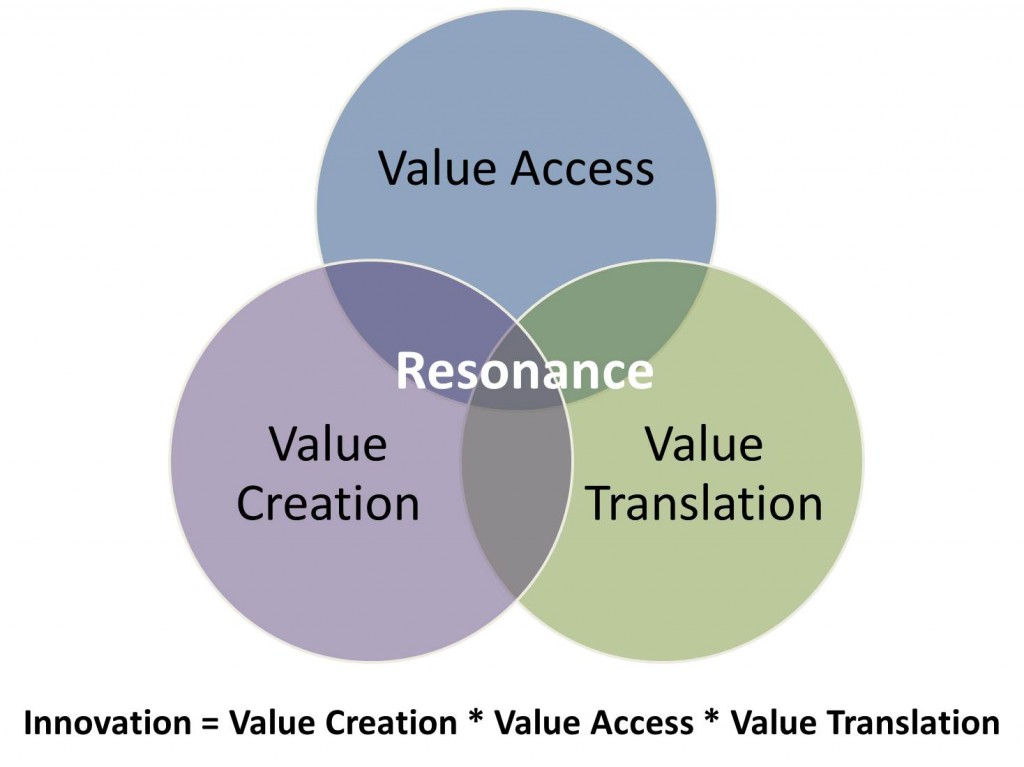
And the ultimate value encompassed in a potential innovation attempting to achieve resonance, comes from three main sources:

1. Value Creation
2. Value Access
3. Value Translation

Innovation = Value Creation * Value Access * Value Translation

You’ll notice in this equation that the parts multiply, and as a result if you do any of the three badly, your potential innovation will fail. But do ALL three well and you will have the opportunity to achieve innovation resonance.

Innovation Resonance Venn Diagram

Optimizing Innovation Resonance

To optimize the value creation component of innovation, you must seek innovation veracity early on, identifying the fundamental truths upon which your potentially innovative solution will be built. During the value creation process you must prototype early and often to test and learn whether your insights are correct and resonating in their expression within the product or service as you expect. From the reactions to your prototypes you must evolve the solution to create more value.

To optimize the value access piece of innovation, you must seek to identify where friction is created in the delivery of your solution and seek to remove it. Carefully observe both where things are awkward or difficult for you to produce and scale the solution, and for your customer to consider and consume it. These friction points represent an opportunity to remove barriers to adoption and to increase potential innovation resonance through better production, purchase and consumption experiences.

To optimize the value translation piece of innovation, you must first identify the gaps in understanding and readiness among your target customers, your plan for working to close these gaps and prepare the market for your launch, and then you’ll want to find your picture or image that communicates a thousand words. Most importantly, you must be aware that the more disruptive your potential innovation the more you may have to educate your potential customers before you even try to sell to them, and so you must build the appropriate amount of market preparation time into the launch plan for your potential innovation plan. Thought leadership marketing and innovation marketing strategies can be very powerful here to help customers understand how the new solution will fit into their lives and why they will want to abandon their existing solution – even if it is the ‘do nothing’ solution.

Resonance Example #1 – The BMW Mini – Barbie in Motion

Barbie Mini CooperOne of those most fun, visually appealing vehicles on the road has to be BMW’s re-release of the Mini. I don’t have one, have only ridden in one once, but whenever I see one driving around, it makes me smile. And if you have any question about whether or not the Mini has achieved a level of resonance (at least in the USA and probably elsewhere), then how would you explain the photo of the Mini on the left that shows you can buy a Mini to drive Ken and Barbie around in? Can you buy a convertible Chrysler LeBaron for Barbie to drive around in? No, but you can buy a Fiat 500, another car achieving resonance here in the USA.

Resonance Example #2 – iPod Nano – Falling from the Pinnacle

iPod Nano 6th GenerationThe iPod Nano is a great example of the rise and fall of innovation resonance. The iPod took three years to take off (right about the time the iPod Nano was released). The trigger for innovation resonance was the Windows version of iTunes (Value Creation), combined with the launch of Apple Retail Stores (Value Access), combined with the iconic advertising campaigns (Value Translation). The iPod became a phenomenon with sales peaking in 2008 right after the iPhone release. Sales have been falling since then, but during this decline came the September 2010 release of the 6th Generation iPod Nano – which resonates to this day – so much so that Apple replaced the design six months ago to protect the market for their upcoming iWatch.
Maintaining Innovation Resonance

As we know from music, to maintain resonance, you must continue to inject energy and focus into the system – a bell won’t ring forever. And as we know from human psychology, just because you continue to ring the bell doesn’t mean that people will continue to want to listen to it in the same way forever. Tastes change, preferences change, the definition of value for each component creating value for customers can potentially change. And so to remain the market leader, to maintain innovation resonance, you must continue to observe, to learn, and to modify your solution to optimize the innovation value equation as needed over time.

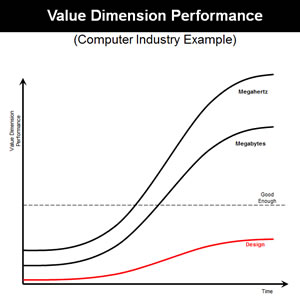
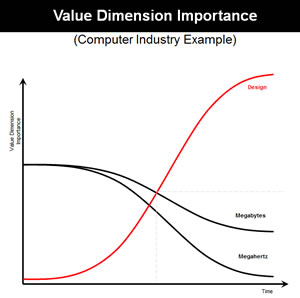
One great example of an innovative organization losing resonance over time was Dell. They (and a handful others) came into the PC marketplace with a disruptive business model, captured market share, rose to #1, and then gradually started to lose their position because they didn’t recognize a shift in the relative value of cost vs. design in the marketplace, causing them to lose market share to HP, Apple and others.

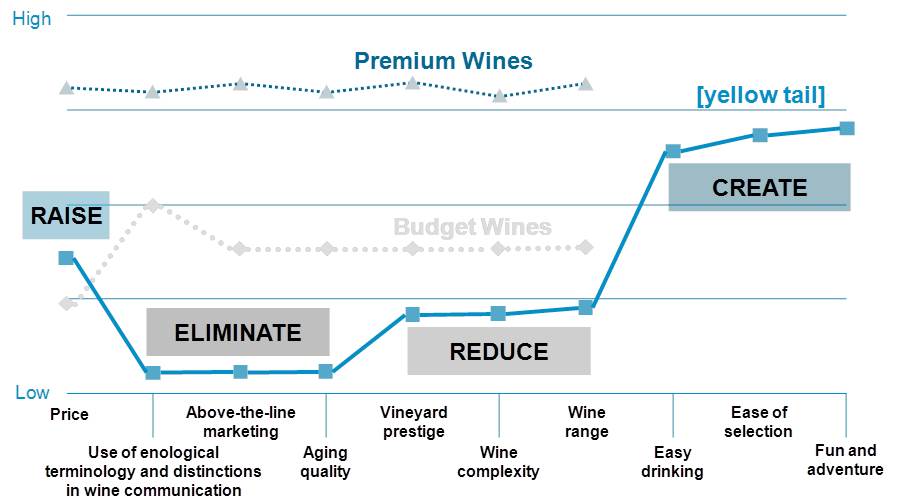
One way to look at the difference in strategies between HP and Dell might be to use the Strategy Canvas from the Blue Ocean Strategy methodology. You can see an example of a Strategy Canvas for the wine industry here:

Blue Ocean Strategy Canvas

But traditional Blue Ocean Strategy (or Value Innovation) is very static. As you can see, building a Strategy Canvas using Blue Ocean Strategy methods is a snapshot in time looking at the relative performance of a company on a selected set of value dimensions against its competition. To sail into a Blue Ocean the theory goes, you must select certain value dimensions to either:

  1. Raise
  2. Eliminate
  3. Reduce
  4. Create

But as we know, value dimension performance, value dimension importance, and the competitive dynamics within the industry are not static, but change over time.

It is because of this weakness in the Blue Ocean Strategy methodology that I layer on the investigation of value dimension performance and importance onto any Value Innovation work that I might do. You can see in the two example images below related to the Dell vs. HP example about how changes in performance over time on certain value dimensions relative to what is “good enough” in the minds of customers can lead to changes in the relative importance of various value dimensions in the mind of the customers.

Value Dimension Performance Value Dimension Importance

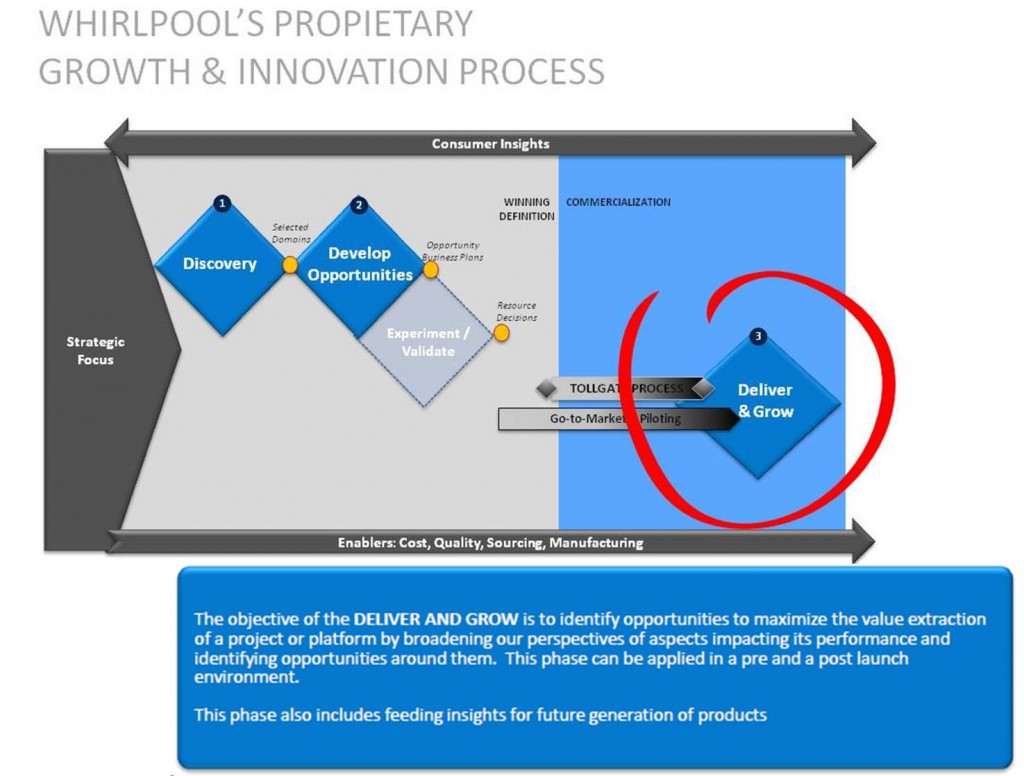
Because we cannot perfectly predict how customers will consume our product or service when we bring it to market, and because of the shifting sands of value force you to continuously re-evaluate the current situation with value dimensions and value importance, we must re-evaluate where we see the innovation process beginning and ending. Smart companies are recognizing that is not just about coming up with a great idea, or having a great launch, but about creating a commitment to launching, learning, and dialing in success by working to create and then maintain innovation resonance. Whirlpool Corporation, one of the early pioneers of a systematic pursuit of innovation excellence, has seen this and has created a commitment to launching and learning and has added a third diamond to their double diamond innovation methodology called ‘Deliver and Grow’.

Whirlpool Triple Diamond Process

Moises Norena, the Global Director of Innovation at the Whirlpool Corporation, was kind enough to share these thoughts:

“While we put a significant emphasis in the front end of innovation and in the commercialization phase, we recognize that you can not launch a product and sit and wait for its success. With the third diamond we assure that innovation teams stay engaged in the product management while it is in the market, contrasting the results with the predictions, not only on business performance but against the consumer and trade promise they were designed to deliver. We also ask these teams to use the innovation tools and process to identify opportunities to experiment and to maximize value extraction from the market.”

Conclusion

To achieve and maintain innovation resonance, you must nurture a commitment to learning fast, both during the innovation development process and after the launch of a potential innovation. You must maintain a laser focus on how you are creating value, helping people access that value, and translating that value for people so they can understand how your potential innovation may fit into their lives. So, do you have processes in place as part of your innovation methodology for measuring and evolving solutions in place to help you get to innovation resonance?

If not, keep a focus on value creation, value access, and value translation, use my evolutions of the Blue Ocean Strategy framework, and have a look at The Eight I’s of Infinite Innovation framework that I created or at the Whirlpool Corporation’s Triple Diamond methodology to help you deliver and grow more successful innovation into your organization, and hopefully reach some level of innovation resonance.


Build a common language of innovation on your team

Subscribe to Human-Centered Change & Innovation WeeklySign up here to get Human-Centered Change & Innovation Weekly delivered to your inbox every week.

7 Ways to Outsmart Your Brain And Be More Innovative

GUEST POST from Stephen Shapiro

You are alive today. You were alive yesterday. You were alive the day before that. This is good news from a survival perspective. Unfortunately it is bad news from an innovation perspective.

Your brain is wired to keep you alive.

Your brain makes the assumption that because you were alive yesterday, what you did previously is safe. Therefore repeating the past is good for survival. As a result, doing things differently, even if it seems like an improvement, is risky. Perpetuating past behaviors, from the brain’s reptilian perspective, is the safest way.

This is why innovation is difficult for most individuals and organizations.

Innovation is about change. It is about doing something different than you did previously. It is about trying something that you have not done before, and therefore may feel is a danger to your survival.

How does the brain’s survival instinct prevent innovation–and what can you do about it?

Here are seven ways to outsmart your brain:

Challenge No. 1: The brain wants pains solved first. The brain is wired to minimize loss. We want to keep what we already have. Equally, we are not interested in something new, until we address our pains. The brain seeks preservation over pleasure.

Solution: Recognize that people want their pains solved more than anything else. Be the aspirin. Innovation is not just about creating something new and different. It should solve a problem that people have. Infomercials are especially effective at demonstrating this.

Challenge No. 2: Expertise is the enemy of innovation. We build neural pathways to known solutions. What we know best (or in some cases have heard most recently) becomes our default answer. Unfortunately, once we find an answer to a problem, we stop looking for other possible solutions. As a result, the tried and true wins out and we get more of the same.

Solution: Keep looking. Although this sounds simple, don’t stop with the obvious answers. Keep pushing until you are out of ideas and then still push forward. Ask “who else has solved a problem like this?” A whitening toothpaste was developed by studying how laundry detergent whitens clothes. A medical device manufacturer learned how angioplasty balloons expand and contract by studying car airbag deployment.

Challenge No. 3: The brain wants solutions, not problems. In the world of business, we hear the expression, “Don’t bring me problems, bring me solutions.” From a survival perspective this makes sense. When faced with the possibility of being eaten by a lion, we don’t want to study our navel. Action is critical. However, in the world of innovation, the “problem” is actually more important.

Solution: Ask better questions. Einstein reputedly said, “If I had an hour to save the world, I would spend 59 minutes defining the problem and one minute finding solutions.” Instead of asking for broad ideas such as how to increase revenues, first identify the specific growth opportunities, untapped markets, emerging trends and current roadblocks. Then find solutions to those more focused challenges.

Challenge No. 4: The brain craves commonality. Contrary to conventional wisdom, opposites do not attract. It is safer to be in a tribe of people who think the same way. Things get done quickly. It feels effortless. But the downside is that it thwarts innovation.

Solution: Work with people who are not like you. Find people with different backgrounds, personality styles, and interests. Appreciate their contribution to you and your professional efforts. For example, I am someone who is disorganized and despises plans or planning. As a result, the first person I bring on to my team is a detail-oriented project manager who can make sure ensure that I get everything done.

Challenge No. 5: The brain sees what it believes. The brain uses a pattern matching technique called “confirmation bias.” In a nutshell, it rejects anything that is inconsistent with your belief structure. This is why two people can listen to the same political candidate and hear completely different things. From an innovation perspective, this may have us get attached to certain ideas, despite evidence proving that they are probably duds.

Solution: Avoid getting wed to your ideas by getting someone to play devil’s advocate. Any time you think to yourself, “Wow, this is a great idea,” get someone to poke holes in your logic. Don’t go to the same people for input. Seek out people who you suspect would reject the idea. Learn from them. Refine your solution based on numerous perspectives, not just your own biases.

Challenge No. 6: Your brain only sees a fraction of reality. What you focus on expands, to the exclusion of everything else. The brain’s reticular activating system is designed to filter out 99.99 percent of the stimuli out there. This prevents the brain from being overwhelmed by information. Unfortunately, as a result, you miss out on opportunities because you cannot even see they are there. When you are a technology expert, the solution to every problem involves software/hardware. Opportunities are limited to your frame of reference.

Solution: Sometimes you need to purposefully retrain the brain. Attend conferences unrelated to your work. Read magazines from different industries. This is why I don’t read books on innovation, but instead read about neuroscience, psychology, and sports performance. This helps me see more of the world and find opportunities in places I wouldn’t have thought to look.

Challenge No. 7: The brain thinks too much: The dorsolateral prefrontal cortex is the judgmental part of the brain. It is analytical and calculating. This is great for decision-making that requires logic. But it can kill innovation. When athletes choke, they are over thinking and constrict the neural pathways that allow access to their deeper capabilities.

Solution: Quiet that part of the brain through meditation, yoga, showering or any other relaxing activity. This allows you to gain access to the creative parts of your brain. Aristotle found his greatest breakthroughs while napping. One company found that they could speed up the development of new product ideas through meditation first thing in the morning.

The brain is incredibly powerful. And it does its job exceptionally well: perpetuate the species. It does this by ensuring the survival of the individual and the gene pool. Although this is of course valuable, it does limit our ability to try new things. Perpetuating the past is the surest way to survive. But for organizations, doing what you did in the past is the fastest path to extinction. By knowing how your brain is wired, you can choose to both survive and thrive.

Subscribe to Human-Centered Change & Innovation WeeklySign up here to join 17,000+ leaders getting Human-Centered Change & Innovation Weekly delivered to their inbox every week.

Making Innovation Sustainable – Part 4 of 4

Click on Part 1 or Part 2 or Part 3 if you missed them

Innovation Is Social

These quotes from John Hagel’s article are important because they reinforce the notion that innovation is a social activity. While many people give Thomas Edison, Alexander Graham Bell, and the modern – day equivalent, Dean Kamen, credit for being lone inventors, the fact is that the lone inventor myth is just that — a myth. All these gentlemen had labs full of people who shared their passion for creative pursuits. Innovation requires collaboration, either publicly or privately, and is realized as an outcome of three social activities.

1. Social Inputs

  • From the very beginning when an organization is seeking to identify key insights to base an innovation strategy or project on, organizations often use ethnographic research, focus groups, or other very social methods to get at the insights. Great innovators also make connections to other industries and other disciplines to help create the great in sights that inspire great solutions.

2. Social Evolution

  • We usually have innovation teams in organizations, not sole inventors, and so the activity of transforming the seeds of useful invention into a solution valued above every existing alternative is very social. It takes a village of passionate villagers to transform an idea into an innovation in the marketplace. Great innovators make connections inside the organization to the people who can ask the right questions, uncover the most important weaknesses, help solve the most difficult challenges, and help break down internal barriers within the organization — all in support of creating a better solution.

3. Social Execution

  • The same customer group that you may have spent time with, seeking to understand, now requires education to show them that they really need the solution that all of their actions and behaviors indicated they needed at the beginning of the process. This social execution includes social outputs like trials, beta programs, trade show booths, and more. Great innovators have the patience to allow a new market space to mature, and they know how to grow the demand while also identifying the key shortcomings with customers who are holding the solution back from mass acceptance.

When it comes to insights, these three activities are not completely discrete. Insights do not expose themselves only in the social inputs phase, but can also expose themselves in other phases — if you’re paying attention. Flickr famously started out as a company producing a video game in the social inputs phase, but was astute enough during the social execution phase to recognize that the most used feature was one that allowed people to share photos. Recognizing that there was an unmet market need amongst customers for easy sharing of photos, Flickr reoriented its market solution from video game to photo sharing site and reaped millions of dollars in the process when they ultimately sold their site to Yahoo!. Ultimately, action is more important than intent, and so as an innovator you must always be listening and watching to see what people do and not just what they say. Build your solution on the wrong insight and nobody will be beating a path to your door.

Bringing It All Together

If your organization is struggling to sustain its innovation efforts, then I hope you will do the following things.

  • Find the purpose and passion that everyone can rally around.
  • Create the flexibility necessary to deal with the constant change that a focus on innovation requires for both customers and the organization.
  • Make innovation the social activity it truly must be for you to become successful.

If your organization has lost the courage to move innovation to its center and has gotten stuck in a project-focused, reactive innovation approach, then now is your chance to regain the higher ground and to refocus, not on having an innovation success but on building an innovation capability. Are you up to the challenge?

You can read ahead by getting the book or downloading the sample chapter, or by checking out the other parts here:

Subscribe to Human-Centered Change & Innovation WeeklySign up here to get Human-Centered Change & Innovation Weekly delivered to your inbox every week.

Making Innovation Sustainable – Part 3 of 4

Making Innovation Sustainable - Part 3 of 4Click on Part 1 or Part 2 if you missed them

Purpose and Passion

Ultimately, successful and sustainable innovation is all about purpose and passion. The people in your organization have to be clear on what the purpose of the organization is. Ideally, that purpose has to be something bigger than the individuals and something that people can get passionate about, because first and foremost, as Jeffrey Phillips has said, “You can’t force a disinterested person to innovate.”

Passion is a prerequisite not just for getting started with innovation; people leading innovation projects must have enough passion to fight through, over, around, or under any obstacles they may encounter in their effort to make a new idea a reality.

“Passion-based organizations stop at nothing to accomplish their goals and are able to attract people and resources to their causes. That got me thinking. Over all of my years as an innovation junkie, the common denominator, among the innovators I have connected with and the most successful enterprises I have observed and worked with, is passion. They started with a passion or cause and then organized around it to make it happen. Not the other way around.” — Saul Kaplan

Blogging Innovation as a Case Study in Passion

I started innovating long ago, but I didn’t start Blogging Innovation until 2006. I realized I needed an outlet to express my passion for innovation, and blogging offered the perfect opportunity. I kept reading and writing about innovation despite getting only a couple of hundred people to read my articles each day. Then at the start of 2009 I completed a marketing strategy project for Wunderman and Microsoft Windows Live, and, using some great tools including Website Grader, I discovered that the blog had some technical challenges. After fixing those, traffic to Blogging Innovation finally started to take off. Now instead of averaging more than 200 daily visits, the blog averages nearly 10,000 and the numbers are still growing. Do I spend less time on the blog now than I used to? No!

Most people would consider an increase in traffic of 2,500 percent in one year as being a huge success and a chance to relax, but I don’t see it that way. Back in August 2009 I decided to commit the blog to a mission of making innovation and marketing insights accessible for the greater good. As a consequence of that mission, I decided to open up the blog to the very best contributing authors on the topic of innovation and other marketing – related subjects that I could find.

Instead of using the blog as an extension of my company, Blogging Innovation exists to help raise the baseline understanding of innovation and marketing so that organizations can become better at satisfying the needs of their customers, the first time they try. After all, the more efficient our organizations are at meeting their customers’ needs, the less waste of human capital and natural resources. That’s what drives me to get up at 5:00 a.m. seven days a week to start letting people know about all the great content our contributing authors have published that day.

We have recently decided to take on a monthly sponsor who wants to be associated with innovation in a tasteful way, but that is not for commercial reasons but because the blog needs additional people power to run it and a new site design to make the content even more accessible. As I go out to look for the assistance I need to take Blogging Innovation to the next level, I’ll be looking for one thing in the people I choose to help make the community stronger — passion.

Note: For the newer readers, Blogging Innovation formed the foundation of Innovation Excellence before I sold it and re-booted Blogging Innovation as Human-Centered Change & Innovation.

Passion versus Obsession

There is a great article “Passion versus Obsession” by John Hagel that explores the differences between passion and obsession. This is an important distinction to understand in order to make sure you are hiring people to power your innovation efforts who are passionate and not obsessive. Here are a few key quotes from the article:

“The first significant difference between passion and obsession is the role free will plays in each disposition: passionate people fight their way willingly to the edge to find places where they can pursue their passions more freely, while obsessive people (at best) passively drift there or (at worst) are exiled there.

It’s not an accident that we speak of an “object of obsession,” but the “subject of passion.” That’s because obsession tends towards highly specific focal points or goals, whereas passion is oriented toward networked, diversified spaces.

The subjects of passion invite and even demand connections with others who share the passion.

Because passionate people are driven to create as a way to grow and achieve their potential, they are constantly seeking out others who share their passion in a quest for collaboration, friction and inspiration . . . . The key difference between passion and obsession is fundamentally social: passion helps build relationships and obsession inhibits them.

It has been a long journey and it is far from over, but it has taught me that obsession confines while passion liberates.”

You can read ahead by getting the book or downloading the sample chapter, or by checking out the other parts here:

Subscribe to Human-Centered Change & Innovation WeeklySign up here to get Human-Centered Change & Innovation Weekly delivered to your inbox every week.

Building a Global Sensing Network

Building a Global Sensing NetworkIf the innovation war is just beginning, then you need to make sure you’re fighting it outside your organization — not inside.

The old way of succeeding in business was to hire the most clever, educated, experienced and motivated people you could afford and then direct them to come up with the best customer solutions possible, organize and execute their production and marketing predictably and efficiently, and do their best to outmaneuver the competition.

But the battlefield of business success is changing. Future business success will be built upon the ability to:

  1. Utilize expert communities.
  2. Identify and gather technology trend information, customer insights and local social mutations from around the globe.
  3. Mobilize the organization in organic ways to utilize resources and information often beyond its control.
  4. Still organize and execute production and marketing predictably and efficiently in the middle of all this complexity.

At the same time, market leaders will be increasingly determined not by their ability to outmaneuver the competition in a known market, but by their ability to identify and solve for the key unknowns in markets that will continue to become more global and less defined. Future market leaders will be those organizations that build superior global sensing networks and do a better job at making sense of the inputs from these networks to select the optimal actionable insights to drive innovation.

By this point, hopefully you are asking yourself two questions:

Continue reading this article on the American Express OPEN Forum.

Download the white paper – ‘Harnessing the Global Talent Pool to Accelerate Innovation’


Build a Common Language of Innovation on your team

Subscribe to Human-Centered Change & Innovation WeeklySign up here to get Human-Centered Change & Innovation Weekly delivered to your inbox every week.

A Creative Marriage Proposal

I found this video via @MeghanMBiro and @berget and I just had to share it.

It’s a wedding proposal from an actor in my hometown to his now bride to be, and is a great example of re-imagining a traditional activity in our society – the marriage proposal.

The things I love about it are not the actual creative execution but the principles exemplified by the experience:

  1. If you have a great product or service, people will be willing to help you sell it
  2. If it’s really good, they may go out of their way to help you sell it – or even do so without asking your permission
  3. Oregon fosters creativity 😉
  4. Focus on more than the transaction – Make magic!
  5. Skills can from other contexts can be valuable to the current challenge
  6. Have fun with everything you do and you’ll have better results 🙂
  7. Don’t just ask people to help, make it fun to help
  8. Give people something to talk about and feel the love spread 🙂
  9. Even if your customers or community do the sales pitch – YOU’VE GOT TO CLOSE

What magic are you making?

Are there boring transactional parts of your business that could use a little love and magic?

Don’t be afraid to invest in reducing the friction in your adoption process. You’ll improve the value access performance in your innovation equation:


Innovation Success (or even business success)
=
Value Creation
+
Value Access
+
Value Translation

For more, see Innovation is All About Value

Build a Common Language of Innovation

Subscribe to Human-Centered Change & Innovation WeeklySign up here to get Human-Centered Change & Innovation Weekly delivered to your inbox every week.

The Code for Successful Innovation

The Code for Successful InnovationI had the opportunity to attend the Front End of Innovation a couple of years ago in Boston and of the three days of sessions, I have to say that unlike most people, my favorite session was that of Dr. Clotaire Rapaille. The author of “The Culture Code: An Ingenious Way to Understand Why People Around the World Live and Buy as They Do”, Dr. Rapaille extolled the crowd with his thoughts on ‘codes’ and ‘imprints’.

For me this particular session was the one that most synchronized with how I view the front end of innovation. For me, the front end has nothing to do with ideas or managing ideas, but instead is all about uncovering the key insights to build your ideation on top of.

Now, there are lots of insights that you can build your ideation on top of to create potentially innovative ideas. Consumer insights is one of the building blocks and the one that Clotaire Rapaille has built his empire on. Dr. Rapaille’s core premise is that there is a ‘code’ for each product and service that drives its purchase and adoption. That ‘code’ in turn is driven by the ‘imprints’ that people make when they first understand what something is for the first time and the sensations and feelings they associate with it.

For example, kids don’t grow up drinking coffee, but they grow up smelling coffee from a very young age, most often in the home. So, most of us imprint coffee to the home and our mothers and have a stronger feeling about the smell of coffee than the taste. What does this mean for coffee sellers? Well, instead of focusing on the taste to drive sales (the logical response), they are more likely to have success by focusing on the smell and on creating images that make the product feel like home.

Taking the concept of ‘codes’ and ‘imprints’ further, Dr. Rapaille spoke about how he doesn’t trust what people say, and so he instead focuses on what people do. If you look back at the coffee example, our logical brain would tell us to prefer the coffee that tastes the best, but the reptilian brain will prefer the coffee that smells the best because of the strength of the imprinting. And according to Dr. Rapaille, the reptilian brain always wins.

To make his point, Dr. Rapaille talked about how we remember our dreams – because the cortex arrives late for work. Translation? Our logical brains (cortex) arrive after a decision has already been made by the reptilian brain or the emotional brain and so the logical brain gets put to work justifying the reptilian or emotional brain’s decision with logical reasons. How else would you explain the purchase of a Hummer after all?

Sounds easy right? Well, it gets more complicated as culture gets involved. For example, another of Rapaille’s examples that was not shared at the event is how in the United States the code for a Jeep is ‘horse’ and so the headlights should be round instead of square because horses have round eyes, but in France the code for Jeep is ‘freedom’ because of the strength of WWII liberation imprints – meaning that the marketing strategy for Jeep in France is completely different than in the United States.

Because imprints happen in general at a very young age and given the reach of Dr. Rapaille’s work, you can see very quickly why so many organizations are marketing to children, even for products that are for adults – seemingly as a way to make sure that ‘imprints’ are made so that there is consumer demand to draw on in the future. Or is that conspiracy theory at work?

Dr. Rapaille at the Front End of Innovation also spoke about how when it comes to technology, people want to be amazed, people want the technology to be magical, and to use his favorite phrase – people want to say “wow!” For wow to happen in technology according to Dr. Rapaille, we must strive for simplicity – one magical step with no cables.

Meanwhile, in our organizations we must try and identify what our organization’s ‘code’ is and better leverage multi-disciplinary, multi-cultural teams to drive creativity, while also being careful not to change the code of the organization so much that people don’t recognize it, or trust in it. And finally to use one of Dr. Rapaille’s many generalizations, Americans love to try things (they learn that way), and they love the impossible, so don’t be afraid to ask them to do it.

When I distill all of what he had to say and what he has had to say other places, for me it boils down to one key insight about the limitations of innovation methodologies like:

  • Customer-led innovation
  • Needs-based innovation
  • Jobs-to-be-done

This insight is that the reason that asking customers what they want is problematic is because of the inconsistencies between imprints and intellect, between the reptilian brain and the logical brain, and between knowing and doing. Taken together this ties in nicely with something I have believed for a while now…

When it comes to driving adoption, it matters less what you say and more what you can get others to do. As marketers we are far too focused on trying to get people to ‘tell a friend’. We should be more focused on getting people to ‘show a friend’.

So, what is your code for successful innovation?

What do you want others to show?

Please think about it and let me know what you come up with in the comments.

For those of you who want to know more, check out this embedded via from PBS’ “The Persuaders” with Douglas Rushkoff:

Build a Common Language of Innovation

Subscribe to Human-Centered Change & Innovation WeeklySign up here to get Human-Centered Change & Innovation Weekly delivered to your inbox every week.

Do you have an Anti-Creativity Checklist?

I came across Yougme Moon’s “Anti-Creativity Checklist” over at the Harvard Business Review after a tweet from @lindegaard and it got me thinking…

In order to build a culture capable of encouraging innovation or creativity (or both), you must first do an inventory of the psychology and mental models in play in your organization.

One great way to do this would be to build an ‘anti-innovation checklist’ or an ‘anti-creativity checklist’. If you start watching the vocabulary that people use in meetings where ideas are being discussed, the behavior of senior leadership as it relates to these areas, and most importantly – how people respond – you’ll get a better sense of where your organizational challenges lie with respect to innovation and creativity. Wouldn’t that make such an exercise of great value to an organization?

Anyways, as an example, I’ve pulled out the fourteen items on Yougme Moon’s checklist from the video above, which you may just want to watch:

  1. Play it safe. Listen to that inner voice.
  2. Know your limitations. Don’t be afraid to pigeonhole yourself.
  3. Remind yourself: It’s just a job.
  4. Show you’re the smartest guy in the room. Make skepticism your middle name.
  5. Be the tough guy. Demand to see the data.
  6. Respect history. Always give the past the benefit of the doubt.
  7. Stop the madness before it can get started. Crush early-stage ideas with your business savvy.
  8. Been there, done that. Use experience as weapon.
  9. Keep your eyes closed. Your mind too.
  10. Assume there is no problem.
  11. Underestimate your customers.
  12. Be a mentor. Give sound advice to the people who work for you.
  13. Be suspicious of the “creatives” in your organization.
  14. When all else fails, act like a grown-up.

What is on your “anti-innovation checklist” or your “anti-creativity checklist”?

Please feel free to share yours in the comments below.

Related Article:

Build a Common Language of Innovation

Subscribe to Human-Centered Change & Innovation WeeklySign up here to get Human-Centered Change & Innovation Weekly delivered to your inbox every week.